BEHAVIOURAL
ADDICTIONS
PRESENTED BY:- GUIDED BY:-
DR. SIMRAN SANDHU DR. ABHAY PALIWAL SIR
DR. SHASHANK KUMAR
To be discussed…
• What is addiction?
• Neurobiology of addiction
• Addictive processes
• Gambling disorder
• Binge eating disorder
• Internet gaming disorder
• Sexual addiction
• Miscallaneous
What is addiction?
• ADDICTION : It is a condition in which a
behaviour that can function both to produce
pleasure and to reduce anxiety or other
painful affects is employed in a pattern that is
characterised by two features:
1. Recurrent failure to control the
behaviour and
2. Continuation of the behaviour despite
significant harmful consequences
What is ‘behavioural’
addiction?
• Several behaviours, besides psychoactive substance ingestion, produce short-
term reward that may lead to persistent behaviour despite knowledge of
adverse consequences.
• Diminished control is a core defining concept of psychoactive substance
dependence or addiction.
• This similarity has given rise to the concept of non-substance or
“behavioural” addictions, i.e., syndromes analogous to substance addiction,
but with a behavioural focus other than ingestion of a psychoactive substance.
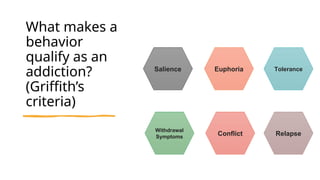
What makes a
behavior
qualify as an
addiction?
(Griffith’s
criteria)
Salience Euphoria Tolerance
Withdrawal
Symptoms
Conflict Relapse
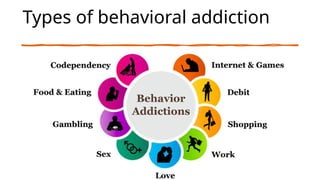
Types of behavioral addiction
NEUROCIRCUITRY
Reward pathway
Impulsivity circuit
Compulsivity circuit
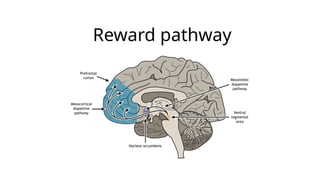
Reward pathway
Impulsivity circuit
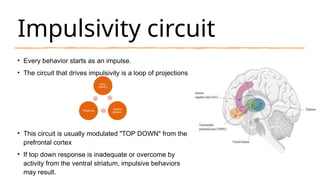
• Every behavior starts as an impulse.
• The circuit that drives impulsivity is a loop of projections
• This circuit is usually modulated "TOP DOWN" from the
prefrontal cortex
• If top down response is inadequate or overcome by
activity from the ventral striatum, impulsive behaviors
may result.
ACC/
VMPFC
Ventral
striatum
Thalamus
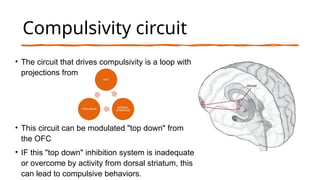
Compulsivity circuit
• The circuit that drives compulsivity is a loop with
projections from
• This circuit can be modulated "top down" from
the OFC
• IF this "top down" inhibition system is inadequate
or overcome by activity from dorsal striatum, this
can lead to compulsive behaviors.
OFC
DORSAL
STRIATUM
THALAMUS
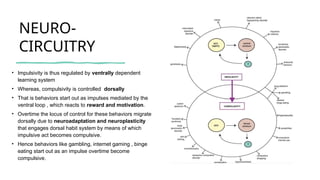
NEURO-
CIRCUITRY
• Impulsivity is thus regulated by ventrally dependent
learning system
• Whereas, compulsivity is controlled dorsally
• That is behaviors start out as impulses mediated by the
ventral loop , which reacts to reward and motivation.
• Overtime the locus of control for these behaviors migrate
dorsally due to neuroadaptation and neuroplasticity
that engages dorsal habit system by means of which
impulsive act becomes compulsive.
• Hence behaviors like gambling, internet gaming , binge
eating start out as an impulse overtime become
compulsive.
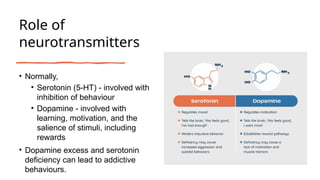
Role of
neurotransmitters
• Normally,
• Serotonin (5-HT) - involved with
inhibition of behaviour
• Dopamine - involved with
learning, motivation, and the
salience of stimuli, including
rewards
• Dopamine excess and serotonin
deficiency can lead to addictive
behaviours.
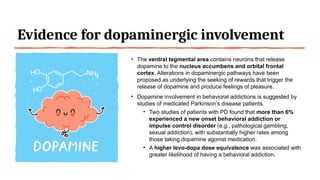
Evidence for dopaminergic involvement
• The ventral tegmental area contains neurons that release
dopamine to the nucleus accumbens and orbital frontal
cortex. Alterations in dopaminergic pathways have been
proposed as underlying the seeking of rewards that trigger the
release of dopamine and produce feelings of pleasure.
• Dopamine involvement in behavioral addictions is suggested by
studies of medicated Parkinson’s disease patients.
• Two studies of patients with PD found that more than 6%
experienced a new onset behavioral addiction or
impulse control disorder (e.g., pathological gambling,
sexual addiction), with substantially higher rates among
those taking dopamine agonist medication.
• A higher levo-dopa dose equivalence was associated with
greater likelihood of having a behavioral addiction.
Evidence for serotonergic involvement
• 5-HIAA, (a metabolite of 5-HT) - considered a
peripheral marker of 5-HT function. Low CSF 5-HIAA
levels correlate with high levels of impulsivity and
sensation-seeking and have been found in
pathological gambling and substance use disorders.
• Pharmacologic challenge studies that measure
hormonal response after administration of
serotonergic drugs also provide evidence for
serotonergic dysfunction in both behavioural
addictions and substance use disorders
Addictive
processes
Addictive
processes
• Develop prior to addictive patterns
• These are guided by two sets of
factors:
• Factors contributing to underlying
addictive process
• Factors that guide the selection of
particular behavior as the one preferred
for addictive use
Factors
contributing to
underlying
addictive process
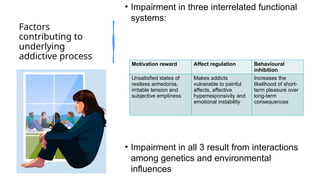
• Impairment in three interrelated functional
systems:
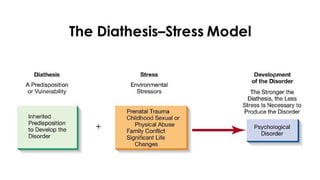
• Impairment in all 3 result from interactions
among genetics and environmental
influences
Motivation reward Affect regulation Behavioural
inhibition
Unsatisfied states of
restless anhedonia,
irritable tension and
subjective emptiness
Makes addicts
vulnerable to painful
affects, affective
hyperresponsivity and
emotional instability
Increases the
likelihood of short-
term pleasure over
long-term
consequences
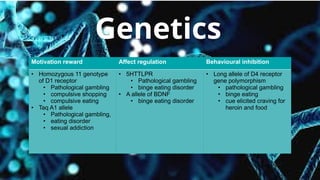
Genetics
Motivation reward Affect regulation Behavioural inhibition
• Homozygous 11 genotype
of D1 receptor
• Pathological gambling
• compulsive shopping
• compulsive eating
• Taq A1 allele
• Pathological gambling,
• eating disorder
• sexual addiction
• 5HTTLPR
• Pathological gambling
• binge eating disorder
• A allele of BDNF
• binge eating disorder
• Long allele of D4 receptor
gene polymorphism
• pathological gambling
• binge eating
• cue elicited craving for
heroin and food
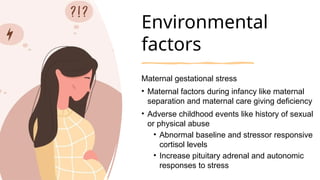
Environmental
factors
Maternal gestational stress
• Maternal factors during infancy like maternal
separation and maternal care giving deficiency
• Adverse childhood events like history of sexual
or physical abuse
• Abnormal baseline and stressor responsive
cortisol levels
• Increase pituitary adrenal and autonomic
responses to stress
Factors that guide the pattern of
addictive behavior
• Impaired self regulation
• Assisted character pathology-
• Characteristic self protective processes
• Impaired ability to symbolise affects
• Impaired management of basic conflicts
• Reliance on the primal fantasy
Impaired self
regulation
• Normally develops during the first years of life by the
process of internalisation
• If impaired,
• May become dependent on external sources like
substance, person, nonhuman object, bodily state
etc
• May learn to ward off traumatic affects and self
states by engaging in a rewarding activity
• External or internal cues associated with intense
affects become conditioned to particular addictive
behavioural responses. so, stress can trigger urge
to engage in such behaviours.
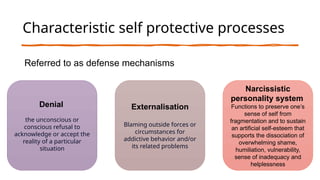
Characteristic self protective processes
Referred to as defense mechanisms
Denial
the unconscious or
conscious refusal to
acknowledge or accept the
reality of a particular
situation
Externalisation
Blaming outside forces or
circumstances for
addictive behavior and/or
its related problems
Narcissistic
personality system
Functions to preserve one’s
sense of self from
fragmentation and to sustain
an artificial self-esteem that
supports the dissociation of
overwhelming shame,
humiliation, vulnerability,
sense of inadequacy and
helplessness
Impaired ability to symbolise
Affects
Difficulty recognising, naming and verbalising their
affects which are typically experienced as physical
bodily states rather than meaningful emotions
Accompanied by lower capacity for empathy and
diminished emotional involvement in interpersonal
relationships
• Addictive behaviour is precipitated by painful
affects that addicts perceive as threatening to
overwhelm them
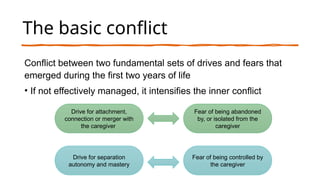
The basic conflict
Conflict between two fundamental sets of drives and fears that
emerged during the first two years of life
• If not effectively managed, it intensifies the inner conflict
Drive for attachment,
connection or merger with
the caregiver
Fear of being abandoned
by, or isolated from the
caregiver
Drive for separation
autonomy and mastery
Fear of being controlled by
the caregiver
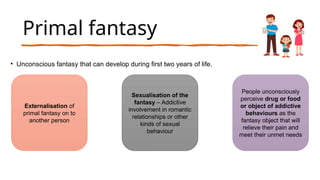
Primal fantasy
Externalisation of
primal fantasy on to
another person
Sexualisation of the
fantasy – Addictive
involvement in romantic
relationships or other
kinds of sexual
behaviour
People unconsciously
perceive drug or food
or object of addictive
behaviours as the
fantasy object that will
relieve their pain and
meet their unmet needs
• Unconscious fantasy that can develop during first two years of life.
Gambling
disorder
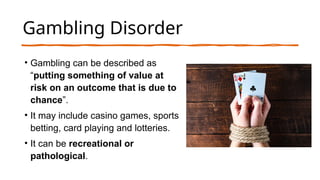
Gambling Disorder
• Gambling can be described as
“putting something of value at
risk on an outcome that is due to
chance”.
• It may include casino games, sports
betting, card playing and lotteries.
• It can be recreational or
pathological.
Nosology
• Separate diagnostic entity first
introduced in DSM III, termed
pathological gambling
• Was previously placed in impulse
control disorder NOS
• DSM V – new category ‘non
substance related disorder’
• New term - gambling disorder
DSM 5 diagnostic criteria
• 4 out of 9 for 12 months –
1. Wagering increasing amount of money in order to achieve the peculiar excitement of the illness
2. Restlessness and irritability accompanying efforts to decrease wagering or abstain from it altogether
3. Repeated unsuccessful efforts to control, diminish or stop gambling
4. Overwhelming preoccupation with past and future actual gambling activities and gambling related
endeavors
5. Gambling in the context of dysphoric affect, anxiety, depression, etc
6. Attempts to get even by repeatedly returning to gamble
7. Lying to Significant others in order to conceal the extent of gambling activity
8. Gambling related jeopardizing or loss of significant family and social relationships, jobs, education or
career opportunities
9. Escalation of the search for sources of money to pay of gambling debts
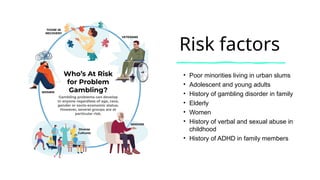
Risk factors
• Poor minorities living in urban slums
• Adolescent and young adults
• History of gambling disorder in family
• Elderly
• Women
• History of verbal and sexual abuse in
childhood
• History of ADHD in family members
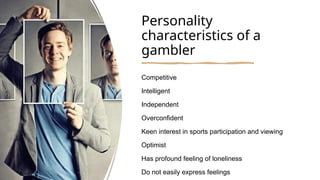
Personality
characteristics of a
gambler
Competitive
Intelligent
Independent
Overconfident
Keen interest in sports participation and viewing
Optimist
Has profound feeling of loneliness
Do not easily express feelings
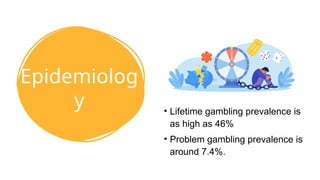
Epidemiolog
y • Lifetime gambling prevalence is
as high as 46%
• Problem gambling prevalence is
around 7.4%.
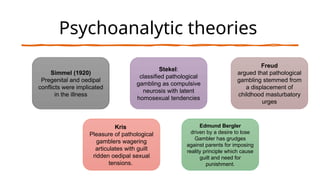
Psychoanalytic theories
Simmel (1920)
Pregenital and oedipal
conflicts were implicated
in the illness
Stekel:
classified pathological
gambling as compulsive
neurosis with latent
homosexual tendencies
Freud
argued that pathological
gambling stemmed from
a displacement of
childhood masturbatory
urges
Edmund Bergler
driven by a desire to lose
Gambler has grudges
against parents for imposing
reality principle which cause
guilt and need for
punishment.
Kris
Pleasure of pathological
gamblers wagering
articulates with guilt
ridden oedipal sexual
tensions.
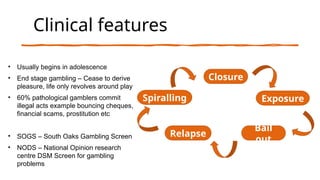
Clinical features
Spiralling
Closure
Exposure
Bail
out
Relapse
• Usually begins in adolescence
• End stage gambling – Cease to derive
pleasure, life only revolves around play
• 60% pathological gamblers commit
illegal acts example bouncing cheques,
financial scams, prostitution etc
• SOGS – South Oaks Gambling Screen
• NODS – National Opinion research
centre DSM Screen for gambling
problems
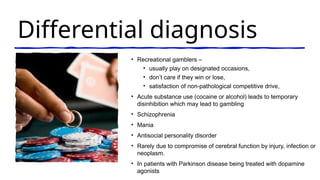
Differential diagnosis
• Recreational gamblers –
• usually play on designated occasions,
• don’t care if they win or lose,
• satisfaction of non-pathological competitive drive,
• Acute substance use (cocaine or alcohol) leads to temporary
disinhibition which may lead to gambling
• Schizophrenia
• Mania
• Antisocial personality disorder
• Rarely due to compromise of cerebral function by injury, infection or
neoplasm.
• In patients with Parkinson disease being treated with dopamine
agonists
Treatment
Tolerant non-critical attitude
Group, family and couples therapy can be helpful
• Pharmacological management: SSRIs, mood stabilisers,
Atypical antipsychotics, opioid antagonist such as
naltrexone
• Gamblers anonymous –
• International self help organisation
• 12 step program
• Administered by accident pathological gamblers
• Analogous to Alcoholics Anonymous
• Similar group for relatives
• High drop out rate
Binge eating
disorder
Nosology
• In DSM-IV, it was classified under eating
disorder not otherwise specified..
• In DSM-V shifted to formally recognized
eating disorder and diagnostic criteria were
modified.
• In DSM-V to make a diagnosis of BED, an
episode of binge eating at least once per
week on average for 3 or more months is
required.
DSM-V CRITERIA
A. Recurrent episodes of binge eating.
• An episode of binge eating is characterized by both of the
following:
1. Eating, in a discrete period of time (e.g., within any 2-hour
period), an amount of food that is definitely larger than
what most people would eat in a similar period of time under
similar circumstances.
2. A sense of lack of control over eating during the episode
(e.g., a feeling that one cannot stop eating or control what or
how much one is eating).
• B. The binge-eating episodes are associated with three
(or more) of the following:
1. Eating much more rapidly than normal.
2. Eating until feeling uncomfortably full.
3. Eating large amounts of food when not feeling physically
hungry.
4. Eating alone because of feeling embarrassed by how
much one is eating.
5. Feeling disgusted with oneself, depressed, or very guilty
afterward.
• C. Marked distress regarding binge eating is present.
• D. The binge eating occurs, on average, at least once a
week for 3 months.
• E. The binge eating is not associated with the recurrent
use of inappropriate compensatory behavior as in
bulimia nervosa.
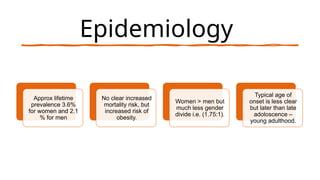
Epidemiology
Approx lifetime
prevalence 3.6%
for women and 2.1
% for men
No clear increased
mortality risk, but
increased risk of
obesity.
Women > men but
much less gender
divide i.e. (1.75:1).
Typical age of
onset is less clear
but later than late
adoloscence –
young adulthood.
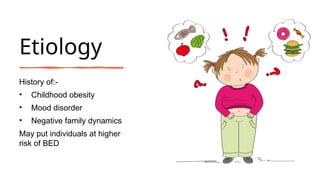
Etiology
History of:-
• Childhood obesity
• Mood disorder
• Negative family dynamics
May put individuals at higher
risk of BED
42
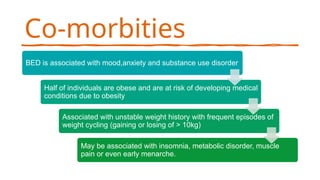
Co-morbities
BED is associated with mood,anxiety and substance use disorder
Half of individuals are obese and are at risk of developing medical
conditions due to obesity
Associated with unstable weight history with frequent episodes of
weight cycling (gaining or losing of > 10kg)
May be associated with insomnia, metabolic disorder, muscle
pain or even early menarche.
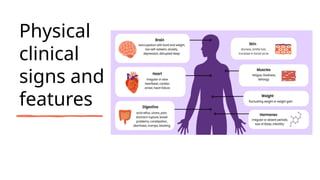
Physical
clinical
signs and
features
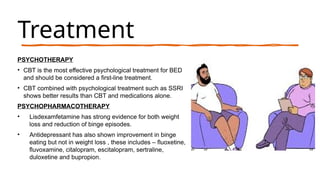
Treatment
PSYCHOTHERAPY
• CBT is the most effective psychological treatment for BED
and should be considered a first-line treatment.
• CBT combined with psychological treatment such as SSRI
shows better results than CBT and medications alone.
PSYCHOPHARMACOTHERAPY
• Lisdexamfetamine has strong evidence for both weight
loss and reduction of binge episodes.
• Antidepressant has also shown improvement in binge
eating but not in weight loss , these includes – fluoxetine,
fluvoxamine, citalopram, escitalopram, sertraline,
duloxetine and bupropion.
Internet gaming
addiction
Introduction
• The DSM-5 work group reviewed more than 240
articles and found some behavioral similarities of
internet gaming to gambling disorder and to
substance use disorder and has proposed internet
gaming addiction in DSM-5 under conditions for further
study.
• However, literature suffers from lack of a standard
definition from to which to derive prevalence data and
understanding natural histories.
• Further, seemingly high prevalence in asian countries
and, to a lesser extent in the west, justified inclusion of
these disorder in this section of DSM-5
Proposed criteria for DSM-V
Persistent and recurrent use of the Internet to
engage in games, often with other players, leading
to clinically significant impairment or distress as
indicated by five (or more) of the following in a 12-
month period:
1. Preoccupation with Internet games.
2. Withdrawal symptoms when Internet gaming is
taken away.
3. Tolerance—the need to spend increasing
amounts of time engaged in Internet games.
4. Unsuccessful attempts to control the participation
in Internet games.
5. Loss of interests in previous hobbies and
entertainment.
6. Continued excessive use of Internet games
despite knowledge of psychosocial problems.
7. Has deceived family members, therapists, or
others regarding the amount of Internet gaming.
8. Use of Internet games to escape or relieve a
negative mood.
9. Has jeopardized or lost a significant
relationship, job, or educational or career
opportunity.
Associated co-morbidities
Individuals with both autism spectrum disorder and attention deficit hyperactivity exhibit elevated
rates of problematic gaming and gaming disorder.
Among adolescents, gaming disorder has been associated with elevated levels of externalizing (e.g.
antisocial behaviour, anger control) and internalizing (e.g. emotional distress, lower self-esteem)
problems.
Among adults, gaming disorder has also been associated with greater levels of depressive and
anxiety symptoms.
Prevalance
• Gaming disorder appears to be most prevalent
among adolescent and young adult males
aged 12–20 years.
• Currently unclear due to varying questionaires,
criteria and threshold employed
• It seems to be highest in Asian countries
especially china and south korea but fewer
from europe and north korea.
Treatment
There are no evidence based study that
provides efficacy of a certain treatment,
such as
• CBT
• FAMILY THERAPY
• PHARMACOTHERAPY
All treatment are considered
experimental for now.
Sexual
addiction
Sexual addiction
• Sexual compulsivity is the name given to this condition by investigators
who argue that the symptomatic sexual behaviour is compulsive
because it functions to reduce anxiety and other painful effects
• Definition of compulsion in DSM-V includes its function of providing
relief from anxiety and other painful affects However, it also specifies
that compulsions are not performed to produce pleasure.
• Addiction is a more suitable description because
• Feel driven
• Entails harmful or unpleasant consequences
• Functions to reduce anxiety or other painful affects
• Functions to produce pleasure or gratification
Nosology
• Not included in DSM
• Provisional criteria-
• Presence of 4 or more of the following for 12 months-
1. Sexual behaviour is often engaged in over a longer period, in greater quantity, or at higher level of intensity than was intended
2. Unsuccessful efforts to cut down or control the sexual behaviour
3. Great deal of time is spent in activities necessary to prepare for the sexual behaviour, engage in it, or recover from its effects
4. Craving to engage in the sexual behaviour
5. Sexual behavior has resulted in failure to fulfil significant responsibilities at work school or home
6. Reduction of social, occupational or recreational activities as a result of engaging in the sexual behavior
7. Continues despite persistent or recurrent social or interpersonal problems that its effects have caused or exacerbated
8. Continues despite knowledge of having a persistent or recurrent physical or psychological problem that is likely to have been
caused or exacerbated by the behaviour
9. It Is recurrently performed in situations in which doing so is physically hazardous
10. Tolerance
11. Withdrawal
Epidemiolog
y
• Prevalence is 3 to 6%
• 80% are males (paraphilic >
non paraphilic)
• Begins in teenage
• peaks between 20 to 40 years
and then gradually declines
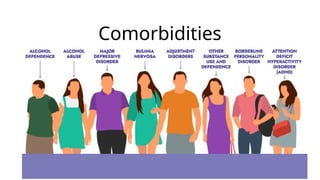
Comorbidities
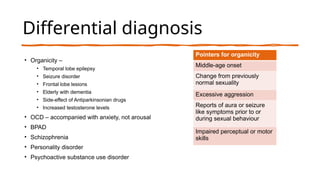
Differential diagnosis
• Organicity –
• Temporal lobe epilepsy
• Seizure disorder
• Frontal lobe lesions
• Elderly with dementia
• Side-effect of Antiparkinsonian drugs
• Increased testosterone levels
• OCD – accompanied with anxiety, not arousal
• BPAD
• Schizophrenia
• Personality disorder
• Psychoactive substance use disorder
Pointers for organicity
Middle-age onset
Change from previously
normal sexuality
Excessive aggression
Reports of aura or seizure
like symptoms prior to or
during sexual behaviour
Impaired perceptual or motor
skills
58
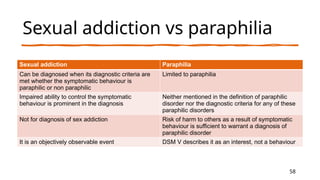
Sexual addiction vs paraphilia
Sexual addiction Paraphilia
Can be diagnosed when its diagnostic criteria are
met whether the symptomatic behaviour is
paraphilic or non paraphilic
Limited to paraphilia
Impaired ability to control the symptomatic
behaviour is prominent in the diagnosis
Neither mentioned in the definition of paraphilic
disorder nor the diagnostic criteria for any of these
paraphilic disorders
Not for diagnosis of sex addiction Risk of harm to others as a result of symptomatic
behaviour is sufficient to warrant a diagnosis of
paraphilic disorder
It is an objectively observable event DSM V describes it as an interest, not a behaviour
Prognosis
Good prognosis
• Healing support factors-
• stable job and primary
relationship
• Supportive social networks
• Availability of supportive
sexual outlets
• Personality factors
• intelligence
• Creativity
• Self observatory capacity
• Sense of humour
• Motivation for change
Poor prognosis
• Illness factors
• early age of onset
• Increased frequency of
symptomatic sexual behaviour
• Use of other substances
• Absence of anxiety or guilt
about the behaviour
• Comorbid psychiatric
disorders
• High degree of associated
character pathology
Treatment
•1. Symptomatic behavioral management
• Goals:
• to prevent the occurrence of symptomatic
sexual behaviour
• If it occurs, to bring about its
discontinuation before it leads to significant
harmful consequences
•2. Healing of the addictive process
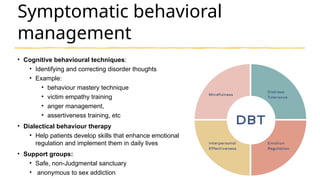
Symptomatic behavioral
management
• Cognitive behavioural techniques:
• Identifying and correcting disorder thoughts
• Example:
• behaviour mastery technique
• victim empathy training
• anger management,
• assertiveness training, etc
• Dialectical behaviour therapy
• Help patients develop skills that enhance emotional
regulation and implement them in daily lives
• Support groups:
• Safe, non-Judgmental sanctuary
• anonymous to sex addiction
Healing of the addictive process
Pharmacotherapy
• SSRI - Fluoxetine, Paroxetine, Fluvoxamine
• TCAs- Imipeamine, Desipramine, Clomipramine
• Lithium
• Anticonvulsants – Carbamazepine, Valproate,
Topiramate
• Buspirone
• Naltrexone
• ECT
Psychotherapy
• Psychodynamic psychotherapy
• Meditation
• Yoga
Miscellaneous
Social media addiction
Compulsive buying
Compulsive exercise
Love addiction
Presentation Title
Social media
addiction
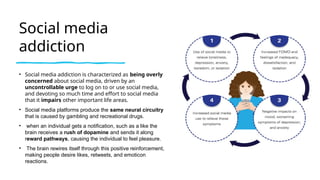
• Social media addiction is characterized as being overly
concerned about social media, driven by an
uncontrollable urge to log on to or use social media,
and devoting so much time and effort to social media
that it impairs other important life areas.
• Social media platforms produce the same neural circuitry
that is caused by gambling and recreational drugs.
• when an individual gets a notification, such as a like the
brain receives a rush of dopamine and sends it along
reward pathways, causing the individual to feel pleasure.
• The brain rewires itself through this positive reinforcement,
making people desire likes, retweets, and emoticon
reactions.
COMPULSIVE
BUYING DISORDER
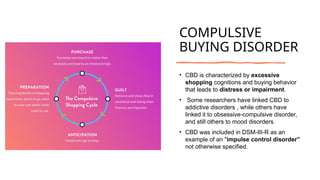
• CBD is characterized by excessive
shopping cognitions and buying behavior
that leads to distress or impairment.
• Some researchers have linked CBD to
addictive disorders , while others have
linked it to obsessive-compulsive disorder,
and still others to mood disorders.
• CBD was included in DSM-III-R as an
example of an "impulse control disorder”
not otherwise specified.
gfCOMPULSIVE exercise
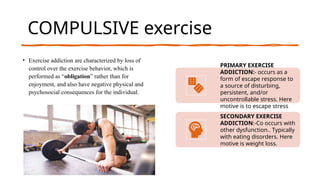
• Exercise addiction are characterized by loss of
control over the exercise behavior, which is
performed as “obligation” rather than for
enjoyment, and also have negative physical and
psychosocial consequences for the individual.
PRIMARY EXERCISE
ADDICTION:- occurs as a
form of escape response to
a source of disturbing,
persistent, and/or
uncontrollable stress. Here
motive is to escape stress
SECONDARY EXERCISE
ADDICTION:-Co occurs with
other dysfunction.. Typically
with eating disorders. Here
motive is weight loss.
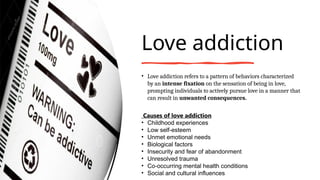
Love addiction
• Love addiction refers to a pattern of behaviors characterized
by an intense fixation on the sensation of being in love,
prompting individuals to actively pursue love in a manner that
can result in unwanted consequences.
Causes of love addiction
• Childhood experiences
• Low self-esteem
• Unmet emotional needs
• Biological factors
• Insecurity and fear of abandonment
• Unresolved trauma
• Co-occurring mental health conditions
• Social and cultural influences
Summary
69
REFERENCES
• Comprehensive textbook of psychiatry.
• Synopsis of psychiatry.
• DSM-5
• Bhatia U, Bhat B, George S, Nadkarni A. The prevalence, patterns, and correlates of gambling behaviours in men: An
exploratory study from Goa, India. Asian J Psychiatr. 2019 Jun;43:143-149. doi: 10.1016/j.ajp.2019.03.021. Epub 2019 Mar 26.
PMID: 31151082; PMCID: PMC6712305.
• Kuss DJ, Griffiths MD. Online social networking and addiction--a review of the psychological literature. Int J Environ Res Public
Health. 2011 Sep;8(9):3528-52. doi: 10.3390/ijerph8093528. Epub 2011 Aug 29. PMID: 22016701; PMCID: PMC3194102.
• Black DW. A review of compulsive buying disorder. World Psychiatry. 2007 Feb;6(1):14-8. PMID: 17342214; PMCID:
PMC1805733.
• Lichtenstein MB, Hinze CJ, Emborg B, Thomsen F, Hemmingsen SD. Compulsive exercise: links, risks and challenges faced.
Psychol Res Behav Manag. 2017 Mar 30;10:85-95. doi: 10.2147/PRBM.S113093. PMID: 28435339; PMCID: PMC5386595.
Presentation Title
Thank You
mcq
Presentation Title 72
1.Addiction is often associated with behaviors that:
​
A) Always result in negative outcomes​
B) Provide pleasure and reduce anxiety​
C) Are easy to stop without support​
D) Are always socially accepted​
Presentation Title 73
1.Addiction is often associated with behaviors that:
​
A) Always result in negative outcomes​
B) Provide pleasure and reduce anxiety​
C) Are easy to stop without support​
D) Are always socially accepted​
Answer: B) Provide pleasure and reduce anxiety
Presentation Title 74
2.The process by which impulsive acts become compulsive is primarily influenced by:
A) Emotional regulation
B) Neuroadaptation and neuroplasticity
C) Social learning
D) Environmental changes
Presentation Title 75
2.The process by which impulsive acts become compulsive is primarily influenced by:
A) Emotional regulation
B) Neuroadaptation and neuroplasticity
C) Social learning
D) Environmental changes
Correct Answer: B) Neuroadaptation and neuroplasticity
Presentation Title 76
3. What regulates impulsivity according to the provided information?
A) Dorsal learning system
B) Ventral learning system
C) Limbic system
D) Cerebellum
Presentation Title 77
3. What regulates impulsivity according to the provided information?
A) Dorsal learning system
B) Ventral learning system
C) Limbic system
D) Cerebellum
Correct Answer: B) Ventral learning system
Presentation Title 78
4. In which disorders are low CSF 5-HIAA levels commonly found?
A. Schizophrenia and bipolar disorder
B. Pathological gambling and substance use disorders
C. Anxiety and depression
D. OCD and PTSD
Presentation Title 79
4. In which disorders are low CSF 5-HIAA levels commonly found?
A. Schizophrenia and bipolar disorder
B. Pathological gambling and substance use disorders
C. Anxiety and depression
D. OCD and PTSD
Answer: B. Pathological gambling and substance use disorders
Presentation Title 80
5. What is 5-HIAA primarily used as a marker for?
A. Dopaminergic function
B. Adrenergic function
C. Serotonergic (5-HT) function
D. GABAergic function
Presentation Title 81
5. What is 5-HIAA primarily used as a marker for?
A. Dopaminergic function
B. Adrenergic function
C. Serotonergic (5-HT) function
D. GABAergic function
Answer: C. Serotonergic (5-HT) function
Presentation Title 82
6. Which brain region is primarily involved in the reward system and plays a crucial role in
addiction?
A. Amygdala
B. Hippocampus
C. Prefrontal cortex
D. Nucleus accumbens
Presentation Title 83
6. Which brain region is primarily involved in the reward system and plays a crucial role in
addiction?
A. Amygdala
B. Hippocampus
C. Prefrontal cortex
D. Nucleus accumbens
Answer: D. Nucleus accumbens
Presentation Title 84
7. Affect regulation in addiction makes individuals vulnerable to which of the following?
A. Enhanced emotional stability
B. Reduced sensitivity to pain
C. Painful affects, affective hyperresponsivity, and emotional instability
D. Improved decision-making skills
Presentation Title 85
7. Affect regulation in addiction makes individuals vulnerable to which of the following?
A. Enhanced emotional stability
B. Reduced sensitivity to pain
C. Painful affects, affective hyperresponsivity, and emotional instability
D. Improved decision-making skills
Answer: C. Painful affects, affective hyperresponsivity, and emotional instability
Presentation Title 86
8. How does addiction affect the perception of reward values among different experiences?
A. It enhances the value of non-addictive experiences.
B. It does not alter the perception of rewards.
C. It distorts the relative reward values, favoring addictive behaviors.
D. It makes all experiences equally rewarding.
Presentation Title 87
8. How does addiction affect the perception of reward values among different experiences?
A. It enhances the value of non-addictive experiences.
B. It does not alter the perception of rewards.
C. It distorts the relative reward values, favoring addictive behaviors.
D. It makes all experiences equally rewarding.
Answer: C. It distorts the relative reward values, favoring addictive behaviors
Presentation Title 88
9. According to DSM 5 , for diagnosis of gambling addiction how many criteria should be met for how
long?
A. 5 out of 9 for 6 months
B. 4 out of 9 for 12 months
c. 4 out of 9 for 6 months
d. 6 out of 9 for 12 months
B. 4 out of 9 for 12 months
Presentation Title 89
9. According to DSM 5 , for diagnosis of gambling addiction how many criteria should be met for how
long?
A. 5 out of 9 for 6 months
B. 4 out of 9 for 12 months
c. 4 out of 9 for 6 months
d. 6 out of 9 for 12 months
Answer: B. 4 out of 9 for 12 months
Presentation Title 90
10. Damage to the VMPFC and amygdala is associated with a preference for which type of decision-
making?
A) Long-term planning and risk assessment
B) Immediate rewards while ignoring long-term consequences
C) Rational decision-making based on past experiences
D) Balanced consideration of pros and cons
Presentation Title 91
10. Damage to the VMPFC and amygdala is associated with a preference for which type of decision-
making?
A) Long-term planning and risk assessment
B) Immediate rewards while ignoring long-term consequences
C) Rational decision-making based on past experiences
D) Balanced consideration of pros and cons
Correct Answer: B) Immediate rewards while ignoring long-term consequences

Behavioral addictions by dr simran and dr shashank

  • 1.
    BEHAVIOURAL ADDICTIONS PRESENTED BY:- GUIDEDBY:- DR. SIMRAN SANDHU DR. ABHAY PALIWAL SIR DR. SHASHANK KUMAR
  • 2.
    To be discussed… •What is addiction? • Neurobiology of addiction • Addictive processes • Gambling disorder • Binge eating disorder • Internet gaming disorder • Sexual addiction • Miscallaneous
  • 3.
    What is addiction? •ADDICTION : It is a condition in which a behaviour that can function both to produce pleasure and to reduce anxiety or other painful affects is employed in a pattern that is characterised by two features: 1. Recurrent failure to control the behaviour and 2. Continuation of the behaviour despite significant harmful consequences
  • 4.
    What is ‘behavioural’ addiction? •Several behaviours, besides psychoactive substance ingestion, produce short- term reward that may lead to persistent behaviour despite knowledge of adverse consequences. • Diminished control is a core defining concept of psychoactive substance dependence or addiction. • This similarity has given rise to the concept of non-substance or “behavioural” addictions, i.e., syndromes analogous to substance addiction, but with a behavioural focus other than ingestion of a psychoactive substance.
  • 5.
    What makes a behavior qualifyas an addiction? (Griffith’s criteria) Salience Euphoria Tolerance Withdrawal Symptoms Conflict Relapse
  • 6.
  • 7.
  • 8.
  • 9.
    Impulsivity circuit • Everybehavior starts as an impulse. • The circuit that drives impulsivity is a loop of projections • This circuit is usually modulated "TOP DOWN" from the prefrontal cortex • If top down response is inadequate or overcome by activity from the ventral striatum, impulsive behaviors may result. ACC/ VMPFC Ventral striatum Thalamus
  • 10.
    Compulsivity circuit • Thecircuit that drives compulsivity is a loop with projections from • This circuit can be modulated "top down" from the OFC • IF this "top down" inhibition system is inadequate or overcome by activity from dorsal striatum, this can lead to compulsive behaviors. OFC DORSAL STRIATUM THALAMUS
  • 11.
    NEURO- CIRCUITRY • Impulsivity isthus regulated by ventrally dependent learning system • Whereas, compulsivity is controlled dorsally • That is behaviors start out as impulses mediated by the ventral loop , which reacts to reward and motivation. • Overtime the locus of control for these behaviors migrate dorsally due to neuroadaptation and neuroplasticity that engages dorsal habit system by means of which impulsive act becomes compulsive. • Hence behaviors like gambling, internet gaming , binge eating start out as an impulse overtime become compulsive.
  • 12.
    Role of neurotransmitters • Normally, •Serotonin (5-HT) - involved with inhibition of behaviour • Dopamine - involved with learning, motivation, and the salience of stimuli, including rewards • Dopamine excess and serotonin deficiency can lead to addictive behaviours.
  • 13.
    Evidence for dopaminergicinvolvement • The ventral tegmental area contains neurons that release dopamine to the nucleus accumbens and orbital frontal cortex. Alterations in dopaminergic pathways have been proposed as underlying the seeking of rewards that trigger the release of dopamine and produce feelings of pleasure. • Dopamine involvement in behavioral addictions is suggested by studies of medicated Parkinson’s disease patients. • Two studies of patients with PD found that more than 6% experienced a new onset behavioral addiction or impulse control disorder (e.g., pathological gambling, sexual addiction), with substantially higher rates among those taking dopamine agonist medication. • A higher levo-dopa dose equivalence was associated with greater likelihood of having a behavioral addiction.
  • 14.
    Evidence for serotonergicinvolvement • 5-HIAA, (a metabolite of 5-HT) - considered a peripheral marker of 5-HT function. Low CSF 5-HIAA levels correlate with high levels of impulsivity and sensation-seeking and have been found in pathological gambling and substance use disorders. • Pharmacologic challenge studies that measure hormonal response after administration of serotonergic drugs also provide evidence for serotonergic dysfunction in both behavioural addictions and substance use disorders
  • 15.
  • 16.
    Addictive processes • Develop priorto addictive patterns • These are guided by two sets of factors: • Factors contributing to underlying addictive process • Factors that guide the selection of particular behavior as the one preferred for addictive use
  • 17.
    Factors contributing to underlying addictive process •Impairment in three interrelated functional systems: • Impairment in all 3 result from interactions among genetics and environmental influences Motivation reward Affect regulation Behavioural inhibition Unsatisfied states of restless anhedonia, irritable tension and subjective emptiness Makes addicts vulnerable to painful affects, affective hyperresponsivity and emotional instability Increases the likelihood of short- term pleasure over long-term consequences
  • 19.
    Genetics Motivation reward Affectregulation Behavioural inhibition • Homozygous 11 genotype of D1 receptor • Pathological gambling • compulsive shopping • compulsive eating • Taq A1 allele • Pathological gambling, • eating disorder • sexual addiction • 5HTTLPR • Pathological gambling • binge eating disorder • A allele of BDNF • binge eating disorder • Long allele of D4 receptor gene polymorphism • pathological gambling • binge eating • cue elicited craving for heroin and food
  • 20.
    Environmental factors Maternal gestational stress •Maternal factors during infancy like maternal separation and maternal care giving deficiency • Adverse childhood events like history of sexual or physical abuse • Abnormal baseline and stressor responsive cortisol levels • Increase pituitary adrenal and autonomic responses to stress
  • 21.
    Factors that guidethe pattern of addictive behavior • Impaired self regulation • Assisted character pathology- • Characteristic self protective processes • Impaired ability to symbolise affects • Impaired management of basic conflicts • Reliance on the primal fantasy
  • 22.
    Impaired self regulation • Normallydevelops during the first years of life by the process of internalisation • If impaired, • May become dependent on external sources like substance, person, nonhuman object, bodily state etc • May learn to ward off traumatic affects and self states by engaging in a rewarding activity • External or internal cues associated with intense affects become conditioned to particular addictive behavioural responses. so, stress can trigger urge to engage in such behaviours.
  • 23.
    Characteristic self protectiveprocesses Referred to as defense mechanisms Denial the unconscious or conscious refusal to acknowledge or accept the reality of a particular situation Externalisation Blaming outside forces or circumstances for addictive behavior and/or its related problems Narcissistic personality system Functions to preserve one’s sense of self from fragmentation and to sustain an artificial self-esteem that supports the dissociation of overwhelming shame, humiliation, vulnerability, sense of inadequacy and helplessness
  • 24.
    Impaired ability tosymbolise Affects Difficulty recognising, naming and verbalising their affects which are typically experienced as physical bodily states rather than meaningful emotions Accompanied by lower capacity for empathy and diminished emotional involvement in interpersonal relationships • Addictive behaviour is precipitated by painful affects that addicts perceive as threatening to overwhelm them
  • 25.
    The basic conflict Conflictbetween two fundamental sets of drives and fears that emerged during the first two years of life • If not effectively managed, it intensifies the inner conflict Drive for attachment, connection or merger with the caregiver Fear of being abandoned by, or isolated from the caregiver Drive for separation autonomy and mastery Fear of being controlled by the caregiver
  • 26.
    Primal fantasy Externalisation of primalfantasy on to another person Sexualisation of the fantasy – Addictive involvement in romantic relationships or other kinds of sexual behaviour People unconsciously perceive drug or food or object of addictive behaviours as the fantasy object that will relieve their pain and meet their unmet needs • Unconscious fantasy that can develop during first two years of life.
  • 27.
  • 28.
    Gambling Disorder • Gamblingcan be described as “putting something of value at risk on an outcome that is due to chance”. • It may include casino games, sports betting, card playing and lotteries. • It can be recreational or pathological.
  • 29.
    Nosology • Separate diagnosticentity first introduced in DSM III, termed pathological gambling • Was previously placed in impulse control disorder NOS • DSM V – new category ‘non substance related disorder’ • New term - gambling disorder
  • 30.
    DSM 5 diagnosticcriteria • 4 out of 9 for 12 months – 1. Wagering increasing amount of money in order to achieve the peculiar excitement of the illness 2. Restlessness and irritability accompanying efforts to decrease wagering or abstain from it altogether 3. Repeated unsuccessful efforts to control, diminish or stop gambling 4. Overwhelming preoccupation with past and future actual gambling activities and gambling related endeavors 5. Gambling in the context of dysphoric affect, anxiety, depression, etc 6. Attempts to get even by repeatedly returning to gamble 7. Lying to Significant others in order to conceal the extent of gambling activity 8. Gambling related jeopardizing or loss of significant family and social relationships, jobs, education or career opportunities 9. Escalation of the search for sources of money to pay of gambling debts
  • 31.
    Risk factors • Poorminorities living in urban slums • Adolescent and young adults • History of gambling disorder in family • Elderly • Women • History of verbal and sexual abuse in childhood • History of ADHD in family members
  • 32.
    Personality characteristics of a gambler Competitive Intelligent Independent Overconfident Keeninterest in sports participation and viewing Optimist Has profound feeling of loneliness Do not easily express feelings
  • 33.
    Epidemiolog y • Lifetimegambling prevalence is as high as 46% • Problem gambling prevalence is around 7.4%.
  • 34.
    Psychoanalytic theories Simmel (1920) Pregenitaland oedipal conflicts were implicated in the illness Stekel: classified pathological gambling as compulsive neurosis with latent homosexual tendencies Freud argued that pathological gambling stemmed from a displacement of childhood masturbatory urges Edmund Bergler driven by a desire to lose Gambler has grudges against parents for imposing reality principle which cause guilt and need for punishment. Kris Pleasure of pathological gamblers wagering articulates with guilt ridden oedipal sexual tensions.
  • 35.
    Clinical features Spiralling Closure Exposure Bail out Relapse • Usuallybegins in adolescence • End stage gambling – Cease to derive pleasure, life only revolves around play • 60% pathological gamblers commit illegal acts example bouncing cheques, financial scams, prostitution etc • SOGS – South Oaks Gambling Screen • NODS – National Opinion research centre DSM Screen for gambling problems
  • 36.
    Differential diagnosis • Recreationalgamblers – • usually play on designated occasions, • don’t care if they win or lose, • satisfaction of non-pathological competitive drive, • Acute substance use (cocaine or alcohol) leads to temporary disinhibition which may lead to gambling • Schizophrenia • Mania • Antisocial personality disorder • Rarely due to compromise of cerebral function by injury, infection or neoplasm. • In patients with Parkinson disease being treated with dopamine agonists
  • 37.
    Treatment Tolerant non-critical attitude Group,family and couples therapy can be helpful • Pharmacological management: SSRIs, mood stabilisers, Atypical antipsychotics, opioid antagonist such as naltrexone • Gamblers anonymous – • International self help organisation • 12 step program • Administered by accident pathological gamblers • Analogous to Alcoholics Anonymous • Similar group for relatives • High drop out rate
  • 38.
  • 39.
    Nosology • In DSM-IV,it was classified under eating disorder not otherwise specified.. • In DSM-V shifted to formally recognized eating disorder and diagnostic criteria were modified. • In DSM-V to make a diagnosis of BED, an episode of binge eating at least once per week on average for 3 or more months is required.
  • 40.
    DSM-V CRITERIA A. Recurrentepisodes of binge eating. • An episode of binge eating is characterized by both of the following: 1. Eating, in a discrete period of time (e.g., within any 2-hour period), an amount of food that is definitely larger than what most people would eat in a similar period of time under similar circumstances. 2. A sense of lack of control over eating during the episode (e.g., a feeling that one cannot stop eating or control what or how much one is eating). • B. The binge-eating episodes are associated with three (or more) of the following: 1. Eating much more rapidly than normal. 2. Eating until feeling uncomfortably full. 3. Eating large amounts of food when not feeling physically hungry. 4. Eating alone because of feeling embarrassed by how much one is eating. 5. Feeling disgusted with oneself, depressed, or very guilty afterward. • C. Marked distress regarding binge eating is present. • D. The binge eating occurs, on average, at least once a week for 3 months. • E. The binge eating is not associated with the recurrent use of inappropriate compensatory behavior as in bulimia nervosa.
  • 41.
    Epidemiology Approx lifetime prevalence 3.6% forwomen and 2.1 % for men No clear increased mortality risk, but increased risk of obesity. Women > men but much less gender divide i.e. (1.75:1). Typical age of onset is less clear but later than late adoloscence – young adulthood.
  • 42.
    Etiology History of:- • Childhoodobesity • Mood disorder • Negative family dynamics May put individuals at higher risk of BED 42
  • 43.
    Co-morbities BED is associatedwith mood,anxiety and substance use disorder Half of individuals are obese and are at risk of developing medical conditions due to obesity Associated with unstable weight history with frequent episodes of weight cycling (gaining or losing of > 10kg) May be associated with insomnia, metabolic disorder, muscle pain or even early menarche.
  • 44.
  • 45.
    Treatment PSYCHOTHERAPY • CBT isthe most effective psychological treatment for BED and should be considered a first-line treatment. • CBT combined with psychological treatment such as SSRI shows better results than CBT and medications alone. PSYCHOPHARMACOTHERAPY • Lisdexamfetamine has strong evidence for both weight loss and reduction of binge episodes. • Antidepressant has also shown improvement in binge eating but not in weight loss , these includes – fluoxetine, fluvoxamine, citalopram, escitalopram, sertraline, duloxetine and bupropion.
  • 46.
  • 47.
    Introduction • The DSM-5work group reviewed more than 240 articles and found some behavioral similarities of internet gaming to gambling disorder and to substance use disorder and has proposed internet gaming addiction in DSM-5 under conditions for further study. • However, literature suffers from lack of a standard definition from to which to derive prevalence data and understanding natural histories. • Further, seemingly high prevalence in asian countries and, to a lesser extent in the west, justified inclusion of these disorder in this section of DSM-5
  • 48.
    Proposed criteria forDSM-V Persistent and recurrent use of the Internet to engage in games, often with other players, leading to clinically significant impairment or distress as indicated by five (or more) of the following in a 12- month period: 1. Preoccupation with Internet games. 2. Withdrawal symptoms when Internet gaming is taken away. 3. Tolerance—the need to spend increasing amounts of time engaged in Internet games. 4. Unsuccessful attempts to control the participation in Internet games. 5. Loss of interests in previous hobbies and entertainment. 6. Continued excessive use of Internet games despite knowledge of psychosocial problems. 7. Has deceived family members, therapists, or others regarding the amount of Internet gaming. 8. Use of Internet games to escape or relieve a negative mood. 9. Has jeopardized or lost a significant relationship, job, or educational or career opportunity.
  • 49.
    Associated co-morbidities Individuals withboth autism spectrum disorder and attention deficit hyperactivity exhibit elevated rates of problematic gaming and gaming disorder. Among adolescents, gaming disorder has been associated with elevated levels of externalizing (e.g. antisocial behaviour, anger control) and internalizing (e.g. emotional distress, lower self-esteem) problems. Among adults, gaming disorder has also been associated with greater levels of depressive and anxiety symptoms.
  • 50.
    Prevalance • Gaming disorderappears to be most prevalent among adolescent and young adult males aged 12–20 years. • Currently unclear due to varying questionaires, criteria and threshold employed • It seems to be highest in Asian countries especially china and south korea but fewer from europe and north korea.
  • 51.
    Treatment There are noevidence based study that provides efficacy of a certain treatment, such as • CBT • FAMILY THERAPY • PHARMACOTHERAPY All treatment are considered experimental for now.
  • 52.
  • 53.
    Sexual addiction • Sexualcompulsivity is the name given to this condition by investigators who argue that the symptomatic sexual behaviour is compulsive because it functions to reduce anxiety and other painful effects • Definition of compulsion in DSM-V includes its function of providing relief from anxiety and other painful affects However, it also specifies that compulsions are not performed to produce pleasure. • Addiction is a more suitable description because • Feel driven • Entails harmful or unpleasant consequences • Functions to reduce anxiety or other painful affects • Functions to produce pleasure or gratification
  • 54.
    Nosology • Not includedin DSM • Provisional criteria- • Presence of 4 or more of the following for 12 months- 1. Sexual behaviour is often engaged in over a longer period, in greater quantity, or at higher level of intensity than was intended 2. Unsuccessful efforts to cut down or control the sexual behaviour 3. Great deal of time is spent in activities necessary to prepare for the sexual behaviour, engage in it, or recover from its effects 4. Craving to engage in the sexual behaviour 5. Sexual behavior has resulted in failure to fulfil significant responsibilities at work school or home 6. Reduction of social, occupational or recreational activities as a result of engaging in the sexual behavior 7. Continues despite persistent or recurrent social or interpersonal problems that its effects have caused or exacerbated 8. Continues despite knowledge of having a persistent or recurrent physical or psychological problem that is likely to have been caused or exacerbated by the behaviour 9. It Is recurrently performed in situations in which doing so is physically hazardous 10. Tolerance 11. Withdrawal
  • 55.
    Epidemiolog y • Prevalence is3 to 6% • 80% are males (paraphilic > non paraphilic) • Begins in teenage • peaks between 20 to 40 years and then gradually declines
  • 56.
  • 57.
    Differential diagnosis • Organicity– • Temporal lobe epilepsy • Seizure disorder • Frontal lobe lesions • Elderly with dementia • Side-effect of Antiparkinsonian drugs • Increased testosterone levels • OCD – accompanied with anxiety, not arousal • BPAD • Schizophrenia • Personality disorder • Psychoactive substance use disorder Pointers for organicity Middle-age onset Change from previously normal sexuality Excessive aggression Reports of aura or seizure like symptoms prior to or during sexual behaviour Impaired perceptual or motor skills
  • 58.
    58 Sexual addiction vsparaphilia Sexual addiction Paraphilia Can be diagnosed when its diagnostic criteria are met whether the symptomatic behaviour is paraphilic or non paraphilic Limited to paraphilia Impaired ability to control the symptomatic behaviour is prominent in the diagnosis Neither mentioned in the definition of paraphilic disorder nor the diagnostic criteria for any of these paraphilic disorders Not for diagnosis of sex addiction Risk of harm to others as a result of symptomatic behaviour is sufficient to warrant a diagnosis of paraphilic disorder It is an objectively observable event DSM V describes it as an interest, not a behaviour
  • 59.
    Prognosis Good prognosis • Healingsupport factors- • stable job and primary relationship • Supportive social networks • Availability of supportive sexual outlets • Personality factors • intelligence • Creativity • Self observatory capacity • Sense of humour • Motivation for change Poor prognosis • Illness factors • early age of onset • Increased frequency of symptomatic sexual behaviour • Use of other substances • Absence of anxiety or guilt about the behaviour • Comorbid psychiatric disorders • High degree of associated character pathology
  • 60.
    Treatment •1. Symptomatic behavioralmanagement • Goals: • to prevent the occurrence of symptomatic sexual behaviour • If it occurs, to bring about its discontinuation before it leads to significant harmful consequences •2. Healing of the addictive process
  • 61.
    Symptomatic behavioral management • Cognitivebehavioural techniques: • Identifying and correcting disorder thoughts • Example: • behaviour mastery technique • victim empathy training • anger management, • assertiveness training, etc • Dialectical behaviour therapy • Help patients develop skills that enhance emotional regulation and implement them in daily lives • Support groups: • Safe, non-Judgmental sanctuary • anonymous to sex addiction
  • 62.
    Healing of theaddictive process Pharmacotherapy • SSRI - Fluoxetine, Paroxetine, Fluvoxamine • TCAs- Imipeamine, Desipramine, Clomipramine • Lithium • Anticonvulsants – Carbamazepine, Valproate, Topiramate • Buspirone • Naltrexone • ECT Psychotherapy • Psychodynamic psychotherapy • Meditation • Yoga
  • 63.
    Miscellaneous Social media addiction Compulsivebuying Compulsive exercise Love addiction Presentation Title
  • 64.
    Social media addiction • Socialmedia addiction is characterized as being overly concerned about social media, driven by an uncontrollable urge to log on to or use social media, and devoting so much time and effort to social media that it impairs other important life areas. • Social media platforms produce the same neural circuitry that is caused by gambling and recreational drugs. • when an individual gets a notification, such as a like the brain receives a rush of dopamine and sends it along reward pathways, causing the individual to feel pleasure. • The brain rewires itself through this positive reinforcement, making people desire likes, retweets, and emoticon reactions.
  • 65.
    COMPULSIVE BUYING DISORDER • CBDis characterized by excessive shopping cognitions and buying behavior that leads to distress or impairment. • Some researchers have linked CBD to addictive disorders , while others have linked it to obsessive-compulsive disorder, and still others to mood disorders. • CBD was included in DSM-III-R as an example of an "impulse control disorder” not otherwise specified.
  • 66.
    gfCOMPULSIVE exercise • Exerciseaddiction are characterized by loss of control over the exercise behavior, which is performed as “obligation” rather than for enjoyment, and also have negative physical and psychosocial consequences for the individual. PRIMARY EXERCISE ADDICTION:- occurs as a form of escape response to a source of disturbing, persistent, and/or uncontrollable stress. Here motive is to escape stress SECONDARY EXERCISE ADDICTION:-Co occurs with other dysfunction.. Typically with eating disorders. Here motive is weight loss.
  • 67.
    Love addiction • Loveaddiction refers to a pattern of behaviors characterized by an intense fixation on the sensation of being in love, prompting individuals to actively pursue love in a manner that can result in unwanted consequences. Causes of love addiction • Childhood experiences • Low self-esteem • Unmet emotional needs • Biological factors • Insecurity and fear of abandonment • Unresolved trauma • Co-occurring mental health conditions • Social and cultural influences
  • 68.
  • 69.
    69 REFERENCES • Comprehensive textbookof psychiatry. • Synopsis of psychiatry. • DSM-5 • Bhatia U, Bhat B, George S, Nadkarni A. The prevalence, patterns, and correlates of gambling behaviours in men: An exploratory study from Goa, India. Asian J Psychiatr. 2019 Jun;43:143-149. doi: 10.1016/j.ajp.2019.03.021. Epub 2019 Mar 26. PMID: 31151082; PMCID: PMC6712305. • Kuss DJ, Griffiths MD. Online social networking and addiction--a review of the psychological literature. Int J Environ Res Public Health. 2011 Sep;8(9):3528-52. doi: 10.3390/ijerph8093528. Epub 2011 Aug 29. PMID: 22016701; PMCID: PMC3194102. • Black DW. A review of compulsive buying disorder. World Psychiatry. 2007 Feb;6(1):14-8. PMID: 17342214; PMCID: PMC1805733. • Lichtenstein MB, Hinze CJ, Emborg B, Thomsen F, Hemmingsen SD. Compulsive exercise: links, risks and challenges faced. Psychol Res Behav Manag. 2017 Mar 30;10:85-95. doi: 10.2147/PRBM.S113093. PMID: 28435339; PMCID: PMC5386595. Presentation Title
  • 70.
  • 71.
  • 72.
    Presentation Title 72 1.Addictionis often associated with behaviors that: ​ A) Always result in negative outcomes​ B) Provide pleasure and reduce anxiety​ C) Are easy to stop without support​ D) Are always socially accepted​
  • 73.
    Presentation Title 73 1.Addictionis often associated with behaviors that: ​ A) Always result in negative outcomes​ B) Provide pleasure and reduce anxiety​ C) Are easy to stop without support​ D) Are always socially accepted​ Answer: B) Provide pleasure and reduce anxiety
  • 74.
    Presentation Title 74 2.Theprocess by which impulsive acts become compulsive is primarily influenced by: A) Emotional regulation B) Neuroadaptation and neuroplasticity C) Social learning D) Environmental changes
  • 75.
    Presentation Title 75 2.Theprocess by which impulsive acts become compulsive is primarily influenced by: A) Emotional regulation B) Neuroadaptation and neuroplasticity C) Social learning D) Environmental changes Correct Answer: B) Neuroadaptation and neuroplasticity
  • 76.
    Presentation Title 76 3.What regulates impulsivity according to the provided information? A) Dorsal learning system B) Ventral learning system C) Limbic system D) Cerebellum
  • 77.
    Presentation Title 77 3.What regulates impulsivity according to the provided information? A) Dorsal learning system B) Ventral learning system C) Limbic system D) Cerebellum Correct Answer: B) Ventral learning system
  • 78.
    Presentation Title 78 4.In which disorders are low CSF 5-HIAA levels commonly found? A. Schizophrenia and bipolar disorder B. Pathological gambling and substance use disorders C. Anxiety and depression D. OCD and PTSD
  • 79.
    Presentation Title 79 4.In which disorders are low CSF 5-HIAA levels commonly found? A. Schizophrenia and bipolar disorder B. Pathological gambling and substance use disorders C. Anxiety and depression D. OCD and PTSD Answer: B. Pathological gambling and substance use disorders
  • 80.
    Presentation Title 80 5.What is 5-HIAA primarily used as a marker for? A. Dopaminergic function B. Adrenergic function C. Serotonergic (5-HT) function D. GABAergic function
  • 81.
    Presentation Title 81 5.What is 5-HIAA primarily used as a marker for? A. Dopaminergic function B. Adrenergic function C. Serotonergic (5-HT) function D. GABAergic function Answer: C. Serotonergic (5-HT) function
  • 82.
    Presentation Title 82 6.Which brain region is primarily involved in the reward system and plays a crucial role in addiction? A. Amygdala B. Hippocampus C. Prefrontal cortex D. Nucleus accumbens
  • 83.
    Presentation Title 83 6.Which brain region is primarily involved in the reward system and plays a crucial role in addiction? A. Amygdala B. Hippocampus C. Prefrontal cortex D. Nucleus accumbens Answer: D. Nucleus accumbens
  • 84.
    Presentation Title 84 7.Affect regulation in addiction makes individuals vulnerable to which of the following? A. Enhanced emotional stability B. Reduced sensitivity to pain C. Painful affects, affective hyperresponsivity, and emotional instability D. Improved decision-making skills
  • 85.
    Presentation Title 85 7.Affect regulation in addiction makes individuals vulnerable to which of the following? A. Enhanced emotional stability B. Reduced sensitivity to pain C. Painful affects, affective hyperresponsivity, and emotional instability D. Improved decision-making skills Answer: C. Painful affects, affective hyperresponsivity, and emotional instability
  • 86.
    Presentation Title 86 8.How does addiction affect the perception of reward values among different experiences? A. It enhances the value of non-addictive experiences. B. It does not alter the perception of rewards. C. It distorts the relative reward values, favoring addictive behaviors. D. It makes all experiences equally rewarding.
  • 87.
    Presentation Title 87 8.How does addiction affect the perception of reward values among different experiences? A. It enhances the value of non-addictive experiences. B. It does not alter the perception of rewards. C. It distorts the relative reward values, favoring addictive behaviors. D. It makes all experiences equally rewarding. Answer: C. It distorts the relative reward values, favoring addictive behaviors
  • 88.
    Presentation Title 88 9.According to DSM 5 , for diagnosis of gambling addiction how many criteria should be met for how long? A. 5 out of 9 for 6 months B. 4 out of 9 for 12 months c. 4 out of 9 for 6 months d. 6 out of 9 for 12 months B. 4 out of 9 for 12 months
  • 89.
    Presentation Title 89 9.According to DSM 5 , for diagnosis of gambling addiction how many criteria should be met for how long? A. 5 out of 9 for 6 months B. 4 out of 9 for 12 months c. 4 out of 9 for 6 months d. 6 out of 9 for 12 months Answer: B. 4 out of 9 for 12 months
  • 90.
    Presentation Title 90 10.Damage to the VMPFC and amygdala is associated with a preference for which type of decision- making? A) Long-term planning and risk assessment B) Immediate rewards while ignoring long-term consequences C) Rational decision-making based on past experiences D) Balanced consideration of pros and cons
  • 91.
    Presentation Title 91 10.Damage to the VMPFC and amygdala is associated with a preference for which type of decision- making? A) Long-term planning and risk assessment B) Immediate rewards while ignoring long-term consequences C) Rational decision-making based on past experiences D) Balanced consideration of pros and cons Correct Answer: B) Immediate rewards while ignoring long-term consequences

Editor's Notes

  • #5 Griffiths critria:- 1 Salience – predominance of the certain behavior in the individuals life. meaning its all they think about even when they are not even engaged in behavior 2. Euphoria:- experience of pleasure and reward. High or buzz 3. Tolerance:- increased amount or frequency to attain same level of high. 4. withdrawal symptoms :- unpleasent feeling such as anxiety, irritability, low mood experienced when the behavior is stopped. 5. conflict :- inner conflict knowing that behavior is wrong or having harmful consequences on individuals life despite engaging in the behavior 6. relapse :- difficulty in stopping the behavior or reverting back to the same behavior
  • #7 To understand neuro-circuit involved in behavior addiction one should know about dopamine reward pathway, impulsivity circuit and compulsivity circuit
  • #8 Reward pathway consists of mainly 2 pathway i.e. Mesolimbic pathway starting from ventral tegmental area in midbrain to nucleus accumbens in limbic system. Mesocortical pathway that goes from ventral tegmental area to prefrontal cortex When involved in a certain behavior neurons from VTA goes to NA and PFC and secrete dopamine which goes to receptors in those areas and generate sensation of pleasure and reward.
  • #15 Addictive process is a strong tendency to engage in some form of addictive behaviour
  • #20 Maternal gestational stress – leads to increased behavioral or affective reactivity, increased negative affects and difficulty being consoled in the offspring All of this makes patient vulnerable to stress related disorders
  • #22 It is the central component of addictive process Out of interaction between infant genes and their relationship with primary caregiver Impairement leads to Easily provoked emotional responses susceptible to getting hurt lack a consistent sense of self such as eating, taking a mood altering substance, gambling or engaging in some form of sexual behaviour
  • #23 Denial – refusal to recognize or admit that one has a problem Externalisation - It's my wife's nagging that makes me want to drink Narcissistic personality system - may engage in certain behaviors to further boost their inflated sense of superiority
  • #26 When deficiency of caregiver responsiveness and the child’s impairment interferes with fulfilment of child’s needs, fantasy develops that those unfulfilled needs of childhood will be met someday. Child believes that the needs are not met because they were not good enough. They believe that if they do well enough their needs will be met.