Introduction to Perl An Introduction to Perl Programming Dave Cross Magnum Solutions Ltd [email_address]
What We Will Cover What is Perl?
Creating and running a Perl program
Input and Output
Perl variables
Operators and Functions
Conditional Constructs
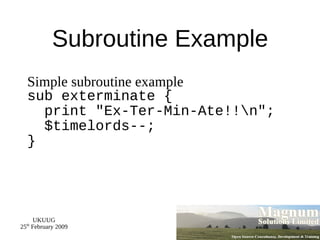
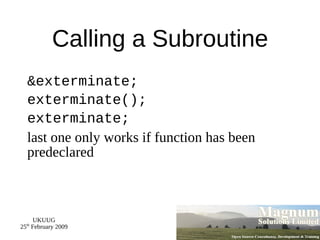
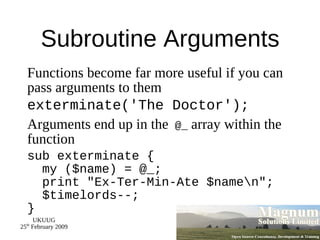
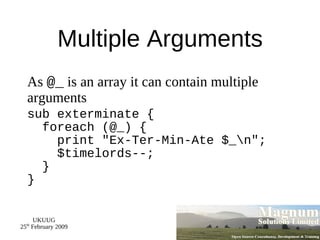
What We Will Cover Subroutines
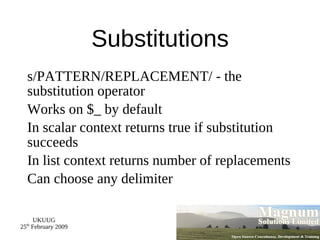
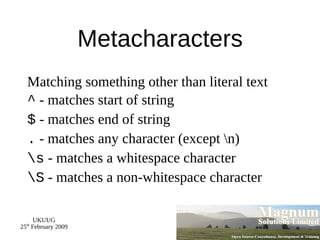
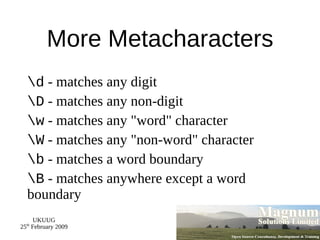
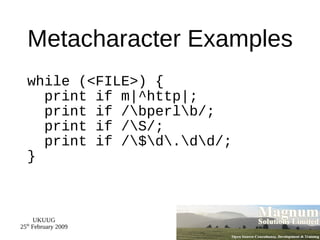
Regular Expressions
References
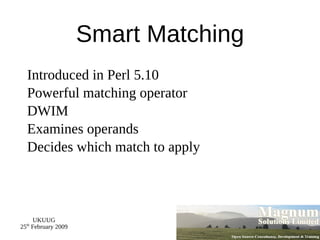
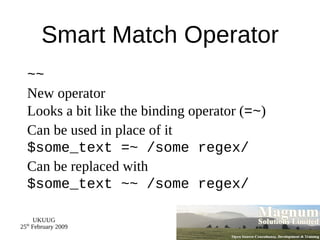
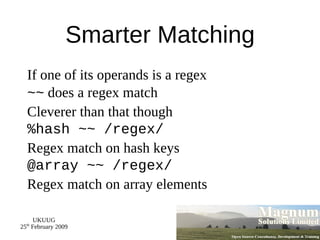
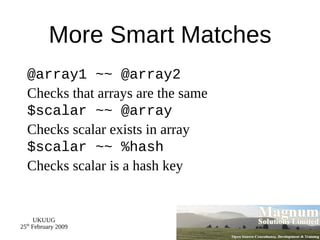
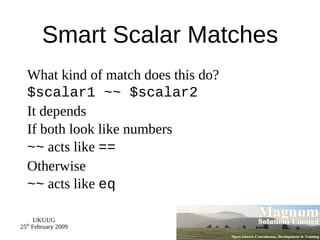
Smart Matching
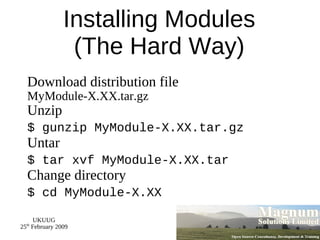
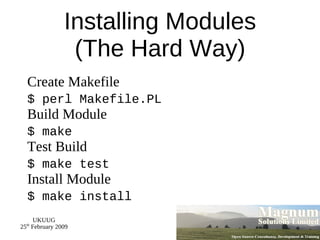
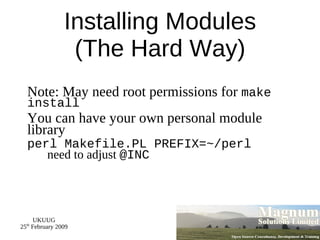
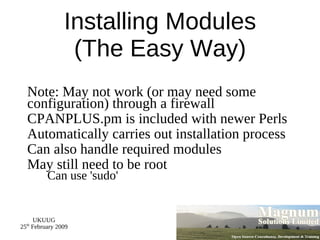
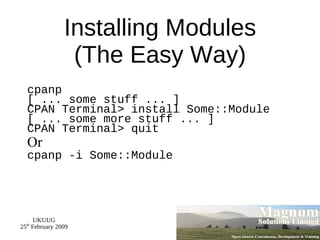
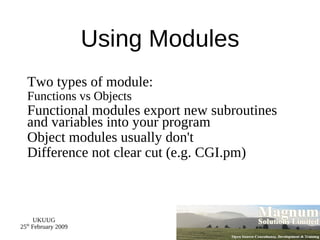
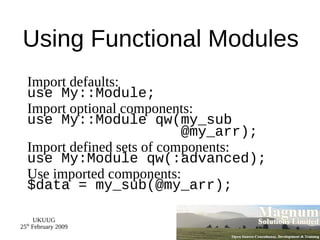
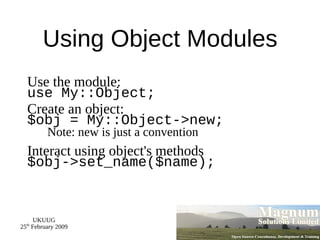
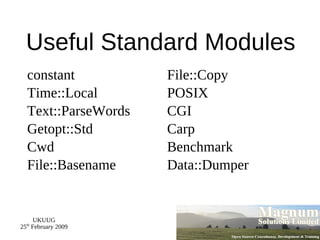
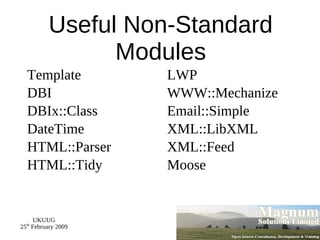
Finding and using Modules
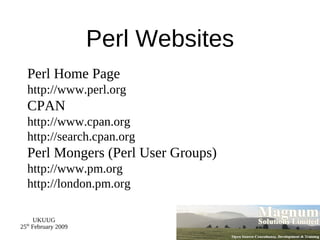
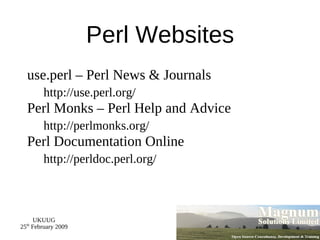
Further Information
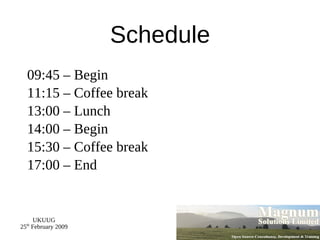
Schedule 09:45 – Begin
11:15 – Coffee break
13:00 – Lunch
14:00 – Begin
15:30 – Coffee break
17:00 – End
Resources Slides available on-line http://mag-sol.com/train/public/2009-02/begin Also see Slideshare http://www.slideshare.net/davorg/slideshows Mailing List http://lists.mag-sol.com/mailman/listinfo/beg2009 Get Satisfaction http://getsatisfaction.com/magnum
What is Perl?
Perl's Name Practical Extraction and Reporting Language
Pathologically Eclectic Rubbish Lister
"Perl" is the language
"perl" is the compiler
Never "PERL"
Typical uses of Perl Text processing
System administration tasks
CGI and web programming
Database interaction
Other Internet programming
Less typical uses of Perl Human Genome Project
NASA
What is Perl Like? General purpose programming language
Free (open source)‏
Fast
Flexible
Secure
Fun
The Perl Philosophy There's more than one way to do it
Three virtues of a programmer Laziness
Impatience
Hubris Share and enjoy!
Creating and Running a Perl Program
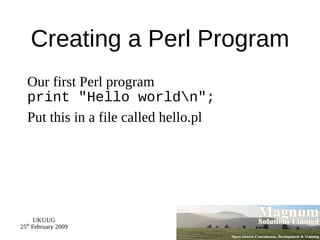
Creating a Perl Program Our first Perl program print "Hello world\n";
Put this in a file called hello.pl
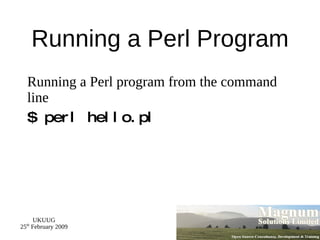
Running a Perl Program Running a Perl program from the command line
$ perl hello.pl
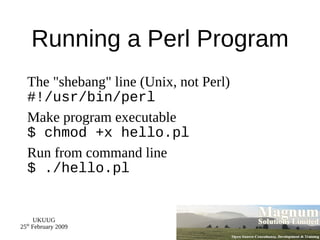
Running a Perl Program The "shebang" line (Unix, not Perl) #!/usr/bin/perl
Make program executable $ chmod +x hello.pl
Run from command line $ ./hello.pl
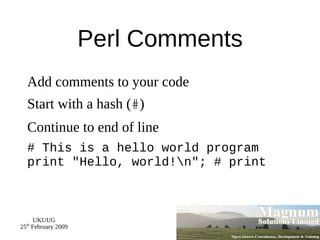
Perl Comments Add comments to your code
Start with a hash ( # )‏
Continue to end of line
# This is a hello world program print "Hello, world!\n"; # print
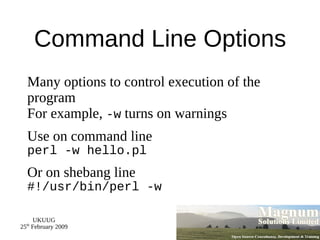
Command Line Options Many options to control execution of the program
For example,  -w  turns on warnings
Use on command line perl -w hello.pl
Or on shebang line #!/usr/bin/perl -w
Perl variables
What is a Variable? A place where we can store data
A variable needs a name to retrieve the data stored in it
put new data in it
Variable Names Contain alphanumeric characters and underscores
User variable names may not start with numbers
Variable names are preceded by a punctuation mark indicating the type of data
Types of Perl Variable Different types of variables start with a different symbol Scalar variables start with $
Array variables start with @
Hash variables start with % More on these types soon
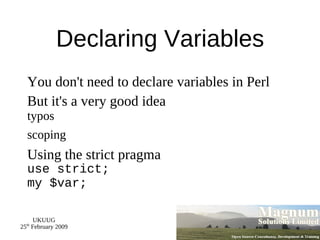
Declaring Variables You don't need to declare variables in Perl
But it's a very good idea typos
scoping Using the strict pragma use strict; my $var;
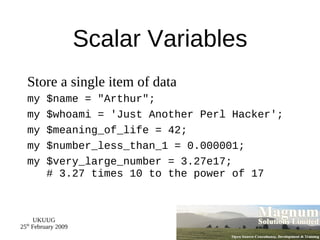
Scalar Variables Store a single item of data
my $name = "Arthur";
my $whoami = 'Just Another Perl Hacker';
my $meaning_of_life = 42;
my $number_less_than_1 = 0.000001;
my $very_large_number = 3.27e17;    # 3.27 times 10 to the power of 17
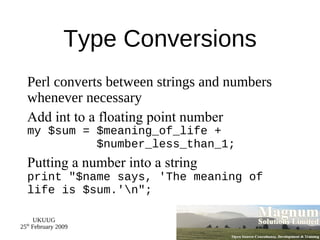
Type Conversions Perl converts between strings and numbers whenever necessary
Add int to a floating point number my $sum = $meaning_of_life +   $number_less_than_1;
Putting a number into a string   print "$name says, 'The meaning of life is $sum.'\n";
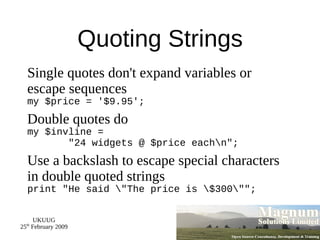
Quoting Strings Single quotes don't expand variables or escape sequences my $price = '$9.95';
Double quotes do my $invline =   "24 widgets @ $price each\n";
Use a backslash to escape special characters in double quoted strings print "He said \"The price is \$300\"";
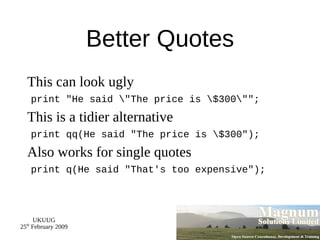
Better Quotes This can look ugly   print "He said \"The price is \$300\"";
This is a tidier alternative   print qq(He said "The price is \$300");
Also works for single quotes   print q(He said "That's too expensive");
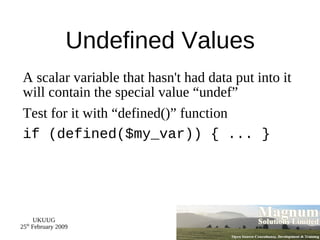
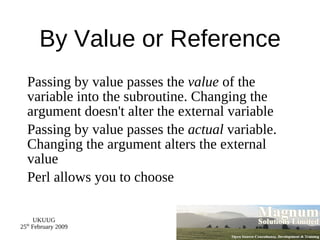
Undefined Values A scalar variable that hasn't had data put into it will contain the special value “undef”
Test for it with “defined()” function
if (defined($my_var)) { ... }
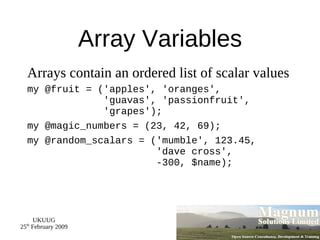
Array Variables Arrays contain an ordered list of scalar values
my @fruit = ('apples', 'oranges',   'guavas', 'passionfruit',   'grapes');
my @magic_numbers = (23, 42, 69);
my @random_scalars = ('mumble', 123.45,   'dave cross',   -300, $name);
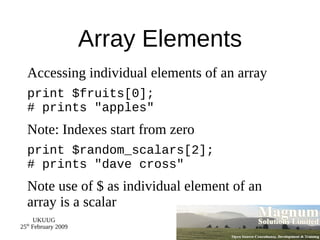
Array Elements Accessing individual elements of an array
print $fruits[0]; # prints "apples"
Note: Indexes start from zero
print $random_scalars[2]; # prints "dave cross"
Note use of $ as individual element of an array is a scalar
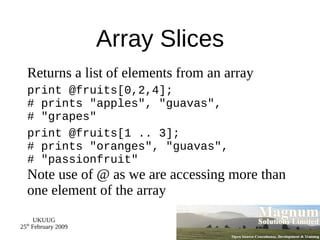
Array Slices Returns a list of elements from an array
print @fruits[0,2,4]; # prints "apples", "guavas", # "grapes"
print @fruits[1 .. 3]; # prints "oranges", "guavas", # "passionfruit"
Note use of @ as we are accessing more than one element of the array
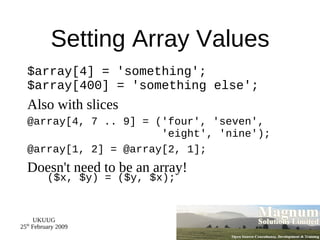
Setting Array Values $array[4] = 'something'; $array[400] = 'something else';
Also with slices
@array[4, 7 .. 9] = ('four', 'seven',    'eight', 'nine');
@array[1, 2] = @array[2, 1];
Doesn't need to be an array! ($x, $y) = ($y, $x);
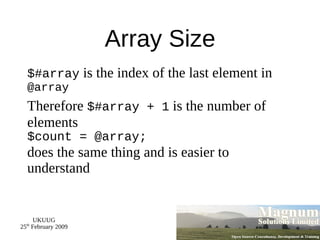
Array Size $#array  is the index of the last element in  @array
Therefore  $#array + 1  is the number of elements
$count = @array;  does the same thing and is easier to understand
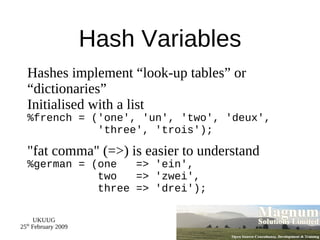
Hash Variables Hashes implement “look-up tables” or “dictionaries”
Initialised with a list %french = ('one', 'un', 'two', 'deux',   'three', 'trois');
"fat comma" (=>) is easier to understand %german = (one  => 'ein',   two  => 'zwei',    three => 'drei');
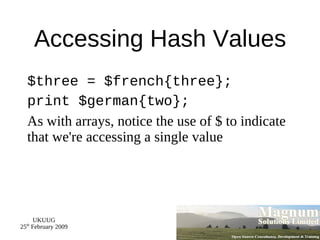
Accessing Hash Values $three = $french{three};
print $german{two};
As with arrays, notice the use of $ to indicate that we're accessing a single value
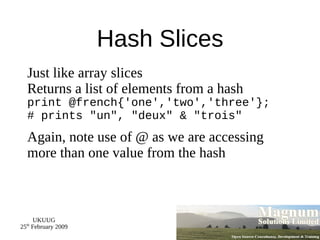
Hash Slices Just like array slices
Returns a list of elements from a hash print @french{'one','two','three'}; # prints "un", "deux" & "trois"
Again, note use of @ as we are accessing more than one value from the hash
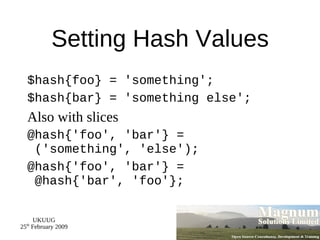
Setting Hash Values $hash{foo} = 'something';
$hash{bar} = 'something else';
Also with slices
@hash{'foo', 'bar'} =  ('something', 'else');
@hash{'foo', 'bar'} =  @hash{'bar', 'foo'};
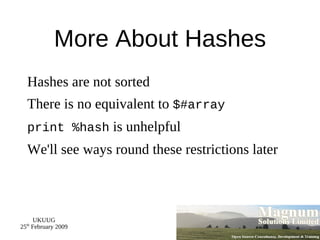
More About Hashes Hashes are not sorted
There is no equivalent to  $#array
print %hash  is unhelpful
We'll see ways round these restrictions later
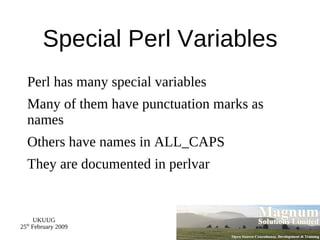
Special Perl Variables Perl has many special variables
Many of them have punctuation marks as names
Others have names in ALL_CAPS
They are documented in perlvar
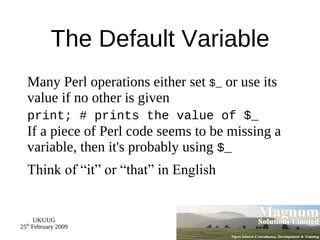
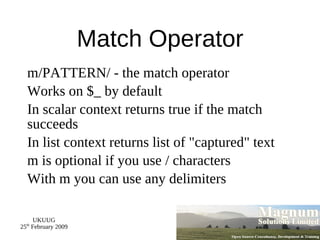
The Default Variable Many Perl operations either set  $_  or use its value if no other is given
print; # prints the value of $_
If a piece of Perl code seems to be missing a variable, then it's probably using  $_
Think of “it” or “that” in English
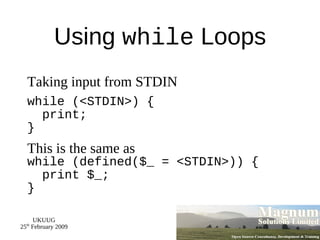
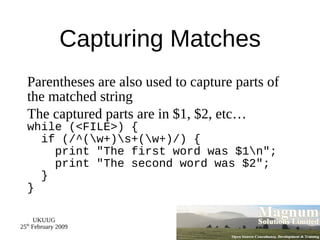
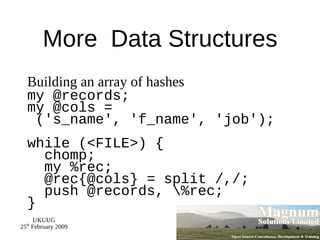
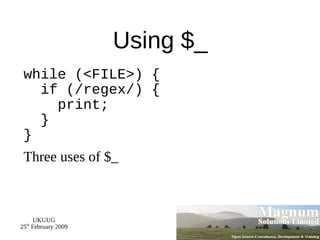
Using $_ while (<FILE>) {   if (/regex/) {   print;   } }
Three uses of $_
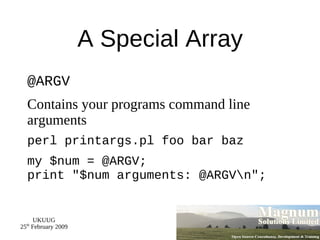
A Special Array @ARGV
Contains your programs command line arguments
perl printargs.pl foo bar baz
my $num = @ARGV; print &quot;$num arguments: @ARGV\n&quot;;
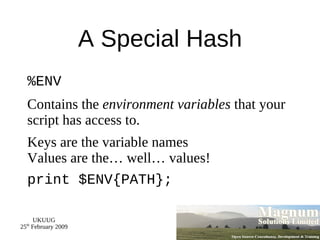
A Special Hash %ENV
Contains the  environment variables  that your script has access to.
Keys are the variable names Values are the… well… values!
print $ENV{PATH};
Input and Output
Input and Output Programs become more useful with input and output
We'll see more input and output methods later in the day
But here are some simple methods
Output The easiest way to get data out of a Perl program is to use  print
print “Hello world\n”;
Input The easiest way to get data into a Perl program is to read from  STDIN
$input = <STDIN>;
< ... >  is the “read from filehandle” operator
STDIN  is the standard input filehandle
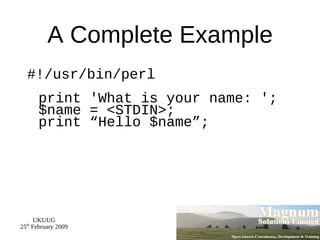
A Complete Example #!/usr/bin/perl print 'What is your name: '; $name = <STDIN>; print “Hello $name”;
Operators and Functions
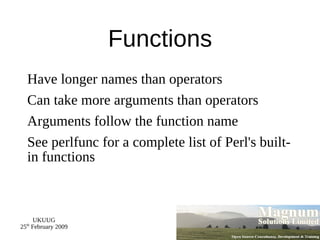
Operators and Functions What are operators and functions?
&quot;Things&quot; that do &quot;stuff&quot;
Routines built into Perl to manipulate data
Other languages have a strong distinction between operators and functions in Perl that distinction can be a bit blurred See perlop and perlfunc
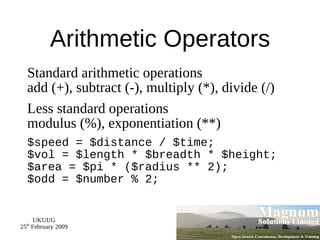
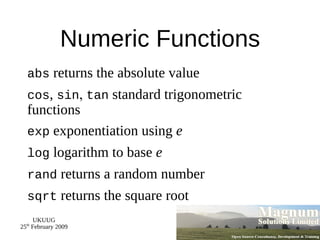
Arithmetic Operators Standard arithmetic operations add (+), subtract (-), multiply (*), divide (/)‏
Less standard operations modulus (%), exponentiation (**)‏
$speed = $distance / $time; $vol = $length * $breadth * $height; $area = $pi * ($radius ** 2); $odd = $number % 2;
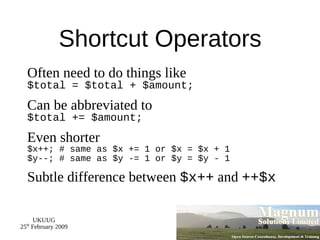
Shortcut Operators Often need to do things like $total = $total + $amount;
Can be abbreviated to $total += $amount;
Even shorter $x++; # same as $x += 1 or $x = $x + 1 $y--; # same as $y -= 1 or $y = $y - 1

Beginning Perl