Model United
Nations (MUN)
Training Session
- Nagappan
Arun
Part 1
General
Information
What is MUN?
Model United Nations is an academic simulation of the United
Nations where students play the role of delegates from
different countries and attempt to solve real world issues with
the policies and perspectives of their assigned country.
For example, a student may be assigned the United Kingdom
and will have to solve global topics such as nuclear non-
proliferation or climate change from the policies and
perspectives of the United Kingdom.
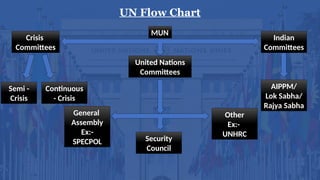
UN Flow Chart
MUN
Crisis
Committees
Indian
Committees
United Nations
Committees
Semi -
Crisis
Continuous
- Crisis
AIPPM/
Lok Sabha/
Rajya Sabha
Security
Council
General
Assembly
Ex:-
SPECPOL
Other
Ex:-
UNHRC
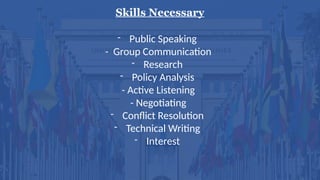
Skills Necessary
- Public Speaking
- Group Communication
- Research
- Policy Analysis
- Active Listening
- Negotiating
- Conflict Resolution
- Technical Writing
- Interest
Part 2
Rules of Procedure
(ROP)
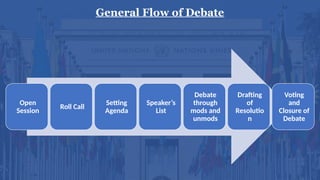
General Flow of Debate
Open
Session
Roll Call
Setting
Agenda
Speaker’s
List
Debate
through
mods and
unmods
Drafting
of
Resolutio
n
Voting
and
Closure of
Debate
Formalities
• Motion to start formal session
• Motion to start roll call
• Motion to set agenda to ______
• Motion to suspend formal session
• Motion to end formal session
• Motion to parley (Not relevant to non CCC/SCC, at discretion of EB)
• Motion to entertain (at discretion of EB)
Debate
• Debate is broadly done through three modes:
1. Formal Debate (General Speaker´s List)
2. Moderated Caucus
3. Un-Moderated Caucus
GSL/PSL
1. The General Speaker´s List (GSL) shows the order of speakers for the topic
being on agenda and is open for the whole duration of the discussion.
2. Once the Speaker´s List is open, any delegate can be added to the Speaker
´s List by raising placard/sending a chit
3. Name can subsequently be added/withdrawn through chits to the EB
4. Default time: 90 secs. Can be altered if motion is raised and passed.
5. If there is a motion adopted altering the mode of the debate, the general
Speaker´s List shall be suspended for the duration of the motion and shall be
resumed afterward.
6. Once the Speaker´s List is exhausted, the debate is considered closed and
the Committee automatically moves into the voting procedure on the
document which is currently being discussed within the set topic.
Moderated Caucus
1. The moderated caucus is aimed to facilitate and accelerate the discussion
on the issues deemed as essential and critical for the topic on agenda.
2. The motion for the moderated caucus can be introduced by any of the
delegates once the Floor is open for Points and Motions. The delegate shall
specify the total time of the Motion (not exceeding 20 minutes), individual
speaker´s time for each of the delegates (not exceeding the speaker´s time
set for the general Speaker´s List) and the purpose of the Motion. The
purpose, i.e. the topic of the Motion shall be connected to the issue
currently being discussed on the agenda and shall be more particular that
the general topic of the discussion.
Moderated Caucus
3. A Simple Majority of the quorum is required for the motion to pass. In
case that there are being more Moderated Caucuses proposed, the
Committee will vote upon them in descending order according to the total
time of the Caucus (i.e. from the longest to the shortest) as set by the
Chairs. 4. The Motion can be ruled out of order at the discretion of the
Chairs- such decision is not a subject to appeal.
Un-Moderated Caucus
1. Un-moderated Caucus is the most informal out of all forms of debate,
2. Committee can break into an unmoderated caucus, once a motion is
raised and passed(not exceeding 30 minutes).
3. A Simple Majority of the quorum is required for the motion to pass.
4. The Motion can be ruled out of order at the discretion of the Chairs- such
decision is not a subject to appeal.
Points
1. Point of Personal Privilege- A delegate may raise the Point of Personal Privilege in case
of whichever kind of personal discomfort which prevents him from full participation in
the debate. Such thing can be for example audibility of other speakers, switching of air-
conditioning etc. A Point of Personal Privilege can interrupt speaker only in the case of
bad audibility.
2. Point of Parliamentary Inquiry- A delegate may raise the Point of Parliamentary Inquiry
in order to clarify certain aspects of the Rules of Procedure by the Chairpersons. Such Point
may not interrupt speakers and can be introduced only when the Floor is open for Points
and Motions.
3. Point of Order- A delegate may raise the Point of Order if there is a discrepancy or
any improperness in the application of the Rules of Procedure by the delegates or
Chairpersons. It is in the discretion of Chairs to decide whether their point is valid and to
clarify any irregularities. The Point of Order may not interrupt a speech.
4. Point of Information- Points of Information can be raised during the Speakers List
segment and during resolution debate when the sponsors present their resolution to the
committee
How to raise a motion?
• The delegate of XYZ wishes to raise a motion to establish roll call.
• The delegate of XYZ wishes to raise a motion to establish general speakers list
with individual speaking time being 60 sec(or if not mentioned automatically 90
sec)
• The delegate of XYZ wishes to raise a motion to set the agenda to “ AGENDA.”
• The delegate of XYZ wishes to raise a motion to suspend formal debate and
move into an unmoderated caucus for X mins.
• The delegate of ___ would like to suspend formal debate and move for a
moderated caucus on topic___ for total time of 10/15/20 mins and individual
speakers time of 30/60/90 seconds
Yeilding Time
A delegate who was granted the permission to speak by the Chairpersons shall
have the right to yield his time- if remaining- to:
• 1. Yield to Another delegate- the remaining time will be offered to another
delegate as allotted by the former speaker. The delegate, if accepting the yield,
cannot yield the floor to any other person with the exception of Chairpersons.
• 2. Yield to Inquiries- If the delegate is open to questions, it is at the discretion of
the Chairpersons to grant this right to any delegate willing to pose an inquiry to
the delegate within the remaining time allocated to the delegate. Inquiries are
not counted into the remaining speaker´s time, unlike the answers provided
by the delegate. The delegate who yielded his time to questions can refuse to
answer any of them at his discretion. Also, Chairpersons shall call to order any
delegate whose inquiry by its character does not comply with the standards.
• 3. Yield back to the Chairs- if there is remaining time left, but the delegate is not
wishing to answer any questions or give his allocated time to another delegate,
he /she can yield his time back to the Chairpersons, who will proceed with
another delegate on the Speaker´s List/ wishing to speak afterwards.
Working Paper
• During an unmoderated caucus, a bloc of delegates can agree upon a
certain set of operative clauses that they would like incorporated in a
resolution. If they have enough sponsors, they may request a
moderated caucus to discuss their working paper, to get feedback
from other delegates and blocs. A working paper may contain
preambulatory clauses, but it is not necessary.
Draft Resolution
• Once the bloc has received feedback on their working paper, they
may, if they want to, make some changes and additions accordingly
to make the resolution more in line with what the “mood” of the
debate was. They may then submit the draft resolution to the
Secretariat, and then request the draft resolution introduced to the
debate. The draft resolution must have both preambulatory and
operative clauses.
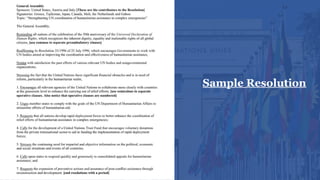
Sample Resolution
Crisis
• Refer to Crisis Handbook
Part 3
Other Info
Areas of Research
• Country/Portfolio Research
• Agenda
• Committee
• Foreign Policy (Matrix)
• Solutions
Speeches
•When the session begins, make speeches focus on stating
country positions and offering recommendations for action.
After blocs have met, speeches should focus on describing
bloc positions to the entire body. Move away from general
ideas on the topic and instead focus on specific ideas or
proposals for action
•Then make statements describing their draft resolutions to
the committee. Bring up points in the draft resolutions that
have yet to be decided or discussed by the body, or points of
agreement and disagreement between two contending draft
resolutions in order to clearly delineate the differences.
Speeches
•Speak in favor or against any amendments that have been
created.
•Convince others of their plan of action and call for input from
as many countries as possible in order to ensure all views are
represented and all ideas discussed are implemented.
MUN Training............... Seminar.pptx

MUN Training............... Seminar.pptx

  • 1.
    Model United Nations (MUN) TrainingSession - Nagappan Arun
  • 2.
  • 3.
    What is MUN? ModelUnited Nations is an academic simulation of the United Nations where students play the role of delegates from different countries and attempt to solve real world issues with the policies and perspectives of their assigned country. For example, a student may be assigned the United Kingdom and will have to solve global topics such as nuclear non- proliferation or climate change from the policies and perspectives of the United Kingdom.
  • 4.
    UN Flow Chart MUN Crisis Committees Indian Committees UnitedNations Committees Semi - Crisis Continuous - Crisis AIPPM/ Lok Sabha/ Rajya Sabha Security Council General Assembly Ex:- SPECPOL Other Ex:- UNHRC
  • 5.
    Skills Necessary - PublicSpeaking - Group Communication - Research - Policy Analysis - Active Listening - Negotiating - Conflict Resolution - Technical Writing - Interest
  • 6.
    Part 2 Rules ofProcedure (ROP)
  • 7.
    General Flow ofDebate Open Session Roll Call Setting Agenda Speaker’s List Debate through mods and unmods Drafting of Resolutio n Voting and Closure of Debate
  • 8.
    Formalities • Motion tostart formal session • Motion to start roll call • Motion to set agenda to ______ • Motion to suspend formal session • Motion to end formal session • Motion to parley (Not relevant to non CCC/SCC, at discretion of EB) • Motion to entertain (at discretion of EB)
  • 9.
    Debate • Debate isbroadly done through three modes: 1. Formal Debate (General Speaker´s List) 2. Moderated Caucus 3. Un-Moderated Caucus
  • 10.
    GSL/PSL 1. The GeneralSpeaker´s List (GSL) shows the order of speakers for the topic being on agenda and is open for the whole duration of the discussion. 2. Once the Speaker´s List is open, any delegate can be added to the Speaker ´s List by raising placard/sending a chit 3. Name can subsequently be added/withdrawn through chits to the EB 4. Default time: 90 secs. Can be altered if motion is raised and passed. 5. If there is a motion adopted altering the mode of the debate, the general Speaker´s List shall be suspended for the duration of the motion and shall be resumed afterward. 6. Once the Speaker´s List is exhausted, the debate is considered closed and the Committee automatically moves into the voting procedure on the document which is currently being discussed within the set topic.
  • 11.
    Moderated Caucus 1. Themoderated caucus is aimed to facilitate and accelerate the discussion on the issues deemed as essential and critical for the topic on agenda. 2. The motion for the moderated caucus can be introduced by any of the delegates once the Floor is open for Points and Motions. The delegate shall specify the total time of the Motion (not exceeding 20 minutes), individual speaker´s time for each of the delegates (not exceeding the speaker´s time set for the general Speaker´s List) and the purpose of the Motion. The purpose, i.e. the topic of the Motion shall be connected to the issue currently being discussed on the agenda and shall be more particular that the general topic of the discussion.
  • 12.
    Moderated Caucus 3. ASimple Majority of the quorum is required for the motion to pass. In case that there are being more Moderated Caucuses proposed, the Committee will vote upon them in descending order according to the total time of the Caucus (i.e. from the longest to the shortest) as set by the Chairs. 4. The Motion can be ruled out of order at the discretion of the Chairs- such decision is not a subject to appeal.
  • 13.
    Un-Moderated Caucus 1. Un-moderatedCaucus is the most informal out of all forms of debate, 2. Committee can break into an unmoderated caucus, once a motion is raised and passed(not exceeding 30 minutes). 3. A Simple Majority of the quorum is required for the motion to pass. 4. The Motion can be ruled out of order at the discretion of the Chairs- such decision is not a subject to appeal.
  • 14.
    Points 1. Point ofPersonal Privilege- A delegate may raise the Point of Personal Privilege in case of whichever kind of personal discomfort which prevents him from full participation in the debate. Such thing can be for example audibility of other speakers, switching of air- conditioning etc. A Point of Personal Privilege can interrupt speaker only in the case of bad audibility. 2. Point of Parliamentary Inquiry- A delegate may raise the Point of Parliamentary Inquiry in order to clarify certain aspects of the Rules of Procedure by the Chairpersons. Such Point may not interrupt speakers and can be introduced only when the Floor is open for Points and Motions. 3. Point of Order- A delegate may raise the Point of Order if there is a discrepancy or any improperness in the application of the Rules of Procedure by the delegates or Chairpersons. It is in the discretion of Chairs to decide whether their point is valid and to clarify any irregularities. The Point of Order may not interrupt a speech. 4. Point of Information- Points of Information can be raised during the Speakers List segment and during resolution debate when the sponsors present their resolution to the committee
  • 15.
    How to raisea motion? • The delegate of XYZ wishes to raise a motion to establish roll call. • The delegate of XYZ wishes to raise a motion to establish general speakers list with individual speaking time being 60 sec(or if not mentioned automatically 90 sec) • The delegate of XYZ wishes to raise a motion to set the agenda to “ AGENDA.” • The delegate of XYZ wishes to raise a motion to suspend formal debate and move into an unmoderated caucus for X mins. • The delegate of ___ would like to suspend formal debate and move for a moderated caucus on topic___ for total time of 10/15/20 mins and individual speakers time of 30/60/90 seconds
  • 16.
    Yeilding Time A delegatewho was granted the permission to speak by the Chairpersons shall have the right to yield his time- if remaining- to: • 1. Yield to Another delegate- the remaining time will be offered to another delegate as allotted by the former speaker. The delegate, if accepting the yield, cannot yield the floor to any other person with the exception of Chairpersons. • 2. Yield to Inquiries- If the delegate is open to questions, it is at the discretion of the Chairpersons to grant this right to any delegate willing to pose an inquiry to the delegate within the remaining time allocated to the delegate. Inquiries are not counted into the remaining speaker´s time, unlike the answers provided by the delegate. The delegate who yielded his time to questions can refuse to answer any of them at his discretion. Also, Chairpersons shall call to order any delegate whose inquiry by its character does not comply with the standards. • 3. Yield back to the Chairs- if there is remaining time left, but the delegate is not wishing to answer any questions or give his allocated time to another delegate, he /she can yield his time back to the Chairpersons, who will proceed with another delegate on the Speaker´s List/ wishing to speak afterwards.
  • 17.
    Working Paper • Duringan unmoderated caucus, a bloc of delegates can agree upon a certain set of operative clauses that they would like incorporated in a resolution. If they have enough sponsors, they may request a moderated caucus to discuss their working paper, to get feedback from other delegates and blocs. A working paper may contain preambulatory clauses, but it is not necessary.
  • 18.
    Draft Resolution • Oncethe bloc has received feedback on their working paper, they may, if they want to, make some changes and additions accordingly to make the resolution more in line with what the “mood” of the debate was. They may then submit the draft resolution to the Secretariat, and then request the draft resolution introduced to the debate. The draft resolution must have both preambulatory and operative clauses.
  • 19.
  • 20.
    Crisis • Refer toCrisis Handbook
  • 21.
  • 22.
    Areas of Research •Country/Portfolio Research • Agenda • Committee • Foreign Policy (Matrix) • Solutions
  • 23.
    Speeches •When the sessionbegins, make speeches focus on stating country positions and offering recommendations for action. After blocs have met, speeches should focus on describing bloc positions to the entire body. Move away from general ideas on the topic and instead focus on specific ideas or proposals for action •Then make statements describing their draft resolutions to the committee. Bring up points in the draft resolutions that have yet to be decided or discussed by the body, or points of agreement and disagreement between two contending draft resolutions in order to clearly delineate the differences.
  • 24.
    Speeches •Speak in favoror against any amendments that have been created. •Convince others of their plan of action and call for input from as many countries as possible in order to ensure all views are represented and all ideas discussed are implemented.