Course Title: Gender, School and Society
Course Code: BED210
GEETA DHASMANA
ASSISTANT PROFESSOR
FIMT
NEW DELHI
10/16/2020 1
10/16/2020 2
Objectives of the Course:
• To develop understanding of some key concepts and
terms and relate them with their context in understanding
the power relations with respect to Educating and
Education
• To develop an understanding of the paradigm shift from
Women studies to Gender Studies based on the historical
backdrop.
• To reflect on different theories of Gender and Education
and relate it to power relations.
• To analyse the institutions involved in Socialisation
processes and see how socialisation practices impact
power relations and identity formation
10/16/2020 3
07/09/2020
Unit III: Gender, Power And Education
• Gender Identities and Socialisation Practices in: Family, other
formal and informal organisation.
• Schooling of Girls: Inequalities and Resistances (issues of
Access, Retention and Exclusion).
• Collection of folklores reflecting socialisation processes.
• Changing Perspectives with Legal Provisions: Right to
Inheritance etc.
10/16/2020 4
A gender role, also known as sex role, is a social role encompassing a
range of behaviours and attitudes that are generally considered
acceptable, appropriate or desirable for people based on their actual
or perceived sex. Gender roles are usually centred on conceptions of
feminity and masculinity although there are exceptions and
variations. The specifics regarding these gendered exceptions may
vary substantially among cultures, while other characteristics may be
common throughout a range of cultures.
The World Health Organisation describes gender roles as “Socially
constructed roles, behaviors and activities and attributes that a given
society considers appropriate for men and women”.
10/16/2020 5
Gender roles in society means how we are expected to act,
speak, dress, groom, and conduct ourselves based upon our
assigned sex. For example, girls and women are generally
expected to dress in typically feminine ways and be polite,
accommodating, and nurturing. Men are generally expected to
be strong, aggressive, and bold. This is generally the set of roles,
activities, expectations, and behaviours assigned to females and
males by society.
Our culture recognises two basic gender roles:
• Masculine (having the qualities attributed to males); and •
Feminine (having the qualities attributed to females).
10/16/2020 6
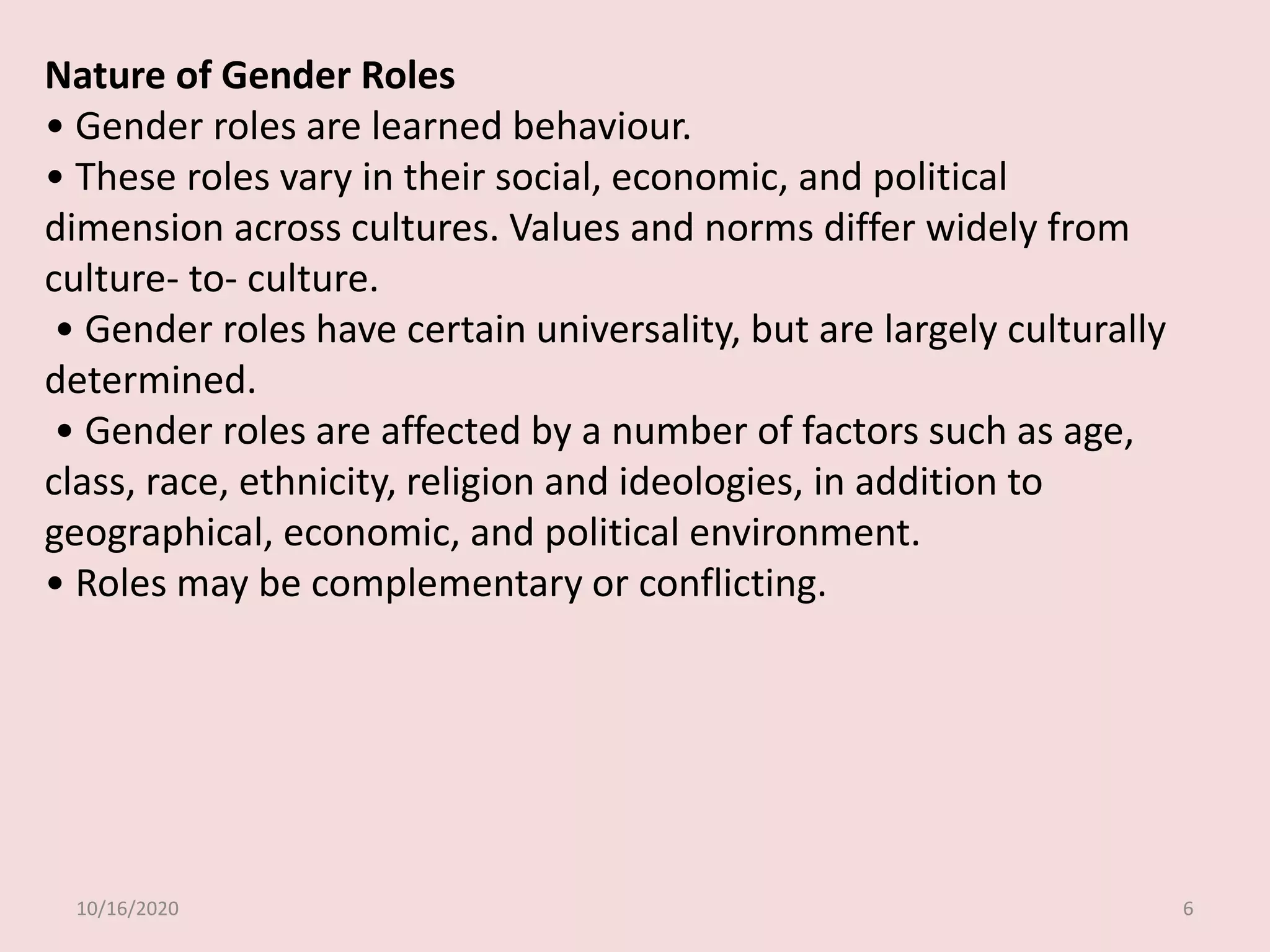
Nature of Gender Roles
• Gender roles are learned behaviour.
• These roles vary in their social, economic, and political
dimension across cultures. Values and norms differ widely from
culture- to- culture.
• Gender roles have certain universality, but are largely culturally
determined.
• Gender roles are affected by a number of factors such as age,
class, race, ethnicity, religion and ideologies, in addition to
geographical, economic, and political environment.
• Roles may be complementary or conflicting.
10/16/2020 7
Factors Determining Gender Roles/Stereotypes
• Personality Traits –Women are often expected to be
accommodating and emotional, while men are expected to be self-
confident and aggressive.
• Domestic Behaviours –Some people expect that women will take
care of the children, cook, and clean the home, while men take care
of finances, work on the car, and do the home repairs.
• Occupations – Some people are quick to assume that teachers and
nurses are women, and that pilots, doctors, and engineers are men.
• Physical Appearance –Women are expected to be thin and graceful,
while men are expected to be tall and muscular. Men and women are
also expected to dress and groom in ways that are stereotypical to
their gender (men wearing pants and short hairstyles, women
wearing dresses and makeup).
10/16/2020 8
Gender Identity
Gender identity is the personal sense of one’s own gender. Gender
identity can correlate with assigned sex at birth or can differ from
it. All societies have a set of gender categories that can serve as the
basis of the formation of a person’s social identity in relation to
other members of society. Gender identity is a person’s private
sense and subjective experience of their own gender. This is
generally described as one’s private sense of being a man or a
woman, consisting primarily of the acceptance of membership into
a category of people as male or female. This concept is intimately
related to the concept of gender role, which is defined as the
outward manifestations of personality that reflect the gender
identity. Gender identity in nearly all instances is self- identified as
result of a combination of inherent and extrinsic or environmental
factors. Gender role on the other hand, is manifested within society
by observable factors such as behaviour and appearance.
10/16/2020 9
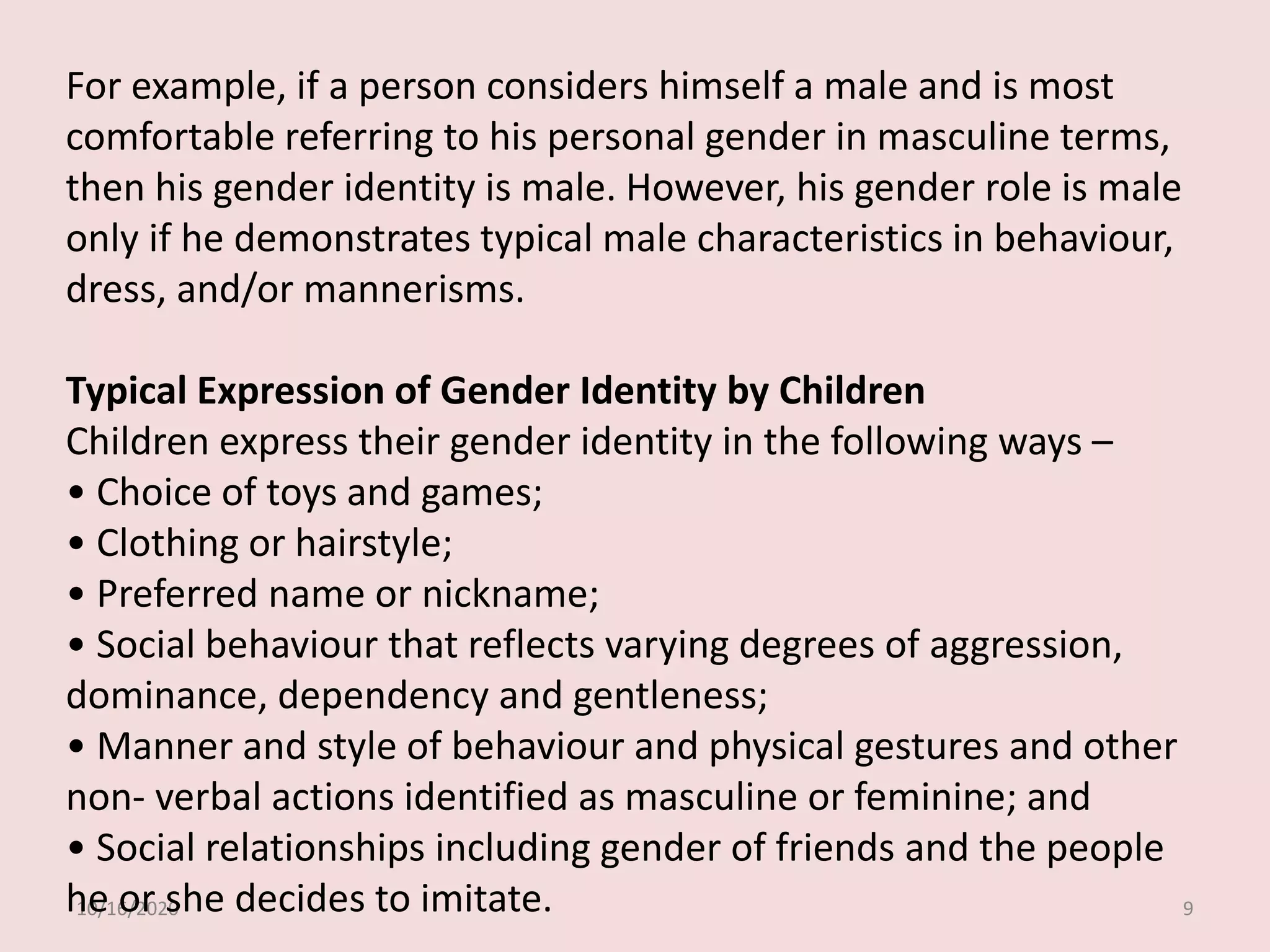
For example, if a person considers himself a male and is most
comfortable referring to his personal gender in masculine terms,
then his gender identity is male. However, his gender role is male
only if he demonstrates typical male characteristics in behaviour,
dress, and/or mannerisms.
Typical Expression of Gender Identity by Children
Children express their gender identity in the following ways –
• Choice of toys and games;
• Clothing or hairstyle;
• Preferred name or nickname;
• Social behaviour that reflects varying degrees of aggression,
dominance, dependency and gentleness;
• Manner and style of behaviour and physical gestures and other
non- verbal actions identified as masculine or feminine; and
• Social relationships including gender of friends and the people
he or she decides to imitate.
10/16/2020 10
Gender identity is the internal sense of oneself as male, female,
both, neither, or something else. Gender identity is a personal
choice, chosen internally by an individual. Gender expression is the
external manifestation of an individual's gender identity. Also called
gender manifestation, gender expression is usually expressed
through behavior, clothing and hairstyle choices, spoken voice, or
body characteristics. People's gender identity does not always match
their gender expression. Heteronormativity is the assumption that
all people are heterosexual, or that heterosexuality is the default or
normal state of human being. It includes the expectation that
biological sex, gender, and gender expression always align. For
example, a heteronormative expectation is that individuals with
male sex characteristics also identify as male (their gender identity is
male).
10/16/2020 11
Behaviors that are compatible with societal expectations about
gender are referred to as gender normative. Aligning oneself with
society's view of gender is called gender conformity. Behaving in
ways that are incompatible with societal expectations about gender
is referred to as gender nonconformity. The
adjective cisgender describes an individual whose gender identity
aligns with the sex assigned to them at birth. The
adjective transgender describes a person whose gender identity
does not align with the sex assigned at birth. Transgender people
might identify as either male or female, neither, or something else.
Sexual orientation refers to whether individuals are sexually
attracted to people of the same sex (homosexual), people of the
opposite sex (heterosexual), or both (bisexual). Sexual orientation,
gender identity, and gender expression are each distinct concepts.
10/16/2020 12
Both cisgender and transgender people may be heterosexual,
homosexual, bisexual, or asexual (without sexual desire). The
acronym LGBTQIA, or lesbian, gay, bisexual, transgender, queer,
intersex, and asexual, is an umbrella term that refers to the diverse
community of people who do not identify as heterosexual and
cisgender.
10/16/2020 13
Factors Influencing Formation of Gender Identity:
The factors influencing the formation of gender identity can be
classified as follows:
1. Biological Factors:
Biological factors play a huge role in shaping children’s physical
development. For instance, boys and girls are born with distinctive
sexual organs, and become further differentiated when secondary
sexual characteristics emerge upon puberty. Naturally occurring
chemical messenger compounds in the body known as hormones are
responsible for coordinating the appearance of these physical
differences
10/16/2020 14
2. Social and Environmental Factors:
Studies have shown that children’s upbringing and social
environments also impacts their developing gender identities. This
can be summarised by stating that children’s interests,
preferences, behaviours, and overall self-concept are strongly
influenced by parental and authority figure teachings regarding
sexual stereotypes occurring in or before the early portion of
middle childhood. Children who are taught that certain traits or
activities are appropriate or inappropriate for them to engage
because they are a girl or a boy do tend to internalise and be
influenced by these teachings in later life. For instance, girls who
are informed that boys are innately better at math than they are
may report that they dislike math and disclaim their interest in
that subject. They may go on to believe that they are not good at
this academic subject, and perform poorly on math tests and
homework assignments.
10/16/2020 15
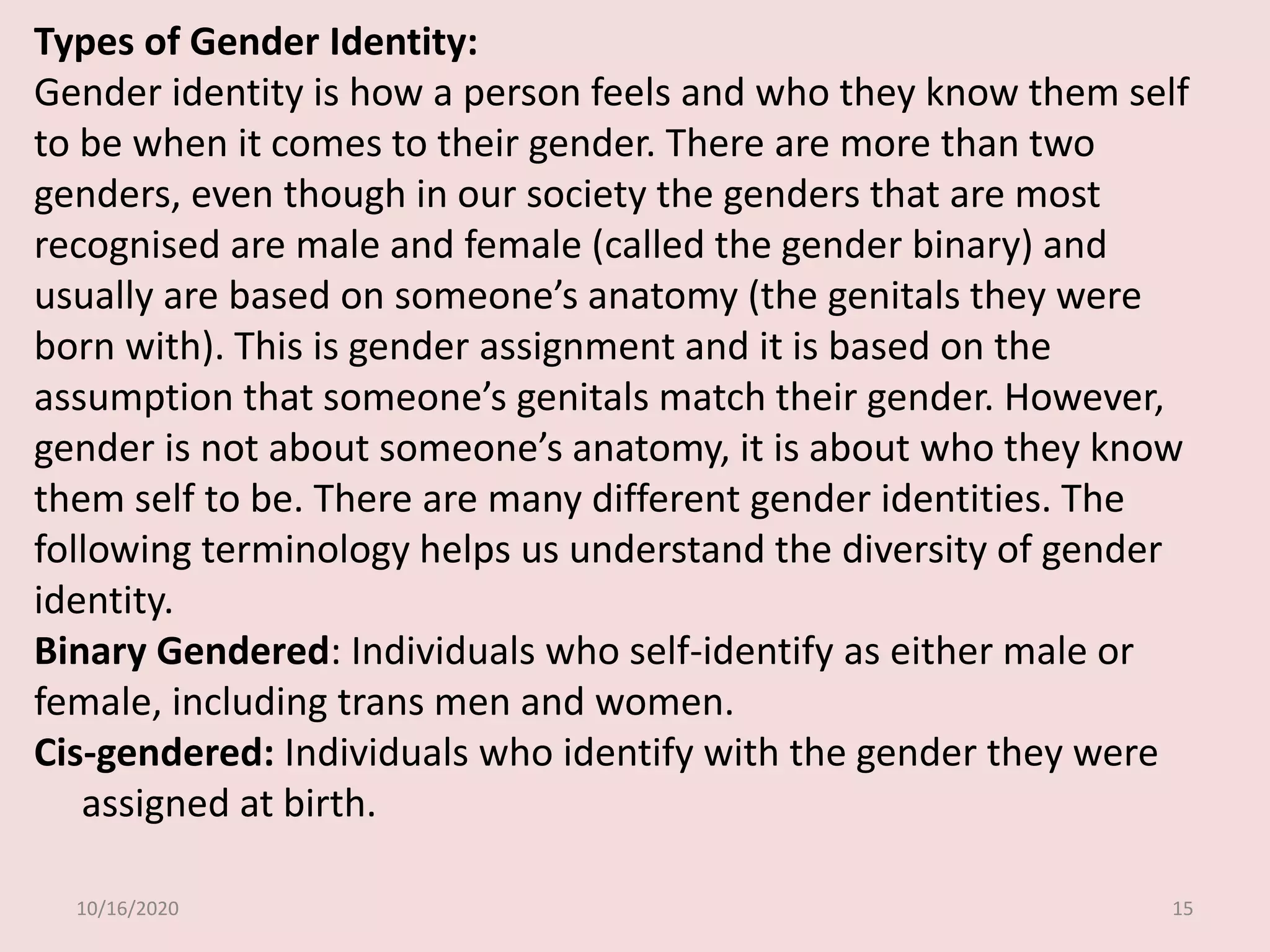
Types of Gender Identity:
Gender identity is how a person feels and who they know them self
to be when it comes to their gender. There are more than two
genders, even though in our society the genders that are most
recognised are male and female (called the gender binary) and
usually are based on someone’s anatomy (the genitals they were
born with). This is gender assignment and it is based on the
assumption that someone’s genitals match their gender. However,
gender is not about someone’s anatomy, it is about who they know
them self to be. There are many different gender identities. The
following terminology helps us understand the diversity of gender
identity.
Binary Gendered: Individuals who self-identify as either male or
female, including trans men and women.
Cis-gendered: Individuals who identify with the gender they were
assigned at birth.
10/16/2020 16
Gender Fluid: An individual’s experience of their gender, which may
be outwardly expressed or not. A dynamic experience of gender
where at one time a person may feel more toward one binary, but
at another time feel more toward the other.
Genderqueer: An identity most often adopted when a person does
not subscribe to conventional gender distinctions and may identify
with neither, both or a combination of male and female genders.
Intersex: People who have variations of sex characteristics that do
not fit with typical male or female bodies.
Non-Binary Gendered: Individuals who define their gender identity
as not male or female. This group includes those who, for
example, describe themselves as ‘Genderqueer’.
10/16/2020 17
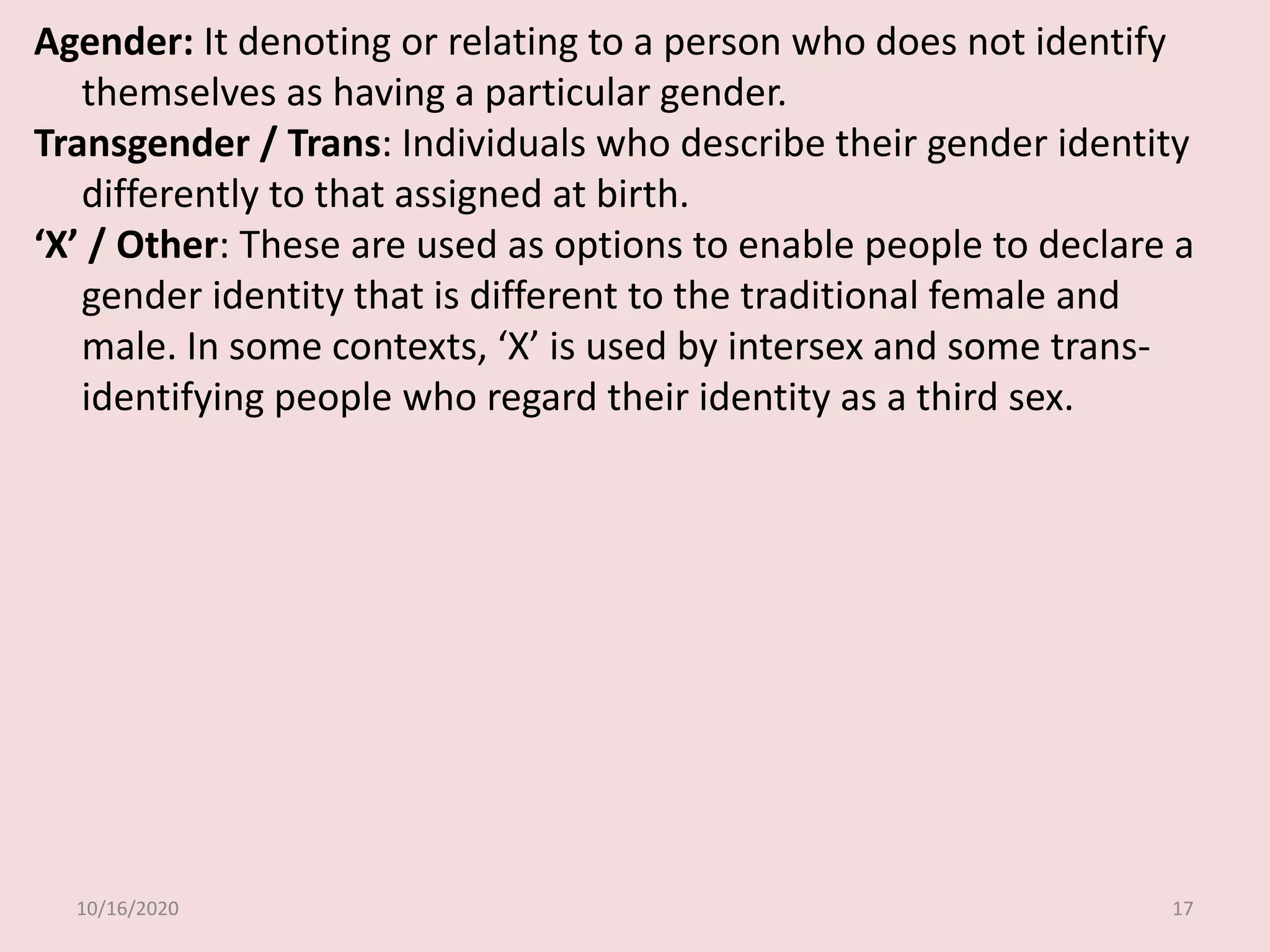
Agender: It denoting or relating to a person who does not identify
themselves as having a particular gender.
Transgender / Trans: Individuals who describe their gender identity
differently to that assigned at birth.
‘X’ / Other: These are used as options to enable people to declare a
gender identity that is different to the traditional female and
male. In some contexts, ‘X’ is used by intersex and some trans-
identifying people who regard their identity as a third sex.
10/16/2020 18
Gender socialisation is the process through which children learn
about social expectations, attitudes, and behaviours typically
associated with boys and girls (Encyclopedia of Early Childhood
Development).
According to Henslin (1999), “Gender Socialization refers to the
learning of behavior and attitudes considered appropriate for a given
sex”.
Cynthia Vinney (2019) defines it as “Gender Socialization is the
process by which we learn our culture’s gender related rules, norms
and expectations”.
10/16/2020 19
Agents of Gender Socialisation
Parents: Parents are typically a child’s first source of information
about gender. From birth, parents communicate different
expectations to their children depending on their sex. For example,
a son may engage in more roughhousing with his father, while a
mother takes her daughter shopping. The child may learn from
their parents that certain activities or toys correspond with a
particular gender. Even parents, who emphasise gender equality,
may inadvertently reinforce some stereotypes due to their own
gender socialisation.
Teachers : Teachers and school administration model roles
sometimes demonstrate gender stereotypes by responding to male
and female students in different ways. For example, separating
students by gender for activities or disciplining students differently
depending on their gender may reinforce children’s developing
beliefs and assumptions.
10/16/2020 20
Peers: Peer interaction also contributes to gender socialisation.
Children tend to play with same gender peers. Through these
interactions, they learn what their peers expect of them as boys and
girls. These lessons may be direct, such as when a peer tells the child
that a certain behaviour is or is not appropriate for their gender. They
can also be indirect as the child observes same and other gender
peers’ behaviour over time. These comments and comparisons may
become less overt over time, but adults continue to turn to same
gendered peers for information on how they are supposed to look
and act as a man or a woman.
Media: Media including movies, television, and books teach children
about what it means to be a boy or a girl. The media conveys
information about the role of gender in people’s lives and can
reinforce gender stereotypes. For example, consider an animated
film that depicts two female characters, a beautiful but passive
heroine, and an ugly but active villain. This and countless other
examples reinforces ideas about which behaviour is acceptable and
valued (and which are not) for a particular gender.
10/16/2020 21
Gender Socialisation within Indian Families:
In Indian families, gender roles are well differentiated, which
influence the socialisation process from birth onwards. From early in
life, children begin to experience gender- based differentiation in
their relationship with others, in distribution of family resources,
and in entitlement to family membership like nutrition, healthcare,
and education. Both, boys and girls, grow up with the knowledge of
the special value attached to the male child. Very often the blatant
expressions of son preference through parental reactions, behaviour,
family rituals, practices, and celebrations, all give rise to the
definition of genderbased relationship between boys and girls, male
and female within the Indian system. The social practices among
Indian families related to gender can be seen in light of the following
–
10/16/2020 22
a) Male-female differentiation : The male and female
differentiation predominantly begins in the family. A girl is
considered to be unwanted in many families and is even
eliminated before birth. Differentiation and discrimination are
seen even in the distribution of nutrition, healthcare, and
education. Distribution of family resource too is made on the
basis of gender in many families, where women are not entitled
to the family’s possessions.
b) Role allocation: Within the Indian patriarchal family system,
dominating and controlling social functions are prescribed for
the males, whereas supportive functions are prescribed for the
females. Thus, by birth, males are caretakers of resources,
performing the functions of earners, and females are family
caretakers performing the functions of child nurturing, caring of
the aged, and running the household. The women are expected
to be obedient daughters, faithful wives, nurturing mother, all
powerful mothers-in-law, and benevolent grandmother.
10/16/2020 23
c) Gender-based hierarchal placement: Along with role allocations,
certain norms and values, along with practices and beliefs, further
promote the husband-wife superior/ inferior hierarchy within a
family. Higher incidence of widowhood in women is observed as
compared with men because of the cultural practice of men
marrying women who are considerably younger to them. This
demonstrates how gender and age can be the sources of
disadvantages. Woman’s role in society, her limited rights,
considerable duties, and the shabby treatment meted out to her in
all walks of life originate from the fact that she is basically
considered a liability and a burden on the family right from birth
itself.
10/16/2020 24
d) Gender- based attitude development: Gender relationship is
learnt within family from early days through the recognition of the
special value accorded to male children in the traditional Indian
family. Elders bless young girls and women by wishing them a large
number of sons. Girls are made to believe that her stay at her natal
home is temporary. Marriage is regarded as the ultimate goal of a
girls’ life. A large percentage of the parents expect all types of
domestic work to be performed by girls, while boys are expected to
do more of outside work.
For PARENTING STYLE click on :
https://patnawomenscollege.in/upload/e-content/Sociolisation.pdf
10/16/2020 25
•Schooling of Girls: Inequalities and Resistances (issues of Access,
Retention and Exclusion).
Gender and education
• In the past, women received little schooling because their lives
revolved around the home. • But times have changed.
• By 1980, women earned a majority of all associate’s and bachelor’s
degrees. College doors have opened to women. Men continue to
dominate some professional fields.
• In 2001 Men received 53% law degree.
• 57% Medical degree
• 61% of Dental degree
• Our society still defines high-paying professions as masculine.
• Nevertheless, the proportion of women in all these professions is
rising steadily.
10/16/2020 26
Inequalities and resistance in society: issues of access, retention
and exclusion
• India is a democratic country, committed to social justice and
improving the lot of the common man.
• One of the social objectives of its education is to cultivate all
available talent in the country, so as to build up an egalitarian society.
• This is possible only when equal opportunities are provided to all in
the field of education.
• There are a few backward or underprivileged classes in India who,
for various reasons, have not been able to get the benefit of
education and they need more and special facilities for educating
their children.
• Inequality of educational opportunities does exist in India.
10/16/2020 27
It exists between:
• One state and another state
• One district and another
• In a district, one area and another
• Boys and girls
• The Different Sections of the society
• The upper castes and the scheduled castes and scheduled tribes.
• Socially advanced and socially backward classes
• Economically better off and economically poorer classes.
Causes of Inequality of opportunities
• Socio, economic and political condition
• Poverty: A large section of India's population is economically poor,
they cannot bear the expenditure on the education of their children.
• They cannot have the same chance as those who come from richer
families, even if they have educational facilities available. Standard
of Schools and Colleges.
10/16/2020 28
• This creates an extremely intractable form of educational
inequality.
• Students coming from rural areas, where the schools are ill-
equipped, do not have the same opportunity as is available to
students coming from the urban areas, Home Environments
• A child from a rural household or an urban slum, having illiterate
parents does not have the same opportunity as a child from an
upper class home with highly educated parents.
• Sex: Wide disparity exists between the education of boys and
girls.
• Socially disadvantaged section
• Varying Literacy level
• Inaccessibility of habitations: hilly and forest areas cannot be easily
approached.
• Varying occupational opportunities
• Dearth of qualified teachers.
10/16/2020 29
Measures
• For the poor- abolish fees, provide free books, stationery, meals
and uniform. Also a large programme of scholarship for economically
backward students.
• A more reliable and egalitarian method of selection of students for
admission to higher level, and award of scholarships.
• Special attention should be paid in schools to children from
underprivileged homes, by the provision of day-study centres or
boarding houses.
• The National Policy on Education 1986 placed special emphasis on
the removal of disparities and a equalising educational
opportunities.
10/16/2020 30
Exclusion
• Marginal groups like: mentally ill
• Physically handicapped
• Suicidal people
• Aged invalids
• Abused children
• Substance abusers
• Marginalized people
• Single parent children
• Multi problem households
• Delinquents
• Anti-social and other misfits
10/16/2020 31
Gender Concerns Related to Retention:
Due to the persistent interest shown by the government and the
educational department, girls are admitted to school. But one
observes that many girls, owing to various reasons, dropout from
schools at different points of time. There are again several causes for
their dropout, which pose a challenge to schools in bringing them
back. Some of the reasons are discussed below.
Safety: Female students who get enrolled into school dropout owing
to safety reasons, which could be related to their journey to school
or the environment in the school. Fear of molestation, sexual abuse,
and sexual harassment stops the girls from coming to school.
Sanitation Facilities: School buildings can also lack adequate
sanitation and hygiene facilities, which pose a major barrier for
menstruating girls. In co-education schools, the girls are
embarrassed by the common toilet facilities or lack of privacy.
10/16/2020 32
Discriminatory norms: Caste or gender related discriminatory norms
affect the education of girls. Some villages have practices where
menstruating girls cannot use a particular road where the village
deity is kept. Girls have to travel using the far away roads to reach
school, which compromises their safety and also discourages them
from coming to school.
School related gender- based violence: Safety and learning are also
compromised by increased levels of school-related gender-based
violence (SRGBV), where institutions may lack the infrastructure to
create or support gender-specific policies around child protection.
School infrastructure: The general destruction of school
infrastructure, limited availability of trained teachers, and
inappropriate teaching materials common to conflict and crisis
settings can undermine the quality of education for all children.
10/16/2020 33
Teacher availability and attitude: The available teachers are less
likely to be trained in gender-sensitive approaches and the existing
teaching practices and learning materials can reinforce gender
stereotypes that significantly disadvantage girls. Furthermore, a
limited number of either female or male teachers can result in a lack
of role models, and students may become less motivated to
participate in class.
Migration : The dropout rate of girls from marginalised and rural
sections, especially from upper primary level onwards is extremely
high. A sizeable proportion of school dropouts, chiefly migrant, poor,
and working children are girls, as school continuation rates of rural
girls are twice as high as that of boys.
10/16/2020 34
Poor teaching-learning environment: One of the major reasons why
children, both boys and girls, in rural and urban areas drop out is
lack of interest in studies due to hostile environment, poor teaching,
non-comprehension, and difficulties of coping. About 26 per cent
children in one study cited school and teaching curricula related
factors such as unfriendly atmosphere in school, doubts about the
usefulness of schooling, and inability to cope with studies as reasons
for their dropping out. Among girls in rural areas, these factors
accounted for over 75 per cent of the dropouts.
Domestic responsibilities: Domestic responsibilities and the
widespread perception of girls merely as future homemakers
contribute to the problem and girls get short shrift when the cost
of education magnifies.
Child marriage: Child marriage, although a crime, is still prevalent in
some of the villages in India. Parents in order to shed their
responsibilities marry off their minor girls. This curtails their
education.
10/16/2020 35
Gender Concerns Related to Participation
a) Difference in their willingness to ask questions: Girls are shyer
and more selfconscious in the presence of boys and as a result, their
willingness in participation is affected.
b) Restlessness of boys attracts more attention than that of girls:
More attention is paid to boys by the teacher due to their restless
nature. As a result, female students are ignored, thus reducing their
interest in participating in classroom discussions and activities.
c) Boys are more vocal: When working in a group, boys can be more
vocal while girls will share information more intimately, hence, girls
are less visible. Boys also tend to dominate due to their vivacious
and loud nature.
d) Girl’s opinion ignored: Most often the opinions expressed by girls
are overlooked or ignored in a group activity consisting of boys and
girls. This lowers their self –confidence and consequently silences
them.
10/16/2020 36
e) Biased teacher interaction: Teachers pay more attention to boys
because of their assertiveness and because they speak up more
frequently than girls.
f) Public versus private talk: Girls prefer private talks than public
discussions and hence, may not participate in classroom
interactions.
g) Distribution of praise and criticism: Distribution of praise and
criticism alsoaffects the participation of students in a class. It is a fact
that the smallest of achievement by the boys gets attention than the
many achievements of girls. Similarly, a small mistake by a girl gets
magnified as she is expected to be good in every sense.
10/16/2020 37
Gender Concerns Related to Achievement
Although the achievement percentage of girls is on par with the
boys when we see the results of various board examinations, yet the
national-level surveys and data also show that 9 out of every 10 girls
enrolled in school is unable to complete schooling. Only 1 out of
every 100 girls enrolled in Class I reaches Class XII in rural areas and
14 out of every 100 girls enrolled in Class I reach Class XII in urban
areas. The reasons for this are similar to what we have discussed in
the gender concerns related to enrolment, participation, and
retention.
10/16/2020 38
Collection of folklores reflecting socialisation processes.
10/16/2020 39
Folklore covers almost our entire life experience. It is present in our
daily life. We cannot deny its presence in speech such as riddles,
jokes; it is present in our games, dance and song. None of the
studies of human life, from ethnography, history, linguistics to
literature can ignore folklore. It is acquiring more and more
importance as a separate field of study and discipline. In order to
grasp the scope and importance of folklore, we need to first
understand the historical development of the discipline in itself.
10/16/2020 40
The history of folklore studies began in the 19th century. However,
one can trace its roots back even further. According to Max Muller, it
is said that all races find their origin in certain basic tribes, originating
from the ancient Medes or the Persians. Certain linguistic, physical,
social and cultural symbols seem thus to be common. The word
father, for example can be seen in the German vater, old German
fatar, Greek and Latin pater and Sanskrit patar or Petri. Hence, we can
determine how folk speech and utterances had some common
generic roots. It is also said that certain folklore ideas of modern
European nations belong to paganism and Hinduism
10/16/2020 41
Scholars have thus defined folk in several ways:
1) Folklore is deeply connected to the nation.
2) It is said to belong to the lower levels of the social hierarchy.
3) It is said to be old fashioned as compared to the complex
civilization.
4) It is believed that it belongs to large societies with a large
population.
5) Folk is said to be a social group connected through a common
tradition and a particular feeling of communication.
10/16/2020 42
Folklore belongs to all. It contains the whole gamut of the society.
It can be said here that it also fulfills and satisfies certain basic
functions. Some of the major areas that it fulfills certain
functional roles are as follows:
1) Psychological or individual: Folklore is largely personal and is
shaped through people’s behaviours, motivations and habits. By
and large folklore is entertaining; it thus fulfills an amusement
amongst the community members. Jokes, riddles, metaphors,
tales and performances as well as the arts highly entertain the
people. These forms of folklore provide entertainment to the
people. It is a well thought out distraction from the humdrum
and the daily needs of life
10/16/2020 43
2) Functional: Folklore gratifies or expresses the hostilities found
in the culture and society. Proverbs can help solve legal decisions,
while riddles sharpen wit and humour and reinforce cultural
values, myths validate conduct in the society, and satirical songs
release pent up feelings and tensions. All the above folklore helps
the individual to remain in the society. Some tales about nature
also talk about how to grow crops and folk medicines help to cure
diseases.
10/16/2020 44
3) Religious: Religion is a part of the daily existence of life. This is
expressed in everyday belief, speech, story and song. It also
affects both the private practices and pubic ritual activities and
also the material life like clothing, food and objects. Legends
about saints like that of Sant Kabir and Tukaram, supernatural
narratives like the myths of Krishna, magic and occult practices all
are deeply religious in content. Talismans and totems, proverbs
and sayings, folk songs, dance and theatre, use of devotional
texts etc. are all replete with the concerns of religion. Folk
religion however differs from formal state religion. Religious
motifs hence integrate the individual’s ideas and practices into a
smooth transition into human society. Folk belief also gets
manifested in healing contexts such as magic, occultism and
medicine. Individuals hence hold these belief systems and
express them in personal and communal demonstrations. It is
within this context of religious beliefs that one can see several
instances of human religiosity. The belief system is largely
communicative.
10/16/2020 45
4) Historical-national : Folklore is a strong cultural symbol that
advocates national and ethnic pride. This is primarily done
through the development, preservation, imitation and collection
of literature, language and traditions. These ideas of a strong
historical and cultural nationalism arose in the 18th and 19th
century. This greatly emphasized the ideas of the individual and
creativity and also it inspired an interest in antiquity, tradition
and folklore.
5) Economic : Folklore has also made great contributions to the
economic life style of the people. This can be seen in the creation
of material culture that has economic as well as utilitarian skills.
Crafts are one such example. This is a process through which
goods are created by hand. Craft can become essential to the
daily utilities of life as well have some decorative and spiritual
functions. They also provide with the basic equipment needed for
domestic life be it tools, furnishings, houses, clothes etc. Craft
hence has both utilitarian as well as aesthetic characteristics.
10/16/2020 46
6) Cross-cultural: All folklore material is based on commonality
and intercultural diffusions. If one understands the above
statement, it can create a cultural cooperation amongst nations.
For example, myths seem to originate in ancient sacrificial fertility
rituals. With the passage of time the myths went their separate
ways and rites became customs. This helps us to imagine that we
all live in pluralistic, open ended and free world in which every
society possesses its own unique history and values.
Folklore hence creates several opportunities and fulfills several
functions. Hence it has several meanings and creates many new
opportunities. It also becomes important to study the various
genres of folklore.
10/16/2020 47
The various forms of folk culture can be divided into four main
headings:
1) Oral literature
2) Material culture
3) Social folk custom
4) Performing folk arts
10/16/2020 48
1. Oral literature
Under this category are spoken, sung or merely voiced forms of
verbal communications that show some repeated behaviour. This is
sometimes defined as verbal or communicative arts. The details of
the various subgenres are given below:
Oral narratives/stories/tales
The need to tell a story and the need to listen to it is ageless. Folk
narratives encompass all genres of oral literature. The tale provides
a sense of fantasy to the listener. Industrial expansion and
urbanization has also floated a large number of tales. These tales
can be having fictitious, historical, revered or ridiculed treatments
and plots. The characters may be mortal, divine, supernatural or
human.The Panchatantra stories from India are very popular folk
narratives.
10/16/2020 49
Folk poetry
This can be differentiated from narrative in the manner of its
transmission. Sometimes they do not concentrate on a single poem
on its own. Oral epics come under this group. Poetry is often
repetitive, dramatic and exaggerated. This often deals with
materials of dramatic local significance. Epics on the other hand
are poems that are highly ornamental dealing with the adventures
of extraordinary people. They can be heroic, romantic and historic.
The Mahabharata and the Ramayana are the two major epics of
our country. Proverbs This can be easily observed and collected
and they have been a part of everyday verbal recourses. These are
short, witty traditional expressions that arise as part of our
everyday discourse a well as in highly structured situations like
education. For example the saying “from the frying pan into the
fire” They often take a personal circumstance and embody it in a
witty form.
10/16/2020 50
Riddles
Riddles are questions that are framed with the purpose of confusing
or testing the wits of those who do not know the answers. Usually
they have confusing descriptions and often describe a scene.
Folk speech
This is a highly informal way of talking that is learned by linguistic
acculturation and by observing language patterns from ones family,
friends and associates. Often one describes this as dialect. They are
often subject to regional, class and community peculiarities. It is
distinguished from cultivated and common speech through its
pronunciation.
10/16/2020 51
2 Material culture
In direct contrast to the oral folklore is the physical folk life that can
be described as material culture. This responds to the techniques
transmitted across generations and all the processes that are hand
made fall under this group. Some of its important sub genres are
described below:
Crafts
Any item having artistic or utilitarian functions, that is hand made
and has been passed down by tradition come under crafts. This is
different from art and an occupation. It has immense aesthetic
appeal and requires workmanship.
10/16/2020 52
Art
Any object that gives some pleasure and also serves some practical
social or economic purpose can be called folk art. It should be noted
here that if the pleasure giving function predominates, then the
artifact is called art and if a practical function predominates it is
called craft. The main purpose is aesthetic appeal. This object can be
more popular and will not be subject to rapidly changing fashions.
Folk architecture
This can be said to be traditional architecture. It is concerned with
all traditional aspects of building, the shapes, sizes and its layouts,
such as barns and sheds; the material used and the tools and
techniques of building; the sites chosen and the placement of the
various buildings; the uses and functionality of such buildings.
10/16/2020 53
Folk costumes
The dress of all traditional, ethnic, occupational and sectarian groups
that is determined geographically and expresses the region or the
locality comes under this category. This can also be different for
different sects and religions. For example the Muslim ladies wear
purdah and the sardars a turban.
Folk cookery
This can be defined as traditional domestic cookery marked by
regional variation. It is the opposite of commercial and institutional
cookery. This includes the study of food themselves, their
composition, their preparation, their preservation, social and
psychological functions. It also includes attitudes, taboos and food
habits.
10/16/2020 54
3. Social folk custom
In between the oral literature and material culture lie areas of
traditional life that we may call social folk customs. This is based on
group interactions rather than individual skills and performances.
Some of the subgenres include:
Celebrations and festivals
Almost all societies periodically set aside some time for celebrations.
These are moments of special significance to the entire community.
They can be seasonal, anniversaries of historical events, birth or
death of a hero or god or religious in significance. They might be
moments in which some living or dead person is honoured with
feasting and some performance.
Recreation and games
This is a form of expressive behaviour and can be non-productive in
nature. This is separated from reality and the goals are in built. The
main idea behind the game is recreation and pleasure. Many
folklorists have paid attention traditional games and pastimes.
10/16/2020 55
Folk medicine
This consists of natural or herbal folk medicines and magical
religious folk medicines. In the former cure is sought from herbs,
plants, minerals and animal substances while the latter attempts at
curing through charms, holy words and actions, in other words
occultism. Ayurveda is one such popular form of folk medicine.
Folk religion
These are orally transmitted popular beliefs amongst the people.
This recognizes one or more deity, spirits ad demons, personal and
impersonal power, ghosts, fate, luck and magic. In this rationalism
and science makes very little impact. They also embrace the
attitudes, behaviours and cultural values of the people.
10/16/2020 56
4 Performing folk art
These are conscious presentations by individuals or groups with
folk instruments, dance, costumes and props. Some of its
subgenres are discussed below:
Folk drama
They are performances that occur in festivals and rituals. They use
conventional symbols such as masks and costumes and the
performance takes place through stylized actions. It is essentially a
public performance and is easily understood by the audiences.
They often use many techniques such as dancing, singing,
bombastic speeches to attract the audiences.
10/16/2020 57
Folk music
This is all traditional music that is aurally transmitted and passed
down by ear and performed by memory. It is not written down and
also does not have any musical score. The origin of the music
remains largely unknown. It can get highly diffused as it passes
down from one individual to another.
Folk dance
A traditional, anonymously choreographed dance that is
communally derived can be called folk dance. It has strong regional
or local characteristics.
10/16/2020 58
Changing Perspectives with Legal Provisions: Right to
Inheritance etc
10/16/2020 59
Indian society being predominantly patriarchal, the role of women is
mostly confined to the four walls of the house and their functions are
limited to tending the family. From ancient times, women have been
the victims of the most heinous crimes like rape, eve teasing, female
infanticide, dowry, domestic violence, etc. In order to safeguard the
dignity and interests of women, laws have been formed and
constitutional provisions have been formulated. Let us now go
through the various laws, reservation bills, and constitutional
provisions related to women.
10/16/2020 60
.1. Laws Related to Rape
Rape means an unlawful intercourse by a man with a woman without
her valid consent (Section 375 of the Indian Penal Code, 1860). As
per Section 375 of the IPC, a man is said to commit the offence of
rape with a women under the following six circumstances –
• Sexual intercourse against the victims will;
• Without victims’ consent;
• With her consent, when her consent has been obtained by putting
her or any person in whom she is interested, in fear of death or of
hurt;
• With her consent, when the man knows that he is not her husband,
and that her consent is given because she believes that he is another
man to whom she is or believes herself to be lawfully married;
• With her consent, when, at the time of giving such consent, by
reason of unsoundness of mind or intoxication or the administration
by him personally or through another of any stupefying or
unwholesome substance, she is unable to understand the nature and
10/16/2020 61
consequences of that to which she gives consent; and
• With or without her consent, when she is under sixteen years of
age.
Rape is a stigma (kalank), which exists in society from a long time.
Rape in India is a cognizable (हस्तक्षेप-योग्य) offence. There are many
provisions in various Acts. It defines rape and also prescribes its
punishment. Whenever a man penetrates or does sexual intercourse
with a woman without her consent or will, it amounts to rape.
The rape law under the Indian Penal Code has undergone several
amendments.
• In 1983, amendment was made and S. 376(2) Custodial Rape, S.376
(A), i.e., marital rape, and S.376 (B to D), i.e., Sexual Intercourse not
Amounting to Rape were added.
• U/S 228A of the Indian Penal Code, no person can disclose the
name of the rape victim and if anybody discloses the name, he shall
10/16/2020 62
be punished with either description for a term, which may extend to
two years and shall also be liable for fine.
• U/S 114A of the Indian Evidence Act, presumption can be made as
to the absence of consent in certain prosecutions for rape.
• U/S 164A of the Code of Criminal Procedure, provisions for medical
examination of rape victim are given.
• U/S 327(2) of Code of Criminal Procedure, there should be in
camera trial for all rape victims.
10/16/2020 63
2. Laws Related to Dowry
Section 2 of the Dowry Prohibition Act, 1961, as amended by the
Dowry (Prohibition) Amendment Act, 1984 and 1986, defines dowry.
“Dowry” means any property or valuable security given or agreed to
be given either directly or indirectly by,
• One party to a marriage to the other party to the marriage; or
• The parents of either party to a marriage; or
• Any other person at or before, or any time after the marriage, in
connection with the marriage of the said parties.
Dowry Prohibition Act, 1961
The punishment for giving and taking dowry or abetting the give and
take of dowry was earlier punishable by imprisonment up to 6
months, or a fine up to Rs. 5000. This punishment was later
enhanced by the Amendment Act and now these offences are
punishable with a minimum of six months and maximum ten years of
imprisonment. The fine limit has been enhanced to Rs. 15, 000 or an
amount equivalent to the dowry given, taken or demanded,
whichever is more.
10/16/2020 64
3. Laws Related to Remarriage
Remarriage is allowing women to remarry after the death of the
spouse or after divorcing the spouse on proper legal grounds.
The Hindu Widows Remarriage Act, 1856, also Act XV, 1856, enacted
on July 1856 legalised the marriage of Hindu widows in all
jurisdictions of India under the East India Company Rule. To protect
what is considered family honour and family property, upper caste
Hindu society had long disallowed the remarriage of widows, even of
children and adolescents all of whom were expected to live a life of
austerity and abnegation. The Hindu Widows Remarriage Act, 1856,
enacted to the campaign of Pandit Ishwar Chandra Vidyasagar,
provided legal safeguards against loss of certain forms of inheritance
for a remarrying Hindu widow, though, under the Act, the widow
forsook any inheritance due to her from her deceased husband.
Especially targeted in the Act were Hindu child widows whose
husbands had died before consummation of marriage. The Hindu
Widow Re-marriage Act of 1856 validated widow’s remarriage.
10/16/2020 65
Given below are the features of this Act –
• Widow re-marriage and the children born of such a marriage
have been declared valid. • After remarriage, the widow loses right
over the property of her deceased husband.
• There are two views in regard to the rights of widow over the
property of her deceased husband, if she changes her religion
before her remarriage. The views of the various high courts are
conflicting in this regard.
• In case a widow is a minor, she will have to obtain permission
from her parents or guardians for remarriage.
• In addition to these provisions, The Hindu Succession Act, 1956,
and the Hindu Marriage Act, 1955, also contain provisions relating
to widow remarriage.
10/16/2020 66
4. Laws Related to Divorce
Divorce (or dissolution of marriage) is the termination of a marriage
or marital union, the cancelling and/or reorganising of the legal duties
and responsibilities of marriage, 66 thus dissolving the bonds of
matrimony between married couple under the rule of law of the
particular country and/or state. A wife can file for divorce on the
following grounds –
• The husband has been guilty of rape, sodomy (दुराचार) or
bestiality(वहशीता)
• In a suit under Section 18 of the Hindu Adoptions and Maintenance
Act, 1956, or in proceeding under Section 125 of the Cr. P.C. 1973, a
decree or order has been passed against the husband awarding
separate residence and maintenance to her and after the passing of
such a decree or order there is no resumption on cohabitation for one
year upwards. Under this Act, there is a provision for divorce by
mutual consent of both parties as in under the Hindu Marriage Act,
1955 (Section 28, Special Marriage Act, 1954)
10/16/2020 67
With the passing of the Hindu Marriage Act in 1955 dissolution of
marriage was provided on all India scale. A wife can seek divorce on
the following grounds –
Adultery : Where the husband “has after the solemnization of the
marriage had voluntary sexual intercourse with any person other than
his spouse”.
Cruelty: Where the husband “has after the solemnization of the
marriage, treated the petitioner with cruelty”.
• Continually used abusive and insulting words, which bring shame
and mental agony to her. • Indulged in excessive sexual intercourse or
in unnatural sexual behaviour against her wishes.
• Indulged in drunkenness or intoxicating drugs • Forced her to have
intercourse with a stranger.
• Brought into the house another woman for his carnal satisfaction
and indulged in sexual orgy with her.
• Deliberately ill-treated the children in her presence with a view to
give her mental pain.
10/16/2020 68
Desertion : (पररत्याग) Where the husband “has deserted the
petitioner for a continuous period of not less than two years
immediately presentation of the petition”.
Conversion: Where the husband “has ceased to be a Hindu by
conversion to another religion” Unsound Mind: Where the husband
“has been incurably of unsound mind or has been suffering
continuously or intermittently from mental disorder of such a kind
and to such an extent that petitioner cannot reasonably be expected
to live with the respondent”. Leprosy: Where the husband “has been
suffering from a virulent and incurable form of leprosy”.
Venereal Disease: Where the husband “has been suffering from
venereal disease in a communicable form”.
Presumed Death: Where the husband “has not been heard of as
being alive for a period of seven years or more by those persons who
would naturally have heard of it”.
10/16/2020 69
Judicial Separation: Where there “has been no resumption of
cohabitation as between the parties to the marriage for a period of
one year or upwards after passing of a decree for judicial separation
in proceeding to which they were parties”.
Bigamy: If the husband had married again before the
commencement of this Act.
Rape and unnatural offence: If the husband has since solemnization
of the marriage been guilty or rape, sodomy or bestiality.
Marriage while being a Minor: Where “her marriage was solemnized
before she has repudiated the marriage after attaining that age but
before attaining the age of 18 years”.
10/16/2020 70
5. Laws Related to Property Inheritance:
The general law relating to inheritance and succession can easily be
referred to as The Indian Succession Act, 1925. Under this Act, every
Indian is entitled to equal share on inheriting the property on the
death of a person. In India, women’s access and rights of ownership
over family property (both moveable and immoveable), in the
absence of a will, is governed by succession laws based on religion.
Under Hindu Law, prior to 1937, a woman did not have the right to
own any property at all, except what she received from her parents
at the time of her wedding. The Succession Act, 1956 was a
breakthrough in terms of giving Hindu women a full and equal share
of their husband’s property as the children; yet, the male bias
persisted. An amendment to this Act in 2005 took the progressive
step of making daughters coparceners at par with sons, such that
they receive an equal birthright to a share in the natal family’s
ancestral property, i.e., parent’s property. Laws are giving importance
to woman’s rights, but still women do not get equal property rights
because of certain social beliefs and attitude of people.
10/16/2020 71
http://www.binaagarwal.com/downloads/apapers/bargaining_and_legal_change.pdf
10/16/2020 72
Legal Aspects related to women
Women in India have faced significant violations of their human
rights for centuries. From rape and domestic violence to forced
labour and denial of educational opportunities, the struggle for rights
and empowerment is a daunting one for Indian women. In the
world’s second-largest country, hundreds of millions of women are
still affected by some of these issues. The following are the essential
legal rights every Indian woman should know.
• Right to equal pay: According to the provisions under the Equal
Remuneration Act, one cannot be discriminated on the basis of sex
when it comes to salary or wages.
• Right against harassment at work: The enactment of the Sexual
Harassment of Women at Workplace Act gives you the right to file a
complaint against sexual harassment.
10/16/2020 73
Legal Aspects related to women
• Right to anonymity: Victims of sexual assault have a right to
anonymity. To ensure that her privacy is protected, a woman who has
been sexually assaulted may record her statement alone before the
district magistrate when the case is under trial, or in the presence of
a female police officer.
• Right against domestic violence: The Act primarily looks to protect
a wife, a female live-in partner or a woman living in a household like
a mother or a sister from domestic violence at the hands of a
husband, male live-in partner or relatives.
• Right to maternity-related benefits: Maternity benefits are not
merely a privilege of the working woman; they are a right. The
Maternity Benefit Act 74 ensures that the new mother does not
suffer any loss of earnings following a period of twelve weeks after
her delivery, allowing her to rejoin the workforce.
•Right not to be arrested at night: A woman cannot be arrested after
sunset and before sunrise, except in exceptional cases on the orders
of a first-class magistrate.
10/16/2020 74
Legal Aspects related to women
• Right against female foeticide: It is a duty imposed on every citizen
of India to allow a woman to experience the most basic of all rights -
the right to life. The Conception and Pre-Natal Diagnostic Techniques
(Prohibition of Sex Selection) Act (PCPNDT) ensures her right against
female foeticide.
• Right to free legal aid: All female rape victims have the right to
free legal aid under the Legal Services Authorities Act. It is
mandatory for the Station House Officer (SHO) to inform the Legal
Services Authority, who arranges for the lawyer.
• Right to dignity and decency: In the event that an accused is a
woman, any medical examination must be performed by or in the
presence of another woman.
• Right to property: The Hindu Succession Act allows women and
men equal share in inheritance, thereby setting new rules and
regulations.
10/16/2020 75
To uphold the Constitutional mandate, the State has enacted
various legislative measures intended to ensure equal rights, to
counter social discrimination and various forms of violence and
atrocities, and to provide support services, especially to working
women. Although women may be victims of crimes such as ‘Murder’,
‘Robbery’, ‘Cheating’, etc. the crimes, which are directed specifically
against women, are characterised as ‘Crimes against Women’. These
are broadly classified under two categories.
A) Crimes Identified Under the Indian Penal Code (IPC)
• Rape (Sec. 376 IPC)
• Kidnapping & Abduction for different purposes ( Sec. 363-373)
• Homicide for Dowry, Dowry Deaths or their attempts (Sec. 302/304-
B IPC)
• Torture, both mental and physical (Sec. 498-A IPC)
• Molestation (Sec. 354 IPC)
• Sexual Harassment (Sec. 509 IPC)
• Importation of girls (up to 21 years of age).
10/16/2020 76
B) Crimes identified Under Special Laws (SLL)
Although all laws are not gender specific, the provisions of law
affecting women significantly have been reviewed periodically and
amendments carried out to keep pace with the emerging
requirements. Some Acts, which have special provisions to
safeguard women and their interests, are –
• The Employees State Insurance Act, 1948
• The Plantation Labour Act, 1951
• The Family Courts Act, 1984
• The Special Marriage Act, 1954
• The Hindu Marriage Act, 1955
• The Hindu Succession Act, 1956 with amendment in 2005
• Immoral Traffic (Prevention) Act, 1956
• The Maternity Benefit Act, 1961 (Amended in 1995)
• Dowry Prohibition Act, 1961
• The Medical Termination of Pregnancy Act, 1971
10/16/2020 77
• The Contract Labour (Regulation and Abolition) Act, 1976
• The Equal Remuneration Act, 1976
• The Prohibition of Child Marriage Act, 2006
• The Criminal Law (Amendment) Act, 1983
• The Factories (Amendment) Act, 1986
• Indecent Representation of Women (Prohibition) Act, 1986
• Commission of Sati (Prevention) Act, 1987
• The Protection of Women from Domestic Violence Act, 2005
10/16/2020 78
MOLESTATION
ASSULT
HARRASSMENT
EVETEASING
10/16/2020 79
References:
https://patnawomenscollege.in/upload/e-content/Sociolisation.pdf
http://egyankosh.ac.in/bitstream/123456789/38805/1/Unit-1.pdf
https://mangaloreuniversity.ac.in/sites/default/files/2019/Course%20-%206%20Gender%20School%20&%20Society%20-%20English%20Version.pdf
http://www.binaagarwal.com/downloads/apapers/bargaining_and_legal_change.pdf

Bed210 sep 2020 unit 3

  • 1.
    Course Title: Gender,School and Society Course Code: BED210 GEETA DHASMANA ASSISTANT PROFESSOR FIMT NEW DELHI 10/16/2020 1
  • 2.
    10/16/2020 2 Objectives ofthe Course: • To develop understanding of some key concepts and terms and relate them with their context in understanding the power relations with respect to Educating and Education • To develop an understanding of the paradigm shift from Women studies to Gender Studies based on the historical backdrop. • To reflect on different theories of Gender and Education and relate it to power relations. • To analyse the institutions involved in Socialisation processes and see how socialisation practices impact power relations and identity formation
  • 3.
    10/16/2020 3 07/09/2020 Unit III:Gender, Power And Education • Gender Identities and Socialisation Practices in: Family, other formal and informal organisation. • Schooling of Girls: Inequalities and Resistances (issues of Access, Retention and Exclusion). • Collection of folklores reflecting socialisation processes. • Changing Perspectives with Legal Provisions: Right to Inheritance etc.
  • 4.
    10/16/2020 4 A genderrole, also known as sex role, is a social role encompassing a range of behaviours and attitudes that are generally considered acceptable, appropriate or desirable for people based on their actual or perceived sex. Gender roles are usually centred on conceptions of feminity and masculinity although there are exceptions and variations. The specifics regarding these gendered exceptions may vary substantially among cultures, while other characteristics may be common throughout a range of cultures. The World Health Organisation describes gender roles as “Socially constructed roles, behaviors and activities and attributes that a given society considers appropriate for men and women”.
  • 5.
    10/16/2020 5 Gender rolesin society means how we are expected to act, speak, dress, groom, and conduct ourselves based upon our assigned sex. For example, girls and women are generally expected to dress in typically feminine ways and be polite, accommodating, and nurturing. Men are generally expected to be strong, aggressive, and bold. This is generally the set of roles, activities, expectations, and behaviours assigned to females and males by society. Our culture recognises two basic gender roles: • Masculine (having the qualities attributed to males); and • Feminine (having the qualities attributed to females).
  • 6.
    10/16/2020 6 Nature ofGender Roles • Gender roles are learned behaviour. • These roles vary in their social, economic, and political dimension across cultures. Values and norms differ widely from culture- to- culture. • Gender roles have certain universality, but are largely culturally determined. • Gender roles are affected by a number of factors such as age, class, race, ethnicity, religion and ideologies, in addition to geographical, economic, and political environment. • Roles may be complementary or conflicting.
  • 7.
    10/16/2020 7 Factors DeterminingGender Roles/Stereotypes • Personality Traits –Women are often expected to be accommodating and emotional, while men are expected to be self- confident and aggressive. • Domestic Behaviours –Some people expect that women will take care of the children, cook, and clean the home, while men take care of finances, work on the car, and do the home repairs. • Occupations – Some people are quick to assume that teachers and nurses are women, and that pilots, doctors, and engineers are men. • Physical Appearance –Women are expected to be thin and graceful, while men are expected to be tall and muscular. Men and women are also expected to dress and groom in ways that are stereotypical to their gender (men wearing pants and short hairstyles, women wearing dresses and makeup).
  • 8.
    10/16/2020 8 Gender Identity Genderidentity is the personal sense of one’s own gender. Gender identity can correlate with assigned sex at birth or can differ from it. All societies have a set of gender categories that can serve as the basis of the formation of a person’s social identity in relation to other members of society. Gender identity is a person’s private sense and subjective experience of their own gender. This is generally described as one’s private sense of being a man or a woman, consisting primarily of the acceptance of membership into a category of people as male or female. This concept is intimately related to the concept of gender role, which is defined as the outward manifestations of personality that reflect the gender identity. Gender identity in nearly all instances is self- identified as result of a combination of inherent and extrinsic or environmental factors. Gender role on the other hand, is manifested within society by observable factors such as behaviour and appearance.
  • 9.
    10/16/2020 9 For example,if a person considers himself a male and is most comfortable referring to his personal gender in masculine terms, then his gender identity is male. However, his gender role is male only if he demonstrates typical male characteristics in behaviour, dress, and/or mannerisms. Typical Expression of Gender Identity by Children Children express their gender identity in the following ways – • Choice of toys and games; • Clothing or hairstyle; • Preferred name or nickname; • Social behaviour that reflects varying degrees of aggression, dominance, dependency and gentleness; • Manner and style of behaviour and physical gestures and other non- verbal actions identified as masculine or feminine; and • Social relationships including gender of friends and the people he or she decides to imitate.
  • 10.
    10/16/2020 10 Gender identityis the internal sense of oneself as male, female, both, neither, or something else. Gender identity is a personal choice, chosen internally by an individual. Gender expression is the external manifestation of an individual's gender identity. Also called gender manifestation, gender expression is usually expressed through behavior, clothing and hairstyle choices, spoken voice, or body characteristics. People's gender identity does not always match their gender expression. Heteronormativity is the assumption that all people are heterosexual, or that heterosexuality is the default or normal state of human being. It includes the expectation that biological sex, gender, and gender expression always align. For example, a heteronormative expectation is that individuals with male sex characteristics also identify as male (their gender identity is male).
  • 11.
    10/16/2020 11 Behaviors thatare compatible with societal expectations about gender are referred to as gender normative. Aligning oneself with society's view of gender is called gender conformity. Behaving in ways that are incompatible with societal expectations about gender is referred to as gender nonconformity. The adjective cisgender describes an individual whose gender identity aligns with the sex assigned to them at birth. The adjective transgender describes a person whose gender identity does not align with the sex assigned at birth. Transgender people might identify as either male or female, neither, or something else. Sexual orientation refers to whether individuals are sexually attracted to people of the same sex (homosexual), people of the opposite sex (heterosexual), or both (bisexual). Sexual orientation, gender identity, and gender expression are each distinct concepts.
  • 12.
    10/16/2020 12 Both cisgenderand transgender people may be heterosexual, homosexual, bisexual, or asexual (without sexual desire). The acronym LGBTQIA, or lesbian, gay, bisexual, transgender, queer, intersex, and asexual, is an umbrella term that refers to the diverse community of people who do not identify as heterosexual and cisgender.
  • 13.
    10/16/2020 13 Factors InfluencingFormation of Gender Identity: The factors influencing the formation of gender identity can be classified as follows: 1. Biological Factors: Biological factors play a huge role in shaping children’s physical development. For instance, boys and girls are born with distinctive sexual organs, and become further differentiated when secondary sexual characteristics emerge upon puberty. Naturally occurring chemical messenger compounds in the body known as hormones are responsible for coordinating the appearance of these physical differences
  • 14.
    10/16/2020 14 2. Socialand Environmental Factors: Studies have shown that children’s upbringing and social environments also impacts their developing gender identities. This can be summarised by stating that children’s interests, preferences, behaviours, and overall self-concept are strongly influenced by parental and authority figure teachings regarding sexual stereotypes occurring in or before the early portion of middle childhood. Children who are taught that certain traits or activities are appropriate or inappropriate for them to engage because they are a girl or a boy do tend to internalise and be influenced by these teachings in later life. For instance, girls who are informed that boys are innately better at math than they are may report that they dislike math and disclaim their interest in that subject. They may go on to believe that they are not good at this academic subject, and perform poorly on math tests and homework assignments.
  • 15.
    10/16/2020 15 Types ofGender Identity: Gender identity is how a person feels and who they know them self to be when it comes to their gender. There are more than two genders, even though in our society the genders that are most recognised are male and female (called the gender binary) and usually are based on someone’s anatomy (the genitals they were born with). This is gender assignment and it is based on the assumption that someone’s genitals match their gender. However, gender is not about someone’s anatomy, it is about who they know them self to be. There are many different gender identities. The following terminology helps us understand the diversity of gender identity. Binary Gendered: Individuals who self-identify as either male or female, including trans men and women. Cis-gendered: Individuals who identify with the gender they were assigned at birth.
  • 16.
    10/16/2020 16 Gender Fluid:An individual’s experience of their gender, which may be outwardly expressed or not. A dynamic experience of gender where at one time a person may feel more toward one binary, but at another time feel more toward the other. Genderqueer: An identity most often adopted when a person does not subscribe to conventional gender distinctions and may identify with neither, both or a combination of male and female genders. Intersex: People who have variations of sex characteristics that do not fit with typical male or female bodies. Non-Binary Gendered: Individuals who define their gender identity as not male or female. This group includes those who, for example, describe themselves as ‘Genderqueer’.
  • 17.
    10/16/2020 17 Agender: Itdenoting or relating to a person who does not identify themselves as having a particular gender. Transgender / Trans: Individuals who describe their gender identity differently to that assigned at birth. ‘X’ / Other: These are used as options to enable people to declare a gender identity that is different to the traditional female and male. In some contexts, ‘X’ is used by intersex and some trans- identifying people who regard their identity as a third sex.
  • 18.
    10/16/2020 18 Gender socialisationis the process through which children learn about social expectations, attitudes, and behaviours typically associated with boys and girls (Encyclopedia of Early Childhood Development). According to Henslin (1999), “Gender Socialization refers to the learning of behavior and attitudes considered appropriate for a given sex”. Cynthia Vinney (2019) defines it as “Gender Socialization is the process by which we learn our culture’s gender related rules, norms and expectations”.
  • 19.
    10/16/2020 19 Agents ofGender Socialisation Parents: Parents are typically a child’s first source of information about gender. From birth, parents communicate different expectations to their children depending on their sex. For example, a son may engage in more roughhousing with his father, while a mother takes her daughter shopping. The child may learn from their parents that certain activities or toys correspond with a particular gender. Even parents, who emphasise gender equality, may inadvertently reinforce some stereotypes due to their own gender socialisation. Teachers : Teachers and school administration model roles sometimes demonstrate gender stereotypes by responding to male and female students in different ways. For example, separating students by gender for activities or disciplining students differently depending on their gender may reinforce children’s developing beliefs and assumptions.
  • 20.
    10/16/2020 20 Peers: Peerinteraction also contributes to gender socialisation. Children tend to play with same gender peers. Through these interactions, they learn what their peers expect of them as boys and girls. These lessons may be direct, such as when a peer tells the child that a certain behaviour is or is not appropriate for their gender. They can also be indirect as the child observes same and other gender peers’ behaviour over time. These comments and comparisons may become less overt over time, but adults continue to turn to same gendered peers for information on how they are supposed to look and act as a man or a woman. Media: Media including movies, television, and books teach children about what it means to be a boy or a girl. The media conveys information about the role of gender in people’s lives and can reinforce gender stereotypes. For example, consider an animated film that depicts two female characters, a beautiful but passive heroine, and an ugly but active villain. This and countless other examples reinforces ideas about which behaviour is acceptable and valued (and which are not) for a particular gender.
  • 21.
    10/16/2020 21 Gender Socialisationwithin Indian Families: In Indian families, gender roles are well differentiated, which influence the socialisation process from birth onwards. From early in life, children begin to experience gender- based differentiation in their relationship with others, in distribution of family resources, and in entitlement to family membership like nutrition, healthcare, and education. Both, boys and girls, grow up with the knowledge of the special value attached to the male child. Very often the blatant expressions of son preference through parental reactions, behaviour, family rituals, practices, and celebrations, all give rise to the definition of genderbased relationship between boys and girls, male and female within the Indian system. The social practices among Indian families related to gender can be seen in light of the following –
  • 22.
    10/16/2020 22 a) Male-femaledifferentiation : The male and female differentiation predominantly begins in the family. A girl is considered to be unwanted in many families and is even eliminated before birth. Differentiation and discrimination are seen even in the distribution of nutrition, healthcare, and education. Distribution of family resource too is made on the basis of gender in many families, where women are not entitled to the family’s possessions. b) Role allocation: Within the Indian patriarchal family system, dominating and controlling social functions are prescribed for the males, whereas supportive functions are prescribed for the females. Thus, by birth, males are caretakers of resources, performing the functions of earners, and females are family caretakers performing the functions of child nurturing, caring of the aged, and running the household. The women are expected to be obedient daughters, faithful wives, nurturing mother, all powerful mothers-in-law, and benevolent grandmother.
  • 23.
    10/16/2020 23 c) Gender-basedhierarchal placement: Along with role allocations, certain norms and values, along with practices and beliefs, further promote the husband-wife superior/ inferior hierarchy within a family. Higher incidence of widowhood in women is observed as compared with men because of the cultural practice of men marrying women who are considerably younger to them. This demonstrates how gender and age can be the sources of disadvantages. Woman’s role in society, her limited rights, considerable duties, and the shabby treatment meted out to her in all walks of life originate from the fact that she is basically considered a liability and a burden on the family right from birth itself.
  • 24.
    10/16/2020 24 d) Gender-based attitude development: Gender relationship is learnt within family from early days through the recognition of the special value accorded to male children in the traditional Indian family. Elders bless young girls and women by wishing them a large number of sons. Girls are made to believe that her stay at her natal home is temporary. Marriage is regarded as the ultimate goal of a girls’ life. A large percentage of the parents expect all types of domestic work to be performed by girls, while boys are expected to do more of outside work. For PARENTING STYLE click on : https://patnawomenscollege.in/upload/e-content/Sociolisation.pdf
  • 25.
    10/16/2020 25 •Schooling ofGirls: Inequalities and Resistances (issues of Access, Retention and Exclusion). Gender and education • In the past, women received little schooling because their lives revolved around the home. • But times have changed. • By 1980, women earned a majority of all associate’s and bachelor’s degrees. College doors have opened to women. Men continue to dominate some professional fields. • In 2001 Men received 53% law degree. • 57% Medical degree • 61% of Dental degree • Our society still defines high-paying professions as masculine. • Nevertheless, the proportion of women in all these professions is rising steadily.
  • 26.
    10/16/2020 26 Inequalities andresistance in society: issues of access, retention and exclusion • India is a democratic country, committed to social justice and improving the lot of the common man. • One of the social objectives of its education is to cultivate all available talent in the country, so as to build up an egalitarian society. • This is possible only when equal opportunities are provided to all in the field of education. • There are a few backward or underprivileged classes in India who, for various reasons, have not been able to get the benefit of education and they need more and special facilities for educating their children. • Inequality of educational opportunities does exist in India.
  • 27.
    10/16/2020 27 It existsbetween: • One state and another state • One district and another • In a district, one area and another • Boys and girls • The Different Sections of the society • The upper castes and the scheduled castes and scheduled tribes. • Socially advanced and socially backward classes • Economically better off and economically poorer classes. Causes of Inequality of opportunities • Socio, economic and political condition • Poverty: A large section of India's population is economically poor, they cannot bear the expenditure on the education of their children. • They cannot have the same chance as those who come from richer families, even if they have educational facilities available. Standard of Schools and Colleges.
  • 28.
    10/16/2020 28 • Thiscreates an extremely intractable form of educational inequality. • Students coming from rural areas, where the schools are ill- equipped, do not have the same opportunity as is available to students coming from the urban areas, Home Environments • A child from a rural household or an urban slum, having illiterate parents does not have the same opportunity as a child from an upper class home with highly educated parents. • Sex: Wide disparity exists between the education of boys and girls. • Socially disadvantaged section • Varying Literacy level • Inaccessibility of habitations: hilly and forest areas cannot be easily approached. • Varying occupational opportunities • Dearth of qualified teachers.
  • 29.
    10/16/2020 29 Measures • Forthe poor- abolish fees, provide free books, stationery, meals and uniform. Also a large programme of scholarship for economically backward students. • A more reliable and egalitarian method of selection of students for admission to higher level, and award of scholarships. • Special attention should be paid in schools to children from underprivileged homes, by the provision of day-study centres or boarding houses. • The National Policy on Education 1986 placed special emphasis on the removal of disparities and a equalising educational opportunities.
  • 30.
    10/16/2020 30 Exclusion • Marginalgroups like: mentally ill • Physically handicapped • Suicidal people • Aged invalids • Abused children • Substance abusers • Marginalized people • Single parent children • Multi problem households • Delinquents • Anti-social and other misfits
  • 31.
    10/16/2020 31 Gender ConcernsRelated to Retention: Due to the persistent interest shown by the government and the educational department, girls are admitted to school. But one observes that many girls, owing to various reasons, dropout from schools at different points of time. There are again several causes for their dropout, which pose a challenge to schools in bringing them back. Some of the reasons are discussed below. Safety: Female students who get enrolled into school dropout owing to safety reasons, which could be related to their journey to school or the environment in the school. Fear of molestation, sexual abuse, and sexual harassment stops the girls from coming to school. Sanitation Facilities: School buildings can also lack adequate sanitation and hygiene facilities, which pose a major barrier for menstruating girls. In co-education schools, the girls are embarrassed by the common toilet facilities or lack of privacy.
  • 32.
    10/16/2020 32 Discriminatory norms:Caste or gender related discriminatory norms affect the education of girls. Some villages have practices where menstruating girls cannot use a particular road where the village deity is kept. Girls have to travel using the far away roads to reach school, which compromises their safety and also discourages them from coming to school. School related gender- based violence: Safety and learning are also compromised by increased levels of school-related gender-based violence (SRGBV), where institutions may lack the infrastructure to create or support gender-specific policies around child protection. School infrastructure: The general destruction of school infrastructure, limited availability of trained teachers, and inappropriate teaching materials common to conflict and crisis settings can undermine the quality of education for all children.
  • 33.
    10/16/2020 33 Teacher availabilityand attitude: The available teachers are less likely to be trained in gender-sensitive approaches and the existing teaching practices and learning materials can reinforce gender stereotypes that significantly disadvantage girls. Furthermore, a limited number of either female or male teachers can result in a lack of role models, and students may become less motivated to participate in class. Migration : The dropout rate of girls from marginalised and rural sections, especially from upper primary level onwards is extremely high. A sizeable proportion of school dropouts, chiefly migrant, poor, and working children are girls, as school continuation rates of rural girls are twice as high as that of boys.
  • 34.
    10/16/2020 34 Poor teaching-learningenvironment: One of the major reasons why children, both boys and girls, in rural and urban areas drop out is lack of interest in studies due to hostile environment, poor teaching, non-comprehension, and difficulties of coping. About 26 per cent children in one study cited school and teaching curricula related factors such as unfriendly atmosphere in school, doubts about the usefulness of schooling, and inability to cope with studies as reasons for their dropping out. Among girls in rural areas, these factors accounted for over 75 per cent of the dropouts. Domestic responsibilities: Domestic responsibilities and the widespread perception of girls merely as future homemakers contribute to the problem and girls get short shrift when the cost of education magnifies. Child marriage: Child marriage, although a crime, is still prevalent in some of the villages in India. Parents in order to shed their responsibilities marry off their minor girls. This curtails their education.
  • 35.
    10/16/2020 35 Gender ConcernsRelated to Participation a) Difference in their willingness to ask questions: Girls are shyer and more selfconscious in the presence of boys and as a result, their willingness in participation is affected. b) Restlessness of boys attracts more attention than that of girls: More attention is paid to boys by the teacher due to their restless nature. As a result, female students are ignored, thus reducing their interest in participating in classroom discussions and activities. c) Boys are more vocal: When working in a group, boys can be more vocal while girls will share information more intimately, hence, girls are less visible. Boys also tend to dominate due to their vivacious and loud nature. d) Girl’s opinion ignored: Most often the opinions expressed by girls are overlooked or ignored in a group activity consisting of boys and girls. This lowers their self –confidence and consequently silences them.
  • 36.
    10/16/2020 36 e) Biasedteacher interaction: Teachers pay more attention to boys because of their assertiveness and because they speak up more frequently than girls. f) Public versus private talk: Girls prefer private talks than public discussions and hence, may not participate in classroom interactions. g) Distribution of praise and criticism: Distribution of praise and criticism alsoaffects the participation of students in a class. It is a fact that the smallest of achievement by the boys gets attention than the many achievements of girls. Similarly, a small mistake by a girl gets magnified as she is expected to be good in every sense.
  • 37.
    10/16/2020 37 Gender ConcernsRelated to Achievement Although the achievement percentage of girls is on par with the boys when we see the results of various board examinations, yet the national-level surveys and data also show that 9 out of every 10 girls enrolled in school is unable to complete schooling. Only 1 out of every 100 girls enrolled in Class I reaches Class XII in rural areas and 14 out of every 100 girls enrolled in Class I reach Class XII in urban areas. The reasons for this are similar to what we have discussed in the gender concerns related to enrolment, participation, and retention.
  • 38.
    10/16/2020 38 Collection offolklores reflecting socialisation processes.
  • 39.
    10/16/2020 39 Folklore coversalmost our entire life experience. It is present in our daily life. We cannot deny its presence in speech such as riddles, jokes; it is present in our games, dance and song. None of the studies of human life, from ethnography, history, linguistics to literature can ignore folklore. It is acquiring more and more importance as a separate field of study and discipline. In order to grasp the scope and importance of folklore, we need to first understand the historical development of the discipline in itself.
  • 40.
    10/16/2020 40 The historyof folklore studies began in the 19th century. However, one can trace its roots back even further. According to Max Muller, it is said that all races find their origin in certain basic tribes, originating from the ancient Medes or the Persians. Certain linguistic, physical, social and cultural symbols seem thus to be common. The word father, for example can be seen in the German vater, old German fatar, Greek and Latin pater and Sanskrit patar or Petri. Hence, we can determine how folk speech and utterances had some common generic roots. It is also said that certain folklore ideas of modern European nations belong to paganism and Hinduism
  • 41.
    10/16/2020 41 Scholars havethus defined folk in several ways: 1) Folklore is deeply connected to the nation. 2) It is said to belong to the lower levels of the social hierarchy. 3) It is said to be old fashioned as compared to the complex civilization. 4) It is believed that it belongs to large societies with a large population. 5) Folk is said to be a social group connected through a common tradition and a particular feeling of communication.
  • 42.
    10/16/2020 42 Folklore belongsto all. It contains the whole gamut of the society. It can be said here that it also fulfills and satisfies certain basic functions. Some of the major areas that it fulfills certain functional roles are as follows: 1) Psychological or individual: Folklore is largely personal and is shaped through people’s behaviours, motivations and habits. By and large folklore is entertaining; it thus fulfills an amusement amongst the community members. Jokes, riddles, metaphors, tales and performances as well as the arts highly entertain the people. These forms of folklore provide entertainment to the people. It is a well thought out distraction from the humdrum and the daily needs of life
  • 43.
    10/16/2020 43 2) Functional:Folklore gratifies or expresses the hostilities found in the culture and society. Proverbs can help solve legal decisions, while riddles sharpen wit and humour and reinforce cultural values, myths validate conduct in the society, and satirical songs release pent up feelings and tensions. All the above folklore helps the individual to remain in the society. Some tales about nature also talk about how to grow crops and folk medicines help to cure diseases.
  • 44.
    10/16/2020 44 3) Religious:Religion is a part of the daily existence of life. This is expressed in everyday belief, speech, story and song. It also affects both the private practices and pubic ritual activities and also the material life like clothing, food and objects. Legends about saints like that of Sant Kabir and Tukaram, supernatural narratives like the myths of Krishna, magic and occult practices all are deeply religious in content. Talismans and totems, proverbs and sayings, folk songs, dance and theatre, use of devotional texts etc. are all replete with the concerns of religion. Folk religion however differs from formal state religion. Religious motifs hence integrate the individual’s ideas and practices into a smooth transition into human society. Folk belief also gets manifested in healing contexts such as magic, occultism and medicine. Individuals hence hold these belief systems and express them in personal and communal demonstrations. It is within this context of religious beliefs that one can see several instances of human religiosity. The belief system is largely communicative.
  • 45.
    10/16/2020 45 4) Historical-national: Folklore is a strong cultural symbol that advocates national and ethnic pride. This is primarily done through the development, preservation, imitation and collection of literature, language and traditions. These ideas of a strong historical and cultural nationalism arose in the 18th and 19th century. This greatly emphasized the ideas of the individual and creativity and also it inspired an interest in antiquity, tradition and folklore. 5) Economic : Folklore has also made great contributions to the economic life style of the people. This can be seen in the creation of material culture that has economic as well as utilitarian skills. Crafts are one such example. This is a process through which goods are created by hand. Craft can become essential to the daily utilities of life as well have some decorative and spiritual functions. They also provide with the basic equipment needed for domestic life be it tools, furnishings, houses, clothes etc. Craft hence has both utilitarian as well as aesthetic characteristics.
  • 46.
    10/16/2020 46 6) Cross-cultural:All folklore material is based on commonality and intercultural diffusions. If one understands the above statement, it can create a cultural cooperation amongst nations. For example, myths seem to originate in ancient sacrificial fertility rituals. With the passage of time the myths went their separate ways and rites became customs. This helps us to imagine that we all live in pluralistic, open ended and free world in which every society possesses its own unique history and values. Folklore hence creates several opportunities and fulfills several functions. Hence it has several meanings and creates many new opportunities. It also becomes important to study the various genres of folklore.
  • 47.
    10/16/2020 47 The variousforms of folk culture can be divided into four main headings: 1) Oral literature 2) Material culture 3) Social folk custom 4) Performing folk arts
  • 48.
    10/16/2020 48 1. Oralliterature Under this category are spoken, sung or merely voiced forms of verbal communications that show some repeated behaviour. This is sometimes defined as verbal or communicative arts. The details of the various subgenres are given below: Oral narratives/stories/tales The need to tell a story and the need to listen to it is ageless. Folk narratives encompass all genres of oral literature. The tale provides a sense of fantasy to the listener. Industrial expansion and urbanization has also floated a large number of tales. These tales can be having fictitious, historical, revered or ridiculed treatments and plots. The characters may be mortal, divine, supernatural or human.The Panchatantra stories from India are very popular folk narratives.
  • 49.
    10/16/2020 49 Folk poetry Thiscan be differentiated from narrative in the manner of its transmission. Sometimes they do not concentrate on a single poem on its own. Oral epics come under this group. Poetry is often repetitive, dramatic and exaggerated. This often deals with materials of dramatic local significance. Epics on the other hand are poems that are highly ornamental dealing with the adventures of extraordinary people. They can be heroic, romantic and historic. The Mahabharata and the Ramayana are the two major epics of our country. Proverbs This can be easily observed and collected and they have been a part of everyday verbal recourses. These are short, witty traditional expressions that arise as part of our everyday discourse a well as in highly structured situations like education. For example the saying “from the frying pan into the fire” They often take a personal circumstance and embody it in a witty form.
  • 50.
    10/16/2020 50 Riddles Riddles arequestions that are framed with the purpose of confusing or testing the wits of those who do not know the answers. Usually they have confusing descriptions and often describe a scene. Folk speech This is a highly informal way of talking that is learned by linguistic acculturation and by observing language patterns from ones family, friends and associates. Often one describes this as dialect. They are often subject to regional, class and community peculiarities. It is distinguished from cultivated and common speech through its pronunciation.
  • 51.
    10/16/2020 51 2 Materialculture In direct contrast to the oral folklore is the physical folk life that can be described as material culture. This responds to the techniques transmitted across generations and all the processes that are hand made fall under this group. Some of its important sub genres are described below: Crafts Any item having artistic or utilitarian functions, that is hand made and has been passed down by tradition come under crafts. This is different from art and an occupation. It has immense aesthetic appeal and requires workmanship.
  • 52.
    10/16/2020 52 Art Any objectthat gives some pleasure and also serves some practical social or economic purpose can be called folk art. It should be noted here that if the pleasure giving function predominates, then the artifact is called art and if a practical function predominates it is called craft. The main purpose is aesthetic appeal. This object can be more popular and will not be subject to rapidly changing fashions. Folk architecture This can be said to be traditional architecture. It is concerned with all traditional aspects of building, the shapes, sizes and its layouts, such as barns and sheds; the material used and the tools and techniques of building; the sites chosen and the placement of the various buildings; the uses and functionality of such buildings.
  • 53.
    10/16/2020 53 Folk costumes Thedress of all traditional, ethnic, occupational and sectarian groups that is determined geographically and expresses the region or the locality comes under this category. This can also be different for different sects and religions. For example the Muslim ladies wear purdah and the sardars a turban. Folk cookery This can be defined as traditional domestic cookery marked by regional variation. It is the opposite of commercial and institutional cookery. This includes the study of food themselves, their composition, their preparation, their preservation, social and psychological functions. It also includes attitudes, taboos and food habits.
  • 54.
    10/16/2020 54 3. Socialfolk custom In between the oral literature and material culture lie areas of traditional life that we may call social folk customs. This is based on group interactions rather than individual skills and performances. Some of the subgenres include: Celebrations and festivals Almost all societies periodically set aside some time for celebrations. These are moments of special significance to the entire community. They can be seasonal, anniversaries of historical events, birth or death of a hero or god or religious in significance. They might be moments in which some living or dead person is honoured with feasting and some performance. Recreation and games This is a form of expressive behaviour and can be non-productive in nature. This is separated from reality and the goals are in built. The main idea behind the game is recreation and pleasure. Many folklorists have paid attention traditional games and pastimes.
  • 55.
    10/16/2020 55 Folk medicine Thisconsists of natural or herbal folk medicines and magical religious folk medicines. In the former cure is sought from herbs, plants, minerals and animal substances while the latter attempts at curing through charms, holy words and actions, in other words occultism. Ayurveda is one such popular form of folk medicine. Folk religion These are orally transmitted popular beliefs amongst the people. This recognizes one or more deity, spirits ad demons, personal and impersonal power, ghosts, fate, luck and magic. In this rationalism and science makes very little impact. They also embrace the attitudes, behaviours and cultural values of the people.
  • 56.
    10/16/2020 56 4 Performingfolk art These are conscious presentations by individuals or groups with folk instruments, dance, costumes and props. Some of its subgenres are discussed below: Folk drama They are performances that occur in festivals and rituals. They use conventional symbols such as masks and costumes and the performance takes place through stylized actions. It is essentially a public performance and is easily understood by the audiences. They often use many techniques such as dancing, singing, bombastic speeches to attract the audiences.
  • 57.
    10/16/2020 57 Folk music Thisis all traditional music that is aurally transmitted and passed down by ear and performed by memory. It is not written down and also does not have any musical score. The origin of the music remains largely unknown. It can get highly diffused as it passes down from one individual to another. Folk dance A traditional, anonymously choreographed dance that is communally derived can be called folk dance. It has strong regional or local characteristics.
  • 58.
    10/16/2020 58 Changing Perspectiveswith Legal Provisions: Right to Inheritance etc
  • 59.
    10/16/2020 59 Indian societybeing predominantly patriarchal, the role of women is mostly confined to the four walls of the house and their functions are limited to tending the family. From ancient times, women have been the victims of the most heinous crimes like rape, eve teasing, female infanticide, dowry, domestic violence, etc. In order to safeguard the dignity and interests of women, laws have been formed and constitutional provisions have been formulated. Let us now go through the various laws, reservation bills, and constitutional provisions related to women.
  • 60.
    10/16/2020 60 .1. LawsRelated to Rape Rape means an unlawful intercourse by a man with a woman without her valid consent (Section 375 of the Indian Penal Code, 1860). As per Section 375 of the IPC, a man is said to commit the offence of rape with a women under the following six circumstances – • Sexual intercourse against the victims will; • Without victims’ consent; • With her consent, when her consent has been obtained by putting her or any person in whom she is interested, in fear of death or of hurt; • With her consent, when the man knows that he is not her husband, and that her consent is given because she believes that he is another man to whom she is or believes herself to be lawfully married; • With her consent, when, at the time of giving such consent, by reason of unsoundness of mind or intoxication or the administration by him personally or through another of any stupefying or unwholesome substance, she is unable to understand the nature and
  • 61.
    10/16/2020 61 consequences ofthat to which she gives consent; and • With or without her consent, when she is under sixteen years of age. Rape is a stigma (kalank), which exists in society from a long time. Rape in India is a cognizable (हस्तक्षेप-योग्य) offence. There are many provisions in various Acts. It defines rape and also prescribes its punishment. Whenever a man penetrates or does sexual intercourse with a woman without her consent or will, it amounts to rape. The rape law under the Indian Penal Code has undergone several amendments. • In 1983, amendment was made and S. 376(2) Custodial Rape, S.376 (A), i.e., marital rape, and S.376 (B to D), i.e., Sexual Intercourse not Amounting to Rape were added. • U/S 228A of the Indian Penal Code, no person can disclose the name of the rape victim and if anybody discloses the name, he shall
  • 62.
    10/16/2020 62 be punishedwith either description for a term, which may extend to two years and shall also be liable for fine. • U/S 114A of the Indian Evidence Act, presumption can be made as to the absence of consent in certain prosecutions for rape. • U/S 164A of the Code of Criminal Procedure, provisions for medical examination of rape victim are given. • U/S 327(2) of Code of Criminal Procedure, there should be in camera trial for all rape victims.
  • 63.
    10/16/2020 63 2. LawsRelated to Dowry Section 2 of the Dowry Prohibition Act, 1961, as amended by the Dowry (Prohibition) Amendment Act, 1984 and 1986, defines dowry. “Dowry” means any property or valuable security given or agreed to be given either directly or indirectly by, • One party to a marriage to the other party to the marriage; or • The parents of either party to a marriage; or • Any other person at or before, or any time after the marriage, in connection with the marriage of the said parties. Dowry Prohibition Act, 1961 The punishment for giving and taking dowry or abetting the give and take of dowry was earlier punishable by imprisonment up to 6 months, or a fine up to Rs. 5000. This punishment was later enhanced by the Amendment Act and now these offences are punishable with a minimum of six months and maximum ten years of imprisonment. The fine limit has been enhanced to Rs. 15, 000 or an amount equivalent to the dowry given, taken or demanded, whichever is more.
  • 64.
    10/16/2020 64 3. LawsRelated to Remarriage Remarriage is allowing women to remarry after the death of the spouse or after divorcing the spouse on proper legal grounds. The Hindu Widows Remarriage Act, 1856, also Act XV, 1856, enacted on July 1856 legalised the marriage of Hindu widows in all jurisdictions of India under the East India Company Rule. To protect what is considered family honour and family property, upper caste Hindu society had long disallowed the remarriage of widows, even of children and adolescents all of whom were expected to live a life of austerity and abnegation. The Hindu Widows Remarriage Act, 1856, enacted to the campaign of Pandit Ishwar Chandra Vidyasagar, provided legal safeguards against loss of certain forms of inheritance for a remarrying Hindu widow, though, under the Act, the widow forsook any inheritance due to her from her deceased husband. Especially targeted in the Act were Hindu child widows whose husbands had died before consummation of marriage. The Hindu Widow Re-marriage Act of 1856 validated widow’s remarriage.
  • 65.
    10/16/2020 65 Given beloware the features of this Act – • Widow re-marriage and the children born of such a marriage have been declared valid. • After remarriage, the widow loses right over the property of her deceased husband. • There are two views in regard to the rights of widow over the property of her deceased husband, if she changes her religion before her remarriage. The views of the various high courts are conflicting in this regard. • In case a widow is a minor, she will have to obtain permission from her parents or guardians for remarriage. • In addition to these provisions, The Hindu Succession Act, 1956, and the Hindu Marriage Act, 1955, also contain provisions relating to widow remarriage.
  • 66.
    10/16/2020 66 4. LawsRelated to Divorce Divorce (or dissolution of marriage) is the termination of a marriage or marital union, the cancelling and/or reorganising of the legal duties and responsibilities of marriage, 66 thus dissolving the bonds of matrimony between married couple under the rule of law of the particular country and/or state. A wife can file for divorce on the following grounds – • The husband has been guilty of rape, sodomy (दुराचार) or bestiality(वहशीता) • In a suit under Section 18 of the Hindu Adoptions and Maintenance Act, 1956, or in proceeding under Section 125 of the Cr. P.C. 1973, a decree or order has been passed against the husband awarding separate residence and maintenance to her and after the passing of such a decree or order there is no resumption on cohabitation for one year upwards. Under this Act, there is a provision for divorce by mutual consent of both parties as in under the Hindu Marriage Act, 1955 (Section 28, Special Marriage Act, 1954)
  • 67.
    10/16/2020 67 With thepassing of the Hindu Marriage Act in 1955 dissolution of marriage was provided on all India scale. A wife can seek divorce on the following grounds – Adultery : Where the husband “has after the solemnization of the marriage had voluntary sexual intercourse with any person other than his spouse”. Cruelty: Where the husband “has after the solemnization of the marriage, treated the petitioner with cruelty”. • Continually used abusive and insulting words, which bring shame and mental agony to her. • Indulged in excessive sexual intercourse or in unnatural sexual behaviour against her wishes. • Indulged in drunkenness or intoxicating drugs • Forced her to have intercourse with a stranger. • Brought into the house another woman for his carnal satisfaction and indulged in sexual orgy with her. • Deliberately ill-treated the children in her presence with a view to give her mental pain.
  • 68.
    10/16/2020 68 Desertion :(पररत्याग) Where the husband “has deserted the petitioner for a continuous period of not less than two years immediately presentation of the petition”. Conversion: Where the husband “has ceased to be a Hindu by conversion to another religion” Unsound Mind: Where the husband “has been incurably of unsound mind or has been suffering continuously or intermittently from mental disorder of such a kind and to such an extent that petitioner cannot reasonably be expected to live with the respondent”. Leprosy: Where the husband “has been suffering from a virulent and incurable form of leprosy”. Venereal Disease: Where the husband “has been suffering from venereal disease in a communicable form”. Presumed Death: Where the husband “has not been heard of as being alive for a period of seven years or more by those persons who would naturally have heard of it”.
  • 69.
    10/16/2020 69 Judicial Separation:Where there “has been no resumption of cohabitation as between the parties to the marriage for a period of one year or upwards after passing of a decree for judicial separation in proceeding to which they were parties”. Bigamy: If the husband had married again before the commencement of this Act. Rape and unnatural offence: If the husband has since solemnization of the marriage been guilty or rape, sodomy or bestiality. Marriage while being a Minor: Where “her marriage was solemnized before she has repudiated the marriage after attaining that age but before attaining the age of 18 years”.
  • 70.
    10/16/2020 70 5. LawsRelated to Property Inheritance: The general law relating to inheritance and succession can easily be referred to as The Indian Succession Act, 1925. Under this Act, every Indian is entitled to equal share on inheriting the property on the death of a person. In India, women’s access and rights of ownership over family property (both moveable and immoveable), in the absence of a will, is governed by succession laws based on religion. Under Hindu Law, prior to 1937, a woman did not have the right to own any property at all, except what she received from her parents at the time of her wedding. The Succession Act, 1956 was a breakthrough in terms of giving Hindu women a full and equal share of their husband’s property as the children; yet, the male bias persisted. An amendment to this Act in 2005 took the progressive step of making daughters coparceners at par with sons, such that they receive an equal birthright to a share in the natal family’s ancestral property, i.e., parent’s property. Laws are giving importance to woman’s rights, but still women do not get equal property rights because of certain social beliefs and attitude of people.
  • 71.
  • 72.
    10/16/2020 72 Legal Aspectsrelated to women Women in India have faced significant violations of their human rights for centuries. From rape and domestic violence to forced labour and denial of educational opportunities, the struggle for rights and empowerment is a daunting one for Indian women. In the world’s second-largest country, hundreds of millions of women are still affected by some of these issues. The following are the essential legal rights every Indian woman should know. • Right to equal pay: According to the provisions under the Equal Remuneration Act, one cannot be discriminated on the basis of sex when it comes to salary or wages. • Right against harassment at work: The enactment of the Sexual Harassment of Women at Workplace Act gives you the right to file a complaint against sexual harassment.
  • 73.
    10/16/2020 73 Legal Aspectsrelated to women • Right to anonymity: Victims of sexual assault have a right to anonymity. To ensure that her privacy is protected, a woman who has been sexually assaulted may record her statement alone before the district magistrate when the case is under trial, or in the presence of a female police officer. • Right against domestic violence: The Act primarily looks to protect a wife, a female live-in partner or a woman living in a household like a mother or a sister from domestic violence at the hands of a husband, male live-in partner or relatives. • Right to maternity-related benefits: Maternity benefits are not merely a privilege of the working woman; they are a right. The Maternity Benefit Act 74 ensures that the new mother does not suffer any loss of earnings following a period of twelve weeks after her delivery, allowing her to rejoin the workforce. •Right not to be arrested at night: A woman cannot be arrested after sunset and before sunrise, except in exceptional cases on the orders of a first-class magistrate.
  • 74.
    10/16/2020 74 Legal Aspectsrelated to women • Right against female foeticide: It is a duty imposed on every citizen of India to allow a woman to experience the most basic of all rights - the right to life. The Conception and Pre-Natal Diagnostic Techniques (Prohibition of Sex Selection) Act (PCPNDT) ensures her right against female foeticide. • Right to free legal aid: All female rape victims have the right to free legal aid under the Legal Services Authorities Act. It is mandatory for the Station House Officer (SHO) to inform the Legal Services Authority, who arranges for the lawyer. • Right to dignity and decency: In the event that an accused is a woman, any medical examination must be performed by or in the presence of another woman. • Right to property: The Hindu Succession Act allows women and men equal share in inheritance, thereby setting new rules and regulations.
  • 75.
    10/16/2020 75 To upholdthe Constitutional mandate, the State has enacted various legislative measures intended to ensure equal rights, to counter social discrimination and various forms of violence and atrocities, and to provide support services, especially to working women. Although women may be victims of crimes such as ‘Murder’, ‘Robbery’, ‘Cheating’, etc. the crimes, which are directed specifically against women, are characterised as ‘Crimes against Women’. These are broadly classified under two categories. A) Crimes Identified Under the Indian Penal Code (IPC) • Rape (Sec. 376 IPC) • Kidnapping & Abduction for different purposes ( Sec. 363-373) • Homicide for Dowry, Dowry Deaths or their attempts (Sec. 302/304- B IPC) • Torture, both mental and physical (Sec. 498-A IPC) • Molestation (Sec. 354 IPC) • Sexual Harassment (Sec. 509 IPC) • Importation of girls (up to 21 years of age).
  • 76.
    10/16/2020 76 B) Crimesidentified Under Special Laws (SLL) Although all laws are not gender specific, the provisions of law affecting women significantly have been reviewed periodically and amendments carried out to keep pace with the emerging requirements. Some Acts, which have special provisions to safeguard women and their interests, are – • The Employees State Insurance Act, 1948 • The Plantation Labour Act, 1951 • The Family Courts Act, 1984 • The Special Marriage Act, 1954 • The Hindu Marriage Act, 1955 • The Hindu Succession Act, 1956 with amendment in 2005 • Immoral Traffic (Prevention) Act, 1956 • The Maternity Benefit Act, 1961 (Amended in 1995) • Dowry Prohibition Act, 1961 • The Medical Termination of Pregnancy Act, 1971
  • 77.
    10/16/2020 77 • TheContract Labour (Regulation and Abolition) Act, 1976 • The Equal Remuneration Act, 1976 • The Prohibition of Child Marriage Act, 2006 • The Criminal Law (Amendment) Act, 1983 • The Factories (Amendment) Act, 1986 • Indecent Representation of Women (Prohibition) Act, 1986 • Commission of Sati (Prevention) Act, 1987 • The Protection of Women from Domestic Violence Act, 2005
  • 78.
  • 79.