INGLÉS


                                        Educación Secundaria
                                                     INGLÉS
                                        Programas de Estudio


         Versión preliminar. Primera etapa de implementación, 2005-2006
Educación Secundaria. Inglés. Programas de Estudio fue elaborado
por el personal académico de la Dirección General de Desarrollo
Curricular de la Subsecretaría de Educación Básica de la Secretaría
de Educación Pública.


Cuidado de edición
Rubén Fischer
Esteban Manteca Aguirre


Diseño
Lourdes Salas Alexander


Formación electrónica
Susana Vargas Rodríguez


Primera edición, 2005


VERSIÓN PRELIMINAR PARA LA PRIMERA ETAPA DE IMPLEMENTACIÓN, 2005-2006.


D. R. © Secretaría de Educación Pública, 2005
Argentina 28
Centro, C. P 06020
            .
México, D. F.


Impreso en México
Distribución gratuita-Prohibida su venta
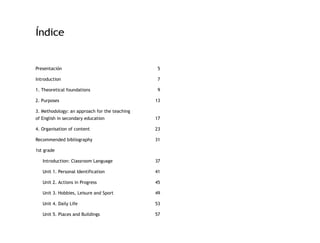
Índice


Presentación                                    5

Introduction                                    7

1. Theoretical foundations                     9

2. Purposes                                    13

3. Methodology: an approach for the teaching
of English in secondary education              17

4. Organisation of content                     23

Recommended bibliography                       31

1st grade

   Introduction: Classroom Language            37

   Unit 1. Personal Identification             41

   Unit 2. Actions in Progress                 45

   Unit 3. Hobbies, Leisure and Sport          49

   Unit 4. Daily Life                          53

   Unit 5. Places and Buildings                57
2nd grade

   Unit 1. People and Animals        65

   Unit 2. Health and the Body       69

   Unit 3. Shopping and Clothes      73

   Unit 4. House and Home            77

   Unit 5. Past Times                81

3rd grade

   Unit 1. Memories                  89

   Unit 2. Rules and Regulations     93

   Unit 3. Food and Drink            97

   Unit 4. Planning Holidays        101

   Unit 5. Life in the Future       105

Introducción                        111

1. Fundamentación                   113

2. Propósitos                       117

3. Enfoque                          121

4. Organización de los contenidos   127

Bibliografía sugerida               135
Presentación


    En la actualidad, la educación secundaria atiende aproximadamente a cinco millones setecientos mil alum-
    nos, en casi treinta mil escuelas donde trabajan cerca de trescientos mil maestros. La escuela secundaria es,
    desde 1993, el último tramo de la educación básica obligatoria para todos los mexicanos; sin embargo, a
    pesar de los avances de la última década, aún estamos lejos de lograr que todos los adolescentes ingresen,
    permanezcan y concluyan satisfactoriamente este nivel de estudios. Otros datos que hablan de la necesi-
    dad de ofrecer una mejor educación son: alrededor de un millón de jóvenes de entre 12 y 15 años de edad
    están fuera de la escuela; además, cerca de 25% de los alumnos que ingresan a la secundaria no la conclu-
    yen; a esto se agregan los resultados de diversas evaluaciones, donde se evidencia que no se están alcanzan-
    do los propósitos educativos de este nivel.
      Frente a tal deuda social, en el Programa Nacional de Educación 2001-2006, el gobierno federal plan-
    teó la necesidad de reformar la educación secundaria. En dicho documento se expresan con claridad los
    retos que enfrenta la escuela secundaria y los propósitos que se busca alcanzar mediante su reforma.
       Para cumplir con este compromiso, desde 2002 la Secretaría de Educación Pública se dio a la tarea de
    convocar a diversos interlocutores, con el fin de que juntos construyeran una propuesta de cambio para la
    educación secundaria de nuestro país. Así, en un ejercicio participativo, autoridades educativas de
    todos los estados, académicos e investigadores con distintas especialidades, profesores y directivos de escue-
    las secundarias, además de instituciones interesadas en el ámbito educativo, se han sumado al esfuerzo
    de definición del nuevo proyecto para la educación secundaria.
     Si bien la propuesta de Reforma Integral de la Educación Secundaria (RIES) considera indispensable
    modificar diversos ámbitos del sistema y de las escuelas, es innegable el papel central que juega el currículo


                                                                                                                     5
como elemento articulador de la vida escolar. El cambio de dicho currículo se plantea, entonces, como un
    elemento fundamental para transformar la organización y el funcionamiento de la escuela.
      El documento que tiene en sus manos es resultado del trabajo de un gran número de personas, quienes
    durante casi tres años han discutido y reflexionado sobre el currículo que debe ofrecer la educación
    secundaria, acorde con las necesidades de los estudiantes mexicanos, para formarlos como futuros ciuda-
    danos que actúen de manera responsable en una sociedad en permanente cambio. Ahora, a este esfuerzo
    se suman las comunidades educativas de cerca de 150 escuelas del país, donde se implementarán los
    nuevos programas de estudio. El resultado de esta primera etapa permitirá, sin duda, obtener informa-
    ción relevante para modificar y enriquecer los programas propuestos.
      Existe pleno convencimiento de que transformar la escuela secundaria, sólo puede realizarse con la
    participación de todos. Un gran número de experiencias muestran que el éxito o fracaso de las reformas
    en educación dependen, en buena medida, de que los actores involucrados en el proceso tengan una
    comprensión común de sus propósitos y se vean a sí mismos trabajando para su consecución. Asimismo,
    ser parte de un proyecto de cambio también puede ser una experiencia altamente satisfactoria y prove-
    chosa para las escuelas. Alrededor de la idea del cambio se asocian aspectos como el optimismo y la
    esperanza por hacer que nuestras escuelas sean espacios que acojan de mejor manera a los estudiantes, se
    comprometan seriamente con su aprendizaje y, por ello, ofrecerles la posibilidad de una vida mejor.
       La Secretaría de Educación Pública agradece a los profesores y los directivos de las escuelas que parti-
    cipan en la primera etapa de implementación, el haber aceptado el reto de incorporarse a esta experien-
    cia, con la seguridad de que su esfuerzo y su compromiso serán en beneficio de nuestros alumnos, futuro
    de México y razón de ser de la educación.
                                                                             Secretaría de Educación Pública


6
Introduction
Background to the programme


 T         he English language curriculum implemented in
           1993 (PPE 1993) constituted an important step
           forward regarding the way language teaching was
conceived in basic education. Attention shifted from structure
                                                                 and false clarities amongst teachers; changes do not seem to
                                                                 have been well assimilated. An example of this can be seen
                                                                 in teachers’ most ‘common practices’: reading aloud, translating,
                                                                 making lists of vocabulary, repeating in chorus, amongst
and translation, and began to concentrate more heavily on        others, all of which are very distant from what is suggested
communication. However, a change at the conceptual level         in the PPE 1993.
is not enough to have an impact on the classroom. True change       Finally, the lack of precise standards regarding the language
is change in practice, one that reflects a clear and coherent    level teachers needed to implement the PPE 1993, together
relationship between beliefs and behaviour while in action.      with the lack of mechanisms to guarantee a minimum level
An exploratory study conducted during 2001–2002 in over 100      of achievement for students upon completion of secondary
state secondary schools in Mexico showed that little “change     education, limited the quality of foreign language learning
in practice” has occurred since 1993.                            and teaching.
  The analysis of the PPE 1993 in actual practice raised some       Nevertheless, the PPE 1993 laid strong foundations on which
issues, which have, to some extent, guided the process of        a more solid curriculum can be built. Thus, it is not necessary
curricular innovation. First, and perhaps most important, is     to change all that has been done. Rather, the curriculum needs
the fact that the programme did not achieve its aims: students   to be innovated. It is necessary to refine and extend the
who complete secondary education cannot communicate in           purposes and evaluation areas, with reference to what is
English, and they rarely develop other non-linguistic skills.    reasonably possible in the Mexican context, but also
  Second, a lack of appropriate means for the diffusion and      considering international standards of achievement. This has
implementation of the approach caused misunderstandings          implied defining the teaching and language skills that teachers


                                                                                                                              7
need in order to implement this programme, which will in           mean looking ‘outside’ for an ‘ideal methodology’ that can
turn provide the basis for pre- and in-service teacher education   be imported and put into practice. Rather, it means looking
programmes.                                                        ‘inside’: looking at our classrooms and our teachers in order
   Similarly, it has been necessary to carefully consider and      to develop a methodology that is appropriate to our context,
describe methodology, i.e. how we want teachers to teach           and enrich that with knowledge gained from research in
and students to learn, and the conditions necessary for            education and language teaching.
teaching and learning to be effective. This process does not


  8
1. Theoretical foundations


1.1. The object of study
For a long time the object of study in language courses has        viewpoint, using language efficiently means being able to
been the language system itself. Descriptions of language that     interact with others through the production and interpretation
come from linguistics (traditional and transformational-           of oral and written texts in order to participate in society.
generative grammars, structural, functional and discourse             Therefore, in this programme the learning of a foreign
analysis, and the like) have found their pedagogical translation   language focuses on what it is that expert language users do
in the teaching of specific language areas (e.g. the elements      in order to and when interpreting and producing oral and
of a sentence, text analysis, etc.). These descriptions,           written texts, preserving the social function of such acts. In
together with how the learning process is conceived (as habit      other words, the object of study of this foreign language course
formation, as acquisition of rules, as active processing of        is the social practices of language.
information, as an emotional experience) have resulted in             Conceptualising the object of study in this way faces us
a variety of methods and approaches for the teaching of a          with important challenges. For pedagogical reasons, language
foreign language. In the case of teaching English, these have      has been traditionally fragmented into parts that were studied
gone from the grammar translation method to communicative          and practised in isolation, with the underlying belief that by
approaches.                                                        studying the parts of the system a student would be able to
   This programme has adopted a different view of language and,    ‘recreate the complete picture’. Having social practices of
therefore, a different view of what teaching language means.       the language as the object of study implied making a different
A fundamental premise is that language is a complex object         selection of contents and organising them in different ways.
that serves not only communicative, but also cognitive and         Thus, the dominant division of language into four skills has
reflection purposes, whereby an individual comprehends the         not been adopted. Instead, the focus is on the practices
world and integrates him/herself into society. From this           needed to produce and interpret oral and written texts.


                                                                                                                               9
1.2. The notion of learning                                                    between what is known and what is currently being experienced.
Experiential learning is a pedagogical conceptualisation of                    When faced with new situations, ‘equilibration’ is broken and
human learning (from a cognitive viewpoint) from which a                       individuals experience ‘cognitive conflict’. In their need to
variety of methodologies and tasks can be derived. It is not                   adapt to the new situation individuals follow two processes:
a term that can be applied to a series of tasks and activities                 ‘accommodation’ (adjusting to new information), and
for the classroom, nor to a method to be followed by teachers                  ‘assimilation’ (incorporating new information into existing
and students.                                                                  knowledge).
   Experiential learning is based on the notion of the constructive              Thus, immediate personal experience is the focal point of
nature of learning, that is, that every individual is constantly               learning, but it is not enough on its own. Experience needs to
and actively involved in making sense of the world by                          be processed consciously by reflecting on it. Experiential
constructing (or reconstructing) meaning from the                              learning is thus conceived as a cyclic process of integrating

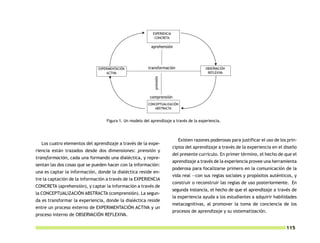
interpretation of personal experiences. This view holds that                   immediate experience, reflection, abstract conceptualisation
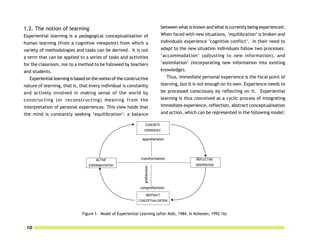
the mind is constantly seeking ‘equilibration’: a balance                      and action, which can be represented in the following model:

                                                                  CONCRETE
                                                                 EXPERIENCE

                                                                apprehension


                                      ACTIVE                   transformation                   REFLECTIVE
                                  EXPERIMENTATION                                               OBSERVATION
                                                                 prehension


                                                               comprehension
                                                                    ABSTRACT
                                                              CONCEPTUALIZATION


                               Figure 1. Model of Experiential Learning (after Kolb, 1984, in Kohonen, 1992:16)

 10
The four elements of experiential learning are drawn from       its social rules and true purposes, and construct or reconstruct
two dimensions: prehension and transformation, each of which       rules of use later. Second, that experiential learning can help
forms a dialectic, and represent the two things that can be        learners to acquire skills for the construction of knowledge
done with information: One is to grasp the information, where      (learning how to learn), by raising an awareness of the learning
the dialectic lies between grasping information through            processes that they follow, and by systematising these
C O N C R E T E E X P E R I E N C E (apprehension), and grasping   processes. Finally, experiential learning seeks to develop
information      through     ABSTRACT     CONCEPTUALISATION        individuals who are competent, who have initiative, sensitivity
(comprehension). The second is to transform the experience,        to others, and awareness of practical realities, as well as
where the dialectic lies between an external process of            sufficient confidence, insight, skill and flexibility to act effectively
ACTIVE EXPERIMENTATION and an internal process of REFLECTIVE       in a changing world, thus promoting personal growth. This
OBSERVATION.                                                       illustrates how learning a foreign language contributes to
   There are other powerful reasons to justify the use of          achieving the characteristics desirable of students who
experiential learning principles in the design of the present      complete basic education, as described in the Perfil de
curriculum. First, the fact that, experiential learning provides   egreso.
a powerful tool to focus on real life communication first with


                                                                                                                                      11
2. Purposes


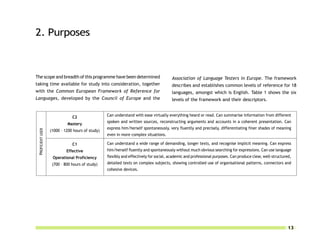
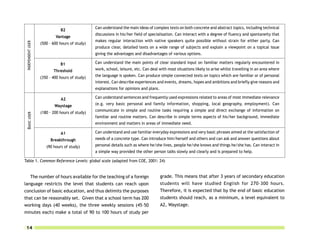
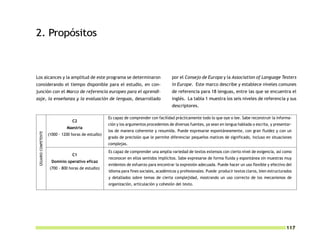
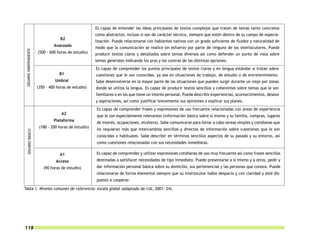
The scope and breadth of this programme have been determined                            Association of Language Testers in Europe. The framework
taking time available for study into consideration, together                            describes and establishes common levels of reference for 18
with the Common European Framework of Reference for                                     languages, amongst which is English. Table 1 shows the six
Languages, developed by the Council of Europe and the                                   levels of the framework and their descriptors.


                               C2                 Can understand with ease virtually everything heard or read. Can summarise information from different
                                                  spoken and written sources, reconstructing arguments and accounts in a coherent presentation. Can
                            Mastery
                                                  express him/herself spontaneously, very fluently and precisely, differentiating finer shades of meaning
 PROFICIENT USER


                   (1000 – 1200 hours of study)
                                                  even in more complex situations.

                               C1                 Can understand a wide range of demanding, longer texts, and recognise implicit meaning. Can express
                            Effective             him/herself fluently and spontaneously without much obvious searching for expressions. Can use language
                    Operational Proficiency       flexibly and effectively for social, academic and professional purposes. Can produce clear, well-structured,
                    (700 – 800 hours of study)    detailed texts on complex subjects, showing controlled use of organisational patterns, connectors and
                                                  cohesive devices.


                                                                                                                                                            13
Can understand the main ideas of complex texts on both concrete and abstract topics, including technical
                               B2
                                                 discussions in his/her field of specialisation. Can interact with a degree of fluency and spontaneity that
                            Vantage
                                                 makes regular interaction with native speakers quite possible without strain for either party. Can
 INDEPENDENT USER


                    (500 – 600 hours of study)
                                                 produce clear, detailed texts on a wide range of subjects and explain a viewpoint on a topical issue
                                                 giving the advantages and disadvantages of various options.

                               B1                Can understand the main points of clear standard input on familiar matters regularly encountered in
                           Threshold             work, school, leisure, etc. Can deal with most situations likely to arise whilst travelling in an area where

                    (350 – 400 hours of study)   the language is spoken. Can produce simple connected texts on topics which are familiar or of personal
                                                 interest. Can describe experiences and events, dreams, hopes and ambitions and briefly give reasons and
                                                 explanations for opinions and plans.

                               A2                Can understand sentences and frequently used expressions related to areas of most immediate relevance

                            Waystage             (e.g. very basic personal and family information, shopping, local geography, employment). Can
                                                 communicate in simple and routine tasks requiring a simple and direct exchange of information on
                    (180 – 200 hours of study)
 BASIC USER


                                                 familiar and routine matters. Can describe in simple terms aspects of his/her background, immediate
                                                 environment and matters in areas of immediate need.

                               A1                Can understand and use familiar everyday expressions and very basic phrases aimed at the satisfaction of
                         Breakthrough            needs of a concrete type. Can introduce him/herself and others and can ask and answer questions about
                       (90 hours of study)       personal details such as where he/she lives, people he/she knows and things he/she has. Can interact in
                                                 a simple way provided the other person talks slowly and clearly and is prepared to help.

Table 1. Common Reference Levels: global scale (adapted from COE, 2001: 24)


            The number of hours available for the teaching of a foreign                 grade. This means that after 3 years of secondary education
language restricts the level that students can reach upon                               students will have studied English for 270–300 hours.
conclusion of basic education, and thus delimits the purposes                           Therefore, it is expected that by the end of basic education
that can be reasonably set. Given that a school term has 200                            students should reach, as a minimum, a level equivalent to
working days (40 weeks), the three weekly sessions (45–50                               A2, Waystage.
minutes each) make a total of 90 to 100 hours of study per


14
It is important to mention that this programme is aimed at       2.1. General purpose of language teaching
students with no prior study of English, but who are already        in basic education
competent users of their mother tongue. This means that             The purpose of teaching language in basic education is that
students arrive in secondary school equipped with solid             students gain ownership of diverse social practices of the
knowledge of how a language works and with a variety of             language and participate effectively in their life in and out of
skills that can be transferred to and exploited in foreign          school. For that purpose, it is essential that they learn to use
language learning.                                                  language to organise their thought and discourse, to analyse
   It must also be said that, for a number of reasons, there is     and solve problems, and to have access to different present
a great social demand for Mexican children and adolescents          and past cultural expressions. In addition, it is necessary that
to learn English. Interesting and successful efforts have been      students acknowledge the role of language in the construction
made in some states in order to introduce English at the            of knowledge and cultural values, and develop an analytical
primary level. However, under present circumstances, it is          and responsible attitude towards the problems of the world.
not possible to provide all children with such service. At the            Ownership of social practices of the language is not
moment, the priority and immediate challenge is that all            achieved through simple practice and over time. On the
students in secondary education receive English lessons of a high   contrary, it demands a series of individual and group
quality. However, for states where English is taught in primary     experiences that involve different ways of reading and
school, the framework can be a useful tool to describe              interpreting texts, of approaching writing and becoming
expected levels of achievement, and to adapt the secondary          involved in oral exchanges and analysing them. School must
programme to the needs and demands of those students who            provide the conditions necessary for students to participate
enter secondary school with some knowledge of English.              in such experiences and gradually achieve autonomy in their
   Similarly, the framework also helps to establish the             intellectual work. The responsibility of school is greater with
minimum level of English that teachers should have in order         students who come from communities with less schooling and/
to be able to handle the present curriculum appropriately.          or lower levels of literacy.
Considering that for many students, the teacher will represent
their first/only contact with an English speaker, it is necessary
that, at the very least, teachers are competent to a B1 level,
Threshold.


                                                                                                                               15
2.2. Purpose of teaching English in secondary                   native speakers of English. In other words, through the
education                                                       production and interpretation of a variety of spoken and
The purpose of studying a foreign language (English) in         written texts —of a quotidian, academic and literary nature—,
secondary education is for students to participate in certain   students will be able to satisfy basic communication needs in
social practices of language, both oral and written, in their   a range of familiar situations.
own or in a foreign country in contact with native and non-


16
ultimate goal of achieving learning. For that purpose,
3. Methodology: an                                                     the teacher needs to understand the essence of the
                                                                       object of study and plan teacher intervention in
approach for the teaching                                              congruence with it. Thus, in this programme, the teacher

of English in secondary                                                needs to plan lessons and activities in which the
                                                                       characteristics of social practices are preserved, and
education                                                              in which there are enough opportunities for students
                                                                       to participate in and reflect upon the social practices
                                                                       of the language.
                                                                     • Organise the learning environment
3.1. Role of teachers and learners
                                                                       Teaching implies a series of organisation tasks. The
In the present curriculum, the student is considered to be an
                                                                       teacher needs to determine how to optimally arrange
active constructor of knowledge. The teacher, on the other
                                                                       and rearrange the physical space in which learning is
hand, is conceptualised as a more experienced language user,
                                                                       to happen (i.e. define seating arrangements, teacher
who is in charge of creating the conditions for students to
                                                                       position, etc.) over a single lesson and throughout a
approach language, and of guiding the process. The teacher
                                                                       school term. Similarly, the teacher needs to decide on
is thus responsible for establishing a dialogue with students
                                                                       the best way to exploit any material resources available
about and through texts, so that learners become effective
                                                                       (e.g. the board, audio-visual aids, worksheets, computers,
participants of an English speaking community: the classroom.
                                                                       coursebooks, etc.) so that they aid learning.
   If, as said earlier, the learning of a foreign language means
                                                                     • Interact and promote interaction
learning what it is that expert language users do in order to
                                                                       Interaction is fundamental to learning. It is the
and when interpreting and producing texts within a social context,
                                                                       teacher’s responsibility to establish and encourage
then teaching towards that aim implies analysing what expert
                                                                       respectful and purposeful interactions with students,
teachers do to promote such learning. From this perspective,
                                                                       among students and between students and language.
expert and effective teachers are those who:
                                                                     • Evaluate students’ achievement and their own
     • Plan teaching
                                                                       performance
       Language teaching is a dynamic social event in which
       the teacher, learners and content interact with the

                                                                                                                            17
Often times evaluation is conceived as a one-way             reflective observation of language, which means that students
       process in which the teacher determines the extent to        themselves must try to make sense of how language works. By
       which learners have reached certain goals. It is important   doing so, students move to a stage of abstract conceptualisation,
       to understand that evaluation is in fact a mechanism to      in which they make generalisations about language. The teacher
       obtain information about student achievement, but at         should seek to promote and guide reflection, and redirect it
       the same time, it is a source of information for the         when necessary.
       teacher to learn about his/her own performance.                 The following part of the process consists in having students
                                                                    use language through tasks that move from control to freedom.
3.1.1. Methodology framework                                        Examples of the productions that are expected from students
Based on the model of experiential learning which was               are described in the SAMPLE PRODUCTIONS section. Indicators
previously defined, a methodology framework was designed            of PERFORMANCE EVIDENCE that correspond to the production of
in order to provide an answer to the question of how we want        texts (SPEAKING and WRITING) describe what students do to
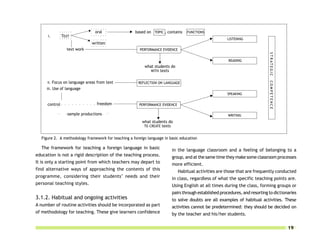
teachers to teach and students to learn. The framework helps        create texts. This is a stage of active experimentation, in
to illustrate how the teaching process is conceptualised in         which students should have the opportunity to test their
this programme, and how this conception is expressed in the         hypothesis about how language works.
different sections of each thematic unit.                              Due to the fact that students’ command of the language is
   The process begins with exposing students to a TEXT, which       limited, they may experience a number of difficulties at any
can be oral or written, which is based on the TOPIC of the          point of the processes of interpreting and producing texts.
unit, and which contains the language FUNCTIONS established         Indicators of STRATEGIC COMPETENCE describe strategies that
for that unit. Indicators of PERFORMANCE EVIDENCE that              students should develop in order to compensate for their lack
correspond to interpretation of texts (LISTENING or READING)        of language. These strategies should gradually move from non-
describe text work, i.e. what students do with texts. This is a     verbal to verbal in response to better knowledge of the
stage of concrete experience with a text.                           language.
   The teacher then selects from the text specific language
areas to focus on. The points for language awareness in every
unit are described under reflection on language. It is important
to mention that this is a stage for students to conduct


 18
oral               based on TOPIC , contains    FUNCTIONS
      I.           TEXT
                                                                                                                                     LISTENING
                                                            written
                               text work                                              PERFORMANCE EVIDENCE


                                                                                                                                                           S T R AT E G I C
                                                                                                   •
                                                                                                   •
                                                                                                   •
                                                                                                   •
                                                                                                   •                                  READING
                                                                                        what students do
                                                                                           WITH texts


     II. Focus on language areas from text


                                                                                                                                                           COMPETENCE
                                                                                     REFLECTION ON LANGUAGE
     III. Use of language
                                                                                                                                     SPEAKING


     control       ○   ○        ○   ○   ○   ○   ○   ○   ○    ○
                                                                 freedom              PERFORMANCE EVIDENCE
                                                                                ○
           ○


                                                                                               •
                                                                                               •
                                                                                               •
                               sample productions
                                                                                ○


                                                                                               •
           ○


                                                                                                                                      WRITING
               ○           ○                                            ○   ○


                                                                                               •

                                                                                       what students do
                                                                                        TO CREATE texts


  Figure 2. A methodology framework for teaching a foreign language in basic education

  The framework for teaching a foreign language in basic                                               in the language classroom and a feeling of belonging to a
education is not a rigid description of the teaching process.                                          group, and at the same time they make some classroom processes
It is only a starting point from which teachers may depart to                                          more efficient.
find alternative ways of approaching the contents of this                                                    Habitual activities are those that are frequently conducted
programme, considering their students’ needs and their                                                 in class, regardless of what the specific teaching points are.
personal teaching styles.                                                                              Using English at all times during the class, forming groups or
                                                                                                       pairs through established procedures, and resorting to dictionaries
3.1.2. Habitual and ongoing activities                                                                 to solve doubts are all examples of habitual activities. These
A number of routine activities should be incorporated as part                                          activities cannot be predetermined: they should be decided on
of methodology for teaching. These give learners confidence                                            by the teacher and his/her students.

                                                                                                                                                                              19
Ongoing activities are longer projects that the teacher and       information about the learning process. Evaluation can help
learners engage in so as to extend language practice and to          the student to identify what he/she has learnt over a period
consolidate the sense of group. In agreement with students,          of time, and what he/she still needs to work on. For teachers,
the teacher could decide to produce a school newspaper, to           evaluation may serve to reflect upon teaching practice and
read a book in English, to research into a specific topic, etc.      trigger innovation. In addition, evaluation responds to the
Some time should be put aside every week for the development         institutional demand of certifying educational results and
of these activities.                                                 assigning grades to students with regard to the extent to which
                                                                     they achieve particular objectives.
3.2. Role of materials                                                   Evaluation is a central element of the curriculum, which
Materials play a significant role in this programme. As may be       has the power of altering purposes and methodology. In other
inferred from the proposed methodology for teaching, the             words, what is evaluated will become the focus of attention
quality of the texts (oral and written) to which students are        for both students and teachers; and how evaluation is
exposed will heavily influence students’ production. Although        conducted will determine the ways in which teachers and
authentic texts are ideal, these are not always available to         learners interact in the classroom.
teachers. For that reason, it is essential that texts designed           Given the characteristics of the object of study of this
for teaching purposes reflect the characteristics of real-life       programme, evaluation needs to concentrate on the processes
texts: they are purposeful, contextualised, and present authentic    followed for the interpretation/production of texts, as well
models of language.                                                  as on the products. Thus, evaluation cannot be an isolated
   In addition, it must be remembered that task authenticity         event that occurs at the end of a teaching period. Rather, it
is equally important, if not more, than text authenticity. If        needs to be an ongoing series of actions through which
learners are to be successful participants of the social practices   information about teaching and learning is collected. In the
of the language, it is fundamental that they engage in tasks         following sections some of the ways in which information may
that mirror the real world.                                          be gathered for student and teacher assessment are described.
                                                                     1
                                                                      In the literature on English language teaching, a distinction between
                   1
3.3. Evaluation                                                      evaluation (of more general processes) and assessment (of learners)
Evaluation is a process through which all the parties involved       is often made. Since it is the second case that this document is
in education —teachers, students, parents, etc.— obtain              concerned with, the terms evaluation and assessment will be used
                                                                     interchangeably.

 20
3.3.1. Evaluation of learning                                             for students to have control over their portfolios and
For some time, tests have been perhaps the only way of                   responsibility for deciding what is included in them.
gathering information for the evaluation of students. Tests          This programme holds that the more varied the ways in
are usually practical and economical tools to collect data,        which information is gathered, the closer the teacher will be
but are not always easy to design. If tests need be used,          to having a real picture of individual’s achievements.
teachers may resort to ready-made tests or design them             Therefore, every thematic unit in the programme provides
themselves. In the second situation, teachers must concentrate     some suggestions for collecting information in different ways.
on producing tests of an appropriate kind (e.g. diagnostic/
prognostic, discrete-point/integrative, subjective/objective,      3.3.2. Evaluation of teaching
etc.), that are valid and reliable, and that make use of           Assessing teaching is essential to improving the teaching and
appropriate elicitation techniques (e.g. questions and             learning processes. Like with student evaluation, teachers can
answers, true/false statements, matching, cloze, etc.).            gather information about their practice from a variety of
  In addition to tests, there are at least another four sources    sources:
that can be used in order to gather information:                       a) Teachers can receive feedback from students in more
    a) Teachers’ assessment. This is a subjective estimate of             or less structured ways (from formal questionnaires to
       students’ performance.                                             casual chats).
    b) Continuous assessment. This is a process of combining           b) Teachers can obtain information through personal
       grades that students receive for individual assignments            reflection on teaching practice, which should preferably
       during a period of time in order to produce an overall             be structured (e.g. recording a lesson or noting down
       grade.                                                             the details of a class) to allow the teacher to focus on
    c) Self- and peer-assessment. This consists of learners               specific areas.
       evaluating their own performance or that of their               c) Teachers can receive feedback from colleagues who
       peers, using clearly established criteria which have               are willing to observe lessons, to be observed and to
       been previously agreed on.                                         share feedback respectfully. An important element of
    d) Portfolio. This is a process in which learners collect             this process is to agree on areas that need attention
       and file different assignments produced over a period              before observation actually takes place so that there
       of time as evidence of their performance. It is important          is a clear focus.


                                                                                                                             21
Teacher evaluation, as described above, has the intention
of raising the quality of teaching for the benefit of learners.
In addition, teacher evaluation can also have an important
effect on teachers’ personal and professional development.


 22
4. Organisation of content


As mentioned earlier, conceptualising the object of study as            complete the three-year programme of English as a foreign
social practices of the language implied a new selection and            language in basic education will participate in communication:
organisation of contents. The object of study demanded that                 • Can use knowledge of the world and specific strategies
two levels of central content were established, namely:                        to get the gist and some detail from a variety of spoken
    a) the participation in a variety of communicative situations              and written texts.
       for the interpretation and production of texts; and                  • Can respond to simple spoken or written language in
    b) the specific linguistic contents, stated in terms of functions          linguistic and non-linguistic ways.
     of the language.                                                       • Can use verbal and non-verbal strategies to plan,
  The former refers to experiencing the actions that expert                    initiate and/or intervene in oral exchanges.
language users do in order to interpret and produce oral and                • Can engage in communication, recognise breakdowns
written texts, while the latter refers to the specific language                and use repair strategies as needed.
needed for effective interpretation/production of such texts.               • Can adjust language and pronunciation to produce
  The descriptors of level A2 of the Common European                           intelligible messages.
Framework of Reference for Languages were used to create                    • Can use strategies to deal with unfamiliar words.
more detailed descriptions of the two levels of contents of                 • Can look for cohesive devices to understand relations
this programme. A list of statements of what students can do                   between parts of a text.
to participate in communication acts for the interpretation                 • Can form and justify an opinion towards a text.
and production of texts was developed. Below is the list, which             • Can use strategies to recognise format and understand
describes the ways in which students who successfully                          content of simple literary texts.


                                                                                                                                  23
• Can use reading strategies to search for specific             As regards the participation in social practices of the
       information and understand a variety of simple academic     language, by the end of secondary education, students will
       texts.                                                      have engaged in three main types of such practices:
     • Can use reading strategies to understand and deal with          • Carrying out certain basic transactions, such as buying
       a variety of simple quotidian texts.                              and selling items or ordering food.
     • Can plan effective texts of a personal, creative, social,       • Giving and obtaining factual information of a personal
       study and institutional nature.                                   (name, age, interests) and non-personal kind (dates,
     • Can produce coherent texts of a personal, creative,               places, times).
       social, study and institutional nature.                         • Establishing and maintain social contacts by exchanging
     • Can edit own or peers’ texts of a personal, creative,             information, views, feelings and personal wishes,
       social, study and institutional nature.                           amongst others.
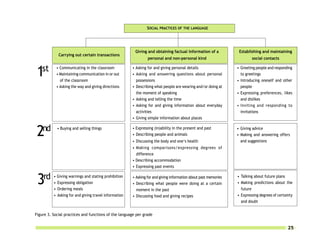
     • Can use grammatical, spelling and mechanical conventions      In order to participate in the above mentioned practices
       for the production of written texts.                        successfully, students need to know a number of language
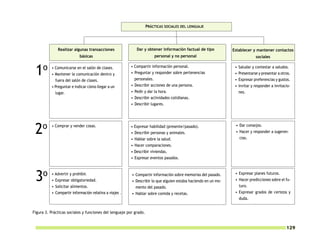
                                                                   functions, which are detailed in Figure 3.


24
SOCIAL PRACTICES OF THE LANGUAGE


                                                        Giving and obtaining factual information of a             Establishing and maintaining
             Carrying out certain transactions
                                                                personal and non-personal kind                           social contacts

    st
 1          • Communicating in the classroom
            • Maintaining communication in or out
              of the classroom
                                                       • Asking for and giving personal details
                                                       • Asking and answering questions about personal
                                                         possessions
                                                                                                                 • Greeting people and responding
                                                                                                                   to greetings
                                                                                                                 • Introducing oneself and other
            • Asking the way and giving directions     • Describing what people are wearing and/or doing at        people
                                                         the moment of speaking                                  • Expressing preferences, likes
                                                       • Asking and telling the time                               and dislikes
                                                       • Asking for and giving information about everyday        • Inviting and responding to
                                                         activities                                                invitations
                                                       • Giving simple information about places

    nd
 2          • Buying and selling things                • Expressing (in)ability in the present and past
                                                       • Describing people and animals
                                                       • Discussing the body and one’s health
                                                                                                                 • Giving advice
                                                                                                                 • Making and answering offers
                                                                                                                   and suggestions
                                                       • Making comparisons/expressing degrees of
                                                         difference
                                                       • Describing accommodation
                                                       • Expressing past events

    rd
 3        • Giving warnings and stating prohibition
          • Expressing obligation
          • Ordering meals
                                                       • Asking for and giving information about past memories
                                                       • Describing what people were doing at a certain
                                                         moment in the past
                                                                                                                 • Talking about future plans
                                                                                                                 • Making predictions about the
                                                                                                                   future
          • Asking for and giving travel information   • Discussing food and giving recipes                      • Expressing degrees of certainty
                                                                                                                   and doubt


Figure 3. Social practices and functions of the language per grade


                                                                                                                                               25
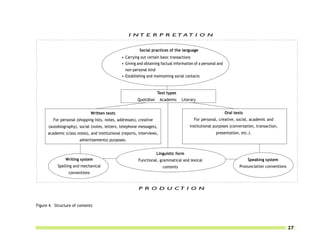
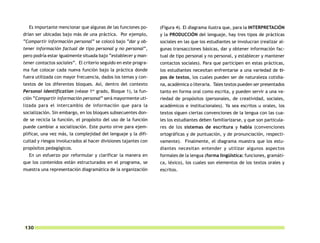
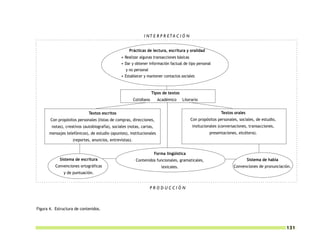
It is important to mention that some of the functions could     of this organisation is presented below (Figure 4). The diagram
be placed under more than one practice. For instance, “asking     illustrates that, for the INTERPRETATION and PRODUCTION of
for and giving personal details” was located within “giving       language, there are three types of social practices in which
and obtaining factual information of a personal kind”, but it     students engage (carrying out certain basic transactions, giving
could equally be placed under “establishing and maintaining       and obtaining factual information of a personal and non-
social contacts”. The criterion followed in the programme         personal kind, and establishing and maintaining social
was to place every new function under the practice where it       contacts). In order to participate in those practices, students
would more frequently be used, given the topics and contexts      need to face a variety of text types which can be of a quotidian,
of the different units. Thus, in the context of Personal          academic or literary nature. Such texts can be presented both
identification (see 1st grade, Unit 1), the function “asking      in writing and orally, and serve a variety of purposes (personal,
for and giving personal details” would be used more for the       creative, social, academic and institutional ones). Either written
exchange of information, rather than for socialisation.           or oral, texts follow certain conventions of the language with
However, in further units where the function is recycled, the     which students need to become familiar, and which are particular
purpose of use may change to socialisation. This issue serves     to the writing and speaking systems (spelling and mechanics,
to exemplify, once again, the complexity of language and the      and pronunciation, respectively). Finally, the diagram shows
difficulty and risks involved in making clear-cut divisions for   that students need to understand and use some formal aspects
pedagogical purposes.                                             of the language (linguistic form: functions, grammar and lexis),
  In an effort to rephrase and clarify how contents are           which are constituent elements of oral and written texts.
structured in the programme, a diagrammatic representation


 26
I NT E R P R ET AT I O N


                                                          Social practices of the language
                                                • Carrying out certain basic transactions
                                                • Giving and obtaining factual information of a personal and
                                                  non-personal kind
                                                • Establishing and maintaining social contacts


                                                                     Text types
                                                         Quotidian      Academic    Literary


                               Written texts                                                                   Oral texts
         For personal (shopping lists, notes, addresses), creative                         For personal, creative, social, academic and
      (autobiography), social (notes, letters, telephone messages),                     institutional purposes (conversation, transaction,
      academic (class notes), and institutional (reports, interviews,                                   presentation, etc.).
                        advertisements) purposes.


                                                                     Linguistic form
                Writing system                           Functional, grammatical and lexical                                Speaking system
           Spelling and mechanical                                       contents                                      Pronunciation conventions
                 conventions


                                                          P R O D U CT I O N


Figure 4. Structure of contents


                                                                                                                                                   27
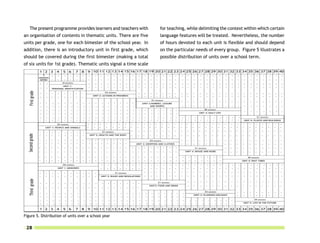
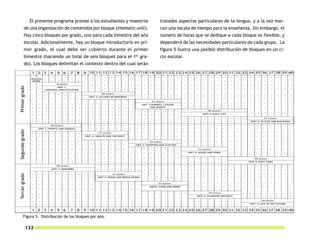
The present programme provides learners and teachers with      for teaching, while delimiting the context within which certain
an organisation of contents in thematic units. There are five     language features will be treated. Nevertheless, the number
units per grade, one for each bimester of the school year. In     of hours devoted to each unit is flexible and should depend
addition, there is an introductory unit in first grade, which     on the particular needs of every group. Figure 5 illustrates a
should be covered during the first bimester (making a total       possible distribution of units over a school term.
of six units for 1st grade). Thematic units signal a time scale


Figure 5. Distribution of units over a school year

 28
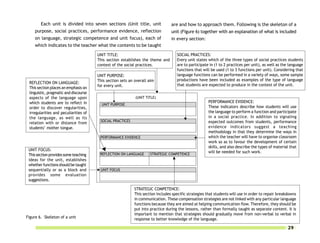
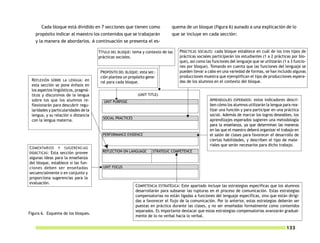
Each unit is divided into seven sections (Unit title, unit              are and how to approach them. Following is the skeleton of a
    purpose, social practices, performance evidence, reflection                 unit (Figure 6) together with an explanation of what is included
    on language, strategic competence and unit focus), each of                  in every section:
    which indicates to the teacher what the contents to be taught

                                       UNIT TITLE:                                 SOCIAL PRACTICES:
                                       This section establishes the theme and      Every unit states which of the three types of social practices students
                                       context of the social practices.            are to participate in (1 to 2 practices per unit), as well as the language
                                                                                   functions that will be used (1 to 3 functions per unit). Considering that
                                       UNIT PURPOSE:                               language functions can be performed in a variety of ways, some sample
                                       This section sets an overall aim            productions have been included as examples of the type of language
 REFLECTION ON LANGUAGE:
                                       for every unit.                             that students are expected to produce in the context of the unit.
 This section places an emphasis on
 linguistic, pragmatic and discourse
 aspects of the language upon                               (UNIT TITLE)
 which students are to reflect in                                                                     PERFORMANCE EVIDENCE:
                                         UNIT PURPOSE
 order to discover regularities,                                                                      These indicators describe how students will use
 irregularities and peculiarities of                                                                  the language to perform a function and participate
 the language, as well as its                                                                         in a social practice. In addition to signaling
                                        SOCIAL PRACTICES                                              expected outcomes from students, performance
 relation with or distance from
 students’ mother tongue.                                                                             evidence indicators suggest a teaching
                                                                                                      methodology in that they determine the ways in
                                        PERFORMANCE EVIDENCE                                          which the teacher will have to organise classroom
                                                                                                      work so as to favour the development of certain
                                                                                                      skills, and also describe the types of material that
 UNIT FOCUS:
                                        REFLECTION ON LANGUAGE      STRATEGIC COMPETENCE
                                                                                                      will be needed for such work.
 This section provides some teaching
 ideas for the unit, establishes
 whether functions should be taught
 sequentially or as a block and          UNIT FOCUS
 provides some evaluation
 suggestions.

                                                           STRATEGIC COMPETENCE:
                                                           This section includes specific strategies that students will use in order to repair breakdowns
                                                           in communication. These compensation strategies are not linked with any particular language
                                                           functions because they are aimed at helping communication flow. Therefore, they should be
                                                           put into practice during the lessons, rather than formally taught as separate content. It is
                                                           important to mention that strategies should gradually move from non-verbal to verbal in
Figure 6. Skeleton of a unit                               response to better knowledge of the language.

                                                                                                                                                    29
Recommended bibliography


Airasian, P. (2000) Assessment in the Classroom. A concise             Kohonen, V. (1992) “Experiential Language Learning: Second
      Approach. Boston: McGraw-Hill.                                         Language Learning as Cooperative Learner Education”. In
Carter, R. and D. Nunan (eds.) (2001) The Cambridge Guide to                 D. Nunan (ed.), Collaborative Language Learning and
      Teaching English to Speakers of Other Languages.                       Teaching. Cambridge: Cambridge University Press.
      Cambridge: Cambridge University Press.                           Kolb, D. (1984) Experiential Learning: Experience as a Source of
COE (2001) The Common European Framework of Reference for                    Learning and Development. Englewood Cliffs: Prentice Hall.
      Languages [on-line] available from: http://culture2.             Lerner, D. (2001) Leer y escribir en la escuela. Mexico: SEP/FCE.
      coe.int/portfolio//documents/0521803136txt.pdf                   Pla, L. and I. Vila (coords.) (1997) Enseñar y aprender inglés en
      Accessed January, 2004.                                                la educación secundaria. Barcelona: Editorial-Gráficas Signo.
Davies, P. and E. Pearse (2000) Success in English Teaching. Oxford:   Richards, J. and W. Renandya (eds.) Methodology in Language
      Oxford University Press.                                               Teaching. Cambridge: Cambridge University Press.
Harmer, J. (2001) The Practice of English Language Teaching.           Ur, P. (1996) A Course in Language Teaching. Cambridge: Cambridge
      Harlow: Pearson Educational Limited.                                   University Press.
Hedge, T. (2000) Teaching and Learning in the Language                 Williams, M. and R. L. Burden (1997) Psychology for Language
      Classroom. Oxford: Oxford University Press.                            Teachers. Cambridge: Cambridge University Press.


                                                                                                                                     31
1ST GRADE
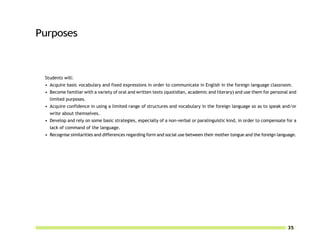
Purposes


 Students will:
 • Acquire basic vocabulary and fixed expressions in order to communicate in English in the foreign language classroom.
 • Become familiar with a variety of oral and written texts (quotidian, academic and literary) and use them for personal and
   limited purposes.
 • Acquire confidence in using a limited range of structures and vocabulary in the foreign language so as to speak and/or
   write about themselves.
 • Develop and rely on some basic strategies, especially of a non-verbal or paralinguistic kind, in order to compensate for a
   lack of command of the language.
 • Recognise similarities and differences regarding form and social use between their mother tongue and the foreign language.


                                                                                                                        35
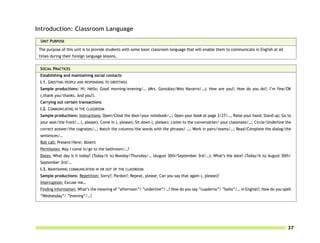
Introduction: Classroom Language

 UNIT PURPOSE

 The purpose of this unit is to provide students with some basic classroom language that will enable them to communicate in English at all
 times during their foreign language lessons.


 SOCIAL PRACTICES
 Establishing and maintaining social contacts
 I.1. GREETING PEOPLE AND RESPONDING TO GREETINGS
 Sample productions: Hi; Hello; Good morning/evening/… (Mrs. González/Miss Navarro/…); How are you?; How do you do?; I’m fine/OK
 (,thank you/thanks. And you?).
 Carrying out certain transactions
 I.2. COMMUNICATING IN THE CLASSROOM
 Sample productions: Instructions: Open/Close the door/your notebook/…; Open your book at page 3/27/…, Raise your hand; Stand up; Go to
 your seat/the front/… (, please); Come in (, please); Sit down (, please); Listen to the conversation/ your classmate/…; Circle/Underline the
 correct answer/the cognates/…; Match the columns/the words with the phrases/ …; Work in pairs/teams/…; Read/Complete the dialog/the
 sentences/…
 Roll call: Present/Here; Absent
 Permission: May I come in/go to the bathroom/…?
 Dates: What day is it today? (Today/It is) Monday/Thursday/… (August 30th/September 3rd/…); What’s the date? (Today/It is) August 30th/
 September 3rd/…
 I.3. MAINTAINING COMMUNICATION IN OR OUT OF THE CLASSROOM
 Sample productions: Repetition: Sorry?; Pardon?; Repeat, please; Can you say that again (, please)?
 Interruption: Excuse me…
 Finding information: What’s the meaning of “afternoon”/ “underline”/…? How do you say “cuaderno”/ “baño”/… in English?; How do you spell
 “Wednesday”/ “evening”/…?


                                                                                                                                             37
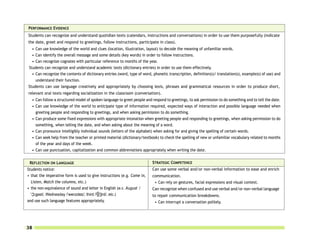
PERFORMANCE EVIDENCE
Students can recognize and understand quotidian texts (calendars, instructions and conversations) in order to use them purposefully (indicate
the date, greet and respond to greetings, follow instructions, participate in class).
   • Can use knowledge of the world and clues (location, illustration, layout) to decode the meaning of unfamiliar words.
   • Can identify the overall message and some details (key words) in order to follow instructions.
   • Can recognize cognates with particular reference to months of the year.
 Students can recognize and understand academic texts (dictionary entries) in order to use them effectively.
   • Can recognize the contents of dictionary entries (word, type of word, phonetic transcription, definition(s)/ translation(s), example(s) of use) and
     understand their function.
Students can use language creatively and appropriately by choosing lexis, phrases and grammatical resources in order to produce short,
relevant oral texts regarding socialization in the classroom (conversation).
  • Can follow a structured model of spoken language to greet people and respond to greetings, to ask permission to do something and to tell the date.
  • Can use knowledge of the world to anticipate type of information required, expected ways of interaction and possible language needed when
    greeting people and responding to greetings, and when asking permission to do something.
  • Can produce some fixed expressions with appropriate intonation when greeting people and responding to greetings, when asking permission to do
    something, when telling the date, and when asking about the meaning of a word.
  • Can pronounce intelligibly individual sounds (letters of the alphabet) when asking for and giving the spelling of certain words.
  • Can seek help from the teacher or printed material (dictionary/textbook) to check the spelling of new or unfamiliar vocabulary related to months
    of the year and days of the week.
  • Can use punctuation, capitalization and common abbreviations appropriately when writing the date.


 REFLECTION ON LANGUAGE                                                    STRATEGIC COMPETENCE
Students notice:                                                           Can use some verbal and/or non-verbal information to ease and enrich
• that the imperative form is used to give instructions (e.g. Come in,     communication.
   Listen, Match the columns, etc.)                                         • Can rely on gestures, facial expressions and visual context.
• the non-equivalence of sound and letter in English (e.c. August /        Can recognize when confused and use verbal and/or non-verbal language
  ’ :g st/, Wednesday /’wenzde /, third /‘ rd/, etc.)                      to repair communication breakdowns.
and use such language features appropriately.                               • Can interrupt a conversation politely.


38
• Can repeat/ask for repetition.
                                                                        • Can ask for/give the spelling/meaning of a word.
                                                                       Can make sense of the organization of reference books (dictionaries,
                                                                       encyclopedias, textbooks) in order to look for help.
                                                                        • Can check the spelling of unfamiliar words.


UNIT FOCUS
From the beginning of the year, students should be exposed to English at all times during the lesson. This implies that the teacher should use
the language continuously, and give students the tools to communicate in English as much as they can. This unit is of utmost importance, as it
will establish the type of work that will be conducted during the three years of secondary education. Therefore, it will be essential to
familiarize students not only with basic classroom language, but also with the patterns of interaction, ONGOING ACTIVITIES AND CLASS ROUTINES,
as well as evaluation tools that will be frequently used.
   The nature of the functions suggests that there should be an emphasis on oral (listening and speaking) work. However, there is an excellent
opportunity to develop reading skills by working with dictionary entries. This is also a way of developing a set of skills that students should be
using during the whole of secondary education. Function I.1 can be taught first and independently during the first two days of classes.
Functions I.2 and I.3 can be taught simultaneously and be integrated with other types of work. For example, it would be a good idea to have
students explore and get to know their textbook (different sections and contents of each section, where to find some information they are
looking for, etc.) and other reference materials (e.g. the dictionary included in the “Biblioteca de Aula”), while practicing following instructions
or finding information.
   Rather than formally evaluating students, this should be an opportunity for the teacher to introduce the different processes through which
students will be assessed. Some time can be devoted to explaining the function of portfolios and to designing one. As a first product, students
could write a reflection (in Spanish) about how they feel in their English class so far and include it in their portfolio.


                                                                                                                                                 39
Unit 1: Personal Identification
 UNIT PURPOSE
 The purpose of this unit is to enable students to introduce themselves and others, and to exchange personal details.


 SOCIAL PRACTICES
 Establishing and maintaining social contacts
   1.1. INTRODUCING ONESELF AND OTHER PEOPLE
   Sample productions: I’m Daniel; He/This is Tony; She/That is Paula; My/Her name is Johanna; He’s an accountant/a taxi
   driver/…; She’s a doctor/an athlete/…; He/She’s 20/13… (years old); I’m from Mexico/ England/...; He/She is Canadian/
   Chinese/…
 Giving and obtaining factual information of a personal and non-personal kind
   1.2. ASKING FOR AND GIVING PERSONAL DETAILS
   Sample productions: What’s your/his name?; (My/His name is) Ana/Samuel; What’s your last name?; (My last name/It is) García; How
      old are you?; (I’m) 12/14/… (years old): Where are they from?; (They’re from) Brazil/The United States/…;They’re Brazilian/American/
      …; What’s your telephone number/e-mail address/ …?; (My telephone number/It is) 11128904; (My e-mail address is)
      secondary_kid@redescolar.org.mx; What’s your occupation?; What do you do?; I’m a student/an engineer/...


 PERFORMANCE EVIDENCE
 Students can recognize and understand quotidian texts (forms, letters/e-mails, personal introductions and conversations) in order to use them
 purposefully (follow instructions to complete the forms, extract personal details from introductions, provide personal details).
    • Can use knowledge of the world about specific situations and clues (layout) to make predictions about the texts.
    • Can identify some details (telephone number, occupation) in order to complete a gapped text and/or respond to a conversation.
    • Can recognize cognates with particular reference to personal details.
 Students can use language creatively and appropriately by choosing lexis, phrases and grammatical resources in order to produce short,
 relevant texts (form, letter/e-mail, conversation) regarding factual information of a personal kind.


                                                                                                                                           41
• Can follow a structured model of spoken/written language to provide personal information.
• Can use knowledge of the world to anticipate type of information required, expected ways of interaction and possible language needed when
  meeting people for the first time, and when exchanging personal information.
• Can produce some fixed expressions with appropriate intonation when introducing oneself and other people, and when asking about personal details.
• Can identify the purpose for writing, intended audience and type of text required (letter/e-mail) when writing a personal introduction.
• Can produce individual sentences, in preparation to write a personal introduction, and join them later using some linking devices (“,”) to make the
  text coherent.
• Can seek help from the teacher or printed material (dictionary/textbook) to check the spelling of new or unfamiliar vocabulary related to personal
  details, and/or make adequate corrections to the text.
• Can use punctuation and capitalization appropriately when completing a form where personal information is required, and when expanding/
  creating a letter/e-mail.

 REFLECTION ON LANGUAGE                                                   STRATEGIC COMPETENCE
 Students notice:                                                         Can use some verbal and/or non-verbal information to ease and enrich
• the implication of physical proximity or distance when using            communication.
  demonstrative pronouns (this – that)                                     • Can rely on gestures, facial expressions and visual context.
• the relation between indefinite articles (a, an) and nouns beginning     • Can make pauses appropriately when speaking.
  with consonant and vowel sounds (e.g. a doctor, an accountant, etc.)    Can recognize when confused and cope with not being able to understand
                                                                          parts of written/oral texts.
• the use of the apostrophe to indicate contraction (e.g. I am
                                                                           • Can tolerate ambiguity.
  Martha      I’m Martha, etc.)
                                                                          Can recognize when confused and use verbal and/or non-verbal language
• that some linking devices indicate addition (and, “,”)
                                                                          to repair communication breakdowns.
• the difference in stress in some numbers (e.g. thirty / ’      rti/ -
                                                                           • Can repeat/ask for repetition.
  thirteen / r’tin /)                                                      • Can support message with gestures.
and use such language features appropriately.                              • Can self-correct pronunciation.
                                                                           • Can ask for/give the spelling/meaning of a word.
                                                                          Can give/take the floor sensibly in verbal and/or non-verbal ways.
                                                                           • Can initiate a conversation appropriately.
                                                                           • Can choose the most appropriate moment to intervene.
                                                                          Can make sense of the organization of reference books (dictionaries,
                                                                          encyclopedias, textbooks) in order to look for help.
                                                                           • Can check the spelling of unfamiliar words.


42
UNIT FOCUS

In everyday situations, Functions 1.1 and 1.2 would normally appear together: you meet someone and then you ask for further details.
Therefore, it is recommended that both functions be dealt with in an integrated fashion and not sequentially. Although it is quite early in the
school year, it is important to expose students to oral and written texts, and to aim for both oral and written production. As regards speaking,
the language practiced in this unit may become rather artificial, since students already know each other fairly well and asking about personal
details may be purposeless. So as to offer sufficient speaking practice, the teacher may conduct activities where students “invent” a new
identity for themselves.
   As for writing, completing forms, which can easily be downloaded from the Internet, is a meaningful way of obtaining written production.
Similarly, if the school has a computer room, forms can be completed on-line by asking students to obtain a new e-mail account (at websites
such as www.hotmail.com or www.yahoo.com) or to subscribe to certain pages in English that might be of interest to them (e.g. www.bbc.co.uk/
teens or www.afterschool.gov/kidsnteens2.html, etc.).
   Students can be asked to create a form emulating those used to subscribe to a web page, get an e-mail account, etc., or to produce an
identification card, and have a partner complete it. They can also write a letter/e-mail containing their personal introduction. Evaluation of
the text(s) produced should focus on the appropriate use of some points practiced during this unit: identifying the purpose for writing and
intended audience, using the linking device “,”, and using punctuation and capitalization. Regarding oral skills, students can be evaluated
while working in groups, where they exchange personal details.


                                                                                                                                              43
Unit 2: Actions in Progress
 UNIT PURPOSE
 The purpose of this unit is to enable students to give and obtain information about possessions and to describe actions that are in progress at
 the moment of speaking.


 SOCIAL PRACTICES
 Giving and obtaining factual information of a personal and non-personal kind
 2.1. ASKING AND ANSWERING QUESTIONS ABOUT PERSONAL POSSESSIONS
 Sample productions: It/This is Ana’s/her skirt/sweater/…; These/Those are Mario’s/his pants/glasses/…; Is that my/your jacket/scarf/…?;
 Yes, it is; No, it isn’t; Are these/those your gloves/tennis shoes/…?; Yes, they are; No, they aren’t.
 2.2. DESCRIBING WHAT PEOPLE ARE WEARING AND/OR DOING AT THE MOMENT OF SPEAKING
 Sample productions: They’re sitting/standing next to/in front of/… Mary; He/She is wearing boots/jeans/…; Are they playing/eating/…?; Yes,
 they are; No, they aren’t; Is he/she wearing blue pants/a black jacket/…?; Yes, he/she is; No, he/she isn’t; What are you doing?; We’re
 watching TV/studying/…; What is he/she wearing?; (He/She is wearing) red shorts/a white T-shirt/…


  PERFORMANCE EVIDENCE

Students can recognize and understand quotidian texts (postcards, descriptions of photographs, letters/e-mails and conversations) in order to
use them purposefully (determine people’s possessions, identify a person, determine what someone is doing/wearing).
 • Can use knowledge of the world and clues (illustrations) to make predictions about the texts.
 • Can identify some details (possession, items of clothing, actions) in order to determine people’s possessions, locate a person, relate characters to
   actions, complete/expand a gapped text and/or respond to a conversation.
 • Can infer age, sex, feelings and location of others.
Students can use language creatively and appropriately by choosing lexis, phrases and grammatical resources in order to produce short, relevant
texts (postcard, photograph description, letter/e-mail, conversation) regarding possessions and actions in progress.
 • Can follow a structured model of spoken/written language to refer to personal possessions.
 • Can use knowledge of the world to anticipate type of information required, expected ways of interaction and possible language needed when giving
   information about personal possessions, and when describing actions in progress.


                                                                                                                                                    45
• Can produce questions with appropriate intonation when asking about actions in progress.
 • Can pronounce intelligibly individual words (personal adjectives) when talking about possessions.
 • Can pronounce short and long vowel sounds that make a difference in meaning when using demonstrative pronouns (this (/ s/) and these (/i:z/)).
 • Can identify the purpose for writing, intended audience and type of text required (postcard, description of a photograph, letter/e-mail) when
   describing what people are wearing/doing; and generate ideas in an organized fashion, with the help of the teacher, using background knowledge.
 • Can produce individual sentences, in preparation to write a description of a photograph/postcard, letter/e-mail, and join them later using some
   linking devices (“,”, and) and prepositions (in, in front of, next to, between, behind) to make the text coherent.
 • Can concentrate separately on content or form, with the help of the teacher, peers or a similar text, to make adequate corrections on a first draft
   and produce a final version of a postcard, photograph description, letter/e-mail.


 REFLECTION ON LANGUAGE                                                       STRATEGIC COMPETENCE
 Students notice:                                                             Can use some verbal and/or non-verbal information to ease and enrich
• the implication of physical proximity or distance when using                communication.
  demonstrative pronouns (this – that, these – those)
                                                                               • Can rely on gestures, facial expressions and visual context.
• singular (this – that) and plural (these – those) forms of demonstrative
                                                                               • Can rely on background noise, tone of voice.
  pronouns
                                                                              Can recognize when confused and cope with not being able to understand
• that some nouns do not have a singular form (e.g. jeans, pants,
                                                                              parts of written/oral texts.
  eyeglasses, etc.)
• that the present continuous structure indicates actions that are in          • Can tolerate ambiguity.
  progress at the moment of speaking                                          Can recognize when confused and use verbal and/or non-verbal language
• that there are differences in word order in statements and questions        to repair communication breakdowns.
  (e.g. He is wearing a uniform          Is he wearing a uniform?)             • Can support message with gestures.
• changes in spelling at the end of verbs in the present participle           Can make sense of the organization of reference books (dictionaries,
  (e.g. dance         dancing, shop         shopping,go        going, etc.)   encyclopedias, textbooks) in order to look for help.
  to form the present continuous                                               • Can check the spelling of unfamiliar words.
• the use of the apostrophe followed by “s” to indicate possession             • Can look up unfamiliar words to find their meaning.
  (e.g. It is Juan’s sweater)
• that some prepositions indicate location (e.g. in, in front of, next
  to, between, behind, etc.)
• that some linking devices indicate addition (“,”, and)
and use such language features appropriately.


46
UNIT FOCUS
Functions 2.1 and 2.2 should be treated sequentially first, and be integrated towards the end of the unit. Function 2.1 provides an appropriate
context to introduce vocabulary that will be recycled later, and at the same time presents possessive adjectives (my, your, his, her, etc.). This
function also recycles some language from Unit 1 (demonstrative adjectives, this – that), and asking for and giving personal information (name,
age, occupation, etc.).
   When introducing Function 2.2, the teacher should create meaningful contexts for presentation. In order to do so, it is important to
remember that the present continuous is used when the interlocutor cannot see what someone else is doing (e.g. On the phone: “What is your
brother doing?” “He’s watching T.V.”), when we want someone to identify another person (e.g. At a party: “Look, that’s Mónica. She’s wearing
a red blouse and she’s dancing with Pedro”), or when we are describing an image (e.g. “This is a picture of my friends. My friend Gaby is
wearing her uniform and she is sitting next to Pablo. I am standing behind them…”). This unit provides good opportunities for personalization.
Students can be encouraged to bring photos of their family or friends in order to describe them orally or in writing. Exchanging e-mails/letters
with their pictures attached with students from the same class, with the teacher or with e-pals can make writing more memorable and
meaningful. www.epals.com offers some interesting possibilities for exchange with students from all over the world, using accounts that the
teacher can monitor if desired. www.rsts.net/home/epals/index.html and http://www.redescolar.ilce.edu.mx are other alternatives to find
e-pals in Mexico and around the world.
   A photo of students’ family/friends may be used as a cue for oral and/or written production to describe what people are doing/wearing. It
is important to aim for real life production, rather than a non-integrated set of sentences in the present continuous tense. Evaluation of both
oral and written production should focus on students’ understanding and appropriate use of the tense. Subject-verb agreement is an important
feature at this stage, especially in writing. Some accuracy in spelling of verbs + -ing is also desirable.
Written productions can be individually corrected first, and then put together in a bulletin board at the back of the classroom. Later, students’
work can be collected and filed in their portfolios.


                                                                                                                                              47
Unit 3: Hobbies, Leisure and Sport
UNIT PURPOSE
   The purpose of this unit is to enable students to express their personal interests around the topic of hobbies, leisure and sport, and to make/
   respond to invitations to events/places related to the topic.

 SOCIAL PRACTICES
  Establishing and maintaining social contacts
  3.1. EXPRESSING PREFERENCES, LIKES AND DISLIKES
  Sample productions: I love/like… pop music/reading/…; He/She hates/doesn’t like comics/swimming/…; Do you like action films/playing
  basketball/…?; Yes, I do; No, I don’t; Does he/she like love stories/collecting stamps/…?; Yes, he/she does; No, he/she doesn’t.
  3.2. INVITING AND RESPONDING TO INVITATIONS
  Sample productions: Would you like to dance/go to a party/…?; Why don’t we go to the amusement park/the movies/ …?; Let’s play soccer/
  go for an ice-cream/…; Shall we listen to music/go for a walk/…?; (Yes,) I’d love to; That sounds great; That’s a good idea; No, thank you/
  thanks. I’d prefer to watch TV/to stay at home/…

 PERFORMANCE EVIDENCE
 Students can recognize and understand quotidian texts (invitations, entertainment guides, advertisements, notices, timetables, letters/e-mails
 and conversations) in order to use them purposefully (respond to invitations, support and compare opinions, suggest a course of action).
  • Can use knowledge of the world and clues (illustrations, headlines, format) to make predictions about the texts.
  • Can identify the overall message and some details (preferences, invitations) in order to complete/expand a gapped text and/or respond to a
    conversation.
  • Can infer age, sex and feelings of others.
  • Can relate personal preferences described in a text to own experience.
  • Students can recognize and understand short literary texts (rhymes, riddles and/or fragments of stories) in order to express the feelings generated
    by them.
 Students can use language creatively and appropriately by choosing lexis, phrases and grammatical resources in order to produce short, relevant
 texts (invitation, letter/e-mail, conversation) regarding preferences about hobbies, leisure and sport, and invitations.
  • Can follow a structured model of spoken/written language to express some personal preferences and to invite and respond to invitations.
  • Can use knowledge of the world to anticipate type of information required, expected ways of interaction and possible language needed when
    expressing preferences, and when suggesting a course of action.

                                                                                                                                                  49
• Can produce some fixed expressions with appropriate intonation when expressing preferences and when inviting.
 • Can identify the purpose for writing, intended audience and type of text required (invitation, letter/e-mail) when expressing preferences, inviting
   and responding to invitations; and generate ideas in an organized fashion, with the help of the teacher, using background knowledge.
 • Can produce individual sentences, in preparation to write an invitation, letter/e-mail, and join them later using some linking devices (“,”, and, but,
   or) to make the text coherent.
 • Can concentrate separately on content or form, with the help of the teacher, peers or a similar text, to make adequate corrections on a first draft
   and produce a final version of an invitation, letter/e-mail.
 • Can use punctuation appropriately when completing/expanding/creating an invitation.


 REFLECTION ON LANGUAGE                                                       STRATEGIC COMPETENCE
Students notice:                                                            Can use some verbal and/or non-verbal information to ease and enrich
• that verbs to express likes/dislikes are followed by a direct object      communication.
  (nouns, gerunds or infinitives) (e.g. He hates basketball, I like          • Can rely on gestures, facial expressions and visual context.
  swimming, We like to dance)                                                • Can make pauses appropriately when speaking.
• the use of do as an auxiliary verb in questions (e.g. Do you like         Can recognize when confused and cope with not being able to understand
  football?) and in negative statements (e.g. She doesn’t like going to     parts of written/oral texts.
  the cinema)                                                                • Can wonder if a given text makes sense.
• that an “s” placed at the end of a noun indicates its plural form (e.g.    • Can recognize when confused and use verbal and/or non-verbal language
  stamps) and placed at the end of a verb indicates third person singular      to repair communication breakdowns.
  (e.g. Paula loves horror films)                                            • Can support message with gestures.
• that some linking devices indicate addition (“,”, and), contrast (but),    • Can ask for/give the spelling/meaning of a word.
  or alternative (or)                                                        • Can give/take the floor sensibly in verbal and/or non-verbal ways.
 and use such language features appropriately.                               • Can show sensitivity towards others.
                                                                             • Can make sense of the organization of reference books (dictionaries,
                                                                               encyclopedias, textbooks) in order to look for help.
                                                                             • Can look up unfamiliar words to find their meaning.


50
UNIT FOCUS
The nature of Function 3.1 suggests that a greater emphasis should be made on speaking and listening, which will imply the need to expose
students to as much spoken language as possible. This can be provided through recordings, and through listening to the teacher or to other
students.
   The function requires less reading and writing work. However, this would seem to be a good opportunity to introduce short literary texts and
let students express preferences about them. Other types of texts in which the author describes preferences can also be used for students to
agree/disagree with the author and for analysis of the text itself (organization of sentences or paragraphs, use of linking devices, etc.). As
regards writing, students may complete texts or create sentences/texts from some cues. If students have subscribed to www.epals.com,
www.rsts.net/home/epals/index.html, or an equivalent, this is another opportunity to exchange e-mails with their e-pals. Alternatively,
students from the same or different classes can also exchange letters.
   Function 3.2 naturally follows after Function 3.1. In addition to the texts mentioned before, some others (entertainment guides, invitations,
timetables, etc.) can be easily found on the Internet and used to provide cues for speaking. Authentic texts (even when in Spanish) can be used for
students to hold conversations in English about true events in their hometown. It is important for students to be aware of the use of fixed
expressions and how these may vary in terms of formality (e.g. Let’s… versus Shall we…?). Students may produce written invitations,
send them to other students and expect a written reply. This task can also be handled through e-mail.
   Students or the teacher may write a series of “can-do” statements based on the functions (e.g. I can talk about my preferences, likes and
dislikes; I can invite people to go to the cinema, etc.). These can be then used as a true/false exercise for students to self-evaluate. This
exercise may be kept in students’ portfolio. Students may also choose to include some of their written products (in the form of e-mails, letters
or invitations) in their portfolios.


                                                                                                                                                51
Unit 4: Daily Life
 UNIT PURPOSE
 The purpose of this unit is to enable students to describe actions that happen daily or periodically in their life or in the life of people and
 animals they are interested in.

 SOCIAL PRACTICES
 Giving and obtaining factual information of a personal and non-personal kind
 4.1. ASKING AND TELLING THE TIME
 Sample productions: What time is it?; What’s the time?; It’s quarter to three/half past eleven/…; It’s nine thirty/o’clock/…
 4.2. ASKING FOR AND GIVING INFORMATION ABOUT EVERYDAY ACTIVITIES
 Sample productions: I (usually/never/…) get up/have lunch/… at five; We (always/sometimes/…) study/ exercise/… in the afternoon; Does
 he/she play soccer/swim/… (on Saturday)?; Yes, he/she does; No, he/she doesn’t; What time do you start school/take a shower/…?; (I start
 school/take a shower/...) At seven thirty; How often does he/she go to the movies/go out for lunch/…?; Twice/Three times a week/month/
 ...; What do they (usually) do at the weekend/on Friday/...?; They (sometimes) visit their grandmother/rent videos/…; The panda eats
 bamboo. It’s from China.


 PERFORMANCE EVIDENCE
Students can recognize and understand quotidian texts (calendars, diaries, timetables, letters/e-mails, magazine/ newspaper articles and conversations)
  in order to use them purposefully (learn about everyday activities).
• Can use knowledge of the world and clues (illustrations, headlines, graphs) to make predictions about the texts.
• Can identify the overall message and some details (time expressions, characters, activities) in order to establish the chronological order of activities,
  relate characters to activities, complete/expand a gapped text and/or respond to a conversation.
• Can infer age, sex and feelings of others.
• Can relate everyday activities described in a text to own experience.
Students can recognize and understand academic texts (academic articles and encyclopedias) in order to share with the rest of the class the information
  understood.
Students can use language creatively and appropriately by choosing lexis, phrases and grammatical resources in order to produce short, relevant texts
  (letter/e-mail, conversation) regarding daily life.


                                                                                                                                                       53
• Can follow a structured model of spoken/written language to describe everyday activities.
• Can use knowledge of the world to anticipate type of information required, expected ways of interaction and possible language needed when asking
  and telling the time, and when talking about everyday activities.
• Can produce some fixed expressions with appropriate intonation when asking about time and frequency of activities.
• Can pronounce intelligibly individual words (numbers) when telling the time.
• Can identify the purpose for writing, intended audience and type of text required (letter/e-mail) when writing a description of everyday activities; and
  generate ideas in an organized fashion, with the help of the teacher, using background knowledge.
• Can produce individual sentences, in preparation to write a letter/e-mail describing everyday activities, and join them later using some linking devices
  (later, then, after that) to make the text coherent.
• Can concentrate separately on content or form, with the help of the teacher, peers or a similar text, to make adequate corrections on a first draft and
  produce a final version of a letter/e-mail.
• Can use capitalization appropriately when completing/expanding/creating a letter/e-mail.

  REFLECTION ON LANGUAGE                                                         STRATEGIC COMPETENCE
Students notice:                                                            Can use some verbal and/or non-verbal information to ease and enrich
 • that the present simple tense is used to express general truths or       communication.
   things that happen with a certain frequency                               • Can make pauses appropriately when speaking.
 • that the present simple tense has an irregular form for the third        Can recognize when confused and cope with not being able to understand
   person singular (e.g. He studies English, She gets up at 6 o’clock,      parts of written/oral texts.
   The polar bear lives in the Arctic, etc.)                                 • Can tolerate ambiguity.
 • that frequency adverbs are placed before main verbs (e.g. He usually      • Can wonder if a given text makes sense.
   wakes up at 7.00, Does he always take a shower in the morning?)          Can recognize when confused and use verbal and/or non-verbal language
 • the use of do as a main verb (e.g. What time do you do your              to repair communication breakdowns.
   homework?) or as an auxiliary verb in questions (e.g. What time do        •   Can repeat/ask for repetition.
   you do your homework?) and in negative statements (e.g. They don’t        •   Can paraphrase.
   wake up early on Sundays)                                                 •   Can self-correct pronunciation.
 • that the pronoun it may refer to animals/objects (e.g. My dog is          •   Can re-read.
   fat. It eats a lot)
                                                                            Can give/take the floor sensibly in verbal and/or non-verbal ways.
 • changes in spelling at the end of verbs in third person singular (e.g.
                                                                             • Can initiate a conversation appropriately.
   study       studies, brush       brushes, make         makes, etc.)
   in present simple

54
• some typical collocations related to everyday activities (e.g. take
   a shower, have lunch, do (my) homework, etc.)
 • that some prepositions indicate time and collocate differently (at
   + clock times, in + parts of the day, on + days of the week)
 • that some linking devices indicate sequence (later, then, after that)
and use such language features appropriately.

UNIT FOCUS
Functions 4.1 and 4.2 should be treated sequentially first and be integrated later on. Function 4.1 pays greater emphasis on speaking and
listening, but provides a good opportunity to practice the spelling of numbers. Some of the material used in the previous unit (e.g. entertainment
guides and timetables) could be reused for presentation of time telling. This could gradually be linked with everyday activities.
    For Function 4.2, students can read texts about animals and/or famous people they are interested in (e.g. actors, actresses, singers, etc.).
It is also a good opportunity for students to exchange letters/e-mails sharing information about their everyday life.
    This unit provides an opportunity to recycle and consolidate some language features from the Introductory unit (conventions for writing the
date, capitalization of days of the week and months of the year), from Unit 1 (asking for and giving personal details), and from Unit 3
(expressing likes and dislikes, yes/no questions with do/does).
    The teacher may divide the class into groups of four to six students in which each member has to present a small monologue describing a
common day in his/her life. The features to focus on must be agreed on beforehand and they may include saying times appropriately, using “s”
at the end of verbs in the third person singular, using linkers, speaking fluently, etc. Such features should be noted down for the other members
of the group to evaluate while a student is speaking. Although the teacher should monitor groups, evaluation should come from students
themselves. This kind of exercise also provides students with information about their peers, which can be later used as cues for writing about
a partner. Written production could be included in students’ portfolios.


                                                                                                                                               55
Unit 5: Places and Buildings
 UNIT PURPOSE

 The purpose of this unit is to enable students to describe the place where they or other people live, and to ask the way/give directions.


  SOCIAL PRACTICES
  Giving and obtaining factual information of a personal and non-personal kind
  5.1. GIVING SIMPLE INFORMATION ABOUT PLACES
  Sample productions: There’s a hotel/a restaurant next to the bank/on Reforma Avenue/…; You can have a sandwich in the café/buy a plane
  ticket at the travel agency/…
  Carrying out transactions
  5.2. ASKING THE WAY AND GIVING DIRECTIONS
  Sample productions: (Excuse me,) Where’s the library/the cinema/…?; It’s on the corner (of Morelos and Zapata)/on Roosevelt Street/...;
  Where can I find a post office/buy a stamp/…?; How can I get to the park/the library/…?; Go along this street/Atlanta Road/...; Turn right/left
  into Hidalgo Avenue; Go past the church/the mall/…; Is there a telephone/an Italian restaurant/… around here/near your house/...?; (Yes,)
  There’s one/It’s opposite the pharmacy/next to the subway station/…; No, there isn’t. (But there’s one/a Japanese restaurant/... on Lincoln
  street/at the town center/...).


 PERFORMANCE EVIDENCE
 Students can recognize and understand quotidian texts (public signs, notices, advertisements, maps, travel brochures, letters/e-mails and
 conversations) in order to use them purposefully (locate places, give directions and details about places and buildings).
  • Can use knowledge of the world and clues (illustrations, titles, captions, maps, signs) to make predictions about texts.
  • Can identify some details (characteristics/location of places, directions to get to a place) in order to follow directions, establish the logical order
    of instructions for getting to a certain place, complete/expand a gapped text/map and/or to respond to a conversation.
  • Can infer location of others.
  • Can recognize cognates with particular reference to public buildings and places.
  • Can relate information about places described in a text to own experience.


                                                                                                                                                        57
Students can recognize and understand academic texts (encyclopedic, historical and oral recounts) in order to share with the rest of the class the
information understood.
Students can use language creatively and appropriately by choosing lexis, phrases and grammatical resources in order to produce short, relevant
texts (travel brochure, advertisement, conversation) regarding places and buildings.
 • Can follow a structured model of spoken/written language to give information about a place and/or give directions.
 • Can use knowledge of the world to anticipate type of information required, expected ways of interaction and possible language needed when asking
   for and giving directions.
 • Can produce some fixed questions with appropriate intonation when asking the way.
 • Can identify the purpose for writing, intended audience and type of text required (travel brochure, advertisement) when giving information about
   places; and generate ideas in an organized fashion, with the help of the teacher, using background knowledge.
 • Can produce individual sentences, in preparation to write a travel brochure or advertisement, and join them later using some linking devices (“,”,
   and, then) and prepositions (on, in front of, next to, beside, etc.) to make the text coherent.
 • Can concentrate separately on content or form, with the help of the teacher, peers or a similar text, to make adequate corrections on a first draft and
   produce a final version of a travel brochure, advertisement.
 • Can illustrate the brochure, classified advertisement produced adequately when needed.


REFLECTION ON LANGUAGE                                                      STRATEGIC COMPETENCE
Students notice:                                                            Can use some verbal and/or non-verbal information to ease and enrich
 • the difference in use between indefinite (a, an) and definite (the)      communication.
   articles (e.g. Is there a bank near here? Yes… The bank is in front       • Can rely on gestures, facial expressions and visual context.
   of…, etc.)                                                                • Can rely on background noise, tone of voice.
 • the relation between indefinite articles (a, an) and nouns/ adjectives    • Can make pauses appropriately when speaking.
   beginning with consonant and vowel sounds (e.g. a pharmacy, an           Can recognize when confused and cope with not being able to understand
   Italian restaurant, etc.)                                                parts of written/oral texts.
 • that some prepositions indicate location (e.g. on, in front of, next       •    Can wonder if a given text makes sense.
   to, beside, etc.)                                                        Can recognize when confused and use verbal and/or non-verbal language
 • that the imperative form is used to give directions (e.g. Turn left,     to repair communication breakdowns.
   Walk straight ahead,Go along..., etc.)                                     •    Can interrupt a conversation politely.
                                                                              •    Can repeat/ask for repetition.


58
• that some linking devices indicate addition (“,”, and) while others    •   Can support message with gestures.
  indicate sequence (then)                                               •   Can ask for/give examples to illustrate message.
 and use such language features appropriately.                           •   Can paraphrase.
                                                                         •   Can self-correct pronunciation.
                                                                         •   Can re-read.
                                                                        Can give/take the floor sensibly in verbal and/or non-verbal ways.
                                                                         • Can initiate a conversation appropriately.
                                                                         • Can show sensitivity towards others.
                                                                        Can make sense of the organization of reference books (dictionaries,
                                                                        encyclopedias, textbooks) in order to look for help.
                                                                             •   Can check the spelling of unfamiliar words.
                                                                             •   Can look up unfamiliar words to find their meaning.


 UNIT FOCUS
 Functions 5.1 and 5.2 should be treated sequentially first and be integrated later on. Function 5.1 can integrate the four skills, since
 information about places can be both written and oral. It is essential to present vocabulary related to towns and buildings, together with
 prepositions. This function also offers a good opportunity for personalization: students can make descriptions of their towns, the areas where
 they live or other places they know. The function also provides an opportunity to revise and consolidate the use of determiners (a/an) from
 Unit 1, and prepositions of place from Unit 2.
    Function 5.2 pays greater emphasis on oral work (speaking and listening). However, some written texts (especially maps) can be used as
 cues for oral production. It is important to recycle language from Function 5.1 (prepositions and names of buildings/places), and integrate
 that with fixed phrases used to ask for directions.
    Students may choose a country, town or area they like and do some research about it in order to produce a travel brochure/advertisement
 that can be displayed in the classroom and compared with others’. Travel brochures/advertisements can be evaluated by peers, focusing on
 the effectiveness of information presented, the use of prepositions, etc. Students can choose whether they want to include their work in their
 portfolios.
    The travel brochures/advertisements may also be used to evaluate oral skills through a short session of questions and answers in small
 groups about the different places described.


                                                                                                                                               59
2ND GRADE
Purposes

 Students will:
  • Consolidate the basic vocabulary and fixed expressions used to communicate in English in the foreign language classroom,
     and use them constantly.
  • Recognise a variety of oral and written texts (quotidian, academic and literary) and use them for life-like purposes.
  • Use their limited knowledge of the language creatively and with minimal fluency in order to speak and/or write about
     people, places or facts.
  • Participate effectively in oral and/or written exchanges for transactional and interactional purposes using formulaic
     language.
  • Develop and rely on some basic strategies of a verbal kind in order to compensate for a limited command of the language.
  • Recognise and respect the differences between their own and the foreign culture.


                                                                                                                        63
Unit 1: People and Animals

  UNIT PURPOSE
  The purpose of this unit is to enable students to describe people and animals by making reference to their physical appearance, (in)abilities
  and habits/routines.

  SOCIAL PRACTICES
  Giving and obtaining factual information of a personal and non-personal kind
  1.1. EXPRESSING (IN)ABILITY IN THE PRESENT
  Sample productions: He/She is a singer/an architect/…, he/she can sing very well/design buildings/…; Can you play the guitar/speak French/
  …?; Yes, I can; No, I can’t (, but I can play the harmonica/speak English/...).
  1.2. DESCRIBING PEOPLE AND ANIMALS
  Sample productions: Zebras are beautiful. They have black and white stripes. They live in the jungle. They eat grass.; Luis/Erika is medium
  height/ thin/… and has big brown eyes. He/She is very nice; Is he/she curious/short/…?; Yes, he/she is; No, he/she isn’t; Do elephants have
  long ears/black eyes/…?; Yes, they do; No, they don’t; What does Luis/Erika look like?; He/She is tall and plump; What’s Erika/… like?; She’s
  tall/responsible/…(. She always does her homework/arrives on time/…); What’s your dog like? It’s fat/lazy/…


PERFORMANCE EVIDENCE
Students can recognize and understand quotidian texts (classified advertisements, letters/e-mails, magazine/newspaper articles and conversations)
in order to use them purposefully (obtain information/learn about people’s and animals’ (in)abilities, appearance and qualities, habits/routines).
 • Can use knowledge of the world and clues (illustrations) to make predictions about the texts.
 • Can identify the overall message and some details (in)abilities, physical characteristics, routines/habits) and discriminate relevant from irrelevant
   information, in order to identify a person or his/her main actions/habits/routines, complete/expand a text and/or respond to a conversation.
 • Can infer age, sex, feelings, attitudes, location and situation of others.
 • Can infer the meaning of some adjectives used for describing people from the context within which they are presented, and/or by recognizing
   synonyms (e.g. thin–slim) and antonyms (e.g. tall–short), based on content as well as on knowledge of the world and/or L1.
 • Can discriminate final consonant sounds used in can (/kæn/ or /k n/) and can’t (/kænt/).
Students can recognize and understand academic texts (articles about the routines of animals or groups of people) in order to compare with the
rest of the class their own interpretation and judgment of such texts.


                                                                                                                                                      65
• Can relate main ideas to examples, descriptions and explanations about the routine of an animal or group of people.
  • Can use maps, photographs and charts in texts to widen information about the animal or group of people described.
Students can recognize and understand short literary texts (tales, fragments of poems and stories) in order to express the feelings generated by
them.
  • Can identify characters and main events.
Students can use language creatively and appropriately by selecting lexis, phrases and grammatical resources in order to produce short, relevant
texts (classified advertisement, letter/e-mail, article, conversation) regarding peoples’ and/or animals’ (in)abilities, physical characteristics,
and habits and routines.
  • Can use knowledge of the world to anticipate type of information required, expected ways of interaction and possible language needed when
    describing people and their routines.
  • Can pronounce intelligibly strong and weak vowel sounds when using modal verbs (can /kæn/ /k n/).
  • Can identify the purpose for writing a description of people and/or animals, intended audience and type of text required (classified advertisement,
    letter/e-mail, article); and generate and organize ideas coherently with the help of peers, the teacher or by consulting different sources of
    information.
  • Can produce a skeleton of the text to be written, identifying and establishing the basic organization components (classified advertisement:
    heading, body; letter/e-mail, article: introduction, body, conclusions), with the help of peers, the teacher or a similar text.
  • Can produce intelligibly individual sentences, in preparation to write a classified advertisement, letter/e-mail, article, and join them later using
    some linking devices (“,”, and, but, or) in order to make the text coherent.
  • Can concentrate separately on content or form, with the help of peers, the teacher or similar texts, to make adequate corrections on a first draft
    and produce a final version of the text.
  • Can illustrate the classified advertisement or article produced adequately when needed.

REFLECTION ON LANGUAGE                                                      STRATEGIC COMPETENCE
Students notice:                                                          Can use some verbal and/or non-verbal information to ease and enrich
 • that the modal verb can indicates present ability and has a regular    communication.
   form for all persons                                                    • Can rely on gestures, facial expressions and visual context.
 • the meaning of What’s something/someone like? when used in the          • Can rely on background noise, tone of voice.
   context of descriptions                                                 • Can adjust pace according to punctuation marks when reading aloud/
 • that adjectives have a fixed order: size + color (e.g. She has big        silently.
                                                                          Can recognize when confused and use verbal and/or non-verbal language
   brown eyes)
                                                                          to repair communication breakdowns.

66
• that some words are used to replace a proper noun (e.g. Maria is       •   Can support message with gestures.
   a nurse     She is kind      Everybody likes her      Her cousin is    •   Can refer to dictionary entries.
   a doctor)                                                              •   Can ask for/give examples to illustrate message.
 • that some linking devices indicate addition (“,”, and) while others    •   Can paraphrase.
   indicate contrast (but), or alternative (or)                           •   Can self-correct pronunciation.
and use such language features appropriately.                             •   Can re-read.
                                                                         Can give/take the floor sensibly in verbal and/or non-verbal ways.
                                                                          • Can choose the most appropriate moment to intervene.
                                                                          • Can show sensitivity towards others.
                                                                         Can make sense of the organization of reference books (dictionaries,
                                                                         encyclopedias, textbooks) in order to look for help.
                                                                          • Can check the spelling of unfamiliar words.
                                                                          • Can look up unfamiliar words to find their meaning.


UNIT FOCUS
This unit recycles language from 1st grade Unit 1, (occupations) and Unit 4, (describing routines), while at the same time introduces language
used to describe (in)ability, physical appearance and personal qualities. Functions 1.1 and 1.2 should be treated sequentially first, and be
integrated later on. Function 1.1 should be fairly easy for students and should take less time for presentation.
   Function 1.2 heavily focuses on presentation of vocabulary used for descriptions (adjectives), and integrates that with previous knowledge
from 1st grade (Unit 4, the present simple tense for habits and routines, as well as frequency adverbs). This function opens up possibilities for
work with academic texts. Internet is an excellent resource in order to find such texts for this unit. Some interesting places to look for texts
are www.kidsplanet.org, www.animaland.org, etc.
   Writing may be evaluated by asking students to write an article regarding (in)abilities, physical characteristics, and habits and routines of
an animal or a group of people. Evaluation should concentrate primarily on content and its organization, as well as on the use of the modal
verb can, adjectives, linkers and prepositions.
   Devote some time for students to create their portfolios. If they are not familiar with these, introduce them and explain their use. The
article students produced can be included in their portfolios.
   To evaluate speaking, the teacher may ask students to prepare a presentation where they describe a famous person and his/her (in)abilities.
Oral evaluation should focus on specific areas, such as the pronunciation of final consonant sound used in can and can’t, fluency, accuracy, etc.


                                                                                                                                               67
Unit 2: Health and the Body
 UNIT PURPOSE
 The purpose of this unit is to enable students to give advice and make suggestions around the topic of health.

 SOCIAL PRACTICES
 Giving and obtaining factual information of a personal and non-personal kind
 2.1. DISCUSSING THE BODY AND ONE’S HEALTH
 Sample productions: (I don’t feel well). I am/feel ill/dizzy/…; Is he/she fine/sick/…?; Yes, he/she is; No, he/she isn’t; Do you feel O.K./hot/
 …?; Yes, I do; No, I don’t; How is he/she?; How does he/she feel?; He/She is/feels sick/better/…; What’s the problem/matter?; I have a
 headache/a toothache/..., I have a cough/a cold/…
 Establishing and maintaining social contacts
 2.2. GIVING ADVICE
 Sample productions: (You don’t look well. I think) You should go to the doctor/take an aspirin/…; You shouldn’t go to school today/eat fat...;
 The best thing for you is to rest/drink a cup of tea/...; If I were you, I would go to the dentist/see a specialist/…; If I were you, I wouldn’t go
 out/take medicine without a prescription/…; Don’t eat junk food/have cold drinks/...; Try drinking a glass of water/putting ointment on/...
 2.3. MAKING AND ANSWERING OFFERS AND SUGGESTIONS
 Sample productions: (Listen,) Why don’t you go to the dentist/put some ice on/...?; How about staying in bed/ taking a hot shower/…?;
 Should/Shall I call the doctor/bring you a cup of tea/…?; Do you want me to take you to the hospital/phone your family/…?; That’s a good idea;
 That would be nice; Thanks/Thank you (very much); I don’t think so; No (thanks/thank you), I’d rather ask my doctor/stay at home/...


PERFORMANCE EVIDENCE
Students can recognize and understand quotidian texts (letters/e-mails, instructions, magazine/newspaper articles and conversations) in order
to use them purposefully (obtain/give advice, suggest a solution/course of action, act according to instructions or treat a certain illness/
discomfort).
 • Can use knowledge of the world and clues (illustrations) to make predictions about the texts.
 • Can identify the overall message and some details (symptoms, feelings or suggestions) and discriminate relevant from irrelevant information, in
   order to deal with common health problems, follow instructions, complete/expand a text and/or respond to a conversation.
 • Can infer age, sex, feelings, attitudes, location and situation of others.

                                                                                                                                                  69
• Can infer the meaning of unfamiliar words related to health and the body from the context within which they are presented, based on content as
  well as on knowledge of the world and/or L1.
• Can express own judgment and make recommendations about the information contained in texts regarding health.
  Students can use language creatively and appropriately by selecting lexis, phrases and grammatical resources in order to produce short,
  relevant texts (letter/e-mail, set of instructions, conversation) regarding health and the body.
• Can follow structured models of spoken/written language to give information about health and the body.
• Can use knowledge of the world to anticipate type of information required, expected ways of interaction and possible language needed when
  exchanging information about health and the body.
• Can produce some fixed expressions with appropriate stress, rhythm and intonation when giving advice, and when making suggestions.
• Can identify the purpose for writing about health, intended audience and type of text required (letter/e-mail, set of instructions); and generate and
  organize ideas coherently with the help of peers, the teacher or by consulting different sources of information.
• Can produce a skeleton of the text to be written, identifying and establishing the basic organization components (letter/e-mail: introduction, body,
  conclusions), with the help of peers, the teacher or a similar text.
• Can produce individual sentences, in preparation to write a letter/e-mail or a set of instructions, and join or sequence them later using some linking
  devices (“,”, and, because, or) in order to make the text coherent.
• Can concentrate separately on content or form, with the help of peers, the teacher or similar texts, to make adequate corrections on a first draft
  and produce a final version of the text.


REFLECTION ON LANGUAGE                                                        STRATEGIC COMPETENCE
Students notice:                                                              Can use some verbal and/or non-verbal information to ease and enrich
 • that the modal verb should is used to give advice or make                  communication.
   suggestions and has a regular form for all persons                          • Can rely on gestures, facial expressions and visual context.
 • that the imperative form is used to give medical indications (e.g.          • Can rely on background noise, tone of voice.
   Take three drops once a day, Don’t drink cold water, Stay in bed,           • Can adjust pace according to punctuation marks when reading aloud/
   etc.)                                                                         silently.
 • that some nouns have irregular plurals (e.g. foot         feet, tooth
                                                                              Can recognize when confused and cope with not being able to understand
        teeth)
                                                                              parts of written/oral texts.
 • that a certain quantity of things that in general are uncountable
   (e.g. cotton, water, tea, etc.) is expressed using a quantifier followed    • Can wonder if a given text makes sense.
   by of and uncountable nouns (e.g. a cup of tea, three drops of syrup, a    Can recognize when confused and use verbal and/or non-verbal language
   piece of cotton, etc.)                                                     to repair communication breakdowns.

70
• the different meanings that a single term may have depending on the     • Can repeat/ask for repetition.
  context of use (sick)                                                   • Can support message with gestures.
• that some linking devices indicate addition (“,”, and) while others     • Can refer to dictionary entries.
  indicate cause (because) or alternative (or)                            • Can ask for/give examples to illustrate message.
and use such language features appropriately.                             • Can paraphrase.
                                                                          • Can re-read.
                                                                          • Can ask for/give the spelling/meaning of a word.
                                                                          • Can give/take the floor sensibly in verbal and/or non-verbal ways.
                                                                          • Can initiate a conversation appropriately.
                                                                          • Can choose the most appropriate moment to intervene.
                                                                          • Can show sensitivity towards others.
                                                                          • Can make sense of the organization of reference books (dictionaries,
                                                                            encyclopedias, textbooks) in order to look for help.
                                                                          • Can check the spelling of unfamiliar words.
                                                                          • Can look up words to decide when they are used.
                                                                          • Can look up unfamiliar words to find their meaning.


 UNIT FOCUS
 Functions 2.1, 2.2 and 2.3 can be treated in an integrated fashion. It is important to focus first on the presentation of vocabulary, which can
 be introduced through a written text, and then move towards discussing health problems and giving advice/suggestions.
    Language for Functions 2.2 and 2.3 will only be used at a formulaic level, which means that the teacher does not need to go into details
 about how phrases are formed. If the teacher wants to use Internet resources, interesting texts can be found at http://health.discovery.com.
 Authentic texts with instructions about how to use certain medicines can be found by searching the name of a product in any search engine.
    To evaluate oral skills, the teacher may set a situation in which two friends or patient and doctor talk about an illness/ache and exchange
 symptoms and advice. Evaluation should focus on students’ ability to convey meaning.
    Students may do parallel writing of a set of instructions for a medicine. An alternative to evaluate writing is to provide students with a
 letter/e-mail of a friend asking for advice to deal with a specific illness/ache or personal problem and then have other students answer it
 giving appropriate advice. Again, evaluation should focus on meaning, but attention should also be paid to appropriate use of grammatical
 areas and vocabulary covered in this unit. Written production can later be included in students’ portfolios.


                                                                                                                                              71
Unit 3: Shopping and Clothes
 UNIT PURPOSE
 The purpose of this unit is to enable students to participate in conversations in which they compare, buy or sell a variety of items.

 SOCIAL PRACTICES
 Giving and obtaining factual information of a personal and non-personal kind
 3.1. MAKING COMPARISONS/EXPRESSING DEGREES OF DIFFERENCE
 Sample productions: The red/This sweater is nicer/warmer… than the pink one/that one; It/That black jacket is more fashionable/original/
 … than the beige one; Are these jeans/pants/… cheaper than those ones?; Are these jeans/pants/…more expensive/ comfortable/… than
 those ones?; Yes, they are; No, they aren’t; Which are the best/cheapest/… shoes?; Which (ones) are the most expensive/colorful/… pants?;
 These/The green ones; Which (one) is nicer/larger/…?; The red/This one; Which is more formal/fashionable/…? The gray/That one.
 Carrying out certain transactions
 3.2. BUYING AND SELLING THINGS
 Sample productions: Can/May I help you?; I’m just looking (, thanks); Yes (, please); Do you have this jacket/that blouse/… in gray/a larger
 size/…?; Would you like to try it/this coat/… on?; Yes, please/thank you; Can I try it/the suit/… on?; Can you get me a larger/smaller size?;
 Certainly/Of course (, sir/madam); What size do you need?; (I need) A medium one /9/… (, please); How much are they/these shorts/…?;
 They’re $100/£2/…

PERFORMANCE EVIDENCE
Students can recognize and understand quotidian texts (advertisements, catalogues and conversations) in order to use them purposefully (make
comparisons, buy, sell, select, obtain information about products).
 • Can use knowledge of the world and clues (illustrations, realia) to make predictions about the texts.
 • Can identify the overall message and some details (prices/features of an object) and discriminate relevant from irrelevant information, in order to
   make comparisons between two or more items, identify prices, complete/expand a text and/or respond to a conversation.
 • Can infer intentions and attitudes of others.
 • Can infer from data provided by the text, knowledge of the world and/or L1, some implicit information (location, target customers, price scale,
   quality and characteristics of product).


                                                                                                                                                   73
• Can infer the meaning of unfamiliar words related to shopping and clothes from the context within which they are presented, and/or by recognizing
  synonyms (e.g. big – large) and antonyms (e.g. cheap – expensive), based on content as well as on knowledge of the world and/or L1.
• Can discriminate the particular sounds used in this (/ s/) and these (/i:z/), and –ty (/t /) and –teen (/ti:n/).
• Can express own judgment and make recommendations about the information contained in texts regarding items for sale.
  Students can use language creatively and appropriately by selecting lexis, phrases and grammatical resources in order to produce short,
  relevant texts (advertisement, catalogue, conversation) regarding comparisons and buying/selling things.
• Can follow structured models of spoken/written language to give information about items for sale.
• Can use knowledge of the world to anticipate type of information required, expected ways of interaction and possible language needed when comparing,
  and when buying/selling things.
• Can produce some fixed expressions with appropriate stress, rhythm and intonation when making comparisons and purchases.
• Can pronounce intelligibly short and long vowel sounds that make a difference in meaning when using demonstrative pronouns (this (/ s/) and these
  (/i:z/)).
• Can identify the purpose for writing a description of items for sale, intended audience and type of text required (advertisement, catalogue); and
  generate and organize ideas coherently with the help of peers, the teacher or by consulting different sources of information.
• Can produce individual sentences, in preparation to write an advertisement, catalogue, and join them later using some linking devices (because, or)
  in order to make the text coherent.
• Can concentrate separately on content or form, with the help of peers, the teacher or similar texts, to make adequate corrections on a first draft and
  produce a final version of the text.
• Can illustrate the advertisement or catalogue produced adequately when needed.


REFLECTION ON LANGUAGE                                                     STRATEGIC COMPETENCE
Students notice:                                                           Can use some verbal and/or non-verbal information to ease and enrich
 • the implication of physical proximity or distance when using singular   communication.
   (this – that) and plural demonstrative pronouns (these – those)          • Can rely on gestures, facial expressions and visual context.
 • that the forms adjective + -er (...than) and more + adjective (...       • Can rely on background noise, tone of voice.
   than) indicate inequality                                               Can recognize when confused and cope with not being able to understand
 • that the forms the + adjective + -est and the most + adjective          parts of written/oral texts.
   indicate that one of a group is outstanding in a particular way
                                                                            • Can tolerate ambiguity.
                                                                           Can recognize when confused and use verbal and/or non-verbal language
                                                                           to repair communication breakdowns.

74
• changes in spelling at the end of adjectives when using their             • Can repeat/ask for repetition.
  comparative and superlative forms (e.g. big        bigger     biggest,    • Can support message with gestures.
  dirty      dirtier     dirtiest, large      larger      largest, cheap    • Can self-correct pronunciation.
        cheaper      cheapest, etc.)                                       Can give/take the floor sensibly in verbal and/or non-verbal ways.
• that some adjectives have irregular comparative and superlative forms     • Can initiate a conversation appropriately.
  (e.g. good     better     best, bad     worse    worst)                  Can make sense of the organization of reference books (dictionaries,
• the different meanings that a single term may have depending on the      encyclopedias, textbooks) in order to look for help.
  context of use (dress, tie, coat, glasses, watch, ring)                   • Can check the spelling of unfamiliar words.
• that some linking devices indicate cause (because) while others           • Can look up words to decide when they are used.
  indicate alternative (or)
and use such language features appropriately.


  UNIT FOCUS
     Functions 3.1 and 3.2 should be treated sequentially first, and may be integrated later on. Function 3.1 focuses on making comparisons,
  and provides an appropriate context for presentation of items of clothing and the use of demonstrative adjectives (this ‡ that – these ‡ those),
  which are recycled from 1st grade, Unit 2. In this function, there should be a focus on speaking and listening, although some written materials
  (e.g. magazine/newspaper advertisements, catalogues, etc.), as well as advertisements on Internet, can be used as cues for oral production.
     Function 3.2 emphasizes oral communication in the context of shopping for clothes and most of the language to be practised should be
  presented and treated as fixed expressions. Written production will be limited to the creation of advertisements or catalogues. If the school
  has a computer room, students could view some attractive Internet pages where different types of clothes are advertised. In order to find
  them, search the name of a store, clothes brand or the words ‘clothes advertisements’ in any search engine. This activity can be used for
  vocabulary expansion and for parallel text writing. If students are interested in the topic and there is enough time, they could create their
  own clothes shop and advertise it on-line by creating a web page. There are many sites where new pages can be designed for free, like http:/
  /geocities.yahoo.com, which provides tools for web page creation and easy to follow instructions.
     To prepare for evaluation of oral skills, the teacher can ask students to bring in some items of clothing to be used as items for sale.
  Evaluation should focus on vocabulary, on the appropriate use of comparisons and appropriate interaction in the context of shopping.
     Using the language of the unit, students could produce an advertisement/catalogue where they make comparisons and ad information
  about the items to buy/sell like prices, sizes, etc. The focus of evaluation should be on the use of comparative forms and spelling. Written
  production can be included in students’ portfolios.


                                                                                                                                                75
Unit 4: House and Home
 UNIT PURPOSE
 The purpose of this unit is to enable students to describe their homes and learn about other people’s homes.


 SOCIAL PRACTICES
 Giving and obtaining factual information of a personal and non-personal kind
 4.1. DESCRIBING ACCOMMODATION
 Sample productions: There’s an apartment/a house for rent/sale in my building/block/…; There are three rooms/two bathrooms/… (there/
 in my apartment); There’s a large/beautiful studio/living room/… and a small bathroom/kitchen/…(in his/her house); My bedroom is larger/
 nicer than my sister’s/the studio; The bedroom/dining room/… is opposite/next to/… the entrance/dining room/…; Are there any closets/
 bookcases/…?; Yes there are; No, there aren’t (any) (. But there’s a chest of drawers); What’s your room/house/... like?; It’s a small room/a
 large apartment/...; There’s a lamp beside the bed and a computer on my desk; There are two bedrooms on the second floor/next to the
 bathroom/...; How many posters/pictures/… are there/do you have?; (There are/I have) Two/Four/…; Where’s the bathroom?; It’s at the end
 of the hall/next to the kitchen/


PERFORMANCE EVIDENCE
Students can recognize and understand quotidian texts (brochures, advertisements, magazine/newspaper articles, classified advertisements,
letters/e-mails and conversations) in order to use them purposefully (obtain the characteristics of accommodation, make comparisons).
 • Can use knowledge of the world and clues (illustrations) to make predictions about the texts.
Can identify the overall message and some details (location phrases, numbers, characteristics of accommodation and parts of a house) and
discriminate relevant from irrelevant information, in order to identify a place/item in the house, determine which place is bigger/better,
complete/expand a text and/or respond to a conversation.
 • Can infer some information such as location of rooms/furniture, size of the house/room, location of speakers in relation to a map.
 • Can infer from the data provided by the text, knowledge of the world and/or L1, some implicit information (state of accommodation, characteristics
   of location).
Can infer the meaning of unfamiliar words related to accommodation from the context within which they are presented, based on content as
well as on knowledge of the world and/or L1.
  • Can express own judgment and make recommendations about the information contained in texts regarding accommodation.


                                                                                                                                                   77
Students can use language creatively and appropriately by selecting lexis, phrases and grammatical resources in order to produce short, relevant
texts (brochure, advertisement, classified advertisement, letter/e-mail, conversation) regarding descriptions of accommodation.
  • Can follow structured models of spoken/written language to give information about accommodation.
  • Can use knowledge of the world to anticipate type of information required, expected ways of interaction and possible language needed when
    describing accommodation.
  • Can produce some fixed expressions with appropriate stress, rhythm and intonation when giving/asking for information about accommodation.
  • Can identify the purpose for writing a description of accommodation, intended audience and type of text required (brochure, advertisement,
    classified advertisement, letter/e-mail); and generate and organize ideas coherently with the help of peers, the teacher or by consulting different
    sources of information.
  • Can produce a skeleton of the text to be written, identifying and establishing the basic organization components (brochure: heading, subheadings,
    body; advertisement: heading, body; classified advertisement: heading, body; letter/e-mail: introduction, body, conclusions), with the help of
    peers, the teacher or a similar text.
  • Can produce individual sentences, in preparation to write a brochure, advertisement, classified advertisement, letter/e-mail, and join them later
    using some linking devices (“,”, and, but) in order to make the text coherent.
  • Can concentrate separately on content or form, with the help of peers, the teacher or similar texts, to make adequate corrections on a first draft
    and produce a final version of the text.
  • Can illustrate the brochure or advertisement produced adequately when needed.


REFLECTION ON LANGUAGE                                                    STRATEGIC COMPETENCE
Students notice:                                                          Can use some verbal and/or non-verbal information to ease and enrich
 • that there is and there are indicate existence in singular and plu-    communication.
   ral forms respectively                                                  • Can rely on gestures, facial expressions and visual context.
 • the different meanings that a single term may have depending on         • Can adjust pace according to punctuation marks when reading aloud/
                                                                             silently.
   the context of use (sink, yard)
 • that some prepositions indicate location (on, in, in front of,         Can recognize when confused and cope with not being able to understand
   between, next to, behind)                                              parts of written/oral texts.
 • that some linking devices indicate addition (“,”, and) while others     • Can tolerate ambiguity.
   indicate contrast (but)                                                Can recognize when confused and use verbal and/or non-verbal language
 and use such language features appropriately.                            to repair communication breakdowns.
                                                                           • Can paraphrase.

78
UNIT FOCUS
Function 4.1 recycles and consolidates language from Unit 3 (making comparisons) and introduces the use of there is/are for descriptions of
places. In addition, vocabulary regarding parts of the house should be presented in this unit.The function provides enough opportunities to
extend and consolidate study of certain language areas from 1st grade (prepositions of place from Units 2 and 5; and there is/are from Unit 5),
as well as adjectives for descriptions from Unit 1 of 2nd grade.
   To evaluate writing, students could produce a classified advertisement or a brochure describing a house/an apartment. Half of the class
could write a classified advertisement to sell/rent a house/an apartment and the other half to buy/rent accommodation. Written production
can later be included in students’ portfolios.
   The advertisements can also be used to evaluate speaking, through a task in which students try to find accommodation that matches the
requirements of their advertisement.


                                                                                                                                             79
Unit 5: Past Times
  UNIT PURPOSE
  The purpose of this unit is to enable students to describe past events in their life and that of others.


 SOCIAL PRACTICES
 Giving and obtaining factual information of a personal and non-personal kind
 5.1. EXPRESSING ABILITY AND INABILITY IN THE PAST
 Sample productions: When I was a child/Two years ago/…, I could run very fast; He/She couldn’t speak English when he/she went to England
 for the first time/in 2004/…; Could you read/ride a bike/… when you were 5 (years old)/were in kinder garden/…?; Yes, I could; No, I couldn’t
 (, but I could skate/climb trees/…).
 5.2. EXPRESSING PAST EVENTS
 Sample productions: We studied for the Spanish exam/watched TV/… yesterday/last night/…; Did you visit the zoo/enjoy that film/…(when
 you went to Mexico City)?; Yes, I did; No, I didn’t; Was it/the weather/… OK/nice/…?; Yes, it was; No, it wasn’t; What did you do last
 weekend/on Saturday/…?; I played soccer/had lunch with my uncle/…; Where did he/she stay (when he/she went to Acapulco)?; (He/She
 stayed) With some friends/In a small hotel/…; What was the best thing from Los Cabos/the disco/…?; The people/The music/…


 PERFORMANCE EVIDENCE
 Students can recognize and understand quotidian texts (letters/e-mails, magazine/newspaper articles, recounts and conversations) in order to
 use them purposefully (obtain information about (in)abilities in the past and about past events).
  • Can use knowledge of the world and clues (illustrations) to make predictions about the texts.
  • Can identify the overall message and some details (sequencers, actions) and discriminate relevant from irrelevant information, in order to
    establish sequence of events, identify main actions/people/places, complete/expand a text and/or respond to a conversation.
  • Can infer feelings and attitudes of others.
 Students can recognize and understand academic texts (historical articles and biographies) in order to compare with the rest of the class their
 own interpretation and judgment of such texts.
  • Can obtain information from texts and register it in charts, diagrams and notes.
  • Can use maps, photographs and charts in texts to widen information about past situations.


                                                                                                                                            81
Students recognize and understand short literary texts (tales and fragments of stories) in order to express the feelings generated by them.
 • Can identify characters, main events and their sequence.
 • Can relate topics, events, characters and conflicts described in texts to own experience.
Students can use language creatively and appropriately by selecting lexis, phrases and grammatical resources in order to produce short, relevant
texts (letter/e-mail, story, diary, biography, conversation) regarding (in)ability in the past and past events.
 • Can use knowledge of the world to anticipate type of information required, expected ways of interaction and possible language needed when
   expressing past events.
 • Can produce connected speech with adequate stress, rhythm and intonation when narrating past events.
 • Can pronounce intelligibly final consonant sounds at the end of regular verbs in the past (/t/ /d/ /ed/).
 • Can identify the purpose for writing a narrative in the past, intended audience and type of text required (letter/e-mail, story, diary, biography); and
   generate and organize ideas coherently with the help of peers, the teacher or by consulting different sources of information.
 • Can produce a skeleton of the text to be written, identifying and establishing the basic organization components (letter/e-mail, story: introduction,
   body, conclusions), with the help of peers, the teacher or a similar text.
 • Can produce individual sentences, in preparation to write a letter/e-mail, story, biography, and join or sequence them later using some linking
   devices (but, when, then, after that) in order to make the text coherent.
 • Can concentrate separately on content or form, with the help of peers, the teacher or similar texts, to make adequate corrections on a first draft
   and produce a final version of the text.


REFLECTION ON LANGUAGE                                                      STRATEGIC COMPETENCE
Students notice:                                                           Can use some verbal and/or non-verbal information to ease and enrich
 • that the modal verb could indicates past ability and has a regular      communication.
   form for all persons                                                     • Can adjust pace according to punctuation marks when reading aloud/
 • that the past simple tense indicates actions/situations that started       silently.
   and finished at a certain moment in the past                            Can recognize when confused and cope with not being able to understand
 • that the past simple tense has a regular form for all persons (e.g.     parts of written/oral texts.
   I studied English, He studied English, We studied English)               • Can tolerate ambiguity.
 • that the suffix –ed indicates the past form of most verbs (regular       • Can wonder if a given text makes sense.
   verbs)                                                                  Can recognize when confused and use verbal and/or non-verbal language
                                                                           to repair communication breakdowns.


82
• the use of do as a main verb (e.g. I did my homework last night) or as      •   Can repeat/ask for repetition.
  an auxiliary verb in questions (e.g. What time did you do your              •   Can refer to dictionary entries.
  homework?) and in negative statements (e.g. I didn’t do my homework)        •   Can self-correct pronunciation.
• changes in spelling at the end of regular verbs in the past (e.g. stop      •   Can re-read.
       stopped, use       used, study      studied, etc.)                     •   Can ask for/give the spelling/meaning of a word.
• that some words are used to replace nouns (e.g. I enjoyed the party.       Can give/take the floor sensibly in verbal and/or non-verbal ways.
  It was wonderful, Romeo and Juliet belonged to enemy families.              • Can indicate a need to intervene in a conversation.
  They died young, I really liked Oaxaca. I went there last year)            Can make sense of the organization of reference books (dictionaries,
• that some linking devices indicate contrast (but) while others indicate    encyclopedias, textbooks) in order to look for help.
  sequence (when, then, after that)                                           • Can check the spelling of unfamiliar words.
• differences in final consonant sounds of regular verbs in the past (e.g.    • Can check the pronunciation of unfamiliar words.
  watch      watched      /t/, dance      danced /d/, visit       visited     • Can look up unfamiliar words to find their meaning.
       /ed/, etc.)
and use such language features appropriately.


 UNIT FOCUS
 Functions 5.1 and 5.2 should be treated sequentially and could be integrated later, if desired. Function 5.1 is used to introduce the concept
 of the past. The structure should be fairly easy for students because it is regular (e.g. I/you/he/they could ride a bike), and because they are
 familiar with can for ability in the present, which was introduced in Unit 1. Therefore, this function should take less time than the following
 one, and there should be an emphasis on oral communication.
     The unit is an introduction to describing the past, and Function 5.2 places an emphasis on regular verbs. Some common irregular verbs
 may occur incidentally (e.g. do, go), but the teacher should concentrate on regular forms. This function naturally lends itself to substantial
 work with written texts. If the teacher wishes to use Internet resources, some interesting texts can be found at www.biography.com or
 www.encilopedia.com.
     In order to evaluate writing, students can write the biography of a famous person that is not alive anymore. This can be done as a text
 expansion task. Fictitious stories could also be written in pairs; then students could share their productions with the rest of the group and
 decide which ones are the most imaginative. Evaluation should concentrate on meaning and on the appropriate use of the past tense.
     To evaluate speaking, students could first write a list of some activities/events in their lives that happened in the recent past (e.g. last
 weekend, last week, etc.) and then use their list to interview others and find someone who did the same. Evaluation should concentrate on
 the use of and response to yes/no questions.

                                                                                                                                                  83
3RD GRADE
Purposes


Students will:
• Communicate in English in the foreign language classroom.
• Recognise a variety of oral and written texts (quotidian, academic and literary) and use them purposefully.
• Broaden their knowledge of the language and use it with some fluency and accuracy in order to speak and/or write about
  people, places or facts.
• Participate effectively in oral and/or written social interaction using formulaic and creative language.
• Consolidate basic strategies of a verbal kind in order to guarantee effective communication.
• Recognise and respect the differences between their own and the foreign culture.


                                                                                                                   87
Unit 1: Memories

 UNIT PURPOSE
 The purpose of this unit is to enable students to discuss their memories and describe actions that happened when other actions were in
 progress.

 SOCIAL PRACTICES
 GIVING AND OBTAINING FACTUAL INFORMATION OF A PERSONAL AND NON-PERSONAL KIND
 1.1. ASKING FOR AND GIVING INFORMATION ABOUT PAST MEMORIES
 Sample productions: (Last week/vacations/...) I visited my aunt/went to Puebla/... ; He/She had a pet/moved/ ... when he/she was ten
 (years old)/in 2003/...; We met/were classmates/... two months ago/last year/...; Did you watch that TV program/go to the movies/...
 yesterday/on Monday/...?; Yes, I did; No, I didn’t; When did they go to Guanajuato/see that movie/…?; (They went there/saw it/…) Three
 years ago/Last April/…; What did he/ she do (last summer/on Friday (afternoon)/…)?; He/She went to Veracruz/played soccer/…
 1.2. DESCRIBING WHAT PEOPLE WERE DOING AT A CERTAIN MOMENT IN THE PAST
 Sample productions: I was cooking/taking a shower/… when I cut my finger/I fell/…; Were you playing/ chewing gum/… when the teacher/
 your mother/... arrived/went out/…?; Yes, I was; No, I wasn’t; Was he/she wearing my new sweater/the uniform/... when you saw him/you
 met her/...?;Yes, he/she was; No, he/she wasn’t; What were your parents/the neighbors/... doing when you got home/the earthquake began/
 ...?; They were reading a book/having a cup of coffee/...


 PERFORMANCE EVIDENCE
 Students can recognize and understand quotidian texts (stories, letters/e-mails, magazine/newspaper articles, recounts and conversations) in
 order to use them purposefully (obtain information about memories and about what people were doing at a certain moment in the past).
  • Can use knowledge of the world, clues (illustrations, title, key words, cognates) and ideas presented in the text to make and check predictions.
  • Can identify the overall message, main ideas and details (people, actions, places) in order to learn about the past, establish sequence of events,
    take notes, complete/expand a gapped text and/or respond to a conversation.
  • Can infer age, sex, feelings and attitudes of others.
  • Can infer location, situation and relation of others.
  • Can infer the meaning of unfamiliar words related to the past based on the global idea of the text as well as on knowledge of the world and/or L1.
  • Can express, compare and justify personal opinions of stories, magazine/newspaper articles.


                                                                                                                                                    89
Students can recognize and understand academic texts (historical articles and biographies) in order to compare with the rest of the class their
own interpretation and judgment of such texts.
 • Can obtain information from texts and register it in charts, diagrams and notes.
 • Can use maps, photographs and charts in texts to widen information about past situations.
Students recognize and understand short literary texts (tales and fragments of stories) in order to express the feelings generated by them.
 • Can establish the sequence of interrupted activities and events in the past contained in literary texts.
 • Can relate topics, events, characters and conflicts described in texts to own experience.
Students can use language creatively and appropriately by adjusting lexis, phrases and grammatical resources in order to produce meaningful,
relevant and clear texts (letter/e-mail, story, diary, conversation) when discussing memories and when describing what people were doing at a
certain moment in the past.
 • Can read aloud magazine/newspaper articles or stories, with adequate stress, rhythm and intonation, adjusting pace according to punctuation.
 • Can use knowledge of the world to anticipate type of information required, expected ways of interaction and possible language needed when
   giving information about memories, and when expressing actions that happened when other actions were in progress.
 • Can produce connected speech with adequate stress, rhythm and intonation when narrating memories.
 • Can identify the purpose for writing, intended audience, type of text required (letter/e-mail, story, diary), and basic organization components of
   the text to be written (letter/e-mail, story: introduction, body, conclusions).
 • Can generate and organize ideas coherently in order to produce the skeleton of a letter/e-mail, story.
 • Can produce individual sentences and/or paragraphs, and join them later using some linking devices (“,”and, when, first, then, after that, finally)
   to make the text coherent.
 • Can concentrate separately on content or form to make adequate corrections on a first draft, with the help of peers or a similar text, and produce
   a final version of the text.

REFLECTION ON LANGUAGE                                                    STRATEGIC COMPETENCE
Students notice:                                                          Can use some verbal and/or non-verbal information to ease and enrich
 • that the past simple tense indicates actions/situations that started   communication.
   and finished at a certain moment in the past                            • Can adjust pace according to punctuation marks when reading aloud/
 • that some verbs have irregular past forms (e.g. be       was/were,        silently.
   go     went, fall     fell, get    got, etc.)                          Can recognize when confused and cope with not being able to understand
                                                                          parts of written/oral texts.
                                                                           • Can tolerate ambiguity.


90
• the use of do as a main verb (e.g. I did my homework last night) or as    • Can wonder if a given text makes sense.
  an auxiliary verb in questions (e.g. What time did you do your           Can recognize when confused and use verbal and/or non-verbal language
  homework?) and in negative statements (e.g. I didn’t do my homework)     to repair communication breakdowns.
• that the past continuous tense indicates actions that were in progress    •   Can interrupt a conversation politely.
  in the past                                                               •   Can repeat/ask for repetition.
• that when the past continuous and the past simple structures are          •   Can refer to dictionary entries.
  used in the same sentence, the action/situation described in past         •   Can paraphrase.
  simple interrupts the action described in past continuous (e.g. He        •   Can self-correct pronunciation.
  was watching TV when his mother arrived)                                  •   Can re-read.
• that some linking devices indicate addition (“,”, and) while others       •   Can ask for/give the spelling/meaning of a word.
  indicate sequence (when, first, then, after that, finally)               Students can give/take the floor sensibly in verbal and/or non-verbal ways.
and use such language features appropriately.                               • Can initiate a conversation appropriately.
                                                                           Can make sense of the organization of reference books (dictionaries,
                                                                           encyclopedias, textbooks) in order to look for help.
                                                                            • Can check the spelling of unfamiliar words.
                                                                            • Can check the pronunciation of unfamiliar words.
                                                                            • Can look up unfamiliar words to find their meaning.


  UNIT FOCUS
  Functions 1.1 and 1.2 should be treated sequentially and could be integrated later. Function 1.1 recycles language from 2nd grade, Unit 5 in
  which the past tense was introduced. The concept of the past should now be familiar for students, and the time of the year (just after
  holidays) provides a good opportunity for practicing this tense. The emphasis of this function should be on both oral and written communication,
  and particular attention should be paid to formally introducing irregular verbs. Function 1.2 will draw on the knowledge that students
  acquired in 2nd grade, Unit 5, and in Function 1.1 to introduce the past continuous. This tense is easier to grasp when taught in contrast with
  the past simple. Important events in students’ life and/or sudden events (funny, risky, pleasant) could be a good source for personalization
  with the language of Function 1.2. A combination of past tenses can be easily found in a variety of written texts. If the teacher wishes to use
  Internet resources, interesting ideas for the creation of texts can be found at www.bham.wednet.edu/bio/biomaker.htm.


                                                                                                                                                  91
In order to evaluate writing, the teacher can write the first paragraph of a story to which each student will add a small paragraph during the
period of the unit. In larger groups more than one story can be produced. At the end of the period, students may read their stories and correct
them in small groups, focusing on coherence and language areas such as tenses, linkers or spelling/punctuation.
     Devote some time for students to create their portfolios. If they are not familiar with portfolios, introduce them and explain their use. A
copy of the final version of the story students produced can be included in the portfolios.


92
Unit 2: Rules and Regulations
 UNIT PURPOSE
 The purpose of this unit is to enable students to interpret and discuss rules and regulations and warning signs/ notices, as well as to express
 obligation.


 SOCIAL PRACTICES
 Carrying out certain transactions
 2.1. GIVING WARNINGS AND STATING PROHIBITION
 Sample productions: Be careful/Warning/... (Wet floor/Flammable gas/...); Keep away from children/sun light/...; Dangerous curve/intersection
 ahead; Do not litter/trespass/...; No running/cycling/... (in this area/the playground/...); Teachers/Personnel only; Never leave luggage/a
 child/... unattended; No cameras/parking/... allowed; Students mustn’t leave the classroom/take books out of the library/... (without
 permission).
 2.2. EXPRESSING OBLIGATION
 Sample productions: I have to leave the class early/study for the exam/...; He/She has to prepare a presentation/make the bed/...; Students
 have to arrive on time/show their ID card at the school entrance/…; You must keep your helmet on/your belongings with you at all times; Dogs
 must be carried; Students must wear a lab coat (in the Science laboratory)/do the homework/

 PERFORMANCE EVIDENCE
 Students can recognize and understand quotidian texts (warning signs, rules and regulations and conversations) in order to use them purposefully
 (regulate own behavior/activities, recognize the possible consequences of breaking rules, warn others about dangers).
  • Can use knowledge of the world, clues (physical context, illustrations, title, key words, cognates) and ideas presented in the text to make and
    check predictions.
  • Can identify main ideas in order to recognize warning, prohibition, obligation and audience, complete/expand a gapped text, and/or respond to
    a conversation.
  • Can identify the purpose, intention and tone of discourse (aggression, anger, humor) in messages regarding warning, prohibition and obligation.
  • Can infer location, situation and relation of others.
  • Can express, compare and justify personal opinions of rules and regulations.


                                                                                                                                                   93
Students can use language creatively and appropriately by adjusting lexis, phrases and grammatical resources in order to produce meaningful,
relevant and clear texts (set of rules and regulations, warning sign, conversation) when stating warning, prohibition and obligation.
 • Can read aloud rules and regulations, with adequate stress, rhythm and intonation, adjusting pace according to punctuation.
 • Can use knowledge of the world to anticipate type of information required, expected ways of interaction and possible language needed when
   stating warning, prohibition and obligation.
 • Can identify the purpose for writing, intended audience and type of text required (set of rules and regulations, warning sign).
 • Can generate and organize ideas coherently in order to produce a set of rules and regulations.
 • Can concentrate separately on content or form to make adequate corrections on a first draft, with the help of peers or a similar text, and produce
   a final version of the text.
 • Can illustrate the set of rules and regulations or warning sign produced adequately when needed.


REFLECTION ON LANGUAGE                                                   STRATEGIC COMPETENCE
Students notice:                                                         Can use some verbal and/or non-verbal information to ease and enrich
 • that the imperative form is used to give warnings (e.g. Be careful,   communication.
   Do not trespass, etc.)                                                  • Can rely on gestures, facial expressions and visual context.
 • that the modal verbs must and have to indicate obligation               • Can rely on background noise, tone of voice.
 • that the modal verb must has a regular form for all persons (e.g.       • Can adjust pace according to punctuation marks when reading aloud/
   You must wear a uniform, She must arrive on time, etc.) while             silently.
   the modal verb have to does not (e.g. You have to wear a uniform,       • Can recognize when confused and cope with not being able to understand
   She has to arrive on time, etc.)                                          parts of written/oral texts.
and use such language features appropriately.                              • Can wonder if a given text makes sense.
                                                                         Can recognize when confused and use verbal and/or non-verbal language
                                                                         to repair communication breakdowns.
                                                                           •   Can repeat/ask for repetition.
                                                                           •   Can refer to dictionary entries.
                                                                           •   Can paraphrase.
                                                                           •   Can self-correct pronunciation.
                                                                           •   Can re-read.
                                                                           •   Can ask for/give the spelling/meaning of a word.


94
Can make sense of the organization of reference books (dictionaries,
                                                                        encyclopedias, textbooks) in order to look for help.
                                                                          • Can look up unfamiliar words to find their meaning.


UNIT FOCUS
Functions 2.1 and 2.2 can be treated in an integrated fashion. The nature of these functions suggests that there should be a heavier emphasis
on reading and writing work. However, in order to produce a set of rules and regulations, for example, students will have to engage in
discussions with their peers. This means that the unit lends itself to integrating skills.
Although the language of the unit appears to be quite simple, it will be important to focus on cultural aspects, which may not be easy to grasp.
For example, the teacher can draw attention to the type of information that is included in warning signs, the type of symbols and icons used,
etc. If students finish the unit too soon, the teacher may want to explore some of the language in the unit further. A tricky language aspect
in this unit is don’t have to. Often times mistaken for the negative of have to, don’t have to actually expresses a lack of obligation: that
something is not necessary (e.g. You don’t have to wear a uniform means you can wear one if you want to but it is not necessary that you do).
To evaluate oral skills, the teacher may provide a set of rules and regulations to be followed in English class for students to discuss it in groups.
They should explain why they consider certain rules important or irrelevant. The teacher should monitor such discussions, focusing on the
effective and continuous use of English. The discussion naturally leads to writing a new version of the set of rules and regulations. This can
be used to evaluate writing and can be kept in students’ portfolios.


                                                                                                                                                   95
Unit 3: Food and Drink
 UNIT PURPOSE
 The purpose of this unit is to enable students to participate in conversations in which food and drink are ordered, as well as to describe food
 and drink that they know/like and their recipes, and learn about food and drink in other parts of the world.


 SOCIAL PRACTICES
 Carrying out certain transactions
 3.1. ORDERING MEALS
 Sample productions: I’d like to order a pizza/a tuna sandwich/...; May I take your order?; Are you ready to order?; (Yes,) I’d like/I’ll have the
 fried/baked/… eggs/potato/…; How would you like your meat?; Rare/Well done (, please); (Would you like) Anything else (to drink/for
 dessert)?; (Yes,) Could/May I have a glass of mineral water/an apple pie/…(, please)?
 Giving and obtaining factual information of a personal and non-personal kind
 3.2. DISCUSSING FOOD AND GIVING RECIPES
 Sample productions: What’s your favorite dish?; My favorite dish is mole/mushroom pizza/…; He/She loves/ doesn’t like/... fried chicken/
 over-easy eggs/…; Do you like orange juice/iced tea/…?; Yes, I do; No, I don’t. (I prefer carrot juice/coffee/...); Where are hamburgers/
 pizzas/... from?; They are from the United States/Italy/...; What do I need (to prepare paella/Caesar’s salad/…)?; You need (some) rice and
 seafood/lettuce and cheese/ ...; How much milk/sugar/... do we need (to prepare it)?; We need a liter/two pounds/…(of milk/sugar/ ...);
 How do you prepare cheese cake/onion soup/...?; (First/Then/...) Mix the flour and the eggs/chop the onions/…


 PERFORMANCE EVIDENCE
 Students can recognize and understand quotidian texts (recipes, menus, commercial labels, magazine/newspaper articles, restaurant reviews
 and conversations), in order to use them purposefully (select/order food and drink, determine what is needed to prepare a dish, follow
 instructions to prepare a dish, decide whether or not to consume a product).
  • Can use knowledge of the world, clues (layout, illustrations, title, key words, cognates) and ideas presented in the text to make and check
    predictions.
  • Can identify details (names of dishes/drinks, ingredients, steps, times) in order to follow a recipe, note down ingredients/procedures, decide what
    to order, take an order, complete/expand a gapped text and/or respond to a conversation.
  • Can infer the meaning of unfamiliar words related to food and drink based on the global idea of the text as well as on knowledge of the world and/or L1.


                                                                                                                                                          97
• Can express, compare and justify personal opinions of recipes, menus, commercial labels, magazine/newspaper articles, restaurant reviews.
Students can use language creatively and appropriately by adjusting lexis, phrases and grammatical resources in order to produce meaningful,
relevant and clear texts (recipe, article, conversation) when ordering meals, when discussing food and drink, and when giving recipes.
 • Can use knowledge of the world to anticipate type of information required, expected ways of interaction and possible language needed when
   ordering meals, when discussing food and drink, and when giving recipes.
 • Can produce connected speech with appropriate stress, rhythm and intonation when offering/ordering food and drink.
 • Can identify the purpose for writing, intended audience, type of text required (recipe, article), and basic organization components of the text to
   be written (recipe: ingredients, procedure; article: introduction, body, conclusions).
 • Can generate and organize ideas coherently in order to produce the skeleton of a recipe, article.
 • Can produce individual sentences and/or paragraphs, and join or sequence them later using some linking devices (or, first, then, after that, next,
   finally) to make the text coherent.
 • Can concentrate separately on content or form to make adequate corrections on a first draft, with the help of peers or a similar text, and produce
   a final version of the text.
 • Can illustrate the recipe or article produced adequately when needed.

REFLECTION ON LANGUAGE                                                    STRATEGIC COMPETENCE
Students notice:                                                          Can use some verbal and/or non-verbal information to ease and enrich
 • that the imperative form is used to give recipes (e.g. Mix all the     communication.
   ingredients, Chop the carrots, etc.)                                    • Can rely on gestures, facial expressions and visual context.
 • that a certain quantity of things that in general are uncountable       • Can make pauses appropriately when speaking.
   (e.g. flour, coffee, sugar, water, etc.) is expressed using a           • Can adjust pace according to punctuation marks when reading aloud/
   quantifier followed by of and an uncountable noun (e.g. two spoons        silently.
   of sugar, a pinch of salt, four cups of coffee, etc.)                   • Can recognize when confused and cope with not being able to understand
 • that the forms how much and how many are used to ask questions            parts of written/oral texts.
   about countable and uncountable nouns, respectively (e.g. How           • Can wonder if a given text makes sense.
   much sugar do we need?, How many apples do we need?, etc.)             Can recognize when confused and use verbal and/or non-verbal language
 • that some linking devices indicate alternative (or) while others       to repair communication breakdowns.
   indicate sequence (first, then, after that, next, finally)              • Can interrupt a conversation politely.
and use such language features appropriately.                              • Can repeat/ask for repetition.
                                                                           • Can refer to dictionary entries.


98
•   Can ask for/give examples to illustrate message.
                                                                         •   Can paraphrase.
                                                                         •   Can self-correct pronunciation.
                                                                         •   Can re-read.
                                                                         •   Can ask for/give the spelling/meaning of a word.
                                                                       Can give/take the floor sensibly in verbal and/or non-verbal ways.
                                                                         • Can initiate a conversation appropriately.
                                                                         • Can show sensitivity towards others.
                                                                       Can make sense of the organization of reference books (dictionaries,
                                                                       encyclopedias, textbooks) in order to look for help.
                                                                         • Can look up words to decide when they are used.
                                                                         • Can look up unfamiliar words to find their meaning.


UNIT FOCUS
Functions 3.1 and 3.2 should be treated sequentially and could be integrated later, if desired. The nature of Function 3.1 suggests that oral
language should be emphasized, although some written support (e.g. menus, restaurant reviews) can be used as cues for oral production.
While most of the language in the unit will be handled as set phrases, it will be important to introduce enough vocabulary related to food and
drink.
   Function 3.2 would seem to be more appropriate for reading and writing work. However, discussion prior to or after reading or writing also
seems natural and necessary. This function provides a great opportunity to expose students to texts on food from different cultures, and then
personalize by asking students to write/talk about typical food in their town/city. It is important to mention that language used to express
preferences, likes and dislikes was introduced in 1st grade, Unit 3, so it may need some revision. A useful website for this unit, with recipes and
the history of dishes from around the world, is www.europeans.com.za/kitchen/international.htm.
   In order to evaluate both writing and oral skills, students can prepare a presentation in small groups about traditional dishes from different
regions/countries. Dates for the presentations as well as the areas that will be evaluated can be arranged with students in advance.
Presentations should include written recipes of the dish(es) presented to be kept in the portfolios. During the presentations, the rest of the
class should take notes and use them later for a session of questions and answers about ingredients, cooking processes and/or a discussion
about food preferences.


                                                                                                                                                 99
Unit 4: Planning Holidays
  UNIT PURPOSE
  The purpose of this unit is to enable students to describe and discuss future plans in the context of holidays and travel.


  SOCIAL PRACTICES
  Carrying out certain transactions
  4.1. ASKING FOR AND GIVING TRAVEL INFORMATION
  Sample productions: Can I help you?; (Yes,) I’d like to book a room/a flight; How can I get to the city center/the beach/…?; You can get there
  by taxi/bus/…; How much is the (single/return) ticket (to Cancun/London/ …)?; It’s $500/£30/…; What time is the (next/last/…) bus/train (to
  Zacatecas/Seattle/…)?; (It’s) At 6.30 p.m./3 o’clock/…; Where can I get/buy some souvenirs/post cards/…?; (You can get/buy some) At the
  mall/newsdealer’s/...; What’s the weather like in London/the winter/...?; It is rainy/very cold/…(in London/the winter/...); Are there any
  banks/restaurants/…near/around/… here/the hotel?; (Yes,) There is a bank/restaurant/… on the corner of Reforma Avenue and Juárez
  Street; No, there aren’t (any).
  Establishing and maintaining social contacts
  4.2. TALKING ABOUT FUTURE PLANS
  Sample productions: I’m going to attend a conference/visit Uxmal/... at five (o’clock)/tomorrow/... ; He/She is going to meet me/us/...
  there/at the cinema/...; Are you going to swim/visit the wax museum/…(next Monday/ at the weekend/...)?; Yes, I am; No, I’m not; What are
  they going to do on Saturday (morning/evening/...)/in the summer/…?; They are going to visit their grandparents/go to Veracruz/...


 PERFORMANCE EVIDENCE
 Students can recognize and understand quotidian texts (diaries, personal notes, letters/e-mails, timetables, diagrams of public transport, road
 maps, travel brochures/guides, advertisements, plain/train/bus tickets and conversations) in order to use them purposefully (schedule meetings/
 appointments, get/give prices, locate places, find/propose alternative routes, discuss future plans).
  • Can use knowledge of the world, clues (layout, illustrations, title, key words, cognates) and ideas presented in the text to make and check
    predictions.
  • Can identify the overall message, main ideas and details (actions, places, numbers) in order to get directions, prices and schedules, complete/
    expand a gapped text and/or respond to a conversation.
  • Can infer age, sex, feelings and attitudes of others.


                                                                                                                                                101
• Can infer location, situation and relation of others.
 • Can infer the meaning of unfamiliar words related to travel based on the global idea of the text as well as on knowledge of the world and/or L1.
 • Can express, compare and justify personal opinions of travel brochures/guides, advertisements.
Students can use language creatively and appropriately by adjusting lexis, phrases and grammatical resources in order to produce meaningful,
relevant and clear texts (personal note, letter/e-mail, travel brochure/guide, conversation) when discussing travel and when planning holidays.
 • Can read aloud brochures, travel guides or advertisements, with adequate stress, rhythm and intonation, adjusting pace according to punctuation.
 • Can use knowledge of the world to anticipate type of information required, expected ways of interaction and possible language needed when talking
   about travel, and when planning holidays.
 • Can produce connected speech with appropriate stress, rhythm and intonation when asking for/giving travel information.
 • Can identify the purpose for writing, intended audience, type of text required (personal note, letter/e-mail, travel brochure/guide), and basic
   organization components of the text to be written (letter/e-mail: introduction, body, conclusions; travel brochure/guide: heading, subheadings,
   body).
 • Can generate and organize ideas coherently in order to produce the skeleton of a letter/e-mail, travel brochure/guide.
 • Can produce individual sentences and/or paragraphs, and join them later using some linking devices (or, where, when, first, then, after that, next,
   finally) to make the text coherent.
 • Can concentrate separately on content or form to make adequate corrections on a first draft, with the help of peers or a similar text, and produce
   a final version of the text.


 REFLECTION ON LANGUAGE                                                   STRATEGIC COMPETENCE
 Students notice:                                                         Can use some verbal and/or non-verbal information to ease and enrich
  • that the structure be going to indicates future intentions which      communication.
    are fairly certain to happen                                           • Can rely on gestures, facial expressions and visual context.
  • that some prepositions indicate a particular method of transport       • Can rely on background noise, tone of voice.
    and collocate differently (e.g. by bus, by train, on foot, etc.)       • Can make pauses appropriately when speaking.
  • that some linking devices indicate alternative (or) while others       • Can adjust pace according to punctuation marks when reading aloud/
    indicate, place (where) or sequence (when, first, then, after that,      silently.
    next, finally)                                                        Can recognize when confused and cope with not being able to understand
 and use such language features appropriately.                            parts of written/oral texts.
                                                                           • Can tolerate ambiguity
                                                                           • Can wonder if a given text makes sense.


102
Can recognize when confused and use verbal and/or non-verbal language to
                                                                  repair communication breakdowns.
                                                                   • Can interrupt a conversation politely.
                                                                   • Can repeat/ask for repetition.
                                                                   • Can refer to dictionary entries.
                                                                   • Can ask for/give examples to illustrate message.
                                                                   • Can paraphrase.
                                                                   • Can self-correct pronunciation.
                                                                   • Can re-read.
                                                                   • Can ask for/give the spelling/meaning of a word.
                                                                  Can give/take the floor sensibly in verbal and/or non-verbal ways.
                                                                   • Can initiate a conversation appropriately.
                                                                   • Can choose the most appropiate moment to intervene.
                                                                   • Can show sensitivity towards others.
                                                                  Can make sense of the organization of reference books (dictionaries,
                                                                  encyclopedias, textbooks) in order to look for help.
                                                                   • Can look up words to decide when they are used.
                                                                   • Can look up unfamiliar words to find their meaning.

UNIT FOCUS
Functions 4.1 and 4.2 should be treated sequentially and could be integrated later, if desired. Function 4.1 focuses more on presenting
vocabulary/set phrases related to traveling. This function recycles and integrates language from 1st grade (dates, days of the week and months
of the year from Unit 1, prepositions of place from Units 2 and 5, there is/there are and language for asking the way and giving directions from
Unit 5) and 2nd grade (language used to ask for/give prices from Unit 3). Function 4.2 helps to further practice vocabulary/set phrases related
to traveling and introduces the structure be going to for future plans.
    Both functions provide a good opportunity to expose students to authentic oral and written texts related to the topic of travel and holidays
(e.g. travel guides, brochures, plain/train/bus tickets, etc.). A tremendously rich source of information for this topic is the Internet. Students
and/or the teacher can find virtually anything by typing a key word (e.g. “vacations”, “plane tickets”, “travel”, “train tickets”, etc.) in any
search engine.
    To evaluate oral skills, the teacher can provide some personal notes about a trip to be used as cues for a dialog in groups of three or four.
Students could then act out their dialog for another group, who could evaluate them, following criteria previously agreed on (e.g. the use of
fixed expressions, intonation, etc.).
    During the unit students will produce a variety of written texts (letters, e-mails or travel brochures), from which they can select one for the
evaluation of writing skills, and include it in their portfolios.

                                                                                                                                               103
Unit 5: Life in the Future
 UNIT PURPOSE
 The purpose of this unit is to enable students to make predictions about their life in the future.


 SOCIAL PRACTICES
 Establishing and maintaining social contacts
 5.1. MAKING PREDICTIONS ABOUT THE FUTURE
 Sample productions: (When I finish secondary/Next year/...) I will/won’t go to High School/learn French/...; He/She will/won’t study
 medicine/be a famous musician/…; Will you get married/travel/…?; Yes, I will; No, I won’t; What will your town/the weather/... be like in 20
 years time/in 2025/...? It will be a big city/very hot/...
 5.2. EXPRESSING DEGREES OF CERTAINTY AND DOUBT
 Sample productions: I’m definitely/probably (not) going to go to university/live with my parents/…; Maybe/Perhaps he/she will/won’t have
 children/be famous/…; I’m sure/certain (that) they are (not) going to have their own business/live in another country/…; I (don’t) think/
 believe (that) you will/won’t get married soon/be an engineer/..; I (don’t) think/believe (that) they are (not) going to be rich/go to Europe/


 PERFORMANCE EVIDENCE
 Students can recognize and understand quotidian texts (magazine/newspaper articles, horoscopes and conversations) in order to use them
 purposefully (make and support own predictions, discuss the future, make/express future plans).
  • Can use knowledge of the world, clues (illustrations, title, key words, cognates) and ideas presented in the text to make and check predictions.
  • Can identify the overall message, main ideas and details (actions, people) in order to understand predictions, learn about the future, complete/
    expand a gapped text and/or respond to a conversation.
  • Can infer age, sex, feelings and attitudes of others.
  • Can infer the meaning of unfamiliar words related to the future based on the global idea of the text as well as on knowledge of the world and/or
    L1.
  • Can express, compare and justify personal opinions of newspaper/magazine articles, horoscopes.
 Students can use language creatively and appropriately by adjusting lexis, phrases and grammatical resources in order to produce meaningful,
 relevant and clear texts (article, horoscope, conversation) when making predictions and when expressing certainty and doubt about the future.


                                                                                                                                                 105
• Can read aloud magazine/newspaper articles or horoscopes, with adequate stress, rhythm and intonation, adjusting pace according to punctuation.
  • Can use knowledge of the world to anticipate type of information required, expected ways of interaction and possible language needed when
    making predictions, and when expressing certainty and doubt about the future.
  • Can produce connected speech with appropriate stress, rhythm and intonation when making predictions, and when expressing degrees of certainty
    and doubt about the future.
  • Can identify the purpose for writing, intended audience, type of text required (article, horoscope), and basic organization components of the text
    to be written (article: introduction, body, conclusions; horoscope: heading, body).
  • Can generate and organize ideas coherently in order to produce the skeleton of an article.
  • Can produce individual sentences and/or paragraphs, and join them later using some linking devices (because, when, first, then, after that) to
    make the text coherent.
  • Can concentrate separately on content or form to make adequate corrections on a first draft, with the help of peers or a similar text, and produce
    a final version of the text.


 REFLECTION ON LANGUAGE                                                   STRATEGIC COMPETENCE
 Students notice:                                                         Can use some verbal and/or non-verbal information to ease and enrich
  • that the modal verb will indicates future predictions and has a       communication.
    regular form for all persons                                            • Can adjust pace according to punctuation marks when reading aloud/
  • the difference in certainty between the modal verb will (less             silently.
    certain) and the structure be going to (more certain)                 Can recognize when confused and cope with not being able to understand
  • that some words indicate different degrees of certainty (e.g.         parts of written/oral texts.
    maybe, definitely, etc.)                                                • Can tolerate ambiguity.
  • that some linking devices indicate cause (because) while others         • Can wonder if a given text makes sense.
    indicate sequence (when, first, then, after that)                     Can recognize when confused and use verbal and/or non-verbal language
 and use such language features appropriately.                            to repair communication breakdowns.
                                                                            • Can refer to dictionary entries.
                                                                            • Can re-read.
                                                                          Can give/take the floor sensibly in verbal and/or non-verbal ways.
                                                                            • Can choose the most appropriate moment to intervene.


106
Can make sense of the organization of reference books (dictionaries,
                                                                       encyclopedias, textbooks) in order to look for help.
                                                                        • Can check the spelling of unfamiliar words.
                                                                        • Can check the pronunciation of unfamiliar words.
                                                                        • Can look up unfamiliar words to find their meaning.


UNIT FOCUS
Functions 5.1 and 5.2 should be treated sequentially and could be integrated later, if desired. Due to the fact that will is a modal verb with
a regular form, similar to others that students have studied before, Function 5.1 should be fairly easy for students. There will be a good
opportunity to have a great deal of personalization, since this seems the right time of the year for students to talk about their life in the
future.
   Function 5.2 expands on ways of talking about the future with different degrees of certainty, and provides an opportunity to recycle and
consolidate language from Unit 4 (be going to). The nature of this function suggests an emphasis should be made on oral work.
   To evaluate oral skills, the teacher can provide a set of yes/no questions about what life will be like in the future. This can be expanded to
a class debate. Students should give reasons for their thoughts and beliefs, while making notes of others’. These notes may be used to write
an article about life in the future, which can be displayed in the classroom. Students could self- and peer-evaluate, focusing on areas such as
organization, tenses, spelling, punctuation, etc. The corrected version of the article could be kept in students’ portfolios.


                                                                                                                                             107
Introducción
Antecedentes


  E         l programa de estudios de 1993 (PPE 1993) cons-
            tituyó un cambio paradigmático fundamental en
            cuanto a la concepción de la lengua extranjera
y su enseñanza dentro de la educación básica. Se dejó atrás
                                                                vación curricular. En primer término, y quizá de manera más
                                                                importante, está el hecho de que el PPE 1993 no alcanzó sus
                                                                objetivos: la mayoría de los estudiantes que concluían la se-
                                                                cundaria no eran capaces de comunicarse en inglés y pocas
la idea de que la enseñanza de la lengua extranjera se redu-    veces desarrollaban otro tipo de habilidades no lingüísticas.
ce a presentar sus aspectos formales o a la traducción, y se      En segunda instancia, la ausencia de medios adecuados
dio paso a una visión comunicativa, cuyo objetivo era hacer     para la difusión e implementación del enfoque provocó con-
de los alumnos usuarios competentes de la lengua. Sin em-       fusión y poca claridad en los docentes. Muestra de ello son
bargo, un cambio a nivel conceptual no es suficiente para       algunas de las prácticas pedagógicas más comunes en las cla-
tener impacto en el aula. El verdadero cambio ha de verse       ses de inglés de secundaria, como la lectura en voz alta, la
en la práctica, como una relación clara y coherente entre las   traducción, la elaboración de listas de vocabulario o la repe-
creencias y las acciones. Un estudio exploratorio realizado     tición en coro, entre otras, que se encuentran muy lejos de
durante 2001-2002 en más de 100 escuelas secundarias del        lo sugerido en el PPE 1993.
sector público mexicano mostró que este cambio en la prác-        Por último, la ausencia de precisión en cuanto al nivel
tica se ha dado poco desde 1993.                                mínimo de dominio del idioma con que debían contar los do-
  Al contrastar lo planteado en el PPE 1993 con lo que efec-    centes para llevar a la práctica el PPE 1993, y en cuanto al
tivamente sucede en una gran mayoría de las aulas del país      nivel mínimo de dominio con el que los alumnos debían egre-
se pueden identificar diversas áreas de oportunidad, las cua-   sar, limitó la calidad de los procesos de la enseñanza y el
les, en buena medida, han guiado el proceso actual de reno-     aprendizaje de la lengua extranjera.


                                                                                                                        111
No obstante, el PPE 1993 legó fundamentos robustos sobre          Por otra parte, ha sido necesario considerar y describir
los cuales se puede ahora construir un currículo más sólido.      cuidadosamente la metodología, es decir, cómo queremos que
El presente programa no pretende derribar todo lo ya cons-        los maestros enseñen y que los estudiantes aprendan. Ello no
truido, sino renovar las partes del currículo que lo requieren.   significó buscar una “metodología ideal” afuera que pudiera
Así, se ha considerado necesario refinar y ampliar el área de     importarse y ponerse en práctica. Significó, por el contrario,
propósitos, tomando como referencia lo que es razonable-          buscar adentro, observar en nuestros salones de clase y a
mente posible en el contexto mexicano, pero considerando          nuestros maestros con el fin de desarrollar una metodología
también estándares de logro internacionales. Lo anterior ha       apropiada para nuestro contexto, misma que ha sido enri-
implicado definir las competencias pedagógicas y de dominio       quecida con los avances en el terreno de la investigación y la
del idioma que los docentes requieren para trabajar con este      didáctica de las lenguas extranjeras.
programa, y que habrán de sentar bases para los programas
de formación y actualización docente.


112
1. Fundamentación


1.1. El objeto de estudio
Durante mucho tiempo el objeto de estudio en las clases de        Así, una premisa fundamental es que el lenguaje es un objeto
idiomas ha sido la lengua en sí misma. Las descripciones de la    complejo a través del cual un individuo comprende el mundo
lengua provenientes de la lingüística (gramáticas tradiciona-     y se integra a la sociedad, y que sirve no sólo a propósitos
les y transformacional-generativas, los análisis estructurales,   comunicativos, sino también cognitivos y de reflexión. Desde
funcionales y discursivos, etcétera) encontraron su traduc-       este punto de vista, utilizar eficientemente el lenguaje signi-
ción pedagógica en la enseñanza de áreas específicas de la        fica ser capaz de interactuar con otros a través de la produc-
lengua (por ejemplo, los elementos de una oración, el análi-      ción e interpretación de textos orales y escritos con el fin de
sis de textos, etcétera). Estas descripciones, aunadas a la       participar en la sociedad.
concepción del proceso de aprendizaje (como formación de            Por lo anterior, en este programa el aprendizaje de una
hábitos, como adquisición de reglas, como procesamiento           lengua extranjera se enfoca en lo que hacen los usuarios ex-
activo de información, como una experiencia emocional),           pertos del lenguaje para y durante la interpretación y pro-
resultaron en una variedad de métodos y enfoques para la          ducción de textos orales y escritos, preservando la función
enseñanza de una lengua extranjera. En el caso de la ense-        social de dichos actos. En otras palabras, el objeto de estu-
ñanza del inglés, éstos van desde el método de gramática-         dio de este curso de lengua extranjera lo constituyen las prác-
traducción hasta los enfoques comunicativos.                      ticas sociales del lenguaje.
  El presente programa ha adoptado una visión diferente             Conceptualizar de esta manera el objeto de estudio nos
del lenguaje y de lo que significa la enseñanza del mismo.        enfrenta a retos importantes. Por razones pedagógicas, la


                                                                                                                           113
lengua ha sido tradicionalmente fragmentada en partes que        sostiene que cada individuo está constante y activamente
eran estudiadas y practicadas aisladamente, con la creencia      involucrado en dar sentido al mundo por medio de la cons-
subyacente de que al estudiar las partes del sistema el estu-    trucción (o reconstrucción) de significados a partir de la in-
diante sería capaz de “recrear la imagen completa”. Tener        terpretación de experiencias personales. Desde esta
prácticas sociales del lenguaje como objeto de estudio impli-    perspectiva, la mente está buscando constantemente el equi-
có elaborar una selección diferente de contenidos y organi-      librio, es decir, un balance entre lo que ya sabe y lo que está
zarlos de manera diferente. Así, no se adoptó la división que    experimentando en el momento. Al enfrentar situaciones
frecuentemente se hace de la lengua en cuatro habilidades.       nuevas, el equilibrio se rompe y los individuos experimentan
En cambio, la atención se centra en las prácticas para produ-    un conflicto cognitivo. En su necesidad de adaptarse a la nueva
cir e interpretar textos orales y escritos.                      situación, la mente lleva a cabo dos procesos: acomodación,
                                                                 es decir, ajustarse a la nueva información; y asimilación, o
1.2. La noción del aprendizaje                                   sea, la incorporación de la nueva información al conocimien-
El aprendizaje a través de la experiencia es una conceptuali-    to existente.
zación pedagógica del aprendizaje humano (desde una pers-          Así, la experiencia personal inmediata es el punto focal
pectiva cognitiva), del cual se pueden derivar una variedad      del aprendizaje, pero por sí sola no es suficiente. Necesita
de metodologías y tareas. No es un término que pueda ser         ser procesada de manera conciente a través de la reflexión. Se
aplicado a una serie de actividades para el salón de clases,     concibe entonces el aprendizaje a través de la experiencia como
tampoco es un método a seguir por maestros y estudiantes.        un proceso cíclico de integración de la experiencia inmedia-
   El aprendizaje a través de la experiencia está basado en la   ta, la reflexión, la conceptualización abstracta y la acción,
noción de la naturaleza constructivista del aprendizaje, que     como se representa a continuación:


114
EXPERIENCIA
                                                            CONCRETA

                                                          aprehensión


                              EXPERIMENTACIÓN            transformación                  OBSERVACIÓN
                                   ACTIVA                                                 REFLEXIVA


                                                            prensión
                                                         comprensión
                                                        CONCEPTUALIZACIÓN
                                                            ABSTRACTA


                                  Figura 1. Un modelo del aprendizaje a través de la experiencia.


                                                                           Existen razones poderosas para justificar el uso de los prin-
  Los cuatro elementos del aprendizaje a través de la expe-
                                                                         cipios del aprendizaje a través de la experiencia en el diseño
riencia están trazados desde dos dimensiones: prensión y
                                                                         del presente currículo. En primer término, el hecho de que el
transformación, cada una formando una dialéctica, y repre-
                                                                         aprendizaje a través de la experiencia provee una herramienta
sentan las dos cosas que se pueden hacer con la información:
                                                                         poderosa para focalizarse primero en la comunicación de la
una es captar la información, donde la dialéctica reside en-
                                                                         vida real —con sus reglas sociales y propósitos auténticos, y
tre la captación de la información a través de la EXPERIENCIA
                                                                         construir o reconstruir las reglas de uso posteriormente. En
CONCRETA (aprehensión), y captar la información a través de
                                                                         segunda instancia, el hecho de que el aprendizaje a través de
la CONCEPTUALIZACIÓN ABSTRACTA (comprensión). La segun-
                                                                         la experiencia ayuda a los estudiantes a adquirir habilidades
da es transformar la experiencia, donde la dialéctica reside
                                                                         metacognitivas, al promover la toma de conciencia de los
entre un proceso externo de EXPERIMENTACIÓN ACTIVA y un
                                                                         procesos de aprendizaje y su sistematización.
proceso interno de OBSERVACIÓN REFLEXIVA.

                                                                                                                                  115
Finalmente, el aprendizaje a través de la experiencia bus-      mente en un mundo cambiante, promoviendo así su creci-
ca desarrollar individuos competentes, con inicativa, con sen-    miento personal. Esto ilustra la manera en que el aprendiza-
sibilidad hacia otros, y con conciencia de las realidades         je de una lengua extranjera contribuye al logro de los rasgos
prácticas que enfrentan, así como con suficiente confianza,       que debe mostrar un estudiante al terminar la educación bá-
introspección, habilidades y flexibilidad para actuar efectiva-   sica, tal como se enuncian en el Perfil de egreso.


 116
2. Propósitos


Los alcances y la amplitud de este programa se determinaron                                por el Consejo de Europa y la Association of Language Testers
considerando el tiempo disponible para el estudio, en con-                                 in Europe. Este marco describe y establece niveles comunes
junción con el Marco de referencia europeo para el aprendi-                                de referencia para 18 lenguas, entre las que se encuentra el
zaje, la enseñanza y la evaluación de lenguas, desarrollado                                inglés. La tabla 1 muestra los seis niveles de referencia y sus
                                                                                           descriptores.

                                                       Es capaz de comprender con facilidad prácticamente todo lo que oye o lee. Sabe reconstruir la informa-
                                   C2
                                                       ción y los argumentos procedentes de diversas fuentes, ya sean en lengua hablada o escrita, y presentar-
                                Maestría
                                                       los de manera coherente y resumida. Puede expresarse espontáneamente, con gran fluidez y con un
 USUARIO COMPETENTE


                      (1000 - 1200 horas de estudio)
                                                       grado de precisión que le permite diferenciar pequeños matices de significado, incluso en situaciones
                                                       complejas.
                                                       Es capaz de comprender una amplia variedad de textos extensos con cierto nivel de exigencia, así como
                                   C1
                                                       reconocer en ellos sentidos implícitos. Sabe expresarse de forma fluida y espontánea sin muestras muy
                        Dominio operativo eficaz
                                                       evidentes de esfuerzo para encontrar la expresión adecuada. Puede hacer un uso flexible y efectivo del
                       (700 - 800 horas de estudio)
                                                       idioma para fines sociales, académicos y profesionales. Puede producir textos claros, bien estructurados
                                                       y detallados sobre temas de cierta complejidad, mostrando un uso correcto de los mecanismos de
                                                       organización, articulación y cohesión del texto.


                                                                                                                                                           117
Es capaz de entender las ideas principales de textos complejos que traten de temas tanto concretos
                                                         como abstractos, incluso si son de carácter técnico, siempre que estén dentro de su campo de especia-
                                      B2
                                                         lización. Puede relacionarse con hablantes nativos con un grado suficiente de fluidez y naturalidad de
                                  Avanzado
                                                         modo que la comunicación se realice sin esfuerzo por parte de ninguno de los interlocutores. Puede
 USUARIO INDEPENDIENTE


                         (500 - 600 horas de estudio)    producir textos claros y detallados sobre temas diversos así como defender un punto de vista sobre
                                                         temas generales indicando los pros y los contras de las distintas opciones.
                                                         Es capaz de comprender los puntos principales de textos claros y en lengua estándar si tratan sobre
                                     B1                  cuestiones que le son conocidas, ya sea en situaciones de trabajo, de estudio o de entretenimiento.
                                   Umbral                Sabe desenvolverse en la mayor parte de las situaciones que pueden surgir durante un viaje por zonas
                         (350 - 400 horas de estudio)    donde se utiliza la lengua. Es capaz de producir textos sencillos y coherentes sobre temas que le son
                                                         familiares o en los que tiene un interés personal. Puede describir experiencias, acontecimientos, deseos
                                                         y aspiraciones, así como justificar brevemente sus opiniones o explicar sus planes.
                                                         Es capaz de comprender frases y expresiones de uso frecuente relacionadas con áreas de experiencia
                                      A2
                                                         que le son especialmente relevantes (información básica sobre sí mismo y su familia, compras, lugares
                                  Plataforma
                                                         de interés, ocupaciones, etcétera). Sabe comunicarse para llevar a cabo tareas simples y cotidianas que
                          (180 - 200 horas de estudio)
                                                         no requieran más que intercambios sencillos y directos de información sobre cuestiones que le son
    USUARIO BÁSICO


                                                         conocidas o habituales. Sabe describir en términos sencillos aspectos de su pasado y su entorno, así
                                                         como cuestiones relacionadas con sus necesidades inmediatas.

                                     A1                  Es capaz de comprender y utilizar expresiones cotidianas de uso muy frecuente así como frases sencillas
                                   Acceso                destinadas a satisfacer necesidades de tipo inmediato. Puede presentarse a sí mismo y a otros, pedir y
                            (90 horas de estudio)        dar información personal básica sobre su domicilio, sus pertenencias y las personas que conoce. Puede
                                                         relacionarse de forma elemental siempre que su interlocutor hable despacio y con claridad y esté dis-
                                                         puesto a cooperar.

Tabla 1. Niveles comunes de referencia: escala global (adaptado de COE, 2001: 24).


118
El tiempo que contempla el mapa curricular de secundaria        ban clases de inglés de alta calidad en la educación secunda-
para la enseñanza de la lengua extranjera determina el nivel      ria. No obstante, para aquellas entidades donde se imparte
que los estudiantes pueden alcanzar al concluir la educación      inglés en la escuela primaria, el marco de referencia antes
básica, y por tanto delimita los propósitos factibles de alcan-   planteado constituye una herramienta útil para describir los
zar en este tramo educativo. En un ciclo escolar de 200 días      niveles de logro esperados en la primaria, y para adecuar el
de labores (40 semanas), las tres sesiones semanales (de 45 a     programa de secundaria a las necesidades y las exigencias de
50 minutos cada una) suman un total de 90 a 100 horas efec-       aquellos alumnos que ingresen con conocimientos previos.
tivas de clase. Ello significa que al término de la secundaria,      De manera similar, el marco de referencia ayuda a esta-
los alumnos habrán estudiado de 270 a 300 horas de inglés,        blecer el nivel mínimo de inglés que los maestros deberán
por lo cual se ha establecido que, como mínimo, deberán           dominar para estar en posibilidad de manejar apropiadamen-
haber alcanzado el nivel A2, Plataforma.                          te el presente currículo. Si se considera que para muchos
  Es importante mencionar que el programa está dirigido a         alumnos el maestro representará el primer/único modelo de
alumnos que no cuentan con conocimientos previos de in-           habla inglesa, es necesario que, por lo menos, los maestros
glés, pero que son ya competentes en el uso de su lengua          posean el nivel B1, Umbral.
materna. Esto significa que, como los estudiantes ingresan a
la escuela secundaria con un sólido conocimiento acerca de        2.1. Propósito general de la enseñanza del lengua-
cómo funciona el lenguaje, cuentan con una variedad de ha-        je en la educación básica
bilidades que pueden ser transferidas y aprovechadas para el      El propósito de la enseñanza del lenguaje para la educación
aprendizaje de la lengua extranjera.                              básica es que los estudiantes se apropien de diversas prácti-
  Debe mencionarse también que, por numerosas razones,            cas sociales del lenguaje y participen de manera eficaz en la
existe una gran demanda social para que los niños y adoles-       vida escolar y extraescolar. Para ello es preciso que aprendan
centes mexicanos aprendan inglés. En este sentido, se han         a utilizar el lenguaje para organizar su pensamiento y su discur-
realizado esfuerzos interesantes y exitosos en algunos esta-      so, analizar y resolver problemas, y acceder a las diferentes
dos con el fin de introducir el inglés desde el nivel primaria.   expresiones culturales del presente y el pasado. Asimismo,
Sin embargo, bajo las circunstancias actuales, no es posible      es esencial que reconozcan el papel del lenguaje en la cons-
proveer dicho servicio a todos los niños. Por el momento, el      trucción del conocimiento y los valores culturales, y desarro-
reto prioritario e inmediato es que todos los estudiantes reci-   llen una actitud analítica y responsable ante los problemas
                                                                  que afectan al mundo.
                                                                                                                             119
La apropiación de las prácticas sociales del lenguaje no se     2.2. Propósito de la enseñanza del inglés en la
logra mediante la simple ejercitación y el paso del tiempo.       educación secundaria
Por el contrario, requiere de una serie de experiencias indivi-   El propósito de estudiar una lengua extranjera (inglés) en la
duales y colectivas que involucran diferentes modos de leer e     educación secundaria es que los estudiantes obtengan los
interpretar los textos, de aproximarse a su escritura e inte-     conocimientos necesarios para participar en algunas prácti-
grarse en los intercambios orales y analizarlos. La escuela       cas sociales del lenguaje, orales y escritas, en su país o en el
debe proporcionar las condiciones necesarias para que los         extranjero, con hablantes nativos y no nativos del inglés. En
estudiantes participen en dichas experiencias y alcancen pro-     otras palabras, a través de la producción e interpretación de
gresivamente la autonomía en su trabajo intelectual. La           diversos tipos de textos tanto orales como escritos —de natu-
responsabilidad de la escuela es mayor en el caso de los es-      raleza cotidiana, académica y literaria—, los estudiantes se-
tudiantes que provienen de comunidades menos escolarizadas        rán capaces de satisfacer necesidades básicas de comunicación
o poco alfabetizadas.                                             en un rango de situaciones familiares.


120
3. Enfoque


3.1. El papel del maestro y de los alumnos                            ractúan con el objetivo final de lograr el aprendizaje.
En el presente currículum, el estudiante es considerado como          Para ello, el maestro requiere entender la esencia del
un constructor activo del conocimiento. El maestro, por otro          objeto de estudio y planear sus intervenciones en con-
lado, es concebido como un usuario del lenguaje más experi-           gruencia con él. Por lo tanto, en este programa, el
mentado, quien está a cargo de crear las condiciones para             docente necesita planear clases y actividades donde
que los alumnos aborden el idioma, y de guiar el proceso. El          se preserve el sentido social de las prácticas, y donde
docente es entonces responsable de establecer un diálogo              haya suficientes oportunidades para que los estudian-
con los estudiantes acerca y a través de textos orales y escri-       tes participen en y reflexionen sobre las prácticas so-
tos, de forma que los alumnos se conviertan en participantes          ciales del lenguaje.
efectivos de una comunidad hablante de inglés: el salón de          • Organizan el ambiente de aprendizaje
clases.                                                               Enseñar implica una serie de tareas de organización.
  Si, como se mencionó antes, el aprendizaje de una lengua            El maestro necesita determinar cómo organizar y re-
extranjera significa aprender lo que un usuario del lenguaje          organizar de manera óptima el espacio físico donde se
experto hace durante/para interpretar y producir textos en            da el aprendizaje (esto es, definir el arreglo de los
un contexto social, entonces enseñar apuntando hacia ese              asientos, posición del maestro, etcétera) durante una
objetivo implica analizar lo que hacen los maestros expertos          clase y a lo largo del periodo escolar. Asimismo, el
para promover dicho aprendizaje. Desde esta perspectiva,              maestro necesita decidir la mejor manera de explotar
los maestros efectivos son aquellos quienes:                          cualquier recurso material disponible (por ejemplo, el
    • Planean la enseñanza                                            pizarrón, los apoyos audiovisuales, las hojas de trabajo,
          Enseñar lenguaje es un evento social dinámico en el         las computadoras, los libros de texto, etcétera) de ma-
          cual el maestro, los estudiantes y los contenidos inte-     nera que éstos apoyen efectivamente el aprendizaje.

                                                                                                                         121
• Interactúan y promueven la interacción                       El proceso comienza con la exposición de los estudiantes a
      La interacción es fundamental para el aprendizaje. Es     un TEXTO oral o escrito, basado en el TEMA del bloque, y que
      responsabilidad del maestro establecer y fomentar         contiene las FUNCIONES del lenguaje estipuladas para ese blo-
      interacciones respetuosas y con propósitos claros con     que. Los indicadores de los APRENDIZAJES ESPERADOS que co-
      los estudiantes, entre los estudiantes, y entre los es-   rresponden a la interpretación de los textos (ESCUCHAR, LEER)
      tudiantes y el lenguaje.                                  describen el trabajo con los textos, esto es, lo que los estu-
    • Evalúan los logros de los estudiantes y el desempeño      diantes hacen con los textos. Esta es una etapa de experien-
      propio                                                    cia concreta con un texto.
      En ocasiones la evaluación es concebida como un pro-         A partir del lenguaje contenido en el texto, el docente
      ceso meramente administrativo y de una sola vía don-      selecciona las áreas en las que se centrará. Los aspectos de
      de el maestro determina el nivel de logro que los         la lengua sobre los que se reflexionará en cada bloque están
      estudiantes obtienen en relación con determinados         descritos en la sección REFLEXIÓN SOBRE LA LENGUA. Es impor-
      objetivos. Es importante entender que la evaluación       tante mencionar que esta es una etapa para conducir la ob-
      es un mecanismo para obtener información sobre los        servación reflexiva de la lengua, lo que significa que los
      logros de los estudiantes, pero al mismo tiempo, es una   estudiantes mismos deben intentar captar el sentido de cómo
      fuente de información para que el maestro aprenda         funciona la lengua. Al hacer esto, los estudiantes avanzan
      sobre su propio desempeño.                                hacia una etapa de conceptualización abstracta, en la cual
                                                                elaboran generalizaciones sobre la lengua. El maestro debe
3.1.1. Marco de metodología para la enseñanza                   buscar la manera de promover y guiar la reflexión, y redirigirla
Con base en el modelo del aprendizaje a través de la expe-      cuando sea necesario.
riencia definido previamente, se diseñó un marco de meto-          La siguiente parte del proceso consiste en hacer que los
dología para la enseñanza que pretende dar respuesta a la       estudiantes usen el lenguaje a través de tareas, que van de lo
pregunta de cómo queremos que los maestros enseñen y que        controlado a lo libre. Algunos ejemplos de las producciones
los estudiantes aprendan. El marco ayuda a ilustrar cómo se     esperadas se describen en la sección PRODUCCIONES MUESTRA.
conceptualiza el proceso de enseñanza en este programa, y       Los indicadores de los APRENDIZAJES ESPERADOS corres-
cómo esta concepción es expresada en las diferentes seccio-     pondientes a la producción de textos (HABLAR y ESCRIBIR) des-
nes de un bloque (thematic unit) del programa.                  criben lo que los estudiantes hacen para crear textos. Esta es


122
una etapa de experimentación activa, donde los estudiantes                                        avanzar gradualmente de lo no verbal hacia lo verbal como
deben tener la oportunidad de probar sus hipótesis sobre el                                       resultado de un mejor conocimiento del idioma.
funcionamiento del lenguaje.                                                                         El marco de metodología para la enseñanza del inglés en
   Dado que los alumnos poseen un dominio limitado del len-                                       la educación básica no es una descripción rígida del proceso
guaje, pueden experimentar ciertas dificultades en algún                                          de enseñanza. Es sólo un punto a partir del cual los profeso-
punto del proceso de interpretación y producción de textos.                                       res pueden encontrar formas alternas de abordar los conteni-
Los indicadores de la sección COMPETENCIA ESTRATÉGICA descri-                                     dos del programa, considerando las necesidades de sus
ben estrategias que los alumnos deberán desarrollar para                                          estudiantes y su estilo personal de enseñanza.
compensar su falta de lenguaje. Estas estrategias deberán


                                                                oral               basado en TEMA , contiene FUNCIONES
           I.           TEXTO
                                                                                                                                ESCUCHAR
                                                            escrito
           trabajo con el texto                                                      APRENDIZAJES ESPERADOS


                                                                                                                                                      COMPETENCIA ESTRATÉGICA
                                                                                                                                  LEER

                                                                                    lo que los alumnos hacen
        II. Centrarse en áreas del                                                        CON los textos
        lenguaje a partir del texto                                                REFLEXIÓN SOBRE LA LENGUA

        III. Uso del lenguaje
                                                                                                                                  HABLAR


       controlado       ○   ○   ○   ○   ○   ○   ○   ○   ○   ○
                                                                 libre              APRENDIZAJES ESPERADOS
                                                                               ○
            ○


                        producciones muestra
                                                                               ○
            ○


                                                                                                                                 ESCRIBIR
                ○   ○                                                  ○   ○


                                                                                   lo que los alumnos hacer
                                                                                      PARA CREAR textos

Figura 2. Marco metodológico para la enseñanza de una lengua extranjera en la educación básica.


                                                                                                                                                                                123
3.1.2. Actividades habituales y continuas                         3.2. Los materiales
Como parte de la metodología para la enseñanza, se propone        Los materiales juegan un papel altamente significativo en
incorporar una serie de actividades rutinarias. Ello con el fin   este programa. Como se habrá podido inferir de la propuesta
de dar confianza en el salón de clase a los alumnos, dar un       metodológica para la enseñanza, la calidad de los materiales
sentido de pertenencia al grupo y, al mismo tiempo, hacer         (orales y escritos) a los que serán expuestos los alumnos ten-
más eficientes los procesos del salón de clases.                  drán gran influencia sobre sus producciones. Si bien los tex-
  Las actividades habituales son aquellas que se efectúan         tos auténticos son ideales para el tipo de trabajo que se
frecuentemente en el salón de clases, independientemente          propone, los docentes no siempre tienen acceso a éstos. Por
de cuáles sean los puntos de enseñaza específicos. Hablar en      ello, es esencial que los textos diseñados con propósitos
inglés todo el tiempo durante la clase, formar grupos o pares     didácticos reflejen las características de los textos de la vida
a través de procedimientos establecidos, y recurrir a diccio-     real: que tengan un propósito claro, que estén contex-
narios para resolver dudas son todos ejemplos de actividades      tualizados, y que contengan modelos de lenguaje auténticos.
habituales. Estas actividades no pueden ser predetermina-             Adicionalmente, debe recordarse que la autenticidad de
das: el maestro y sus estudiantes deberán construirlas a lo       las tareas es igualmente importante, si no más, que la auten-
largo de un ciclo.                                                ticidad del texto. Si los estudiantes han de ser participantes
  Las actividades continuas, por su parte, son proyectos de       exitosos de las prácticas sociales del lenguaje, es fundamen-
mayor longitud en los que el docente y los alumnos se             tal que se involucren en tareas que reflejen el mundo real.
involucran a fin de extender el aprendizaje de clase y conso-
lidar el sentido de grupo. Tras un acuerdo entre el docente y     3.3. La evaluación1
sus alumnos se podría trabajar, por ejemplo, en la elabora-       La evaluación es un proceso a través del cual todos los
ción de un periódico escolar, en la lectura de un libro en        involucrados en la educación —maestros, alumnos, padres de
inglés, en la investigación sobre un tema particular, etcéte-
ra. Estas actividades no están contempladas dentro del pro-       1
                                                                    La literatura sobre la enseñanza del inglés a menudo marca una
grama, por lo cual se recomienda reservar tiempo de clase         distinción entre los términos “evaluation” (para propósitos más ge-
cada semana para el desarrollo de las mismas.                     nerales) y “assessment” (de los alumnos). En español no existen equi-
                                                                  valentes precisos para esas palabras. El presente documento no con-
                                                                  sidera la distinción y, en su versión en inglés, emplea los términos
                                                                  indistintamente.

124
familia, etcétera— obtienen información sobre el aprendiza-       3.3.1. La evaluación del aprendizaje
je. La evaluación puede ayudar al alumno a identificar lo         Tradicionalmente los exámenes han sido quizá la única ma-
que ha aprendido dentro de un periodo determinado, y aque-        nera de recoger información para evaluar a los alumnos. Los
llo en lo que aún necesita trabajar. Para los docentes, la eva-   exámenes son generalmente herramientas prácticas y eficien-
luación puede servir para reflexionar sobre la propia enseñanza   tes para reunir datos, pero no son siempre fáciles de diseñar.
y dar pie a la innovación de la práctica. Además, la evalua-      Si es necesario emplearlos, el docente puede hacer uso de
ción responde a la necesidad institucional de acreditar los       exámenes previamente elaborados o puede diseñar sus pro-
resultados educativos y asignar calificaciones a los alumnos      pias pruebas. En la segunda situación, los maestros deben
dependiendo de la medida en que hayan alcanzado objetivos         concentrarse en producir exámenes apropiados para los propó-
particulares.                                                     sitos de la evaluación (por ejemplo, diagnóstico/prognóstico,
  La evaluación es un elemento central del currículum, dado       integral/sobre puntos particulares, subjetivo/objetivo, etcé-
que tiene el poder de afectar los propósitos y la metodolo-       tera), que sean válidos y confiables, y que utilicen tipos de
gía. En otras palabras, aquello que se evalúa se convertirá en    ejercicios diferentes y apropiados (por ejemplo, pregunta-
el centro de atención de maestros y alumnos, y la manera en       respuesta, verdadero-falso, relacionar columnas, etcétera).
la que se evalúe determinará las formas de interacción entre            Además de los exámenes, se pueden utilizar al menos
maestro y alumnos en el salón de clases.                          otras cuatro fuentes para recopilar información sobre el apren-
  Dadas las características del objeto de estudio de este         dizaje:
programa, la evaluación deberá concentrarse tanto en los              a) La evaluación del docente. Este es un estimado subje-
procesos que se siguen para la interpretación/producción de                 tivo del desempeño del alumno.
textos como en los productos. De tal forma, la evaluación no          b) La evaluación continua. Este es un proceso en el que
puede ser un evento aislado que ocurre al final de un período               se combinan las calificaciones obtenidas en diversas
de enseñanza. Necesita constituirse en un proceso continuo                  tareas a lo largo de un período determinado para asig-
a través del cual se recoge información sobre la enseñanza y                nar una calificación general.
el aprendizaje. En las siguientes secciones se describen algu-        c) La autoevaluación y la evaluación entre pares. Consis-
nas de las maneras en que dicha información puede ser reco-                 te en que los alumnos evalúen su propio desempeño o
pilada.                                                                     el de sus compañeros, y para ello utilicen criterios cla-


                                                                                                                               125
ramente establecidos y que deberán ser previamente               estructuradas (desde cuestionarios formales hasta char-
      acordados.                                                       las informales).
    d) Los portafolios. Este es un proceso en el que los alum-       b) Los maestros pueden obtener información a través de
      nos recogen los productos de diversas tareas efectua-            la reflexión personal sobre su práctica docente, pre-
      das a lo largo de un período dado, y los archivan como           feriblemente de una manera estructurada (por ejem-
      evidencia de su desempeño. Es importante que los                 plo, grabar una sesión o anotar los detalles de una
      alumnos tengan control sobre sus portafolios y la res-           clase) que permita al maestro enfocarse en áreas es-
      ponsabilidad de decidir qué se incorpora en ellos.               pecíficas.
  Este programa sostiene que en la medida en que se varíen           c) Los maestros pueden recibir retroalimentación por par-
las maneras de recopilar información sobre el aprendizaje,             te de sus colegas que estén dispuestos a observar al-
se podrá tener una visión más clara de los aprendizajes rea-           gunas clases, a ser observados y a compartir la
les de los alumnos. Cada bloque del programa presenta su-              retroalimentación de una manera respetuosa. Un ele-
gerencias para obtener información sobre el aprendizaje en             mento importante de este proceso es el llegar a acuer-
formas variadas.                                                       dos sobre las áreas que requieren atención antes de
                                                                       que la observación se lleve a cabo para llegar a ella
3.3.2. La evaluación de la enseñanza                                   con un objetivo claro.
Evaluar la enseñanza es esencial para mejorar los procesos         La evaluación del maestro, como se dijo anteriormente,
de enseñanza y aprendizaje. Al igual que con la evaluación       tiene la intención de incrementar la calidad de la enseñanza
del estudiante, los maestros pueden recopilar información        en beneficio de los estudiantes. Adicionalmente, la evalua-
sobre su práctica docente de diversas fuentes:                   ción del maestro puede tener un efecto importante en el
    a) Los maestros pueden recibir retroalimentación por par-    desarrollo personal y profesional del maestro.
      te de sus estudiantes en maneras más o menos


126
4. Organización de contenidos


Como se mencionó anteriormente, el conceptualizar el obje-       rrolló una lista de enunciados de lo que los estudiantes hacen
to de estudio como prácticas sociales del lenguaje implicó       (can do statements) al participar en actos de comunicación
una nueva selección y organización de contenidos. El objeto      para la interpretación y producción de textos. Abajo se pre-
de estudio demandó que se establecieran los siguientes dos       senta la lista, la cual describe las formas en que participarán
niveles de contenidos centrales:                                 en la comunicación los estudiantes que concluyan exitosa-
    a) la participación en una variedad de situaciones           mente el programa de tres años de inglés como lengua ex-
       comunicativas para la interpretación y producción de      tranjera:
       textos; y                                                     • Obtienen la idea principal y algunos detalles de una
    b) los contenidos lingüísticos específicos, planteados en           variedad de textos orales y escritos utilizando su co-
      términos de funciones del lenguaje.                               nocimiento del mundo.
  El primero se refiere a experimentar las acciones que los          • Responden al lenguaje oral y escrito de diversas ma-
usuarios expertos del lenguaje realizan para interpretar y              neras lingüísticas y no lingüísticas.
producir textos orales y escritos, mientras que el segundo se        • Inician y/o intervienen en una variedad de conversa-
refiere a las formas lingüísticas requeridas para la interpre-          ciones y/o transacciones utilizando estrategias verba-
tación/producción de dichos textos.                                     les y no verbales.
  Los descriptores del nivel A2 del Marco de referencia eu-          • Mantienen la comunicación, reconocen cuando hay rup-
ropeo para el aprendizaje, la enseñanza y la evaluación de              turas y utilizan recursos estratégicos para reparar la
lenguas se utilizaron para crear descripciones más detalladas           comunicación cuando lo requieren.
de los dos niveles de contenidos de este programa. Se desa-

                                                                                                                           127
• Producen mensajes inteligibles adecuando su selección          • Editan los escritos propios o los de sus compañeros.
      de formas lingüísticas y su pronunciación.                   • Utilizan adecuadamente las convenciones gramatica-
  • Comprenden vocabulario poco familiar o desconocido               les, ortográficas y de puntuación.
      utilizando estrategias específicas.                        Las prácticas en las que los alumnos participarán son:
  • Buscan elementos de cohesión para entender la rela-            • Realizar algunas transacciones básicas;
      ción de las partes dentro de un enunciado o texto.           • Dar y obtener información factual de tipo personal
  • Forman y justifican una opinión acerca de un texto.               (nombre, edad, intereses) y no personal (fechas, luga-
  • Reconocen la forma y comprenden el contenido de una               res, horarios);
      variedad de textos literarios sencillos.                     • Establecer y mantener contactos sociales a través del
  • Buscan información específica y comprenden una va-                intercambio de información, ideas, sentimientos y de-
      riedad de textos académicos.                                   seos, entre otros.
  • Comprenden y responden efectivamente a una varie-            Para estar en posibilidad de participar exitosamente en
      dad de textos cotidianos sencillos.                      estas prácticas, los estudiantes requieren conocer una canti-
  • Planean la escritura de textos efectivos que respon-       dad de funciones del lenguaje, las cuales se detallan en la
      den a propósitos personales, creativos, sociales, aca-   Figura 3.
      démicos e institucionales.
  • Producen textos coherentes que responden a propósi-
      tos personales, creativos, sociales, académicos e
      institucionales.


128
PRÁCTICAS SOCIALES DEL LENGUAJE


              Realizar algunas transacciones               Dar y obtener información factual de tipo           Establecer y mantener contactos
                           básicas                                     personal y no personal                                 sociales

     o
 1        • Comunicarse en el salón de clases.
          • Mantener la comunicación dentro y
            fuera del salón de clases.
                                                        • Compartir información personal.
                                                        • Preguntar y responder sobre pertenencias
                                                          personales.
                                                                                                                •
                                                                                                                •
                                                                                                                •
                                                                                                                    Saludar y contestar a saludos.
                                                                                                                    Presentarse y presentar a otros.
                                                                                                                    Expresar preferencias y gustos.
          • Preguntar e indicar cómo llegar a un        • Describir acciones de una persona.                    •   Invitar y responder a invitacio-
            lugar.                                      • Pedir y dar la hora.                                      nes.
                                                        • Describir actividades cotidianas.
                                                        • Describir lugares.


     o
 2        • Comprar y vender cosas.                     • Expresar habilidad (presente/pasado).
                                                        • Describir personas y animales.
                                                        • Hablar sobre la salud.
                                                                                                                • Dar consejos.
                                                                                                                • Hacer y responder a sugeren-
                                                                                                                  cias.
                                                        • Hacer comparaciones.
                                                        • Describir viviendas.
                                                        • Expresar eventos pasados.


     o
 3        • Advertir y prohibir.
          • Expresar obligatoriedad.
          • Solicitar alimentos.
                                                        • Compartir información sobre memorias del pasado.
                                                        • Describir lo que alguien estaba haciendo en un mo-
                                                                                                                • Expresar planes futuros.
                                                                                                                • Hacer predicciones sobre el fu-
                                                                                                                  turo.
                                                          mento del pasado.
          • Compartir información relativa a viajes .   • Hablar sobre comida y recetas.                        • Expresar grados de certeza y
                                                                                                                  duda.


Figura 3. Prácticas sociales y funciones del lenguaje por grado.


                                                                                                                                                 129
Es importante mencionar que algunas de las funciones po-       (Figura 4). El diagrama ilustra que, para la INTERPRETACIÓN
drían ser ubicadas bajo más de una práctica. Por ejemplo,        y la PRODUCCIÓN del lenguaje, hay tres tipos de prácticas
“Compartir información personal” se colocó bajo “dar y ob-       sociales en las que los estudiantes se involucran (realizar al-
tener información factual de tipo personal y no personal”,       gunas transacciones básicas, dar y obtener información fac-
pero podría estar igualmente situada bajo “establecer y man-     tual de tipo personal y no personal, y establecer y mantener
tener contactos sociales”. El criterio seguido en este progra-   contactos sociales). Para que participen en estas prácticas,
ma fue colocar cada nueva función bajo la práctica donde         los estudiantes necesitan enfrentarse a una variedad de ti-
fuera utilizada con mayor frecuencia, dados los temas y con-     pos de textos, los cuales pueden ser de naturaleza cotidia-
textos de los diferentes bloques. Así, dentro del contexto       na, académica o literaria. Tales textos pueden ser presentados
                                  er
Personal identification (véase 1 grado, Bloque 1), la fun-       tanto en forma oral como escrita, y pueden servir a una va-
ción “Compartir información personal” será mayormente uti-       riedad de propósitos (personales, de creatividad, sociales,
lizada para el intercambio de información que para la            académicos e institucionales). Ya sea escritos u orales, los
socialización. Sin embargo, en los bloques subsecuentes don-     textos siguen ciertas convenciones de la lengua con las cua-
de se recicla la función, el propósito del uso de la función     les los estudiantes deben familiarizarse, y que son particula-
puede cambiar a socialización. Este punto sirve para ejem-       res de los sistemas de escritura y habla (convenciones
plificar, una vez más, la complejidad del lenguaje y la difi-    ortográficas y de puntuación, y de pronunciación, respecti-
cultad y riesgos involucrados al hacer divisiones tajantes con   vamente). Finalmente, el diagrama muestra que los estu-
propósitos pedagógicos.                                          diantes necesitan entender y utilizar algunos aspectos
  En un esfuerzo por reformular y clarificar la manera en        formales de la lengua (forma lingüística: funciones, gramáti-
que los contenidos están estructurados en el programa, se        ca, léxico), los cuales son elementos de los textos orales y
muestra una representación diagramática de la organización       escritos.


130
I NT E R P R ET A C I Ó N


                                                     Prácticas de lectura, escritura y oralidad
                                                • Realizar algunas transacciones básicas
                                                • Dar y obtener información factual de tipo personal
                                                  y no personal
                                                • Establecer y mantener contactos sociales


                                                                     Tipos de textos
                                                         Cotidiano      Académico      Literario


                             Textos escritos                                                                Textos orales
       Con propósitos personales (listas de compras, direcciones,                          Con propósitos personales, sociales, de estudio,
        notas), creativos (autobiografía), sociales (notas, cartas,                         insitucionales (conversaciones, transacciones,
      mensajes telefónicos), de estudio (apuntes), institucionales                                   presentaciones, etcétera).
                    (reportes, anuncios, entrevistas).


                                                                      Forma lingüística
            Sistema de escritura                          Contenidos funcionales, gramaticales,                             Sistema de habla
          Convenciones ortográficas                                       lexicales.                               Convenciones de pronunciación.
              y de puntuación.


                                                                 PRODUCCIÓN


Figura 4. Estructura de contenidos.


                                                                                                                                               131
El presente programa provee a los estudiantes y maestros   tratados aspectos particulares de la lengua, y a la vez mar-
         de una organización de contenidos por bloque (thematic unit).     can una escala de tiempo para la enseñanza. Sin embargo, el
         Hay cinco bloques por grado, uno para cada bimestre del año       número de horas que se dedique a cada bloque es flexible, y
         escolar. Adicionalmente, hay un bloque introductorio en pri-      dependerá de las necesidades particulares de cada grupo. La
         mer grado, el cual debe ser cubierto durante el primer            figura 5 ilustra una posible distribución de bloques en un ci-
                                                                  er
         bimestre (haciendo un total de seis bloques para el 1 gra-        clo escolar.
         do). Los bloques delimitan el contexto dentro del cual serán
Primer grado
Segundo grado
Tercer grado


       Figura 5. Distribución de los bloques por año.

            132
Cada bloque está dividido en 7 secciones que tienen como                 quema de un bloque (figura 6) aunado a una explicación de lo
   propósito indicar al maestro los contenidos que se trabajarán               que se incluye en cada sección:
   y la manera de abordarlos. A continuación se presenta el es-

                                      TÍTULO DEL BLOQUE: tema y contexto de las    PRÁCTICAS SOCIALES: cada bloque establece en cuál de los tres tipos de
                                      prácticas sociales.                          prácticas sociales participarán los estudiantes (1 a 2 prácticas por blo-
                                                                                   que), así como las funciones del lenguaje que se utilizarán (1 a 3 funcio-
                                                                                   nes por bloque). Tomando en cuenta que las funciones del lenguaje se
                                       PROPÓSITO DEL BLOQUE: esta sec-             pueden llevar a cabo en una variedad de formas, se han incluido algunas
                                       ción plantea un propósito gene-             producciones muestra que ejemplifican el tipo de producciones espera-
 REFLEXIÓN SOBRE LA LENGUA: en         ral para cada bloque.                       das de los alumnos en el contexto del bloque.
 esta sección se pone énfasis en
 los aspectos lingüísticos, pragmá-
 ticos y discursivos de la lengua                           (UNIT TITLE)
 sobre los que los alumnos re-           UNIT PURPOSE                                               APRENDIZAJES ESPERADOS: estos indicadores descri-
 flexionarán para descubrir regu-                                                                   ben cómo los alumnos utilizarán la lengua para rea-
 laridades y particularidades de la                                                                 lizar una función y para participar en una práctica
 lengua, y su relación o distancia                                                                  social. Además de marcar los logros deseables, los
                                        SOCIAL PRACTICES                                            aprendizajes esperados sugieren una metodología
 con la lengua materna.
                                                                                                    para la enseñanza, ya que determinan las maneras
                                                                                                    en las que el maestro deberá organizar el trabajo en
                                        PERFORMANCE EVIDENCE                                        el salón de clases para favorecer el desarrollo de
                                                                                                    ciertas habilidades, y describen el tipo de mate-
                                                                                                    riales que serán necesarios para dicho trabajo.
C OMENTARIOS Y SUGERENCIAS
DIDÁCTICAS: Esta sección provee         REFLECTION ON LANGUAGE      STRATEGIC COMPETENCE
algunas ideas para la enseñanza
del bloque, establece si las fun-
ciones deben ser enseñadas              UNIT FOCUS
secuencialmente o en conjunto y
proporciona sugerencias para la
evaluación.
                                                           COMPETENCIA ESTRATÉGICA: Este apartado incluye las estrategias específicas que los alumnos
                                                           desarrollarán para subsanar las rupturas en el proceso de comunicación. Estas estrategias
                                                           compensatorias no están ligadas a funciones del lenguaje específicas, sino que están dirigi-
                                                           das a favorecer el flujo de la comunicación. Por lo anterior, estas estrategias deberán ser
                                                           puestas en práctica durante las clases, y no ser enseñadas formalmente como contenidos
                                                           separados. Es importante destacar que estas estrategias compensatorias avanzarán gradual-
Figura 6. Esquema de los bloques.
                                                           mente de lo no verbal hacia lo verbal.

                                                                                                                                                 133
Bibliografía sugerida


Airasian, P. (2000), Assessment in the Classroom. A concise           Kohonen, V. (1992), “Experiential Language Learning: Second
      Approach, Boston, McGraw-Hill.                                        Language Learning as Cooperative Learner Education”, en
Carter, R. y D. Nunan (eds.) (2001), The Cambridge Guide to                 D. Nunan (ed.), Collaborative Language Learning and
      Teaching English to Speakers of Other Languages,                      Teaching, Cambridge, Cambridge University Press.
      Cambridge, Cambridge University Press.                          Kolb, D. (1984), Experiential Learning: Experience as a Source of
COE (2001), The Common European Framework of Reference for                  Learning and Development, Englewood Cliffs, Prentice Hall.
      Languages [en línea] disponible en: http://culture2.            Lerner, D. (2001), Leer y escribir en la escuela, México, SEP/FCE.
      coe.int/portfolio//documents/0521803136txt.pdf Consul-          Pla, L. e I. Vila (coords.) (1997), Enseñar y aprender inglés en la
      tado en enero, 2004.                                                  educación secundaria, Barcelona, Editorial Gráficas Signo.
Davies, P. y E. Pearse (2000), Success in English Teaching, Oxford,   Richards, J. y W. Renandya (eds.), Methodology in Language
      Oxford University Press.                                              Teaching, Cambridge, Cambridge University Press.
Harmer, J. (2001), The Practice of English Language Teaching,         Ur, P (1996), A Course in Language Teaching, Cambridge, Cam-
                                                                           .
      Harlow, Pearson Educational Limited.                                  bridge University Press.
Hedge, T. (2000), Teaching and Learning in the Language               Williams, M. y R. L. Burden (1997), Psychology for Language
      Classroom, Oxford, Oxford University Press.                           Teachers, Cambridge, Cambridge University Press.


                                                                                                                                   135

Programa de Ingles Secundaria

  • 1.
    INGLÉS Educación Secundaria INGLÉS Programas de Estudio Versión preliminar. Primera etapa de implementación, 2005-2006
  • 2.
    Educación Secundaria. Inglés.Programas de Estudio fue elaborado por el personal académico de la Dirección General de Desarrollo Curricular de la Subsecretaría de Educación Básica de la Secretaría de Educación Pública. Cuidado de edición Rubén Fischer Esteban Manteca Aguirre Diseño Lourdes Salas Alexander Formación electrónica Susana Vargas Rodríguez Primera edición, 2005 VERSIÓN PRELIMINAR PARA LA PRIMERA ETAPA DE IMPLEMENTACIÓN, 2005-2006. D. R. © Secretaría de Educación Pública, 2005 Argentina 28 Centro, C. P 06020 . México, D. F. Impreso en México Distribución gratuita-Prohibida su venta
  • 3.
    Índice Presentación 5 Introduction 7 1. Theoretical foundations 9 2. Purposes 13 3. Methodology: an approach for the teaching of English in secondary education 17 4. Organisation of content 23 Recommended bibliography 31 1st grade Introduction: Classroom Language 37 Unit 1. Personal Identification 41 Unit 2. Actions in Progress 45 Unit 3. Hobbies, Leisure and Sport 49 Unit 4. Daily Life 53 Unit 5. Places and Buildings 57
  • 4.
    2nd grade Unit 1. People and Animals 65 Unit 2. Health and the Body 69 Unit 3. Shopping and Clothes 73 Unit 4. House and Home 77 Unit 5. Past Times 81 3rd grade Unit 1. Memories 89 Unit 2. Rules and Regulations 93 Unit 3. Food and Drink 97 Unit 4. Planning Holidays 101 Unit 5. Life in the Future 105 Introducción 111 1. Fundamentación 113 2. Propósitos 117 3. Enfoque 121 4. Organización de los contenidos 127 Bibliografía sugerida 135
  • 5.
    Presentación En la actualidad, la educación secundaria atiende aproximadamente a cinco millones setecientos mil alum- nos, en casi treinta mil escuelas donde trabajan cerca de trescientos mil maestros. La escuela secundaria es, desde 1993, el último tramo de la educación básica obligatoria para todos los mexicanos; sin embargo, a pesar de los avances de la última década, aún estamos lejos de lograr que todos los adolescentes ingresen, permanezcan y concluyan satisfactoriamente este nivel de estudios. Otros datos que hablan de la necesi- dad de ofrecer una mejor educación son: alrededor de un millón de jóvenes de entre 12 y 15 años de edad están fuera de la escuela; además, cerca de 25% de los alumnos que ingresan a la secundaria no la conclu- yen; a esto se agregan los resultados de diversas evaluaciones, donde se evidencia que no se están alcanzan- do los propósitos educativos de este nivel. Frente a tal deuda social, en el Programa Nacional de Educación 2001-2006, el gobierno federal plan- teó la necesidad de reformar la educación secundaria. En dicho documento se expresan con claridad los retos que enfrenta la escuela secundaria y los propósitos que se busca alcanzar mediante su reforma. Para cumplir con este compromiso, desde 2002 la Secretaría de Educación Pública se dio a la tarea de convocar a diversos interlocutores, con el fin de que juntos construyeran una propuesta de cambio para la educación secundaria de nuestro país. Así, en un ejercicio participativo, autoridades educativas de todos los estados, académicos e investigadores con distintas especialidades, profesores y directivos de escue- las secundarias, además de instituciones interesadas en el ámbito educativo, se han sumado al esfuerzo de definición del nuevo proyecto para la educación secundaria. Si bien la propuesta de Reforma Integral de la Educación Secundaria (RIES) considera indispensable modificar diversos ámbitos del sistema y de las escuelas, es innegable el papel central que juega el currículo 5
  • 6.
    como elemento articuladorde la vida escolar. El cambio de dicho currículo se plantea, entonces, como un elemento fundamental para transformar la organización y el funcionamiento de la escuela. El documento que tiene en sus manos es resultado del trabajo de un gran número de personas, quienes durante casi tres años han discutido y reflexionado sobre el currículo que debe ofrecer la educación secundaria, acorde con las necesidades de los estudiantes mexicanos, para formarlos como futuros ciuda- danos que actúen de manera responsable en una sociedad en permanente cambio. Ahora, a este esfuerzo se suman las comunidades educativas de cerca de 150 escuelas del país, donde se implementarán los nuevos programas de estudio. El resultado de esta primera etapa permitirá, sin duda, obtener informa- ción relevante para modificar y enriquecer los programas propuestos. Existe pleno convencimiento de que transformar la escuela secundaria, sólo puede realizarse con la participación de todos. Un gran número de experiencias muestran que el éxito o fracaso de las reformas en educación dependen, en buena medida, de que los actores involucrados en el proceso tengan una comprensión común de sus propósitos y se vean a sí mismos trabajando para su consecución. Asimismo, ser parte de un proyecto de cambio también puede ser una experiencia altamente satisfactoria y prove- chosa para las escuelas. Alrededor de la idea del cambio se asocian aspectos como el optimismo y la esperanza por hacer que nuestras escuelas sean espacios que acojan de mejor manera a los estudiantes, se comprometan seriamente con su aprendizaje y, por ello, ofrecerles la posibilidad de una vida mejor. La Secretaría de Educación Pública agradece a los profesores y los directivos de las escuelas que parti- cipan en la primera etapa de implementación, el haber aceptado el reto de incorporarse a esta experien- cia, con la seguridad de que su esfuerzo y su compromiso serán en beneficio de nuestros alumnos, futuro de México y razón de ser de la educación. Secretaría de Educación Pública 6
  • 7.
    Introduction Background to theprogramme T he English language curriculum implemented in 1993 (PPE 1993) constituted an important step forward regarding the way language teaching was conceived in basic education. Attention shifted from structure and false clarities amongst teachers; changes do not seem to have been well assimilated. An example of this can be seen in teachers’ most ‘common practices’: reading aloud, translating, making lists of vocabulary, repeating in chorus, amongst and translation, and began to concentrate more heavily on others, all of which are very distant from what is suggested communication. However, a change at the conceptual level in the PPE 1993. is not enough to have an impact on the classroom. True change Finally, the lack of precise standards regarding the language is change in practice, one that reflects a clear and coherent level teachers needed to implement the PPE 1993, together relationship between beliefs and behaviour while in action. with the lack of mechanisms to guarantee a minimum level An exploratory study conducted during 2001–2002 in over 100 of achievement for students upon completion of secondary state secondary schools in Mexico showed that little “change education, limited the quality of foreign language learning in practice” has occurred since 1993. and teaching. The analysis of the PPE 1993 in actual practice raised some Nevertheless, the PPE 1993 laid strong foundations on which issues, which have, to some extent, guided the process of a more solid curriculum can be built. Thus, it is not necessary curricular innovation. First, and perhaps most important, is to change all that has been done. Rather, the curriculum needs the fact that the programme did not achieve its aims: students to be innovated. It is necessary to refine and extend the who complete secondary education cannot communicate in purposes and evaluation areas, with reference to what is English, and they rarely develop other non-linguistic skills. reasonably possible in the Mexican context, but also Second, a lack of appropriate means for the diffusion and considering international standards of achievement. This has implementation of the approach caused misunderstandings implied defining the teaching and language skills that teachers 7
  • 8.
    need in orderto implement this programme, which will in mean looking ‘outside’ for an ‘ideal methodology’ that can turn provide the basis for pre- and in-service teacher education be imported and put into practice. Rather, it means looking programmes. ‘inside’: looking at our classrooms and our teachers in order Similarly, it has been necessary to carefully consider and to develop a methodology that is appropriate to our context, describe methodology, i.e. how we want teachers to teach and enrich that with knowledge gained from research in and students to learn, and the conditions necessary for education and language teaching. teaching and learning to be effective. This process does not 8
  • 9.
    1. Theoretical foundations 1.1.The object of study For a long time the object of study in language courses has viewpoint, using language efficiently means being able to been the language system itself. Descriptions of language that interact with others through the production and interpretation come from linguistics (traditional and transformational- of oral and written texts in order to participate in society. generative grammars, structural, functional and discourse Therefore, in this programme the learning of a foreign analysis, and the like) have found their pedagogical translation language focuses on what it is that expert language users do in the teaching of specific language areas (e.g. the elements in order to and when interpreting and producing oral and of a sentence, text analysis, etc.). These descriptions, written texts, preserving the social function of such acts. In together with how the learning process is conceived (as habit other words, the object of study of this foreign language course formation, as acquisition of rules, as active processing of is the social practices of language. information, as an emotional experience) have resulted in Conceptualising the object of study in this way faces us a variety of methods and approaches for the teaching of a with important challenges. For pedagogical reasons, language foreign language. In the case of teaching English, these have has been traditionally fragmented into parts that were studied gone from the grammar translation method to communicative and practised in isolation, with the underlying belief that by approaches. studying the parts of the system a student would be able to This programme has adopted a different view of language and, ‘recreate the complete picture’. Having social practices of therefore, a different view of what teaching language means. the language as the object of study implied making a different A fundamental premise is that language is a complex object selection of contents and organising them in different ways. that serves not only communicative, but also cognitive and Thus, the dominant division of language into four skills has reflection purposes, whereby an individual comprehends the not been adopted. Instead, the focus is on the practices world and integrates him/herself into society. From this needed to produce and interpret oral and written texts. 9
  • 10.
    1.2. The notionof learning between what is known and what is currently being experienced. Experiential learning is a pedagogical conceptualisation of When faced with new situations, ‘equilibration’ is broken and human learning (from a cognitive viewpoint) from which a individuals experience ‘cognitive conflict’. In their need to variety of methodologies and tasks can be derived. It is not adapt to the new situation individuals follow two processes: a term that can be applied to a series of tasks and activities ‘accommodation’ (adjusting to new information), and for the classroom, nor to a method to be followed by teachers ‘assimilation’ (incorporating new information into existing and students. knowledge). Experiential learning is based on the notion of the constructive Thus, immediate personal experience is the focal point of nature of learning, that is, that every individual is constantly learning, but it is not enough on its own. Experience needs to and actively involved in making sense of the world by be processed consciously by reflecting on it. Experiential constructing (or reconstructing) meaning from the learning is thus conceived as a cyclic process of integrating interpretation of personal experiences. This view holds that immediate experience, reflection, abstract conceptualisation the mind is constantly seeking ‘equilibration’: a balance and action, which can be represented in the following model: CONCRETE EXPERIENCE apprehension ACTIVE transformation REFLECTIVE EXPERIMENTATION OBSERVATION prehension comprehension ABSTRACT CONCEPTUALIZATION Figure 1. Model of Experiential Learning (after Kolb, 1984, in Kohonen, 1992:16) 10
  • 11.
    The four elementsof experiential learning are drawn from its social rules and true purposes, and construct or reconstruct two dimensions: prehension and transformation, each of which rules of use later. Second, that experiential learning can help forms a dialectic, and represent the two things that can be learners to acquire skills for the construction of knowledge done with information: One is to grasp the information, where (learning how to learn), by raising an awareness of the learning the dialectic lies between grasping information through processes that they follow, and by systematising these C O N C R E T E E X P E R I E N C E (apprehension), and grasping processes. Finally, experiential learning seeks to develop information through ABSTRACT CONCEPTUALISATION individuals who are competent, who have initiative, sensitivity (comprehension). The second is to transform the experience, to others, and awareness of practical realities, as well as where the dialectic lies between an external process of sufficient confidence, insight, skill and flexibility to act effectively ACTIVE EXPERIMENTATION and an internal process of REFLECTIVE in a changing world, thus promoting personal growth. This OBSERVATION. illustrates how learning a foreign language contributes to There are other powerful reasons to justify the use of achieving the characteristics desirable of students who experiential learning principles in the design of the present complete basic education, as described in the Perfil de curriculum. First, the fact that, experiential learning provides egreso. a powerful tool to focus on real life communication first with 11
  • 12.
    2. Purposes The scopeand breadth of this programme have been determined Association of Language Testers in Europe. The framework taking time available for study into consideration, together describes and establishes common levels of reference for 18 with the Common European Framework of Reference for languages, amongst which is English. Table 1 shows the six Languages, developed by the Council of Europe and the levels of the framework and their descriptors. C2 Can understand with ease virtually everything heard or read. Can summarise information from different spoken and written sources, reconstructing arguments and accounts in a coherent presentation. Can Mastery express him/herself spontaneously, very fluently and precisely, differentiating finer shades of meaning PROFICIENT USER (1000 – 1200 hours of study) even in more complex situations. C1 Can understand a wide range of demanding, longer texts, and recognise implicit meaning. Can express Effective him/herself fluently and spontaneously without much obvious searching for expressions. Can use language Operational Proficiency flexibly and effectively for social, academic and professional purposes. Can produce clear, well-structured, (700 – 800 hours of study) detailed texts on complex subjects, showing controlled use of organisational patterns, connectors and cohesive devices. 13
  • 13.
    Can understand themain ideas of complex texts on both concrete and abstract topics, including technical B2 discussions in his/her field of specialisation. Can interact with a degree of fluency and spontaneity that Vantage makes regular interaction with native speakers quite possible without strain for either party. Can INDEPENDENT USER (500 – 600 hours of study) produce clear, detailed texts on a wide range of subjects and explain a viewpoint on a topical issue giving the advantages and disadvantages of various options. B1 Can understand the main points of clear standard input on familiar matters regularly encountered in Threshold work, school, leisure, etc. Can deal with most situations likely to arise whilst travelling in an area where (350 – 400 hours of study) the language is spoken. Can produce simple connected texts on topics which are familiar or of personal interest. Can describe experiences and events, dreams, hopes and ambitions and briefly give reasons and explanations for opinions and plans. A2 Can understand sentences and frequently used expressions related to areas of most immediate relevance Waystage (e.g. very basic personal and family information, shopping, local geography, employment). Can communicate in simple and routine tasks requiring a simple and direct exchange of information on (180 – 200 hours of study) BASIC USER familiar and routine matters. Can describe in simple terms aspects of his/her background, immediate environment and matters in areas of immediate need. A1 Can understand and use familiar everyday expressions and very basic phrases aimed at the satisfaction of Breakthrough needs of a concrete type. Can introduce him/herself and others and can ask and answer questions about (90 hours of study) personal details such as where he/she lives, people he/she knows and things he/she has. Can interact in a simple way provided the other person talks slowly and clearly and is prepared to help. Table 1. Common Reference Levels: global scale (adapted from COE, 2001: 24) The number of hours available for the teaching of a foreign grade. This means that after 3 years of secondary education language restricts the level that students can reach upon students will have studied English for 270–300 hours. conclusion of basic education, and thus delimits the purposes Therefore, it is expected that by the end of basic education that can be reasonably set. Given that a school term has 200 students should reach, as a minimum, a level equivalent to working days (40 weeks), the three weekly sessions (45–50 A2, Waystage. minutes each) make a total of 90 to 100 hours of study per 14
  • 14.
    It is importantto mention that this programme is aimed at 2.1. General purpose of language teaching students with no prior study of English, but who are already in basic education competent users of their mother tongue. This means that The purpose of teaching language in basic education is that students arrive in secondary school equipped with solid students gain ownership of diverse social practices of the knowledge of how a language works and with a variety of language and participate effectively in their life in and out of skills that can be transferred to and exploited in foreign school. For that purpose, it is essential that they learn to use language learning. language to organise their thought and discourse, to analyse It must also be said that, for a number of reasons, there is and solve problems, and to have access to different present a great social demand for Mexican children and adolescents and past cultural expressions. In addition, it is necessary that to learn English. Interesting and successful efforts have been students acknowledge the role of language in the construction made in some states in order to introduce English at the of knowledge and cultural values, and develop an analytical primary level. However, under present circumstances, it is and responsible attitude towards the problems of the world. not possible to provide all children with such service. At the Ownership of social practices of the language is not moment, the priority and immediate challenge is that all achieved through simple practice and over time. On the students in secondary education receive English lessons of a high contrary, it demands a series of individual and group quality. However, for states where English is taught in primary experiences that involve different ways of reading and school, the framework can be a useful tool to describe interpreting texts, of approaching writing and becoming expected levels of achievement, and to adapt the secondary involved in oral exchanges and analysing them. School must programme to the needs and demands of those students who provide the conditions necessary for students to participate enter secondary school with some knowledge of English. in such experiences and gradually achieve autonomy in their Similarly, the framework also helps to establish the intellectual work. The responsibility of school is greater with minimum level of English that teachers should have in order students who come from communities with less schooling and/ to be able to handle the present curriculum appropriately. or lower levels of literacy. Considering that for many students, the teacher will represent their first/only contact with an English speaker, it is necessary that, at the very least, teachers are competent to a B1 level, Threshold. 15
  • 15.
    2.2. Purpose ofteaching English in secondary native speakers of English. In other words, through the education production and interpretation of a variety of spoken and The purpose of studying a foreign language (English) in written texts —of a quotidian, academic and literary nature—, secondary education is for students to participate in certain students will be able to satisfy basic communication needs in social practices of language, both oral and written, in their a range of familiar situations. own or in a foreign country in contact with native and non- 16
  • 16.
    ultimate goal ofachieving learning. For that purpose, 3. Methodology: an the teacher needs to understand the essence of the object of study and plan teacher intervention in approach for the teaching congruence with it. Thus, in this programme, the teacher of English in secondary needs to plan lessons and activities in which the characteristics of social practices are preserved, and education in which there are enough opportunities for students to participate in and reflect upon the social practices of the language. • Organise the learning environment 3.1. Role of teachers and learners Teaching implies a series of organisation tasks. The In the present curriculum, the student is considered to be an teacher needs to determine how to optimally arrange active constructor of knowledge. The teacher, on the other and rearrange the physical space in which learning is hand, is conceptualised as a more experienced language user, to happen (i.e. define seating arrangements, teacher who is in charge of creating the conditions for students to position, etc.) over a single lesson and throughout a approach language, and of guiding the process. The teacher school term. Similarly, the teacher needs to decide on is thus responsible for establishing a dialogue with students the best way to exploit any material resources available about and through texts, so that learners become effective (e.g. the board, audio-visual aids, worksheets, computers, participants of an English speaking community: the classroom. coursebooks, etc.) so that they aid learning. If, as said earlier, the learning of a foreign language means • Interact and promote interaction learning what it is that expert language users do in order to Interaction is fundamental to learning. It is the and when interpreting and producing texts within a social context, teacher’s responsibility to establish and encourage then teaching towards that aim implies analysing what expert respectful and purposeful interactions with students, teachers do to promote such learning. From this perspective, among students and between students and language. expert and effective teachers are those who: • Evaluate students’ achievement and their own • Plan teaching performance Language teaching is a dynamic social event in which the teacher, learners and content interact with the 17
  • 17.
    Often times evaluationis conceived as a one-way reflective observation of language, which means that students process in which the teacher determines the extent to themselves must try to make sense of how language works. By which learners have reached certain goals. It is important doing so, students move to a stage of abstract conceptualisation, to understand that evaluation is in fact a mechanism to in which they make generalisations about language. The teacher obtain information about student achievement, but at should seek to promote and guide reflection, and redirect it the same time, it is a source of information for the when necessary. teacher to learn about his/her own performance. The following part of the process consists in having students use language through tasks that move from control to freedom. 3.1.1. Methodology framework Examples of the productions that are expected from students Based on the model of experiential learning which was are described in the SAMPLE PRODUCTIONS section. Indicators previously defined, a methodology framework was designed of PERFORMANCE EVIDENCE that correspond to the production of in order to provide an answer to the question of how we want texts (SPEAKING and WRITING) describe what students do to teachers to teach and students to learn. The framework helps create texts. This is a stage of active experimentation, in to illustrate how the teaching process is conceptualised in which students should have the opportunity to test their this programme, and how this conception is expressed in the hypothesis about how language works. different sections of each thematic unit. Due to the fact that students’ command of the language is The process begins with exposing students to a TEXT, which limited, they may experience a number of difficulties at any can be oral or written, which is based on the TOPIC of the point of the processes of interpreting and producing texts. unit, and which contains the language FUNCTIONS established Indicators of STRATEGIC COMPETENCE describe strategies that for that unit. Indicators of PERFORMANCE EVIDENCE that students should develop in order to compensate for their lack correspond to interpretation of texts (LISTENING or READING) of language. These strategies should gradually move from non- describe text work, i.e. what students do with texts. This is a verbal to verbal in response to better knowledge of the stage of concrete experience with a text. language. The teacher then selects from the text specific language areas to focus on. The points for language awareness in every unit are described under reflection on language. It is important to mention that this is a stage for students to conduct 18
  • 18.
    oral based on TOPIC , contains FUNCTIONS I. TEXT LISTENING written text work PERFORMANCE EVIDENCE S T R AT E G I C • • • • • READING what students do WITH texts II. Focus on language areas from text COMPETENCE REFLECTION ON LANGUAGE III. Use of language SPEAKING control ○ ○ ○ ○ ○ ○ ○ ○ ○ ○ freedom PERFORMANCE EVIDENCE ○ ○ • • • sample productions ○ • ○ WRITING ○ ○ ○ ○ • what students do TO CREATE texts Figure 2. A methodology framework for teaching a foreign language in basic education The framework for teaching a foreign language in basic in the language classroom and a feeling of belonging to a education is not a rigid description of the teaching process. group, and at the same time they make some classroom processes It is only a starting point from which teachers may depart to more efficient. find alternative ways of approaching the contents of this Habitual activities are those that are frequently conducted programme, considering their students’ needs and their in class, regardless of what the specific teaching points are. personal teaching styles. Using English at all times during the class, forming groups or pairs through established procedures, and resorting to dictionaries 3.1.2. Habitual and ongoing activities to solve doubts are all examples of habitual activities. These A number of routine activities should be incorporated as part activities cannot be predetermined: they should be decided on of methodology for teaching. These give learners confidence by the teacher and his/her students. 19
  • 19.
    Ongoing activities arelonger projects that the teacher and information about the learning process. Evaluation can help learners engage in so as to extend language practice and to the student to identify what he/she has learnt over a period consolidate the sense of group. In agreement with students, of time, and what he/she still needs to work on. For teachers, the teacher could decide to produce a school newspaper, to evaluation may serve to reflect upon teaching practice and read a book in English, to research into a specific topic, etc. trigger innovation. In addition, evaluation responds to the Some time should be put aside every week for the development institutional demand of certifying educational results and of these activities. assigning grades to students with regard to the extent to which they achieve particular objectives. 3.2. Role of materials Evaluation is a central element of the curriculum, which Materials play a significant role in this programme. As may be has the power of altering purposes and methodology. In other inferred from the proposed methodology for teaching, the words, what is evaluated will become the focus of attention quality of the texts (oral and written) to which students are for both students and teachers; and how evaluation is exposed will heavily influence students’ production. Although conducted will determine the ways in which teachers and authentic texts are ideal, these are not always available to learners interact in the classroom. teachers. For that reason, it is essential that texts designed Given the characteristics of the object of study of this for teaching purposes reflect the characteristics of real-life programme, evaluation needs to concentrate on the processes texts: they are purposeful, contextualised, and present authentic followed for the interpretation/production of texts, as well models of language. as on the products. Thus, evaluation cannot be an isolated In addition, it must be remembered that task authenticity event that occurs at the end of a teaching period. Rather, it is equally important, if not more, than text authenticity. If needs to be an ongoing series of actions through which learners are to be successful participants of the social practices information about teaching and learning is collected. In the of the language, it is fundamental that they engage in tasks following sections some of the ways in which information may that mirror the real world. be gathered for student and teacher assessment are described. 1 In the literature on English language teaching, a distinction between 1 3.3. Evaluation evaluation (of more general processes) and assessment (of learners) Evaluation is a process through which all the parties involved is often made. Since it is the second case that this document is in education —teachers, students, parents, etc.— obtain concerned with, the terms evaluation and assessment will be used interchangeably. 20
  • 20.
    3.3.1. Evaluation oflearning for students to have control over their portfolios and For some time, tests have been perhaps the only way of responsibility for deciding what is included in them. gathering information for the evaluation of students. Tests This programme holds that the more varied the ways in are usually practical and economical tools to collect data, which information is gathered, the closer the teacher will be but are not always easy to design. If tests need be used, to having a real picture of individual’s achievements. teachers may resort to ready-made tests or design them Therefore, every thematic unit in the programme provides themselves. In the second situation, teachers must concentrate some suggestions for collecting information in different ways. on producing tests of an appropriate kind (e.g. diagnostic/ prognostic, discrete-point/integrative, subjective/objective, 3.3.2. Evaluation of teaching etc.), that are valid and reliable, and that make use of Assessing teaching is essential to improving the teaching and appropriate elicitation techniques (e.g. questions and learning processes. Like with student evaluation, teachers can answers, true/false statements, matching, cloze, etc.). gather information about their practice from a variety of In addition to tests, there are at least another four sources sources: that can be used in order to gather information: a) Teachers can receive feedback from students in more a) Teachers’ assessment. This is a subjective estimate of or less structured ways (from formal questionnaires to students’ performance. casual chats). b) Continuous assessment. This is a process of combining b) Teachers can obtain information through personal grades that students receive for individual assignments reflection on teaching practice, which should preferably during a period of time in order to produce an overall be structured (e.g. recording a lesson or noting down grade. the details of a class) to allow the teacher to focus on c) Self- and peer-assessment. This consists of learners specific areas. evaluating their own performance or that of their c) Teachers can receive feedback from colleagues who peers, using clearly established criteria which have are willing to observe lessons, to be observed and to been previously agreed on. share feedback respectfully. An important element of d) Portfolio. This is a process in which learners collect this process is to agree on areas that need attention and file different assignments produced over a period before observation actually takes place so that there of time as evidence of their performance. It is important is a clear focus. 21
  • 21.
    Teacher evaluation, asdescribed above, has the intention of raising the quality of teaching for the benefit of learners. In addition, teacher evaluation can also have an important effect on teachers’ personal and professional development. 22
  • 22.
    4. Organisation ofcontent As mentioned earlier, conceptualising the object of study as complete the three-year programme of English as a foreign social practices of the language implied a new selection and language in basic education will participate in communication: organisation of contents. The object of study demanded that • Can use knowledge of the world and specific strategies two levels of central content were established, namely: to get the gist and some detail from a variety of spoken a) the participation in a variety of communicative situations and written texts. for the interpretation and production of texts; and • Can respond to simple spoken or written language in b) the specific linguistic contents, stated in terms of functions linguistic and non-linguistic ways. of the language. • Can use verbal and non-verbal strategies to plan, The former refers to experiencing the actions that expert initiate and/or intervene in oral exchanges. language users do in order to interpret and produce oral and • Can engage in communication, recognise breakdowns written texts, while the latter refers to the specific language and use repair strategies as needed. needed for effective interpretation/production of such texts. • Can adjust language and pronunciation to produce The descriptors of level A2 of the Common European intelligible messages. Framework of Reference for Languages were used to create • Can use strategies to deal with unfamiliar words. more detailed descriptions of the two levels of contents of • Can look for cohesive devices to understand relations this programme. A list of statements of what students can do between parts of a text. to participate in communication acts for the interpretation • Can form and justify an opinion towards a text. and production of texts was developed. Below is the list, which • Can use strategies to recognise format and understand describes the ways in which students who successfully content of simple literary texts. 23
  • 23.
    • Can usereading strategies to search for specific As regards the participation in social practices of the information and understand a variety of simple academic language, by the end of secondary education, students will texts. have engaged in three main types of such practices: • Can use reading strategies to understand and deal with • Carrying out certain basic transactions, such as buying a variety of simple quotidian texts. and selling items or ordering food. • Can plan effective texts of a personal, creative, social, • Giving and obtaining factual information of a personal study and institutional nature. (name, age, interests) and non-personal kind (dates, • Can produce coherent texts of a personal, creative, places, times). social, study and institutional nature. • Establishing and maintain social contacts by exchanging • Can edit own or peers’ texts of a personal, creative, information, views, feelings and personal wishes, social, study and institutional nature. amongst others. • Can use grammatical, spelling and mechanical conventions In order to participate in the above mentioned practices for the production of written texts. successfully, students need to know a number of language functions, which are detailed in Figure 3. 24
  • 24.
    SOCIAL PRACTICES OFTHE LANGUAGE Giving and obtaining factual information of a Establishing and maintaining Carrying out certain transactions personal and non-personal kind social contacts st 1 • Communicating in the classroom • Maintaining communication in or out of the classroom • Asking for and giving personal details • Asking and answering questions about personal possessions • Greeting people and responding to greetings • Introducing oneself and other • Asking the way and giving directions • Describing what people are wearing and/or doing at people the moment of speaking • Expressing preferences, likes • Asking and telling the time and dislikes • Asking for and giving information about everyday • Inviting and responding to activities invitations • Giving simple information about places nd 2 • Buying and selling things • Expressing (in)ability in the present and past • Describing people and animals • Discussing the body and one’s health • Giving advice • Making and answering offers and suggestions • Making comparisons/expressing degrees of difference • Describing accommodation • Expressing past events rd 3 • Giving warnings and stating prohibition • Expressing obligation • Ordering meals • Asking for and giving information about past memories • Describing what people were doing at a certain moment in the past • Talking about future plans • Making predictions about the future • Asking for and giving travel information • Discussing food and giving recipes • Expressing degrees of certainty and doubt Figure 3. Social practices and functions of the language per grade 25
  • 25.
    It is importantto mention that some of the functions could of this organisation is presented below (Figure 4). The diagram be placed under more than one practice. For instance, “asking illustrates that, for the INTERPRETATION and PRODUCTION of for and giving personal details” was located within “giving language, there are three types of social practices in which and obtaining factual information of a personal kind”, but it students engage (carrying out certain basic transactions, giving could equally be placed under “establishing and maintaining and obtaining factual information of a personal and non- social contacts”. The criterion followed in the programme personal kind, and establishing and maintaining social was to place every new function under the practice where it contacts). In order to participate in those practices, students would more frequently be used, given the topics and contexts need to face a variety of text types which can be of a quotidian, of the different units. Thus, in the context of Personal academic or literary nature. Such texts can be presented both identification (see 1st grade, Unit 1), the function “asking in writing and orally, and serve a variety of purposes (personal, for and giving personal details” would be used more for the creative, social, academic and institutional ones). Either written exchange of information, rather than for socialisation. or oral, texts follow certain conventions of the language with However, in further units where the function is recycled, the which students need to become familiar, and which are particular purpose of use may change to socialisation. This issue serves to the writing and speaking systems (spelling and mechanics, to exemplify, once again, the complexity of language and the and pronunciation, respectively). Finally, the diagram shows difficulty and risks involved in making clear-cut divisions for that students need to understand and use some formal aspects pedagogical purposes. of the language (linguistic form: functions, grammar and lexis), In an effort to rephrase and clarify how contents are which are constituent elements of oral and written texts. structured in the programme, a diagrammatic representation 26
  • 26.
    I NT ER P R ET AT I O N Social practices of the language • Carrying out certain basic transactions • Giving and obtaining factual information of a personal and non-personal kind • Establishing and maintaining social contacts Text types Quotidian Academic Literary Written texts Oral texts For personal (shopping lists, notes, addresses), creative For personal, creative, social, academic and (autobiography), social (notes, letters, telephone messages), institutional purposes (conversation, transaction, academic (class notes), and institutional (reports, interviews, presentation, etc.). advertisements) purposes. Linguistic form Writing system Functional, grammatical and lexical Speaking system Spelling and mechanical contents Pronunciation conventions conventions P R O D U CT I O N Figure 4. Structure of contents 27
  • 27.
    The present programmeprovides learners and teachers with for teaching, while delimiting the context within which certain an organisation of contents in thematic units. There are five language features will be treated. Nevertheless, the number units per grade, one for each bimester of the school year. In of hours devoted to each unit is flexible and should depend addition, there is an introductory unit in first grade, which on the particular needs of every group. Figure 5 illustrates a should be covered during the first bimester (making a total possible distribution of units over a school term. of six units for 1st grade). Thematic units signal a time scale Figure 5. Distribution of units over a school year 28
  • 28.
    Each unit isdivided into seven sections (Unit title, unit are and how to approach them. Following is the skeleton of a purpose, social practices, performance evidence, reflection unit (Figure 6) together with an explanation of what is included on language, strategic competence and unit focus), each of in every section: which indicates to the teacher what the contents to be taught UNIT TITLE: SOCIAL PRACTICES: This section establishes the theme and Every unit states which of the three types of social practices students context of the social practices. are to participate in (1 to 2 practices per unit), as well as the language functions that will be used (1 to 3 functions per unit). Considering that UNIT PURPOSE: language functions can be performed in a variety of ways, some sample This section sets an overall aim productions have been included as examples of the type of language REFLECTION ON LANGUAGE: for every unit. that students are expected to produce in the context of the unit. This section places an emphasis on linguistic, pragmatic and discourse aspects of the language upon (UNIT TITLE) which students are to reflect in PERFORMANCE EVIDENCE: UNIT PURPOSE order to discover regularities, These indicators describe how students will use irregularities and peculiarities of the language to perform a function and participate the language, as well as its in a social practice. In addition to signaling SOCIAL PRACTICES expected outcomes from students, performance relation with or distance from students’ mother tongue. evidence indicators suggest a teaching methodology in that they determine the ways in PERFORMANCE EVIDENCE which the teacher will have to organise classroom work so as to favour the development of certain skills, and also describe the types of material that UNIT FOCUS: REFLECTION ON LANGUAGE STRATEGIC COMPETENCE will be needed for such work. This section provides some teaching ideas for the unit, establishes whether functions should be taught sequentially or as a block and UNIT FOCUS provides some evaluation suggestions. STRATEGIC COMPETENCE: This section includes specific strategies that students will use in order to repair breakdowns in communication. These compensation strategies are not linked with any particular language functions because they are aimed at helping communication flow. Therefore, they should be put into practice during the lessons, rather than formally taught as separate content. It is important to mention that strategies should gradually move from non-verbal to verbal in Figure 6. Skeleton of a unit response to better knowledge of the language. 29
  • 29.
    Recommended bibliography Airasian, P.(2000) Assessment in the Classroom. A concise Kohonen, V. (1992) “Experiential Language Learning: Second Approach. Boston: McGraw-Hill. Language Learning as Cooperative Learner Education”. In Carter, R. and D. Nunan (eds.) (2001) The Cambridge Guide to D. Nunan (ed.), Collaborative Language Learning and Teaching English to Speakers of Other Languages. Teaching. Cambridge: Cambridge University Press. Cambridge: Cambridge University Press. Kolb, D. (1984) Experiential Learning: Experience as a Source of COE (2001) The Common European Framework of Reference for Learning and Development. Englewood Cliffs: Prentice Hall. Languages [on-line] available from: http://culture2. Lerner, D. (2001) Leer y escribir en la escuela. Mexico: SEP/FCE. coe.int/portfolio//documents/0521803136txt.pdf Pla, L. and I. Vila (coords.) (1997) Enseñar y aprender inglés en Accessed January, 2004. la educación secundaria. Barcelona: Editorial-Gráficas Signo. Davies, P. and E. Pearse (2000) Success in English Teaching. Oxford: Richards, J. and W. Renandya (eds.) Methodology in Language Oxford University Press. Teaching. Cambridge: Cambridge University Press. Harmer, J. (2001) The Practice of English Language Teaching. Ur, P. (1996) A Course in Language Teaching. Cambridge: Cambridge Harlow: Pearson Educational Limited. University Press. Hedge, T. (2000) Teaching and Learning in the Language Williams, M. and R. L. Burden (1997) Psychology for Language Classroom. Oxford: Oxford University Press. Teachers. Cambridge: Cambridge University Press. 31
  • 30.
  • 31.
    Purposes Students will: • Acquire basic vocabulary and fixed expressions in order to communicate in English in the foreign language classroom. • Become familiar with a variety of oral and written texts (quotidian, academic and literary) and use them for personal and limited purposes. • Acquire confidence in using a limited range of structures and vocabulary in the foreign language so as to speak and/or write about themselves. • Develop and rely on some basic strategies, especially of a non-verbal or paralinguistic kind, in order to compensate for a lack of command of the language. • Recognise similarities and differences regarding form and social use between their mother tongue and the foreign language. 35
  • 32.
    Introduction: Classroom Language UNIT PURPOSE The purpose of this unit is to provide students with some basic classroom language that will enable them to communicate in English at all times during their foreign language lessons. SOCIAL PRACTICES Establishing and maintaining social contacts I.1. GREETING PEOPLE AND RESPONDING TO GREETINGS Sample productions: Hi; Hello; Good morning/evening/… (Mrs. González/Miss Navarro/…); How are you?; How do you do?; I’m fine/OK (,thank you/thanks. And you?). Carrying out certain transactions I.2. COMMUNICATING IN THE CLASSROOM Sample productions: Instructions: Open/Close the door/your notebook/…; Open your book at page 3/27/…, Raise your hand; Stand up; Go to your seat/the front/… (, please); Come in (, please); Sit down (, please); Listen to the conversation/ your classmate/…; Circle/Underline the correct answer/the cognates/…; Match the columns/the words with the phrases/ …; Work in pairs/teams/…; Read/Complete the dialog/the sentences/… Roll call: Present/Here; Absent Permission: May I come in/go to the bathroom/…? Dates: What day is it today? (Today/It is) Monday/Thursday/… (August 30th/September 3rd/…); What’s the date? (Today/It is) August 30th/ September 3rd/… I.3. MAINTAINING COMMUNICATION IN OR OUT OF THE CLASSROOM Sample productions: Repetition: Sorry?; Pardon?; Repeat, please; Can you say that again (, please)? Interruption: Excuse me… Finding information: What’s the meaning of “afternoon”/ “underline”/…? How do you say “cuaderno”/ “baño”/… in English?; How do you spell “Wednesday”/ “evening”/…? 37
  • 33.
    PERFORMANCE EVIDENCE Students canrecognize and understand quotidian texts (calendars, instructions and conversations) in order to use them purposefully (indicate the date, greet and respond to greetings, follow instructions, participate in class). • Can use knowledge of the world and clues (location, illustration, layout) to decode the meaning of unfamiliar words. • Can identify the overall message and some details (key words) in order to follow instructions. • Can recognize cognates with particular reference to months of the year. Students can recognize and understand academic texts (dictionary entries) in order to use them effectively. • Can recognize the contents of dictionary entries (word, type of word, phonetic transcription, definition(s)/ translation(s), example(s) of use) and understand their function. Students can use language creatively and appropriately by choosing lexis, phrases and grammatical resources in order to produce short, relevant oral texts regarding socialization in the classroom (conversation). • Can follow a structured model of spoken language to greet people and respond to greetings, to ask permission to do something and to tell the date. • Can use knowledge of the world to anticipate type of information required, expected ways of interaction and possible language needed when greeting people and responding to greetings, and when asking permission to do something. • Can produce some fixed expressions with appropriate intonation when greeting people and responding to greetings, when asking permission to do something, when telling the date, and when asking about the meaning of a word. • Can pronounce intelligibly individual sounds (letters of the alphabet) when asking for and giving the spelling of certain words. • Can seek help from the teacher or printed material (dictionary/textbook) to check the spelling of new or unfamiliar vocabulary related to months of the year and days of the week. • Can use punctuation, capitalization and common abbreviations appropriately when writing the date. REFLECTION ON LANGUAGE STRATEGIC COMPETENCE Students notice: Can use some verbal and/or non-verbal information to ease and enrich • that the imperative form is used to give instructions (e.g. Come in, communication. Listen, Match the columns, etc.) • Can rely on gestures, facial expressions and visual context. • the non-equivalence of sound and letter in English (e.c. August / Can recognize when confused and use verbal and/or non-verbal language ’ :g st/, Wednesday /’wenzde /, third /‘ rd/, etc.) to repair communication breakdowns. and use such language features appropriately. • Can interrupt a conversation politely. 38
  • 34.
    • Can repeat/askfor repetition. • Can ask for/give the spelling/meaning of a word. Can make sense of the organization of reference books (dictionaries, encyclopedias, textbooks) in order to look for help. • Can check the spelling of unfamiliar words. UNIT FOCUS From the beginning of the year, students should be exposed to English at all times during the lesson. This implies that the teacher should use the language continuously, and give students the tools to communicate in English as much as they can. This unit is of utmost importance, as it will establish the type of work that will be conducted during the three years of secondary education. Therefore, it will be essential to familiarize students not only with basic classroom language, but also with the patterns of interaction, ONGOING ACTIVITIES AND CLASS ROUTINES, as well as evaluation tools that will be frequently used. The nature of the functions suggests that there should be an emphasis on oral (listening and speaking) work. However, there is an excellent opportunity to develop reading skills by working with dictionary entries. This is also a way of developing a set of skills that students should be using during the whole of secondary education. Function I.1 can be taught first and independently during the first two days of classes. Functions I.2 and I.3 can be taught simultaneously and be integrated with other types of work. For example, it would be a good idea to have students explore and get to know their textbook (different sections and contents of each section, where to find some information they are looking for, etc.) and other reference materials (e.g. the dictionary included in the “Biblioteca de Aula”), while practicing following instructions or finding information. Rather than formally evaluating students, this should be an opportunity for the teacher to introduce the different processes through which students will be assessed. Some time can be devoted to explaining the function of portfolios and to designing one. As a first product, students could write a reflection (in Spanish) about how they feel in their English class so far and include it in their portfolio. 39
  • 35.
    Unit 1: PersonalIdentification UNIT PURPOSE The purpose of this unit is to enable students to introduce themselves and others, and to exchange personal details. SOCIAL PRACTICES Establishing and maintaining social contacts 1.1. INTRODUCING ONESELF AND OTHER PEOPLE Sample productions: I’m Daniel; He/This is Tony; She/That is Paula; My/Her name is Johanna; He’s an accountant/a taxi driver/…; She’s a doctor/an athlete/…; He/She’s 20/13… (years old); I’m from Mexico/ England/...; He/She is Canadian/ Chinese/… Giving and obtaining factual information of a personal and non-personal kind 1.2. ASKING FOR AND GIVING PERSONAL DETAILS Sample productions: What’s your/his name?; (My/His name is) Ana/Samuel; What’s your last name?; (My last name/It is) García; How old are you?; (I’m) 12/14/… (years old): Where are they from?; (They’re from) Brazil/The United States/…;They’re Brazilian/American/ …; What’s your telephone number/e-mail address/ …?; (My telephone number/It is) 11128904; (My e-mail address is) secondary_kid@redescolar.org.mx; What’s your occupation?; What do you do?; I’m a student/an engineer/... PERFORMANCE EVIDENCE Students can recognize and understand quotidian texts (forms, letters/e-mails, personal introductions and conversations) in order to use them purposefully (follow instructions to complete the forms, extract personal details from introductions, provide personal details). • Can use knowledge of the world about specific situations and clues (layout) to make predictions about the texts. • Can identify some details (telephone number, occupation) in order to complete a gapped text and/or respond to a conversation. • Can recognize cognates with particular reference to personal details. Students can use language creatively and appropriately by choosing lexis, phrases and grammatical resources in order to produce short, relevant texts (form, letter/e-mail, conversation) regarding factual information of a personal kind. 41
  • 36.
    • Can followa structured model of spoken/written language to provide personal information. • Can use knowledge of the world to anticipate type of information required, expected ways of interaction and possible language needed when meeting people for the first time, and when exchanging personal information. • Can produce some fixed expressions with appropriate intonation when introducing oneself and other people, and when asking about personal details. • Can identify the purpose for writing, intended audience and type of text required (letter/e-mail) when writing a personal introduction. • Can produce individual sentences, in preparation to write a personal introduction, and join them later using some linking devices (“,”) to make the text coherent. • Can seek help from the teacher or printed material (dictionary/textbook) to check the spelling of new or unfamiliar vocabulary related to personal details, and/or make adequate corrections to the text. • Can use punctuation and capitalization appropriately when completing a form where personal information is required, and when expanding/ creating a letter/e-mail. REFLECTION ON LANGUAGE STRATEGIC COMPETENCE Students notice: Can use some verbal and/or non-verbal information to ease and enrich • the implication of physical proximity or distance when using communication. demonstrative pronouns (this – that) • Can rely on gestures, facial expressions and visual context. • the relation between indefinite articles (a, an) and nouns beginning • Can make pauses appropriately when speaking. with consonant and vowel sounds (e.g. a doctor, an accountant, etc.) Can recognize when confused and cope with not being able to understand parts of written/oral texts. • the use of the apostrophe to indicate contraction (e.g. I am • Can tolerate ambiguity. Martha I’m Martha, etc.) Can recognize when confused and use verbal and/or non-verbal language • that some linking devices indicate addition (and, “,”) to repair communication breakdowns. • the difference in stress in some numbers (e.g. thirty / ’ rti/ - • Can repeat/ask for repetition. thirteen / r’tin /) • Can support message with gestures. and use such language features appropriately. • Can self-correct pronunciation. • Can ask for/give the spelling/meaning of a word. Can give/take the floor sensibly in verbal and/or non-verbal ways. • Can initiate a conversation appropriately. • Can choose the most appropriate moment to intervene. Can make sense of the organization of reference books (dictionaries, encyclopedias, textbooks) in order to look for help. • Can check the spelling of unfamiliar words. 42
  • 37.
    UNIT FOCUS In everydaysituations, Functions 1.1 and 1.2 would normally appear together: you meet someone and then you ask for further details. Therefore, it is recommended that both functions be dealt with in an integrated fashion and not sequentially. Although it is quite early in the school year, it is important to expose students to oral and written texts, and to aim for both oral and written production. As regards speaking, the language practiced in this unit may become rather artificial, since students already know each other fairly well and asking about personal details may be purposeless. So as to offer sufficient speaking practice, the teacher may conduct activities where students “invent” a new identity for themselves. As for writing, completing forms, which can easily be downloaded from the Internet, is a meaningful way of obtaining written production. Similarly, if the school has a computer room, forms can be completed on-line by asking students to obtain a new e-mail account (at websites such as www.hotmail.com or www.yahoo.com) or to subscribe to certain pages in English that might be of interest to them (e.g. www.bbc.co.uk/ teens or www.afterschool.gov/kidsnteens2.html, etc.). Students can be asked to create a form emulating those used to subscribe to a web page, get an e-mail account, etc., or to produce an identification card, and have a partner complete it. They can also write a letter/e-mail containing their personal introduction. Evaluation of the text(s) produced should focus on the appropriate use of some points practiced during this unit: identifying the purpose for writing and intended audience, using the linking device “,”, and using punctuation and capitalization. Regarding oral skills, students can be evaluated while working in groups, where they exchange personal details. 43
  • 38.
    Unit 2: Actionsin Progress UNIT PURPOSE The purpose of this unit is to enable students to give and obtain information about possessions and to describe actions that are in progress at the moment of speaking. SOCIAL PRACTICES Giving and obtaining factual information of a personal and non-personal kind 2.1. ASKING AND ANSWERING QUESTIONS ABOUT PERSONAL POSSESSIONS Sample productions: It/This is Ana’s/her skirt/sweater/…; These/Those are Mario’s/his pants/glasses/…; Is that my/your jacket/scarf/…?; Yes, it is; No, it isn’t; Are these/those your gloves/tennis shoes/…?; Yes, they are; No, they aren’t. 2.2. DESCRIBING WHAT PEOPLE ARE WEARING AND/OR DOING AT THE MOMENT OF SPEAKING Sample productions: They’re sitting/standing next to/in front of/… Mary; He/She is wearing boots/jeans/…; Are they playing/eating/…?; Yes, they are; No, they aren’t; Is he/she wearing blue pants/a black jacket/…?; Yes, he/she is; No, he/she isn’t; What are you doing?; We’re watching TV/studying/…; What is he/she wearing?; (He/She is wearing) red shorts/a white T-shirt/… PERFORMANCE EVIDENCE Students can recognize and understand quotidian texts (postcards, descriptions of photographs, letters/e-mails and conversations) in order to use them purposefully (determine people’s possessions, identify a person, determine what someone is doing/wearing). • Can use knowledge of the world and clues (illustrations) to make predictions about the texts. • Can identify some details (possession, items of clothing, actions) in order to determine people’s possessions, locate a person, relate characters to actions, complete/expand a gapped text and/or respond to a conversation. • Can infer age, sex, feelings and location of others. Students can use language creatively and appropriately by choosing lexis, phrases and grammatical resources in order to produce short, relevant texts (postcard, photograph description, letter/e-mail, conversation) regarding possessions and actions in progress. • Can follow a structured model of spoken/written language to refer to personal possessions. • Can use knowledge of the world to anticipate type of information required, expected ways of interaction and possible language needed when giving information about personal possessions, and when describing actions in progress. 45
  • 39.
    • Can producequestions with appropriate intonation when asking about actions in progress. • Can pronounce intelligibly individual words (personal adjectives) when talking about possessions. • Can pronounce short and long vowel sounds that make a difference in meaning when using demonstrative pronouns (this (/ s/) and these (/i:z/)). • Can identify the purpose for writing, intended audience and type of text required (postcard, description of a photograph, letter/e-mail) when describing what people are wearing/doing; and generate ideas in an organized fashion, with the help of the teacher, using background knowledge. • Can produce individual sentences, in preparation to write a description of a photograph/postcard, letter/e-mail, and join them later using some linking devices (“,”, and) and prepositions (in, in front of, next to, between, behind) to make the text coherent. • Can concentrate separately on content or form, with the help of the teacher, peers or a similar text, to make adequate corrections on a first draft and produce a final version of a postcard, photograph description, letter/e-mail. REFLECTION ON LANGUAGE STRATEGIC COMPETENCE Students notice: Can use some verbal and/or non-verbal information to ease and enrich • the implication of physical proximity or distance when using communication. demonstrative pronouns (this – that, these – those) • Can rely on gestures, facial expressions and visual context. • singular (this – that) and plural (these – those) forms of demonstrative • Can rely on background noise, tone of voice. pronouns Can recognize when confused and cope with not being able to understand • that some nouns do not have a singular form (e.g. jeans, pants, parts of written/oral texts. eyeglasses, etc.) • that the present continuous structure indicates actions that are in • Can tolerate ambiguity. progress at the moment of speaking Can recognize when confused and use verbal and/or non-verbal language • that there are differences in word order in statements and questions to repair communication breakdowns. (e.g. He is wearing a uniform Is he wearing a uniform?) • Can support message with gestures. • changes in spelling at the end of verbs in the present participle Can make sense of the organization of reference books (dictionaries, (e.g. dance dancing, shop shopping,go going, etc.) encyclopedias, textbooks) in order to look for help. to form the present continuous • Can check the spelling of unfamiliar words. • the use of the apostrophe followed by “s” to indicate possession • Can look up unfamiliar words to find their meaning. (e.g. It is Juan’s sweater) • that some prepositions indicate location (e.g. in, in front of, next to, between, behind, etc.) • that some linking devices indicate addition (“,”, and) and use such language features appropriately. 46
  • 40.
    UNIT FOCUS Functions 2.1and 2.2 should be treated sequentially first, and be integrated towards the end of the unit. Function 2.1 provides an appropriate context to introduce vocabulary that will be recycled later, and at the same time presents possessive adjectives (my, your, his, her, etc.). This function also recycles some language from Unit 1 (demonstrative adjectives, this – that), and asking for and giving personal information (name, age, occupation, etc.). When introducing Function 2.2, the teacher should create meaningful contexts for presentation. In order to do so, it is important to remember that the present continuous is used when the interlocutor cannot see what someone else is doing (e.g. On the phone: “What is your brother doing?” “He’s watching T.V.”), when we want someone to identify another person (e.g. At a party: “Look, that’s Mónica. She’s wearing a red blouse and she’s dancing with Pedro”), or when we are describing an image (e.g. “This is a picture of my friends. My friend Gaby is wearing her uniform and she is sitting next to Pablo. I am standing behind them…”). This unit provides good opportunities for personalization. Students can be encouraged to bring photos of their family or friends in order to describe them orally or in writing. Exchanging e-mails/letters with their pictures attached with students from the same class, with the teacher or with e-pals can make writing more memorable and meaningful. www.epals.com offers some interesting possibilities for exchange with students from all over the world, using accounts that the teacher can monitor if desired. www.rsts.net/home/epals/index.html and http://www.redescolar.ilce.edu.mx are other alternatives to find e-pals in Mexico and around the world. A photo of students’ family/friends may be used as a cue for oral and/or written production to describe what people are doing/wearing. It is important to aim for real life production, rather than a non-integrated set of sentences in the present continuous tense. Evaluation of both oral and written production should focus on students’ understanding and appropriate use of the tense. Subject-verb agreement is an important feature at this stage, especially in writing. Some accuracy in spelling of verbs + -ing is also desirable. Written productions can be individually corrected first, and then put together in a bulletin board at the back of the classroom. Later, students’ work can be collected and filed in their portfolios. 47
  • 41.
    Unit 3: Hobbies,Leisure and Sport UNIT PURPOSE The purpose of this unit is to enable students to express their personal interests around the topic of hobbies, leisure and sport, and to make/ respond to invitations to events/places related to the topic. SOCIAL PRACTICES Establishing and maintaining social contacts 3.1. EXPRESSING PREFERENCES, LIKES AND DISLIKES Sample productions: I love/like… pop music/reading/…; He/She hates/doesn’t like comics/swimming/…; Do you like action films/playing basketball/…?; Yes, I do; No, I don’t; Does he/she like love stories/collecting stamps/…?; Yes, he/she does; No, he/she doesn’t. 3.2. INVITING AND RESPONDING TO INVITATIONS Sample productions: Would you like to dance/go to a party/…?; Why don’t we go to the amusement park/the movies/ …?; Let’s play soccer/ go for an ice-cream/…; Shall we listen to music/go for a walk/…?; (Yes,) I’d love to; That sounds great; That’s a good idea; No, thank you/ thanks. I’d prefer to watch TV/to stay at home/… PERFORMANCE EVIDENCE Students can recognize and understand quotidian texts (invitations, entertainment guides, advertisements, notices, timetables, letters/e-mails and conversations) in order to use them purposefully (respond to invitations, support and compare opinions, suggest a course of action). • Can use knowledge of the world and clues (illustrations, headlines, format) to make predictions about the texts. • Can identify the overall message and some details (preferences, invitations) in order to complete/expand a gapped text and/or respond to a conversation. • Can infer age, sex and feelings of others. • Can relate personal preferences described in a text to own experience. • Students can recognize and understand short literary texts (rhymes, riddles and/or fragments of stories) in order to express the feelings generated by them. Students can use language creatively and appropriately by choosing lexis, phrases and grammatical resources in order to produce short, relevant texts (invitation, letter/e-mail, conversation) regarding preferences about hobbies, leisure and sport, and invitations. • Can follow a structured model of spoken/written language to express some personal preferences and to invite and respond to invitations. • Can use knowledge of the world to anticipate type of information required, expected ways of interaction and possible language needed when expressing preferences, and when suggesting a course of action. 49
  • 42.
    • Can producesome fixed expressions with appropriate intonation when expressing preferences and when inviting. • Can identify the purpose for writing, intended audience and type of text required (invitation, letter/e-mail) when expressing preferences, inviting and responding to invitations; and generate ideas in an organized fashion, with the help of the teacher, using background knowledge. • Can produce individual sentences, in preparation to write an invitation, letter/e-mail, and join them later using some linking devices (“,”, and, but, or) to make the text coherent. • Can concentrate separately on content or form, with the help of the teacher, peers or a similar text, to make adequate corrections on a first draft and produce a final version of an invitation, letter/e-mail. • Can use punctuation appropriately when completing/expanding/creating an invitation. REFLECTION ON LANGUAGE STRATEGIC COMPETENCE Students notice: Can use some verbal and/or non-verbal information to ease and enrich • that verbs to express likes/dislikes are followed by a direct object communication. (nouns, gerunds or infinitives) (e.g. He hates basketball, I like • Can rely on gestures, facial expressions and visual context. swimming, We like to dance) • Can make pauses appropriately when speaking. • the use of do as an auxiliary verb in questions (e.g. Do you like Can recognize when confused and cope with not being able to understand football?) and in negative statements (e.g. She doesn’t like going to parts of written/oral texts. the cinema) • Can wonder if a given text makes sense. • that an “s” placed at the end of a noun indicates its plural form (e.g. • Can recognize when confused and use verbal and/or non-verbal language stamps) and placed at the end of a verb indicates third person singular to repair communication breakdowns. (e.g. Paula loves horror films) • Can support message with gestures. • that some linking devices indicate addition (“,”, and), contrast (but), • Can ask for/give the spelling/meaning of a word. or alternative (or) • Can give/take the floor sensibly in verbal and/or non-verbal ways. and use such language features appropriately. • Can show sensitivity towards others. • Can make sense of the organization of reference books (dictionaries, encyclopedias, textbooks) in order to look for help. • Can look up unfamiliar words to find their meaning. 50
  • 43.
    UNIT FOCUS The natureof Function 3.1 suggests that a greater emphasis should be made on speaking and listening, which will imply the need to expose students to as much spoken language as possible. This can be provided through recordings, and through listening to the teacher or to other students. The function requires less reading and writing work. However, this would seem to be a good opportunity to introduce short literary texts and let students express preferences about them. Other types of texts in which the author describes preferences can also be used for students to agree/disagree with the author and for analysis of the text itself (organization of sentences or paragraphs, use of linking devices, etc.). As regards writing, students may complete texts or create sentences/texts from some cues. If students have subscribed to www.epals.com, www.rsts.net/home/epals/index.html, or an equivalent, this is another opportunity to exchange e-mails with their e-pals. Alternatively, students from the same or different classes can also exchange letters. Function 3.2 naturally follows after Function 3.1. In addition to the texts mentioned before, some others (entertainment guides, invitations, timetables, etc.) can be easily found on the Internet and used to provide cues for speaking. Authentic texts (even when in Spanish) can be used for students to hold conversations in English about true events in their hometown. It is important for students to be aware of the use of fixed expressions and how these may vary in terms of formality (e.g. Let’s… versus Shall we…?). Students may produce written invitations, send them to other students and expect a written reply. This task can also be handled through e-mail. Students or the teacher may write a series of “can-do” statements based on the functions (e.g. I can talk about my preferences, likes and dislikes; I can invite people to go to the cinema, etc.). These can be then used as a true/false exercise for students to self-evaluate. This exercise may be kept in students’ portfolio. Students may also choose to include some of their written products (in the form of e-mails, letters or invitations) in their portfolios. 51
  • 44.
    Unit 4: DailyLife UNIT PURPOSE The purpose of this unit is to enable students to describe actions that happen daily or periodically in their life or in the life of people and animals they are interested in. SOCIAL PRACTICES Giving and obtaining factual information of a personal and non-personal kind 4.1. ASKING AND TELLING THE TIME Sample productions: What time is it?; What’s the time?; It’s quarter to three/half past eleven/…; It’s nine thirty/o’clock/… 4.2. ASKING FOR AND GIVING INFORMATION ABOUT EVERYDAY ACTIVITIES Sample productions: I (usually/never/…) get up/have lunch/… at five; We (always/sometimes/…) study/ exercise/… in the afternoon; Does he/she play soccer/swim/… (on Saturday)?; Yes, he/she does; No, he/she doesn’t; What time do you start school/take a shower/…?; (I start school/take a shower/...) At seven thirty; How often does he/she go to the movies/go out for lunch/…?; Twice/Three times a week/month/ ...; What do they (usually) do at the weekend/on Friday/...?; They (sometimes) visit their grandmother/rent videos/…; The panda eats bamboo. It’s from China. PERFORMANCE EVIDENCE Students can recognize and understand quotidian texts (calendars, diaries, timetables, letters/e-mails, magazine/ newspaper articles and conversations) in order to use them purposefully (learn about everyday activities). • Can use knowledge of the world and clues (illustrations, headlines, graphs) to make predictions about the texts. • Can identify the overall message and some details (time expressions, characters, activities) in order to establish the chronological order of activities, relate characters to activities, complete/expand a gapped text and/or respond to a conversation. • Can infer age, sex and feelings of others. • Can relate everyday activities described in a text to own experience. Students can recognize and understand academic texts (academic articles and encyclopedias) in order to share with the rest of the class the information understood. Students can use language creatively and appropriately by choosing lexis, phrases and grammatical resources in order to produce short, relevant texts (letter/e-mail, conversation) regarding daily life. 53
  • 45.
    • Can followa structured model of spoken/written language to describe everyday activities. • Can use knowledge of the world to anticipate type of information required, expected ways of interaction and possible language needed when asking and telling the time, and when talking about everyday activities. • Can produce some fixed expressions with appropriate intonation when asking about time and frequency of activities. • Can pronounce intelligibly individual words (numbers) when telling the time. • Can identify the purpose for writing, intended audience and type of text required (letter/e-mail) when writing a description of everyday activities; and generate ideas in an organized fashion, with the help of the teacher, using background knowledge. • Can produce individual sentences, in preparation to write a letter/e-mail describing everyday activities, and join them later using some linking devices (later, then, after that) to make the text coherent. • Can concentrate separately on content or form, with the help of the teacher, peers or a similar text, to make adequate corrections on a first draft and produce a final version of a letter/e-mail. • Can use capitalization appropriately when completing/expanding/creating a letter/e-mail. REFLECTION ON LANGUAGE STRATEGIC COMPETENCE Students notice: Can use some verbal and/or non-verbal information to ease and enrich • that the present simple tense is used to express general truths or communication. things that happen with a certain frequency • Can make pauses appropriately when speaking. • that the present simple tense has an irregular form for the third Can recognize when confused and cope with not being able to understand person singular (e.g. He studies English, She gets up at 6 o’clock, parts of written/oral texts. The polar bear lives in the Arctic, etc.) • Can tolerate ambiguity. • that frequency adverbs are placed before main verbs (e.g. He usually • Can wonder if a given text makes sense. wakes up at 7.00, Does he always take a shower in the morning?) Can recognize when confused and use verbal and/or non-verbal language • the use of do as a main verb (e.g. What time do you do your to repair communication breakdowns. homework?) or as an auxiliary verb in questions (e.g. What time do • Can repeat/ask for repetition. you do your homework?) and in negative statements (e.g. They don’t • Can paraphrase. wake up early on Sundays) • Can self-correct pronunciation. • that the pronoun it may refer to animals/objects (e.g. My dog is • Can re-read. fat. It eats a lot) Can give/take the floor sensibly in verbal and/or non-verbal ways. • changes in spelling at the end of verbs in third person singular (e.g. • Can initiate a conversation appropriately. study studies, brush brushes, make makes, etc.) in present simple 54
  • 46.
    • some typicalcollocations related to everyday activities (e.g. take a shower, have lunch, do (my) homework, etc.) • that some prepositions indicate time and collocate differently (at + clock times, in + parts of the day, on + days of the week) • that some linking devices indicate sequence (later, then, after that) and use such language features appropriately. UNIT FOCUS Functions 4.1 and 4.2 should be treated sequentially first and be integrated later on. Function 4.1 pays greater emphasis on speaking and listening, but provides a good opportunity to practice the spelling of numbers. Some of the material used in the previous unit (e.g. entertainment guides and timetables) could be reused for presentation of time telling. This could gradually be linked with everyday activities. For Function 4.2, students can read texts about animals and/or famous people they are interested in (e.g. actors, actresses, singers, etc.). It is also a good opportunity for students to exchange letters/e-mails sharing information about their everyday life. This unit provides an opportunity to recycle and consolidate some language features from the Introductory unit (conventions for writing the date, capitalization of days of the week and months of the year), from Unit 1 (asking for and giving personal details), and from Unit 3 (expressing likes and dislikes, yes/no questions with do/does). The teacher may divide the class into groups of four to six students in which each member has to present a small monologue describing a common day in his/her life. The features to focus on must be agreed on beforehand and they may include saying times appropriately, using “s” at the end of verbs in the third person singular, using linkers, speaking fluently, etc. Such features should be noted down for the other members of the group to evaluate while a student is speaking. Although the teacher should monitor groups, evaluation should come from students themselves. This kind of exercise also provides students with information about their peers, which can be later used as cues for writing about a partner. Written production could be included in students’ portfolios. 55
  • 47.
    Unit 5: Placesand Buildings UNIT PURPOSE The purpose of this unit is to enable students to describe the place where they or other people live, and to ask the way/give directions. SOCIAL PRACTICES Giving and obtaining factual information of a personal and non-personal kind 5.1. GIVING SIMPLE INFORMATION ABOUT PLACES Sample productions: There’s a hotel/a restaurant next to the bank/on Reforma Avenue/…; You can have a sandwich in the café/buy a plane ticket at the travel agency/… Carrying out transactions 5.2. ASKING THE WAY AND GIVING DIRECTIONS Sample productions: (Excuse me,) Where’s the library/the cinema/…?; It’s on the corner (of Morelos and Zapata)/on Roosevelt Street/...; Where can I find a post office/buy a stamp/…?; How can I get to the park/the library/…?; Go along this street/Atlanta Road/...; Turn right/left into Hidalgo Avenue; Go past the church/the mall/…; Is there a telephone/an Italian restaurant/… around here/near your house/...?; (Yes,) There’s one/It’s opposite the pharmacy/next to the subway station/…; No, there isn’t. (But there’s one/a Japanese restaurant/... on Lincoln street/at the town center/...). PERFORMANCE EVIDENCE Students can recognize and understand quotidian texts (public signs, notices, advertisements, maps, travel brochures, letters/e-mails and conversations) in order to use them purposefully (locate places, give directions and details about places and buildings). • Can use knowledge of the world and clues (illustrations, titles, captions, maps, signs) to make predictions about texts. • Can identify some details (characteristics/location of places, directions to get to a place) in order to follow directions, establish the logical order of instructions for getting to a certain place, complete/expand a gapped text/map and/or to respond to a conversation. • Can infer location of others. • Can recognize cognates with particular reference to public buildings and places. • Can relate information about places described in a text to own experience. 57
  • 48.
    Students can recognizeand understand academic texts (encyclopedic, historical and oral recounts) in order to share with the rest of the class the information understood. Students can use language creatively and appropriately by choosing lexis, phrases and grammatical resources in order to produce short, relevant texts (travel brochure, advertisement, conversation) regarding places and buildings. • Can follow a structured model of spoken/written language to give information about a place and/or give directions. • Can use knowledge of the world to anticipate type of information required, expected ways of interaction and possible language needed when asking for and giving directions. • Can produce some fixed questions with appropriate intonation when asking the way. • Can identify the purpose for writing, intended audience and type of text required (travel brochure, advertisement) when giving information about places; and generate ideas in an organized fashion, with the help of the teacher, using background knowledge. • Can produce individual sentences, in preparation to write a travel brochure or advertisement, and join them later using some linking devices (“,”, and, then) and prepositions (on, in front of, next to, beside, etc.) to make the text coherent. • Can concentrate separately on content or form, with the help of the teacher, peers or a similar text, to make adequate corrections on a first draft and produce a final version of a travel brochure, advertisement. • Can illustrate the brochure, classified advertisement produced adequately when needed. REFLECTION ON LANGUAGE STRATEGIC COMPETENCE Students notice: Can use some verbal and/or non-verbal information to ease and enrich • the difference in use between indefinite (a, an) and definite (the) communication. articles (e.g. Is there a bank near here? Yes… The bank is in front • Can rely on gestures, facial expressions and visual context. of…, etc.) • Can rely on background noise, tone of voice. • the relation between indefinite articles (a, an) and nouns/ adjectives • Can make pauses appropriately when speaking. beginning with consonant and vowel sounds (e.g. a pharmacy, an Can recognize when confused and cope with not being able to understand Italian restaurant, etc.) parts of written/oral texts. • that some prepositions indicate location (e.g. on, in front of, next • Can wonder if a given text makes sense. to, beside, etc.) Can recognize when confused and use verbal and/or non-verbal language • that the imperative form is used to give directions (e.g. Turn left, to repair communication breakdowns. Walk straight ahead,Go along..., etc.) • Can interrupt a conversation politely. • Can repeat/ask for repetition. 58
  • 49.
    • that somelinking devices indicate addition (“,”, and) while others • Can support message with gestures. indicate sequence (then) • Can ask for/give examples to illustrate message. and use such language features appropriately. • Can paraphrase. • Can self-correct pronunciation. • Can re-read. Can give/take the floor sensibly in verbal and/or non-verbal ways. • Can initiate a conversation appropriately. • Can show sensitivity towards others. Can make sense of the organization of reference books (dictionaries, encyclopedias, textbooks) in order to look for help. • Can check the spelling of unfamiliar words. • Can look up unfamiliar words to find their meaning. UNIT FOCUS Functions 5.1 and 5.2 should be treated sequentially first and be integrated later on. Function 5.1 can integrate the four skills, since information about places can be both written and oral. It is essential to present vocabulary related to towns and buildings, together with prepositions. This function also offers a good opportunity for personalization: students can make descriptions of their towns, the areas where they live or other places they know. The function also provides an opportunity to revise and consolidate the use of determiners (a/an) from Unit 1, and prepositions of place from Unit 2. Function 5.2 pays greater emphasis on oral work (speaking and listening). However, some written texts (especially maps) can be used as cues for oral production. It is important to recycle language from Function 5.1 (prepositions and names of buildings/places), and integrate that with fixed phrases used to ask for directions. Students may choose a country, town or area they like and do some research about it in order to produce a travel brochure/advertisement that can be displayed in the classroom and compared with others’. Travel brochures/advertisements can be evaluated by peers, focusing on the effectiveness of information presented, the use of prepositions, etc. Students can choose whether they want to include their work in their portfolios. The travel brochures/advertisements may also be used to evaluate oral skills through a short session of questions and answers in small groups about the different places described. 59
  • 50.
  • 51.
    Purposes Students will: • Consolidate the basic vocabulary and fixed expressions used to communicate in English in the foreign language classroom, and use them constantly. • Recognise a variety of oral and written texts (quotidian, academic and literary) and use them for life-like purposes. • Use their limited knowledge of the language creatively and with minimal fluency in order to speak and/or write about people, places or facts. • Participate effectively in oral and/or written exchanges for transactional and interactional purposes using formulaic language. • Develop and rely on some basic strategies of a verbal kind in order to compensate for a limited command of the language. • Recognise and respect the differences between their own and the foreign culture. 63
  • 52.
    Unit 1: Peopleand Animals UNIT PURPOSE The purpose of this unit is to enable students to describe people and animals by making reference to their physical appearance, (in)abilities and habits/routines. SOCIAL PRACTICES Giving and obtaining factual information of a personal and non-personal kind 1.1. EXPRESSING (IN)ABILITY IN THE PRESENT Sample productions: He/She is a singer/an architect/…, he/she can sing very well/design buildings/…; Can you play the guitar/speak French/ …?; Yes, I can; No, I can’t (, but I can play the harmonica/speak English/...). 1.2. DESCRIBING PEOPLE AND ANIMALS Sample productions: Zebras are beautiful. They have black and white stripes. They live in the jungle. They eat grass.; Luis/Erika is medium height/ thin/… and has big brown eyes. He/She is very nice; Is he/she curious/short/…?; Yes, he/she is; No, he/she isn’t; Do elephants have long ears/black eyes/…?; Yes, they do; No, they don’t; What does Luis/Erika look like?; He/She is tall and plump; What’s Erika/… like?; She’s tall/responsible/…(. She always does her homework/arrives on time/…); What’s your dog like? It’s fat/lazy/… PERFORMANCE EVIDENCE Students can recognize and understand quotidian texts (classified advertisements, letters/e-mails, magazine/newspaper articles and conversations) in order to use them purposefully (obtain information/learn about people’s and animals’ (in)abilities, appearance and qualities, habits/routines). • Can use knowledge of the world and clues (illustrations) to make predictions about the texts. • Can identify the overall message and some details (in)abilities, physical characteristics, routines/habits) and discriminate relevant from irrelevant information, in order to identify a person or his/her main actions/habits/routines, complete/expand a text and/or respond to a conversation. • Can infer age, sex, feelings, attitudes, location and situation of others. • Can infer the meaning of some adjectives used for describing people from the context within which they are presented, and/or by recognizing synonyms (e.g. thin–slim) and antonyms (e.g. tall–short), based on content as well as on knowledge of the world and/or L1. • Can discriminate final consonant sounds used in can (/kæn/ or /k n/) and can’t (/kænt/). Students can recognize and understand academic texts (articles about the routines of animals or groups of people) in order to compare with the rest of the class their own interpretation and judgment of such texts. 65
  • 53.
    • Can relatemain ideas to examples, descriptions and explanations about the routine of an animal or group of people. • Can use maps, photographs and charts in texts to widen information about the animal or group of people described. Students can recognize and understand short literary texts (tales, fragments of poems and stories) in order to express the feelings generated by them. • Can identify characters and main events. Students can use language creatively and appropriately by selecting lexis, phrases and grammatical resources in order to produce short, relevant texts (classified advertisement, letter/e-mail, article, conversation) regarding peoples’ and/or animals’ (in)abilities, physical characteristics, and habits and routines. • Can use knowledge of the world to anticipate type of information required, expected ways of interaction and possible language needed when describing people and their routines. • Can pronounce intelligibly strong and weak vowel sounds when using modal verbs (can /kæn/ /k n/). • Can identify the purpose for writing a description of people and/or animals, intended audience and type of text required (classified advertisement, letter/e-mail, article); and generate and organize ideas coherently with the help of peers, the teacher or by consulting different sources of information. • Can produce a skeleton of the text to be written, identifying and establishing the basic organization components (classified advertisement: heading, body; letter/e-mail, article: introduction, body, conclusions), with the help of peers, the teacher or a similar text. • Can produce intelligibly individual sentences, in preparation to write a classified advertisement, letter/e-mail, article, and join them later using some linking devices (“,”, and, but, or) in order to make the text coherent. • Can concentrate separately on content or form, with the help of peers, the teacher or similar texts, to make adequate corrections on a first draft and produce a final version of the text. • Can illustrate the classified advertisement or article produced adequately when needed. REFLECTION ON LANGUAGE STRATEGIC COMPETENCE Students notice: Can use some verbal and/or non-verbal information to ease and enrich • that the modal verb can indicates present ability and has a regular communication. form for all persons • Can rely on gestures, facial expressions and visual context. • the meaning of What’s something/someone like? when used in the • Can rely on background noise, tone of voice. context of descriptions • Can adjust pace according to punctuation marks when reading aloud/ • that adjectives have a fixed order: size + color (e.g. She has big silently. Can recognize when confused and use verbal and/or non-verbal language brown eyes) to repair communication breakdowns. 66
  • 54.
    • that somewords are used to replace a proper noun (e.g. Maria is • Can support message with gestures. a nurse She is kind Everybody likes her Her cousin is • Can refer to dictionary entries. a doctor) • Can ask for/give examples to illustrate message. • that some linking devices indicate addition (“,”, and) while others • Can paraphrase. indicate contrast (but), or alternative (or) • Can self-correct pronunciation. and use such language features appropriately. • Can re-read. Can give/take the floor sensibly in verbal and/or non-verbal ways. • Can choose the most appropriate moment to intervene. • Can show sensitivity towards others. Can make sense of the organization of reference books (dictionaries, encyclopedias, textbooks) in order to look for help. • Can check the spelling of unfamiliar words. • Can look up unfamiliar words to find their meaning. UNIT FOCUS This unit recycles language from 1st grade Unit 1, (occupations) and Unit 4, (describing routines), while at the same time introduces language used to describe (in)ability, physical appearance and personal qualities. Functions 1.1 and 1.2 should be treated sequentially first, and be integrated later on. Function 1.1 should be fairly easy for students and should take less time for presentation. Function 1.2 heavily focuses on presentation of vocabulary used for descriptions (adjectives), and integrates that with previous knowledge from 1st grade (Unit 4, the present simple tense for habits and routines, as well as frequency adverbs). This function opens up possibilities for work with academic texts. Internet is an excellent resource in order to find such texts for this unit. Some interesting places to look for texts are www.kidsplanet.org, www.animaland.org, etc. Writing may be evaluated by asking students to write an article regarding (in)abilities, physical characteristics, and habits and routines of an animal or a group of people. Evaluation should concentrate primarily on content and its organization, as well as on the use of the modal verb can, adjectives, linkers and prepositions. Devote some time for students to create their portfolios. If they are not familiar with these, introduce them and explain their use. The article students produced can be included in their portfolios. To evaluate speaking, the teacher may ask students to prepare a presentation where they describe a famous person and his/her (in)abilities. Oral evaluation should focus on specific areas, such as the pronunciation of final consonant sound used in can and can’t, fluency, accuracy, etc. 67
  • 55.
    Unit 2: Healthand the Body UNIT PURPOSE The purpose of this unit is to enable students to give advice and make suggestions around the topic of health. SOCIAL PRACTICES Giving and obtaining factual information of a personal and non-personal kind 2.1. DISCUSSING THE BODY AND ONE’S HEALTH Sample productions: (I don’t feel well). I am/feel ill/dizzy/…; Is he/she fine/sick/…?; Yes, he/she is; No, he/she isn’t; Do you feel O.K./hot/ …?; Yes, I do; No, I don’t; How is he/she?; How does he/she feel?; He/She is/feels sick/better/…; What’s the problem/matter?; I have a headache/a toothache/..., I have a cough/a cold/… Establishing and maintaining social contacts 2.2. GIVING ADVICE Sample productions: (You don’t look well. I think) You should go to the doctor/take an aspirin/…; You shouldn’t go to school today/eat fat...; The best thing for you is to rest/drink a cup of tea/...; If I were you, I would go to the dentist/see a specialist/…; If I were you, I wouldn’t go out/take medicine without a prescription/…; Don’t eat junk food/have cold drinks/...; Try drinking a glass of water/putting ointment on/... 2.3. MAKING AND ANSWERING OFFERS AND SUGGESTIONS Sample productions: (Listen,) Why don’t you go to the dentist/put some ice on/...?; How about staying in bed/ taking a hot shower/…?; Should/Shall I call the doctor/bring you a cup of tea/…?; Do you want me to take you to the hospital/phone your family/…?; That’s a good idea; That would be nice; Thanks/Thank you (very much); I don’t think so; No (thanks/thank you), I’d rather ask my doctor/stay at home/... PERFORMANCE EVIDENCE Students can recognize and understand quotidian texts (letters/e-mails, instructions, magazine/newspaper articles and conversations) in order to use them purposefully (obtain/give advice, suggest a solution/course of action, act according to instructions or treat a certain illness/ discomfort). • Can use knowledge of the world and clues (illustrations) to make predictions about the texts. • Can identify the overall message and some details (symptoms, feelings or suggestions) and discriminate relevant from irrelevant information, in order to deal with common health problems, follow instructions, complete/expand a text and/or respond to a conversation. • Can infer age, sex, feelings, attitudes, location and situation of others. 69
  • 56.
    • Can inferthe meaning of unfamiliar words related to health and the body from the context within which they are presented, based on content as well as on knowledge of the world and/or L1. • Can express own judgment and make recommendations about the information contained in texts regarding health. Students can use language creatively and appropriately by selecting lexis, phrases and grammatical resources in order to produce short, relevant texts (letter/e-mail, set of instructions, conversation) regarding health and the body. • Can follow structured models of spoken/written language to give information about health and the body. • Can use knowledge of the world to anticipate type of information required, expected ways of interaction and possible language needed when exchanging information about health and the body. • Can produce some fixed expressions with appropriate stress, rhythm and intonation when giving advice, and when making suggestions. • Can identify the purpose for writing about health, intended audience and type of text required (letter/e-mail, set of instructions); and generate and organize ideas coherently with the help of peers, the teacher or by consulting different sources of information. • Can produce a skeleton of the text to be written, identifying and establishing the basic organization components (letter/e-mail: introduction, body, conclusions), with the help of peers, the teacher or a similar text. • Can produce individual sentences, in preparation to write a letter/e-mail or a set of instructions, and join or sequence them later using some linking devices (“,”, and, because, or) in order to make the text coherent. • Can concentrate separately on content or form, with the help of peers, the teacher or similar texts, to make adequate corrections on a first draft and produce a final version of the text. REFLECTION ON LANGUAGE STRATEGIC COMPETENCE Students notice: Can use some verbal and/or non-verbal information to ease and enrich • that the modal verb should is used to give advice or make communication. suggestions and has a regular form for all persons • Can rely on gestures, facial expressions and visual context. • that the imperative form is used to give medical indications (e.g. • Can rely on background noise, tone of voice. Take three drops once a day, Don’t drink cold water, Stay in bed, • Can adjust pace according to punctuation marks when reading aloud/ etc.) silently. • that some nouns have irregular plurals (e.g. foot feet, tooth Can recognize when confused and cope with not being able to understand teeth) parts of written/oral texts. • that a certain quantity of things that in general are uncountable (e.g. cotton, water, tea, etc.) is expressed using a quantifier followed • Can wonder if a given text makes sense. by of and uncountable nouns (e.g. a cup of tea, three drops of syrup, a Can recognize when confused and use verbal and/or non-verbal language piece of cotton, etc.) to repair communication breakdowns. 70
  • 57.
    • the differentmeanings that a single term may have depending on the • Can repeat/ask for repetition. context of use (sick) • Can support message with gestures. • that some linking devices indicate addition (“,”, and) while others • Can refer to dictionary entries. indicate cause (because) or alternative (or) • Can ask for/give examples to illustrate message. and use such language features appropriately. • Can paraphrase. • Can re-read. • Can ask for/give the spelling/meaning of a word. • Can give/take the floor sensibly in verbal and/or non-verbal ways. • Can initiate a conversation appropriately. • Can choose the most appropriate moment to intervene. • Can show sensitivity towards others. • Can make sense of the organization of reference books (dictionaries, encyclopedias, textbooks) in order to look for help. • Can check the spelling of unfamiliar words. • Can look up words to decide when they are used. • Can look up unfamiliar words to find their meaning. UNIT FOCUS Functions 2.1, 2.2 and 2.3 can be treated in an integrated fashion. It is important to focus first on the presentation of vocabulary, which can be introduced through a written text, and then move towards discussing health problems and giving advice/suggestions. Language for Functions 2.2 and 2.3 will only be used at a formulaic level, which means that the teacher does not need to go into details about how phrases are formed. If the teacher wants to use Internet resources, interesting texts can be found at http://health.discovery.com. Authentic texts with instructions about how to use certain medicines can be found by searching the name of a product in any search engine. To evaluate oral skills, the teacher may set a situation in which two friends or patient and doctor talk about an illness/ache and exchange symptoms and advice. Evaluation should focus on students’ ability to convey meaning. Students may do parallel writing of a set of instructions for a medicine. An alternative to evaluate writing is to provide students with a letter/e-mail of a friend asking for advice to deal with a specific illness/ache or personal problem and then have other students answer it giving appropriate advice. Again, evaluation should focus on meaning, but attention should also be paid to appropriate use of grammatical areas and vocabulary covered in this unit. Written production can later be included in students’ portfolios. 71
  • 58.
    Unit 3: Shoppingand Clothes UNIT PURPOSE The purpose of this unit is to enable students to participate in conversations in which they compare, buy or sell a variety of items. SOCIAL PRACTICES Giving and obtaining factual information of a personal and non-personal kind 3.1. MAKING COMPARISONS/EXPRESSING DEGREES OF DIFFERENCE Sample productions: The red/This sweater is nicer/warmer… than the pink one/that one; It/That black jacket is more fashionable/original/ … than the beige one; Are these jeans/pants/… cheaper than those ones?; Are these jeans/pants/…more expensive/ comfortable/… than those ones?; Yes, they are; No, they aren’t; Which are the best/cheapest/… shoes?; Which (ones) are the most expensive/colorful/… pants?; These/The green ones; Which (one) is nicer/larger/…?; The red/This one; Which is more formal/fashionable/…? The gray/That one. Carrying out certain transactions 3.2. BUYING AND SELLING THINGS Sample productions: Can/May I help you?; I’m just looking (, thanks); Yes (, please); Do you have this jacket/that blouse/… in gray/a larger size/…?; Would you like to try it/this coat/… on?; Yes, please/thank you; Can I try it/the suit/… on?; Can you get me a larger/smaller size?; Certainly/Of course (, sir/madam); What size do you need?; (I need) A medium one /9/… (, please); How much are they/these shorts/…?; They’re $100/£2/… PERFORMANCE EVIDENCE Students can recognize and understand quotidian texts (advertisements, catalogues and conversations) in order to use them purposefully (make comparisons, buy, sell, select, obtain information about products). • Can use knowledge of the world and clues (illustrations, realia) to make predictions about the texts. • Can identify the overall message and some details (prices/features of an object) and discriminate relevant from irrelevant information, in order to make comparisons between two or more items, identify prices, complete/expand a text and/or respond to a conversation. • Can infer intentions and attitudes of others. • Can infer from data provided by the text, knowledge of the world and/or L1, some implicit information (location, target customers, price scale, quality and characteristics of product). 73
  • 59.
    • Can inferthe meaning of unfamiliar words related to shopping and clothes from the context within which they are presented, and/or by recognizing synonyms (e.g. big – large) and antonyms (e.g. cheap – expensive), based on content as well as on knowledge of the world and/or L1. • Can discriminate the particular sounds used in this (/ s/) and these (/i:z/), and –ty (/t /) and –teen (/ti:n/). • Can express own judgment and make recommendations about the information contained in texts regarding items for sale. Students can use language creatively and appropriately by selecting lexis, phrases and grammatical resources in order to produce short, relevant texts (advertisement, catalogue, conversation) regarding comparisons and buying/selling things. • Can follow structured models of spoken/written language to give information about items for sale. • Can use knowledge of the world to anticipate type of information required, expected ways of interaction and possible language needed when comparing, and when buying/selling things. • Can produce some fixed expressions with appropriate stress, rhythm and intonation when making comparisons and purchases. • Can pronounce intelligibly short and long vowel sounds that make a difference in meaning when using demonstrative pronouns (this (/ s/) and these (/i:z/)). • Can identify the purpose for writing a description of items for sale, intended audience and type of text required (advertisement, catalogue); and generate and organize ideas coherently with the help of peers, the teacher or by consulting different sources of information. • Can produce individual sentences, in preparation to write an advertisement, catalogue, and join them later using some linking devices (because, or) in order to make the text coherent. • Can concentrate separately on content or form, with the help of peers, the teacher or similar texts, to make adequate corrections on a first draft and produce a final version of the text. • Can illustrate the advertisement or catalogue produced adequately when needed. REFLECTION ON LANGUAGE STRATEGIC COMPETENCE Students notice: Can use some verbal and/or non-verbal information to ease and enrich • the implication of physical proximity or distance when using singular communication. (this – that) and plural demonstrative pronouns (these – those) • Can rely on gestures, facial expressions and visual context. • that the forms adjective + -er (...than) and more + adjective (... • Can rely on background noise, tone of voice. than) indicate inequality Can recognize when confused and cope with not being able to understand • that the forms the + adjective + -est and the most + adjective parts of written/oral texts. indicate that one of a group is outstanding in a particular way • Can tolerate ambiguity. Can recognize when confused and use verbal and/or non-verbal language to repair communication breakdowns. 74
  • 60.
    • changes inspelling at the end of adjectives when using their • Can repeat/ask for repetition. comparative and superlative forms (e.g. big bigger biggest, • Can support message with gestures. dirty dirtier dirtiest, large larger largest, cheap • Can self-correct pronunciation. cheaper cheapest, etc.) Can give/take the floor sensibly in verbal and/or non-verbal ways. • that some adjectives have irregular comparative and superlative forms • Can initiate a conversation appropriately. (e.g. good better best, bad worse worst) Can make sense of the organization of reference books (dictionaries, • the different meanings that a single term may have depending on the encyclopedias, textbooks) in order to look for help. context of use (dress, tie, coat, glasses, watch, ring) • Can check the spelling of unfamiliar words. • that some linking devices indicate cause (because) while others • Can look up words to decide when they are used. indicate alternative (or) and use such language features appropriately. UNIT FOCUS Functions 3.1 and 3.2 should be treated sequentially first, and may be integrated later on. Function 3.1 focuses on making comparisons, and provides an appropriate context for presentation of items of clothing and the use of demonstrative adjectives (this ‡ that – these ‡ those), which are recycled from 1st grade, Unit 2. In this function, there should be a focus on speaking and listening, although some written materials (e.g. magazine/newspaper advertisements, catalogues, etc.), as well as advertisements on Internet, can be used as cues for oral production. Function 3.2 emphasizes oral communication in the context of shopping for clothes and most of the language to be practised should be presented and treated as fixed expressions. Written production will be limited to the creation of advertisements or catalogues. If the school has a computer room, students could view some attractive Internet pages where different types of clothes are advertised. In order to find them, search the name of a store, clothes brand or the words ‘clothes advertisements’ in any search engine. This activity can be used for vocabulary expansion and for parallel text writing. If students are interested in the topic and there is enough time, they could create their own clothes shop and advertise it on-line by creating a web page. There are many sites where new pages can be designed for free, like http:/ /geocities.yahoo.com, which provides tools for web page creation and easy to follow instructions. To prepare for evaluation of oral skills, the teacher can ask students to bring in some items of clothing to be used as items for sale. Evaluation should focus on vocabulary, on the appropriate use of comparisons and appropriate interaction in the context of shopping. Using the language of the unit, students could produce an advertisement/catalogue where they make comparisons and ad information about the items to buy/sell like prices, sizes, etc. The focus of evaluation should be on the use of comparative forms and spelling. Written production can be included in students’ portfolios. 75
  • 61.
    Unit 4: Houseand Home UNIT PURPOSE The purpose of this unit is to enable students to describe their homes and learn about other people’s homes. SOCIAL PRACTICES Giving and obtaining factual information of a personal and non-personal kind 4.1. DESCRIBING ACCOMMODATION Sample productions: There’s an apartment/a house for rent/sale in my building/block/…; There are three rooms/two bathrooms/… (there/ in my apartment); There’s a large/beautiful studio/living room/… and a small bathroom/kitchen/…(in his/her house); My bedroom is larger/ nicer than my sister’s/the studio; The bedroom/dining room/… is opposite/next to/… the entrance/dining room/…; Are there any closets/ bookcases/…?; Yes there are; No, there aren’t (any) (. But there’s a chest of drawers); What’s your room/house/... like?; It’s a small room/a large apartment/...; There’s a lamp beside the bed and a computer on my desk; There are two bedrooms on the second floor/next to the bathroom/...; How many posters/pictures/… are there/do you have?; (There are/I have) Two/Four/…; Where’s the bathroom?; It’s at the end of the hall/next to the kitchen/ PERFORMANCE EVIDENCE Students can recognize and understand quotidian texts (brochures, advertisements, magazine/newspaper articles, classified advertisements, letters/e-mails and conversations) in order to use them purposefully (obtain the characteristics of accommodation, make comparisons). • Can use knowledge of the world and clues (illustrations) to make predictions about the texts. Can identify the overall message and some details (location phrases, numbers, characteristics of accommodation and parts of a house) and discriminate relevant from irrelevant information, in order to identify a place/item in the house, determine which place is bigger/better, complete/expand a text and/or respond to a conversation. • Can infer some information such as location of rooms/furniture, size of the house/room, location of speakers in relation to a map. • Can infer from the data provided by the text, knowledge of the world and/or L1, some implicit information (state of accommodation, characteristics of location). Can infer the meaning of unfamiliar words related to accommodation from the context within which they are presented, based on content as well as on knowledge of the world and/or L1. • Can express own judgment and make recommendations about the information contained in texts regarding accommodation. 77
  • 62.
    Students can uselanguage creatively and appropriately by selecting lexis, phrases and grammatical resources in order to produce short, relevant texts (brochure, advertisement, classified advertisement, letter/e-mail, conversation) regarding descriptions of accommodation. • Can follow structured models of spoken/written language to give information about accommodation. • Can use knowledge of the world to anticipate type of information required, expected ways of interaction and possible language needed when describing accommodation. • Can produce some fixed expressions with appropriate stress, rhythm and intonation when giving/asking for information about accommodation. • Can identify the purpose for writing a description of accommodation, intended audience and type of text required (brochure, advertisement, classified advertisement, letter/e-mail); and generate and organize ideas coherently with the help of peers, the teacher or by consulting different sources of information. • Can produce a skeleton of the text to be written, identifying and establishing the basic organization components (brochure: heading, subheadings, body; advertisement: heading, body; classified advertisement: heading, body; letter/e-mail: introduction, body, conclusions), with the help of peers, the teacher or a similar text. • Can produce individual sentences, in preparation to write a brochure, advertisement, classified advertisement, letter/e-mail, and join them later using some linking devices (“,”, and, but) in order to make the text coherent. • Can concentrate separately on content or form, with the help of peers, the teacher or similar texts, to make adequate corrections on a first draft and produce a final version of the text. • Can illustrate the brochure or advertisement produced adequately when needed. REFLECTION ON LANGUAGE STRATEGIC COMPETENCE Students notice: Can use some verbal and/or non-verbal information to ease and enrich • that there is and there are indicate existence in singular and plu- communication. ral forms respectively • Can rely on gestures, facial expressions and visual context. • the different meanings that a single term may have depending on • Can adjust pace according to punctuation marks when reading aloud/ silently. the context of use (sink, yard) • that some prepositions indicate location (on, in, in front of, Can recognize when confused and cope with not being able to understand between, next to, behind) parts of written/oral texts. • that some linking devices indicate addition (“,”, and) while others • Can tolerate ambiguity. indicate contrast (but) Can recognize when confused and use verbal and/or non-verbal language and use such language features appropriately. to repair communication breakdowns. • Can paraphrase. 78
  • 63.
    UNIT FOCUS Function 4.1recycles and consolidates language from Unit 3 (making comparisons) and introduces the use of there is/are for descriptions of places. In addition, vocabulary regarding parts of the house should be presented in this unit.The function provides enough opportunities to extend and consolidate study of certain language areas from 1st grade (prepositions of place from Units 2 and 5; and there is/are from Unit 5), as well as adjectives for descriptions from Unit 1 of 2nd grade. To evaluate writing, students could produce a classified advertisement or a brochure describing a house/an apartment. Half of the class could write a classified advertisement to sell/rent a house/an apartment and the other half to buy/rent accommodation. Written production can later be included in students’ portfolios. The advertisements can also be used to evaluate speaking, through a task in which students try to find accommodation that matches the requirements of their advertisement. 79
  • 64.
    Unit 5: PastTimes UNIT PURPOSE The purpose of this unit is to enable students to describe past events in their life and that of others. SOCIAL PRACTICES Giving and obtaining factual information of a personal and non-personal kind 5.1. EXPRESSING ABILITY AND INABILITY IN THE PAST Sample productions: When I was a child/Two years ago/…, I could run very fast; He/She couldn’t speak English when he/she went to England for the first time/in 2004/…; Could you read/ride a bike/… when you were 5 (years old)/were in kinder garden/…?; Yes, I could; No, I couldn’t (, but I could skate/climb trees/…). 5.2. EXPRESSING PAST EVENTS Sample productions: We studied for the Spanish exam/watched TV/… yesterday/last night/…; Did you visit the zoo/enjoy that film/…(when you went to Mexico City)?; Yes, I did; No, I didn’t; Was it/the weather/… OK/nice/…?; Yes, it was; No, it wasn’t; What did you do last weekend/on Saturday/…?; I played soccer/had lunch with my uncle/…; Where did he/she stay (when he/she went to Acapulco)?; (He/She stayed) With some friends/In a small hotel/…; What was the best thing from Los Cabos/the disco/…?; The people/The music/… PERFORMANCE EVIDENCE Students can recognize and understand quotidian texts (letters/e-mails, magazine/newspaper articles, recounts and conversations) in order to use them purposefully (obtain information about (in)abilities in the past and about past events). • Can use knowledge of the world and clues (illustrations) to make predictions about the texts. • Can identify the overall message and some details (sequencers, actions) and discriminate relevant from irrelevant information, in order to establish sequence of events, identify main actions/people/places, complete/expand a text and/or respond to a conversation. • Can infer feelings and attitudes of others. Students can recognize and understand academic texts (historical articles and biographies) in order to compare with the rest of the class their own interpretation and judgment of such texts. • Can obtain information from texts and register it in charts, diagrams and notes. • Can use maps, photographs and charts in texts to widen information about past situations. 81
  • 65.
    Students recognize andunderstand short literary texts (tales and fragments of stories) in order to express the feelings generated by them. • Can identify characters, main events and their sequence. • Can relate topics, events, characters and conflicts described in texts to own experience. Students can use language creatively and appropriately by selecting lexis, phrases and grammatical resources in order to produce short, relevant texts (letter/e-mail, story, diary, biography, conversation) regarding (in)ability in the past and past events. • Can use knowledge of the world to anticipate type of information required, expected ways of interaction and possible language needed when expressing past events. • Can produce connected speech with adequate stress, rhythm and intonation when narrating past events. • Can pronounce intelligibly final consonant sounds at the end of regular verbs in the past (/t/ /d/ /ed/). • Can identify the purpose for writing a narrative in the past, intended audience and type of text required (letter/e-mail, story, diary, biography); and generate and organize ideas coherently with the help of peers, the teacher or by consulting different sources of information. • Can produce a skeleton of the text to be written, identifying and establishing the basic organization components (letter/e-mail, story: introduction, body, conclusions), with the help of peers, the teacher or a similar text. • Can produce individual sentences, in preparation to write a letter/e-mail, story, biography, and join or sequence them later using some linking devices (but, when, then, after that) in order to make the text coherent. • Can concentrate separately on content or form, with the help of peers, the teacher or similar texts, to make adequate corrections on a first draft and produce a final version of the text. REFLECTION ON LANGUAGE STRATEGIC COMPETENCE Students notice: Can use some verbal and/or non-verbal information to ease and enrich • that the modal verb could indicates past ability and has a regular communication. form for all persons • Can adjust pace according to punctuation marks when reading aloud/ • that the past simple tense indicates actions/situations that started silently. and finished at a certain moment in the past Can recognize when confused and cope with not being able to understand • that the past simple tense has a regular form for all persons (e.g. parts of written/oral texts. I studied English, He studied English, We studied English) • Can tolerate ambiguity. • that the suffix –ed indicates the past form of most verbs (regular • Can wonder if a given text makes sense. verbs) Can recognize when confused and use verbal and/or non-verbal language to repair communication breakdowns. 82
  • 66.
    • the useof do as a main verb (e.g. I did my homework last night) or as • Can repeat/ask for repetition. an auxiliary verb in questions (e.g. What time did you do your • Can refer to dictionary entries. homework?) and in negative statements (e.g. I didn’t do my homework) • Can self-correct pronunciation. • changes in spelling at the end of regular verbs in the past (e.g. stop • Can re-read. stopped, use used, study studied, etc.) • Can ask for/give the spelling/meaning of a word. • that some words are used to replace nouns (e.g. I enjoyed the party. Can give/take the floor sensibly in verbal and/or non-verbal ways. It was wonderful, Romeo and Juliet belonged to enemy families. • Can indicate a need to intervene in a conversation. They died young, I really liked Oaxaca. I went there last year) Can make sense of the organization of reference books (dictionaries, • that some linking devices indicate contrast (but) while others indicate encyclopedias, textbooks) in order to look for help. sequence (when, then, after that) • Can check the spelling of unfamiliar words. • differences in final consonant sounds of regular verbs in the past (e.g. • Can check the pronunciation of unfamiliar words. watch watched /t/, dance danced /d/, visit visited • Can look up unfamiliar words to find their meaning. /ed/, etc.) and use such language features appropriately. UNIT FOCUS Functions 5.1 and 5.2 should be treated sequentially and could be integrated later, if desired. Function 5.1 is used to introduce the concept of the past. The structure should be fairly easy for students because it is regular (e.g. I/you/he/they could ride a bike), and because they are familiar with can for ability in the present, which was introduced in Unit 1. Therefore, this function should take less time than the following one, and there should be an emphasis on oral communication. The unit is an introduction to describing the past, and Function 5.2 places an emphasis on regular verbs. Some common irregular verbs may occur incidentally (e.g. do, go), but the teacher should concentrate on regular forms. This function naturally lends itself to substantial work with written texts. If the teacher wishes to use Internet resources, some interesting texts can be found at www.biography.com or www.encilopedia.com. In order to evaluate writing, students can write the biography of a famous person that is not alive anymore. This can be done as a text expansion task. Fictitious stories could also be written in pairs; then students could share their productions with the rest of the group and decide which ones are the most imaginative. Evaluation should concentrate on meaning and on the appropriate use of the past tense. To evaluate speaking, students could first write a list of some activities/events in their lives that happened in the recent past (e.g. last weekend, last week, etc.) and then use their list to interview others and find someone who did the same. Evaluation should concentrate on the use of and response to yes/no questions. 83
  • 67.
  • 68.
    Purposes Students will: • Communicatein English in the foreign language classroom. • Recognise a variety of oral and written texts (quotidian, academic and literary) and use them purposefully. • Broaden their knowledge of the language and use it with some fluency and accuracy in order to speak and/or write about people, places or facts. • Participate effectively in oral and/or written social interaction using formulaic and creative language. • Consolidate basic strategies of a verbal kind in order to guarantee effective communication. • Recognise and respect the differences between their own and the foreign culture. 87
  • 69.
    Unit 1: Memories UNIT PURPOSE The purpose of this unit is to enable students to discuss their memories and describe actions that happened when other actions were in progress. SOCIAL PRACTICES GIVING AND OBTAINING FACTUAL INFORMATION OF A PERSONAL AND NON-PERSONAL KIND 1.1. ASKING FOR AND GIVING INFORMATION ABOUT PAST MEMORIES Sample productions: (Last week/vacations/...) I visited my aunt/went to Puebla/... ; He/She had a pet/moved/ ... when he/she was ten (years old)/in 2003/...; We met/were classmates/... two months ago/last year/...; Did you watch that TV program/go to the movies/... yesterday/on Monday/...?; Yes, I did; No, I didn’t; When did they go to Guanajuato/see that movie/…?; (They went there/saw it/…) Three years ago/Last April/…; What did he/ she do (last summer/on Friday (afternoon)/…)?; He/She went to Veracruz/played soccer/… 1.2. DESCRIBING WHAT PEOPLE WERE DOING AT A CERTAIN MOMENT IN THE PAST Sample productions: I was cooking/taking a shower/… when I cut my finger/I fell/…; Were you playing/ chewing gum/… when the teacher/ your mother/... arrived/went out/…?; Yes, I was; No, I wasn’t; Was he/she wearing my new sweater/the uniform/... when you saw him/you met her/...?;Yes, he/she was; No, he/she wasn’t; What were your parents/the neighbors/... doing when you got home/the earthquake began/ ...?; They were reading a book/having a cup of coffee/... PERFORMANCE EVIDENCE Students can recognize and understand quotidian texts (stories, letters/e-mails, magazine/newspaper articles, recounts and conversations) in order to use them purposefully (obtain information about memories and about what people were doing at a certain moment in the past). • Can use knowledge of the world, clues (illustrations, title, key words, cognates) and ideas presented in the text to make and check predictions. • Can identify the overall message, main ideas and details (people, actions, places) in order to learn about the past, establish sequence of events, take notes, complete/expand a gapped text and/or respond to a conversation. • Can infer age, sex, feelings and attitudes of others. • Can infer location, situation and relation of others. • Can infer the meaning of unfamiliar words related to the past based on the global idea of the text as well as on knowledge of the world and/or L1. • Can express, compare and justify personal opinions of stories, magazine/newspaper articles. 89
  • 70.
    Students can recognizeand understand academic texts (historical articles and biographies) in order to compare with the rest of the class their own interpretation and judgment of such texts. • Can obtain information from texts and register it in charts, diagrams and notes. • Can use maps, photographs and charts in texts to widen information about past situations. Students recognize and understand short literary texts (tales and fragments of stories) in order to express the feelings generated by them. • Can establish the sequence of interrupted activities and events in the past contained in literary texts. • Can relate topics, events, characters and conflicts described in texts to own experience. Students can use language creatively and appropriately by adjusting lexis, phrases and grammatical resources in order to produce meaningful, relevant and clear texts (letter/e-mail, story, diary, conversation) when discussing memories and when describing what people were doing at a certain moment in the past. • Can read aloud magazine/newspaper articles or stories, with adequate stress, rhythm and intonation, adjusting pace according to punctuation. • Can use knowledge of the world to anticipate type of information required, expected ways of interaction and possible language needed when giving information about memories, and when expressing actions that happened when other actions were in progress. • Can produce connected speech with adequate stress, rhythm and intonation when narrating memories. • Can identify the purpose for writing, intended audience, type of text required (letter/e-mail, story, diary), and basic organization components of the text to be written (letter/e-mail, story: introduction, body, conclusions). • Can generate and organize ideas coherently in order to produce the skeleton of a letter/e-mail, story. • Can produce individual sentences and/or paragraphs, and join them later using some linking devices (“,”and, when, first, then, after that, finally) to make the text coherent. • Can concentrate separately on content or form to make adequate corrections on a first draft, with the help of peers or a similar text, and produce a final version of the text. REFLECTION ON LANGUAGE STRATEGIC COMPETENCE Students notice: Can use some verbal and/or non-verbal information to ease and enrich • that the past simple tense indicates actions/situations that started communication. and finished at a certain moment in the past • Can adjust pace according to punctuation marks when reading aloud/ • that some verbs have irregular past forms (e.g. be was/were, silently. go went, fall fell, get got, etc.) Can recognize when confused and cope with not being able to understand parts of written/oral texts. • Can tolerate ambiguity. 90
  • 71.
    • the useof do as a main verb (e.g. I did my homework last night) or as • Can wonder if a given text makes sense. an auxiliary verb in questions (e.g. What time did you do your Can recognize when confused and use verbal and/or non-verbal language homework?) and in negative statements (e.g. I didn’t do my homework) to repair communication breakdowns. • that the past continuous tense indicates actions that were in progress • Can interrupt a conversation politely. in the past • Can repeat/ask for repetition. • that when the past continuous and the past simple structures are • Can refer to dictionary entries. used in the same sentence, the action/situation described in past • Can paraphrase. simple interrupts the action described in past continuous (e.g. He • Can self-correct pronunciation. was watching TV when his mother arrived) • Can re-read. • that some linking devices indicate addition (“,”, and) while others • Can ask for/give the spelling/meaning of a word. indicate sequence (when, first, then, after that, finally) Students can give/take the floor sensibly in verbal and/or non-verbal ways. and use such language features appropriately. • Can initiate a conversation appropriately. Can make sense of the organization of reference books (dictionaries, encyclopedias, textbooks) in order to look for help. • Can check the spelling of unfamiliar words. • Can check the pronunciation of unfamiliar words. • Can look up unfamiliar words to find their meaning. UNIT FOCUS Functions 1.1 and 1.2 should be treated sequentially and could be integrated later. Function 1.1 recycles language from 2nd grade, Unit 5 in which the past tense was introduced. The concept of the past should now be familiar for students, and the time of the year (just after holidays) provides a good opportunity for practicing this tense. The emphasis of this function should be on both oral and written communication, and particular attention should be paid to formally introducing irregular verbs. Function 1.2 will draw on the knowledge that students acquired in 2nd grade, Unit 5, and in Function 1.1 to introduce the past continuous. This tense is easier to grasp when taught in contrast with the past simple. Important events in students’ life and/or sudden events (funny, risky, pleasant) could be a good source for personalization with the language of Function 1.2. A combination of past tenses can be easily found in a variety of written texts. If the teacher wishes to use Internet resources, interesting ideas for the creation of texts can be found at www.bham.wednet.edu/bio/biomaker.htm. 91
  • 72.
    In order toevaluate writing, the teacher can write the first paragraph of a story to which each student will add a small paragraph during the period of the unit. In larger groups more than one story can be produced. At the end of the period, students may read their stories and correct them in small groups, focusing on coherence and language areas such as tenses, linkers or spelling/punctuation. Devote some time for students to create their portfolios. If they are not familiar with portfolios, introduce them and explain their use. A copy of the final version of the story students produced can be included in the portfolios. 92
  • 73.
    Unit 2: Rulesand Regulations UNIT PURPOSE The purpose of this unit is to enable students to interpret and discuss rules and regulations and warning signs/ notices, as well as to express obligation. SOCIAL PRACTICES Carrying out certain transactions 2.1. GIVING WARNINGS AND STATING PROHIBITION Sample productions: Be careful/Warning/... (Wet floor/Flammable gas/...); Keep away from children/sun light/...; Dangerous curve/intersection ahead; Do not litter/trespass/...; No running/cycling/... (in this area/the playground/...); Teachers/Personnel only; Never leave luggage/a child/... unattended; No cameras/parking/... allowed; Students mustn’t leave the classroom/take books out of the library/... (without permission). 2.2. EXPRESSING OBLIGATION Sample productions: I have to leave the class early/study for the exam/...; He/She has to prepare a presentation/make the bed/...; Students have to arrive on time/show their ID card at the school entrance/…; You must keep your helmet on/your belongings with you at all times; Dogs must be carried; Students must wear a lab coat (in the Science laboratory)/do the homework/ PERFORMANCE EVIDENCE Students can recognize and understand quotidian texts (warning signs, rules and regulations and conversations) in order to use them purposefully (regulate own behavior/activities, recognize the possible consequences of breaking rules, warn others about dangers). • Can use knowledge of the world, clues (physical context, illustrations, title, key words, cognates) and ideas presented in the text to make and check predictions. • Can identify main ideas in order to recognize warning, prohibition, obligation and audience, complete/expand a gapped text, and/or respond to a conversation. • Can identify the purpose, intention and tone of discourse (aggression, anger, humor) in messages regarding warning, prohibition and obligation. • Can infer location, situation and relation of others. • Can express, compare and justify personal opinions of rules and regulations. 93
  • 74.
    Students can uselanguage creatively and appropriately by adjusting lexis, phrases and grammatical resources in order to produce meaningful, relevant and clear texts (set of rules and regulations, warning sign, conversation) when stating warning, prohibition and obligation. • Can read aloud rules and regulations, with adequate stress, rhythm and intonation, adjusting pace according to punctuation. • Can use knowledge of the world to anticipate type of information required, expected ways of interaction and possible language needed when stating warning, prohibition and obligation. • Can identify the purpose for writing, intended audience and type of text required (set of rules and regulations, warning sign). • Can generate and organize ideas coherently in order to produce a set of rules and regulations. • Can concentrate separately on content or form to make adequate corrections on a first draft, with the help of peers or a similar text, and produce a final version of the text. • Can illustrate the set of rules and regulations or warning sign produced adequately when needed. REFLECTION ON LANGUAGE STRATEGIC COMPETENCE Students notice: Can use some verbal and/or non-verbal information to ease and enrich • that the imperative form is used to give warnings (e.g. Be careful, communication. Do not trespass, etc.) • Can rely on gestures, facial expressions and visual context. • that the modal verbs must and have to indicate obligation • Can rely on background noise, tone of voice. • that the modal verb must has a regular form for all persons (e.g. • Can adjust pace according to punctuation marks when reading aloud/ You must wear a uniform, She must arrive on time, etc.) while silently. the modal verb have to does not (e.g. You have to wear a uniform, • Can recognize when confused and cope with not being able to understand She has to arrive on time, etc.) parts of written/oral texts. and use such language features appropriately. • Can wonder if a given text makes sense. Can recognize when confused and use verbal and/or non-verbal language to repair communication breakdowns. • Can repeat/ask for repetition. • Can refer to dictionary entries. • Can paraphrase. • Can self-correct pronunciation. • Can re-read. • Can ask for/give the spelling/meaning of a word. 94
  • 75.
    Can make senseof the organization of reference books (dictionaries, encyclopedias, textbooks) in order to look for help. • Can look up unfamiliar words to find their meaning. UNIT FOCUS Functions 2.1 and 2.2 can be treated in an integrated fashion. The nature of these functions suggests that there should be a heavier emphasis on reading and writing work. However, in order to produce a set of rules and regulations, for example, students will have to engage in discussions with their peers. This means that the unit lends itself to integrating skills. Although the language of the unit appears to be quite simple, it will be important to focus on cultural aspects, which may not be easy to grasp. For example, the teacher can draw attention to the type of information that is included in warning signs, the type of symbols and icons used, etc. If students finish the unit too soon, the teacher may want to explore some of the language in the unit further. A tricky language aspect in this unit is don’t have to. Often times mistaken for the negative of have to, don’t have to actually expresses a lack of obligation: that something is not necessary (e.g. You don’t have to wear a uniform means you can wear one if you want to but it is not necessary that you do). To evaluate oral skills, the teacher may provide a set of rules and regulations to be followed in English class for students to discuss it in groups. They should explain why they consider certain rules important or irrelevant. The teacher should monitor such discussions, focusing on the effective and continuous use of English. The discussion naturally leads to writing a new version of the set of rules and regulations. This can be used to evaluate writing and can be kept in students’ portfolios. 95
  • 76.
    Unit 3: Foodand Drink UNIT PURPOSE The purpose of this unit is to enable students to participate in conversations in which food and drink are ordered, as well as to describe food and drink that they know/like and their recipes, and learn about food and drink in other parts of the world. SOCIAL PRACTICES Carrying out certain transactions 3.1. ORDERING MEALS Sample productions: I’d like to order a pizza/a tuna sandwich/...; May I take your order?; Are you ready to order?; (Yes,) I’d like/I’ll have the fried/baked/… eggs/potato/…; How would you like your meat?; Rare/Well done (, please); (Would you like) Anything else (to drink/for dessert)?; (Yes,) Could/May I have a glass of mineral water/an apple pie/…(, please)? Giving and obtaining factual information of a personal and non-personal kind 3.2. DISCUSSING FOOD AND GIVING RECIPES Sample productions: What’s your favorite dish?; My favorite dish is mole/mushroom pizza/…; He/She loves/ doesn’t like/... fried chicken/ over-easy eggs/…; Do you like orange juice/iced tea/…?; Yes, I do; No, I don’t. (I prefer carrot juice/coffee/...); Where are hamburgers/ pizzas/... from?; They are from the United States/Italy/...; What do I need (to prepare paella/Caesar’s salad/…)?; You need (some) rice and seafood/lettuce and cheese/ ...; How much milk/sugar/... do we need (to prepare it)?; We need a liter/two pounds/…(of milk/sugar/ ...); How do you prepare cheese cake/onion soup/...?; (First/Then/...) Mix the flour and the eggs/chop the onions/… PERFORMANCE EVIDENCE Students can recognize and understand quotidian texts (recipes, menus, commercial labels, magazine/newspaper articles, restaurant reviews and conversations), in order to use them purposefully (select/order food and drink, determine what is needed to prepare a dish, follow instructions to prepare a dish, decide whether or not to consume a product). • Can use knowledge of the world, clues (layout, illustrations, title, key words, cognates) and ideas presented in the text to make and check predictions. • Can identify details (names of dishes/drinks, ingredients, steps, times) in order to follow a recipe, note down ingredients/procedures, decide what to order, take an order, complete/expand a gapped text and/or respond to a conversation. • Can infer the meaning of unfamiliar words related to food and drink based on the global idea of the text as well as on knowledge of the world and/or L1. 97
  • 77.
    • Can express,compare and justify personal opinions of recipes, menus, commercial labels, magazine/newspaper articles, restaurant reviews. Students can use language creatively and appropriately by adjusting lexis, phrases and grammatical resources in order to produce meaningful, relevant and clear texts (recipe, article, conversation) when ordering meals, when discussing food and drink, and when giving recipes. • Can use knowledge of the world to anticipate type of information required, expected ways of interaction and possible language needed when ordering meals, when discussing food and drink, and when giving recipes. • Can produce connected speech with appropriate stress, rhythm and intonation when offering/ordering food and drink. • Can identify the purpose for writing, intended audience, type of text required (recipe, article), and basic organization components of the text to be written (recipe: ingredients, procedure; article: introduction, body, conclusions). • Can generate and organize ideas coherently in order to produce the skeleton of a recipe, article. • Can produce individual sentences and/or paragraphs, and join or sequence them later using some linking devices (or, first, then, after that, next, finally) to make the text coherent. • Can concentrate separately on content or form to make adequate corrections on a first draft, with the help of peers or a similar text, and produce a final version of the text. • Can illustrate the recipe or article produced adequately when needed. REFLECTION ON LANGUAGE STRATEGIC COMPETENCE Students notice: Can use some verbal and/or non-verbal information to ease and enrich • that the imperative form is used to give recipes (e.g. Mix all the communication. ingredients, Chop the carrots, etc.) • Can rely on gestures, facial expressions and visual context. • that a certain quantity of things that in general are uncountable • Can make pauses appropriately when speaking. (e.g. flour, coffee, sugar, water, etc.) is expressed using a • Can adjust pace according to punctuation marks when reading aloud/ quantifier followed by of and an uncountable noun (e.g. two spoons silently. of sugar, a pinch of salt, four cups of coffee, etc.) • Can recognize when confused and cope with not being able to understand • that the forms how much and how many are used to ask questions parts of written/oral texts. about countable and uncountable nouns, respectively (e.g. How • Can wonder if a given text makes sense. much sugar do we need?, How many apples do we need?, etc.) Can recognize when confused and use verbal and/or non-verbal language • that some linking devices indicate alternative (or) while others to repair communication breakdowns. indicate sequence (first, then, after that, next, finally) • Can interrupt a conversation politely. and use such language features appropriately. • Can repeat/ask for repetition. • Can refer to dictionary entries. 98
  • 78.
    Can ask for/give examples to illustrate message. • Can paraphrase. • Can self-correct pronunciation. • Can re-read. • Can ask for/give the spelling/meaning of a word. Can give/take the floor sensibly in verbal and/or non-verbal ways. • Can initiate a conversation appropriately. • Can show sensitivity towards others. Can make sense of the organization of reference books (dictionaries, encyclopedias, textbooks) in order to look for help. • Can look up words to decide when they are used. • Can look up unfamiliar words to find their meaning. UNIT FOCUS Functions 3.1 and 3.2 should be treated sequentially and could be integrated later, if desired. The nature of Function 3.1 suggests that oral language should be emphasized, although some written support (e.g. menus, restaurant reviews) can be used as cues for oral production. While most of the language in the unit will be handled as set phrases, it will be important to introduce enough vocabulary related to food and drink. Function 3.2 would seem to be more appropriate for reading and writing work. However, discussion prior to or after reading or writing also seems natural and necessary. This function provides a great opportunity to expose students to texts on food from different cultures, and then personalize by asking students to write/talk about typical food in their town/city. It is important to mention that language used to express preferences, likes and dislikes was introduced in 1st grade, Unit 3, so it may need some revision. A useful website for this unit, with recipes and the history of dishes from around the world, is www.europeans.com.za/kitchen/international.htm. In order to evaluate both writing and oral skills, students can prepare a presentation in small groups about traditional dishes from different regions/countries. Dates for the presentations as well as the areas that will be evaluated can be arranged with students in advance. Presentations should include written recipes of the dish(es) presented to be kept in the portfolios. During the presentations, the rest of the class should take notes and use them later for a session of questions and answers about ingredients, cooking processes and/or a discussion about food preferences. 99
  • 79.
    Unit 4: PlanningHolidays UNIT PURPOSE The purpose of this unit is to enable students to describe and discuss future plans in the context of holidays and travel. SOCIAL PRACTICES Carrying out certain transactions 4.1. ASKING FOR AND GIVING TRAVEL INFORMATION Sample productions: Can I help you?; (Yes,) I’d like to book a room/a flight; How can I get to the city center/the beach/…?; You can get there by taxi/bus/…; How much is the (single/return) ticket (to Cancun/London/ …)?; It’s $500/£30/…; What time is the (next/last/…) bus/train (to Zacatecas/Seattle/…)?; (It’s) At 6.30 p.m./3 o’clock/…; Where can I get/buy some souvenirs/post cards/…?; (You can get/buy some) At the mall/newsdealer’s/...; What’s the weather like in London/the winter/...?; It is rainy/very cold/…(in London/the winter/...); Are there any banks/restaurants/…near/around/… here/the hotel?; (Yes,) There is a bank/restaurant/… on the corner of Reforma Avenue and Juárez Street; No, there aren’t (any). Establishing and maintaining social contacts 4.2. TALKING ABOUT FUTURE PLANS Sample productions: I’m going to attend a conference/visit Uxmal/... at five (o’clock)/tomorrow/... ; He/She is going to meet me/us/... there/at the cinema/...; Are you going to swim/visit the wax museum/…(next Monday/ at the weekend/...)?; Yes, I am; No, I’m not; What are they going to do on Saturday (morning/evening/...)/in the summer/…?; They are going to visit their grandparents/go to Veracruz/... PERFORMANCE EVIDENCE Students can recognize and understand quotidian texts (diaries, personal notes, letters/e-mails, timetables, diagrams of public transport, road maps, travel brochures/guides, advertisements, plain/train/bus tickets and conversations) in order to use them purposefully (schedule meetings/ appointments, get/give prices, locate places, find/propose alternative routes, discuss future plans). • Can use knowledge of the world, clues (layout, illustrations, title, key words, cognates) and ideas presented in the text to make and check predictions. • Can identify the overall message, main ideas and details (actions, places, numbers) in order to get directions, prices and schedules, complete/ expand a gapped text and/or respond to a conversation. • Can infer age, sex, feelings and attitudes of others. 101
  • 80.
    • Can inferlocation, situation and relation of others. • Can infer the meaning of unfamiliar words related to travel based on the global idea of the text as well as on knowledge of the world and/or L1. • Can express, compare and justify personal opinions of travel brochures/guides, advertisements. Students can use language creatively and appropriately by adjusting lexis, phrases and grammatical resources in order to produce meaningful, relevant and clear texts (personal note, letter/e-mail, travel brochure/guide, conversation) when discussing travel and when planning holidays. • Can read aloud brochures, travel guides or advertisements, with adequate stress, rhythm and intonation, adjusting pace according to punctuation. • Can use knowledge of the world to anticipate type of information required, expected ways of interaction and possible language needed when talking about travel, and when planning holidays. • Can produce connected speech with appropriate stress, rhythm and intonation when asking for/giving travel information. • Can identify the purpose for writing, intended audience, type of text required (personal note, letter/e-mail, travel brochure/guide), and basic organization components of the text to be written (letter/e-mail: introduction, body, conclusions; travel brochure/guide: heading, subheadings, body). • Can generate and organize ideas coherently in order to produce the skeleton of a letter/e-mail, travel brochure/guide. • Can produce individual sentences and/or paragraphs, and join them later using some linking devices (or, where, when, first, then, after that, next, finally) to make the text coherent. • Can concentrate separately on content or form to make adequate corrections on a first draft, with the help of peers or a similar text, and produce a final version of the text. REFLECTION ON LANGUAGE STRATEGIC COMPETENCE Students notice: Can use some verbal and/or non-verbal information to ease and enrich • that the structure be going to indicates future intentions which communication. are fairly certain to happen • Can rely on gestures, facial expressions and visual context. • that some prepositions indicate a particular method of transport • Can rely on background noise, tone of voice. and collocate differently (e.g. by bus, by train, on foot, etc.) • Can make pauses appropriately when speaking. • that some linking devices indicate alternative (or) while others • Can adjust pace according to punctuation marks when reading aloud/ indicate, place (where) or sequence (when, first, then, after that, silently. next, finally) Can recognize when confused and cope with not being able to understand and use such language features appropriately. parts of written/oral texts. • Can tolerate ambiguity • Can wonder if a given text makes sense. 102
  • 81.
    Can recognize whenconfused and use verbal and/or non-verbal language to repair communication breakdowns. • Can interrupt a conversation politely. • Can repeat/ask for repetition. • Can refer to dictionary entries. • Can ask for/give examples to illustrate message. • Can paraphrase. • Can self-correct pronunciation. • Can re-read. • Can ask for/give the spelling/meaning of a word. Can give/take the floor sensibly in verbal and/or non-verbal ways. • Can initiate a conversation appropriately. • Can choose the most appropiate moment to intervene. • Can show sensitivity towards others. Can make sense of the organization of reference books (dictionaries, encyclopedias, textbooks) in order to look for help. • Can look up words to decide when they are used. • Can look up unfamiliar words to find their meaning. UNIT FOCUS Functions 4.1 and 4.2 should be treated sequentially and could be integrated later, if desired. Function 4.1 focuses more on presenting vocabulary/set phrases related to traveling. This function recycles and integrates language from 1st grade (dates, days of the week and months of the year from Unit 1, prepositions of place from Units 2 and 5, there is/there are and language for asking the way and giving directions from Unit 5) and 2nd grade (language used to ask for/give prices from Unit 3). Function 4.2 helps to further practice vocabulary/set phrases related to traveling and introduces the structure be going to for future plans. Both functions provide a good opportunity to expose students to authentic oral and written texts related to the topic of travel and holidays (e.g. travel guides, brochures, plain/train/bus tickets, etc.). A tremendously rich source of information for this topic is the Internet. Students and/or the teacher can find virtually anything by typing a key word (e.g. “vacations”, “plane tickets”, “travel”, “train tickets”, etc.) in any search engine. To evaluate oral skills, the teacher can provide some personal notes about a trip to be used as cues for a dialog in groups of three or four. Students could then act out their dialog for another group, who could evaluate them, following criteria previously agreed on (e.g. the use of fixed expressions, intonation, etc.). During the unit students will produce a variety of written texts (letters, e-mails or travel brochures), from which they can select one for the evaluation of writing skills, and include it in their portfolios. 103
  • 82.
    Unit 5: Lifein the Future UNIT PURPOSE The purpose of this unit is to enable students to make predictions about their life in the future. SOCIAL PRACTICES Establishing and maintaining social contacts 5.1. MAKING PREDICTIONS ABOUT THE FUTURE Sample productions: (When I finish secondary/Next year/...) I will/won’t go to High School/learn French/...; He/She will/won’t study medicine/be a famous musician/…; Will you get married/travel/…?; Yes, I will; No, I won’t; What will your town/the weather/... be like in 20 years time/in 2025/...? It will be a big city/very hot/... 5.2. EXPRESSING DEGREES OF CERTAINTY AND DOUBT Sample productions: I’m definitely/probably (not) going to go to university/live with my parents/…; Maybe/Perhaps he/she will/won’t have children/be famous/…; I’m sure/certain (that) they are (not) going to have their own business/live in another country/…; I (don’t) think/ believe (that) you will/won’t get married soon/be an engineer/..; I (don’t) think/believe (that) they are (not) going to be rich/go to Europe/ PERFORMANCE EVIDENCE Students can recognize and understand quotidian texts (magazine/newspaper articles, horoscopes and conversations) in order to use them purposefully (make and support own predictions, discuss the future, make/express future plans). • Can use knowledge of the world, clues (illustrations, title, key words, cognates) and ideas presented in the text to make and check predictions. • Can identify the overall message, main ideas and details (actions, people) in order to understand predictions, learn about the future, complete/ expand a gapped text and/or respond to a conversation. • Can infer age, sex, feelings and attitudes of others. • Can infer the meaning of unfamiliar words related to the future based on the global idea of the text as well as on knowledge of the world and/or L1. • Can express, compare and justify personal opinions of newspaper/magazine articles, horoscopes. Students can use language creatively and appropriately by adjusting lexis, phrases and grammatical resources in order to produce meaningful, relevant and clear texts (article, horoscope, conversation) when making predictions and when expressing certainty and doubt about the future. 105
  • 83.
    • Can readaloud magazine/newspaper articles or horoscopes, with adequate stress, rhythm and intonation, adjusting pace according to punctuation. • Can use knowledge of the world to anticipate type of information required, expected ways of interaction and possible language needed when making predictions, and when expressing certainty and doubt about the future. • Can produce connected speech with appropriate stress, rhythm and intonation when making predictions, and when expressing degrees of certainty and doubt about the future. • Can identify the purpose for writing, intended audience, type of text required (article, horoscope), and basic organization components of the text to be written (article: introduction, body, conclusions; horoscope: heading, body). • Can generate and organize ideas coherently in order to produce the skeleton of an article. • Can produce individual sentences and/or paragraphs, and join them later using some linking devices (because, when, first, then, after that) to make the text coherent. • Can concentrate separately on content or form to make adequate corrections on a first draft, with the help of peers or a similar text, and produce a final version of the text. REFLECTION ON LANGUAGE STRATEGIC COMPETENCE Students notice: Can use some verbal and/or non-verbal information to ease and enrich • that the modal verb will indicates future predictions and has a communication. regular form for all persons • Can adjust pace according to punctuation marks when reading aloud/ • the difference in certainty between the modal verb will (less silently. certain) and the structure be going to (more certain) Can recognize when confused and cope with not being able to understand • that some words indicate different degrees of certainty (e.g. parts of written/oral texts. maybe, definitely, etc.) • Can tolerate ambiguity. • that some linking devices indicate cause (because) while others • Can wonder if a given text makes sense. indicate sequence (when, first, then, after that) Can recognize when confused and use verbal and/or non-verbal language and use such language features appropriately. to repair communication breakdowns. • Can refer to dictionary entries. • Can re-read. Can give/take the floor sensibly in verbal and/or non-verbal ways. • Can choose the most appropriate moment to intervene. 106
  • 84.
    Can make senseof the organization of reference books (dictionaries, encyclopedias, textbooks) in order to look for help. • Can check the spelling of unfamiliar words. • Can check the pronunciation of unfamiliar words. • Can look up unfamiliar words to find their meaning. UNIT FOCUS Functions 5.1 and 5.2 should be treated sequentially and could be integrated later, if desired. Due to the fact that will is a modal verb with a regular form, similar to others that students have studied before, Function 5.1 should be fairly easy for students. There will be a good opportunity to have a great deal of personalization, since this seems the right time of the year for students to talk about their life in the future. Function 5.2 expands on ways of talking about the future with different degrees of certainty, and provides an opportunity to recycle and consolidate language from Unit 4 (be going to). The nature of this function suggests an emphasis should be made on oral work. To evaluate oral skills, the teacher can provide a set of yes/no questions about what life will be like in the future. This can be expanded to a class debate. Students should give reasons for their thoughts and beliefs, while making notes of others’. These notes may be used to write an article about life in the future, which can be displayed in the classroom. Students could self- and peer-evaluate, focusing on areas such as organization, tenses, spelling, punctuation, etc. The corrected version of the article could be kept in students’ portfolios. 107
  • 85.
  • 86.
    Antecedentes E l programa de estudios de 1993 (PPE 1993) cons- tituyó un cambio paradigmático fundamental en cuanto a la concepción de la lengua extranjera y su enseñanza dentro de la educación básica. Se dejó atrás vación curricular. En primer término, y quizá de manera más importante, está el hecho de que el PPE 1993 no alcanzó sus objetivos: la mayoría de los estudiantes que concluían la se- cundaria no eran capaces de comunicarse en inglés y pocas la idea de que la enseñanza de la lengua extranjera se redu- veces desarrollaban otro tipo de habilidades no lingüísticas. ce a presentar sus aspectos formales o a la traducción, y se En segunda instancia, la ausencia de medios adecuados dio paso a una visión comunicativa, cuyo objetivo era hacer para la difusión e implementación del enfoque provocó con- de los alumnos usuarios competentes de la lengua. Sin em- fusión y poca claridad en los docentes. Muestra de ello son bargo, un cambio a nivel conceptual no es suficiente para algunas de las prácticas pedagógicas más comunes en las cla- tener impacto en el aula. El verdadero cambio ha de verse ses de inglés de secundaria, como la lectura en voz alta, la en la práctica, como una relación clara y coherente entre las traducción, la elaboración de listas de vocabulario o la repe- creencias y las acciones. Un estudio exploratorio realizado tición en coro, entre otras, que se encuentran muy lejos de durante 2001-2002 en más de 100 escuelas secundarias del lo sugerido en el PPE 1993. sector público mexicano mostró que este cambio en la prác- Por último, la ausencia de precisión en cuanto al nivel tica se ha dado poco desde 1993. mínimo de dominio del idioma con que debían contar los do- Al contrastar lo planteado en el PPE 1993 con lo que efec- centes para llevar a la práctica el PPE 1993, y en cuanto al tivamente sucede en una gran mayoría de las aulas del país nivel mínimo de dominio con el que los alumnos debían egre- se pueden identificar diversas áreas de oportunidad, las cua- sar, limitó la calidad de los procesos de la enseñanza y el les, en buena medida, han guiado el proceso actual de reno- aprendizaje de la lengua extranjera. 111
  • 87.
    No obstante, elPPE 1993 legó fundamentos robustos sobre Por otra parte, ha sido necesario considerar y describir los cuales se puede ahora construir un currículo más sólido. cuidadosamente la metodología, es decir, cómo queremos que El presente programa no pretende derribar todo lo ya cons- los maestros enseñen y que los estudiantes aprendan. Ello no truido, sino renovar las partes del currículo que lo requieren. significó buscar una “metodología ideal” afuera que pudiera Así, se ha considerado necesario refinar y ampliar el área de importarse y ponerse en práctica. Significó, por el contrario, propósitos, tomando como referencia lo que es razonable- buscar adentro, observar en nuestros salones de clase y a mente posible en el contexto mexicano, pero considerando nuestros maestros con el fin de desarrollar una metodología también estándares de logro internacionales. Lo anterior ha apropiada para nuestro contexto, misma que ha sido enri- implicado definir las competencias pedagógicas y de dominio quecida con los avances en el terreno de la investigación y la del idioma que los docentes requieren para trabajar con este didáctica de las lenguas extranjeras. programa, y que habrán de sentar bases para los programas de formación y actualización docente. 112
  • 88.
    1. Fundamentación 1.1. Elobjeto de estudio Durante mucho tiempo el objeto de estudio en las clases de Así, una premisa fundamental es que el lenguaje es un objeto idiomas ha sido la lengua en sí misma. Las descripciones de la complejo a través del cual un individuo comprende el mundo lengua provenientes de la lingüística (gramáticas tradiciona- y se integra a la sociedad, y que sirve no sólo a propósitos les y transformacional-generativas, los análisis estructurales, comunicativos, sino también cognitivos y de reflexión. Desde funcionales y discursivos, etcétera) encontraron su traduc- este punto de vista, utilizar eficientemente el lenguaje signi- ción pedagógica en la enseñanza de áreas específicas de la fica ser capaz de interactuar con otros a través de la produc- lengua (por ejemplo, los elementos de una oración, el análi- ción e interpretación de textos orales y escritos con el fin de sis de textos, etcétera). Estas descripciones, aunadas a la participar en la sociedad. concepción del proceso de aprendizaje (como formación de Por lo anterior, en este programa el aprendizaje de una hábitos, como adquisición de reglas, como procesamiento lengua extranjera se enfoca en lo que hacen los usuarios ex- activo de información, como una experiencia emocional), pertos del lenguaje para y durante la interpretación y pro- resultaron en una variedad de métodos y enfoques para la ducción de textos orales y escritos, preservando la función enseñanza de una lengua extranjera. En el caso de la ense- social de dichos actos. En otras palabras, el objeto de estu- ñanza del inglés, éstos van desde el método de gramática- dio de este curso de lengua extranjera lo constituyen las prác- traducción hasta los enfoques comunicativos. ticas sociales del lenguaje. El presente programa ha adoptado una visión diferente Conceptualizar de esta manera el objeto de estudio nos del lenguaje y de lo que significa la enseñanza del mismo. enfrenta a retos importantes. Por razones pedagógicas, la 113
  • 89.
    lengua ha sidotradicionalmente fragmentada en partes que sostiene que cada individuo está constante y activamente eran estudiadas y practicadas aisladamente, con la creencia involucrado en dar sentido al mundo por medio de la cons- subyacente de que al estudiar las partes del sistema el estu- trucción (o reconstrucción) de significados a partir de la in- diante sería capaz de “recrear la imagen completa”. Tener terpretación de experiencias personales. Desde esta prácticas sociales del lenguaje como objeto de estudio impli- perspectiva, la mente está buscando constantemente el equi- có elaborar una selección diferente de contenidos y organi- librio, es decir, un balance entre lo que ya sabe y lo que está zarlos de manera diferente. Así, no se adoptó la división que experimentando en el momento. Al enfrentar situaciones frecuentemente se hace de la lengua en cuatro habilidades. nuevas, el equilibrio se rompe y los individuos experimentan En cambio, la atención se centra en las prácticas para produ- un conflicto cognitivo. En su necesidad de adaptarse a la nueva cir e interpretar textos orales y escritos. situación, la mente lleva a cabo dos procesos: acomodación, es decir, ajustarse a la nueva información; y asimilación, o 1.2. La noción del aprendizaje sea, la incorporación de la nueva información al conocimien- El aprendizaje a través de la experiencia es una conceptuali- to existente. zación pedagógica del aprendizaje humano (desde una pers- Así, la experiencia personal inmediata es el punto focal pectiva cognitiva), del cual se pueden derivar una variedad del aprendizaje, pero por sí sola no es suficiente. Necesita de metodologías y tareas. No es un término que pueda ser ser procesada de manera conciente a través de la reflexión. Se aplicado a una serie de actividades para el salón de clases, concibe entonces el aprendizaje a través de la experiencia como tampoco es un método a seguir por maestros y estudiantes. un proceso cíclico de integración de la experiencia inmedia- El aprendizaje a través de la experiencia está basado en la ta, la reflexión, la conceptualización abstracta y la acción, noción de la naturaleza constructivista del aprendizaje, que como se representa a continuación: 114
  • 90.
    EXPERIENCIA CONCRETA aprehensión EXPERIMENTACIÓN transformación OBSERVACIÓN ACTIVA REFLEXIVA prensión comprensión CONCEPTUALIZACIÓN ABSTRACTA Figura 1. Un modelo del aprendizaje a través de la experiencia. Existen razones poderosas para justificar el uso de los prin- Los cuatro elementos del aprendizaje a través de la expe- cipios del aprendizaje a través de la experiencia en el diseño riencia están trazados desde dos dimensiones: prensión y del presente currículo. En primer término, el hecho de que el transformación, cada una formando una dialéctica, y repre- aprendizaje a través de la experiencia provee una herramienta sentan las dos cosas que se pueden hacer con la información: poderosa para focalizarse primero en la comunicación de la una es captar la información, donde la dialéctica reside en- vida real —con sus reglas sociales y propósitos auténticos, y tre la captación de la información a través de la EXPERIENCIA construir o reconstruir las reglas de uso posteriormente. En CONCRETA (aprehensión), y captar la información a través de segunda instancia, el hecho de que el aprendizaje a través de la CONCEPTUALIZACIÓN ABSTRACTA (comprensión). La segun- la experiencia ayuda a los estudiantes a adquirir habilidades da es transformar la experiencia, donde la dialéctica reside metacognitivas, al promover la toma de conciencia de los entre un proceso externo de EXPERIMENTACIÓN ACTIVA y un procesos de aprendizaje y su sistematización. proceso interno de OBSERVACIÓN REFLEXIVA. 115
  • 91.
    Finalmente, el aprendizajea través de la experiencia bus- mente en un mundo cambiante, promoviendo así su creci- ca desarrollar individuos competentes, con inicativa, con sen- miento personal. Esto ilustra la manera en que el aprendiza- sibilidad hacia otros, y con conciencia de las realidades je de una lengua extranjera contribuye al logro de los rasgos prácticas que enfrentan, así como con suficiente confianza, que debe mostrar un estudiante al terminar la educación bá- introspección, habilidades y flexibilidad para actuar efectiva- sica, tal como se enuncian en el Perfil de egreso. 116
  • 92.
    2. Propósitos Los alcancesy la amplitud de este programa se determinaron por el Consejo de Europa y la Association of Language Testers considerando el tiempo disponible para el estudio, en con- in Europe. Este marco describe y establece niveles comunes junción con el Marco de referencia europeo para el aprendi- de referencia para 18 lenguas, entre las que se encuentra el zaje, la enseñanza y la evaluación de lenguas, desarrollado inglés. La tabla 1 muestra los seis niveles de referencia y sus descriptores. Es capaz de comprender con facilidad prácticamente todo lo que oye o lee. Sabe reconstruir la informa- C2 ción y los argumentos procedentes de diversas fuentes, ya sean en lengua hablada o escrita, y presentar- Maestría los de manera coherente y resumida. Puede expresarse espontáneamente, con gran fluidez y con un USUARIO COMPETENTE (1000 - 1200 horas de estudio) grado de precisión que le permite diferenciar pequeños matices de significado, incluso en situaciones complejas. Es capaz de comprender una amplia variedad de textos extensos con cierto nivel de exigencia, así como C1 reconocer en ellos sentidos implícitos. Sabe expresarse de forma fluida y espontánea sin muestras muy Dominio operativo eficaz evidentes de esfuerzo para encontrar la expresión adecuada. Puede hacer un uso flexible y efectivo del (700 - 800 horas de estudio) idioma para fines sociales, académicos y profesionales. Puede producir textos claros, bien estructurados y detallados sobre temas de cierta complejidad, mostrando un uso correcto de los mecanismos de organización, articulación y cohesión del texto. 117
  • 93.
    Es capaz deentender las ideas principales de textos complejos que traten de temas tanto concretos como abstractos, incluso si son de carácter técnico, siempre que estén dentro de su campo de especia- B2 lización. Puede relacionarse con hablantes nativos con un grado suficiente de fluidez y naturalidad de Avanzado modo que la comunicación se realice sin esfuerzo por parte de ninguno de los interlocutores. Puede USUARIO INDEPENDIENTE (500 - 600 horas de estudio) producir textos claros y detallados sobre temas diversos así como defender un punto de vista sobre temas generales indicando los pros y los contras de las distintas opciones. Es capaz de comprender los puntos principales de textos claros y en lengua estándar si tratan sobre B1 cuestiones que le son conocidas, ya sea en situaciones de trabajo, de estudio o de entretenimiento. Umbral Sabe desenvolverse en la mayor parte de las situaciones que pueden surgir durante un viaje por zonas (350 - 400 horas de estudio) donde se utiliza la lengua. Es capaz de producir textos sencillos y coherentes sobre temas que le son familiares o en los que tiene un interés personal. Puede describir experiencias, acontecimientos, deseos y aspiraciones, así como justificar brevemente sus opiniones o explicar sus planes. Es capaz de comprender frases y expresiones de uso frecuente relacionadas con áreas de experiencia A2 que le son especialmente relevantes (información básica sobre sí mismo y su familia, compras, lugares Plataforma de interés, ocupaciones, etcétera). Sabe comunicarse para llevar a cabo tareas simples y cotidianas que (180 - 200 horas de estudio) no requieran más que intercambios sencillos y directos de información sobre cuestiones que le son USUARIO BÁSICO conocidas o habituales. Sabe describir en términos sencillos aspectos de su pasado y su entorno, así como cuestiones relacionadas con sus necesidades inmediatas. A1 Es capaz de comprender y utilizar expresiones cotidianas de uso muy frecuente así como frases sencillas Acceso destinadas a satisfacer necesidades de tipo inmediato. Puede presentarse a sí mismo y a otros, pedir y (90 horas de estudio) dar información personal básica sobre su domicilio, sus pertenencias y las personas que conoce. Puede relacionarse de forma elemental siempre que su interlocutor hable despacio y con claridad y esté dis- puesto a cooperar. Tabla 1. Niveles comunes de referencia: escala global (adaptado de COE, 2001: 24). 118
  • 94.
    El tiempo quecontempla el mapa curricular de secundaria ban clases de inglés de alta calidad en la educación secunda- para la enseñanza de la lengua extranjera determina el nivel ria. No obstante, para aquellas entidades donde se imparte que los estudiantes pueden alcanzar al concluir la educación inglés en la escuela primaria, el marco de referencia antes básica, y por tanto delimita los propósitos factibles de alcan- planteado constituye una herramienta útil para describir los zar en este tramo educativo. En un ciclo escolar de 200 días niveles de logro esperados en la primaria, y para adecuar el de labores (40 semanas), las tres sesiones semanales (de 45 a programa de secundaria a las necesidades y las exigencias de 50 minutos cada una) suman un total de 90 a 100 horas efec- aquellos alumnos que ingresen con conocimientos previos. tivas de clase. Ello significa que al término de la secundaria, De manera similar, el marco de referencia ayuda a esta- los alumnos habrán estudiado de 270 a 300 horas de inglés, blecer el nivel mínimo de inglés que los maestros deberán por lo cual se ha establecido que, como mínimo, deberán dominar para estar en posibilidad de manejar apropiadamen- haber alcanzado el nivel A2, Plataforma. te el presente currículo. Si se considera que para muchos Es importante mencionar que el programa está dirigido a alumnos el maestro representará el primer/único modelo de alumnos que no cuentan con conocimientos previos de in- habla inglesa, es necesario que, por lo menos, los maestros glés, pero que son ya competentes en el uso de su lengua posean el nivel B1, Umbral. materna. Esto significa que, como los estudiantes ingresan a la escuela secundaria con un sólido conocimiento acerca de 2.1. Propósito general de la enseñanza del lengua- cómo funciona el lenguaje, cuentan con una variedad de ha- je en la educación básica bilidades que pueden ser transferidas y aprovechadas para el El propósito de la enseñanza del lenguaje para la educación aprendizaje de la lengua extranjera. básica es que los estudiantes se apropien de diversas prácti- Debe mencionarse también que, por numerosas razones, cas sociales del lenguaje y participen de manera eficaz en la existe una gran demanda social para que los niños y adoles- vida escolar y extraescolar. Para ello es preciso que aprendan centes mexicanos aprendan inglés. En este sentido, se han a utilizar el lenguaje para organizar su pensamiento y su discur- realizado esfuerzos interesantes y exitosos en algunos esta- so, analizar y resolver problemas, y acceder a las diferentes dos con el fin de introducir el inglés desde el nivel primaria. expresiones culturales del presente y el pasado. Asimismo, Sin embargo, bajo las circunstancias actuales, no es posible es esencial que reconozcan el papel del lenguaje en la cons- proveer dicho servicio a todos los niños. Por el momento, el trucción del conocimiento y los valores culturales, y desarro- reto prioritario e inmediato es que todos los estudiantes reci- llen una actitud analítica y responsable ante los problemas que afectan al mundo. 119
  • 95.
    La apropiación delas prácticas sociales del lenguaje no se 2.2. Propósito de la enseñanza del inglés en la logra mediante la simple ejercitación y el paso del tiempo. educación secundaria Por el contrario, requiere de una serie de experiencias indivi- El propósito de estudiar una lengua extranjera (inglés) en la duales y colectivas que involucran diferentes modos de leer e educación secundaria es que los estudiantes obtengan los interpretar los textos, de aproximarse a su escritura e inte- conocimientos necesarios para participar en algunas prácti- grarse en los intercambios orales y analizarlos. La escuela cas sociales del lenguaje, orales y escritas, en su país o en el debe proporcionar las condiciones necesarias para que los extranjero, con hablantes nativos y no nativos del inglés. En estudiantes participen en dichas experiencias y alcancen pro- otras palabras, a través de la producción e interpretación de gresivamente la autonomía en su trabajo intelectual. La diversos tipos de textos tanto orales como escritos —de natu- responsabilidad de la escuela es mayor en el caso de los es- raleza cotidiana, académica y literaria—, los estudiantes se- tudiantes que provienen de comunidades menos escolarizadas rán capaces de satisfacer necesidades básicas de comunicación o poco alfabetizadas. en un rango de situaciones familiares. 120
  • 96.
    3. Enfoque 3.1. Elpapel del maestro y de los alumnos ractúan con el objetivo final de lograr el aprendizaje. En el presente currículum, el estudiante es considerado como Para ello, el maestro requiere entender la esencia del un constructor activo del conocimiento. El maestro, por otro objeto de estudio y planear sus intervenciones en con- lado, es concebido como un usuario del lenguaje más experi- gruencia con él. Por lo tanto, en este programa, el mentado, quien está a cargo de crear las condiciones para docente necesita planear clases y actividades donde que los alumnos aborden el idioma, y de guiar el proceso. El se preserve el sentido social de las prácticas, y donde docente es entonces responsable de establecer un diálogo haya suficientes oportunidades para que los estudian- con los estudiantes acerca y a través de textos orales y escri- tes participen en y reflexionen sobre las prácticas so- tos, de forma que los alumnos se conviertan en participantes ciales del lenguaje. efectivos de una comunidad hablante de inglés: el salón de • Organizan el ambiente de aprendizaje clases. Enseñar implica una serie de tareas de organización. Si, como se mencionó antes, el aprendizaje de una lengua El maestro necesita determinar cómo organizar y re- extranjera significa aprender lo que un usuario del lenguaje organizar de manera óptima el espacio físico donde se experto hace durante/para interpretar y producir textos en da el aprendizaje (esto es, definir el arreglo de los un contexto social, entonces enseñar apuntando hacia ese asientos, posición del maestro, etcétera) durante una objetivo implica analizar lo que hacen los maestros expertos clase y a lo largo del periodo escolar. Asimismo, el para promover dicho aprendizaje. Desde esta perspectiva, maestro necesita decidir la mejor manera de explotar los maestros efectivos son aquellos quienes: cualquier recurso material disponible (por ejemplo, el • Planean la enseñanza pizarrón, los apoyos audiovisuales, las hojas de trabajo, Enseñar lenguaje es un evento social dinámico en el las computadoras, los libros de texto, etcétera) de ma- cual el maestro, los estudiantes y los contenidos inte- nera que éstos apoyen efectivamente el aprendizaje. 121
  • 97.
    • Interactúan ypromueven la interacción El proceso comienza con la exposición de los estudiantes a La interacción es fundamental para el aprendizaje. Es un TEXTO oral o escrito, basado en el TEMA del bloque, y que responsabilidad del maestro establecer y fomentar contiene las FUNCIONES del lenguaje estipuladas para ese blo- interacciones respetuosas y con propósitos claros con que. Los indicadores de los APRENDIZAJES ESPERADOS que co- los estudiantes, entre los estudiantes, y entre los es- rresponden a la interpretación de los textos (ESCUCHAR, LEER) tudiantes y el lenguaje. describen el trabajo con los textos, esto es, lo que los estu- • Evalúan los logros de los estudiantes y el desempeño diantes hacen con los textos. Esta es una etapa de experien- propio cia concreta con un texto. En ocasiones la evaluación es concebida como un pro- A partir del lenguaje contenido en el texto, el docente ceso meramente administrativo y de una sola vía don- selecciona las áreas en las que se centrará. Los aspectos de de el maestro determina el nivel de logro que los la lengua sobre los que se reflexionará en cada bloque están estudiantes obtienen en relación con determinados descritos en la sección REFLEXIÓN SOBRE LA LENGUA. Es impor- objetivos. Es importante entender que la evaluación tante mencionar que esta es una etapa para conducir la ob- es un mecanismo para obtener información sobre los servación reflexiva de la lengua, lo que significa que los logros de los estudiantes, pero al mismo tiempo, es una estudiantes mismos deben intentar captar el sentido de cómo fuente de información para que el maestro aprenda funciona la lengua. Al hacer esto, los estudiantes avanzan sobre su propio desempeño. hacia una etapa de conceptualización abstracta, en la cual elaboran generalizaciones sobre la lengua. El maestro debe 3.1.1. Marco de metodología para la enseñanza buscar la manera de promover y guiar la reflexión, y redirigirla Con base en el modelo del aprendizaje a través de la expe- cuando sea necesario. riencia definido previamente, se diseñó un marco de meto- La siguiente parte del proceso consiste en hacer que los dología para la enseñanza que pretende dar respuesta a la estudiantes usen el lenguaje a través de tareas, que van de lo pregunta de cómo queremos que los maestros enseñen y que controlado a lo libre. Algunos ejemplos de las producciones los estudiantes aprendan. El marco ayuda a ilustrar cómo se esperadas se describen en la sección PRODUCCIONES MUESTRA. conceptualiza el proceso de enseñanza en este programa, y Los indicadores de los APRENDIZAJES ESPERADOS corres- cómo esta concepción es expresada en las diferentes seccio- pondientes a la producción de textos (HABLAR y ESCRIBIR) des- nes de un bloque (thematic unit) del programa. criben lo que los estudiantes hacen para crear textos. Esta es 122
  • 98.
    una etapa deexperimentación activa, donde los estudiantes avanzar gradualmente de lo no verbal hacia lo verbal como deben tener la oportunidad de probar sus hipótesis sobre el resultado de un mejor conocimiento del idioma. funcionamiento del lenguaje. El marco de metodología para la enseñanza del inglés en Dado que los alumnos poseen un dominio limitado del len- la educación básica no es una descripción rígida del proceso guaje, pueden experimentar ciertas dificultades en algún de enseñanza. Es sólo un punto a partir del cual los profeso- punto del proceso de interpretación y producción de textos. res pueden encontrar formas alternas de abordar los conteni- Los indicadores de la sección COMPETENCIA ESTRATÉGICA descri- dos del programa, considerando las necesidades de sus ben estrategias que los alumnos deberán desarrollar para estudiantes y su estilo personal de enseñanza. compensar su falta de lenguaje. Estas estrategias deberán oral basado en TEMA , contiene FUNCIONES I. TEXTO ESCUCHAR escrito trabajo con el texto APRENDIZAJES ESPERADOS COMPETENCIA ESTRATÉGICA LEER lo que los alumnos hacen II. Centrarse en áreas del CON los textos lenguaje a partir del texto REFLEXIÓN SOBRE LA LENGUA III. Uso del lenguaje HABLAR controlado ○ ○ ○ ○ ○ ○ ○ ○ ○ ○ libre APRENDIZAJES ESPERADOS ○ ○ producciones muestra ○ ○ ESCRIBIR ○ ○ ○ ○ lo que los alumnos hacer PARA CREAR textos Figura 2. Marco metodológico para la enseñanza de una lengua extranjera en la educación básica. 123
  • 99.
    3.1.2. Actividades habitualesy continuas 3.2. Los materiales Como parte de la metodología para la enseñanza, se propone Los materiales juegan un papel altamente significativo en incorporar una serie de actividades rutinarias. Ello con el fin este programa. Como se habrá podido inferir de la propuesta de dar confianza en el salón de clase a los alumnos, dar un metodológica para la enseñanza, la calidad de los materiales sentido de pertenencia al grupo y, al mismo tiempo, hacer (orales y escritos) a los que serán expuestos los alumnos ten- más eficientes los procesos del salón de clases. drán gran influencia sobre sus producciones. Si bien los tex- Las actividades habituales son aquellas que se efectúan tos auténticos son ideales para el tipo de trabajo que se frecuentemente en el salón de clases, independientemente propone, los docentes no siempre tienen acceso a éstos. Por de cuáles sean los puntos de enseñaza específicos. Hablar en ello, es esencial que los textos diseñados con propósitos inglés todo el tiempo durante la clase, formar grupos o pares didácticos reflejen las características de los textos de la vida a través de procedimientos establecidos, y recurrir a diccio- real: que tengan un propósito claro, que estén contex- narios para resolver dudas son todos ejemplos de actividades tualizados, y que contengan modelos de lenguaje auténticos. habituales. Estas actividades no pueden ser predetermina- Adicionalmente, debe recordarse que la autenticidad de das: el maestro y sus estudiantes deberán construirlas a lo las tareas es igualmente importante, si no más, que la auten- largo de un ciclo. ticidad del texto. Si los estudiantes han de ser participantes Las actividades continuas, por su parte, son proyectos de exitosos de las prácticas sociales del lenguaje, es fundamen- mayor longitud en los que el docente y los alumnos se tal que se involucren en tareas que reflejen el mundo real. involucran a fin de extender el aprendizaje de clase y conso- lidar el sentido de grupo. Tras un acuerdo entre el docente y 3.3. La evaluación1 sus alumnos se podría trabajar, por ejemplo, en la elabora- La evaluación es un proceso a través del cual todos los ción de un periódico escolar, en la lectura de un libro en involucrados en la educación —maestros, alumnos, padres de inglés, en la investigación sobre un tema particular, etcéte- ra. Estas actividades no están contempladas dentro del pro- 1 La literatura sobre la enseñanza del inglés a menudo marca una grama, por lo cual se recomienda reservar tiempo de clase distinción entre los términos “evaluation” (para propósitos más ge- cada semana para el desarrollo de las mismas. nerales) y “assessment” (de los alumnos). En español no existen equi- valentes precisos para esas palabras. El presente documento no con- sidera la distinción y, en su versión en inglés, emplea los términos indistintamente. 124
  • 100.
    familia, etcétera— obtieneninformación sobre el aprendiza- 3.3.1. La evaluación del aprendizaje je. La evaluación puede ayudar al alumno a identificar lo Tradicionalmente los exámenes han sido quizá la única ma- que ha aprendido dentro de un periodo determinado, y aque- nera de recoger información para evaluar a los alumnos. Los llo en lo que aún necesita trabajar. Para los docentes, la eva- exámenes son generalmente herramientas prácticas y eficien- luación puede servir para reflexionar sobre la propia enseñanza tes para reunir datos, pero no son siempre fáciles de diseñar. y dar pie a la innovación de la práctica. Además, la evalua- Si es necesario emplearlos, el docente puede hacer uso de ción responde a la necesidad institucional de acreditar los exámenes previamente elaborados o puede diseñar sus pro- resultados educativos y asignar calificaciones a los alumnos pias pruebas. En la segunda situación, los maestros deben dependiendo de la medida en que hayan alcanzado objetivos concentrarse en producir exámenes apropiados para los propó- particulares. sitos de la evaluación (por ejemplo, diagnóstico/prognóstico, La evaluación es un elemento central del currículum, dado integral/sobre puntos particulares, subjetivo/objetivo, etcé- que tiene el poder de afectar los propósitos y la metodolo- tera), que sean válidos y confiables, y que utilicen tipos de gía. En otras palabras, aquello que se evalúa se convertirá en ejercicios diferentes y apropiados (por ejemplo, pregunta- el centro de atención de maestros y alumnos, y la manera en respuesta, verdadero-falso, relacionar columnas, etcétera). la que se evalúe determinará las formas de interacción entre Además de los exámenes, se pueden utilizar al menos maestro y alumnos en el salón de clases. otras cuatro fuentes para recopilar información sobre el apren- Dadas las características del objeto de estudio de este dizaje: programa, la evaluación deberá concentrarse tanto en los a) La evaluación del docente. Este es un estimado subje- procesos que se siguen para la interpretación/producción de tivo del desempeño del alumno. textos como en los productos. De tal forma, la evaluación no b) La evaluación continua. Este es un proceso en el que puede ser un evento aislado que ocurre al final de un período se combinan las calificaciones obtenidas en diversas de enseñanza. Necesita constituirse en un proceso continuo tareas a lo largo de un período determinado para asig- a través del cual se recoge información sobre la enseñanza y nar una calificación general. el aprendizaje. En las siguientes secciones se describen algu- c) La autoevaluación y la evaluación entre pares. Consis- nas de las maneras en que dicha información puede ser reco- te en que los alumnos evalúen su propio desempeño o pilada. el de sus compañeros, y para ello utilicen criterios cla- 125
  • 101.
    ramente establecidos yque deberán ser previamente estructuradas (desde cuestionarios formales hasta char- acordados. las informales). d) Los portafolios. Este es un proceso en el que los alum- b) Los maestros pueden obtener información a través de nos recogen los productos de diversas tareas efectua- la reflexión personal sobre su práctica docente, pre- das a lo largo de un período dado, y los archivan como feriblemente de una manera estructurada (por ejem- evidencia de su desempeño. Es importante que los plo, grabar una sesión o anotar los detalles de una alumnos tengan control sobre sus portafolios y la res- clase) que permita al maestro enfocarse en áreas es- ponsabilidad de decidir qué se incorpora en ellos. pecíficas. Este programa sostiene que en la medida en que se varíen c) Los maestros pueden recibir retroalimentación por par- las maneras de recopilar información sobre el aprendizaje, te de sus colegas que estén dispuestos a observar al- se podrá tener una visión más clara de los aprendizajes rea- gunas clases, a ser observados y a compartir la les de los alumnos. Cada bloque del programa presenta su- retroalimentación de una manera respetuosa. Un ele- gerencias para obtener información sobre el aprendizaje en mento importante de este proceso es el llegar a acuer- formas variadas. dos sobre las áreas que requieren atención antes de que la observación se lleve a cabo para llegar a ella 3.3.2. La evaluación de la enseñanza con un objetivo claro. Evaluar la enseñanza es esencial para mejorar los procesos La evaluación del maestro, como se dijo anteriormente, de enseñanza y aprendizaje. Al igual que con la evaluación tiene la intención de incrementar la calidad de la enseñanza del estudiante, los maestros pueden recopilar información en beneficio de los estudiantes. Adicionalmente, la evalua- sobre su práctica docente de diversas fuentes: ción del maestro puede tener un efecto importante en el a) Los maestros pueden recibir retroalimentación por par- desarrollo personal y profesional del maestro. te de sus estudiantes en maneras más o menos 126
  • 102.
    4. Organización decontenidos Como se mencionó anteriormente, el conceptualizar el obje- rrolló una lista de enunciados de lo que los estudiantes hacen to de estudio como prácticas sociales del lenguaje implicó (can do statements) al participar en actos de comunicación una nueva selección y organización de contenidos. El objeto para la interpretación y producción de textos. Abajo se pre- de estudio demandó que se establecieran los siguientes dos senta la lista, la cual describe las formas en que participarán niveles de contenidos centrales: en la comunicación los estudiantes que concluyan exitosa- a) la participación en una variedad de situaciones mente el programa de tres años de inglés como lengua ex- comunicativas para la interpretación y producción de tranjera: textos; y • Obtienen la idea principal y algunos detalles de una b) los contenidos lingüísticos específicos, planteados en variedad de textos orales y escritos utilizando su co- términos de funciones del lenguaje. nocimiento del mundo. El primero se refiere a experimentar las acciones que los • Responden al lenguaje oral y escrito de diversas ma- usuarios expertos del lenguaje realizan para interpretar y neras lingüísticas y no lingüísticas. producir textos orales y escritos, mientras que el segundo se • Inician y/o intervienen en una variedad de conversa- refiere a las formas lingüísticas requeridas para la interpre- ciones y/o transacciones utilizando estrategias verba- tación/producción de dichos textos. les y no verbales. Los descriptores del nivel A2 del Marco de referencia eu- • Mantienen la comunicación, reconocen cuando hay rup- ropeo para el aprendizaje, la enseñanza y la evaluación de turas y utilizan recursos estratégicos para reparar la lenguas se utilizaron para crear descripciones más detalladas comunicación cuando lo requieren. de los dos niveles de contenidos de este programa. Se desa- 127
  • 103.
    • Producen mensajesinteligibles adecuando su selección • Editan los escritos propios o los de sus compañeros. de formas lingüísticas y su pronunciación. • Utilizan adecuadamente las convenciones gramatica- • Comprenden vocabulario poco familiar o desconocido les, ortográficas y de puntuación. utilizando estrategias específicas. Las prácticas en las que los alumnos participarán son: • Buscan elementos de cohesión para entender la rela- • Realizar algunas transacciones básicas; ción de las partes dentro de un enunciado o texto. • Dar y obtener información factual de tipo personal • Forman y justifican una opinión acerca de un texto. (nombre, edad, intereses) y no personal (fechas, luga- • Reconocen la forma y comprenden el contenido de una res, horarios); variedad de textos literarios sencillos. • Establecer y mantener contactos sociales a través del • Buscan información específica y comprenden una va- intercambio de información, ideas, sentimientos y de- riedad de textos académicos. seos, entre otros. • Comprenden y responden efectivamente a una varie- Para estar en posibilidad de participar exitosamente en dad de textos cotidianos sencillos. estas prácticas, los estudiantes requieren conocer una canti- • Planean la escritura de textos efectivos que respon- dad de funciones del lenguaje, las cuales se detallan en la den a propósitos personales, creativos, sociales, aca- Figura 3. démicos e institucionales. • Producen textos coherentes que responden a propósi- tos personales, creativos, sociales, académicos e institucionales. 128
  • 104.
    PRÁCTICAS SOCIALES DELLENGUAJE Realizar algunas transacciones Dar y obtener información factual de tipo Establecer y mantener contactos básicas personal y no personal sociales o 1 • Comunicarse en el salón de clases. • Mantener la comunicación dentro y fuera del salón de clases. • Compartir información personal. • Preguntar y responder sobre pertenencias personales. • • • Saludar y contestar a saludos. Presentarse y presentar a otros. Expresar preferencias y gustos. • Preguntar e indicar cómo llegar a un • Describir acciones de una persona. • Invitar y responder a invitacio- lugar. • Pedir y dar la hora. nes. • Describir actividades cotidianas. • Describir lugares. o 2 • Comprar y vender cosas. • Expresar habilidad (presente/pasado). • Describir personas y animales. • Hablar sobre la salud. • Dar consejos. • Hacer y responder a sugeren- cias. • Hacer comparaciones. • Describir viviendas. • Expresar eventos pasados. o 3 • Advertir y prohibir. • Expresar obligatoriedad. • Solicitar alimentos. • Compartir información sobre memorias del pasado. • Describir lo que alguien estaba haciendo en un mo- • Expresar planes futuros. • Hacer predicciones sobre el fu- turo. mento del pasado. • Compartir información relativa a viajes . • Hablar sobre comida y recetas. • Expresar grados de certeza y duda. Figura 3. Prácticas sociales y funciones del lenguaje por grado. 129
  • 105.
    Es importante mencionarque algunas de las funciones po- (Figura 4). El diagrama ilustra que, para la INTERPRETACIÓN drían ser ubicadas bajo más de una práctica. Por ejemplo, y la PRODUCCIÓN del lenguaje, hay tres tipos de prácticas “Compartir información personal” se colocó bajo “dar y ob- sociales en las que los estudiantes se involucran (realizar al- tener información factual de tipo personal y no personal”, gunas transacciones básicas, dar y obtener información fac- pero podría estar igualmente situada bajo “establecer y man- tual de tipo personal y no personal, y establecer y mantener tener contactos sociales”. El criterio seguido en este progra- contactos sociales). Para que participen en estas prácticas, ma fue colocar cada nueva función bajo la práctica donde los estudiantes necesitan enfrentarse a una variedad de ti- fuera utilizada con mayor frecuencia, dados los temas y con- pos de textos, los cuales pueden ser de naturaleza cotidia- textos de los diferentes bloques. Así, dentro del contexto na, académica o literaria. Tales textos pueden ser presentados er Personal identification (véase 1 grado, Bloque 1), la fun- tanto en forma oral como escrita, y pueden servir a una va- ción “Compartir información personal” será mayormente uti- riedad de propósitos (personales, de creatividad, sociales, lizada para el intercambio de información que para la académicos e institucionales). Ya sea escritos u orales, los socialización. Sin embargo, en los bloques subsecuentes don- textos siguen ciertas convenciones de la lengua con las cua- de se recicla la función, el propósito del uso de la función les los estudiantes deben familiarizarse, y que son particula- puede cambiar a socialización. Este punto sirve para ejem- res de los sistemas de escritura y habla (convenciones plificar, una vez más, la complejidad del lenguaje y la difi- ortográficas y de puntuación, y de pronunciación, respecti- cultad y riesgos involucrados al hacer divisiones tajantes con vamente). Finalmente, el diagrama muestra que los estu- propósitos pedagógicos. diantes necesitan entender y utilizar algunos aspectos En un esfuerzo por reformular y clarificar la manera en formales de la lengua (forma lingüística: funciones, gramáti- que los contenidos están estructurados en el programa, se ca, léxico), los cuales son elementos de los textos orales y muestra una representación diagramática de la organización escritos. 130
  • 106.
    I NT ER P R ET A C I Ó N Prácticas de lectura, escritura y oralidad • Realizar algunas transacciones básicas • Dar y obtener información factual de tipo personal y no personal • Establecer y mantener contactos sociales Tipos de textos Cotidiano Académico Literario Textos escritos Textos orales Con propósitos personales (listas de compras, direcciones, Con propósitos personales, sociales, de estudio, notas), creativos (autobiografía), sociales (notas, cartas, insitucionales (conversaciones, transacciones, mensajes telefónicos), de estudio (apuntes), institucionales presentaciones, etcétera). (reportes, anuncios, entrevistas). Forma lingüística Sistema de escritura Contenidos funcionales, gramaticales, Sistema de habla Convenciones ortográficas lexicales. Convenciones de pronunciación. y de puntuación. PRODUCCIÓN Figura 4. Estructura de contenidos. 131
  • 107.
    El presente programaprovee a los estudiantes y maestros tratados aspectos particulares de la lengua, y a la vez mar- de una organización de contenidos por bloque (thematic unit). can una escala de tiempo para la enseñanza. Sin embargo, el Hay cinco bloques por grado, uno para cada bimestre del año número de horas que se dedique a cada bloque es flexible, y escolar. Adicionalmente, hay un bloque introductorio en pri- dependerá de las necesidades particulares de cada grupo. La mer grado, el cual debe ser cubierto durante el primer figura 5 ilustra una posible distribución de bloques en un ci- er bimestre (haciendo un total de seis bloques para el 1 gra- clo escolar. do). Los bloques delimitan el contexto dentro del cual serán Primer grado Segundo grado Tercer grado Figura 5. Distribución de los bloques por año. 132
  • 108.
    Cada bloque estádividido en 7 secciones que tienen como quema de un bloque (figura 6) aunado a una explicación de lo propósito indicar al maestro los contenidos que se trabajarán que se incluye en cada sección: y la manera de abordarlos. A continuación se presenta el es- TÍTULO DEL BLOQUE: tema y contexto de las PRÁCTICAS SOCIALES: cada bloque establece en cuál de los tres tipos de prácticas sociales. prácticas sociales participarán los estudiantes (1 a 2 prácticas por blo- que), así como las funciones del lenguaje que se utilizarán (1 a 3 funcio- nes por bloque). Tomando en cuenta que las funciones del lenguaje se PROPÓSITO DEL BLOQUE: esta sec- pueden llevar a cabo en una variedad de formas, se han incluido algunas ción plantea un propósito gene- producciones muestra que ejemplifican el tipo de producciones espera- REFLEXIÓN SOBRE LA LENGUA: en ral para cada bloque. das de los alumnos en el contexto del bloque. esta sección se pone énfasis en los aspectos lingüísticos, pragmá- ticos y discursivos de la lengua (UNIT TITLE) sobre los que los alumnos re- UNIT PURPOSE APRENDIZAJES ESPERADOS: estos indicadores descri- flexionarán para descubrir regu- ben cómo los alumnos utilizarán la lengua para rea- laridades y particularidades de la lizar una función y para participar en una práctica lengua, y su relación o distancia social. Además de marcar los logros deseables, los SOCIAL PRACTICES aprendizajes esperados sugieren una metodología con la lengua materna. para la enseñanza, ya que determinan las maneras en las que el maestro deberá organizar el trabajo en PERFORMANCE EVIDENCE el salón de clases para favorecer el desarrollo de ciertas habilidades, y describen el tipo de mate- riales que serán necesarios para dicho trabajo. C OMENTARIOS Y SUGERENCIAS DIDÁCTICAS: Esta sección provee REFLECTION ON LANGUAGE STRATEGIC COMPETENCE algunas ideas para la enseñanza del bloque, establece si las fun- ciones deben ser enseñadas UNIT FOCUS secuencialmente o en conjunto y proporciona sugerencias para la evaluación. COMPETENCIA ESTRATÉGICA: Este apartado incluye las estrategias específicas que los alumnos desarrollarán para subsanar las rupturas en el proceso de comunicación. Estas estrategias compensatorias no están ligadas a funciones del lenguaje específicas, sino que están dirigi- das a favorecer el flujo de la comunicación. Por lo anterior, estas estrategias deberán ser puestas en práctica durante las clases, y no ser enseñadas formalmente como contenidos separados. Es importante destacar que estas estrategias compensatorias avanzarán gradual- Figura 6. Esquema de los bloques. mente de lo no verbal hacia lo verbal. 133
  • 109.
    Bibliografía sugerida Airasian, P.(2000), Assessment in the Classroom. A concise Kohonen, V. (1992), “Experiential Language Learning: Second Approach, Boston, McGraw-Hill. Language Learning as Cooperative Learner Education”, en Carter, R. y D. Nunan (eds.) (2001), The Cambridge Guide to D. Nunan (ed.), Collaborative Language Learning and Teaching English to Speakers of Other Languages, Teaching, Cambridge, Cambridge University Press. Cambridge, Cambridge University Press. Kolb, D. (1984), Experiential Learning: Experience as a Source of COE (2001), The Common European Framework of Reference for Learning and Development, Englewood Cliffs, Prentice Hall. Languages [en línea] disponible en: http://culture2. Lerner, D. (2001), Leer y escribir en la escuela, México, SEP/FCE. coe.int/portfolio//documents/0521803136txt.pdf Consul- Pla, L. e I. Vila (coords.) (1997), Enseñar y aprender inglés en la tado en enero, 2004. educación secundaria, Barcelona, Editorial Gráficas Signo. Davies, P. y E. Pearse (2000), Success in English Teaching, Oxford, Richards, J. y W. Renandya (eds.), Methodology in Language Oxford University Press. Teaching, Cambridge, Cambridge University Press. Harmer, J. (2001), The Practice of English Language Teaching, Ur, P (1996), A Course in Language Teaching, Cambridge, Cam- . Harlow, Pearson Educational Limited. bridge University Press. Hedge, T. (2000), Teaching and Learning in the Language Williams, M. y R. L. Burden (1997), Psychology for Language Classroom, Oxford, Oxford University Press. Teachers, Cambridge, Cambridge University Press. 135