“Less vanilla, more pistachio”: The
state of diversity in television news,
and what broadcast educators can
do about it
Brad Clark
Associate Professor
Mount Royal University
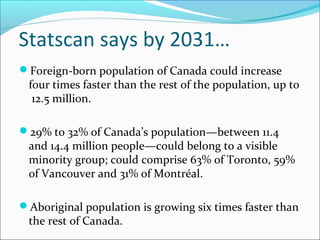
Statscan says by 2031…
Foreign-born population of Canada could increase
four times faster than the rest of the population, up to
12.5 million.
29% to 32% of Canada’s population—between 11.4
and 14.4 million people—could belong to a visible
minority group; could comprise 63% of Toronto, 59%
of Vancouver and 31% of Montréal.
Aboriginal population is growing six times faster than
the rest of Canada.
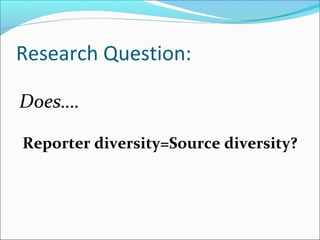
Research Question:
Does….
Reporter diversity=Source diversity?
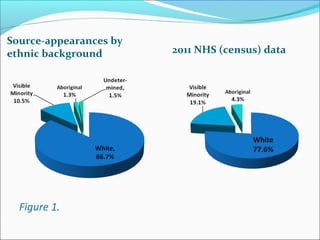
Source-appearances by
ethnic background 2011 NHS (census) data
Figure 1.
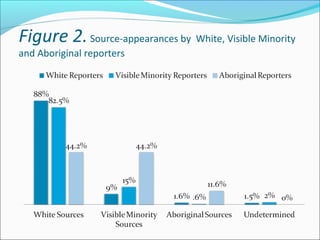
Figure 2.Source-appearances by White, Visible Minority
and Aboriginal reporters
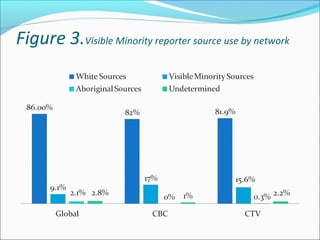
Figure 3.Visible Minority reporter source use by network
Study 2: Comparative analysis
Versus
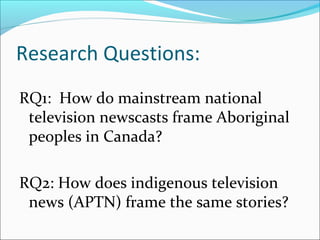
Research Questions:
RQ1: How do mainstream national
television newscasts frame Aboriginal
peoples in Canada?
RQ2: How does indigenous television
news (APTN) frame the same stories?
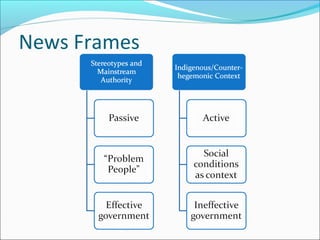
News Frames
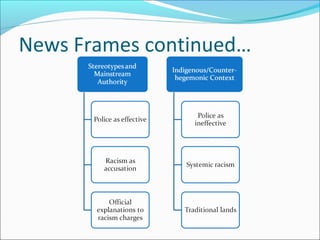
News Frames continued…
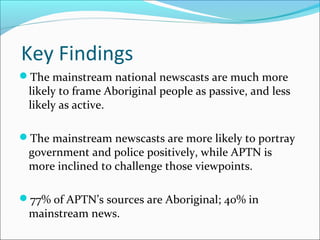
Key Findings
The mainstream national newscasts are much more
likely to frame Aboriginal people as passive, and less
likely as active.
The mainstream newscasts are more likely to portray
government and police positively, while APTN is
more inclined to challenge those viewpoints.
77% of APTN’s sources are Aboriginal; 40% in
mainstream news.
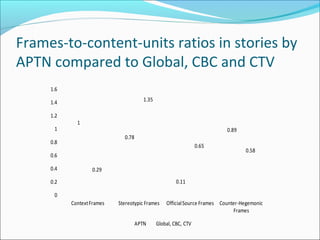
Frames-to-content-units ratios in stories by
APTN compared to Global, CBC and CTV
1
0.78
0.11
0.89
0.29
1.35
0.65
0.58
0
0.2
0.4
0.6
0.8
1
1.2
1.4
1.6
ContextFrames Stereotypic Frames OfficialSource Frames Counter-Hegemonic
Frames
APTN Global, CBC, CTV
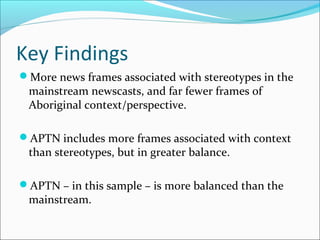
Key Findings
More news frames associated with stereotypes in the
mainstream newscasts, and far fewer frames of
Aboriginal context/perspective.
APTN includes more frames associated with context
than stereotypes, but in greater balance.
APTN – in this sample – is more balanced than the
mainstream.
Implications
This is not simply an issue of negativity in the news;
the mainstream coverage is dominated by stereotypes.
Need for greater context in mainstream news.
Escape the routine of “crisis and calamity” news
coverage of Aboriginal communities.
Further investigation into the production norms that
shape the discourse.
That “Further Investigation”…
Newsroom study and interviews, summer 2012
Plenty of awareness and commitment.
Hiring diverse journalists works… to a point.
Diversity might be an issue at the assignment level.
Diversity is often “soft news”, the “low-hanging fruit”.
Newsroom study
Community outreach takes time.
The agenda is king; and so are newsgathering
routines around it.
Stories about ethnic communities are still far more
likely to make it to air when there’s a negative
element to it.
Diversity as added effort
“However, the Commission must also
recognize that providing the best and most
accurate news coverage requires finding
experts who are (a) available when we need
them, and (b) considered experts with the
utmost credibility in their field. Therefore, it is
not always possible to locate specific
individuals in a timely manner as issues arise.”
Shaw Diversity Report, 2010
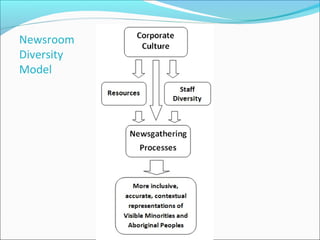
Newsroom
Diversity
Model
Bringing it to the classroom
What didn’t work:
The Excellence Project.
Also: Ethics case, business
case.
Bringing it to the classroom
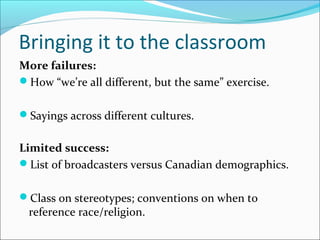
More failures:
How “we’re all different, but the same” exercise.
Sayings across different cultures.
Limited success:
List of broadcasters versus Canadian demographics.
Class on stereotypes; conventions on when to
reference race/religion.
Bringing it to the classroom
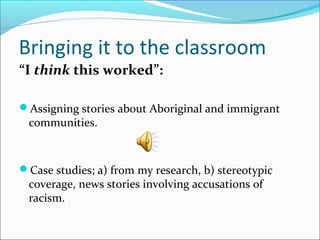
“I think this worked”:
Assigning stories about Aboriginal and immigrant
communities.
Case studies; a) from my research, b) stereotypic
coverage, news stories involving accusations of
racism.
Bringing it to the classroom
Next year:
Do diversity audits on students’ work.
Watch ethnic media.
Get more diverse students.
Links:
Duncan McCue’s website, Reporting in Indigenous Communities:
http://www.riic.ca/
Strategic Alliance of Broadcasters for Aboriginal Reflection
(SABAR):
http://www.sabar.ca/
The Authentic Voice: The Best Reporting on Race and Ethnicity
http://theauthenticvoice.org/
Links:
CBC documentary series, The Eighth Fire
http://www.cbc.ca/doczone/8thfire/
Reflecting Which Canada? A Source Analysis of Canadian
Network Television News, International Journal of Diverse
Identities, Volume 12, Issue 1, p. 33-45.
http://ijdi.cgpublisher.com/product/pub.243/prod.3
-FIN-
A Brad Clark Joint

Beac pp slides share

  • 1.
    “Less vanilla, morepistachio”: The state of diversity in television news, and what broadcast educators can do about it Brad Clark Associate Professor Mount Royal University
  • 2.
    Statscan says by2031… Foreign-born population of Canada could increase four times faster than the rest of the population, up to 12.5 million. 29% to 32% of Canada’s population—between 11.4 and 14.4 million people—could belong to a visible minority group; could comprise 63% of Toronto, 59% of Vancouver and 31% of Montréal. Aboriginal population is growing six times faster than the rest of Canada.
  • 3.
  • 4.
    Source-appearances by ethnic background2011 NHS (census) data Figure 1.
  • 5.
    Figure 2.Source-appearances byWhite, Visible Minority and Aboriginal reporters
  • 6.
    Figure 3.Visible Minorityreporter source use by network
  • 7.
    Study 2: Comparativeanalysis Versus
  • 8.
    Research Questions: RQ1: Howdo mainstream national television newscasts frame Aboriginal peoples in Canada? RQ2: How does indigenous television news (APTN) frame the same stories?
  • 9.
  • 10.
  • 11.
    Key Findings The mainstreamnational newscasts are much more likely to frame Aboriginal people as passive, and less likely as active. The mainstream newscasts are more likely to portray government and police positively, while APTN is more inclined to challenge those viewpoints. 77% of APTN’s sources are Aboriginal; 40% in mainstream news.
  • 12.
    Frames-to-content-units ratios instories by APTN compared to Global, CBC and CTV 1 0.78 0.11 0.89 0.29 1.35 0.65 0.58 0 0.2 0.4 0.6 0.8 1 1.2 1.4 1.6 ContextFrames Stereotypic Frames OfficialSource Frames Counter-Hegemonic Frames APTN Global, CBC, CTV
  • 13.
    Key Findings More newsframes associated with stereotypes in the mainstream newscasts, and far fewer frames of Aboriginal context/perspective. APTN includes more frames associated with context than stereotypes, but in greater balance. APTN – in this sample – is more balanced than the mainstream.
  • 14.
    Implications This is notsimply an issue of negativity in the news; the mainstream coverage is dominated by stereotypes. Need for greater context in mainstream news. Escape the routine of “crisis and calamity” news coverage of Aboriginal communities. Further investigation into the production norms that shape the discourse.
  • 15.
    That “Further Investigation”… Newsroomstudy and interviews, summer 2012 Plenty of awareness and commitment. Hiring diverse journalists works… to a point. Diversity might be an issue at the assignment level. Diversity is often “soft news”, the “low-hanging fruit”.
  • 16.
    Newsroom study Community outreachtakes time. The agenda is king; and so are newsgathering routines around it. Stories about ethnic communities are still far more likely to make it to air when there’s a negative element to it.
  • 17.
    Diversity as addedeffort “However, the Commission must also recognize that providing the best and most accurate news coverage requires finding experts who are (a) available when we need them, and (b) considered experts with the utmost credibility in their field. Therefore, it is not always possible to locate specific individuals in a timely manner as issues arise.” Shaw Diversity Report, 2010
  • 18.
  • 19.
    Bringing it tothe classroom What didn’t work: The Excellence Project. Also: Ethics case, business case.
  • 20.
    Bringing it tothe classroom More failures: How “we’re all different, but the same” exercise. Sayings across different cultures. Limited success: List of broadcasters versus Canadian demographics. Class on stereotypes; conventions on when to reference race/religion.
  • 21.
    Bringing it tothe classroom “I think this worked”: Assigning stories about Aboriginal and immigrant communities. Case studies; a) from my research, b) stereotypic coverage, news stories involving accusations of racism.
  • 22.
    Bringing it tothe classroom Next year: Do diversity audits on students’ work. Watch ethnic media. Get more diverse students.
  • 23.
    Links: Duncan McCue’s website,Reporting in Indigenous Communities: http://www.riic.ca/ Strategic Alliance of Broadcasters for Aboriginal Reflection (SABAR): http://www.sabar.ca/ The Authentic Voice: The Best Reporting on Race and Ethnicity http://theauthenticvoice.org/
  • 24.
    Links: CBC documentary series,The Eighth Fire http://www.cbc.ca/doczone/8thfire/ Reflecting Which Canada? A Source Analysis of Canadian Network Television News, International Journal of Diverse Identities, Volume 12, Issue 1, p. 33-45. http://ijdi.cgpublisher.com/product/pub.243/prod.3
  • 25.