Journalism
Group 2 :
1. Heci Aptrilia
2. Roudhoh Aulia Rahmi
3. Marry Lucky Couple
Journalism is a method of inquiry and literary style that aims
to provide a service to the public by the dissemination and analysis
of news and other information. Journalistic integrity is based on the
principles of truth, disclosure, and editorial independence.
Journalistic mediums can vary diversely, from print publishing to
electronic broadcasting, and from newspaper to television channels,
as well as to the web, and to digital technology.
In modern society, the news media is the chief purveyor of
information and opinion about public affairs. Journalism, however, is
not always confined to the news media or to news itself, as
journalistic communication may find its way into broader forms of
expression, including literature and cinema. In some nations, the
news media is still controlled by government intervention, and is not
fully an independent body.
In a democratic society, however, access to free information plays a central
role in creating a system of checks and balance, and in distributing power equally
between governments, businesses, individuals, and other social entities. Access to
verifiable information gathered by independent media sources, which adhere to
journalistic standards, can also be of service to ordinary citizens, by empowering
them with the tools they need in order to participate in the political process.
The role and status of journalism, along with that of the mass media, has
undergone profound changes over the last two decades with the advent of digital
technology and publication of news on the Internet. This has created a shift in the
consumption of print media channels, as people increasingly consume news through
e-readers, smartphones, and other electronic devices, challenging news organizations
to fully monetize their digital wing, as well as improvise on the context in which they
publish news in print. Notably, in the American media landscape, newsrooms have
reduced their staff and coverage as traditional media channels, such as television,
grapple with declining audiences. For instance, between 2007 and 2012, CNN edited
its story packages into nearly half of their original time length.
This compactness in coverage has been linked to broad audience attrition,
as a large majority of respondents in recent studies show changing preferences in
news consumption. The digital era has also ushered in a new kind of journalism in
which ordinary citizens play a greater role in the process of newsmaking, with the
rise of citizen journalism being possible through the Internet. Using video camera
equipped smartphones, active citizens are now enabled to record footage of news
events and upload them onto channels like YouTube, which is often discovered and
used by mainstream news media outlets. Meanwhile, easy access to news from a
variety of online sources, like blogs and other social media, has resulted in readers
being able to pick from a wider choice of official and unofficial sources, instead of
only from traditional media organizations.
Task 1
Answer the following question based on the text.
1. What is the purpose of journalism?
2. What are the fundamental of journalism?
3. How do journalistic media vary? Give some examples of journalism.
4. Mention another function form of journalistic communication besides a
news media?
5. What is the role of news media in democratic society?
6. How does the advent of digital technology and publication affect the
printed media?
7. How do news organizations react to the incresed news consumtion
through electronic devices?
8. What is meant “citizen journalism”?
9. What is the relationship between digital era and a new kind of
journalism?
10. After reading the next, how do you reflect the content of the text with
journalism in Indonesia?
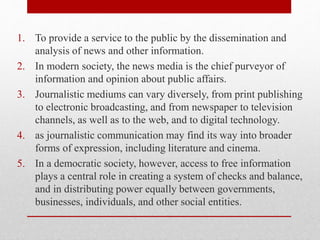
1. To provide a service to the public by the dissemination and
analysis of news and other information.
2. In modern society, the news media is the chief purveyor of
information and opinion about public affairs.
3. Journalistic mediums can vary diversely, from print publishing
to electronic broadcasting, and from newspaper to television
channels, as well as to the web, and to digital technology.
4. as journalistic communication may find its way into broader
forms of expression, including literature and cinema.
5. In a democratic society, however, access to free information
plays a central role in creating a system of checks and balance,
and in distributing power equally between governments,
businesses, individuals, and other social entities.
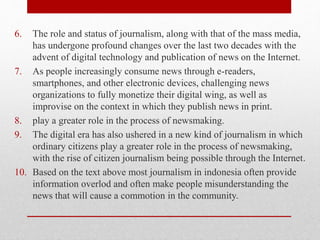
6. The role and status of journalism, along with that of the mass media,
has undergone profound changes over the last two decades with the
advent of digital technology and publication of news on the Internet.
7. As people increasingly consume news through e-readers,
smartphones, and other electronic devices, challenging news
organizations to fully monetize their digital wing, as well as
improvise on the context in which they publish news in print.
8. play a greater role in the process of newsmaking.
9. The digital era has also ushered in a new kind of journalism in which
ordinary citizens play a greater role in the process of newsmaking,
with the rise of citizen journalism being possible through the Internet.
10. Based on the text above most journalism in indonesia often provide
information overlod and often make people misunderstanding the
news that will cause a commotion in the community.
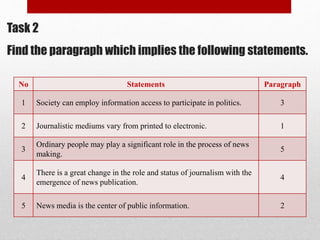
Task 2
Find the paragraph which implies the following statements.
No Statements Paragraph
1 Society can employ information access to participate in politics. 3
2 Journalistic mediums vary from printed to electronic. 1
3
Ordinary people may play a significant role in the process of news
making.
5
4
There is a great change in the role and status of journalism with the
emergence of news publication.
4
5 News media is the center of public information. 2
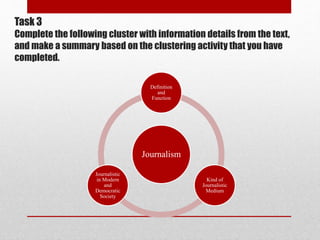
Task 3
Complete the following cluster with information details from the text,
and make a summary based on the clustering activity that you have
completed.
Journalism
Definition
and
Function
Kind of
Journalistic
Medium
Journalistic
in Modern
and
Democratic
Society
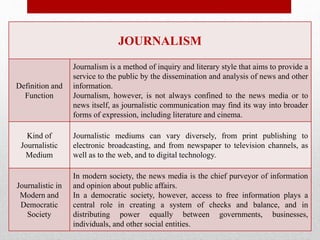
JOURNALISM
Definition and
Function
Journalism is a method of inquiry and literary style that aims to provide a
service to the public by the dissemination and analysis of news and other
information.
Journalism, however, is not always confined to the news media or to
news itself, as journalistic communication may find its way into broader
forms of expression, including literature and cinema.
Kind of
Journalistic
Medium
Journalistic mediums can vary diversely, from print publishing to
electronic broadcasting, and from newspaper to television channels, as
well as to the web, and to digital technology.
Journalistic in
Modern and
Democratic
Society
In modern society, the news media is the chief purveyor of information
and opinion about public affairs.
In a democratic society, however, access to free information plays a
central role in creating a system of checks and balance, and in
distributing power equally between governments, businesses,
individuals, and other social entities.
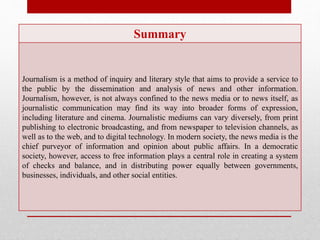
Summary
Journalism is a method of inquiry and literary style that aims to provide a service to
the public by the dissemination and analysis of news and other information.
Journalism, however, is not always confined to the news media or to news itself, as
journalistic communication may find its way into broader forms of expression,
including literature and cinema. Journalistic mediums can vary diversely, from print
publishing to electronic broadcasting, and from newspaper to television channels, as
well as to the web, and to digital technology. In modern society, the news media is the
chief purveyor of information and opinion about public affairs. In a democratic
society, however, access to free information plays a central role in creating a system
of checks and balance, and in distributing power equally between governments,
businesses, individuals, and other social entities.

Jounalism

  • 1.
    Journalism Group 2 : 1.Heci Aptrilia 2. Roudhoh Aulia Rahmi 3. Marry Lucky Couple
  • 2.
    Journalism is amethod of inquiry and literary style that aims to provide a service to the public by the dissemination and analysis of news and other information. Journalistic integrity is based on the principles of truth, disclosure, and editorial independence. Journalistic mediums can vary diversely, from print publishing to electronic broadcasting, and from newspaper to television channels, as well as to the web, and to digital technology. In modern society, the news media is the chief purveyor of information and opinion about public affairs. Journalism, however, is not always confined to the news media or to news itself, as journalistic communication may find its way into broader forms of expression, including literature and cinema. In some nations, the news media is still controlled by government intervention, and is not fully an independent body.
  • 3.
    In a democraticsociety, however, access to free information plays a central role in creating a system of checks and balance, and in distributing power equally between governments, businesses, individuals, and other social entities. Access to verifiable information gathered by independent media sources, which adhere to journalistic standards, can also be of service to ordinary citizens, by empowering them with the tools they need in order to participate in the political process. The role and status of journalism, along with that of the mass media, has undergone profound changes over the last two decades with the advent of digital technology and publication of news on the Internet. This has created a shift in the consumption of print media channels, as people increasingly consume news through e-readers, smartphones, and other electronic devices, challenging news organizations to fully monetize their digital wing, as well as improvise on the context in which they publish news in print. Notably, in the American media landscape, newsrooms have reduced their staff and coverage as traditional media channels, such as television, grapple with declining audiences. For instance, between 2007 and 2012, CNN edited its story packages into nearly half of their original time length.
  • 4.
    This compactness incoverage has been linked to broad audience attrition, as a large majority of respondents in recent studies show changing preferences in news consumption. The digital era has also ushered in a new kind of journalism in which ordinary citizens play a greater role in the process of newsmaking, with the rise of citizen journalism being possible through the Internet. Using video camera equipped smartphones, active citizens are now enabled to record footage of news events and upload them onto channels like YouTube, which is often discovered and used by mainstream news media outlets. Meanwhile, easy access to news from a variety of online sources, like blogs and other social media, has resulted in readers being able to pick from a wider choice of official and unofficial sources, instead of only from traditional media organizations.
  • 5.
    Task 1 Answer thefollowing question based on the text. 1. What is the purpose of journalism? 2. What are the fundamental of journalism? 3. How do journalistic media vary? Give some examples of journalism. 4. Mention another function form of journalistic communication besides a news media? 5. What is the role of news media in democratic society? 6. How does the advent of digital technology and publication affect the printed media? 7. How do news organizations react to the incresed news consumtion through electronic devices? 8. What is meant “citizen journalism”? 9. What is the relationship between digital era and a new kind of journalism? 10. After reading the next, how do you reflect the content of the text with journalism in Indonesia?
  • 6.
    1. To providea service to the public by the dissemination and analysis of news and other information. 2. In modern society, the news media is the chief purveyor of information and opinion about public affairs. 3. Journalistic mediums can vary diversely, from print publishing to electronic broadcasting, and from newspaper to television channels, as well as to the web, and to digital technology. 4. as journalistic communication may find its way into broader forms of expression, including literature and cinema. 5. In a democratic society, however, access to free information plays a central role in creating a system of checks and balance, and in distributing power equally between governments, businesses, individuals, and other social entities.
  • 7.
    6. The roleand status of journalism, along with that of the mass media, has undergone profound changes over the last two decades with the advent of digital technology and publication of news on the Internet. 7. As people increasingly consume news through e-readers, smartphones, and other electronic devices, challenging news organizations to fully monetize their digital wing, as well as improvise on the context in which they publish news in print. 8. play a greater role in the process of newsmaking. 9. The digital era has also ushered in a new kind of journalism in which ordinary citizens play a greater role in the process of newsmaking, with the rise of citizen journalism being possible through the Internet. 10. Based on the text above most journalism in indonesia often provide information overlod and often make people misunderstanding the news that will cause a commotion in the community.
  • 8.
    Task 2 Find theparagraph which implies the following statements. No Statements Paragraph 1 Society can employ information access to participate in politics. 3 2 Journalistic mediums vary from printed to electronic. 1 3 Ordinary people may play a significant role in the process of news making. 5 4 There is a great change in the role and status of journalism with the emergence of news publication. 4 5 News media is the center of public information. 2
  • 9.
    Task 3 Complete thefollowing cluster with information details from the text, and make a summary based on the clustering activity that you have completed. Journalism Definition and Function Kind of Journalistic Medium Journalistic in Modern and Democratic Society
  • 10.
    JOURNALISM Definition and Function Journalism isa method of inquiry and literary style that aims to provide a service to the public by the dissemination and analysis of news and other information. Journalism, however, is not always confined to the news media or to news itself, as journalistic communication may find its way into broader forms of expression, including literature and cinema. Kind of Journalistic Medium Journalistic mediums can vary diversely, from print publishing to electronic broadcasting, and from newspaper to television channels, as well as to the web, and to digital technology. Journalistic in Modern and Democratic Society In modern society, the news media is the chief purveyor of information and opinion about public affairs. In a democratic society, however, access to free information plays a central role in creating a system of checks and balance, and in distributing power equally between governments, businesses, individuals, and other social entities.
  • 11.
    Summary Journalism is amethod of inquiry and literary style that aims to provide a service to the public by the dissemination and analysis of news and other information. Journalism, however, is not always confined to the news media or to news itself, as journalistic communication may find its way into broader forms of expression, including literature and cinema. Journalistic mediums can vary diversely, from print publishing to electronic broadcasting, and from newspaper to television channels, as well as to the web, and to digital technology. In modern society, the news media is the chief purveyor of information and opinion about public affairs. In a democratic society, however, access to free information plays a central role in creating a system of checks and balance, and in distributing power equally between governments, businesses, individuals, and other social entities.