Be Your Own Prada:
Fashion Synthesis With Structural Coherence
DATASETS
 DeepFashion: facing toward the camera, and the background of the image is not severely cluttered(凌
乱).
Objective
 Given an input image of a
person and a sentence
describing a different outfit,
our model “redresses” the
person as desired, while at the
same time keeping the wearer
and her/his pose unchanged.
Notation Of FashionGAN
 Training data: one photo per user where each photo has a sentence description of the outfit.
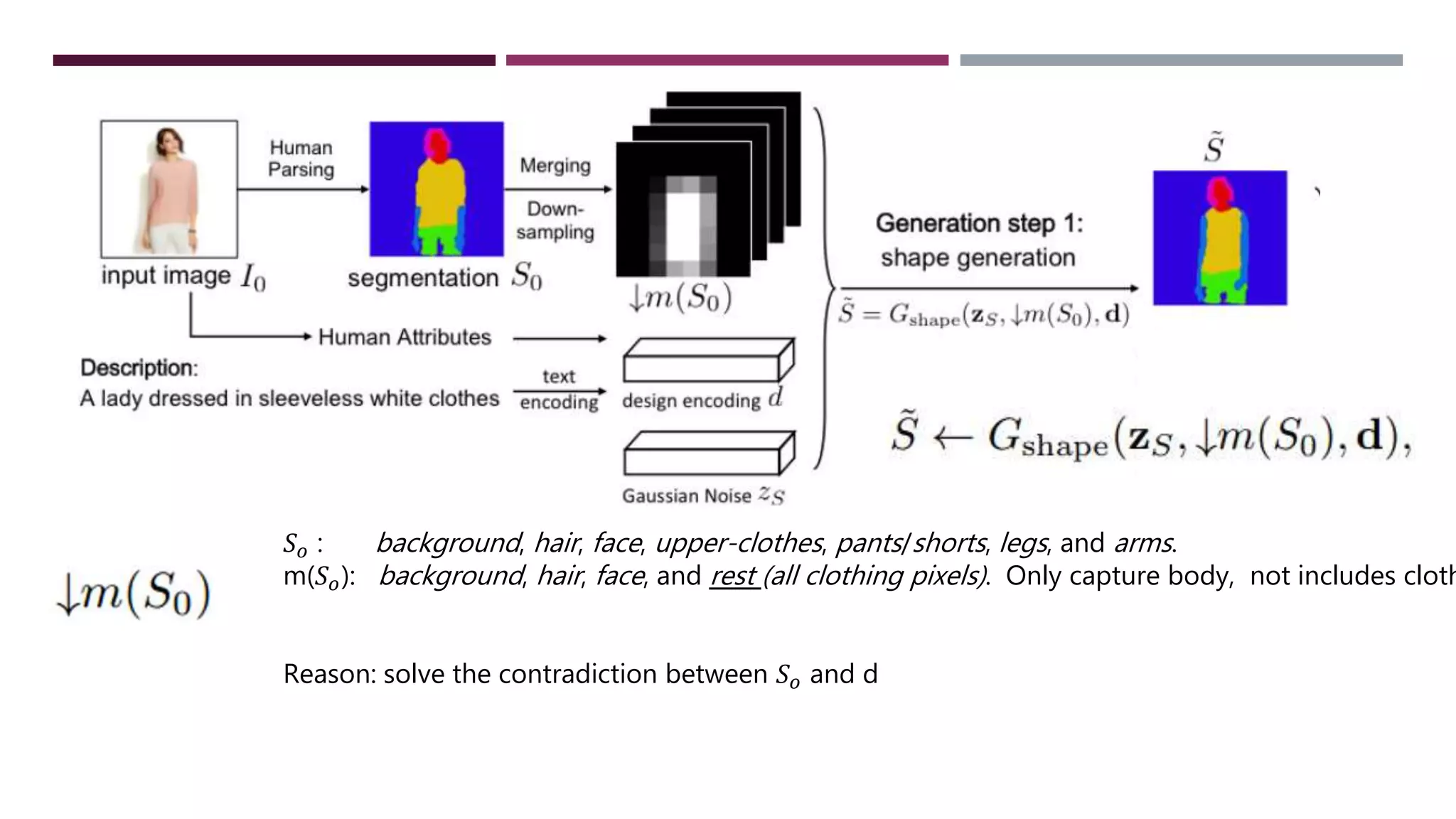
 original image 𝐼 𝑜 ,
 segmentation map:𝑆 𝑜 , pixel−wise class labels such as hair, face, upper−clothes, pants/shorts, etc body
shape
 vector of binary attribute: a ,gender, long/short hair, wearing/not sunglasses and wearing/not hat, skin
color
information should be preserved during generation
 Description v : generated by a text encoder
 Design coding d = (a, v)
𝑆 𝑜 : background, hair, face, upper-clothes, pants/shorts, legs, and arms.
m(𝑆 𝑜): background, hair, face, and rest (all clothing pixels). Only capture body, not includes cloth
Reason: solve the contradiction between 𝑆 𝑜 and d
Goal:generate new segmentation which is
(1) Attributes are consistent with the design
coding
(2) Pose are consistent with original image
(3) Segmentation is consistent with new
description in design coding.
each pixel in the map has a probabilistic simplex constraint, use the Softmax activation function on each
pixel at the end of the generator, so that the generated fake shape map is comparable with the real
segmentation map.
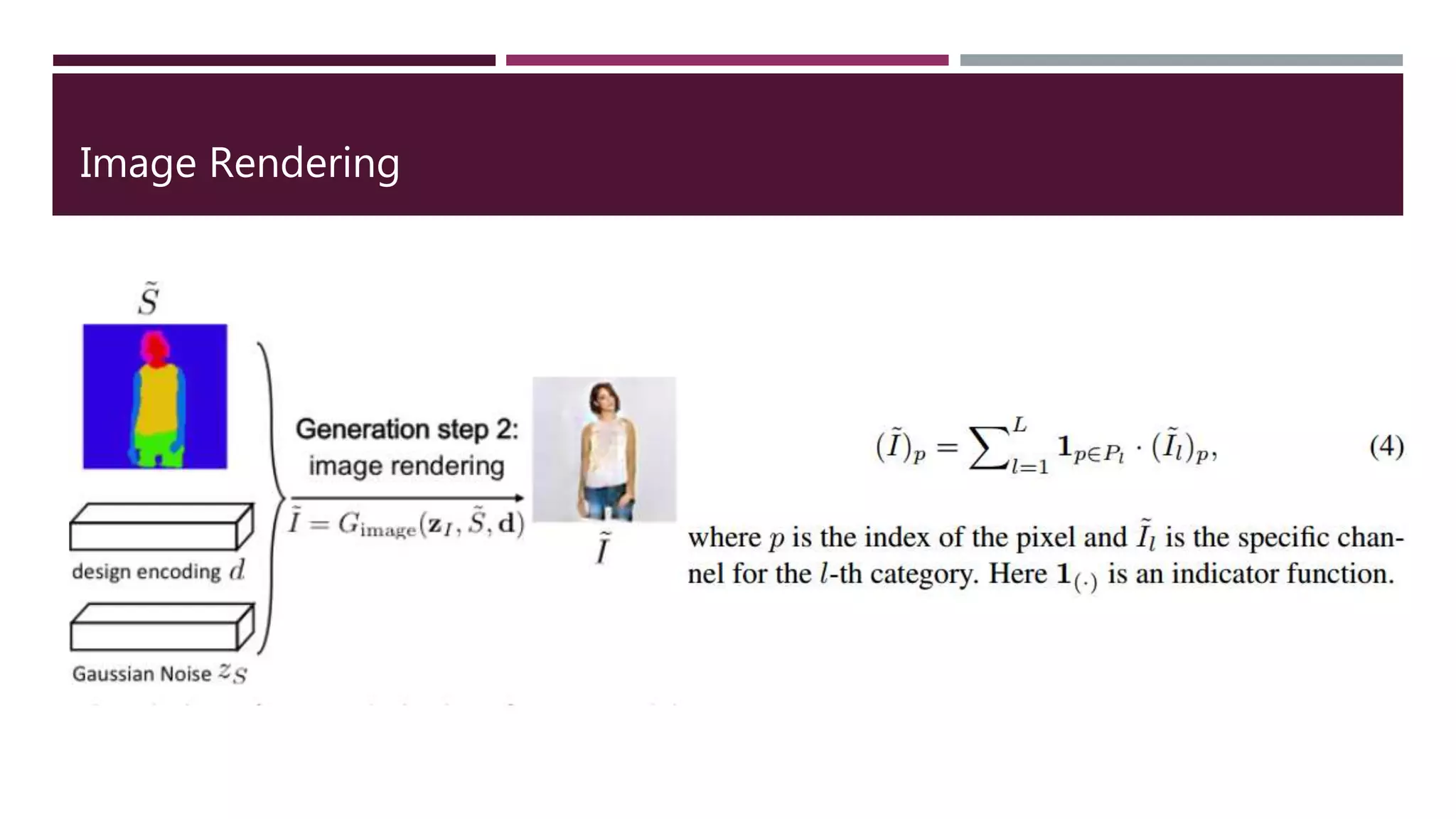
Image Rendering
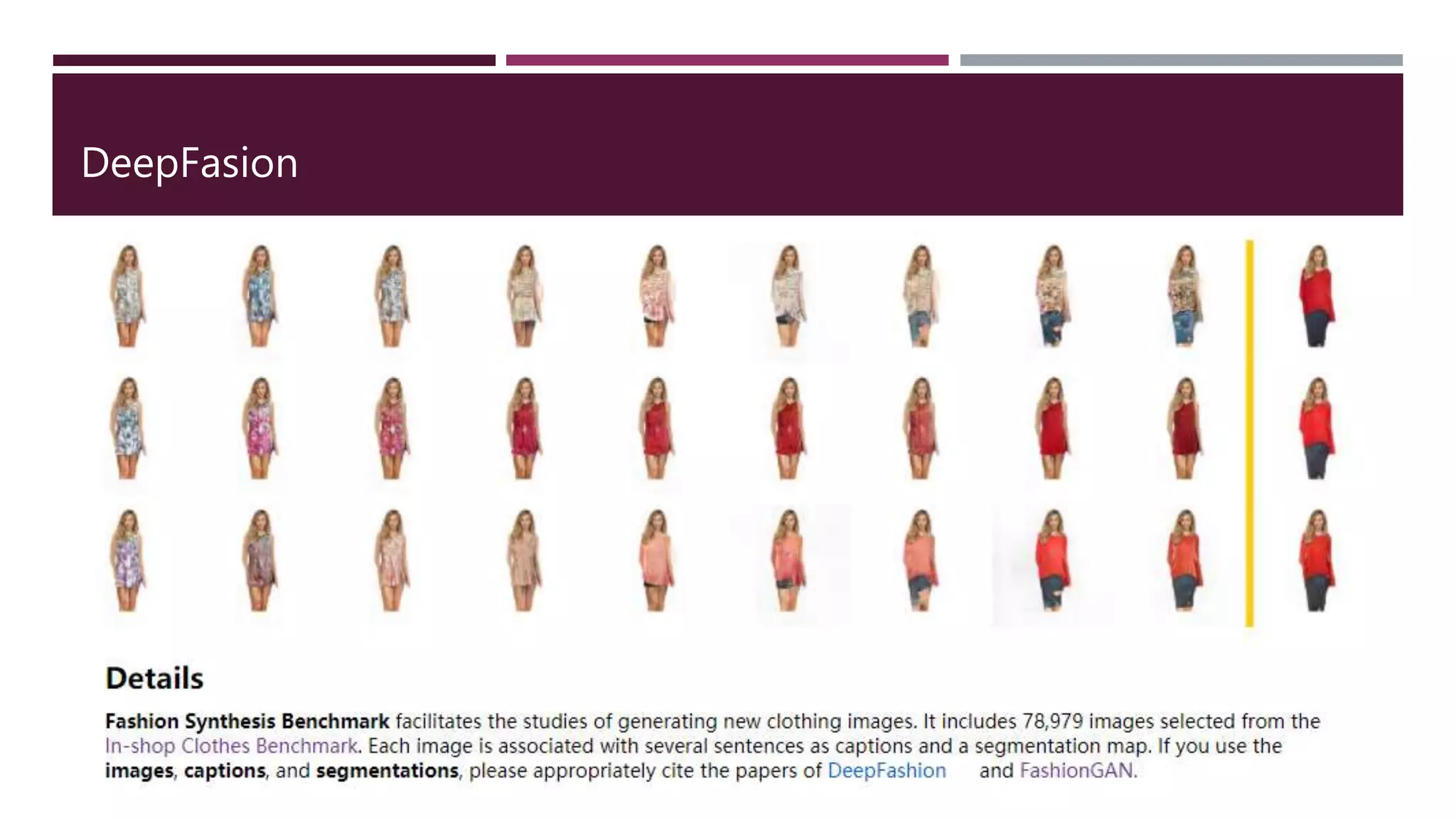
DeepFasion
 DeepFashion contains over 800,000 diverse fashion images ranging from well-posed shop images to
unconstrained consumer photos.
 DeepFashion is annotated with rich information of clothing items. Each image in this dataset is labeled
with 50categories, 1,000 descriptive attributes, bounding box and clothing landmarks.
 DeepFashion contains over 300,000 cross-pose/cross-domain image pairs.
 4个任务:Attribute Prediction, Consumer-to-shop Clothes Retrieval, In-shop Clothes
Retrieval, Landmark Detection.
DeepFasion
DeepFasion

Be your own prada

  • 1.
    Be Your OwnPrada: Fashion Synthesis With Structural Coherence
  • 2.
    DATASETS  DeepFashion: facingtoward the camera, and the background of the image is not severely cluttered(凌 乱).
  • 3.
    Objective  Given aninput image of a person and a sentence describing a different outfit, our model “redresses” the person as desired, while at the same time keeping the wearer and her/his pose unchanged.
  • 4.
    Notation Of FashionGAN Training data: one photo per user where each photo has a sentence description of the outfit.  original image 𝐼 𝑜 ,  segmentation map:𝑆 𝑜 , pixel−wise class labels such as hair, face, upper−clothes, pants/shorts, etc body shape  vector of binary attribute: a ,gender, long/short hair, wearing/not sunglasses and wearing/not hat, skin color information should be preserved during generation  Description v : generated by a text encoder  Design coding d = (a, v)
  • 5.
    𝑆 𝑜 :background, hair, face, upper-clothes, pants/shorts, legs, and arms. m(𝑆 𝑜): background, hair, face, and rest (all clothing pixels). Only capture body, not includes cloth Reason: solve the contradiction between 𝑆 𝑜 and d
  • 6.
    Goal:generate new segmentationwhich is (1) Attributes are consistent with the design coding (2) Pose are consistent with original image (3) Segmentation is consistent with new description in design coding.
  • 7.
    each pixel inthe map has a probabilistic simplex constraint, use the Softmax activation function on each pixel at the end of the generator, so that the generated fake shape map is comparable with the real segmentation map.
  • 8.
  • 9.
    DeepFasion  DeepFashion containsover 800,000 diverse fashion images ranging from well-posed shop images to unconstrained consumer photos.  DeepFashion is annotated with rich information of clothing items. Each image in this dataset is labeled with 50categories, 1,000 descriptive attributes, bounding box and clothing landmarks.  DeepFashion contains over 300,000 cross-pose/cross-domain image pairs.  4个任务:Attribute Prediction, Consumer-to-shop Clothes Retrieval, In-shop Clothes Retrieval, Landmark Detection.
  • 10.
  • 11.