Automated
background removal
IN SCOPE OF E-COMMERCE FASHION IMAGE
PROCESSING
Simona Stolnicu
Data Scientist @ Levi9
Romania
Olexander Miroshynchenko
Machine Learning Engineer
@ GlobalLogic
Speakers
Agenda
▪ Intro Wehkamp
▪ Problem definition
▪ Input data
▪ Modeling
▪ Results
▪ Examples
▪ Q&A
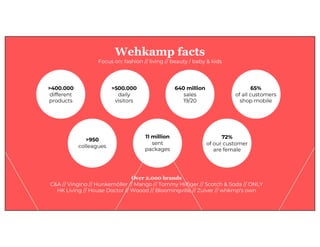
>400.000
different
products
>500.000
daily
visitors
640 million
sales
19/20
11 million
sent
packages
>950
colleagues
65%
of all customers
shop mobile
72%
of our customer
are female
Over 2.000 brands
C&A // Vingino // Hunkemöller // Mango // Tommy Hilfiger // Scotch & Soda // ONLY
HK Living // House Doctor // Woood // Bloomingville // Zuiver // whkmp’s own
Wehkamp facts
Focus on: fashion // living // beauty / baby & kids
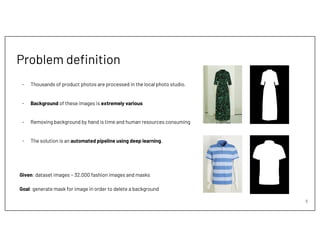
- Thousands of product photos are processed in the local photo studio.
- Background of these images is extremely various
- Removing background by hand is time and human resources consuming
- The solution is an automated pipeline using deep learning.
Problem definition
Given: dataset images ~ 32.000 fashion images and masks
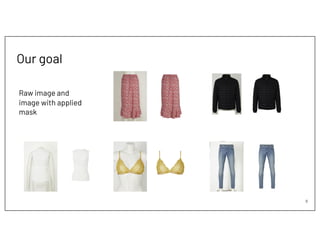
Goal: generate mask for image in order to delete a background
5
6
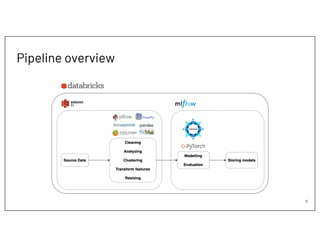
Pipeline overview
7
Dataset
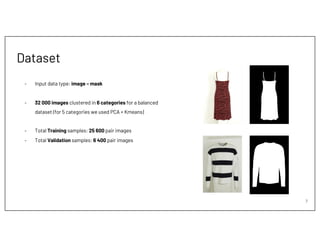
- Input data type: image – mask
- 32 000 images clustered in 6 categories for a balanced
dataset (for 5 categories we used PCA + Kmeans)
- Total Training samples: 25 600 pair images
- Total Validation samples: 6 400 pair images
8
Raw image and
image with applied
mask
Our goal
9
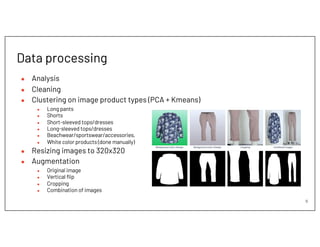
● Analysis
● Cleaning
● Clustering on image product types (PCA + Kmeans)
● Long pants
● Shorts
● Short-sleeved tops/dresses
● Long-sleeved tops/dresses
● Beachwear/sportswear/accessories,
● White color products (done manually)
● Resizing images to 320x320
● Augmentation
● Original image
● Vertical flip
● Cropping
● Combination of images
Data processing
10
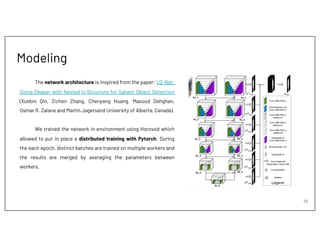
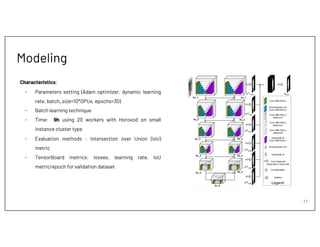
The network architecture is inspired from the paper: U2-Net:
Going Deeper with Nested U-Structure for Salient Object Detection
(Xuebin Qin, Zichen Zhang, Chenyang Huang, Masood Dehghan,
Osmar R. Zaiane and Martin Jagersand University of Alberta, Canada).
We trained the network in environment using Horovod which
allowed to put in place a distributed training with Pytorch. During
the each epoch, distinct batches are trained on multiple workers and
the results are merged by averaging the parameters between
workers.
Modeling
11
Characteristics:
- Parameters setting (Adam optimizer, dynamic learning
rate, batch_size=10*GPUs, epochs=30)
- Batch learning technique
- Time: 9h using 20 workers with Horovod on small
instance cluster type
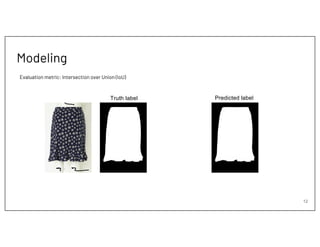
- Evaluation methods : Intersection over Union (IoU)
metric
- TensorBoard metrics: losses, learning rate, IoU
metric/epoch for validation dataset
Modeling
12
Evaluation metric: Intersection over Union (IoU)
Truth label Predicted label
Modeling
13
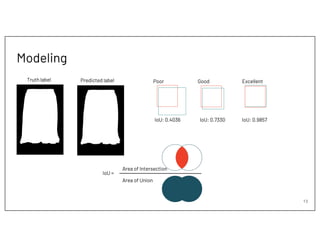
Truth label Predicted label
Modeling
Good
Poor Excellent
IoU: 0.4036 IoU: 0.7330 IoU: 0.9857
IoU =
Area of Intersection
Area of Union
14
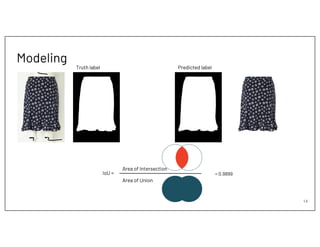
Truth label Predicted label
= 0.9899
Modeling
IoU =
Area of Intersection
Area of Union
15
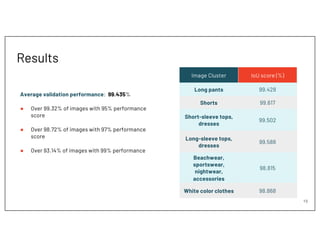
Average validation performance: 99.435%
● Over 99.32% of images with 95% performance
score
● Over 98.72% of images with 97% performance
score
● Over 93.14% of images with 99% performance
Image Cluster IoU score (%)
Long pants 99.428
Shorts 99.617
Short-sleeve tops,
dresses
99.502
Long-sleeve tops,
dresses
99.588
Beachwear,
sportswear,
nightwear,
accessories
98.815
White color clothes 98.868
Results
16
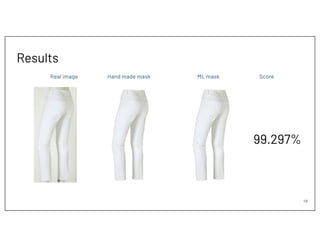
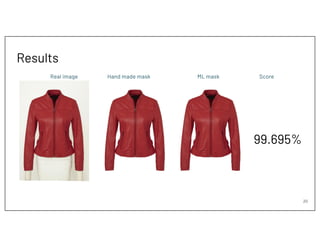
Real image Hand made mask ML mask
Results
99.297%
Score
17
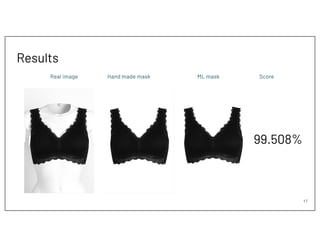
Real image Hand made mask ML mask
Results
99.508%
Score
18
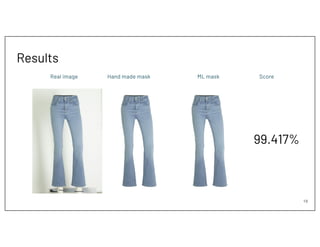
Real image Hand made mask ML mask
Results
99.417%
Score
19
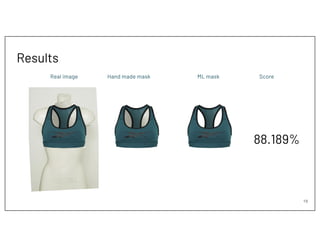
Real image Hand made mask ML mask
Results
88.189%
Score
20
Real image Hand made mask ML mask
Results
99.695%
Score
21
Real image Hand made mask ML mask
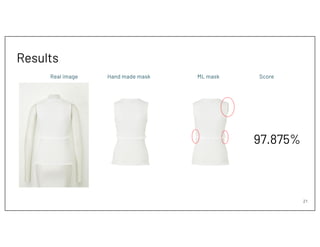
Results
97.875%
Score
22
Real image Hand made mask ML mask
Results
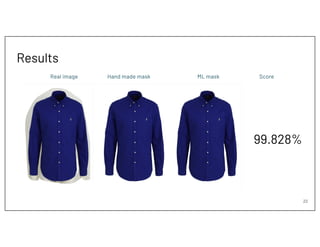
99.828%
Score
23
Real image Hand made mask ML mask
Results
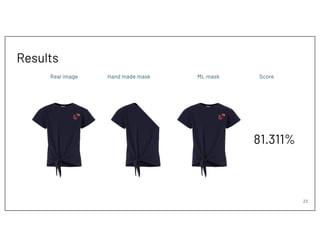
81.311%
Score
24
Real image Hand made mask ML mask
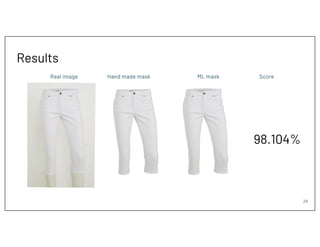
Results
98.104%
Score
25
Real image Hand made mask ML mask
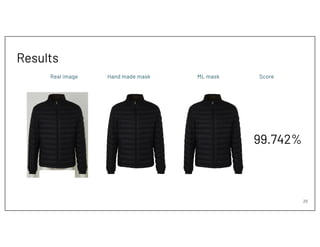
Results
99.742%
Score
26
Real image Hand made mask ML mask
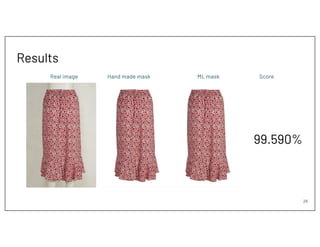
Results
99.590%
Score
27
Real image Hand made mask ML mask
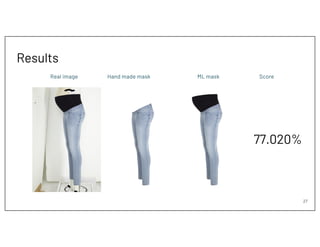
Results
77.020%
Score
28
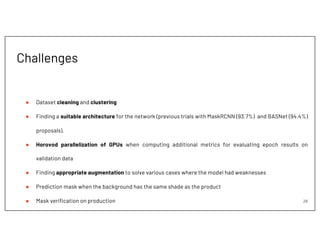
● Dataset cleaning and clustering
● Finding a suitable architecture for the network (previous trials with MaskRCNN (93.7%) and BASNet (94.4%)
proposals).
● Horovod parallelization of GPUs when computing additional metrics for evaluating epoch results on
validation data
● Finding appropriate augmentation to solve various cases where the model had weaknesses
● Prediction mask when the background has the same shade as the product
● Mask verification on production
Challenges
THANKS FOR YOUR ATTENTION!
Q&A section
Simona Stolnicu
Data Scientist @ Levi9
Romania
Olexander Miroshynchenko
Machine Learning Engineer
@ GlobalLogic
Speakers

Automated Background Removal Using PyTorch

  • 1.
    Automated background removal IN SCOPEOF E-COMMERCE FASHION IMAGE PROCESSING
  • 2.
    Simona Stolnicu Data Scientist@ Levi9 Romania Olexander Miroshynchenko Machine Learning Engineer @ GlobalLogic Speakers
  • 3.
    Agenda ▪ Intro Wehkamp ▪Problem definition ▪ Input data ▪ Modeling ▪ Results ▪ Examples ▪ Q&A
  • 4.
    >400.000 different products >500.000 daily visitors 640 million sales 19/20 11 million sent packages >950 colleagues 65% ofall customers shop mobile 72% of our customer are female Over 2.000 brands C&A // Vingino // Hunkemöller // Mango // Tommy Hilfiger // Scotch & Soda // ONLY HK Living // House Doctor // Woood // Bloomingville // Zuiver // whkmp’s own Wehkamp facts Focus on: fashion // living // beauty / baby & kids
  • 5.
    - Thousands ofproduct photos are processed in the local photo studio. - Background of these images is extremely various - Removing background by hand is time and human resources consuming - The solution is an automated pipeline using deep learning. Problem definition Given: dataset images ~ 32.000 fashion images and masks Goal: generate mask for image in order to delete a background 5
  • 6.
  • 7.
    7 Dataset - Input datatype: image – mask - 32 000 images clustered in 6 categories for a balanced dataset (for 5 categories we used PCA + Kmeans) - Total Training samples: 25 600 pair images - Total Validation samples: 6 400 pair images
  • 8.
    8 Raw image and imagewith applied mask Our goal
  • 9.
    9 ● Analysis ● Cleaning ●Clustering on image product types (PCA + Kmeans) ● Long pants ● Shorts ● Short-sleeved tops/dresses ● Long-sleeved tops/dresses ● Beachwear/sportswear/accessories, ● White color products (done manually) ● Resizing images to 320x320 ● Augmentation ● Original image ● Vertical flip ● Cropping ● Combination of images Data processing
  • 10.
    10 The network architectureis inspired from the paper: U2-Net: Going Deeper with Nested U-Structure for Salient Object Detection (Xuebin Qin, Zichen Zhang, Chenyang Huang, Masood Dehghan, Osmar R. Zaiane and Martin Jagersand University of Alberta, Canada). We trained the network in environment using Horovod which allowed to put in place a distributed training with Pytorch. During the each epoch, distinct batches are trained on multiple workers and the results are merged by averaging the parameters between workers. Modeling
  • 11.
    11 Characteristics: - Parameters setting(Adam optimizer, dynamic learning rate, batch_size=10*GPUs, epochs=30) - Batch learning technique - Time: 9h using 20 workers with Horovod on small instance cluster type - Evaluation methods : Intersection over Union (IoU) metric - TensorBoard metrics: losses, learning rate, IoU metric/epoch for validation dataset Modeling
  • 12.
    12 Evaluation metric: Intersectionover Union (IoU) Truth label Predicted label Modeling
  • 13.
    13 Truth label Predictedlabel Modeling Good Poor Excellent IoU: 0.4036 IoU: 0.7330 IoU: 0.9857 IoU = Area of Intersection Area of Union
  • 14.
    14 Truth label Predictedlabel = 0.9899 Modeling IoU = Area of Intersection Area of Union
  • 15.
    15 Average validation performance:99.435% ● Over 99.32% of images with 95% performance score ● Over 98.72% of images with 97% performance score ● Over 93.14% of images with 99% performance Image Cluster IoU score (%) Long pants 99.428 Shorts 99.617 Short-sleeve tops, dresses 99.502 Long-sleeve tops, dresses 99.588 Beachwear, sportswear, nightwear, accessories 98.815 White color clothes 98.868 Results
  • 16.
    16 Real image Handmade mask ML mask Results 99.297% Score
  • 17.
    17 Real image Handmade mask ML mask Results 99.508% Score
  • 18.
    18 Real image Handmade mask ML mask Results 99.417% Score
  • 19.
    19 Real image Handmade mask ML mask Results 88.189% Score
  • 20.
    20 Real image Handmade mask ML mask Results 99.695% Score
  • 21.
    21 Real image Handmade mask ML mask Results 97.875% Score
  • 22.
    22 Real image Handmade mask ML mask Results 99.828% Score
  • 23.
    23 Real image Handmade mask ML mask Results 81.311% Score
  • 24.
    24 Real image Handmade mask ML mask Results 98.104% Score
  • 25.
    25 Real image Handmade mask ML mask Results 99.742% Score
  • 26.
    26 Real image Handmade mask ML mask Results 99.590% Score
  • 27.
    27 Real image Handmade mask ML mask Results 77.020% Score
  • 28.
    28 ● Dataset cleaningand clustering ● Finding a suitable architecture for the network (previous trials with MaskRCNN (93.7%) and BASNet (94.4%) proposals). ● Horovod parallelization of GPUs when computing additional metrics for evaluating epoch results on validation data ● Finding appropriate augmentation to solve various cases where the model had weaknesses ● Prediction mask when the background has the same shade as the product ● Mask verification on production Challenges
  • 29.
    THANKS FOR YOURATTENTION!
  • 30.
  • 31.
    Simona Stolnicu Data Scientist@ Levi9 Romania Olexander Miroshynchenko Machine Learning Engineer @ GlobalLogic Speakers