DreamPose: Fashion
Image-to-Video Synthesis
via Stable Diffusion
Johanna Karras1, Aleksander Holynski2,
Ting-Chun Wang3, Ira Kemelmacher-Shlizerman1
1University of Washington, 2UC Berkeley, Google
Research 3NVIDIA
https://grail.cs.washington.edu/projects/dreampose/
Introduction
• A diffusion-based method for generating animated fashion videos
from still images.
• Given an image and a sequence of human body poses, our method
synthesizes a video containing both human and fabric motion.
• To achieve this, we transform a pretrained text to- image Stable
Diffusion Model into a pose-and image guided video synthesis model,
using
• finetuning strategy,
• a set of architectural changes to support the added conditioning signals,
and
• techniques to encourage temporal consistency.
• Fine-tune on a collection of fashion videos from the UBC Fashion
dataset
Architecture
Objectives of Image Animation
(1) faithfulness to the provided input image,
(2) visual quality, and
(3) temporal stability across generated frames.
Requirements
• an image conditioning mechanism that captures the
global structure, person identity, and fine-grained
details of the garment
• a method to effectively condition the output image on
target pose while also enabling temporal consistency
between independently sampled output frames.
Architecture Overview
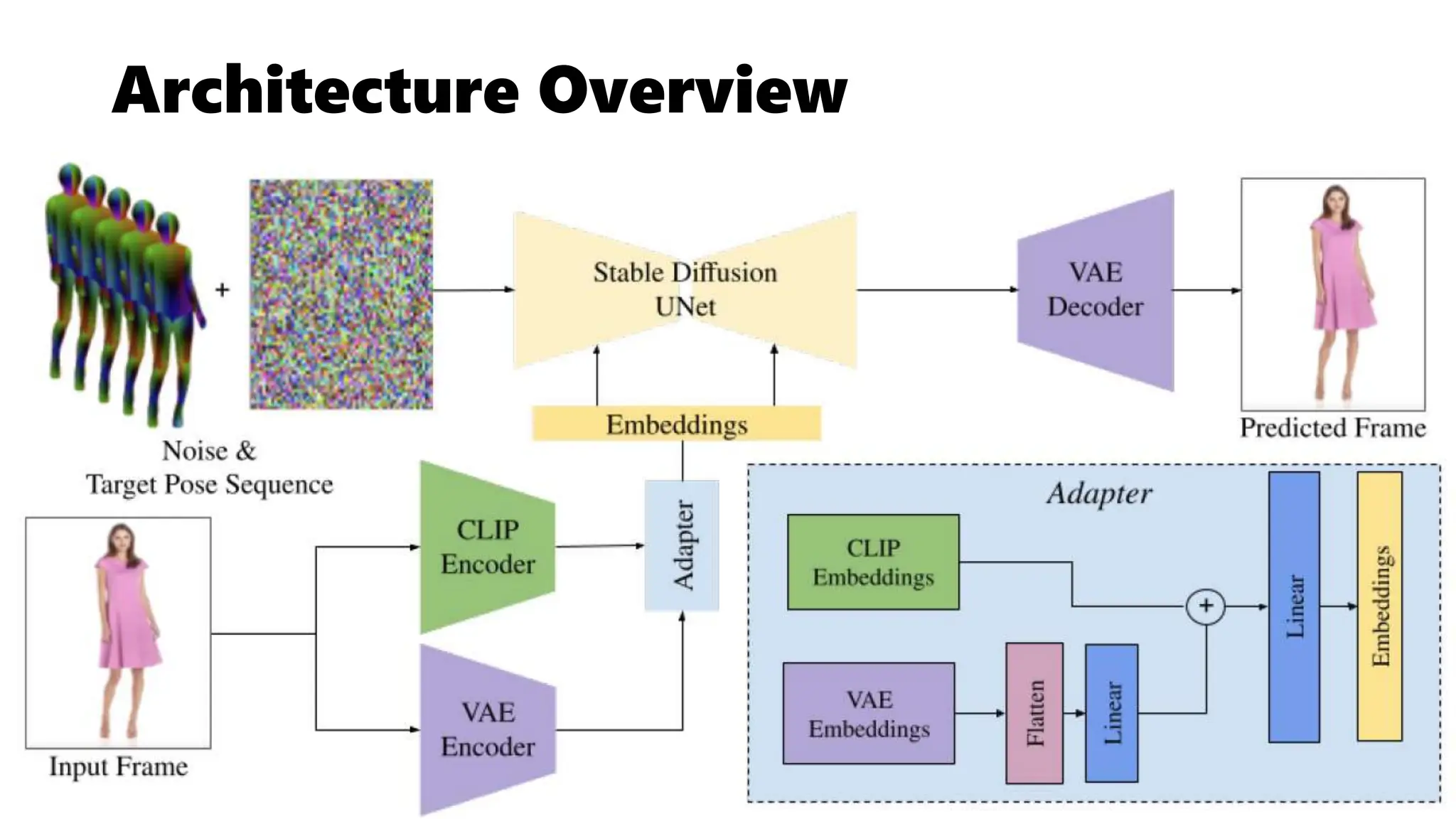
• We modify the original Stable Diffusion architecture in order to enable
image and pose conditioning.
• First, we replace the CLIP text encoder with a dual CLIP-VAE image
encoder and adapter module.
• The adapter module jointly models and reshapes the pretrained CLIP
and VAE input image embeddings.
• Then, we concatenate the target pose representation, consisting of 5
consecutive poses surrounding the target pose, to the input noise.
• During training, we finetune the denoising UNet and our Adapter
module on the full dataset and further perform subject-specific
finetuning of the UNet, Adapter, and VAE decoder on a single input
image.
Split CLIP-VAE Encoder
Conclusion
• virtual try-on network (VITON) is able to transfer a clothing
item in a product image to a person relying only on RGB
images.
• A coarse sample is first generated with a multi-task encoder-
decoder conditioned on a detailed clothing-agnostic person
representation.
• The coarse results are further enhanced with a refinement
network that learns the optimal composition.
• Experiments on a newly collected dataset show promising
results both quantitatively and qualitatively.
• This indicates that this 2D image-based synthesis pipeline can
be used as an alternative to expensive 3D based methods.

DreamPose: Fashion Image to Video Synthesis via Stable Diffusion

  • 1.
    DreamPose: Fashion Image-to-Video Synthesis viaStable Diffusion Johanna Karras1, Aleksander Holynski2, Ting-Chun Wang3, Ira Kemelmacher-Shlizerman1 1University of Washington, 2UC Berkeley, Google Research 3NVIDIA https://grail.cs.washington.edu/projects/dreampose/
  • 2.
    Introduction • A diffusion-basedmethod for generating animated fashion videos from still images. • Given an image and a sequence of human body poses, our method synthesizes a video containing both human and fabric motion. • To achieve this, we transform a pretrained text to- image Stable Diffusion Model into a pose-and image guided video synthesis model, using • finetuning strategy, • a set of architectural changes to support the added conditioning signals, and • techniques to encourage temporal consistency. • Fine-tune on a collection of fashion videos from the UBC Fashion dataset
  • 3.
  • 4.
    Objectives of ImageAnimation (1) faithfulness to the provided input image, (2) visual quality, and (3) temporal stability across generated frames.
  • 5.
    Requirements • an imageconditioning mechanism that captures the global structure, person identity, and fine-grained details of the garment • a method to effectively condition the output image on target pose while also enabling temporal consistency between independently sampled output frames.
  • 6.
  • 7.
    Architecture Overview • Wemodify the original Stable Diffusion architecture in order to enable image and pose conditioning. • First, we replace the CLIP text encoder with a dual CLIP-VAE image encoder and adapter module. • The adapter module jointly models and reshapes the pretrained CLIP and VAE input image embeddings. • Then, we concatenate the target pose representation, consisting of 5 consecutive poses surrounding the target pose, to the input noise. • During training, we finetune the denoising UNet and our Adapter module on the full dataset and further perform subject-specific finetuning of the UNet, Adapter, and VAE decoder on a single input image.
  • 8.
  • 9.
    Conclusion • virtual try-onnetwork (VITON) is able to transfer a clothing item in a product image to a person relying only on RGB images. • A coarse sample is first generated with a multi-task encoder- decoder conditioned on a detailed clothing-agnostic person representation. • The coarse results are further enhanced with a refinement network that learns the optimal composition. • Experiments on a newly collected dataset show promising results both quantitatively and qualitatively. • This indicates that this 2D image-based synthesis pipeline can be used as an alternative to expensive 3D based methods.