be supposed to do/be something
a) used to say what someone should or should not do, especially
because of rules or what someone in authority has said:
We're supposed to check out of the hotel by 11 o'clock.
I'm not supposed to tell anyone.
What time are you supposed to be there?
b) used to say what was or is expected or intended to happen,
especially when it did not happen:
No one was supposed to know about it.
The meeting was supposed to take place on Tuesday, but we've had
to postpone it.
The new laws are supposed to prevent crime.
c) used to say that something is believed to be true by many people,
although it might not be true or you might disagree:
The castle is supposed to be haunted.
'Dirty Harry' is supposed to be one of Eastwood's best films.
Mrs Carver is supposed to have a lot of money.
I am supposed to do this = this is what I should do.
The train is supposed to arrive at 10 am = that is the time the train
should arrive according to the timetable.
Tefl Games: Modal Verbs
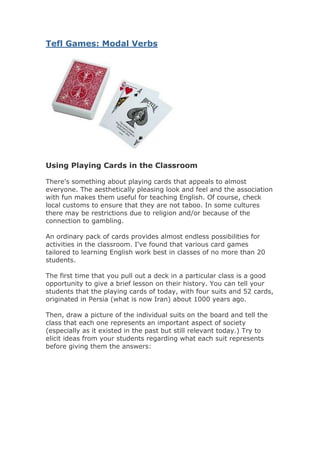
Using Playing Cards in the Classroom
There's something about playing cards that appeals to almost
everyone. The aesthetically pleasing look and feel and the association
with fun makes them useful for teaching English. Of course, check
local customs to ensure that they are not taboo. In some cultures
there may be restrictions due to religion and/or because of the
connection to gambling.
An ordinary pack of cards provides almost endless possibilities for
activities in the classroom. I've found that various card games
tailored to learning English work best in classes of no more than 20
students.
The first time that you pull out a deck in a particular class is a good
opportunity to give a brief lesson on their history. You can tell your
students that the playing cards of today, with four suits and 52 cards,
originated in Persia (what is now Iran) about 1000 years ago.
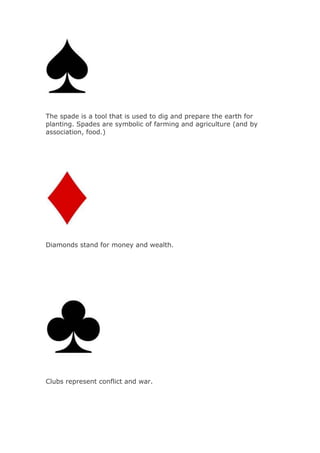
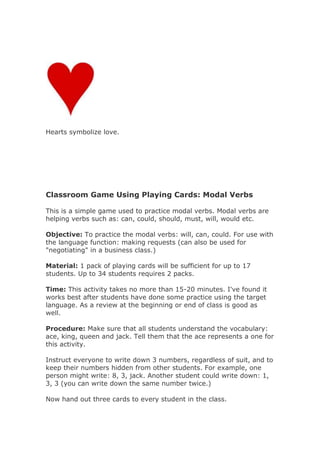
Then, draw a picture of the individual suits on the board and tell the
class that each one represents an important aspect of society
(especially as it existed in the past but still relevant today.) Try to
elicit ideas from your students regarding what each suit represents
before giving them the answers:
The spade is a tool that is used to dig and prepare the earth for
planting. Spades are symbolic of farming and agriculture (and by
association, food.)
Diamonds stand for money and wealth.
Clubs represent conflict and war.
Hearts symbolize love.
Classroom Game Using Playing Cards: Modal Verbs
This is a simple game used to practice modal verbs. Modal verbs are
helping verbs such as: can, could, should, must, will, would etc.
Objective: To practice the modal verbs: will, can, could. For use with
the language function: making requests (can also be used for
"negotiating" in a business class.)
Material: 1 pack of playing cards will be sufficient for up to 17
students. Up to 34 students requires 2 packs.
Time: This activity takes no more than 15-20 minutes. I've found it
works best after students have done some practice using the target
language. As a review at the beginning or end of class is good as
well.
Procedure: Make sure that all students understand the vocabulary:
ace, king, queen and jack. Tell them that the ace represents a one for
this activity.
Instruct everyone to write down 3 numbers, regardless of suit, and to
keep their numbers hidden from other students. For example, one
person might write: 8, 3, jack. Another student could write down: 1,
3, 3 (you can write down the same number twice.)
Now hand out three cards to every student in the class.
Tell them that in a few moments they are going to walk around with
their three cards held out in front of them, face out, and try to trade
the cards they have for the ones other students possess in an
attempt to get the three numbers they previously wrote down.
Now draw their attention to the board. Model the language that they
should try to use.
When trying to obtain a card:
"I'll give you an eight for your queen." or "Can I get your 9 in
exchange for my ten?"
Responding: "No you can't. " or "Sure, here you go."
Now, advise the students to stand up and mingle amongst each other
trying to collect the cards that represent the numbers they wrote
down earlier. The student who gets their numbers first will naturally
run up to you or shout out. Let the activity run its course as the other
students continue making requests.
In all the time that I have used this activity, only one person has
received all three of the numbers they wrote down in the first group
of three cards that I handed out.
Modifications: Instead of having the cards face out, have the
students hold them in the traditional poker style with the value
hidden from others. They can incorporate other questions into the
activity such as "Do you have an eight?" before proceeding to the
modal verb questions listed above. This will obviously extend the time
needed.
As you likely may have considered by now, most popular card games
have a standard number of requests and statements that are
repeated throughout the course of play. It is quite easy to use many
common games to suit the particular language function and/or
grammar point that you are focusing on.
Actually playing the card game around a table with the hope of just
allowing the targeted language to flow can work though you are
limited by the number of students who can play.
Modifying any game to work in a "mingle" setting is something that
seems to be the most effective. Remember also that simply allowing
a game to play out between students while you stand by may create
the sense that not much learning per se is taking place. I have done
this on occasion but usually only with a group I have been teaching
for some time.
Be supposed to do

Be supposed to do

  • 1.
    be supposed todo/be something a) used to say what someone should or should not do, especially because of rules or what someone in authority has said: We're supposed to check out of the hotel by 11 o'clock. I'm not supposed to tell anyone. What time are you supposed to be there? b) used to say what was or is expected or intended to happen, especially when it did not happen: No one was supposed to know about it. The meeting was supposed to take place on Tuesday, but we've had to postpone it. The new laws are supposed to prevent crime. c) used to say that something is believed to be true by many people, although it might not be true or you might disagree: The castle is supposed to be haunted. 'Dirty Harry' is supposed to be one of Eastwood's best films. Mrs Carver is supposed to have a lot of money. I am supposed to do this = this is what I should do. The train is supposed to arrive at 10 am = that is the time the train should arrive according to the timetable.
  • 2.
    Tefl Games: ModalVerbs Using Playing Cards in the Classroom There's something about playing cards that appeals to almost everyone. The aesthetically pleasing look and feel and the association with fun makes them useful for teaching English. Of course, check local customs to ensure that they are not taboo. In some cultures there may be restrictions due to religion and/or because of the connection to gambling. An ordinary pack of cards provides almost endless possibilities for activities in the classroom. I've found that various card games tailored to learning English work best in classes of no more than 20 students. The first time that you pull out a deck in a particular class is a good opportunity to give a brief lesson on their history. You can tell your students that the playing cards of today, with four suits and 52 cards, originated in Persia (what is now Iran) about 1000 years ago. Then, draw a picture of the individual suits on the board and tell the class that each one represents an important aspect of society (especially as it existed in the past but still relevant today.) Try to elicit ideas from your students regarding what each suit represents before giving them the answers:
  • 3.
    The spade isa tool that is used to dig and prepare the earth for planting. Spades are symbolic of farming and agriculture (and by association, food.) Diamonds stand for money and wealth. Clubs represent conflict and war.
  • 4.
    Hearts symbolize love. ClassroomGame Using Playing Cards: Modal Verbs This is a simple game used to practice modal verbs. Modal verbs are helping verbs such as: can, could, should, must, will, would etc. Objective: To practice the modal verbs: will, can, could. For use with the language function: making requests (can also be used for "negotiating" in a business class.) Material: 1 pack of playing cards will be sufficient for up to 17 students. Up to 34 students requires 2 packs. Time: This activity takes no more than 15-20 minutes. I've found it works best after students have done some practice using the target language. As a review at the beginning or end of class is good as well. Procedure: Make sure that all students understand the vocabulary: ace, king, queen and jack. Tell them that the ace represents a one for this activity. Instruct everyone to write down 3 numbers, regardless of suit, and to keep their numbers hidden from other students. For example, one person might write: 8, 3, jack. Another student could write down: 1, 3, 3 (you can write down the same number twice.) Now hand out three cards to every student in the class.
  • 5.
    Tell them thatin a few moments they are going to walk around with their three cards held out in front of them, face out, and try to trade the cards they have for the ones other students possess in an attempt to get the three numbers they previously wrote down. Now draw their attention to the board. Model the language that they should try to use. When trying to obtain a card: "I'll give you an eight for your queen." or "Can I get your 9 in exchange for my ten?" Responding: "No you can't. " or "Sure, here you go." Now, advise the students to stand up and mingle amongst each other trying to collect the cards that represent the numbers they wrote down earlier. The student who gets their numbers first will naturally run up to you or shout out. Let the activity run its course as the other students continue making requests. In all the time that I have used this activity, only one person has received all three of the numbers they wrote down in the first group of three cards that I handed out. Modifications: Instead of having the cards face out, have the students hold them in the traditional poker style with the value hidden from others. They can incorporate other questions into the activity such as "Do you have an eight?" before proceeding to the modal verb questions listed above. This will obviously extend the time needed. As you likely may have considered by now, most popular card games have a standard number of requests and statements that are repeated throughout the course of play. It is quite easy to use many common games to suit the particular language function and/or grammar point that you are focusing on. Actually playing the card game around a table with the hope of just allowing the targeted language to flow can work though you are limited by the number of students who can play. Modifying any game to work in a "mingle" setting is something that seems to be the most effective. Remember also that simply allowing a game to play out between students while you stand by may create the sense that not much learning per se is taking place. I have done this on occasion but usually only with a group I have been teaching for some time.