Binary-Coded Decimal (BCD)
•A Presentation on BCD Number System
• Presented by: [Your Name]
• College Name: [Your College Name]
2.
Introduction to BCD
•• BCD stands for Binary-Coded Decimal
• • Each digit of a decimal number is
represented by its binary equivalent
• • Commonly used in digital systems like
calculators, clocks, etc.
3.
What is BCD?
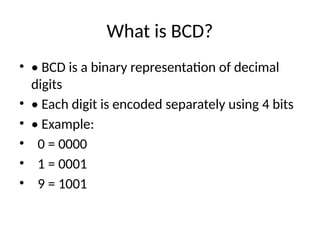
•• BCD is a binary representation of decimal
digits
• • Each digit is encoded separately using 4 bits
• • Example:
• 0 = 0000
• 1 = 0001
• 9 = 1001
4.
BCD vs Binary
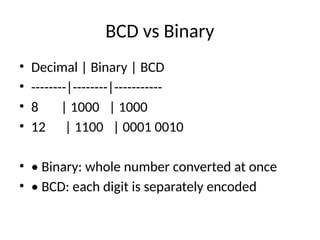
•Decimal | Binary | BCD
• --------|--------|-----------
• 8 | 1000 | 1000
• 12 | 1100 | 0001 0010
• • Binary: whole number converted at once
• • BCD: each digit is separately encoded
Advantages of BCD
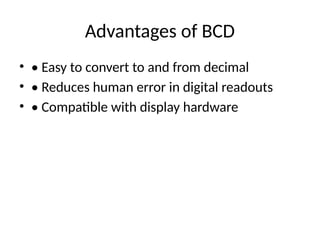
•• Easy to convert to and from decimal
• • Reduces human error in digital readouts
• • Compatible with display hardware
8.
Disadvantages of BCD
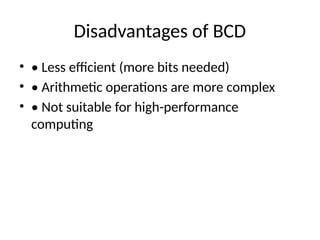
•• Less efficient (more bits needed)
• • Arithmetic operations are more complex
• • Not suitable for high-performance
computing
9.
Applications of BCD
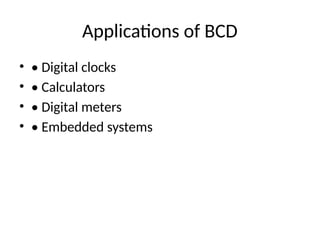
•• Digital clocks
• • Calculators
• • Digital meters
• • Embedded systems
10.
Summary
• • BCDrepresents each decimal digit in binary
form
• • Common in electronics where human-
readable output is needed
• • Various types like 8421 BCD and Excess-3
![Binary-Coded Decimal (BCD)
• A Presentation on BCD Number System
• Presented by: [Your Name]
• College Name: [Your College Name]](https://image.slidesharecdn.com/bcdpresentation-250725182322-9cafbbe5/85/BCD_Presentation-pptx-building-construction-1-320.jpg)
![Binary-Coded Decimal (BCD)
• A Presentation on BCD Number System
• Presented by: [Your Name]
• College Name: [Your College Name]](https://image.slidesharecdn.com/bcdpresentation-250725182322-9cafbbe5/75/BCD_Presentation-pptx-building-construction-1-2048.jpg)