Download to read offline

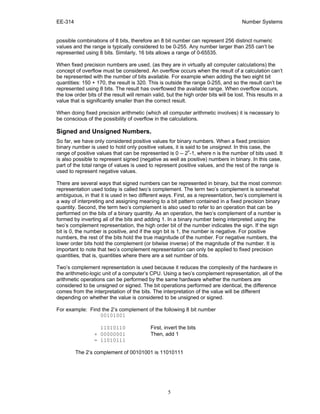
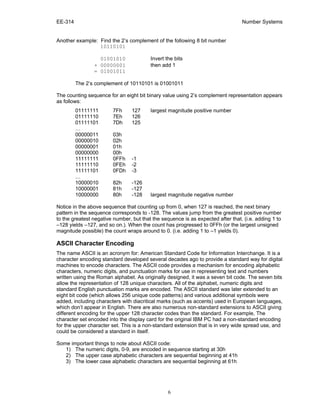
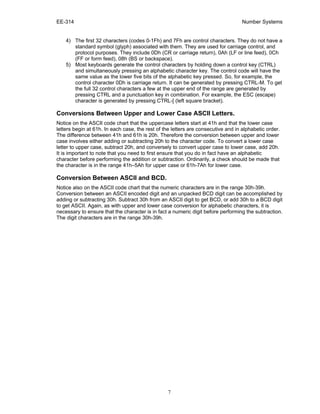
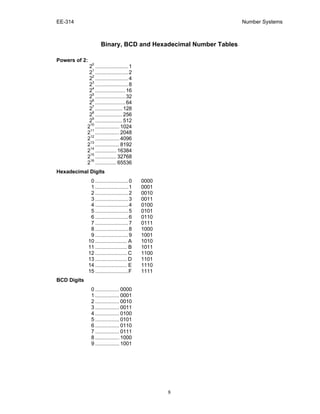
![EE-314 Number Systems
10
ASCII Character Set
High Order Bits
0000 0001 0010 0011 0100 0101 0110 0111Low Order
Bits 0 1 2 3 4 5 6 7
0000 0 NUL DLE Space 0 @ P ` p
0001 1 SOH DC1 ! 1 A Q a q
0010 2 STX DC2 “ 2 B R b r
0011 3 ETX DC3 # 3 C S c s
0100 4 EOT DC4 $ 4 D T d t
0101 5 ENQ NAK % 5 E U e u
0110 6 ACK SYN & 6 F V f v
0111 7 BEL ETB ‘ 7 G W g w
1000 8 BS CAN ( 8 H X h x
1001 9 HT EM ) 9 I Y i y
1010 A LF SUB * : J Z j z
1011 B VT ESC + ; K [ k {
1100 C FF FS , < L l |
1101 D CR GS - = M ] m }
1110 E SO RS . > N ^ n ~
1111 F SI US / ? O _ o DEL](https://image.slidesharecdn.com/numsys-140721213114-phpapp01/85/Numsys-10-320.jpg)

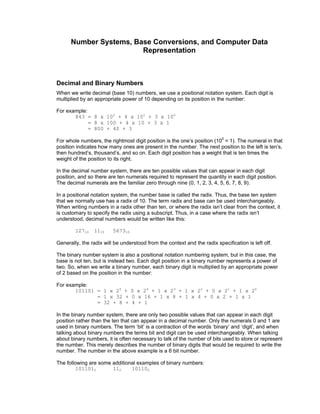
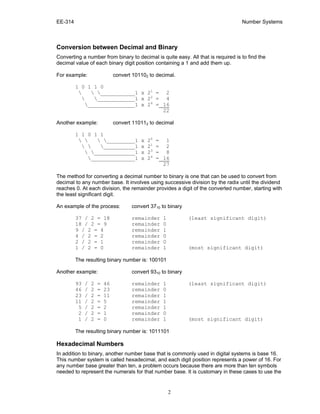
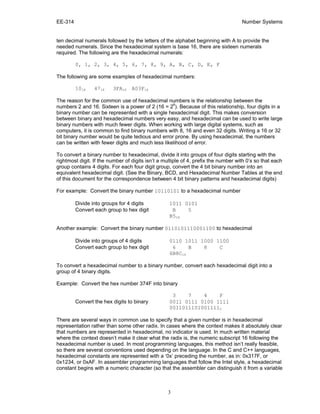
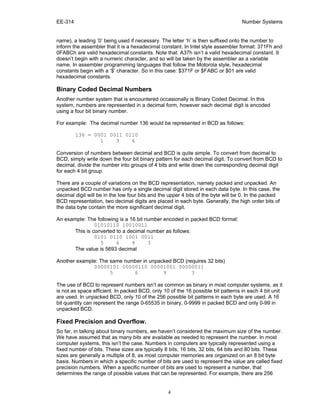
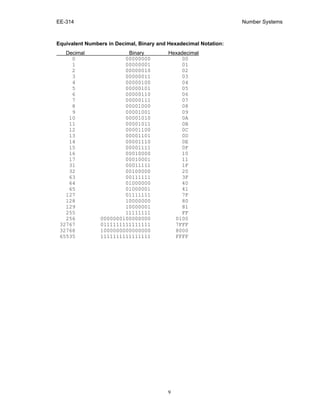
This document discusses different number systems used in computing including decimal, binary, hexadecimal, and binary-coded decimal (BCD). It explains how each system uses a positional notation with a radix or base to represent values. Binary uses a base of 2 with digits of 0 and 1. Hexadecimal uses a base of 16 with digits 0-9 and A-F. Conversion between decimal, binary, and hexadecimal is described. Signed and unsigned numbers are also discussed, with two's complement being the most common way of representing signed binary numbers. Fixed precision and the concept of overflow are introduced when numbers are represented with a limited number of bits in computers.


