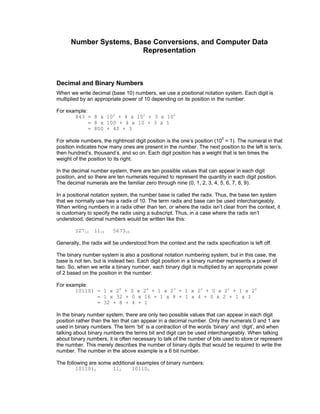
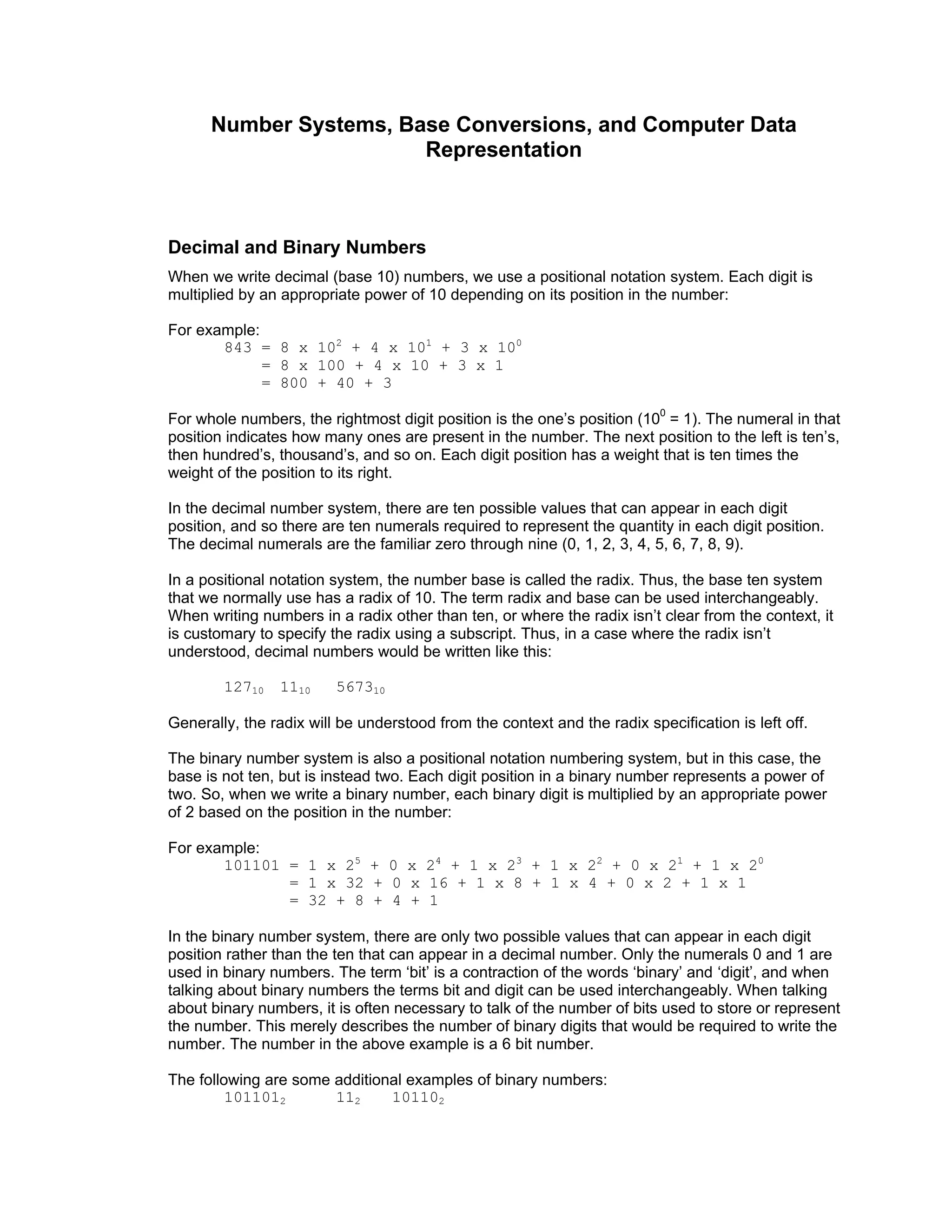
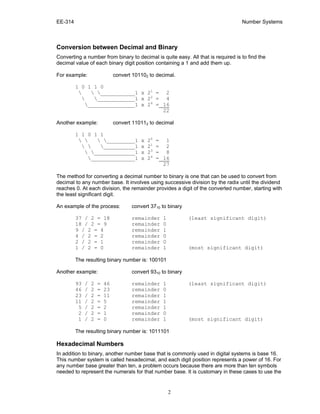
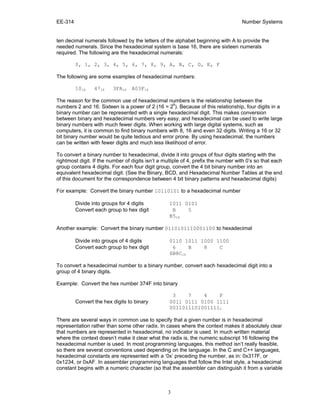
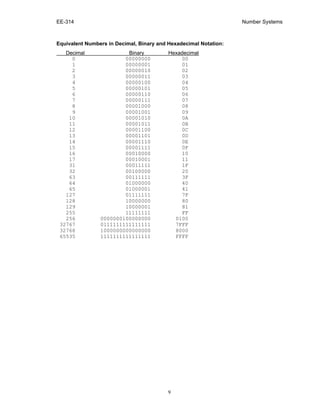
This document discusses different number systems used in computing including decimal, binary, hexadecimal, and binary-coded decimal (BCD). It explains how each system uses a positional notation with a base or radix to represent numbers. Decimal uses base 10 with digits 0-9, binary uses base 2 with digits 0-1, hexadecimal uses base 16 with digits 0-9 and A-F, and BCD encodes each decimal digit as a 4-bit binary number. The document describes how to convert between these number systems through division and remainder operations. Hexadecimal is commonly used to efficiently represent large binary numbers with fewer digits.

![EE-314 Number Systems
10
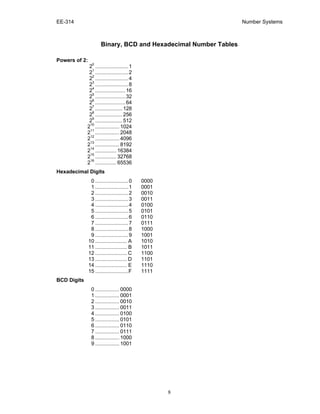
ASCII Character Set
High Order Bits
0000 0001 0010 0011 0100 0101 0110 0111
Low Order
Bits 0 1 2 3 4 5 6 7
0000 0 NUL DLE Space 0 @ P ` p
0001 1 SOH DC1 ! 1 A Q a q
0010 2 STX DC2 “ 2 B R b r
0011 3 ETX DC3 # 3 C S c s
0100 4 EOT DC4 $ 4 D T d t
0101 5 ENQ NAK % 5 E U e u
0110 6 ACK SYN & 6 F V f v
0111 7 BEL ETB ‘ 7 G W g w
1000 8 BS CAN ( 8 H X h x
1001 9 HT EM ) 9 I Y i y
1010 A LF SUB * : J Z j z
1011 B VT ESC + ; K [ k {
1100 C FF FS , < L l |
1101 D CR GS - = M ] m }
1110 E SO RS . > N ^ n ~
1111 F SI US / ? O _ o DEL](https://image.slidesharecdn.com/numsys-211007130817/85/Number-system-10-320.jpg)


