BCBSM 
Physician Group Incentive 
Program 
Patient-Centered Medical Home 
and Patient-Centered Medical 
Home-Neighbor 
Domains of Function 
Interpretive Guidelines 
V1.0 
2013-2014
Table of Contents 
Page 
1.0 PATIENT-PROVIDER PARTNERSHIP 12 
2.0 PATIENT REGISTRY 15 
3.0 PERFORMANCE REPORTING 20 
4.0 INDIVIDUAL CARE MANAGEMENT 24 
5.0 EXTENDED ACCESS 33 
6.0 TEST RESULTS TRACKING & FOLLOW-UP 36 
9.0 PREVENTIVE SERVICES 38 
10.0 LINKAGE TO COMMUNITY SERVICES 41 
11.0 SELF-MANAGEMENT SUPPORT 44 
12.0 PATIENT WEB PORTAL 48 
13.0 COORDINATION OF CARE 50 
14.0 SPECIALIST PRE-CONSULTATION AND REFERRAL PROCESS 53
1 
Blue Cross Blue Shield of Michigan 
Physician Group Incentive Program 
Patient-Centered Medical Home 
And Patient-Centered Medical Home-Neighbor 
Domains of Function Interpretive Guidelines 
Under Blue Cross Blue Shield of Michigan’s (BCBSM) Physician Group Incentive 
Program (PGIP), Patient-Centered Medical Home (PCMH)-based infrastructure and 
care processes have been organized into 12 “Domains of Function” (listed in Table of 
Contents). Each PCMH Domain of Function has a set of required capabilities, 
collaboratively developed by BCBSM and PGIP Physician Organizations (POs), which 
are described in this document. To provide further information regarding the definition 
of each required capability, a BCBSM-PO team was assembled to review and finalize 
these PCMH Interpretive Guidelines. 
Any capability reported to BCBSM as “in place” must be fully in place and in use by all 
appropriate members of the practice unit team on a routine and systematic basis, and, 
where applicable, patients must be able to use the capability. “Clinical Practice Unit 
teams” should be composed of “clinicians,” defined as physicians, nurse practitioners, 
or physician assistants (unless otherwise specified in the guidelines). 
Capabilities are not necessarily listed in sequential order (except for patient-provider 
partnership capabilities) and may be implemented in any sequence the PO and/or 
practice unit feels is most suitable to their practice transformation strategy. 
Note: Domains 7 and 8 are not included in this document. Domain 7 was previously 
used to collect evidence-based care data, and Domain 8 is used to collect self-reported 
electronic prescribing data. 
Note regarding expansion to address role of specialists and subspecialists: PCMH-Neighbor 
(PCMH-N) Interpretive Guidelines (June 2012): 
BCBSM’s PCMH program provides the foundation to build Organized Systems of Care 
(OSCs). These expanded PCMH-N Interpretive Guidelines support implementation of 
capabilities that will enable specialists and sub-specialists, including behavioral health 
providers, to partner with primary care physicians and other providers to create OSCs. 
The goals of the PCMH-N model are to: 
• Ensure effective communication, coordination and integration with PCMH 
practices, including appropriate flow of patient care information 
• Provide appropriate and timely consultations and referrals that complement and 
advance the aims of the PCMH practices
• Clearly define roles and responsibilities of primary care physicians and 
specialists in caring for the patient 
Under the PGIP program, specialists must be members of one, and only one, PGIP 
Physician Organization. A specialist practice will be identified as a Principal Partner of 
another PO (a PO which the specialist is not a member of) if all of the following criteria 
are met: 
• the patients attributed to the non-member PO account for a substantial proportion 
of the patients a practice serves, 
• the non-member PO represents a greater share of the members who received 
services from the practice than the member PO, 
• the practice provided services to at least 50 patients from the non-member PO, 
• the non-member PO represents at least 20% of the total BCBSM members who 
received services from the practice 
POs and OSCs are encouraged to execute Primary Care-Specialist agreements with 
their member and principal partner specialists (a sample template of a high-level, one 
page agreement is available at the BCBSM website, but providers may also develop 
their own agreements). When POs nominate a specialist for an uplift, they must attest 
that there is a signed Primary Care-Specialist agreement with that specialist. (For 
information on the specialist nomination for uplift process and requirements regarding 
Primary Care-Specialist agreements, please check the BCBSM PGIP Collaboration site.) 
Types of PCP/Specialist Clinical Interactions 
Pre-consultation exchange - Expedite/prioritize care, clarify need for a 
referral, answer a clinical question and facilitate the diagnostic evaluation of 
the patient prior to specialty assessment 
Formal consultation - Deal with a discrete question regarding a patient’s 
diagnosis, diagnostic results, procedure, treatment or prognosis with the 
intention that the care of the patient will be transferred back to the PCMH/PCP 
after one or two visits. 
Co-management 
• Co-management with shared management for the disease – specialist 
shares long-term management with the PCP for a patient’s referred 
condition and provides advice, guidance and periodic follow-up for 
one specific condition. 
• Co-management with principal care for the disease – (referral) the 
specialist assumes responsibility for long-term, comprehensive 
management of a patient’s referred medical/surgical condition; PCP 
receives consultation reports and provides input on secondary 
referrals and quality of life/treatment decisions and continues to care 
for all other aspects of patient care and new or other unrelated health 
problems and remains first contact for patient. 
BCBSM PCMH-N Interpretive Guidelines – October 2013 2
• Co-management with principal care of the patient for a consuming 
illness for a limited period – when, for a limited time due to the nature 
and impact of the disease, the specialist becomes first contact for care 
until the crisis or treatment has stabilized or completed. PCP remains 
active in bi-directional information and provides input on secondary 
referrals and other defined areas of care. 
Transfer of patient to Specialist - Transfer of patient to specialist for the 
entirety of care. 
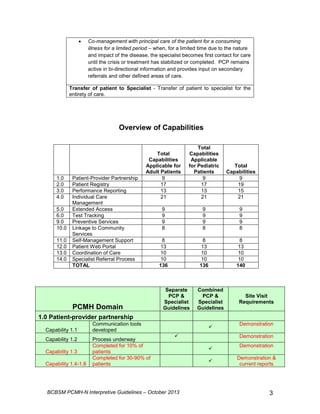
Overview of Capabilities 
Total 
Capabilities 
Applicable for 
Adult Patients 
Total 
Capabilities 
Applicable 
for Pediatric 
Patients 
Total 
Capabilities 
1.0 Patient-Provider Partnership 9 9 9 
2.0 Patient Registry 17 17 19 
3.0 Performance Reporting 13 13 15 
4.0 Individual Care 
Management 
21 21 21 
5.0 Extended Access 9 9 9 
6.0 Test Tracking 9 9 9 
9.0 Preventive Services 9 9 9 
10.0 Linkage to Community 
Services 
8 8 8 
11.0 Self-Management Support 8 8 8 
12.0 Patient Web Portal 13 13 13 
13.0 Coordination of Care 10 10 10 
14.0 Specialist Referral Process 10 10 10 
TOTAL 136 136 140 
PCMH Domain 
Separate 
PCP & 
Specialist 
Guidelines 
Combined 
PCP & 
Specialist 
Guidelines 
Site Visit 
Requirements 
1.0 Patient-provider partnership 
Capability 1.1 
Communication tools 
developed 
 
Demonstration 
Capability 1.2 Process underway 
 
Demonstration 
Capability 1.3 
Completed for 10% of 
patients 
 
Demonstration 
Capability 1.4-1.8 
Completed for 30-90% of 
patients 
 
Demonstration  
current reports 
BCBSM PCMH-N Interpretive Guidelines – October 2013 3
PCMH Domain 
Separate 
PCP  
Specialist 
Guidelines 
Combined 
PCP  
Specialist 
Guidelines 
Site Visit 
Requirements 
Capability 1.9 
Patients informed that 
health information may be 
shared with care partners 
 
Demonstration 
2.0 Patient registry 
Capability 2.1 
Pt registry for diabetes or 
condition relevant to 
specialty 
 
Demonstration  
current reports 
Capability 2.2 
Info on health care services 
at other sites 
 
Demonstration  
current reports 
Capability 2.3 
Evidence-based care 
guidelines 
 
Demonstration  
current reports 
Capability 2.4 Point of Care 
 
Demonstration  
current reports 
Capability 2.5 Attributed practitioner 
 
Demonstration  
current reports 
Capability 2.6 
Gaps in care alerts to 
patients 
 
Demonstration  
current reports 
Capability 2.7 
Gaps in care flags for all 
patients 
 
Demonstration  
current reports 
Capability 2.8 
Patient demographics and 
clinical parameters 
 
Demonstration  
current reports 
Capability 2.9 Electronic 
 
Demonstration  
current reports 
Capability 2.10 Asthma 
 
Demonstration  
current reports 
Capability 2.11 CAD (adult pts) 
 
Demonstration  
current reports 
Capability 2.12 CHF (adult pts) 
 
Demonstration  
current reports 
Capability 2.13 2 other chronic conditions 
 
Demonstration  
current reports 
Capability 2.14 Preventive services 
 
Demonstration  
current reports 
Capability 2.15 Assigned patients 
 
Demonstration  
current reports 
Capability 2.16 CKD 
 
Demonstration  
current reports 
Capability 2.17 Pediatric obesity (peds pts) 
 
Demonstration  
current reports 
Capability 2.18 Pediatric ADHD (peds pts) 
 
Demonstration  
current reports 
Capability 2.19 Care manager identified 
 
Demonstration  
current reports 
3.0 Performance reporting 
Capability 3.1 Diabetes 
 
Demonstration  
current reports 
Capability 3.2 
PO/sub-PO, practice unit, 
and individual provider level 
 
Demonstration  
current reports 
BCBSM PCMH-N Interpretive Guidelines – October 2013 4
PCMH Domain 
Separate 
PCP  
Specialist 
Guidelines 
Combined 
PCP  
Specialist 
Guidelines 
Site Visit 
Requirements 
Capability 3.3 2 other chronic conditions 
 Demonstration  
current reports 
Capability 3.4 Data validated 
 
Demonstration  
current reports 
Capability 3.5 Trend reports 
 
Demonstration  
current reports 
Capability 3.6 Pediatric obesity 
 
Demonstration  
current reports 
Capability 3.7 All current patients 
 
Demonstration  
current reports 
Capability 3.8 
Reports on health care 
services at other sites 
 
Demonstration  
current reports 
Capability 3.9 Specialists 
 
Demonstration  
current reports 
Capability 3.10 Asthma 
 
Demonstration  
current reports 
Capability 3.11 CAD 
 
Demonstration  
current reports 
Capability 3.12 CHF 
 
Demonstration  
current reports 
Capability 3.13 Pediatric ADHD 
 
Demonstration  
current reports 
Capability 3.14 
Reports include care 
manager activity 
 
Demonstration  
current reports 
Capability 3.15 
Quality metrics reported to 
external entities 
 
Demonstration  
current reports 
4.0 Individual care management 
Capability 4.1 PCMH training 
 
Current 
documentation  
training documents 
Capability 4.2 
Integrated team of multi-disciplinary 
providers 
 
Demonstration 
Capability 4.3 
Evidence-based care 
guidelines in use at point of 
care 
 
Demonstration and 
review of guidelines 
Capability 4.4 
Patient satisfaction/office 
efficiency measured 
 
Documentation of 
aggregated results 
Capability 4.5 
Action plan and self-management 
goal-setting 
 
Demonstration 
Capability 4.6 
Appointment tracking and 
reminders – one chronic 
condition 
 
Demonstration 
Capability 4.7 
Follow-up for needed 
services – one chronic 
condition 
 
Demonstration 
Capability 4.8 
Planned visits – one 
chronic condition 
 
Demonstration and 
documentation 
Capability 4.9 Group visit 
 
BCBSM PCMH-N Interpretive Guidelines – October 2013 5
PCMH Domain 
Separate 
PCP  
Specialist 
Guidelines 
Combined 
PCP  
Specialist 
Guidelines 
Site Visit 
Requirements 
Capability 4.10 
Medication review and 
management 
 
Demonstration 
Capability 4.11 
Action plan development 
and self-management goal-setting 
-- all chronic 
conditions or other complex 
health care needs 
 
Demonstration and 
documentation 
Capability 4.12 
Appointment tracking and 
reminders - all patients 
 
Demonstration 
Capability 4.13 
Follow-up for needed 
services – all patients 
 
Demonstration 
Capability 4.14 
Planned visits – all chronic 
conditions 
 
Demonstration and 
documentation 
Capability 4.15 
Group visit option -- all 
chronic conditions 
 
Capability 4.16 Advance care planning 
 
Demonstration 
Capability 4.17 Survivorship Plan 
 
Demonstration 
Capability 4.18 Palliative Care 
 
Demonstration 
Capability 4.19 
Identify candidates for care 
management 
 Documentation of 
process results 
Capability 4.20 
Inform patients about care 
management services 
 
Capability 4.21 
Conduct regular case 
reviews 
 Example of 
developed care plan 
5.0 Extended access 
Capability 5.1 
24-hour access to a 
clinical decision-maker by 
phone with feedback loop 
within 24 hours 
 Demonstration 
Capability 5.2 
Clinical decision-maker 
has access to EMR or 
registry info during phone 
call 
 
Capability 5.3  5.5 
Access to non-ED after-hours 
provider for urgent 
care needs during at 
least 8 after-hours per 
week, with feedback loop 
 
Capability 5.4 
All patients fully informed 
about after-hours care 
availability 
 
Capability 5.5 
Access to non-ED after-hours 
provider for urgent 
care needs during at 
least 12 after-hours per 
 
BCBSM PCMH-N Interpretive Guidelines – October 2013 6
PCMH Domain 
Separate 
PCP  
Specialist 
Guidelines 
Combined 
PCP  
Specialist 
Guidelines 
Site Visit 
Requirements 
week, with feedback loop 
Capability 5.6 
After-hours provider has 
access to EMR or 
patient's registry record 
during the visit 
 Demonstration 
Capability 5.7 
Advanced access 
scheduling for at least 
30% of appointments 
(tiered access for 
specialists) 
 Demonstration and 
Written policy 
Capability 5.8 
Advanced access 
scheduling for at least 
50% of appointments 
PCP only Demonstration and 
Written policy 
Capability 5.9 
Practice unit has 
telephonic or other 
access to interpreters for 
all languages common to 
practice's established 
patients 
 
6.0 Test results tracking  follow-up 
Capability 6.1 
Process/procedure 
documented, 
 
Demonstration and 
Written process 
Capability 6.2 
Ensure patients receive 
needed tests and practices 
obtains results 
 
Capability 6.3 
Patient contact details are 
kept up to date 
 
Capability 6.4 
Mechanism for patients to 
obtain information about 
normal tests 
 
Demonstration 
Capability 6.5 
Systematic approach to 
inform patients about 
abnormal test results 
 
Demonstration 
Capability 6.6 
Patients with abnormal 
results receive 
recommended follow-up 
care 
 
Capability 6.7 
All test tracking steps 
documented 
 
Demonstration 
Capability 6.8 
All clinicians and 
appropriate office staff 
trained 
 
Demonstration 
Documentation of 
training 
Capability 6.9 
Computerized order entry 
integrated with automated 
test tracking system 
 
Demonstration 
BCBSM PCMH-N Interpretive Guidelines – October 2013 7
PCMH Domain 
Separate 
PCP  
Specialist 
Guidelines 
Combined 
PCP  
Specialist 
Guidelines 
Site Visit 
Requirements 
9.0 Preventive services 
Capability 9.1 
Primary prevention 
program 
 
Capability 9.2 
Systematic approach to 
providing preventive 
services 
 
Capability 9.3 
Outreach regarding 
ongoing well care visits and 
screenings 
 
Demonstration 
Capability 9.4 
Process in place to inquire 
and incorporate information 
about patient's outside 
health encounters 
 
Capability 9.5 
Provision of tobacco use 
assessment tools and 
smoking cessation advice 
 
Demonstration 
Capability 9.6 
Written standing order 
protocols for preventive 
services without 
examination by a clinician 
 
Demonstration and 
standing order 
protocols 
Capability 9.7 
Secondary prevention 
program 
 
Demonstration 
Capability 9.8 Staff training 
 
Demonstration 
Capability 9.9 
Planned visits for 
preventive services 
 
Planned visit 
template 
10.0 Linkage to community services 
Capability 10.1 Comprehensive review 
 
Demonstration 
Capability 10.2 
PO maintains a community 
resource database 
 
Demonstration 
Capability 10.3 
Collaborative relationships 
with appropriate 
community-based agencies 
and organizations 
 
Demonstration 
Capability 10.4 Staff training 
 
Demonstration 
Capability 10.5 
Systematic approach for 
educating all patients about 
community resources and 
assessing/discussing need 
for referral 
 
Demonstration 
Capability 10.6 
Systematic approach for 
referring patients to 
community resources 
 
Demonstration 
Capability 10.7 
Systematic approach for 
tracking referrals of high-risk 
patients 
 
Demonstration 
BCBSM PCMH-N Interpretive Guidelines – October 2013 8
PCMH Domain 
Separate 
PCP  
Specialist 
Guidelines 
Combined 
PCP  
Specialist 
Guidelines 
Site Visit 
Requirements 
Capability 10.8 
Systematic approach for 
conducting follow-up with 
high-risk patients 
 
Demonstration 
11.0 Self-management support 
Capability 11.1 
Member of clinical care 
team or PO educated about 
and familiar with self-management 
support 
concepts and techniques 
 
Demonstration 
Capability 11.2 
Self-management support – 
initial chronic condition 
 
Demonstration 
Capability 11.3 
Follow-up to discuss action 
plans and goals and 
provide supportive 
reminders – initial chronic 
condition 
 
Demonstration 
Capability 11.4 
Regular patient 
experience/satisfaction 
surveys of patients 
engaged in self-management 
support 
 
Demonstration  
aggregated survey 
results 
Capability 11.5 
Self-management support – 
all chronic conditions 
 
Demonstration 
Capability 11.6 
Follow-up to discuss action 
plans and goals and 
provide supportive 
reminders – all chronic 
conditions 
 
Demonstration 
Capability 11.7 
Self-management goal-setting 
- all patients 
 
Demonstration 
Capability 11.8 
One member of PO or 
practice unit is formally 
trained and regularly works 
with appropriate staff 
members 
 
Demonstration 
12.0 Patient web portal 
Capability 12.1 
Available vendor options 
have been evaluated 
 
Demonstration 
Capability 12.2 
Liability and safety issues 
assessed 
 
Demonstration 
Capability 12.3 
Electronic appointment 
scheduling 
 
Demonstration  
documentation of 
usage logs (even if 
patients aren’t using) 
Capability 12.4 
Patients can log results of 
self-administered tests 
 
Demonstration  
documentation of 
usage logs (even if 
patients aren’t using) 
BCBSM PCMH-N Interpretive Guidelines – October 2013 9
PCMH Domain 
Separate 
PCP  
Specialist 
Guidelines 
Combined 
PCP  
Specialist 
Guidelines 
Site Visit 
Requirements 
Capability 12.5 
Automatic alerts for self-reported 
patient data that 
indicates a potential health 
issue 
 
Demonstration  
documentation of 
usage logs (even if 
patients aren’t using) 
Capability 12.6 E-visits 
 
Demonstration  
documentation of 
usage logs (even if 
patients aren’t using) 
Capability 12.7 
Using patient portal to send 
automated care reminders, 
other info 
 
Demonstration  
documentation of 
usage logs (even if 
patients aren’t using) 
Capability 12.8 
Capability for patient to 
create personal health 
record 
 
Demonstration  
documentation of 
usage logs (even if 
patients aren’t using) 
Capability 12.9 
Ability for patients to review 
test results electronically 
 
Demonstration  
documentation of 
usage logs (even if 
patients aren’t using) 
Capability 12.10 
Ability for patients to 
request prescription 
renewals electronically 
 
Demonstration  
documentation of 
usage logs (even if 
patients aren’t using) 
Capability 12.11 
Ability for patients to graph 
and analyze results of self-administered 
tests 
 
Demonstration  
documentation of 
usage logs (even if 
patients aren’t using) 
Capability 12.12 
Ability for patients to view 
registries, electronic 
medical records online 
 
Demonstration  
documentation of 
usage logs (even if 
patients aren’t using) 
Capability 12.13 
Ability to schedule 
appointments electronically 
 
Demonstration  
documentation of 
usage logs (even if 
patients aren’t using) 
13.0 Coordination of care 
Capability 13.1 
Notified of each patient 
admit and discharge - initial 
chronic condition 
 
Demonstration 
Capability 13.2 
Process for exchanging 
medical records – initial 
chronic condition 
 
Demonstration 
Capability 13.3 
Systematically track care 
coordination – initial chronic 
condition 
 Demonstration 
Capability 13.4 
Flags for time-sensitive 
health issue – initial chronic 
condition 
 
Demonstration 
BCBSM PCMH-N Interpretive Guidelines – October 2013 10
PCMH Domain 
Separate 
PCP  
Specialist 
Guidelines 
Combined 
PCP  
Specialist 
Guidelines 
Site Visit 
Requirements 
Capability 13.5 
Written transition plans for 
patients leaving the 
practice - initial chronic 
condition 
 
Demonstration 
Capability 13.6 
Coordinate care with payer 
case manager 
 
Demonstration 
Capability 13.7 
Written procedures, team 
members trained 
 
Demonstration 
Capability 13.8 
Capabilities 13.1-13.7 
extended to all chronic 
conditions 
 
Demonstration 
Capability 13.9 
Capabilities 13.1-13.7 
extended to all patients 
 
Demonstration 
Capability 13.10 Discharge follow-up 
 
Demonstration  
documentation of 
tracking method 
14.0 Specialist referral process 
Capability 14.1 
Documented procedures 
for preferred/high-volume 
specialists 
 Documented process 
Capability 14.2 
Documented procedures 
for other key providers 
 Documented process 
Capability 14.3 Directory maintained 
Demonstration 
Capability 14.4 Specialist referral materials  Demonstration 
Capability 14.5 
Makes specialist 
appointments on behalf of 
patients 
 
Capability 14.6 
Electronically-based tools 
and processes 
 Demonstration 
Capability 14.7 
Process to monitor and 
confirm referrals and follow-up 
took place 
 Demonstration 
Capability 14.8 Staff trained 
 
Capability 14.9 
Practice unit regularly 
evaluates patient 
satisfaction 
 Documentation of 
aggregated survey 
results 
Capability 14.10 
Phys-to-phys pre-referral 
communication 
 Demonstration and 
documented process 
Note: Electronic prescribing is not a PCMH domain, but is included in the capability counts for 
PCMH Designation, and so is part of the site visit review process. Starting in 2013, e-prescribing 
opportunity reports, which are generated for each PO and show actual rate of e-prescribed 
claims at the provider level, will be reviewed during the site visit. 
BCBSM PCMH-N Interpretive Guidelines – October 2013 11
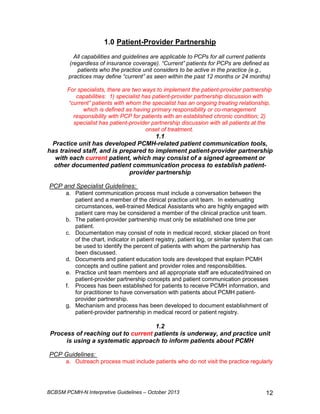
1.0 Patient-Provider Partnership 
All capabilities and guidelines are applicable to PCPs for all current patients 
(regardless of insurance coverage). “Current” patients for PCPs are defined as 
patients who the practice unit considers to be active in the practice (e.g., 
practices may define “current” as seen within the past 12 months or 24 months) 
For specialists, there are two ways to implement the patient-provider partnership 
capabilities: 1) specialist has patient-provider partnership discussion with 
“current” patients with whom the specialist has an ongoing treating relationship, 
which is defined as having primary responsibility or co-management 
responsibility with PCP for patients with an established chronic condition; 2) 
specialist has patient-provider partnership discussion with all patients at the 
onset of treatment. 
1.1 
Practice unit has developed PCMH-related patient communication tools, 
has trained staff, and is prepared to implement patient-provider partnership 
with each current patient, which may consist of a signed agreement or 
other documented patient communication process to establish patient-provider 
partnership 
PCP and Specialist Guidelines: 
a. Patient communication process must include a conversation between the 
patient and a member of the clinical practice unit team. In extenuating 
circumstances, well-trained Medical Assistants who are highly engaged with 
patient care may be considered a member of the clinical practice unit team. 
b. The patient-provider partnership must only be established one time per 
patient. 
c. Documentation may consist of note in medical record, sticker placed on front 
of the chart, indicator in patient registry, patient log, or similar system that can 
be used to identify the percent of patients with whom the partnership has 
been discussed. 
d. Documents and patient education tools are developed that explain PCMH 
concepts and outline patient and provider roles and responsibilities. 
e. Practice unit team members and all appropriate staff are educated/trained on 
patient-provider partnership concepts and patient communication processes 
f. Process has been established for patients to receive PCMH information, and 
for practitioner to have conversation with patients about PCMH patient-provider 
partnership. 
g. Mechanism and process has been developed to document establishment of 
patient-provider partnership in medical record or patient registry. 
1.2 
Process of reaching out to current patients is underway, and practice unit 
is using a systematic approach to inform patients about PCMH 
PCP Guidelines: 
a. Outreach process must include patients who do not visit the practice regularly 
BCBSM PCMH-N Interpretive Guidelines – October 2013 12
b. Examples of outreach include discussion at the time of visit, mailings, emails, 
websites, telephone outreach, or other electronic means, 
i Mass mailings do not meet the requirements for 1.3 through 1.8 
ii Outreach materials should explain the PCMH concept and patient-provider 
partnership 
iii For any reference to a practice having “BCBSM Designation status” 
please reference BCBSM’s recommended language for 
communications to patients from PCMH-Designated practices 
c. For those patients who do not come into the practice regularly, outreach must 
consist of distribution of material that the patient receives personally, either 
via mail, email, telephone, or patient portal. 
Specialist Guidelines: 
a. Examples of outreach include discussion at the time of visit, mailings, emails, 
websites, telephone outreach, or other electronic means, 
i Mass mailings do not meet the requirements for 1.3 through 1.8 
ii Outreach materials should explain the PCMH concept and patient-provider 
partnership 
1.3 
Patient-provider agreement or other documented patient communication 
process is implemented and documented for at least 10% of current 
patients 
PCP and Specialist Guidelines: 
a. Establishment of patient-provider partnership must include conversation 
between patient and a member of the practice unit clinical team 
i. In extenuating circumstances, well-trained Medical Assistants who are 
highly engaged with patient care may be considered a member of the 
clinical practice unit team. 
ii. Conversation should preferably take place in person, but may take 
place over phone in extenuating circumstances, for a limited number 
of patients 
iii. Other team members may begin the conversation, or follow-up after 
physician conversation with more detailed discussion/information, but 
a clinical team member must participate in at least part of the patient-provider 
partnership conversation 
b. Conversation may be documented in medical record, patient registry, or other 
type of list. 
c. Practice must also have mechanism to track percent of patients that have 
established partnership, and be able to provide data during site visit showing 
denominator (total number of “current” patients in the practice) and numerator 
(total number of patients in the denominator with whom conversations have 
been held and partnerships established at any point in the past). 
BCBSM PCMH-N Interpretive Guidelines – October 2013 13
1.4 
Patient-provider agreement or other documented patient communication 
process is implemented and documented for at least 30% of current 
patients 
PCP and Specialist Guidelines: 
a. Reference 1.3 
1.5 
Patient-provider agreement or other documented patient communication 
process is implemented and documented for at least 50% of current 
patients 
PCP and Specialist Guidelines: 
a. Reference 1.3 
1.6 
Patient-provider agreement or other documented patient communication 
process is implemented and documented for at least 60% of current 
patients 
PCP and Specialist Guidelines: 
a. Reference 1.3 
1.7 
Patient-provider agreement or other documented patient communication 
process is implemented and documented for at least 80% of current 
patients 
PCP and Specialist Guidelines: 
a. Reference 1.3 
1.8 
Patient-provider agreement or other documented patient communication 
process is implemented and documented for at least 90% of current 
patients 
PCP and Specialist Guidelines: 
a. Reference 1.3 
1.9 
Providers ensure that patients are aware that as part of comprehensive, 
quality care and to support population management, health care information 
is shared among care partners as necessary. 
PCP and Specialist Guidelines: 
a. Providers ensure that patients are aware and clearly understand that in 
the course of providing care, providers will share patient information with 
other providers who are involved in the patient's care, as appropriate. The 
BCBSM PCMH-N Interpretive Guidelines – October 2013 14
data sharing may be through provision of written medical information or 
through electronic sharing of information (for example, electronic 
transmission of information about admissions, discharges and transfers 
from/to hospital based care settings). 
b. Language regarding the sharing of health information with other providers 
can be added to the patient-provider partnership documentation, or it may 
be incorporated into the practice’s existing HIPAA documentation, such as 
a “notice of privacy practices”, in order to fulfill the requirement to inform 
patients in this regard. 
2.0 Patient Registry 
Applicable to PCPs; and to specialists for the condition(s) relevant to their patient 
population for which the specialist has primary responsibility (regardless of 
insurance coverage and including Medicare patients). 
For all Patient Registry capabilities except 2.9, registry may be paper or 
electronic. A fully electronic registry may be the last capability to be 
implemented. 
Nine of the Patient Registry capabilities identify the population of patients 
included in the registry (2.1, 2.10, 2.11, 2.12, 2.13, 2.15, 2.16, 2.17, and 2.18). 
The other nine Patient Registry capabilities pertain to registry functionality (2.2, 
2.3, 2.4, 2.5, 2.6., 2.7, 2.8, 2.9, and 2.14). All capabilities pertaining to 
functionality that are marked as in place must be in place for each population of 
patients marked as included in the registry. 
2.1 
A paper or electronic all-payer registry is being used to manage all 
established patients in the Practice Unit with: Diabetes (or, for specialists, 
relevant condition) 
PCP and Specialist Guidelines: 
a. A patient registry is a database that contains several dimensions of clinical 
data on patients to enable providers to manage their population of patients. 
Relevant clinical information that is the focus of attention in generally 
accepted guidelines and is incorporated in common quality measures 
pertinent to the chronic illness must be incorporated in the registry (i.e., 
physiologic parameters, lab results, medication prescription in use, physical 
findings, and patient behaviors such as peak flow meter use or daily salt 
intake). 
b. Registry data must be in the form of data fields that are accessible for 
tabulation and population management. 
c. Registry must include all established patients with the disease referenced in 
the capability, regardless of insurance coverage (including Medicare patients) 
d. Patients assigned by managed care organizations do not have to be included 
in registry if they are not established patients (reference 2.15). 
BCBSM PCMH-N Interpretive Guidelines – October 2013 15
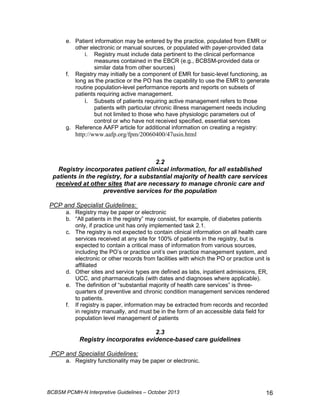
e. Patient information may be entered by the practice, populated from EMR or 
other electronic or manual sources, or populated with payer-provided data 
i. Registry must include data pertinent to the clinical performance 
measures contained in the EBCR (e.g., BCBSM-provided data or 
similar data from other sources) 
f. Registry may initially be a component of EMR for basic-level functioning, as 
long as the practice or the PO has the capability to use the EMR to generate 
routine population-level performance reports and reports on subsets of 
patients requiring active management. 
i. Subsets of patients requiring active management refers to those 
patients with particular chronic illness management needs including 
but not limited to those who have physiologic parameters out of 
control or who have not received specified, essential services 
g. Reference AAFP article for additional information on creating a registry: 
http://www.aafp.org/fpm/20060400/47usin.html 
2.2 
Registry incorporates patient clinical information, for all established 
patients in the registry, for a substantial majority of health care services 
received at other sites that are necessary to manage chronic care and 
preventive services for the population 
PCP and Specialist Guidelines: 
a. Registry may be paper or electronic 
b. “All patients in the registry” may consist, for example, of diabetes patients 
only, if practice unit has only implemented task 2.1. 
c. The registry is not expected to contain clinical information on all health care 
services received at any site for 100% of patients in the registry, but is 
expected to contain a critical mass of information from various sources, 
including the PO’s or practice unit’s own practice management system, and 
electronic or other records from facilities with which the PO or practice unit is 
affiliated 
d. Other sites and service types are defined as labs, inpatient admissions, ER, 
UCC, and pharmaceuticals (with dates and diagnoses where applicable). 
e. The definition of “substantial majority of health care services” is three-quarters 
of preventive and chronic condition management services rendered 
to patients. 
f. If registry is paper, information may be extracted from records and recorded 
in registry manually, and must be in the form of an accessible data field for 
population level management of patients 
2.3 
Registry incorporates evidence-based care guidelines 
PCP and Specialist Guidelines: 
a. Registry functionality may be paper or electronic. 
BCBSM PCMH-N Interpretive Guidelines – October 2013 16
b. Guidelines should be drawn from recognized, validated sources at the state 
or national level (e.g., MQIC Guidelines, USPSTF). 
c. Determination of which evidence-based care guidelines to use should be 
based on judgment of practice leaders. 
2.4 
Registry information is available and in use by the Practice Unit team at the 
point of care 
PCP and Specialist Guidelines: 
a. Registry functionality may be paper or electronic. 
b. Practice unit has and is fully using the capability to generate up-to-date, 
integrated individual patient reports at the point of care to be used during the 
visit. 
c. EMR would meet the requirements of this capability provided it has evidence-based 
guidelines embedded in the tool, and relevant information is identified 
and imported into screens or reports that facilitate easy access to all relevant 
data elements particular to the conditions under management, for the 
purpose of guiding point of care services. 
2.5 
Registry contains information on the individual attributed practitioner for 
every patient currently in the registry who has a medical home in the 
practice unit 
PCP and Specialist Guidelines: 
a. Registry may be paper or electronic 
b. The individual practitioner responsible for the care of each patient is identified 
in the registry 
i. Occasional gaps in information about some patients’ individual 
attributed practitioner due to changes in medical personnel are 
acceptable 
2.6 
Registry is being used to generate routine, systematic communication to 
patients regarding gaps in care 
PCP and Specialist Guidelines: 
a. Registry may be paper or electronic. 
b. Communications may be manual, provided there is a systematic process in 
place and in use for generation of regular and timely communications to 
patients. 
c. Communications may be sent to patients via email, fax, regular mail, text 
messaging, or phone messaging. 
2.7 
Registry is being used to flag gaps in care for every patient currently in the 
registry 
BCBSM PCMH-N Interpretive Guidelines – October 2013 17
PCP and Specialist Guidelines: 
a. Registry may be paper or electronic. 
b. Registry must have capability to identify all patients with gaps in care based 
on evidence-based guidelines incorporated in the registry. 
c. EMR would meet the requirements of this capability if it can be used to 
produce population level information on gaps in care for chronic condition 
patients. 
2.8 
Registry incorporates information on patient demographics for all patients 
currently in the registry 
PCP and Specialist Guidelines: 
a. Registry may be paper or electronic. 
b. Registry must contain all relevant patient demographics, such as name, 
gender, age. 
2.9 
Registry is fully electronic, comprehensive and integrated, with analytic 
capabilities 
PCP and Specialist Guidelines: 
a. Practice unit must have capability 2.2 in place in order to receive credit for 2.9 
b. All entities must flow electronically into the registry 
c. Data is housed electronically 
d. Linkages to other sources of information (as defined in 2.2) are electronic for 
all facilities and other health care providers with whom the practice unit 
regularly shares responsibility for health care. 
e. Registry has population-level database and capability to electronically 
produce comprehensive analytic integrated reports that facilitate 
management of the entire population of the Practice Unit’s patients. 
2.10 
Registry is being used to manage all patients with: Persistent Asthma 
PCP and Specialist Guidelines: 
a. Reference 2.1(a)-(g). 
2.11 
Registry is being used to manage all patients with Coronary Artery Disease 
(CAD) 
PCP and Specialist Guidelines: 
b. Reference 2.1(a)-(g). 
BCBSM PCMH-N Interpretive Guidelines – October 2013 18
2.12 
Registry is being used to manage all patients with: Congestive Heart 
Failure (CHF) 
PCP and Specialist Guidelines: 
a. Reference 2.1(a)-(g). 
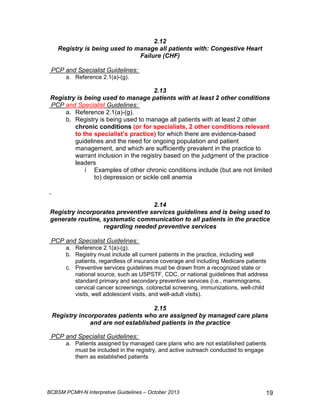
2.13 
Registry is being used to manage patients with at least 2 other conditions 
PCP and Specialist Guidelines: 
a. Reference 2.1(a)-(g). 
b. Registry is being used to manage all patients with at least 2 other 
chronic conditions (or for specialists, 2 other conditions relevant 
to the specialist’s practice) for which there are evidence-based 
guidelines and the need for ongoing population and patient 
management, and which are sufficiently prevalent in the practice to 
warrant inclusion in the registry based on the judgment of the practice 
leaders 
i Examples of other chronic conditions include (but are not limited 
to) depression or sickle cell anemia 
2.14 
Registry incorporates preventive services guidelines and is being used to 
generate routine, systematic communication to all patients in the practice 
regarding needed preventive services 
PCP and Specialist Guidelines: 
a. Reference 2.1(a)-(g). 
b. Registry must include all current patients in the practice, including well 
patients, regardless of insurance coverage and including Medicare patients 
c. Preventive services guidelines must be drawn from a recognized state or 
national source, such as USPSTF, CDC, or national guidelines that address 
standard primary and secondary preventive services (i.e., mammograms, 
cervical cancer screenings, colorectal screening, immunizations, well-child 
visits, well adolescent visits, and well-adult visits). 
2.15 
Registry incorporates patients who are assigned by managed care plans 
and are not established patients in the practice 
PCP and Specialist Guidelines: 
a. Patients assigned by managed care plans who are not established patients 
must be included in the registry, and active outreach conducted to engage 
them as established patients 
BCBSM PCMH-N Interpretive Guidelines – October 2013 19
2.16 
Registry is being used to manage all patients with: Chronic Kidney 
Disease 
PCP and Specialist Guidelines: 
a. Reference 2.1(a)-(g). 
2.17 
Registry is being used to manage all patients with: Pediatric Obesity 
PCP and Specialist Guidelines: 
a. Reference 2.1(a)-(g). 
2.18 
Registry is being used to manage all patients with: Pediatric ADD/ADHD 
PCP and Specialist Guidelines: 
a. Reference 2.1(a)-(g). 
2.19 
Registry contains information identifying the individual care manager for 
every patient currently in the registry who has an assigned care manager 
PCP and Specialist Guidelines: 
a. Registry may be paper or electronic 
b. Registry includes name of the care manager for each patient with an 
assigned care manager 
c. Where a patient has more than one care manager, registry must identify 
which care manager is the lead care manager 
3.0 Performance Reporting 
Applicable to PCPs; and to specialists for the condition(s) relevant to their patient 
population for which the specialist has primary responsibility (regardless of 
insurance coverage and including Medicare patients). 
Seven of the Performance Reporting capabilities identify the population(s) of 
patients included in the reports (3.1, 3.3, 3.6, 3.10, 3.11, 3.12, and 3.13). The 
other six Performance Reporting capabilities pertain to report attributes (3.2, 3.4, 
3.5, 3.7, 3.8, and 3.9). All capabilities pertaining to report attributes that are 
marked as in place must be in place for each population of patients marked as 
included in the reports. 
BCBSM PCMH-N Interpretive Guidelines – October 2013 20
3.1 
Performance reports that allow tracking and comparison of results at a 
specific point in time across the population of patients are generated for: 
Diabetes (or, for specialists, relevant condition) 
PCP and Specialist Guidelines: 
a. Performance reports are systematic, routine, aggregate-level reports that 
provide current, clinically meaningful health care information on the entire 
population of patients of all ages that are included in the registry (e.g., all 
diabetics, regardless of payor and including Medicare patients), allowing 
comparison across the population of patients, at a single point in time. 
b. The performance reports must be actively analyzed and used in self-assessment 
of provider performance 
c. The reports must contain several dimensions of clinical data on patients to 
enable providers to manage their population of patients. Relevant clinical 
information that is the focus of attention in established generally accepted 
guidelines and is incorporated in common quality measures pertinent to the 
chronic illness must be incorporated in the reports (i.e., physiologic 
parameters, lab results, medication prescription in use, physical findings, and 
patient behaviors such as peak flow meter use or daily salt intake) 
d. It is acceptable for the performance reports to be produced and distributed on 
a regular basis by the PO or sub-PO, as long as the practice units have the 
capability to request and receive reports on a timely basis. 
3.2 
Performance reports are generated at the population level, Practice Unit, 
and individual provider level 
PCP and Specialist Guidelines: 
a. Population level optimally consists of PO and/or sub-PO population, but 
alternatively, as the PO works toward implementing registry capabilities 
across all practice units, the population level report may be based on a 
meaningful subset of relevant aggregated practice unit performance 
b. Performance reports provide information and allow comparison at the 
population, practice unit, and individual provider level for all patients currently 
in the registry, regardless of insurance coverage and including Medicare 
patients 
3.3 
Performance reports include patients with at least 2 other conditions 
PCP Guidelines: 
a. Reference 2.13 
b. Performance reports are being generated for at least 2 other chronic 
conditions (or for specialists, 2 other conditions relevant to the specialist’s 
practice) for which there are evidence-based guidelines and the need for 
ongoing population and patient management, and which are sufficiently 
prevalent in the practice to warrant inclusion in the registry based on the 
BCBSM PCMH-N Interpretive Guidelines – October 2013 21
judgment of the practice leaders (regardless of insurance coverage and 
including Medicare patients). 
3.4 
Data contained in performance reports has been fully validated and 
reconciled to ensure accuracy 
3.5 
Trend reports are generated, enabling physicians and their POs/sub-POs to 
track, compare and manage performance results for their population of 
patients over time 
PCP and Specialist Guidelines: 
a. Performance reports include both current and past health care information for 
the population of patients currently in the registry (regardless of insurance 
coverage and including Medicare patients), allowing analysis and comparison 
of results across time (e.g., quarter to quarter, year to year). 
b. Trend reports must be generated by the PO/sub-PO at the individual 
provider, practice unit, and population level 
c. Population level optimally consists of PO and/or sub-PO population, but 
alternatively, as the PO works towards implementing registry capabilities 
across all practice units, the population level report may be based on a 
meaningful subset of relevant aggregated practice unit performance 
3.6 
Performance reports are generated for the population of patients with: 
Pediatric Obesity 
PCP and Specialist Guidelines: 
a. Reference 3.1. 
3.7 
Performance reports include all current patients in the practice, including 
well patients, and include data on preventive services 
PCP and Specialist Guidelines: 
a. Performance reports include all current patients in the practice, including well 
patients, as defined in 2.14 and 3.1 
b. Reports include preventive services information 
3.8 
Performance reports include patient clinical information for a substantial 
majority of health care services received at other sites that are necessary 
to manage chronic care and preventive services for the population 
PCP and Specialist Guidelines: 
a. Reference guidelines for Capability 2.2 
BCBSM PCMH-N Interpretive Guidelines – October 2013 22
b. For all established patients in the registry, the performance reports are 
expected to include treatment information pertinent to standard quality 
metrics (e.g., use of beta blockers following AMI), but are not expected to 
contain comprehensive treatment information as this level of information is 
often contained in detailed narrative text in clinical notes. 
c. Reportable items could include diagnosis and associated labs, physiologic 
parameters such as blood pressure, medications, or diagnostic services 
provided during the encounter. 
3.9 
Performance reports include information on services provided by 
specialists 
PCP and Specialist Guidelines: 
a. Reference 3.1 
b. Information on key preventive or disease specific services provided by 
specialists (e.g., ob-gyn, ophthalmologists, podiatrists, endocrinologists) is 
incorporated into performance reports. 
3.10 
Performance reports are generated for the population of patients with: 
Persistent Asthma 
PCP and Specialist Guidelines: 
a. Reference 3.1 
3.11 
Performance reports are generated for the population of patients with: 
Coronary Artery Disease [not applicable to pediatric practices] 
PCP and Specialist Guidelines: 
a. Reference 3.1 
3.12 
Performance reports are generated for the population of patients with: 
Congestive Heart Failure [not applicable to pediatric practices] 
PCP and Specialist Guidelines: 
a. Reference 3.1 
3.13 
Performance reports are generated for the population of patients with: 
Pediatric ADD/ADHD 
PCP and Specialist Guidelines: 
a. Reference 3.1 
BCBSM PCMH-N Interpretive Guidelines – October 2013 23
3.14 
Performance reports include care management activity 
PCP and Specialist Guidelines: 
a. Care management activity should include the following information for each 
member of the care management team: 
i Patient caseload (number of unique patients) 
ii Number of in-person encounters 
iii Number of telephonic encounters 
3.15 
Key clinical indicators are tracked and reported to external entities to 
which practices are accountable for quality measurement 
PCP and Specialist Guidelines: 
a. Practices are tracking and reporting on key clinical indicators, such as rates 
of patients with HTN who are well controlled, patients with LDL levels below 
200, and patients with DM who have an A1C showing reasonable control, in a 
manner consistent with standardized, generally accepted specifications for 
such measures 
4.0 Individual Care Management 
Applicable to PCPs and specialists. For patients with an ongoing care 
relationship with a specialist, PCP and specialist must establish agreement 
regarding who will have lead responsibility for care management. 
4.1 
Practice Unit leaders and staff have been trained/educated and have 
comprehensive knowledge of the Patient Centered-Medical Home model, 
the Chronic Care model, and practice transformation concepts 
PCP and Specialist Guidelines: 
a. Training content should include comprehensive information about the Chronic 
Care Model 
i. Reference information provided at the Improving Chronic Illness Care 
website: http://www.improvingchroniccare.org 
b. Training/educational activity is documented in personnel or training records, 
and content material used for training is available for review. 
4.2 
Practice Unit has developed an integrated team of multi-disciplinary 
providers and a systematic approach is in place to deliver coordinated care 
management services that address patients' full range of health care needs 
for at least one chronic condition (or, for some specialists, a sub-acute 
condition) 
BCBSM PCMH-N Interpretive Guidelines – October 2013 24
PCP and Specialist Guidelines: 
a. The integrated team of multi-disciplinary providers must consist of at least 3 
non-physician members, including an RN and at least 2 of the following: 
certified diabetes educator, nutritionist (RD or Masters-trained nutritionist), 
respiratory therapist, PharmD or RPH, MSW, certified asthma health 
educator or other certified health educator specialist (Bachelors degree, or 
higher, in Health Education), licensed professional counselor, licensed mental 
health counselor, or an NP and/or PA with training/experience in health 
education who is actively engaged in care coordination/self-management 
training separate from their office visit EM duties 
i. When they are unable to include RNs or PharmDs in the multi-disciplinary 
care management team, individual practices may use 
LPNs or PharmD students, in which case these ancillary providers 
with lesser training must be actively supervised by the physician 
and/or by a supervising RN or PharmD, with regard to the educational 
and care management interventions provided to each individual 
patient. This supervision must be provided either directly in the 
practice (e.g., by the primary care physician) or by staff employed by 
the Physician Organization. 
b. Practice unit team members hold regular team meetings and/or other 
structured communications about patients whose chronic conditions are 
being actively managed. 
c. All members of the team do not have to be at the same location or at the 
practice site, but care delivered by the team must be coordinated and 
integrated with the practice. 
i. When care is delivered by travel teams or at sites other than the 
practice: 
 the care must be fully coordinated by a practice team member 
or a health navigator who has ongoing communication with the 
practice 
 the PCMH practice must be involved in ongoing monitoring, 
follow-up and reinforcement of health education/training 
received by patients at other sites 
• monitoring includes proactive outreach to engage the 
patient in actively addressing ongoing health needs 
and health care goals on a longitudinal basis 
ii. The multi-disciplinary providers are not required to be employees of 
the PCMH practice, but must have an ongoing relationship with, and 
communication with, the practice team members 
 Communication can be a combination of verbal, written, and 
electronic methods, preferably including some direct verbal 
communication and participation in in-person team meetings, 
although individual team members who are not on-site at a 
practice can make their information and perspective known to 
specific team members so that their information about 
individual patients is actively considered by the team as a 
routine part of case review and planning 
iii. The care management services must be coordinated and integrated 
with the patient’s overall care plan 
BCBSM PCMH-N Interpretive Guidelines – October 2013 25
The requirements for capability 4.2 can be met through 
referrals to hospital-based diabetes educators that take place 
in the context of an overall coordinated, integrated care plan 
and include bi-lateral communication between the diabetes 
educator and care management team, with individualized 
feedback provided to care team following the diabetes 
education sessions. Diabetes educator and care team 
collaborate to ensure that referred patients receive needed 
services, and that patients understand that they should follow-up 
with PCMH practice regarding questions and concerns. 
 Standard referrals to hospital-based diabetes educators with 
summary reports sent back to the PCP do not constitute care 
that is coordinated and integrated, and would not meet the 
requirements for capability 4.2 
d. Tools such as Interactive Voice Response systems may be helpful in 
coordinating transition care and managing patients with chronic conditions. 
4.3 
Systematic approach is in place to ensure that evidence-based care 
guidelines are established and in use at the point of care by all team 
members of the Practice Unit 
PCP and Specialist Guidelines: 
a. Guidelines are available and used at the point of care by all clinical staff in 
the Practice Unit 
i. Guidelines are activated and used regularly to provide alerts about 
gaps in care on the Point of Care report or in the EMR 
b. All members in the practice, including front office staff who work with 
clinicians and patients, are knowledgeable about the type and length of 
appointments to book and their responsibilities for preparing resources for 
visits, based on the guidelines 
i. Guidelines are actively used to monitor, track, and conduct outreach 
to patients to schedule care as needed 
c. Guidelines are used by PO to evaluate performance of physicians, Practice 
Units, and PO. 
4.4 
PCMH patient satisfaction/office efficiency measures are systematically 
administered 
PCP and Specialist Guidelines: 
a. Patient satisfaction and office efficiency measures (e.g., patient waiting time 
to obtain appointment, office visit cycle time, percentage of no-show 
appointments) are monitored 
i. Measures must be derived from surveys conducted by the office or 
from information provided by health plans, the PO, or other sources 
 Surveys do not need to focus on single specific chronic 
condition, providing they are capturing information relevant to 
all chronic conditions, such as asking about whether the 
primary practitioner discusses health care goals, diet and 
BCBSM PCMH-N Interpretive Guidelines – October 2013 26
exercise, and supports the patient in achieving health 
management goals 
ii. Reference information at Institute for Healthcare Improvement: 
http://www.ihi.org/IHI/Topics/OfficePractices/Access/Measures/ 
iii. Results must be quantified, aggregated, and tracked over time 
b. If office is not meeting standards for patient-centered care, follow-up occurs 
(e.g., process improvements are implemented; efficiencies are improved; 
practice culture is addressed) 
[Please see Patient Registry and Performance Reporting Initiatives for clinical monitoring 
expectations] 
4.5 
Development and incorporation into the medical record of written action 
plan and goal-setting is systematically offered to all patients with the 
chronic condition (or, for some specialists, sub-acute condition) selected 
for initial focus, with substantive patient-specific and patient-friendly 
documentation provided to the patient 
PCP and Specialist Guidelines: 
a. Physicians and other practice team members are actively involved in working 
with patients to use goal-setting techniques and develop action plans 
i. Goal-setting should focus on specific changes in behavior (e.g., 
walking around the block once a day) or concrete, tangible results 
(e.g., losing 2 pounds) rather than general clinical goals (such as 
lowering blood pressure or reducing LDL levels) 
b. Patient-specific action plan and patient’s individual goals must be 
documented in medical record, enabling providers to monitor and follow-up 
with patient during subsequent visits 
c. Reference information provided at the Improving Chronic Illness Care 
website: http://www.improvingchroniccare.org/index.php?p=self-management_ 
supports=39 
4.6 
A systematic approach is in place for appointment tracking and generation 
of reminders for all patients with the chronic condition (or, for some 
specialists, sub-acute condition) selected for initial focus 
PCP and Specialist Guidelines: 
a. Evidence-based guidelines are used systematically as a basis for: 
i. Conducting tracking and follow-up regarding missed appointments 
ii. Providing patients with mail and/or telephone reminders of upcoming 
appointments 
4.7 
A systematic approach is in place to ensure that follow-up for needed 
services is provided for all patients with the chronic condition (or, for some 
specialists, sub-acute condition) selected for initial focus 
BCBSM PCMH-N Interpretive Guidelines – October 2013 27
PCP and Specialist Guidelines: 
a. Evidence-based guidelines are used systematically as a basis for: 
i. Following up with patients to ensure that needed services, whether at 
the PCMH practice site or at another care site, are obtained by the 
patients 
4.8 
Planned visits are offered to all patients with the chronic condition (or, for 
some specialists, sub-acute condition) selected for initial focus 
PCP and Specialist Guidelines: 
a. Planned visits consist of a documented, proactive, comprehensive approach 
to ensure that patients receive needed care in an efficient and effective 
manner. 
i. Planned visits include the well-orchestrated, team-based approach to 
managing the patient’s care during the visit, all performed on a routine 
basis, as well as the tracking and scheduling of regular visits, and the 
guideline-based preparation that occurs prior to the visit. 
b. Reference information provided at the Improving Chronic Illness Care 
website: 
http://www.improvingchroniccare.org/index.php?p=Planned_Visitss=48 
c. “Many healthcare providers believe themselves to already be doing ‘planned’ 
visits. They note that their patients with chronic conditions come back at 
defined intervals. Yet upon closer inspection, these visits may look a lot like 
acute care: the provider might lack necessary information about the patient’s 
care needs; provider and patient might have different expectations for the 
visit; and staff may not be fully utilized to help with the organization of the visit 
and delivery of care. These “check-back” visits, while scheduled in advance, 
are often not efficient nor productive for the provider and patient. 
d. Key Components of a Planned Visit 
i. Assign Team Roles and Responsibilities 
 For example, the following questions might need to be 
addressed: who is going to call the patient to schedule the 
visit? Who will room the patient? If the patient has diabetes, 
who will remove her/his shoes and socks? Who will examine 
the feet? Who will prepare the patient encounter form for use 
during the visit? All tasks need to be delegated to specific 
team members so that nothing is left to chance. 
ii. Call a Patient In For a Visit 
 Develop a script for the call, and decide which team member 
will make the call. Set the tone and expectations for the issues 
addressed in the visit. 
 If you choose to mail an invitation to patients, be sure to track 
respondents. Typically, less than 50% of patients respond to a 
letter. You will need to plan an alternative method of 
contacting non-responders. 
iii. Deliver Clinical Care and Self-Management Support 
 In preparation for the visit, print an encounter form from your 
registry or pull the chart in advance so that you can review the 
BCBSM PCMH-N Interpretive Guidelines – October 2013 28
patient’s care to date. Document what clinical care needs to be 
done during the visit. 
iv. Until new roles are well integrated into the normal work flow, many 
practices have team huddles for 5-10 minutes…to review the 
schedule and identify chronic care patients coming in that day for an 
acute care visit. Decide how best to meet as a team to manage these 
patients. Determine the best intervals and timing for these meetings, 
and stick to them. The brief get-togethers help the team stay focused 
on practice redesign and create a spirit of ‘one for all’.” 
4.9 
Group visit option is available for all patients in the practice unit with the 
chronic condition (or, for some specialists, sub-acute condition) selected 
for initial focus (as appropriate for the patient) 
PCP and Specialist Guidelines: 
a. Reference AAFP information on group visits at: 
http://www.aafp.org/fpm/20060100/37grou.html 
b. Group visits are a form of office visit. (They are not the same as care 
coordination/care management services, which are follow-up services 
delivered by non-physician clinicians antecedent to an office visit at which 
individual treatment and/or health behavior goals have been established.) 
c. Group visits include not only group education and interaction but also all 
essential elements of an individual patient visit, including but not limited to the 
collection of vital signs, history taking, relevant physical examination and 
clinical decision-making. 
i. Group visits differ from other forms of group interventions, such as 
support groups, which are generally led by peers and do not include 
one-on-one consultations with physicians. 
d. The clinician is directly involved and meets with each patient individually 
e. Members of the care management team may take vital signs and other 
measurements and assist with individual encounters 
f. Dietitians or pharmacists may lead educational sessions. Topics such as 
medication management, stress management, exercise and nutrition, and 
community resources, may be suggested by the group facilitator or by 
patients, who raise concerns, share information and ask questions. In 
programs emphasizing self-management, physicians and patients work 
together to create behavior-change action plans, which detail achievable and 
behavior-specific goals that participants aim to accomplish by the next 
session. Once plans are set, the group discusses ways to overcome potential 
obstacles, which raises patients' self-efficacy and commitment to behavioral 
change. Patients' family members can also be included in these group 
sessions.” 
g. Group visits generally last from two to 2.5 hours and include no more than 20 
patients at a time. 
h. Group visits may be conducted in collaboration with other Practice Units 
BCBSM PCMH-N Interpretive Guidelines – October 2013 29
4.10 
Medication review and management is provided at every visit for all 
patients with chronic conditions 
PCP and Specialist Guidelines: 
a. Chronic conditions under 4.10 are defined as any condition requiring 
maintenance drug therapy. 
b. During every patient encounter, a list of all medications currently taken by the 
patient is reviewed and updated, and any concerns regarding medication 
interactions or side effects are addressed. 
4.11 
Development and incorporation into medical record of written action plans 
and goal-setting is systematically offered to all patients with chronic 
conditions or other complex health care needs prevalent in practice’s 
patient population 
PCP and Specialist Guidelines: 
a. Reference 4.5 
4.12 
A systematic approach is in place for appointment tracking and generation 
of reminders for all patients 
PCP and Specialist Guidelines: 
a. Reference 4.6 
4.13 
A systematic approach is in place to ensure follow-up for needed services 
for all patients 
PCP and Specialist Guidelines: 
a. Reference 4.7 
4.14 
Planned visits are offered to all patients with chronic conditions (or, for 
some specialists, all sub-acute conditions) prevalent in practice population 
PCP and Specialist Guidelines: 
a. Reference 4.8 
4.15 
Group visit option is available to all patients with chronic conditions (or, for 
some specialists, all sub-acute conditions) prevalent in practice population 
PCP and Specialist Guidelines: 
a. Reference 4.9 
BCBSM PCMH-N Interpretive Guidelines – October 2013 30
4.16 
A systematic approach is in place for engaging patients in conversation 
about advance care planning, executing an advance care plan with each 
patient who wishes to do so, and including a copy of a signed advance 
care plan in the patient’s medical record 
PCP and Specialist Guidelines: 
a. PCP and specialist(s) must have systematic process in place to identify who 
has lead responsibility for discussing and assisting each patient with advance 
care planning 
i. Training and information about advance care planning is available 
from the Centers for Disease Control and through a number of 
healthcare organizations 
b. Provider with lead responsibility must ensure that all care partners are aware 
of and have copies of advance care plan 
4.17 
A systematic approach is in place for developing a survivorship plan for 
patients once treatment is completed, including a copy of the survivorship 
plan in the patient’s medical record, and ensuring that the plan is shared 
with the patient and the patient’s providers 
PCP and Specialist Guidelines: 
a. PCP and specialist(s) must have systematic process in place to identify who 
has lead responsibility for developing each patient’s individualized patient 
survivorship care plan that includes guidelines for monitoring and maintaining 
the health of patients who have completed treatment 
i. Information about survivorship plans can be accessed at: 
http://www.cancer.org/Treatment/SurvivorshipDuringandAfterTreatme 
nt/SurvivorshipCarePlans/index 
b. Provider with lead responsibility must ensure that key care partners are 
aware of and have copies of the survivorship care plan 
4.18 
A systematic approach is in place for assessing patient palliative care 
needs and ensuring patients receive needed palliative care services 
PCP and Specialist Guidelines: 
a. PCP and specialist(s) have systematic process in place to identify who has 
lead responsibility for addressing each patient’s palliative care needs 
i. Provider with lead responsibility ensures that all care partners are 
aware that patient is receiving palliative care services 
b. Reference 
http://www.nationalconsensusproject.org/Guidelines_Download2.aspx for 
definition of palliative care, and an overview of the domains that should be 
addressed in the delivery of palliative care 
c. Practice has established written protocols for determining when patients 
should be assessed for palliative care needs, based on accepted standards 
relevant to their patient population. Tools that can be used to support 
BCBSM PCMH-N Interpretive Guidelines – October 2013 31
assessment of palliative care needs: 
http://www.palliative.org/newpc/professionals/tools/esas.html , 
http://www.hpsm.org/documents/End_of_Life_Summit_FICA_References.pd 
f , http://www.cqaimh.org/pdf/tool_phq9.pdf , 
http://www.cqaimh.org/pdf/tool_phq2.pdf 
d. Options for delivery of palliative care include: 
ii. Delivery within practice: At least one member of practice has received 
training through established palliative care training program (cite 
examples), and has educated other practice staff. For domains that 
cannot be addressed directly by practice staff, practice has knowledge 
of community resources that will enable patient to receive palliative 
care across all domains (e.g., legal, ethical, spiritual). 
iii. Referrals: Practice maintains information on availability of 
comprehensive palliative care teams, and makes referrals as 
appropriate. Sources for referral can found at 
http://www.mihospice.org/ 
4.19 
Systematic process is in place to identify patients who would benefit from 
care management services based on clinical conditions and ED, inpatient, 
and other service use 
PCP and Specialist Guidelines: 
a. PCP and specialist(s) must have systematic process in place to identify 
patients who are candidates for care management, and to document the 
results of the identification process 
4.20 
Systematic process is in place to inform patients about availability of care 
management services 
PCP and Specialist Guidelines: 
a. PCP and specialist(s) must have systematic process in place to inform 
patients about availability of care management services, and to document the 
conversation and the patient’s response 
4.21 
Inter-disciplinary team meetings are held regularly to conduct patient case 
reviews, with development and review of comprehensive care plans for 
medically complex patients 
PCP and Specialist Guidelines: 
a. PCP and specialist(s) must have systematic process in place to conduct and 
document regular patient case reviews, and develop and review 
comprehensive care plans for medically complex patients 
b. Common elements of a comprehensive care management plan include: 
i. Full problem list 
BCBSM PCMH-N Interpretive Guidelines – October 2013 32
ii. Expected outcome and prognosis 
iii. Measureable treatment goals 
iv. Symptom management 
v. Planned interventions 
vi. Medication management 
 Medication allergies 
vii. Community/social services ordered 
viii. Plan for directing/coordinating the services of agencies and specialists 
which are not connected to the practice 
ix. Identify individual who is responsible for each intervention 
5.0 Extended Access 
Applicable to PCPs and specialists. 
5.1 
Patients have 24-hour access to a clinical decision-maker by phone, and 
clinical decision-maker has a feedback loop within 24 hours or next 
business day to the patient's PCMH 
PCP and Specialist Guidelines: 
a. Clinical decision-maker must be an M.D., D.O., P.A., or N.P. If not M.D. or 
D.O., clinical-decision maker must have ability to contact supervising M.D. or 
D.O. on an immediate basis if needed 
i. Clinical decision-maker may be, but is not required to be, the patient’s 
primary care provider 
b. Clinical decision-maker has the ability to direct the patient regarding self-care 
or to an appropriate level of care. 
i. When reason for patient contact is not relevant to provider’s domain of 
care, provider will ensure that patient is able to contact PCP or other 
relevant provider 
c. Clinical decision-maker communicates all clinically relevant information via 
phone conversation directly to patient’s primary physician, by email, by 
automated notification in an EMR system, or by faxing directly to primary 
physician regarding the interaction within 24 hours (or next business day) of 
the interaction 
d. Clinical decision-maker responds to patient inquiry in a timely manner 
(generally 15-30 minutes, and no later than 60 minutes after initial patient 
inquiry) 
5.2 
Clinical decision-maker accesses and updates patient's EMR or registry 
info during the phone call 
PCP and Specialist Guidelines: 
a. Clinical decision-maker (as defined in 5.1) must routinely have access to and 
update patient’s EMR or registry information during all calls 
BCBSM PCMH-N Interpretive Guidelines – October 2013 33
i. Occasional technical problems, such as failure of internet service in 
rural areas, may occur and would not constitute failure to meet the 
requirements of 5.2 as long as access to the EMR or registry is 
typically and routinely available 
5.3 
Provider has made arrangements for patients to have access to non-ED 
after-hours provider for urgent care needs during at least 8 after-hours per 
week and, if different from the PCMH office, after-hours provider has a 
feedback loop within 24 hours or next business day to the patient's PCMH 
PCP and Specialist Guidelines: 
a. After-hours is defined as office visit availability during weekday evening (e.g., 
5-8 pm) and/or early morning hours (e.g., 7-9 am) and/or weekend hours 
(e.g., Saturday 9-12), sufficient to reduce patients’ use of ED for non-ED care 
b. After-hours provider may be at Practice Unit site or may be in a physically 
separate location (e.g., an urgent care location or a separate physician office) 
as long as it is within 30 minutes travel time of the PCMH 
i. Services provided by the after-hours provider must be billable as an 
office visit or an urgent care visit, not as an ER visit 
c. If after-hours provider is different from Practice Unit (e.g., they are an urgent 
care center or a physician who shares on-call responsibilities), there must be 
an established arrangement for after-hours coverage, and the after-hours 
provider must be able to provide feedback regarding care encounter to the 
patient's Practice Unit within 24 hours or on the next business day 
d. Practice Units may team with other practice units/physicians to provide after-hours 
urgent care 
e. Patient referral to specialists, high tech imaging, and inpatient admissions 
recommended by urgent care providers should be made by or coordinated 
with PCP 
5.4 
A systematic approach is in place to ensure that all patients are fully 
informed about after-hours care availability and location, at the PCMH site 
as well as other after-hours care sites, including urgent care facilities, if 
applicable 
5.5 
Practice Unit has made arrangements for patients to have access to non- 
ED after-hours provider for urgent care needs (as defined under 5.3) during 
at least 12 after-hours per week 
PCP and Specialist Guidelines: 
a. Reference 5.3 
BCBSM PCMH-N Interpretive Guidelines – October 2013 34
5.6 
Non-ED after-hours provider for urgent care accesses and updates the 
patient’s EMR or patient’s registry record during the visit 
PCP and Specialist Guidelines: 
a. Reference 5.3 for definition of non-ED after-hours provider for urgent care 
needs 
b. Clinical decision-maker must routinely have access to and update patient’s 
EMR or registry information during all visits 
i. Occasional technical problems, such as failure of internet service in 
rural areas, may occur and would not constitute failure to meet the 
requirements of 5.6 as long as access to the EMR or registry is 
typically and routinely available 
5.7 
Advanced access scheduling is in place: for PCPs, at least 30% of 
appointments are reserved for same-day appointments for acute and 
routine care (i.e., any elective non-acute/urgent need, including physical 
exams and planned chronic care services, for established patients); for 
specialists, tiered access is in place 
PCP Guidelines: 
a. 30% of the day’s appointments should be available at the start of business for 
same-day appointments for both acute and routine care needs 
i. In unusual, extenuating circumstances (such as a solo practice in a 
rural or urban under-served area), practice units may meet the 
requirements of capability 5.7 by having a routine, systematic 
procedure that practice unit clinicians remain after-hours as necessary 
to see the majority of patients requesting routine or acute care 
b. Written policy for advanced access is available 
i. Patients are aware of policy and do not feel that they must self-screen 
to avoid imposing on practice unit staff 
c. Patients can be accommodated throughout the day (not only during lunch or 
after-hours) 
d. Patients are seen on a timely basis with no excessive waiting time 
e. Patients can be seen by PAs/NPs or by any physician in practice 
f. If practice does not have an approach to scheduling that closely follows 
the structure and process of formal open access scheduling consistent 
with the sources cited herein, then they must have documented policy 
and procedures demonstrating that the practice’s advanced access 
approach has the attributes referenced at the following sites: 
i. http://www.aafp.org/fpm/20000900/45same.html 
ii. Reference Institute for Healthcare Improvement articles at 
http://www.ihi.org/IHI/Topics/OfficePractices/Access/Changes/IH 
for information on implementing advanced access 
Specialist Guidelines: 
a. Specialists must establish tiered access system to address needs of sub-acute, 
chronic, and routine patients 
BCBSM PCMH-N Interpretive Guidelines – October 2013 35
i. Same day appointments available for urgent patients 
ii. Appointments within 1-3 weeks available for sub-acute patients 
5.8 
Advanced access scheduling is in place reserving at least 50% of 
appointments for same-day appointment for acute and routine care (i.e., 
any elective non-acute/urgent need, including physical exams and planned 
chronic care services, for established patients) 
[Applicable to PCPs only] 
PCP Guidelines: 
a. 50% of the day’s appointments should be available at the start of the 
business day for same-day appointments for acute and routine patient needs 
b. Reference 5.7 
5.9 
Practice unit has telephonic or other access to interpreter(s) for all 
languages common to practice’s established patients. 
6.0 Test Results Tracking  Follow-up 
Applicable to PCPs and specialists. 
When patient is co-managed by PCP and specialist, provider ordering the test is 
responsible for all follow-up and for clearly communicating information about test 
orders and test results to partner provider. When specialist recommends tests 
for co-managed patient, ordering PCP is responsible for all follow-up and for 
clearly communicating test orders and test results to partner provider. 
6.1 
Practice has test tracking process/procedure documented, which requires 
tracking and follow-up for all tests and test results, with identified 
timeframes for notifying patients of results 
PCP and Specialist Guidelines: 
a. Test tracking procedure must be in writing and identify all steps in process 
and timeframes 
6.2 
Systematic approach and identified timeframes are in place for ensuring 
patients receive needed tests and practice obtains results 
PCP and Specialist Guidelines: 
a. Follow-up occurs with patients to ensure necessary tests are performed 
b. Communication processes are in place with testing entities as necessary, to 
ensure results are received 
c. Result are reviewed, signed, and dated by the physician and filed in the 
patient’s medical record 
BCBSM PCMH-N Interpretive Guidelines – October 2013 36
6.3 
Process is in place for ensuring patient contact details are kept up to date 
PCP and Specialist Guidelines: 
a. Patients are asked at every visit to confirm that address and phone numbers 
are current 
6.4 
Mechanism is in place for patients to obtain information about normal tests 
PCP and Specialist Guidelines: 
a. Patients are informed about how to access normal test results 
b. Process may use any of the following mechanisms: 
i. Patient phone call to specific phone number at practice 
ii. Phone call from practice to patient 
iii. Mail from practice 
iv. Patient access via secure web portal (in conjunction with one of the 
above options for patients without internet access) 
6.5 
Systematic approach is used to inform patients about all abnormal test 
results 
PCP and Specialist Guidelines: 
a. Systematic approach is in place to flag as high priority results where follow-up 
is essential and the risk of not following up is high, i.e., tissue biopsies, 
diagnostic mammograms, INR tests 
b. For high priority results, patient is contacted by phone (repeated attempts at 
different times of day, on different days if necessary; if necessary and 
acceptable to patient, email or patient portal may be used to request the 
patient call office; as a last resort, results may be sent by registered mail) 
i. For low priority results, such as minor lab abnormalities, contact may 
be by letter 
c. Systematic approach is in place to ensure that practice is aware of and 
communicates to patients about all abnormal test results for all patients, in a 
timely manner, and that patient communication process is clear and patients 
understand implications of test results 
6.6 
Systematic approach is used to ensure that patients with abnormal results 
receive the recommended follow-up care within defined timeframes. 
PCP and Specialist Guidelines: 
a. Patients requiring follow-up are flagged and follow-up timeframes are 
specified 
b. Cancellations and no-show appointments are tracked and assessed to 
determine whether any patients require follow-up 
c. Outcomes of follow-up action are filed in patient’s medical record 
BCBSM PCMH-N Interpretive Guidelines – October 2013 37
6.7 
Systematic approach is used to document all test tracking steps in the 
patient’s medical record 
PCP and Specialist Guidelines: 
a. All phone calls, letters, and other communications with patient regarding 
testing and test results are documented in the patient’s medical record 
6.8 
All clinicians and appropriate office staff are trained to ensure adherence to 
the test-tracking procedure; all training is documented either in personnel 
file or in training logs or records 
PCP and Specialist Guidelines: 
a. Practice unit or PO maintains record of training and can provide training 
content for review 
6.9 
Practice has Computerized Order Entry integrated with automated test 
tracking system 
PCP and Specialist Guidelines: 
a. Test-tracking system has Computerized Order Entry system structured to log 
all test orders and is linked to automated tracking system that supports 
caregiver follow-up 
b. Test tracking system has the ability to electronically receive and track results 
9.0 Preventive Services 
Applicable to PCPs and specialists. 
When patient is co-managed by PCP and specialist, roles must be clearly 
defined regarding who is responsible for ensuring patients receives needed 
preventive services. 
9.1 
Primary prevention program is in place that focuses on identifying and 
educating patients about personal health behaviors to reduce their risk of 
disease and injury. 
PCP and Specialist Guidelines: 
a. Primary prevention is defined as inhibiting the development of disease before 
it occurs. Secondary prevention, also called screening, refers to measures 
that detect disease before it is symptomatic. Tertiary prevention efforts focus 
on people already affected by disease and attempt to reduce resultant 
disability and restore functionality. 
b. Patient questionnaire or other mechanism is used to elicit information about 
personal health behaviors that may be contributing to disease risk 
i. During well-visit exam and initial intake for new patients 
BCBSM PCMH-N Interpretive Guidelines – October 2013 38
ii. During other visits when behavior may be relevant to acute concern 
(e.g., tobacco use when patient presents with cough) 
c. Patient assessment addresses personal health behaviors and disease risk 
factors, based on age, gender, health issues 
i. Behaviors and risks assessed should include a majority of the 
following, as appropriate to the patient population: Alcohol and Drug 
Use, Breast Self-Examination, Awareness of Lead Exposure, Low Fat 
Diet and Exercise, Use of Sunscreen, Safe Sex, Testicular Self- 
Examination, and Tobacco Avoidance 
9.2 
A systematic approach is in place to providing preventive services 
PCP and Specialist Guidelines: 
a. Preventive care guidelines are integrated into clinical practice (e.g., Michigan 
Quality Improvement Consortium - www.mqic.org). Examples of appropriate 
Guidelines include: 
i. Adult Preventive Services Guideline 18-49 Yrs 
ii. Adult Preventive Services Guideline 50-65 Yrs 
iii. Childhood Overweight Prevention Guideline 
iv. Prevention of Unintended Pregnancy in Adults 
v. Preventive Service for Children  Adolescents Ages Birth – 24 
Months 
vi. Preventive Service for Children and Adolescents Ages 2-18 Yrs 
vii. Tobacco Control Guideline 
b. Systematic appointment tracking system (implemented as part of Individual 
Care Management Initiative) is in place 
9.3 
Strategies are in place to promote and conduct outreach regarding ongoing 
well care visits and screenings for all populations, consistent with 
guidelines for such age and gender-appropriate services promulgated by 
credible national organizations 
PCP and Specialist Guidelines: 
a. Systematic reminder system is in place and incorporates the following 
elements: 
i. Age appropriate health reminders (e.g., annual physicals). 
ii. Age appropriate immunization information consistent with most 
current evidence-based guidelines 
iii. If reminders are generated by PO, offices should have knowledge of 
the process 
b. For children and adolescents from birth to 18 years of age examples of 
outreach strategies may include birthday reminders for well-visits, 
kindergarten round-up, flu vaccine reminders, health fairs, brochures, school 
physical fairs 
BCBSM PCMH-N Interpretive Guidelines – October 2013 39
c. For adults, examples of outreach strategies may include annual health 
maintenance examination reminders, and age and gender-appropriate 
reminders about recommended screenings (e.g., mammograms) 
d. Outreach should be systematic and consistent with evidence-based 
guidelines 
9.4 
Practice has process in place to inquire about a patient’s outside health 
encounters and has capability to incorporate information in patient 
tracking system or medical record 
PCP and Specialist Guidelines: 
a. “Outside health encounter information” includes services such as 
immunizations provided at health fairs 
b. Practice unit should include actual/estimated date of service in the medical 
record whenever possible 
c. Information may be included in historical section of record 
9.5 
Practice has a systematic approach in place to ensure the 
provision/documentation of tobacco use assessment tools and advice 
regarding smoking cessation 
PCP and Specialist Guidelines: 
a. Examples may include yearly assessment sheet, tobacco use intervention 
programs 
9.6 
Written standing order protocols are in place allowing Practice Unit care 
team members to authorize and deliver preventive services according to 
physician-approved protocol without examination by a clinician 
PCP and Specialist Guidelines: 
a. Standing orders are orders for office personnel that are signed in advance by 
the physician authorizing the provision of specified services under certain 
clinical circumstances, and are reviewed/updated on a regular basis 
b. Examples include vaccinations, fecal occult blood tests and mammogram 
orders, medication intensification algorithm for patients with lipid disorder or 
high blood pressure 
9.7 
Secondary prevention program is in place to identify and treat 
asymptomatic persons who have already developed risk factors or pre-clinical 
disease, but in whom the disease itself has not become clinically 
apparent. 
PCP and Specialist Guidelines: 
BCBSM PCMH-N Interpretive Guidelines – October 2013 40
a. System with guideline-based reminders for age-appropriate risk assessment 
and screening tests is in place. 
i. Practice Unit may choose to implement tools such as checklists 
attached to the patient chart, tagged notes, computer generated 
encounter forms and prompting stickers. 
b. Mechanisms are established to identify asymptomatic at-risk patients and 
provide appropriate treatment 
c. Examples include metabolic syndrome, osteoporosis, coronary artery 
disease, depression, alcoholism, STDs, accelerated regimen for colon and 
breast cancer screening in high risk patients 
9.8 
Staff receives regular training and/or communications in health promotion 
and disease prevention and incorporates preventive-focused practices into 
ongoing administrative operations 
PCP and Specialist Guidelines: 
a. Practice unit staff has received training or educational material has been 
posted or circulated regarding a full range of preventive services and health 
promotion issues 
i. New hires receive appropriate training 
ii. Educational material is circulated or posted when guidelines change 
 For example, PO or practice unit staff person may be assigned 
to update clinical personnel on standards and guidelines such 
as AHRQ newsletter updates, the immunization schedule  
standards issued by the Advisory Committee on Immunization 
Practices, Alliance of Immunization in Michigan, or Centers for 
Disease Control and Prevention. 
 For example, information may be provided to practice units 
educating them on appropriate billing and ICD-9 codes in 
order to ensure accurate reporting for preventive medicine 
services (including use of the correct ICD-9 code for a 
physical) 
b. Staff is trained (as appropriate to patient population) regarding consistently 
using and entering information into the Michigan Care Improvement Registry 
(MCIR) 
9.9 
Planned visits are offered as a means of providing preventive services in 
the context of structured health maintenance exams for which the practice 
team and patient are prepared in advance of the date of service 
PCP and Specialist Guidelines: 
a. Reference 4.8 for requirements of planned visit 
10.0 Linkage to Community Services 
Applicable to PCPs and specialists. 
BCBSM PCMH-N Interpretive Guidelines – October 2013 41
When patient is co-managed by PCP and specialist, roles must be clearly 
defined regarding who is responsible for ensuring patients receives needed 
community services. 
10.1 
PO has conducted a comprehensive review of community resources for the 
geographic population that they serve, in conjunction with Practice Units 
PCP and Specialist Guidelines: 
a. The review may take place within the context of a multi-PO effort 
b. Review should include health care, social, pharmaceutical, mental health, 
and rare disease support associations 
i. If comprehensive community resource database has already been 
developed (e.g., by hospital, United Way) then further review by PO is 
not necessary 
ii. Review may include survey of practice units to assist in identifying 
local community resources 
10.2 
PO maintains a community resource database based on input from 
Practice Units that serves as a central repository of information for all 
Practice Units. 
PCP and Specialist Guidelines: 
a. The database may include resources such as the United Way’s 2-1-1 hotline, 
and links to online resources. 
b. At least one staff person in the PO is responsible for conducting a 
semiannual update of the database and verifying local resource listings (PO 
may coordinate with Practice Unit staff to ensure resource reliability) 
i. During the update process, consideration may be given to including 
new, innovative community resources such as Southeast Michigan 
Beacon Community’s Text4Health program 
ii. It is acceptable for staff to not verify aggregate listings (such as 2-1-1) 
if they are able to document how often the listings are updated by the 
resource administrator 
c. Resource databases are shared with other POs, particularly in overlapping 
geographic regions 
d. Portion of database includes self-management training programs available in 
the community 
10.3 
PO in conjunction with Practice Units has established collaborative 
relationships with appropriate community-based agencies and 
organizations 
PCP and Specialist Guidelines: 
a. PO is able to provide a list of organizations in which collaborative 
relationships are directly established 
BCBSM PCMH-N Interpretive Guidelines – October 2013 42
b. Collaborative relationships must be established with selected agencies with 
relevance to patients’ needs 
c. Collaborative relationships need to be established directly with the individual 
agencies (not via 2-1-1) and involve ongoing substantive dialogue 
10.4 
All members of practice unit care team involved in establishing care 
treatment plans have received training on community resources so that 
they can identify and refer patients appropriately 
PCP and Specialist Guidelines: 
a. Training may occur in collaboration with community agencies that serve as 
subject-matter experts on local resources 
b. PO or Practice Unit administrator assesses the competency of Practice Unit 
staff involved in the resource referral process at least annually. This may 
occur in conjunction with community agencies. 
i. For example, practice unit staff are able to explain process for 
identifying and referring patients to relevant community resources 
ii. Practice Unit is able to demonstrate that training occurs as part of new 
staff orientation 
10.5 
Systematic approach is in place for educating all patients about community 
resources and assessing/discussing need for referral 
PCP and Specialist Guidelines: 
a. Systematic process is in place for educating new patients and all patients 
during annual exam (or other visits, as appropriate) about community 
resources and assessing/discussing need for referral 
i. For example, Practice Units may develop an algorithm (or series of 
algorithms) to guide the referral process 
ii. Information about available community resources may be 
disseminated via language added to patient-provider partnership 
documents, PO or Practice Unit website, brochures or county booklets 
at check-out desk 
10.6 
Systematic approach is in place for referring patients to community 
resources 
PCP and Specialist Guidelines: 
a. Practice Unit must be able to verbally describe or provide written evidence of 
systematic process for referring patients to community resources. 
i. For example, systematic process may consist of standardized patient 
referral materials such as a “prescription form”, computer-generated 
printout that details appropriate sources of community-based care, or 
other documented process or tools. 
ii. Patients should have access to resources that are appropriate for 
their ethnicity, gender orientation, ability status, age, and religious 
BCBSM PCMH-N Interpretive Guidelines – October 2013 43
preference, including resources that are available in other languages 
such as Spanish, Arabic, and American Sign Language, and 
resources available both locally and nationally. 
iii. For example, if Practice Units within a PO have a great deal of 
diversity within their patient population, the PO may amass specific 
information about services for those diverse patient groups. Practice 
Units may also share information about resources for diverse groups. 
10.7 
Systematic approach is in place for tracking referrals of high-risk patients 
to community resources made by the care team, and making every effort to 
ensure that patients complete the referral activity 
PCP and Specialist Guidelines: 
a. Practice units have the responsibility to identify those patients who are at high 
risk of complications/decompensation for whom referral to a particular agency 
is critical to reaching established health and treatment goals. 
b. Referrals to community resources should be tracked for high-risk patients. 
Practice Units are encouraged to create a hierarchy to ensure that vital 
services (such as referrals to mental health providers) are being tracked 
appropriately. Specialists must ensure that PCPs are notified about referrals 
to community resources for high-risk patients. 
c. The purpose of tracking the referrals is to ensure that these high-risk patients 
receive the services they need. 
10.8 
Systematic approach is in place for conducting follow-up with high-risk 
patients regarding any indicated next steps as an outcome of their referral 
to a community-based program or agency. 
PCP and Specialist Guidelines: 
a. Patients may be held partially responsible for the tracking process. For 
example, Practice Units may use technology such as Interactive Voice 
Response (IVR) for patients to report initial contact and completion, develop a 
“passport” that patients can have stamped when they complete trainings or 
attend a support group, or use existing disease registries such as 
WellCentive to track community-based referral activities. 
b. Process includes mechanism to track patients who decline care and obtain 
information about reasons care was not sought. 
11.0 Self-Management Support 
Applicable to PCPs and specialists. When patient is co-managed by PCP and 
specialist, roles must be clearly defined regarding which provider is responsible 
for leading self-management support activities and which provider is responsible 
for reinforcing self-management support activities. 
BCBSM PCMH-N Interpretive Guidelines – October 2013 44
Self-management support is a systematic approach to empowering the patient 
with chronic illness to understand their central role in effectively managing their 
illness, making informed decisions about care, and engaging in healthy 
behaviors. To receive credit for a self-management support capability, basic self-management 
support delivered in the context of office visits must be available to 
all patients. Advanced self-management support, delivered by trained care 
managers in the context of provider-delivered care management services, is 
expected to be available only to those members who have the provider-delivered 
care management benefit. 
11.1 
Clinician who is member of care team or PO staffperson is educated about 
and familiar with self-management support concepts and techniques and 
works with appropriate staff members at the practice unit at regular 
intervals to ensure they are educated in and able to actively use self-management 
support concepts and techniques. The intent of this capability 
is to actively empower the staff within the practice unit to incorporate self-management 
support efforts into routine clinic process. 
PCP and Specialist Guidelines: 
a. Self-management support uses a team-based, systematic, model-driven 
(including behavioral and clinical dimensions) approach to actively motivating 
and engaging the patient in effective self-care for identified chronic 
conditions; must extend beyond usual care such as encouragement to follow 
instructions 
b. Level, type, and intensity of training, education, and expertise may vary, 
depending upon team members’ roles and responsibilities in the Practice Unit 
i. Education must be substantive and in-depth and focus on a particular 
model of self-management support and not consist of only a brief 
introduction to the concept. Recommended sites for more information 
include: 
 IHI Partnering in Self-Management Support: A Toolkit for 
Clinicians 
• http://www.ihi.org/knowledge/Pages/Tools/SelfManage 
mentToolkitforClinicians.aspx 
 Self-Management Support Information for Patients and 
Families 
• http://www.ihi.org/knowledge/Pages/Tools/SelfManage 
mentToolkitforPatientsFamilies.aspx 
 California Health Care Foundation Self-Management Support 
training materials 
• http://www.chcf.org/publications/2009/09/selfmanagem 
ent-support-training-materials 
 Flinders Self-Management Model 
• http://www.flinders.edu.au/medicine/sites/fhbhru/self-management. 
cfm#EduTraining 
 Motivational Interviewing 
BCBSM PCMH-N Interpretive Guidelines – October 2013 45
• http://www.motivationalinterviewing.org/ 
c. Education of practice unit staff members may be provided by PO staff person 
if the PO staff person has adequate time to provide comprehensive, 
meaningful education; otherwise, practice unit is responsible for identifying a 
member of the practice’s clinical care team to receive education in self-management 
support concepts and techniques 
d. Appropriate team members should have awareness of self-management 
concepts and techniques, including: 
i. Motivational interviewing 
ii. Health literacy/identification of health literacy barriers 
iii. Use of teach-back techniques 
iv. Identification of medical obstacles to self-management 
v. Establishment of problem-solving strategies to overcome barriers of 
immediate concern to patients 
vi. Systematic follow-up with patients 
11.2 
Self-management support is offered to all patients with the chronic 
condition (or, for some specialists, sub-acute condition) selected for initial 
focus (based on need, suitability, and patient interest) 
PCP and Specialist Guidelines: 
a. Self-management support is assisting patients in implementing their action 
plan through face-to-face interactions and/or phone outreach in between 
visits. 
b. Self-management support services may be provided in the context of a 
planned visit 
c. An action plan is a patient-specific goal statement that incorporates treatment 
goals including aspects of treatment that involve self-management. It is not 
an action step; it is a goal statement. 
d. Physicians may provide self-management support (but would not be eligible 
to bill T-codes for such services) 
11.3 
Systematic follow-up occurs for all patients with the chronic condition (or, 
for some specialists, sub-acute condition) selected for initial focus who are 
engaged in self-management support to discuss action plans and goals, 
and provide supportive reminders 
PCP and Specialist Guidelines: 
a. Follow-up may occur via phone, email, patient portal, or in person, and must 
occur on a timely basis appropriate to the patient’s needs, either at the time 
of visits if they are frequent, or in between office visits if they are infrequent. 
BCBSM PCMH-N Interpretive Guidelines – October 2013 46
11.4 
Regular patient experience/satisfaction surveys are conducted for patients 
engaged in self-management support, to identify areas for improvement in 
the self-management support efforts 
PCP and Specialist Guidelines: 
a. Surveys may be administered electronically, via phone, mail, or in person 
b. Results must be quantified, aggregated, and tracked over time 
c. Self-management support survey questions may be added to regular patient 
satisfaction surveys providing sampling is structured to ensure adequate 
responses from those who actually received self-management support 
services 
d. If survey results identify areas for improvement, timely follow-up occurs (e.g., 
self-management support efforts are systematized to assure they are 
available on a timely basis to all patients for whom they are appropriate) 
11.5 
Self-management support is offered to patients with all chronic conditions 
(or, for some specialists, sub-acute conditions) prevalent in the practice’s 
patient population (based on need, suitability and patient interest) 
11.6 
Systematic follow-up occurs for patients with all chronic conditions (or, for 
some specialists, sub-acute conditions) prevalent in the practice’s patient 
population who are engaged in self-management support to discuss action 
plans and goals, and provide supportive reminders 
PCP and Specialist Guidelines: 
a. Follow-up may occur via phone, email, patient portal, or in person, and must 
occur on a timely basis appropriate to the patient’s needs, either at the time 
of visits if they are frequent, or in between office visits if they are infrequent. 
11.7 
Support and guidance in establishing and working towards a self-management 
goal is offered to every patient, including well patients 
11.8 
At least one member of PO or practice unit is formally trained through 
completion of a nationally or internationally-accredited program in self-management 
support concepts and techniques, and regularly works with 
appropriate staff members at the practice unit to educate them so they are 
able to actively use self-management support concepts and techniques. 
PCP and Specialist Guidelines: 
a. Training for self-management techniques should include: 
i. Motivational interviewing 
ii. Health literacy/identification of health literacy barriers 
iii. Use of teach-back techniques 
BCBSM PCMH-N Interpretive Guidelines – October 2013 47
iv. Identification of medical obstacles to self-management 
v. Establishment of problem-solving strategies to overcome barriers of 
immediate concern to patients 
vi. Systematic follow-up with patients 
b. Practices should seek structured information/approaches/processes, which 
can be from any legitimate source 
c. Examples of training programs that meet the criteria are available from the 
PGIP Care Management Resource Center 
i. Such programs must be sufficiently robust that they provide ample 
opportunities for learners to practice new self management support 
skills with individualized feedback as part of the practice experience. 
12.0 Patient Web Portal 
Applicable to PCPs and specialists. 
Patient web portal is a system that supports two-way, secure, compliant 
communication between the practice and the patient. For capabilities pertaining 
to patient’s use of portal, practice unit staff must be trained in and have 
implemented this capability, and patients must be able to use it currently. 
12.1 
Available vendor options for purchasing and implementing a patient web 
portal system have been evaluated 
PCP and Specialist Guidelines: 
a. Assessment of vendor options may be conducted by PO or Practice Unit. 
12.2 
PO or Practice Unit has assessed liability and safety issues involved in 
maintaining a patient web portal at any level and developed policies that 
allow for a safe and efficient exchange of information 
PCP and Specialist Guidelines: 
a. Safety issues may include prohibiting electronic communication for 
emergency situations, etc. 
b. All messages exchanged must be secure and HIPAA compliant. 
12.3 
Ability for patients to request appointments electronically is activated and 
available to all patients 
12.4 
Ability for patients to log and/or graph results of self-administered tests 
(e.g., daily blood glucose levels) is activated and available to all patients 
PCP and Specialist Guidelines: 
BCBSM PCMH-N Interpretive Guidelines – October 2013 48
a. Option should be available to patients, recognizing that not all patients will 
choose to use these tools. 
12.5 
Providers are automatically alerted by system regarding self-reported 
patient data that indicates a potential health issue 
PCP and Specialist Guidelines: 
a. “Flags” may be set using customized parameters for individuals based on 
their care needs. 
12.6 
Ability for patients to participate in E-visits is activated and available to all 
patients 
PCP and Specialist Guidelines: 
a. POs and/or Practice Units have developed and implemented protocol for 
responding to patient messages/requests for e-visits in a consistent and 
timely manner (e.g., a triage system), using structured online tools. 
b. Please refer to the AAFP guidelines for e-visits for more information. The 
guidelines are available here: 
http://www.aafp.org/online/en/home/policy/policies/e/evisits.html 
12.7 
Providers are using patient portal to send automated care reminders, 
health education materials, links to community resources, educational 
websites and self-management materials to patients electronically 
PCP and Specialist Guidelines: 
a. Information must be actively transmitted to patients (not merely available on 
website) 
12.8 
Patient portal system includes capability for patient to create personal 
health record, and is activated and available to all patients 
PCP and Specialist Guidelines: 
a. Content of personal health record may be defined by PO/Practice Unit, within 
context of patient portal system. 
12.9 
Ability for patients to review test results electronically is activated and 
available to all patients 
12.10 
Ability for patients to request prescription renewals electronically is 
activated and available to all patients 
BCBSM PCMH-N Interpretive Guidelines – October 2013 49
12.11 
Ability for patients to graph and analyze results of self-administered tests 
for self-management support purposes is activated and available to all 
patients 
PCP and Specialist Guidelines: 
a. Option should be available to patients, recognizing that not all patients will 
choose to use these tools 
12.12 
Ability for patients to have access to view registries and/or electronic 
medical records online that contain patient personal health information that 
has been reviewed and released by the provider and/or practice is activated 
and available to all patients 
12.13 
Ability for patients to schedule appointments electronically through an 
interactive calendar is activated and available to all patients 
PCP and Specialist Guidelines: 
a. Patients should have the ability to see current available appointments and insert 
themselves in to the schedule of the practice. 
13.0 Coordination of Care 
Applicable to PCPs and specialists. When patient is co-managed by PCP and 
specialist, roles must be clearly defined regarding which provider is responsible 
for leading care coordination activities. 
13.1 
For every patient with chronic condition selected for initial focus (or 
specialty condition), mechanism is established for being notified of each 
patient admit and discharge or other type of encounter, at facilities with 
which the physician has admitting privileges or other ongoing 
relationships 
PCP and Specialist Guidelines: 
a. Standards for information exchange have been established among 
participating organizations to enable timely follow-up with patients. 
b. Facilities must include hospitals, and may include long-term care facilities, 
home health care, and other ancillary providers. 
c. For specialists, may be limited to patients for whom specialist has lead care 
management responsibility 
BCBSM PCMH-N Interpretive Guidelines – October 2013 50
13.2 
Process is in place for exchanging necessary medical records and 
discussing continued care arrangements with other providers, including 
facilities, for all patients with chronic condition selected for initial focus 
PCP and Specialist Guidelines: 
a. Patients are encouraged to request that their practice unit be notified of any 
encounter they may have with other health care facilities and providers (for 
example, SNFs, rehab facilities, non-primary hospitals) 
b. Practice units are responsible for ensuring that other providers have relevant 
medical information in a timely manner necessary to make care decisions 
13.3 
Approach is in place to systematically track care coordination activities for 
each patient with chronic condition selected for initial focus. 
PCP and Specialist Guidelines: 
a. Processes are structured to allow care coordination across other settings of 
care, and may include: 
i. Facility name 
ii. Admit date 
iii. Origin of admit (ED, referring physician, etc.) 
iv. Attending physician (if someone other than PCP) 
v. Discharge date 
vi. Diagnostic findings 
vii. Pending tests 
viii. Treatment plans 
ix. Complications at discharge 
13.4 
Process is in place to systematically flag for immediate attention any 
patient issue that indicates a potentially time-sensitive health issue for all 
patients with chronic condition selected for initial focus 
PCP and Specialist Guidelines: 
a. For example, home monitoring of CHF patient indicates weight gain, or 
diabetes patient is treated for cellulitis in ER, or a CHF patient has a change 
in mental health status 
13.5 
Process is in place to ensure that written transition plans are developed, in 
collaboration with patient and caregivers, where appropriate, for patients 
with chronic condition selected for initial focus who are leaving the 
practice (i.e., because they are moving, going into a long-term care facility, 
or choosing to leave the practice). 
PCP and Specialist Guidelines: 
a. Caregivers may include nurse, social workers, or other individuals involved in 
the patient’s care 
BCBSM PCMH-N Interpretive Guidelines – October 2013 51
b. Practice units are responsible for ensuring that written transition plan is 
provided in a timely manner so that patient can receive needed care 
c. Transition plan must consist of either a written summary or clear, concise 
excerpts from the medical record containing diagnoses, procedures, current 
medications, and other information relevant during the transition period (e.g., 
upcoming needed services, prescription refills) 
d. A copy of the transition plan must be provided to the patient 
e. Inability to develop collaborative plan due to voluntary, precipitous departure 
of patient from the practice, or unwillingness of the patient to participate, 
would not constitute failure to meet the requirements of 13.5 
13.6 
Process is in place to coordinate care with payer case manager for patients 
with complex or catastrophic conditions 
PCP and Specialist Guidelines: 
a. Process may be directed by PO or practice unit 
b. Process should include ability to respond to and coordinate with payor case 
managers when the patient is enrolled in formal case management program 
c. Process should include ability to contact health plan case managers when, in 
the clinician’s judgment, unusual circumstances may warrant the coverage of 
non-covered services, particularly to avoid inpatient admissions or use of 
other higher-cost services 
13.7 
Practice has written procedures and/or guidelines on care coordination 
processes, and appropriate members of care team are trained on care 
coordination processes and have clearly defined roles within that process 
PCP and Specialist Guidelines: 
a. Written procedures and/or guidelines are developed for each phase of the 
care coordination process 
b. The procedures or guidelines are developed by either the PO or practice unit 
c. Training/education of members of care team are conducted by either the PO 
or practice 
13.8 
Care coordination capabilities as defined in 13.1-13.7 are extended to all 
patients with chronic conditions that need care coordination assistance 
PCP and Specialist Guidelines: 
a. Written procedures and/or guidelines on care coordination processes may be 
developed by the PO or practice 
13.9 
Coordination capabilities as defined in 13.1-13.7 are extended to all 
patients that need care coordination assistance 
BCBSM PCMH-N Interpretive Guidelines – October 2013 52
13.10 
Following hospital discharge, a tracking method is in place to apply the 
practice’s defined hospital discharge follow-up criteria, and those patients 
eligible receive individualized transition of care phone call or face-to-face 
visit within 24-48 hours 
PCP and Specialist Guidelines: 
a. Hospital discharge follow-up criteria is defined by the practice 
14.0 Specialist Pre-Consultation and Referral Process 
14.1 
Documented procedures are in place to guide each phase of the specialist 
referral process – including desired timeframes for appointment and 
information exchange - for preferred or high volume providers 
PCP Guidelines: 
a. Practice unit has defined parameters for specialist referral process, including 
timeframes, scheduling process, transfer of patient information to specialist, 
and reporting of results from specialist(s), for preferred and high-volume 
providers 
i. Parameters include procedures to ensure that specialists are being 
given the information they need prior to appointments 
Specialist Guidelines: 
a. Practice unit has defined parameters for specialist referral process, including 
when patient is being referred from PCP to specialist, and when specialist is 
referring to another sub-specialty, for preferred and high-volume providers 
i. Parameters must define timeframes, scheduling process, transfer of 
patient information from referring physician to specialist, and reporting 
of results 
ii. Parameters include procedures to ensure that PCPs are providing the 
information needed by specialist prior to appointments 
14.2 
Documented procedures are in place to guide each phase of the specialist 
referral process – including desired timeframes for appointment and 
information exchange – for other key providers 
PCP Guidelines: 
a. Other key providers are defined as those to whom patient is referred to 
manage an uncommon chronic condition of special importance to the 
patient’s well-being 
Specialist Guidelines: 
a. Other key providers are defined as PCPs who refer patients for management 
of an uncommon chronic condition of special importance to the patient’s well-being 
BCBSM PCMH-N Interpretive Guidelines – October 2013 53
14.3 
Directory is maintained listing specialists to whom patients are routinely 
referred 
PCP Guidelines: 
a. Practice Units have defined and validated the criteria which are most 
important to them when referring patients to a specialist, and revise or update 
database of preferred physicians regularly 
Specialist Guidelines: 
a. For PCPs with whom the specialist shares a meaningful number of patients, 
specialists will provide PCPs or POs with information needed to maintain the 
PCP’s directory 
i. Information should include current contact information (phone, 
address, fax, list of key contacts: office manager, appt scheduler), 
provider updates (new providers or if providers left practice), new 
procedures/techniques available, any insurance changes, and a 
summary of any other key changes in the practice (EMR, patient 
portal) 
ii. Specialist must contact PCP or PO to validate information at least 
annually and update when necessary 
14.4 
PO or Practice Unit has developed specialist referral materials supportive 
of process and individual patient needs 
PCP Guidelines: 
a. Referral materials for processing the referral in the PCP office and for receipt 
by the specialist include the following information: 
i. Basic information about the specialist, including name, office location 
and hours 
ii. Expectations about the specialist visit: e.g., consultation, 
test/procedure, transfer of responsibility for patient management 
iii. Expected duration of specialist involvement, if PCP is able to 
determine in advance 
iv. How quickly patient should see the specialist 
v. Referral materials may be provided to specialist and patient (where 
appropriate for patient) in writing or via email 
 If referral materials are not appropriate for patient, verbal or 
other communication mechanism may be used to ensure 
patient understands timeframe and purpose of referral 
Specialist Guidelines: 
a. Processes are in place to ensure PCP referral materials are used 
appropriately by the specialist and other team members in the specialist 
office 
b. Specialist practice must provide patient with a summary of the specialist 
appointment, including: 
i. Diagnosis, medication changes, plan of care 
BCBSM PCMH-N Interpretive Guidelines – October 2013 54
i. Expected duration of specialist involvement 
ii. When the patient should return to the specialist and when should the 
patient return to the PCP 
c. Visit information must be provided to patient in writing at time of visit 
14.5 
Practice Unit or designee routinely makes specialist appointments on 
behalf of patients 
PCP Guidelines: 
a. Practice Units may coordinate with central scheduling office or specialist 
office to have appointments made on behalf of patients in timely manner 
b. Exceptions may be made if patient prefers to make own appointment, but 
follow-up should then occur to ensure that patient was able to secure 
appointment in a timely manner 
Specialist Guidelines: 
a. Specialist coordinates with PCPs to make appointments for patients when 
requested to do so by PCP 
b. Responsibility for notifying patient of appointment date and time is clearly 
established 
c. Specialists schedule any out of office or sub-specialist referrals and notifies 
PCP of these appointments 
14.6 
Each facet of the interaction between preferred/high volume specialists and 
the PCPs at the Practice Unit level is automated by using electronically-based 
tools and processes to avoid duplication of testing and prescribing 
across multiple care settings 
PCP Guidelines: 
a. Practice Units have built processes into existing patient registry, portal 
system, or EMR, or utilize other tools (e.g. Fusion by CareFX) 
b. Policies have been developed to ensure safe, HIPAA compliant information 
exchange for all information related to the specialist referral process 
Specialist Guidelines: 
a. Specialist has capability to accept electronically-generated referrals via 
patient registry, portal system, or EMR, or other tools (e.g. Fusion by CareFX) 
b. Policies have been developed to ensure safe, HIPAA compliant information 
exchange for all information related to the specialist referral process 
14.7 
For all specialist and sub-specialist visits deemed important to the 
patient’s well-being, process is in place to determine whether or not 
patients completed the specialist referral in a timely manner, reasons they 
did not seek care if applicable, additional sub-specialist visits that 
BCBSM PCMH-N Interpretive Guidelines – October 2013 55
occurred, specialist recommendations, and whether patients received 
recommended services 
PCP Guidelines: 
a. System must be in place to determine whether the patient was seen, to 
identify what was done or recommended and whether the recommendations, 
including testing, procedures or follow up visits, occurred. 
b. The patient’s care plan should be updated to reflect the specialist results and 
recommendations 
Specialist Guidelines: 
a. System is in place to inform PCPs when patients are seen, identify what was 
done or recommended and whether the recommendations, including testing, 
procedures or follow up visits, occurred. 
i. If patient is not seen, specialist conducts outreach to patient and PCP 
is notified 
14.8 
Appropriate Practice Unit staff are trained on all aspects of the specialist 
referral process 
14.9 
Practice Unit regularly evaluates patient satisfaction with most commonly 
used specialists, to ensure physicians are referring patients to specialists 
that meet their standards for patient-centered care 
PCP Guidelines: 
a. Evaluation of patient satisfaction may consist of conversations between 
clinician and patient following specialist visit, patient satisfaction survey 
results from specialist office, or formal survey conducted by the primary care 
practice 
b. Results must be quantified, aggregated, and tracked over time 
c. Evaluation should be conducted at least annually 
d. If specialists are not meeting standards for patient-centered care, timely 
follow-up occurs (e.g., PCP may contact specialist’s office to discuss 
concerns; referral patterns may be modified) 
Specialist Guidelines: 
a. Specialist conducts patient satisfaction survey and provides results to 
referring PCPs 
14.10 
Physician-to-physician pre-consultation exchanges are used to clarify need 
for referral and enable PCP to obtain guidance from specialists and 
subspecialists, ensuring optimal and efficient patient care 
PCP Guidelines: 
a. Documented procedures are in place outlining processes to be followed for 
pre-consultation exchanges and related documentation 
BCBSM PCMH-N Interpretive Guidelines – October 2013 56
Specialist Guidelines: 
a. Specialist practice has mechanism in place to ensure PCP access to timely 
pre-consultation exchanges 
BCBSM PCMH-N Interpretive Guidelines – October 2013 57

Bcbsm pcmh n-interpretive_guidelines_2013-2014

  • 1.
    BCBSM Physician GroupIncentive Program Patient-Centered Medical Home and Patient-Centered Medical Home-Neighbor Domains of Function Interpretive Guidelines V1.0 2013-2014
  • 2.
    Table of Contents Page 1.0 PATIENT-PROVIDER PARTNERSHIP 12 2.0 PATIENT REGISTRY 15 3.0 PERFORMANCE REPORTING 20 4.0 INDIVIDUAL CARE MANAGEMENT 24 5.0 EXTENDED ACCESS 33 6.0 TEST RESULTS TRACKING & FOLLOW-UP 36 9.0 PREVENTIVE SERVICES 38 10.0 LINKAGE TO COMMUNITY SERVICES 41 11.0 SELF-MANAGEMENT SUPPORT 44 12.0 PATIENT WEB PORTAL 48 13.0 COORDINATION OF CARE 50 14.0 SPECIALIST PRE-CONSULTATION AND REFERRAL PROCESS 53
  • 3.
    1 Blue CrossBlue Shield of Michigan Physician Group Incentive Program Patient-Centered Medical Home And Patient-Centered Medical Home-Neighbor Domains of Function Interpretive Guidelines Under Blue Cross Blue Shield of Michigan’s (BCBSM) Physician Group Incentive Program (PGIP), Patient-Centered Medical Home (PCMH)-based infrastructure and care processes have been organized into 12 “Domains of Function” (listed in Table of Contents). Each PCMH Domain of Function has a set of required capabilities, collaboratively developed by BCBSM and PGIP Physician Organizations (POs), which are described in this document. To provide further information regarding the definition of each required capability, a BCBSM-PO team was assembled to review and finalize these PCMH Interpretive Guidelines. Any capability reported to BCBSM as “in place” must be fully in place and in use by all appropriate members of the practice unit team on a routine and systematic basis, and, where applicable, patients must be able to use the capability. “Clinical Practice Unit teams” should be composed of “clinicians,” defined as physicians, nurse practitioners, or physician assistants (unless otherwise specified in the guidelines). Capabilities are not necessarily listed in sequential order (except for patient-provider partnership capabilities) and may be implemented in any sequence the PO and/or practice unit feels is most suitable to their practice transformation strategy. Note: Domains 7 and 8 are not included in this document. Domain 7 was previously used to collect evidence-based care data, and Domain 8 is used to collect self-reported electronic prescribing data. Note regarding expansion to address role of specialists and subspecialists: PCMH-Neighbor (PCMH-N) Interpretive Guidelines (June 2012): BCBSM’s PCMH program provides the foundation to build Organized Systems of Care (OSCs). These expanded PCMH-N Interpretive Guidelines support implementation of capabilities that will enable specialists and sub-specialists, including behavioral health providers, to partner with primary care physicians and other providers to create OSCs. The goals of the PCMH-N model are to: • Ensure effective communication, coordination and integration with PCMH practices, including appropriate flow of patient care information • Provide appropriate and timely consultations and referrals that complement and advance the aims of the PCMH practices
  • 4.
    • Clearly defineroles and responsibilities of primary care physicians and specialists in caring for the patient Under the PGIP program, specialists must be members of one, and only one, PGIP Physician Organization. A specialist practice will be identified as a Principal Partner of another PO (a PO which the specialist is not a member of) if all of the following criteria are met: • the patients attributed to the non-member PO account for a substantial proportion of the patients a practice serves, • the non-member PO represents a greater share of the members who received services from the practice than the member PO, • the practice provided services to at least 50 patients from the non-member PO, • the non-member PO represents at least 20% of the total BCBSM members who received services from the practice POs and OSCs are encouraged to execute Primary Care-Specialist agreements with their member and principal partner specialists (a sample template of a high-level, one page agreement is available at the BCBSM website, but providers may also develop their own agreements). When POs nominate a specialist for an uplift, they must attest that there is a signed Primary Care-Specialist agreement with that specialist. (For information on the specialist nomination for uplift process and requirements regarding Primary Care-Specialist agreements, please check the BCBSM PGIP Collaboration site.) Types of PCP/Specialist Clinical Interactions Pre-consultation exchange - Expedite/prioritize care, clarify need for a referral, answer a clinical question and facilitate the diagnostic evaluation of the patient prior to specialty assessment Formal consultation - Deal with a discrete question regarding a patient’s diagnosis, diagnostic results, procedure, treatment or prognosis with the intention that the care of the patient will be transferred back to the PCMH/PCP after one or two visits. Co-management • Co-management with shared management for the disease – specialist shares long-term management with the PCP for a patient’s referred condition and provides advice, guidance and periodic follow-up for one specific condition. • Co-management with principal care for the disease – (referral) the specialist assumes responsibility for long-term, comprehensive management of a patient’s referred medical/surgical condition; PCP receives consultation reports and provides input on secondary referrals and quality of life/treatment decisions and continues to care for all other aspects of patient care and new or other unrelated health problems and remains first contact for patient. BCBSM PCMH-N Interpretive Guidelines – October 2013 2
  • 5.
    • Co-management withprincipal care of the patient for a consuming illness for a limited period – when, for a limited time due to the nature and impact of the disease, the specialist becomes first contact for care until the crisis or treatment has stabilized or completed. PCP remains active in bi-directional information and provides input on secondary referrals and other defined areas of care. Transfer of patient to Specialist - Transfer of patient to specialist for the entirety of care. Overview of Capabilities Total Capabilities Applicable for Adult Patients Total Capabilities Applicable for Pediatric Patients Total Capabilities 1.0 Patient-Provider Partnership 9 9 9 2.0 Patient Registry 17 17 19 3.0 Performance Reporting 13 13 15 4.0 Individual Care Management 21 21 21 5.0 Extended Access 9 9 9 6.0 Test Tracking 9 9 9 9.0 Preventive Services 9 9 9 10.0 Linkage to Community Services 8 8 8 11.0 Self-Management Support 8 8 8 12.0 Patient Web Portal 13 13 13 13.0 Coordination of Care 10 10 10 14.0 Specialist Referral Process 10 10 10 TOTAL 136 136 140 PCMH Domain Separate PCP & Specialist Guidelines Combined PCP & Specialist Guidelines Site Visit Requirements 1.0 Patient-provider partnership Capability 1.1 Communication tools developed Demonstration Capability 1.2 Process underway Demonstration Capability 1.3 Completed for 10% of patients Demonstration Capability 1.4-1.8 Completed for 30-90% of patients Demonstration current reports BCBSM PCMH-N Interpretive Guidelines – October 2013 3
  • 6.
    PCMH Domain Separate PCP Specialist Guidelines Combined PCP Specialist Guidelines Site Visit Requirements Capability 1.9 Patients informed that health information may be shared with care partners Demonstration 2.0 Patient registry Capability 2.1 Pt registry for diabetes or condition relevant to specialty Demonstration current reports Capability 2.2 Info on health care services at other sites Demonstration current reports Capability 2.3 Evidence-based care guidelines Demonstration current reports Capability 2.4 Point of Care Demonstration current reports Capability 2.5 Attributed practitioner Demonstration current reports Capability 2.6 Gaps in care alerts to patients Demonstration current reports Capability 2.7 Gaps in care flags for all patients Demonstration current reports Capability 2.8 Patient demographics and clinical parameters Demonstration current reports Capability 2.9 Electronic Demonstration current reports Capability 2.10 Asthma Demonstration current reports Capability 2.11 CAD (adult pts) Demonstration current reports Capability 2.12 CHF (adult pts) Demonstration current reports Capability 2.13 2 other chronic conditions Demonstration current reports Capability 2.14 Preventive services Demonstration current reports Capability 2.15 Assigned patients Demonstration current reports Capability 2.16 CKD Demonstration current reports Capability 2.17 Pediatric obesity (peds pts) Demonstration current reports Capability 2.18 Pediatric ADHD (peds pts) Demonstration current reports Capability 2.19 Care manager identified Demonstration current reports 3.0 Performance reporting Capability 3.1 Diabetes Demonstration current reports Capability 3.2 PO/sub-PO, practice unit, and individual provider level Demonstration current reports BCBSM PCMH-N Interpretive Guidelines – October 2013 4
  • 7.
    PCMH Domain Separate PCP Specialist Guidelines Combined PCP Specialist Guidelines Site Visit Requirements Capability 3.3 2 other chronic conditions Demonstration current reports Capability 3.4 Data validated Demonstration current reports Capability 3.5 Trend reports Demonstration current reports Capability 3.6 Pediatric obesity Demonstration current reports Capability 3.7 All current patients Demonstration current reports Capability 3.8 Reports on health care services at other sites Demonstration current reports Capability 3.9 Specialists Demonstration current reports Capability 3.10 Asthma Demonstration current reports Capability 3.11 CAD Demonstration current reports Capability 3.12 CHF Demonstration current reports Capability 3.13 Pediatric ADHD Demonstration current reports Capability 3.14 Reports include care manager activity Demonstration current reports Capability 3.15 Quality metrics reported to external entities Demonstration current reports 4.0 Individual care management Capability 4.1 PCMH training Current documentation training documents Capability 4.2 Integrated team of multi-disciplinary providers Demonstration Capability 4.3 Evidence-based care guidelines in use at point of care Demonstration and review of guidelines Capability 4.4 Patient satisfaction/office efficiency measured Documentation of aggregated results Capability 4.5 Action plan and self-management goal-setting Demonstration Capability 4.6 Appointment tracking and reminders – one chronic condition Demonstration Capability 4.7 Follow-up for needed services – one chronic condition Demonstration Capability 4.8 Planned visits – one chronic condition Demonstration and documentation Capability 4.9 Group visit BCBSM PCMH-N Interpretive Guidelines – October 2013 5
  • 8.
    PCMH Domain Separate PCP Specialist Guidelines Combined PCP Specialist Guidelines Site Visit Requirements Capability 4.10 Medication review and management Demonstration Capability 4.11 Action plan development and self-management goal-setting -- all chronic conditions or other complex health care needs Demonstration and documentation Capability 4.12 Appointment tracking and reminders - all patients Demonstration Capability 4.13 Follow-up for needed services – all patients Demonstration Capability 4.14 Planned visits – all chronic conditions Demonstration and documentation Capability 4.15 Group visit option -- all chronic conditions Capability 4.16 Advance care planning Demonstration Capability 4.17 Survivorship Plan Demonstration Capability 4.18 Palliative Care Demonstration Capability 4.19 Identify candidates for care management Documentation of process results Capability 4.20 Inform patients about care management services Capability 4.21 Conduct regular case reviews Example of developed care plan 5.0 Extended access Capability 5.1 24-hour access to a clinical decision-maker by phone with feedback loop within 24 hours Demonstration Capability 5.2 Clinical decision-maker has access to EMR or registry info during phone call Capability 5.3 5.5 Access to non-ED after-hours provider for urgent care needs during at least 8 after-hours per week, with feedback loop Capability 5.4 All patients fully informed about after-hours care availability Capability 5.5 Access to non-ED after-hours provider for urgent care needs during at least 12 after-hours per BCBSM PCMH-N Interpretive Guidelines – October 2013 6
  • 9.
    PCMH Domain Separate PCP Specialist Guidelines Combined PCP Specialist Guidelines Site Visit Requirements week, with feedback loop Capability 5.6 After-hours provider has access to EMR or patient's registry record during the visit Demonstration Capability 5.7 Advanced access scheduling for at least 30% of appointments (tiered access for specialists) Demonstration and Written policy Capability 5.8 Advanced access scheduling for at least 50% of appointments PCP only Demonstration and Written policy Capability 5.9 Practice unit has telephonic or other access to interpreters for all languages common to practice's established patients 6.0 Test results tracking follow-up Capability 6.1 Process/procedure documented, Demonstration and Written process Capability 6.2 Ensure patients receive needed tests and practices obtains results Capability 6.3 Patient contact details are kept up to date Capability 6.4 Mechanism for patients to obtain information about normal tests Demonstration Capability 6.5 Systematic approach to inform patients about abnormal test results Demonstration Capability 6.6 Patients with abnormal results receive recommended follow-up care Capability 6.7 All test tracking steps documented Demonstration Capability 6.8 All clinicians and appropriate office staff trained Demonstration Documentation of training Capability 6.9 Computerized order entry integrated with automated test tracking system Demonstration BCBSM PCMH-N Interpretive Guidelines – October 2013 7
  • 10.
    PCMH Domain Separate PCP Specialist Guidelines Combined PCP Specialist Guidelines Site Visit Requirements 9.0 Preventive services Capability 9.1 Primary prevention program Capability 9.2 Systematic approach to providing preventive services Capability 9.3 Outreach regarding ongoing well care visits and screenings Demonstration Capability 9.4 Process in place to inquire and incorporate information about patient's outside health encounters Capability 9.5 Provision of tobacco use assessment tools and smoking cessation advice Demonstration Capability 9.6 Written standing order protocols for preventive services without examination by a clinician Demonstration and standing order protocols Capability 9.7 Secondary prevention program Demonstration Capability 9.8 Staff training Demonstration Capability 9.9 Planned visits for preventive services Planned visit template 10.0 Linkage to community services Capability 10.1 Comprehensive review Demonstration Capability 10.2 PO maintains a community resource database Demonstration Capability 10.3 Collaborative relationships with appropriate community-based agencies and organizations Demonstration Capability 10.4 Staff training Demonstration Capability 10.5 Systematic approach for educating all patients about community resources and assessing/discussing need for referral Demonstration Capability 10.6 Systematic approach for referring patients to community resources Demonstration Capability 10.7 Systematic approach for tracking referrals of high-risk patients Demonstration BCBSM PCMH-N Interpretive Guidelines – October 2013 8
  • 11.
    PCMH Domain Separate PCP Specialist Guidelines Combined PCP Specialist Guidelines Site Visit Requirements Capability 10.8 Systematic approach for conducting follow-up with high-risk patients Demonstration 11.0 Self-management support Capability 11.1 Member of clinical care team or PO educated about and familiar with self-management support concepts and techniques Demonstration Capability 11.2 Self-management support – initial chronic condition Demonstration Capability 11.3 Follow-up to discuss action plans and goals and provide supportive reminders – initial chronic condition Demonstration Capability 11.4 Regular patient experience/satisfaction surveys of patients engaged in self-management support Demonstration aggregated survey results Capability 11.5 Self-management support – all chronic conditions Demonstration Capability 11.6 Follow-up to discuss action plans and goals and provide supportive reminders – all chronic conditions Demonstration Capability 11.7 Self-management goal-setting - all patients Demonstration Capability 11.8 One member of PO or practice unit is formally trained and regularly works with appropriate staff members Demonstration 12.0 Patient web portal Capability 12.1 Available vendor options have been evaluated Demonstration Capability 12.2 Liability and safety issues assessed Demonstration Capability 12.3 Electronic appointment scheduling Demonstration documentation of usage logs (even if patients aren’t using) Capability 12.4 Patients can log results of self-administered tests Demonstration documentation of usage logs (even if patients aren’t using) BCBSM PCMH-N Interpretive Guidelines – October 2013 9
  • 12.
    PCMH Domain Separate PCP Specialist Guidelines Combined PCP Specialist Guidelines Site Visit Requirements Capability 12.5 Automatic alerts for self-reported patient data that indicates a potential health issue Demonstration documentation of usage logs (even if patients aren’t using) Capability 12.6 E-visits Demonstration documentation of usage logs (even if patients aren’t using) Capability 12.7 Using patient portal to send automated care reminders, other info Demonstration documentation of usage logs (even if patients aren’t using) Capability 12.8 Capability for patient to create personal health record Demonstration documentation of usage logs (even if patients aren’t using) Capability 12.9 Ability for patients to review test results electronically Demonstration documentation of usage logs (even if patients aren’t using) Capability 12.10 Ability for patients to request prescription renewals electronically Demonstration documentation of usage logs (even if patients aren’t using) Capability 12.11 Ability for patients to graph and analyze results of self-administered tests Demonstration documentation of usage logs (even if patients aren’t using) Capability 12.12 Ability for patients to view registries, electronic medical records online Demonstration documentation of usage logs (even if patients aren’t using) Capability 12.13 Ability to schedule appointments electronically Demonstration documentation of usage logs (even if patients aren’t using) 13.0 Coordination of care Capability 13.1 Notified of each patient admit and discharge - initial chronic condition Demonstration Capability 13.2 Process for exchanging medical records – initial chronic condition Demonstration Capability 13.3 Systematically track care coordination – initial chronic condition Demonstration Capability 13.4 Flags for time-sensitive health issue – initial chronic condition Demonstration BCBSM PCMH-N Interpretive Guidelines – October 2013 10
  • 13.
    PCMH Domain Separate PCP Specialist Guidelines Combined PCP Specialist Guidelines Site Visit Requirements Capability 13.5 Written transition plans for patients leaving the practice - initial chronic condition Demonstration Capability 13.6 Coordinate care with payer case manager Demonstration Capability 13.7 Written procedures, team members trained Demonstration Capability 13.8 Capabilities 13.1-13.7 extended to all chronic conditions Demonstration Capability 13.9 Capabilities 13.1-13.7 extended to all patients Demonstration Capability 13.10 Discharge follow-up Demonstration documentation of tracking method 14.0 Specialist referral process Capability 14.1 Documented procedures for preferred/high-volume specialists Documented process Capability 14.2 Documented procedures for other key providers Documented process Capability 14.3 Directory maintained Demonstration Capability 14.4 Specialist referral materials Demonstration Capability 14.5 Makes specialist appointments on behalf of patients Capability 14.6 Electronically-based tools and processes Demonstration Capability 14.7 Process to monitor and confirm referrals and follow-up took place Demonstration Capability 14.8 Staff trained Capability 14.9 Practice unit regularly evaluates patient satisfaction Documentation of aggregated survey results Capability 14.10 Phys-to-phys pre-referral communication Demonstration and documented process Note: Electronic prescribing is not a PCMH domain, but is included in the capability counts for PCMH Designation, and so is part of the site visit review process. Starting in 2013, e-prescribing opportunity reports, which are generated for each PO and show actual rate of e-prescribed claims at the provider level, will be reviewed during the site visit. BCBSM PCMH-N Interpretive Guidelines – October 2013 11
  • 14.
    1.0 Patient-Provider Partnership All capabilities and guidelines are applicable to PCPs for all current patients (regardless of insurance coverage). “Current” patients for PCPs are defined as patients who the practice unit considers to be active in the practice (e.g., practices may define “current” as seen within the past 12 months or 24 months) For specialists, there are two ways to implement the patient-provider partnership capabilities: 1) specialist has patient-provider partnership discussion with “current” patients with whom the specialist has an ongoing treating relationship, which is defined as having primary responsibility or co-management responsibility with PCP for patients with an established chronic condition; 2) specialist has patient-provider partnership discussion with all patients at the onset of treatment. 1.1 Practice unit has developed PCMH-related patient communication tools, has trained staff, and is prepared to implement patient-provider partnership with each current patient, which may consist of a signed agreement or other documented patient communication process to establish patient-provider partnership PCP and Specialist Guidelines: a. Patient communication process must include a conversation between the patient and a member of the clinical practice unit team. In extenuating circumstances, well-trained Medical Assistants who are highly engaged with patient care may be considered a member of the clinical practice unit team. b. The patient-provider partnership must only be established one time per patient. c. Documentation may consist of note in medical record, sticker placed on front of the chart, indicator in patient registry, patient log, or similar system that can be used to identify the percent of patients with whom the partnership has been discussed. d. Documents and patient education tools are developed that explain PCMH concepts and outline patient and provider roles and responsibilities. e. Practice unit team members and all appropriate staff are educated/trained on patient-provider partnership concepts and patient communication processes f. Process has been established for patients to receive PCMH information, and for practitioner to have conversation with patients about PCMH patient-provider partnership. g. Mechanism and process has been developed to document establishment of patient-provider partnership in medical record or patient registry. 1.2 Process of reaching out to current patients is underway, and practice unit is using a systematic approach to inform patients about PCMH PCP Guidelines: a. Outreach process must include patients who do not visit the practice regularly BCBSM PCMH-N Interpretive Guidelines – October 2013 12
  • 15.
    b. Examples ofoutreach include discussion at the time of visit, mailings, emails, websites, telephone outreach, or other electronic means, i Mass mailings do not meet the requirements for 1.3 through 1.8 ii Outreach materials should explain the PCMH concept and patient-provider partnership iii For any reference to a practice having “BCBSM Designation status” please reference BCBSM’s recommended language for communications to patients from PCMH-Designated practices c. For those patients who do not come into the practice regularly, outreach must consist of distribution of material that the patient receives personally, either via mail, email, telephone, or patient portal. Specialist Guidelines: a. Examples of outreach include discussion at the time of visit, mailings, emails, websites, telephone outreach, or other electronic means, i Mass mailings do not meet the requirements for 1.3 through 1.8 ii Outreach materials should explain the PCMH concept and patient-provider partnership 1.3 Patient-provider agreement or other documented patient communication process is implemented and documented for at least 10% of current patients PCP and Specialist Guidelines: a. Establishment of patient-provider partnership must include conversation between patient and a member of the practice unit clinical team i. In extenuating circumstances, well-trained Medical Assistants who are highly engaged with patient care may be considered a member of the clinical practice unit team. ii. Conversation should preferably take place in person, but may take place over phone in extenuating circumstances, for a limited number of patients iii. Other team members may begin the conversation, or follow-up after physician conversation with more detailed discussion/information, but a clinical team member must participate in at least part of the patient-provider partnership conversation b. Conversation may be documented in medical record, patient registry, or other type of list. c. Practice must also have mechanism to track percent of patients that have established partnership, and be able to provide data during site visit showing denominator (total number of “current” patients in the practice) and numerator (total number of patients in the denominator with whom conversations have been held and partnerships established at any point in the past). BCBSM PCMH-N Interpretive Guidelines – October 2013 13
  • 16.
    1.4 Patient-provider agreementor other documented patient communication process is implemented and documented for at least 30% of current patients PCP and Specialist Guidelines: a. Reference 1.3 1.5 Patient-provider agreement or other documented patient communication process is implemented and documented for at least 50% of current patients PCP and Specialist Guidelines: a. Reference 1.3 1.6 Patient-provider agreement or other documented patient communication process is implemented and documented for at least 60% of current patients PCP and Specialist Guidelines: a. Reference 1.3 1.7 Patient-provider agreement or other documented patient communication process is implemented and documented for at least 80% of current patients PCP and Specialist Guidelines: a. Reference 1.3 1.8 Patient-provider agreement or other documented patient communication process is implemented and documented for at least 90% of current patients PCP and Specialist Guidelines: a. Reference 1.3 1.9 Providers ensure that patients are aware that as part of comprehensive, quality care and to support population management, health care information is shared among care partners as necessary. PCP and Specialist Guidelines: a. Providers ensure that patients are aware and clearly understand that in the course of providing care, providers will share patient information with other providers who are involved in the patient's care, as appropriate. The BCBSM PCMH-N Interpretive Guidelines – October 2013 14
  • 17.
    data sharing maybe through provision of written medical information or through electronic sharing of information (for example, electronic transmission of information about admissions, discharges and transfers from/to hospital based care settings). b. Language regarding the sharing of health information with other providers can be added to the patient-provider partnership documentation, or it may be incorporated into the practice’s existing HIPAA documentation, such as a “notice of privacy practices”, in order to fulfill the requirement to inform patients in this regard. 2.0 Patient Registry Applicable to PCPs; and to specialists for the condition(s) relevant to their patient population for which the specialist has primary responsibility (regardless of insurance coverage and including Medicare patients). For all Patient Registry capabilities except 2.9, registry may be paper or electronic. A fully electronic registry may be the last capability to be implemented. Nine of the Patient Registry capabilities identify the population of patients included in the registry (2.1, 2.10, 2.11, 2.12, 2.13, 2.15, 2.16, 2.17, and 2.18). The other nine Patient Registry capabilities pertain to registry functionality (2.2, 2.3, 2.4, 2.5, 2.6., 2.7, 2.8, 2.9, and 2.14). All capabilities pertaining to functionality that are marked as in place must be in place for each population of patients marked as included in the registry. 2.1 A paper or electronic all-payer registry is being used to manage all established patients in the Practice Unit with: Diabetes (or, for specialists, relevant condition) PCP and Specialist Guidelines: a. A patient registry is a database that contains several dimensions of clinical data on patients to enable providers to manage their population of patients. Relevant clinical information that is the focus of attention in generally accepted guidelines and is incorporated in common quality measures pertinent to the chronic illness must be incorporated in the registry (i.e., physiologic parameters, lab results, medication prescription in use, physical findings, and patient behaviors such as peak flow meter use or daily salt intake). b. Registry data must be in the form of data fields that are accessible for tabulation and population management. c. Registry must include all established patients with the disease referenced in the capability, regardless of insurance coverage (including Medicare patients) d. Patients assigned by managed care organizations do not have to be included in registry if they are not established patients (reference 2.15). BCBSM PCMH-N Interpretive Guidelines – October 2013 15
  • 18.
    e. Patient informationmay be entered by the practice, populated from EMR or other electronic or manual sources, or populated with payer-provided data i. Registry must include data pertinent to the clinical performance measures contained in the EBCR (e.g., BCBSM-provided data or similar data from other sources) f. Registry may initially be a component of EMR for basic-level functioning, as long as the practice or the PO has the capability to use the EMR to generate routine population-level performance reports and reports on subsets of patients requiring active management. i. Subsets of patients requiring active management refers to those patients with particular chronic illness management needs including but not limited to those who have physiologic parameters out of control or who have not received specified, essential services g. Reference AAFP article for additional information on creating a registry: http://www.aafp.org/fpm/20060400/47usin.html 2.2 Registry incorporates patient clinical information, for all established patients in the registry, for a substantial majority of health care services received at other sites that are necessary to manage chronic care and preventive services for the population PCP and Specialist Guidelines: a. Registry may be paper or electronic b. “All patients in the registry” may consist, for example, of diabetes patients only, if practice unit has only implemented task 2.1. c. The registry is not expected to contain clinical information on all health care services received at any site for 100% of patients in the registry, but is expected to contain a critical mass of information from various sources, including the PO’s or practice unit’s own practice management system, and electronic or other records from facilities with which the PO or practice unit is affiliated d. Other sites and service types are defined as labs, inpatient admissions, ER, UCC, and pharmaceuticals (with dates and diagnoses where applicable). e. The definition of “substantial majority of health care services” is three-quarters of preventive and chronic condition management services rendered to patients. f. If registry is paper, information may be extracted from records and recorded in registry manually, and must be in the form of an accessible data field for population level management of patients 2.3 Registry incorporates evidence-based care guidelines PCP and Specialist Guidelines: a. Registry functionality may be paper or electronic. BCBSM PCMH-N Interpretive Guidelines – October 2013 16
  • 19.
    b. Guidelines shouldbe drawn from recognized, validated sources at the state or national level (e.g., MQIC Guidelines, USPSTF). c. Determination of which evidence-based care guidelines to use should be based on judgment of practice leaders. 2.4 Registry information is available and in use by the Practice Unit team at the point of care PCP and Specialist Guidelines: a. Registry functionality may be paper or electronic. b. Practice unit has and is fully using the capability to generate up-to-date, integrated individual patient reports at the point of care to be used during the visit. c. EMR would meet the requirements of this capability provided it has evidence-based guidelines embedded in the tool, and relevant information is identified and imported into screens or reports that facilitate easy access to all relevant data elements particular to the conditions under management, for the purpose of guiding point of care services. 2.5 Registry contains information on the individual attributed practitioner for every patient currently in the registry who has a medical home in the practice unit PCP and Specialist Guidelines: a. Registry may be paper or electronic b. The individual practitioner responsible for the care of each patient is identified in the registry i. Occasional gaps in information about some patients’ individual attributed practitioner due to changes in medical personnel are acceptable 2.6 Registry is being used to generate routine, systematic communication to patients regarding gaps in care PCP and Specialist Guidelines: a. Registry may be paper or electronic. b. Communications may be manual, provided there is a systematic process in place and in use for generation of regular and timely communications to patients. c. Communications may be sent to patients via email, fax, regular mail, text messaging, or phone messaging. 2.7 Registry is being used to flag gaps in care for every patient currently in the registry BCBSM PCMH-N Interpretive Guidelines – October 2013 17
  • 20.
    PCP and SpecialistGuidelines: a. Registry may be paper or electronic. b. Registry must have capability to identify all patients with gaps in care based on evidence-based guidelines incorporated in the registry. c. EMR would meet the requirements of this capability if it can be used to produce population level information on gaps in care for chronic condition patients. 2.8 Registry incorporates information on patient demographics for all patients currently in the registry PCP and Specialist Guidelines: a. Registry may be paper or electronic. b. Registry must contain all relevant patient demographics, such as name, gender, age. 2.9 Registry is fully electronic, comprehensive and integrated, with analytic capabilities PCP and Specialist Guidelines: a. Practice unit must have capability 2.2 in place in order to receive credit for 2.9 b. All entities must flow electronically into the registry c. Data is housed electronically d. Linkages to other sources of information (as defined in 2.2) are electronic for all facilities and other health care providers with whom the practice unit regularly shares responsibility for health care. e. Registry has population-level database and capability to electronically produce comprehensive analytic integrated reports that facilitate management of the entire population of the Practice Unit’s patients. 2.10 Registry is being used to manage all patients with: Persistent Asthma PCP and Specialist Guidelines: a. Reference 2.1(a)-(g). 2.11 Registry is being used to manage all patients with Coronary Artery Disease (CAD) PCP and Specialist Guidelines: b. Reference 2.1(a)-(g). BCBSM PCMH-N Interpretive Guidelines – October 2013 18
  • 21.
    2.12 Registry isbeing used to manage all patients with: Congestive Heart Failure (CHF) PCP and Specialist Guidelines: a. Reference 2.1(a)-(g). 2.13 Registry is being used to manage patients with at least 2 other conditions PCP and Specialist Guidelines: a. Reference 2.1(a)-(g). b. Registry is being used to manage all patients with at least 2 other chronic conditions (or for specialists, 2 other conditions relevant to the specialist’s practice) for which there are evidence-based guidelines and the need for ongoing population and patient management, and which are sufficiently prevalent in the practice to warrant inclusion in the registry based on the judgment of the practice leaders i Examples of other chronic conditions include (but are not limited to) depression or sickle cell anemia 2.14 Registry incorporates preventive services guidelines and is being used to generate routine, systematic communication to all patients in the practice regarding needed preventive services PCP and Specialist Guidelines: a. Reference 2.1(a)-(g). b. Registry must include all current patients in the practice, including well patients, regardless of insurance coverage and including Medicare patients c. Preventive services guidelines must be drawn from a recognized state or national source, such as USPSTF, CDC, or national guidelines that address standard primary and secondary preventive services (i.e., mammograms, cervical cancer screenings, colorectal screening, immunizations, well-child visits, well adolescent visits, and well-adult visits). 2.15 Registry incorporates patients who are assigned by managed care plans and are not established patients in the practice PCP and Specialist Guidelines: a. Patients assigned by managed care plans who are not established patients must be included in the registry, and active outreach conducted to engage them as established patients BCBSM PCMH-N Interpretive Guidelines – October 2013 19
  • 22.
    2.16 Registry isbeing used to manage all patients with: Chronic Kidney Disease PCP and Specialist Guidelines: a. Reference 2.1(a)-(g). 2.17 Registry is being used to manage all patients with: Pediatric Obesity PCP and Specialist Guidelines: a. Reference 2.1(a)-(g). 2.18 Registry is being used to manage all patients with: Pediatric ADD/ADHD PCP and Specialist Guidelines: a. Reference 2.1(a)-(g). 2.19 Registry contains information identifying the individual care manager for every patient currently in the registry who has an assigned care manager PCP and Specialist Guidelines: a. Registry may be paper or electronic b. Registry includes name of the care manager for each patient with an assigned care manager c. Where a patient has more than one care manager, registry must identify which care manager is the lead care manager 3.0 Performance Reporting Applicable to PCPs; and to specialists for the condition(s) relevant to their patient population for which the specialist has primary responsibility (regardless of insurance coverage and including Medicare patients). Seven of the Performance Reporting capabilities identify the population(s) of patients included in the reports (3.1, 3.3, 3.6, 3.10, 3.11, 3.12, and 3.13). The other six Performance Reporting capabilities pertain to report attributes (3.2, 3.4, 3.5, 3.7, 3.8, and 3.9). All capabilities pertaining to report attributes that are marked as in place must be in place for each population of patients marked as included in the reports. BCBSM PCMH-N Interpretive Guidelines – October 2013 20
  • 23.
    3.1 Performance reportsthat allow tracking and comparison of results at a specific point in time across the population of patients are generated for: Diabetes (or, for specialists, relevant condition) PCP and Specialist Guidelines: a. Performance reports are systematic, routine, aggregate-level reports that provide current, clinically meaningful health care information on the entire population of patients of all ages that are included in the registry (e.g., all diabetics, regardless of payor and including Medicare patients), allowing comparison across the population of patients, at a single point in time. b. The performance reports must be actively analyzed and used in self-assessment of provider performance c. The reports must contain several dimensions of clinical data on patients to enable providers to manage their population of patients. Relevant clinical information that is the focus of attention in established generally accepted guidelines and is incorporated in common quality measures pertinent to the chronic illness must be incorporated in the reports (i.e., physiologic parameters, lab results, medication prescription in use, physical findings, and patient behaviors such as peak flow meter use or daily salt intake) d. It is acceptable for the performance reports to be produced and distributed on a regular basis by the PO or sub-PO, as long as the practice units have the capability to request and receive reports on a timely basis. 3.2 Performance reports are generated at the population level, Practice Unit, and individual provider level PCP and Specialist Guidelines: a. Population level optimally consists of PO and/or sub-PO population, but alternatively, as the PO works toward implementing registry capabilities across all practice units, the population level report may be based on a meaningful subset of relevant aggregated practice unit performance b. Performance reports provide information and allow comparison at the population, practice unit, and individual provider level for all patients currently in the registry, regardless of insurance coverage and including Medicare patients 3.3 Performance reports include patients with at least 2 other conditions PCP Guidelines: a. Reference 2.13 b. Performance reports are being generated for at least 2 other chronic conditions (or for specialists, 2 other conditions relevant to the specialist’s practice) for which there are evidence-based guidelines and the need for ongoing population and patient management, and which are sufficiently prevalent in the practice to warrant inclusion in the registry based on the BCBSM PCMH-N Interpretive Guidelines – October 2013 21
  • 24.
    judgment of thepractice leaders (regardless of insurance coverage and including Medicare patients). 3.4 Data contained in performance reports has been fully validated and reconciled to ensure accuracy 3.5 Trend reports are generated, enabling physicians and their POs/sub-POs to track, compare and manage performance results for their population of patients over time PCP and Specialist Guidelines: a. Performance reports include both current and past health care information for the population of patients currently in the registry (regardless of insurance coverage and including Medicare patients), allowing analysis and comparison of results across time (e.g., quarter to quarter, year to year). b. Trend reports must be generated by the PO/sub-PO at the individual provider, practice unit, and population level c. Population level optimally consists of PO and/or sub-PO population, but alternatively, as the PO works towards implementing registry capabilities across all practice units, the population level report may be based on a meaningful subset of relevant aggregated practice unit performance 3.6 Performance reports are generated for the population of patients with: Pediatric Obesity PCP and Specialist Guidelines: a. Reference 3.1. 3.7 Performance reports include all current patients in the practice, including well patients, and include data on preventive services PCP and Specialist Guidelines: a. Performance reports include all current patients in the practice, including well patients, as defined in 2.14 and 3.1 b. Reports include preventive services information 3.8 Performance reports include patient clinical information for a substantial majority of health care services received at other sites that are necessary to manage chronic care and preventive services for the population PCP and Specialist Guidelines: a. Reference guidelines for Capability 2.2 BCBSM PCMH-N Interpretive Guidelines – October 2013 22
  • 25.
    b. For allestablished patients in the registry, the performance reports are expected to include treatment information pertinent to standard quality metrics (e.g., use of beta blockers following AMI), but are not expected to contain comprehensive treatment information as this level of information is often contained in detailed narrative text in clinical notes. c. Reportable items could include diagnosis and associated labs, physiologic parameters such as blood pressure, medications, or diagnostic services provided during the encounter. 3.9 Performance reports include information on services provided by specialists PCP and Specialist Guidelines: a. Reference 3.1 b. Information on key preventive or disease specific services provided by specialists (e.g., ob-gyn, ophthalmologists, podiatrists, endocrinologists) is incorporated into performance reports. 3.10 Performance reports are generated for the population of patients with: Persistent Asthma PCP and Specialist Guidelines: a. Reference 3.1 3.11 Performance reports are generated for the population of patients with: Coronary Artery Disease [not applicable to pediatric practices] PCP and Specialist Guidelines: a. Reference 3.1 3.12 Performance reports are generated for the population of patients with: Congestive Heart Failure [not applicable to pediatric practices] PCP and Specialist Guidelines: a. Reference 3.1 3.13 Performance reports are generated for the population of patients with: Pediatric ADD/ADHD PCP and Specialist Guidelines: a. Reference 3.1 BCBSM PCMH-N Interpretive Guidelines – October 2013 23
  • 26.
    3.14 Performance reportsinclude care management activity PCP and Specialist Guidelines: a. Care management activity should include the following information for each member of the care management team: i Patient caseload (number of unique patients) ii Number of in-person encounters iii Number of telephonic encounters 3.15 Key clinical indicators are tracked and reported to external entities to which practices are accountable for quality measurement PCP and Specialist Guidelines: a. Practices are tracking and reporting on key clinical indicators, such as rates of patients with HTN who are well controlled, patients with LDL levels below 200, and patients with DM who have an A1C showing reasonable control, in a manner consistent with standardized, generally accepted specifications for such measures 4.0 Individual Care Management Applicable to PCPs and specialists. For patients with an ongoing care relationship with a specialist, PCP and specialist must establish agreement regarding who will have lead responsibility for care management. 4.1 Practice Unit leaders and staff have been trained/educated and have comprehensive knowledge of the Patient Centered-Medical Home model, the Chronic Care model, and practice transformation concepts PCP and Specialist Guidelines: a. Training content should include comprehensive information about the Chronic Care Model i. Reference information provided at the Improving Chronic Illness Care website: http://www.improvingchroniccare.org b. Training/educational activity is documented in personnel or training records, and content material used for training is available for review. 4.2 Practice Unit has developed an integrated team of multi-disciplinary providers and a systematic approach is in place to deliver coordinated care management services that address patients' full range of health care needs for at least one chronic condition (or, for some specialists, a sub-acute condition) BCBSM PCMH-N Interpretive Guidelines – October 2013 24
  • 27.
    PCP and SpecialistGuidelines: a. The integrated team of multi-disciplinary providers must consist of at least 3 non-physician members, including an RN and at least 2 of the following: certified diabetes educator, nutritionist (RD or Masters-trained nutritionist), respiratory therapist, PharmD or RPH, MSW, certified asthma health educator or other certified health educator specialist (Bachelors degree, or higher, in Health Education), licensed professional counselor, licensed mental health counselor, or an NP and/or PA with training/experience in health education who is actively engaged in care coordination/self-management training separate from their office visit EM duties i. When they are unable to include RNs or PharmDs in the multi-disciplinary care management team, individual practices may use LPNs or PharmD students, in which case these ancillary providers with lesser training must be actively supervised by the physician and/or by a supervising RN or PharmD, with regard to the educational and care management interventions provided to each individual patient. This supervision must be provided either directly in the practice (e.g., by the primary care physician) or by staff employed by the Physician Organization. b. Practice unit team members hold regular team meetings and/or other structured communications about patients whose chronic conditions are being actively managed. c. All members of the team do not have to be at the same location or at the practice site, but care delivered by the team must be coordinated and integrated with the practice. i. When care is delivered by travel teams or at sites other than the practice: the care must be fully coordinated by a practice team member or a health navigator who has ongoing communication with the practice the PCMH practice must be involved in ongoing monitoring, follow-up and reinforcement of health education/training received by patients at other sites • monitoring includes proactive outreach to engage the patient in actively addressing ongoing health needs and health care goals on a longitudinal basis ii. The multi-disciplinary providers are not required to be employees of the PCMH practice, but must have an ongoing relationship with, and communication with, the practice team members Communication can be a combination of verbal, written, and electronic methods, preferably including some direct verbal communication and participation in in-person team meetings, although individual team members who are not on-site at a practice can make their information and perspective known to specific team members so that their information about individual patients is actively considered by the team as a routine part of case review and planning iii. The care management services must be coordinated and integrated with the patient’s overall care plan BCBSM PCMH-N Interpretive Guidelines – October 2013 25
  • 28.
    The requirements forcapability 4.2 can be met through referrals to hospital-based diabetes educators that take place in the context of an overall coordinated, integrated care plan and include bi-lateral communication between the diabetes educator and care management team, with individualized feedback provided to care team following the diabetes education sessions. Diabetes educator and care team collaborate to ensure that referred patients receive needed services, and that patients understand that they should follow-up with PCMH practice regarding questions and concerns. Standard referrals to hospital-based diabetes educators with summary reports sent back to the PCP do not constitute care that is coordinated and integrated, and would not meet the requirements for capability 4.2 d. Tools such as Interactive Voice Response systems may be helpful in coordinating transition care and managing patients with chronic conditions. 4.3 Systematic approach is in place to ensure that evidence-based care guidelines are established and in use at the point of care by all team members of the Practice Unit PCP and Specialist Guidelines: a. Guidelines are available and used at the point of care by all clinical staff in the Practice Unit i. Guidelines are activated and used regularly to provide alerts about gaps in care on the Point of Care report or in the EMR b. All members in the practice, including front office staff who work with clinicians and patients, are knowledgeable about the type and length of appointments to book and their responsibilities for preparing resources for visits, based on the guidelines i. Guidelines are actively used to monitor, track, and conduct outreach to patients to schedule care as needed c. Guidelines are used by PO to evaluate performance of physicians, Practice Units, and PO. 4.4 PCMH patient satisfaction/office efficiency measures are systematically administered PCP and Specialist Guidelines: a. Patient satisfaction and office efficiency measures (e.g., patient waiting time to obtain appointment, office visit cycle time, percentage of no-show appointments) are monitored i. Measures must be derived from surveys conducted by the office or from information provided by health plans, the PO, or other sources Surveys do not need to focus on single specific chronic condition, providing they are capturing information relevant to all chronic conditions, such as asking about whether the primary practitioner discusses health care goals, diet and BCBSM PCMH-N Interpretive Guidelines – October 2013 26
  • 29.
    exercise, and supportsthe patient in achieving health management goals ii. Reference information at Institute for Healthcare Improvement: http://www.ihi.org/IHI/Topics/OfficePractices/Access/Measures/ iii. Results must be quantified, aggregated, and tracked over time b. If office is not meeting standards for patient-centered care, follow-up occurs (e.g., process improvements are implemented; efficiencies are improved; practice culture is addressed) [Please see Patient Registry and Performance Reporting Initiatives for clinical monitoring expectations] 4.5 Development and incorporation into the medical record of written action plan and goal-setting is systematically offered to all patients with the chronic condition (or, for some specialists, sub-acute condition) selected for initial focus, with substantive patient-specific and patient-friendly documentation provided to the patient PCP and Specialist Guidelines: a. Physicians and other practice team members are actively involved in working with patients to use goal-setting techniques and develop action plans i. Goal-setting should focus on specific changes in behavior (e.g., walking around the block once a day) or concrete, tangible results (e.g., losing 2 pounds) rather than general clinical goals (such as lowering blood pressure or reducing LDL levels) b. Patient-specific action plan and patient’s individual goals must be documented in medical record, enabling providers to monitor and follow-up with patient during subsequent visits c. Reference information provided at the Improving Chronic Illness Care website: http://www.improvingchroniccare.org/index.php?p=self-management_ supports=39 4.6 A systematic approach is in place for appointment tracking and generation of reminders for all patients with the chronic condition (or, for some specialists, sub-acute condition) selected for initial focus PCP and Specialist Guidelines: a. Evidence-based guidelines are used systematically as a basis for: i. Conducting tracking and follow-up regarding missed appointments ii. Providing patients with mail and/or telephone reminders of upcoming appointments 4.7 A systematic approach is in place to ensure that follow-up for needed services is provided for all patients with the chronic condition (or, for some specialists, sub-acute condition) selected for initial focus BCBSM PCMH-N Interpretive Guidelines – October 2013 27
  • 30.
    PCP and SpecialistGuidelines: a. Evidence-based guidelines are used systematically as a basis for: i. Following up with patients to ensure that needed services, whether at the PCMH practice site or at another care site, are obtained by the patients 4.8 Planned visits are offered to all patients with the chronic condition (or, for some specialists, sub-acute condition) selected for initial focus PCP and Specialist Guidelines: a. Planned visits consist of a documented, proactive, comprehensive approach to ensure that patients receive needed care in an efficient and effective manner. i. Planned visits include the well-orchestrated, team-based approach to managing the patient’s care during the visit, all performed on a routine basis, as well as the tracking and scheduling of regular visits, and the guideline-based preparation that occurs prior to the visit. b. Reference information provided at the Improving Chronic Illness Care website: http://www.improvingchroniccare.org/index.php?p=Planned_Visitss=48 c. “Many healthcare providers believe themselves to already be doing ‘planned’ visits. They note that their patients with chronic conditions come back at defined intervals. Yet upon closer inspection, these visits may look a lot like acute care: the provider might lack necessary information about the patient’s care needs; provider and patient might have different expectations for the visit; and staff may not be fully utilized to help with the organization of the visit and delivery of care. These “check-back” visits, while scheduled in advance, are often not efficient nor productive for the provider and patient. d. Key Components of a Planned Visit i. Assign Team Roles and Responsibilities For example, the following questions might need to be addressed: who is going to call the patient to schedule the visit? Who will room the patient? If the patient has diabetes, who will remove her/his shoes and socks? Who will examine the feet? Who will prepare the patient encounter form for use during the visit? All tasks need to be delegated to specific team members so that nothing is left to chance. ii. Call a Patient In For a Visit Develop a script for the call, and decide which team member will make the call. Set the tone and expectations for the issues addressed in the visit. If you choose to mail an invitation to patients, be sure to track respondents. Typically, less than 50% of patients respond to a letter. You will need to plan an alternative method of contacting non-responders. iii. Deliver Clinical Care and Self-Management Support In preparation for the visit, print an encounter form from your registry or pull the chart in advance so that you can review the BCBSM PCMH-N Interpretive Guidelines – October 2013 28
  • 31.
    patient’s care todate. Document what clinical care needs to be done during the visit. iv. Until new roles are well integrated into the normal work flow, many practices have team huddles for 5-10 minutes…to review the schedule and identify chronic care patients coming in that day for an acute care visit. Decide how best to meet as a team to manage these patients. Determine the best intervals and timing for these meetings, and stick to them. The brief get-togethers help the team stay focused on practice redesign and create a spirit of ‘one for all’.” 4.9 Group visit option is available for all patients in the practice unit with the chronic condition (or, for some specialists, sub-acute condition) selected for initial focus (as appropriate for the patient) PCP and Specialist Guidelines: a. Reference AAFP information on group visits at: http://www.aafp.org/fpm/20060100/37grou.html b. Group visits are a form of office visit. (They are not the same as care coordination/care management services, which are follow-up services delivered by non-physician clinicians antecedent to an office visit at which individual treatment and/or health behavior goals have been established.) c. Group visits include not only group education and interaction but also all essential elements of an individual patient visit, including but not limited to the collection of vital signs, history taking, relevant physical examination and clinical decision-making. i. Group visits differ from other forms of group interventions, such as support groups, which are generally led by peers and do not include one-on-one consultations with physicians. d. The clinician is directly involved and meets with each patient individually e. Members of the care management team may take vital signs and other measurements and assist with individual encounters f. Dietitians or pharmacists may lead educational sessions. Topics such as medication management, stress management, exercise and nutrition, and community resources, may be suggested by the group facilitator or by patients, who raise concerns, share information and ask questions. In programs emphasizing self-management, physicians and patients work together to create behavior-change action plans, which detail achievable and behavior-specific goals that participants aim to accomplish by the next session. Once plans are set, the group discusses ways to overcome potential obstacles, which raises patients' self-efficacy and commitment to behavioral change. Patients' family members can also be included in these group sessions.” g. Group visits generally last from two to 2.5 hours and include no more than 20 patients at a time. h. Group visits may be conducted in collaboration with other Practice Units BCBSM PCMH-N Interpretive Guidelines – October 2013 29
  • 32.
    4.10 Medication reviewand management is provided at every visit for all patients with chronic conditions PCP and Specialist Guidelines: a. Chronic conditions under 4.10 are defined as any condition requiring maintenance drug therapy. b. During every patient encounter, a list of all medications currently taken by the patient is reviewed and updated, and any concerns regarding medication interactions or side effects are addressed. 4.11 Development and incorporation into medical record of written action plans and goal-setting is systematically offered to all patients with chronic conditions or other complex health care needs prevalent in practice’s patient population PCP and Specialist Guidelines: a. Reference 4.5 4.12 A systematic approach is in place for appointment tracking and generation of reminders for all patients PCP and Specialist Guidelines: a. Reference 4.6 4.13 A systematic approach is in place to ensure follow-up for needed services for all patients PCP and Specialist Guidelines: a. Reference 4.7 4.14 Planned visits are offered to all patients with chronic conditions (or, for some specialists, all sub-acute conditions) prevalent in practice population PCP and Specialist Guidelines: a. Reference 4.8 4.15 Group visit option is available to all patients with chronic conditions (or, for some specialists, all sub-acute conditions) prevalent in practice population PCP and Specialist Guidelines: a. Reference 4.9 BCBSM PCMH-N Interpretive Guidelines – October 2013 30
  • 33.
    4.16 A systematicapproach is in place for engaging patients in conversation about advance care planning, executing an advance care plan with each patient who wishes to do so, and including a copy of a signed advance care plan in the patient’s medical record PCP and Specialist Guidelines: a. PCP and specialist(s) must have systematic process in place to identify who has lead responsibility for discussing and assisting each patient with advance care planning i. Training and information about advance care planning is available from the Centers for Disease Control and through a number of healthcare organizations b. Provider with lead responsibility must ensure that all care partners are aware of and have copies of advance care plan 4.17 A systematic approach is in place for developing a survivorship plan for patients once treatment is completed, including a copy of the survivorship plan in the patient’s medical record, and ensuring that the plan is shared with the patient and the patient’s providers PCP and Specialist Guidelines: a. PCP and specialist(s) must have systematic process in place to identify who has lead responsibility for developing each patient’s individualized patient survivorship care plan that includes guidelines for monitoring and maintaining the health of patients who have completed treatment i. Information about survivorship plans can be accessed at: http://www.cancer.org/Treatment/SurvivorshipDuringandAfterTreatme nt/SurvivorshipCarePlans/index b. Provider with lead responsibility must ensure that key care partners are aware of and have copies of the survivorship care plan 4.18 A systematic approach is in place for assessing patient palliative care needs and ensuring patients receive needed palliative care services PCP and Specialist Guidelines: a. PCP and specialist(s) have systematic process in place to identify who has lead responsibility for addressing each patient’s palliative care needs i. Provider with lead responsibility ensures that all care partners are aware that patient is receiving palliative care services b. Reference http://www.nationalconsensusproject.org/Guidelines_Download2.aspx for definition of palliative care, and an overview of the domains that should be addressed in the delivery of palliative care c. Practice has established written protocols for determining when patients should be assessed for palliative care needs, based on accepted standards relevant to their patient population. Tools that can be used to support BCBSM PCMH-N Interpretive Guidelines – October 2013 31
  • 34.
    assessment of palliativecare needs: http://www.palliative.org/newpc/professionals/tools/esas.html , http://www.hpsm.org/documents/End_of_Life_Summit_FICA_References.pd f , http://www.cqaimh.org/pdf/tool_phq9.pdf , http://www.cqaimh.org/pdf/tool_phq2.pdf d. Options for delivery of palliative care include: ii. Delivery within practice: At least one member of practice has received training through established palliative care training program (cite examples), and has educated other practice staff. For domains that cannot be addressed directly by practice staff, practice has knowledge of community resources that will enable patient to receive palliative care across all domains (e.g., legal, ethical, spiritual). iii. Referrals: Practice maintains information on availability of comprehensive palliative care teams, and makes referrals as appropriate. Sources for referral can found at http://www.mihospice.org/ 4.19 Systematic process is in place to identify patients who would benefit from care management services based on clinical conditions and ED, inpatient, and other service use PCP and Specialist Guidelines: a. PCP and specialist(s) must have systematic process in place to identify patients who are candidates for care management, and to document the results of the identification process 4.20 Systematic process is in place to inform patients about availability of care management services PCP and Specialist Guidelines: a. PCP and specialist(s) must have systematic process in place to inform patients about availability of care management services, and to document the conversation and the patient’s response 4.21 Inter-disciplinary team meetings are held regularly to conduct patient case reviews, with development and review of comprehensive care plans for medically complex patients PCP and Specialist Guidelines: a. PCP and specialist(s) must have systematic process in place to conduct and document regular patient case reviews, and develop and review comprehensive care plans for medically complex patients b. Common elements of a comprehensive care management plan include: i. Full problem list BCBSM PCMH-N Interpretive Guidelines – October 2013 32
  • 35.
    ii. Expected outcomeand prognosis iii. Measureable treatment goals iv. Symptom management v. Planned interventions vi. Medication management Medication allergies vii. Community/social services ordered viii. Plan for directing/coordinating the services of agencies and specialists which are not connected to the practice ix. Identify individual who is responsible for each intervention 5.0 Extended Access Applicable to PCPs and specialists. 5.1 Patients have 24-hour access to a clinical decision-maker by phone, and clinical decision-maker has a feedback loop within 24 hours or next business day to the patient's PCMH PCP and Specialist Guidelines: a. Clinical decision-maker must be an M.D., D.O., P.A., or N.P. If not M.D. or D.O., clinical-decision maker must have ability to contact supervising M.D. or D.O. on an immediate basis if needed i. Clinical decision-maker may be, but is not required to be, the patient’s primary care provider b. Clinical decision-maker has the ability to direct the patient regarding self-care or to an appropriate level of care. i. When reason for patient contact is not relevant to provider’s domain of care, provider will ensure that patient is able to contact PCP or other relevant provider c. Clinical decision-maker communicates all clinically relevant information via phone conversation directly to patient’s primary physician, by email, by automated notification in an EMR system, or by faxing directly to primary physician regarding the interaction within 24 hours (or next business day) of the interaction d. Clinical decision-maker responds to patient inquiry in a timely manner (generally 15-30 minutes, and no later than 60 minutes after initial patient inquiry) 5.2 Clinical decision-maker accesses and updates patient's EMR or registry info during the phone call PCP and Specialist Guidelines: a. Clinical decision-maker (as defined in 5.1) must routinely have access to and update patient’s EMR or registry information during all calls BCBSM PCMH-N Interpretive Guidelines – October 2013 33
  • 36.
    i. Occasional technicalproblems, such as failure of internet service in rural areas, may occur and would not constitute failure to meet the requirements of 5.2 as long as access to the EMR or registry is typically and routinely available 5.3 Provider has made arrangements for patients to have access to non-ED after-hours provider for urgent care needs during at least 8 after-hours per week and, if different from the PCMH office, after-hours provider has a feedback loop within 24 hours or next business day to the patient's PCMH PCP and Specialist Guidelines: a. After-hours is defined as office visit availability during weekday evening (e.g., 5-8 pm) and/or early morning hours (e.g., 7-9 am) and/or weekend hours (e.g., Saturday 9-12), sufficient to reduce patients’ use of ED for non-ED care b. After-hours provider may be at Practice Unit site or may be in a physically separate location (e.g., an urgent care location or a separate physician office) as long as it is within 30 minutes travel time of the PCMH i. Services provided by the after-hours provider must be billable as an office visit or an urgent care visit, not as an ER visit c. If after-hours provider is different from Practice Unit (e.g., they are an urgent care center or a physician who shares on-call responsibilities), there must be an established arrangement for after-hours coverage, and the after-hours provider must be able to provide feedback regarding care encounter to the patient's Practice Unit within 24 hours or on the next business day d. Practice Units may team with other practice units/physicians to provide after-hours urgent care e. Patient referral to specialists, high tech imaging, and inpatient admissions recommended by urgent care providers should be made by or coordinated with PCP 5.4 A systematic approach is in place to ensure that all patients are fully informed about after-hours care availability and location, at the PCMH site as well as other after-hours care sites, including urgent care facilities, if applicable 5.5 Practice Unit has made arrangements for patients to have access to non- ED after-hours provider for urgent care needs (as defined under 5.3) during at least 12 after-hours per week PCP and Specialist Guidelines: a. Reference 5.3 BCBSM PCMH-N Interpretive Guidelines – October 2013 34
  • 37.
    5.6 Non-ED after-hoursprovider for urgent care accesses and updates the patient’s EMR or patient’s registry record during the visit PCP and Specialist Guidelines: a. Reference 5.3 for definition of non-ED after-hours provider for urgent care needs b. Clinical decision-maker must routinely have access to and update patient’s EMR or registry information during all visits i. Occasional technical problems, such as failure of internet service in rural areas, may occur and would not constitute failure to meet the requirements of 5.6 as long as access to the EMR or registry is typically and routinely available 5.7 Advanced access scheduling is in place: for PCPs, at least 30% of appointments are reserved for same-day appointments for acute and routine care (i.e., any elective non-acute/urgent need, including physical exams and planned chronic care services, for established patients); for specialists, tiered access is in place PCP Guidelines: a. 30% of the day’s appointments should be available at the start of business for same-day appointments for both acute and routine care needs i. In unusual, extenuating circumstances (such as a solo practice in a rural or urban under-served area), practice units may meet the requirements of capability 5.7 by having a routine, systematic procedure that practice unit clinicians remain after-hours as necessary to see the majority of patients requesting routine or acute care b. Written policy for advanced access is available i. Patients are aware of policy and do not feel that they must self-screen to avoid imposing on practice unit staff c. Patients can be accommodated throughout the day (not only during lunch or after-hours) d. Patients are seen on a timely basis with no excessive waiting time e. Patients can be seen by PAs/NPs or by any physician in practice f. If practice does not have an approach to scheduling that closely follows the structure and process of formal open access scheduling consistent with the sources cited herein, then they must have documented policy and procedures demonstrating that the practice’s advanced access approach has the attributes referenced at the following sites: i. http://www.aafp.org/fpm/20000900/45same.html ii. Reference Institute for Healthcare Improvement articles at http://www.ihi.org/IHI/Topics/OfficePractices/Access/Changes/IH for information on implementing advanced access Specialist Guidelines: a. Specialists must establish tiered access system to address needs of sub-acute, chronic, and routine patients BCBSM PCMH-N Interpretive Guidelines – October 2013 35
  • 38.
    i. Same dayappointments available for urgent patients ii. Appointments within 1-3 weeks available for sub-acute patients 5.8 Advanced access scheduling is in place reserving at least 50% of appointments for same-day appointment for acute and routine care (i.e., any elective non-acute/urgent need, including physical exams and planned chronic care services, for established patients) [Applicable to PCPs only] PCP Guidelines: a. 50% of the day’s appointments should be available at the start of the business day for same-day appointments for acute and routine patient needs b. Reference 5.7 5.9 Practice unit has telephonic or other access to interpreter(s) for all languages common to practice’s established patients. 6.0 Test Results Tracking Follow-up Applicable to PCPs and specialists. When patient is co-managed by PCP and specialist, provider ordering the test is responsible for all follow-up and for clearly communicating information about test orders and test results to partner provider. When specialist recommends tests for co-managed patient, ordering PCP is responsible for all follow-up and for clearly communicating test orders and test results to partner provider. 6.1 Practice has test tracking process/procedure documented, which requires tracking and follow-up for all tests and test results, with identified timeframes for notifying patients of results PCP and Specialist Guidelines: a. Test tracking procedure must be in writing and identify all steps in process and timeframes 6.2 Systematic approach and identified timeframes are in place for ensuring patients receive needed tests and practice obtains results PCP and Specialist Guidelines: a. Follow-up occurs with patients to ensure necessary tests are performed b. Communication processes are in place with testing entities as necessary, to ensure results are received c. Result are reviewed, signed, and dated by the physician and filed in the patient’s medical record BCBSM PCMH-N Interpretive Guidelines – October 2013 36
  • 39.
    6.3 Process isin place for ensuring patient contact details are kept up to date PCP and Specialist Guidelines: a. Patients are asked at every visit to confirm that address and phone numbers are current 6.4 Mechanism is in place for patients to obtain information about normal tests PCP and Specialist Guidelines: a. Patients are informed about how to access normal test results b. Process may use any of the following mechanisms: i. Patient phone call to specific phone number at practice ii. Phone call from practice to patient iii. Mail from practice iv. Patient access via secure web portal (in conjunction with one of the above options for patients without internet access) 6.5 Systematic approach is used to inform patients about all abnormal test results PCP and Specialist Guidelines: a. Systematic approach is in place to flag as high priority results where follow-up is essential and the risk of not following up is high, i.e., tissue biopsies, diagnostic mammograms, INR tests b. For high priority results, patient is contacted by phone (repeated attempts at different times of day, on different days if necessary; if necessary and acceptable to patient, email or patient portal may be used to request the patient call office; as a last resort, results may be sent by registered mail) i. For low priority results, such as minor lab abnormalities, contact may be by letter c. Systematic approach is in place to ensure that practice is aware of and communicates to patients about all abnormal test results for all patients, in a timely manner, and that patient communication process is clear and patients understand implications of test results 6.6 Systematic approach is used to ensure that patients with abnormal results receive the recommended follow-up care within defined timeframes. PCP and Specialist Guidelines: a. Patients requiring follow-up are flagged and follow-up timeframes are specified b. Cancellations and no-show appointments are tracked and assessed to determine whether any patients require follow-up c. Outcomes of follow-up action are filed in patient’s medical record BCBSM PCMH-N Interpretive Guidelines – October 2013 37
  • 40.
    6.7 Systematic approachis used to document all test tracking steps in the patient’s medical record PCP and Specialist Guidelines: a. All phone calls, letters, and other communications with patient regarding testing and test results are documented in the patient’s medical record 6.8 All clinicians and appropriate office staff are trained to ensure adherence to the test-tracking procedure; all training is documented either in personnel file or in training logs or records PCP and Specialist Guidelines: a. Practice unit or PO maintains record of training and can provide training content for review 6.9 Practice has Computerized Order Entry integrated with automated test tracking system PCP and Specialist Guidelines: a. Test-tracking system has Computerized Order Entry system structured to log all test orders and is linked to automated tracking system that supports caregiver follow-up b. Test tracking system has the ability to electronically receive and track results 9.0 Preventive Services Applicable to PCPs and specialists. When patient is co-managed by PCP and specialist, roles must be clearly defined regarding who is responsible for ensuring patients receives needed preventive services. 9.1 Primary prevention program is in place that focuses on identifying and educating patients about personal health behaviors to reduce their risk of disease and injury. PCP and Specialist Guidelines: a. Primary prevention is defined as inhibiting the development of disease before it occurs. Secondary prevention, also called screening, refers to measures that detect disease before it is symptomatic. Tertiary prevention efforts focus on people already affected by disease and attempt to reduce resultant disability and restore functionality. b. Patient questionnaire or other mechanism is used to elicit information about personal health behaviors that may be contributing to disease risk i. During well-visit exam and initial intake for new patients BCBSM PCMH-N Interpretive Guidelines – October 2013 38
  • 41.
    ii. During othervisits when behavior may be relevant to acute concern (e.g., tobacco use when patient presents with cough) c. Patient assessment addresses personal health behaviors and disease risk factors, based on age, gender, health issues i. Behaviors and risks assessed should include a majority of the following, as appropriate to the patient population: Alcohol and Drug Use, Breast Self-Examination, Awareness of Lead Exposure, Low Fat Diet and Exercise, Use of Sunscreen, Safe Sex, Testicular Self- Examination, and Tobacco Avoidance 9.2 A systematic approach is in place to providing preventive services PCP and Specialist Guidelines: a. Preventive care guidelines are integrated into clinical practice (e.g., Michigan Quality Improvement Consortium - www.mqic.org). Examples of appropriate Guidelines include: i. Adult Preventive Services Guideline 18-49 Yrs ii. Adult Preventive Services Guideline 50-65 Yrs iii. Childhood Overweight Prevention Guideline iv. Prevention of Unintended Pregnancy in Adults v. Preventive Service for Children Adolescents Ages Birth – 24 Months vi. Preventive Service for Children and Adolescents Ages 2-18 Yrs vii. Tobacco Control Guideline b. Systematic appointment tracking system (implemented as part of Individual Care Management Initiative) is in place 9.3 Strategies are in place to promote and conduct outreach regarding ongoing well care visits and screenings for all populations, consistent with guidelines for such age and gender-appropriate services promulgated by credible national organizations PCP and Specialist Guidelines: a. Systematic reminder system is in place and incorporates the following elements: i. Age appropriate health reminders (e.g., annual physicals). ii. Age appropriate immunization information consistent with most current evidence-based guidelines iii. If reminders are generated by PO, offices should have knowledge of the process b. For children and adolescents from birth to 18 years of age examples of outreach strategies may include birthday reminders for well-visits, kindergarten round-up, flu vaccine reminders, health fairs, brochures, school physical fairs BCBSM PCMH-N Interpretive Guidelines – October 2013 39
  • 42.
    c. For adults,examples of outreach strategies may include annual health maintenance examination reminders, and age and gender-appropriate reminders about recommended screenings (e.g., mammograms) d. Outreach should be systematic and consistent with evidence-based guidelines 9.4 Practice has process in place to inquire about a patient’s outside health encounters and has capability to incorporate information in patient tracking system or medical record PCP and Specialist Guidelines: a. “Outside health encounter information” includes services such as immunizations provided at health fairs b. Practice unit should include actual/estimated date of service in the medical record whenever possible c. Information may be included in historical section of record 9.5 Practice has a systematic approach in place to ensure the provision/documentation of tobacco use assessment tools and advice regarding smoking cessation PCP and Specialist Guidelines: a. Examples may include yearly assessment sheet, tobacco use intervention programs 9.6 Written standing order protocols are in place allowing Practice Unit care team members to authorize and deliver preventive services according to physician-approved protocol without examination by a clinician PCP and Specialist Guidelines: a. Standing orders are orders for office personnel that are signed in advance by the physician authorizing the provision of specified services under certain clinical circumstances, and are reviewed/updated on a regular basis b. Examples include vaccinations, fecal occult blood tests and mammogram orders, medication intensification algorithm for patients with lipid disorder or high blood pressure 9.7 Secondary prevention program is in place to identify and treat asymptomatic persons who have already developed risk factors or pre-clinical disease, but in whom the disease itself has not become clinically apparent. PCP and Specialist Guidelines: BCBSM PCMH-N Interpretive Guidelines – October 2013 40
  • 43.
    a. System withguideline-based reminders for age-appropriate risk assessment and screening tests is in place. i. Practice Unit may choose to implement tools such as checklists attached to the patient chart, tagged notes, computer generated encounter forms and prompting stickers. b. Mechanisms are established to identify asymptomatic at-risk patients and provide appropriate treatment c. Examples include metabolic syndrome, osteoporosis, coronary artery disease, depression, alcoholism, STDs, accelerated regimen for colon and breast cancer screening in high risk patients 9.8 Staff receives regular training and/or communications in health promotion and disease prevention and incorporates preventive-focused practices into ongoing administrative operations PCP and Specialist Guidelines: a. Practice unit staff has received training or educational material has been posted or circulated regarding a full range of preventive services and health promotion issues i. New hires receive appropriate training ii. Educational material is circulated or posted when guidelines change For example, PO or practice unit staff person may be assigned to update clinical personnel on standards and guidelines such as AHRQ newsletter updates, the immunization schedule standards issued by the Advisory Committee on Immunization Practices, Alliance of Immunization in Michigan, or Centers for Disease Control and Prevention. For example, information may be provided to practice units educating them on appropriate billing and ICD-9 codes in order to ensure accurate reporting for preventive medicine services (including use of the correct ICD-9 code for a physical) b. Staff is trained (as appropriate to patient population) regarding consistently using and entering information into the Michigan Care Improvement Registry (MCIR) 9.9 Planned visits are offered as a means of providing preventive services in the context of structured health maintenance exams for which the practice team and patient are prepared in advance of the date of service PCP and Specialist Guidelines: a. Reference 4.8 for requirements of planned visit 10.0 Linkage to Community Services Applicable to PCPs and specialists. BCBSM PCMH-N Interpretive Guidelines – October 2013 41
  • 44.
    When patient isco-managed by PCP and specialist, roles must be clearly defined regarding who is responsible for ensuring patients receives needed community services. 10.1 PO has conducted a comprehensive review of community resources for the geographic population that they serve, in conjunction with Practice Units PCP and Specialist Guidelines: a. The review may take place within the context of a multi-PO effort b. Review should include health care, social, pharmaceutical, mental health, and rare disease support associations i. If comprehensive community resource database has already been developed (e.g., by hospital, United Way) then further review by PO is not necessary ii. Review may include survey of practice units to assist in identifying local community resources 10.2 PO maintains a community resource database based on input from Practice Units that serves as a central repository of information for all Practice Units. PCP and Specialist Guidelines: a. The database may include resources such as the United Way’s 2-1-1 hotline, and links to online resources. b. At least one staff person in the PO is responsible for conducting a semiannual update of the database and verifying local resource listings (PO may coordinate with Practice Unit staff to ensure resource reliability) i. During the update process, consideration may be given to including new, innovative community resources such as Southeast Michigan Beacon Community’s Text4Health program ii. It is acceptable for staff to not verify aggregate listings (such as 2-1-1) if they are able to document how often the listings are updated by the resource administrator c. Resource databases are shared with other POs, particularly in overlapping geographic regions d. Portion of database includes self-management training programs available in the community 10.3 PO in conjunction with Practice Units has established collaborative relationships with appropriate community-based agencies and organizations PCP and Specialist Guidelines: a. PO is able to provide a list of organizations in which collaborative relationships are directly established BCBSM PCMH-N Interpretive Guidelines – October 2013 42
  • 45.
    b. Collaborative relationshipsmust be established with selected agencies with relevance to patients’ needs c. Collaborative relationships need to be established directly with the individual agencies (not via 2-1-1) and involve ongoing substantive dialogue 10.4 All members of practice unit care team involved in establishing care treatment plans have received training on community resources so that they can identify and refer patients appropriately PCP and Specialist Guidelines: a. Training may occur in collaboration with community agencies that serve as subject-matter experts on local resources b. PO or Practice Unit administrator assesses the competency of Practice Unit staff involved in the resource referral process at least annually. This may occur in conjunction with community agencies. i. For example, practice unit staff are able to explain process for identifying and referring patients to relevant community resources ii. Practice Unit is able to demonstrate that training occurs as part of new staff orientation 10.5 Systematic approach is in place for educating all patients about community resources and assessing/discussing need for referral PCP and Specialist Guidelines: a. Systematic process is in place for educating new patients and all patients during annual exam (or other visits, as appropriate) about community resources and assessing/discussing need for referral i. For example, Practice Units may develop an algorithm (or series of algorithms) to guide the referral process ii. Information about available community resources may be disseminated via language added to patient-provider partnership documents, PO or Practice Unit website, brochures or county booklets at check-out desk 10.6 Systematic approach is in place for referring patients to community resources PCP and Specialist Guidelines: a. Practice Unit must be able to verbally describe or provide written evidence of systematic process for referring patients to community resources. i. For example, systematic process may consist of standardized patient referral materials such as a “prescription form”, computer-generated printout that details appropriate sources of community-based care, or other documented process or tools. ii. Patients should have access to resources that are appropriate for their ethnicity, gender orientation, ability status, age, and religious BCBSM PCMH-N Interpretive Guidelines – October 2013 43
  • 46.
    preference, including resourcesthat are available in other languages such as Spanish, Arabic, and American Sign Language, and resources available both locally and nationally. iii. For example, if Practice Units within a PO have a great deal of diversity within their patient population, the PO may amass specific information about services for those diverse patient groups. Practice Units may also share information about resources for diverse groups. 10.7 Systematic approach is in place for tracking referrals of high-risk patients to community resources made by the care team, and making every effort to ensure that patients complete the referral activity PCP and Specialist Guidelines: a. Practice units have the responsibility to identify those patients who are at high risk of complications/decompensation for whom referral to a particular agency is critical to reaching established health and treatment goals. b. Referrals to community resources should be tracked for high-risk patients. Practice Units are encouraged to create a hierarchy to ensure that vital services (such as referrals to mental health providers) are being tracked appropriately. Specialists must ensure that PCPs are notified about referrals to community resources for high-risk patients. c. The purpose of tracking the referrals is to ensure that these high-risk patients receive the services they need. 10.8 Systematic approach is in place for conducting follow-up with high-risk patients regarding any indicated next steps as an outcome of their referral to a community-based program or agency. PCP and Specialist Guidelines: a. Patients may be held partially responsible for the tracking process. For example, Practice Units may use technology such as Interactive Voice Response (IVR) for patients to report initial contact and completion, develop a “passport” that patients can have stamped when they complete trainings or attend a support group, or use existing disease registries such as WellCentive to track community-based referral activities. b. Process includes mechanism to track patients who decline care and obtain information about reasons care was not sought. 11.0 Self-Management Support Applicable to PCPs and specialists. When patient is co-managed by PCP and specialist, roles must be clearly defined regarding which provider is responsible for leading self-management support activities and which provider is responsible for reinforcing self-management support activities. BCBSM PCMH-N Interpretive Guidelines – October 2013 44
  • 47.
    Self-management support isa systematic approach to empowering the patient with chronic illness to understand their central role in effectively managing their illness, making informed decisions about care, and engaging in healthy behaviors. To receive credit for a self-management support capability, basic self-management support delivered in the context of office visits must be available to all patients. Advanced self-management support, delivered by trained care managers in the context of provider-delivered care management services, is expected to be available only to those members who have the provider-delivered care management benefit. 11.1 Clinician who is member of care team or PO staffperson is educated about and familiar with self-management support concepts and techniques and works with appropriate staff members at the practice unit at regular intervals to ensure they are educated in and able to actively use self-management support concepts and techniques. The intent of this capability is to actively empower the staff within the practice unit to incorporate self-management support efforts into routine clinic process. PCP and Specialist Guidelines: a. Self-management support uses a team-based, systematic, model-driven (including behavioral and clinical dimensions) approach to actively motivating and engaging the patient in effective self-care for identified chronic conditions; must extend beyond usual care such as encouragement to follow instructions b. Level, type, and intensity of training, education, and expertise may vary, depending upon team members’ roles and responsibilities in the Practice Unit i. Education must be substantive and in-depth and focus on a particular model of self-management support and not consist of only a brief introduction to the concept. Recommended sites for more information include: IHI Partnering in Self-Management Support: A Toolkit for Clinicians • http://www.ihi.org/knowledge/Pages/Tools/SelfManage mentToolkitforClinicians.aspx Self-Management Support Information for Patients and Families • http://www.ihi.org/knowledge/Pages/Tools/SelfManage mentToolkitforPatientsFamilies.aspx California Health Care Foundation Self-Management Support training materials • http://www.chcf.org/publications/2009/09/selfmanagem ent-support-training-materials Flinders Self-Management Model • http://www.flinders.edu.au/medicine/sites/fhbhru/self-management. cfm#EduTraining Motivational Interviewing BCBSM PCMH-N Interpretive Guidelines – October 2013 45
  • 48.
    • http://www.motivationalinterviewing.org/ c.Education of practice unit staff members may be provided by PO staff person if the PO staff person has adequate time to provide comprehensive, meaningful education; otherwise, practice unit is responsible for identifying a member of the practice’s clinical care team to receive education in self-management support concepts and techniques d. Appropriate team members should have awareness of self-management concepts and techniques, including: i. Motivational interviewing ii. Health literacy/identification of health literacy barriers iii. Use of teach-back techniques iv. Identification of medical obstacles to self-management v. Establishment of problem-solving strategies to overcome barriers of immediate concern to patients vi. Systematic follow-up with patients 11.2 Self-management support is offered to all patients with the chronic condition (or, for some specialists, sub-acute condition) selected for initial focus (based on need, suitability, and patient interest) PCP and Specialist Guidelines: a. Self-management support is assisting patients in implementing their action plan through face-to-face interactions and/or phone outreach in between visits. b. Self-management support services may be provided in the context of a planned visit c. An action plan is a patient-specific goal statement that incorporates treatment goals including aspects of treatment that involve self-management. It is not an action step; it is a goal statement. d. Physicians may provide self-management support (but would not be eligible to bill T-codes for such services) 11.3 Systematic follow-up occurs for all patients with the chronic condition (or, for some specialists, sub-acute condition) selected for initial focus who are engaged in self-management support to discuss action plans and goals, and provide supportive reminders PCP and Specialist Guidelines: a. Follow-up may occur via phone, email, patient portal, or in person, and must occur on a timely basis appropriate to the patient’s needs, either at the time of visits if they are frequent, or in between office visits if they are infrequent. BCBSM PCMH-N Interpretive Guidelines – October 2013 46
  • 49.
    11.4 Regular patientexperience/satisfaction surveys are conducted for patients engaged in self-management support, to identify areas for improvement in the self-management support efforts PCP and Specialist Guidelines: a. Surveys may be administered electronically, via phone, mail, or in person b. Results must be quantified, aggregated, and tracked over time c. Self-management support survey questions may be added to regular patient satisfaction surveys providing sampling is structured to ensure adequate responses from those who actually received self-management support services d. If survey results identify areas for improvement, timely follow-up occurs (e.g., self-management support efforts are systematized to assure they are available on a timely basis to all patients for whom they are appropriate) 11.5 Self-management support is offered to patients with all chronic conditions (or, for some specialists, sub-acute conditions) prevalent in the practice’s patient population (based on need, suitability and patient interest) 11.6 Systematic follow-up occurs for patients with all chronic conditions (or, for some specialists, sub-acute conditions) prevalent in the practice’s patient population who are engaged in self-management support to discuss action plans and goals, and provide supportive reminders PCP and Specialist Guidelines: a. Follow-up may occur via phone, email, patient portal, or in person, and must occur on a timely basis appropriate to the patient’s needs, either at the time of visits if they are frequent, or in between office visits if they are infrequent. 11.7 Support and guidance in establishing and working towards a self-management goal is offered to every patient, including well patients 11.8 At least one member of PO or practice unit is formally trained through completion of a nationally or internationally-accredited program in self-management support concepts and techniques, and regularly works with appropriate staff members at the practice unit to educate them so they are able to actively use self-management support concepts and techniques. PCP and Specialist Guidelines: a. Training for self-management techniques should include: i. Motivational interviewing ii. Health literacy/identification of health literacy barriers iii. Use of teach-back techniques BCBSM PCMH-N Interpretive Guidelines – October 2013 47
  • 50.
    iv. Identification ofmedical obstacles to self-management v. Establishment of problem-solving strategies to overcome barriers of immediate concern to patients vi. Systematic follow-up with patients b. Practices should seek structured information/approaches/processes, which can be from any legitimate source c. Examples of training programs that meet the criteria are available from the PGIP Care Management Resource Center i. Such programs must be sufficiently robust that they provide ample opportunities for learners to practice new self management support skills with individualized feedback as part of the practice experience. 12.0 Patient Web Portal Applicable to PCPs and specialists. Patient web portal is a system that supports two-way, secure, compliant communication between the practice and the patient. For capabilities pertaining to patient’s use of portal, practice unit staff must be trained in and have implemented this capability, and patients must be able to use it currently. 12.1 Available vendor options for purchasing and implementing a patient web portal system have been evaluated PCP and Specialist Guidelines: a. Assessment of vendor options may be conducted by PO or Practice Unit. 12.2 PO or Practice Unit has assessed liability and safety issues involved in maintaining a patient web portal at any level and developed policies that allow for a safe and efficient exchange of information PCP and Specialist Guidelines: a. Safety issues may include prohibiting electronic communication for emergency situations, etc. b. All messages exchanged must be secure and HIPAA compliant. 12.3 Ability for patients to request appointments electronically is activated and available to all patients 12.4 Ability for patients to log and/or graph results of self-administered tests (e.g., daily blood glucose levels) is activated and available to all patients PCP and Specialist Guidelines: BCBSM PCMH-N Interpretive Guidelines – October 2013 48
  • 51.
    a. Option shouldbe available to patients, recognizing that not all patients will choose to use these tools. 12.5 Providers are automatically alerted by system regarding self-reported patient data that indicates a potential health issue PCP and Specialist Guidelines: a. “Flags” may be set using customized parameters for individuals based on their care needs. 12.6 Ability for patients to participate in E-visits is activated and available to all patients PCP and Specialist Guidelines: a. POs and/or Practice Units have developed and implemented protocol for responding to patient messages/requests for e-visits in a consistent and timely manner (e.g., a triage system), using structured online tools. b. Please refer to the AAFP guidelines for e-visits for more information. The guidelines are available here: http://www.aafp.org/online/en/home/policy/policies/e/evisits.html 12.7 Providers are using patient portal to send automated care reminders, health education materials, links to community resources, educational websites and self-management materials to patients electronically PCP and Specialist Guidelines: a. Information must be actively transmitted to patients (not merely available on website) 12.8 Patient portal system includes capability for patient to create personal health record, and is activated and available to all patients PCP and Specialist Guidelines: a. Content of personal health record may be defined by PO/Practice Unit, within context of patient portal system. 12.9 Ability for patients to review test results electronically is activated and available to all patients 12.10 Ability for patients to request prescription renewals electronically is activated and available to all patients BCBSM PCMH-N Interpretive Guidelines – October 2013 49
  • 52.
    12.11 Ability forpatients to graph and analyze results of self-administered tests for self-management support purposes is activated and available to all patients PCP and Specialist Guidelines: a. Option should be available to patients, recognizing that not all patients will choose to use these tools 12.12 Ability for patients to have access to view registries and/or electronic medical records online that contain patient personal health information that has been reviewed and released by the provider and/or practice is activated and available to all patients 12.13 Ability for patients to schedule appointments electronically through an interactive calendar is activated and available to all patients PCP and Specialist Guidelines: a. Patients should have the ability to see current available appointments and insert themselves in to the schedule of the practice. 13.0 Coordination of Care Applicable to PCPs and specialists. When patient is co-managed by PCP and specialist, roles must be clearly defined regarding which provider is responsible for leading care coordination activities. 13.1 For every patient with chronic condition selected for initial focus (or specialty condition), mechanism is established for being notified of each patient admit and discharge or other type of encounter, at facilities with which the physician has admitting privileges or other ongoing relationships PCP and Specialist Guidelines: a. Standards for information exchange have been established among participating organizations to enable timely follow-up with patients. b. Facilities must include hospitals, and may include long-term care facilities, home health care, and other ancillary providers. c. For specialists, may be limited to patients for whom specialist has lead care management responsibility BCBSM PCMH-N Interpretive Guidelines – October 2013 50
  • 53.
    13.2 Process isin place for exchanging necessary medical records and discussing continued care arrangements with other providers, including facilities, for all patients with chronic condition selected for initial focus PCP and Specialist Guidelines: a. Patients are encouraged to request that their practice unit be notified of any encounter they may have with other health care facilities and providers (for example, SNFs, rehab facilities, non-primary hospitals) b. Practice units are responsible for ensuring that other providers have relevant medical information in a timely manner necessary to make care decisions 13.3 Approach is in place to systematically track care coordination activities for each patient with chronic condition selected for initial focus. PCP and Specialist Guidelines: a. Processes are structured to allow care coordination across other settings of care, and may include: i. Facility name ii. Admit date iii. Origin of admit (ED, referring physician, etc.) iv. Attending physician (if someone other than PCP) v. Discharge date vi. Diagnostic findings vii. Pending tests viii. Treatment plans ix. Complications at discharge 13.4 Process is in place to systematically flag for immediate attention any patient issue that indicates a potentially time-sensitive health issue for all patients with chronic condition selected for initial focus PCP and Specialist Guidelines: a. For example, home monitoring of CHF patient indicates weight gain, or diabetes patient is treated for cellulitis in ER, or a CHF patient has a change in mental health status 13.5 Process is in place to ensure that written transition plans are developed, in collaboration with patient and caregivers, where appropriate, for patients with chronic condition selected for initial focus who are leaving the practice (i.e., because they are moving, going into a long-term care facility, or choosing to leave the practice). PCP and Specialist Guidelines: a. Caregivers may include nurse, social workers, or other individuals involved in the patient’s care BCBSM PCMH-N Interpretive Guidelines – October 2013 51
  • 54.
    b. Practice unitsare responsible for ensuring that written transition plan is provided in a timely manner so that patient can receive needed care c. Transition plan must consist of either a written summary or clear, concise excerpts from the medical record containing diagnoses, procedures, current medications, and other information relevant during the transition period (e.g., upcoming needed services, prescription refills) d. A copy of the transition plan must be provided to the patient e. Inability to develop collaborative plan due to voluntary, precipitous departure of patient from the practice, or unwillingness of the patient to participate, would not constitute failure to meet the requirements of 13.5 13.6 Process is in place to coordinate care with payer case manager for patients with complex or catastrophic conditions PCP and Specialist Guidelines: a. Process may be directed by PO or practice unit b. Process should include ability to respond to and coordinate with payor case managers when the patient is enrolled in formal case management program c. Process should include ability to contact health plan case managers when, in the clinician’s judgment, unusual circumstances may warrant the coverage of non-covered services, particularly to avoid inpatient admissions or use of other higher-cost services 13.7 Practice has written procedures and/or guidelines on care coordination processes, and appropriate members of care team are trained on care coordination processes and have clearly defined roles within that process PCP and Specialist Guidelines: a. Written procedures and/or guidelines are developed for each phase of the care coordination process b. The procedures or guidelines are developed by either the PO or practice unit c. Training/education of members of care team are conducted by either the PO or practice 13.8 Care coordination capabilities as defined in 13.1-13.7 are extended to all patients with chronic conditions that need care coordination assistance PCP and Specialist Guidelines: a. Written procedures and/or guidelines on care coordination processes may be developed by the PO or practice 13.9 Coordination capabilities as defined in 13.1-13.7 are extended to all patients that need care coordination assistance BCBSM PCMH-N Interpretive Guidelines – October 2013 52
  • 55.
    13.10 Following hospitaldischarge, a tracking method is in place to apply the practice’s defined hospital discharge follow-up criteria, and those patients eligible receive individualized transition of care phone call or face-to-face visit within 24-48 hours PCP and Specialist Guidelines: a. Hospital discharge follow-up criteria is defined by the practice 14.0 Specialist Pre-Consultation and Referral Process 14.1 Documented procedures are in place to guide each phase of the specialist referral process – including desired timeframes for appointment and information exchange - for preferred or high volume providers PCP Guidelines: a. Practice unit has defined parameters for specialist referral process, including timeframes, scheduling process, transfer of patient information to specialist, and reporting of results from specialist(s), for preferred and high-volume providers i. Parameters include procedures to ensure that specialists are being given the information they need prior to appointments Specialist Guidelines: a. Practice unit has defined parameters for specialist referral process, including when patient is being referred from PCP to specialist, and when specialist is referring to another sub-specialty, for preferred and high-volume providers i. Parameters must define timeframes, scheduling process, transfer of patient information from referring physician to specialist, and reporting of results ii. Parameters include procedures to ensure that PCPs are providing the information needed by specialist prior to appointments 14.2 Documented procedures are in place to guide each phase of the specialist referral process – including desired timeframes for appointment and information exchange – for other key providers PCP Guidelines: a. Other key providers are defined as those to whom patient is referred to manage an uncommon chronic condition of special importance to the patient’s well-being Specialist Guidelines: a. Other key providers are defined as PCPs who refer patients for management of an uncommon chronic condition of special importance to the patient’s well-being BCBSM PCMH-N Interpretive Guidelines – October 2013 53
  • 56.
    14.3 Directory ismaintained listing specialists to whom patients are routinely referred PCP Guidelines: a. Practice Units have defined and validated the criteria which are most important to them when referring patients to a specialist, and revise or update database of preferred physicians regularly Specialist Guidelines: a. For PCPs with whom the specialist shares a meaningful number of patients, specialists will provide PCPs or POs with information needed to maintain the PCP’s directory i. Information should include current contact information (phone, address, fax, list of key contacts: office manager, appt scheduler), provider updates (new providers or if providers left practice), new procedures/techniques available, any insurance changes, and a summary of any other key changes in the practice (EMR, patient portal) ii. Specialist must contact PCP or PO to validate information at least annually and update when necessary 14.4 PO or Practice Unit has developed specialist referral materials supportive of process and individual patient needs PCP Guidelines: a. Referral materials for processing the referral in the PCP office and for receipt by the specialist include the following information: i. Basic information about the specialist, including name, office location and hours ii. Expectations about the specialist visit: e.g., consultation, test/procedure, transfer of responsibility for patient management iii. Expected duration of specialist involvement, if PCP is able to determine in advance iv. How quickly patient should see the specialist v. Referral materials may be provided to specialist and patient (where appropriate for patient) in writing or via email If referral materials are not appropriate for patient, verbal or other communication mechanism may be used to ensure patient understands timeframe and purpose of referral Specialist Guidelines: a. Processes are in place to ensure PCP referral materials are used appropriately by the specialist and other team members in the specialist office b. Specialist practice must provide patient with a summary of the specialist appointment, including: i. Diagnosis, medication changes, plan of care BCBSM PCMH-N Interpretive Guidelines – October 2013 54
  • 57.
    i. Expected durationof specialist involvement ii. When the patient should return to the specialist and when should the patient return to the PCP c. Visit information must be provided to patient in writing at time of visit 14.5 Practice Unit or designee routinely makes specialist appointments on behalf of patients PCP Guidelines: a. Practice Units may coordinate with central scheduling office or specialist office to have appointments made on behalf of patients in timely manner b. Exceptions may be made if patient prefers to make own appointment, but follow-up should then occur to ensure that patient was able to secure appointment in a timely manner Specialist Guidelines: a. Specialist coordinates with PCPs to make appointments for patients when requested to do so by PCP b. Responsibility for notifying patient of appointment date and time is clearly established c. Specialists schedule any out of office or sub-specialist referrals and notifies PCP of these appointments 14.6 Each facet of the interaction between preferred/high volume specialists and the PCPs at the Practice Unit level is automated by using electronically-based tools and processes to avoid duplication of testing and prescribing across multiple care settings PCP Guidelines: a. Practice Units have built processes into existing patient registry, portal system, or EMR, or utilize other tools (e.g. Fusion by CareFX) b. Policies have been developed to ensure safe, HIPAA compliant information exchange for all information related to the specialist referral process Specialist Guidelines: a. Specialist has capability to accept electronically-generated referrals via patient registry, portal system, or EMR, or other tools (e.g. Fusion by CareFX) b. Policies have been developed to ensure safe, HIPAA compliant information exchange for all information related to the specialist referral process 14.7 For all specialist and sub-specialist visits deemed important to the patient’s well-being, process is in place to determine whether or not patients completed the specialist referral in a timely manner, reasons they did not seek care if applicable, additional sub-specialist visits that BCBSM PCMH-N Interpretive Guidelines – October 2013 55
  • 58.
    occurred, specialist recommendations,and whether patients received recommended services PCP Guidelines: a. System must be in place to determine whether the patient was seen, to identify what was done or recommended and whether the recommendations, including testing, procedures or follow up visits, occurred. b. The patient’s care plan should be updated to reflect the specialist results and recommendations Specialist Guidelines: a. System is in place to inform PCPs when patients are seen, identify what was done or recommended and whether the recommendations, including testing, procedures or follow up visits, occurred. i. If patient is not seen, specialist conducts outreach to patient and PCP is notified 14.8 Appropriate Practice Unit staff are trained on all aspects of the specialist referral process 14.9 Practice Unit regularly evaluates patient satisfaction with most commonly used specialists, to ensure physicians are referring patients to specialists that meet their standards for patient-centered care PCP Guidelines: a. Evaluation of patient satisfaction may consist of conversations between clinician and patient following specialist visit, patient satisfaction survey results from specialist office, or formal survey conducted by the primary care practice b. Results must be quantified, aggregated, and tracked over time c. Evaluation should be conducted at least annually d. If specialists are not meeting standards for patient-centered care, timely follow-up occurs (e.g., PCP may contact specialist’s office to discuss concerns; referral patterns may be modified) Specialist Guidelines: a. Specialist conducts patient satisfaction survey and provides results to referring PCPs 14.10 Physician-to-physician pre-consultation exchanges are used to clarify need for referral and enable PCP to obtain guidance from specialists and subspecialists, ensuring optimal and efficient patient care PCP Guidelines: a. Documented procedures are in place outlining processes to be followed for pre-consultation exchanges and related documentation BCBSM PCMH-N Interpretive Guidelines – October 2013 56
  • 59.
    Specialist Guidelines: a.Specialist practice has mechanism in place to ensure PCP access to timely pre-consultation exchanges BCBSM PCMH-N Interpretive Guidelines – October 2013 57