Transforming Northern Health:  Innovations Making a Difference Group Health Centre:  EMR XTRA  and Preparing for ePrescribing (PeP) Lucy Fronzi, Project Manager March 31, 2010
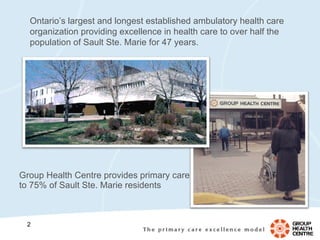
Group Health Centre provides primary care to 75% of Sault Ste. Marie residents Ontario’s largest and longest established ambulatory health care organization providing excellence in health care to over half the population of Sault Ste. Marie for 47 years.
Group Health Centre is a partnership of two organizations Sault Ste. Marie and District Group Health Association (GHA) Algoma District Medical Group (ADMG) Not-for-profit, charitable corporation  Governed by volunteer, community-based Board Owns physical facility, equipment, furnishings Employs all “non-physician” staff including allied health professionals and support services Independent corporation of 67 physicians (38 GPs, 16 Specialists, 13 Associates/Visiting Specialists) Wide range of specialties, including anaesthesia, cardiology, dermatology, emergency medicine, internal medicine, neurosurgery, obstetrics & gynaecology, ophthalmology, paediatrics, psychiatry, sports medicine and surgery
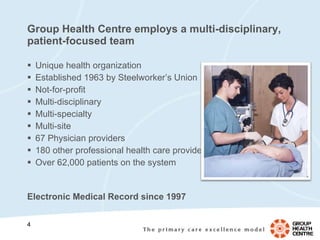
Group Health Centre employs a multi-disciplinary, patient-focused team Unique health organization Established 1963 by Steelworker’s Union Not-for-profit Multi-disciplinary Multi-specialty Multi-site 67  Physician providers   180 other professional health care providers Over 62,000 patients on the system Electronic Medical Record since 1997
Group Health Centre is recognized for its Health Promotion Initiatives (HPI) HPI aims to develop and evaluate evidence-based outcomes management programs in order to improve the quality of health care for GHC patients GUIDELINES BY THEMSELVES DON’T WORK Aid the provision of Appropriate Evidence Based Care Primary Care and Patient-centric Population Health Approach  Continuous Assessment and Evaluation Outcomes Based
HPI Example #1:  Diabetes GHC providers focus on achieving evidence-based process and clinical outcomes, measured for diabetes patients using the “Good Health Outcomes in Diabetes” (“GHOD”)  score Process Outcomes Clinical Outcomes BP within 6 mo HbA1c within 6mo Lipids annually Albuminuria annually Foot exam completed in past year Eye exam completed in past year On ACE-I/ARB On ASA/antiplatelet On Statins BP within 6 mo and <=130/80 mmHg HbA1c within 6 mo and <= .07 Lipids annually and LDL < 2.0
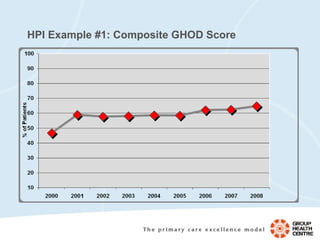
HPI Example #1: Composite GHOD Score
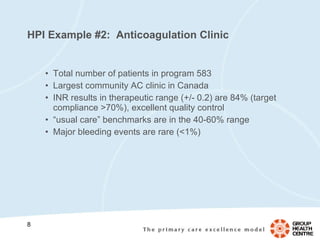
HPI Example #2:  Anticoagulation Clinic Total number of patients in program 583 Largest community AC clinic in Canada INR results in therapeutic range (+/- 0.2) are 84% (target compliance >70%), excellent quality control “ usual care” benchmarks are in the 40-60% range Major bleeding events are rare (<1%)
HPI Example #3:  Congestive Heart Failure Number one admission diagnosis in most hospitals in Canada High re-admission rate (>25%) High mortality rate Incidence and Prevalence Increasing Since 2000, there has been a coordinated approach to the care a patient receives after leaving the hospital.  All information is tracked and viewed by all involved in the care of that patient.
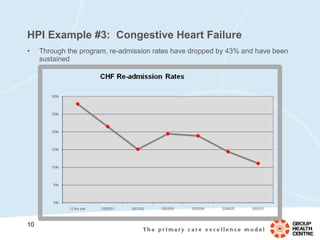
HPI Example #3:  Congestive Heart Failure Through the program, re-admission rates have dropped by 43% and have been sustained
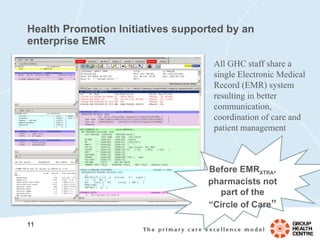
Health Promotion Initiatives supported by an enterprise EMR Before EMR XTRA , pharmacists not part of the “Circle of Care ” All GHC staff share a single Electronic Medical Record (EMR) system resulting in better communication, coordination of care and patient management
August 2006 – February 2008
Source:  Ontario’s eHealth Strategy 2009-2012 Preventable adverse drug events are the fourth-leading cause of death in Ontario 1 Over 10 Ontarians die every day unnecessarily because of adverse drug events
Medications are often not being taken safely or appropriately by Ontarians It is estimated that there will be  394,000 preventable adverse drug events  resulting in: 240,000  physician office visits 36,000  hospitalizations 4,000  deaths Source:  Ontario’s eHealth Strategy 2009-2012
EMR XTRA  provides pharmacists access to GHC’s enterprise EMR system Launched in May 2007 Partnership with Canada Health Infoway, Group Health Centre, Ontario Pharmacists’ Association to expand the circle of care  to include pharmacists With patient consent, pharmacists can access pertinent patient information in EMR (labs, care plan, program notes, progress notes, DI test results, allergies, etc.) **no psych, counseling, social history or OBGYN notes Development of web portal for patients to access their health information
Focus of EMR XTRA Pharmacists in Sault Ste. Marie area  were the first in Canada to access lab test results, allergies and other vital data from consenting patients’ electronic medical records Collaboration with Primary Care Physicians (PCP) at Group Health Centre (GHC) and access to the EMR means that pharmacists have accurate and comprehensive medical data about the patients for whom they provide care  Enhanced “circle of care” increases the opportunity to provide better, safer care to these patients and to help reduce adverse medical events
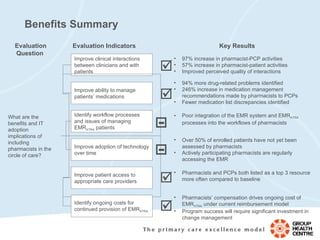
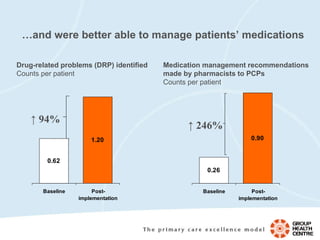
Benefits Summary  What are the benefits and IT adoption implications of including pharmacists in the circle of care? Improve clinical interactions between clinicians and with patients Improve ability to manage patients’ medications Identify workflow processes and issues of managing EMR XTRA  patients Improve adoption of technology over time  Improve patient access to appropriate care providers Identify ongoing costs for continued provision of EMR XTRA   Evaluation Question  Evaluation Indicators  Key Results  97% increase in pharmacist-PCP activities  57% increase in pharmacist-patient activities Improved perceived quality of interactions 94% more drug-related problems identified 246% increase in medication management recommendations made by pharmacists to PCPs Fewer medication list discrepancies identified Poor integration of the EMR system and EMR XTRA  processes into the workflows of pharmacists Over 50% of enrolled patients have not yet been assessed by pharmacists  Actively participating pharmacists are regularly accessing the EMR Pharmacists and PCPs both listed as a top 3 resource more often compared to baseline Pharmacists’ compensation drives ongoing cost of EMR XTRA  under current reimbursement model Program success will require significant investment in change management              - - - 
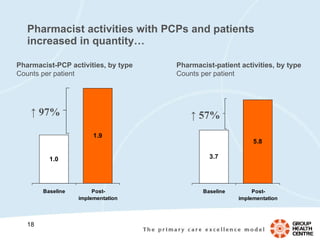
Pharmacist activities with PCPs and patients increased in quantity… Pharmacist-PCP activities, by type Counts per patient ↑   97% Pharmacist-patient activities, by type Counts per patient ↑   57%
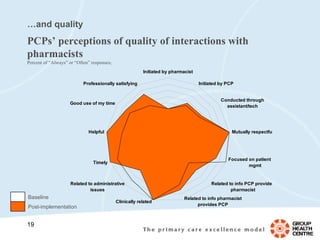
… and quality PCPs’ perceptions of quality of interactions with pharmacists Percent of “Always” or “Often” responses;  Baseline Post-implementation
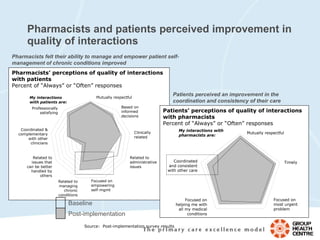
Pharmacists and patients perceived improvement in quality of interactions Pharmacists’ perceptions of quality of interactions with patients Percent of “Always” or “Often” responses Pharmacists felt their ability to manage and empower patient self-management of chronic conditions improved Patients perceived an improvement in the coordination and consistency of their care Source:  Post-implementation survey results Baseline Post-implementation Patients’ perceptions of quality of interactions with pharmacists Percent of “Always” or “Often” responses
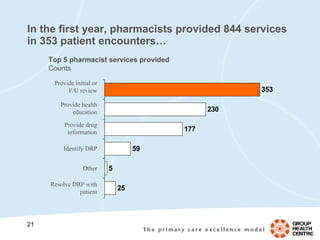
In the first year, pharmacists provided 844 services in 353 patient encounters… Top 5 pharmacist services provided Counts Provide initial or F/U review Provide health education Provide drug information Identify DRP Resolve DRP with patient Other
… and were better able to manage patients’ medications Drug-related problems (DRP) identified Counts per patient ↑   94% Medication management recommendations made by pharmacists to PCPs Counts per patient ↑   246%
Preparing for ePrescribing PeP
The ePrescribing Demonstration Project evaluates the impact of electronic prescribing on providers and patients Goals of the ePrescribing Demonstration Project: Quickly provide and demonstrate the patient safety and quality of care benefits of electronic prescribing to Ontarians Create physician, nurse practitioner and pharmacist champions of electronic prescribing  Demonstrate the full cycle of electronic prescribing through to dispensing in local settings Identify and understand the issues, challenges and opportunities of implementing electronic prescribing and apply this understanding to the provincial roll out Create tools and frameworks for process/workflow changes, adoption strategies and benefits evaluation that can be used for the overall provincial roll out The intent was not to test prototypes of the provincial solution
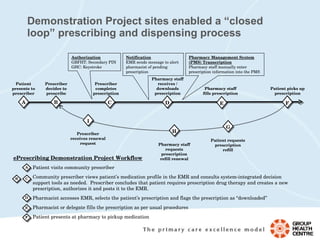
Demonstration Project sites enabled a “closed loop” prescribing and dispensing process Authorization GBFHT: Secondary PIN GHC: Keystroke  Notification EMR sends message to alert pharmacist of pending prescription  Pharmacy Management System (PMS) Transcription Pharmacy staff manually enter prescription information into the PMS Pharmacy staff receives / downloads   prescription Patient presents to prescriber Prescriber decides to prescribe Prescriber completes prescription Pharmacy staff fills prescription Patient picks up prescription D A B C F G H I Patient requests prescription refill Pharmacy staff requests prescription refill renewal Prescriber receives renewal request E Patient visits community prescriber Community prescriber views patient’s medication profile in the EMR and consults system-integrated decision support tools as needed.  Prescriber concludes that patient requires prescription drug therapy and creates a new prescription, authorizes it and posts it to the EMR. Pharmacist accesses EMR, selects the patient’s prescription and flags the prescription as “downloaded” Pharmacist or delegate fills the prescription as per usual procedures Patient presents at pharmacy to pickup medication  A B C D E F ePrescribing Demonstration Project Workflow
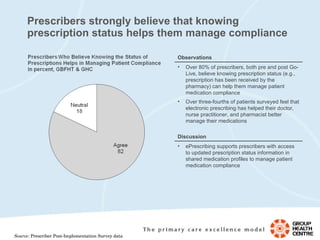
Prescribers strongly believe that knowing prescription status helps them manage compliance Source:  Prescriber Post-Implementation Survey data Observations Over 80% of prescribers, both pre and post Go-Live, believe knowing prescription status (e.g., prescription has been received by the pharmacy) can help them manage patient medication compliance Over three-fourths of patients surveyed feel that electronic prescribing has helped their doctor, nurse practitioner, and pharmacist better manage their medications Discussion ePrescribing supports prescribers with access to updated prescription status information in shared medication profiles to manage patient medication compliance
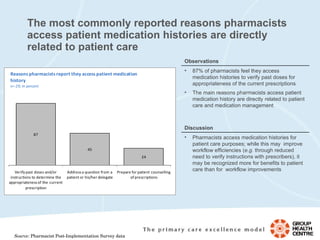
The most commonly reported reasons pharmacists access patient medication histories are directly related to patient care Source:  Pharmacist Post-Implementation Survey data Observations 87% of pharmacists feel they access medication histories to verify past doses for appropriateness of the current prescriptions The main reasons pharmacists access patient medication history are directly related to patient care and medication management Discussion Pharmacists access medication histories for patient care purposes; while this may  improve workflow efficiencies ( e.g.  through reduced need to verify instructions with prescribers), it may be recognized more for benefits to patient care than for  workflow improvements
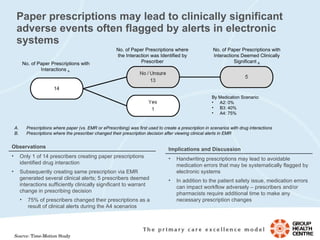
Paper prescriptions may lead to clinically significant adverse events often flagged by alerts in electronic systems Prescriptions where paper (vs. EMR or ePrescribing) was first used to create a prescription in scenarios with drug interactions Prescriptions where the prescriber changed their prescription decision after viewing clinical alerts in EMR By Medication Scenario: A2: 0% B3: 40% A4: 75% Source:  Time-Motion Study Implications and Discussion Handwriting prescriptions may lead to avoidable medication errors that may be systematically flagged by electronic systems In addition to the patient safety issue, medication errors can impact workflow adversely – prescribers and/or pharmacists require additional time to make any necessary prescription changes No. of Paper Prescriptions with Interactions  A   No. of Paper Prescriptions where the Interaction was Identified by Prescriber No. of Paper Prescriptions with Interactions Deemed Clinically Significant  B Observations Only 1 of 14 prescribers creating paper prescriptions identified drug interaction Subsequently creating same prescription via EMR generated several clinical alerts; 5 prescribers deemed interactions sufficiently clinically significant to warrant change in prescribing decision 75% of prescribers changed their prescriptions as a result of clinical alerts during the A4 scenarios
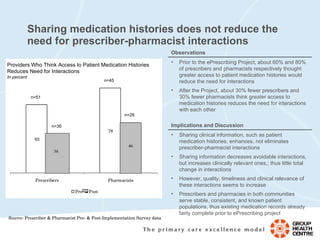
Sharing medication histories does not reduce the need for prescriber-pharmacist interactions Providers Who Think Access to Patient Medication Histories Reduces Need for Interactions In percent n=51 n=36 n=29 n=45 Source:  Prescriber & Pharmacist Pre- & Post-Implementation Survey data 46 36 Observations Prior to the ePrescribing Project, about 60% and 80% of prescribers and pharmacists respectively thought greater access to patient medication histories would reduce the need for interactions After the Project, about 30% fewer prescribers and 30% fewer pharmacists think greater access to medication histories reduces the need for interactions with each other Implications and Discussion Sharing clinical information, such as patient medication histories, enhances, not eliminates prescriber-pharmacist interactions Sharing information decreases avoidable interactions, but increases clinically relevant ones,; thus little total change in interactions However, quality, timeliness and clinical relevance of these interactions seems to increase Prescribers and pharmacies in both communities serve stable, consistent, and known patient populations, thus existing medication records already fairly complete prior to ePrescribing project
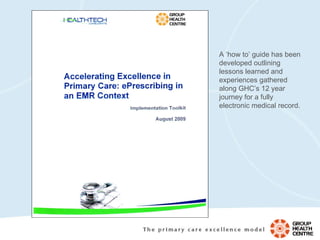
A ‘how to’ guide has been developed outlining lessons learned and experiences gathered along GHC’s 12 year journey for a fully electronic medical record.
Key takeaways from EMR XTRA  and ePrescribing evaluation Benefits of extending EMR access to the complete circle of care team on  improving clinical interactions, medication management and patient safety are clear Patients understand the value pharmacists bring to their care Systematic, concerted change management efforts are required to drive adoption, even for the most “technologically advanced” clinicians – money by itself is not enough!
Engaging and leveraging early adopters as project champions is an effective strategy to achieve results Despite adoption challenges, primary care providers, pharmacists and patients all recognize the benefits of extending clinical histories to community providers Continuing and expanding EMR XTRA  will require a sustainable pharmacist reimbursement model, a structured change management strategy, and an investment in technology infrastructure Continuing eprescribing requires changes in regulatory college requirements and legislation changes Key takeaways from EMR XTRA  and ePrescribing evaluation
Key Messages Silos that exist with in health care sector act as barriers to better health outcomes and work to increase costs while decreasing services 1 Integration of technology and interaction between health care providers improve patient safety Expected results of Implementation of medication management systems will help prevent – each year – 217,000 adverse drug events, 132,000 physician office visits, 20,000 hospitalizations and 2,200 deaths due to adverse events 2 Source 1: 2004 Pharmacist and Primary Health Care  Canadian Pharmacists Association Source 2: Ontario’s eHealth Strategy 2009-2012
Questions? Lucy Fronzi [email_address]

Fronzi (Ghc)

  • 1.
    Transforming Northern Health: Innovations Making a Difference Group Health Centre: EMR XTRA and Preparing for ePrescribing (PeP) Lucy Fronzi, Project Manager March 31, 2010
  • 2.
    Group Health Centreprovides primary care to 75% of Sault Ste. Marie residents Ontario’s largest and longest established ambulatory health care organization providing excellence in health care to over half the population of Sault Ste. Marie for 47 years.
  • 3.
    Group Health Centreis a partnership of two organizations Sault Ste. Marie and District Group Health Association (GHA) Algoma District Medical Group (ADMG) Not-for-profit, charitable corporation Governed by volunteer, community-based Board Owns physical facility, equipment, furnishings Employs all “non-physician” staff including allied health professionals and support services Independent corporation of 67 physicians (38 GPs, 16 Specialists, 13 Associates/Visiting Specialists) Wide range of specialties, including anaesthesia, cardiology, dermatology, emergency medicine, internal medicine, neurosurgery, obstetrics & gynaecology, ophthalmology, paediatrics, psychiatry, sports medicine and surgery
  • 4.
    Group Health Centreemploys a multi-disciplinary, patient-focused team Unique health organization Established 1963 by Steelworker’s Union Not-for-profit Multi-disciplinary Multi-specialty Multi-site 67 Physician providers 180 other professional health care providers Over 62,000 patients on the system Electronic Medical Record since 1997
  • 5.
    Group Health Centreis recognized for its Health Promotion Initiatives (HPI) HPI aims to develop and evaluate evidence-based outcomes management programs in order to improve the quality of health care for GHC patients GUIDELINES BY THEMSELVES DON’T WORK Aid the provision of Appropriate Evidence Based Care Primary Care and Patient-centric Population Health Approach Continuous Assessment and Evaluation Outcomes Based
  • 6.
    HPI Example #1: Diabetes GHC providers focus on achieving evidence-based process and clinical outcomes, measured for diabetes patients using the “Good Health Outcomes in Diabetes” (“GHOD”) score Process Outcomes Clinical Outcomes BP within 6 mo HbA1c within 6mo Lipids annually Albuminuria annually Foot exam completed in past year Eye exam completed in past year On ACE-I/ARB On ASA/antiplatelet On Statins BP within 6 mo and <=130/80 mmHg HbA1c within 6 mo and <= .07 Lipids annually and LDL < 2.0
  • 7.
    HPI Example #1:Composite GHOD Score
  • 8.
    HPI Example #2: Anticoagulation Clinic Total number of patients in program 583 Largest community AC clinic in Canada INR results in therapeutic range (+/- 0.2) are 84% (target compliance >70%), excellent quality control “ usual care” benchmarks are in the 40-60% range Major bleeding events are rare (<1%)
  • 9.
    HPI Example #3: Congestive Heart Failure Number one admission diagnosis in most hospitals in Canada High re-admission rate (>25%) High mortality rate Incidence and Prevalence Increasing Since 2000, there has been a coordinated approach to the care a patient receives after leaving the hospital. All information is tracked and viewed by all involved in the care of that patient.
  • 10.
    HPI Example #3: Congestive Heart Failure Through the program, re-admission rates have dropped by 43% and have been sustained
  • 11.
    Health Promotion Initiativessupported by an enterprise EMR Before EMR XTRA , pharmacists not part of the “Circle of Care ” All GHC staff share a single Electronic Medical Record (EMR) system resulting in better communication, coordination of care and patient management
  • 12.
    August 2006 –February 2008
  • 13.
    Source: Ontario’seHealth Strategy 2009-2012 Preventable adverse drug events are the fourth-leading cause of death in Ontario 1 Over 10 Ontarians die every day unnecessarily because of adverse drug events
  • 14.
    Medications are oftennot being taken safely or appropriately by Ontarians It is estimated that there will be 394,000 preventable adverse drug events resulting in: 240,000 physician office visits 36,000 hospitalizations 4,000 deaths Source: Ontario’s eHealth Strategy 2009-2012
  • 15.
    EMR XTRA provides pharmacists access to GHC’s enterprise EMR system Launched in May 2007 Partnership with Canada Health Infoway, Group Health Centre, Ontario Pharmacists’ Association to expand the circle of care to include pharmacists With patient consent, pharmacists can access pertinent patient information in EMR (labs, care plan, program notes, progress notes, DI test results, allergies, etc.) **no psych, counseling, social history or OBGYN notes Development of web portal for patients to access their health information
  • 16.
    Focus of EMRXTRA Pharmacists in Sault Ste. Marie area were the first in Canada to access lab test results, allergies and other vital data from consenting patients’ electronic medical records Collaboration with Primary Care Physicians (PCP) at Group Health Centre (GHC) and access to the EMR means that pharmacists have accurate and comprehensive medical data about the patients for whom they provide care Enhanced “circle of care” increases the opportunity to provide better, safer care to these patients and to help reduce adverse medical events
  • 17.
    Benefits Summary What are the benefits and IT adoption implications of including pharmacists in the circle of care? Improve clinical interactions between clinicians and with patients Improve ability to manage patients’ medications Identify workflow processes and issues of managing EMR XTRA patients Improve adoption of technology over time Improve patient access to appropriate care providers Identify ongoing costs for continued provision of EMR XTRA Evaluation Question Evaluation Indicators Key Results 97% increase in pharmacist-PCP activities 57% increase in pharmacist-patient activities Improved perceived quality of interactions 94% more drug-related problems identified 246% increase in medication management recommendations made by pharmacists to PCPs Fewer medication list discrepancies identified Poor integration of the EMR system and EMR XTRA processes into the workflows of pharmacists Over 50% of enrolled patients have not yet been assessed by pharmacists Actively participating pharmacists are regularly accessing the EMR Pharmacists and PCPs both listed as a top 3 resource more often compared to baseline Pharmacists’ compensation drives ongoing cost of EMR XTRA under current reimbursement model Program success will require significant investment in change management      - - - 
  • 18.
    Pharmacist activities withPCPs and patients increased in quantity… Pharmacist-PCP activities, by type Counts per patient ↑ 97% Pharmacist-patient activities, by type Counts per patient ↑ 57%
  • 19.
    … and qualityPCPs’ perceptions of quality of interactions with pharmacists Percent of “Always” or “Often” responses; Baseline Post-implementation
  • 20.
    Pharmacists and patientsperceived improvement in quality of interactions Pharmacists’ perceptions of quality of interactions with patients Percent of “Always” or “Often” responses Pharmacists felt their ability to manage and empower patient self-management of chronic conditions improved Patients perceived an improvement in the coordination and consistency of their care Source: Post-implementation survey results Baseline Post-implementation Patients’ perceptions of quality of interactions with pharmacists Percent of “Always” or “Often” responses
  • 21.
    In the firstyear, pharmacists provided 844 services in 353 patient encounters… Top 5 pharmacist services provided Counts Provide initial or F/U review Provide health education Provide drug information Identify DRP Resolve DRP with patient Other
  • 22.
    … and werebetter able to manage patients’ medications Drug-related problems (DRP) identified Counts per patient ↑ 94% Medication management recommendations made by pharmacists to PCPs Counts per patient ↑ 246%
  • 23.
  • 24.
    The ePrescribing DemonstrationProject evaluates the impact of electronic prescribing on providers and patients Goals of the ePrescribing Demonstration Project: Quickly provide and demonstrate the patient safety and quality of care benefits of electronic prescribing to Ontarians Create physician, nurse practitioner and pharmacist champions of electronic prescribing Demonstrate the full cycle of electronic prescribing through to dispensing in local settings Identify and understand the issues, challenges and opportunities of implementing electronic prescribing and apply this understanding to the provincial roll out Create tools and frameworks for process/workflow changes, adoption strategies and benefits evaluation that can be used for the overall provincial roll out The intent was not to test prototypes of the provincial solution
  • 25.
    Demonstration Project sitesenabled a “closed loop” prescribing and dispensing process Authorization GBFHT: Secondary PIN GHC: Keystroke Notification EMR sends message to alert pharmacist of pending prescription Pharmacy Management System (PMS) Transcription Pharmacy staff manually enter prescription information into the PMS Pharmacy staff receives / downloads prescription Patient presents to prescriber Prescriber decides to prescribe Prescriber completes prescription Pharmacy staff fills prescription Patient picks up prescription D A B C F G H I Patient requests prescription refill Pharmacy staff requests prescription refill renewal Prescriber receives renewal request E Patient visits community prescriber Community prescriber views patient’s medication profile in the EMR and consults system-integrated decision support tools as needed. Prescriber concludes that patient requires prescription drug therapy and creates a new prescription, authorizes it and posts it to the EMR. Pharmacist accesses EMR, selects the patient’s prescription and flags the prescription as “downloaded” Pharmacist or delegate fills the prescription as per usual procedures Patient presents at pharmacy to pickup medication A B C D E F ePrescribing Demonstration Project Workflow
  • 26.
    Prescribers strongly believethat knowing prescription status helps them manage compliance Source: Prescriber Post-Implementation Survey data Observations Over 80% of prescribers, both pre and post Go-Live, believe knowing prescription status (e.g., prescription has been received by the pharmacy) can help them manage patient medication compliance Over three-fourths of patients surveyed feel that electronic prescribing has helped their doctor, nurse practitioner, and pharmacist better manage their medications Discussion ePrescribing supports prescribers with access to updated prescription status information in shared medication profiles to manage patient medication compliance
  • 27.
    The most commonlyreported reasons pharmacists access patient medication histories are directly related to patient care Source: Pharmacist Post-Implementation Survey data Observations 87% of pharmacists feel they access medication histories to verify past doses for appropriateness of the current prescriptions The main reasons pharmacists access patient medication history are directly related to patient care and medication management Discussion Pharmacists access medication histories for patient care purposes; while this may improve workflow efficiencies ( e.g. through reduced need to verify instructions with prescribers), it may be recognized more for benefits to patient care than for workflow improvements
  • 28.
    Paper prescriptions maylead to clinically significant adverse events often flagged by alerts in electronic systems Prescriptions where paper (vs. EMR or ePrescribing) was first used to create a prescription in scenarios with drug interactions Prescriptions where the prescriber changed their prescription decision after viewing clinical alerts in EMR By Medication Scenario: A2: 0% B3: 40% A4: 75% Source: Time-Motion Study Implications and Discussion Handwriting prescriptions may lead to avoidable medication errors that may be systematically flagged by electronic systems In addition to the patient safety issue, medication errors can impact workflow adversely – prescribers and/or pharmacists require additional time to make any necessary prescription changes No. of Paper Prescriptions with Interactions A No. of Paper Prescriptions where the Interaction was Identified by Prescriber No. of Paper Prescriptions with Interactions Deemed Clinically Significant B Observations Only 1 of 14 prescribers creating paper prescriptions identified drug interaction Subsequently creating same prescription via EMR generated several clinical alerts; 5 prescribers deemed interactions sufficiently clinically significant to warrant change in prescribing decision 75% of prescribers changed their prescriptions as a result of clinical alerts during the A4 scenarios
  • 29.
    Sharing medication historiesdoes not reduce the need for prescriber-pharmacist interactions Providers Who Think Access to Patient Medication Histories Reduces Need for Interactions In percent n=51 n=36 n=29 n=45 Source: Prescriber & Pharmacist Pre- & Post-Implementation Survey data 46 36 Observations Prior to the ePrescribing Project, about 60% and 80% of prescribers and pharmacists respectively thought greater access to patient medication histories would reduce the need for interactions After the Project, about 30% fewer prescribers and 30% fewer pharmacists think greater access to medication histories reduces the need for interactions with each other Implications and Discussion Sharing clinical information, such as patient medication histories, enhances, not eliminates prescriber-pharmacist interactions Sharing information decreases avoidable interactions, but increases clinically relevant ones,; thus little total change in interactions However, quality, timeliness and clinical relevance of these interactions seems to increase Prescribers and pharmacies in both communities serve stable, consistent, and known patient populations, thus existing medication records already fairly complete prior to ePrescribing project
  • 30.
    A ‘how to’guide has been developed outlining lessons learned and experiences gathered along GHC’s 12 year journey for a fully electronic medical record.
  • 31.
    Key takeaways fromEMR XTRA and ePrescribing evaluation Benefits of extending EMR access to the complete circle of care team on improving clinical interactions, medication management and patient safety are clear Patients understand the value pharmacists bring to their care Systematic, concerted change management efforts are required to drive adoption, even for the most “technologically advanced” clinicians – money by itself is not enough!
  • 32.
    Engaging and leveragingearly adopters as project champions is an effective strategy to achieve results Despite adoption challenges, primary care providers, pharmacists and patients all recognize the benefits of extending clinical histories to community providers Continuing and expanding EMR XTRA will require a sustainable pharmacist reimbursement model, a structured change management strategy, and an investment in technology infrastructure Continuing eprescribing requires changes in regulatory college requirements and legislation changes Key takeaways from EMR XTRA and ePrescribing evaluation
  • 33.
    Key Messages Silosthat exist with in health care sector act as barriers to better health outcomes and work to increase costs while decreasing services 1 Integration of technology and interaction between health care providers improve patient safety Expected results of Implementation of medication management systems will help prevent – each year – 217,000 adverse drug events, 132,000 physician office visits, 20,000 hospitalizations and 2,200 deaths due to adverse events 2 Source 1: 2004 Pharmacist and Primary Health Care Canadian Pharmacists Association Source 2: Ontario’s eHealth Strategy 2009-2012
  • 34.
    Questions? Lucy Fronzi[email_address]

Editor's Notes

  • #7 Let’s go to an example to see how this works. Diabetes, one of the first diseases looked at by the HPI group. Evidence based practice focuses on these ten process interventions to obtain better clinical outcomes. So how do you continuously evaluate and provide appropriate evidence-based health promotion interventions to diabetics in a busy provider office.
  • #8 Having these guidelines in front of the provider for each visit, we saw improvements in clinical outcomes. In fact, there has been a 55% increase in better health outcomes for our diabetics which we refer to as the GHOD score (Good Health Outcomes for Diabetics). The GHOD score is a composite view of the 10 interventions for diabetes.
  • #9 Anticoagulation clinic is a nurse run clinic set up to provide for management of patients on oral anticoagulation. These nurses work in the EMR to pull together the information required in the care of these patients. This clinic also uses the appointment centre to book lab appointments. The booking of these appointments made it easier for the patients and the lab staff, but it also now provided information to the nurses as to who hasn’t come in for their lab work and they could follow up with a phone call. The anticoagulation clinic outcomes are such that INR results are in the therapeutic range 84% of the time. This is compared to usual care benchmarks of 40-60%.
  • #14 Marisa Preventable adverse drug events will be the 4 th leading cause of death Many reasons – physician may not monitor drug allergies, prescribe wrong drug or dose MAIN reason 1 – pharmacists have insufficient or unclear information to support effective outcomes MAIN reason 2 – illegible Rx On-line management of Rx medications via EMRxtra which is accessible to pharmacists will prevent these errors and improve pt. safety
  • #17 Lucy
  • #18 Lucy
  • #19 Marisa Quality: Improve clinical interactions between clinicians and with patients Note: Pharmacists documented almost two activities with PCPs per patient 50% (72/145) of patients required pharmacists to address drug-related problems (DRPs) with PCPs Implications Many activities involve information sharing and clarification 20% (72/274) of activities are related to addressing DRPs – integral for managing patient safety Note: The number of pharmacist-patient activities increased by 57% compared to baseline Pharmacists provided significantly more educational services (health education and drug information) compared to baseline Implications Medication reviews improved in quantity and quality – in baseline, reviews based on incomplete profiles By having access to patients’ medical profiles, pharmacists are better informed to provide educational services and address drug-related problems
  • #20 Marisa Pharmacists and patients perceived an improvement in the quality of their interactions Pharmacists felt their ability to manage and empower patient self-management of chronic conditions improved Patients perceived an improvement in the coordination and consistency of their care
  • #21 Marisa
  • #22 Lucy
  • #23 Marisa
  • #29 =