
Created By – Rizwan Rajik Qureshi
Project Report
On
“BATIK PRINTING”
A Dissertation Submitted to R.T.M Nagpur University
In Partial Fulfilment of the Requirement
For the Award of Degree of
BACHELOR OF TEXTILE SCIENCE
Submitted By
Miss. Shubhangi M. Sahare
( Bachelor of Textile Science, III Year)
Under the Guidance of
Mrs. Snehal Rohadkar
MAHALAXMI JAGDAMBA COLLAGE OF LIBRARY & INFORMATION SCIENCE
RASHTRASANT TUKDOJI MAHARAJ NAGPUR UNIVERSITY,
NAGPUR.2018-2019
File
N
otC
opy
CERTIFICATE
This is Certify that the dissertation entitled
“BATIK PRINTING”
Is a record of dissertation work
Carried out by
Miss. Shubhangi M. Sahare
Submitted in the partial fulfilment of requirement
For the degree of Bachelor of Textile Science
Of R.T.M. Nagpur university.
Mrs. Snehal Rohadkar Mrs. Janvi Nandanwar Mrs. Meghna Polkat
Guide Principal Head of
Department
MAHALAXMI JAGDAMBA COLLAGE OF LIABRARY & INFORMATION SCIENCE
RASHTRASANT TUKDOJI MAHARAJ NAGPUR UNIVERSITY
NAGPUR. 2018-2019
File
N
otC
opy
Acknowledgement
It was golden opportunity for these project and each step is a learning
process of one life. Each opportunity that we get adds something to our
personality. I take this opportunity to express my profound gratitude
towards every who helped me through the making of this project.
To being with I must acknowledge the whole hearted support I received
from Mrs. Snehal Rohadkar.
I am also thankful to Principle Janvi Nandanwar Madam for their valuable
guidance. Mahalaxmi Jagdamba Mahavidhylaya Nagpur.
Finally I thank to all my friends and each and every member for their
unfailing, valuable suggestion, support & assistance.
Miss. Shubhangi M. Sahare
B.T.S Final Year
Mahalaxmi Jagdamba Mahavidhylaya
Nagpur
File
N
otC
opy
INTRODUCTION
Batik is a technique of wax-resist dyeing applied to whole cloth, or cloth made using this technique.
Batik is made either by drawing dots and lines of the resist with a spouted tool called a canting
also spelled or by printing the resist with a copper stamp called a cap. The applied wax resists dyes
and therefore allows the artisan to colour selectively by soaking the cloth in one colour, removing
the wax with boiling water, and repeating if multiple colors are desired.
A tradition of making batik is found in various countries, including Indonesia, Malaysia,
Singapore, India, Bangladesh, Sri Lanka, Philippines and Nigeria; the batik of Indonesia, however,
is the best-known. Indonesian batik made in the island of Java has a long history of acculturation,
with diverse patterns influenced by a variety of cultures, and is the most developed in terms of
pattern, technique, and the quality of workmanship. In October 2009, UNESCO designated
Indonesian batik as a Masterpiece of Oral and Intangible Heritage of Humanity. A special type of
resist-dyeing technique is used for Batik printing. Under this technique, part of plain cloth are
covered by wax retain their original color, thus creating beautiful designs. Cracks are developed
in the wax by crumpling the cloth, leading to seepage of the dye into the area covered by wax. This
is one of the distinguishing features of batik printing.
The two main batik according to the type of resist used i.e. wax and starch can be best defined
accordingly and the manner of its application. Batik is a wax resist fiber art. Hot wax is applied to
fabric in a design. The wax serves as resist, preventing the dye from reaching the fabric where it
was applied. This technique can be applied in layers with different colors.
(A) Hot Wax Resist:
Using hot liquid wax, lines shapes are drawn on to cloth with brushes, special tools or stamps. The
wax penetrates the cloth forming a resist. The unwashed sections of the fabric are dyed; the
sections of the fabric protected by the wax resist remain free of the dye. This process is known
batik throughout Indonesia, India and the Orient.
In traditional batik there is a characteristics network of the web like lines scattered over the surface
of the cloth, due to the deliberate crushing of the fabric prior to the final dye bath. As traditional
methods are simplified and adapted to present day interpretation many variations are possible.
The fabric can be taken through several overlapping applications of wax and dyes, the increasing
the complexity of the design or the work can be completed with a single application of wax and
dye, as in silk paintings, eliminating a final crackle producing dye bath.
File
N
otC
opy
(B) Starch paste resists:
Historically, the use of waters soluble flour pastes which are applied to cloth in different ways is
well known throughout Asia and parts of Africa. In Nigeria the term 'admire elect’ refers to the
indigo dyed decorative fabrics made with cassava-flour paste applied with cut blocks and stencils.
Other variations include applying the design by scrapping through with a comb or similar tool.
In the first part of this project i.e., the review of literature chapter no 1 history of batik has been
explained. In the next chapter i.e. chapter No. 2 tools and equipment’s has been given which
include the basic equipment’s for dyeing, tools and brushes, Tjanting blocks, candles materials
used in batik etc. Further in the 3rd chapter, an explanation about the dyes and chemicals used in
batik printing has been given, basically they are naphtha dyes, their applications, exhaustions of
dye bath, preparations of solutions, de-waxing and diazotization and soaping etc. Also about vat
coolers, reactive dyes, method of dyeing solubilized vat dyes developing etc. has been explained
in this project. In the chapter 4 experimenting with the dye colours,has been given, its effects
produced, its conclusion, then trips on application of wax, also useful information about dyes has
been noticed.
In the other part of this project i.e. methodology, a complete study of the project has been
discussed. What had been done, its effects and conclusion have been noted.
File
N
otC
opy
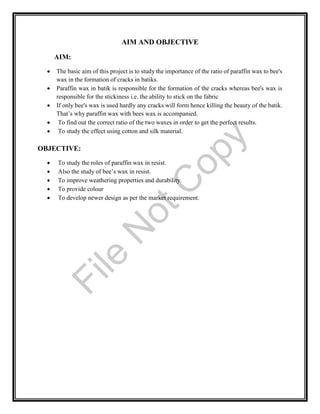
AIM AND OBJECTIVE
AIM:
 The basic aim of this project is to study the importance of the ratio of paraffin wax to bee's
wax in the formation of cracks in batiks.
 Paraffin wax in batik is responsible for the formation of the cracks whereas bee's wax is
responsible for the stickiness i.e. the ability to stick on the fabric
 If only bee's wax is used hardly any cracks will form hence killing the beauty of the batik.
That’s why paraffin wax with bees wax is accompanied.
 To find out the correct ratio of the two waxes in order to get the perfect results.
 To study the effect using cotton and silk material.
OBJECTIVE:
 To study the roles of paraffin wax in resist.
 Also the study of bee’s wax in resist.
 To improve weathering properties and durability.
 To provide colour
 To develop newer design as per the market requirement.
File
N
otC
opy
REVIEw OF
LITERATURE
File
N
otC
opy
Chapter 1
HISTORY OF BATIK
Evidence of early example of batik has been found in the Far East, Middle East, Central Asia and
India from over 2000 years ago. The batik is originally a Japanese term, denoting a kind of resist
technique for producing design on fabric. The word batik is Indonesian in origin but the concept
itself was probably first derived either by the Egyptians or according to other scholars on the
Indian archipelago. It is known that liquid or paste starch resists preceded the use of wax.
In the 4th century B.C. the Greeks invaded India and returned with many textiles. This indicated
an already well-established tradition in weaving, as well as cloth painting and dyeing. The
images were geometric or highly stylized arrangements of flowers, fruits, birds and animals. The
craftsmanship was the highest quality. With increasing migration of people and expanding trade
routes, knowledge of wax-resist dyeing spread throughout Asia. About 300 or 400 A.D. Indian
traders and merchants introduced in their own unique manner to the very high degree of
excellence so admired today . Since the textile arts were of great importance to these people, the
batiks of Indonesia give us an unusually complete and unbroken tradition that can be traced for
centuries.
The volcanic island of java, where the batik art was perfected, was invited by Hindu tribes from
India who remained and were powerful rulers for 1300 years. During the medial period, Arabs
came, also by way of India, introducing the Muslim religion. The Sultans of their empires were
supreme rulers with elaborate palaces and numerous court attendants; they lived story books
lives of richness and splendor. The usual preference for finery throughout for Asia is for silk and
the Javanese, because of their ancient batik tradition, favored cotton. Cotton was easy to grow
and in a tropical climate a comfortable fabric to wear. Batik decoration was used only on
garments, rather than ceremonial cloths or decorative hangings. At one time a Sultan dared that
batik making was a 'Royal Art' to be practiced only by the women of the court. This ruling of
course, could not be enforced for long; the craft was too deeply in ingrain among the people but
it serves as evidence of the value and high regard giving those garments.
For centuries the native villages with a precision and concern for detail, we marvel at today
practiced batik. Time was on importance that employed infinite patience, working, reworking
motifs handed down from one generation to another.
The women were responsible for the design and the waxing, the men for the dyeing and finishing.
The ingrained superstitions of many centuries played their part the ritual of batik work. These skills
were thought of as benevolent gifts from the spirits of that were blessed. Offering of incense, rice
and flowers were prepared to win the favor of the spirits. While the waxing demanded great skills,
the dyeing procedures were extremely complicated and time consuming a slight error in mixing
could prove ruinous. If the colour was faulty, the evil spirits were surely at work.
File
N
otC
opy
All the traditional patterns had whimsical names - "a carefree life" or”moonshine charm” - Which
assist in identification. Certain patterns were reserved exclusively for the family of the sultan and
his highest ranking officers. There were boned for use on other garments. The workmanship and
dye coloration had to be perfect; this meant no sign of wax crackle for any break in the wax meant
faulty handling. Batik with such "defects" had to be destroyed so that the evil spirits could not
molest the ruler.
Some aspects of batik making changed when the 'tjap' or copper hand stamp, came into use in java
about 100 years ago. It had been known in other areas for centuries. After the stamp is dipped into
a bed of molten wax, the design motif is imprinted onto the cloth. The principle is that of block
printing with the hot wax taking the place of the ink. The stamp was made by inserting the edges
of thin strips of Copper into a wood base, conforming to a preplanned design. A second stamp was
made of the reverse of each motif for printing on the back of the cloth.
This device has obviously made it possible for batik to be completed in far less time than the
taunting methods requires. The stamp which is so greatly speeded up the process, marked the
beginning of the movement to change batik making from a folk craft or “cottage industry " kind
of activity to the small factory type of production that is prevalent today. There are several
thousand of these factories in java today. With some exceptions, aniline dyes have almost
completely supplemented natural colorants. The last generation has seen many changes in the
social structure, which have added to the breaking down of the handcraft traditions that existed
unchanged for so many centuries.
File
N
otC
opy
Chapter 2
TOOLS AND EQUIPMENTS
BASIC EQUIPMENT:
For Waxing
1. An electric heater. Stove or a gas ring stove.
2. A saucepan or pot to heat wax (aluminum or enamel) preferably with a
handle.
3. After table surface covered with newspapers or pieces of plywood or hand
board. Do all your waxing on this table.
4. A sheet of asbestos to keep under this stove for safety measures.
5. Candles or blocks of paraffin wax.
6. Resin and bees wax.
7. A wooden frame to pin the cloth to do this waxing.
8. Tools likes brushes and blocks to do printing and painting.
EQUIPMENT FOR DYEING:
1. Plastic or enamel bowls, buckets or bath.
2. Plastic or glass measures.
3. Rubber gloves.
4. Rubber or plastic sheet.
5. Plastic spoons of various sizes.
6. Newspaper to cover working surface.
7. Small bowls or pots to mix dyes.
TOOLS AND BRUSHES:
The most commonly used tools are brushes of various width and sizes. The wedge
shaped brush will also cover large areas, but advantage here is that it can also
give fine lines. The small round brush is mainly for doing all the fine linear work,
mostly used for very fine linear pattern where the use of a thinker brush may not
be so good as the wax may spread. DEY BRUSHING the word dry brushing
expresses the very technique of applying the wax on the cloth. One van get some
level textures by this method. As the word suggests the brush should be free of
excess wax. Before applying the brush to the cloth, squeeze out the extra wax on a
piece of newspaper or a rough piece of cloth. (Do not make it completely dry).
File
N
otC
opy
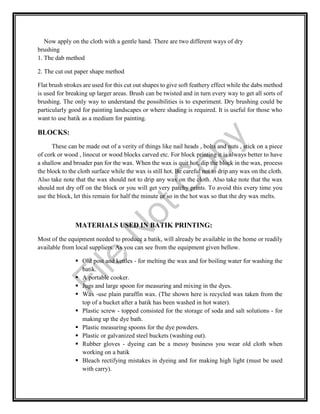
Now apply on the cloth with a gentle hand. There are two different ways of dry
brushing
1. The dab method
2. The cut out paper shape method
Flat brush strokes are used for this cut out shapes to give soft feathery effect while the dabs method
is used for breaking up larger areas. Brush can be twisted and in turn every way to get all sorts of
brushing. The only way to understand the possibilities is to experiment. Dry brushing could be
particularly good for painting landscapes or where shading is required. It is useful for those who
want to use batik as a medium for painting.
BLOCKS:
These can be made out of a verity of things like nail heads , bolts and nuts , stick on a piece
of cork or wood , linocut or wood blocks carved etc. For block printing it is always better to have
a shallow and broader pan for the wax. When the wax is quit hot, dip the block in the wax, process
the block to the cloth surface while the wax is still hot. Be careful not to drip any wax on the cloth.
Also take note that the wax should not to drip any wax on the cloth. Also take note that the wax
should not dry off on the block or you will get very patchy prints. To avoid this every time you
use the block, let this remain for half the minute or so in the hot wax so that the dry wax melts.
MATERIALS USED IN BATIK PRINTING:
Most of the equipment needed to produce a batik, will already be available in the home or readily
available from local suppliers. As you can see from the equipment given bellow.
 Old post and kettles - for melting the wax and for boiling water for washing the
batik.
 A portable cooker.
 Jugs and large spoon for measuring and mixing in the dyes.
 Wax -use plain paraffin wax. (The shown here is recycled wax taken from the
top of a bucket after a batik has been washed in hot water).
 Plastic screw - topped consisted for the storage of soda and salt solutions - for
making up the dye bath.
 Plastic measuring spoons for the dye powders.
 Plastic or galvanized steel buckets (washing out).
 Rubber gloves - dyeing can be a messy business you wear old cloth when
working on a batik
 Bleach rectifying mistakes in dyeing and for making high light (must be used
with carry).
File
N
otC
opy
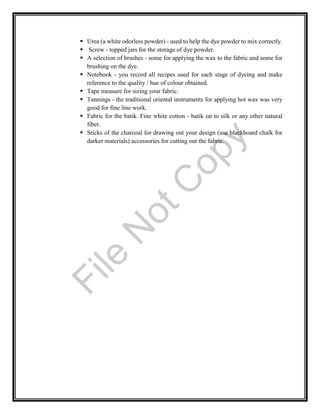
 Urea (a white odorless powder) - used to help the dye powder to mix correctly.
 Screw - topped jars for the storage of dye powder.
 A selection of brushes - some for applying the wax to the fabric and some for
brushing on the dye.
 Notebook - you record all recipes used for each stage of dyeing and make
reference to the quality / hue of colour obtained.
 Tape measure for sizing your fabric.
 Tannings - the traditional oriental instruments for applying hot wax was very
good for fine line work.
 Fabric for the batik. Fine white cotton - batik on to silk or any other natural
fiber.
 Sticks of the charcoal for drawing out your design (use blackboard chalk for
darker materials) accessories for cutting out the fabric.
File
N
otC
opy
Chapter 3
DYES AND CHEMICALS USE IN BATIK PRINTING
COLOURS:
The colors / Dyestuffs which are capable of applied from a cold dye bath only are suitable since hot dyeing
hot dyeing dyestuffs would remove the wax resist. Dyes and chemicals used in batik printing are as follows:
1) Naphthol or Azoic Dyestuff
2) Cold dyeing vat dyes tuffs
3) Cold dyeing reactive dyestuff
4) Solubilized vat dyestuff
NAPHTHOL OR AZOIC DYESTUFFS:
These dyestuffs are mostly used for batik work as the naphtholated fabric can be waxed and cracked and
then developed with a diazotized solution of a base. They produce deep shades of high fastness and
remarkable brilliancy. Although a large number of combinations of naphtha and bases are available, the
more substantive naphthols are mainly used as they give satisfactory rubbing fastness. The naphthol
solutions can be applied by brushing it on to the cloth. Nylon brushes are used for these purposes as brushes
with natural bristles are used for these purpose as brushes cloth natural bristles are attacked by caustic soda
present in the naphthol solution.
TRADE NAMES OF AZOIC COOLERS:
Azoic or Naphthol colors are manufactured by different companies. M/s. Atul product Ltd.Atul M/s. Indian
Dyestuff industries Ltd Bombay is marketing their naphthol.
Tulathol / Indothol Tulabase / Fast base
1. As 1. Yellow GC
2. As-G 2. Orange GC
3. As-D 3. Orange GR
4. As-BO 4. Scarlet GGS
5. As-SW 5. Scarlet RC
6. As-TR 6. Red RC
7. As-SG 7. Red Kb
8. As-Bt 8. Red B
9. As-BC 9. Bordeaux GP
APPLICATION OF NAPHTHOLS:
Naphthols are insoluble in water and can be made into soluble using caustic soda, the dyeing process consist
essentially the following 4 stages.
1. Impregnation of cloth with selected naphthol
2. Draining of the excess naphthol.
File
N
otC
opy
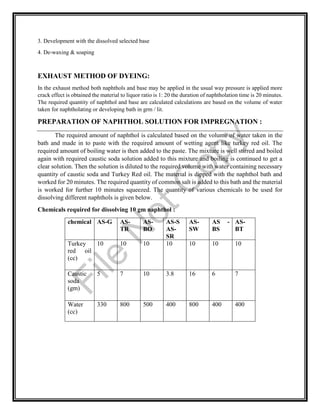
3. Development with the dissolved selected base
4. De-waxing & soaping
EXHAUST METHOD OF DYEING:
In the exhaust method both naphthols and base may be applied in the usual way pressure is applied more
crack effect is obtained the material to liquor ratio is 1: 20 the duration of naphtholation time is 20 minutes.
The required quantity of naphthol and base are calculated calculations are based on the volume of water
taken for naphtholating or developing bath in grm / lit.
PREPARATION OF NAPHTHOL SOLUTION FOR IMPREGNATION :
The required amount of naphthol is calculated based on the volume of water taken in the
bath and made in to paste with the required amount of wetting agent like turkey red oil. The
required amount of boiling water is then added to the paste. The mixture is well stirred and boiled
again with required caustic soda solution added to this mixture and boiling is continued to get a
clear solution. Then the solution is diluted to the required volume with water containing necessary
quantity of caustic soda and Turkey Red oil. The material is dipped with the naphthol bath and
worked for 20 minutes. The required quantity of common salt is added to this bath and the material
is worked for further 10 minutes squeezed. The quantity of various chemicals to be used for
dissolving different naphthols is given below.
Chemicals required for dissolving 10 gm naphthol :
chemical AS-G AS-
TR
AS-
BO
AS-S
AS-
SR
AS-
SW
AS -
BS
AS-
BT
Turkey
red oil
(cc)
10 10 10 10 10 10 10
Caustic
soda
(gm)
5 7 10 3.8 16 6 7
Water
(cc)
330 800 500 400 800 400 400
File
N
otC
opy
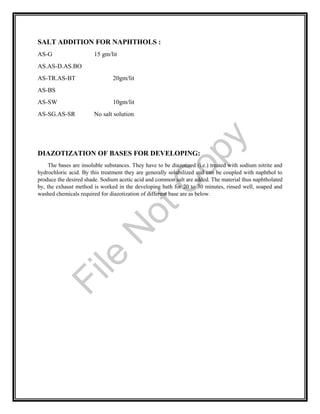
SALT ADDITION FOR NAPHTHOLS :
AS-G 15 gm/lit
AS.AS-D.AS.BO
AS-TR.AS-BT 20gm/lit
AS-BS
AS-SW 10gm/lit
AS-SG.AS-SR No salt solution
DIAZOTIZATION OF BASES FOR DEVELOPING:
The bases are insoluble substances. They have to be diazotized (i.e.) treated with sodium nitrite and
hydrochloric acid. By this treatment they are generally solubilized and can be coupled with naphthol to
produce the desired shade. Sodium acetic acid and common salt are added. The material thus naphtholated
by, the exhaust method is worked in the developing bath for 20 to 30 minutes, rinsed well, soaped and
washed chemicals required for diazotization of different base are as below.
File
N
otC
opy
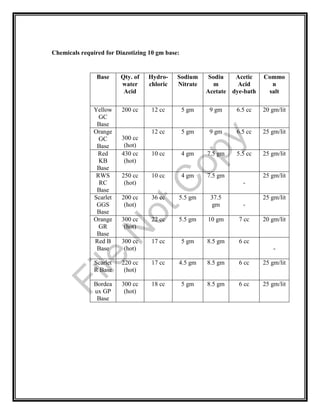
Chemicals required for Diazotizing 10 gm base:
Base Qty. of
water
Acid
Hydro-
chloric
Sodium
Nitrate
Sodiu
m
Acetate
Acetic
Acid
dye-bath
Commo
n
salt
Yellow
GC
Base
200 cc 12 cc 5 gm 9 gm 6.5 cc 20 gm/lit
Orange
GC
Base
300 cc
(hot)
12 cc 5 gm 9 gm 6.5 cc 25 gm/lit
Red
KB
Base
430 cc
(hot)
10 cc 4 gm 7.5 gm 5.5 cc 25 gm/lit
RWS
RC
Base
250 cc
(hot)
10 cc 4 gm 7.5 gm
-
25 gm/lit
Scarlet
GGS
Base
200 cc
(hot)
36 cc 5.5 gm 37.5
gm -
25 gm/lit
Orange
GR
Base
300 cc
(hot)
22 cc 5.5 gm 10 gm 7 cc 20 gm/lit
Red B
Base
300 cc
(hot)
17 cc 5 gm 8.5 gm 6 cc
-
Scarlet
R Base
220 cc
(hot)
17 cc 4.5 gm 8.5 gm 6 cc 25 gm/lit
Bordea
ux GP
Base
300 cc
(hot)
18 cc 5 gm 8.5 gm 6 cc 25 gm/lit
File
N
otC
opy
DE-WAXING AND SOAPING :
After dyeing it is necessary to remove the wax content from the material the wax removed by treating the
material in boiling water and then water containing with 2.3 gm. / hot soda ash at boil for 5 min. further
material is soaped in a bath containing 5 gm / lit soap at boil for 10 min and thoroughly washed with water
by doing so the material, gets brightness.
COLD DYEING VAT DYESTUFFS :
Vat colours are largely used in hot method. But certain colours are applied in cold methods and these colours
can be dyed for Batik style without melting the wax portions. Vat colours are insoluble in water and can be
brought into soluble condition by reducing with sodium hydrosulphite in presence of caustic soda. The
colours in dyeing are used on the basis of percentage of the weight of material.
METHOD OF DISSOLVING VAT COLOURS:
Weigh the wax applied material. The requirement of dyestuffs is calculated on percentage
on the weight of material. If we want to dye 2% of any shades means for 100 gm weight of material
2 gm of dyestuff is required.
Take the dyestuff in a dye-pot, and add equal quantity of turkey-red oil, paste well. Add hot
water at 500° C add 2 times of caustic soda on the weight of material stirr well. Add 2 times of
sodium hydrosulphite on the weight of material, stirr well and keep it for 10 minutes for well
dissolving.
The dissolved dyestuff is transferred into the dye-bath already set with 30 times of water on
the weight of material at 25°C - 30°C added with 1.5 gm/lit caustic soda and 1.5 - 2 gm/lit sodium
hydrosulphite. The wax applied melted material is entered into the dye-bath and worked for 15 -
20 min with occasional stirring. The material is then removed and aired for 15 - 20 min and washed
well.
Lastly the material is de-waxed and soaped in hot water as in the case of Naphthol that
colours referred above.
REACTIVE DYES:
Reactive Dyes are applied on cotton material both in cold and hot method, cold colours
reactive dyes are available in the market in specific trade name which can be applied in cold
method. These colours form an unique class by themselves. As they form a true chemical linkage
with the fiber. These dyestuffs combine in them the simplicity of application and the brightness of
shade only surpassed by basic colours. These dyes have good fastness to, light and washing. They
are superior to Naphthol colours in respect of rubbing fastness. Their fastness to chlorine is
generally poor. However there are some dyes which possess good fastness to chlorine. Colours
File
N
otC
opy
such as Deep Turquoise and Deep magenta which are difficult to produce from vat and naphthol
colours can be produced using these reactive colours. A number of bright shades can be produced
with these dyes by using dip-dyeing techniques or by brush dyeing locally over the waxed areas.
METHOD OF DYEING:
Weigh the wax coated material, suppose if the wax of material is 500gm, prepare the dye- bath
as follows.
The material liquor ratio is 1:20, 250 gm urea is dissolved in 3000 cc of boiling water, 25 gm
of reactive cold brand dye is added and stirred, 5725 cc of cold water is added to make volume up
to 9000 cc quantity.
The wax coated wetted material is entered into the dye bath and worked for 15-20 min.Then
the alkaline solution is prepared as follows:
100 gm sodium carbonate (soda ash) and 900 gm cold water are mixed well. The material is
lifted up and the alkaline solution is added to the dye bath and the material is entered and worked
in the same cold bath for further one hour.
The material is removed and de-waxed and soaped in hot water as in the case of Naphthol
colours as referred in previous.
SOLUBILIZED VAT DYES:
This group of colours is called by another name as “Indigo sol” solubilised vat dyes are water
soluble derivatives of vat dyes. These are eminently suited for batik work and they give very fast
shades. They can be applied in cold to cotton, silk, rayon or woolen materials. The disadvantages
of this group is only cost factor. Since the cost of dye is so high that it is advised to use pale to
medium shades.
APPLICATION OF SOLUBLE VAT COLOURS:
The actual dyeing process is carried out up to 35 stages viz.
1. Application of the dyestuff in Neutral or weakly alkaline solution to the
fiber in presence of glaubur’s salt.
2. Development of the dyestuff on the fiber with the aid of acid and oxidizing
agent (i.e.) with sodium Nitrite and sulphuric Acid.
3. After treatment of the dyed material with 2-5 gm/lit soda ash solution.
File
N
otC
opy
METHOD OF DYEING:
Weight the wax applied material suppose if the wt of material is 500 gm prepare the dye bath
as follows: Material liquor ratio is 1:20 soluble vat colors 5 gm (1%) Boiling water 500cc, and
dissolved.
Transfer the dye solution to the dye ball containing 9.5 lit cold water enter the material and
work for 10 min. add 200 gm glaubur’s
sail into the dye bath and work for 15 min. add 50 grams sodium nitrite into the bath and work for
another 10 min. The excess water can be removed.
DEVELOPING :
Develop the dyed material in a bath containing 20 cc/lit sulphuric acid for 2-3 min. remove the
material and after treat the same in a bath containing 2-5 grams soda ash.
DE-WAXING & SOAPING :
The material is treated in the boiling water to remove the wax. Then add 2-3 gm. Of soda ash and
boil further to remove the remaining wax. Finally the material is soaped in a bath containing 5
gm/lit soap at boil for 10 min and thoroughly washed with water and dried.
CONCLUSION :
It would be seen from the above that beautiful crack effect and multi color prints could be obtained
by batik style using different classes of dyes like naphthol. Vat reactive and solubilised vat colors.
Others cannot copy the monopoly of the batik style of printing work. A skill
Batik worker leaving artistic knowledge can create an excellent product for which the sales value
is not the criteria in case of wall hangings.
File
N
otC
opy
Chapter 4
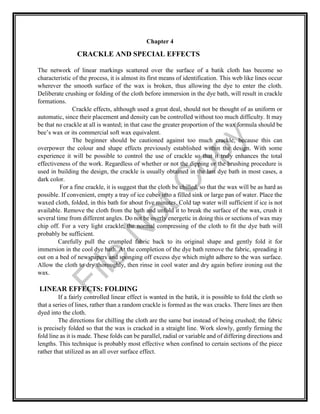
CRACKLE AND SPECIAL EFFECTS
The network of linear markings scattered over the surface of a batik cloth has become so
characteristic of the process, it is almost its first means of identification. This web like lines occur
wherever the smooth surface of the wax is broken, thus allowing the dye to enter the cloth.
Deliberate crushing or folding of the cloth before immersion in the dye bath, will result in crackle
formations.
Crackle effects, although used a great deal, should not be thought of as uniform or
automatic, since their placement and density can be controlled without too much difficulty. It may
be that no crackle at all is wanted; in that case the greater proportion of the wax formula should be
bee’s wax or its commercial soft wax equivalent.
The beginner should be cautioned against too much crackle, because this can
overpower the colour and shape effects previously established within the design. With some
experience it will be possible to control the use of crackle so that it truly enhances the total
effectiveness of the work. Regardless of whether or not the dipping or the brushing procedure is
used in building the design, the crackle is usually obtained in the last dye bath in most cases, a
dark color.
For a fine crackle, it is suggest that the cloth be chilled, so that the wax will be as hard as
possible. If convenient, empty a tray of ice cubes into a filled sink or large pan of water. Place the
waxed cloth, folded, in this bath for about five minutes. Cold tap water will sufficient if ice is not
available. Remove the cloth from the bath and unfold it to break the surface of the wax, crush it
several time from different angles. Do not be overly energetic in doing this or sections of wax may
chip off. For a very light crackle, the normal compressing of the cloth to fit the dye bath will
probably be sufficient.
Carefully pull the crumpled fabric back to its original shape and gently fold it for
immersion in the cool dye bath. At the completion of the dye bath remove the fabric, spreading it
out on a bed of newspapers and sponging off excess dye which might adhere to the wax surface.
Allow the cloth to dry thoroughly, then rinse in cool water and dry again before ironing out the
wax.
LINEAR EFFECTS: FOLDING
If a fairly controlled linear effect is wanted in the batik, it is possible to fold the cloth so
that a series of lines, rather than a random crackle is formed as the wax cracks. There lines are then
dyed into the cloth.
The directions for chilling the cloth are the same but instead of being crushed; the fabric
is precisely folded so that the wax is cracked in a straight line. Work slowly, gently firming the
fold line as it is made. These folds can be parallel, radial or variable and of differing directions and
lengths. This technique is probably most effective when confined to certain sections of the piece
rather that utilized as an all over surface effect.
File
N
otC
opy
LINEAR EFFECTS: DRAWING INTO THE WAX
Before the last dye bath, it is possible to actually draw of scratch linear marking into the wax,
which is then permanently dyed into the cloth. Here again, this is a technique best utilized in one
or two areas of the work.
The tool for this drawing or graffito can be improvised, as long as the marking point is smooth
and there is no danger of accidentally tearing the cloth. A section of 1/411 dowel rod, sharpened
to a point and lightly sanded, works very well, as do some brush- handle tips.File
N
otC
opy
Chapter 5
EXPERIMENT WITH DYE COLOURS
When you have learned the basics of the batik process, experiment on some scarp pieces
of fabric before attempting to get down to some serious work. Use different dye colours
and keep notes about the recipe used, the time the fabric is in the dye-bath, the maturing
time and your impression of the resultant colours, four colours over dyed without
washing out. This exercise is about making a picture of different coloured concentric
circles. The sequence shows what happens when you dye a series of colours without
washing out the wax between each dye colour. This idea is to try and have a white centre
(of course, there is no white dye: by white means the natural colour of the fabric).
However, this is more difficult than you may think, especially if you do not re-wax any
previously waxed areas.
For this exercise four dyes are used yellow, red, deep red, and navy blue but you can
use whatever colours you choose:
1. Prepare a square of white fabric and draw a circle with a piece of
charcoal. Fill the circle with wax, immerse the fabric in the yellow
dye-bath, then take it out and allow the fabric to dry.
2. Now draw in another circle on the yellow background, larger than
the first one. Apply a band of wax around but not over the original
circle, immerse the fabric in the red dye and then let it dry.
3. Wax a further ring on the resultant orange, then dye with a
deeper red and dry the fabric.
4. Finally wax yet another ring on the deeper red and deep blue to give
a purple colour on the background.
5. Wash, dry and iron the fabric to show the finished result. Note how the
‘white’ center has almost disappeared under all the cracking.
Two colors over dyed after washing out:
In this exercise the wax is washed out after each dye has been applied to the fabric. If you are
careful when you immerse the fabric in the dye-bath you should eliminate any cracking.
1) Draw a diagonal line across a square a fabric, carefully apply wax to one
half, making sure that you do not crack the wa, and then dye with red.
2) Wash out the wax with boiling water and allow drying. You now have a
square with one white triangle and one red triangle. Now draw another
diagonal line in the other direction and apply wax to one side (i.e. across
one half of each of the white and red triangle).
3) Carefully immerse the fabric in green dye.
4) Wash out the wax and allow the fabric to dry. The result is four different
coloured triangles from two dyes. The triangle that was wax prior to the
application of both dyes remains white; red over white gives red; green
File
N
otC
opy
over white gives green; green over red gives a sort of brown (in this
example the red was pinkish and the green bluish, hence not a true
brown 1).
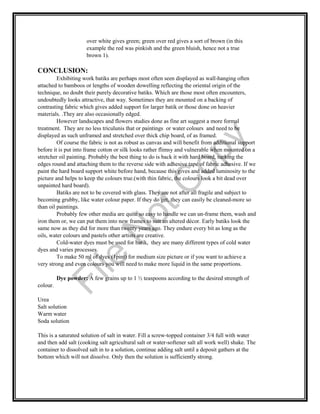
CONCLUSION:
Exhibiting work batiks are perhaps most often seen displayed as wall-hanging often
attached to bamboos or lengths of wooden dowelling reflecting the oriental origin of the
technique, no doubt their purely decorative batiks. Which are those most often encounters,
undoubtedly looks attractive, that way. Sometimes they are mounted on a backing of
contrasting fabric which gives added support for larger batik or those done on heavier
materials. .They are also occasionally edged.
However landscapes and flowers studies done as fine art suggest a more formal
treatment. They are no less triculunis that or paintings or water colours and need to be
displayed as such unframed and stretched over thick chip board, of as framed.
Of course the fabric is not as robust as canvas and will benefit from additional support
before it is put into frame cotton or silk looks rather flimsy and vulnerable when mounted on a
stretcher oil painting. Probably the best thing to do is back it with hard board, tucking the
edges round and attaching them to the reverse side with adhesive tape of fabric adhesive. If we
paint the hard board support white before hand, because this gives and added luminosity to the
picture and helps to keep the colours true.(with thin fabric, the colours look a bit dead over
unpainted hard board).
Batiks are not to be covered with glass. They are not after all fragile and subject to
becoming grubby, like water colour paper. If they do get, they can easily be cleaned-more so
than oil paintings.
Probably few other media are quite so easy to handle we can un-frame them, wash and
iron them or, we can put them into new frames to suit an altered décor. Early batiks look the
same now as they did for more than twenty years ago. They endure every bit as long as the
oils, water colours and pastels other artists are creative.
Cold-water dyes must be used for batik, they are many different types of cold water
dyes and varies processes.
To make 50 ml of dyes (1pint) for medium size picture or if you want to achieve a
very strong and even colours you will need to make more liquid in the same proportions.
Dye powder: A few grains up to 1 ½ teaspoons according to the desired strength of
colour.
Urea
Salt solution
Warm water
Soda solution
This is a saturated solution of salt in water. Fill a screw-topped container 3/4 full with water
and then add salt (cooking salt agricultural salt or water-softener salt all work well) shake. The
container to dissolved salt in to a solution, continue adding salt until a deposit gathers at the
bottom which will not dissolve. Only then the solution is sufficiently strong.
File
N
otC
opy
HEATING OF WAX:
As explained earlier batik is a resist technique, which means that under every drop or
line of hot wax we are retaining some colour, while working, one should be careful not to drop
any wax accidentally on the cloth as nothing helps to remove the spot completely.
1) Two parts of bee’s wax and part paraffin wax is mix in a vessel.
2) For different crackle effects, the proportion could be reversed to one part
bee’s wax and two parts paraffin wax adding a little resin. Resin is quite
useful for doing block printing batik as the wax has to be thin.
3) Always wash and iron material before waxing and dyeing yet adhering to
the colour.
4) Designs can be drawn or traced on cloth tightly with pencil or painted
with wax in free hand style.
5) Stretch the material tightly over a frame of the proper size, a small
quitting frame is good.
6) The temperature of the wax must be maintained at the degree base suited
to application.
7) Before starting wax is tested on a rough piece of cloth and hot wax to see
it is hot enough for use.
8) If the wax is too hot, it will run out of control, if too cool, it will pile
upon the fabric.
9) While applying wax, makes sure that you are not too slow with brush or
the wax.
10) If it is very hot, it will spread on the cloth. On the other hand do not be in
a hurry that you go dripping wax over cloth and around. Make sure that
the wax reaches both side of the material.
11) The dyes of wax should not be very thin. It should be thicker to insure
pure colours.
12) Cold wax in use will also give thick layer but it will not adhere to the
cloth properly and will peel off, so always make sure every time that wax
used is not enough.
Tips on application wax:
1) Do not let the wax smoke.
2) Application on very thin fabric is easier to control if the fabric is
lightly startched and ironed first.
3) Now apply wax with a brush to those areas only that are to retain
white or the base colour of the fabric. Different types of brushes
and blocks are used.
4) Waxes are as resistant the dyes.
5) Thoroughly wet out the fabric before dipping it into the dye.
6) After the first waxing the cloth will go in for a dye bath.
7) The dye pan must be large enough to receive the cloth satisfactory.
8) Be sure the dye is thoroughly dissolved, strained and evenly
distributed in the dye bath. The dye bath must be agitated before
adding the cloth.
File
N
otC
opy
9) The cloth is added to the bath and removed as soon as the proper
tint is acquired.
The dye takes best when the temperature is as warm as the wax will stand without
melting. However, a crack lies desired.
DYEING:
Making Base colour (for 1 meter of cloth)
(Brenthol or Naphthol process)
First dip:
1. In an enamel mug or a small pot, put 1 teaspoon of Turkey red
oil or monopol soap and add 5 gm, Brenthol base powder and
make it into a paste.
2. Add 1/2 a cup of water and mix it properly. See that no lumps
are formed.
3. Put the pot on a stove and bring it to boiling point.
4. Remove it from the stove and add 1 level teaspoon of caustic
soda in it and keep stirring till the solution becomes clear. If it
is still not clear then boil again till it is clear.
5. Dip the cloth in plain water so that it can absorb the base
solution properly and evenly mix the solution in a small bucket
or pot containing sufficient cold water for the cloth to be
immersed in. Dip your cloth in this solution first, open all the
folds in the cloth and stirr it.
Useful information about dyes:
1. Always keep a newspaper under the dye jars or bowls while
mixing them.
2. Never use a wet spoon. A clean dry spoon should be used for
each dye and chemical.
3. Remember to replace the lids, stoppers, corks, etc., on dyes and
chemical immediately after use. All chemical and dyes should
be kept air tight and in a cool place.
4. Always have a separate bowl or a separate bucket for each dye
and put the names on them.
5. Always use the same spoon measure throughout each recipe
like 1 level teaspoon.
6. Dye powder should always be turned into paste form, and then
dissolved in water.
File
N
otC
opy
7. Keep a few strips of the same cloth to test out the dyes on it.
Dyes work differently on cloths, so it better to try them out
first.
8. The colour scheme should be worked up from lighter colours to
the darkest shades.
9. Make sure that you use rubber gloves while dyeing. The colour
is difficult to remove from the hands. Besides, it is not
hygienic.
10. Always rinse your cloth after and before the dye baths. See that
while in the dye bath all folds are open and the cloth is soaked
properly.
11. After every dye bath rise the cloth till no more colour comes
off. All excess dye must be removed from it.
12. After the dyeing, the bolls and buckets in use must be washed.
Also wash the gloves and the spoons after use.
Useful Information about de-waxing:
1. Do not boil the cloth too long in the same water or the fabric
may reabsorb the loose dye and become muddy. Change the
water 2-3 times to remove the wax.
2. Do not use very strong detergents while boiling or the colours
will come out pale.
3. Another way of removing wax is to place several layers of
newspaper above and below the cloth and iron it. But to be
completely wax free, it is better to give the cloth a final wash in
very hot water.
4. Benzene and petrol will also do the trick except that it is quite a
dangerous and tedious method.
5. Do not boil silk for too long as boiling will delustre the silk.
Batik painting could be practiced and perfected by all interested in it as a pastime as
well as a profession.
This could be one’s media of self –expression if one is an artist. One could make wall
hangings, table lines, etc, with fascinating designs in batik. There are a lot of
possibilities in this methods but one has to explore and experiment to exploit it.
File
N
otC
opy
METHODOLOGY
THE BATIK PROCESS:
In batik, the colours are produced using cold water fabric dyes. However, you
cannot just paint dyes on to the fabric. They would run everywhere and you can never
get real colours or recognizable shaped. So you have to use a “resist process”. Hot
molten wax is used to resist or prevent the dye from going where is not wanted to
cover parts of the design with wax or draw around a particular shape in wax and then
apply dye the closed area.
When designing batik you have to plan your “painting” in reverse (much like the
negative of a photograph) because the areas that you actually print with wax are those
on which you do not want the colour to appear. You do not paint dark background,
you have to wax the background objects and allow the colour of the background to
build-up to a dark shade from the various dyes you apply.
Making a picture using the bath process relatively slow process you must allow a dye
for each application of colour. Good depth of colour can only be achieved by allowing
the dye to mature during a slow drying process. However, the rewards are well worth
the effort.
There is a bonus to this seemingly complicated process: the wax can be
cracked and the dye will penetrate through the cracks that when the wax is eventually
removed, fine cobwebby lines of colour are left. This gives batik its unique
characteristics colour. There is an art in the crack itself; the less movement of the cloth
during dyeing the less cracking you get.
This project deals with the study of the ratio of paraffin wax to bee’s wax in
the formation of cracks has been followed by the steps mentioned bellow:
1. Preparation of the cloth
2. Selection of the design
3. Wax preparation and application
4. Dye-bath preparation
5. Dyeing
6. De-waxing
7. Drying
1. Preparation of the cloth:
First of all, we know that batik is not suitable for synthetic fabrics as they do not hold
the naphthol dye which is mostly used for batik. Batik is generally done on natural
fiber fabrics i.e. cotton, silk, linen, poplin, muslin, voile etc. cotton is the best for batik
printing.
In this project, in order to study, both cotton and silk have been used
a) Cotton:
First of all, it is very important to remove the starch from the cotton fabric in order to
have better dye penetration. This process is called as desizing.
File
N
otC
opy
Desizing: for desizing, the fabric is deeped in cold water containing concentrated HCl.
For 100 gm of fabric, 0.5 ml of concentrated HCl is put in 2 lit. in this project, in order
to study 50 gms of fabric has been taken. Hence it was dipped in 1 lit of water
containing 0.025% HCl for 1 hour.
Samples of fabric measuring 5”x 5” were cut.
b) Silk:
Unlike cotton, silk fabric contain gum particles in it, so it has to undergo a process
called as degumming in order to remove gum from the surface of the silk fabric.
Degumming: For this, the fabric is dipped in water containing soap oil or Turkey red
oil. MLR = 1:20. For 100 gm of fabric,
MLR = 1:20
Therefore, water = 2000 ml
TRO = 1-2%
But for the studies done in this project, 50 gm of silk fabric has been taken. Therefore,
water = 1000 ml
TRO = 1%
Time = 1 hour
After the pre-treatments have been given, the fabric was dried properly and ironed.
2. Selection of design:
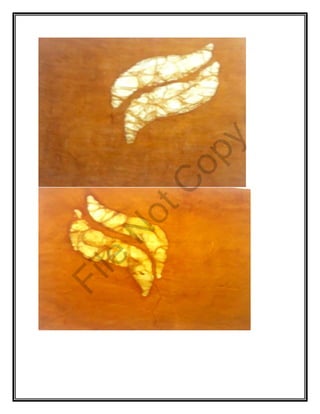
To study the formation of cracks with paraffin and bee’s wax, a bold design was
chosen throughout on the cotton and silk fabric. The sample size is 5” x 5” and the
design is as bellow:
3. Wax preparation and application:
There are various types of waxes available: bee’s wax, paraffin wax and a special
batik wax. Use of paraffin wax alone cracks too easily, use of bee’s wax alone gives
too stickiness and batik wax id the mixture of both.
In this project, batik wax has been used i.e. mixture of both paraffin wax and bee’s
wax.
To study the effect of cracks on the design by taking mixture of both paraffin and
bee’s wax.
This wax has been applied on both cotton and silk fabric having 5” x 5” samples of
design for producing the results.
For the application of wax, a newspaper was taken and spread over it to form a
platform for waxing the samples on the areas to be resisted with the help of brush.
File
N
otC
opy
4. Dye-bath preparation :
Naphthols dyes have been used for doing the batik. As we already know that for this
dye we require naphthol and a base as the process is divided into 2 parts i.e.
naphtholation and diazotization.
Naphtholation: While doing this project, for the formation of naphthol, we required.
AS-G Naphthol : 2 gm
TRO (for pasting) : 2 ml
Caustic Soda : 2 gm
Hot Water : 20 ml
Cold Water : 1 liter
For base:
Scarlet RC Base : 2 gm
Red B Base : 2 gm
Conc. HCl : 2 ml
Sodium Nitrate : 1 gm
Alum : 2 gm
Cold Water : 1 liter
5. Dyeing:
First of all, the samples after being waxed are impegrated in the water and kept it for
some time. Then the samples are taken out and immersed in naphtholated dyebath and
kept for 10 – 15 min in it.
Then they are taken out and immersed in the base solution for diazotization process. It
is seen that a beautiful red – orange is for on the designed fabric. The sample were
kept in it for another 10 min for colour formation. Continuous stirring is required to
avoid patches in the the dyed areas.
6. Dewaxing:
Dewaxing id done to remove the wax from the design after the dyeing is completed.
For dewaxing 2 lit of water was taken and boiled. Then 5 ml of soap oil was added to
it and 10 gm of soda ash is also added and boil further. Then the samples are
immersed in it and boiled to remove the wax. The complete wax from the fabric gets
melted and removed from the fabric. Then removed all the samples and wash it in cold
water.
Beautiful effects on all samples were observed having different effects due to the no.
of cracks formed on the surface of the design fabric.
7. Drying:
The samples were dried in the sun and then ironed.
File
N
otC
opy
BIBLIOGRAPHY
Sr. No. Name of the Book Auther
1 Batik printing
Code No. 173
Shree. K. Sundaraj, Ms. K. Lalithabai,
Ms. Jayalakshmi Damodaran, Shri.
Venkatesan
2 Batik Printing & Tie & Dye Nancy Belter
3 www.google.com
4 www.yahoo.com
5 Project record
File
N
otC
opy
SAMPALE
OF COTTON
AND SILK
File
N
otC
opy
File
N
otC
opy
File
N
otC
opy
File
N
otC
opy

batik printing shubhangi

  • 1.
    Created By –Rizwan Rajik Qureshi
  • 2.
    Project Report On “BATIK PRINTING” ADissertation Submitted to R.T.M Nagpur University In Partial Fulfilment of the Requirement For the Award of Degree of BACHELOR OF TEXTILE SCIENCE Submitted By Miss. Shubhangi M. Sahare ( Bachelor of Textile Science, III Year) Under the Guidance of Mrs. Snehal Rohadkar MAHALAXMI JAGDAMBA COLLAGE OF LIBRARY & INFORMATION SCIENCE RASHTRASANT TUKDOJI MAHARAJ NAGPUR UNIVERSITY, NAGPUR.2018-2019 File N otC opy
  • 3.
    CERTIFICATE This is Certifythat the dissertation entitled “BATIK PRINTING” Is a record of dissertation work Carried out by Miss. Shubhangi M. Sahare Submitted in the partial fulfilment of requirement For the degree of Bachelor of Textile Science Of R.T.M. Nagpur university. Mrs. Snehal Rohadkar Mrs. Janvi Nandanwar Mrs. Meghna Polkat Guide Principal Head of Department MAHALAXMI JAGDAMBA COLLAGE OF LIABRARY & INFORMATION SCIENCE RASHTRASANT TUKDOJI MAHARAJ NAGPUR UNIVERSITY NAGPUR. 2018-2019 File N otC opy
  • 4.
    Acknowledgement It was goldenopportunity for these project and each step is a learning process of one life. Each opportunity that we get adds something to our personality. I take this opportunity to express my profound gratitude towards every who helped me through the making of this project. To being with I must acknowledge the whole hearted support I received from Mrs. Snehal Rohadkar. I am also thankful to Principle Janvi Nandanwar Madam for their valuable guidance. Mahalaxmi Jagdamba Mahavidhylaya Nagpur. Finally I thank to all my friends and each and every member for their unfailing, valuable suggestion, support & assistance. Miss. Shubhangi M. Sahare B.T.S Final Year Mahalaxmi Jagdamba Mahavidhylaya Nagpur File N otC opy
  • 5.
    INTRODUCTION Batik is atechnique of wax-resist dyeing applied to whole cloth, or cloth made using this technique. Batik is made either by drawing dots and lines of the resist with a spouted tool called a canting also spelled or by printing the resist with a copper stamp called a cap. The applied wax resists dyes and therefore allows the artisan to colour selectively by soaking the cloth in one colour, removing the wax with boiling water, and repeating if multiple colors are desired. A tradition of making batik is found in various countries, including Indonesia, Malaysia, Singapore, India, Bangladesh, Sri Lanka, Philippines and Nigeria; the batik of Indonesia, however, is the best-known. Indonesian batik made in the island of Java has a long history of acculturation, with diverse patterns influenced by a variety of cultures, and is the most developed in terms of pattern, technique, and the quality of workmanship. In October 2009, UNESCO designated Indonesian batik as a Masterpiece of Oral and Intangible Heritage of Humanity. A special type of resist-dyeing technique is used for Batik printing. Under this technique, part of plain cloth are covered by wax retain their original color, thus creating beautiful designs. Cracks are developed in the wax by crumpling the cloth, leading to seepage of the dye into the area covered by wax. This is one of the distinguishing features of batik printing. The two main batik according to the type of resist used i.e. wax and starch can be best defined accordingly and the manner of its application. Batik is a wax resist fiber art. Hot wax is applied to fabric in a design. The wax serves as resist, preventing the dye from reaching the fabric where it was applied. This technique can be applied in layers with different colors. (A) Hot Wax Resist: Using hot liquid wax, lines shapes are drawn on to cloth with brushes, special tools or stamps. The wax penetrates the cloth forming a resist. The unwashed sections of the fabric are dyed; the sections of the fabric protected by the wax resist remain free of the dye. This process is known batik throughout Indonesia, India and the Orient. In traditional batik there is a characteristics network of the web like lines scattered over the surface of the cloth, due to the deliberate crushing of the fabric prior to the final dye bath. As traditional methods are simplified and adapted to present day interpretation many variations are possible. The fabric can be taken through several overlapping applications of wax and dyes, the increasing the complexity of the design or the work can be completed with a single application of wax and dye, as in silk paintings, eliminating a final crackle producing dye bath. File N otC opy
  • 6.
    (B) Starch pasteresists: Historically, the use of waters soluble flour pastes which are applied to cloth in different ways is well known throughout Asia and parts of Africa. In Nigeria the term 'admire elect’ refers to the indigo dyed decorative fabrics made with cassava-flour paste applied with cut blocks and stencils. Other variations include applying the design by scrapping through with a comb or similar tool. In the first part of this project i.e., the review of literature chapter no 1 history of batik has been explained. In the next chapter i.e. chapter No. 2 tools and equipment’s has been given which include the basic equipment’s for dyeing, tools and brushes, Tjanting blocks, candles materials used in batik etc. Further in the 3rd chapter, an explanation about the dyes and chemicals used in batik printing has been given, basically they are naphtha dyes, their applications, exhaustions of dye bath, preparations of solutions, de-waxing and diazotization and soaping etc. Also about vat coolers, reactive dyes, method of dyeing solubilized vat dyes developing etc. has been explained in this project. In the chapter 4 experimenting with the dye colours,has been given, its effects produced, its conclusion, then trips on application of wax, also useful information about dyes has been noticed. In the other part of this project i.e. methodology, a complete study of the project has been discussed. What had been done, its effects and conclusion have been noted. File N otC opy
  • 7.
    AIM AND OBJECTIVE AIM: The basic aim of this project is to study the importance of the ratio of paraffin wax to bee's wax in the formation of cracks in batiks.  Paraffin wax in batik is responsible for the formation of the cracks whereas bee's wax is responsible for the stickiness i.e. the ability to stick on the fabric  If only bee's wax is used hardly any cracks will form hence killing the beauty of the batik. That’s why paraffin wax with bees wax is accompanied.  To find out the correct ratio of the two waxes in order to get the perfect results.  To study the effect using cotton and silk material. OBJECTIVE:  To study the roles of paraffin wax in resist.  Also the study of bee’s wax in resist.  To improve weathering properties and durability.  To provide colour  To develop newer design as per the market requirement. File N otC opy
  • 8.
  • 9.
    Chapter 1 HISTORY OFBATIK Evidence of early example of batik has been found in the Far East, Middle East, Central Asia and India from over 2000 years ago. The batik is originally a Japanese term, denoting a kind of resist technique for producing design on fabric. The word batik is Indonesian in origin but the concept itself was probably first derived either by the Egyptians or according to other scholars on the Indian archipelago. It is known that liquid or paste starch resists preceded the use of wax. In the 4th century B.C. the Greeks invaded India and returned with many textiles. This indicated an already well-established tradition in weaving, as well as cloth painting and dyeing. The images were geometric or highly stylized arrangements of flowers, fruits, birds and animals. The craftsmanship was the highest quality. With increasing migration of people and expanding trade routes, knowledge of wax-resist dyeing spread throughout Asia. About 300 or 400 A.D. Indian traders and merchants introduced in their own unique manner to the very high degree of excellence so admired today . Since the textile arts were of great importance to these people, the batiks of Indonesia give us an unusually complete and unbroken tradition that can be traced for centuries. The volcanic island of java, where the batik art was perfected, was invited by Hindu tribes from India who remained and were powerful rulers for 1300 years. During the medial period, Arabs came, also by way of India, introducing the Muslim religion. The Sultans of their empires were supreme rulers with elaborate palaces and numerous court attendants; they lived story books lives of richness and splendor. The usual preference for finery throughout for Asia is for silk and the Javanese, because of their ancient batik tradition, favored cotton. Cotton was easy to grow and in a tropical climate a comfortable fabric to wear. Batik decoration was used only on garments, rather than ceremonial cloths or decorative hangings. At one time a Sultan dared that batik making was a 'Royal Art' to be practiced only by the women of the court. This ruling of course, could not be enforced for long; the craft was too deeply in ingrain among the people but it serves as evidence of the value and high regard giving those garments. For centuries the native villages with a precision and concern for detail, we marvel at today practiced batik. Time was on importance that employed infinite patience, working, reworking motifs handed down from one generation to another. The women were responsible for the design and the waxing, the men for the dyeing and finishing. The ingrained superstitions of many centuries played their part the ritual of batik work. These skills were thought of as benevolent gifts from the spirits of that were blessed. Offering of incense, rice and flowers were prepared to win the favor of the spirits. While the waxing demanded great skills, the dyeing procedures were extremely complicated and time consuming a slight error in mixing could prove ruinous. If the colour was faulty, the evil spirits were surely at work. File N otC opy
  • 10.
    All the traditionalpatterns had whimsical names - "a carefree life" or”moonshine charm” - Which assist in identification. Certain patterns were reserved exclusively for the family of the sultan and his highest ranking officers. There were boned for use on other garments. The workmanship and dye coloration had to be perfect; this meant no sign of wax crackle for any break in the wax meant faulty handling. Batik with such "defects" had to be destroyed so that the evil spirits could not molest the ruler. Some aspects of batik making changed when the 'tjap' or copper hand stamp, came into use in java about 100 years ago. It had been known in other areas for centuries. After the stamp is dipped into a bed of molten wax, the design motif is imprinted onto the cloth. The principle is that of block printing with the hot wax taking the place of the ink. The stamp was made by inserting the edges of thin strips of Copper into a wood base, conforming to a preplanned design. A second stamp was made of the reverse of each motif for printing on the back of the cloth. This device has obviously made it possible for batik to be completed in far less time than the taunting methods requires. The stamp which is so greatly speeded up the process, marked the beginning of the movement to change batik making from a folk craft or “cottage industry " kind of activity to the small factory type of production that is prevalent today. There are several thousand of these factories in java today. With some exceptions, aniline dyes have almost completely supplemented natural colorants. The last generation has seen many changes in the social structure, which have added to the breaking down of the handcraft traditions that existed unchanged for so many centuries. File N otC opy
  • 11.
    Chapter 2 TOOLS ANDEQUIPMENTS BASIC EQUIPMENT: For Waxing 1. An electric heater. Stove or a gas ring stove. 2. A saucepan or pot to heat wax (aluminum or enamel) preferably with a handle. 3. After table surface covered with newspapers or pieces of plywood or hand board. Do all your waxing on this table. 4. A sheet of asbestos to keep under this stove for safety measures. 5. Candles or blocks of paraffin wax. 6. Resin and bees wax. 7. A wooden frame to pin the cloth to do this waxing. 8. Tools likes brushes and blocks to do printing and painting. EQUIPMENT FOR DYEING: 1. Plastic or enamel bowls, buckets or bath. 2. Plastic or glass measures. 3. Rubber gloves. 4. Rubber or plastic sheet. 5. Plastic spoons of various sizes. 6. Newspaper to cover working surface. 7. Small bowls or pots to mix dyes. TOOLS AND BRUSHES: The most commonly used tools are brushes of various width and sizes. The wedge shaped brush will also cover large areas, but advantage here is that it can also give fine lines. The small round brush is mainly for doing all the fine linear work, mostly used for very fine linear pattern where the use of a thinker brush may not be so good as the wax may spread. DEY BRUSHING the word dry brushing expresses the very technique of applying the wax on the cloth. One van get some level textures by this method. As the word suggests the brush should be free of excess wax. Before applying the brush to the cloth, squeeze out the extra wax on a piece of newspaper or a rough piece of cloth. (Do not make it completely dry). File N otC opy
  • 12.
    Now apply onthe cloth with a gentle hand. There are two different ways of dry brushing 1. The dab method 2. The cut out paper shape method Flat brush strokes are used for this cut out shapes to give soft feathery effect while the dabs method is used for breaking up larger areas. Brush can be twisted and in turn every way to get all sorts of brushing. The only way to understand the possibilities is to experiment. Dry brushing could be particularly good for painting landscapes or where shading is required. It is useful for those who want to use batik as a medium for painting. BLOCKS: These can be made out of a verity of things like nail heads , bolts and nuts , stick on a piece of cork or wood , linocut or wood blocks carved etc. For block printing it is always better to have a shallow and broader pan for the wax. When the wax is quit hot, dip the block in the wax, process the block to the cloth surface while the wax is still hot. Be careful not to drip any wax on the cloth. Also take note that the wax should not to drip any wax on the cloth. Also take note that the wax should not dry off on the block or you will get very patchy prints. To avoid this every time you use the block, let this remain for half the minute or so in the hot wax so that the dry wax melts. MATERIALS USED IN BATIK PRINTING: Most of the equipment needed to produce a batik, will already be available in the home or readily available from local suppliers. As you can see from the equipment given bellow.  Old post and kettles - for melting the wax and for boiling water for washing the batik.  A portable cooker.  Jugs and large spoon for measuring and mixing in the dyes.  Wax -use plain paraffin wax. (The shown here is recycled wax taken from the top of a bucket after a batik has been washed in hot water).  Plastic screw - topped consisted for the storage of soda and salt solutions - for making up the dye bath.  Plastic measuring spoons for the dye powders.  Plastic or galvanized steel buckets (washing out).  Rubber gloves - dyeing can be a messy business you wear old cloth when working on a batik  Bleach rectifying mistakes in dyeing and for making high light (must be used with carry). File N otC opy
  • 13.
     Urea (awhite odorless powder) - used to help the dye powder to mix correctly.  Screw - topped jars for the storage of dye powder.  A selection of brushes - some for applying the wax to the fabric and some for brushing on the dye.  Notebook - you record all recipes used for each stage of dyeing and make reference to the quality / hue of colour obtained.  Tape measure for sizing your fabric.  Tannings - the traditional oriental instruments for applying hot wax was very good for fine line work.  Fabric for the batik. Fine white cotton - batik on to silk or any other natural fiber.  Sticks of the charcoal for drawing out your design (use blackboard chalk for darker materials) accessories for cutting out the fabric. File N otC opy
  • 14.
    Chapter 3 DYES ANDCHEMICALS USE IN BATIK PRINTING COLOURS: The colors / Dyestuffs which are capable of applied from a cold dye bath only are suitable since hot dyeing hot dyeing dyestuffs would remove the wax resist. Dyes and chemicals used in batik printing are as follows: 1) Naphthol or Azoic Dyestuff 2) Cold dyeing vat dyes tuffs 3) Cold dyeing reactive dyestuff 4) Solubilized vat dyestuff NAPHTHOL OR AZOIC DYESTUFFS: These dyestuffs are mostly used for batik work as the naphtholated fabric can be waxed and cracked and then developed with a diazotized solution of a base. They produce deep shades of high fastness and remarkable brilliancy. Although a large number of combinations of naphtha and bases are available, the more substantive naphthols are mainly used as they give satisfactory rubbing fastness. The naphthol solutions can be applied by brushing it on to the cloth. Nylon brushes are used for these purposes as brushes with natural bristles are used for these purpose as brushes cloth natural bristles are attacked by caustic soda present in the naphthol solution. TRADE NAMES OF AZOIC COOLERS: Azoic or Naphthol colors are manufactured by different companies. M/s. Atul product Ltd.Atul M/s. Indian Dyestuff industries Ltd Bombay is marketing their naphthol. Tulathol / Indothol Tulabase / Fast base 1. As 1. Yellow GC 2. As-G 2. Orange GC 3. As-D 3. Orange GR 4. As-BO 4. Scarlet GGS 5. As-SW 5. Scarlet RC 6. As-TR 6. Red RC 7. As-SG 7. Red Kb 8. As-Bt 8. Red B 9. As-BC 9. Bordeaux GP APPLICATION OF NAPHTHOLS: Naphthols are insoluble in water and can be made into soluble using caustic soda, the dyeing process consist essentially the following 4 stages. 1. Impregnation of cloth with selected naphthol 2. Draining of the excess naphthol. File N otC opy
  • 15.
    3. Development withthe dissolved selected base 4. De-waxing & soaping EXHAUST METHOD OF DYEING: In the exhaust method both naphthols and base may be applied in the usual way pressure is applied more crack effect is obtained the material to liquor ratio is 1: 20 the duration of naphtholation time is 20 minutes. The required quantity of naphthol and base are calculated calculations are based on the volume of water taken for naphtholating or developing bath in grm / lit. PREPARATION OF NAPHTHOL SOLUTION FOR IMPREGNATION : The required amount of naphthol is calculated based on the volume of water taken in the bath and made in to paste with the required amount of wetting agent like turkey red oil. The required amount of boiling water is then added to the paste. The mixture is well stirred and boiled again with required caustic soda solution added to this mixture and boiling is continued to get a clear solution. Then the solution is diluted to the required volume with water containing necessary quantity of caustic soda and Turkey Red oil. The material is dipped with the naphthol bath and worked for 20 minutes. The required quantity of common salt is added to this bath and the material is worked for further 10 minutes squeezed. The quantity of various chemicals to be used for dissolving different naphthols is given below. Chemicals required for dissolving 10 gm naphthol : chemical AS-G AS- TR AS- BO AS-S AS- SR AS- SW AS - BS AS- BT Turkey red oil (cc) 10 10 10 10 10 10 10 Caustic soda (gm) 5 7 10 3.8 16 6 7 Water (cc) 330 800 500 400 800 400 400 File N otC opy
  • 16.
    SALT ADDITION FORNAPHTHOLS : AS-G 15 gm/lit AS.AS-D.AS.BO AS-TR.AS-BT 20gm/lit AS-BS AS-SW 10gm/lit AS-SG.AS-SR No salt solution DIAZOTIZATION OF BASES FOR DEVELOPING: The bases are insoluble substances. They have to be diazotized (i.e.) treated with sodium nitrite and hydrochloric acid. By this treatment they are generally solubilized and can be coupled with naphthol to produce the desired shade. Sodium acetic acid and common salt are added. The material thus naphtholated by, the exhaust method is worked in the developing bath for 20 to 30 minutes, rinsed well, soaped and washed chemicals required for diazotization of different base are as below. File N otC opy
  • 17.
    Chemicals required forDiazotizing 10 gm base: Base Qty. of water Acid Hydro- chloric Sodium Nitrate Sodiu m Acetate Acetic Acid dye-bath Commo n salt Yellow GC Base 200 cc 12 cc 5 gm 9 gm 6.5 cc 20 gm/lit Orange GC Base 300 cc (hot) 12 cc 5 gm 9 gm 6.5 cc 25 gm/lit Red KB Base 430 cc (hot) 10 cc 4 gm 7.5 gm 5.5 cc 25 gm/lit RWS RC Base 250 cc (hot) 10 cc 4 gm 7.5 gm - 25 gm/lit Scarlet GGS Base 200 cc (hot) 36 cc 5.5 gm 37.5 gm - 25 gm/lit Orange GR Base 300 cc (hot) 22 cc 5.5 gm 10 gm 7 cc 20 gm/lit Red B Base 300 cc (hot) 17 cc 5 gm 8.5 gm 6 cc - Scarlet R Base 220 cc (hot) 17 cc 4.5 gm 8.5 gm 6 cc 25 gm/lit Bordea ux GP Base 300 cc (hot) 18 cc 5 gm 8.5 gm 6 cc 25 gm/lit File N otC opy
  • 18.
    DE-WAXING AND SOAPING: After dyeing it is necessary to remove the wax content from the material the wax removed by treating the material in boiling water and then water containing with 2.3 gm. / hot soda ash at boil for 5 min. further material is soaped in a bath containing 5 gm / lit soap at boil for 10 min and thoroughly washed with water by doing so the material, gets brightness. COLD DYEING VAT DYESTUFFS : Vat colours are largely used in hot method. But certain colours are applied in cold methods and these colours can be dyed for Batik style without melting the wax portions. Vat colours are insoluble in water and can be brought into soluble condition by reducing with sodium hydrosulphite in presence of caustic soda. The colours in dyeing are used on the basis of percentage of the weight of material. METHOD OF DISSOLVING VAT COLOURS: Weigh the wax applied material. The requirement of dyestuffs is calculated on percentage on the weight of material. If we want to dye 2% of any shades means for 100 gm weight of material 2 gm of dyestuff is required. Take the dyestuff in a dye-pot, and add equal quantity of turkey-red oil, paste well. Add hot water at 500° C add 2 times of caustic soda on the weight of material stirr well. Add 2 times of sodium hydrosulphite on the weight of material, stirr well and keep it for 10 minutes for well dissolving. The dissolved dyestuff is transferred into the dye-bath already set with 30 times of water on the weight of material at 25°C - 30°C added with 1.5 gm/lit caustic soda and 1.5 - 2 gm/lit sodium hydrosulphite. The wax applied melted material is entered into the dye-bath and worked for 15 - 20 min with occasional stirring. The material is then removed and aired for 15 - 20 min and washed well. Lastly the material is de-waxed and soaped in hot water as in the case of Naphthol that colours referred above. REACTIVE DYES: Reactive Dyes are applied on cotton material both in cold and hot method, cold colours reactive dyes are available in the market in specific trade name which can be applied in cold method. These colours form an unique class by themselves. As they form a true chemical linkage with the fiber. These dyestuffs combine in them the simplicity of application and the brightness of shade only surpassed by basic colours. These dyes have good fastness to, light and washing. They are superior to Naphthol colours in respect of rubbing fastness. Their fastness to chlorine is generally poor. However there are some dyes which possess good fastness to chlorine. Colours File N otC opy
  • 19.
    such as DeepTurquoise and Deep magenta which are difficult to produce from vat and naphthol colours can be produced using these reactive colours. A number of bright shades can be produced with these dyes by using dip-dyeing techniques or by brush dyeing locally over the waxed areas. METHOD OF DYEING: Weigh the wax coated material, suppose if the wax of material is 500gm, prepare the dye- bath as follows. The material liquor ratio is 1:20, 250 gm urea is dissolved in 3000 cc of boiling water, 25 gm of reactive cold brand dye is added and stirred, 5725 cc of cold water is added to make volume up to 9000 cc quantity. The wax coated wetted material is entered into the dye bath and worked for 15-20 min.Then the alkaline solution is prepared as follows: 100 gm sodium carbonate (soda ash) and 900 gm cold water are mixed well. The material is lifted up and the alkaline solution is added to the dye bath and the material is entered and worked in the same cold bath for further one hour. The material is removed and de-waxed and soaped in hot water as in the case of Naphthol colours as referred in previous. SOLUBILIZED VAT DYES: This group of colours is called by another name as “Indigo sol” solubilised vat dyes are water soluble derivatives of vat dyes. These are eminently suited for batik work and they give very fast shades. They can be applied in cold to cotton, silk, rayon or woolen materials. The disadvantages of this group is only cost factor. Since the cost of dye is so high that it is advised to use pale to medium shades. APPLICATION OF SOLUBLE VAT COLOURS: The actual dyeing process is carried out up to 35 stages viz. 1. Application of the dyestuff in Neutral or weakly alkaline solution to the fiber in presence of glaubur’s salt. 2. Development of the dyestuff on the fiber with the aid of acid and oxidizing agent (i.e.) with sodium Nitrite and sulphuric Acid. 3. After treatment of the dyed material with 2-5 gm/lit soda ash solution. File N otC opy
  • 20.
    METHOD OF DYEING: Weightthe wax applied material suppose if the wt of material is 500 gm prepare the dye bath as follows: Material liquor ratio is 1:20 soluble vat colors 5 gm (1%) Boiling water 500cc, and dissolved. Transfer the dye solution to the dye ball containing 9.5 lit cold water enter the material and work for 10 min. add 200 gm glaubur’s sail into the dye bath and work for 15 min. add 50 grams sodium nitrite into the bath and work for another 10 min. The excess water can be removed. DEVELOPING : Develop the dyed material in a bath containing 20 cc/lit sulphuric acid for 2-3 min. remove the material and after treat the same in a bath containing 2-5 grams soda ash. DE-WAXING & SOAPING : The material is treated in the boiling water to remove the wax. Then add 2-3 gm. Of soda ash and boil further to remove the remaining wax. Finally the material is soaped in a bath containing 5 gm/lit soap at boil for 10 min and thoroughly washed with water and dried. CONCLUSION : It would be seen from the above that beautiful crack effect and multi color prints could be obtained by batik style using different classes of dyes like naphthol. Vat reactive and solubilised vat colors. Others cannot copy the monopoly of the batik style of printing work. A skill Batik worker leaving artistic knowledge can create an excellent product for which the sales value is not the criteria in case of wall hangings. File N otC opy
  • 21.
    Chapter 4 CRACKLE ANDSPECIAL EFFECTS The network of linear markings scattered over the surface of a batik cloth has become so characteristic of the process, it is almost its first means of identification. This web like lines occur wherever the smooth surface of the wax is broken, thus allowing the dye to enter the cloth. Deliberate crushing or folding of the cloth before immersion in the dye bath, will result in crackle formations. Crackle effects, although used a great deal, should not be thought of as uniform or automatic, since their placement and density can be controlled without too much difficulty. It may be that no crackle at all is wanted; in that case the greater proportion of the wax formula should be bee’s wax or its commercial soft wax equivalent. The beginner should be cautioned against too much crackle, because this can overpower the colour and shape effects previously established within the design. With some experience it will be possible to control the use of crackle so that it truly enhances the total effectiveness of the work. Regardless of whether or not the dipping or the brushing procedure is used in building the design, the crackle is usually obtained in the last dye bath in most cases, a dark color. For a fine crackle, it is suggest that the cloth be chilled, so that the wax will be as hard as possible. If convenient, empty a tray of ice cubes into a filled sink or large pan of water. Place the waxed cloth, folded, in this bath for about five minutes. Cold tap water will sufficient if ice is not available. Remove the cloth from the bath and unfold it to break the surface of the wax, crush it several time from different angles. Do not be overly energetic in doing this or sections of wax may chip off. For a very light crackle, the normal compressing of the cloth to fit the dye bath will probably be sufficient. Carefully pull the crumpled fabric back to its original shape and gently fold it for immersion in the cool dye bath. At the completion of the dye bath remove the fabric, spreading it out on a bed of newspapers and sponging off excess dye which might adhere to the wax surface. Allow the cloth to dry thoroughly, then rinse in cool water and dry again before ironing out the wax. LINEAR EFFECTS: FOLDING If a fairly controlled linear effect is wanted in the batik, it is possible to fold the cloth so that a series of lines, rather than a random crackle is formed as the wax cracks. There lines are then dyed into the cloth. The directions for chilling the cloth are the same but instead of being crushed; the fabric is precisely folded so that the wax is cracked in a straight line. Work slowly, gently firming the fold line as it is made. These folds can be parallel, radial or variable and of differing directions and lengths. This technique is probably most effective when confined to certain sections of the piece rather that utilized as an all over surface effect. File N otC opy
  • 22.
    LINEAR EFFECTS: DRAWINGINTO THE WAX Before the last dye bath, it is possible to actually draw of scratch linear marking into the wax, which is then permanently dyed into the cloth. Here again, this is a technique best utilized in one or two areas of the work. The tool for this drawing or graffito can be improvised, as long as the marking point is smooth and there is no danger of accidentally tearing the cloth. A section of 1/411 dowel rod, sharpened to a point and lightly sanded, works very well, as do some brush- handle tips.File N otC opy
  • 23.
    Chapter 5 EXPERIMENT WITHDYE COLOURS When you have learned the basics of the batik process, experiment on some scarp pieces of fabric before attempting to get down to some serious work. Use different dye colours and keep notes about the recipe used, the time the fabric is in the dye-bath, the maturing time and your impression of the resultant colours, four colours over dyed without washing out. This exercise is about making a picture of different coloured concentric circles. The sequence shows what happens when you dye a series of colours without washing out the wax between each dye colour. This idea is to try and have a white centre (of course, there is no white dye: by white means the natural colour of the fabric). However, this is more difficult than you may think, especially if you do not re-wax any previously waxed areas. For this exercise four dyes are used yellow, red, deep red, and navy blue but you can use whatever colours you choose: 1. Prepare a square of white fabric and draw a circle with a piece of charcoal. Fill the circle with wax, immerse the fabric in the yellow dye-bath, then take it out and allow the fabric to dry. 2. Now draw in another circle on the yellow background, larger than the first one. Apply a band of wax around but not over the original circle, immerse the fabric in the red dye and then let it dry. 3. Wax a further ring on the resultant orange, then dye with a deeper red and dry the fabric. 4. Finally wax yet another ring on the deeper red and deep blue to give a purple colour on the background. 5. Wash, dry and iron the fabric to show the finished result. Note how the ‘white’ center has almost disappeared under all the cracking. Two colors over dyed after washing out: In this exercise the wax is washed out after each dye has been applied to the fabric. If you are careful when you immerse the fabric in the dye-bath you should eliminate any cracking. 1) Draw a diagonal line across a square a fabric, carefully apply wax to one half, making sure that you do not crack the wa, and then dye with red. 2) Wash out the wax with boiling water and allow drying. You now have a square with one white triangle and one red triangle. Now draw another diagonal line in the other direction and apply wax to one side (i.e. across one half of each of the white and red triangle). 3) Carefully immerse the fabric in green dye. 4) Wash out the wax and allow the fabric to dry. The result is four different coloured triangles from two dyes. The triangle that was wax prior to the application of both dyes remains white; red over white gives red; green File N otC opy
  • 24.
    over white givesgreen; green over red gives a sort of brown (in this example the red was pinkish and the green bluish, hence not a true brown 1). CONCLUSION: Exhibiting work batiks are perhaps most often seen displayed as wall-hanging often attached to bamboos or lengths of wooden dowelling reflecting the oriental origin of the technique, no doubt their purely decorative batiks. Which are those most often encounters, undoubtedly looks attractive, that way. Sometimes they are mounted on a backing of contrasting fabric which gives added support for larger batik or those done on heavier materials. .They are also occasionally edged. However landscapes and flowers studies done as fine art suggest a more formal treatment. They are no less triculunis that or paintings or water colours and need to be displayed as such unframed and stretched over thick chip board, of as framed. Of course the fabric is not as robust as canvas and will benefit from additional support before it is put into frame cotton or silk looks rather flimsy and vulnerable when mounted on a stretcher oil painting. Probably the best thing to do is back it with hard board, tucking the edges round and attaching them to the reverse side with adhesive tape of fabric adhesive. If we paint the hard board support white before hand, because this gives and added luminosity to the picture and helps to keep the colours true.(with thin fabric, the colours look a bit dead over unpainted hard board). Batiks are not to be covered with glass. They are not after all fragile and subject to becoming grubby, like water colour paper. If they do get, they can easily be cleaned-more so than oil paintings. Probably few other media are quite so easy to handle we can un-frame them, wash and iron them or, we can put them into new frames to suit an altered décor. Early batiks look the same now as they did for more than twenty years ago. They endure every bit as long as the oils, water colours and pastels other artists are creative. Cold-water dyes must be used for batik, they are many different types of cold water dyes and varies processes. To make 50 ml of dyes (1pint) for medium size picture or if you want to achieve a very strong and even colours you will need to make more liquid in the same proportions. Dye powder: A few grains up to 1 ½ teaspoons according to the desired strength of colour. Urea Salt solution Warm water Soda solution This is a saturated solution of salt in water. Fill a screw-topped container 3/4 full with water and then add salt (cooking salt agricultural salt or water-softener salt all work well) shake. The container to dissolved salt in to a solution, continue adding salt until a deposit gathers at the bottom which will not dissolve. Only then the solution is sufficiently strong. File N otC opy
  • 25.
    HEATING OF WAX: Asexplained earlier batik is a resist technique, which means that under every drop or line of hot wax we are retaining some colour, while working, one should be careful not to drop any wax accidentally on the cloth as nothing helps to remove the spot completely. 1) Two parts of bee’s wax and part paraffin wax is mix in a vessel. 2) For different crackle effects, the proportion could be reversed to one part bee’s wax and two parts paraffin wax adding a little resin. Resin is quite useful for doing block printing batik as the wax has to be thin. 3) Always wash and iron material before waxing and dyeing yet adhering to the colour. 4) Designs can be drawn or traced on cloth tightly with pencil or painted with wax in free hand style. 5) Stretch the material tightly over a frame of the proper size, a small quitting frame is good. 6) The temperature of the wax must be maintained at the degree base suited to application. 7) Before starting wax is tested on a rough piece of cloth and hot wax to see it is hot enough for use. 8) If the wax is too hot, it will run out of control, if too cool, it will pile upon the fabric. 9) While applying wax, makes sure that you are not too slow with brush or the wax. 10) If it is very hot, it will spread on the cloth. On the other hand do not be in a hurry that you go dripping wax over cloth and around. Make sure that the wax reaches both side of the material. 11) The dyes of wax should not be very thin. It should be thicker to insure pure colours. 12) Cold wax in use will also give thick layer but it will not adhere to the cloth properly and will peel off, so always make sure every time that wax used is not enough. Tips on application wax: 1) Do not let the wax smoke. 2) Application on very thin fabric is easier to control if the fabric is lightly startched and ironed first. 3) Now apply wax with a brush to those areas only that are to retain white or the base colour of the fabric. Different types of brushes and blocks are used. 4) Waxes are as resistant the dyes. 5) Thoroughly wet out the fabric before dipping it into the dye. 6) After the first waxing the cloth will go in for a dye bath. 7) The dye pan must be large enough to receive the cloth satisfactory. 8) Be sure the dye is thoroughly dissolved, strained and evenly distributed in the dye bath. The dye bath must be agitated before adding the cloth. File N otC opy
  • 26.
    9) The clothis added to the bath and removed as soon as the proper tint is acquired. The dye takes best when the temperature is as warm as the wax will stand without melting. However, a crack lies desired. DYEING: Making Base colour (for 1 meter of cloth) (Brenthol or Naphthol process) First dip: 1. In an enamel mug or a small pot, put 1 teaspoon of Turkey red oil or monopol soap and add 5 gm, Brenthol base powder and make it into a paste. 2. Add 1/2 a cup of water and mix it properly. See that no lumps are formed. 3. Put the pot on a stove and bring it to boiling point. 4. Remove it from the stove and add 1 level teaspoon of caustic soda in it and keep stirring till the solution becomes clear. If it is still not clear then boil again till it is clear. 5. Dip the cloth in plain water so that it can absorb the base solution properly and evenly mix the solution in a small bucket or pot containing sufficient cold water for the cloth to be immersed in. Dip your cloth in this solution first, open all the folds in the cloth and stirr it. Useful information about dyes: 1. Always keep a newspaper under the dye jars or bowls while mixing them. 2. Never use a wet spoon. A clean dry spoon should be used for each dye and chemical. 3. Remember to replace the lids, stoppers, corks, etc., on dyes and chemical immediately after use. All chemical and dyes should be kept air tight and in a cool place. 4. Always have a separate bowl or a separate bucket for each dye and put the names on them. 5. Always use the same spoon measure throughout each recipe like 1 level teaspoon. 6. Dye powder should always be turned into paste form, and then dissolved in water. File N otC opy
  • 27.
    7. Keep afew strips of the same cloth to test out the dyes on it. Dyes work differently on cloths, so it better to try them out first. 8. The colour scheme should be worked up from lighter colours to the darkest shades. 9. Make sure that you use rubber gloves while dyeing. The colour is difficult to remove from the hands. Besides, it is not hygienic. 10. Always rinse your cloth after and before the dye baths. See that while in the dye bath all folds are open and the cloth is soaked properly. 11. After every dye bath rise the cloth till no more colour comes off. All excess dye must be removed from it. 12. After the dyeing, the bolls and buckets in use must be washed. Also wash the gloves and the spoons after use. Useful Information about de-waxing: 1. Do not boil the cloth too long in the same water or the fabric may reabsorb the loose dye and become muddy. Change the water 2-3 times to remove the wax. 2. Do not use very strong detergents while boiling or the colours will come out pale. 3. Another way of removing wax is to place several layers of newspaper above and below the cloth and iron it. But to be completely wax free, it is better to give the cloth a final wash in very hot water. 4. Benzene and petrol will also do the trick except that it is quite a dangerous and tedious method. 5. Do not boil silk for too long as boiling will delustre the silk. Batik painting could be practiced and perfected by all interested in it as a pastime as well as a profession. This could be one’s media of self –expression if one is an artist. One could make wall hangings, table lines, etc, with fascinating designs in batik. There are a lot of possibilities in this methods but one has to explore and experiment to exploit it. File N otC opy
  • 28.
    METHODOLOGY THE BATIK PROCESS: Inbatik, the colours are produced using cold water fabric dyes. However, you cannot just paint dyes on to the fabric. They would run everywhere and you can never get real colours or recognizable shaped. So you have to use a “resist process”. Hot molten wax is used to resist or prevent the dye from going where is not wanted to cover parts of the design with wax or draw around a particular shape in wax and then apply dye the closed area. When designing batik you have to plan your “painting” in reverse (much like the negative of a photograph) because the areas that you actually print with wax are those on which you do not want the colour to appear. You do not paint dark background, you have to wax the background objects and allow the colour of the background to build-up to a dark shade from the various dyes you apply. Making a picture using the bath process relatively slow process you must allow a dye for each application of colour. Good depth of colour can only be achieved by allowing the dye to mature during a slow drying process. However, the rewards are well worth the effort. There is a bonus to this seemingly complicated process: the wax can be cracked and the dye will penetrate through the cracks that when the wax is eventually removed, fine cobwebby lines of colour are left. This gives batik its unique characteristics colour. There is an art in the crack itself; the less movement of the cloth during dyeing the less cracking you get. This project deals with the study of the ratio of paraffin wax to bee’s wax in the formation of cracks has been followed by the steps mentioned bellow: 1. Preparation of the cloth 2. Selection of the design 3. Wax preparation and application 4. Dye-bath preparation 5. Dyeing 6. De-waxing 7. Drying 1. Preparation of the cloth: First of all, we know that batik is not suitable for synthetic fabrics as they do not hold the naphthol dye which is mostly used for batik. Batik is generally done on natural fiber fabrics i.e. cotton, silk, linen, poplin, muslin, voile etc. cotton is the best for batik printing. In this project, in order to study, both cotton and silk have been used a) Cotton: First of all, it is very important to remove the starch from the cotton fabric in order to have better dye penetration. This process is called as desizing. File N otC opy
  • 29.
    Desizing: for desizing,the fabric is deeped in cold water containing concentrated HCl. For 100 gm of fabric, 0.5 ml of concentrated HCl is put in 2 lit. in this project, in order to study 50 gms of fabric has been taken. Hence it was dipped in 1 lit of water containing 0.025% HCl for 1 hour. Samples of fabric measuring 5”x 5” were cut. b) Silk: Unlike cotton, silk fabric contain gum particles in it, so it has to undergo a process called as degumming in order to remove gum from the surface of the silk fabric. Degumming: For this, the fabric is dipped in water containing soap oil or Turkey red oil. MLR = 1:20. For 100 gm of fabric, MLR = 1:20 Therefore, water = 2000 ml TRO = 1-2% But for the studies done in this project, 50 gm of silk fabric has been taken. Therefore, water = 1000 ml TRO = 1% Time = 1 hour After the pre-treatments have been given, the fabric was dried properly and ironed. 2. Selection of design: To study the formation of cracks with paraffin and bee’s wax, a bold design was chosen throughout on the cotton and silk fabric. The sample size is 5” x 5” and the design is as bellow: 3. Wax preparation and application: There are various types of waxes available: bee’s wax, paraffin wax and a special batik wax. Use of paraffin wax alone cracks too easily, use of bee’s wax alone gives too stickiness and batik wax id the mixture of both. In this project, batik wax has been used i.e. mixture of both paraffin wax and bee’s wax. To study the effect of cracks on the design by taking mixture of both paraffin and bee’s wax. This wax has been applied on both cotton and silk fabric having 5” x 5” samples of design for producing the results. For the application of wax, a newspaper was taken and spread over it to form a platform for waxing the samples on the areas to be resisted with the help of brush. File N otC opy
  • 30.
    4. Dye-bath preparation: Naphthols dyes have been used for doing the batik. As we already know that for this dye we require naphthol and a base as the process is divided into 2 parts i.e. naphtholation and diazotization. Naphtholation: While doing this project, for the formation of naphthol, we required. AS-G Naphthol : 2 gm TRO (for pasting) : 2 ml Caustic Soda : 2 gm Hot Water : 20 ml Cold Water : 1 liter For base: Scarlet RC Base : 2 gm Red B Base : 2 gm Conc. HCl : 2 ml Sodium Nitrate : 1 gm Alum : 2 gm Cold Water : 1 liter 5. Dyeing: First of all, the samples after being waxed are impegrated in the water and kept it for some time. Then the samples are taken out and immersed in naphtholated dyebath and kept for 10 – 15 min in it. Then they are taken out and immersed in the base solution for diazotization process. It is seen that a beautiful red – orange is for on the designed fabric. The sample were kept in it for another 10 min for colour formation. Continuous stirring is required to avoid patches in the the dyed areas. 6. Dewaxing: Dewaxing id done to remove the wax from the design after the dyeing is completed. For dewaxing 2 lit of water was taken and boiled. Then 5 ml of soap oil was added to it and 10 gm of soda ash is also added and boil further. Then the samples are immersed in it and boiled to remove the wax. The complete wax from the fabric gets melted and removed from the fabric. Then removed all the samples and wash it in cold water. Beautiful effects on all samples were observed having different effects due to the no. of cracks formed on the surface of the design fabric. 7. Drying: The samples were dried in the sun and then ironed. File N otC opy
  • 31.
    BIBLIOGRAPHY Sr. No. Nameof the Book Auther 1 Batik printing Code No. 173 Shree. K. Sundaraj, Ms. K. Lalithabai, Ms. Jayalakshmi Damodaran, Shri. Venkatesan 2 Batik Printing & Tie & Dye Nancy Belter 3 www.google.com 4 www.yahoo.com 5 Project record File N otC opy
  • 32.
  • 33.
  • 34.
  • 35.