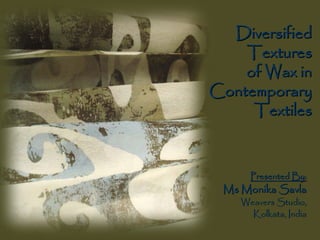
DiversifiedDiversified
TexturesTextures
of Wax inof Wax in
ContemporaryContemporary
TextilesTextiles
Presented By:Presented By:
Ms Monika SavlaMs Monika Savla
Weavers Studio,Weavers Studio,
Kolkata, IndiaKolkata, India
AcknowledgementAcknowledgement
I would like to express my sincere gratitude to
Ms. Darshan Shah. This Batik Presentation
wouldn’t have been possible without her vision,
and constant guidance and support.
Also I would like to thank Ms. Syeda Ruby
Ghaznavi for being our Guru in teaching us
Batik with natural dyes and helping me to
broaden my view and knowledge.
My deepest appreciation and heartiest thanks to
the entire family of Weaver’s Studio, Rangeen
and Veda for being a valuable part in
accomplishing the task.
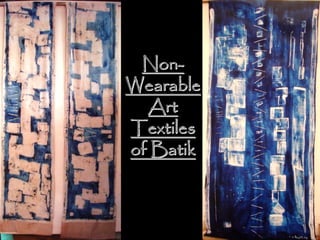
NonNon--
WearableWearable
ArtArt
TextilesTextiles
of Batikof Batik
History & OriginHistory & Origin
• Discoveries show it already existed in
Egypt in the 4th century BCE, where it
was used to wrap mummies; linen was soaked
in wax, and scratched using a sharp tool.
• In Asia, - in China during the T'ang
dynasty (618-907 CE), and in India and
Japan during the Nara period (645-794
CE).
• In Africa - by the Yoruba tribe in Nigeria,
Soninke and Wolof in Senegal. In Sub
Sahara Africa, Javanese batik was
introduced in the 19th century by Dutch
and English traders.
Wax resist dyeing technique in
fabric is an ancient art form.
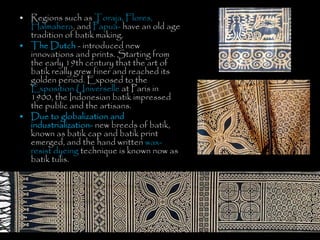
• Regions such as Toraja, Flores,
Halmahera, and Papua- have an old age
tradition of batik making.
• The Dutch - introduced new
innovations and prints. Starting from
the early 19th century that the art of
batik really grew finer and reached its
golden period. Exposed to the
Exposition Universelle at Paris in
1900, the Indonesian batik impressed
the public and the artisans.
• Due to globalization and
industrialization- new breeds of batik,
known as batik cap and batik print
emerged, and the hand written wax-
resist dyeing technique is known now as
batik tulis.
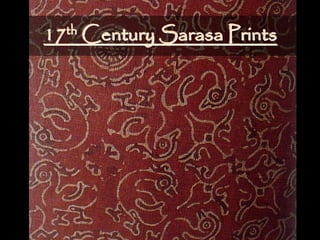
1717thth
Century Sarasa PrintsCentury Sarasa Prints
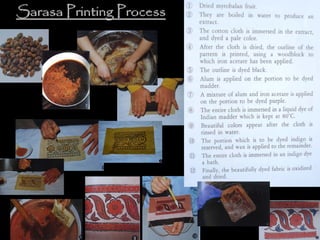
Sarasa Printing ProcessSarasa Printing Process
Contemporaries of Sarasa PrintsContemporaries of Sarasa Prints
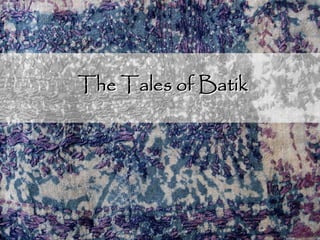
The Tales of BatikThe Tales of Batik
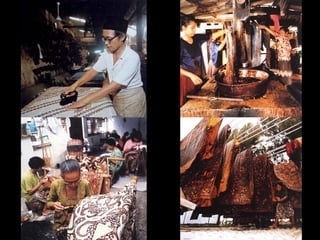
Batik is a cloth that traditionally uses a manual
wax-resist dyeing technique. Batik or fabrics with the
traditional batik patterns are found in:
• Indonesia,
• Malaysia,
• Japan,
• China,
• Azerbaijan,
• India,
• Sri Lanka,
• Egypt,
• Nigeria,
• Senegal, and
• Singapore.
UNESCO designated Indonesian batik as a Masterpiece
of Oral and Intangible Heritage of Humanity on October 2,
2009. As part of the acknowledgment, UNESCO insisted
that Indonesia preserve their heritage.
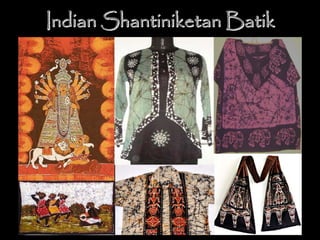
Indian batikIndian batik
Santiniketan is a small
town near Bolpur in
the Birbhum district
of West Bengal,
India, and
approximately 180
kilometers north of
Kolkata.
Rural artisans continue
to do crafts like batik
printed materials, the
most famous
Santiniketan
Leather bags,
earthen wares, batik
paintings.
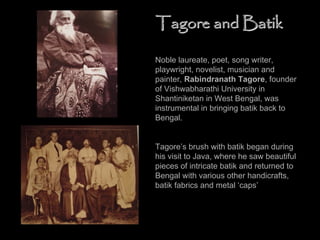
Noble laureate, poet, song writer,
playwright, novelist, musician and
painter, Rabindranath Tagore, founder
of Vishwabharathi University in
Shantiniketan in West Bengal, was
instrumental in bringing batik back to
Bengal.
Tagore’s brush with batik began during
his visit to Java, where he saw beautiful
pieces of intricate batik and returned to
Bengal with various other handicrafts,
batik fabrics and metal ‘caps’
Tagore and BatikTagore and Batik
Indian Shantiniketan BatikIndian Shantiniketan Batik
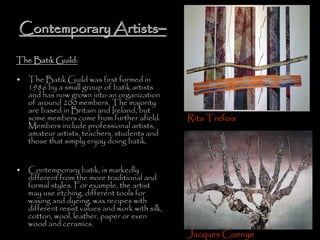
Contemporary ArtistsContemporary Artists––
The Batik Guild:
• The Batik Guild was first formed in
1986 by a small group of batik artists
and has now grown into an organization
of around 200 members. The majority
are based in Britain and Ireland, but
some members come from further afield.
Members include professional artists,
amateur artists, teachers, students and
those that simply enjoy doing batik.
• Contemporary batik, is markedly
different from the more traditional and
formal styles. For example, the artist
may use etching, different tools for
waxing and dyeing, wax recipes with
different resist values and work with silk,
cotton, wool, leather, paper or even
wood and ceramics.
Rita Trefois
Jacques Coenye
The Process ofThe Process of BatikBatik
IngredientsIngredients
Wax
Tools
Dyes
Product line
WaxWax –– the basic ingredient of Batikthe basic ingredient of Batik
A traditional recipe for batik wax is a mix of beeswax and paraffin,
about 60%/40% respectively.
Beeswax is soft, pliable, and blocks completely: no cracking.
Paraffin is more brittle, and lets dye penetrate wherever cracks form.
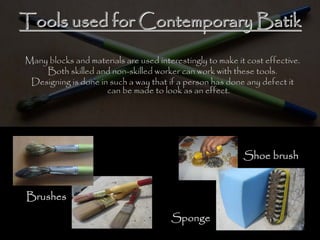
Tools used for Contemporary BatikTools used for Contemporary Batik
Many blocks and materials are used interestingly to make it cost effective.
Both skilled and non-skilled worker can work with these tools.
Designing is done in such a way that if a person has done any defect it
can be made to look as an effect.
Brushes
Sponge
Shoe brush
Wooden
Blocks
(design/
solid)
Tjanting
Brass block
Wooden
Spatula
Hues of Natural DyesHues of Natural Dyes
The challenge to keep the use and beauty of Natural dyes
intact is the whole idea to create something different and
contemporary to give it the social & economic status to let
Natural dyes be dyes used more often than just
demonstrations or revival projects.
Indigo
Pomegranate Rind
Madder
Catechu
Turmeric
Marigold Flower
Tea Leaves
Eucalyptus
Myrobalan
Base Fabric
The regular process for doing a layer of wax
printing is:
First Layer of
Wax Print
Placement
Brushing with
Natural Dye
Reprint Areas
with Wax
Dye with
Natural Dye
Reprint base
with Wax
Re-Dye in Natural
Dye & De-wax
The above details of the product/design and process are time tested as the
organization –Weaver’s Studio –retails to its national and international
clients, designers and patrons for the last 18years.The export wing Veda
Commercials Pvt Ltd has had good experiences of business with batik
textile products. Retails chain stores –Liberty London, designers of Japan,
India, USA, & Europe have successfully enjoyed the batik heritage
technique in innovative patterns and wearable textiles.
Weavers Studio products include textiles in the form of Yardages, Fabric pcs,
Saris, Stoles, Dupatta, Tunics, Shawls, and Non-wearable textiles in the
form of Art Textiles.
Product DesigningProduct Designing
It is being explored in diversified ways for the purpose of creative printing
and development of contemporary textiles that is unique and spreads to
many ends with its different results.
Fields of Colour
The expression of shades completes the
composition as the moral fibers collects to give
a subtleness to the valiant and flamboyant
characters
Fabric used :
Tussar silk
Technique:
Multiple Application of wax resist
Colours used are:
Catechu ,Indigo , Pomegranate
ring, Marigold flowers Layering
Size: 200cms X 50cms
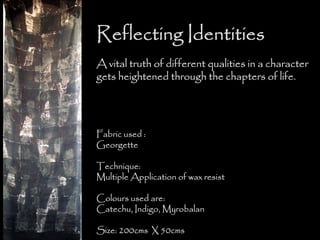
Reflecting Identities
A vital truth of different qualities in a character
gets heightened through the chapters of life.
Fabric used :
Georgette
Technique:
Multiple Application of wax resist
Colours used are:
Catechu, Indigo, Myrobalan
Size: 200cms X 50cms
Collections…
Weaver’s Studio 2011
• Javanese traditional batik, especially from
Yogyakarta and Surakarta, has notable
meanings rooted to the Javanese
conceptualization of the universe.
Traditional colours include indigo, dark
brown, and white, which represent the
three major Hindu Gods (Brahmā, Visnu,
and Śiva).
• Traditionally, wider stripes or wavy lines
of greater width indicated higher rank.
Consequently, during Javanese
ceremonies, one could determine the royal
lineage of a person by the cloth he or she
was wearing
• Other regions of Indonesia have their
own unique patterns that normally take
themes from everyday lives, incorporating
patterns such as flowers, nature, animals,
folklore or people.
Indonesia:Indonesia:
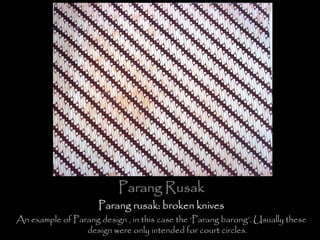
Parang Rusak
Parang rusak: broken knives
An example of Parang design , in this case the ‘Parang barong’. Usually these
design were only intended for court circles.
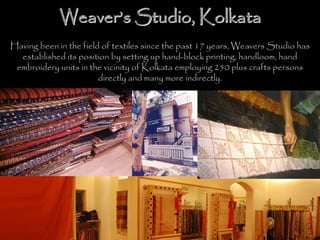
WeaverWeaver’’s Studio, Kolkatas Studio, Kolkata
Having been in the field of textiles since the past 17 years, Weavers Studio has
established its position by setting up hand-block printing, handloom, hand
embroidery units in the vicinity of Kolkata employing 250 plus crafts persons
directly and many more indirectly.
Various Textures of WaxVarious Textures of Wax
Batik is practiced ,created and produced all
over the world-Indonesia, Malaysia, Japan,
China, India, Sri Lanka, Egypt, Africa
and many more.
The challenge to keep the use of batik intact
is the whole idea to create something
different and contemporary to give it the
social and economic status to let batik be
used apart from just demonstration or
revival projects.
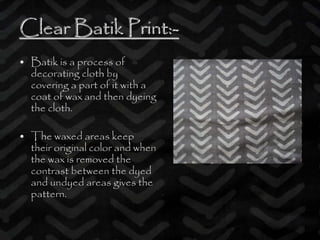
Clear Batik Print:Clear Batik Print:--
• Batik is a process of
decorating cloth by
covering a part of it with a
coat of wax and then dyeing
the cloth.
• The waxed areas keep
their original color and when
the wax is removed the
contrast between the dyed
and undyed areas gives the
pattern.
Wax print with Cracks:Wax print with Cracks:--
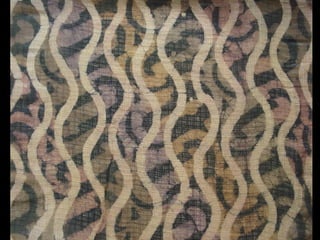
• Crackle is a characteristic batik effect, a
scatter of thin dark wavy lines, a batik
hallmark.
• The Batik effect is unique in that the
wax cracks during handling, either
intentionally or not.
• In each dye bath, the cracks in the wax
allow the dye to reach the fabric creating
the unique batik effect.
• Batik can be done on cottons, silks and
other natural fabrics.
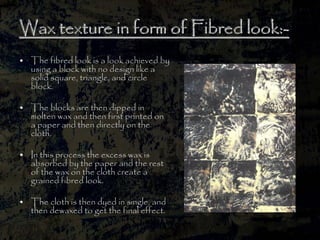
Wax texture in form of Fibred look:Wax texture in form of Fibred look:--
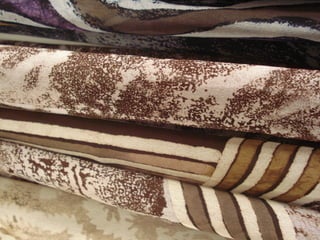
• The fibred look is a look achieved by
using a block with no design like a
solid square, triangle, and circle
block.
• The blocks are then dipped in
molten wax and then first printed on
a paper and then directly on the
cloth.
• In this process the excess wax is
absorbed by the paper and the rest
of the wax on the cloth create a
grained fibred look.
• The cloth is then dyed in single, and
then dewaxed to get the final effect.
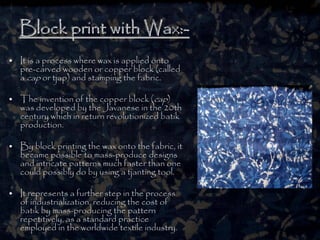
Block print with Wax:Block print with Wax:--
• It is a process where wax is applied onto
pre-carved wooden or copper block (called
a cap or tjap) and stamping the fabric.
• The invention of the copper block (cap)
was developed by the Javanese in the 20th
century which in return revolutionized batik
production.
• By block printing the wax onto the fabric, it
became possible to mass-produce designs
and intricate patterns much faster than one
could possibly do by using a tjanting tool.
• It represents a further step in the process
of industrialization, reducing the cost of
batik by mass-producing the pattern
repetitively, as a standard practice
employed in the worldwide textile industry.
Hand drawn forms and textures:Hand drawn forms and textures:--
• This category of batik is works is made
by making use of the hand.
• Creation batik texture on the clothes is
done by using a brush or any other
medium by hand not just for making the
textures but also making.
• By way of making it then it is a kind of
batik clothing that have a value higher
selling and more people are interested in
using these types of batik clothes.
• The use and production of handmade
batik clothes have been done long ago
and preserved by generations.
Multicolored layering with batik:Multicolored layering with batik:--
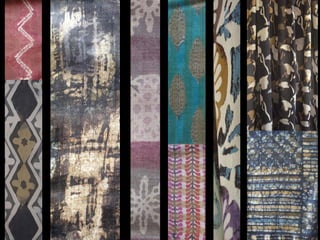
• Multicolour batik refer to the batik cloth
where there is more than two colours
used in a single piece of cloth.
• The process is done by using layers of
wax and natural dyes to create the
effect of a multi-coloured look.
• The fabric needs to be first printed with
wax, then placement brushing with
natural dyes colours; after it dries it is
again printed with a second layer of wax.
• Then the fabric is dyed in a single
natural dye bath and then dewaxed to
get the final effect of a multicolor look.
Batik Printed Kantha Bases
with Natural Dyes
ISEND 2011, EuropeISEND 2011, Europe
Poster Presentation on:Poster Presentation on:
““Layers of Natural Dyes with theLayers of Natural Dyes with the
help of Batikhelp of Batik””
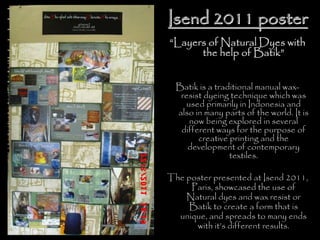
Isend 2011 posterIsend 2011 poster
“Layers of Natural Dyes with
the help of Batik”
Batik is a traditional manual wax-
resist dyeing technique which was
used primarily in Indonesia and
also in many parts of the world. It is
now being explored in several
different ways for the purpose of
creative printing and the
development of contemporary
textiles.
The poster presented at Isend 2011,
Paris, showcased the use of
Natural dyes and wax resist or
Batik to create a form that is
unique, and spreads to many ends
with it’s different results.
Certificate for participation in poster presentationCertificate for participation in poster presentation
at Isend 2011, Paris, Europeat Isend 2011, Paris, Europe
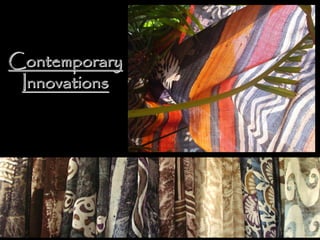
ContemporaryContemporary
InnovationsInnovations
Old Textiles of BatikOld Textiles of Batik
CollectionCollection
Owned by :Owned by :
WeaverWeaver’’s Studio Resource Centres Studio Resource Centre
( Study Centre)( Study Centre)
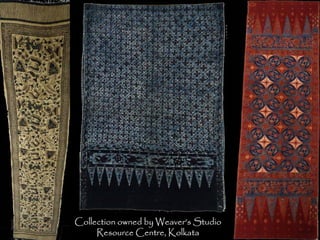
Collection owned by Weaver’s Studio
Resource Centre, Kolkata
Collection owned by Weaver’s Studio
Resource Centre, Kolkata
OldOld
BatikBatik
TextileTextile
CollectionsCollections
Collection owned by Weaver’s Studio
Resource Centre, Kolkata
Collection owned by Weaver’s Studio Resource Centre, Kolkata
Batik Art Textiles
Products – stoles and scarves
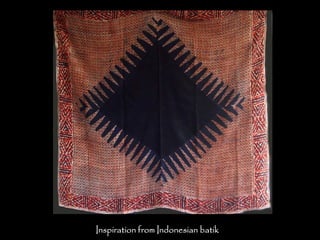
Inspiration from Indonesian batik
Monika Savla
E-mail: savlamonika@gmail.com
Mobile : +91-9831283202
DOB : 22.11.1970
Nationality : Indian
Languages: English, Hindi
Native & Regional Dialect Design and Production Head of :
Rangeen I (Hand-loom Weaving Unit) and
Rangeen II (Hand block Printing Unit) of
Weavers Studio, Kolkata, India.
My journey of textiles started 18 yrs back with the sole guidance and
encouragement of Ms. Darshan Shah with her dream of creating a dyeing
and printing unit which could revive the age old traditions of natural dyes,
design patterns and to give work to as many hands as possible.
Textile Experience:
•Training of Mud resist (Dabu) in Jaipur by master crafts person –
Late Raghunatha Nama, Kaladera – Jaipur.
•Trained in Natural dyeing & printing with Mrs. Sayyeda Ruby
Ghuznavi – Dhaka, Bangladesh.
•Visited various production centers of Natural dye & hand block printing &
hand block making at Pedana & Polavaram – Machalipatnam.
•Exposure to the western countries ,their arts ,culture and trends.
•Knowledge in multicolor wax resist in natural dyes, Shibori, Bandhni,
Leheria in natural dyeing
•Yarn dyeing, wrap printing, warp tieing, inlaying in the weaving looms.
•Creating saris, dupattas, scarfs, stoles, and art pcs. from various dyes.
Designing and producing contemporary products for the in-house store and
export market.
Work Shops & Seminars:
1. Poster & Art Textile Exhibition in ISEND 2011 conference on Natural Dyes with Batik – La
Rochelle Paris- April 2011.
2. Sutra Conference in Kolkata on Conservation & Preservation of Old Textiles – 2010.
3. Received award for the Best use of Colour in Scarf Festival in Australia – 2010.
4. Participation in the Jury Textile Exhibition in Minneapolis, USA - 2009.
5.Participated in International Folk Art Market, Santa Fe , Mexico – 2008.
6.International Natural Dye conference Hyderabad- 2007.
7.Visited – Okinawa islands of Japan for meeting the master weavers working with the banana fiber –
Basho, how this is extracted, made into yarn & then tie dyed to make Kasuri (Japanese tie & dye)
Kimono fabric - Japan-2006 .
8.Surface Design Conference – Kansas – USA – 2005.
9.World Batik Conference – Boston – USA – 2005.
10.Weft Forum – Kuching – Malaysia – 2003.
11.Natural Dye Conference at Iowa – USA – 2002.
12.Sutra Conference in Kolkata on Traded Textiles – 2002.
13.Formal training for Shibori & Natural Indigo dyeing at the Kyoto University under professor Hiroyuki
Shindo – Kyoto – Japan – 2000.
14.World Shibori Symposium at The National Institute of Design – Ahmedabad – 1997.
15.Natural dye conference at the Anna University Chennai – 1995.
16.Participated in international fairs in Germany, Japan, USA and India.
17.Participated in Indian crafts council exhibitions in Delhi, Chennai, Hyderabad, Bangalore.
The journey of 18years has been an experience of learning, understanding, sharing of Ideas &
Views with masters, pioneers, and the entire team of co-workers.

Batik presentation

  • 1.
    DiversifiedDiversified TexturesTextures of Wax inofWax in ContemporaryContemporary TextilesTextiles Presented By:Presented By: Ms Monika SavlaMs Monika Savla Weavers Studio,Weavers Studio, Kolkata, IndiaKolkata, India
  • 2.
    AcknowledgementAcknowledgement I would liketo express my sincere gratitude to Ms. Darshan Shah. This Batik Presentation wouldn’t have been possible without her vision, and constant guidance and support. Also I would like to thank Ms. Syeda Ruby Ghaznavi for being our Guru in teaching us Batik with natural dyes and helping me to broaden my view and knowledge. My deepest appreciation and heartiest thanks to the entire family of Weaver’s Studio, Rangeen and Veda for being a valuable part in accomplishing the task.
  • 4.
  • 5.
  • 6.
    • Discoveries showit already existed in Egypt in the 4th century BCE, where it was used to wrap mummies; linen was soaked in wax, and scratched using a sharp tool. • In Asia, - in China during the T'ang dynasty (618-907 CE), and in India and Japan during the Nara period (645-794 CE). • In Africa - by the Yoruba tribe in Nigeria, Soninke and Wolof in Senegal. In Sub Sahara Africa, Javanese batik was introduced in the 19th century by Dutch and English traders. Wax resist dyeing technique in fabric is an ancient art form.
  • 7.
    • Regions suchas Toraja, Flores, Halmahera, and Papua- have an old age tradition of batik making. • The Dutch - introduced new innovations and prints. Starting from the early 19th century that the art of batik really grew finer and reached its golden period. Exposed to the Exposition Universelle at Paris in 1900, the Indonesian batik impressed the public and the artisans. • Due to globalization and industrialization- new breeds of batik, known as batik cap and batik print emerged, and the hand written wax- resist dyeing technique is known now as batik tulis.
  • 8.
  • 9.
  • 10.
    Contemporaries of SarasaPrintsContemporaries of Sarasa Prints
  • 12.
    The Tales ofBatikThe Tales of Batik
  • 13.
    Batik is acloth that traditionally uses a manual wax-resist dyeing technique. Batik or fabrics with the traditional batik patterns are found in: • Indonesia, • Malaysia, • Japan, • China, • Azerbaijan, • India, • Sri Lanka, • Egypt, • Nigeria, • Senegal, and • Singapore.
  • 14.
    UNESCO designated Indonesianbatik as a Masterpiece of Oral and Intangible Heritage of Humanity on October 2, 2009. As part of the acknowledgment, UNESCO insisted that Indonesia preserve their heritage.
  • 15.
    Indian batikIndian batik Santiniketanis a small town near Bolpur in the Birbhum district of West Bengal, India, and approximately 180 kilometers north of Kolkata. Rural artisans continue to do crafts like batik printed materials, the most famous Santiniketan Leather bags, earthen wares, batik paintings.
  • 16.
    Noble laureate, poet,song writer, playwright, novelist, musician and painter, Rabindranath Tagore, founder of Vishwabharathi University in Shantiniketan in West Bengal, was instrumental in bringing batik back to Bengal. Tagore’s brush with batik began during his visit to Java, where he saw beautiful pieces of intricate batik and returned to Bengal with various other handicrafts, batik fabrics and metal ‘caps’ Tagore and BatikTagore and Batik
  • 17.
  • 18.
    Contemporary ArtistsContemporary Artists–– TheBatik Guild: • The Batik Guild was first formed in 1986 by a small group of batik artists and has now grown into an organization of around 200 members. The majority are based in Britain and Ireland, but some members come from further afield. Members include professional artists, amateur artists, teachers, students and those that simply enjoy doing batik. • Contemporary batik, is markedly different from the more traditional and formal styles. For example, the artist may use etching, different tools for waxing and dyeing, wax recipes with different resist values and work with silk, cotton, wool, leather, paper or even wood and ceramics. Rita Trefois Jacques Coenye
  • 19.
    The Process ofTheProcess of BatikBatik
  • 20.
  • 21.
    WaxWax –– thebasic ingredient of Batikthe basic ingredient of Batik A traditional recipe for batik wax is a mix of beeswax and paraffin, about 60%/40% respectively. Beeswax is soft, pliable, and blocks completely: no cracking. Paraffin is more brittle, and lets dye penetrate wherever cracks form.
  • 22.
    Tools used forContemporary BatikTools used for Contemporary Batik Many blocks and materials are used interestingly to make it cost effective. Both skilled and non-skilled worker can work with these tools. Designing is done in such a way that if a person has done any defect it can be made to look as an effect. Brushes Sponge Shoe brush
  • 23.
  • 24.
    Hues of NaturalDyesHues of Natural Dyes The challenge to keep the use and beauty of Natural dyes intact is the whole idea to create something different and contemporary to give it the social & economic status to let Natural dyes be dyes used more often than just demonstrations or revival projects. Indigo Pomegranate Rind Madder Catechu Turmeric Marigold Flower Tea Leaves Eucalyptus Myrobalan
  • 25.
    Base Fabric The regularprocess for doing a layer of wax printing is: First Layer of Wax Print Placement Brushing with Natural Dye Reprint Areas with Wax Dye with Natural Dye Reprint base with Wax Re-Dye in Natural Dye & De-wax
  • 26.
    The above detailsof the product/design and process are time tested as the organization –Weaver’s Studio –retails to its national and international clients, designers and patrons for the last 18years.The export wing Veda Commercials Pvt Ltd has had good experiences of business with batik textile products. Retails chain stores –Liberty London, designers of Japan, India, USA, & Europe have successfully enjoyed the batik heritage technique in innovative patterns and wearable textiles. Weavers Studio products include textiles in the form of Yardages, Fabric pcs, Saris, Stoles, Dupatta, Tunics, Shawls, and Non-wearable textiles in the form of Art Textiles. Product DesigningProduct Designing It is being explored in diversified ways for the purpose of creative printing and development of contemporary textiles that is unique and spreads to many ends with its different results.
  • 28.
    Fields of Colour Theexpression of shades completes the composition as the moral fibers collects to give a subtleness to the valiant and flamboyant characters Fabric used : Tussar silk Technique: Multiple Application of wax resist Colours used are: Catechu ,Indigo , Pomegranate ring, Marigold flowers Layering Size: 200cms X 50cms
  • 29.
    Reflecting Identities A vitaltruth of different qualities in a character gets heightened through the chapters of life. Fabric used : Georgette Technique: Multiple Application of wax resist Colours used are: Catechu, Indigo, Myrobalan Size: 200cms X 50cms
  • 32.
  • 33.
    • Javanese traditionalbatik, especially from Yogyakarta and Surakarta, has notable meanings rooted to the Javanese conceptualization of the universe. Traditional colours include indigo, dark brown, and white, which represent the three major Hindu Gods (Brahmā, Visnu, and Śiva). • Traditionally, wider stripes or wavy lines of greater width indicated higher rank. Consequently, during Javanese ceremonies, one could determine the royal lineage of a person by the cloth he or she was wearing • Other regions of Indonesia have their own unique patterns that normally take themes from everyday lives, incorporating patterns such as flowers, nature, animals, folklore or people. Indonesia:Indonesia:
  • 34.
    Parang Rusak Parang rusak:broken knives An example of Parang design , in this case the ‘Parang barong’. Usually these design were only intended for court circles.
  • 36.
    WeaverWeaver’’s Studio, KolkatasStudio, Kolkata Having been in the field of textiles since the past 17 years, Weavers Studio has established its position by setting up hand-block printing, handloom, hand embroidery units in the vicinity of Kolkata employing 250 plus crafts persons directly and many more indirectly.
  • 37.
    Various Textures ofWaxVarious Textures of Wax Batik is practiced ,created and produced all over the world-Indonesia, Malaysia, Japan, China, India, Sri Lanka, Egypt, Africa and many more. The challenge to keep the use of batik intact is the whole idea to create something different and contemporary to give it the social and economic status to let batik be used apart from just demonstration or revival projects.
  • 38.
    Clear Batik Print:ClearBatik Print:-- • Batik is a process of decorating cloth by covering a part of it with a coat of wax and then dyeing the cloth. • The waxed areas keep their original color and when the wax is removed the contrast between the dyed and undyed areas gives the pattern.
  • 39.
    Wax print withCracks:Wax print with Cracks:-- • Crackle is a characteristic batik effect, a scatter of thin dark wavy lines, a batik hallmark. • The Batik effect is unique in that the wax cracks during handling, either intentionally or not. • In each dye bath, the cracks in the wax allow the dye to reach the fabric creating the unique batik effect. • Batik can be done on cottons, silks and other natural fabrics.
  • 40.
    Wax texture inform of Fibred look:Wax texture in form of Fibred look:-- • The fibred look is a look achieved by using a block with no design like a solid square, triangle, and circle block. • The blocks are then dipped in molten wax and then first printed on a paper and then directly on the cloth. • In this process the excess wax is absorbed by the paper and the rest of the wax on the cloth create a grained fibred look. • The cloth is then dyed in single, and then dewaxed to get the final effect.
  • 41.
    Block print withWax:Block print with Wax:-- • It is a process where wax is applied onto pre-carved wooden or copper block (called a cap or tjap) and stamping the fabric. • The invention of the copper block (cap) was developed by the Javanese in the 20th century which in return revolutionized batik production. • By block printing the wax onto the fabric, it became possible to mass-produce designs and intricate patterns much faster than one could possibly do by using a tjanting tool. • It represents a further step in the process of industrialization, reducing the cost of batik by mass-producing the pattern repetitively, as a standard practice employed in the worldwide textile industry.
  • 42.
    Hand drawn formsand textures:Hand drawn forms and textures:-- • This category of batik is works is made by making use of the hand. • Creation batik texture on the clothes is done by using a brush or any other medium by hand not just for making the textures but also making. • By way of making it then it is a kind of batik clothing that have a value higher selling and more people are interested in using these types of batik clothes. • The use and production of handmade batik clothes have been done long ago and preserved by generations.
  • 43.
    Multicolored layering withbatik:Multicolored layering with batik:-- • Multicolour batik refer to the batik cloth where there is more than two colours used in a single piece of cloth. • The process is done by using layers of wax and natural dyes to create the effect of a multi-coloured look. • The fabric needs to be first printed with wax, then placement brushing with natural dyes colours; after it dries it is again printed with a second layer of wax. • Then the fabric is dyed in a single natural dye bath and then dewaxed to get the final effect of a multicolor look.
  • 45.
    Batik Printed KanthaBases with Natural Dyes
  • 46.
    ISEND 2011, EuropeISEND2011, Europe Poster Presentation on:Poster Presentation on: ““Layers of Natural Dyes with theLayers of Natural Dyes with the help of Batikhelp of Batik””
  • 47.
    Isend 2011 posterIsend2011 poster “Layers of Natural Dyes with the help of Batik” Batik is a traditional manual wax- resist dyeing technique which was used primarily in Indonesia and also in many parts of the world. It is now being explored in several different ways for the purpose of creative printing and the development of contemporary textiles. The poster presented at Isend 2011, Paris, showcased the use of Natural dyes and wax resist or Batik to create a form that is unique, and spreads to many ends with it’s different results.
  • 48.
    Certificate for participationin poster presentationCertificate for participation in poster presentation at Isend 2011, Paris, Europeat Isend 2011, Paris, Europe
  • 49.
  • 59.
    Old Textiles ofBatikOld Textiles of Batik CollectionCollection Owned by :Owned by : WeaverWeaver’’s Studio Resource Centres Studio Resource Centre ( Study Centre)( Study Centre)
  • 60.
    Collection owned byWeaver’s Studio Resource Centre, Kolkata
  • 61.
    Collection owned byWeaver’s Studio Resource Centre, Kolkata
  • 62.
  • 63.
    Collection owned byWeaver’s Studio Resource Centre, Kolkata
  • 64.
    Collection owned byWeaver’s Studio Resource Centre, Kolkata
  • 65.
  • 66.
  • 67.
  • 68.
    Monika Savla E-mail: savlamonika@gmail.com Mobile: +91-9831283202 DOB : 22.11.1970 Nationality : Indian Languages: English, Hindi Native & Regional Dialect Design and Production Head of : Rangeen I (Hand-loom Weaving Unit) and Rangeen II (Hand block Printing Unit) of Weavers Studio, Kolkata, India. My journey of textiles started 18 yrs back with the sole guidance and encouragement of Ms. Darshan Shah with her dream of creating a dyeing and printing unit which could revive the age old traditions of natural dyes, design patterns and to give work to as many hands as possible. Textile Experience: •Training of Mud resist (Dabu) in Jaipur by master crafts person – Late Raghunatha Nama, Kaladera – Jaipur. •Trained in Natural dyeing & printing with Mrs. Sayyeda Ruby Ghuznavi – Dhaka, Bangladesh.
  • 69.
    •Visited various productioncenters of Natural dye & hand block printing & hand block making at Pedana & Polavaram – Machalipatnam. •Exposure to the western countries ,their arts ,culture and trends. •Knowledge in multicolor wax resist in natural dyes, Shibori, Bandhni, Leheria in natural dyeing •Yarn dyeing, wrap printing, warp tieing, inlaying in the weaving looms. •Creating saris, dupattas, scarfs, stoles, and art pcs. from various dyes. Designing and producing contemporary products for the in-house store and export market. Work Shops & Seminars: 1. Poster & Art Textile Exhibition in ISEND 2011 conference on Natural Dyes with Batik – La Rochelle Paris- April 2011. 2. Sutra Conference in Kolkata on Conservation & Preservation of Old Textiles – 2010. 3. Received award for the Best use of Colour in Scarf Festival in Australia – 2010. 4. Participation in the Jury Textile Exhibition in Minneapolis, USA - 2009. 5.Participated in International Folk Art Market, Santa Fe , Mexico – 2008. 6.International Natural Dye conference Hyderabad- 2007.
  • 70.
    7.Visited – Okinawaislands of Japan for meeting the master weavers working with the banana fiber – Basho, how this is extracted, made into yarn & then tie dyed to make Kasuri (Japanese tie & dye) Kimono fabric - Japan-2006 . 8.Surface Design Conference – Kansas – USA – 2005. 9.World Batik Conference – Boston – USA – 2005. 10.Weft Forum – Kuching – Malaysia – 2003. 11.Natural Dye Conference at Iowa – USA – 2002. 12.Sutra Conference in Kolkata on Traded Textiles – 2002. 13.Formal training for Shibori & Natural Indigo dyeing at the Kyoto University under professor Hiroyuki Shindo – Kyoto – Japan – 2000. 14.World Shibori Symposium at The National Institute of Design – Ahmedabad – 1997. 15.Natural dye conference at the Anna University Chennai – 1995. 16.Participated in international fairs in Germany, Japan, USA and India. 17.Participated in Indian crafts council exhibitions in Delhi, Chennai, Hyderabad, Bangalore. The journey of 18years has been an experience of learning, understanding, sharing of Ideas & Views with masters, pioneers, and the entire team of co-workers.