E-mail: drraghuveer07@gmail.com
INTRODUCTION
• dispense Definition
• dis·pense (di spens′)
• 1. to give or deal out; distribute
• 2. to prepare and give out (medicines,
prescriptions, etc.)
• 3. to administer to dispense the law justly
• 4. to exempt; excuse
• Dispensing is that part of the practice of pharmacy in
which the pharmacist or a pharmacy technician under
his supervision interprets the doctor’s requirements
for the drug treatment of his patient.
General dispensing procedure
• Work on your own
• Wear freshly laundered overall coat
• Provide your self with a clean materials like glass cloth,
duster, sponge etc
• Work in clean tidy manner
• Read the prescription carefully
• Check the doses of internal preparations
• Work out your calculations
• Check the labels and fix them in a container
• Wrap the container
• Make the appropriate records
Prescription
• A prescription is an order from a doctor,
dentist or veterinary surgeon for the supply of
medicines dressing or surgical appliances to a
patient .
It contains following information
• The patient name and address
• The prefix Rx
• The Name and quantity of medicaments to be
supplied
• Instructions for the patient
• Prescribers signature and address
• Date on which prescription is written
Types of Dispensed Preparations
• Aerosols
• Applications
• Cachets
• Capsules
• Collodions
• Creams
• Draughts
• Dusting powder
• Ear drops
• Elixirs
• Emulsions
• Enemas
• Gargles
• Gels
• Granules
• Effervescent Granules
• Inhalations
• Insufflations
• Irrigations
• Linctuses
• Liniments
• Lotions
• Lozenges
• Mixtures
• Mouth washes
• Nasal drops
• Anointments
• Pediatric drops
• Paints
• Pastes
• Pastilles
• Passerines
• Pills
• Poultices
• Powders
• Solutions
• Solution tablets
• Sprays
• Suppositories
• Syrup
• Tablets
• Vitrellae
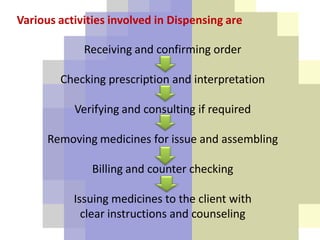
Receiving and confirming order
Checking prescription and interpretation
Verifying and consulting if required
Removing medicines for issue and assembling
Billing and counter checking
Issuing medicines to the client with
clear instructions and counseling
Various activities involved in Dispensing are
Dispensing environment
• Prescription Counter
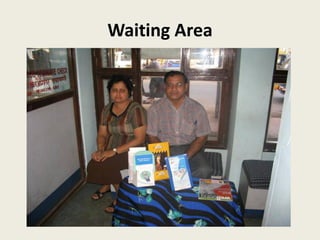
• Waiting Area
• Requirements of a good dispensing
environment
• Barriers, noise and distractions that can affect
dispensing
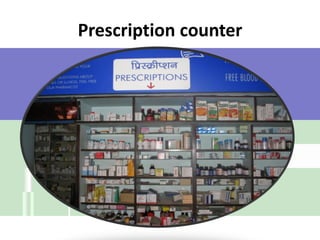
Prescription counter
Waiting Area
Requirements of a Good Dispensing
Environment
• Be clean
• Be organized
• Have sufficient space
• Temperature and humidity controlled
• No loud music playing, gossiping, talking, or television
(e.g. a cricket match or a movie)
• Have medicines stored in an organized way on shelves
in alphabetical order or using the method normally
employed
in that particular pharmacy.
Barriers, Noise and Distractions that can Affect
Dispensing
Barriers:
• Physical positioning of the prescription counter.
• Elevated working areas (high counters).
• Glass enclosures (like banks, making talking
through glass difficult).
• Multiple counters.
• Complexity of the patient’s regimen.
• Education of the patient.
Noise
• Sound systems (music, radio)
• TV (sports, movies, news)
• Screaming children
• Printers
• Proximity to the roadside(traffic), railway
tracks, noisy workplace or machinary nearby
• Telephone not answered quickly
• Loud talking on telephone
Distractions
• Frequent interruptions by telephones
• Non-health conflicting services being provided
in the pharmacy. Eg. Telephone booth,
photocopying etc.
• Friends/visitors coming to meet staff
Handling of Prescriptions
• Receiving the prescription
• Reading the prescription and checking for
A. Legality
B. Legibility
C. Completeness and correctness
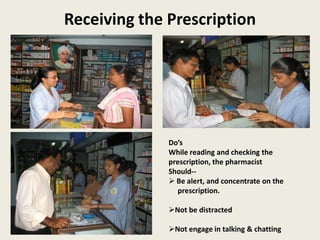
Receiving the Prescription
Do’s
While reading and checking the
prescription, the pharmacist
Should--
 Be alert, and concentrate on the
prescription.
Not be distracted
Not engage in talking & chatting
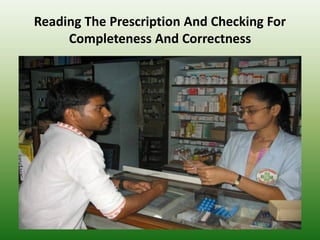
Reading The Prescription And Checking For
Completeness And Correctness
A. Legality
A prescription is legal when :
• It is written (can also be typed) by a R.M.P.
• Signed by the R.M.P.
• Has all the information required to be
contained with respect to parts of prescription.
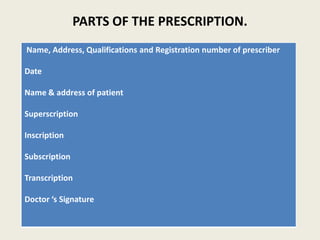
PARTS OF THE PRESCRIPTION.
Name, Address, Qualifications and Registration number of prescriber
Date
Name & address of patient
Superscription
Inscription
Subscription
Transcription
Doctor ‘s Signature
Superscription:
• The 'Rx' symbol is called the superscription. It is used as an abbreviation of the
Latin word recipe,
• which means, “Take thou” or “you take”, the imperative form of the Latin word
recipio, i.e, “I take”.
Inscription:
• Inscription is the part of the prescription that comprises of a list of medicines
and their strengths.
• E.g. Daonil 5 mg, Novamox 250 mg.
Subscription:
• This part of the prescription consists of directions given to the pharmacist with
respect to the dosage
form and the number of dosage units/quantity to be supplied.
• E.g. Tab. Calcium ---- (50) [Means dispense 50 tablets of calcium]
• E.g. Liq Digene--------1 bottle
Signatura /Transcription:
• Signatura refers to the directions given by the doctor
to the patient. In this portion, the physician
indicates to the patient, how he/she should take the
prescribed medicine/s. The directions are usually
representative/caretaker can read and understand.
For example, 'Take 1 teaspoonful three times a day.
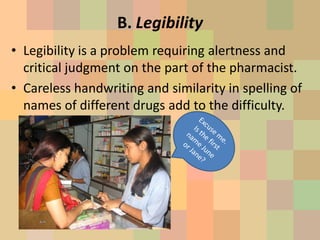
B. Legibility
• Legibility is a problem requiring alertness and
critical judgment on the part of the pharmacist.
• Careless handwriting and similarity in spelling of
names of different drugs add to the difficulty.
Example of a Reading error
• Arlidin and Artidin - Due to illegible handwriting of
doctors, Artidin could be read as Arlidin. Artidin is a
brand containing Diclofenac whereas Arlidin
contains Nylidrin two different drugs used for two
different conditions.
• When handwriting is illegible, the best thing to do is
to contact the physician over the phone and
confirm.
• Remember, you are dealing with medicines and
thus, the lives of patients so be sure of what you are
dispensing. Imagine the disastrous consequences of
dispensing the wrong medicine.
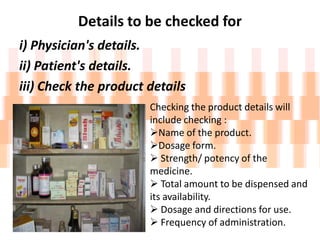
Details to be checked for
i) Physician's details.
ii) Patient's details.
iii) Check the product details
Checking the product details will
include checking :
Name of the product.
Dosage form.
 Strength/ potency of the
medicine.
 Total amount to be dispensed and
its availability.
 Dosage and directions for use.
 Frequency of administration.
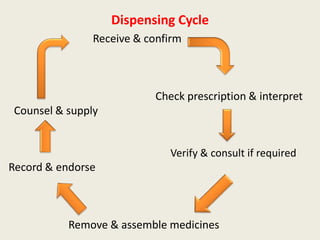
Dispensing Cycle
Receive & confirm
Check prescription & interpret
Counsel & supply
Verify & consult if required
Record & endorse
Remove & assemble medicines
Advantages of a good dispensing environment
• Reduces dispensing errors.
• Reduces fatigue among pharmacy staff.
• Enhances services.
• Improves the image of the pharmacy.
• Creates a professional image.
Pharmaceutical Dispensing Practice I pdf

Pharmaceutical Dispensing Practice I pdf

  • 1.
  • 2.
    INTRODUCTION • dispense Definition •dis·pense (di spens′) • 1. to give or deal out; distribute • 2. to prepare and give out (medicines, prescriptions, etc.) • 3. to administer to dispense the law justly • 4. to exempt; excuse • Dispensing is that part of the practice of pharmacy in which the pharmacist or a pharmacy technician under his supervision interprets the doctor’s requirements for the drug treatment of his patient.
  • 3.
    General dispensing procedure •Work on your own • Wear freshly laundered overall coat • Provide your self with a clean materials like glass cloth, duster, sponge etc • Work in clean tidy manner • Read the prescription carefully • Check the doses of internal preparations • Work out your calculations • Check the labels and fix them in a container • Wrap the container • Make the appropriate records
  • 4.
    Prescription • A prescriptionis an order from a doctor, dentist or veterinary surgeon for the supply of medicines dressing or surgical appliances to a patient .
  • 5.
    It contains followinginformation • The patient name and address • The prefix Rx • The Name and quantity of medicaments to be supplied • Instructions for the patient • Prescribers signature and address • Date on which prescription is written
  • 6.
    Types of DispensedPreparations • Aerosols • Applications • Cachets • Capsules • Collodions • Creams • Draughts • Dusting powder
  • 7.
    • Ear drops •Elixirs • Emulsions • Enemas • Gargles • Gels • Granules • Effervescent Granules • Inhalations • Insufflations • Irrigations
  • 8.
    • Linctuses • Liniments •Lotions • Lozenges • Mixtures • Mouth washes • Nasal drops • Anointments • Pediatric drops
  • 9.
    • Paints • Pastes •Pastilles • Passerines • Pills • Poultices • Powders • Solutions • Solution tablets • Sprays • Suppositories • Syrup • Tablets • Vitrellae
  • 10.
    Receiving and confirmingorder Checking prescription and interpretation Verifying and consulting if required Removing medicines for issue and assembling Billing and counter checking Issuing medicines to the client with clear instructions and counseling Various activities involved in Dispensing are
  • 11.
    Dispensing environment • PrescriptionCounter • Waiting Area • Requirements of a good dispensing environment • Barriers, noise and distractions that can affect dispensing
  • 12.
  • 13.
  • 14.
    Requirements of aGood Dispensing Environment • Be clean • Be organized • Have sufficient space • Temperature and humidity controlled • No loud music playing, gossiping, talking, or television (e.g. a cricket match or a movie) • Have medicines stored in an organized way on shelves in alphabetical order or using the method normally employed in that particular pharmacy.
  • 15.
    Barriers, Noise andDistractions that can Affect Dispensing Barriers: • Physical positioning of the prescription counter. • Elevated working areas (high counters). • Glass enclosures (like banks, making talking through glass difficult). • Multiple counters. • Complexity of the patient’s regimen. • Education of the patient.
  • 16.
    Noise • Sound systems(music, radio) • TV (sports, movies, news) • Screaming children • Printers • Proximity to the roadside(traffic), railway tracks, noisy workplace or machinary nearby • Telephone not answered quickly • Loud talking on telephone
  • 17.
    Distractions • Frequent interruptionsby telephones • Non-health conflicting services being provided in the pharmacy. Eg. Telephone booth, photocopying etc. • Friends/visitors coming to meet staff
  • 18.
    Handling of Prescriptions •Receiving the prescription • Reading the prescription and checking for A. Legality B. Legibility C. Completeness and correctness
  • 19.
    Receiving the Prescription Do’s Whilereading and checking the prescription, the pharmacist Should--  Be alert, and concentrate on the prescription. Not be distracted Not engage in talking & chatting
  • 20.
    Reading The PrescriptionAnd Checking For Completeness And Correctness
  • 21.
    A. Legality A prescriptionis legal when : • It is written (can also be typed) by a R.M.P. • Signed by the R.M.P. • Has all the information required to be contained with respect to parts of prescription.
  • 22.
    PARTS OF THEPRESCRIPTION. Name, Address, Qualifications and Registration number of prescriber Date Name & address of patient Superscription Inscription Subscription Transcription Doctor ‘s Signature
  • 23.
    Superscription: • The 'Rx'symbol is called the superscription. It is used as an abbreviation of the Latin word recipe, • which means, “Take thou” or “you take”, the imperative form of the Latin word recipio, i.e, “I take”. Inscription: • Inscription is the part of the prescription that comprises of a list of medicines and their strengths. • E.g. Daonil 5 mg, Novamox 250 mg. Subscription: • This part of the prescription consists of directions given to the pharmacist with respect to the dosage form and the number of dosage units/quantity to be supplied. • E.g. Tab. Calcium ---- (50) [Means dispense 50 tablets of calcium] • E.g. Liq Digene--------1 bottle
  • 24.
    Signatura /Transcription: • Signaturarefers to the directions given by the doctor to the patient. In this portion, the physician indicates to the patient, how he/she should take the prescribed medicine/s. The directions are usually representative/caretaker can read and understand. For example, 'Take 1 teaspoonful three times a day.
  • 25.
    B. Legibility • Legibilityis a problem requiring alertness and critical judgment on the part of the pharmacist. • Careless handwriting and similarity in spelling of names of different drugs add to the difficulty.
  • 26.
    Example of aReading error • Arlidin and Artidin - Due to illegible handwriting of doctors, Artidin could be read as Arlidin. Artidin is a brand containing Diclofenac whereas Arlidin contains Nylidrin two different drugs used for two different conditions. • When handwriting is illegible, the best thing to do is to contact the physician over the phone and confirm. • Remember, you are dealing with medicines and thus, the lives of patients so be sure of what you are dispensing. Imagine the disastrous consequences of dispensing the wrong medicine.
  • 27.
    Details to bechecked for i) Physician's details. ii) Patient's details. iii) Check the product details Checking the product details will include checking : Name of the product. Dosage form.  Strength/ potency of the medicine.  Total amount to be dispensed and its availability.  Dosage and directions for use.  Frequency of administration.
  • 28.
    Dispensing Cycle Receive &confirm Check prescription & interpret Counsel & supply Verify & consult if required Record & endorse Remove & assemble medicines
  • 29.
    Advantages of agood dispensing environment • Reduces dispensing errors. • Reduces fatigue among pharmacy staff. • Enhances services. • Improves the image of the pharmacy. • Creates a professional image.