PRESENTED BY
Name - KUNAL
Class – B.VOC JMT I
Roll No. - 2223090041
Journalism refers to the activity of collecting,
compiling, and delivering fact-based news and other
related information to the general public in an unbiased
manner. The term “journalism” also describes the
occupation—more commonly known as a journalist.
This occupation is responsible for gathering news from
various sources (like media, tipsters, inside sources, and
eyewitnesses) then presenting it to the public through a
media outlet, either in print, online, on television, or
radio. There are many different journalistic fields,
including investigative reporting, photojournalism,
sports coverage, entertainment reporting, and watchdog
journalism.
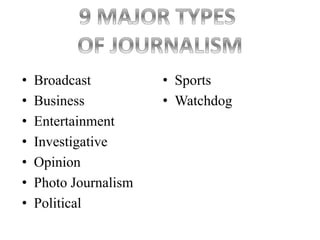
• Broadcast
• Business
• Entertainment
• Investigative
• Opinion
• Photo Journalism
• Political
• Sports
• Watchdog
Broadcast Journalism
• Broadcast journalism is an umbrella term that
refers to any reporting that is broadcast on
television, radio, or the internet. Common
types of broadcast journalism include day-to-
day breaking news stories, entertainment,
investigative, opinion, and sports journalism.
Business Journalism
• Business journalism aims to keep readers and
viewers up-to-date on the trends and changes
in the business world. It can cover many
different topics, including stock trading,
economic policy, business mergers, and
technological advances.
Entertainment Journalism
• Entertainment journalism covers various
topics, including celebrities, film, music,
festivals, and awards ceremonies. This form of
journalism also includes profiling celebrities,
actors, and musicians.
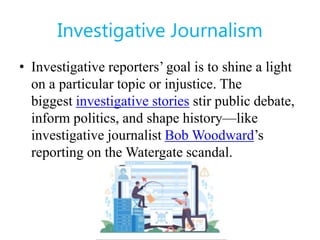
Investigative Journalism
• Investigative reporters’ goal is to shine a light
on a particular topic or injustice. The
biggest investigative stories stir public debate,
inform politics, and shape history—like
investigative journalist Bob Woodward’s
reporting on the Watergate scandal.
Opinion Journalism
• Opinion journalism is a field that showcases
the writer’s opinion rather than solely
reporting new data or events. Most opinion
journalism pieces center on a particular
subject, which the journalist discusses either
briefly or at length before providing their
opinion on the matter. Advice columns, op-eds,
reviews, and letters from the editor all fall
under the umbrella of opinion journalism.
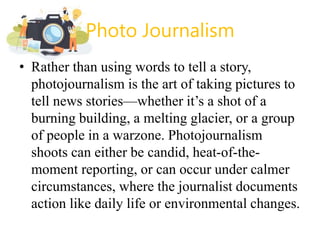
Photo Journalism
• Rather than using words to tell a story,
photojournalism is the art of taking pictures to
tell news stories—whether it’s a shot of a
burning building, a melting glacier, or a group
of people in a warzone. Photojournalism
shoots can either be candid, heat-of-the-
moment reporting, or can occur under calmer
circumstances, where the journalist documents
action like daily life or environmental changes.
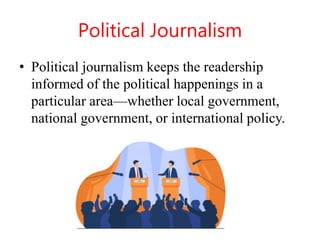
Political Journalism
• Political journalism keeps the readership
informed of the political happenings in a
particular area—whether local government,
national government, or international policy.
Sports Journalism
• Sports journalism covers sports-related topics,
including coverage of games and discussion of
players and strategy, and profiles that spotlight
specific players, coaches, or teams.
Watchdog Journalism
• Watchdog journalism aims to protect society from
illegal activities or corruption, especially within
their governments or economic structures.
Watchdog journalists monitor the actions of
particular organizations—from governments to
political campaigns to large corporations—to
ensure that illegal activities are not occurring. If
they discover corruption, watchdog journalists
will report the findings immediately to hold the
organization responsible.

Basics of Journalism.pptx

  • 1.
    PRESENTED BY Name -KUNAL Class – B.VOC JMT I Roll No. - 2223090041
  • 2.
    Journalism refers tothe activity of collecting, compiling, and delivering fact-based news and other related information to the general public in an unbiased manner. The term “journalism” also describes the occupation—more commonly known as a journalist. This occupation is responsible for gathering news from various sources (like media, tipsters, inside sources, and eyewitnesses) then presenting it to the public through a media outlet, either in print, online, on television, or radio. There are many different journalistic fields, including investigative reporting, photojournalism, sports coverage, entertainment reporting, and watchdog journalism.
  • 3.
    • Broadcast • Business •Entertainment • Investigative • Opinion • Photo Journalism • Political • Sports • Watchdog
  • 4.
    Broadcast Journalism • Broadcastjournalism is an umbrella term that refers to any reporting that is broadcast on television, radio, or the internet. Common types of broadcast journalism include day-to- day breaking news stories, entertainment, investigative, opinion, and sports journalism.
  • 5.
    Business Journalism • Businessjournalism aims to keep readers and viewers up-to-date on the trends and changes in the business world. It can cover many different topics, including stock trading, economic policy, business mergers, and technological advances.
  • 6.
    Entertainment Journalism • Entertainmentjournalism covers various topics, including celebrities, film, music, festivals, and awards ceremonies. This form of journalism also includes profiling celebrities, actors, and musicians.
  • 7.
    Investigative Journalism • Investigativereporters’ goal is to shine a light on a particular topic or injustice. The biggest investigative stories stir public debate, inform politics, and shape history—like investigative journalist Bob Woodward’s reporting on the Watergate scandal.
  • 8.
    Opinion Journalism • Opinionjournalism is a field that showcases the writer’s opinion rather than solely reporting new data or events. Most opinion journalism pieces center on a particular subject, which the journalist discusses either briefly or at length before providing their opinion on the matter. Advice columns, op-eds, reviews, and letters from the editor all fall under the umbrella of opinion journalism.
  • 9.
    Photo Journalism • Ratherthan using words to tell a story, photojournalism is the art of taking pictures to tell news stories—whether it’s a shot of a burning building, a melting glacier, or a group of people in a warzone. Photojournalism shoots can either be candid, heat-of-the- moment reporting, or can occur under calmer circumstances, where the journalist documents action like daily life or environmental changes.
  • 10.
    Political Journalism • Politicaljournalism keeps the readership informed of the political happenings in a particular area—whether local government, national government, or international policy.
  • 11.
    Sports Journalism • Sportsjournalism covers sports-related topics, including coverage of games and discussion of players and strategy, and profiles that spotlight specific players, coaches, or teams.
  • 12.
    Watchdog Journalism • Watchdogjournalism aims to protect society from illegal activities or corruption, especially within their governments or economic structures. Watchdog journalists monitor the actions of particular organizations—from governments to political campaigns to large corporations—to ensure that illegal activities are not occurring. If they discover corruption, watchdog journalists will report the findings immediately to hold the organization responsible.