Journalism
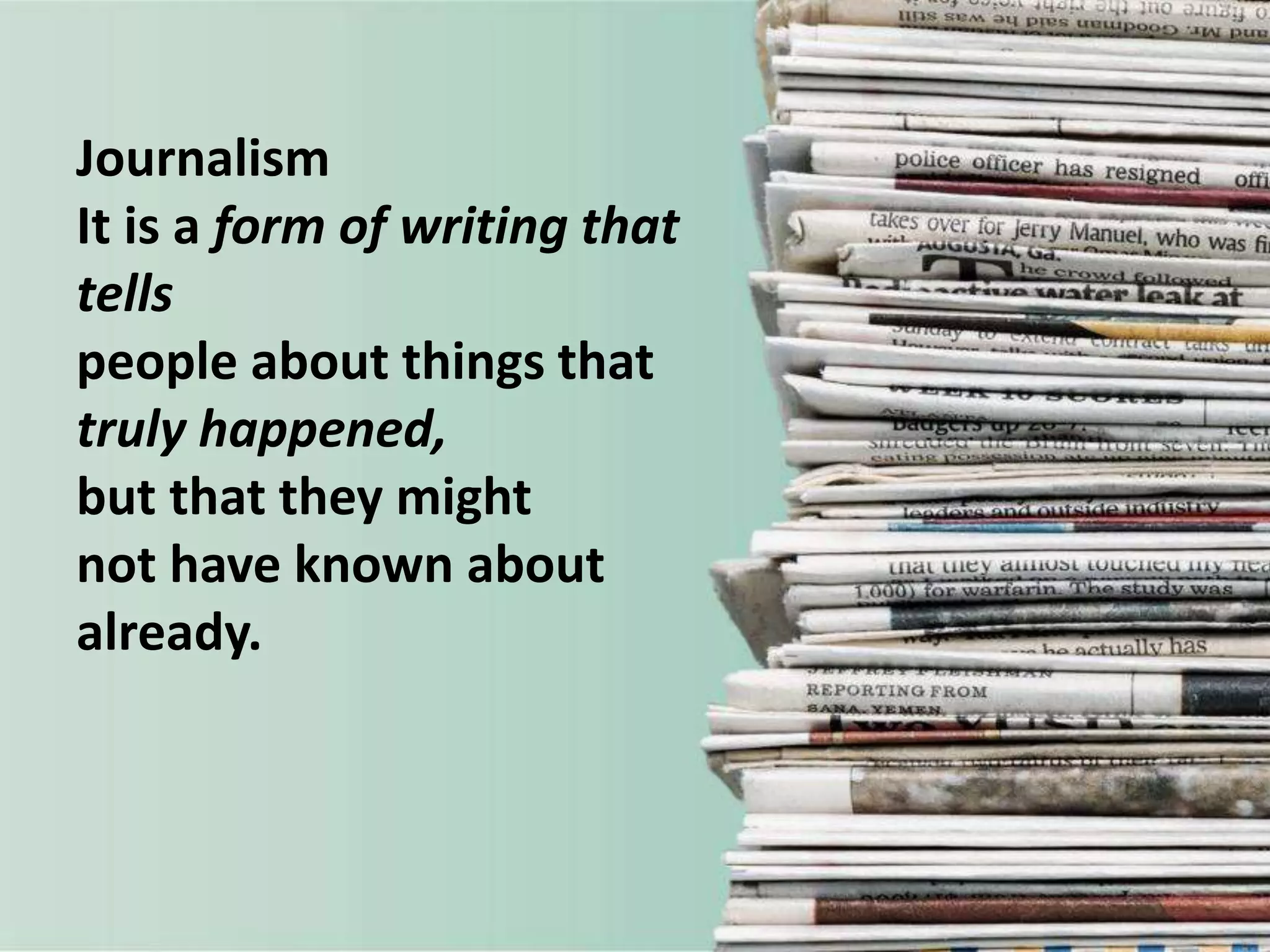
It is a form of writing that
tells
people about things that
truly happened,
but that they might
not have known about
already.
Journalism is the
activity of gathering,
writing, editing, and
publishing or
broadcasting news, as
through newspapers
and magazines or by
radio and television . A
journalist’s work is
called Journalism.
Responsible Journalism
•Not biased writing;
•Reports of what is only
seen;
•No exaggeration or
leaving out details;
•Not enhancing what is
seen;
•Reveals all truth in the
story with no edits
Journalism as a career
Journalism is a highly
responsible job, and highly
interesting at the same
time. People looking for a
career in journalism should
have a presentable and
confident personality, along
with the ability to write
and present information
accurately and concisely
Other essential requirements that highlight a good
journalist are: an inquisitive bent of mind, good
writing and communication skills, ability to
differentiate between fact and fiction, tact,
intelligence, awareness, and interest in current
affairs. Most importantly, one must be capable of
handling the unforeseen situations efficiently.
If you are talented and hard working, a career in
journalism is for you. It
will take you to a good salary package and perhaps
even fame. With
the growing importance of media today, the
opportunities in the field are
numerous and the job is also demanding and
exhilarating at the same
time.
1.Resourcefulness- a good journalist is
supposed to be resourceful in order
to gain access credible sources of
information and to gain success to all
important event.
2. Critical- in order to separate truth
from propaganda and dogmas that
may distort truth.
3. Objective- a journalist is supposed to put aside
personal biases and should not let his emotions
cloud his judgment.
4. Conscientious- a journalist is not supposed to
use his influence in order to meet personal
objectives and should be well aware of the
consequences that may result from his actions.
FUNCTION 1: INFORMATION
FUNCTION 2: INCREASING PUBLIC AWARENESS
FUNCTION 3: INTREPRETING THE FACTS
FUNCTION 4: ENCOURAGING DECISIONS,INFLUENCING,
CHANGES AND SHAPING PUBLIC OPINION
2. Audio
3. Audio-visual
4. Print
ADVOCACY JOURNALISM
BROADCAST JOURNALISM
INVESTIGATIVE JOURNALISM
TABLOID JOURNALISM
YELLOW JOURNALISM
Investigative journalism is a form
of journalism in which reporters
deeply investigate a single topic of
interest, such as serious
crimes, political corruption, or
corporate wrongdoing.An
investigative journalist may spend
months or years researching and
preparing a report. Investigative
journalism is a primary source of
information.
Broadcast journalism is a type of
news reporting presented to the
public electronically or by radio
instead of being published in
newspapers. Media in broadcast
journalism include television, radio
and the Internet.
5. Advocacy journalism is
a genre of journalism that
is fact- based, but
supports a specific point
of view on an issue .
Advocacy journalism is
practiced by alternative
media and special interest
publications and
programs . In this type of
journalism, the journalists
can be openly biased
about a particular person,
or a group of people.
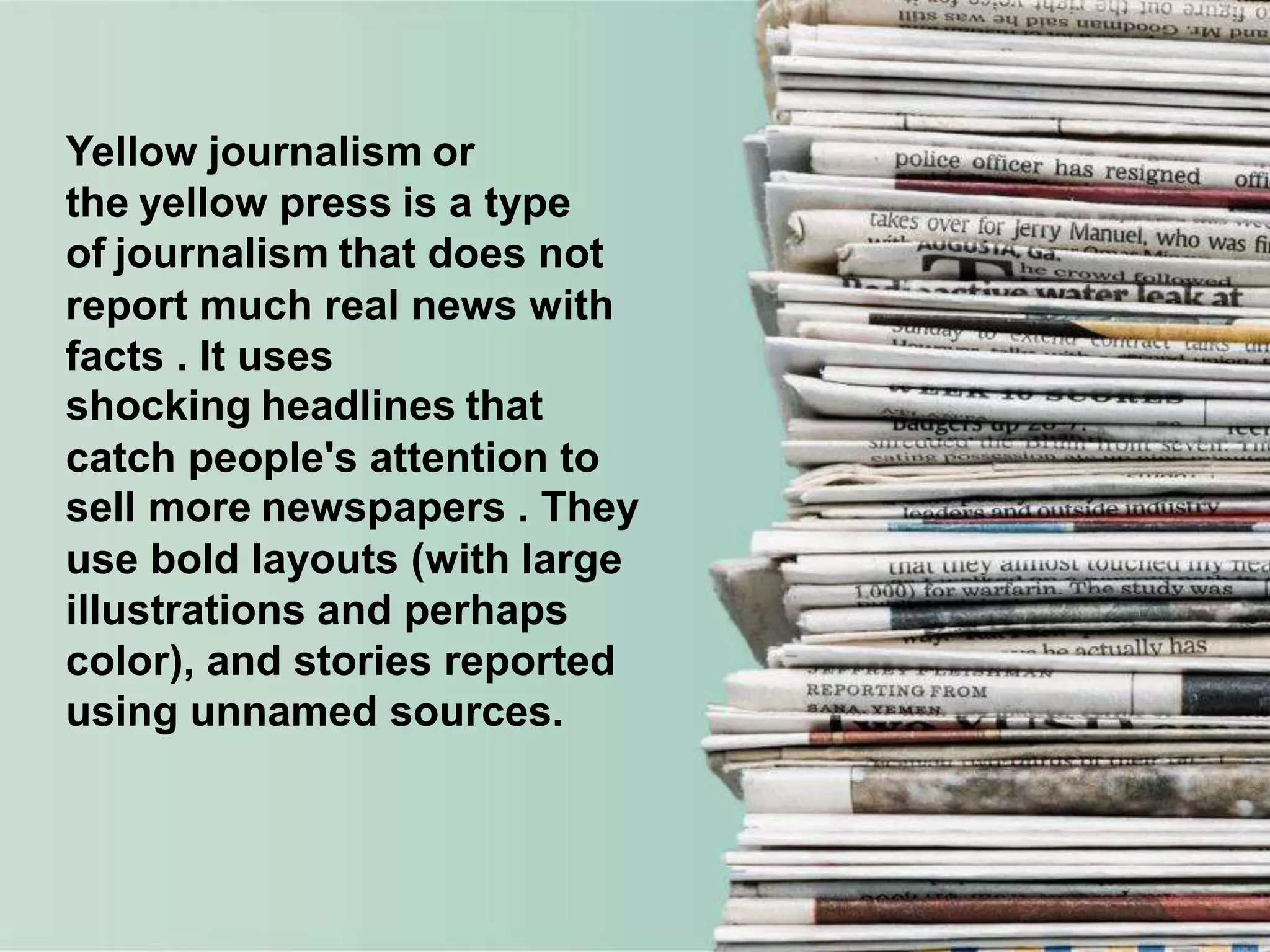
Yellow journalism or
the yellow press is a type
of journalism that does not
report much real news with
facts . It uses
shocking headlines that
catch people's attention to
sell more newspapers . They
use bold layouts (with large
illustrations and perhaps
color), and stories reported
using unnamed sources.
Tabloid journalism is a style
of journalism that
emphasizes sensational crim
e stories, gossip
columns about celebrities
and sports stars, junk food
news and astrology. Although
it is associated with tabloid-
size newspapers, not all
newspapers associated with
tabloid journalism are tabloid
size, and not all tabloid-size
newspapers engage in
tabloid journalism.
Journalism
Journalism
Journalism

Journalism

  • 2.
    Journalism It is aform of writing that tells people about things that truly happened, but that they might not have known about already.
  • 3.
    Journalism is the activityof gathering, writing, editing, and publishing or broadcasting news, as through newspapers and magazines or by radio and television . A journalist’s work is called Journalism.
  • 4.
    Responsible Journalism •Not biasedwriting; •Reports of what is only seen; •No exaggeration or leaving out details; •Not enhancing what is seen; •Reveals all truth in the story with no edits
  • 5.
    Journalism as acareer Journalism is a highly responsible job, and highly interesting at the same time. People looking for a career in journalism should have a presentable and confident personality, along with the ability to write and present information accurately and concisely
  • 6.
    Other essential requirementsthat highlight a good journalist are: an inquisitive bent of mind, good writing and communication skills, ability to differentiate between fact and fiction, tact, intelligence, awareness, and interest in current affairs. Most importantly, one must be capable of handling the unforeseen situations efficiently. If you are talented and hard working, a career in journalism is for you. It will take you to a good salary package and perhaps even fame. With the growing importance of media today, the opportunities in the field are numerous and the job is also demanding and exhilarating at the same time.
  • 7.
    1.Resourcefulness- a goodjournalist is supposed to be resourceful in order to gain access credible sources of information and to gain success to all important event. 2. Critical- in order to separate truth from propaganda and dogmas that may distort truth.
  • 8.
    3. Objective- ajournalist is supposed to put aside personal biases and should not let his emotions cloud his judgment. 4. Conscientious- a journalist is not supposed to use his influence in order to meet personal objectives and should be well aware of the consequences that may result from his actions.
  • 9.
    FUNCTION 1: INFORMATION FUNCTION2: INCREASING PUBLIC AWARENESS FUNCTION 3: INTREPRETING THE FACTS FUNCTION 4: ENCOURAGING DECISIONS,INFLUENCING, CHANGES AND SHAPING PUBLIC OPINION
  • 10.
  • 11.
    ADVOCACY JOURNALISM BROADCAST JOURNALISM INVESTIGATIVEJOURNALISM TABLOID JOURNALISM YELLOW JOURNALISM
  • 12.
    Investigative journalism isa form of journalism in which reporters deeply investigate a single topic of interest, such as serious crimes, political corruption, or corporate wrongdoing.An investigative journalist may spend months or years researching and preparing a report. Investigative journalism is a primary source of information.
  • 13.
    Broadcast journalism isa type of news reporting presented to the public electronically or by radio instead of being published in newspapers. Media in broadcast journalism include television, radio and the Internet.
  • 14.
    5. Advocacy journalismis a genre of journalism that is fact- based, but supports a specific point of view on an issue . Advocacy journalism is practiced by alternative media and special interest publications and programs . In this type of journalism, the journalists can be openly biased about a particular person, or a group of people.
  • 15.
    Yellow journalism or theyellow press is a type of journalism that does not report much real news with facts . It uses shocking headlines that catch people's attention to sell more newspapers . They use bold layouts (with large illustrations and perhaps color), and stories reported using unnamed sources.
  • 16.
    Tabloid journalism isa style of journalism that emphasizes sensational crim e stories, gossip columns about celebrities and sports stars, junk food news and astrology. Although it is associated with tabloid- size newspapers, not all newspapers associated with tabloid journalism are tabloid size, and not all tabloid-size newspapers engage in tabloid journalism.