Automation Overview
1.1 Automation -vue d'ensemble
Automation - Übersicht
Prof. Dr. H. Kirrmann
EPFL / ABB Research Center, Baden, Switzerland
Industrial Automation
Automation Industrielle
Industrielle Automation
2005 March, HK
1.1 Automation Overview
2/12
Industrial Automation
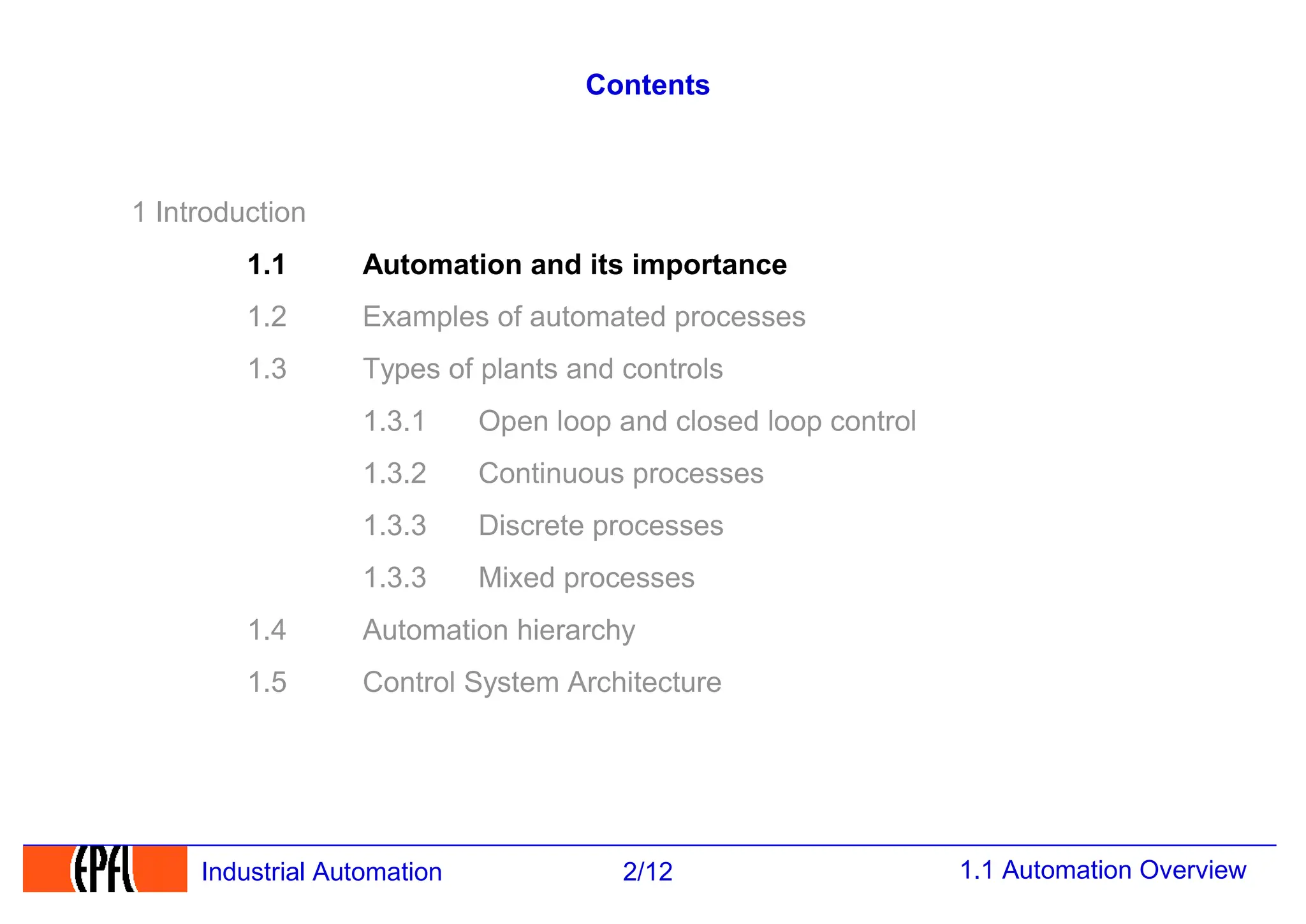
Contents
1 Introduction
1.1 Automation and its importance
1.2 Examples of automated processes
1.3 Types of plants and controls
1.3.1 Open loop and closed loop control
1.3.2 Continuous processes
1.3.3 Discrete processes
1.3.3 Mixed processes
1.4 Automation hierarchy
1.5 Control System Architecture
1.1 Automation Overview
3/12
Industrial Automation
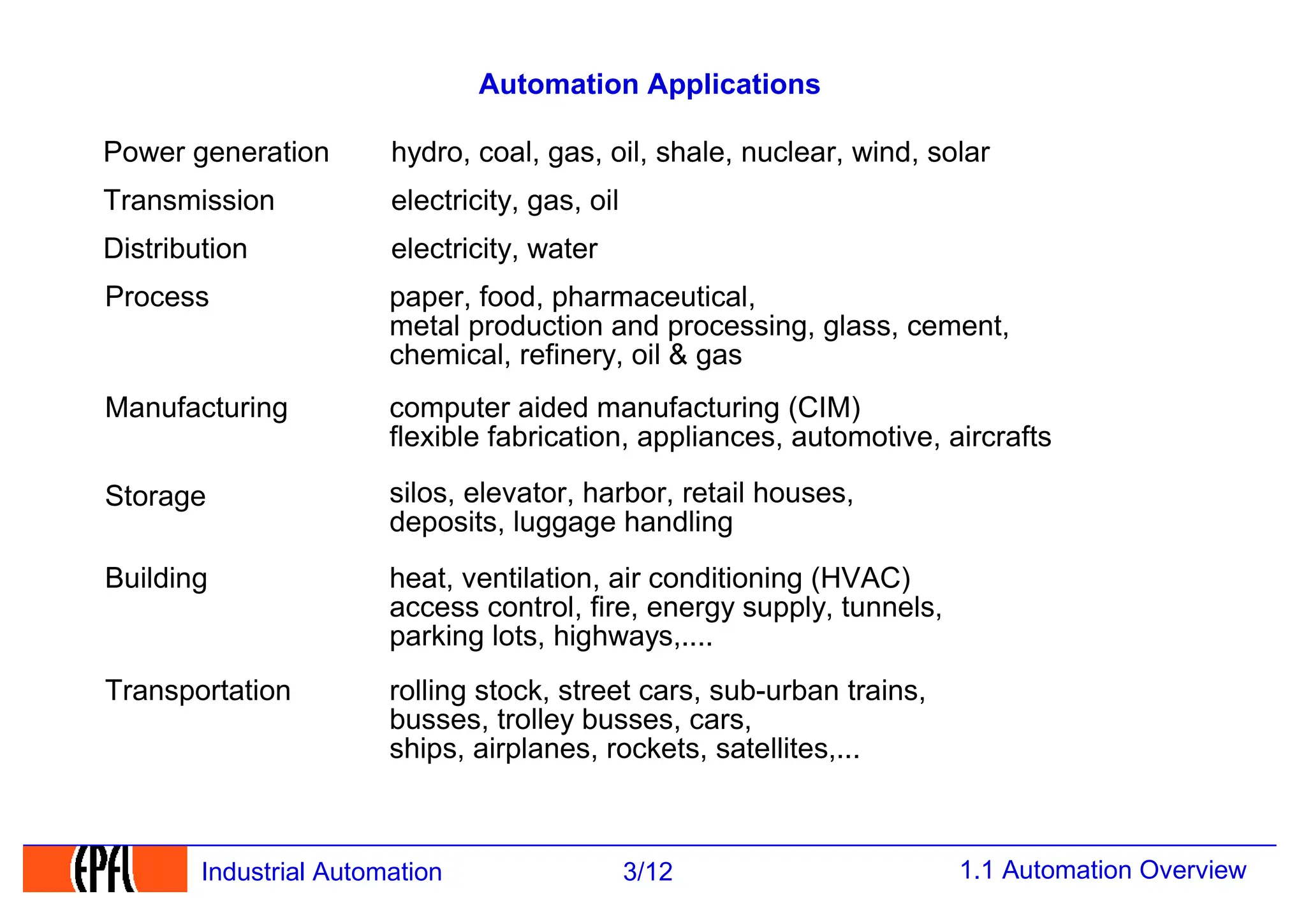
Automation Applications
Power generation hydro, coal, gas, oil, shale, nuclear, wind, solar
Distribution electricity, water
Process paper, food, pharmaceutical,
metal production and processing, glass, cement,
chemical, refinery, oil & gas
Manufacturing computer aided manufacturing (CIM)
flexible fabrication, appliances, automotive, aircrafts
Storage
Building heat, ventilation, air conditioning (HVAC)
access control, fire, energy supply, tunnels,
parking lots, highways,....
Transportation rolling stock, street cars, sub-urban trains,
busses, trolley busses, cars,
ships, airplanes, rockets, satellites,...
silos, elevator, harbor, retail houses,
deposits, luggage handling
Transmission electricity, gas, oil
1.1 Automation Overview
4/12
Industrial Automation
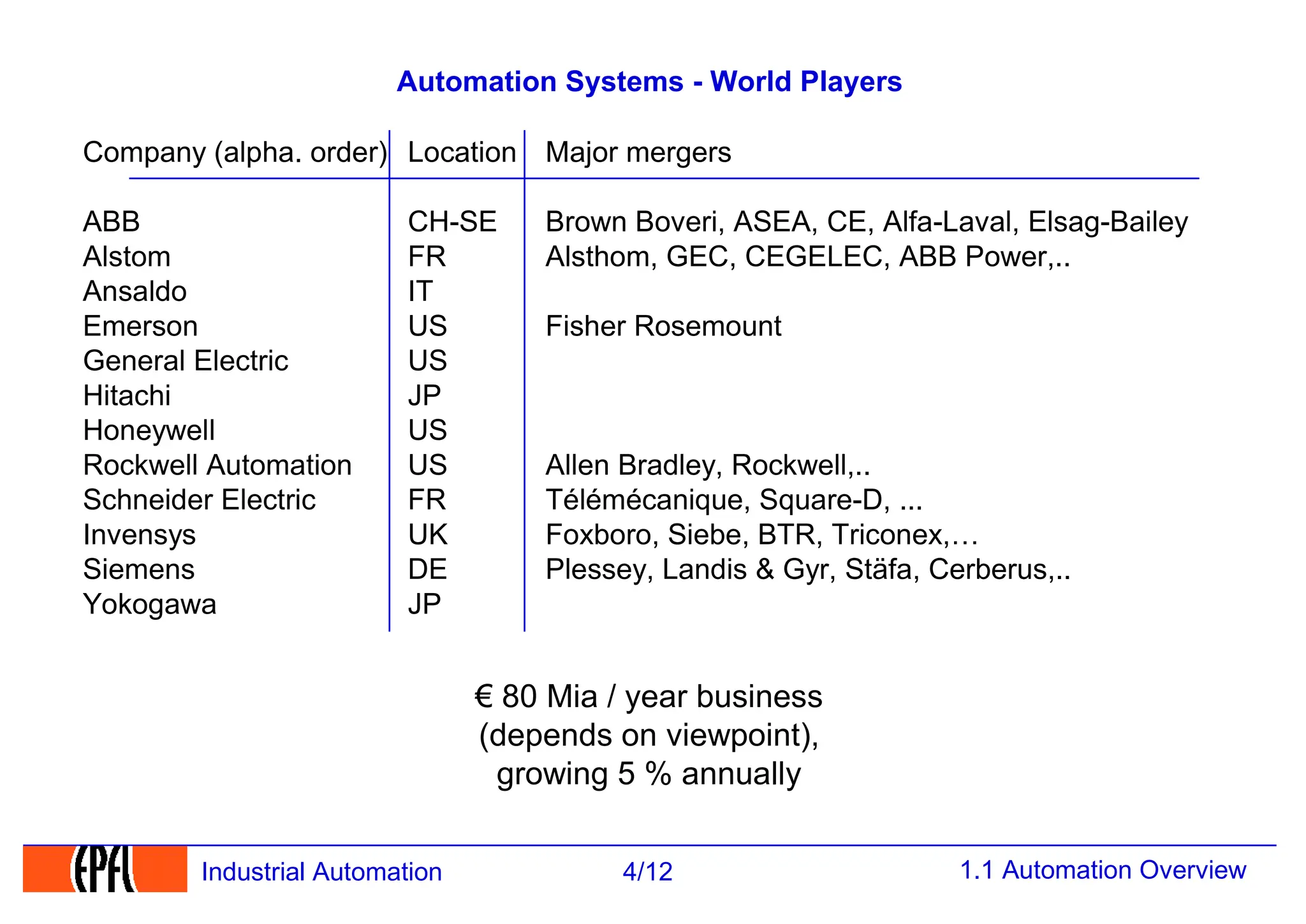
Automation Systems - World Players
Company (alpha. order) Location Major mergers
ABB CH-SE Brown Boveri, ASEA, CE, Alfa-Laval, Elsag-Bailey
Alstom FR Alsthom, GEC, CEGELEC, ABB Power,..
Ansaldo IT
Emerson US Fisher Rosemount
General Electric US
Hitachi JP
Honeywell US
Rockwell Automation US Allen Bradley, Rockwell,..
Schneider Electric FR Télémécanique, Square-D, ...
Invensys UK Foxboro, Siebe, BTR, Triconex,…
Siemens DE Plessey, Landis & Gyr, Stäfa, Cerberus,..
Yokogawa JP
€ 80 Mia / year business
(depends on viewpoint),
growing 5 % annually
1.1 Automation Overview
5/12
Industrial Automation
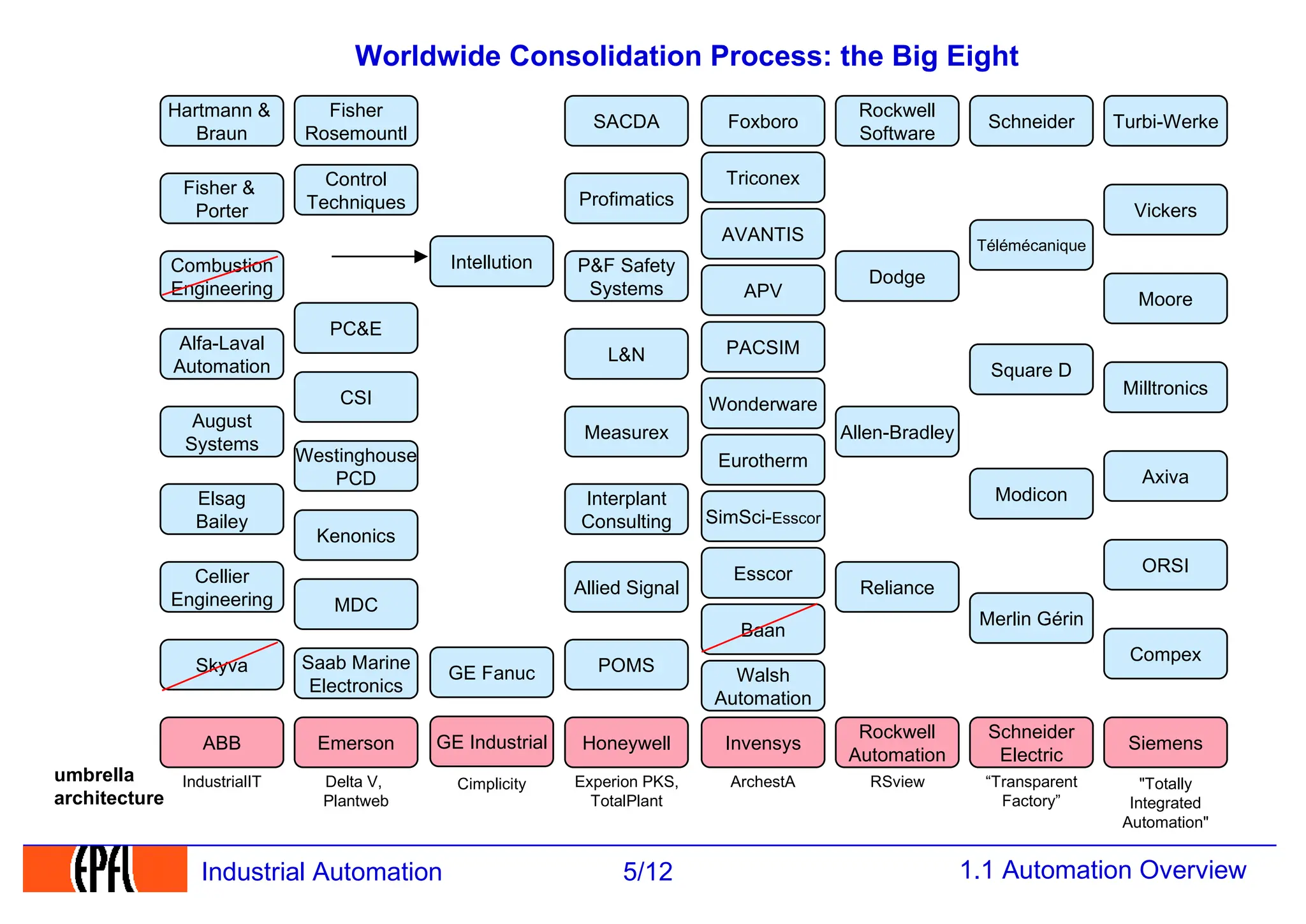
Worldwide Consolidation Process: the Big Eight
Schneider
Télémécanique
Square D
Modicon
Schneider
Electric
Merlin Gérin
“Transparent
Factory”
SACDA
Profimatics
P&F Safety
Systems
L&N
Measurex
Interplant
Consulting
Allied Signal
POMS
Honeywell
Experion PKS,
TotalPlant
Rockwell
Software
Dodge
Allen-Bradley
Reliance
Rockwell
Automation
RSview
Moore
Milltronics
Axiva
ORSI
Siemens
Compex
Vickers
Turbi-Werke
"Totally
Integrated
Automation"
Intellution
GE Industrial
GE Fanuc
Cimplicity
Fisher
Rosemountl
PC&E
Emerson
CSI
Westinghouse
PCD
Kenonics
MDC
Control
Techniques
Saab Marine
Electronics
Delta V,
Plantweb
Wonderware
Triconex
Eurotherm
APV
Baan
Foxboro
AVANTIS
PACSIM
SimSci-Esscor
Walsh
Automation
Invensys
Esscor
ArchestA
Hartmann &
Braun
Fisher &
Porter
Combustion
Engineering
Alfa-Laval
Automation
August
Systems
Elsag
Bailey
Cellier
Engineering
Skyva
ABB
IndustrialIT
umbrella
architecture
1.1 Automation Overview
6/12
Industrial Automation
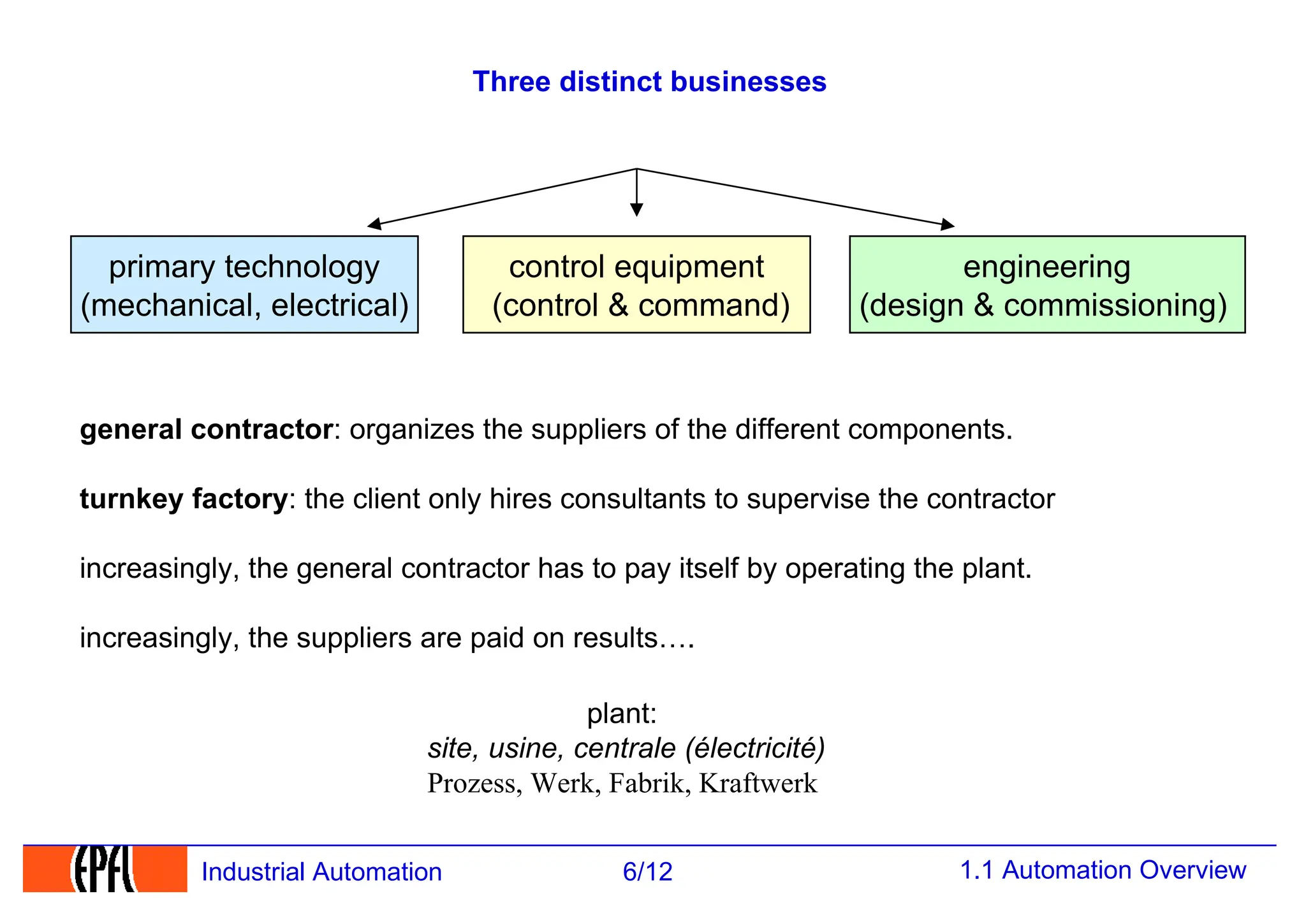
Three distinct businesses
control equipment
(control & command)
engineering
(design & commissioning)
primary technology
(mechanical, electrical)
general contractor: organizes the suppliers of the different components.
turnkey factory: the client only hires consultants to supervise the contractor
increasingly, the general contractor has to pay itself by operating the plant.
increasingly, the suppliers are paid on results….
plant:
site, usine, centrale (électricité)
Prozess, Werk, Fabrik, Kraftwerk
1.1 Automation Overview
7/12
Industrial Automation
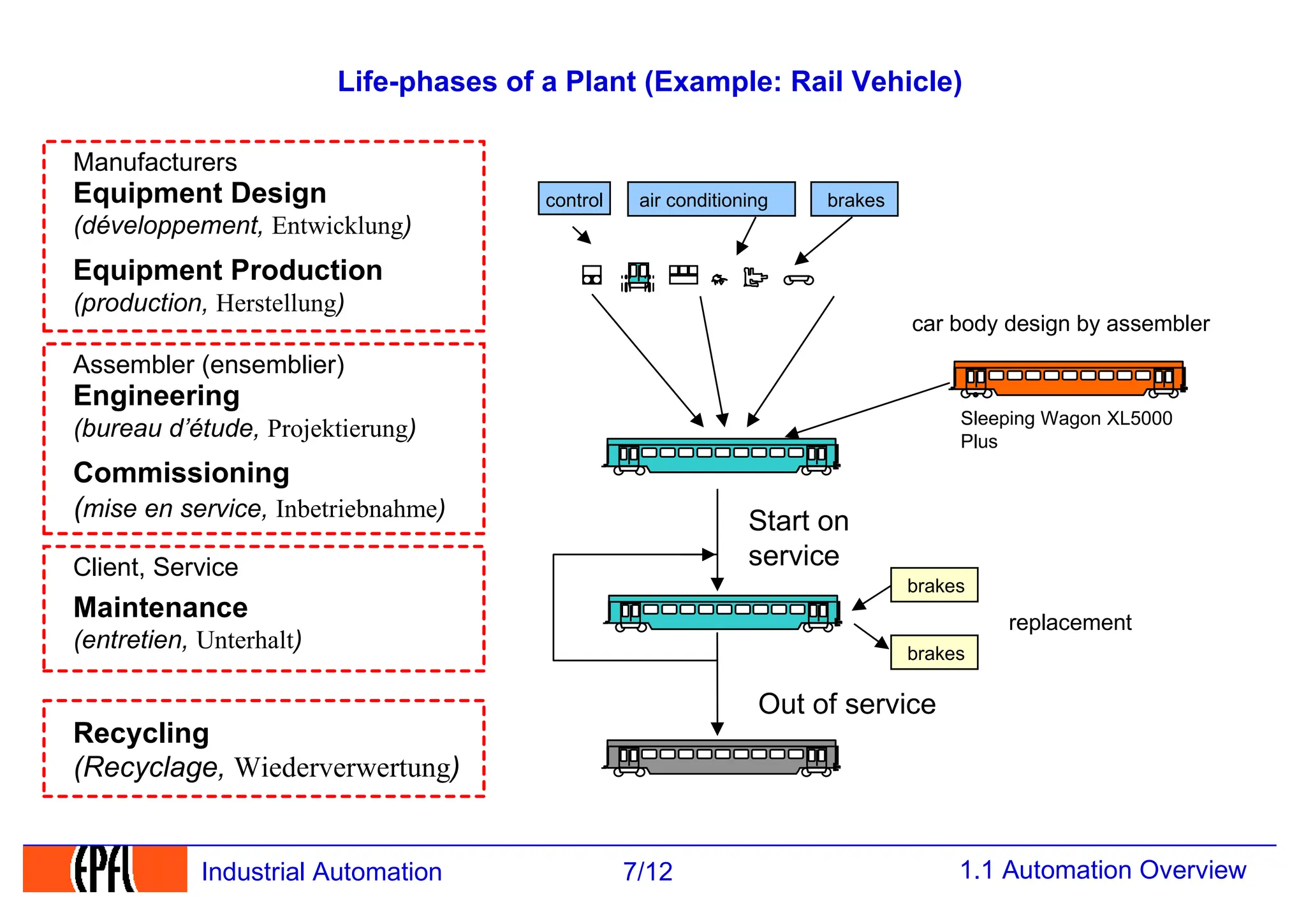
Life-phases of a Plant (Example: Rail Vehicle)
Maintenance
(entretien, Unterhalt)
Start on
service
Recycling
(Recyclage, Wiederverwertung)
Out of service
Commissioning
(mise en service, Inbetriebnahme)
Sleeping Wagon XL5000
Plus
Engineering
(bureau d’étude, Projektierung)
Equipment Production
(production, Herstellung)
air conditioning brakes
control
Equipment Design
(développement, Entwicklung)
brakes
brakes
replacement
Manufacturers
Assembler (ensemblier)
Client, Service
car body design by assembler
1.1 Automation Overview
8/12
Industrial Automation
Technical necessity of automation
• Processing of the information flow
• Enforcement of safety and availability
• Reduction of personal costs
1.1 Automation Overview
9/12
Industrial Automation
Expectations of automation
• Energy, material and time savings
• Quality improvement and stabilisation
• Reduction of waste, pollution control
• Compliance with regulations and laws, product tracking
• Increase availability, safety
• Fast response to market
• Connection to management and accounting (SAP™)
• Automation of engineering, commissioning and maintenance
• Software configuration, back-up and versioning
• Life-cycle control
• Maintenance support
Asset Optimisation (gestion des moyens de production)
-> Human-Machine Interface (MMC = Man-Machine Communication)
-> Acquisition of large number of “Process Variables”, data mining
Personal costs reduction
Process Optimisation
• Simplify interface
• Assist decision
• Require data processing, displays, data base, expert systems
-> Engineering Tools
1.1 Automation Overview
10/12
Industrial Automation
Data quantity in plants
Data reduction and processing is necessary to operate plants
information flow to the personal: > 5 kbit/s.
human processing capacity: about 25 bit/s
without computers, 200 engineers (today: 3)
Electricity distribution network
three times more points than in conventional power plants
Nuclear Power Plant
10'000 points, comprising
8'000 binary and analog measurement points and
2'000 actuation point
1'000 micro-controllers and logic controllers
Coal-fired power plant today
100 measurement and action variables (called "points")
Analog controllers, analog instruments
one central "process controller" for data monitoring and protocol.
Power Plant 25 years ago
100’000 - 10’000’000 points
1.1 Automation Overview
11/12
Industrial Automation
Assessment
How is automation justified ?
Which are the expectations put on automation ?
What quantity of data can be expected in a typical plant ?
Prof. Dr. H. Kirrmann
EPFL /ABB Research Center, Baden, Switzerland
Industrial Automation
Automation Industrielle
Industrielle Automation
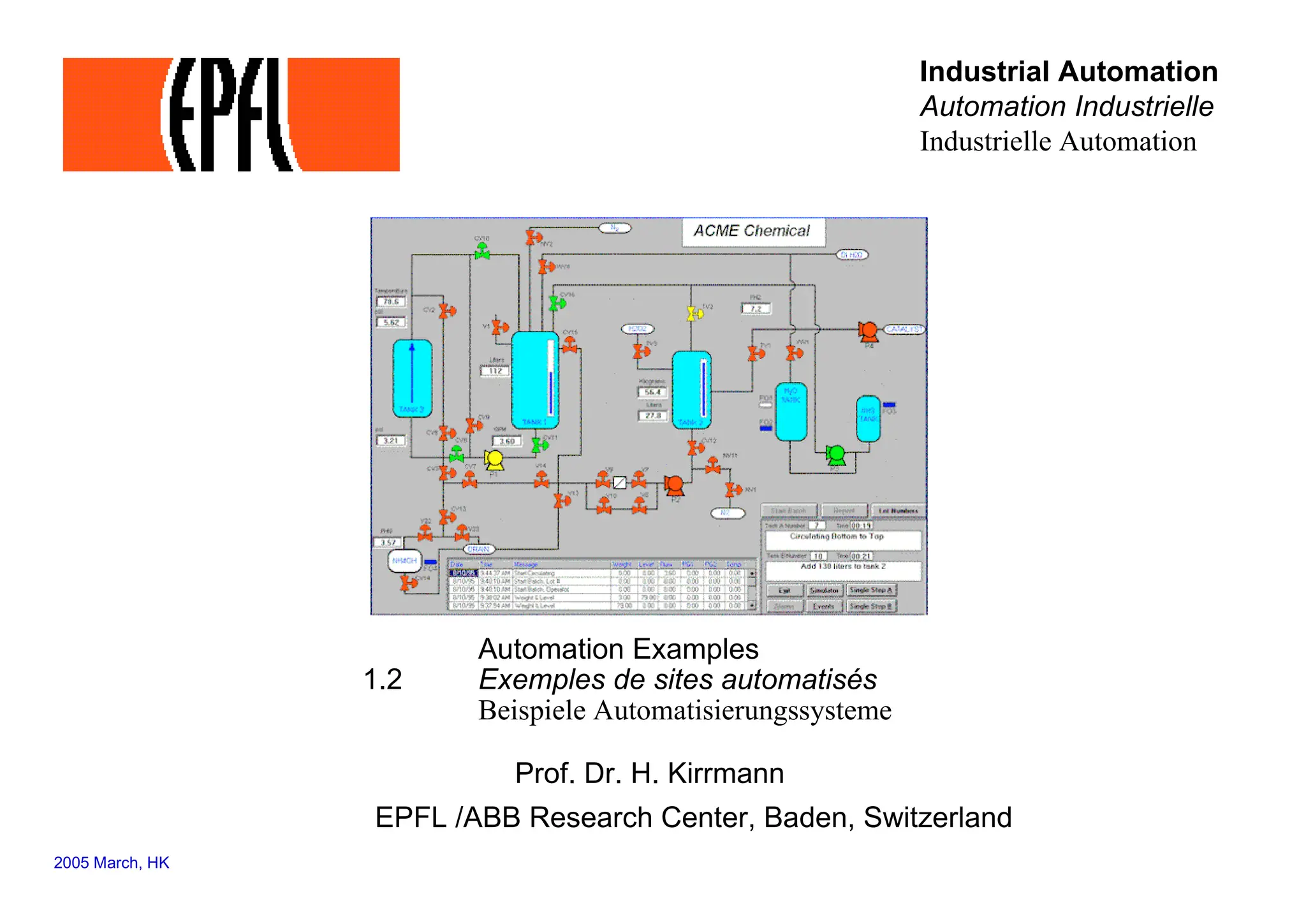
Automation Examples
1.2 Exemples de sites automatisés
Beispiele Automatisierungssysteme
2005 March, HK
2
2004 June, HK 1.2 Automation Examples
EPFL - Industrial Automation
Examples of Automated Plants
1 Introduction
1.1 Automation and its importance
1.2 Applications of automation
1.3 Types of Plants and Control
1.3.1 Open Loop and Closed Loop Control
1.3.2 Continuous processes
1.3.2 Discrete processes
1.3.3 Mixed processes
1.4 Automation hierarchy
1.5 Control System Architecture
3
2004 June, HK 1.2 Automation Examples
EPFL - Industrial Automation
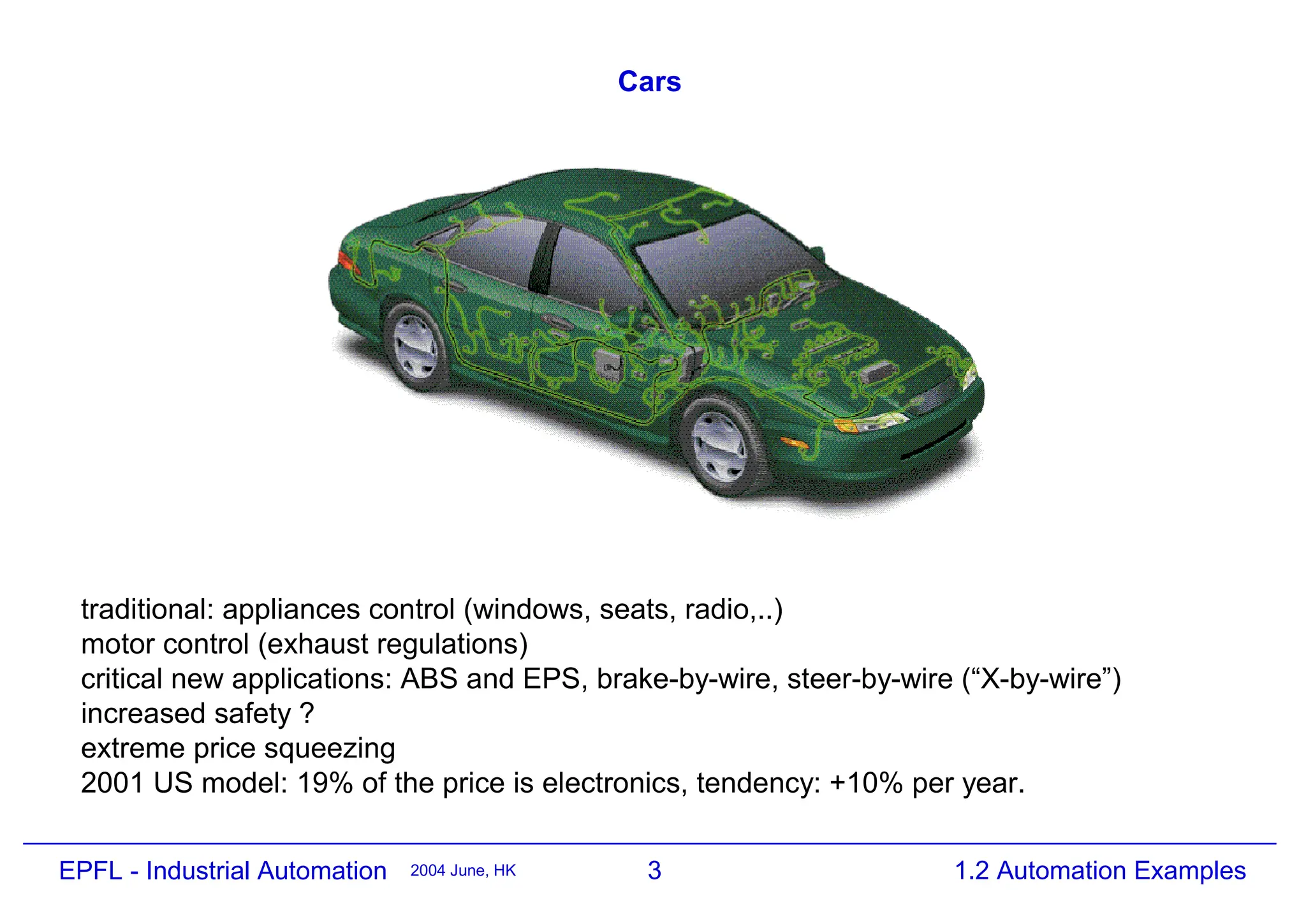
Cars
traditional: appliances control (windows, seats, radio,..)
motor control (exhaust regulations)
critical new applications: ABS and EPS, brake-by-wire, steer-by-wire (“X-by-wire”)
increased safety ?
extreme price squeezing
2001 US model: 19% of the price is electronics, tendency: +10% per year.
4
2004 June, HK 1.2 Automation Examples
EPFL - Industrial Automation
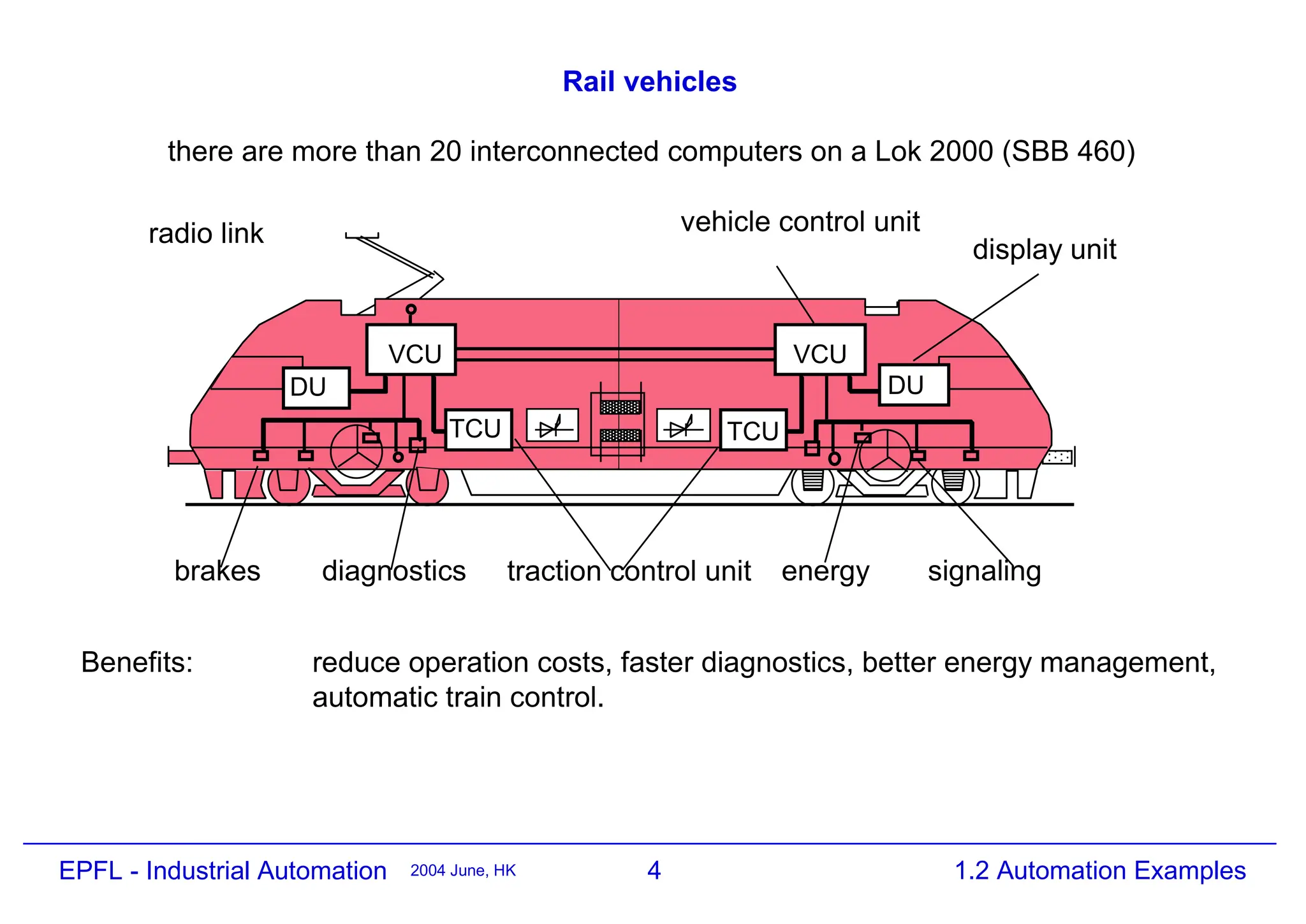
Rail vehicles
display unit
vehicle control unit
DU
TCU
DU
TCU
VCU
radio link
there are more than 20 interconnected computers on a Lok 2000 (SBB 460)
brakes signaling
traction control unit
diagnostics energy
Benefits: reduce operation costs, faster diagnostics, better energy management,
automatic train control.
VCU
5
2004 June, HK 1.2 Automation Examples
EPFL - Industrial Automation
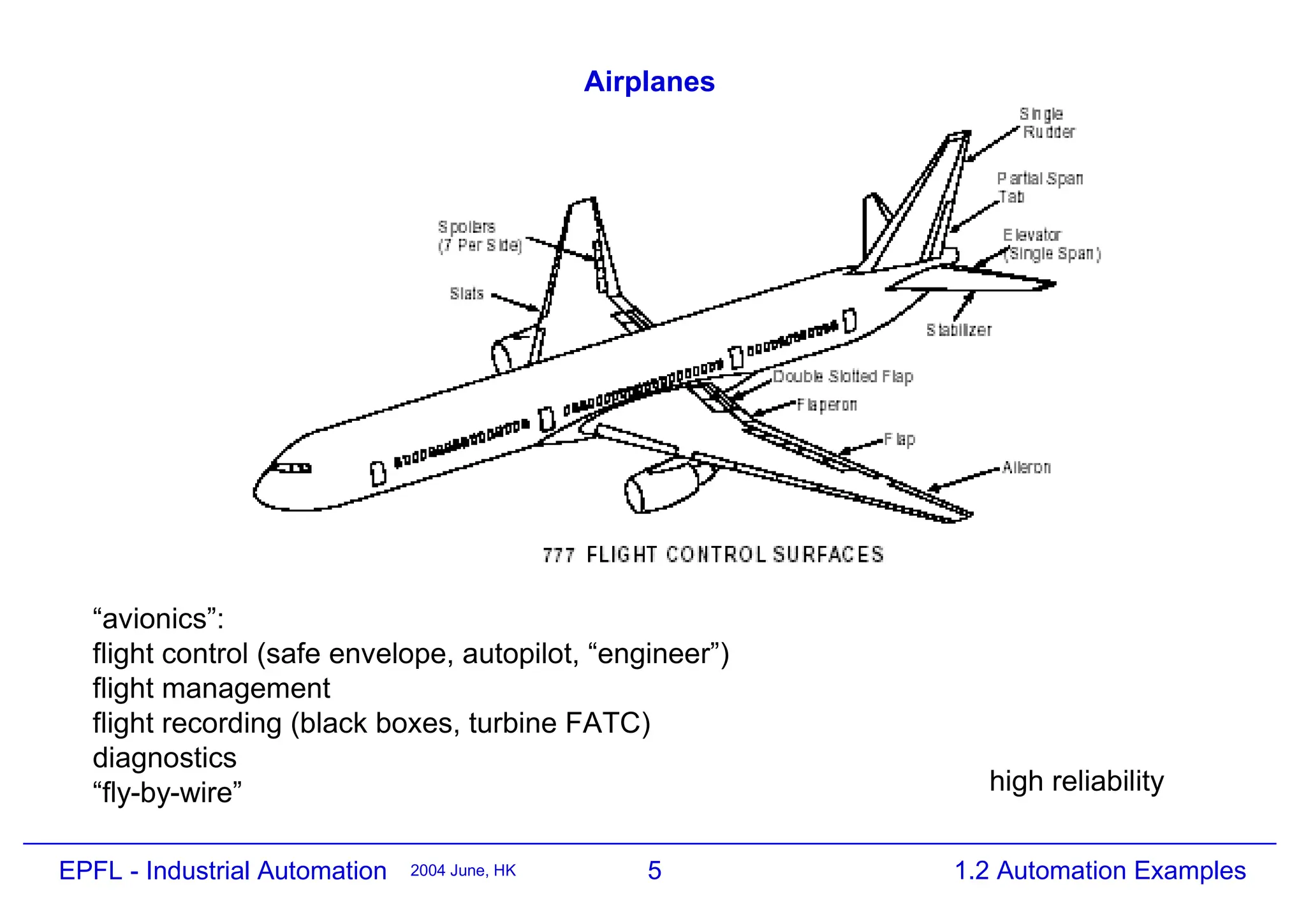
Airplanes
“avionics”:
flight control (safe envelope, autopilot, “engineer”)
flight management
flight recording (black boxes, turbine FATC)
diagnostics
“fly-by-wire” high reliability
6
2004 June, HK 1.2 Automation Examples
EPFL - Industrial Automation
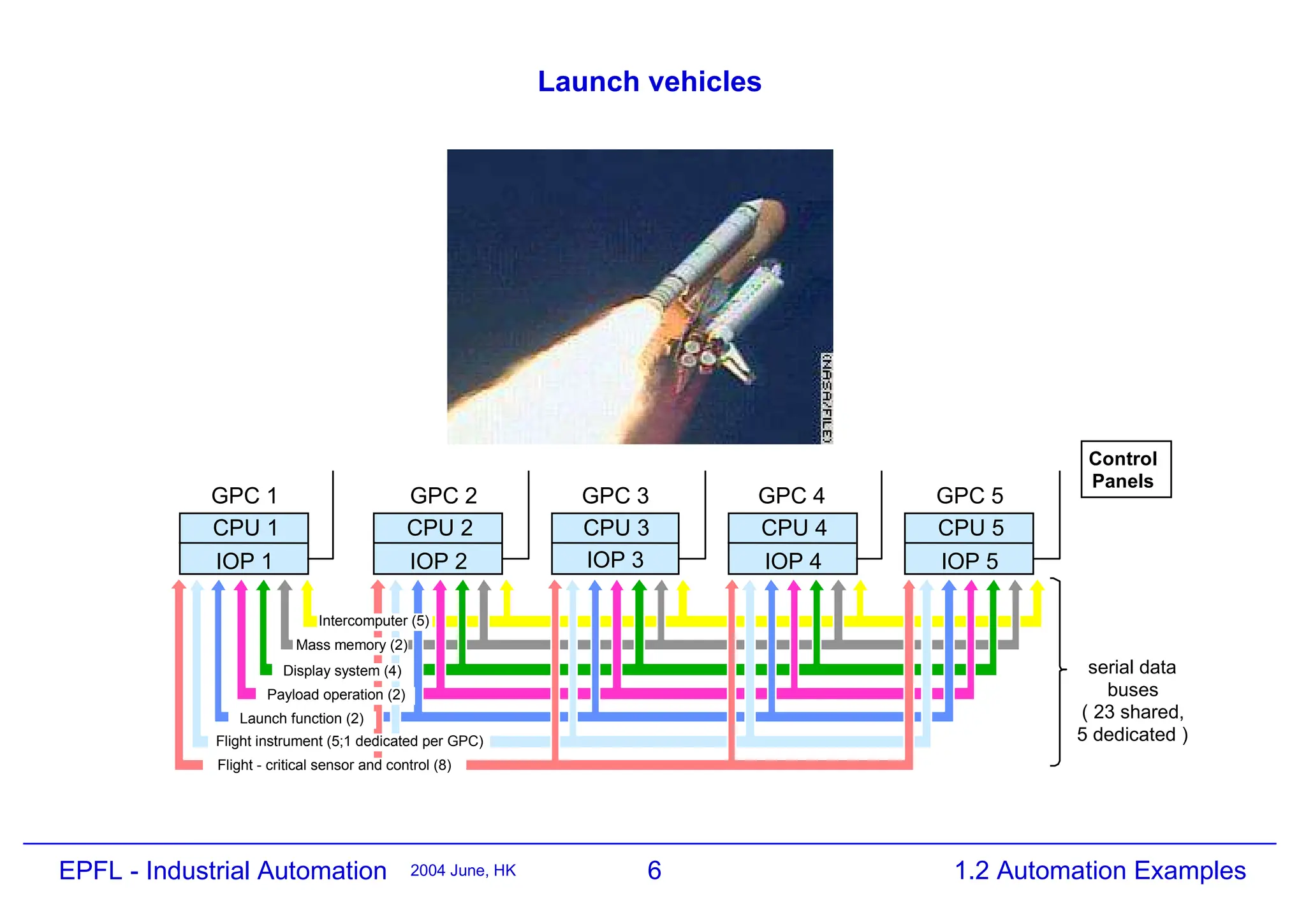
Launch vehicles
serial data
buses
( 23 shared,
5 dedicated )
GPC 5
IOP 5
GPC 4
IOP 4
GPC 3
IOP 3
GPC 2
IOP 2
GPC 1
IOP 1
Intercomputer (5)
Mass memory (2)
Display system (4)
Payload operation (2)
Launch function (2)
Flight instrument (5;1 dedicated per GPC)
Flight - critical sensor and control (8)
Control
Panels
CPU 1 CPU 2 CPU 3 CPU 4 CPU 5
7
2004 June, HK 1.2 Automation Examples
EPFL - Industrial Automation
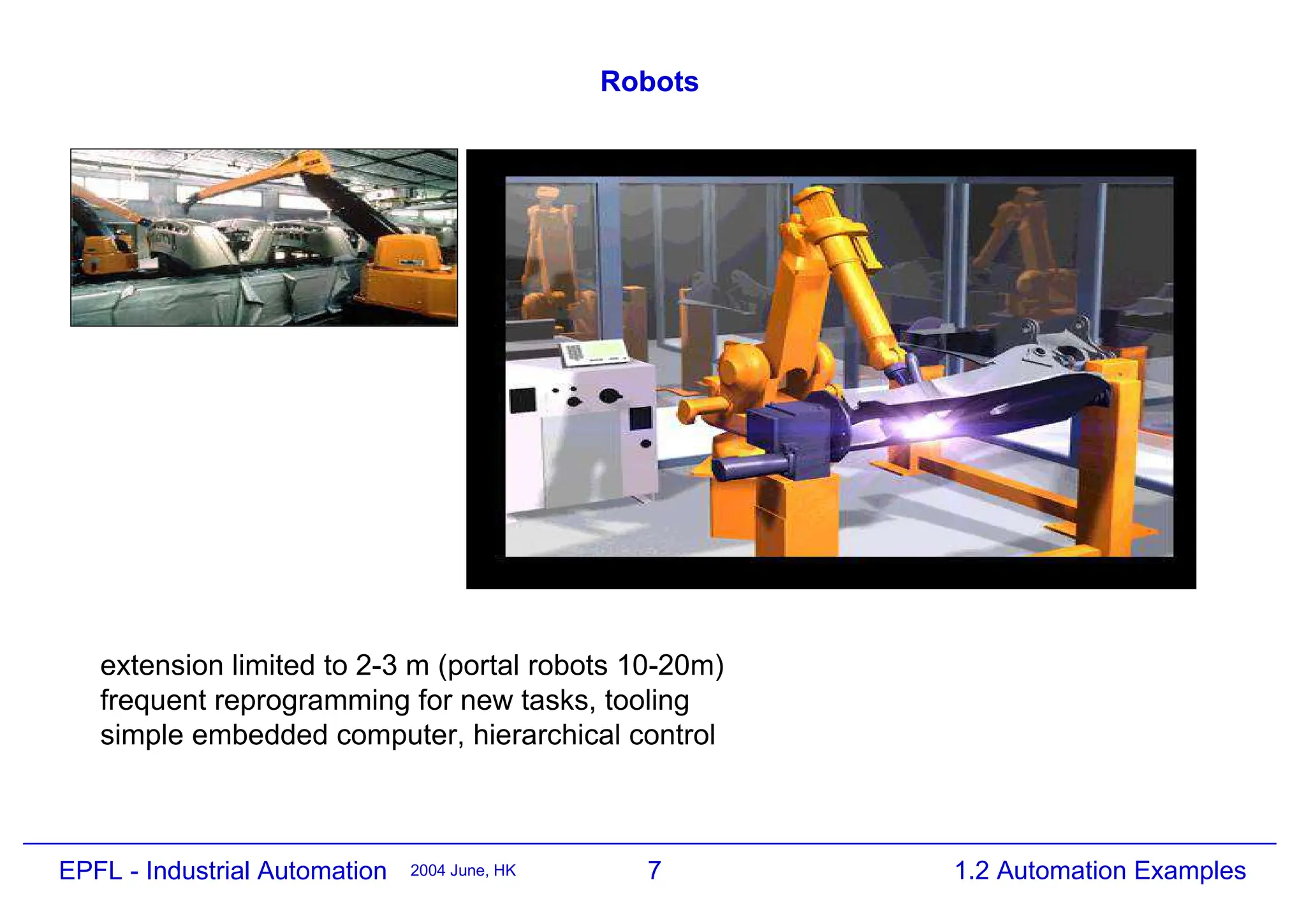
Robots
extension limited to 2-3 m (portal robots 10-20m)
frequent reprogramming for new tasks, tooling
simple embedded computer, hierarchical control
8
2004 June, HK 1.2 Automation Examples
EPFL - Industrial Automation
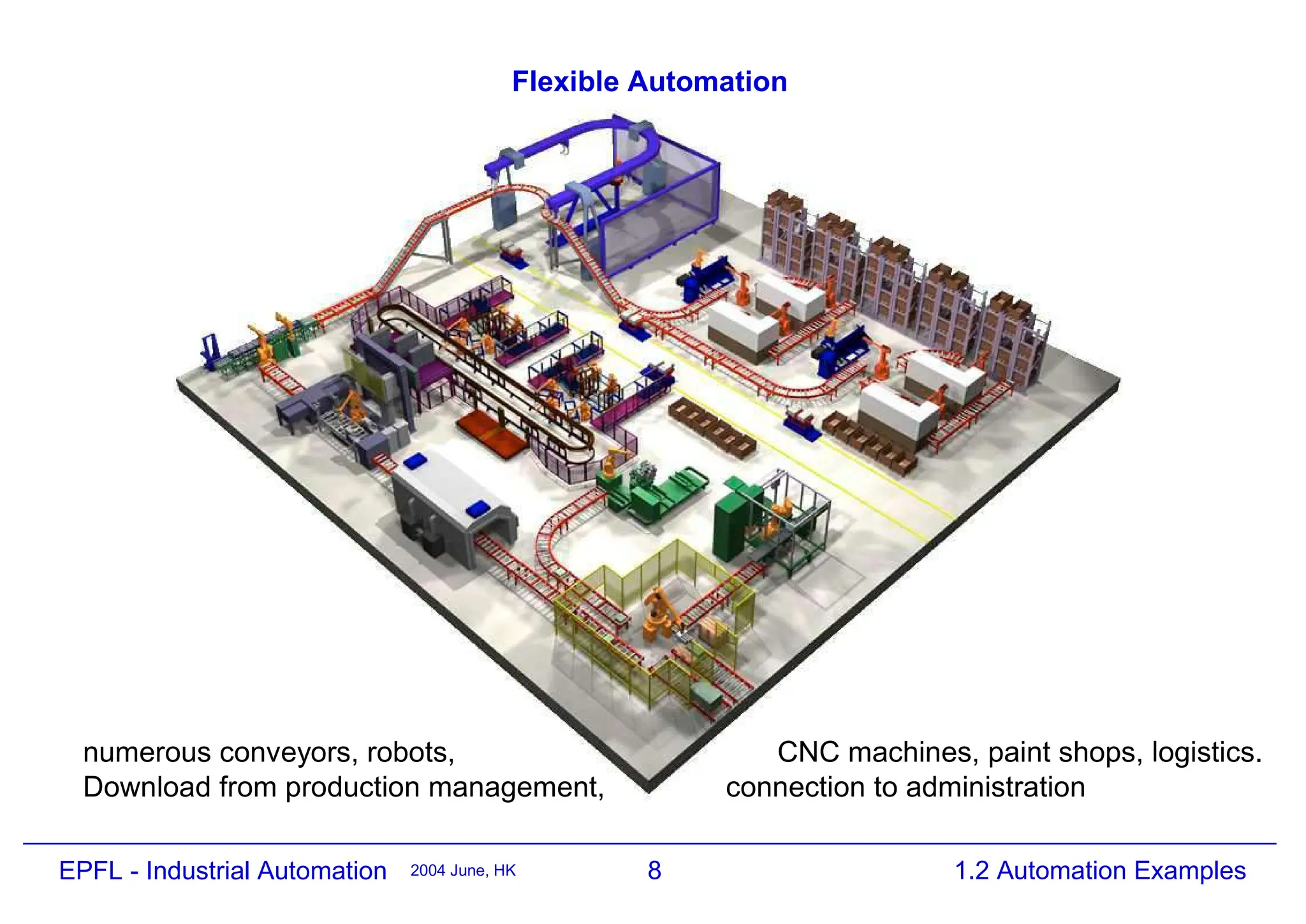
Flexible Automation
numerous conveyors, robots, CNC machines, paint shops, logistics.
Download from production management, connection to administration
9
2004 June, HK 1.2 Automation Examples
EPFL - Industrial Automation
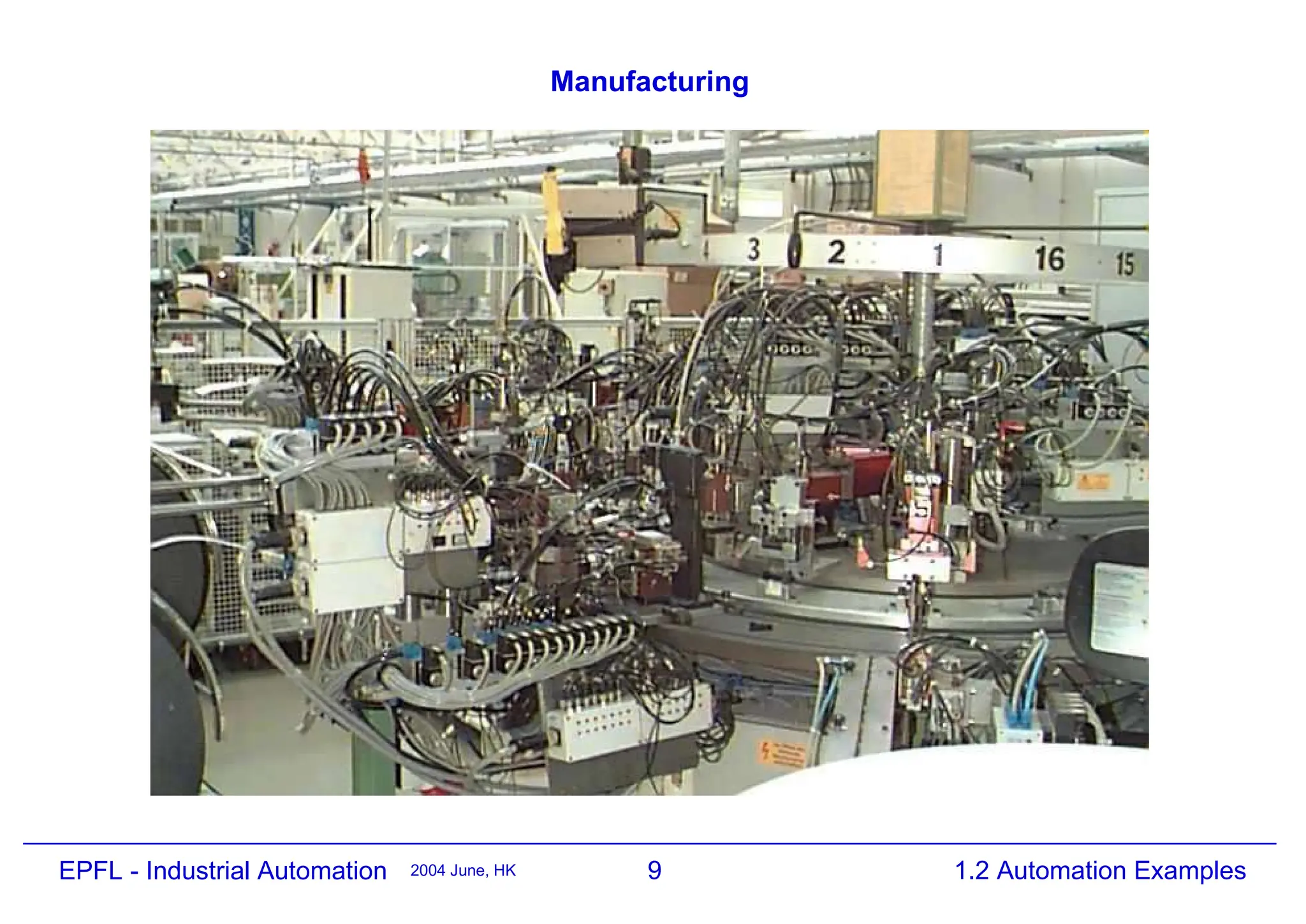
Manufacturing
10
2004 June, HK 1.2 Automation Examples
EPFL - Industrial Automation
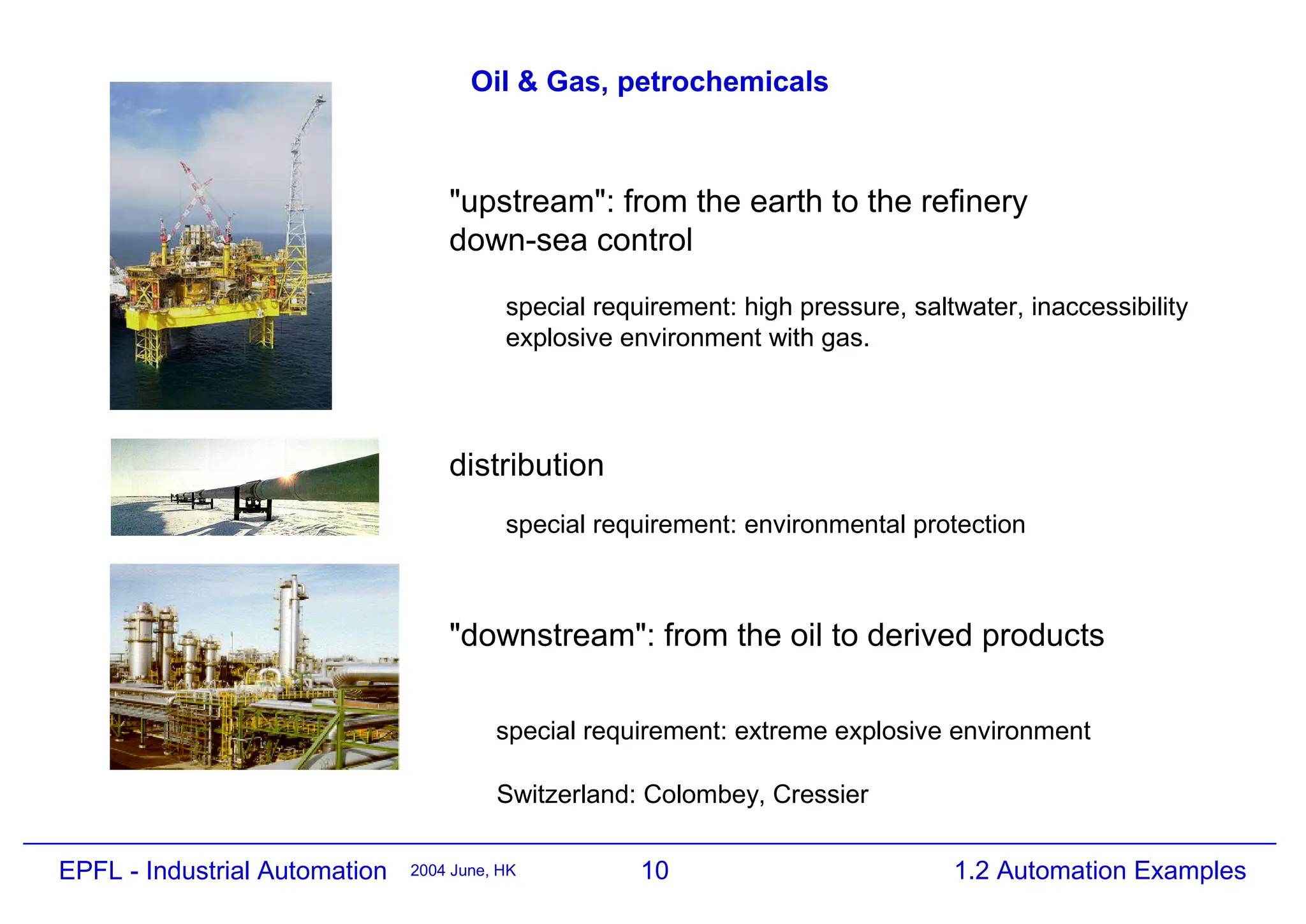
Oil & Gas, petrochemicals
"upstream": from the earth to the refinery
down-sea control
"downstream": from the oil to derived products
special requirement: extreme explosive environment
distribution
special requirement: high pressure, saltwater, inaccessibility
explosive environment with gas.
special requirement: environmental protection
Switzerland: Colombey, Cressier
11
2004 June, HK 1.2 Automation Examples
EPFL - Industrial Automation
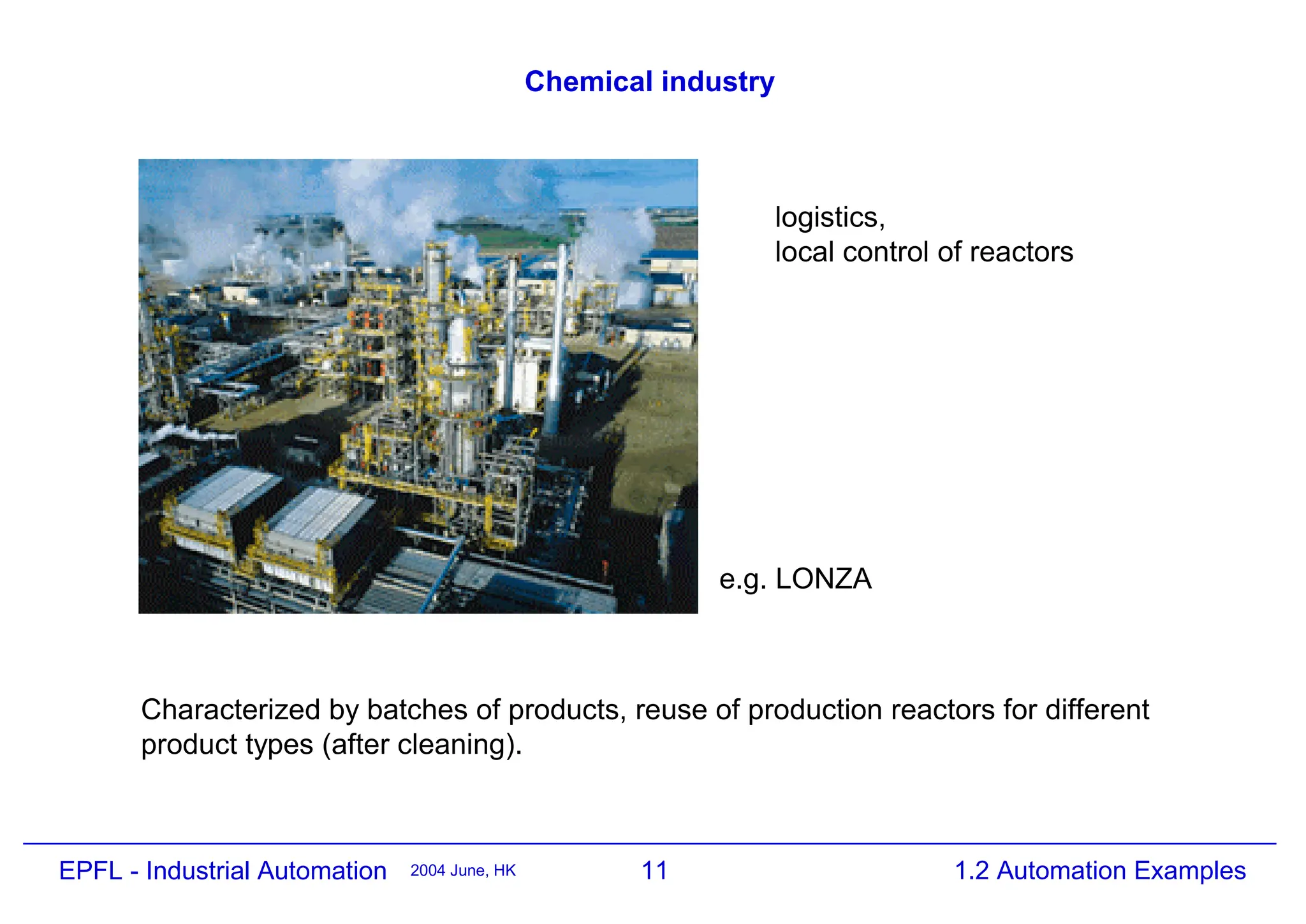
Chemical industry
e.g. LONZA
logistics,
local control of reactors
Characterized by batches of products, reuse of production reactors for different
product types (after cleaning).
12
2004 June, HK 1.2 Automation Examples
EPFL - Industrial Automation
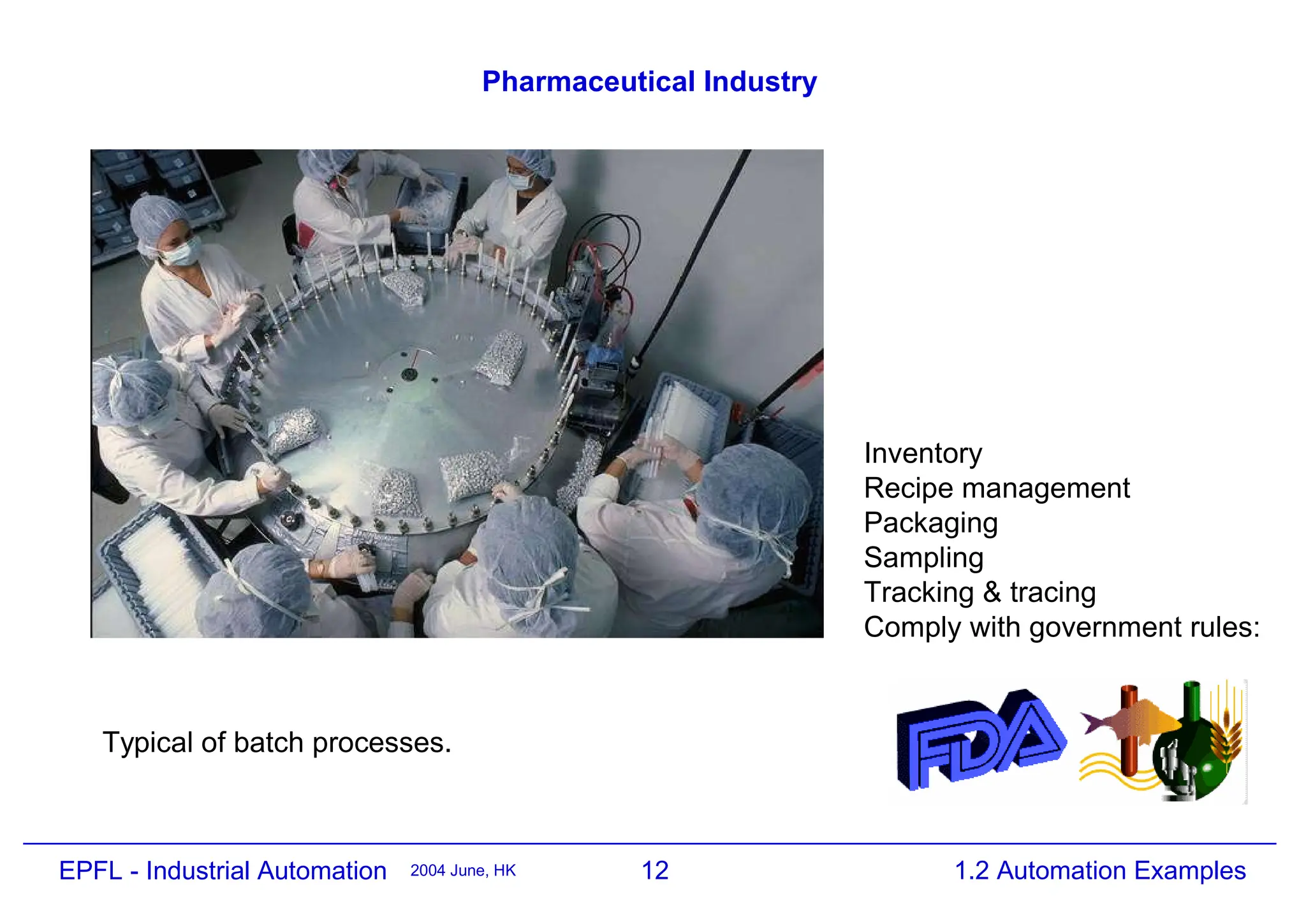
Pharmaceutical Industry
Inventory
Recipe management
Packaging
Sampling
Tracking & tracing
Comply with government rules:
Typical of batch processes.
13
2004 June, HK 1.2 Automation Examples
EPFL - Industrial Automation
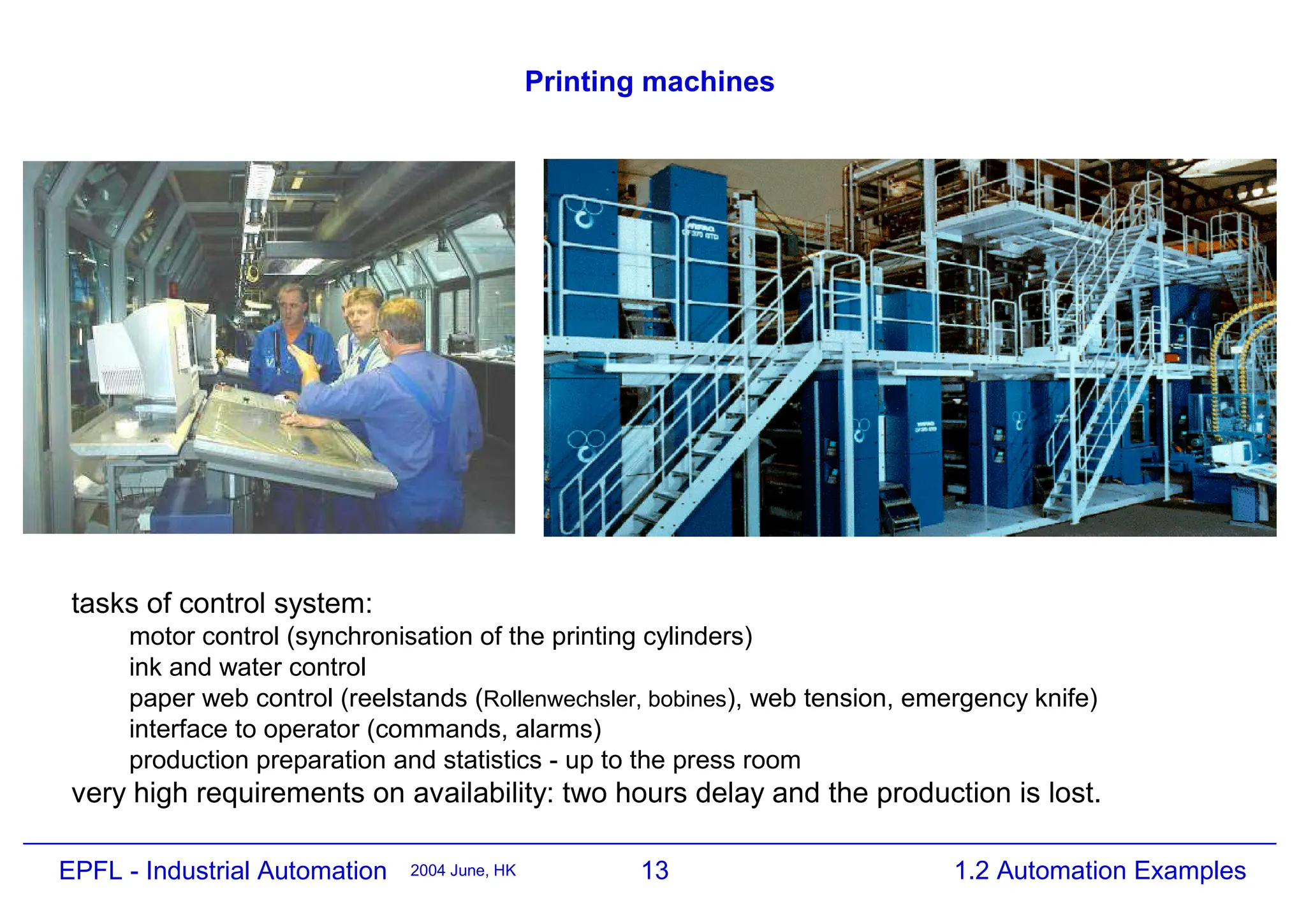
Printing machines
tasks of control system:
motor control (synchronisation of the printing cylinders)
ink and water control
paper web control (reelstands (Rollenwechsler, bobines), web tension, emergency knife)
interface to operator (commands, alarms)
production preparation and statistics - up to the press room
very high requirements on availability: two hours delay and the production is lost.
14
2004 June, HK 1.2 Automation Examples
EPFL - Industrial Automation
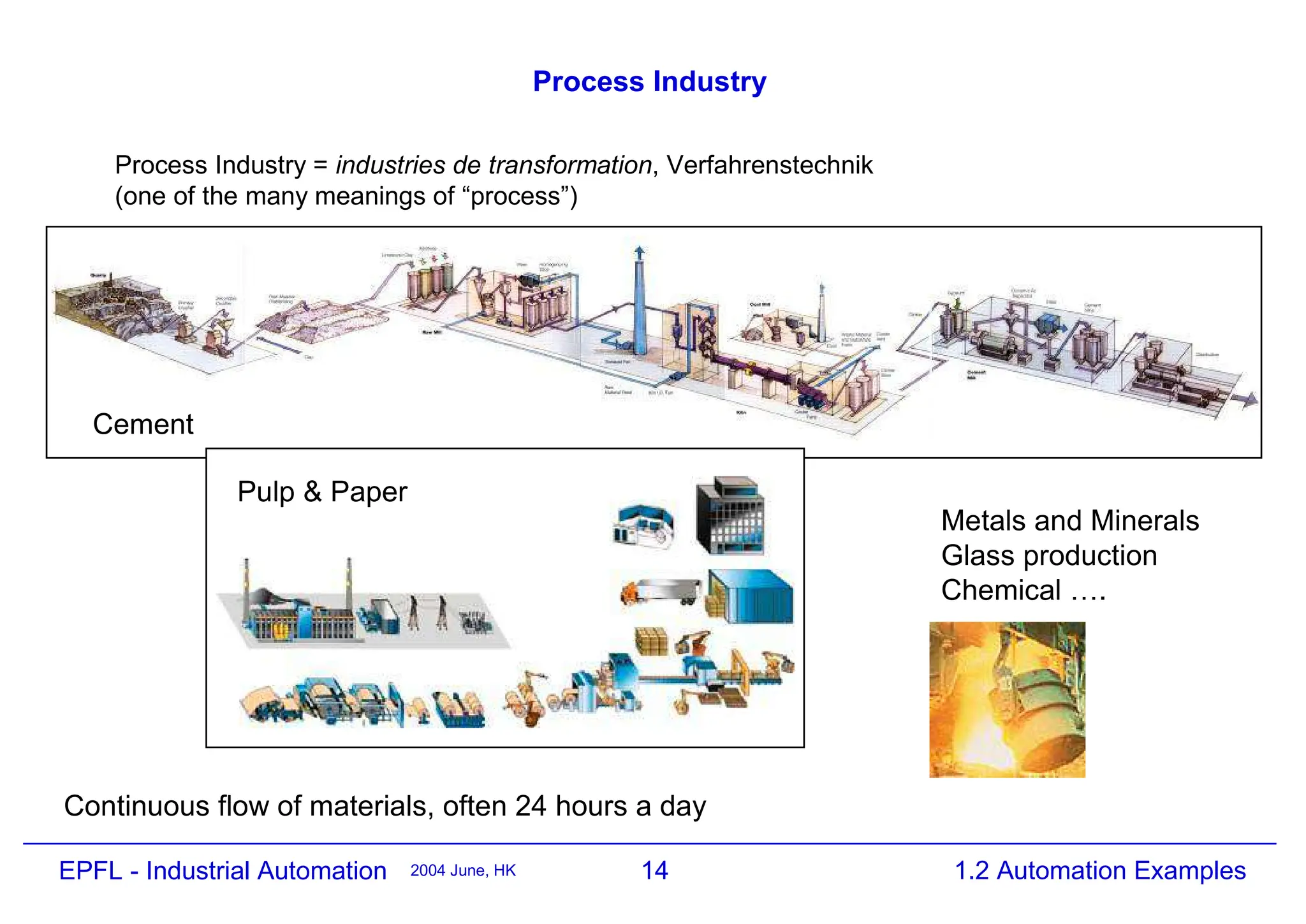
Process Industry
Metals and Minerals
Glass production
Chemical ….
Process Industry = industries de transformation, Verfahrenstechnik
(one of the many meanings of “process”)
Cement
Pulp & Paper
Continuous flow of materials, often 24 hours a day
15
2004 June, HK 1.2 Automation Examples
EPFL - Industrial Automation
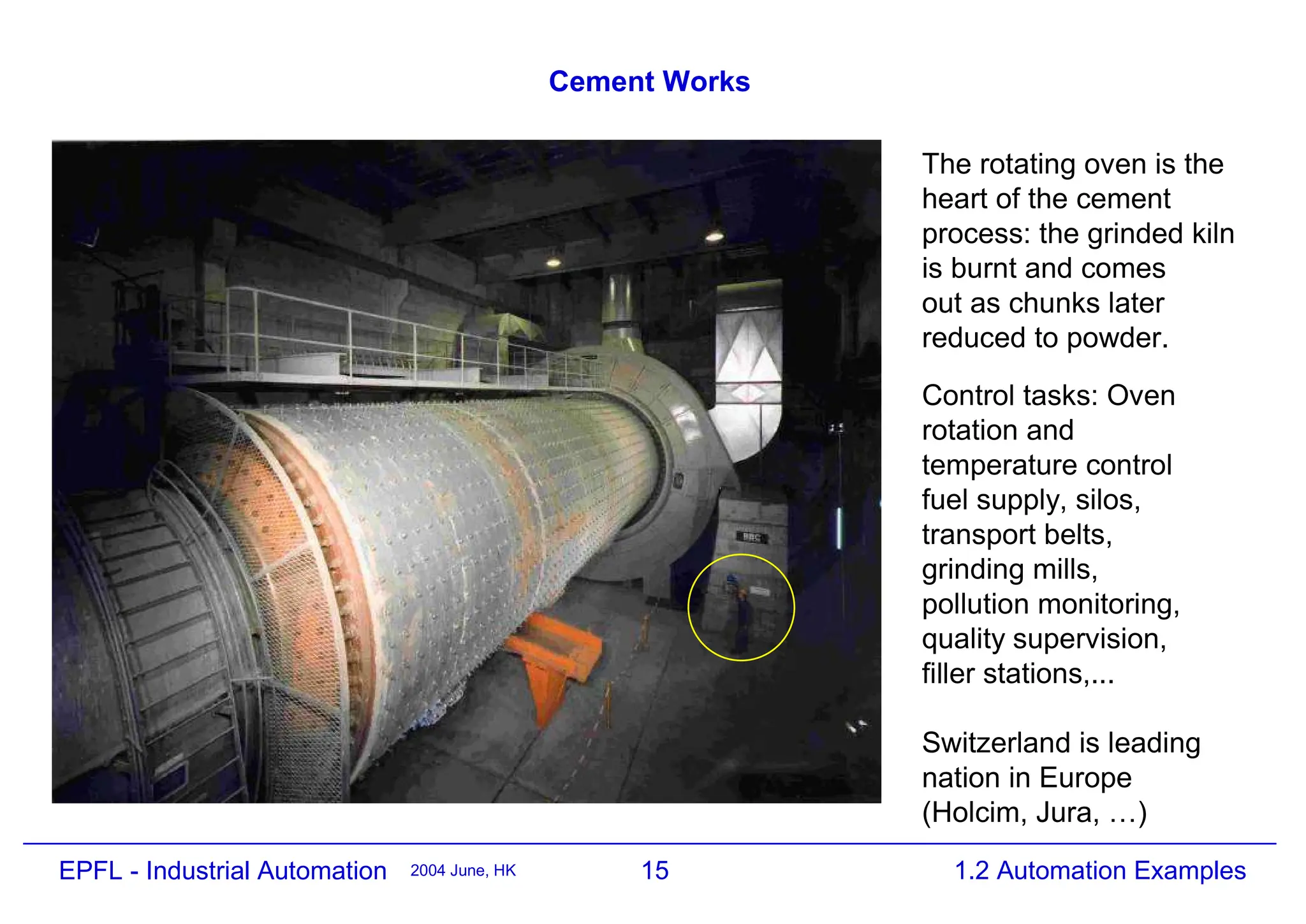
Cement Works
Control tasks: Oven
rotation and
temperature control
fuel supply, silos,
transport belts,
grinding mills,
pollution monitoring,
quality supervision,
filler stations,...
Switzerland is leading
nation in Europe
(Holcim, Jura, …)
The rotating oven is the
heart of the cement
process: the grinded kiln
is burnt and comes
out as chunks later
reduced to powder.
16
2004 June, HK 1.2 Automation Examples
EPFL - Industrial Automation
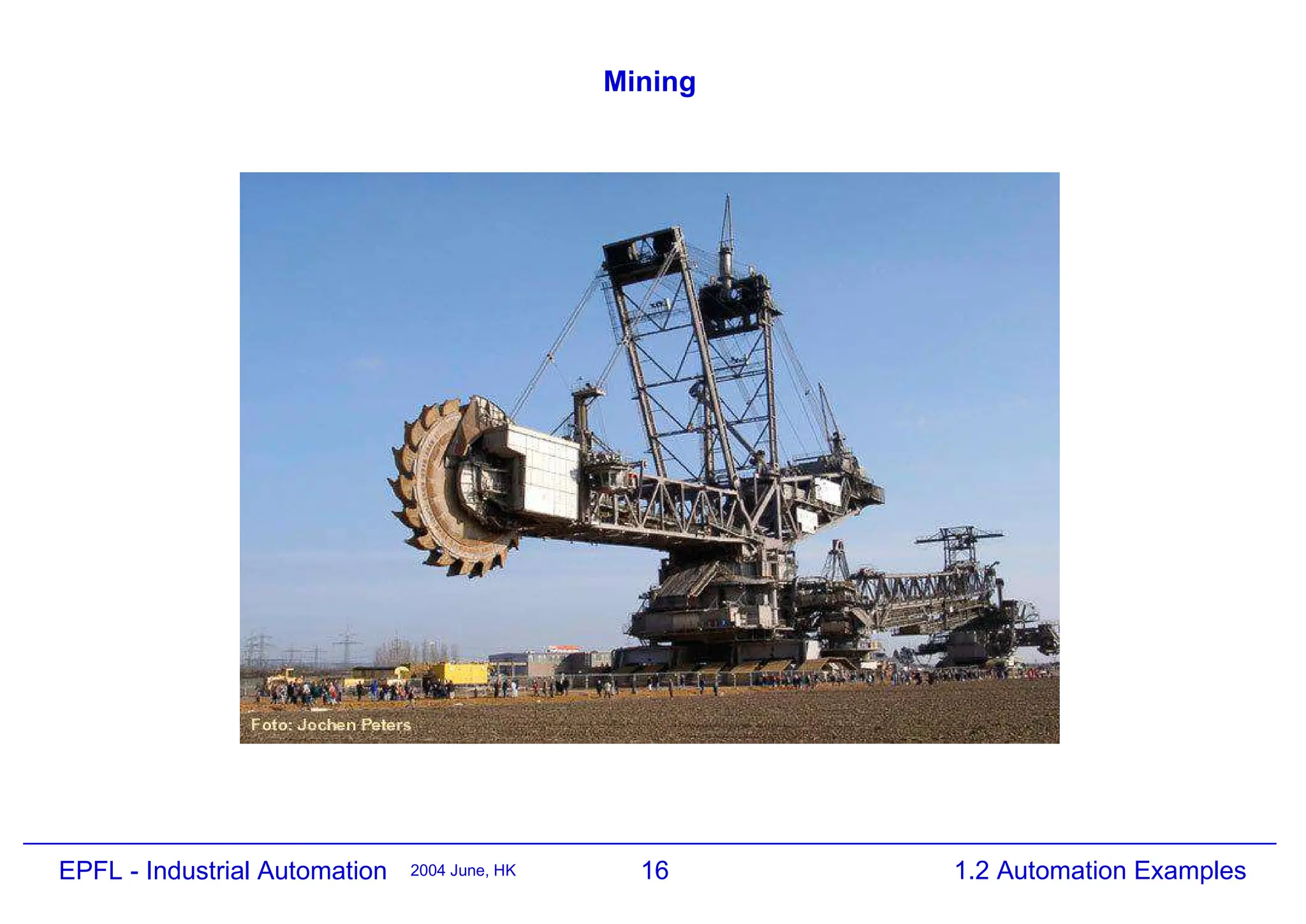
Mining
17
2004 June, HK 1.2 Automation Examples
EPFL - Industrial Automation
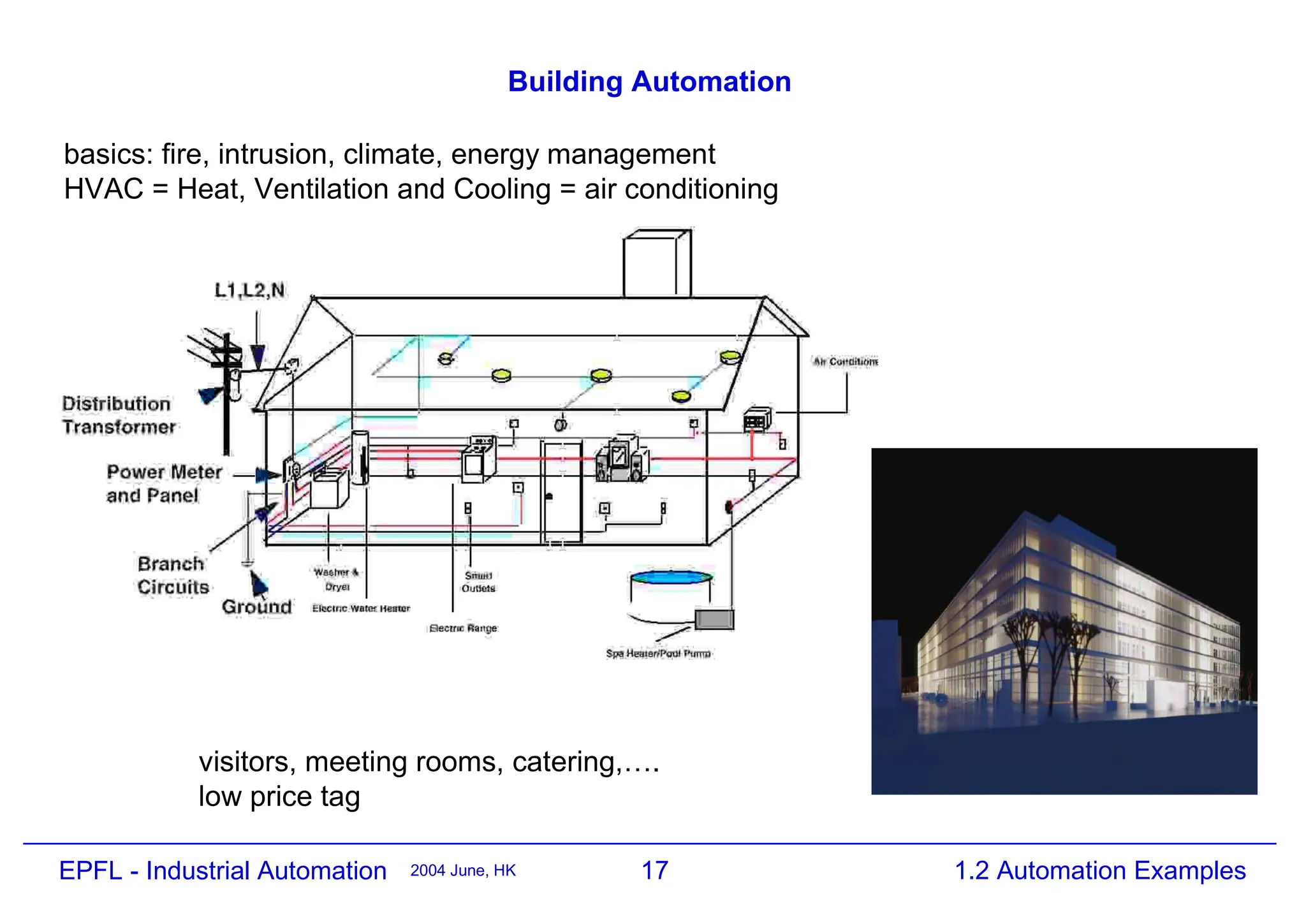
Building Automation
basics: fire, intrusion, climate, energy management
HVAC = Heat, Ventilation and Cooling = air conditioning
visitors, meeting rooms, catering,….
low price tag
18
2004 June, HK 1.2 Automation Examples
EPFL - Industrial Automation
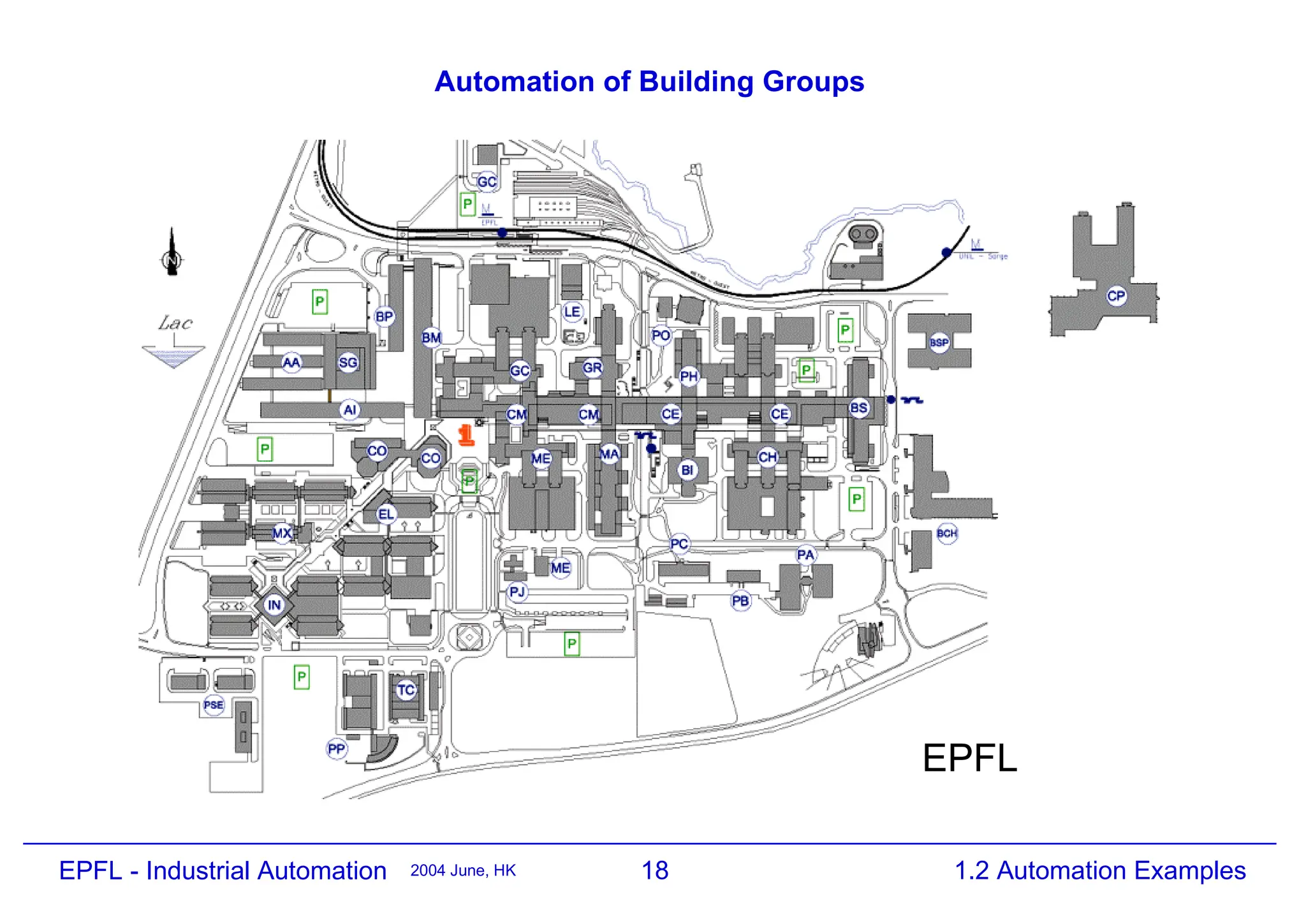
Automation of Building Groups
EPFL
19
2004 June, HK 1.2 Automation Examples
EPFL - Industrial Automation
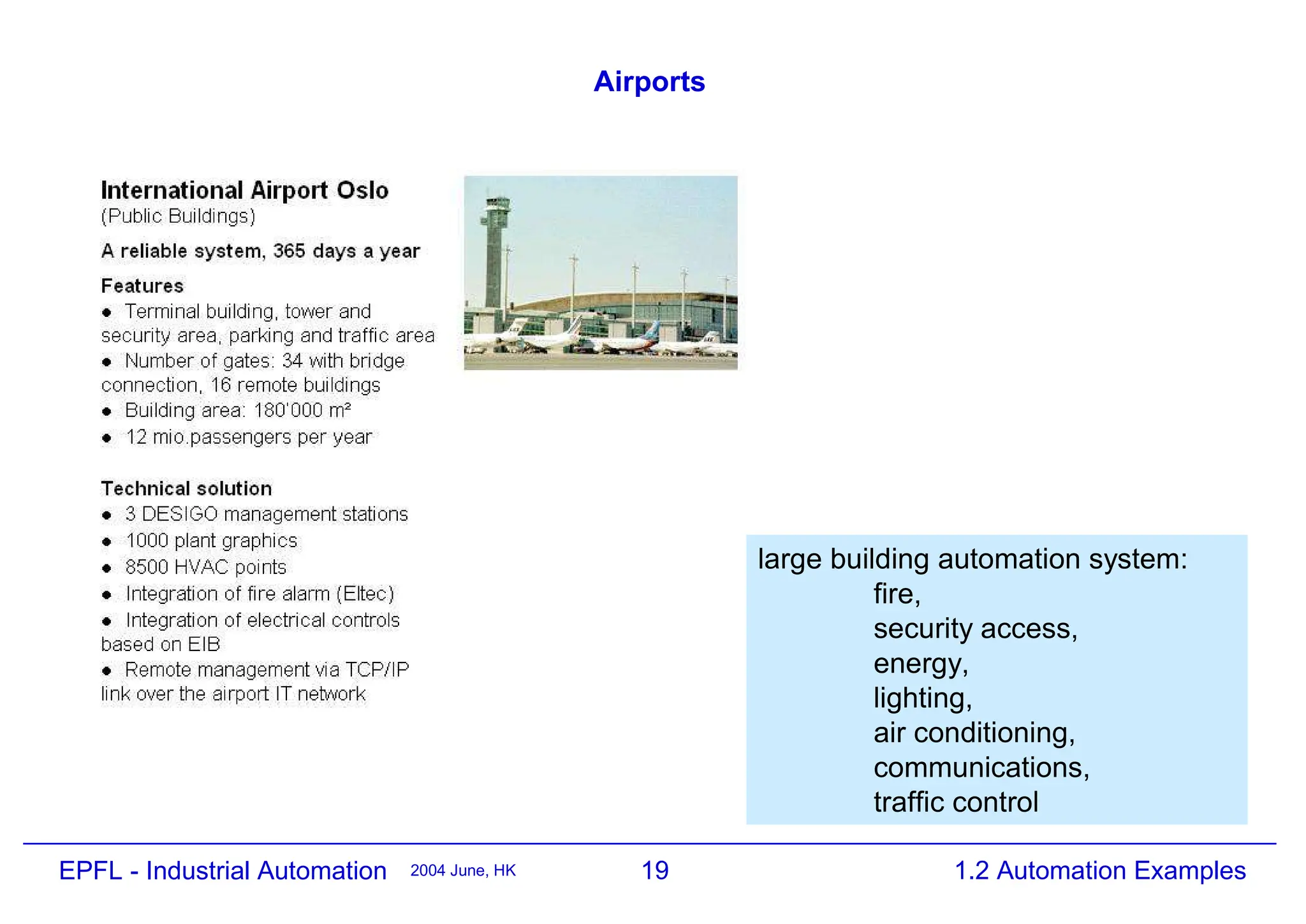
Airports
large building automation system:
fire,
security access,
energy,
lighting,
air conditioning,
communications,
traffic control
20
2004 June, HK 1.2 Automation Examples
EPFL - Industrial Automation
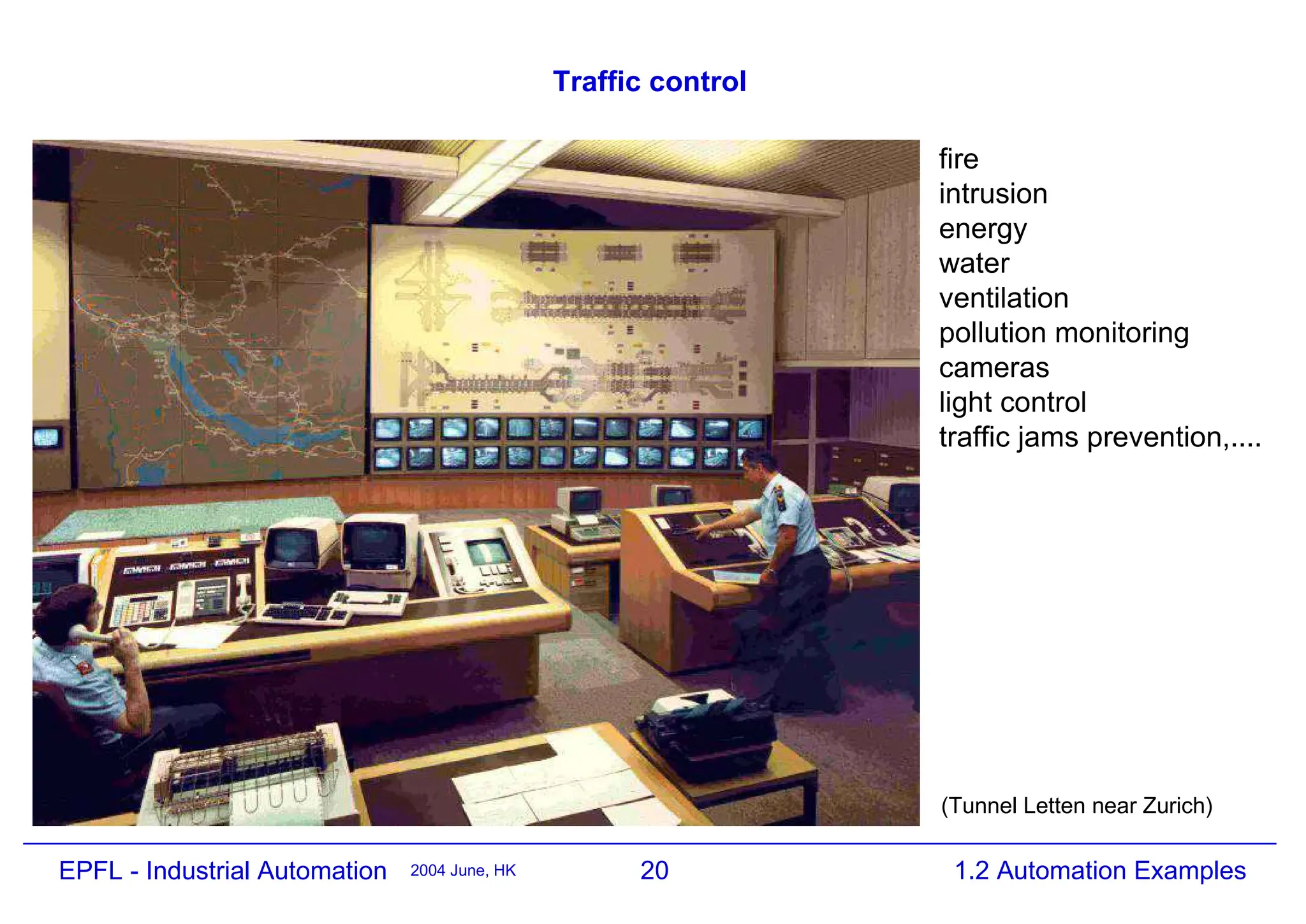
Traffic control
fire
intrusion
energy
water
ventilation
pollution monitoring
cameras
light control
traffic jams prevention,....
(Tunnel Letten near Zurich)
21
2004 June, HK 1.2 Automation Examples
EPFL - Industrial Automation
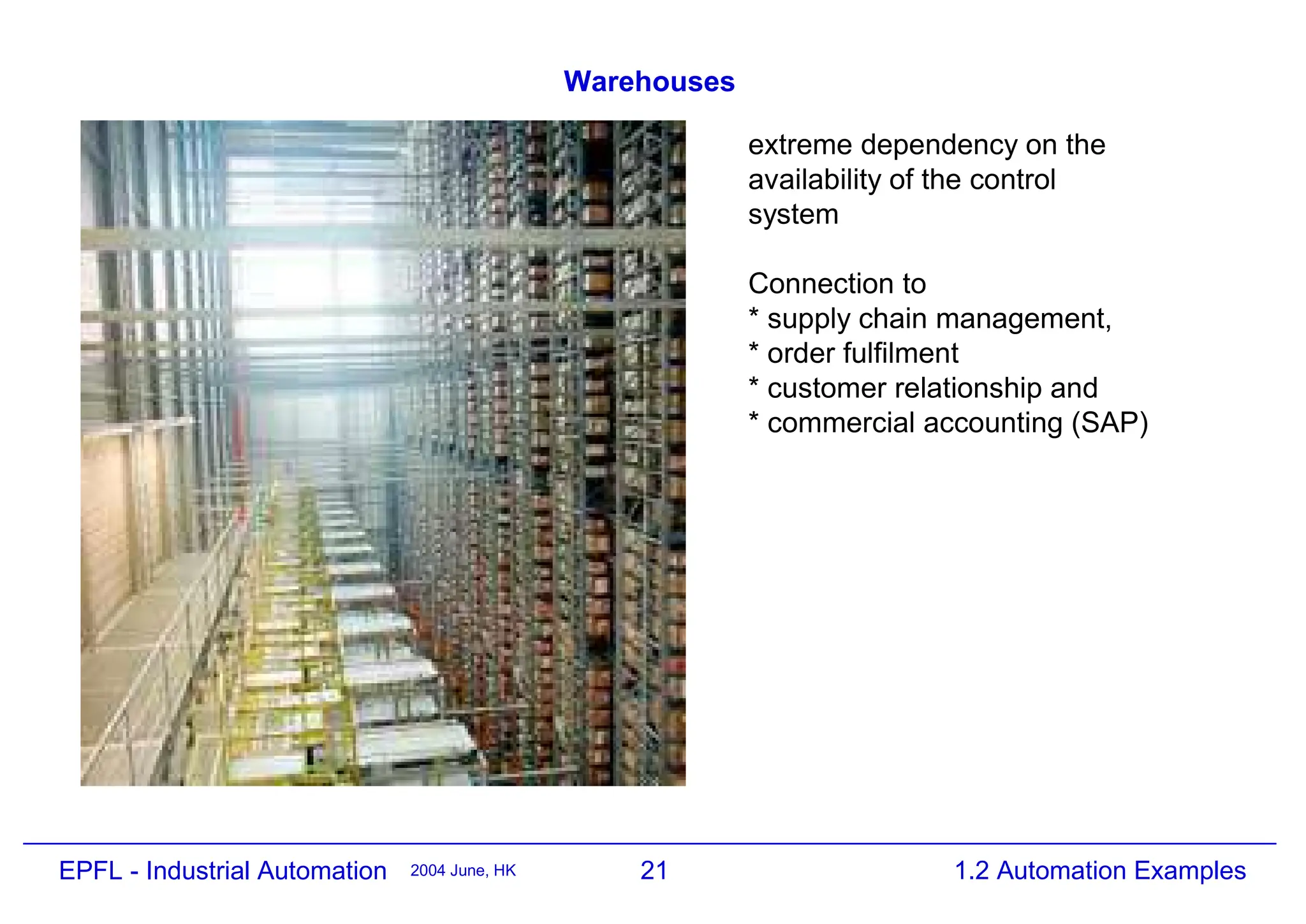
Warehouses
extreme dependency on the
availability of the control
system
Connection to
* supply chain management,
* order fulfilment
* customer relationship and
* commercial accounting (SAP)
22
2004 June, HK 1.2 Automation Examples
EPFL - Industrial Automation
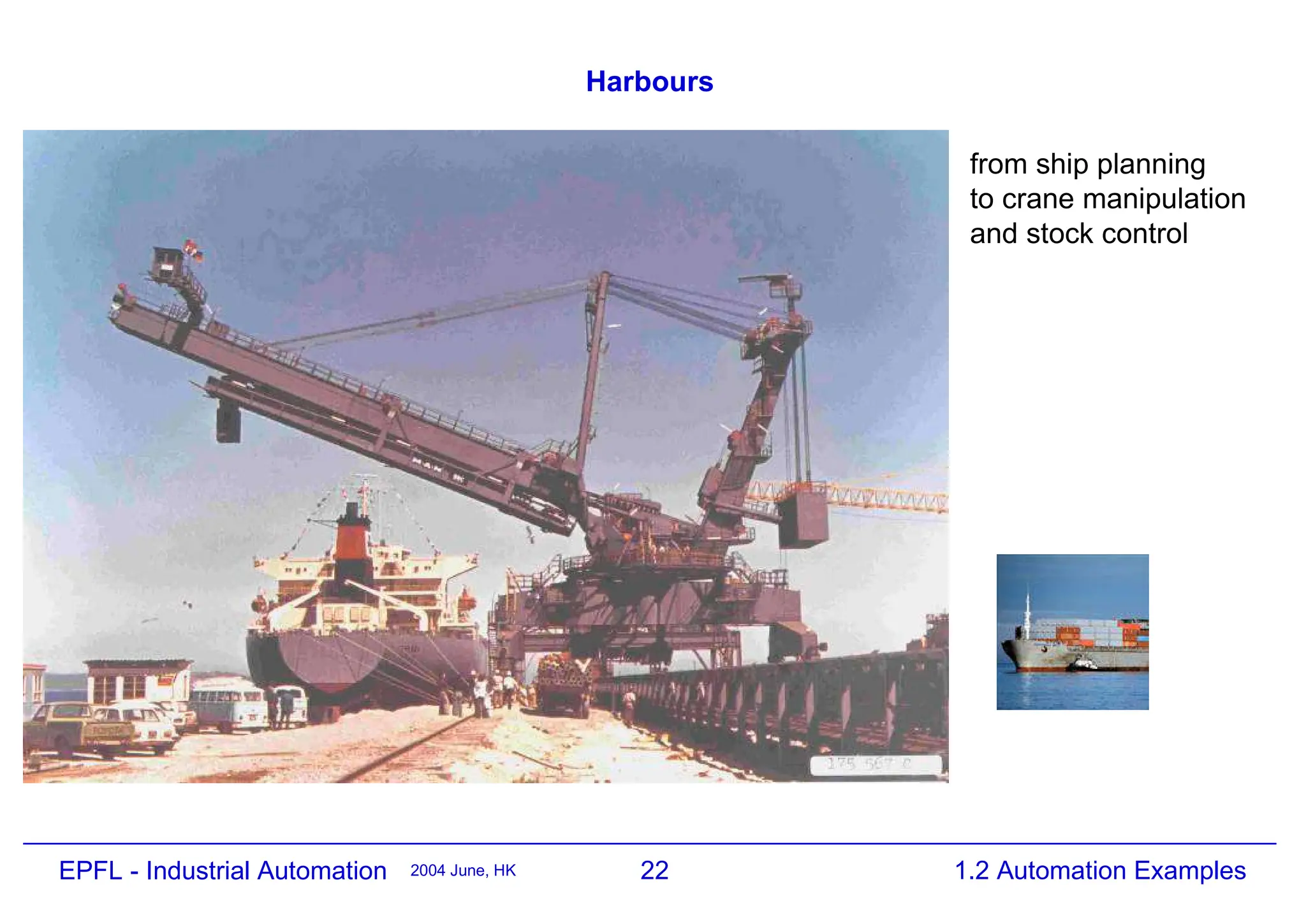
Harbours
from ship planning
to crane manipulation
and stock control
23
2004 June, HK 1.2 Automation Examples
EPFL - Industrial Automation
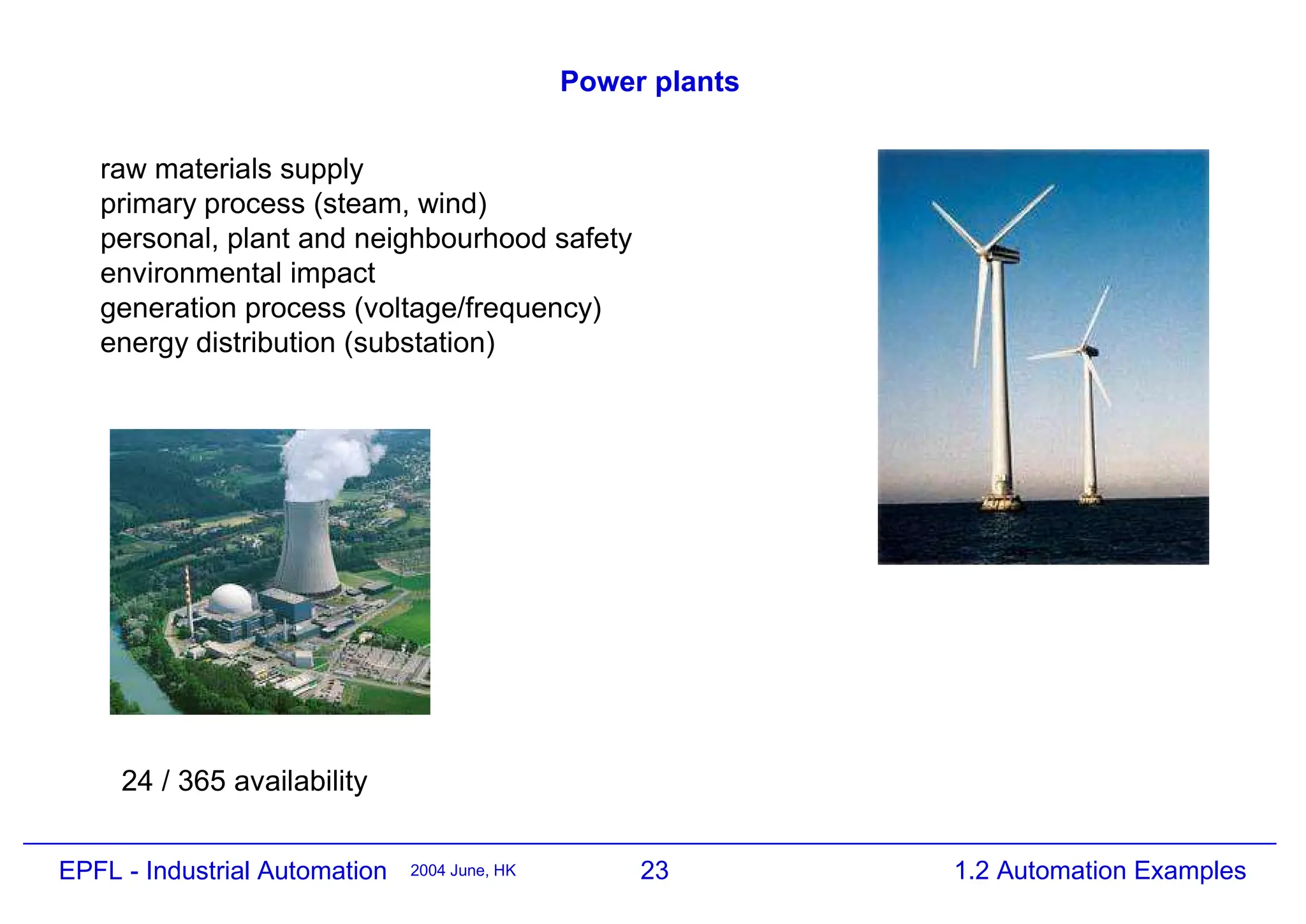
Power plants
raw materials supply
primary process (steam, wind)
personal, plant and neighbourhood safety
environmental impact
generation process (voltage/frequency)
energy distribution (substation)
24 / 365 availability
24
2004 June, HK 1.2 Automation Examples
EPFL - Industrial Automation
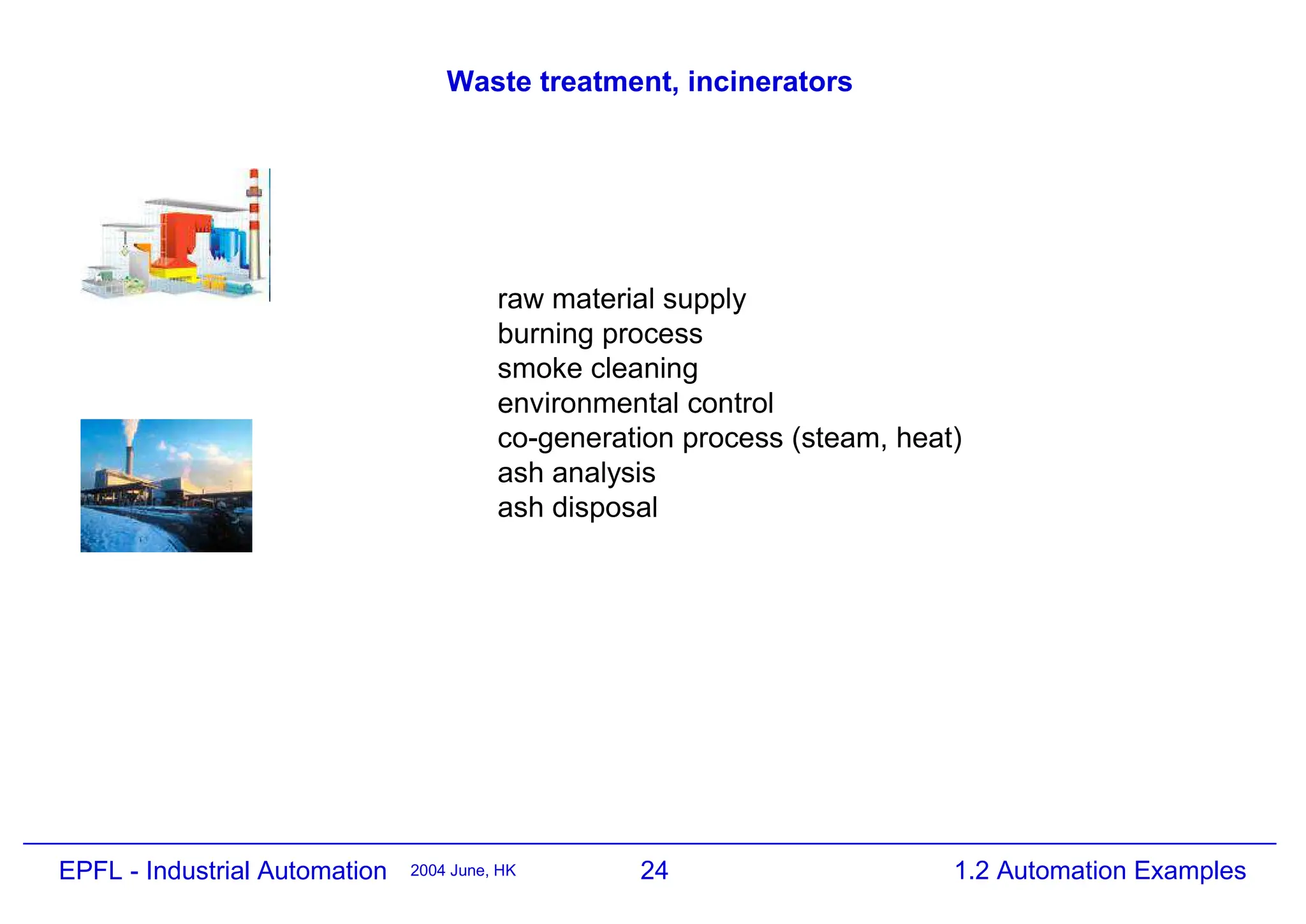
Waste treatment, incinerators
raw material supply
burning process
smoke cleaning
environmental control
co-generation process (steam, heat)
ash analysis
ash disposal
25
2004 June, HK 1.2 Automation Examples
EPFL - Industrial Automation
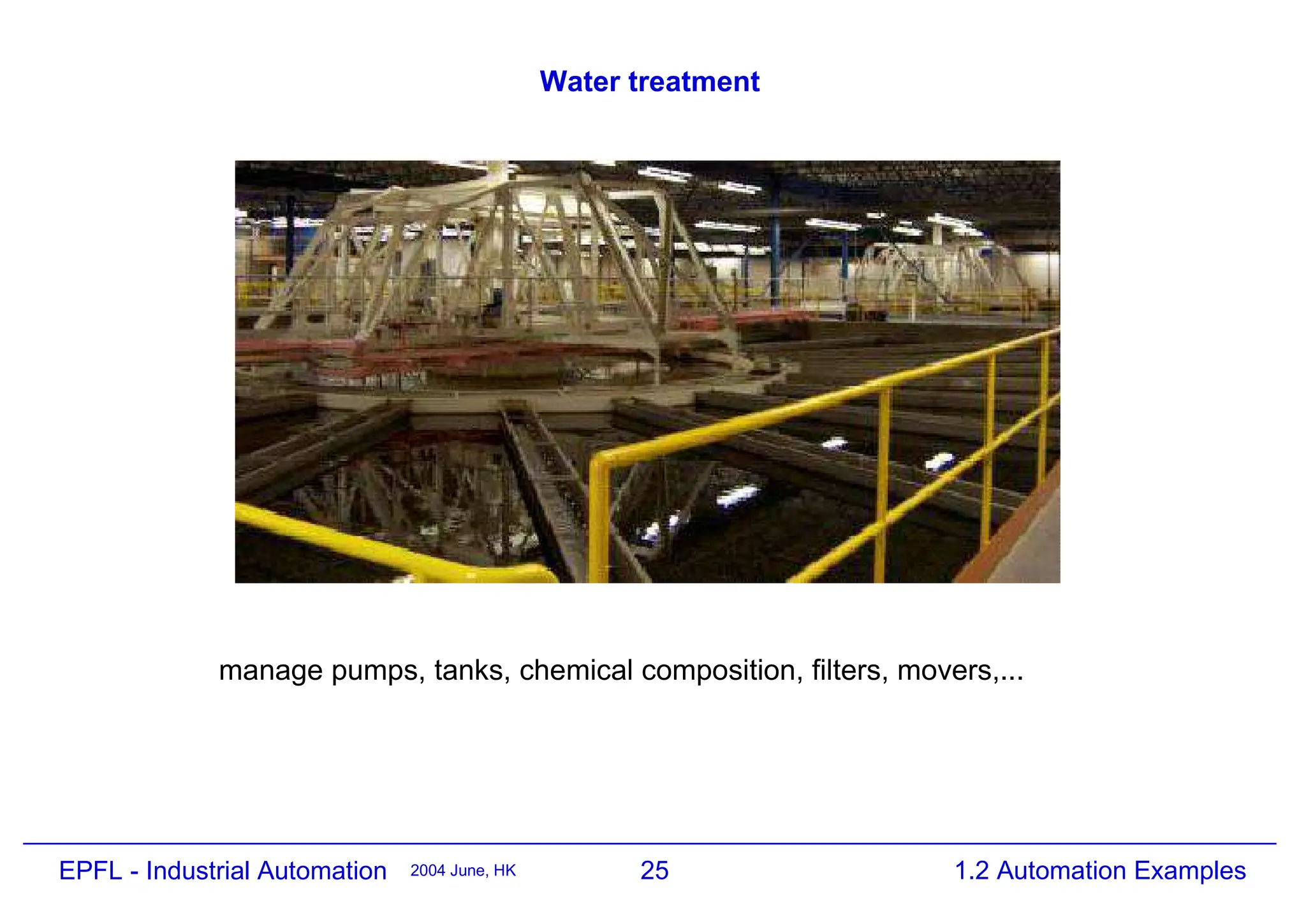
Water treatment
manage pumps, tanks, chemical composition, filters, movers,...
26
2004 June, HK 1.2 Automation Examples
EPFL - Industrial Automation
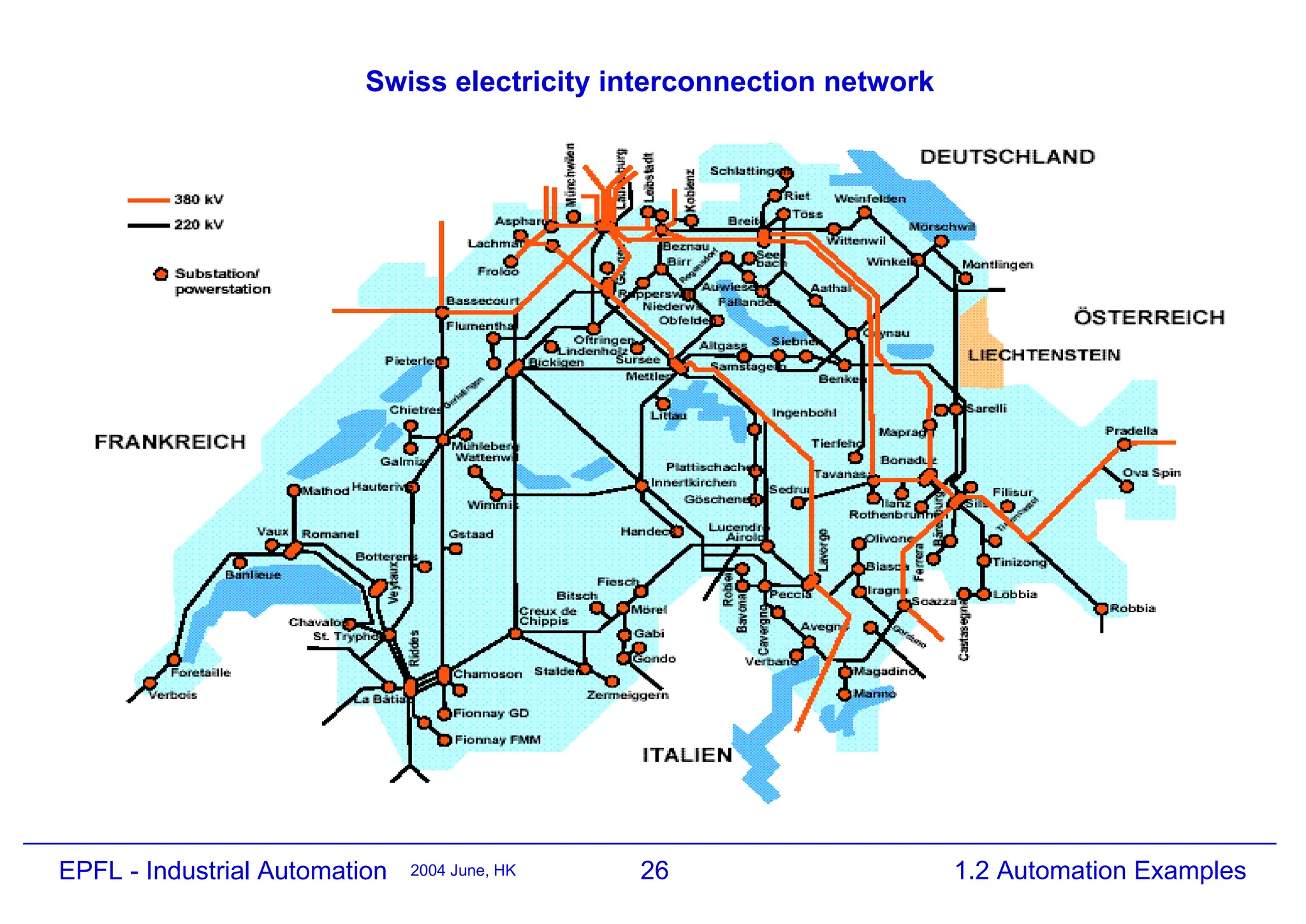
Swiss electricity interconnection network
27
2004 June, HK 1.2 Automation Examples
EPFL - Industrial Automation
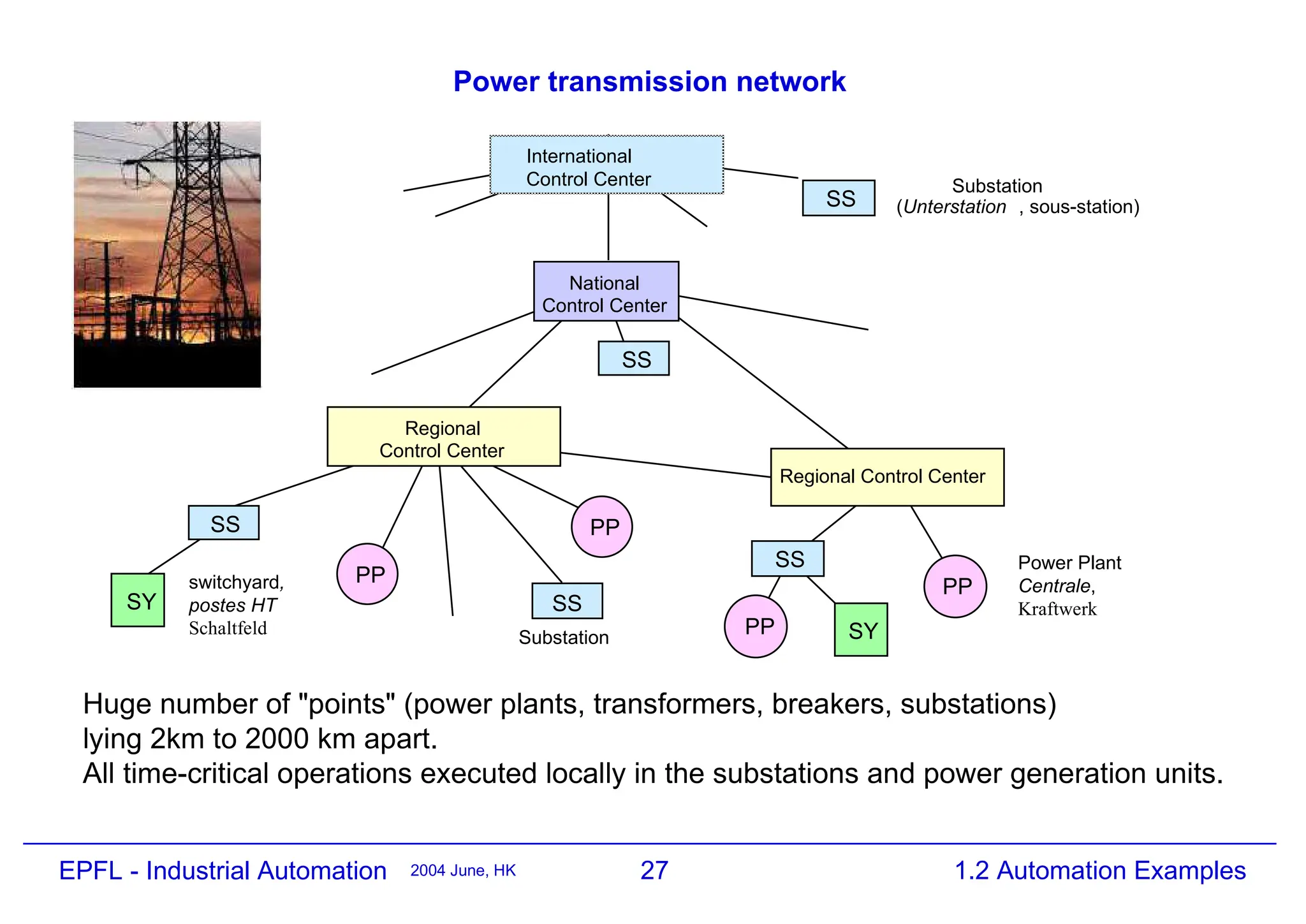
Power transmission network
Power Plant
Centrale,
Kraftwerk
switchyard,
postes HT
Schaltfeld
SS
Regional
Control Center
Regional Control Center
PP
Substation
(Unterstation , sous-station)
SS
SS
PP
SS
PP
SY
SY
PP
Huge number of "points" (power plants, transformers, breakers, substations)
lying 2km to 2000 km apart.
All time-critical operations executed locally in the substations and power generation units.
International
Control Center
National
Control Center
SS
Substation
28
2004 June, HK 1.2 Automation Examples
EPFL - Industrial Automation
Assessment
1) describe some of the typical processes…
2) what is the process industry ?
3) what does upstream / downstream means ?
4) what is the task of a control system in an interconnection network ?
5) which computer functions do you know in a car and which are to come ?
6) draw an electricity network and show where data processing takes place and to which purpose
7) in the EPFL buildings, identify the automation components and their function.
8) what are the functions of the control computers in a locomotive ?
29
2004 June, HK 1.2 Automation Examples
EPFL - Industrial Automation
Types of Plants and Control
1.3 Systèmes contrôlés et contrôle
Strecken und Steuerungen
2005 March, HK
Prof. Dr. H. Kirrmann
ABB Research Center, Baden, Switzerland
Industrial Automation
Automation Industrielle
Industrielle Automation
1.3 Types of Plants and Controls
2/16
Industrial Automation
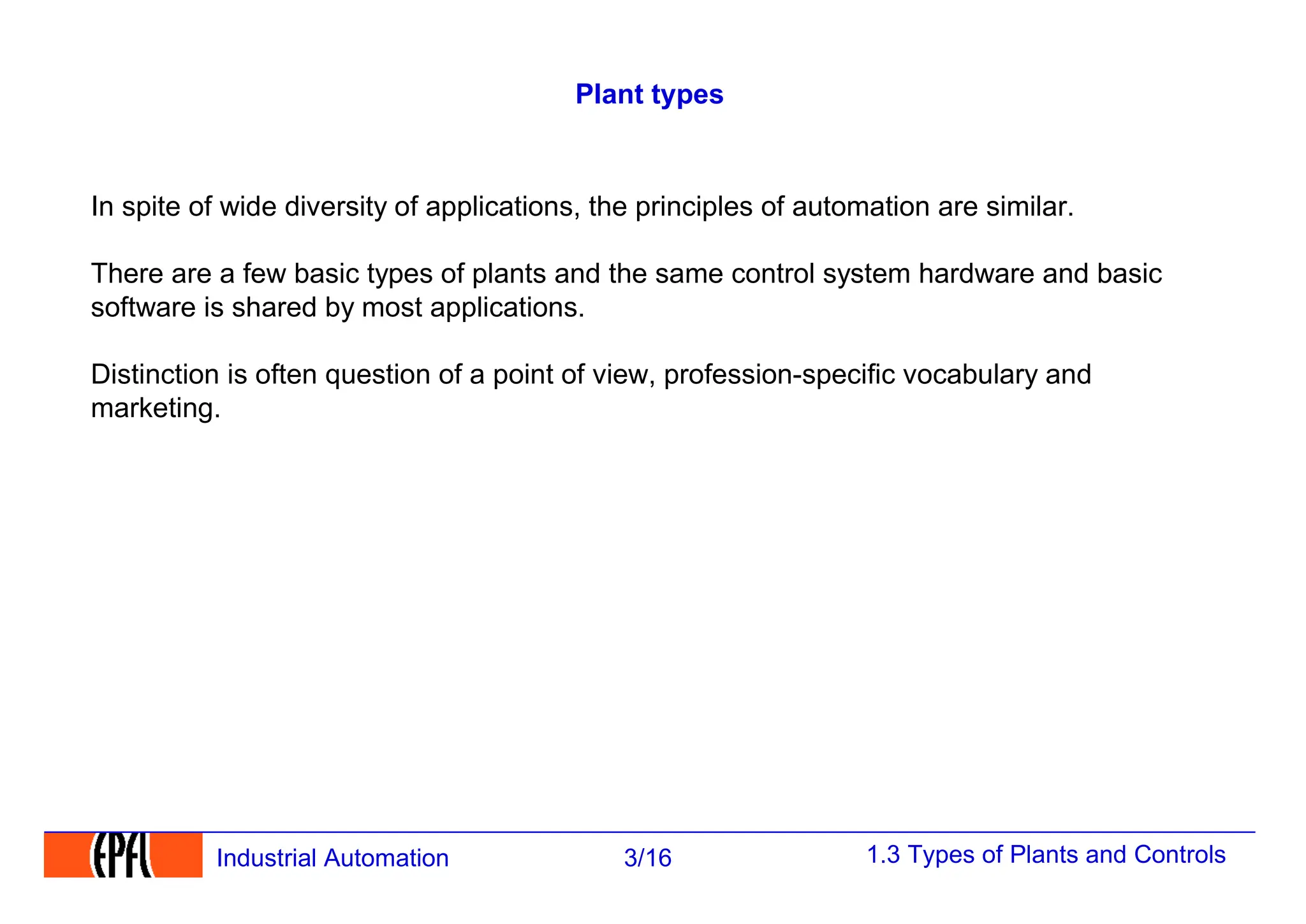
1.3 Contents
1 Introduction
1.1 Automation and its importance
1.2 Applications of automation
1.3 Plants and controls
1.3.1 Open loop and closed loop control
1.3.2 Continuous processes
1.3.3 Discrete processes
1.3.3 Mixed processes
1.4 Automation hierarchy
1.5 Control system architecture
1.3 Types of Plants and Controls
3/16
Industrial Automation
Plant types
In spite of wide diversity of applications, the principles of automation are similar.
There are a few basic types of plants and the same control system hardware and basic
software is shared by most applications.
Distinction is often question of a point of view, profession-specific vocabulary and
marketing.
1.3 Types of Plants and Controls
4/16
Industrial Automation
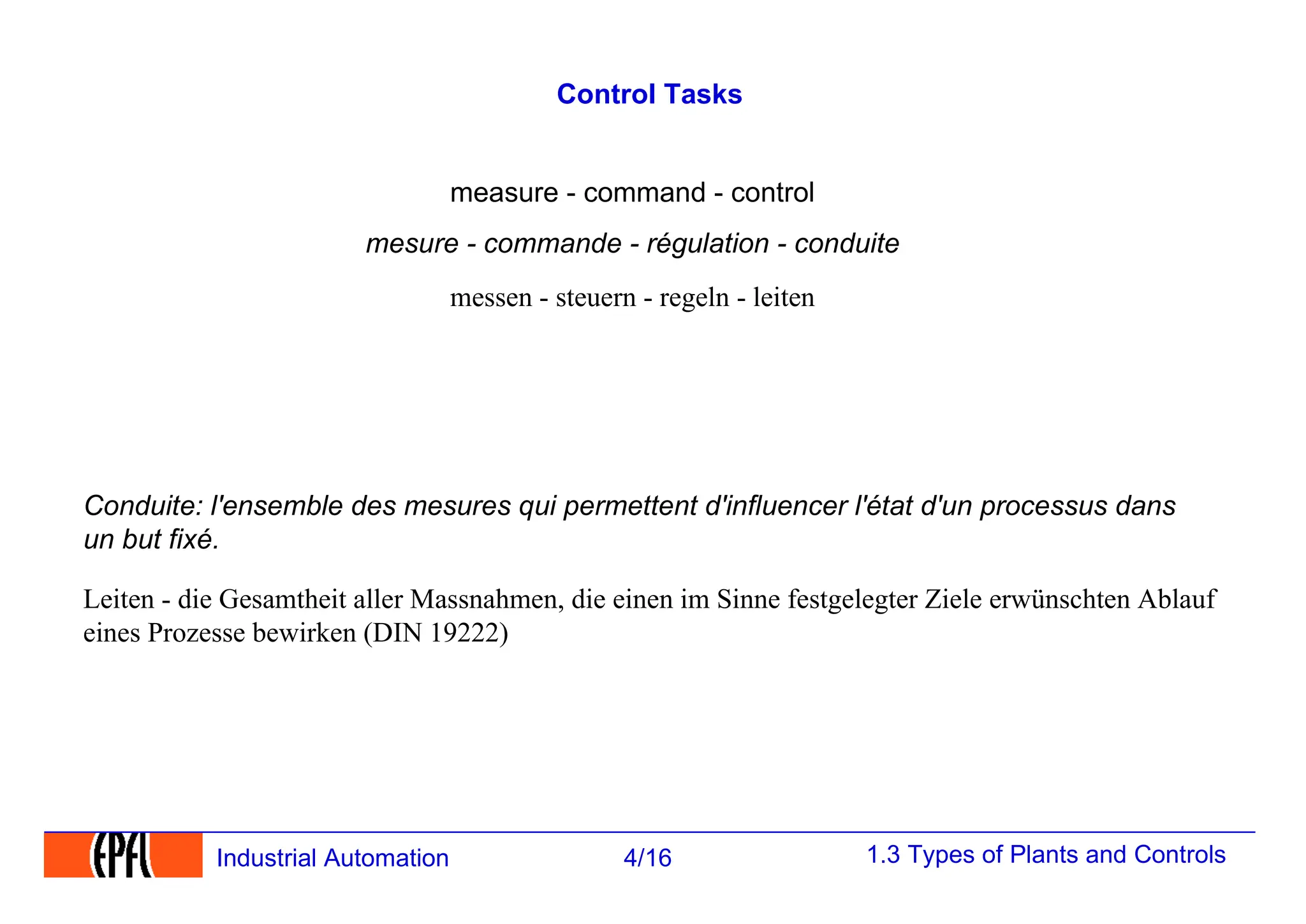
Control Tasks
Leiten - die Gesamtheit aller Massnahmen, die einen im Sinne festgelegter Ziele erwünschten Ablauf
eines Prozesse bewirken (DIN 19222)
Conduite: l'ensemble des mesures qui permettent d'influencer l'état d'un processus dans
un but fixé.
messen - steuern - regeln - leiten
mesure - commande - régulation - conduite
measure - command - control
1.3 Types of Plants and Controls
5/16
Industrial Automation
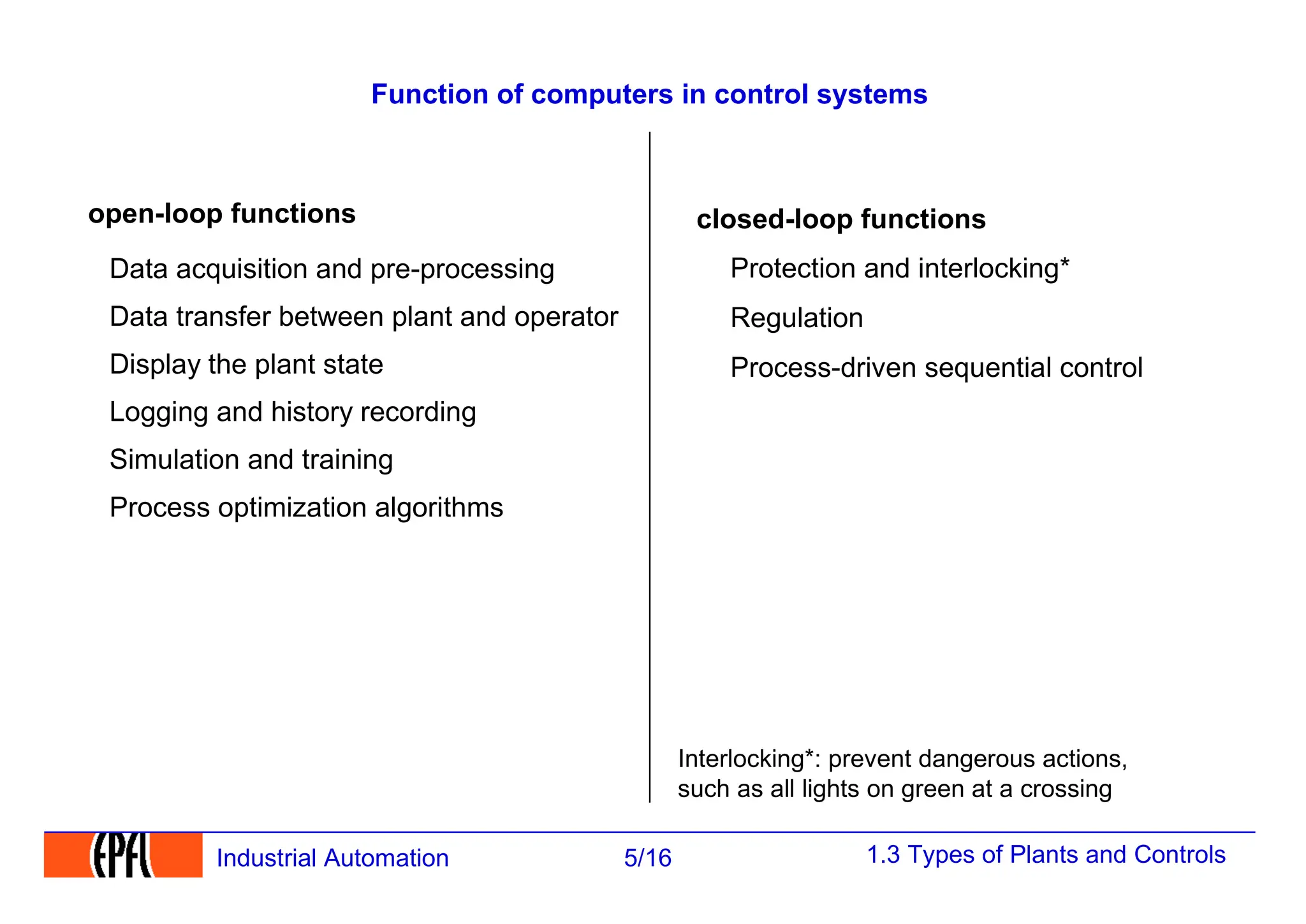
Function of computers in control systems
open-loop functions
Data acquisition and pre-processing
Data transfer between plant and operator
Display the plant state
Simulation and training
Logging and history recording
Process optimization algorithms
closed-loop functions
Protection and interlocking*
Regulation
Process-driven sequential control
Interlocking*: prevent dangerous actions,
such as all lights on green at a crossing
1.3 Types of Plants and Controls
6/16
Industrial Automation
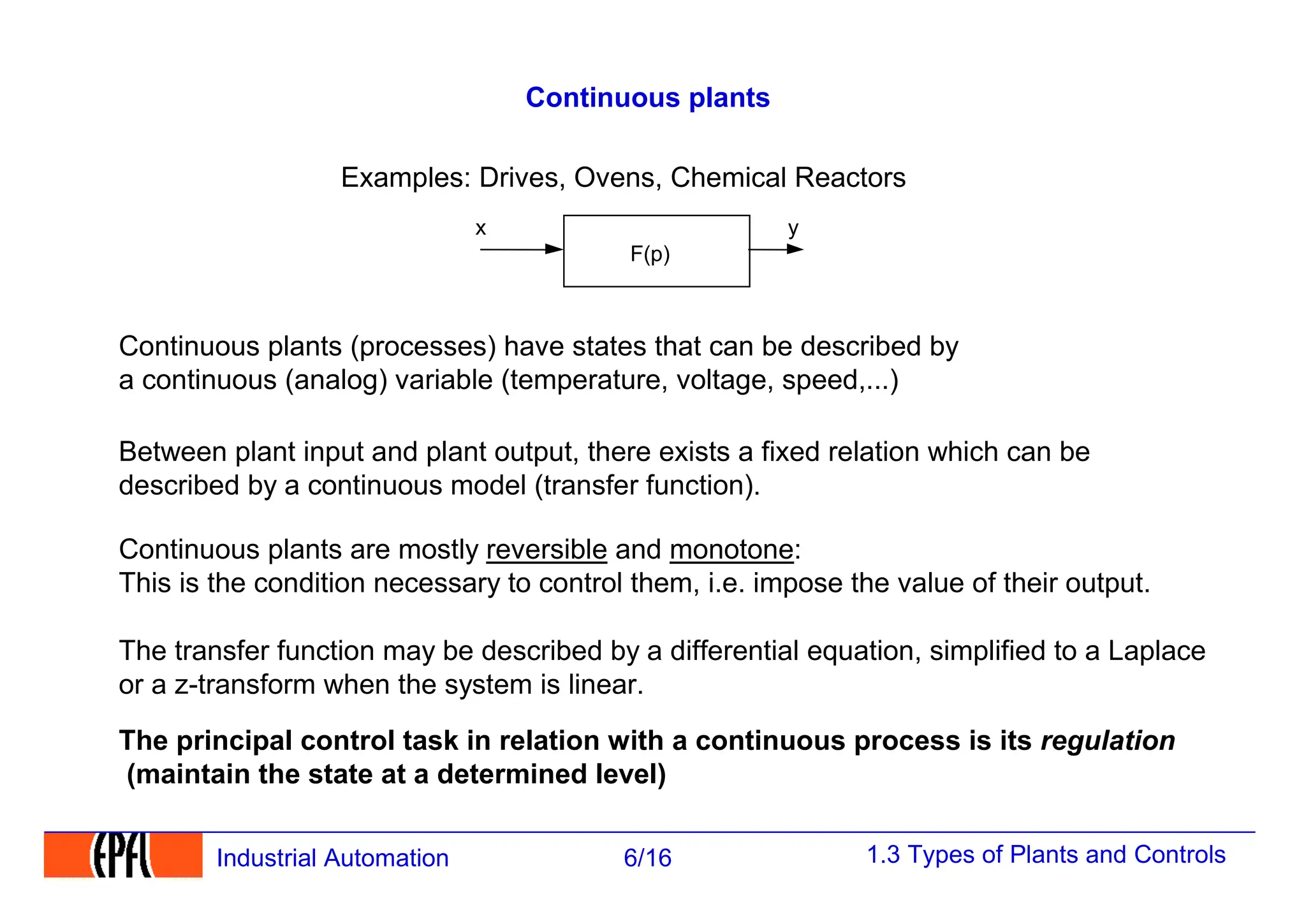
Continuous plants
Examples: Drives, Ovens, Chemical Reactors
F(p)
y
x
Continuous plants (processes) have states that can be described by
a continuous (analog) variable (temperature, voltage, speed,...)
Between plant input and plant output, there exists a fixed relation which can be
described by a continuous model (transfer function).
Continuous plants are mostly reversible and monotone:
This is the condition necessary to control them, i.e. impose the value of their output.
The transfer function may be described by a differential equation, simplified to a Laplace
or a z-transform when the system is linear.
The principal control task in relation with a continuous process is its regulation
(maintain the state at a determined level)
1.3 Types of Plants and Controls
7/16
Industrial Automation
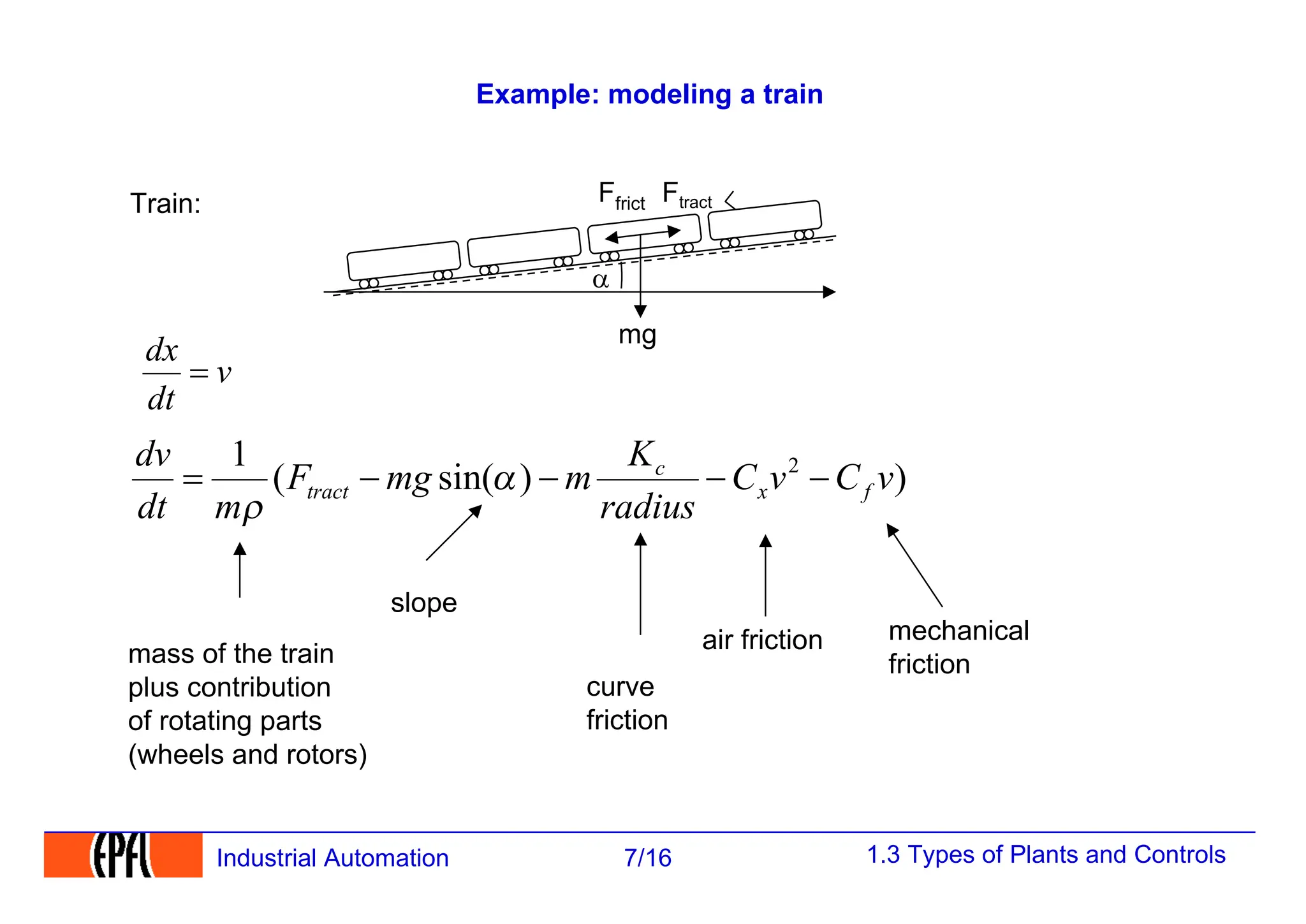
Example: modeling a train
Train:
v
dt
dx
=
)
)
sin(
(
1 2
v
C
v
C
radius
K
m
mg
F
m
dt
dv
f
x
c
tract -
-
-
-
= a
r
a
Ftract
mg
mass of the train
plus contribution
of rotating parts
(wheels and rotors)
slope
Ffrict
air friction mechanical
friction
curve
friction
1.3 Types of Plants and Controls
8/16
Industrial Automation
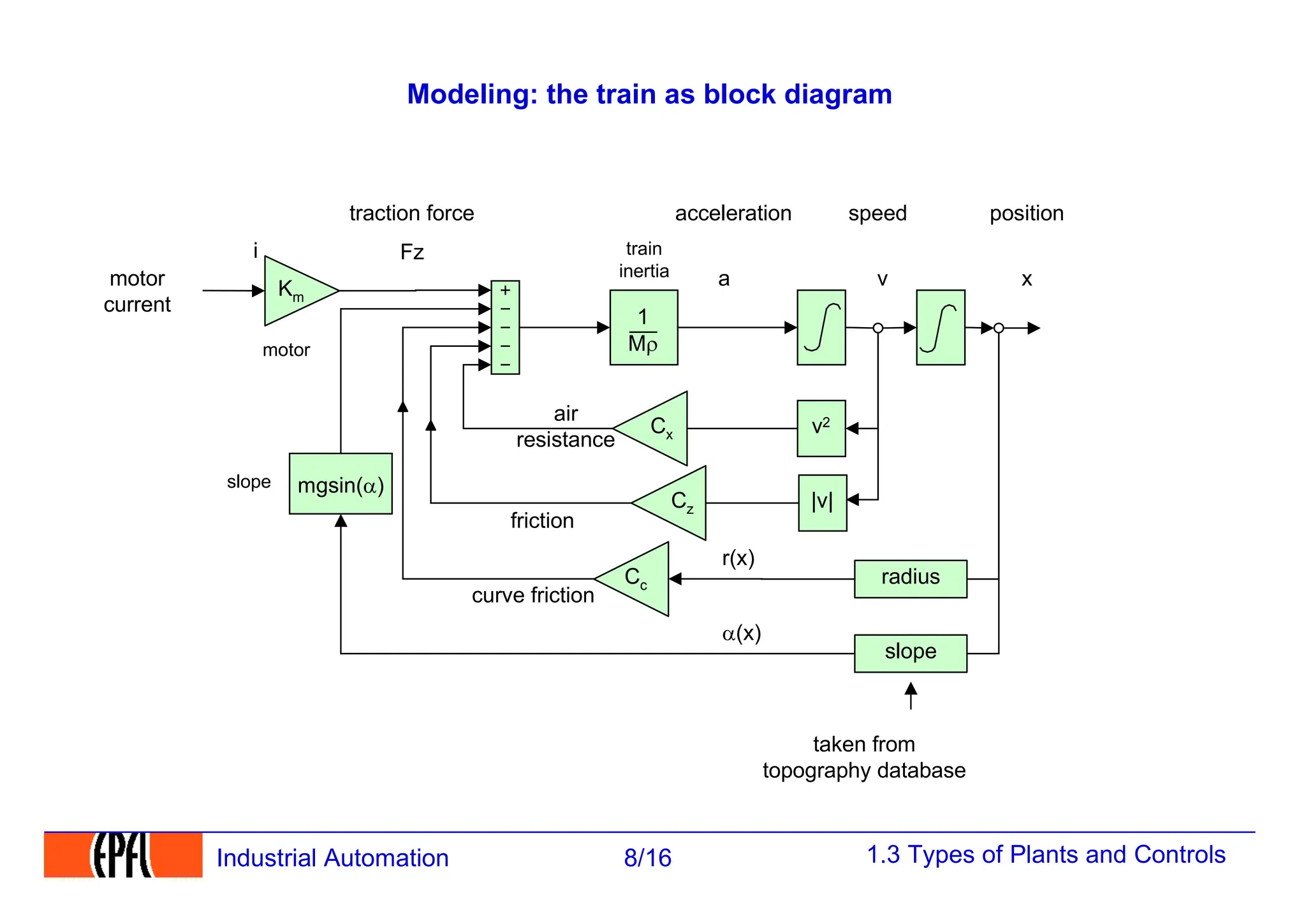
Modeling: the train as block diagram
train
inertia v
position
Km
Cx
traction force
Fz
Cz
x
friction
air
resistance
v2
1
Mr
mgsin(a)
i
Cc
curve friction
slope
radius
taken from
topography database
motor
current
motor
speed
|v|
r(x)
a(x)
a
acceleration
slope
1.3 Types of Plants and Controls
9/16
Industrial Automation
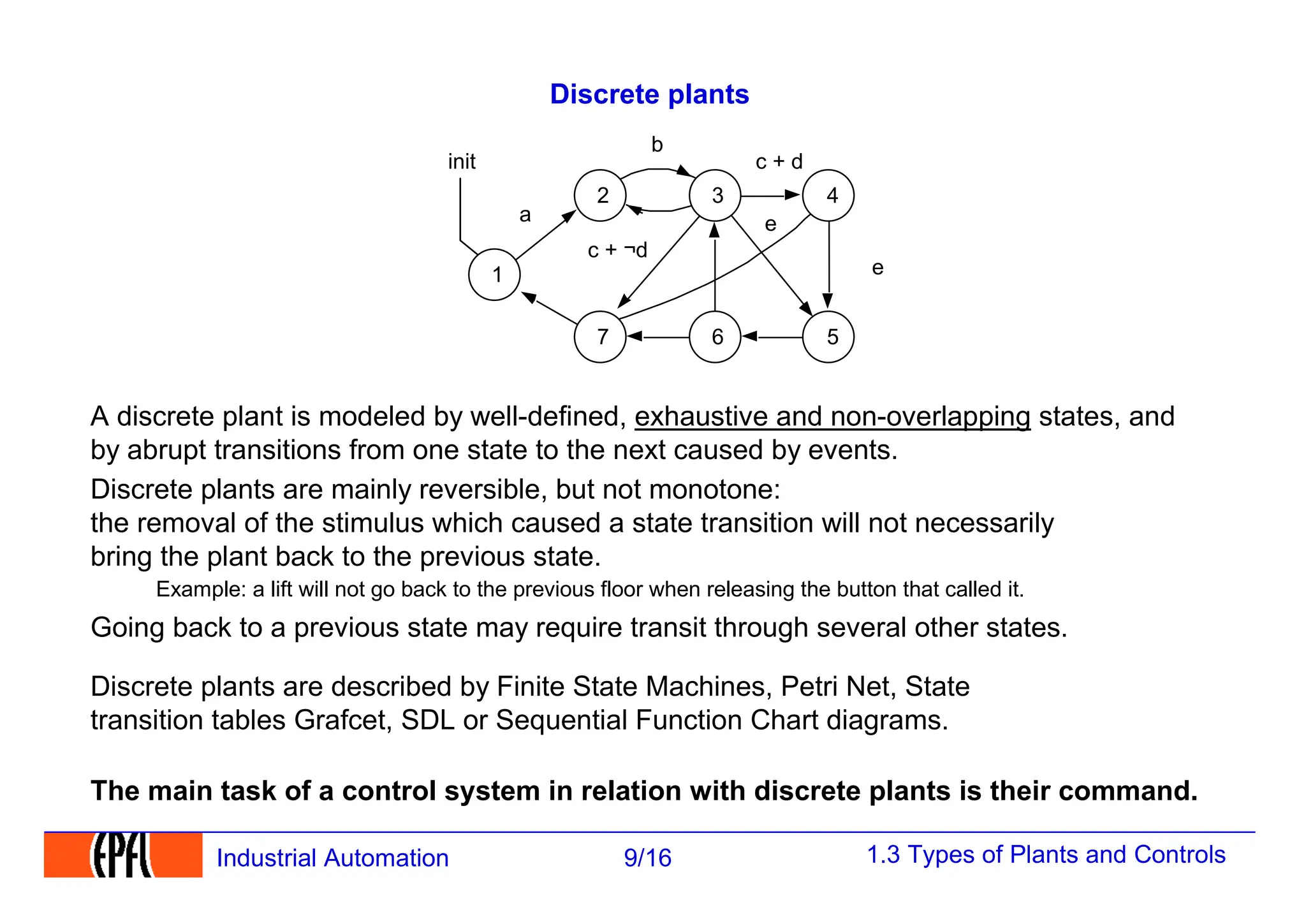
Discrete plants
e
c + ¬d
1
2 3
6 5
4
7
a
b
c + d
e
init
A discrete plant is modeled by well-defined, exhaustive and non-overlapping states, and
by abrupt transitions from one state to the next caused by events.
Discrete plants are mainly reversible, but not monotone:
the removal of the stimulus which caused a state transition will not necessarily
bring the plant back to the previous state.
Example: a lift will not go back to the previous floor when releasing the button that called it.
Discrete plants are described by Finite State Machines, Petri Net, State
transition tables Grafcet, SDL or Sequential Function Chart diagrams.
The main task of a control system in relation with discrete plants is their command.
Going back to a previous state may require transit through several other states.
1.3 Types of Plants and Controls
10/16
Industrial Automation
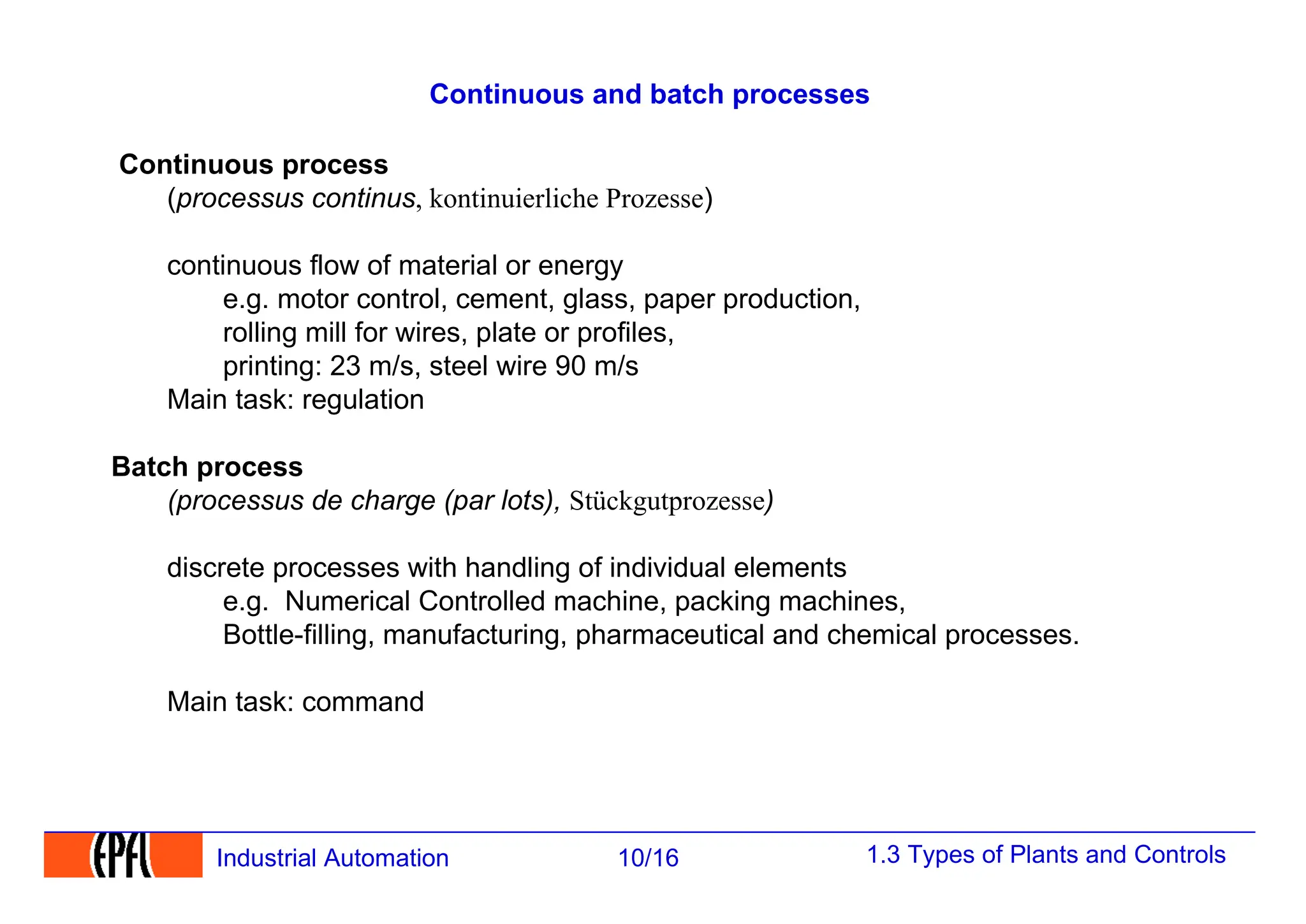
Continuous and batch processes
Continuous process
(processus continus, kontinuierliche Prozesse)
continuous flow of material or energy
e.g. motor control, cement, glass, paper production,
rolling mill for wires, plate or profiles,
printing: 23 m/s, steel wire 90 m/s
Main task: regulation
Batch process
(processus de charge (par lots), Stückgutprozesse)
discrete processes with handling of individual elements
e.g. Numerical Controlled machine, packing machines,
Bottle-filling, manufacturing, pharmaceutical and chemical processes.
Main task: command
1.3 Types of Plants and Controls
11/16
Industrial Automation
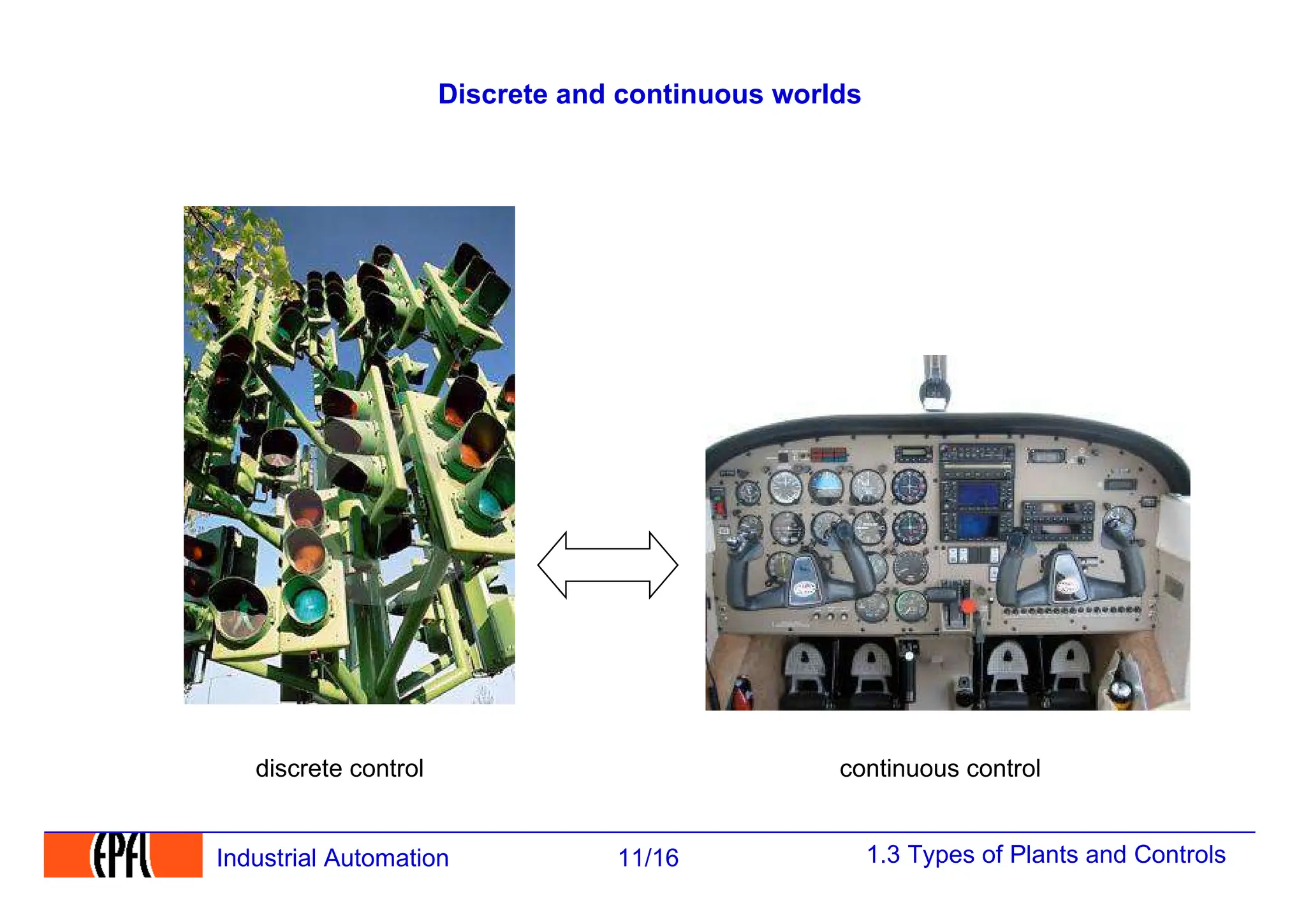
Discrete and continuous worlds
discrete control continuous control
1.3 Types of Plants and Controls
12/16
Industrial Automation
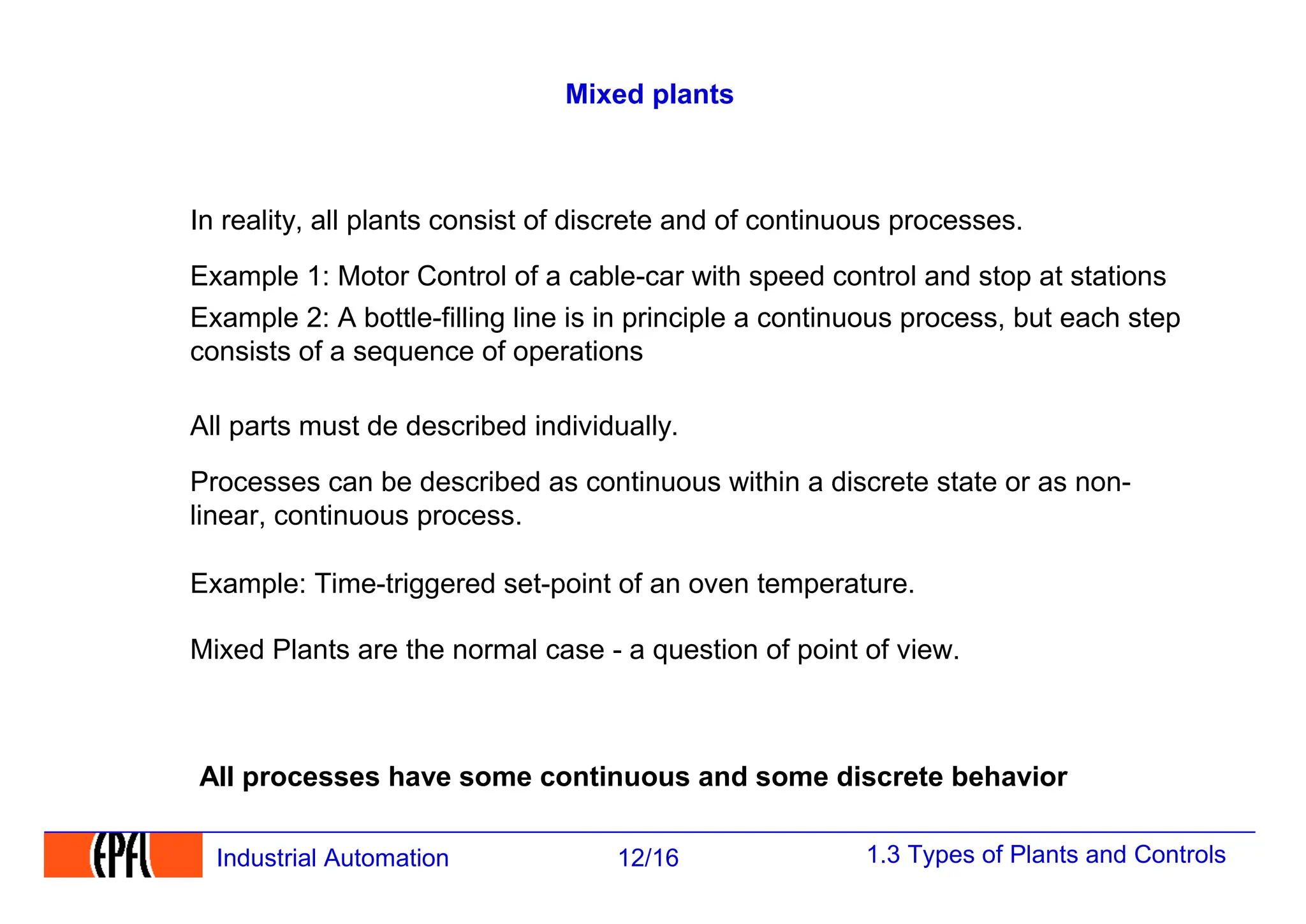
Mixed plants
All processes have some continuous and some discrete behavior
In reality, all plants consist of discrete and of continuous processes.
Example 1: Motor Control of a cable-car with speed control and stop at stations
All parts must de described individually.
Processes can be described as continuous within a discrete state or as non-
linear, continuous process.
Example: Time-triggered set-point of an oven temperature.
Mixed Plants are the normal case - a question of point of view.
Example 2: A bottle-filling line is in principle a continuous process, but each step
consists of a sequence of operations
1.3 Types of Plants and Controls
13/16
Industrial Automation
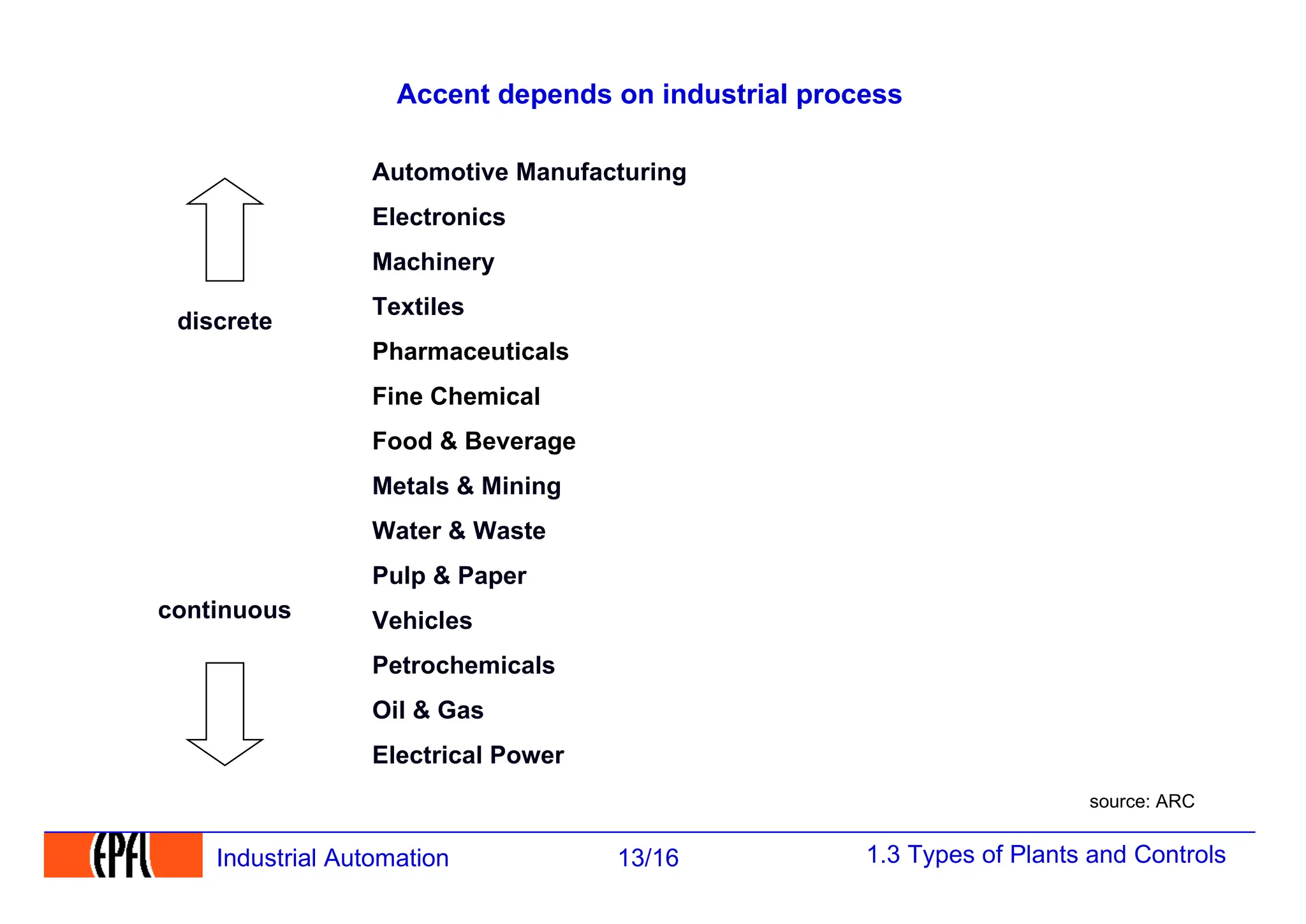
Accent depends on industrial process
Automotive Manufacturing
Electronics
Machinery
Textiles
Pharmaceuticals
Fine Chemical
Food & Beverage
Metals & Mining
Water & Waste
Pulp & Paper
Vehicles
Petrochemicals
Oil & Gas
Electrical Power
discrete
continuous
source: ARC
1.3 Types of Plants and Controls
14/16
Industrial Automation
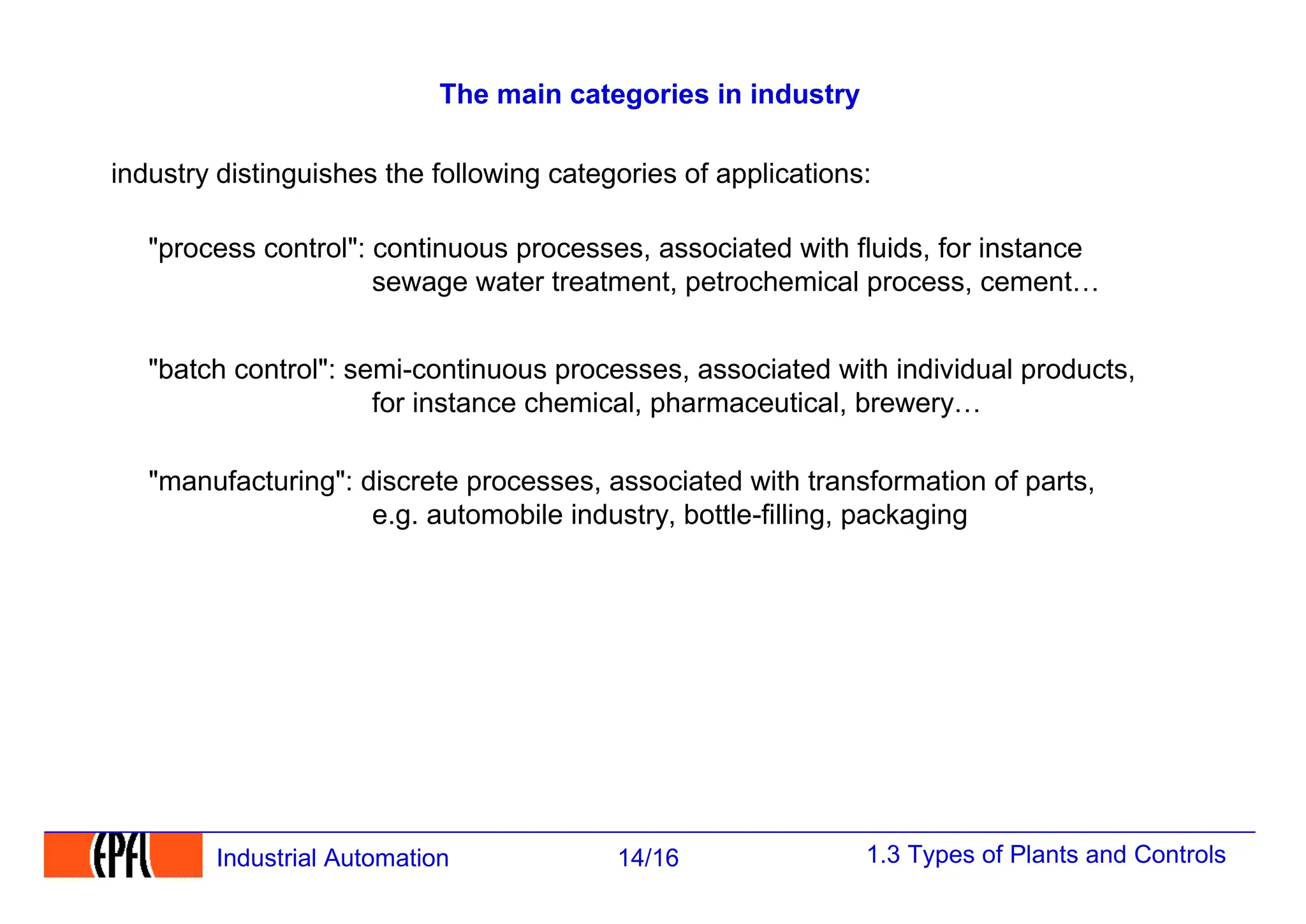
The main categories in industry
industry distinguishes the following categories of applications:
"process control": continuous processes, associated with fluids, for instance
sewage water treatment, petrochemical process, cement…
"batch control": semi-continuous processes, associated with individual products,
for instance chemical, pharmaceutical, brewery…
"manufacturing": discrete processes, associated with transformation of parts,
e.g. automobile industry, bottle-filling, packaging
1.3 Types of Plants and Controls
15/16
Industrial Automation
Assessment
What is open loop and what closed loop control ?
What is the difference between continuous and discrete processes ?
What is the difference between a discrete and a batch process ?
What is the main task of a controller in a discrete process, in a continuous process ?
1.3 Types of Plants and Controls
16/16
Industrial Automation
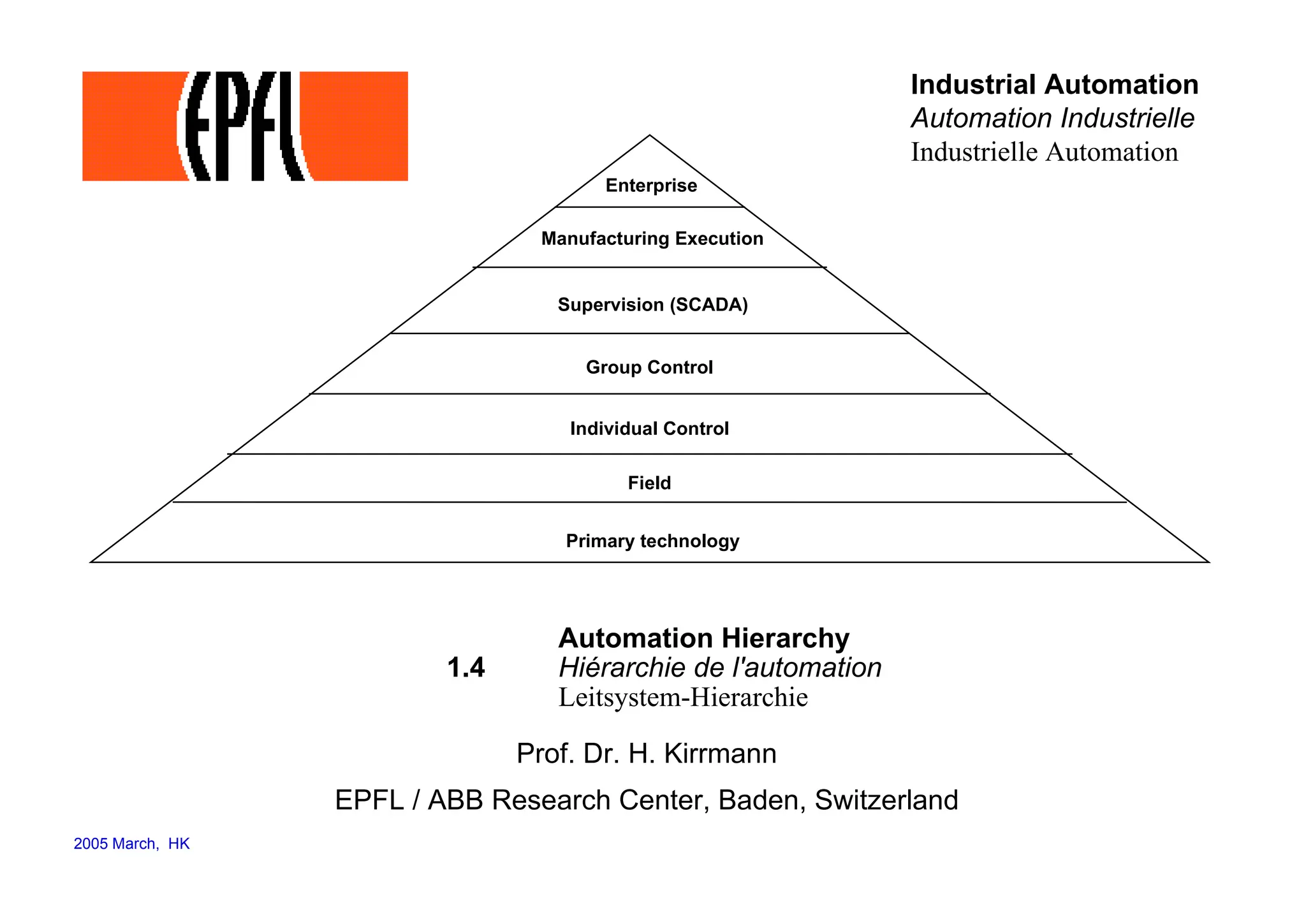
Automation Hierarchy
1.4 Hiérarchie de l'automation
Leitsystem-Hierarchie
Prof. Dr. H. Kirrmann
EPFL / ABB Research Center, Baden, Switzerland
Industrial Automation
Automation Industrielle
Industrielle Automation
Manufacturing Execution
Supervision (SCADA)
Group Control
Individual Control
Field
Primary technology
Enterprise
2005 March, HK
1.4 Automation hierarchy
2/28
Industrial Automation
1.4 Contents
1 Introduction
1.1 Automation and its importance
1.2 Examples of automated processes
1.3 Types of plants and controls
1.3.1 Open loop and closed loop control
1.3.2 Continuous processes
1.3.3 Discrete processes
1.3.3 Mixed plants
1.4 Automation hierarchy
1.5 Control system architecture
1.4 Automation hierarchy
3/28
Industrial Automation
Automation System Structure
Although applications differ widely, there is little difference in the
overall architecture of their control systems.
Why the control system of a power plant is not sold also for automating a brewery
depends largely on small differences (e.g. explosion-proof), on regulations
(e.g. Food and Drug Administration) and also tradition, customer relationship.
1.4 Automation hierarchy
4/28
Industrial Automation
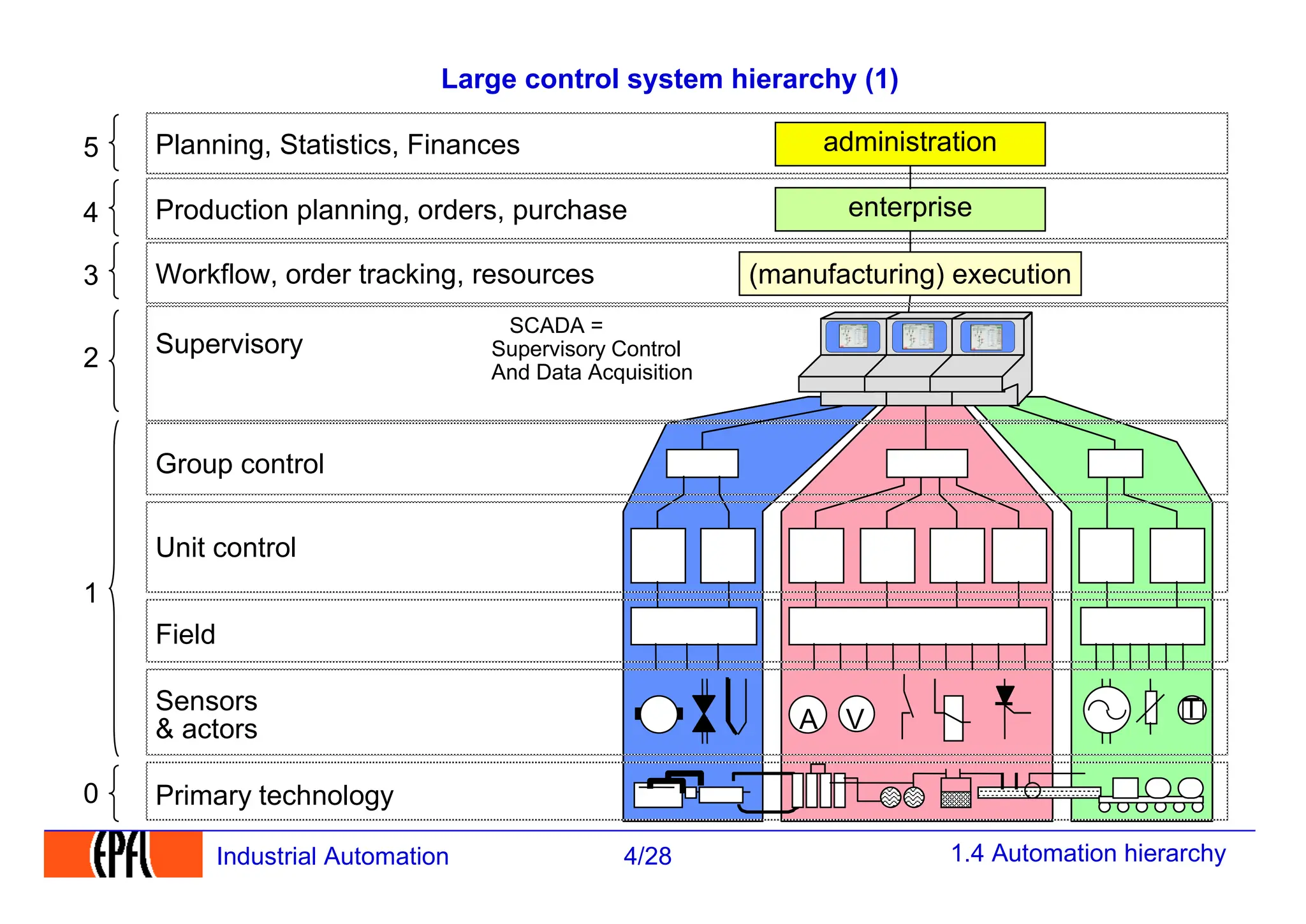
Large control system hierarchy (1)
Group control
Unit control
Field
Sensors
& actors A V
Supervisory
Primary technology
Workflow, order tracking, resources
SCADA =
Supervisory Control
And Data Acquisition
T
Production planning, orders, purchase
1
2
3
4
0
Planning, Statistics, Finances
5
(manufacturing) execution
enterprise
administration
1.4 Automation hierarchy
5/28
Industrial Automation
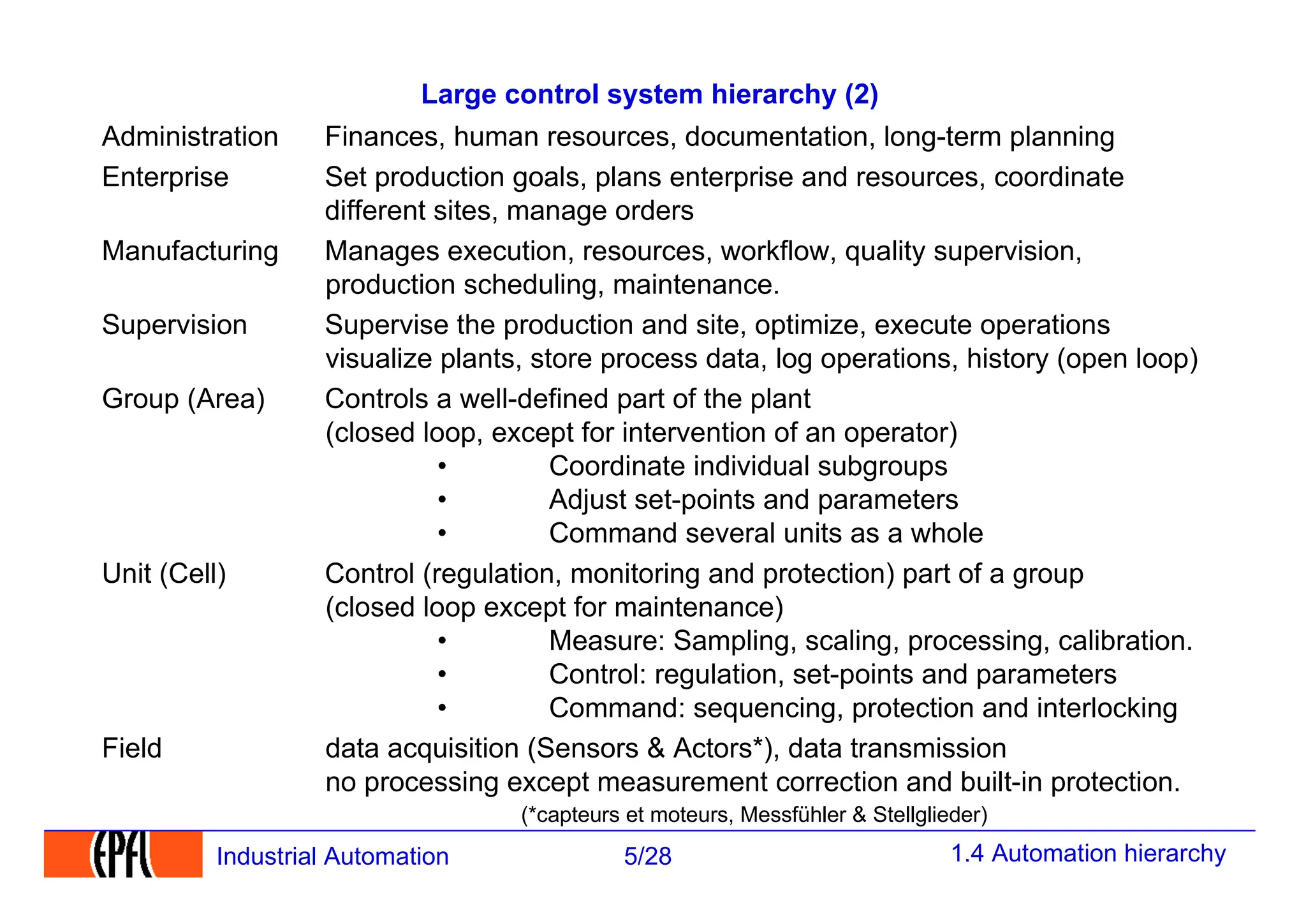
Large control system hierarchy (2)
Administration Finances, human resources, documentation, long-term planning
Enterprise Set production goals, plans enterprise and resources, coordinate
different sites, manage orders
Manufacturing Manages execution, resources, workflow, quality supervision,
production scheduling, maintenance.
Supervision Supervise the production and site, optimize, execute operations
visualize plants, store process data, log operations, history (open loop)
Group (Area) Controls a well-defined part of the plant
(closed loop, except for intervention of an operator)
• Coordinate individual subgroups
• Adjust set-points and parameters
• Command several units as a whole
Unit (Cell) Control (regulation, monitoring and protection) part of a group
(closed loop except for maintenance)
• Measure: Sampling, scaling, processing, calibration.
• Control: regulation, set-points and parameters
• Command: sequencing, protection and interlocking
Field data acquisition (Sensors & Actors*), data transmission
no processing except measurement correction and built-in protection.
(*capteurs et moteurs, Messfühler & Stellglieder)
.
1.4 Automation hierarchy
6/28
Industrial Automation
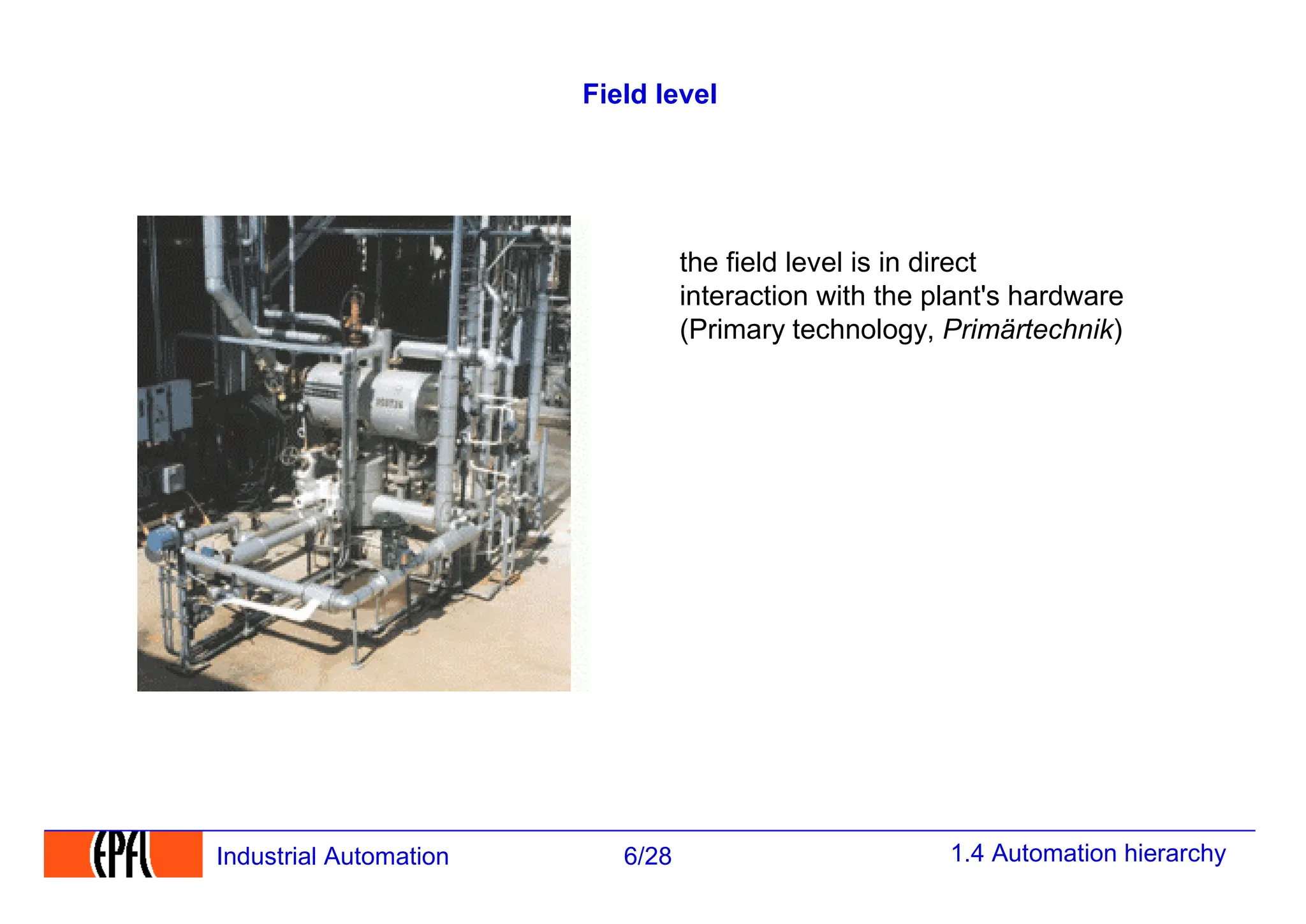
Field level
the field level is in direct
interaction with the plant's hardware
(Primary technology, Primärtechnik)
1.4 Automation hierarchy
7/28
Industrial Automation
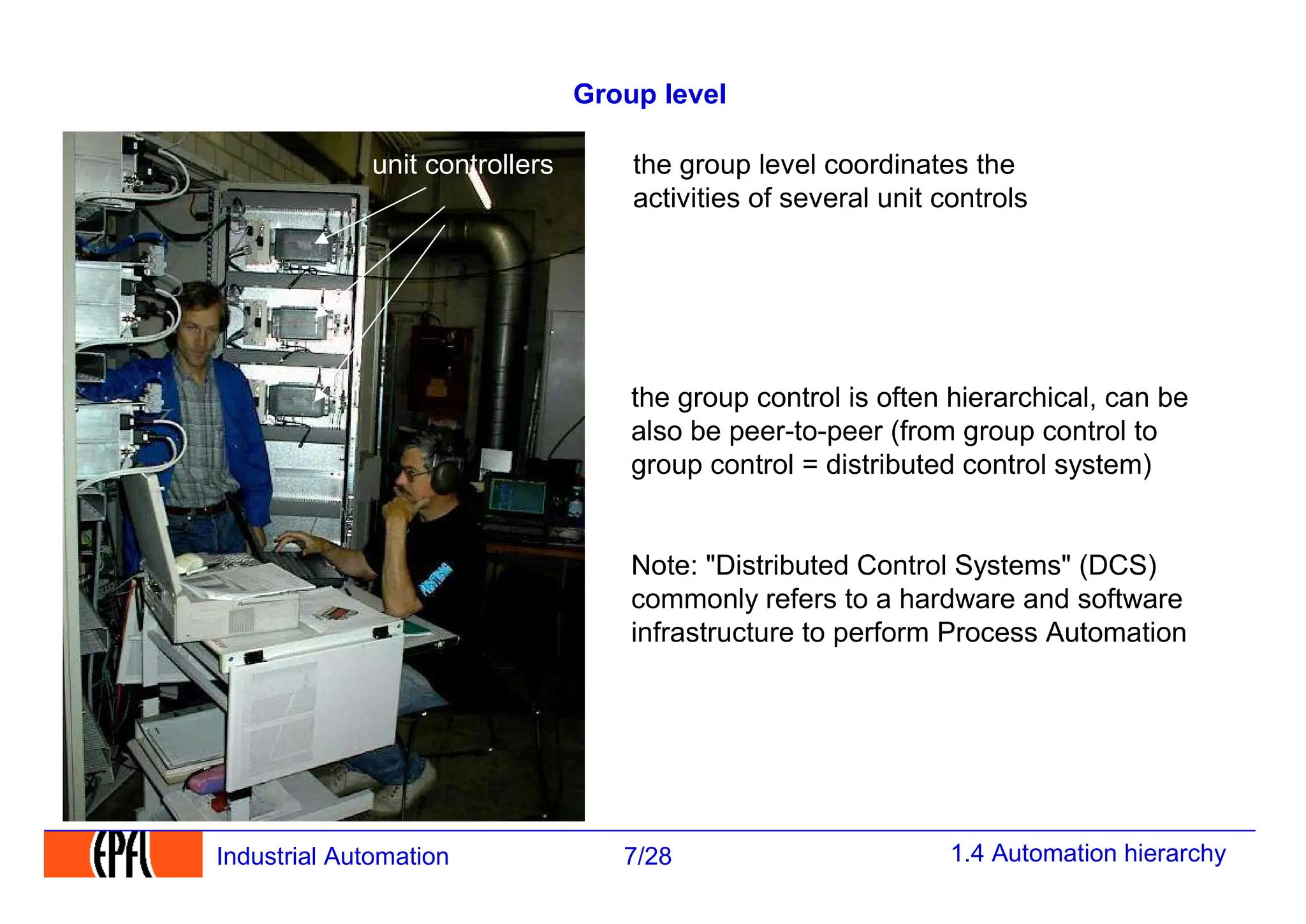
Group level
the group level coordinates the
activities of several unit controls
the group control is often hierarchical, can be
also be peer-to-peer (from group control to
group control = distributed control system)
Note: "Distributed Control Systems" (DCS)
commonly refers to a hardware and software
infrastructure to perform Process Automation
unit controllers
1.4 Automation hierarchy
8/28
Industrial Automation
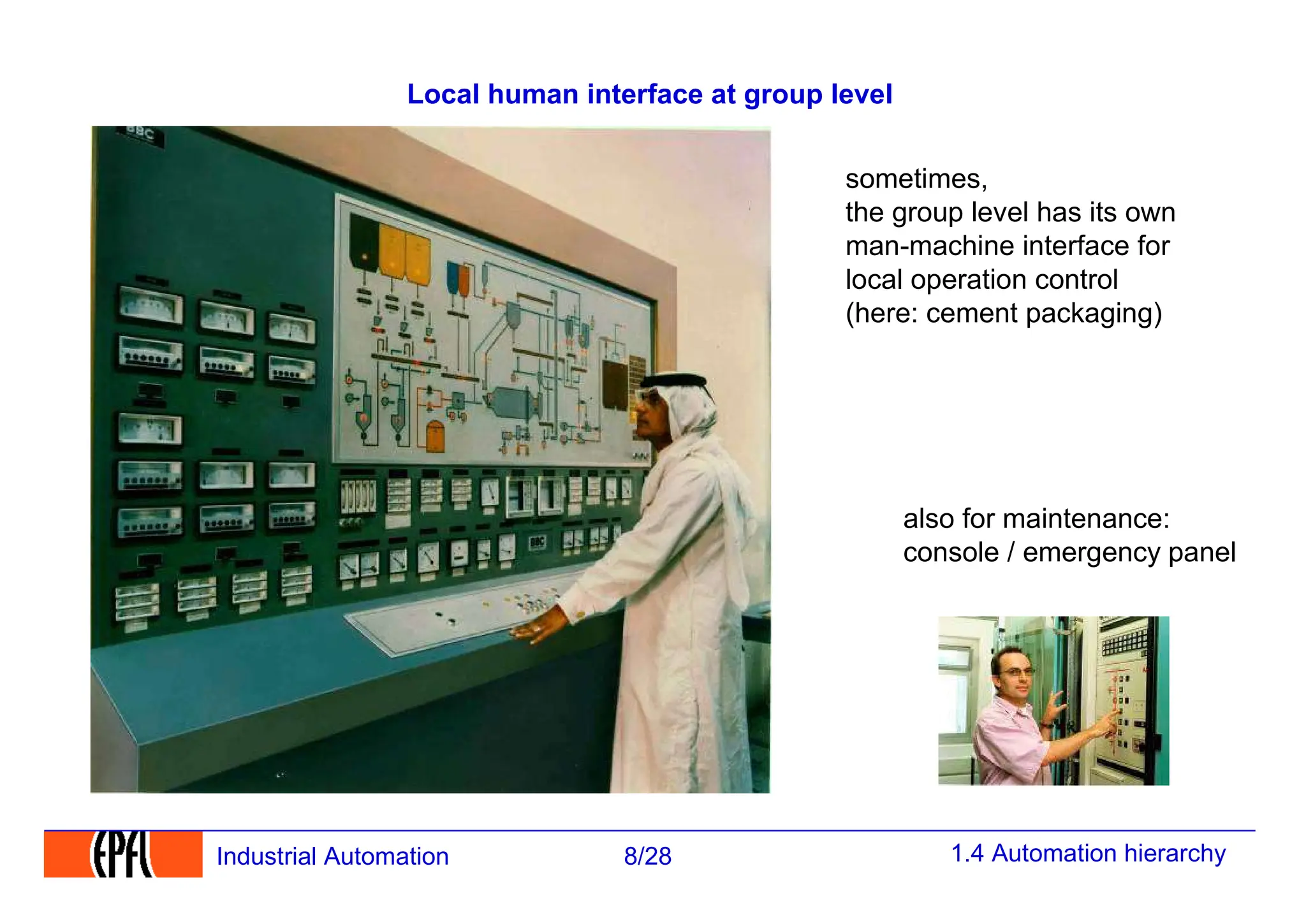
Local human interface at group level
sometimes,
the group level has its own
man-machine interface for
local operation control
(here: cement packaging)
also for maintenance:
console / emergency panel
1.4 Automation hierarchy
9/28
Industrial Automation
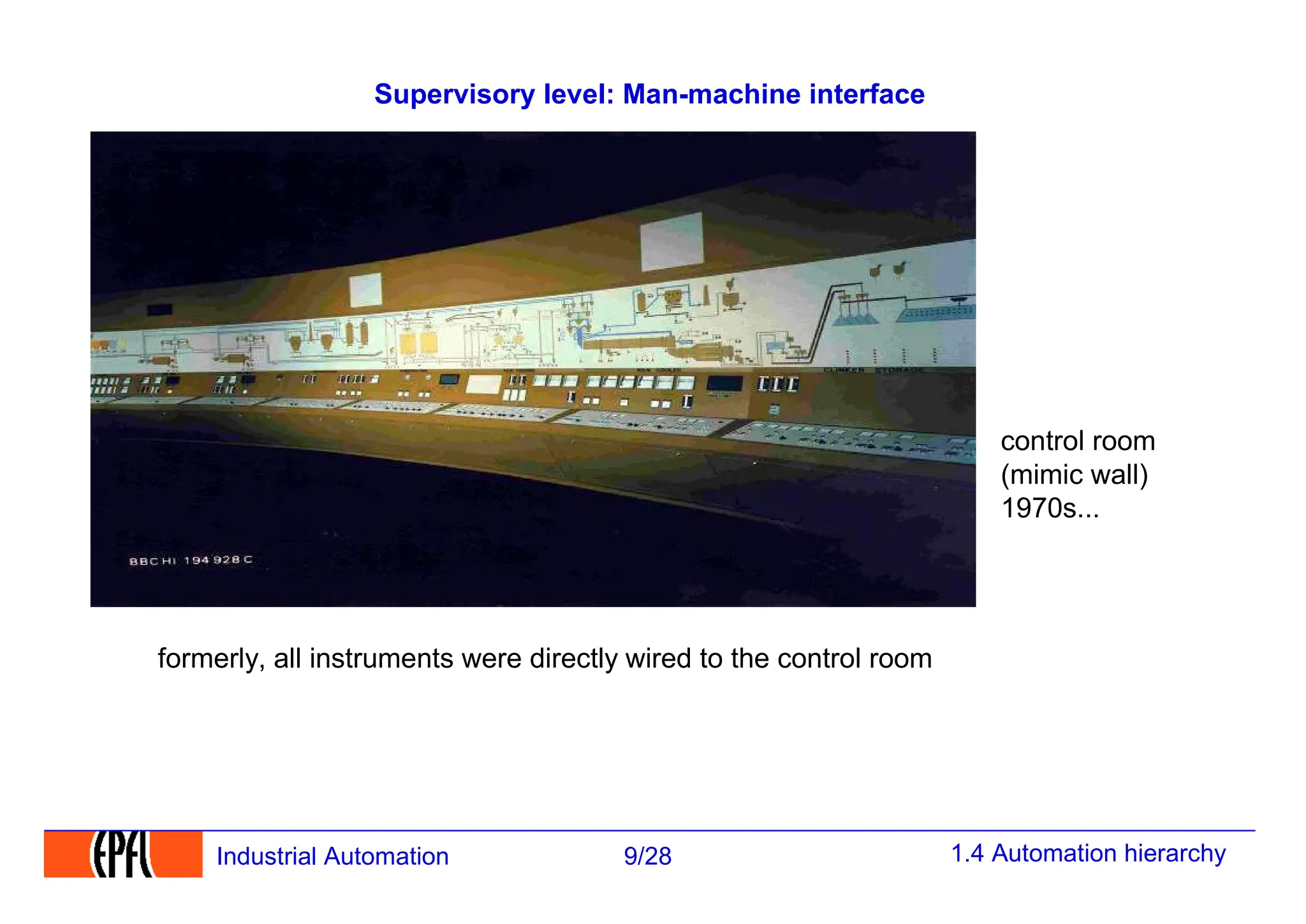
Supervisory level: Man-machine interface
control room
(mimic wall)
1970s...
formerly, all instruments were directly wired to the control room
1.4 Automation hierarchy
10/28
Industrial Automation
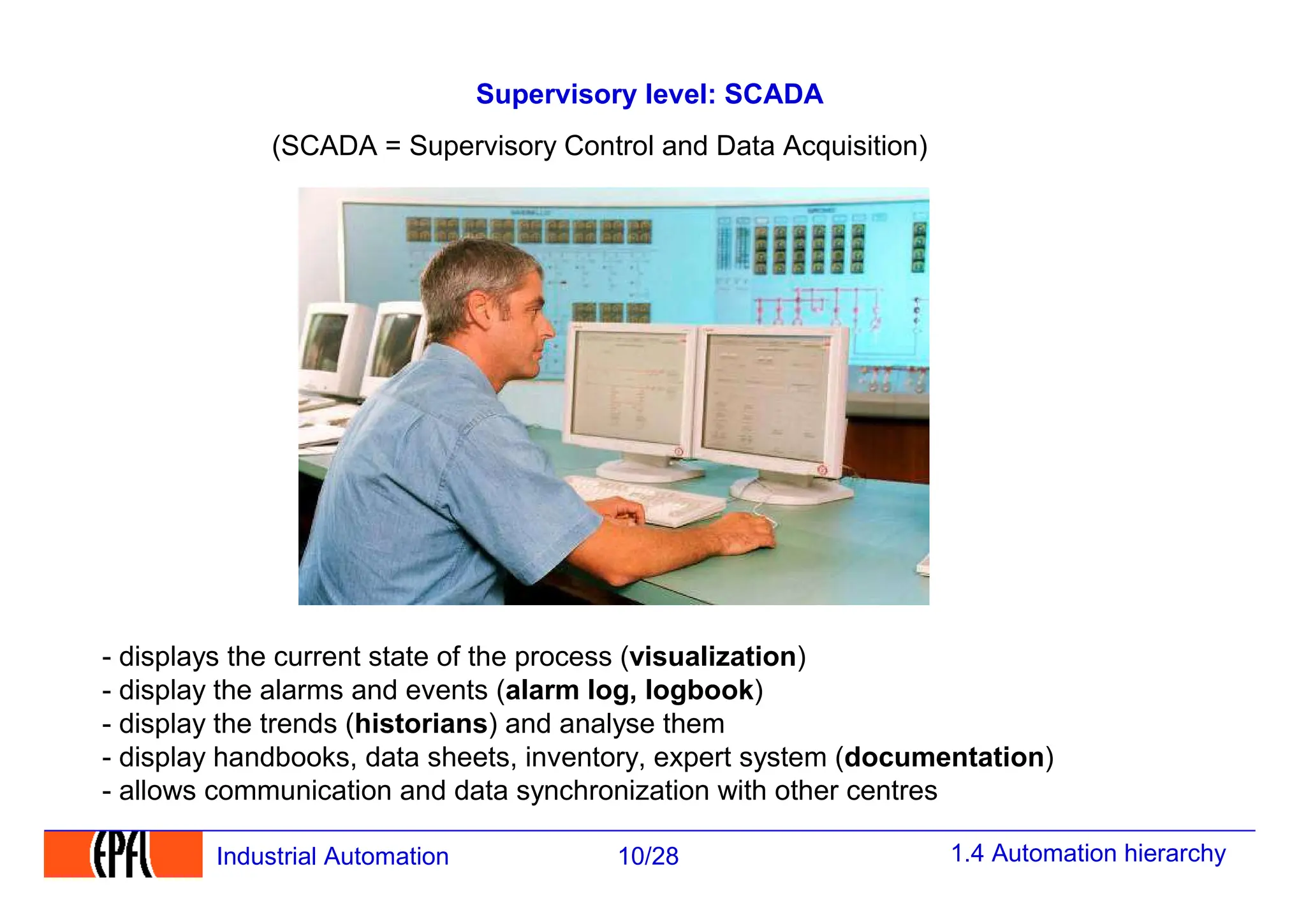
Supervisory level: SCADA
- displays the current state of the process (visualization)
- display the alarms and events (alarm log, logbook)
- display the trends (historians) and analyse them
- display handbooks, data sheets, inventory, expert system (documentation)
- allows communication and data synchronization with other centres
(SCADA = Supervisory Control and Data Acquisition)
1.4 Automation hierarchy
11/28
Industrial Automation
Plant management
- store the plant and product data for further processing in a secure way
(historian), allowing to track processes and trace products
-> Plant Information Management System (PIMS)
- make predictions on the future behaviour of the processes and in particular
about the maintenance of the equipment, track KPI (key performance indicators)
-> Asset Optimisation (AO)
1.4 Automation hierarchy
12/28
Industrial Automation
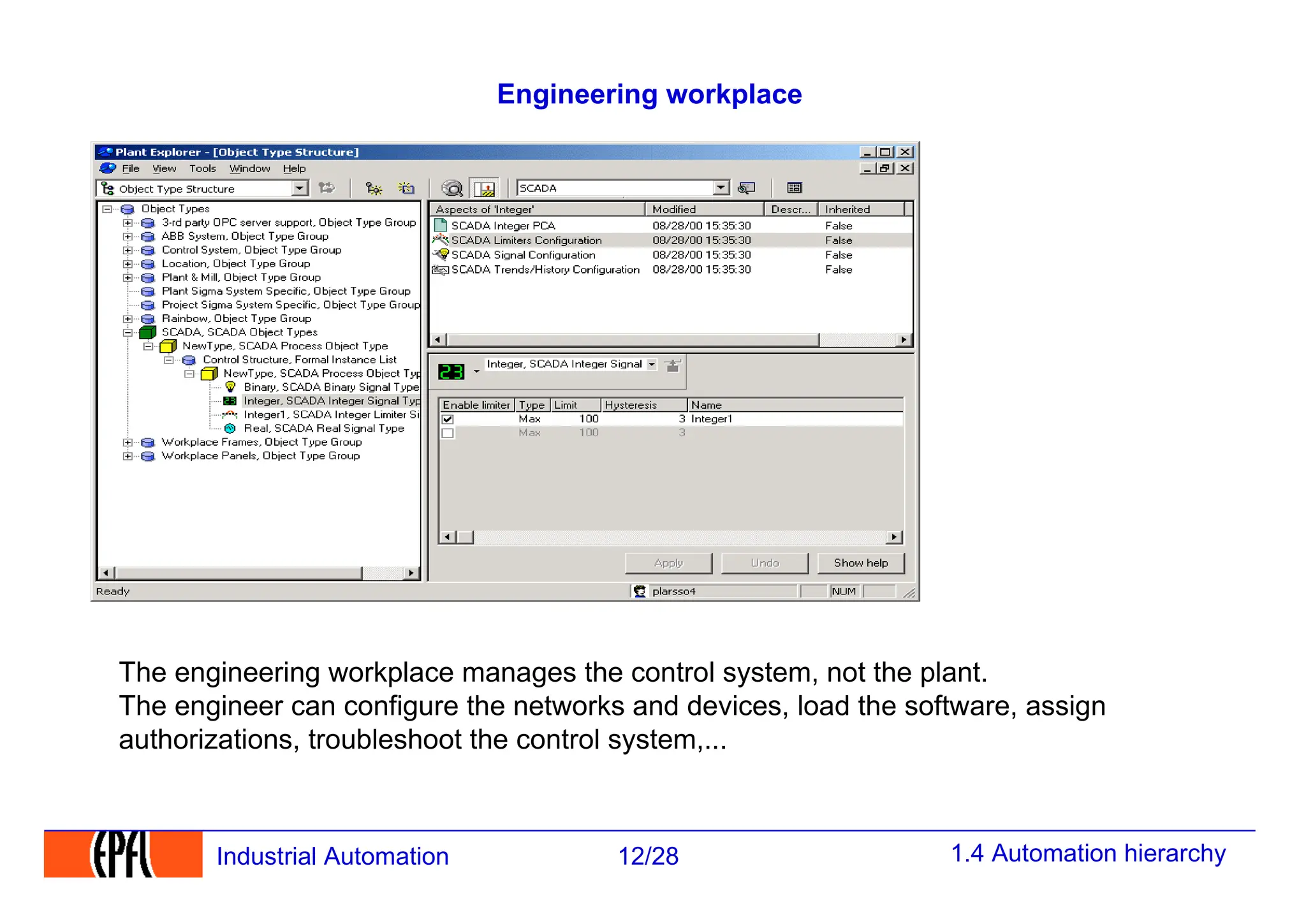
Engineering workplace
The engineering workplace manages the control system, not the plant.
The engineer can configure the networks and devices, load the software, assign
authorizations, troubleshoot the control system,...
1.4 Automation hierarchy
13/28
Industrial Automation
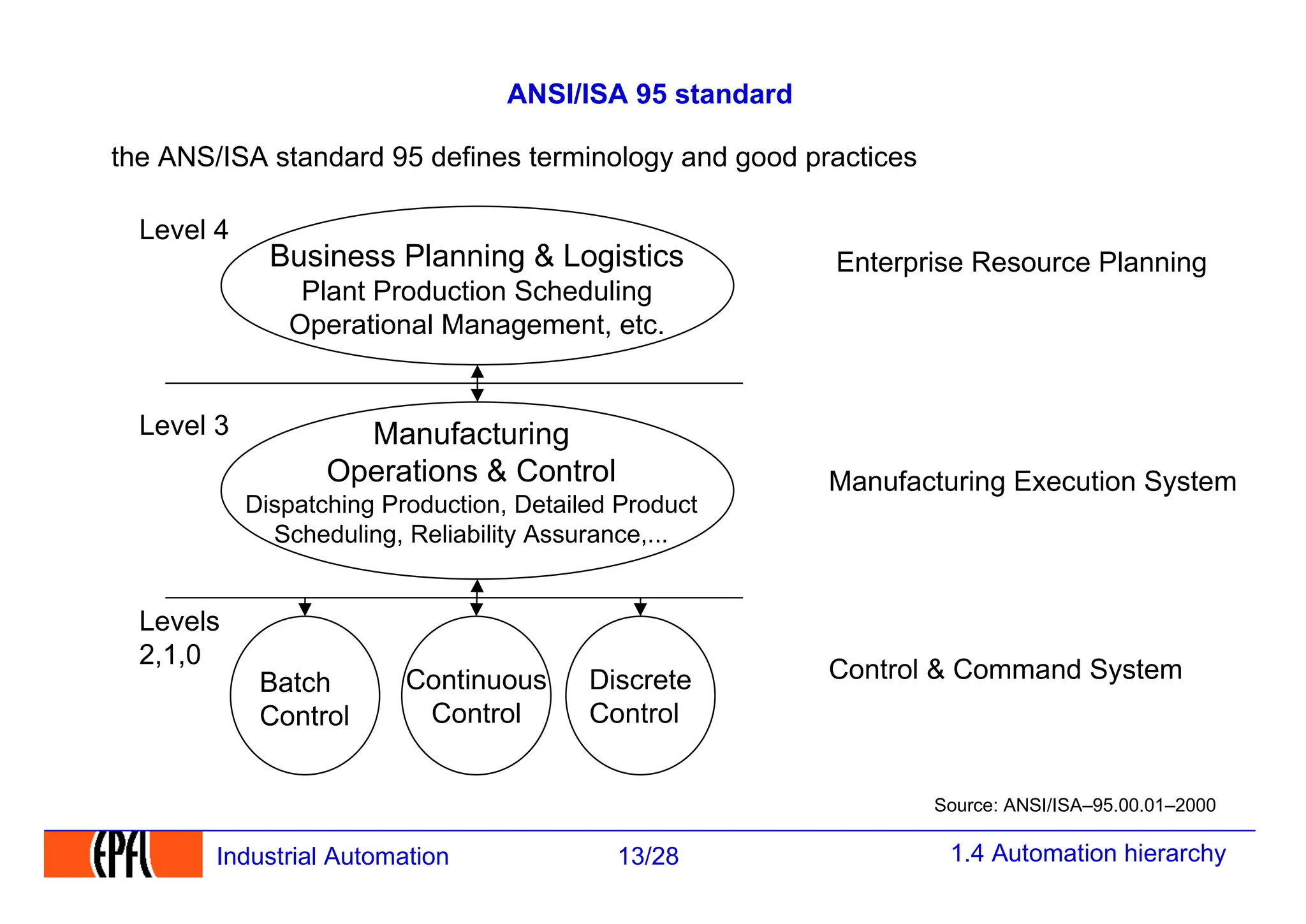
ANSI/ISA 95 standard
Source: ANSI/ISA–95.00.01–2000
the ANS/ISA standard 95 defines terminology and good practices
Enterprise Resource Planning
Manufacturing Execution System
Control & Command System
Business Planning & Logistics
Plant Production Scheduling
Operational Management, etc.
Manufacturing
Operations & Control
Dispatching Production, Detailed Product
Scheduling, Reliability Assurance,...
Level 4
Level 3
Levels
2,1,0
Batch
Control
Continuous
Control
Discrete
Control
1.4 Automation hierarchy
14/28
Industrial Automation
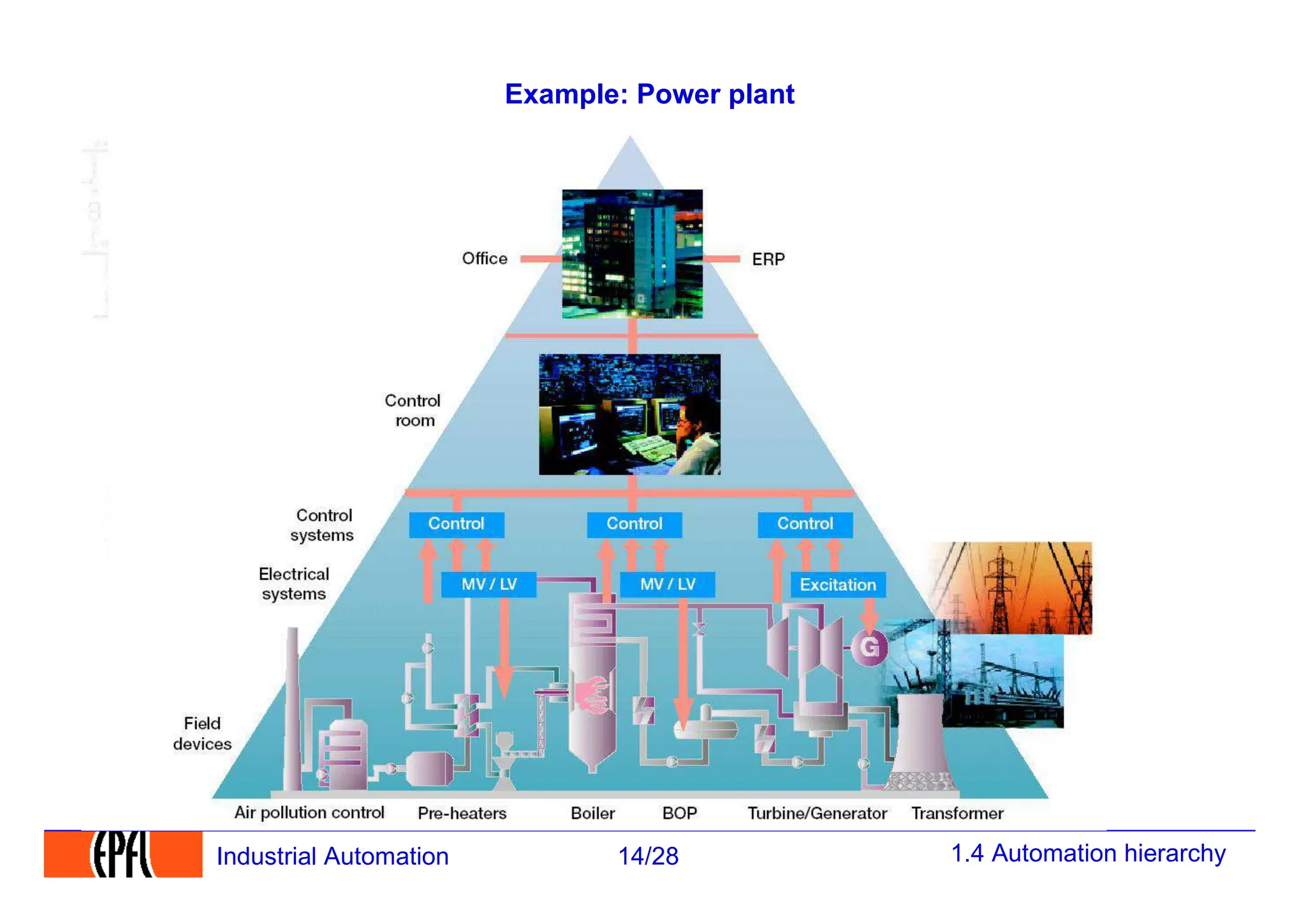
Example: Power plant
1.4 Automation hierarchy
15/28
Industrial Automation
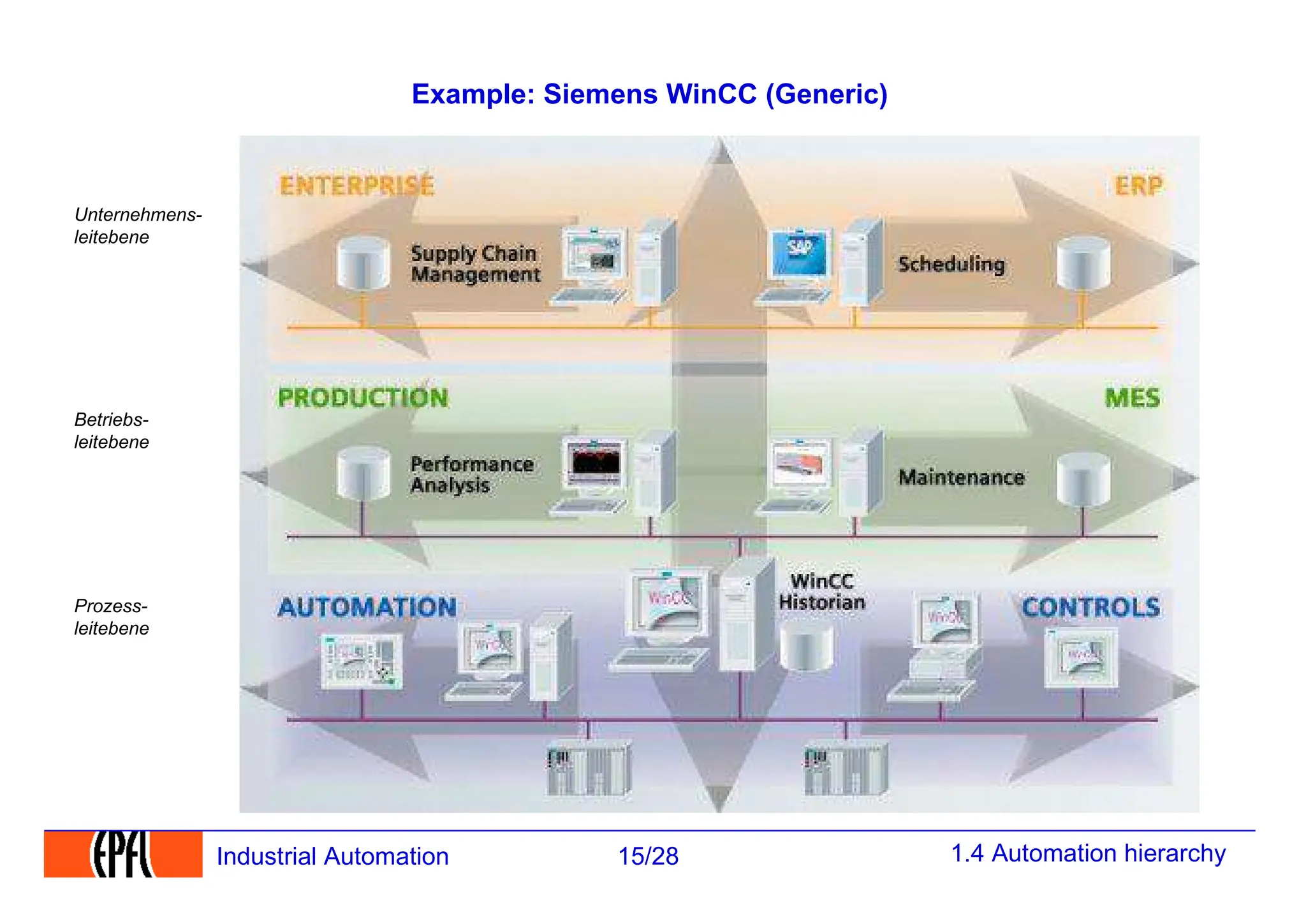
Example: Siemens WinCC (Generic)
Betriebs-
leitebene
Unternehmens-
leitebene
Prozess-
leitebene
1.4 Automation hierarchy
16/28
Industrial Automation
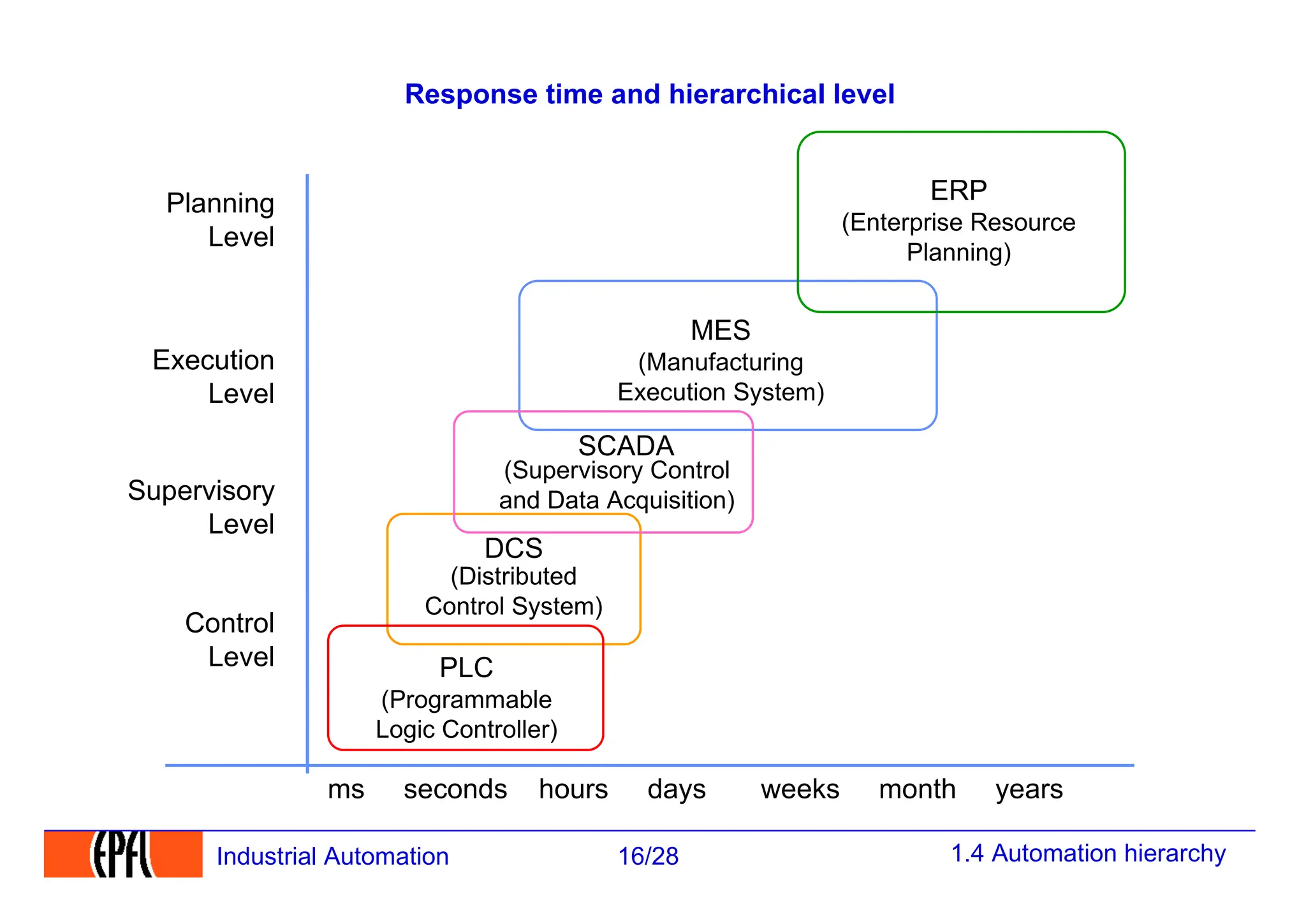
Response time and hierarchical level
Planning
Level
Execution
Level
Control
Level
Supervisory
Level
ms seconds hours days weeks month years
ERP
(Enterprise Resource
Planning)
DCS
MES
(Manufacturing
Execution System)
PLC
(Programmable
Logic Controller)
(Distributed
Control System)
(Supervisory Control
and Data Acquisition)
SCADA
1.4 Automation hierarchy
17/28
Industrial Automation
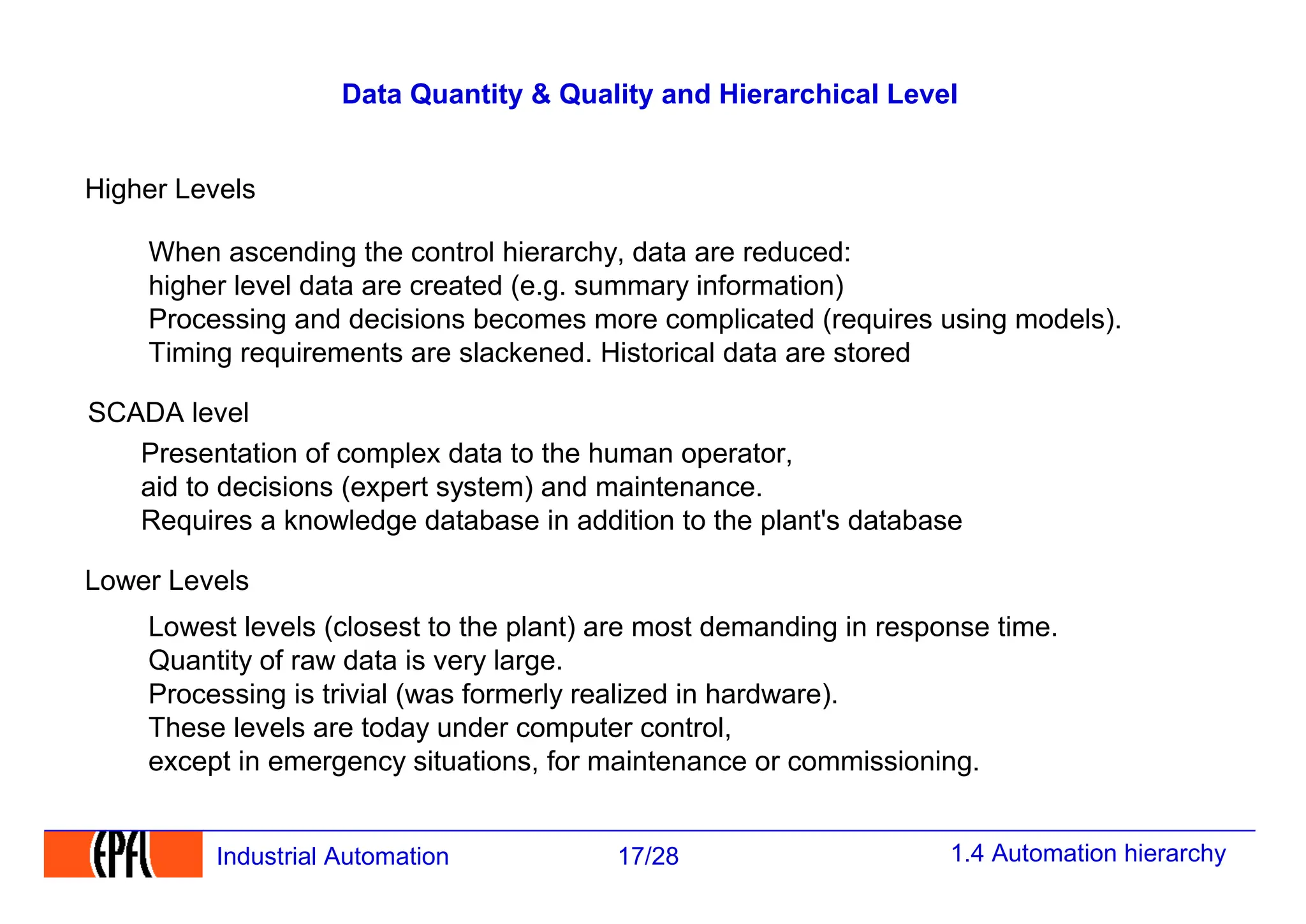
Data Quantity & Quality and Hierarchical Level
Lowest levels (closest to the plant) are most demanding in response time.
Quantity of raw data is very large.
Processing is trivial (was formerly realized in hardware).
These levels are today under computer control,
except in emergency situations, for maintenance or commissioning.
Lower Levels
Higher Levels
SCADA level
Presentation of complex data to the human operator,
aid to decisions (expert system) and maintenance.
Requires a knowledge database in addition to the plant's database
When ascending the control hierarchy, data are reduced:
higher level data are created (e.g. summary information)
Processing and decisions becomes more complicated (requires using models).
Timing requirements are slackened. Historical data are stored
1.4 Automation hierarchy
18/28
Industrial Automation
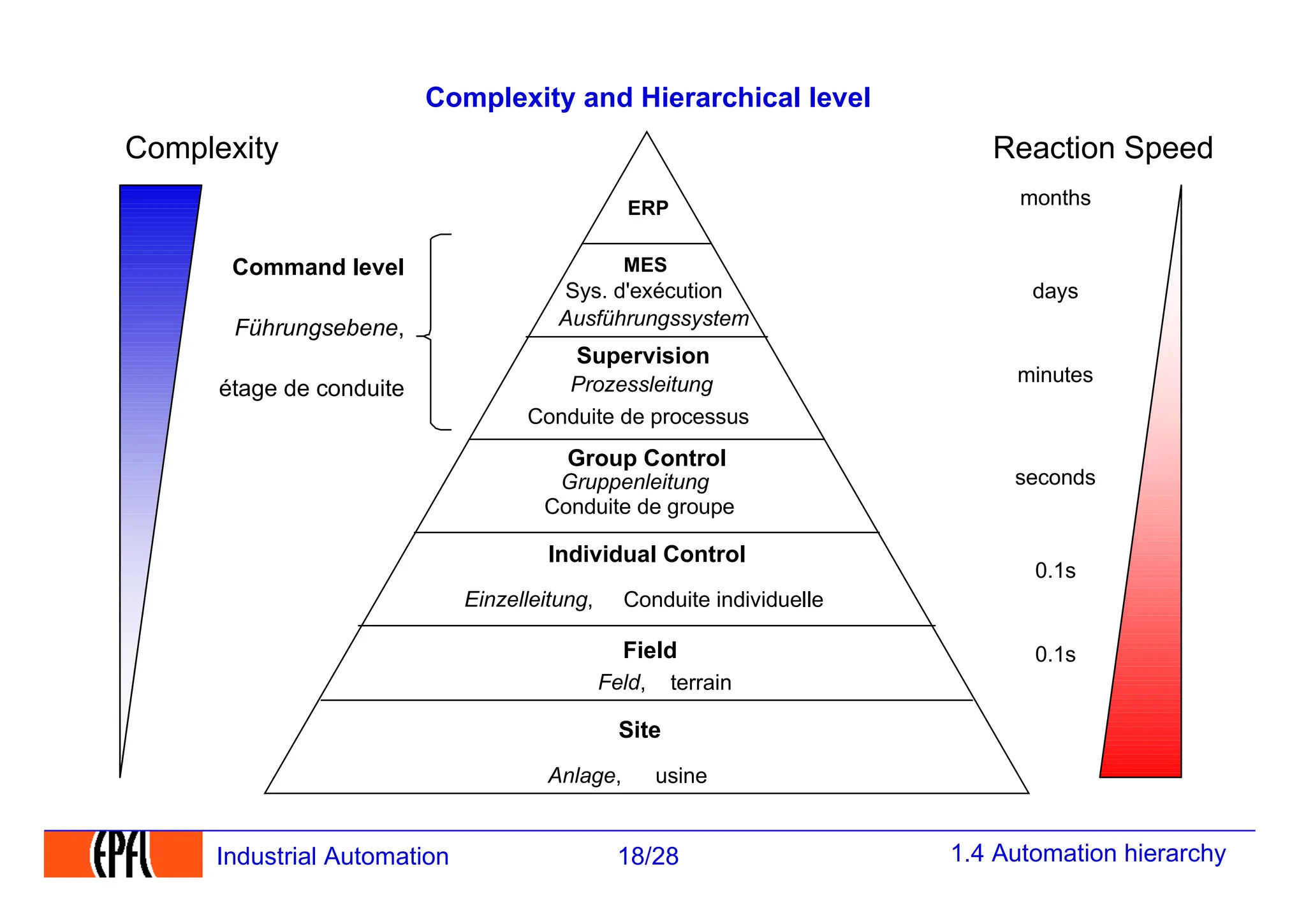
Complexity and Hierarchical level
MES
Supervision
Prozessleitung
Conduite de processus
Group Control
Gruppenleitung
Conduite de groupe
Individual Control
Conduite individuelle
Field
terrain
Site
usine
Command level
Führungsebene,
étage de conduite
Complexity Reaction Speed
Sys. d'exécution
Ausführungssystem
ERP
days
months
minutes
seconds
0.1s
0.1s
Einzelleitung,
Feld,
Anlage,
1.4 Automation hierarchy
19/28
Industrial Automation
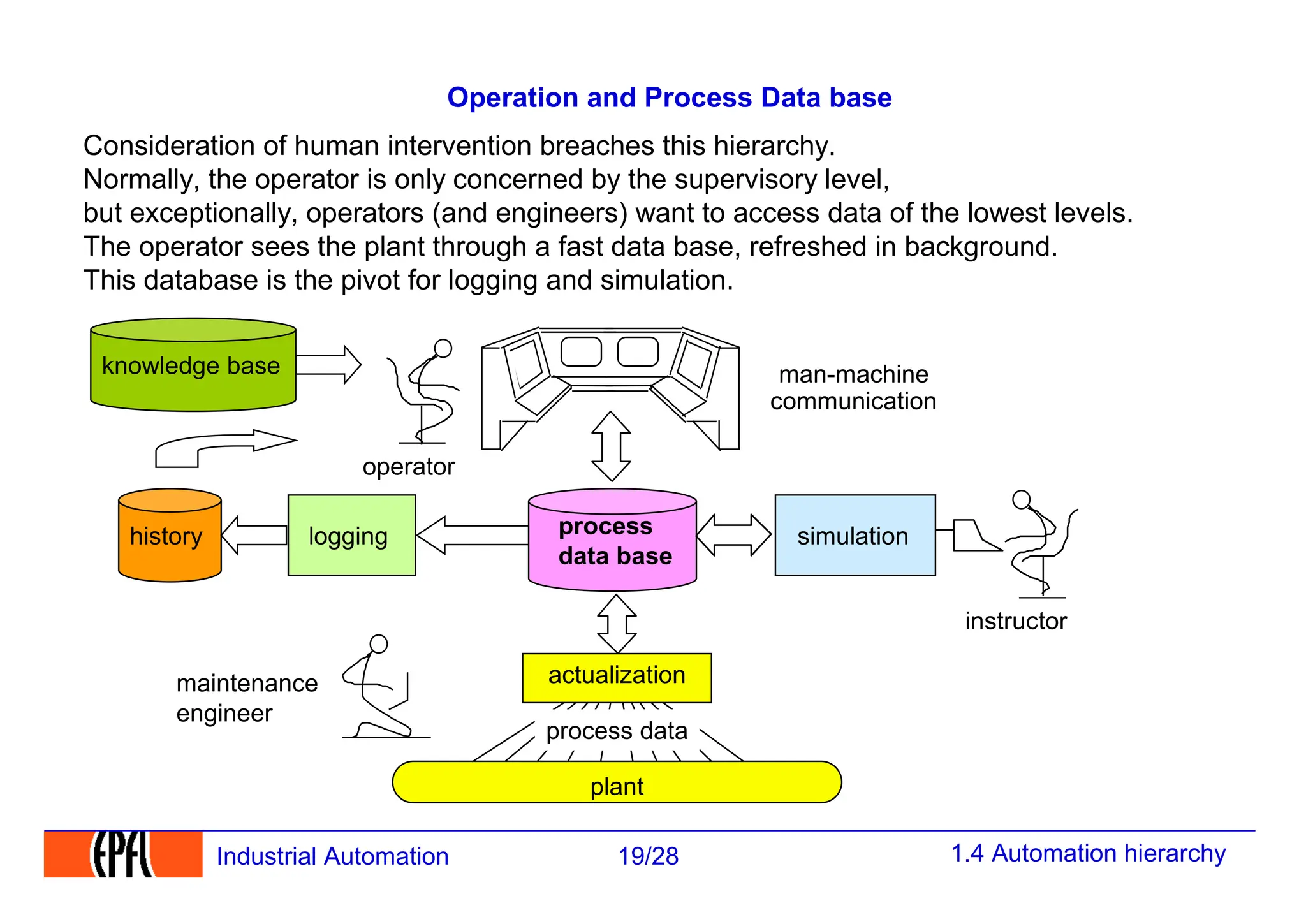
Operation and Process Data base
Consideration of human intervention breaches this hierarchy.
Normally, the operator is only concerned by the supervisory level,
but exceptionally, operators (and engineers) want to access data of the lowest levels.
The operator sees the plant through a fast data base, refreshed in background.
This database is the pivot for logging and simulation.
man-machine
communication
instructor
logging
process data
actualization
operator
process
data base
plant
simulation
maintenance
engineer
history
knowledge base
1.4 Automation hierarchy
20/28
Industrial Automation
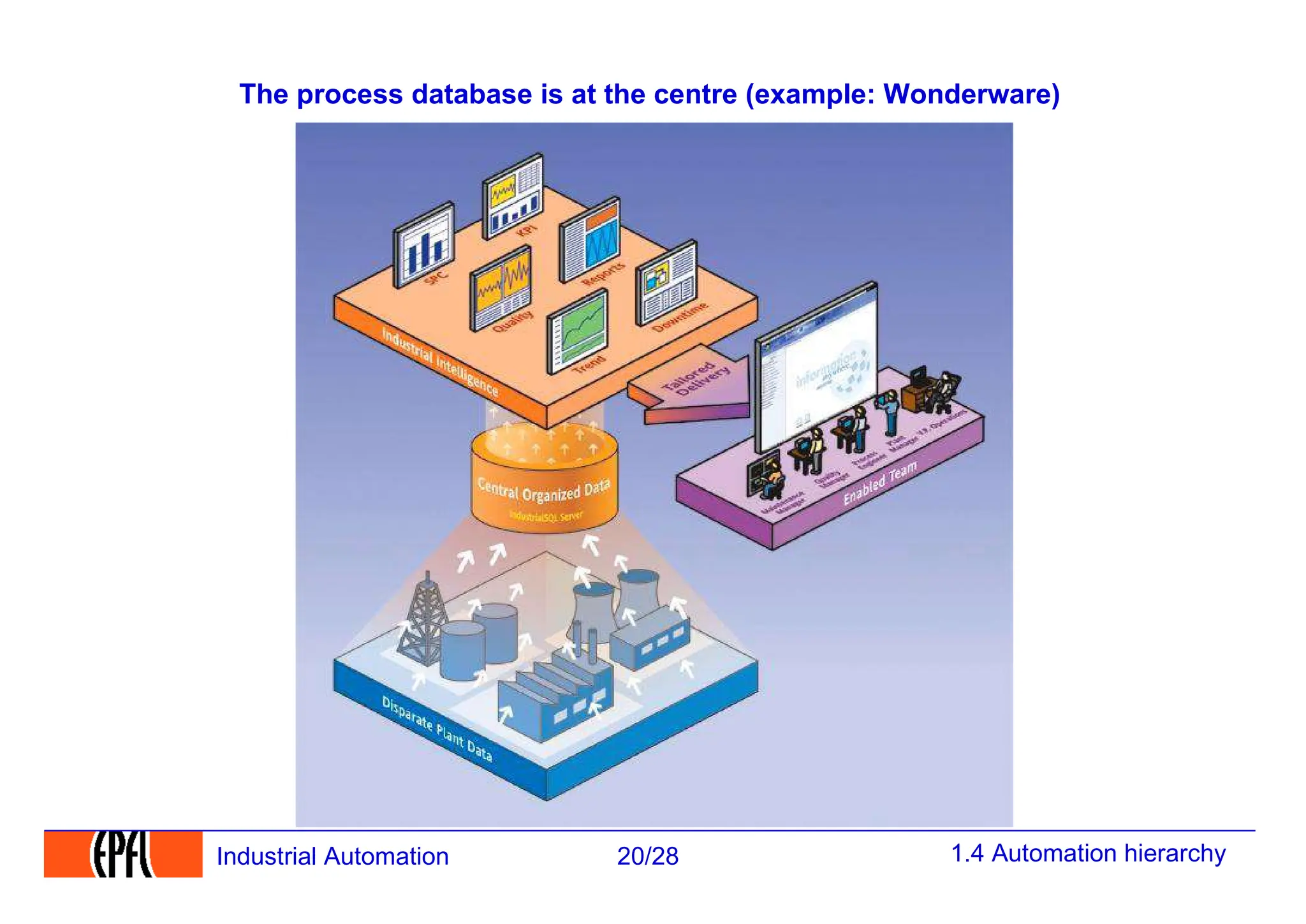
The process database is at the centre (example: Wonderware)
1.4 Automation hierarchy
21/28
Industrial Automation
Assessment
Describe the levels of a hierarchical control system
What is the relationship between hierarchical level, the response time, data quantity and complexity ?
What does SCADA stands for ?
What is a group control used for ?
What is the role of a Manufacturing Execution System ?
What are the three functions of the operator interface ?
What is Enterprise Resource Planning ?
What is the role of the process database ?
1.4 Automation hierarchy
22/28
Industrial Automation
Automation Industrielle
Industrielle Automation
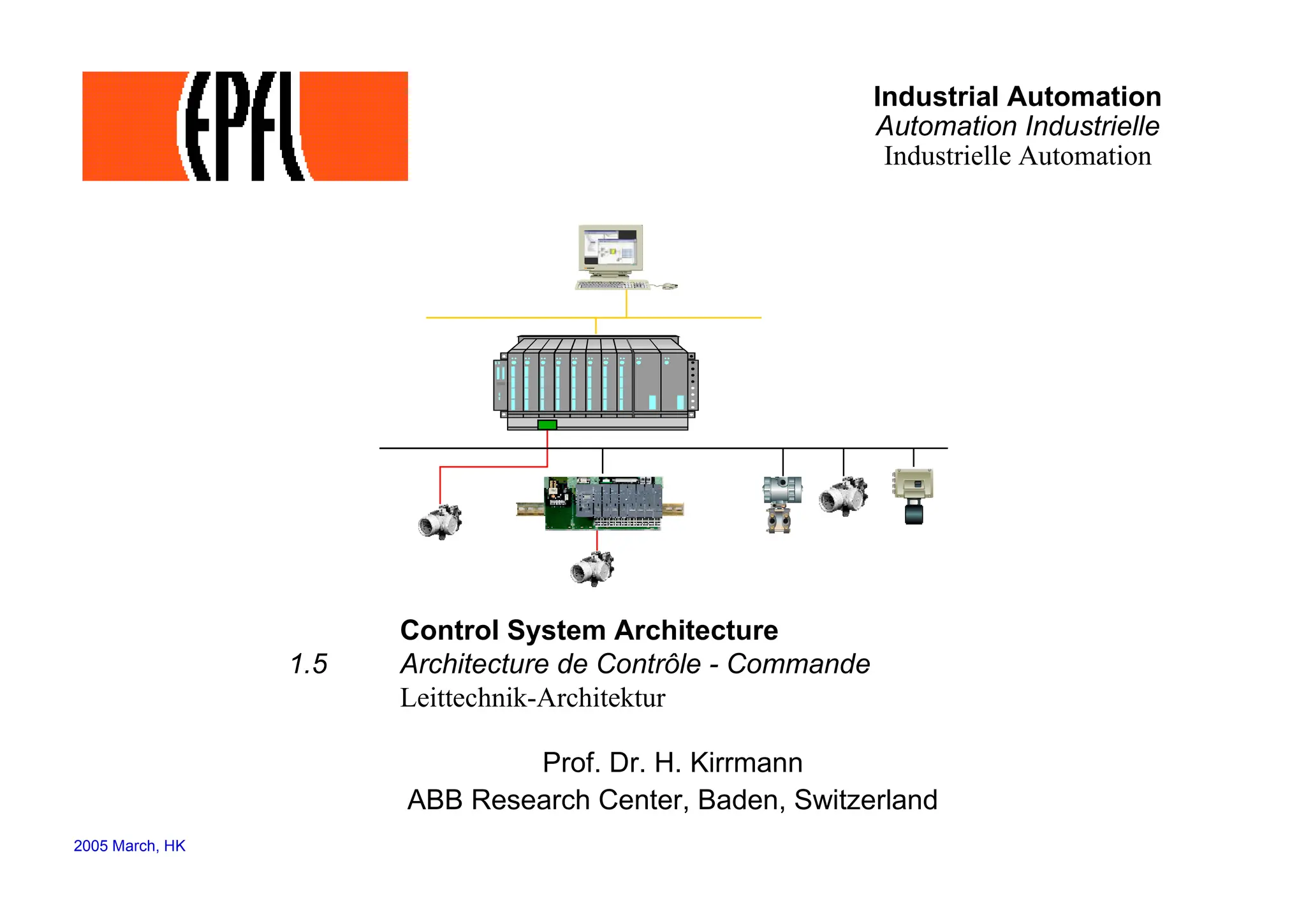
Control System Architecture
1.5 Architecture de Contrôle - Commande
Leittechnik-Architektur
Prof. Dr. H. Kirrmann
ABB Research Center, Baden, Switzerland
2005 March, HK
1.5 Control System Architecture
2/20
Industrial Automation
1.5 Control System Architecture
1 Introduction
1.1 Automation and its importance
1.2 Applications of automation
1.3 Plants and controls
1.3.1 Open loop and closed loop control
1.3.2 Continuous process
1.3.3 Discrete process
1.3.3 Dual plants
1.4 Automation hierarchy
1.5 Control System Architecture
3/20
Industrial Automation
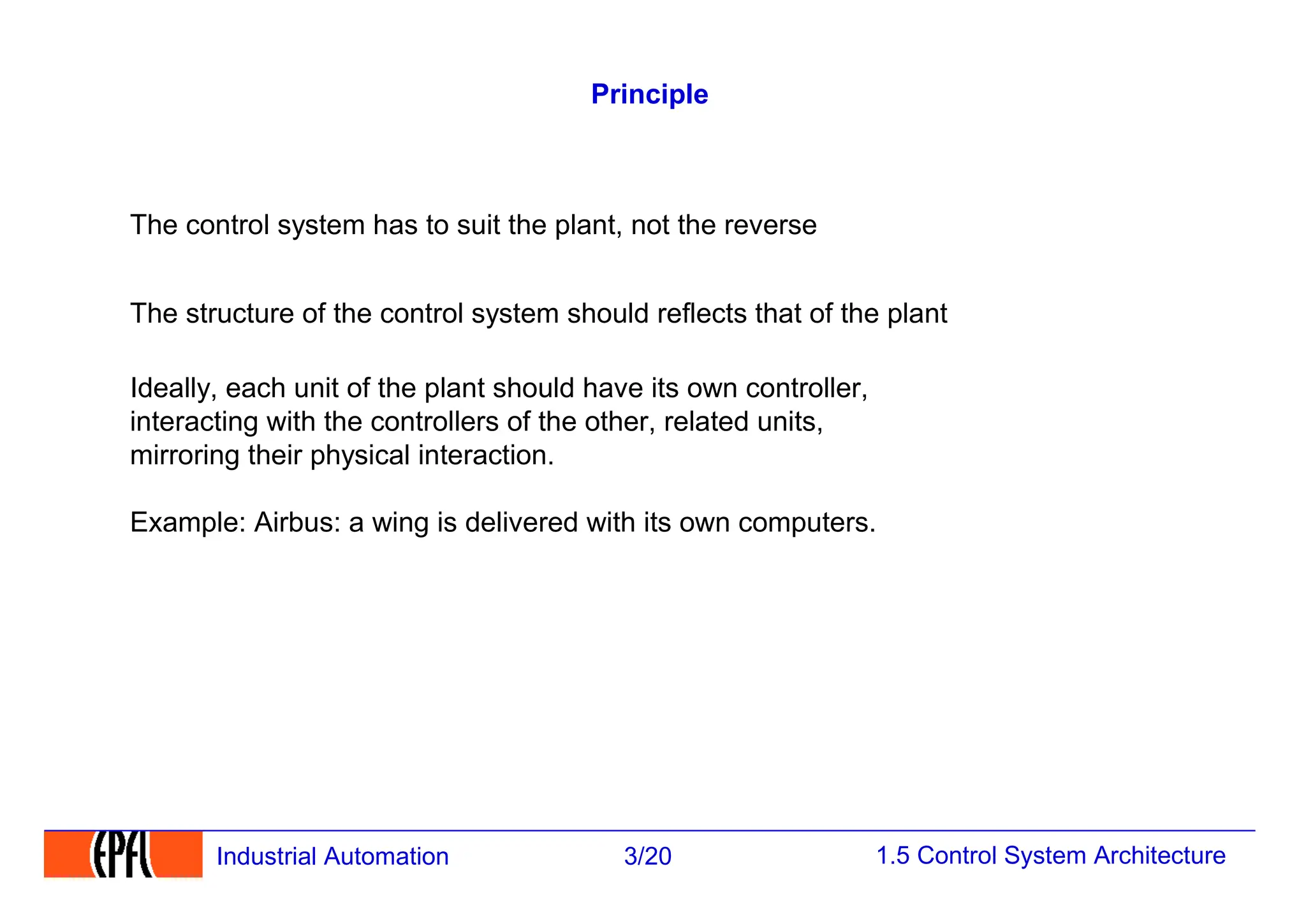
Principle
The control system has to suit the plant, not the reverse
The structure of the control system should reflects that of the plant
Ideally, each unit of the plant should have its own controller,
interacting with the controllers of the other, related units,
mirroring their physical interaction.
Example: Airbus: a wing is delivered with its own computers.
1.5 Control System Architecture
4/20
Industrial Automation
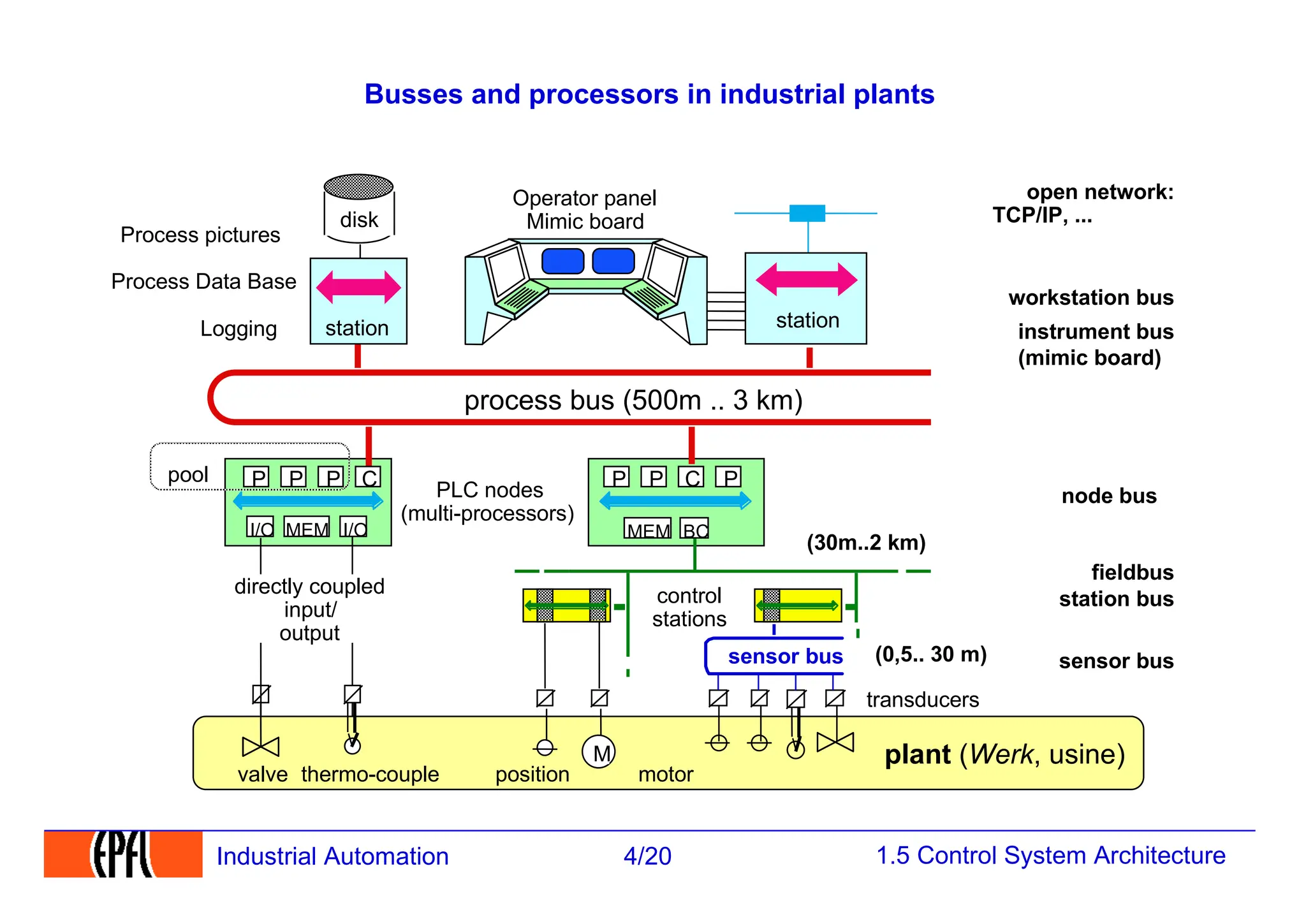
Busses and processors in industrial plants
PLC nodes
(multi-processors)
fieldbus
Operator panel
Mimic board
plant (Werk, usine)
P
disk
pool
transducers
control
stations
process bus (500m .. 3 km)
valve thermo-couple motor
Process pictures
Process Data Base
Logging
position
station bus
(0,5.. 30 m)
node bus
workstation bus
instrument bus
(mimic board)
sensor bus
directly coupled
input/
output
open network:
TCP/IP, ...
station
P P C
I/O MEM I/O
P P C P
MEM BC
station
M
sensor bus
(30m..2 km)
1.5 Control System Architecture
5/20
Industrial Automation
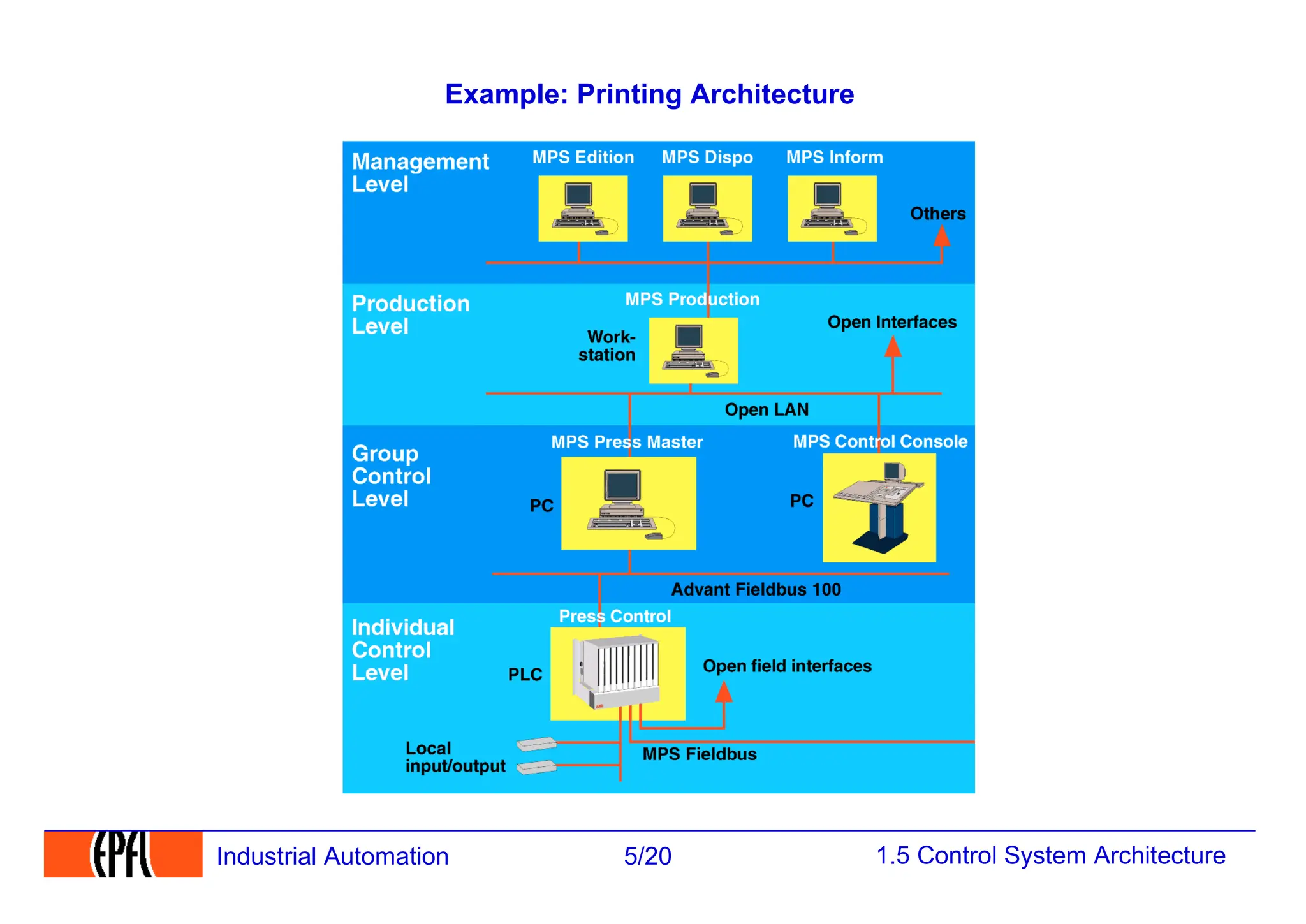
Example: Printing Architecture
1.5 Control System Architecture
6/20
Industrial Automation
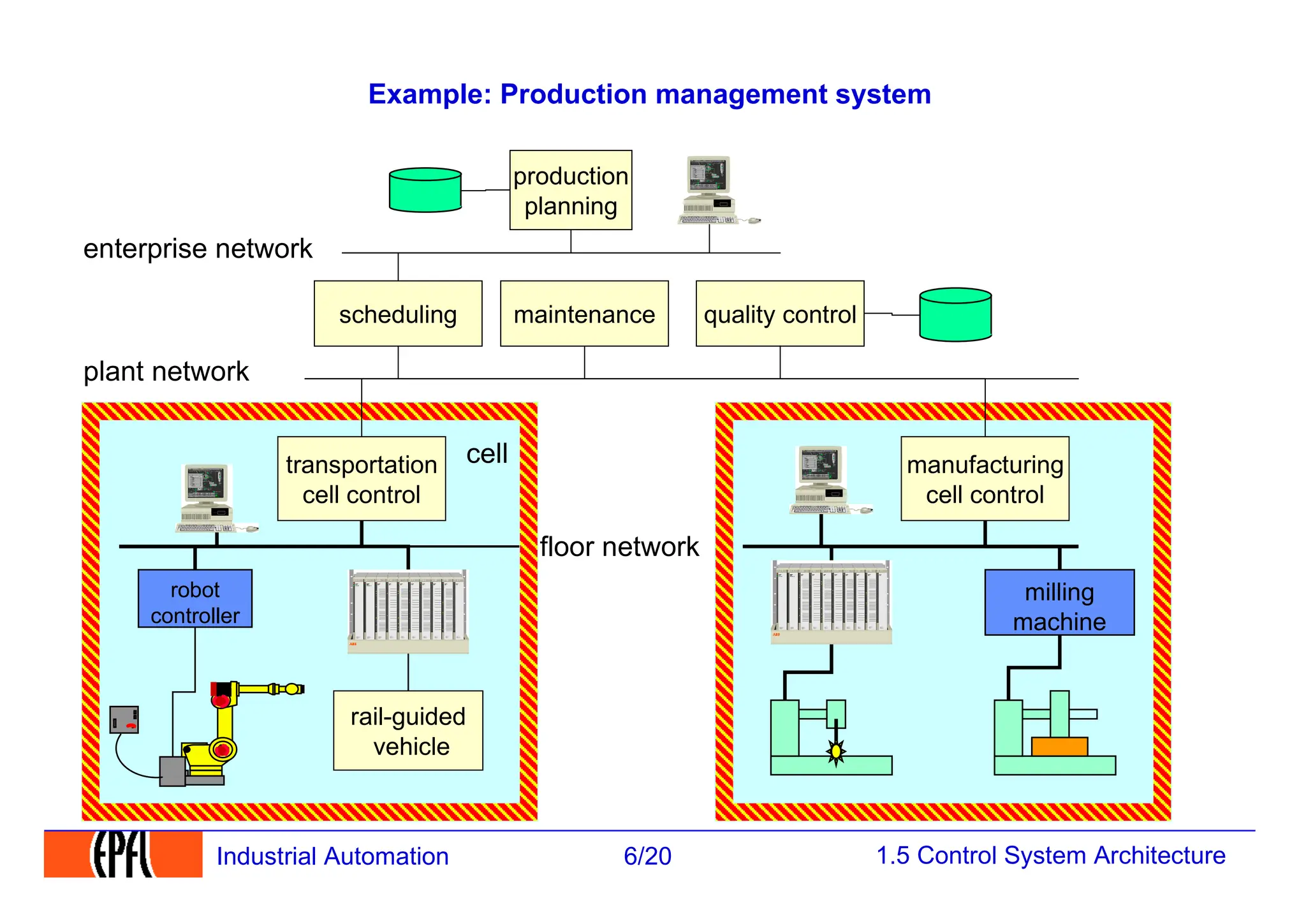
Example: Production management system
transportation
cell control
manufacturing
cell control
scheduling maintenance quality control
plant network
floor network
production
planning
robot
controller
enterprise network
milling
machine
rail-guided
vehicle
cell
1.5 Control System Architecture
7/20
Industrial Automation
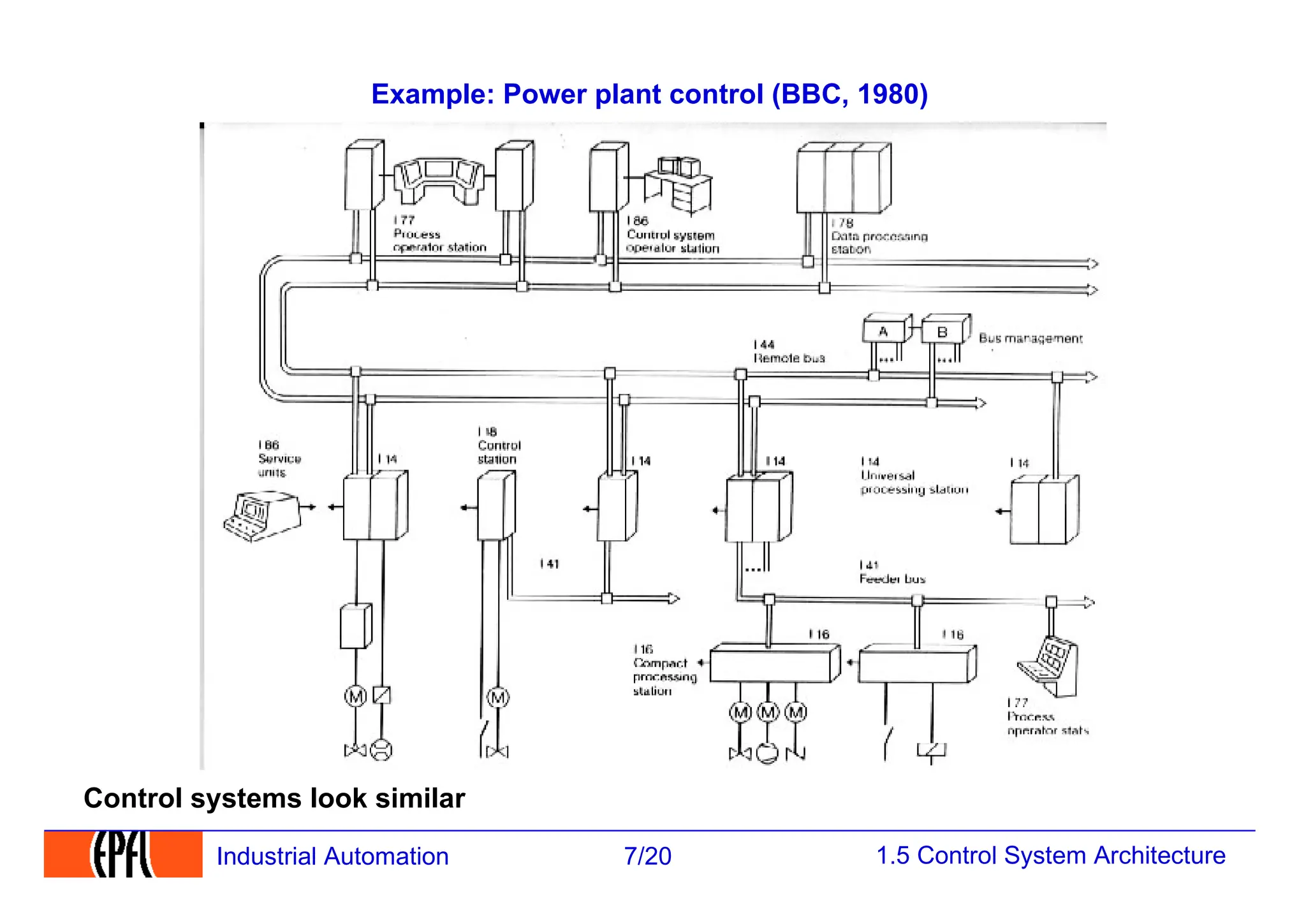
Example: Power plant control (BBC, 1980)
Control systems look similar
1.5 Control System Architecture
8/20
Industrial Automation
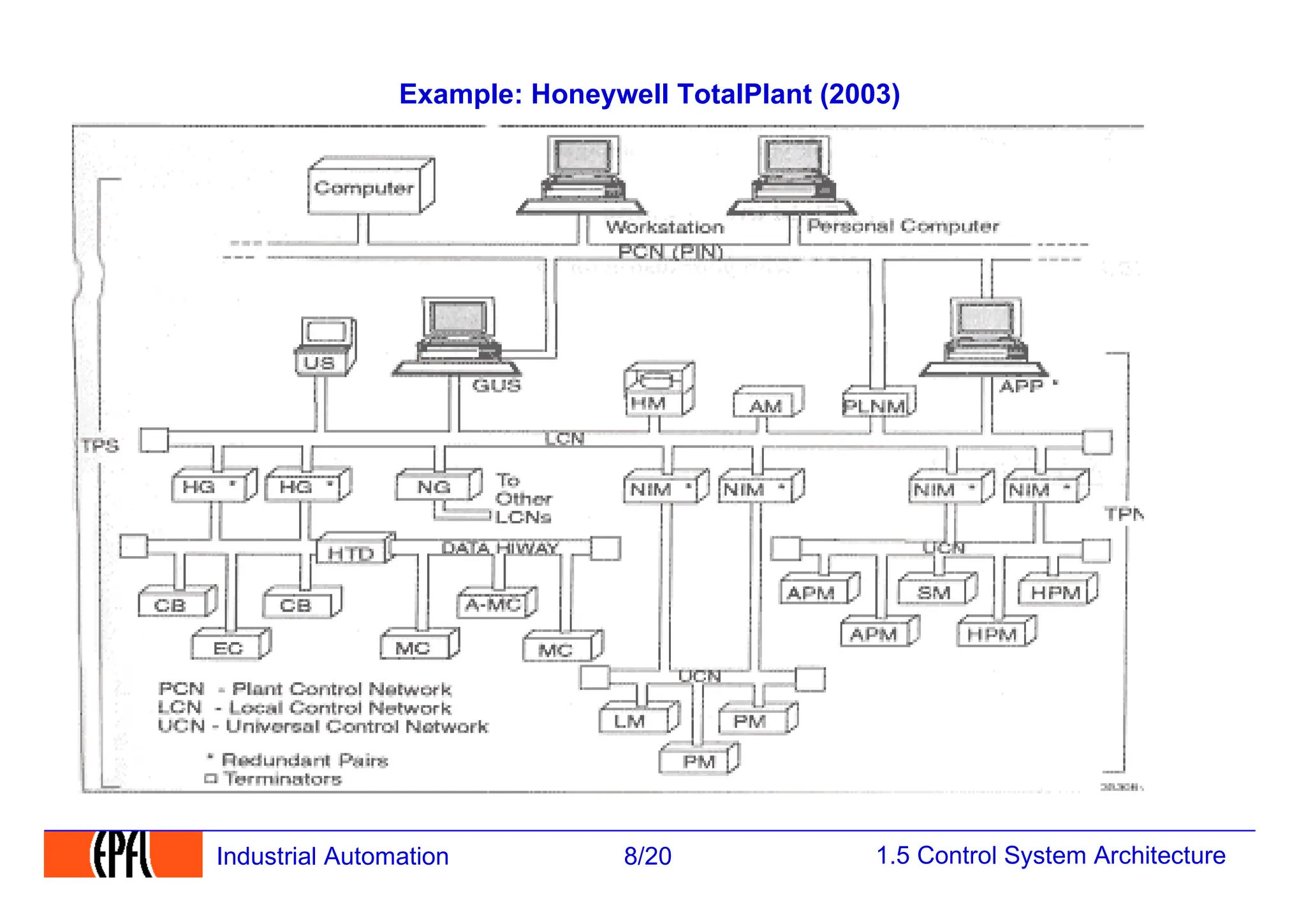
Example: Honeywell TotalPlant (2003)
1.5 Control System Architecture
9/20
Industrial Automation
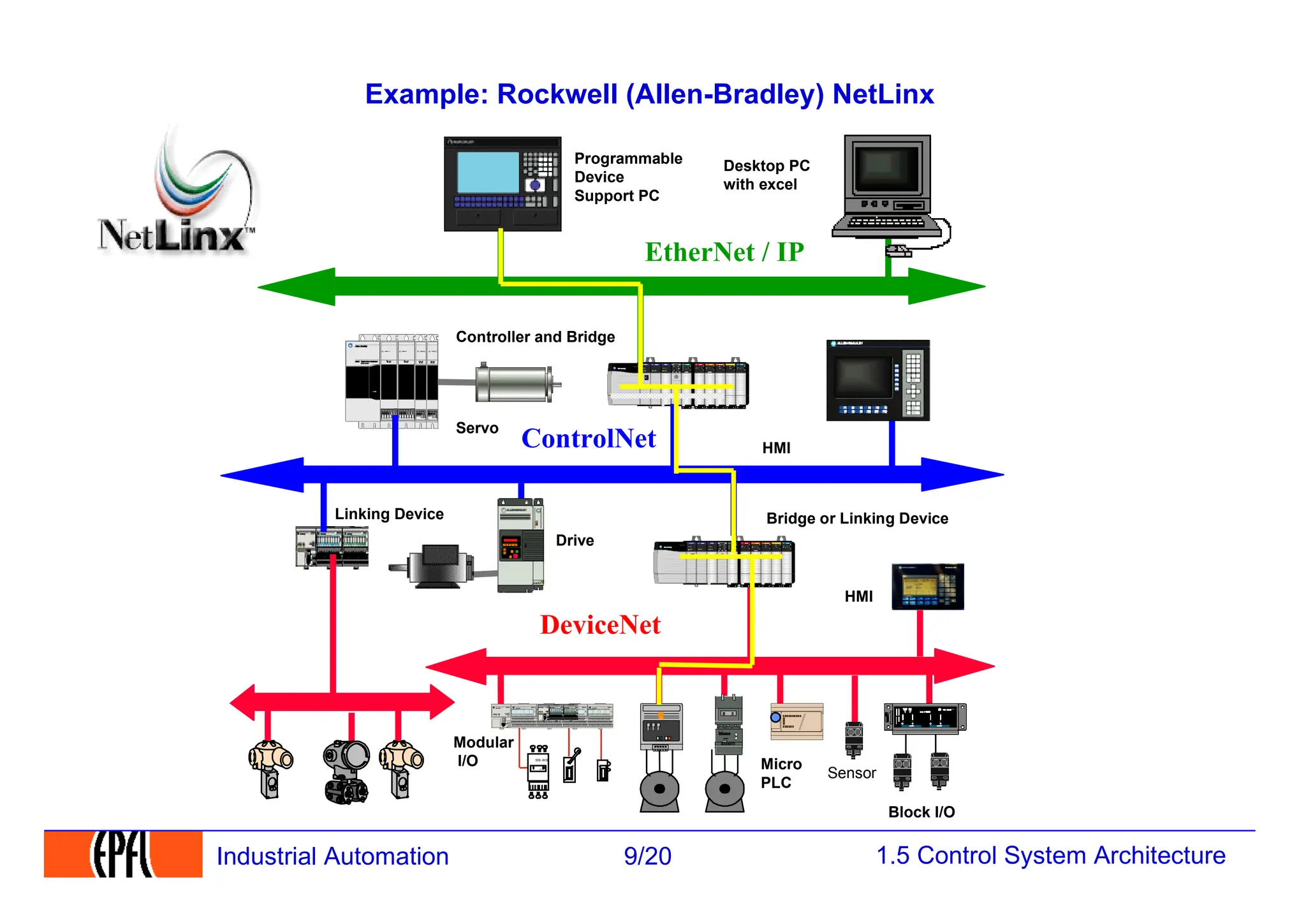
Example: Rockwell (Allen-Bradley) NetLinx
Modular
I/O
HMI
24vdc
509 -BOD
Bridge or Linking Device
Programmable
Device
Support PC
Block I/O
Micro
PLC
Drive
Servo
Controller and Bridge
HMI
Desktop PC
with excel
Linking Device
Sensor
EtherNet / IP
ControlNet
DeviceNet
1.5 Control System Architecture
10/20
Industrial Automation
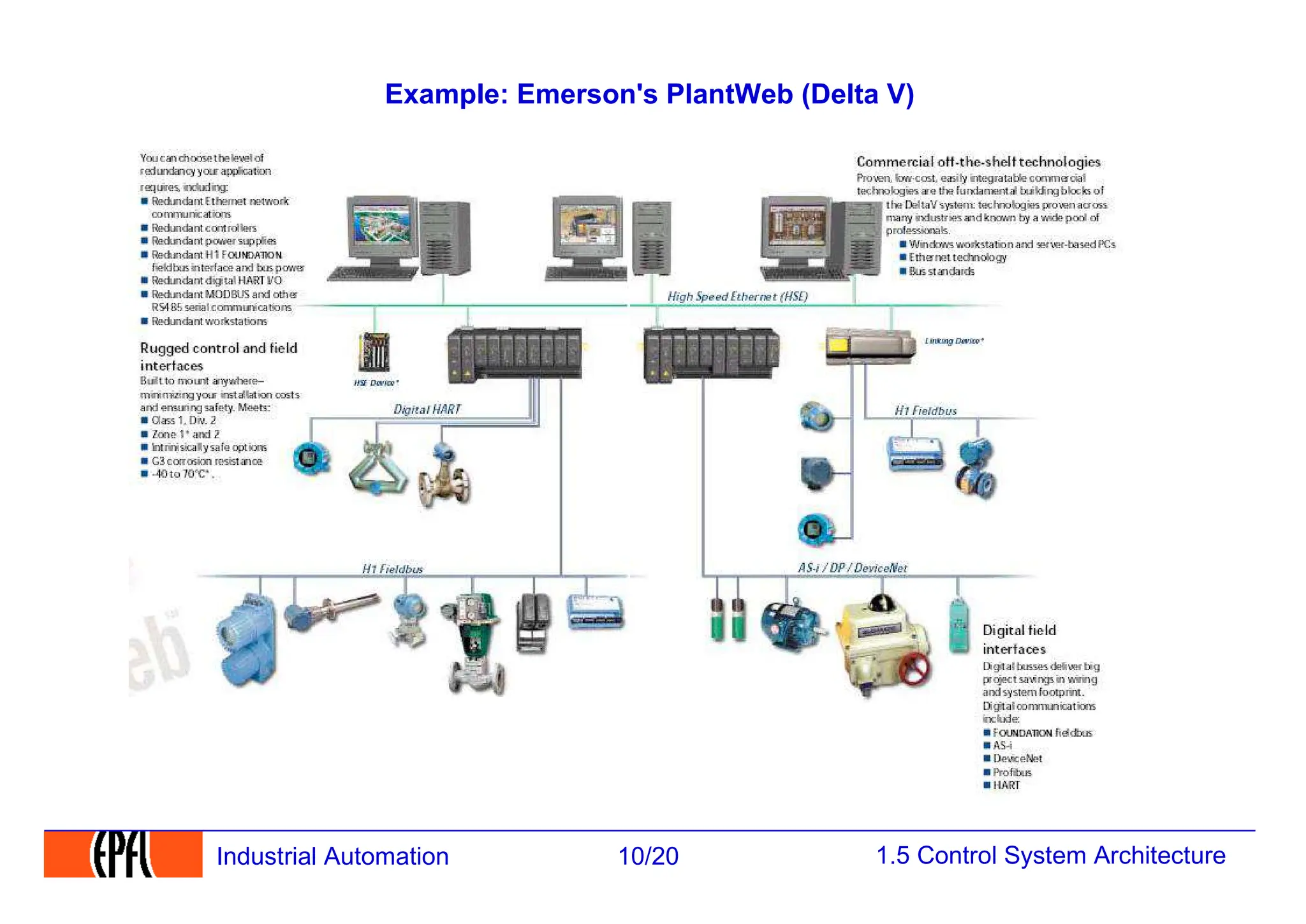
Example: Emerson's PlantWeb (Delta V)
1.5 Control System Architecture
11/20
Industrial Automation
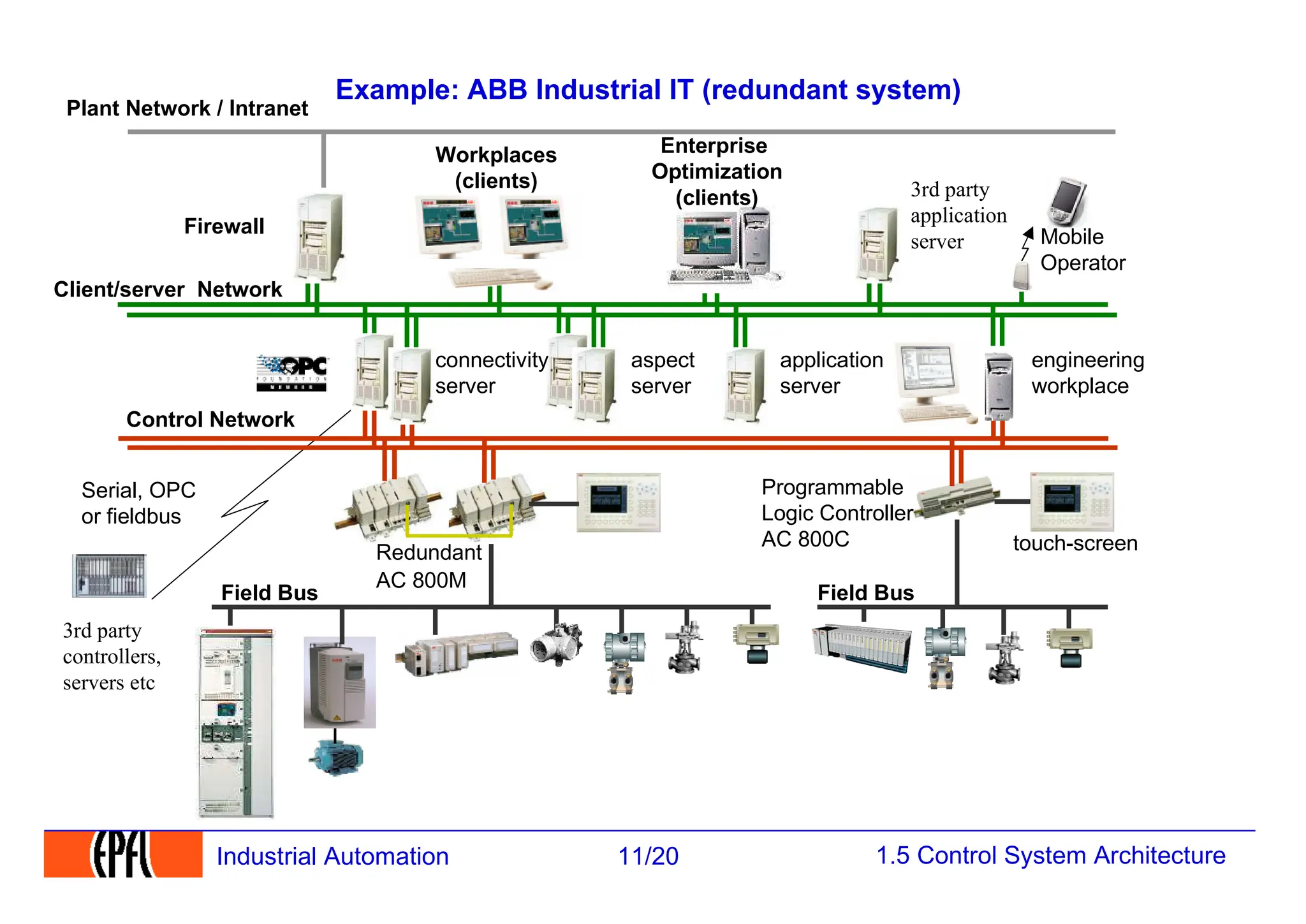
Example: ABB Industrial IT (redundant system)
3rd party
controllers,
servers etc
Serial, OPC
or fieldbus
engineering
workplace
Field Bus
Firewall
Plant Network / Intranet
Field Bus
Client/server Network
3rd party
application
server
application
server
aspect
server
Workplaces
(clients)
Enterprise
Optimization
(clients)
Mobile
Operator
connectivity
server
Control Network
Programmable
Logic Controller
AC 800C
Redundant
AC 800M
touch-screen
1.5 Control System Architecture
12/20
Industrial Automation
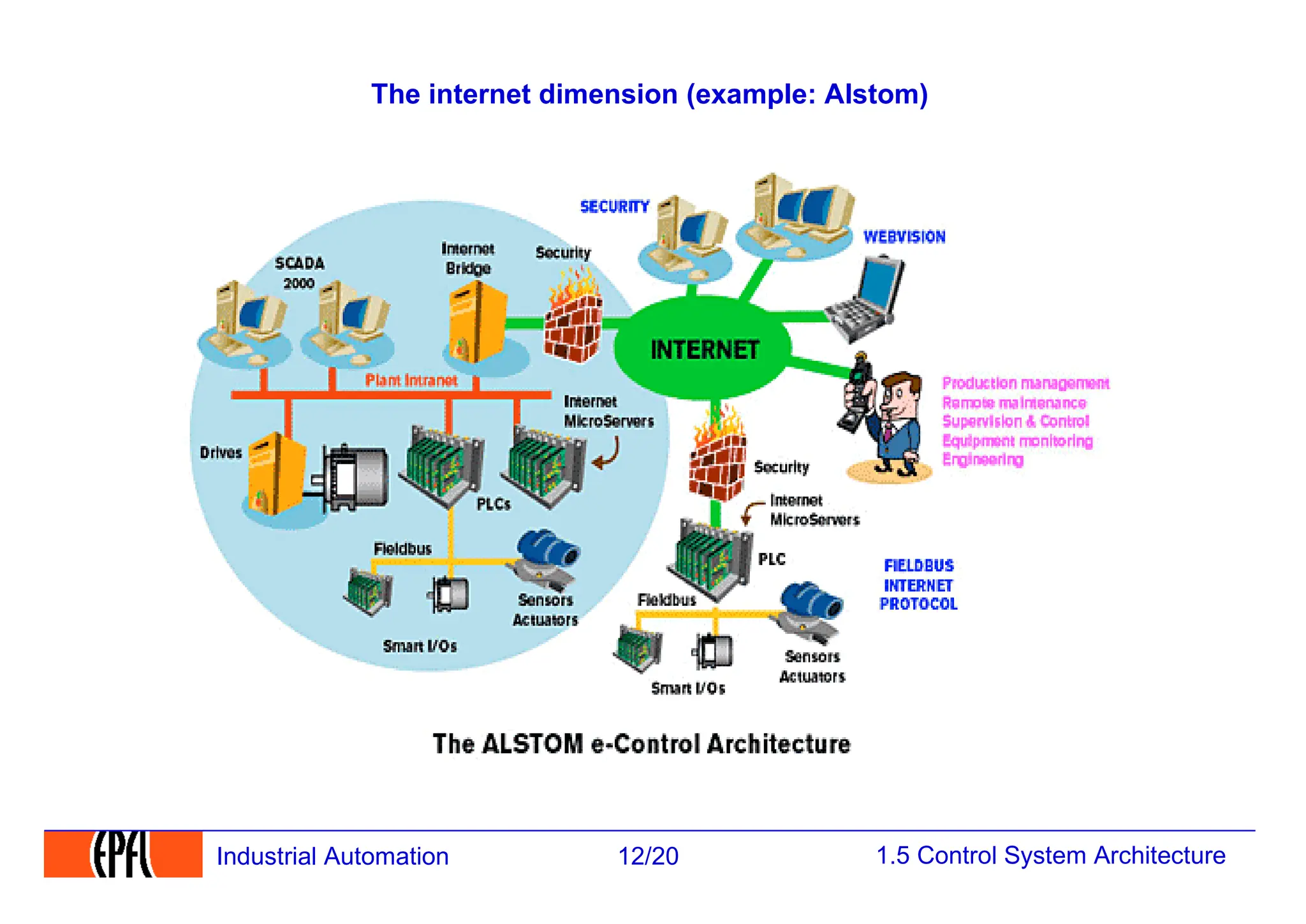
The internet dimension (example: Alstom)
1.5 Control System Architecture
13/20
Industrial Automation
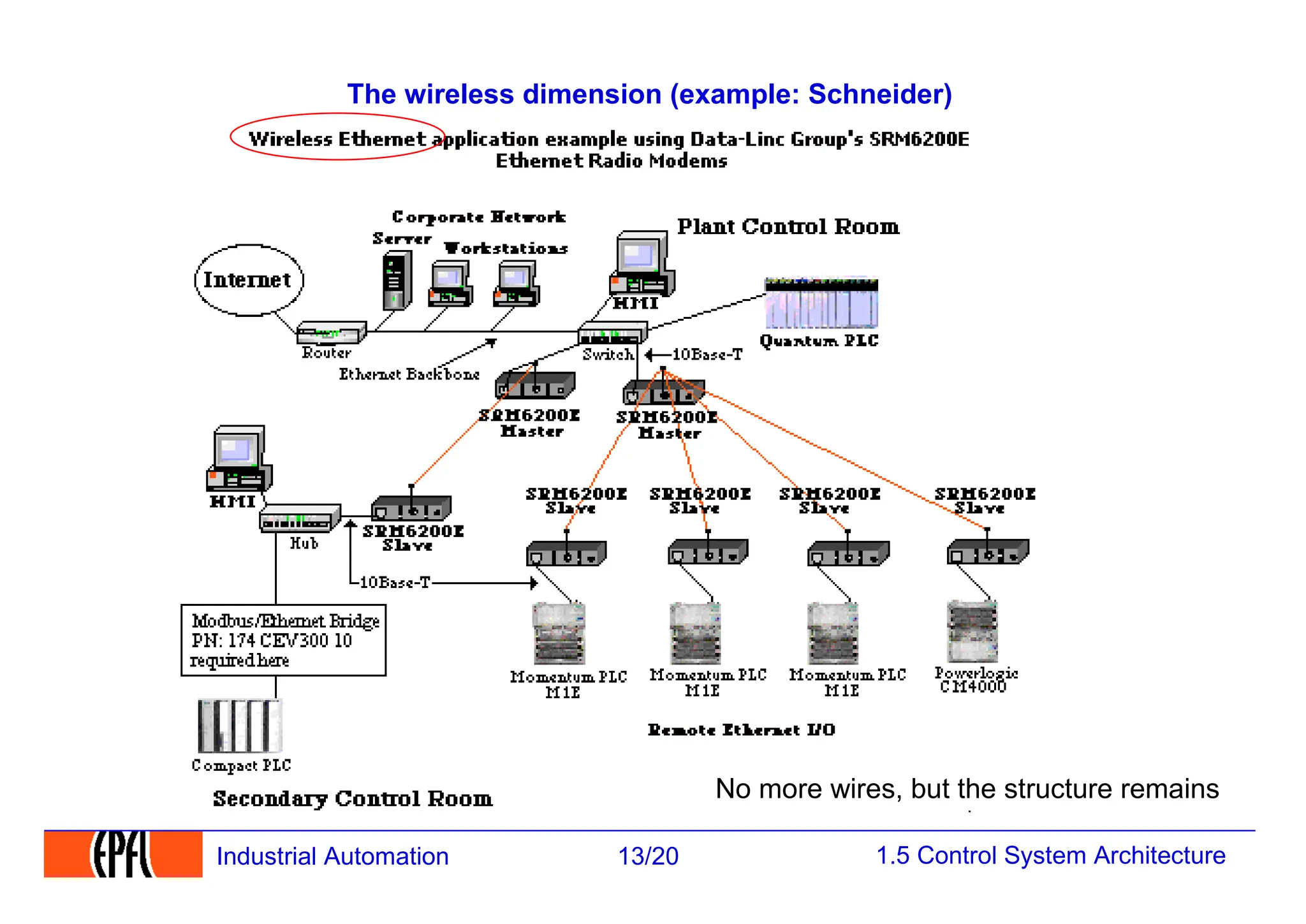
The wireless dimension (example: Schneider)
No more wires, but the structure remains
1.5 Control System Architecture
14/20
Industrial Automation
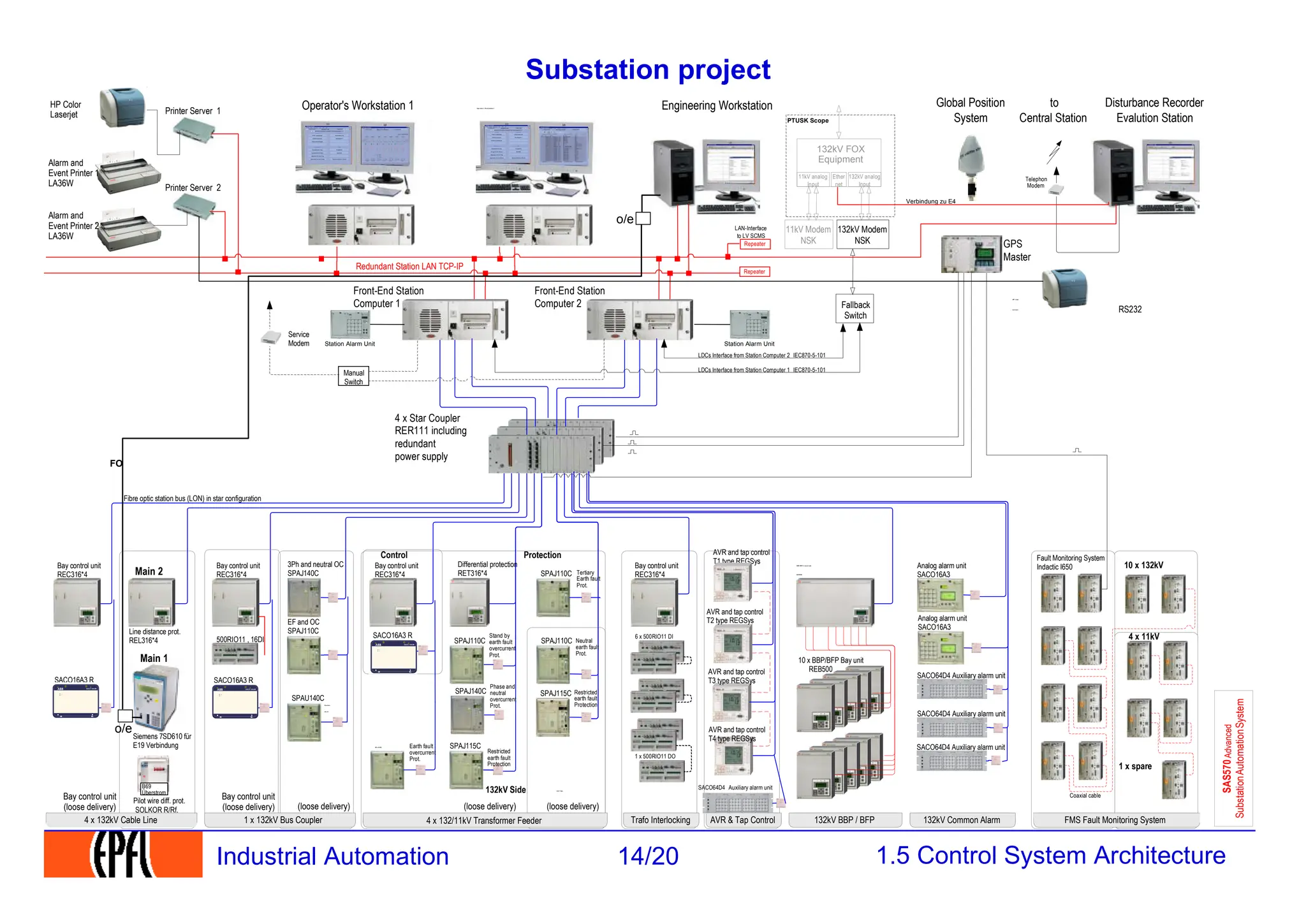
Substation project
Printer Server 1
Alarm and
Event Printer 1
LA36W
Fibre optic station bus (LON) in star configuration
4 x Star Coupler
RER111 including
redundant
power supply
GPS
Master
SAS570
Advanced
Substation
Automation
System
Ope rator's Workstation 2
Operator's Workstation 1 Global Position
System
Front-End Station
Computer 1
Front-End Station
Computer 2
Alarm and
Event Printer 2
LA36W
Redundant Station LAN TCP-IP
Printer Server 2
LAN-Interface
to LV SCMS
Engineering Workstation Disturbance Recorder
Evalution Station
to
Central Station
Manual
Switch
Bay control unit
REC316*4
Bay control unit
REC316*4
4 x 132kV Cable Line 1 x 132kV Bus Coupler Trafo Interlocking 132kV Common Alarm
Differential protection
RET316*4
6 x 500RIO11 DI
SACO64D4 Auxiliary alarm unit
3Ph and neutral OC
SPAJ140C
Bay control unit
(loose delivery)
4 x 132/11kV Transformer Feeder
SPAJ110C
Stand by
earth fault
overcurrent
Prot.
SPAJ115C
Restricted
earth fault
Protection
Neutral
earth fault
Prot.
SPAJ110C
SPAJ115C Restricted
earth fault
Protection
132kV Side 11kV Side
132kV BBP / BFP
BBP/BFP C entral unit
REB500
10 x BBP/BFP Bay unit
REB500
Bay control unit
REC316*4
Bay control unit
REC316*4
AVR & Tap Control
AVR and tap control
T1 type REGSys Fault Monitoring System
Indactic I650
Coaxial cable
Telephon
Modem
SACO64D4 Auxiliary alarm unit
AVR and tap control
T2 type REGSys
Repeater
(loose delivery)
1 x 500RIO11 DO
Service
Modem
132kV Modem
NSK
Fallback
Switch
LDCs Interface from Station Computer 2 IEC870-5-101
LDCs Interface from Station Computer 1 IEC870-5-101
AVR and tap control
T3 type REGSys
Line distance prot.
REL316*4
AVR and tap control
T4 type REGSys
(loose delivery)
(loose delivery)
Bay control unit
(loose delivery)
HP Color
Laserjet
HP Color
Laserjet
EF and OC
SPAJ110C
500RIO11 , 16DI
Analog alarm unit
SACO16A3
Station Alarm Unit Station Alarm Unit
SPA J110C
SPAJ110C
Earth fault
overcurrent
Prot.
Tertiary
Earth fault
Prot.
Repeater
Control Protection
Analog alarm unit
SACO16A3
FMS Fault Monitoring System
10 x 132kV
4 x 11kV
1 x spare
SACO16A3 R
SPAU140C
Synchro-
che ck
SPAJ140C
Phase and
neutral
overcurrent
Prot.
SACO16A3 R
SACO16A3 R
132kV analog
Input
132kV FOX
Equipment
11kV analog
Input
PTUSK Scope
11kV Modem
NSK
SACO64D4 Auxiliary alarm unit
Main 2
o/e
o/e
SACO64D4 Auxiliary alarm unit
Ether
net
Verbindung zu E4
FO
RS232
Pilot wire diff. prot.
SOLKOR R/Rf.
B69
Überstrom
Main 1
Siemens 7SD610 für
E19 Verbindung
1.5 Control System Architecture
15/20
Industrial Automation
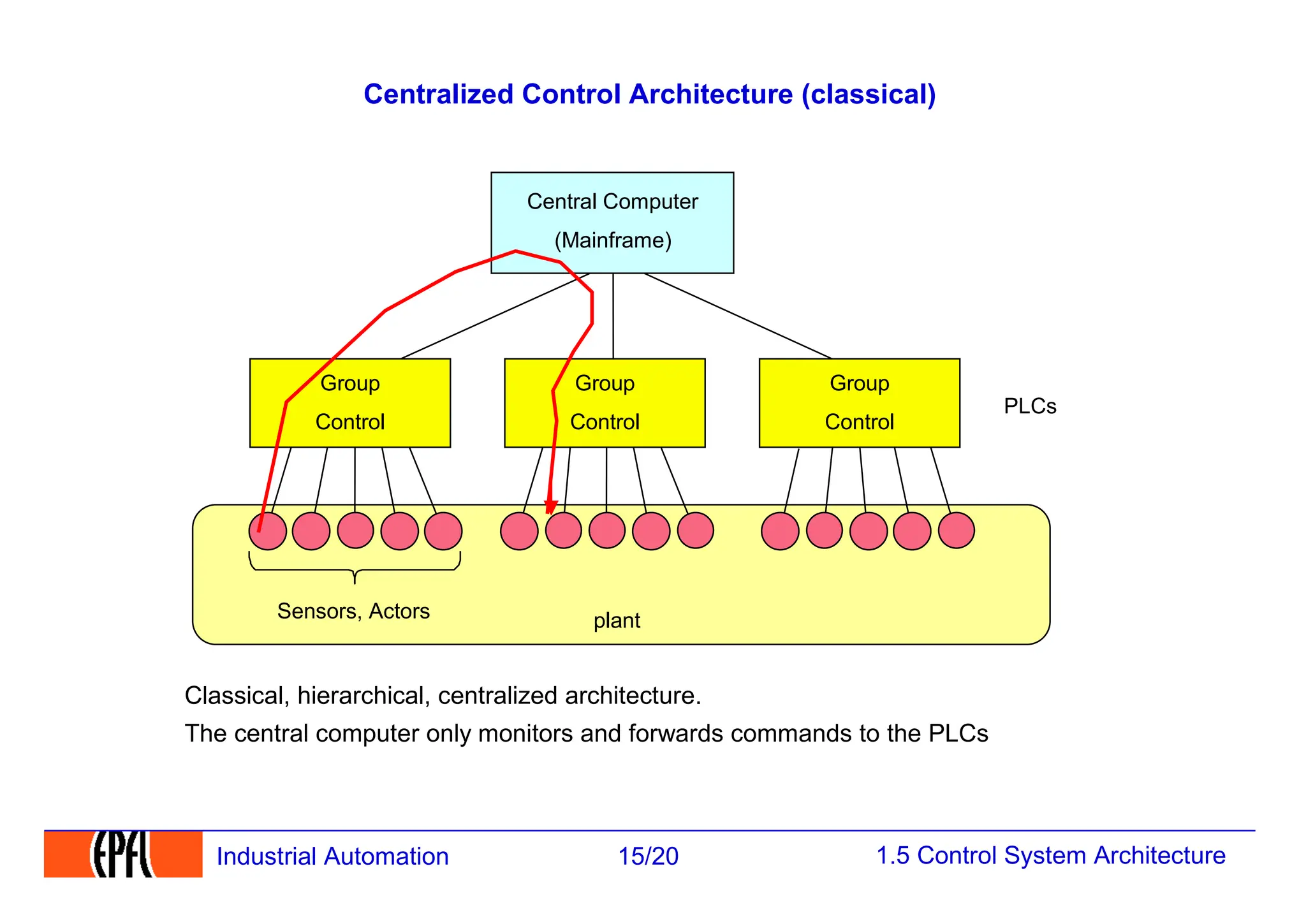
Centralized Control Architecture (classical)
Sensors, Actors
PLCs
Group
Control
Group
Control
Group
Control
Central Computer
(Mainframe)
Classical, hierarchical, centralized architecture.
The central computer only monitors and forwards commands to the PLCs
plant
1.5 Control System Architecture
16/20
Industrial Automation
plant
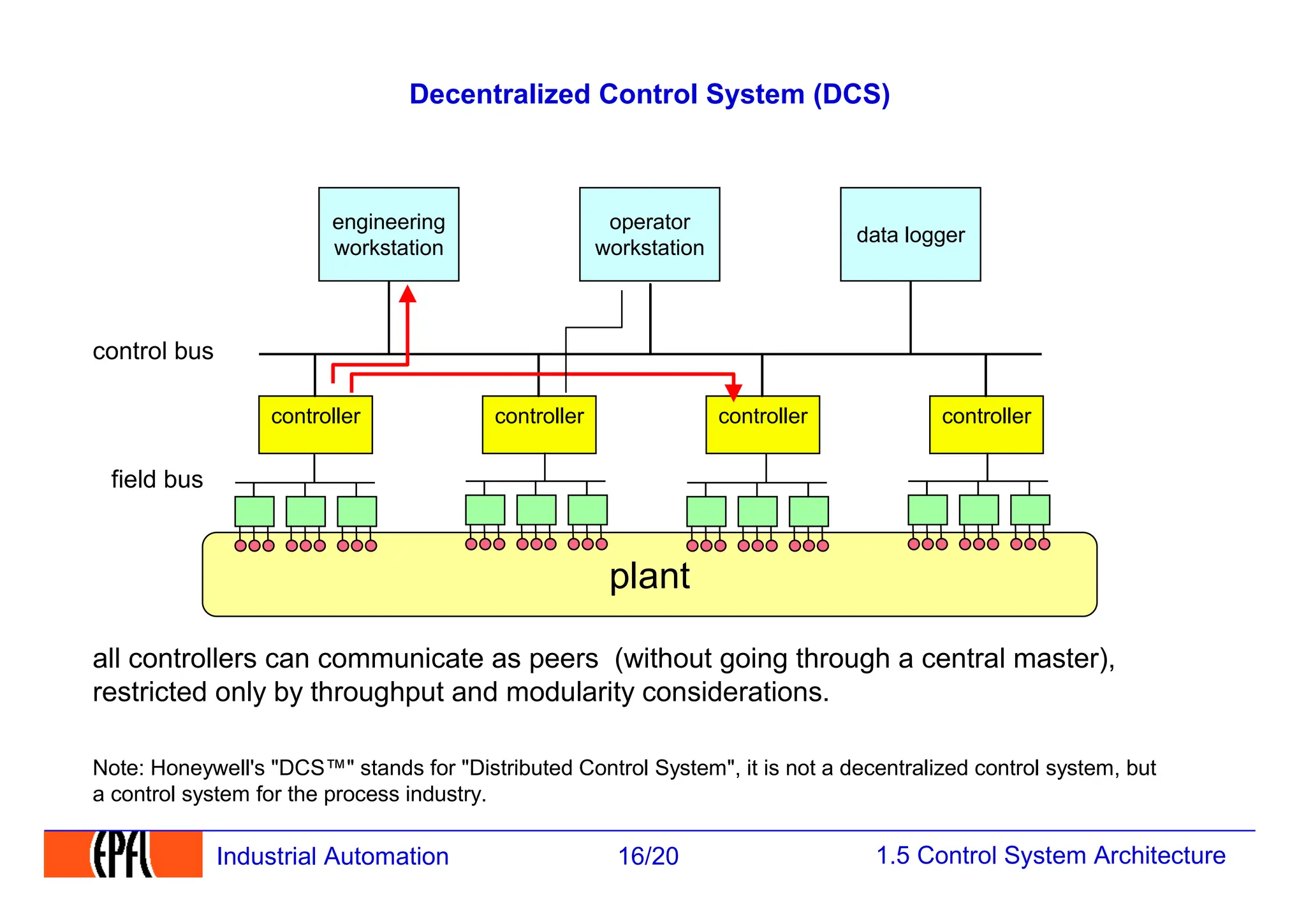
Decentralized Control System (DCS)
engineering
workstation
operator
workstation
data logger
controller controller controller controller
field bus
control bus
all controllers can communicate as peers (without going through a central master),
restricted only by throughput and modularity considerations.
Note: Honeywell's "DCS™" stands for "Distributed Control System", it is not a decentralized control system, but
a control system for the process industry.
1.5 Control System Architecture
17/20
Industrial Automation
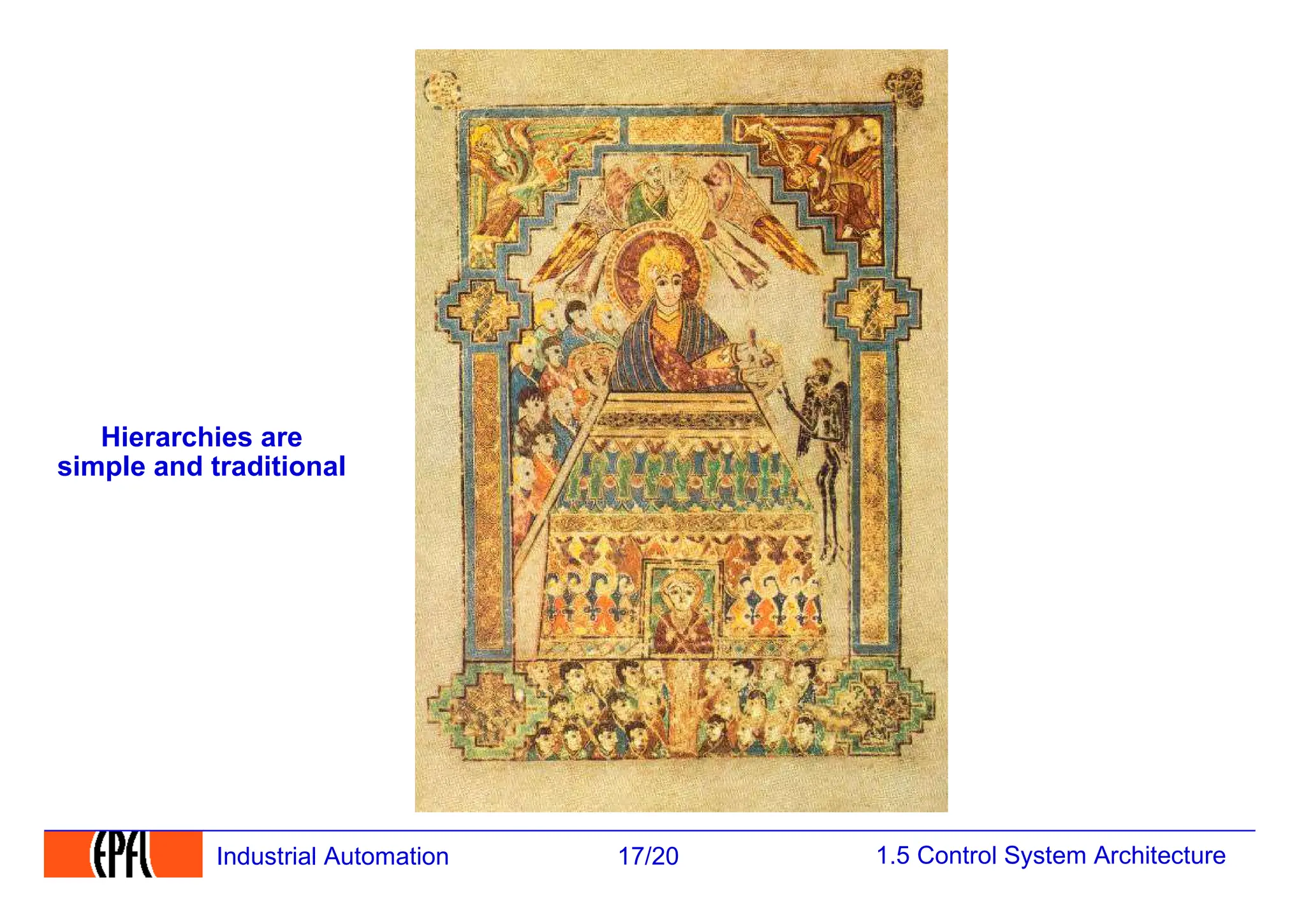
Hierarchies are
simple and traditional
1.5 Control System Architecture
18/20
Industrial Automation
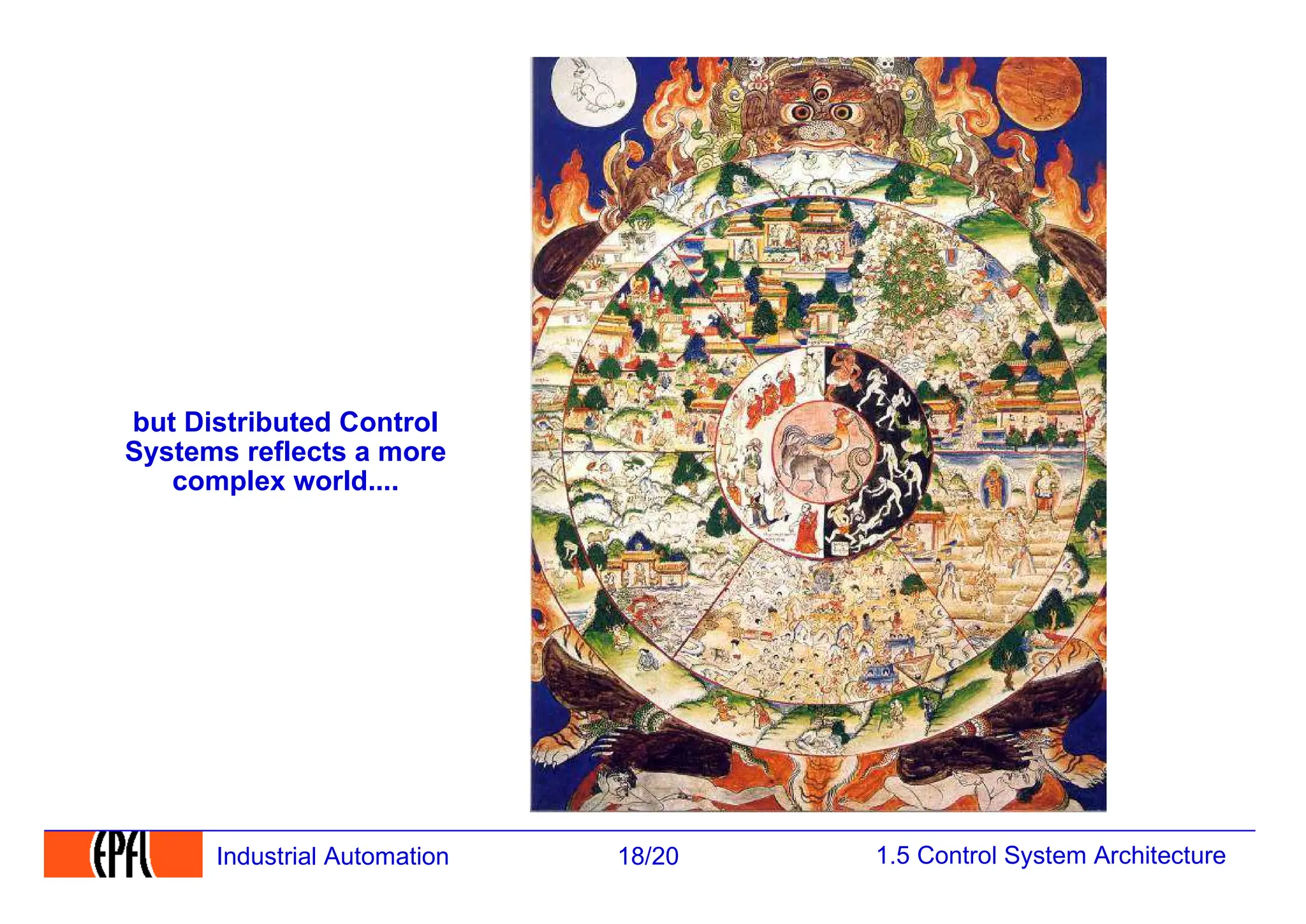
but Distributed Control
Systems reflects a more
complex world....
1.5 Control System Architecture
19/20
Industrial Automation
Assessment
1. Draw a typical hierarchical control system showing busses and controllers
2. How does the network hierarchy relate to the plant control hierarchy ?
3. What is the difference between a centralized and a decentralized control system ?
(can this difference be seen from the outside ?)
Basics of Industrial Automation.pdf

Basics of Industrial Automation.pdf

  • 1.
    Automation Overview 1.1 Automation-vue d'ensemble Automation - Übersicht Prof. Dr. H. Kirrmann EPFL / ABB Research Center, Baden, Switzerland Industrial Automation Automation Industrielle Industrielle Automation 2005 March, HK
  • 2.
    1.1 Automation Overview 2/12 IndustrialAutomation Contents 1 Introduction 1.1 Automation and its importance 1.2 Examples of automated processes 1.3 Types of plants and controls 1.3.1 Open loop and closed loop control 1.3.2 Continuous processes 1.3.3 Discrete processes 1.3.3 Mixed processes 1.4 Automation hierarchy 1.5 Control System Architecture
  • 3.
    1.1 Automation Overview 3/12 IndustrialAutomation Automation Applications Power generation hydro, coal, gas, oil, shale, nuclear, wind, solar Distribution electricity, water Process paper, food, pharmaceutical, metal production and processing, glass, cement, chemical, refinery, oil & gas Manufacturing computer aided manufacturing (CIM) flexible fabrication, appliances, automotive, aircrafts Storage Building heat, ventilation, air conditioning (HVAC) access control, fire, energy supply, tunnels, parking lots, highways,.... Transportation rolling stock, street cars, sub-urban trains, busses, trolley busses, cars, ships, airplanes, rockets, satellites,... silos, elevator, harbor, retail houses, deposits, luggage handling Transmission electricity, gas, oil
  • 4.
    1.1 Automation Overview 4/12 IndustrialAutomation Automation Systems - World Players Company (alpha. order) Location Major mergers ABB CH-SE Brown Boveri, ASEA, CE, Alfa-Laval, Elsag-Bailey Alstom FR Alsthom, GEC, CEGELEC, ABB Power,.. Ansaldo IT Emerson US Fisher Rosemount General Electric US Hitachi JP Honeywell US Rockwell Automation US Allen Bradley, Rockwell,.. Schneider Electric FR Télémécanique, Square-D, ... Invensys UK Foxboro, Siebe, BTR, Triconex,… Siemens DE Plessey, Landis & Gyr, Stäfa, Cerberus,.. Yokogawa JP € 80 Mia / year business (depends on viewpoint), growing 5 % annually
  • 5.
    1.1 Automation Overview 5/12 IndustrialAutomation Worldwide Consolidation Process: the Big Eight Schneider Télémécanique Square D Modicon Schneider Electric Merlin Gérin “Transparent Factory” SACDA Profimatics P&F Safety Systems L&N Measurex Interplant Consulting Allied Signal POMS Honeywell Experion PKS, TotalPlant Rockwell Software Dodge Allen-Bradley Reliance Rockwell Automation RSview Moore Milltronics Axiva ORSI Siemens Compex Vickers Turbi-Werke "Totally Integrated Automation" Intellution GE Industrial GE Fanuc Cimplicity Fisher Rosemountl PC&E Emerson CSI Westinghouse PCD Kenonics MDC Control Techniques Saab Marine Electronics Delta V, Plantweb Wonderware Triconex Eurotherm APV Baan Foxboro AVANTIS PACSIM SimSci-Esscor Walsh Automation Invensys Esscor ArchestA Hartmann & Braun Fisher & Porter Combustion Engineering Alfa-Laval Automation August Systems Elsag Bailey Cellier Engineering Skyva ABB IndustrialIT umbrella architecture
  • 6.
    1.1 Automation Overview 6/12 IndustrialAutomation Three distinct businesses control equipment (control & command) engineering (design & commissioning) primary technology (mechanical, electrical) general contractor: organizes the suppliers of the different components. turnkey factory: the client only hires consultants to supervise the contractor increasingly, the general contractor has to pay itself by operating the plant. increasingly, the suppliers are paid on results…. plant: site, usine, centrale (électricité) Prozess, Werk, Fabrik, Kraftwerk
  • 7.
    1.1 Automation Overview 7/12 IndustrialAutomation Life-phases of a Plant (Example: Rail Vehicle) Maintenance (entretien, Unterhalt) Start on service Recycling (Recyclage, Wiederverwertung) Out of service Commissioning (mise en service, Inbetriebnahme) Sleeping Wagon XL5000 Plus Engineering (bureau d’étude, Projektierung) Equipment Production (production, Herstellung) air conditioning brakes control Equipment Design (développement, Entwicklung) brakes brakes replacement Manufacturers Assembler (ensemblier) Client, Service car body design by assembler
  • 8.
    1.1 Automation Overview 8/12 IndustrialAutomation Technical necessity of automation • Processing of the information flow • Enforcement of safety and availability • Reduction of personal costs
  • 9.
    1.1 Automation Overview 9/12 IndustrialAutomation Expectations of automation • Energy, material and time savings • Quality improvement and stabilisation • Reduction of waste, pollution control • Compliance with regulations and laws, product tracking • Increase availability, safety • Fast response to market • Connection to management and accounting (SAP™) • Automation of engineering, commissioning and maintenance • Software configuration, back-up and versioning • Life-cycle control • Maintenance support Asset Optimisation (gestion des moyens de production) -> Human-Machine Interface (MMC = Man-Machine Communication) -> Acquisition of large number of “Process Variables”, data mining Personal costs reduction Process Optimisation • Simplify interface • Assist decision • Require data processing, displays, data base, expert systems -> Engineering Tools
  • 10.
    1.1 Automation Overview 10/12 IndustrialAutomation Data quantity in plants Data reduction and processing is necessary to operate plants information flow to the personal: > 5 kbit/s. human processing capacity: about 25 bit/s without computers, 200 engineers (today: 3) Electricity distribution network three times more points than in conventional power plants Nuclear Power Plant 10'000 points, comprising 8'000 binary and analog measurement points and 2'000 actuation point 1'000 micro-controllers and logic controllers Coal-fired power plant today 100 measurement and action variables (called "points") Analog controllers, analog instruments one central "process controller" for data monitoring and protocol. Power Plant 25 years ago 100’000 - 10’000’000 points
  • 11.
    1.1 Automation Overview 11/12 IndustrialAutomation Assessment How is automation justified ? Which are the expectations put on automation ? What quantity of data can be expected in a typical plant ?
  • 13.
    Prof. Dr. H.Kirrmann EPFL /ABB Research Center, Baden, Switzerland Industrial Automation Automation Industrielle Industrielle Automation Automation Examples 1.2 Exemples de sites automatisés Beispiele Automatisierungssysteme 2005 March, HK
  • 14.
    2 2004 June, HK1.2 Automation Examples EPFL - Industrial Automation Examples of Automated Plants 1 Introduction 1.1 Automation and its importance 1.2 Applications of automation 1.3 Types of Plants and Control 1.3.1 Open Loop and Closed Loop Control 1.3.2 Continuous processes 1.3.2 Discrete processes 1.3.3 Mixed processes 1.4 Automation hierarchy 1.5 Control System Architecture
  • 15.
    3 2004 June, HK1.2 Automation Examples EPFL - Industrial Automation Cars traditional: appliances control (windows, seats, radio,..) motor control (exhaust regulations) critical new applications: ABS and EPS, brake-by-wire, steer-by-wire (“X-by-wire”) increased safety ? extreme price squeezing 2001 US model: 19% of the price is electronics, tendency: +10% per year.
  • 16.
    4 2004 June, HK1.2 Automation Examples EPFL - Industrial Automation Rail vehicles display unit vehicle control unit DU TCU DU TCU VCU radio link there are more than 20 interconnected computers on a Lok 2000 (SBB 460) brakes signaling traction control unit diagnostics energy Benefits: reduce operation costs, faster diagnostics, better energy management, automatic train control. VCU
  • 17.
    5 2004 June, HK1.2 Automation Examples EPFL - Industrial Automation Airplanes “avionics”: flight control (safe envelope, autopilot, “engineer”) flight management flight recording (black boxes, turbine FATC) diagnostics “fly-by-wire” high reliability
  • 18.
    6 2004 June, HK1.2 Automation Examples EPFL - Industrial Automation Launch vehicles serial data buses ( 23 shared, 5 dedicated ) GPC 5 IOP 5 GPC 4 IOP 4 GPC 3 IOP 3 GPC 2 IOP 2 GPC 1 IOP 1 Intercomputer (5) Mass memory (2) Display system (4) Payload operation (2) Launch function (2) Flight instrument (5;1 dedicated per GPC) Flight - critical sensor and control (8) Control Panels CPU 1 CPU 2 CPU 3 CPU 4 CPU 5
  • 19.
    7 2004 June, HK1.2 Automation Examples EPFL - Industrial Automation Robots extension limited to 2-3 m (portal robots 10-20m) frequent reprogramming for new tasks, tooling simple embedded computer, hierarchical control
  • 20.
    8 2004 June, HK1.2 Automation Examples EPFL - Industrial Automation Flexible Automation numerous conveyors, robots, CNC machines, paint shops, logistics. Download from production management, connection to administration
  • 21.
    9 2004 June, HK1.2 Automation Examples EPFL - Industrial Automation Manufacturing
  • 22.
    10 2004 June, HK1.2 Automation Examples EPFL - Industrial Automation Oil & Gas, petrochemicals "upstream": from the earth to the refinery down-sea control "downstream": from the oil to derived products special requirement: extreme explosive environment distribution special requirement: high pressure, saltwater, inaccessibility explosive environment with gas. special requirement: environmental protection Switzerland: Colombey, Cressier
  • 23.
    11 2004 June, HK1.2 Automation Examples EPFL - Industrial Automation Chemical industry e.g. LONZA logistics, local control of reactors Characterized by batches of products, reuse of production reactors for different product types (after cleaning).
  • 24.
    12 2004 June, HK1.2 Automation Examples EPFL - Industrial Automation Pharmaceutical Industry Inventory Recipe management Packaging Sampling Tracking & tracing Comply with government rules: Typical of batch processes.
  • 25.
    13 2004 June, HK1.2 Automation Examples EPFL - Industrial Automation Printing machines tasks of control system: motor control (synchronisation of the printing cylinders) ink and water control paper web control (reelstands (Rollenwechsler, bobines), web tension, emergency knife) interface to operator (commands, alarms) production preparation and statistics - up to the press room very high requirements on availability: two hours delay and the production is lost.
  • 26.
    14 2004 June, HK1.2 Automation Examples EPFL - Industrial Automation Process Industry Metals and Minerals Glass production Chemical …. Process Industry = industries de transformation, Verfahrenstechnik (one of the many meanings of “process”) Cement Pulp & Paper Continuous flow of materials, often 24 hours a day
  • 27.
    15 2004 June, HK1.2 Automation Examples EPFL - Industrial Automation Cement Works Control tasks: Oven rotation and temperature control fuel supply, silos, transport belts, grinding mills, pollution monitoring, quality supervision, filler stations,... Switzerland is leading nation in Europe (Holcim, Jura, …) The rotating oven is the heart of the cement process: the grinded kiln is burnt and comes out as chunks later reduced to powder.
  • 28.
    16 2004 June, HK1.2 Automation Examples EPFL - Industrial Automation Mining
  • 29.
    17 2004 June, HK1.2 Automation Examples EPFL - Industrial Automation Building Automation basics: fire, intrusion, climate, energy management HVAC = Heat, Ventilation and Cooling = air conditioning visitors, meeting rooms, catering,…. low price tag
  • 30.
    18 2004 June, HK1.2 Automation Examples EPFL - Industrial Automation Automation of Building Groups EPFL
  • 31.
    19 2004 June, HK1.2 Automation Examples EPFL - Industrial Automation Airports large building automation system: fire, security access, energy, lighting, air conditioning, communications, traffic control
  • 32.
    20 2004 June, HK1.2 Automation Examples EPFL - Industrial Automation Traffic control fire intrusion energy water ventilation pollution monitoring cameras light control traffic jams prevention,.... (Tunnel Letten near Zurich)
  • 33.
    21 2004 June, HK1.2 Automation Examples EPFL - Industrial Automation Warehouses extreme dependency on the availability of the control system Connection to * supply chain management, * order fulfilment * customer relationship and * commercial accounting (SAP)
  • 34.
    22 2004 June, HK1.2 Automation Examples EPFL - Industrial Automation Harbours from ship planning to crane manipulation and stock control
  • 35.
    23 2004 June, HK1.2 Automation Examples EPFL - Industrial Automation Power plants raw materials supply primary process (steam, wind) personal, plant and neighbourhood safety environmental impact generation process (voltage/frequency) energy distribution (substation) 24 / 365 availability
  • 36.
    24 2004 June, HK1.2 Automation Examples EPFL - Industrial Automation Waste treatment, incinerators raw material supply burning process smoke cleaning environmental control co-generation process (steam, heat) ash analysis ash disposal
  • 37.
    25 2004 June, HK1.2 Automation Examples EPFL - Industrial Automation Water treatment manage pumps, tanks, chemical composition, filters, movers,...
  • 38.
    26 2004 June, HK1.2 Automation Examples EPFL - Industrial Automation Swiss electricity interconnection network
  • 39.
    27 2004 June, HK1.2 Automation Examples EPFL - Industrial Automation Power transmission network Power Plant Centrale, Kraftwerk switchyard, postes HT Schaltfeld SS Regional Control Center Regional Control Center PP Substation (Unterstation , sous-station) SS SS PP SS PP SY SY PP Huge number of "points" (power plants, transformers, breakers, substations) lying 2km to 2000 km apart. All time-critical operations executed locally in the substations and power generation units. International Control Center National Control Center SS Substation
  • 40.
    28 2004 June, HK1.2 Automation Examples EPFL - Industrial Automation Assessment 1) describe some of the typical processes… 2) what is the process industry ? 3) what does upstream / downstream means ? 4) what is the task of a control system in an interconnection network ? 5) which computer functions do you know in a car and which are to come ? 6) draw an electricity network and show where data processing takes place and to which purpose 7) in the EPFL buildings, identify the automation components and their function. 8) what are the functions of the control computers in a locomotive ?
  • 41.
    29 2004 June, HK1.2 Automation Examples EPFL - Industrial Automation
  • 42.
    Types of Plantsand Control 1.3 Systèmes contrôlés et contrôle Strecken und Steuerungen 2005 March, HK Prof. Dr. H. Kirrmann ABB Research Center, Baden, Switzerland Industrial Automation Automation Industrielle Industrielle Automation
  • 43.
    1.3 Types ofPlants and Controls 2/16 Industrial Automation 1.3 Contents 1 Introduction 1.1 Automation and its importance 1.2 Applications of automation 1.3 Plants and controls 1.3.1 Open loop and closed loop control 1.3.2 Continuous processes 1.3.3 Discrete processes 1.3.3 Mixed processes 1.4 Automation hierarchy 1.5 Control system architecture
  • 44.
    1.3 Types ofPlants and Controls 3/16 Industrial Automation Plant types In spite of wide diversity of applications, the principles of automation are similar. There are a few basic types of plants and the same control system hardware and basic software is shared by most applications. Distinction is often question of a point of view, profession-specific vocabulary and marketing.
  • 45.
    1.3 Types ofPlants and Controls 4/16 Industrial Automation Control Tasks Leiten - die Gesamtheit aller Massnahmen, die einen im Sinne festgelegter Ziele erwünschten Ablauf eines Prozesse bewirken (DIN 19222) Conduite: l'ensemble des mesures qui permettent d'influencer l'état d'un processus dans un but fixé. messen - steuern - regeln - leiten mesure - commande - régulation - conduite measure - command - control
  • 46.
    1.3 Types ofPlants and Controls 5/16 Industrial Automation Function of computers in control systems open-loop functions Data acquisition and pre-processing Data transfer between plant and operator Display the plant state Simulation and training Logging and history recording Process optimization algorithms closed-loop functions Protection and interlocking* Regulation Process-driven sequential control Interlocking*: prevent dangerous actions, such as all lights on green at a crossing
  • 47.
    1.3 Types ofPlants and Controls 6/16 Industrial Automation Continuous plants Examples: Drives, Ovens, Chemical Reactors F(p) y x Continuous plants (processes) have states that can be described by a continuous (analog) variable (temperature, voltage, speed,...) Between plant input and plant output, there exists a fixed relation which can be described by a continuous model (transfer function). Continuous plants are mostly reversible and monotone: This is the condition necessary to control them, i.e. impose the value of their output. The transfer function may be described by a differential equation, simplified to a Laplace or a z-transform when the system is linear. The principal control task in relation with a continuous process is its regulation (maintain the state at a determined level)
  • 48.
    1.3 Types ofPlants and Controls 7/16 Industrial Automation Example: modeling a train Train: v dt dx = ) ) sin( ( 1 2 v C v C radius K m mg F m dt dv f x c tract - - - - = a r a Ftract mg mass of the train plus contribution of rotating parts (wheels and rotors) slope Ffrict air friction mechanical friction curve friction
  • 49.
    1.3 Types ofPlants and Controls 8/16 Industrial Automation Modeling: the train as block diagram train inertia v position Km Cx traction force Fz Cz x friction air resistance v2 1 Mr mgsin(a) i Cc curve friction slope radius taken from topography database motor current motor speed |v| r(x) a(x) a acceleration slope
  • 50.
    1.3 Types ofPlants and Controls 9/16 Industrial Automation Discrete plants e c + ¬d 1 2 3 6 5 4 7 a b c + d e init A discrete plant is modeled by well-defined, exhaustive and non-overlapping states, and by abrupt transitions from one state to the next caused by events. Discrete plants are mainly reversible, but not monotone: the removal of the stimulus which caused a state transition will not necessarily bring the plant back to the previous state. Example: a lift will not go back to the previous floor when releasing the button that called it. Discrete plants are described by Finite State Machines, Petri Net, State transition tables Grafcet, SDL or Sequential Function Chart diagrams. The main task of a control system in relation with discrete plants is their command. Going back to a previous state may require transit through several other states.
  • 51.
    1.3 Types ofPlants and Controls 10/16 Industrial Automation Continuous and batch processes Continuous process (processus continus, kontinuierliche Prozesse) continuous flow of material or energy e.g. motor control, cement, glass, paper production, rolling mill for wires, plate or profiles, printing: 23 m/s, steel wire 90 m/s Main task: regulation Batch process (processus de charge (par lots), Stückgutprozesse) discrete processes with handling of individual elements e.g. Numerical Controlled machine, packing machines, Bottle-filling, manufacturing, pharmaceutical and chemical processes. Main task: command
  • 52.
    1.3 Types ofPlants and Controls 11/16 Industrial Automation Discrete and continuous worlds discrete control continuous control
  • 53.
    1.3 Types ofPlants and Controls 12/16 Industrial Automation Mixed plants All processes have some continuous and some discrete behavior In reality, all plants consist of discrete and of continuous processes. Example 1: Motor Control of a cable-car with speed control and stop at stations All parts must de described individually. Processes can be described as continuous within a discrete state or as non- linear, continuous process. Example: Time-triggered set-point of an oven temperature. Mixed Plants are the normal case - a question of point of view. Example 2: A bottle-filling line is in principle a continuous process, but each step consists of a sequence of operations
  • 54.
    1.3 Types ofPlants and Controls 13/16 Industrial Automation Accent depends on industrial process Automotive Manufacturing Electronics Machinery Textiles Pharmaceuticals Fine Chemical Food & Beverage Metals & Mining Water & Waste Pulp & Paper Vehicles Petrochemicals Oil & Gas Electrical Power discrete continuous source: ARC
  • 55.
    1.3 Types ofPlants and Controls 14/16 Industrial Automation The main categories in industry industry distinguishes the following categories of applications: "process control": continuous processes, associated with fluids, for instance sewage water treatment, petrochemical process, cement… "batch control": semi-continuous processes, associated with individual products, for instance chemical, pharmaceutical, brewery… "manufacturing": discrete processes, associated with transformation of parts, e.g. automobile industry, bottle-filling, packaging
  • 56.
    1.3 Types ofPlants and Controls 15/16 Industrial Automation Assessment What is open loop and what closed loop control ? What is the difference between continuous and discrete processes ? What is the difference between a discrete and a batch process ? What is the main task of a controller in a discrete process, in a continuous process ?
  • 57.
    1.3 Types ofPlants and Controls 16/16 Industrial Automation
  • 59.
    Automation Hierarchy 1.4 Hiérarchiede l'automation Leitsystem-Hierarchie Prof. Dr. H. Kirrmann EPFL / ABB Research Center, Baden, Switzerland Industrial Automation Automation Industrielle Industrielle Automation Manufacturing Execution Supervision (SCADA) Group Control Individual Control Field Primary technology Enterprise 2005 March, HK
  • 60.
    1.4 Automation hierarchy 2/28 IndustrialAutomation 1.4 Contents 1 Introduction 1.1 Automation and its importance 1.2 Examples of automated processes 1.3 Types of plants and controls 1.3.1 Open loop and closed loop control 1.3.2 Continuous processes 1.3.3 Discrete processes 1.3.3 Mixed plants 1.4 Automation hierarchy 1.5 Control system architecture
  • 61.
    1.4 Automation hierarchy 3/28 IndustrialAutomation Automation System Structure Although applications differ widely, there is little difference in the overall architecture of their control systems. Why the control system of a power plant is not sold also for automating a brewery depends largely on small differences (e.g. explosion-proof), on regulations (e.g. Food and Drug Administration) and also tradition, customer relationship.
  • 62.
    1.4 Automation hierarchy 4/28 IndustrialAutomation Large control system hierarchy (1) Group control Unit control Field Sensors & actors A V Supervisory Primary technology Workflow, order tracking, resources SCADA = Supervisory Control And Data Acquisition T Production planning, orders, purchase 1 2 3 4 0 Planning, Statistics, Finances 5 (manufacturing) execution enterprise administration
  • 63.
    1.4 Automation hierarchy 5/28 IndustrialAutomation Large control system hierarchy (2) Administration Finances, human resources, documentation, long-term planning Enterprise Set production goals, plans enterprise and resources, coordinate different sites, manage orders Manufacturing Manages execution, resources, workflow, quality supervision, production scheduling, maintenance. Supervision Supervise the production and site, optimize, execute operations visualize plants, store process data, log operations, history (open loop) Group (Area) Controls a well-defined part of the plant (closed loop, except for intervention of an operator) • Coordinate individual subgroups • Adjust set-points and parameters • Command several units as a whole Unit (Cell) Control (regulation, monitoring and protection) part of a group (closed loop except for maintenance) • Measure: Sampling, scaling, processing, calibration. • Control: regulation, set-points and parameters • Command: sequencing, protection and interlocking Field data acquisition (Sensors & Actors*), data transmission no processing except measurement correction and built-in protection. (*capteurs et moteurs, Messfühler & Stellglieder) .
  • 64.
    1.4 Automation hierarchy 6/28 IndustrialAutomation Field level the field level is in direct interaction with the plant's hardware (Primary technology, Primärtechnik)
  • 65.
    1.4 Automation hierarchy 7/28 IndustrialAutomation Group level the group level coordinates the activities of several unit controls the group control is often hierarchical, can be also be peer-to-peer (from group control to group control = distributed control system) Note: "Distributed Control Systems" (DCS) commonly refers to a hardware and software infrastructure to perform Process Automation unit controllers
  • 66.
    1.4 Automation hierarchy 8/28 IndustrialAutomation Local human interface at group level sometimes, the group level has its own man-machine interface for local operation control (here: cement packaging) also for maintenance: console / emergency panel
  • 67.
    1.4 Automation hierarchy 9/28 IndustrialAutomation Supervisory level: Man-machine interface control room (mimic wall) 1970s... formerly, all instruments were directly wired to the control room
  • 68.
    1.4 Automation hierarchy 10/28 IndustrialAutomation Supervisory level: SCADA - displays the current state of the process (visualization) - display the alarms and events (alarm log, logbook) - display the trends (historians) and analyse them - display handbooks, data sheets, inventory, expert system (documentation) - allows communication and data synchronization with other centres (SCADA = Supervisory Control and Data Acquisition)
  • 69.
    1.4 Automation hierarchy 11/28 IndustrialAutomation Plant management - store the plant and product data for further processing in a secure way (historian), allowing to track processes and trace products -> Plant Information Management System (PIMS) - make predictions on the future behaviour of the processes and in particular about the maintenance of the equipment, track KPI (key performance indicators) -> Asset Optimisation (AO)
  • 70.
    1.4 Automation hierarchy 12/28 IndustrialAutomation Engineering workplace The engineering workplace manages the control system, not the plant. The engineer can configure the networks and devices, load the software, assign authorizations, troubleshoot the control system,...
  • 71.
    1.4 Automation hierarchy 13/28 IndustrialAutomation ANSI/ISA 95 standard Source: ANSI/ISA–95.00.01–2000 the ANS/ISA standard 95 defines terminology and good practices Enterprise Resource Planning Manufacturing Execution System Control & Command System Business Planning & Logistics Plant Production Scheduling Operational Management, etc. Manufacturing Operations & Control Dispatching Production, Detailed Product Scheduling, Reliability Assurance,... Level 4 Level 3 Levels 2,1,0 Batch Control Continuous Control Discrete Control
  • 72.
    1.4 Automation hierarchy 14/28 IndustrialAutomation Example: Power plant
  • 73.
    1.4 Automation hierarchy 15/28 IndustrialAutomation Example: Siemens WinCC (Generic) Betriebs- leitebene Unternehmens- leitebene Prozess- leitebene
  • 74.
    1.4 Automation hierarchy 16/28 IndustrialAutomation Response time and hierarchical level Planning Level Execution Level Control Level Supervisory Level ms seconds hours days weeks month years ERP (Enterprise Resource Planning) DCS MES (Manufacturing Execution System) PLC (Programmable Logic Controller) (Distributed Control System) (Supervisory Control and Data Acquisition) SCADA
  • 75.
    1.4 Automation hierarchy 17/28 IndustrialAutomation Data Quantity & Quality and Hierarchical Level Lowest levels (closest to the plant) are most demanding in response time. Quantity of raw data is very large. Processing is trivial (was formerly realized in hardware). These levels are today under computer control, except in emergency situations, for maintenance or commissioning. Lower Levels Higher Levels SCADA level Presentation of complex data to the human operator, aid to decisions (expert system) and maintenance. Requires a knowledge database in addition to the plant's database When ascending the control hierarchy, data are reduced: higher level data are created (e.g. summary information) Processing and decisions becomes more complicated (requires using models). Timing requirements are slackened. Historical data are stored
  • 76.
    1.4 Automation hierarchy 18/28 IndustrialAutomation Complexity and Hierarchical level MES Supervision Prozessleitung Conduite de processus Group Control Gruppenleitung Conduite de groupe Individual Control Conduite individuelle Field terrain Site usine Command level Führungsebene, étage de conduite Complexity Reaction Speed Sys. d'exécution Ausführungssystem ERP days months minutes seconds 0.1s 0.1s Einzelleitung, Feld, Anlage,
  • 77.
    1.4 Automation hierarchy 19/28 IndustrialAutomation Operation and Process Data base Consideration of human intervention breaches this hierarchy. Normally, the operator is only concerned by the supervisory level, but exceptionally, operators (and engineers) want to access data of the lowest levels. The operator sees the plant through a fast data base, refreshed in background. This database is the pivot for logging and simulation. man-machine communication instructor logging process data actualization operator process data base plant simulation maintenance engineer history knowledge base
  • 78.
    1.4 Automation hierarchy 20/28 IndustrialAutomation The process database is at the centre (example: Wonderware)
  • 79.
    1.4 Automation hierarchy 21/28 IndustrialAutomation Assessment Describe the levels of a hierarchical control system What is the relationship between hierarchical level, the response time, data quantity and complexity ? What does SCADA stands for ? What is a group control used for ? What is the role of a Manufacturing Execution System ? What are the three functions of the operator interface ? What is Enterprise Resource Planning ? What is the role of the process database ?
  • 80.
  • 82.
    Industrial Automation Automation Industrielle IndustrielleAutomation Control System Architecture 1.5 Architecture de Contrôle - Commande Leittechnik-Architektur Prof. Dr. H. Kirrmann ABB Research Center, Baden, Switzerland 2005 March, HK
  • 83.
    1.5 Control SystemArchitecture 2/20 Industrial Automation 1.5 Control System Architecture 1 Introduction 1.1 Automation and its importance 1.2 Applications of automation 1.3 Plants and controls 1.3.1 Open loop and closed loop control 1.3.2 Continuous process 1.3.3 Discrete process 1.3.3 Dual plants 1.4 Automation hierarchy 1.5 Control System Architecture
  • 84.
    1.5 Control SystemArchitecture 3/20 Industrial Automation Principle The control system has to suit the plant, not the reverse The structure of the control system should reflects that of the plant Ideally, each unit of the plant should have its own controller, interacting with the controllers of the other, related units, mirroring their physical interaction. Example: Airbus: a wing is delivered with its own computers.
  • 85.
    1.5 Control SystemArchitecture 4/20 Industrial Automation Busses and processors in industrial plants PLC nodes (multi-processors) fieldbus Operator panel Mimic board plant (Werk, usine) P disk pool transducers control stations process bus (500m .. 3 km) valve thermo-couple motor Process pictures Process Data Base Logging position station bus (0,5.. 30 m) node bus workstation bus instrument bus (mimic board) sensor bus directly coupled input/ output open network: TCP/IP, ... station P P C I/O MEM I/O P P C P MEM BC station M sensor bus (30m..2 km)
  • 86.
    1.5 Control SystemArchitecture 5/20 Industrial Automation Example: Printing Architecture
  • 87.
    1.5 Control SystemArchitecture 6/20 Industrial Automation Example: Production management system transportation cell control manufacturing cell control scheduling maintenance quality control plant network floor network production planning robot controller enterprise network milling machine rail-guided vehicle cell
  • 88.
    1.5 Control SystemArchitecture 7/20 Industrial Automation Example: Power plant control (BBC, 1980) Control systems look similar
  • 89.
    1.5 Control SystemArchitecture 8/20 Industrial Automation Example: Honeywell TotalPlant (2003)
  • 90.
    1.5 Control SystemArchitecture 9/20 Industrial Automation Example: Rockwell (Allen-Bradley) NetLinx Modular I/O HMI 24vdc 509 -BOD Bridge or Linking Device Programmable Device Support PC Block I/O Micro PLC Drive Servo Controller and Bridge HMI Desktop PC with excel Linking Device Sensor EtherNet / IP ControlNet DeviceNet
  • 91.
    1.5 Control SystemArchitecture 10/20 Industrial Automation Example: Emerson's PlantWeb (Delta V)
  • 92.
    1.5 Control SystemArchitecture 11/20 Industrial Automation Example: ABB Industrial IT (redundant system) 3rd party controllers, servers etc Serial, OPC or fieldbus engineering workplace Field Bus Firewall Plant Network / Intranet Field Bus Client/server Network 3rd party application server application server aspect server Workplaces (clients) Enterprise Optimization (clients) Mobile Operator connectivity server Control Network Programmable Logic Controller AC 800C Redundant AC 800M touch-screen
  • 93.
    1.5 Control SystemArchitecture 12/20 Industrial Automation The internet dimension (example: Alstom)
  • 94.
    1.5 Control SystemArchitecture 13/20 Industrial Automation The wireless dimension (example: Schneider) No more wires, but the structure remains
  • 95.
    1.5 Control SystemArchitecture 14/20 Industrial Automation Substation project Printer Server 1 Alarm and Event Printer 1 LA36W Fibre optic station bus (LON) in star configuration 4 x Star Coupler RER111 including redundant power supply GPS Master SAS570 Advanced Substation Automation System Ope rator's Workstation 2 Operator's Workstation 1 Global Position System Front-End Station Computer 1 Front-End Station Computer 2 Alarm and Event Printer 2 LA36W Redundant Station LAN TCP-IP Printer Server 2 LAN-Interface to LV SCMS Engineering Workstation Disturbance Recorder Evalution Station to Central Station Manual Switch Bay control unit REC316*4 Bay control unit REC316*4 4 x 132kV Cable Line 1 x 132kV Bus Coupler Trafo Interlocking 132kV Common Alarm Differential protection RET316*4 6 x 500RIO11 DI SACO64D4 Auxiliary alarm unit 3Ph and neutral OC SPAJ140C Bay control unit (loose delivery) 4 x 132/11kV Transformer Feeder SPAJ110C Stand by earth fault overcurrent Prot. SPAJ115C Restricted earth fault Protection Neutral earth fault Prot. SPAJ110C SPAJ115C Restricted earth fault Protection 132kV Side 11kV Side 132kV BBP / BFP BBP/BFP C entral unit REB500 10 x BBP/BFP Bay unit REB500 Bay control unit REC316*4 Bay control unit REC316*4 AVR & Tap Control AVR and tap control T1 type REGSys Fault Monitoring System Indactic I650 Coaxial cable Telephon Modem SACO64D4 Auxiliary alarm unit AVR and tap control T2 type REGSys Repeater (loose delivery) 1 x 500RIO11 DO Service Modem 132kV Modem NSK Fallback Switch LDCs Interface from Station Computer 2 IEC870-5-101 LDCs Interface from Station Computer 1 IEC870-5-101 AVR and tap control T3 type REGSys Line distance prot. REL316*4 AVR and tap control T4 type REGSys (loose delivery) (loose delivery) Bay control unit (loose delivery) HP Color Laserjet HP Color Laserjet EF and OC SPAJ110C 500RIO11 , 16DI Analog alarm unit SACO16A3 Station Alarm Unit Station Alarm Unit SPA J110C SPAJ110C Earth fault overcurrent Prot. Tertiary Earth fault Prot. Repeater Control Protection Analog alarm unit SACO16A3 FMS Fault Monitoring System 10 x 132kV 4 x 11kV 1 x spare SACO16A3 R SPAU140C Synchro- che ck SPAJ140C Phase and neutral overcurrent Prot. SACO16A3 R SACO16A3 R 132kV analog Input 132kV FOX Equipment 11kV analog Input PTUSK Scope 11kV Modem NSK SACO64D4 Auxiliary alarm unit Main 2 o/e o/e SACO64D4 Auxiliary alarm unit Ether net Verbindung zu E4 FO RS232 Pilot wire diff. prot. SOLKOR R/Rf. B69 Überstrom Main 1 Siemens 7SD610 für E19 Verbindung
  • 96.
    1.5 Control SystemArchitecture 15/20 Industrial Automation Centralized Control Architecture (classical) Sensors, Actors PLCs Group Control Group Control Group Control Central Computer (Mainframe) Classical, hierarchical, centralized architecture. The central computer only monitors and forwards commands to the PLCs plant
  • 97.
    1.5 Control SystemArchitecture 16/20 Industrial Automation plant Decentralized Control System (DCS) engineering workstation operator workstation data logger controller controller controller controller field bus control bus all controllers can communicate as peers (without going through a central master), restricted only by throughput and modularity considerations. Note: Honeywell's "DCS™" stands for "Distributed Control System", it is not a decentralized control system, but a control system for the process industry.
  • 98.
    1.5 Control SystemArchitecture 17/20 Industrial Automation Hierarchies are simple and traditional
  • 99.
    1.5 Control SystemArchitecture 18/20 Industrial Automation but Distributed Control Systems reflects a more complex world....
  • 100.
    1.5 Control SystemArchitecture 19/20 Industrial Automation Assessment 1. Draw a typical hierarchical control system showing busses and controllers 2. How does the network hierarchy relate to the plant control hierarchy ? 3. What is the difference between a centralized and a decentralized control system ? (can this difference be seen from the outside ?)