PE & HEALTH 4
QUARTER 4 - WEEK 6
1. identify the elements of rhythm and movement of space;
2. learn the fundamental rhythmic pattern and activities;
3. perform actively the locomotor and non-locomotor
movements using the elements of dance; and
4. apply fitness concepts in physical activity.
DAY 1
Activity: Dance
Memory
Procedure: Explain to pupils that they will be playing a game to test their knowledge
of different dance styles.
Rules:
1. Divide the class into small teams or pairs, depending on the size of your class.
2. Place all the flashcards face down on a table or the floor.
3. The teams take turns flipping over two cards at a time, they will try to find
matching pairs of dance styles. This will be done only once at a time.
4. If a team correctly matches a pair, they get to keep the cards and earn 1 point. If
the cards don’t match, they will bring the card back and are turned face down again,
and it's the next team's turn.
5. The game continues and will end until all the cards have been matched.
6. The team with the highest earned points will be the winner.
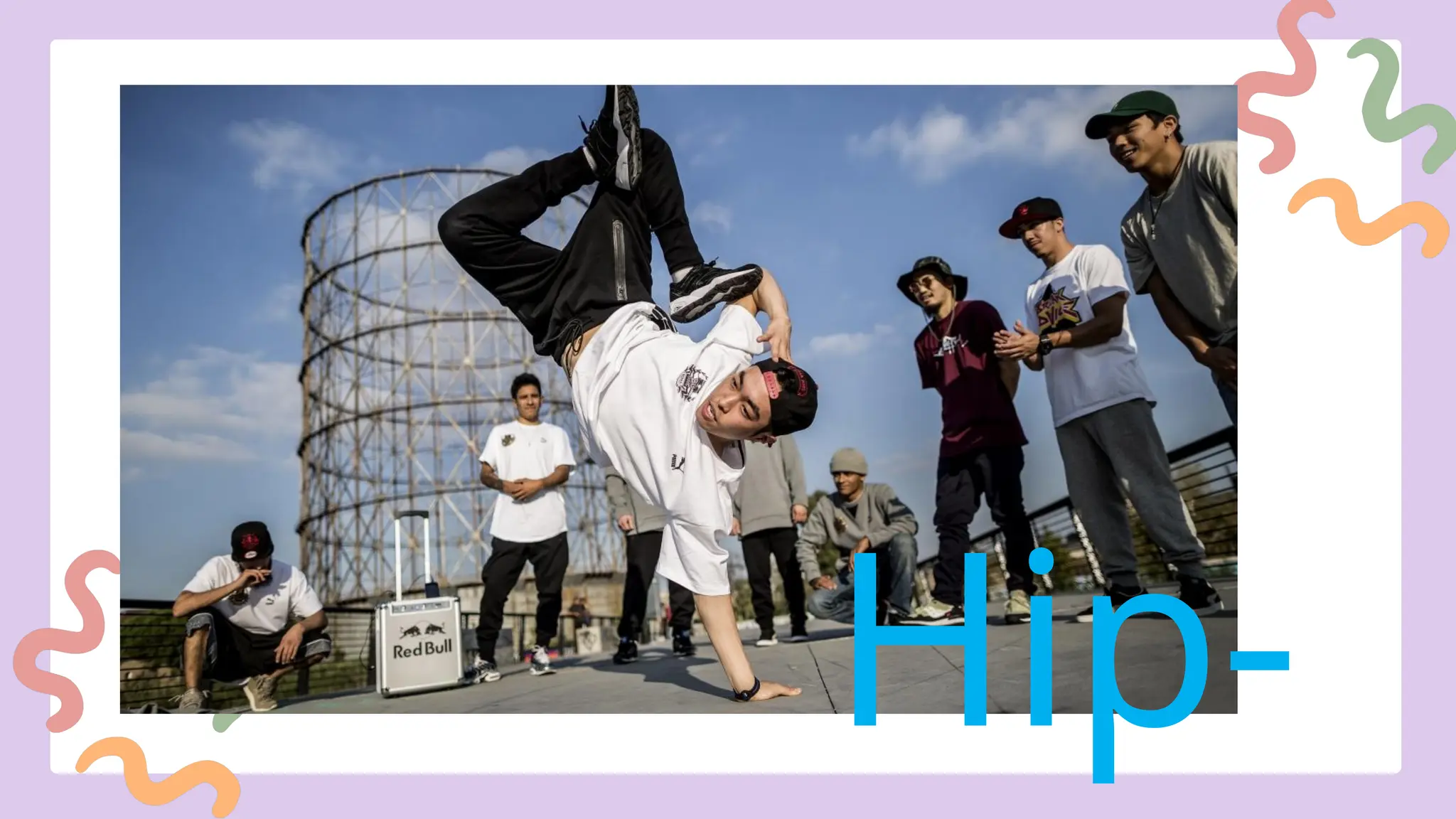
• Can anyone share your idea about the dance
style called “hip hop”? What do you think of
music that is often used in hip- hop dance?
Can you describe specific moves of it?
Answer:
1. Can you name one way in which we use our
bodies in dance? What are the examples of a dance
move that shows how we can use our bodies in
different ways?
2. There are different types of movement skills. Can
you explain what a "locomotor" movement skill is
and give an example? How about a "non-
locomotor" movement skill? Manipulative?
3. How does agility play a role in dance movements? Can
you think of a dance move that requires quick and active
movements?
4. What is coordination, and why is it important for
dancers? Can you describe a dance routine that
showcases good coordination among the dancers?
5. Can you explain how participating in a dance routine
can increase your heart rate and improve cardiovascular
fitness? What are some examples of dance styles or
routines that would be considered moderate to vigorous
physical activities?
Vocabulary focus:
Locomotor, Non-locomotor,
Agility, Coordination,
Cardiovascular fitness
Understanding the essential elements of
dance (Body, Action, Space, Time, and
Energy) and their relation to physical
fitness.
How does coordination affect the
execution of different dance moves?
Dance Elements:
1. Body - The body is the dancer’s instrument of
expression. When an audience looks at dance, they
see the dancer’s body and what is moving. The
dance could be made up of a variety of actions and
still poses. It could use the whole body or
emphasize one part of the body. Exploring body
shapes and movement actions increases our
awareness of movement possibilities.
2. Action -Dance movements or actions fall
into two main categories:
a. Locomotor: (traveling moves) walk, run,
jump, hop, skip, leap, gallop, crawl, roll, etc.
b. Non-locomotor: (moves that stay in place)
melt, stretch, bend, twist, swing, turn,
shake, stomp, etc.
3. Space - This is where the dance takes place. Is
the dance expansive, using lots of space, or is it
more intimate, using primarily personal space? An
exploration of space increases the awareness of
the visual design aspects of movement.
4. Time - Dance is a time art; movement develops
and reveals itself in Time. Adding a rhythmic sense
to movement helps transform ordinary movement
into dance and informs when the dancer moves.
5. Energy - An exploration of “how” a movement is
done rather than “what” it is gives us a richer sense of
dance as an expressive art. A dancer can walk, reach
for an imaginary object, and turn, making these
movements look completely different by changing the
use of Energy. For example, anger could be shown
with a loud quick walk, a sharp reach, and a strong
twisting turn. Happiness could be depicted by using a
delicate gliding walk, a gentle reach out, and a
smooth, light turn. Energy is what brings the dancer’s
intent or emotion to the audience. The element of
Energy is sometimes called efforts or movement
qualities.
Conduct a brief physical activity where students
practice basic locomotor (e.g., walk, skip, jump)
and non-locomotor movements (e.g., twist,
bend, swing) in the space.
Ask students to explore different ways to
perform these movements with varying energy
(fast, slow, strong, light) and time (quick,
sustained).
How do different dance movements use the
body in unique ways?
Why is it important for dancers to be agile and
coordinated?
How can understanding energy and time help
you become a better dancer?
Use the Dance Memory game results to
assess understanding of different dance
styles.
DAY 2
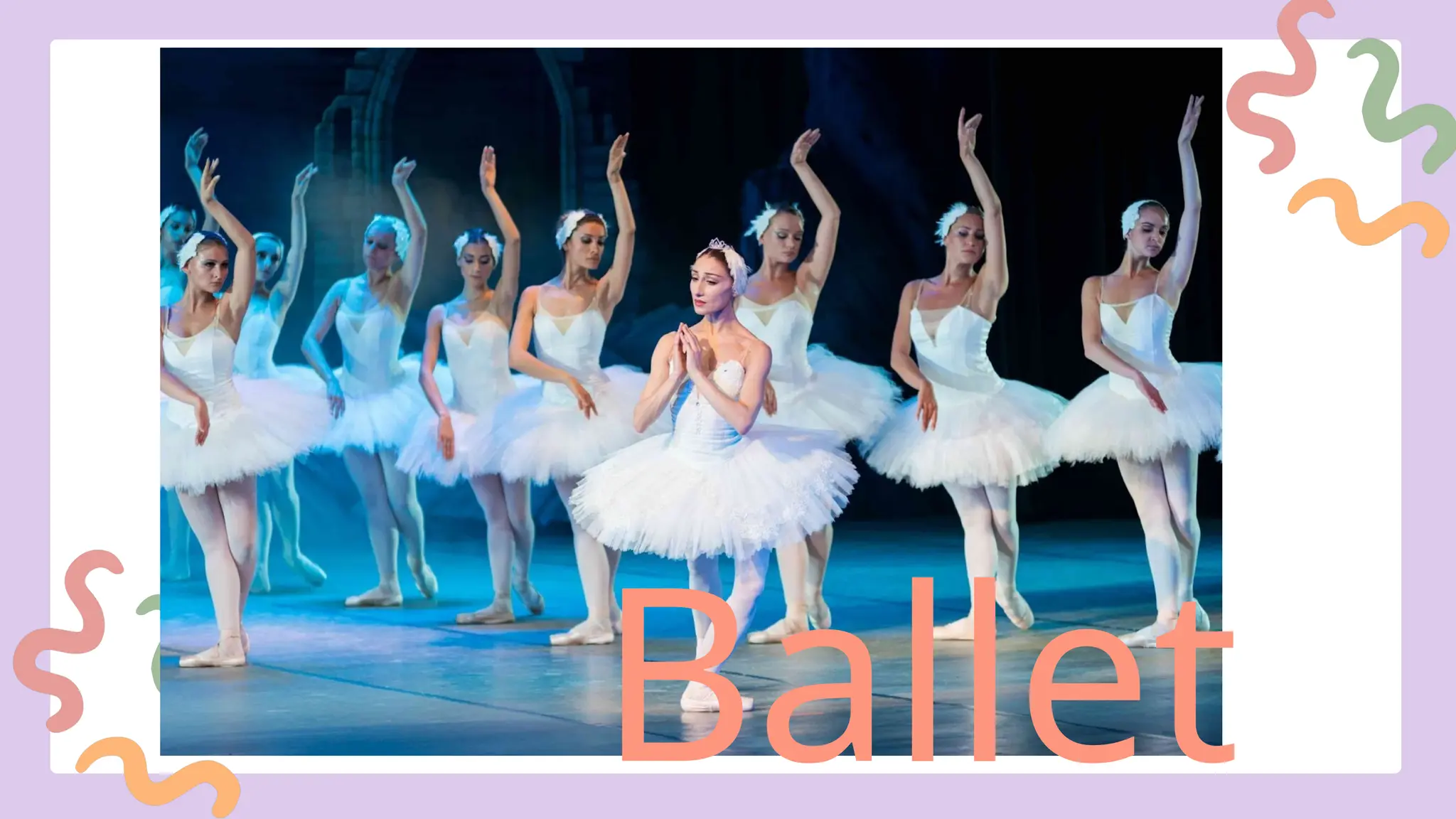
Ballet
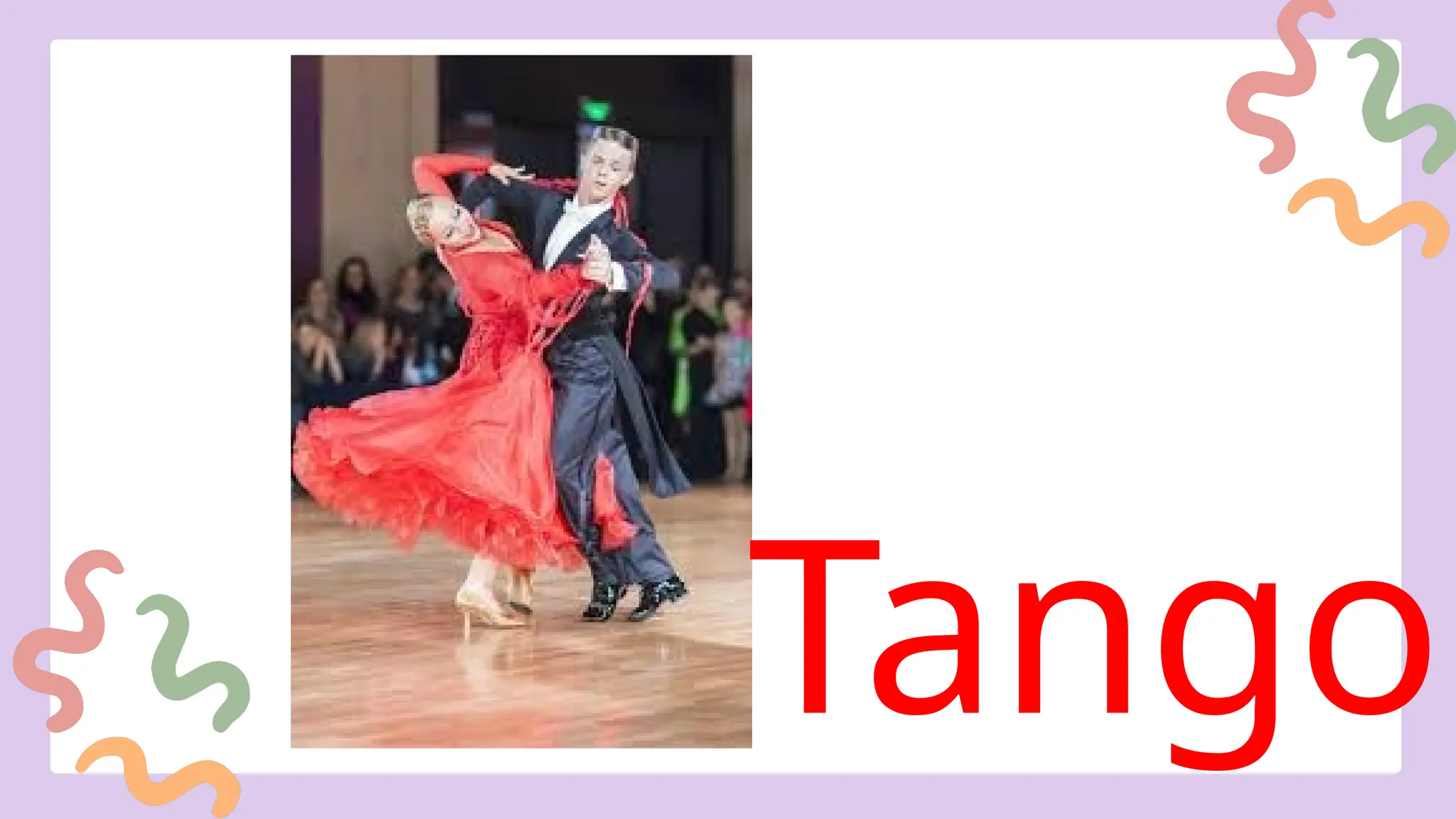
Tango
Hip-
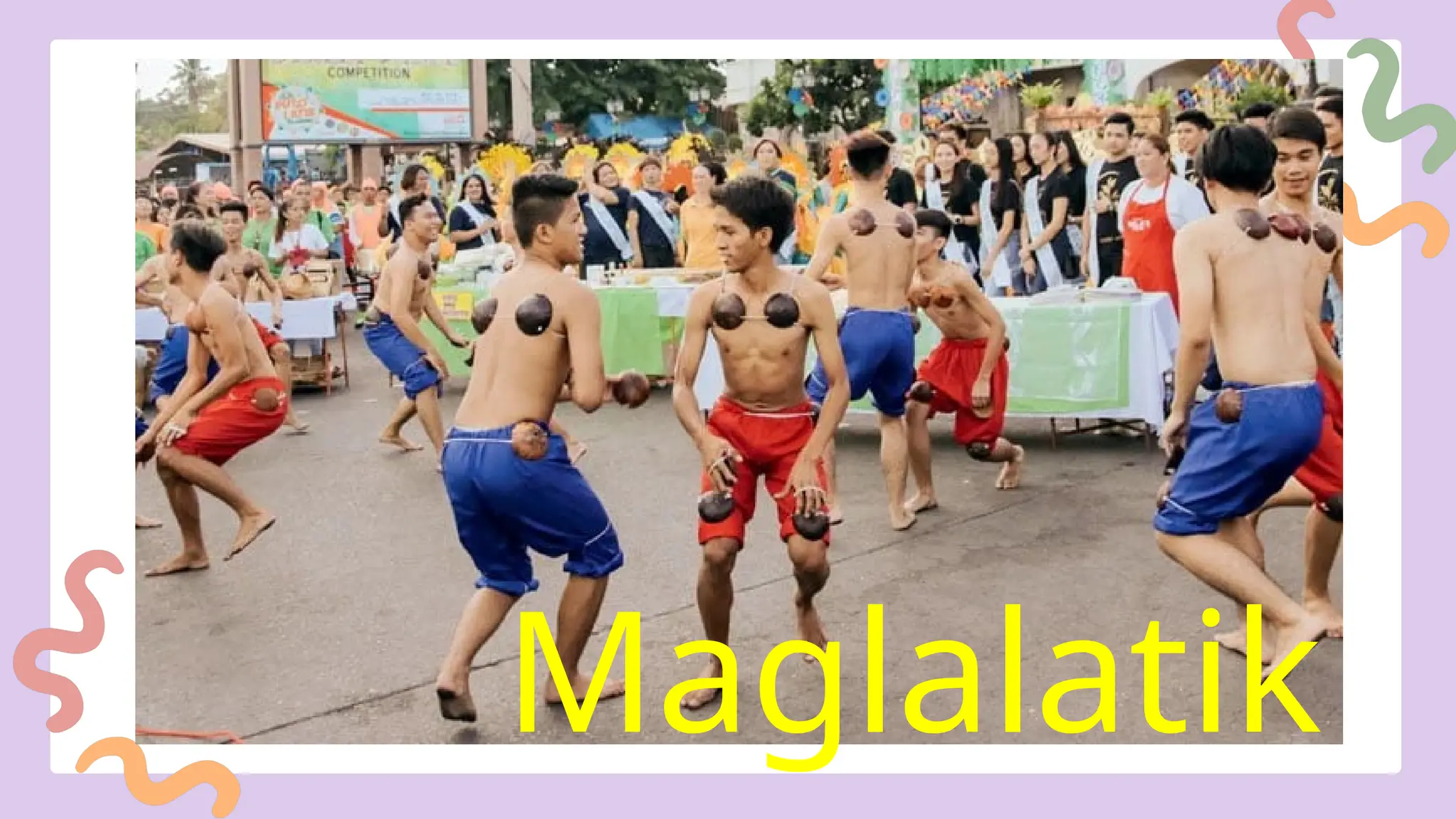
Maglalatik
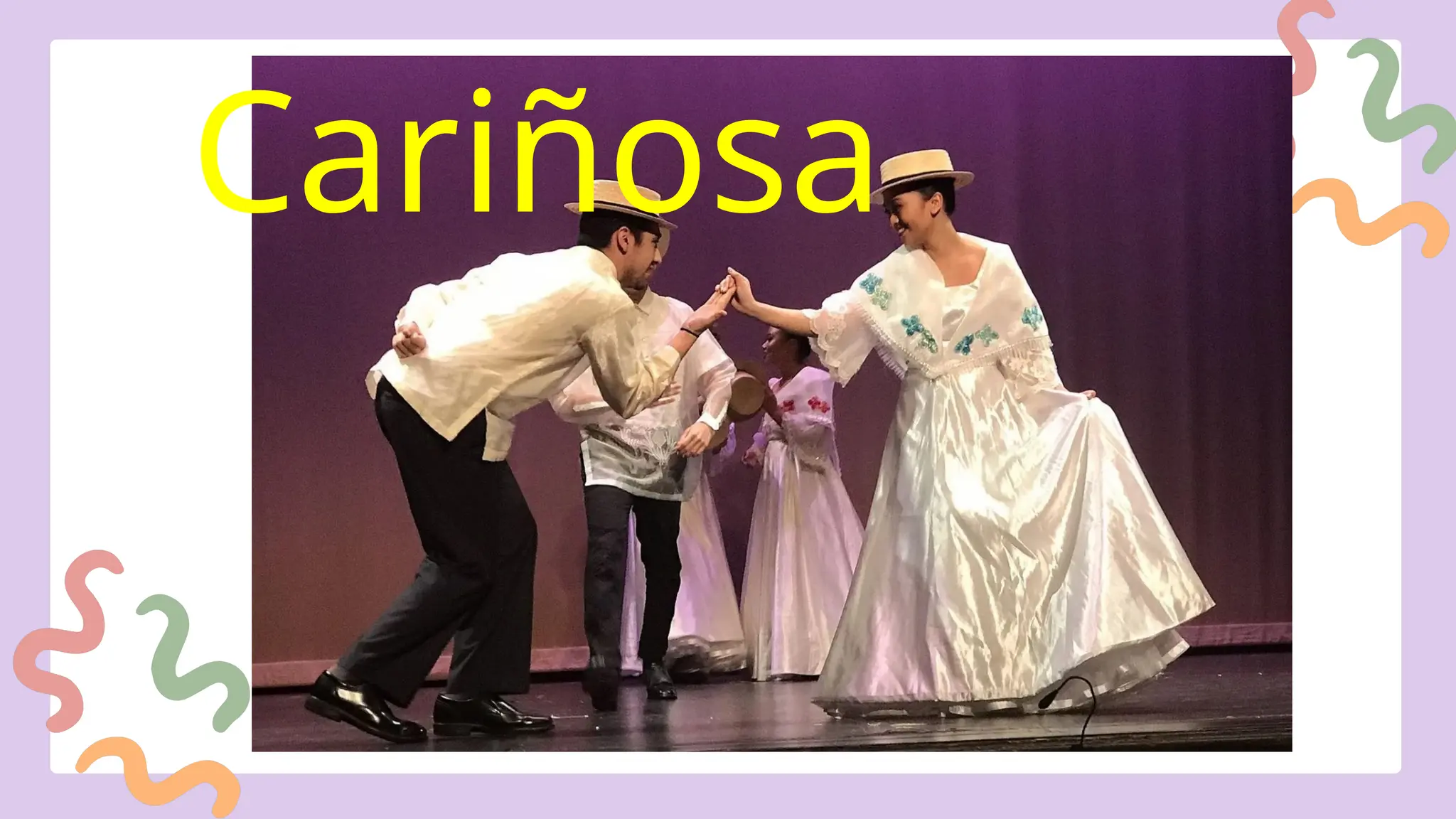
Cariñosa
What do you think is important when performing
different dance movements?
How do body positions in folk dances (e.g.,
Maglalatik, Carinosa) affect the overall dance
performance?
What are some common movements shared by
different types of folk dances?
Target Vocabulary:
• Dance Elements: Body, Action, Space, Time,
Energy.
• Positions: First, Second, Third, Fourth, Fifth
(for arms and feet).
• Movement Types: Locomotor and Non-
locomotor movements.
In folk dance, the correct positioning of the body,
arms, and feet is essential to ensure proper
execution of movements. These positions are
consistent across different folk dances and form the
foundation of each performance.
Directions: Write in the circle the folk dances of the
Philippines.
Tell and Do Activity
Demonstration of the proper execution of the fundamentals of
arm and feet positions. There are basic positions and
movements for the arms and legs that are common in folk
dances.
Arms position:
First Position
a. Arrange the arms and hands in front of the chest.
b. Curve the arms in a circular motion with elbows out.
c. Keep your palms facing towards you.
Second Position
a. Open your arms and hands simultaneously to
your sides, parallel to your shoulders.
b. Curve your arms.
c. Your palms are facing upward.
Third Position
a. Raise the right (left) arm with your palm facing
downward.
b. Keep your left (right) arm in the second
position.
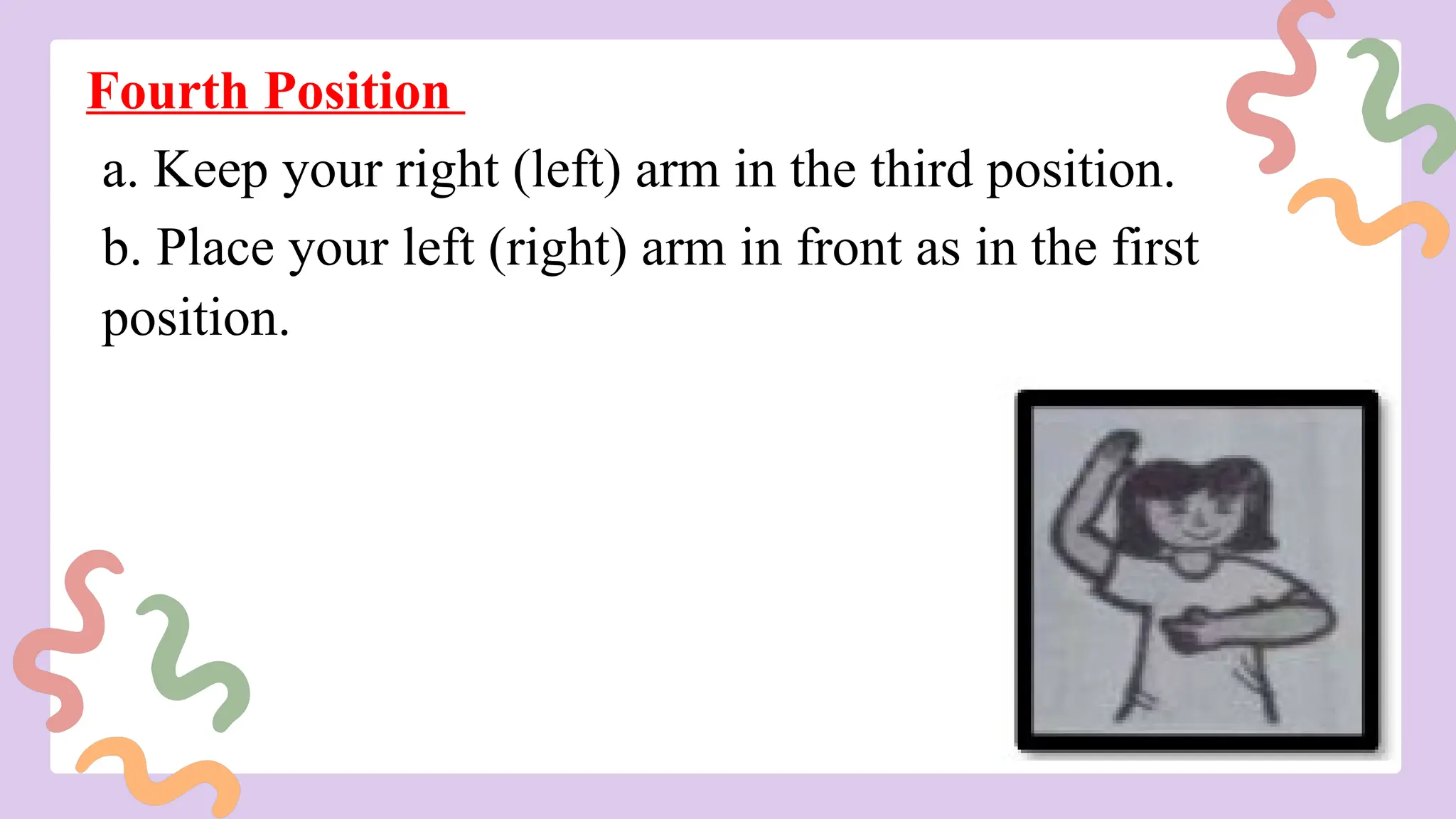
Fourth Position
a. Keep your right (left) arm in the third position.
b. Place your left (right) arm in front as in the first
position.
Fifth Position
a. Raise your arms.
b. Curve your arms and keep your palm
facing downwards
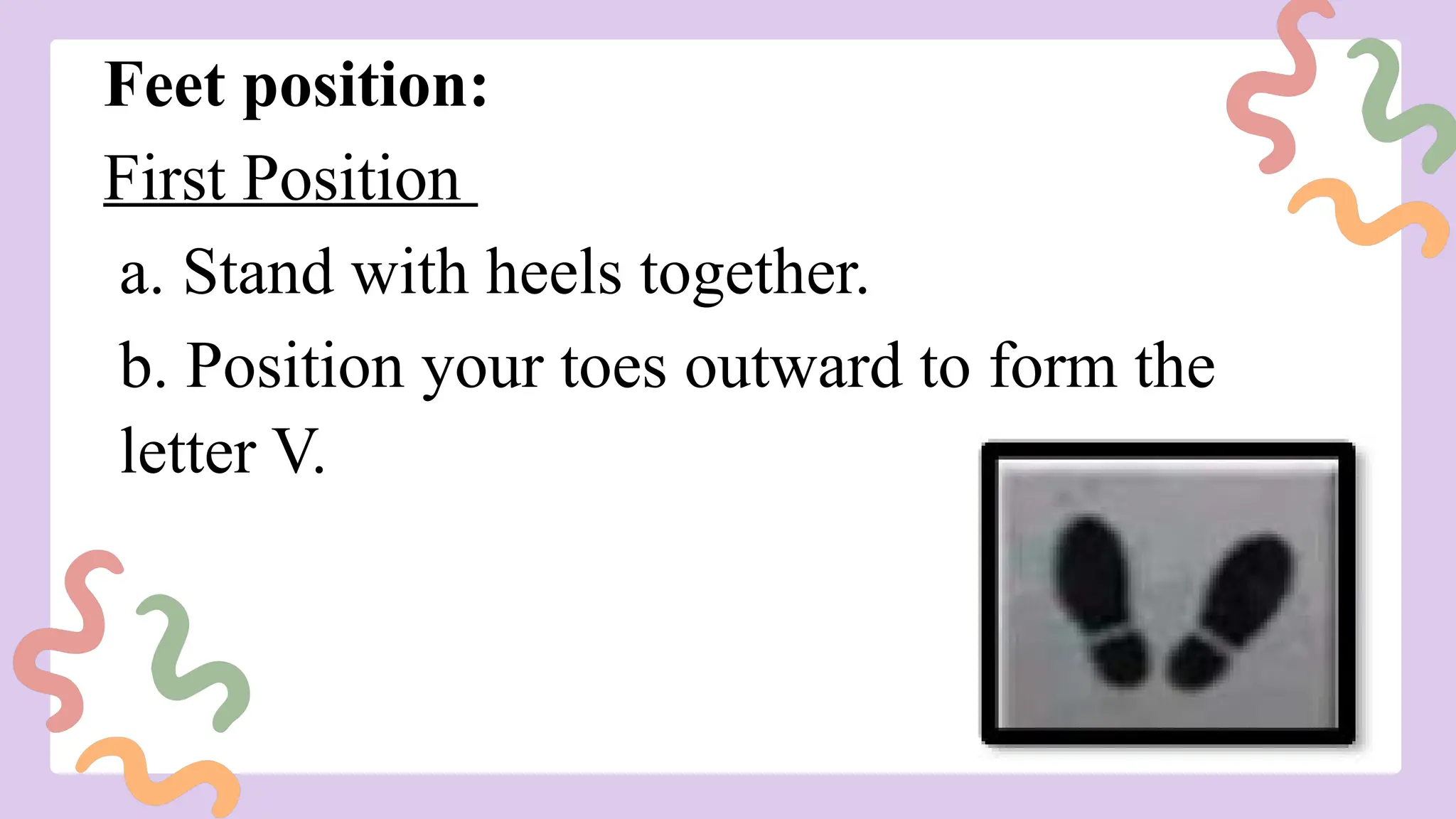
Feet position:
First Position
a. Stand with heels together.
b. Position your toes outward to form the
letter V.
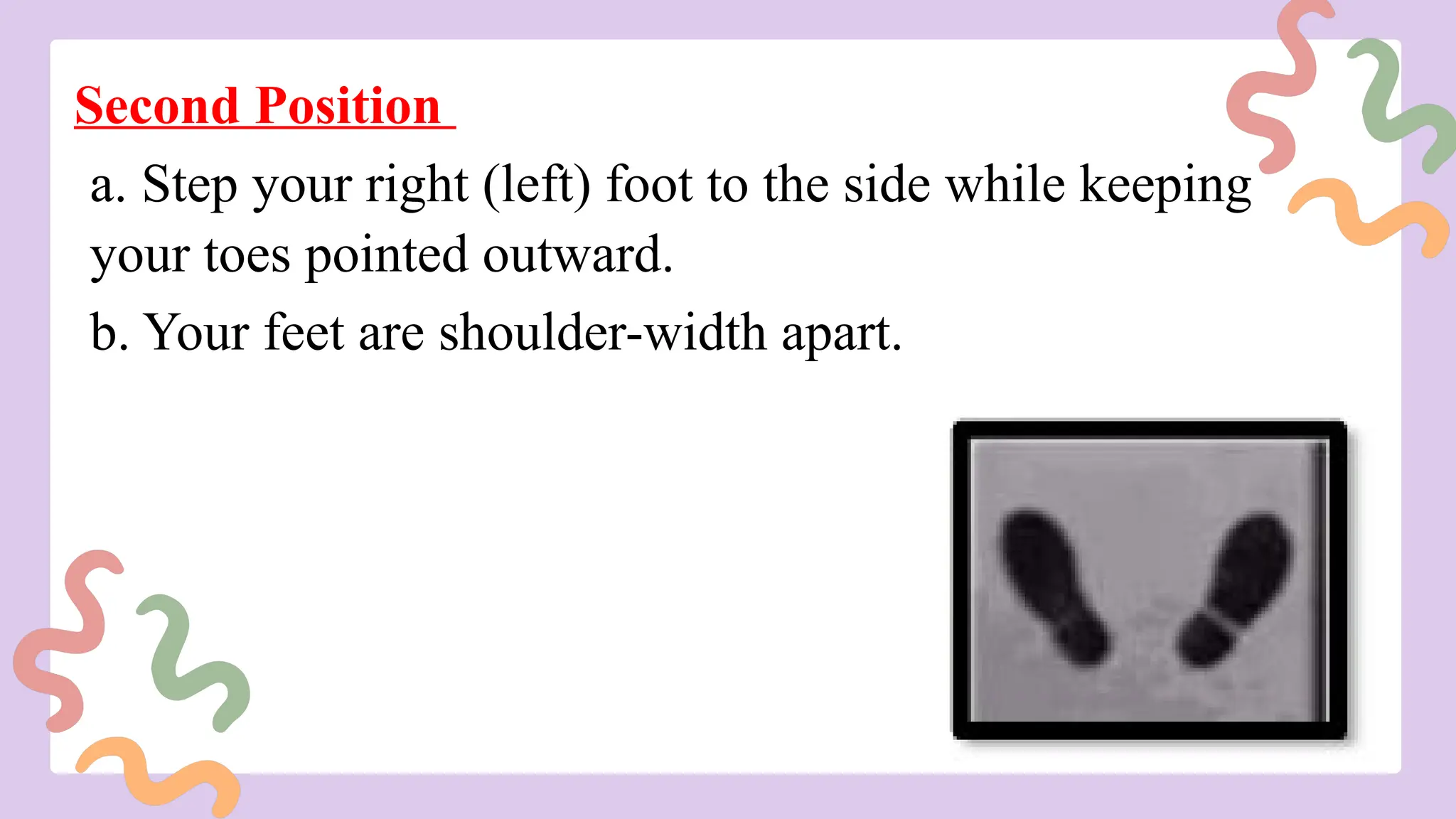
Second Position
a. Step your right (left) foot to the side while keeping
your toes pointed outward.
b. Your feet are shoulder-width apart.
Third Position
a. Keep your left (right) foot in its previous
position.
b. Place your right (left) foot at the arch of your
left (right) foot.
Fourth Position
a. Keep your left (right) foot in its previous
position.
b. Step your right (left) foot diagonally forward.
c. Keep your toes pointed outward.
Fifth Position
a. Place your right (left) foot in front of your
left (right) foot.
b. Allow the heel of your right (left) foot to
touch the toes of your left (right) foot.
Demonstration: Teacher will demonstrate the arm
and foot positions in sequence, explaining each
movement. Use video resources (
https://tinyurl.com/h335k7zr ) for visual support.
Student Practice: Students will practice the positions
individually or in pairs, with guidance from the
teacher.
How do the arm and feet positions help you
perform folk dances more accurately?
What other dance movements can you think of
that also require specific body positions?
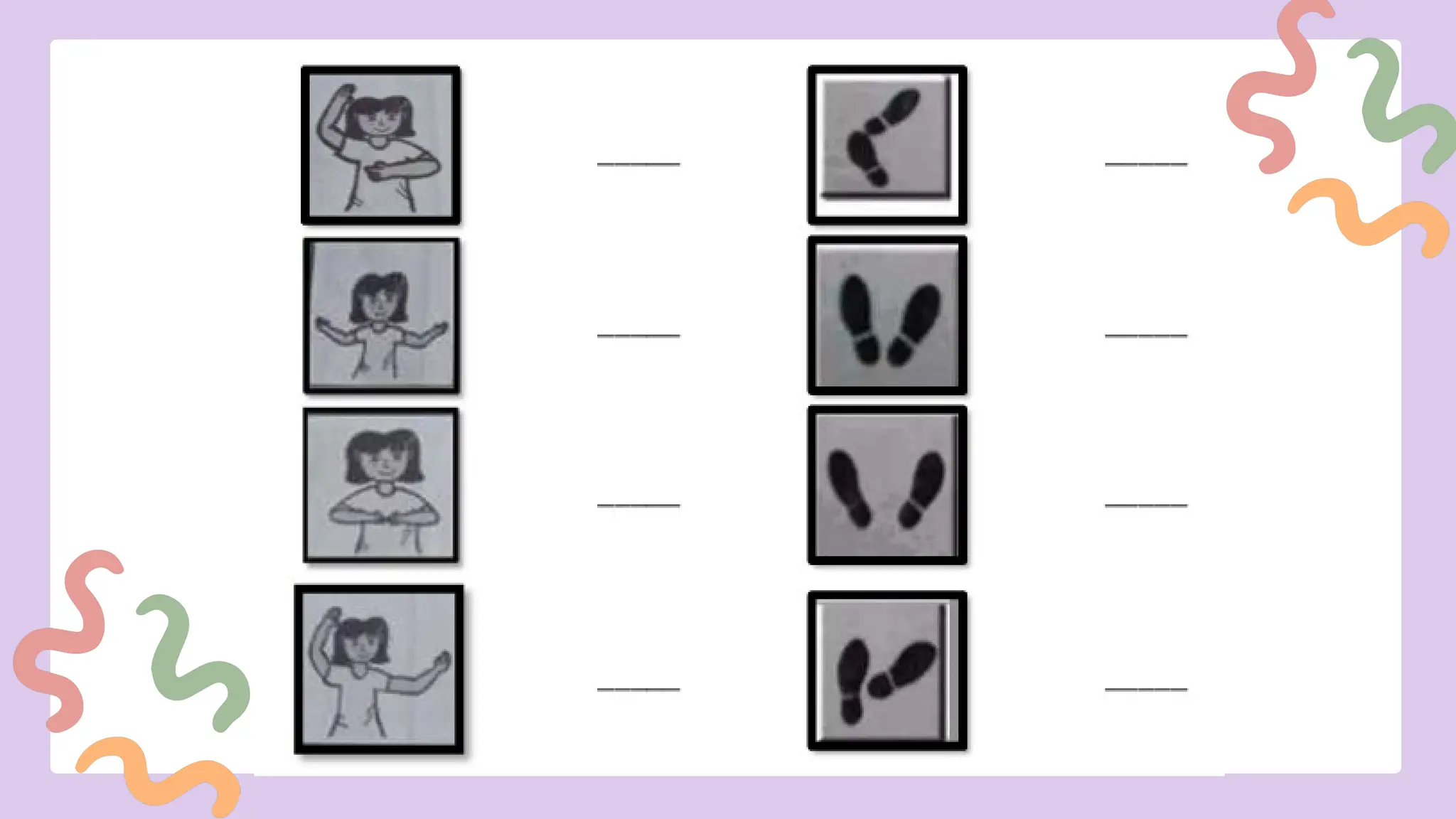
Activity: Label Me!
Directions: Assign the correct numbers 1-5 according to the
correct sequence of arms and feet positions in folk dance.
Q4-PE & HEALTH 4 WEEK 6-PPT.pptx matatag

Q4-PE & HEALTH 4 WEEK 6-PPT.pptx matatag

  • 1.
    PE & HEALTH4 QUARTER 4 - WEEK 6
  • 2.
    1. identify theelements of rhythm and movement of space; 2. learn the fundamental rhythmic pattern and activities; 3. perform actively the locomotor and non-locomotor movements using the elements of dance; and 4. apply fitness concepts in physical activity.
  • 3.
  • 4.
    Activity: Dance Memory Procedure: Explainto pupils that they will be playing a game to test their knowledge of different dance styles. Rules: 1. Divide the class into small teams or pairs, depending on the size of your class. 2. Place all the flashcards face down on a table or the floor. 3. The teams take turns flipping over two cards at a time, they will try to find matching pairs of dance styles. This will be done only once at a time. 4. If a team correctly matches a pair, they get to keep the cards and earn 1 point. If the cards don’t match, they will bring the card back and are turned face down again, and it's the next team's turn. 5. The game continues and will end until all the cards have been matched. 6. The team with the highest earned points will be the winner.
  • 5.
    • Can anyoneshare your idea about the dance style called “hip hop”? What do you think of music that is often used in hip- hop dance? Can you describe specific moves of it?
  • 6.
    Answer: 1. Can youname one way in which we use our bodies in dance? What are the examples of a dance move that shows how we can use our bodies in different ways? 2. There are different types of movement skills. Can you explain what a "locomotor" movement skill is and give an example? How about a "non- locomotor" movement skill? Manipulative?
  • 7.
    3. How doesagility play a role in dance movements? Can you think of a dance move that requires quick and active movements? 4. What is coordination, and why is it important for dancers? Can you describe a dance routine that showcases good coordination among the dancers? 5. Can you explain how participating in a dance routine can increase your heart rate and improve cardiovascular fitness? What are some examples of dance styles or routines that would be considered moderate to vigorous physical activities?
  • 8.
    Vocabulary focus: Locomotor, Non-locomotor, Agility,Coordination, Cardiovascular fitness
  • 9.
    Understanding the essentialelements of dance (Body, Action, Space, Time, and Energy) and their relation to physical fitness. How does coordination affect the execution of different dance moves?
  • 10.
    Dance Elements: 1. Body- The body is the dancer’s instrument of expression. When an audience looks at dance, they see the dancer’s body and what is moving. The dance could be made up of a variety of actions and still poses. It could use the whole body or emphasize one part of the body. Exploring body shapes and movement actions increases our awareness of movement possibilities.
  • 11.
    2. Action -Dancemovements or actions fall into two main categories: a. Locomotor: (traveling moves) walk, run, jump, hop, skip, leap, gallop, crawl, roll, etc. b. Non-locomotor: (moves that stay in place) melt, stretch, bend, twist, swing, turn, shake, stomp, etc.
  • 12.
    3. Space -This is where the dance takes place. Is the dance expansive, using lots of space, or is it more intimate, using primarily personal space? An exploration of space increases the awareness of the visual design aspects of movement. 4. Time - Dance is a time art; movement develops and reveals itself in Time. Adding a rhythmic sense to movement helps transform ordinary movement into dance and informs when the dancer moves.
  • 13.
    5. Energy -An exploration of “how” a movement is done rather than “what” it is gives us a richer sense of dance as an expressive art. A dancer can walk, reach for an imaginary object, and turn, making these movements look completely different by changing the use of Energy. For example, anger could be shown with a loud quick walk, a sharp reach, and a strong twisting turn. Happiness could be depicted by using a delicate gliding walk, a gentle reach out, and a smooth, light turn. Energy is what brings the dancer’s intent or emotion to the audience. The element of Energy is sometimes called efforts or movement qualities.
  • 14.
    Conduct a briefphysical activity where students practice basic locomotor (e.g., walk, skip, jump) and non-locomotor movements (e.g., twist, bend, swing) in the space. Ask students to explore different ways to perform these movements with varying energy (fast, slow, strong, light) and time (quick, sustained).
  • 15.
    How do differentdance movements use the body in unique ways? Why is it important for dancers to be agile and coordinated? How can understanding energy and time help you become a better dancer?
  • 16.
    Use the DanceMemory game results to assess understanding of different dance styles.
  • 17.
  • 18.
  • 19.
  • 20.
  • 21.
  • 22.
  • 23.
    What do youthink is important when performing different dance movements? How do body positions in folk dances (e.g., Maglalatik, Carinosa) affect the overall dance performance? What are some common movements shared by different types of folk dances?
  • 24.
    Target Vocabulary: • DanceElements: Body, Action, Space, Time, Energy. • Positions: First, Second, Third, Fourth, Fifth (for arms and feet). • Movement Types: Locomotor and Non- locomotor movements.
  • 25.
    In folk dance,the correct positioning of the body, arms, and feet is essential to ensure proper execution of movements. These positions are consistent across different folk dances and form the foundation of each performance.
  • 26.
    Directions: Write inthe circle the folk dances of the Philippines.
  • 27.
    Tell and DoActivity Demonstration of the proper execution of the fundamentals of arm and feet positions. There are basic positions and movements for the arms and legs that are common in folk dances. Arms position: First Position a. Arrange the arms and hands in front of the chest. b. Curve the arms in a circular motion with elbows out. c. Keep your palms facing towards you.
  • 28.
    Second Position a. Openyour arms and hands simultaneously to your sides, parallel to your shoulders. b. Curve your arms. c. Your palms are facing upward.
  • 29.
    Third Position a. Raisethe right (left) arm with your palm facing downward. b. Keep your left (right) arm in the second position.
  • 30.
    Fourth Position a. Keepyour right (left) arm in the third position. b. Place your left (right) arm in front as in the first position.
  • 31.
    Fifth Position a. Raiseyour arms. b. Curve your arms and keep your palm facing downwards
  • 32.
    Feet position: First Position a.Stand with heels together. b. Position your toes outward to form the letter V.
  • 33.
    Second Position a. Stepyour right (left) foot to the side while keeping your toes pointed outward. b. Your feet are shoulder-width apart.
  • 34.
    Third Position a. Keepyour left (right) foot in its previous position. b. Place your right (left) foot at the arch of your left (right) foot.
  • 35.
    Fourth Position a. Keepyour left (right) foot in its previous position. b. Step your right (left) foot diagonally forward. c. Keep your toes pointed outward.
  • 36.
    Fifth Position a. Placeyour right (left) foot in front of your left (right) foot. b. Allow the heel of your right (left) foot to touch the toes of your left (right) foot.
  • 37.
    Demonstration: Teacher willdemonstrate the arm and foot positions in sequence, explaining each movement. Use video resources ( https://tinyurl.com/h335k7zr ) for visual support. Student Practice: Students will practice the positions individually or in pairs, with guidance from the teacher.
  • 38.
    How do thearm and feet positions help you perform folk dances more accurately? What other dance movements can you think of that also require specific body positions?
  • 39.
    Activity: Label Me! Directions:Assign the correct numbers 1-5 according to the correct sequence of arms and feet positions in folk dance.