To view this with Audio and practice games, visit www.CultureAlley.com/Punjabi
Lesson objects

1

Use of interrogations&Forms of verbs

2 Asking and giving introduction

To view this with Audio and practice games, visit www.CultureAlley.com/Punjabi
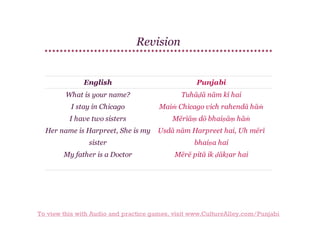
Revision

English

Punjabi

What is your name?

Tuhāḍā nām kī hai

I stay in Chicago

Maiṁ Chicago vich rahendā hāṁ

I have two sisters

Mērīāṃ dō bhaiṇāṃ hāṁ

Her name is Harpreet, She is my

Usdā nām Harpreet hai, Uh mērī

sister

bhaiṇa hai

My father is a Doctor

Mērē pitā ik ḍākṭar hai

To view this with Audio and practice games, visit www.CultureAlley.com/Punjabi
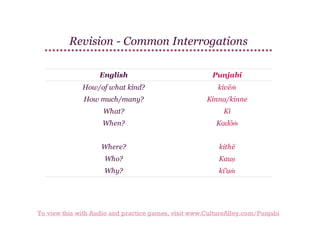
Revision - Common Interrogations
English

Punjabi

How/of what kind?

kivēṁ

How much/many?

Kinna/kinne

What?

Kī

When?

Kadōṁ

Where?

kithē

Who?

Kauṇ

Why?

ki'uṁ

To view this with Audio and practice games, visit www.CultureAlley.com/Punjabi
Lesson objects

1

Use of interrogations&Forms of verbs

2 Asking and giving introduction

To view this with Audio and practice games, visit www.CultureAlley.com/Punjabi
Use of interrogations
English

Punjabi

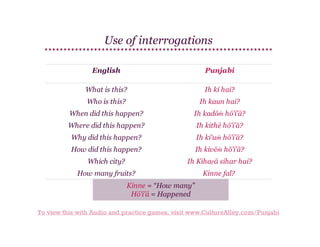
What is this?

Ih ki hai?

Who is this?

Ih kaun hai?

When did this happen?

Ih kadōṁ hō'i'ā?

Where did this happen?

Ih kithē hō'i'ā?

Why did this happen?

Ih ki'uṁ hō'i'ā?

How did this happen?

Ih kivēṁ hō'i'ā?

Which city?

Ih Kihaṛā sihar hai?

How many fruits?

Kinne fal?

Kinne = “How many”
Hō'i'ā = Happened
To view this with Audio and practice games, visit www.CultureAlley.com/Punjabi
Forms of Verbs-Concept of do
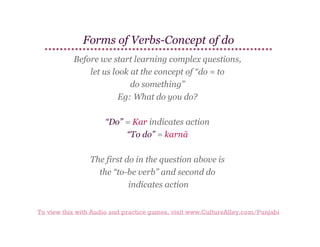
Before we start learning complex questions,
let us look at the concept of “do = to
do something”
Eg: What do you do?
“Do” = Kar indicates action
“To do” = karnā
The first do in the question above is
the “to-be verb” and second do
indicates action
To view this with Audio and practice games, visit www.CultureAlley.com/Punjabi
Forms of do = karnā

English

Punjabi

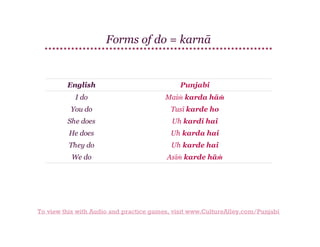
I do

Maiṁ karda hāṁ

You do

Tusī karde ho

She does

Uh kardi hai

He does

Uh karda hai

They do

Uh karde hai

We do

Asīṁ karde hāṁ

To view this with Audio and practice games, visit www.CultureAlley.com/Punjabi
Grammar tip

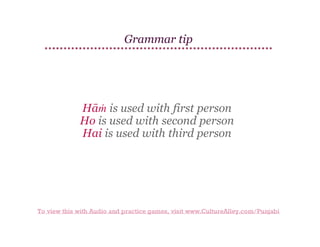
Hāṁ is used with first person
Ho is used with second person
Hai is used with third person

To view this with Audio and practice games, visit www.CultureAlley.com/Punjabi
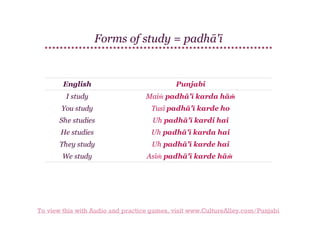
Forms of study = padhā'ī

English

Punjabi

I study

Maiṁ padhā'ī karda hāṁ

You study

Tusī padhā'ī karde ho

She studies

Uh padhā'ī kardi hai

He studies

Uh padhā'ī karda hai

They study

Uh padhā'ī karde hai

We study

Asīṁ padhā'ī karde hāṁ

To view this with Audio and practice games, visit www.CultureAlley.com/Punjabi
Lesson objects

1

Use of interrogations&Forms of verbs

2 Asking and giving introduction

To view this with Audio and practice games, visit www.CultureAlley.com/Punjabi
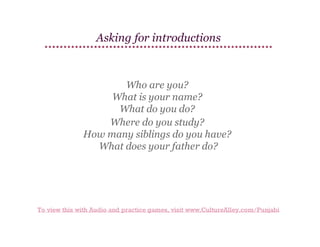
Asking for introductions

Who are you?
What is your name?
What do you do?
Where do you study?
How many siblings do you have?
What does your father do?

To view this with Audio and practice games, visit www.CultureAlley.com/Punjabi
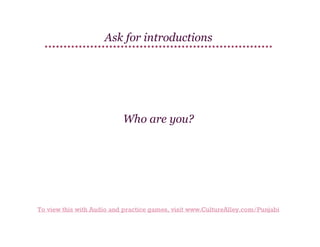
Ask for introductions

Who are you?

To view this with Audio and practice games, visit www.CultureAlley.com/Punjabi
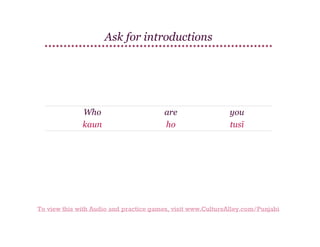
Ask for introductions

Who
kaun

are
ho

you
tusī

To view this with Audio and practice games, visit www.CultureAlley.com/Punjabi
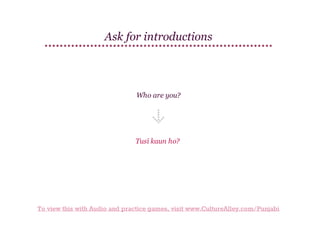
Ask for introductions

Who are you?

Tusī kaun ho?

To view this with Audio and practice games, visit www.CultureAlley.com/Punjabi
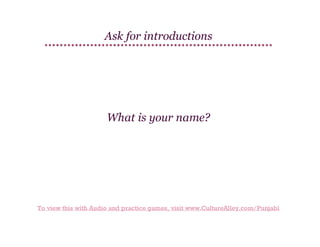
Ask for introductions

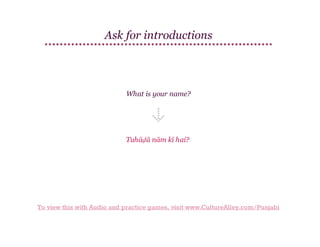
What is your name?

To view this with Audio and practice games, visit www.CultureAlley.com/Punjabi
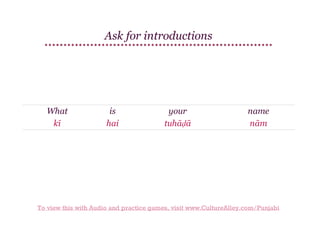
Ask for introductions

What
kī

is
hai

your
tuhāḍā

name
nām

To view this with Audio and practice games, visit www.CultureAlley.com/Punjabi
Ask for introductions

What is your name?

Tuhāḍā nām kī hai?

To view this with Audio and practice games, visit www.CultureAlley.com/Punjabi
Ask for introductions

What do you do?

To view this with Audio and practice games, visit www.CultureAlley.com/Punjabi
Ask for introductions

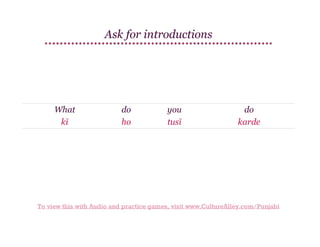
What
kī

do
ho

you
tusī

do
karde

To view this with Audio and practice games, visit www.CultureAlley.com/Punjabi
Ask for introductions

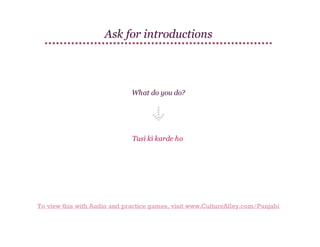
What do you do?

Tusī kī karde ho

To view this with Audio and practice games, visit www.CultureAlley.com/Punjabi
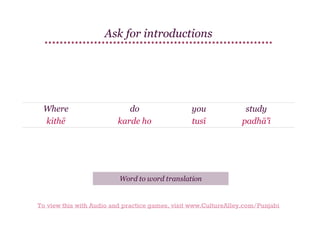
Ask for introductions

Where
kithē

do
karde ho

you
tusī

study
padhā'ī

Word to word translation

To view this with Audio and practice games, visit www.CultureAlley.com/Punjabi
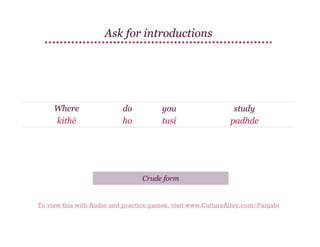
Ask for introductions

Where
kithē

do
ho

you
tusī

study
padhde

Crude form

To view this with Audio and practice games, visit www.CultureAlley.com/Punjabi
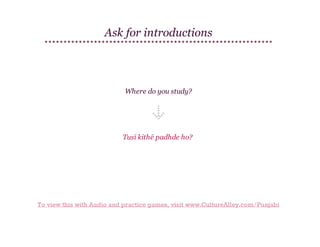
Ask for introductions

Where do you study?

Tusī kithē padhde ho?

To view this with Audio and practice games, visit www.CultureAlley.com/Punjabi
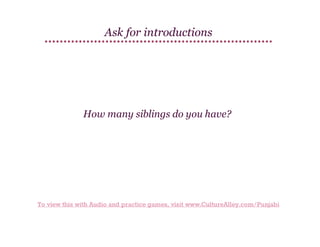
Ask for introductions

How many siblings do you have?

To view this with Audio and practice games, visit www.CultureAlley.com/Punjabi
Ask for introductions

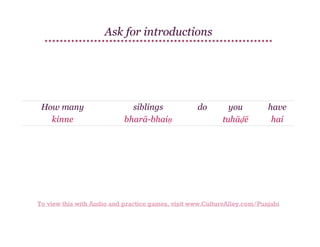
How many
kinne

siblings
bharā-bhaiṇ

do

you
tuhāḍē

have
hai

To view this with Audio and practice games, visit www.CultureAlley.com/Punjabi
Grammar tip

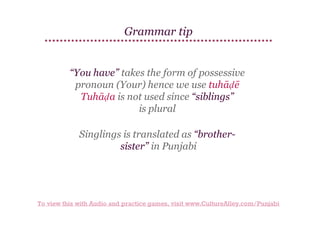
“You have” takes the form of possessive
pronoun (Your) hence we use tuhāḍē
Tuhāḍa is not used since “siblings”
is plural
Singlings is translated as “brothersister” in Punjabi

To view this with Audio and practice games, visit www.CultureAlley.com/Punjabi
Ask for introductions

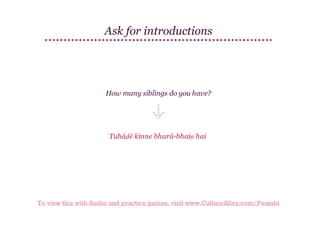
How many siblings do you have?

Tuhāḍē kinne bharā-bhaiṇ hai

To view this with Audio and practice games, visit www.CultureAlley.com/Punjabi
Ask for introductions

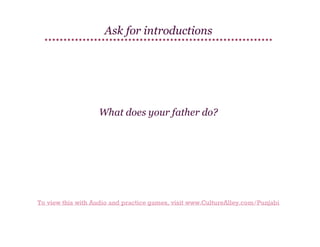
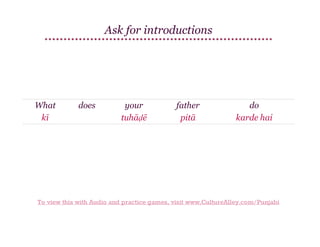
What does your father do?

To view this with Audio and practice games, visit www.CultureAlley.com/Punjabi
Ask for introductions

What
kī

does

your
tuhāḍē

father
pitā

do
karde hai

To view this with Audio and practice games, visit www.CultureAlley.com/Punjabi
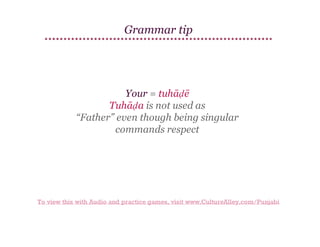
Grammar tip

Your = tuhāḍē
Tuhāḍa is not used as
“Father” even though being singular
commands respect

To view this with Audio and practice games, visit www.CultureAlley.com/Punjabi
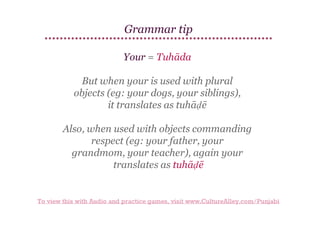
Grammar tip
Your = Tuhāda
But when your is used with plural
objects (eg: your dogs, your siblings),
it translates as tuhāḍē
Also, when used with objects commanding
respect (eg: your father, your
grandmom, your teacher), again your
translates as tuhāḍē

To view this with Audio and practice games, visit www.CultureAlley.com/Punjabi
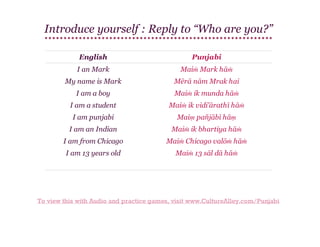
Introduce yourself : Reply to “Who are you?”
English

Punjabi

I an Mark

Maiṁ Mark hāṁ

My name is Mark

Mērā nām Mrak hai

I am a boy

Maiṁ ik munda hāṁ

I am a student

Maiṁ ik vidi'ārathī hāṁ

I am punjabi

Maiṃ pañjābī hāṃ

I am an Indian

Maiṁ ik bhartiya hāṁ

I am from Chicago

Maiṁ Chicago valōṁ hāṁ

I am 13 years old

Maiṁ 13 sāl dā hāṁ

To view this with Audio and practice games, visit www.CultureAlley.com/Punjabi
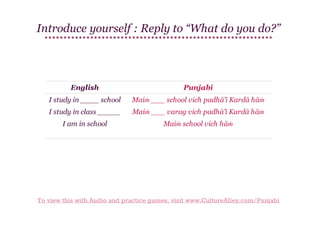
Introduce yourself : Reply to “What do you do?”

English

Punjabi

I study in ____ school

Maiṁ ___ school vich padhā'ī Kardā hāṁ

I study in class _____

Maiṁ ___ varag vich padhā'ī Kardā hāṁ

I am in school

Maiṁ school vich hāṁ

To view this with Audio and practice games, visit www.CultureAlley.com/Punjabi
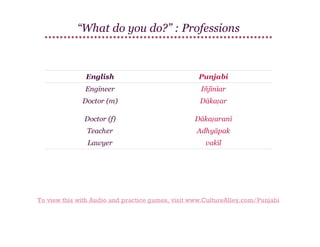
“What do you do?” : Professions

English

Punjabi

Engineer

Iñjīnīar

Doctor (m)

Dākaṭar

Doctor (f)

Dākaṭaranī

Teacher

Adhyāpak

Lawyer

vakīl

To view this with Audio and practice games, visit www.CultureAlley.com/Punjabi
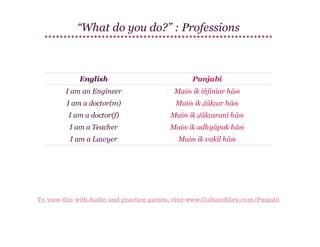
“What do you do?” : Professions

English

Punjabi

I am an Engineer

Maiṁ ik iñjīnīar hāṁ

I am a doctor(m)

Maiṁ ik ḍākṭar hāṁ

I am a doctor(f)

Maiṁ ik ḍākṭaranī hāṁ

I am a Teacher

Maiṁ ik adhyāpak hāṁ

I am a Lawyer

Maiṁ ik vakīl hāṁ

To view this with Audio and practice games, visit www.CultureAlley.com/Punjabi
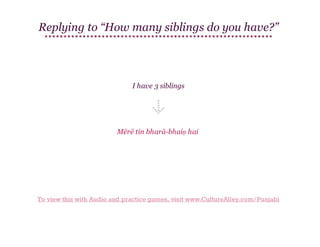
Replying to “How many siblings do you have?”

I have 3 siblings

Mērē tin bharā-bhaiṇ hai

To view this with Audio and practice games, visit www.CultureAlley.com/Punjabi
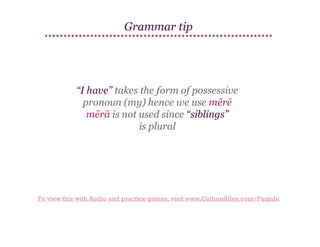
Grammar tip

“I have” takes the form of possessive
pronoun (my) hence we use mērē
mērā is not used since “siblings”
is plural

To view this with Audio and practice games, visit www.CultureAlley.com/Punjabi
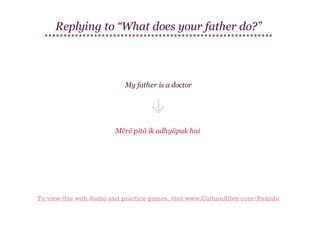
Replying to “What does your father do?”

My father is a doctor

Mērē pitā ik adhyāpak hai

To view this with Audio and practice games, visit www.CultureAlley.com/Punjabi
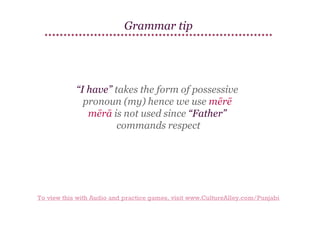
Grammar tip

“I have” takes the form of possessive
pronoun (my) hence we use mērē
mērā is not used since “Father”
commands respect

To view this with Audio and practice games, visit www.CultureAlley.com/Punjabi
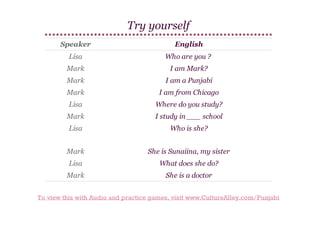
Try yourself
Speaker
Lisa

English
Who are you ? ​

Mark

I am Mark?

Mark

I am a Punjabi

Mark

I am from Chicago

Lisa

Where do you study?

Mark

I study in ___ school

Lisa

Who is she?

Mark

She is Sunaiina, my sister

Lisa

What does she do?

Mark

She is a doctor

To view this with Audio and practice games, visit www.CultureAlley.com/Punjabi
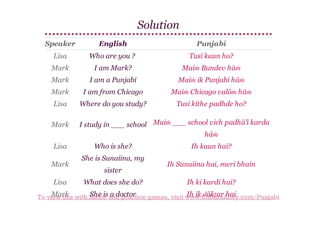
Solution
Speaker
Lisa

English
Who are you ? ​

Punjabi
Tusī kaun ho?

Mark

I am Mark?

Maiṁ Bundev hāṁ

Mark

I am a Punjabi

Maiṁ ik Punjabi hāṁ

Mark

I am from Chicago

Maiṁ Chicago valōṁ hāṁ

Lisa

Where do you study?

Tusi kithe padhde ho?

Mark
Lisa
Mark
Lisa

I study in ___ school Maiṁ ___ school vich padhā'ī karda
hāṁ
Who is she?
She is Sunaiina, my
sister
What does she do?

Ih kaun hai?
Ih Sunaiina hai, meri bhain
Ih ki kardi hai?

Mark
She is a doctor
Ih ik ḍākṭar hai
To view this with Audio and practice games, visit www.CultureAlley.com/Punjabi
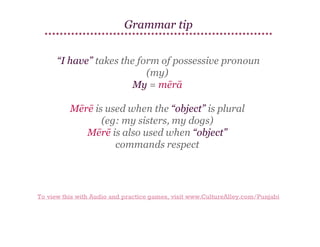
Grammar tip
“I have” takes the form of possessive pronoun
(my)
My = mērā
Mērē is used when the “object” is plural
(eg: my sisters, my dogs)
Mērē is also used when “object”
commands respect

To view this with Audio and practice games, visit www.CultureAlley.com/Punjabi
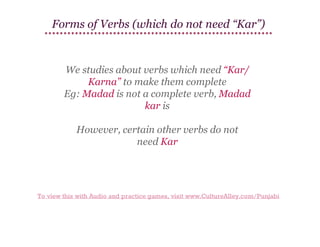
Forms of Verbs (which do not need “Kar”)

We studies about verbs which need “Kar/
Karna” to make them complete
Eg: Madad is not a complete verb, Madad
kar is
However, certain other verbs do not
need Kar

To view this with Audio and practice games, visit www.CultureAlley.com/Punjabi
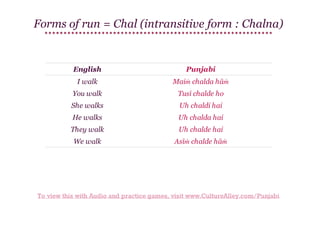
Forms of run = Chal (intransitive form : Chalna)

English

Punjabi

I walk

Maiṁ chalda hāṁ

You walk

Tusī chalde ho

She walks

Uh chaldi hai

He walks

Uh chalda hai

They walk

Uh chalde hai

We walk

Asīṁ chalde hāṁ

To view this with Audio and practice games, visit www.CultureAlley.com/Punjabi
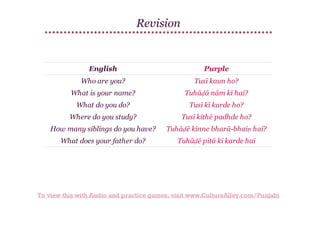
Revision

English

Purple

Who are you?

Tusī kaun ho?

What is your name?

Tuhāḍā nām kī hai?

What do you do?

Tusī kī karde ho?

Where do you study?

Tusī kithē padhde ho?

How many siblings do you have?

Tuhāḍē kinne bharā-bhaiṇ hai?

What does your father do?

Tuhāḍē pitā kī karde hai

To view this with Audio and practice games, visit www.CultureAlley.com/Punjabi
See you at the Alley!
To view this with Audio and practice games, visit www.CultureAlley.com/Punjabi

Basic Punjabi | Lesson 6 | Asking and giving introduction

  • 1.
    To view thiswith Audio and practice games, visit www.CultureAlley.com/Punjabi
  • 2.
    Lesson objects 1 Use ofinterrogations&Forms of verbs 2 Asking and giving introduction To view this with Audio and practice games, visit www.CultureAlley.com/Punjabi
  • 3.
    Revision English Punjabi What is yourname? Tuhāḍā nām kī hai I stay in Chicago Maiṁ Chicago vich rahendā hāṁ I have two sisters Mērīāṃ dō bhaiṇāṃ hāṁ Her name is Harpreet, She is my Usdā nām Harpreet hai, Uh mērī sister bhaiṇa hai My father is a Doctor Mērē pitā ik ḍākṭar hai To view this with Audio and practice games, visit www.CultureAlley.com/Punjabi
  • 4.
    Revision - CommonInterrogations English Punjabi How/of what kind? kivēṁ How much/many? Kinna/kinne What? Kī When? Kadōṁ Where? kithē Who? Kauṇ Why? ki'uṁ To view this with Audio and practice games, visit www.CultureAlley.com/Punjabi
  • 5.
    Lesson objects 1 Use ofinterrogations&Forms of verbs 2 Asking and giving introduction To view this with Audio and practice games, visit www.CultureAlley.com/Punjabi
  • 6.
    Use of interrogations English Punjabi Whatis this? Ih ki hai? Who is this? Ih kaun hai? When did this happen? Ih kadōṁ hō'i'ā? Where did this happen? Ih kithē hō'i'ā? Why did this happen? Ih ki'uṁ hō'i'ā? How did this happen? Ih kivēṁ hō'i'ā? Which city? Ih Kihaṛā sihar hai? How many fruits? Kinne fal? Kinne = “How many” Hō'i'ā = Happened To view this with Audio and practice games, visit www.CultureAlley.com/Punjabi
  • 7.
    Forms of Verbs-Conceptof do Before we start learning complex questions, let us look at the concept of “do = to do something” Eg: What do you do? “Do” = Kar indicates action “To do” = karnā The first do in the question above is the “to-be verb” and second do indicates action To view this with Audio and practice games, visit www.CultureAlley.com/Punjabi
  • 8.
    Forms of do= karnā English Punjabi I do Maiṁ karda hāṁ You do Tusī karde ho She does Uh kardi hai He does Uh karda hai They do Uh karde hai We do Asīṁ karde hāṁ To view this with Audio and practice games, visit www.CultureAlley.com/Punjabi
  • 9.
    Grammar tip Hāṁ isused with first person Ho is used with second person Hai is used with third person To view this with Audio and practice games, visit www.CultureAlley.com/Punjabi
  • 10.
    Forms of study= padhā'ī English Punjabi I study Maiṁ padhā'ī karda hāṁ You study Tusī padhā'ī karde ho She studies Uh padhā'ī kardi hai He studies Uh padhā'ī karda hai They study Uh padhā'ī karde hai We study Asīṁ padhā'ī karde hāṁ To view this with Audio and practice games, visit www.CultureAlley.com/Punjabi
  • 11.
    Lesson objects 1 Use ofinterrogations&Forms of verbs 2 Asking and giving introduction To view this with Audio and practice games, visit www.CultureAlley.com/Punjabi
  • 12.
    Asking for introductions Whoare you? What is your name? What do you do? Where do you study? How many siblings do you have? What does your father do? To view this with Audio and practice games, visit www.CultureAlley.com/Punjabi
  • 13.
    Ask for introductions Whoare you? To view this with Audio and practice games, visit www.CultureAlley.com/Punjabi
  • 14.
    Ask for introductions Who kaun are ho you tusī Toview this with Audio and practice games, visit www.CultureAlley.com/Punjabi
  • 15.
    Ask for introductions Whoare you? Tusī kaun ho? To view this with Audio and practice games, visit www.CultureAlley.com/Punjabi
  • 16.
    Ask for introductions Whatis your name? To view this with Audio and practice games, visit www.CultureAlley.com/Punjabi
  • 17.
    Ask for introductions What kī is hai your tuhāḍā name nām Toview this with Audio and practice games, visit www.CultureAlley.com/Punjabi
  • 18.
    Ask for introductions Whatis your name? Tuhāḍā nām kī hai? To view this with Audio and practice games, visit www.CultureAlley.com/Punjabi
  • 19.
    Ask for introductions Whatdo you do? To view this with Audio and practice games, visit www.CultureAlley.com/Punjabi
  • 20.
    Ask for introductions What kī do ho you tusī do karde Toview this with Audio and practice games, visit www.CultureAlley.com/Punjabi
  • 21.
    Ask for introductions Whatdo you do? Tusī kī karde ho To view this with Audio and practice games, visit www.CultureAlley.com/Punjabi
  • 22.
    Ask for introductions Where kithē do kardeho you tusī study padhā'ī Word to word translation To view this with Audio and practice games, visit www.CultureAlley.com/Punjabi
  • 23.
    Ask for introductions Where kithē do ho you tusī study padhde Crudeform To view this with Audio and practice games, visit www.CultureAlley.com/Punjabi
  • 24.
    Ask for introductions Wheredo you study? Tusī kithē padhde ho? To view this with Audio and practice games, visit www.CultureAlley.com/Punjabi
  • 25.
    Ask for introductions Howmany siblings do you have? To view this with Audio and practice games, visit www.CultureAlley.com/Punjabi
  • 26.
    Ask for introductions Howmany kinne siblings bharā-bhaiṇ do you tuhāḍē have hai To view this with Audio and practice games, visit www.CultureAlley.com/Punjabi
  • 27.
    Grammar tip “You have”takes the form of possessive pronoun (Your) hence we use tuhāḍē Tuhāḍa is not used since “siblings” is plural Singlings is translated as “brothersister” in Punjabi To view this with Audio and practice games, visit www.CultureAlley.com/Punjabi
  • 28.
    Ask for introductions Howmany siblings do you have? Tuhāḍē kinne bharā-bhaiṇ hai To view this with Audio and practice games, visit www.CultureAlley.com/Punjabi
  • 29.
    Ask for introductions Whatdoes your father do? To view this with Audio and practice games, visit www.CultureAlley.com/Punjabi
  • 30.
    Ask for introductions What kī does your tuhāḍē father pitā do kardehai To view this with Audio and practice games, visit www.CultureAlley.com/Punjabi
  • 31.
    Grammar tip Your =tuhāḍē Tuhāḍa is not used as “Father” even though being singular commands respect To view this with Audio and practice games, visit www.CultureAlley.com/Punjabi
  • 32.
    Grammar tip Your =Tuhāda But when your is used with plural objects (eg: your dogs, your siblings), it translates as tuhāḍē Also, when used with objects commanding respect (eg: your father, your grandmom, your teacher), again your translates as tuhāḍē To view this with Audio and practice games, visit www.CultureAlley.com/Punjabi
  • 33.
    Introduce yourself :Reply to “Who are you?” English Punjabi I an Mark Maiṁ Mark hāṁ My name is Mark Mērā nām Mrak hai I am a boy Maiṁ ik munda hāṁ I am a student Maiṁ ik vidi'ārathī hāṁ I am punjabi Maiṃ pañjābī hāṃ I am an Indian Maiṁ ik bhartiya hāṁ I am from Chicago Maiṁ Chicago valōṁ hāṁ I am 13 years old Maiṁ 13 sāl dā hāṁ To view this with Audio and practice games, visit www.CultureAlley.com/Punjabi
  • 34.
    Introduce yourself :Reply to “What do you do?” English Punjabi I study in ____ school Maiṁ ___ school vich padhā'ī Kardā hāṁ I study in class _____ Maiṁ ___ varag vich padhā'ī Kardā hāṁ I am in school Maiṁ school vich hāṁ To view this with Audio and practice games, visit www.CultureAlley.com/Punjabi
  • 35.
    “What do youdo?” : Professions English Punjabi Engineer Iñjīnīar Doctor (m) Dākaṭar Doctor (f) Dākaṭaranī Teacher Adhyāpak Lawyer vakīl To view this with Audio and practice games, visit www.CultureAlley.com/Punjabi
  • 36.
    “What do youdo?” : Professions English Punjabi I am an Engineer Maiṁ ik iñjīnīar hāṁ I am a doctor(m) Maiṁ ik ḍākṭar hāṁ I am a doctor(f) Maiṁ ik ḍākṭaranī hāṁ I am a Teacher Maiṁ ik adhyāpak hāṁ I am a Lawyer Maiṁ ik vakīl hāṁ To view this with Audio and practice games, visit www.CultureAlley.com/Punjabi
  • 37.
    Replying to “Howmany siblings do you have?” I have 3 siblings Mērē tin bharā-bhaiṇ hai To view this with Audio and practice games, visit www.CultureAlley.com/Punjabi
  • 38.
    Grammar tip “I have”takes the form of possessive pronoun (my) hence we use mērē mērā is not used since “siblings” is plural To view this with Audio and practice games, visit www.CultureAlley.com/Punjabi
  • 39.
    Replying to “Whatdoes your father do?” My father is a doctor Mērē pitā ik adhyāpak hai To view this with Audio and practice games, visit www.CultureAlley.com/Punjabi
  • 40.
    Grammar tip “I have”takes the form of possessive pronoun (my) hence we use mērē mērā is not used since “Father” commands respect To view this with Audio and practice games, visit www.CultureAlley.com/Punjabi
  • 41.
    Try yourself Speaker Lisa English Who areyou ? ​ Mark I am Mark? Mark I am a Punjabi Mark I am from Chicago Lisa Where do you study? Mark I study in ___ school Lisa Who is she? Mark She is Sunaiina, my sister Lisa What does she do? Mark She is a doctor To view this with Audio and practice games, visit www.CultureAlley.com/Punjabi
  • 42.
    Solution Speaker Lisa English Who are you? ​ Punjabi Tusī kaun ho? Mark I am Mark? Maiṁ Bundev hāṁ Mark I am a Punjabi Maiṁ ik Punjabi hāṁ Mark I am from Chicago Maiṁ Chicago valōṁ hāṁ Lisa Where do you study? Tusi kithe padhde ho? Mark Lisa Mark Lisa I study in ___ school Maiṁ ___ school vich padhā'ī karda hāṁ Who is she? She is Sunaiina, my sister What does she do? Ih kaun hai? Ih Sunaiina hai, meri bhain Ih ki kardi hai? Mark She is a doctor Ih ik ḍākṭar hai To view this with Audio and practice games, visit www.CultureAlley.com/Punjabi
  • 43.
    Grammar tip “I have”takes the form of possessive pronoun (my) My = mērā Mērē is used when the “object” is plural (eg: my sisters, my dogs) Mērē is also used when “object” commands respect To view this with Audio and practice games, visit www.CultureAlley.com/Punjabi
  • 44.
    Forms of Verbs(which do not need “Kar”) We studies about verbs which need “Kar/ Karna” to make them complete Eg: Madad is not a complete verb, Madad kar is However, certain other verbs do not need Kar To view this with Audio and practice games, visit www.CultureAlley.com/Punjabi
  • 45.
    Forms of run= Chal (intransitive form : Chalna) English Punjabi I walk Maiṁ chalda hāṁ You walk Tusī chalde ho She walks Uh chaldi hai He walks Uh chalda hai They walk Uh chalde hai We walk Asīṁ chalde hāṁ To view this with Audio and practice games, visit www.CultureAlley.com/Punjabi
  • 46.
    Revision English Purple Who are you? Tusīkaun ho? What is your name? Tuhāḍā nām kī hai? What do you do? Tusī kī karde ho? Where do you study? Tusī kithē padhde ho? How many siblings do you have? Tuhāḍē kinne bharā-bhaiṇ hai? What does your father do? Tuhāḍē pitā kī karde hai To view this with Audio and practice games, visit www.CultureAlley.com/Punjabi
  • 47.
    See you atthe Alley! To view this with Audio and practice games, visit www.CultureAlley.com/Punjabi