












3 Tres
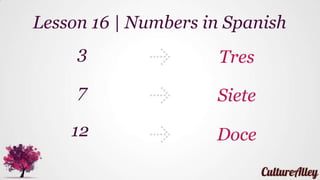
Lesson 16 | Numbers in Spanish
7 Siete
12 Doce
¡Hola!
Lesson 16 on Basic Spanish!
Revision
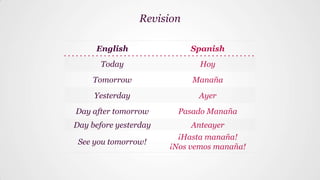
English Spanish
Today Hoy
Tomorrow Manaña
Yesterday Ayer
Day after tomorrow Pasado Manaña
Day before yesterday Anteayer
See you tomorrow!
¡Hasta manaña!
¡Nos vemos manaña!
Revision
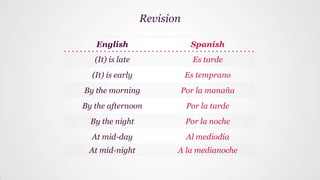
English Spanish
(It) is late Es tarde
(It) is early Es temprano
By the morning Por la manaña
By the afternoon Por la tarde
By the night Por la noche
At mid-day Al mediodía
At mid-night A la medianoche
1 Numbers in Spanish!
Lesson objectives
To move on to our next topic of asking and telling
time, it is essential that we learn basic numbers in
Spanish and also how large numbers are derived
from basic ones!
What’s in store today?
Numbers (0-99)
To learn numbers in Spanish, you need to remember
few basic numbers and the rest can be
derived from them
Let us start by learning numbers from 0-10
Learning numbers
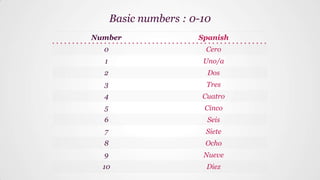
Number Spanish
0 Cero
1 Uno/a
2 Dos
3 Tres
4 Cuatro
5 Cinco
6 Seis
7 Siete
8 Ocho
9 Nueve
10 Diez
Basic numbers : 0-10
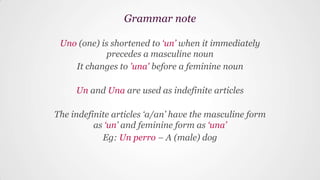
Uno (one) is shortened to ‘un’ when it immediately
precedes a masculine noun
It changes to 'una' before a feminine noun
Un and Una are used as indefinite articles
The indefinite articles ‘a/an’ have the masculine form
as ‘un’ and feminine form as ‘una’
Eg: Un perro – A (male) dog
Grammar note
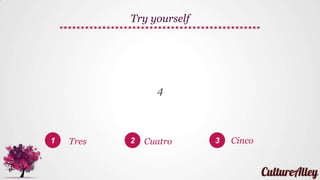
1 2 3
4
Try yourself
Tres Cuatro Cinco
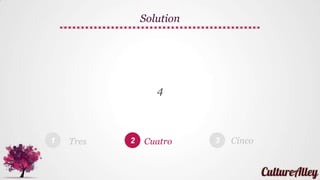
1 2 3
4
Solution
Tres Cuatro Cinco
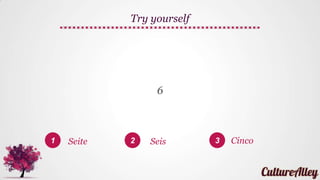
1 2 3
6
Try yourself
Seite Seis Cinco
1 2 3
6
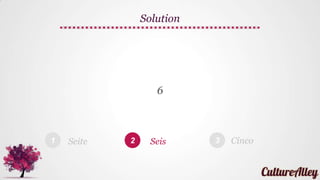
Solution
Seite Seis Cinco
Lets now look at numbers from 11-19
Notice the pattern from 16-19 carefully
Moving on...
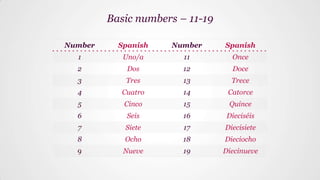
Number Spanish Number Spanish
1 Uno/a 11 Once
2 Dos 12 Doce
3 Tres 13 Trece
4 Cuatro 14 Catorce
5 Cinco 15 Quince
6 Seis 16 Dieciséis
7 Siete 17 Diecisiete
8 Ocho 18 Dieciocho
9 Nueve 19 Diecinueve
Basic numbers – 11-19
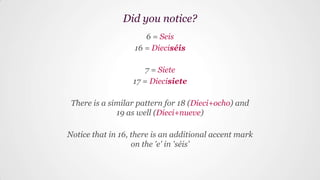
6 = Seis
16 = Dieciséis
7 = Siete
17 = Diecisiete
There is a similar pattern for 18 (Dieci+ocho) and
19 as well (Dieci+nueve)
Notice that in 16, there is an additional accent mark
on the 'e' in 'séis'
Did you notice?
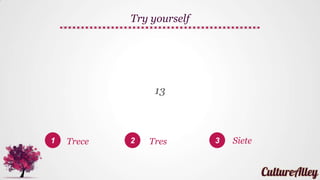
1 2 3
13
Try yourself
Trece Tres Siete
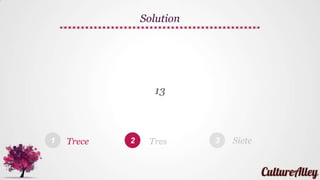
1 2 3
13
Solution
Trece Tres Siete
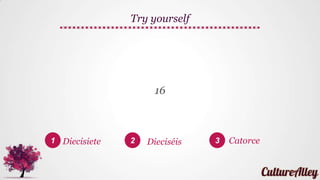
1 2 3
16
Try yourself
Diecisiete Dieciséis Catorce
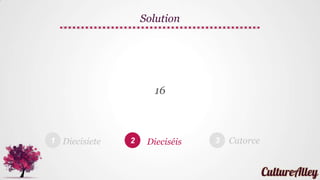
1 2 3
16
Solution
Diecisiete Dieciséis Catorce
1 2 3
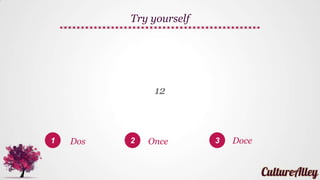
12
Try yourself
Dos Once Doce
1 2 3
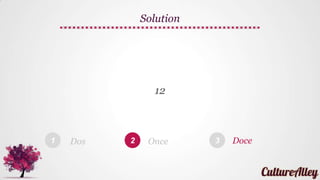
12
Solution
Dos Once Doce
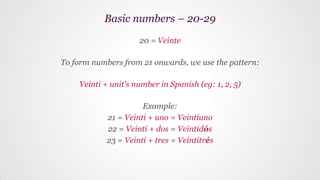
20 = Veinte
To form numbers from 21 onwards, we use the pattern:
Veinti + unit's number in Spanish (eg: 1, 2, 5)
Example:
21 = Veinti + uno = Veintiuno
22 = Veinti + dos = Veintidós
23 = Veinti + tres = Veintitrés
Basic numbers – 20-29
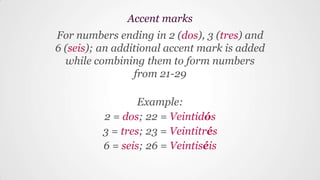
For numbers ending in 2 (dos), 3 (tres) and
6 (seis); an additional accent mark is added
while combining them to form numbers
from 21-29
Example:
2 = dos; 22 = Veintidós
3 = tres; 23 = Veintitrés
6 = seis; 26 = Veintiséis
Accent marks
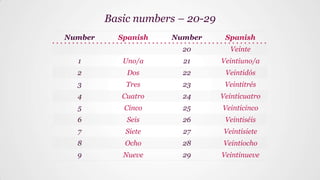
Number Spanish Number Spanish
20 Veinte
1 Uno/a 21 Veintiuno/a
2 Dos 22 Veintidós
3 Tres 23 Veintitrés
4 Cuatro 24 Veinticuatro
5 Cinco 25 Veinticinco
6 Seis 26 Veintiséis
7 Siete 27 Veintisiete
8 Ocho 28 Veintiocho
9 Nueve 29 Veintinueve
Basic numbers – 20-29
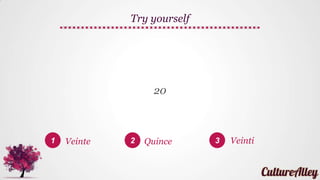
1 2 3
20
Try yourself
Veinte Quince Veinti
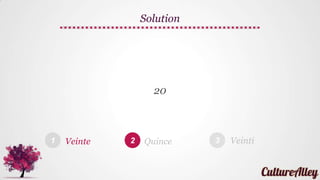
1 2 3
20
Solution
Veinte Quince Veinti
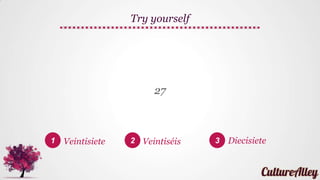
1 2 3
27
Try yourself
Veintisiete Veintiséis Diecisiete
1 2 3
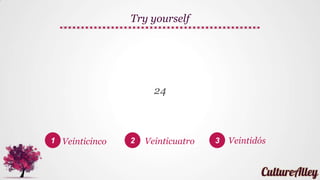
24
Try yourself
Veinticinco Veinticuatro Veintidós
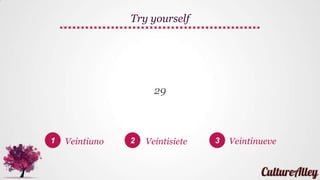
1 2 3
29
Try yourself
Veintiuno Veintisiete Veintinueve
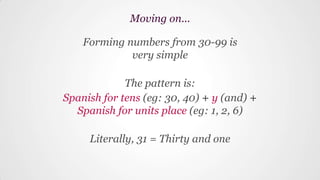
Forming numbers from 30-99 is
very simple
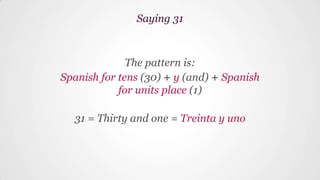
The pattern is:
Spanish for tens (eg: 30, 40) + y (and) +
Spanish for units place (eg: 1, 2, 6)
Literally, 31 = Thirty and one
Moving on...
Since we already know all numbers at units
place (like 1, 2, 4, 6 etc.), lets look at
numbers at tens place (30, 40, 50 etc)
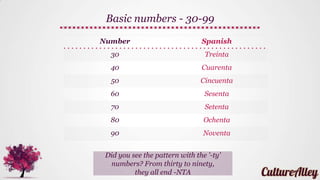
Basic numbers - 30-99
Did you see the pattern with the '-ty'
numbers? From thirty to ninety,
they all end -NTA
Number Spanish
30 Treinta
40 Cuarenta
50 Cincuenta
60 Sesenta
70 Setenta
80 Ochenta
90 Noventa
The pattern is:
Spanish for tens (30) + y (and) + Spanish
for units place (1)
31 = Thirty and one = Treinta y uno
Saying 31
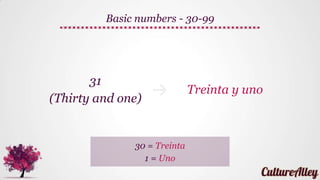
31
(Thirty and one)
Treinta y uno
Basic numbers - 30-99
30 = Treinta
1 = Uno
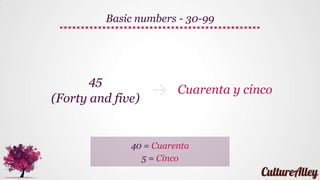
45
(Forty and five)
Cuarenta y cinco
Basic numbers - 30-99
40 = Cuarenta
5 = Cinco
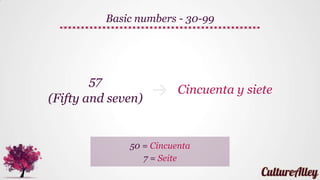
57
(Fifty and seven)
Cincuenta y siete
Basic numbers - 30-99
50 = Cincuenta
7 = Seite
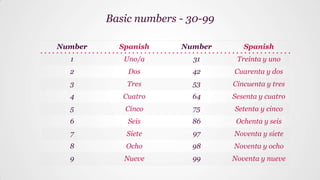
Number Spanish Number Spanish
1 Uno/a 31 Treinta y uno
2 Dos 42 Cuarenta y dos
3 Tres 53 Cincuenta y tres
4 Cuatro 64 Sesenta y cuatro
5 Cinco 75 Setenta y cinco
6 Seis 86 Ochenta y seis
7 Siete 97 Noventa y siete
8 Ocho 98 Noventa y ocho
9 Nueve 99 Noventa y nueve
Basic numbers - 30-99
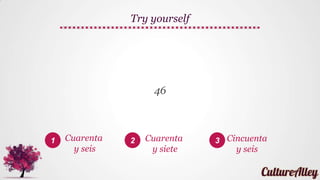
1 2 3
46
Try yourself
Cuarenta
y seis
Cuarenta
y siete
Cincuenta
y seis
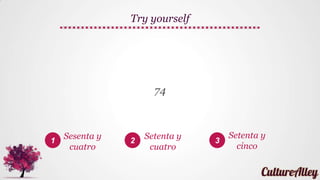
1 2 3
74
Try yourself
Sesenta y
cuatro
Setenta y
cuatro
Setenta y
cinco
1 2 3
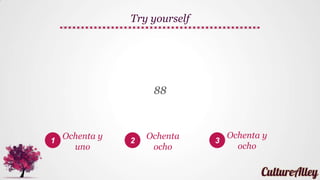
88
Try yourself
Ochenta y
uno
Ochenta
ocho
Ochenta y
ocho
1 2 3
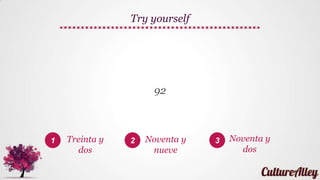
92
Try yourself
Treinta y
dos
Noventa y
nueve
Noventa y
dos
Culture Leaf
Spanish wine has kept pace, generating an explosion
of new wines, wineries, brands, and regions that is
unprecedented in viniculture history
Spain is an ancient wine-producing country and
produces nearly as much wine as the number-one
and number-two wine producers in the world: Italy
and France
Culture leaf : Spanish Wine
Grapes are the third biggest crop in
Spain after cereals and olives
Spain the number one ranked country in the
world in terms of area covered by vineyards
Despite most of Spain's wine being red, 61.5%
of Spain's vineyards are white
This is because Spain also makes a lot of
brandy and sherry
One third of Spanish wine is exported
Culture leaf : Spanish Wine
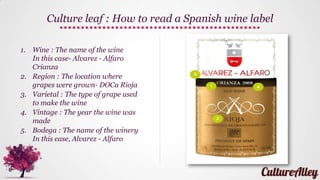
Culture leaf : How to read a Spanish wine label
1. Wine : The name of the wine
In this case- Alvarez - Alfaro
Crianza
2. Region : The location where
grapes were grown- DOCa Rioja
3. Varietal : The type of grape used
to make the wine
4. Vintage : The year the wine was
made
5. Bodega : The name of the winery
In this case, Alvarez - Alfaro
In the next lesson, we will learn how
to ask and tell time!
What’s next?
Content
Team CultureAlley, Okairy Zuñiga, Tomasa Merino
Image
http://www.winesfromspainusa.com/learn/how-read-
spanish-wine-label
Credits
See you at the Alley!
Lesson 17 | Asking and telling time!

Basic Spanish | Lesson 16 | Numbers in Spanish!

  • 1.
    3 Tres Lesson 16| Numbers in Spanish 7 Siete 12 Doce
  • 3.
    ¡Hola! Lesson 16 onBasic Spanish!
  • 4.
    Revision English Spanish Today Hoy TomorrowManaña Yesterday Ayer Day after tomorrow Pasado Manaña Day before yesterday Anteayer See you tomorrow! ¡Hasta manaña! ¡Nos vemos manaña!
  • 5.
    Revision English Spanish (It) islate Es tarde (It) is early Es temprano By the morning Por la manaña By the afternoon Por la tarde By the night Por la noche At mid-day Al mediodía At mid-night A la medianoche
  • 6.
    1 Numbers inSpanish! Lesson objectives
  • 7.
    To move onto our next topic of asking and telling time, it is essential that we learn basic numbers in Spanish and also how large numbers are derived from basic ones! What’s in store today?
  • 8.
  • 9.
    To learn numbersin Spanish, you need to remember few basic numbers and the rest can be derived from them Let us start by learning numbers from 0-10 Learning numbers
  • 10.
    Number Spanish 0 Cero 1Uno/a 2 Dos 3 Tres 4 Cuatro 5 Cinco 6 Seis 7 Siete 8 Ocho 9 Nueve 10 Diez Basic numbers : 0-10
  • 11.
    Uno (one) isshortened to ‘un’ when it immediately precedes a masculine noun It changes to 'una' before a feminine noun Un and Una are used as indefinite articles The indefinite articles ‘a/an’ have the masculine form as ‘un’ and feminine form as ‘una’ Eg: Un perro – A (male) dog Grammar note
  • 12.
    1 2 3 4 Tryyourself Tres Cuatro Cinco
  • 13.
  • 14.
    1 2 3 6 Tryyourself Seite Seis Cinco
  • 15.
  • 16.
    Lets now lookat numbers from 11-19 Notice the pattern from 16-19 carefully Moving on...
  • 17.
    Number Spanish NumberSpanish 1 Uno/a 11 Once 2 Dos 12 Doce 3 Tres 13 Trece 4 Cuatro 14 Catorce 5 Cinco 15 Quince 6 Seis 16 Dieciséis 7 Siete 17 Diecisiete 8 Ocho 18 Dieciocho 9 Nueve 19 Diecinueve Basic numbers – 11-19
  • 18.
    6 = Seis 16= Dieciséis 7 = Siete 17 = Diecisiete There is a similar pattern for 18 (Dieci+ocho) and 19 as well (Dieci+nueve) Notice that in 16, there is an additional accent mark on the 'e' in 'séis' Did you notice?
  • 19.
    1 2 3 13 Tryyourself Trece Tres Siete
  • 20.
  • 21.
    1 2 3 16 Tryyourself Diecisiete Dieciséis Catorce
  • 22.
    1 2 3 16 Solution DiecisieteDieciséis Catorce
  • 23.
    1 2 3 12 Tryyourself Dos Once Doce
  • 24.
  • 25.
    20 = Veinte Toform numbers from 21 onwards, we use the pattern: Veinti + unit's number in Spanish (eg: 1, 2, 5) Example: 21 = Veinti + uno = Veintiuno 22 = Veinti + dos = Veintidós 23 = Veinti + tres = Veintitrés Basic numbers – 20-29
  • 26.
    For numbers endingin 2 (dos), 3 (tres) and 6 (seis); an additional accent mark is added while combining them to form numbers from 21-29 Example: 2 = dos; 22 = Veintidós 3 = tres; 23 = Veintitrés 6 = seis; 26 = Veintiséis Accent marks
  • 27.
    Number Spanish NumberSpanish 20 Veinte 1 Uno/a 21 Veintiuno/a 2 Dos 22 Veintidós 3 Tres 23 Veintitrés 4 Cuatro 24 Veinticuatro 5 Cinco 25 Veinticinco 6 Seis 26 Veintiséis 7 Siete 27 Veintisiete 8 Ocho 28 Veintiocho 9 Nueve 29 Veintinueve Basic numbers – 20-29
  • 28.
    1 2 3 20 Tryyourself Veinte Quince Veinti
  • 29.
  • 30.
    1 2 3 27 Tryyourself Veintisiete Veintiséis Diecisiete
  • 32.
    1 2 3 24 Tryyourself Veinticinco Veinticuatro Veintidós
  • 34.
    1 2 3 29 Tryyourself Veintiuno Veintisiete Veintinueve
  • 36.
    Forming numbers from30-99 is very simple The pattern is: Spanish for tens (eg: 30, 40) + y (and) + Spanish for units place (eg: 1, 2, 6) Literally, 31 = Thirty and one Moving on...
  • 37.
    Since we alreadyknow all numbers at units place (like 1, 2, 4, 6 etc.), lets look at numbers at tens place (30, 40, 50 etc) Basic numbers - 30-99
  • 38.
    Basic numbers -30-99 Did you see the pattern with the '-ty' numbers? From thirty to ninety, they all end -NTA Number Spanish 30 Treinta 40 Cuarenta 50 Cincuenta 60 Sesenta 70 Setenta 80 Ochenta 90 Noventa
  • 39.
    The pattern is: Spanishfor tens (30) + y (and) + Spanish for units place (1) 31 = Thirty and one = Treinta y uno Saying 31
  • 40.
    31 (Thirty and one) Treintay uno Basic numbers - 30-99 30 = Treinta 1 = Uno
  • 41.
    45 (Forty and five) Cuarentay cinco Basic numbers - 30-99 40 = Cuarenta 5 = Cinco
  • 42.
    57 (Fifty and seven) Cincuentay siete Basic numbers - 30-99 50 = Cincuenta 7 = Seite
  • 43.
    Number Spanish NumberSpanish 1 Uno/a 31 Treinta y uno 2 Dos 42 Cuarenta y dos 3 Tres 53 Cincuenta y tres 4 Cuatro 64 Sesenta y cuatro 5 Cinco 75 Setenta y cinco 6 Seis 86 Ochenta y seis 7 Siete 97 Noventa y siete 8 Ocho 98 Noventa y ocho 9 Nueve 99 Noventa y nueve Basic numbers - 30-99
  • 44.
    1 2 3 46 Tryyourself Cuarenta y seis Cuarenta y siete Cincuenta y seis
  • 46.
    1 2 3 74 Tryyourself Sesenta y cuatro Setenta y cuatro Setenta y cinco
  • 48.
    1 2 3 88 Tryyourself Ochenta y uno Ochenta ocho Ochenta y ocho
  • 50.
    1 2 3 92 Tryyourself Treinta y dos Noventa y nueve Noventa y dos
  • 52.
  • 53.
    Spanish wine haskept pace, generating an explosion of new wines, wineries, brands, and regions that is unprecedented in viniculture history Spain is an ancient wine-producing country and produces nearly as much wine as the number-one and number-two wine producers in the world: Italy and France Culture leaf : Spanish Wine
  • 54.
    Grapes are thethird biggest crop in Spain after cereals and olives Spain the number one ranked country in the world in terms of area covered by vineyards Despite most of Spain's wine being red, 61.5% of Spain's vineyards are white This is because Spain also makes a lot of brandy and sherry One third of Spanish wine is exported Culture leaf : Spanish Wine
  • 55.
    Culture leaf :How to read a Spanish wine label 1. Wine : The name of the wine In this case- Alvarez - Alfaro Crianza 2. Region : The location where grapes were grown- DOCa Rioja 3. Varietal : The type of grape used to make the wine 4. Vintage : The year the wine was made 5. Bodega : The name of the winery In this case, Alvarez - Alfaro
  • 56.
    In the nextlesson, we will learn how to ask and tell time! What’s next?
  • 57.
    Content Team CultureAlley, OkairyZuñiga, Tomasa Merino Image http://www.winesfromspainusa.com/learn/how-read- spanish-wine-label Credits
  • 58.
    See you atthe Alley!
  • 59.
    Lesson 17 |Asking and telling time!