To view this with Audio and practice games, visit www.CultureAlley.com/Punjabi
Sat sri akāl Lesson 2 on Basic
Punjabi!
To view this with Audio and practice games, visit www.CultureAlley.com/Punjabi
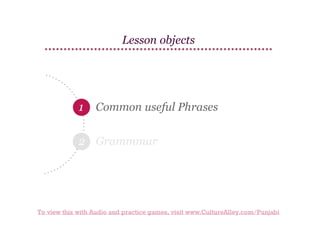
Lesson objects

1

Common useful Phrases

2 Grammar

To view this with Audio and practice games, visit www.CultureAlley.com/Punjabi
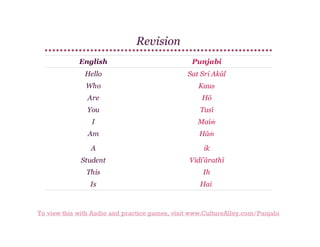
Revision
English

Punjabi

Hello

Sat Sri Akāl

Who

Kauṇ

Are

Hō

You

Tusī

I

Maiṁ

Am

Hāṁ

A

ik

Student

Vidi'ārathī

This

Ih

Is

Hai

To view this with Audio and practice games, visit www.CultureAlley.com/Punjabi
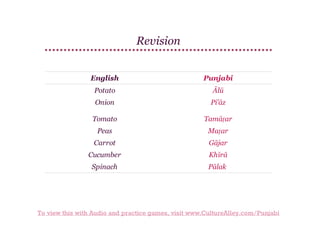
Revision
English

Punjabi

Potato

Ālū

Onion

Pi'āz

Tomato

Tamāṭar

Peas

Maṭar

Carrot

Gājar

Cucumber

Khīrā

Spinach

Pālak

To view this with Audio and practice games, visit www.CultureAlley.com/Punjabi
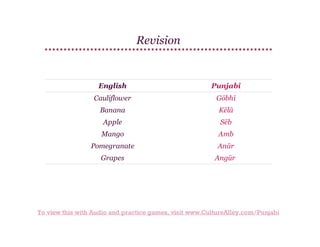
Revision

English

Punjabi

Cauliflower

Gōbhī

Banana

Kēlā

Apple

Sēb

Mango

Amb

Pomegranate

Anār

Grapes

Angūr

To view this with Audio and practice games, visit www.CultureAlley.com/Punjabi
Lesson objects

1

Common useful Phrases

2 Grammmar

To view this with Audio and practice games, visit www.CultureAlley.com/Punjabi
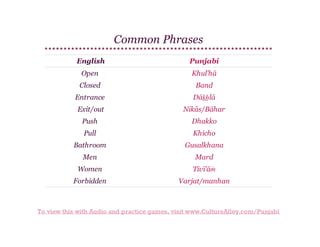
Common Phrases
English

Punjabi

Open

Khul'hā

Closed

Band

Entrance

Dāḵẖlā

Exit/out

Nikās/Bāhar

Push

Dhakko

Pull

Khicho

Bathroom

Gusalkhana

Men

Mard

Women

Tīvī'āṁ

Forbidden

Varjat/manhan

To view this with Audio and practice games, visit www.CultureAlley.com/Punjabi
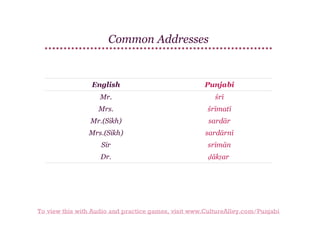
Common Addresses

English

Punjabi

Mr.

śrī

Mrs.

śrīmatī

Mr.(Sikh)

sardār

Mrs.(Sikh)

sardārnī

Sir

srīmān

Dr.

ḍākṭar

To view this with Audio and practice games, visit www.CultureAlley.com/Punjabi
Lesson objects

1

Conman useful phrases

2 Grammar

To view this with Audio and practice games, visit www.CultureAlley.com/Punjabi
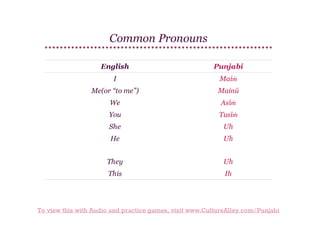
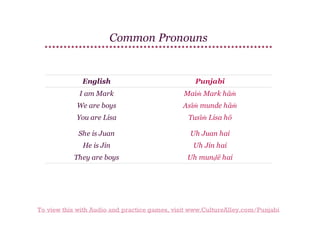
Common Pronouns
English

Punjabi

I

Maiṁ

Me(or “to me”)

Mainū

We

Asīṁ

You

Tusīṁ

She

Uh

He

Uh

They

Uh

This

Ih

To view this with Audio and practice games, visit www.CultureAlley.com/Punjabi
Common Pronouns

English

Punjabi

I am Mark

Maiṁ Mark hāṁ

We are boys

Asīṁ munde hāṁ

You are Lisa

Tusīṁ Lisa hō

She is Juan

Uh Juan hai

He is Jin

Uh Jin hai

They are boys

Uh munḍē hai

To view this with Audio and practice games, visit www.CultureAlley.com/Punjabi
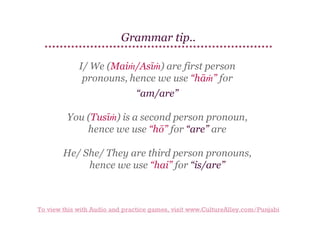
Grammar tip..
I/ We (Maiṁ/Asīṁ) are first person
pronouns, hence we use “hāṁ” for
“am/are”
You (Tusīṁ) is a second person pronoun,
hence we use “hō” for “are” are
He/ She/ They are third person pronouns,
hence we use “hai” for “is/are”

To view this with Audio and practice games, visit www.CultureAlley.com/Punjabi
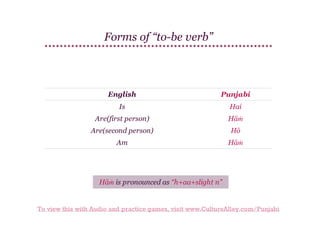
Forms of “to-be verb”

English

Punjabi

Is

Hai

Are(first person)

Hāṁ

Are(second person)

Hō

Am

Hāṁ

Hāṁ is pronounced as “h+aa+slight n”

To view this with Audio and practice games, visit www.CultureAlley.com/Punjabi
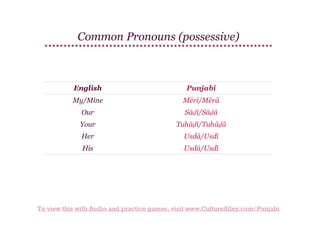
Common Pronouns (possessive)

English

Punjabi

My/Mine

Mērī/Mērā

Our

Sāḍī/Sāḍā

Your

Tuhāḍī/Tuhāḍā

Her

Usdā/Usdī

His

Usdā/Usdī

To view this with Audio and practice games, visit www.CultureAlley.com/Punjabi
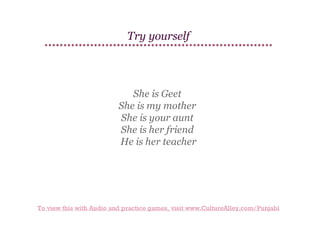
Try yourself

She is Geet
She is my mother
She is your aunt
She is her friend
He is her teacher

To view this with Audio and practice games, visit www.CultureAlley.com/Punjabi
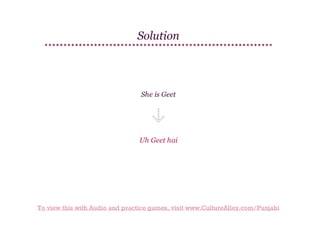
Solution

She is Geet

Uh Geet hai

To view this with Audio and practice games, visit www.CultureAlley.com/Punjabi
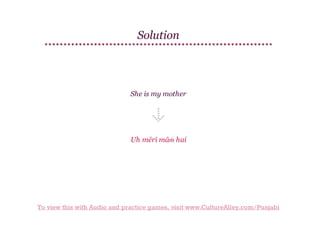
Solution

She is my mother

Uh mērī māṁ hai

To view this with Audio and practice games, visit www.CultureAlley.com/Punjabi
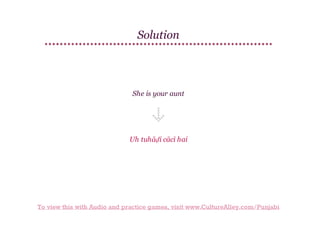
Solution

She is your aunt

Uh tuhāḍī cācī hai

To view this with Audio and practice games, visit www.CultureAlley.com/Punjabi
Solution

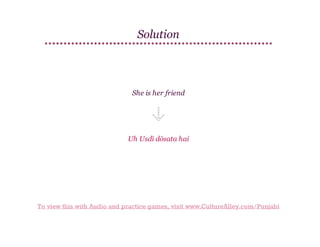
She is her friend

Uh Usdī dōsata hai

To view this with Audio and practice games, visit www.CultureAlley.com/Punjabi
Solution

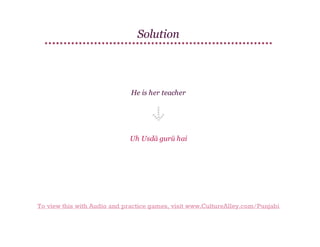
He is her teacher

Uh Usdā gurū hai

To view this with Audio and practice games, visit www.CultureAlley.com/Punjabi
Grammar tip

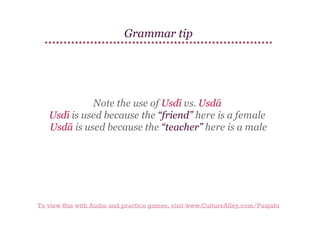
Note the use of Usdī vs. Usdā
Usdī is used because the “friend” here is a female
Usdā is used because the “teacher” here is a male

To view this with Audio and practice games, visit www.CultureAlley.com/Punjabi
Revision

English

Punjabi

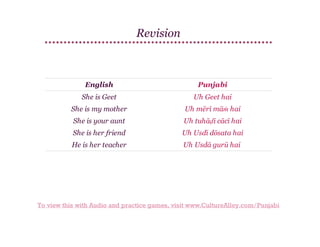
She is Geet

Uh Geet hai

She is my mother

Uh mērī māṁ hai

She is your aunt

Uh tuhāḍī cācī hai

She is her friend

Uh Usdī dōsata hai

He is her teacher

Uh Usdā gurū hai

To view this with Audio and practice games, visit www.CultureAlley.com/Punjabi
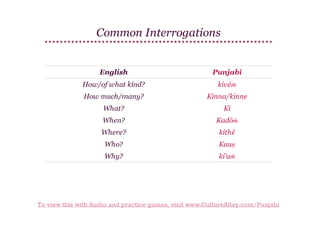
Common Interrogations

English

Punjabi

How/of what kind?

kivēṁ

How much/many?

Kinna/kinne

What?

Kī

When?

Kadōṁ

Where?

kithē

Who?

Kauṇ

Why?

ki'uṁ

To view this with Audio and practice games, visit www.CultureAlley.com/Punjabi
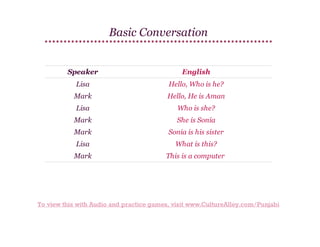
Basic Conversation

Speaker

English

Lisa

Hello, Who is he?

Mark

Hello, He is Aman

Lisa

Who is she?

Mark

She is Sonia

Mark

Sonia is his sister

Lisa

What is this?

Mark

This is a computer

To view this with Audio and practice games, visit www.CultureAlley.com/Punjabi
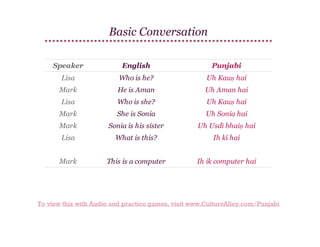
Basic Conversation
Speaker

English

Punjabi

Lisa

Who is he?

Uh Kauṇ hai

Mark

He is Aman

Uh Aman hai

Lisa

Who is she?

Uh Kauṇ hai

Mark

She is Sonia

Uh Sonia hai

Mark

Sonia is his sister

Uh Usdī bhaiṇ hai

Lisa

What is this?

Ih kī hai

Mark

This is a computer

Ih ik computer hai

To view this with Audio and practice games, visit www.CultureAlley.com/Punjabi
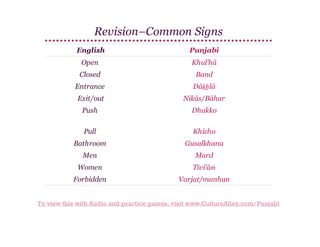
Revision–Common Signs
English

Punjabi

Open

Khul'hā

Closed

Band

Entrance

Dāḵẖlā

Exit/out

Nikās/Bāhar

Push

Dhakko

Pull

Khicho

Bathroom

Gusalkhana

Men

Mard

Women

Tīvī'āṁ

Forbidden

Varjat/manhan

To view this with Audio and practice games, visit www.CultureAlley.com/Punjabi
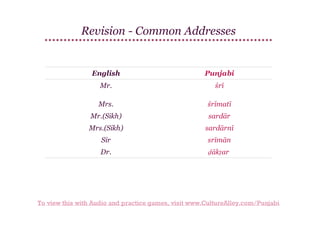
Revision - Common Addresses

English

Punjabi

Mr.

śrī

Mrs.

śrīmatī

Mr.(Sikh)

sardār

Mrs.(Sikh)

sardārnī

Sir

srīmān

Dr.

ḍākṭar

To view this with Audio and practice games, visit www.CultureAlley.com/Punjabi
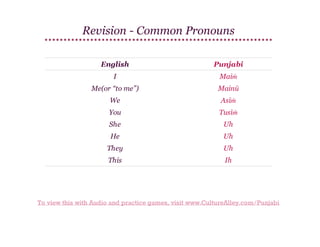
Revision - Common Pronouns
English

Punjabi

I

Maiṁ

Me(or “to me”)

Mainū

We

Asīṁ

You

Tusīṁ

She

Uh

He

Uh

They

Uh

This

Ih

To view this with Audio and practice games, visit www.CultureAlley.com/Punjabi
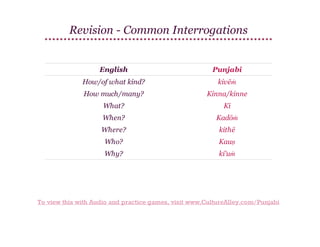
Revision - Common Interrogations

English

Punjabi

How/of what kind?

kivēṁ

How much/many?

Kinna/kinne

What?

Kī

When?

Kadōṁ

Where?

kithē

Who?

Kauṇ

Why?

ki'uṁ

To view this with Audio and practice games, visit www.CultureAlley.com/Punjabi
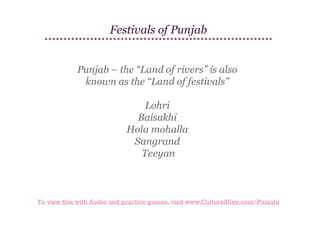
Festivals of Punjab
Punjab – the “Land of rivers” is also
known as the “Land of festivals”
Lohri
Baisakhi
Hola mohalla
Sangrand
Teeyan

To view this with Audio and practice games, visit www.CultureAlley.com/Punjabi
Festivals of Punjab
Lohri is an extremely popular agricultural winter festival
celebrated throughout Punjab and in parts of Haryana,
Himachal Pradesh and Jammu
It is celebrated on January 13th and is
traditionally associated with the harvest of
the rabi crops (sown in autumn, harvested in winters)
People take peanuts, rewri, flour,
butter and various food items to places
of religious worship to thank God for a
good harvest

To view this with Audio and practice games, visit www.CultureAlley.com/Punjabi
Festivals of Punjab
Baisakhi (also known as Vaishakhi, or Vasakhi)
is a religious as well as harvest festival and
New Year Day also
In Sikhism, as the Khalsa
was founded on same day in 1699
It is celebrated on April 13th
and celebrations include parades and
Nagar Kirtan observances Prayers,
Processions, raising of the
Nishan Sahib flag

To view this with Audio and practice games, visit www.CultureAlley.com/Punjabi
Festivals of Punjab

Hola Mahalla is a Sikh Olympics event
which most often falls in March, lasts for a week,
and consists of camping out and various
displays of fighting prowess and bravery,
followed by kirtan, music, and poetry.
Visitors sit together in pangats
(Queues) and eat food of the langars

To view this with Audio and practice games, visit www.CultureAlley.com/Punjabi
Festivals of Punjab

Sangrand means the first day of month. Special
divans take place at Gurdwaras when Guru
Arjan’s Baramaha is
read in addition to the performance of usual
services.
Devotees turn up in large numbers and
bring offerings, especially of karah prasad.

To view this with Audio and practice games, visit www.CultureAlley.com/Punjabi
Festivals of Punjab

Teeyan is the women's dance festival Giddha can
be seen at its best during the
celebrations in the month of Sawan (Rains).
The dancing usually takes place
on the bank of some river. Swings are
thrown over the branches and singing,
swinging and dancing is seen.

To view this with Audio and practice games, visit www.CultureAlley.com/Punjabi
See you at the Alley!
To view this with Audio and practice games, visit www.CultureAlley.com/Punjabi

Basic Punjabi | Lesson 2 | Common useful phrases & Grammar