Rima Melati
2201414014
Book Report and Review
Worksheet for Writing a Book Report
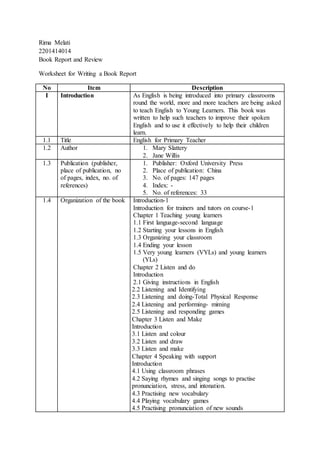
No Item Description
I Introduction As English is being introduced into primary classrooms
round the world, more and more teachers are being asked
to teach English to Young Learners. This book was
written to help such teachers to improve their spoken
English and to use it effectively to help their children
learn.
1.1 Title English for Primary Teacher
1.2 Author 1. Mary Slattery
2. Jane Willis
1.3 Publication (publisher,
place of publication, no
of pages, index, no. of
references)
1. Publisher: Oxford University Press
2. Place of publication: China
3. No. of pages: 147 pages
4. Index: -
5. No. of references: 33
1.4 Organization of the book Introduction-1
Introduction for trainers and tutors on course-1
Chapter 1 Teaching young learners
1.1 First language-second language
1.2 Starting your lessons in English
1.3 Organizing your classroom
1.4 Ending your lesson
1.5 Very young learners (VYLs) and young learners
(YLs)
Chapter 2 Listen and do
Introduction
2.1 Giving instructions in English
2.2 Listening and Identifying
2.3 Listening and doing-Total Physical Response
2.4 Listening and performing- miming
2.5 Listening and responding games
Chapter 3 Listen and Make
Introduction
3.1 Listen and colour
3.2 Listen and draw
3.3 Listen and make
Chapter 4 Speaking with support
Introduction
4.1 Using classroom phrases
4.2 Saying rhymes and singing songs to practise
pronunciation, stress, and intonation.
4.3 Practising new vocabulary
4.4 Playing vocabulary games
4.5 Practising pronunciation of new sounds
Chapter 5 Speaking more freely
Introduction
5.1 Cognitive development and language learning
5.2 Starting to speak freely- eliciting personal talk
5.3 Speaking games
5.4 Children speaking in groups
Chapter 6 Reading in English
Introduction
6.1 Beginning reading
6.2 Speaking to reading- helping sound and word
recognition
6.3 Helping children recognize phrases
6.4 Reading independently-finding information
Chapter 7 Writing in English
Introduction
7.1 Practising the Alphabet
7.2 From speaking to writing and from reading to writing
7.3Writing with other children
7.4 Children writing freely
Chapter 8 Reading and telling stories
Introduction
The value of stories
8.1 Telling a new story
8.2 reading a story to a very young learners
8.3 Ways to retell a story
8.4 Retelling a story as a class
Chapter 9 Story Activities
Introduction
9.1 Things to do after retelling a story
9.2 Getting children to add to story
9.3 Making up a story
9.4 Using stories for project work
Chapter 10 Planning for effective use of English in the
classroom
Introduction
10.1 Helping children learn and improve
10.2 Using your course book as a resource
10.3 Planning your lessons
Over to you
Key to units
Contents of the CD
Resources
About the teachers
Glossary
Index
1.5 Thesis statement Educational principles; demonstrate effective language
teaching practice.
II Summary
2.1 Chapter 1 Teaching young learners
2.1.1 Main Points First language-second language
2.1.2 Function of chapter 1 - Knowing how children learn their first language.
- How we can help children acquire English as a
second language.
- Knowing opportunities for using English when
starting lessons, changing activities, and ending
lessons.
- Knowing the differences between teaching young
learners and very young learners.
2.2 Chapter 2 Listen and do
2.2.1 Main points Giving instructions in English
2.2.2 Function of chapter 2 - To acquire English by listening to instructions.
- To be active and enjoy doing things in English.
- To uses non-verbal clues (e.g. gestures)
- To interpret meaning.
- To get used to understanding general meaning.
- To prepare spoken interaction.
- To absorb good pronunciation and intonation
patterns.
2.3 Chapter 3 Listen and make
2.3.1 Main points Listening and doing
2.3.2 Function of chapter 3 How listening to English and making things can be done
without expecting children to speak English at first.
2.4 Chapter 4 Speaking with support
2.4.1 Main points How to increase children’s listening time
2.4.2 Function of chapter 4 - Introducing new vocabulary using pictures, gesture,
and repetition.
- Helping learners remember new words and phrases in
context.
- Teaching pronunciation and vocabulary together.
- Collecting suitable rhymes and songs.
2.5 Chapter 5 Speaking more freely
2.5.1 Main points How we can help children to continue speaking for a
longer time.
2.5.2 Function of chapter 5 - Supporting and encouraging them while they are
speaking.
- Showing them how to ask questions and elicit simple
responses.
2.6 Chapter 6 Reading in English
2.6.1 Main points How to use reading activities that focus on meaning
2.6.2 Function of chapter 6 - Support pupils as they move from spoken to written
language.
- Show pupils how to use the printed word an
alternatives source of language input.
2.7 Chapter 7 Writing in English
2.7.1 Main points Prepare children for more creative writing.
2.7.2 Function of chapter 7 - Help children to learn and practise handwriting.
- Activities that link writing with reading, listening,
and speaking.
- Help children to write more freely.
2.8 Chapter 8 Reading and telling stories
2.8.1 Main points Stories for language teaching.
2.8.2 Function of chapter 8 - To prepare to tell a story for the first time.
- To prepare to read a story using pictures and familiar
language.
- To retell stories in different ways.
- Get children to retell a story as a class.
2.9 Chapter 9 Story activities
2.9.1 Main points Using stories to give children more practice at listening,
speaking, reading, and writing.
2.9.2 Function of chapter 9 - How activities from units 2-7 can be adapted for use
with stories.
- To measure how stories provide a meaningful context
for children when they are acquiring a language.
2.10 Chapter 10 Planning for effective use of English in the classroom
2.10.1 Main points Helping children learn and improve
2.10.2 Function of chapter 10 - Knowing how we can help children acquire English
through your own effective use of English.
- Help our own use of English in the classroom.
III Conclusion
3.1 Like/dislike I like this book.
3.2 Reasons for like/dislike This book is very good. It so important and helps
everybody who is will be a teacher. So we can prepare
ourselves to become a good teacher. This book also quite
easy to understand because the authors give a clear
explanation about each step.

Worksheet for writing a book report

  • 1.
    Rima Melati 2201414014 Book Reportand Review Worksheet for Writing a Book Report No Item Description I Introduction As English is being introduced into primary classrooms round the world, more and more teachers are being asked to teach English to Young Learners. This book was written to help such teachers to improve their spoken English and to use it effectively to help their children learn. 1.1 Title English for Primary Teacher 1.2 Author 1. Mary Slattery 2. Jane Willis 1.3 Publication (publisher, place of publication, no of pages, index, no. of references) 1. Publisher: Oxford University Press 2. Place of publication: China 3. No. of pages: 147 pages 4. Index: - 5. No. of references: 33 1.4 Organization of the book Introduction-1 Introduction for trainers and tutors on course-1 Chapter 1 Teaching young learners 1.1 First language-second language 1.2 Starting your lessons in English 1.3 Organizing your classroom 1.4 Ending your lesson 1.5 Very young learners (VYLs) and young learners (YLs) Chapter 2 Listen and do Introduction 2.1 Giving instructions in English 2.2 Listening and Identifying 2.3 Listening and doing-Total Physical Response 2.4 Listening and performing- miming 2.5 Listening and responding games Chapter 3 Listen and Make Introduction 3.1 Listen and colour 3.2 Listen and draw 3.3 Listen and make Chapter 4 Speaking with support Introduction 4.1 Using classroom phrases 4.2 Saying rhymes and singing songs to practise pronunciation, stress, and intonation. 4.3 Practising new vocabulary 4.4 Playing vocabulary games 4.5 Practising pronunciation of new sounds
  • 2.
    Chapter 5 Speakingmore freely Introduction 5.1 Cognitive development and language learning 5.2 Starting to speak freely- eliciting personal talk 5.3 Speaking games 5.4 Children speaking in groups Chapter 6 Reading in English Introduction 6.1 Beginning reading 6.2 Speaking to reading- helping sound and word recognition 6.3 Helping children recognize phrases 6.4 Reading independently-finding information Chapter 7 Writing in English Introduction 7.1 Practising the Alphabet 7.2 From speaking to writing and from reading to writing 7.3Writing with other children 7.4 Children writing freely Chapter 8 Reading and telling stories Introduction The value of stories 8.1 Telling a new story 8.2 reading a story to a very young learners 8.3 Ways to retell a story 8.4 Retelling a story as a class Chapter 9 Story Activities Introduction 9.1 Things to do after retelling a story 9.2 Getting children to add to story 9.3 Making up a story 9.4 Using stories for project work Chapter 10 Planning for effective use of English in the classroom Introduction 10.1 Helping children learn and improve 10.2 Using your course book as a resource 10.3 Planning your lessons Over to you Key to units Contents of the CD Resources About the teachers Glossary Index 1.5 Thesis statement Educational principles; demonstrate effective language teaching practice.
  • 3.
    II Summary 2.1 Chapter1 Teaching young learners 2.1.1 Main Points First language-second language 2.1.2 Function of chapter 1 - Knowing how children learn their first language. - How we can help children acquire English as a second language. - Knowing opportunities for using English when starting lessons, changing activities, and ending lessons. - Knowing the differences between teaching young learners and very young learners. 2.2 Chapter 2 Listen and do 2.2.1 Main points Giving instructions in English 2.2.2 Function of chapter 2 - To acquire English by listening to instructions. - To be active and enjoy doing things in English. - To uses non-verbal clues (e.g. gestures) - To interpret meaning. - To get used to understanding general meaning. - To prepare spoken interaction. - To absorb good pronunciation and intonation patterns. 2.3 Chapter 3 Listen and make 2.3.1 Main points Listening and doing 2.3.2 Function of chapter 3 How listening to English and making things can be done without expecting children to speak English at first. 2.4 Chapter 4 Speaking with support 2.4.1 Main points How to increase children’s listening time 2.4.2 Function of chapter 4 - Introducing new vocabulary using pictures, gesture, and repetition. - Helping learners remember new words and phrases in context. - Teaching pronunciation and vocabulary together. - Collecting suitable rhymes and songs. 2.5 Chapter 5 Speaking more freely 2.5.1 Main points How we can help children to continue speaking for a longer time. 2.5.2 Function of chapter 5 - Supporting and encouraging them while they are speaking. - Showing them how to ask questions and elicit simple responses. 2.6 Chapter 6 Reading in English 2.6.1 Main points How to use reading activities that focus on meaning 2.6.2 Function of chapter 6 - Support pupils as they move from spoken to written language. - Show pupils how to use the printed word an alternatives source of language input. 2.7 Chapter 7 Writing in English 2.7.1 Main points Prepare children for more creative writing.
  • 4.
    2.7.2 Function ofchapter 7 - Help children to learn and practise handwriting. - Activities that link writing with reading, listening, and speaking. - Help children to write more freely. 2.8 Chapter 8 Reading and telling stories 2.8.1 Main points Stories for language teaching. 2.8.2 Function of chapter 8 - To prepare to tell a story for the first time. - To prepare to read a story using pictures and familiar language. - To retell stories in different ways. - Get children to retell a story as a class. 2.9 Chapter 9 Story activities 2.9.1 Main points Using stories to give children more practice at listening, speaking, reading, and writing. 2.9.2 Function of chapter 9 - How activities from units 2-7 can be adapted for use with stories. - To measure how stories provide a meaningful context for children when they are acquiring a language. 2.10 Chapter 10 Planning for effective use of English in the classroom 2.10.1 Main points Helping children learn and improve 2.10.2 Function of chapter 10 - Knowing how we can help children acquire English through your own effective use of English. - Help our own use of English in the classroom. III Conclusion 3.1 Like/dislike I like this book. 3.2 Reasons for like/dislike This book is very good. It so important and helps everybody who is will be a teacher. So we can prepare ourselves to become a good teacher. This book also quite easy to understand because the authors give a clear explanation about each step.