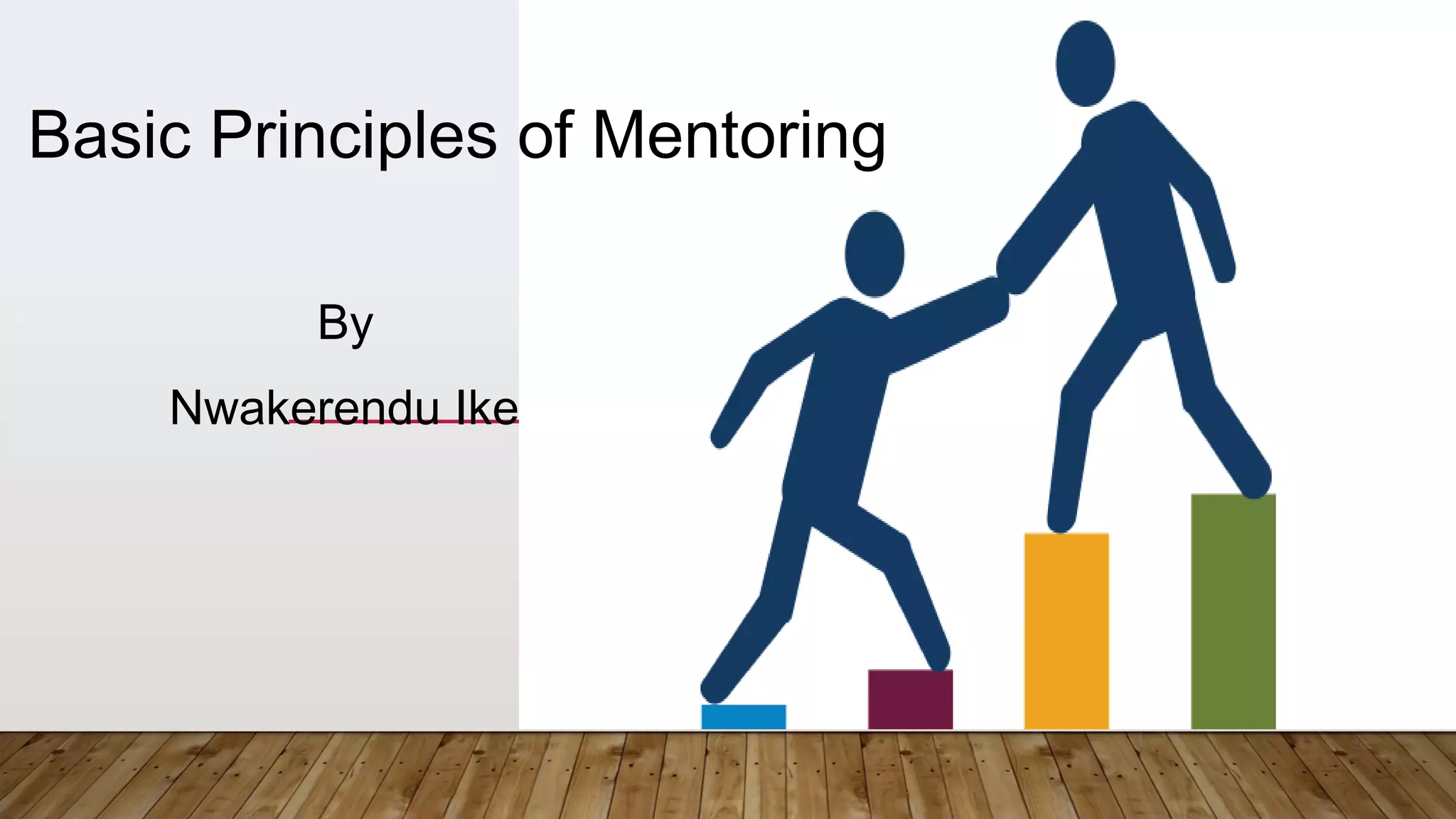
Basic Principles of Mentoring
By
Nwakerendu Ike
OBJECTIVE
The main objective of this
presentation is to help leaders at all
levels and in all sectors, understand
Mentoring and how to apply it
OUTLINE
• Introduction
• Understanding Mentoring
• Essence of Mentoring
• How to develop mentoring ability
• Mentor’s Job
• Managing the Mentor-Mentee relationship
• Developing a company-wide culture of mentoring
• Conclusion
INTRODUCTION
• Leadership is a position of influence.
• It offers the leader an opportunity to sway opinions and attitudes of others
• A true leader should therefore seek to replicate him/herself in others by becoming a
mentor to younger and less experienced members of the team.
• This course will seek to help participants to understand mentorship and how to apply it at
all levels of leadership.
UNDERSTANDING MENTORING
• Mentoring is a relationship between two
people where the individual with more
experience, knowledge, and connections
is able to pass along what they have
learned to a junior individual within a
certain field or organisation.
• The senior individual is the mentor, and
the junior individual is the mentee.
ESSENCE OF MENTORING
• To provide leadership to future generation
• Pass along best practices
• Help willing mentees achieve their goal
• To preserve your legacy
• To ensure successful succession
• To lead beyond your lifetime
• To reproduce yourself in others
• To replicate vision to another generation
HOW TO DEVELOP MENTORING ABILITY
• Develop courage by looking at other mentoring
examples
• Raise a transition team
• Train your replacements
• Make yourself unnecessary
• Work yourself out of the job
• Train the person who will make sure you do not stay
• Make time to spend with your mentee
THE MENTOR’S JOB
• Timely advice to the Mentee
• Share capacity building resources with
the Mentee
• Provide financial guidance to the Mentee
• Be a role model for leadership
responsibilities
• Provide direct access and opportunities
for development
• Co-leadership to build mentee’s
confidence
MANAGING THE MENTOR-MENTEE RELATIONSHIP
• Mentor guides by instructions; Mentee learns by obedience
and questioning
• Mentor gives opportunities for Mentee to apply his skills and
gifts
• Mentor gives platforms to showcase Mentee; mentee
develops capacity to meet the expectations
• Mentor gives Mentee the required recognition
• Focus on developing Mentee not managing him/her
• Mentor to create time and show patience
• Mentor to be honest with correction and generous with
praise
DEVELOPING A COMPANY-WIDE MENTORING CULTURE
• Provide for mentoring in your strategic
vision
• Make succession planning part of your
policy
• Monitor the implementation of succession
planning in every department
• Provide a reward system to encourage
mentoring
CONCLUSION
• The purpose of leadership is to raise other leaders, not to have followers. It is
important that the leadership vision is captured and made known to everyone in
the organisation.
• Leaders at all levels need to realise that it is the success of their successor that
guarantees their success, and therefore develop them to take over at the
appropriate time.
• Every leader needs to see their position as a relay race and be willing to move
the baton at the right time.
Thank You

Basic principles of mentoring

  • 1.
    Basic Principles ofMentoring By Nwakerendu Ike
  • 2.
    OBJECTIVE The main objectiveof this presentation is to help leaders at all levels and in all sectors, understand Mentoring and how to apply it
  • 3.
    OUTLINE • Introduction • UnderstandingMentoring • Essence of Mentoring • How to develop mentoring ability • Mentor’s Job • Managing the Mentor-Mentee relationship • Developing a company-wide culture of mentoring • Conclusion
  • 4.
    INTRODUCTION • Leadership isa position of influence. • It offers the leader an opportunity to sway opinions and attitudes of others • A true leader should therefore seek to replicate him/herself in others by becoming a mentor to younger and less experienced members of the team. • This course will seek to help participants to understand mentorship and how to apply it at all levels of leadership.
  • 5.
    UNDERSTANDING MENTORING • Mentoringis a relationship between two people where the individual with more experience, knowledge, and connections is able to pass along what they have learned to a junior individual within a certain field or organisation. • The senior individual is the mentor, and the junior individual is the mentee.
  • 6.
    ESSENCE OF MENTORING •To provide leadership to future generation • Pass along best practices • Help willing mentees achieve their goal • To preserve your legacy • To ensure successful succession • To lead beyond your lifetime • To reproduce yourself in others • To replicate vision to another generation
  • 7.
    HOW TO DEVELOPMENTORING ABILITY • Develop courage by looking at other mentoring examples • Raise a transition team • Train your replacements • Make yourself unnecessary • Work yourself out of the job • Train the person who will make sure you do not stay • Make time to spend with your mentee
  • 8.
    THE MENTOR’S JOB •Timely advice to the Mentee • Share capacity building resources with the Mentee • Provide financial guidance to the Mentee • Be a role model for leadership responsibilities • Provide direct access and opportunities for development • Co-leadership to build mentee’s confidence
  • 9.
    MANAGING THE MENTOR-MENTEERELATIONSHIP • Mentor guides by instructions; Mentee learns by obedience and questioning • Mentor gives opportunities for Mentee to apply his skills and gifts • Mentor gives platforms to showcase Mentee; mentee develops capacity to meet the expectations • Mentor gives Mentee the required recognition • Focus on developing Mentee not managing him/her • Mentor to create time and show patience • Mentor to be honest with correction and generous with praise
  • 10.
    DEVELOPING A COMPANY-WIDEMENTORING CULTURE • Provide for mentoring in your strategic vision • Make succession planning part of your policy • Monitor the implementation of succession planning in every department • Provide a reward system to encourage mentoring
  • 11.
    CONCLUSION • The purposeof leadership is to raise other leaders, not to have followers. It is important that the leadership vision is captured and made known to everyone in the organisation. • Leaders at all levels need to realise that it is the success of their successor that guarantees their success, and therefore develop them to take over at the appropriate time. • Every leader needs to see their position as a relay race and be willing to move the baton at the right time.
  • 12.