Why Systolic
Architecture ?
Motivation & Introduction
•We need a high-performance , special-purpose computer
system to meet specific application.
•I/O and computation imbalance is a notable problem.
•The concept of Systolic architecture can map high-level
computation into hardware structures.
•Systolic system works like an automobile assembly line.
•Systolic system is easy to implement because of its
regularity and easy to reconfigure.
•Systolic architecture can result in cost-effective , high-
performance special-purpose systems for a wide range
of problems.
Key architectural issues in designing
special-purpose systems
•Simple and regular design
Simple, regular design yields cost-effective special
systems.
•Concurrency and communication
Design algorithm to support high concurrency and
meantime to employ only simple.
•Balancing computation with I/O
A special-purpose system should be match a variety
of I/O bandwidth.
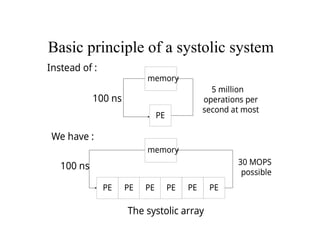
Basic principle of systolic architecture
•Systolic system consists of a set interconnected
cells , each capable of performing some simple
operation.
•Systolic approach can speed up a compute-bound
computation in a relatively simple and inexpensive
manner.
•A systolic array in particular , is illustrated in next
page. (we achieve higher computation throughput
without increasing memory bandwidth)
Basic principle of a systolic system
memory
PE
memory
PE PE PE PE PE
Instead of :
100 ns
We have :
100 ns 30 MOPS
possible
5 million
operations per
second at most
The systolic array
PE
CONVOLUTION
In mathematics and, in particular, functional analysis, convolution is
a mathematical operator which takes two functions f and g and
produces a third function that, in a sense, represents the amount of
overlap between f and a reversed and translated version of g.
Typically, one of the functions is taken to be a fixed filter impulse
response, and is known as a kernel. Such a convolution is a kind of
generalized moving average, as one can see by taking the kernel to be
an indicator function of an interval.
CONVOLUTION
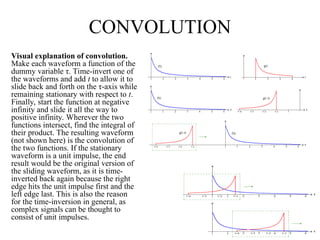
Visual explanation of convolution.
Make each waveform a function of the
dummy variable τ. Time-invert one of
the waveforms and add t to allow it to
slide back and forth on the τ-axis while
remaining stationary with respect to t.
Finally, start the function at negative
infinity and slide it all the way to
positive infinity. Wherever the two
functions intersect, find the integral of
their product. The resulting waveform
(not shown here) is the convolution of
the two functions. If the stationary
waveform is a unit impulse, the end
result would be the original version of
the sliding waveform, as it is time-
inverted back again because the right
edge hits the unit impulse first and the
left edge last. This is also the reason
for the time-inversion in general, as
complex signals can be thought to
consist of unit impulses.
CONVOLUTION
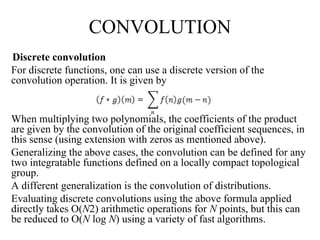
Discrete convolution
For discrete functions, one can use a discrete version of the
convolution operation. It is given by
When multiplying two polynomials, the coefficients of the product
are given by the convolution of the original coefficient sequences, in
this sense (using extension with zeros as mentioned above).
Generalizing the above cases, the convolution can be defined for any
two integratable functions defined on a locally compact topological
group.
A different generalization is the convolution of distributions.
Evaluating discrete convolutions using the above formula applied
directly takes O(N2) arithmetic operations for N points, but this can
be reduced to O(N log N) using a variety of fast algorithms.
CONVOLUTION
Code:
#include <stdio.h>
#include <stdlib.h>
int main( ){
int w[ ] = {1,2,2,1};
int x[ ] = { 11,2,3,4,5,6,3,2,1};
int y [20];
int w_len = 4;
int x_len = 9;
int i, j, temp;
for( i=1; i <= (w_len+x_len), i++) {
y[i] = 0;
}
for( i=1; i <= (w_len+x_len - 1); i++) {
for( j =1; j <= w_len; j++){
if ( ( i – j < 0 ) || ( i – j > (x_len -1 ) ) )
temp = 0;
else
temp = x[ i – j];
y[i] = y[i] + w[j] *temp;
}
printf ( “y[ %d] = %d n ” , i , y [i] );
}
return 1;
}
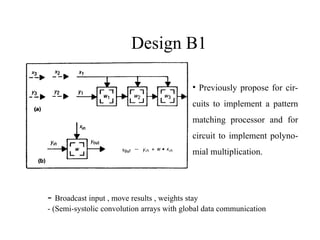
Design B1
- Broadcast input , move results , weights stay
- (Semi-systolic convolution arrays with global data communication
• Previously propose for cir-
cuits to implement a pattern
matching processor and for
circuit to implement polyno-
mial multiplication.
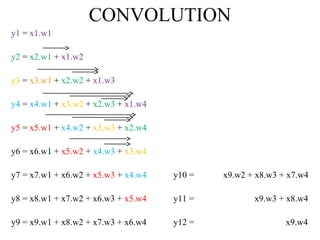
CONVOLUTION
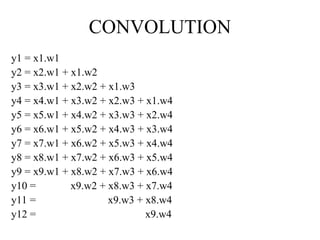
y1 = x1.w1
y2 = x2.w1 + x1.w2
y3 = x3.w1 + x2.w2 + x1.w3
y4 = x4.w1 + x3.w2 + x2.w3 + x1.w4
y5 = x5.w1 + x4.w2 + x3.w3 + x2.w4
y6 = x6.w1 + x5.w2 + x4.w3 + x3.w4
y7 = x7.w1 + x6.w2 + x5.w3 + x4.w4 y10 = x9.w2 + x8.w3 + x7.w4
y8 = x8.w1 + x7.w2 + x6.w3 + x5.w4 y11 = x9.w3 + x8.w4
y9 = x9.w1 + x8.w2 + x7.w3 + x6.w4 y12 = x9.w4
Design B2
Broadcast input , move weights , results stay
[(Semi-) systolic convolution arrays with
global data communication]
• The path for moving yi’s is
wider then wi’s because of
yi’s carry more bits then wi’s
in numerical accuracy.
• The use of multiplier-
accumlators may also help
increase precision of the
result , since extra bit can be
kept in these accumulators
with modest cost.
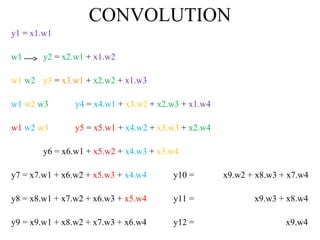
CONVOLUTION
y1 = x1.w1
w1 y2 = x2.w1 + x1.w2
w1 w2 y3 = x3.w1 + x2.w2 + x1.w3
w1 w2 w3 y4 = x4.w1 + x3.w2 + x2.w3 + x1.w4
w1 w2 w3 y5 = x5.w1 + x4.w2 + x3.w3 + x2.w4
y6 = x6.w1 + x5.w2 + x4.w3 + x3.w4
y7 = x7.w1 + x6.w2 + x5.w3 + x4.w4 y10 = x9.w2 + x8.w3 + x7.w4
y8 = x8.w1 + x7.w2 + x6.w3 + x5.w4 y11 = x9.w3 + x8.w4
y9 = x9.w1 + x8.w2 + x7.w3 + x6.w4 y12 = x9.w4
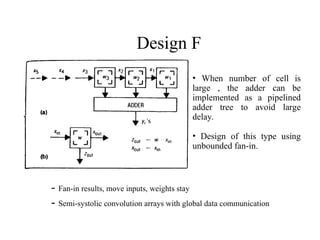
Design F
- Fan-in results, move inputs, weights stay
- Semi-systolic convolution arrays with global data communication
• When number of cell is
large , the adder can be
implemented as a pipelined
adder tree to avoid large
delay.
• Design of this type using
unbounded fan-in.
CONVOLUTION
y1 = x1.w1
y2 = x2.w1 + x1.w2
y3 = x3.w1 + x2.w2 + x1.w3
y4 = x4.w1 + x3.w2 + x2.w3 + x1.w4
y5 = x5.w1 + x4.w2 + x3.w3 + x2.w4
y6 = x6.w1 + x5.w2 + x4.w3 + x3.w4
y7 = x7.w1 + x6.w2 + x5.w3 + x4.w4
y8 = x8.w1 + x7.w2 + x6.w3 + x5.w4
y9 = x9.w1 + x8.w2 + x7.w3 + x6.w4
y10 = x9.w2 + x8.w3 + x7.w4
y11 = x9.w3 + x8.w4
y12 = x9.w4
pp. 16
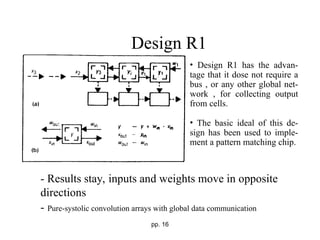
Design R1
- Results stay, inputs and weights move in opposite
directions
- Pure-systolic convolution arrays with global data communication
• Design R1 has the advan-
tage that it dose not require a
bus , or any other global net-
work , for collecting output
from cells.
• The basic ideal of this de-
sign has been used to imple-
ment a pattern matching chip.
CONVOLUTION
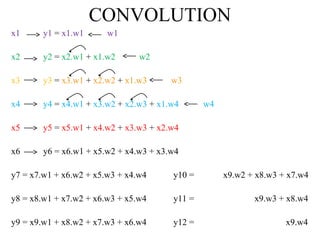
x1 y1 = x1.w1 w1
x2 y2 = x2.w1 + x1.w2 w2
x3 y3 = x3.w1 + x2.w2 + x1.w3 w3
x4 y4 = x4.w1 + x3.w2 + x2.w3 + x1.w4 w4
x5 y5 = x5.w1 + x4.w2 + x3.w3 + x2.w4
x6 y6 = x6.w1 + x5.w2 + x4.w3 + x3.w4
y7 = x7.w1 + x6.w2 + x5.w3 + x4.w4 y10 = x9.w2 + x8.w3 + x7.w4
y8 = x8.w1 + x7.w2 + x6.w3 + x5.w4 y11 = x9.w3 + x8.w4
y9 = x9.w1 + x8.w2 + x7.w3 + x6.w4 y12 = x9.w4
CONVOLUTION
Description :
For the sequence of computations shown on the previous page, design
a structural VHDL code such that the computation is fully
pipelined. x[i] represents a single datum input to circuit from the
testbench, while y[i] is the output back to the testbench. New
values of x[i] move into the circuit every clock cycle, and new
values of y[i] move out to the testbench every clock cycle.
“Clock” is another input ot the system.
1. The individual components of the system should be described
behaviorally. [25%]
2. Show a plan for architecting your design for a pipelined
implementation. [25%]
3. Write the top level VHDL structural code for the design. [25%]
4. Write a testbench for the system. [25%]

Basic principle of a systolic system-Convolution

  • 1.
  • 2.
    Motivation & Introduction •Weneed a high-performance , special-purpose computer system to meet specific application. •I/O and computation imbalance is a notable problem. •The concept of Systolic architecture can map high-level computation into hardware structures. •Systolic system works like an automobile assembly line. •Systolic system is easy to implement because of its regularity and easy to reconfigure. •Systolic architecture can result in cost-effective , high- performance special-purpose systems for a wide range of problems.
  • 3.
    Key architectural issuesin designing special-purpose systems •Simple and regular design Simple, regular design yields cost-effective special systems. •Concurrency and communication Design algorithm to support high concurrency and meantime to employ only simple. •Balancing computation with I/O A special-purpose system should be match a variety of I/O bandwidth.
  • 4.
    Basic principle ofsystolic architecture •Systolic system consists of a set interconnected cells , each capable of performing some simple operation. •Systolic approach can speed up a compute-bound computation in a relatively simple and inexpensive manner. •A systolic array in particular , is illustrated in next page. (we achieve higher computation throughput without increasing memory bandwidth)
  • 5.
    Basic principle ofa systolic system memory PE memory PE PE PE PE PE Instead of : 100 ns We have : 100 ns 30 MOPS possible 5 million operations per second at most The systolic array PE
  • 6.
    CONVOLUTION In mathematics and,in particular, functional analysis, convolution is a mathematical operator which takes two functions f and g and produces a third function that, in a sense, represents the amount of overlap between f and a reversed and translated version of g. Typically, one of the functions is taken to be a fixed filter impulse response, and is known as a kernel. Such a convolution is a kind of generalized moving average, as one can see by taking the kernel to be an indicator function of an interval.
  • 7.
    CONVOLUTION Visual explanation ofconvolution. Make each waveform a function of the dummy variable τ. Time-invert one of the waveforms and add t to allow it to slide back and forth on the τ-axis while remaining stationary with respect to t. Finally, start the function at negative infinity and slide it all the way to positive infinity. Wherever the two functions intersect, find the integral of their product. The resulting waveform (not shown here) is the convolution of the two functions. If the stationary waveform is a unit impulse, the end result would be the original version of the sliding waveform, as it is time- inverted back again because the right edge hits the unit impulse first and the left edge last. This is also the reason for the time-inversion in general, as complex signals can be thought to consist of unit impulses.
  • 8.
    CONVOLUTION Discrete convolution For discretefunctions, one can use a discrete version of the convolution operation. It is given by When multiplying two polynomials, the coefficients of the product are given by the convolution of the original coefficient sequences, in this sense (using extension with zeros as mentioned above). Generalizing the above cases, the convolution can be defined for any two integratable functions defined on a locally compact topological group. A different generalization is the convolution of distributions. Evaluating discrete convolutions using the above formula applied directly takes O(N2) arithmetic operations for N points, but this can be reduced to O(N log N) using a variety of fast algorithms.
  • 9.
    CONVOLUTION Code: #include <stdio.h> #include <stdlib.h> intmain( ){ int w[ ] = {1,2,2,1}; int x[ ] = { 11,2,3,4,5,6,3,2,1}; int y [20]; int w_len = 4; int x_len = 9; int i, j, temp; for( i=1; i <= (w_len+x_len), i++) { y[i] = 0; } for( i=1; i <= (w_len+x_len - 1); i++) { for( j =1; j <= w_len; j++){ if ( ( i – j < 0 ) || ( i – j > (x_len -1 ) ) ) temp = 0; else temp = x[ i – j]; y[i] = y[i] + w[j] *temp; } printf ( “y[ %d] = %d n ” , i , y [i] ); } return 1; }
  • 10.
    Design B1 - Broadcastinput , move results , weights stay - (Semi-systolic convolution arrays with global data communication • Previously propose for cir- cuits to implement a pattern matching processor and for circuit to implement polyno- mial multiplication.
  • 11.
    CONVOLUTION y1 = x1.w1 y2= x2.w1 + x1.w2 y3 = x3.w1 + x2.w2 + x1.w3 y4 = x4.w1 + x3.w2 + x2.w3 + x1.w4 y5 = x5.w1 + x4.w2 + x3.w3 + x2.w4 y6 = x6.w1 + x5.w2 + x4.w3 + x3.w4 y7 = x7.w1 + x6.w2 + x5.w3 + x4.w4 y10 = x9.w2 + x8.w3 + x7.w4 y8 = x8.w1 + x7.w2 + x6.w3 + x5.w4 y11 = x9.w3 + x8.w4 y9 = x9.w1 + x8.w2 + x7.w3 + x6.w4 y12 = x9.w4
  • 12.
    Design B2 Broadcast input, move weights , results stay [(Semi-) systolic convolution arrays with global data communication] • The path for moving yi’s is wider then wi’s because of yi’s carry more bits then wi’s in numerical accuracy. • The use of multiplier- accumlators may also help increase precision of the result , since extra bit can be kept in these accumulators with modest cost.
  • 13.
    CONVOLUTION y1 = x1.w1 w1y2 = x2.w1 + x1.w2 w1 w2 y3 = x3.w1 + x2.w2 + x1.w3 w1 w2 w3 y4 = x4.w1 + x3.w2 + x2.w3 + x1.w4 w1 w2 w3 y5 = x5.w1 + x4.w2 + x3.w3 + x2.w4 y6 = x6.w1 + x5.w2 + x4.w3 + x3.w4 y7 = x7.w1 + x6.w2 + x5.w3 + x4.w4 y10 = x9.w2 + x8.w3 + x7.w4 y8 = x8.w1 + x7.w2 + x6.w3 + x5.w4 y11 = x9.w3 + x8.w4 y9 = x9.w1 + x8.w2 + x7.w3 + x6.w4 y12 = x9.w4
  • 14.
    Design F - Fan-inresults, move inputs, weights stay - Semi-systolic convolution arrays with global data communication • When number of cell is large , the adder can be implemented as a pipelined adder tree to avoid large delay. • Design of this type using unbounded fan-in.
  • 15.
    CONVOLUTION y1 = x1.w1 y2= x2.w1 + x1.w2 y3 = x3.w1 + x2.w2 + x1.w3 y4 = x4.w1 + x3.w2 + x2.w3 + x1.w4 y5 = x5.w1 + x4.w2 + x3.w3 + x2.w4 y6 = x6.w1 + x5.w2 + x4.w3 + x3.w4 y7 = x7.w1 + x6.w2 + x5.w3 + x4.w4 y8 = x8.w1 + x7.w2 + x6.w3 + x5.w4 y9 = x9.w1 + x8.w2 + x7.w3 + x6.w4 y10 = x9.w2 + x8.w3 + x7.w4 y11 = x9.w3 + x8.w4 y12 = x9.w4
  • 16.
    pp. 16 Design R1 -Results stay, inputs and weights move in opposite directions - Pure-systolic convolution arrays with global data communication • Design R1 has the advan- tage that it dose not require a bus , or any other global net- work , for collecting output from cells. • The basic ideal of this de- sign has been used to imple- ment a pattern matching chip.
  • 17.
    CONVOLUTION x1 y1 =x1.w1 w1 x2 y2 = x2.w1 + x1.w2 w2 x3 y3 = x3.w1 + x2.w2 + x1.w3 w3 x4 y4 = x4.w1 + x3.w2 + x2.w3 + x1.w4 w4 x5 y5 = x5.w1 + x4.w2 + x3.w3 + x2.w4 x6 y6 = x6.w1 + x5.w2 + x4.w3 + x3.w4 y7 = x7.w1 + x6.w2 + x5.w3 + x4.w4 y10 = x9.w2 + x8.w3 + x7.w4 y8 = x8.w1 + x7.w2 + x6.w3 + x5.w4 y11 = x9.w3 + x8.w4 y9 = x9.w1 + x8.w2 + x7.w3 + x6.w4 y12 = x9.w4
  • 18.
    CONVOLUTION Description : For thesequence of computations shown on the previous page, design a structural VHDL code such that the computation is fully pipelined. x[i] represents a single datum input to circuit from the testbench, while y[i] is the output back to the testbench. New values of x[i] move into the circuit every clock cycle, and new values of y[i] move out to the testbench every clock cycle. “Clock” is another input ot the system. 1. The individual components of the system should be described behaviorally. [25%] 2. Show a plan for architecting your design for a pipelined implementation. [25%] 3. Write the top level VHDL structural code for the design. [25%] 4. Write a testbench for the system. [25%]