Basic Grammatical
Concepts
Just the basics
Verbs
• Verbs are words that show some kind of action
• There are two types of action verbs
* Active (the subject performs the action)
* Passive (the subject is acted upon)
• Bill hit the ball [active]
• Bill was hit by the ball [passive]
Verbs
• Verbs come in three different classifications:
• transitive verbs. Verbs that transfer action to their object. We will
learn about direct objects a little later on.
John ran all the way home
• Intransitive verbs - these verbs do not transfer actions to their
object
Jesus wept
• Auxiliary verbs - also called helping or linking verbs. These verbs
help complete the action of another verb or show a state of being
John is helping his father at work today
John is sick today
Verbs
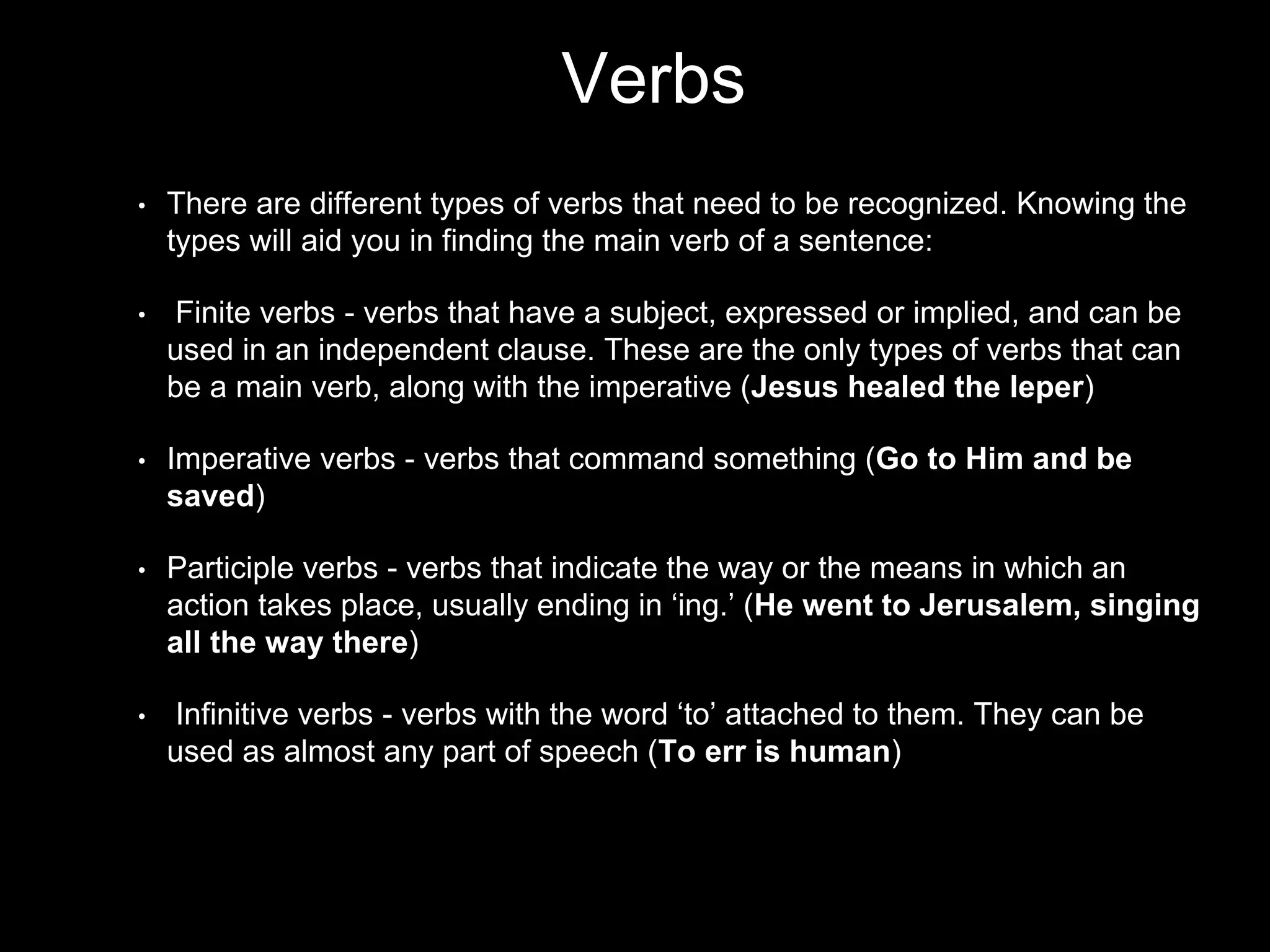
• There are different types of verbs that need to be recognized. Knowing the
types will aid you in finding the main verb of a sentence:
• Finite verbs - verbs that have a subject, expressed or implied, and can be
used in an independent clause. These are the only types of verbs that can
be a main verb, along with the imperative (Jesus healed the leper)
• Imperative verbs - verbs that command something (Go to Him and be
saved)
• Participle verbs - verbs that indicate the way or the means in which an
action takes place, usually ending in ‘ing.’ (He went to Jerusalem, singing
all the way there)
• Infinitive verbs - verbs with the word ‘to’ attached to them. They can be
used as almost any part of speech (To err is human)
Verbs
• Remember
• only finite and imperatives can be the main verb
of a sentence.
Subjects
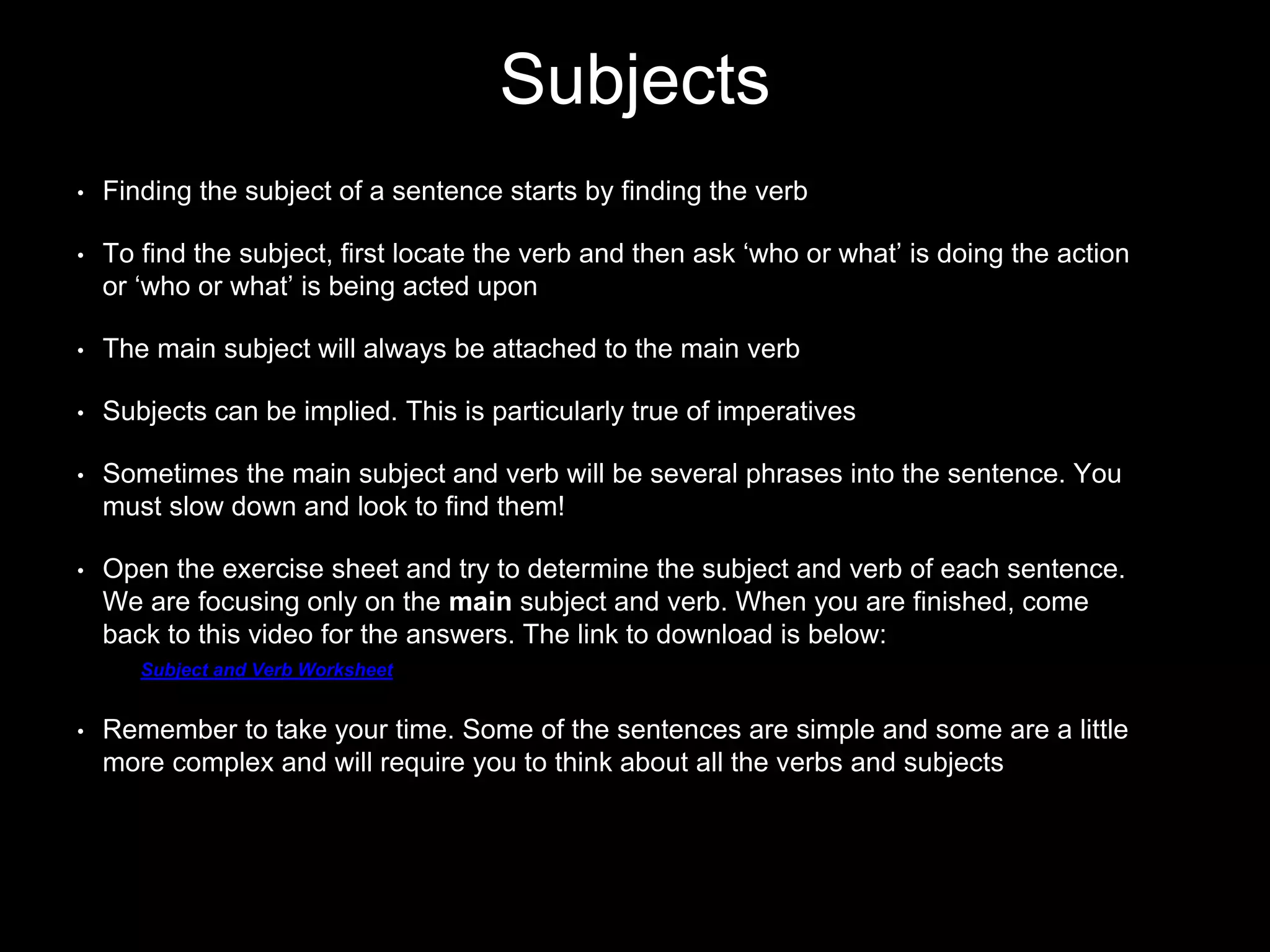
• Finding the subject of a sentence starts by finding the verb
• To find the subject, first locate the verb and then ask ‘who or what’ is doing the action
or ‘who or what’ is being acted upon
• The main subject will always be attached to the main verb
• Subjects can be implied. This is particularly true of imperatives
• Sometimes the main subject and verb will be several phrases into the sentence. You
must slow down and look to find them!
• Open the exercise sheet and try to determine the subject and verb of each sentence.
We are focusing only on the main subject and verb. When you are finished, come
back to this video for the answers. The link to download is below:
Subject and Verb Worksheet
• Remember to take your time. Some of the sentences are simple and some are a little
more complex and will require you to think about all the verbs and subjects
Answers to the Exercises
1. He has caused us to be born again to a living hope
2. God created the heavens and the earth
3. Love the brotherhood [this is an imperative with an understood 'you' as the subject]
4. As you come to him, a living stone rejected by men but in the sight of God chosen
and precious, you are being built up as a spiritual house
5. Be subject for the Lord’s sake to every human institution [another understood you]
6. I would remind you, brothers, of the gospel I preached to you… and by which you
are being saved
7. She came from the ends of the earth to hear the wisdom of Solomon
she came from the ends of the earth to hear the wisdom of Solomon
Blue lines= subjects
Red lines = verbs
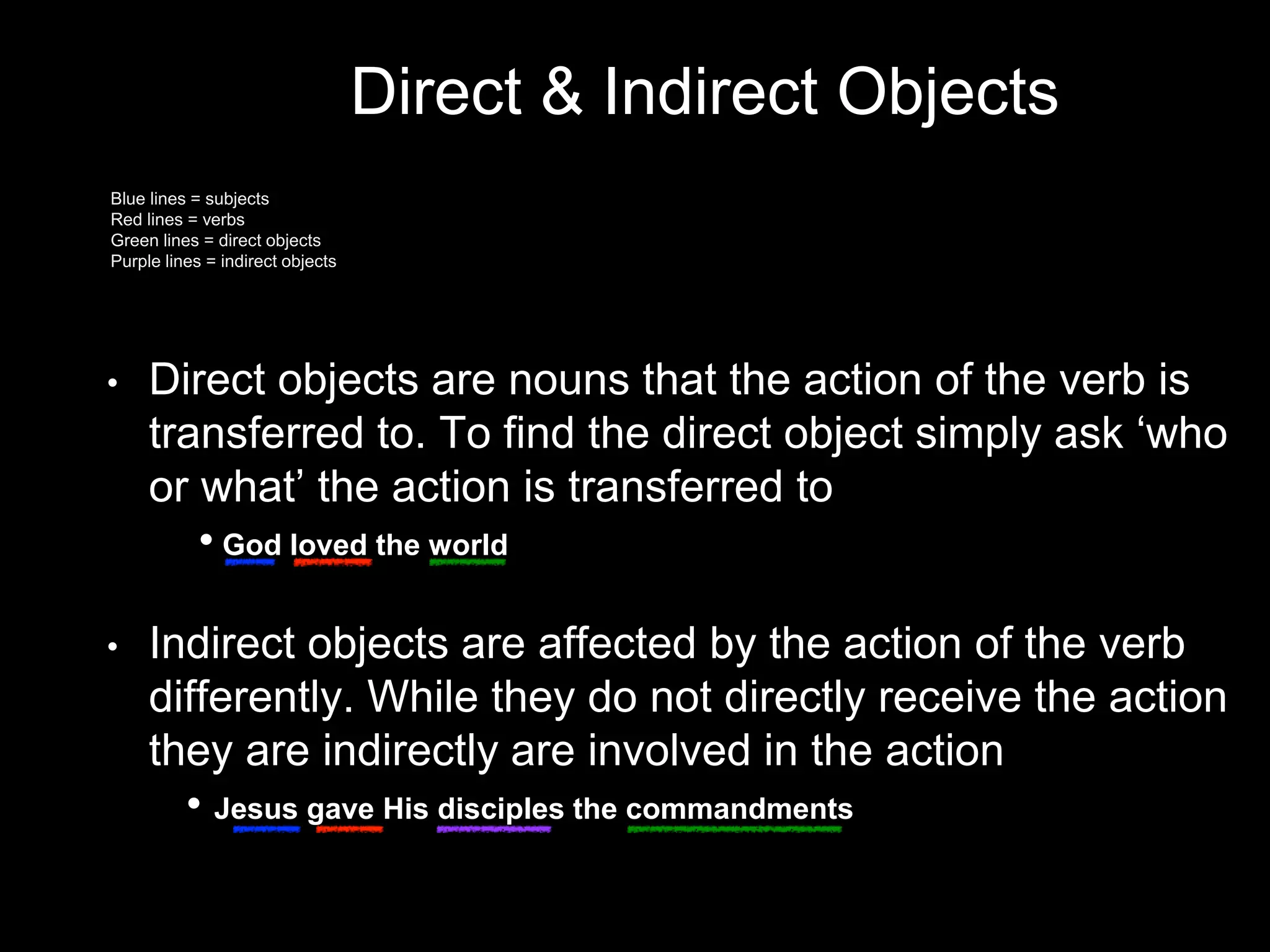
Direct & Indirect Objects
• Direct objects are nouns that the action of the verb is
transferred to. To find the direct object simply ask ‘who
or what’ the action is transferred to
• God loved the world
• Indirect objects are affected by the action of the verb
differently. While they do not directly receive the action
they are indirectly are involved in the action
• Jesus gave His disciples the commandments
Blue lines = subjects
Red lines = verbs
Green lines = direct objects
Purple lines = indirect objects
Practice Makes Perfect
• Remember to try and spot subjects, verbs, direct
objects and indirect objects while you read
Scripture. It might go slow at first, but as you
learn to spot these things in your reading it will
become much easier as you go along
• End part 2

Basic grammatical concepts

  • 1.
  • 2.
    Verbs • Verbs arewords that show some kind of action • There are two types of action verbs * Active (the subject performs the action) * Passive (the subject is acted upon) • Bill hit the ball [active] • Bill was hit by the ball [passive]
  • 3.
    Verbs • Verbs comein three different classifications: • transitive verbs. Verbs that transfer action to their object. We will learn about direct objects a little later on. John ran all the way home • Intransitive verbs - these verbs do not transfer actions to their object Jesus wept • Auxiliary verbs - also called helping or linking verbs. These verbs help complete the action of another verb or show a state of being John is helping his father at work today John is sick today
  • 4.
    Verbs • There aredifferent types of verbs that need to be recognized. Knowing the types will aid you in finding the main verb of a sentence: • Finite verbs - verbs that have a subject, expressed or implied, and can be used in an independent clause. These are the only types of verbs that can be a main verb, along with the imperative (Jesus healed the leper) • Imperative verbs - verbs that command something (Go to Him and be saved) • Participle verbs - verbs that indicate the way or the means in which an action takes place, usually ending in ‘ing.’ (He went to Jerusalem, singing all the way there) • Infinitive verbs - verbs with the word ‘to’ attached to them. They can be used as almost any part of speech (To err is human)
  • 5.
    Verbs • Remember • onlyfinite and imperatives can be the main verb of a sentence.
  • 6.
    Subjects • Finding thesubject of a sentence starts by finding the verb • To find the subject, first locate the verb and then ask ‘who or what’ is doing the action or ‘who or what’ is being acted upon • The main subject will always be attached to the main verb • Subjects can be implied. This is particularly true of imperatives • Sometimes the main subject and verb will be several phrases into the sentence. You must slow down and look to find them! • Open the exercise sheet and try to determine the subject and verb of each sentence. We are focusing only on the main subject and verb. When you are finished, come back to this video for the answers. The link to download is below: Subject and Verb Worksheet • Remember to take your time. Some of the sentences are simple and some are a little more complex and will require you to think about all the verbs and subjects
  • 7.
    Answers to theExercises 1. He has caused us to be born again to a living hope 2. God created the heavens and the earth 3. Love the brotherhood [this is an imperative with an understood 'you' as the subject] 4. As you come to him, a living stone rejected by men but in the sight of God chosen and precious, you are being built up as a spiritual house 5. Be subject for the Lord’s sake to every human institution [another understood you] 6. I would remind you, brothers, of the gospel I preached to you… and by which you are being saved 7. She came from the ends of the earth to hear the wisdom of Solomon she came from the ends of the earth to hear the wisdom of Solomon Blue lines= subjects Red lines = verbs
  • 8.
    Direct & IndirectObjects • Direct objects are nouns that the action of the verb is transferred to. To find the direct object simply ask ‘who or what’ the action is transferred to • God loved the world • Indirect objects are affected by the action of the verb differently. While they do not directly receive the action they are indirectly are involved in the action • Jesus gave His disciples the commandments Blue lines = subjects Red lines = verbs Green lines = direct objects Purple lines = indirect objects
  • 9.
    Practice Makes Perfect •Remember to try and spot subjects, verbs, direct objects and indirect objects while you read Scripture. It might go slow at first, but as you learn to spot these things in your reading it will become much easier as you go along
  • 10.