Understanding Different Types,
Size and Scope of Organisations
DR FRED OKPALA
Objectives
๏ƒ˜To Understand Different Types of Organisation
๏ƒ˜To Understand Different Sizes of Organisation
๏ƒ˜To Understand Different Scope of Organisation
Copyright ยฉ 2021 Talent & Skills HuB
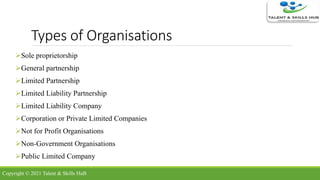
Types of Organisations
๏ƒ˜Sole proprietorship
๏ƒ˜General partnership
๏ƒ˜Limited Partnership
๏ƒ˜Limited Liability Partnership
๏ƒ˜Limited Liability Company
๏ƒ˜Corporation or Private Limited Companies
๏ƒ˜Not for Profit Organisations
๏ƒ˜Non-Government Organisations
๏ƒ˜Public Limited Company
Copyright ยฉ 2021 Talent & Skills HuB
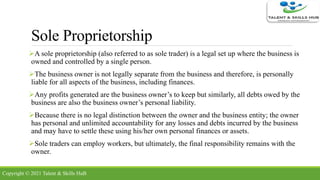
Sole Proprietorship
๏ƒ˜A sole proprietorship (also referred to as sole trader) is a legal set up where the business is
owned and controlled by a single person.
๏ƒ˜The business owner is not legally separate from the business and therefore, is personally
liable for all aspects of the business, including finances.
๏ƒ˜Any profits generated are the business ownerโ€™s to keep but similarly, all debts owed by the
business are also the business ownerโ€™s personal liability.
๏ƒ˜Because there is no legal distinction between the owner and the business entity; the owner
has personal and unlimited accountability for any losses and debts incurred by the business
and may have to settle these using his/her own personal finances or assets.
๏ƒ˜Sole traders can employ workers, but ultimately, the final responsibility remains with the
owner.
Copyright ยฉ 2021 Talent & Skills HuB
General Partnership
๏ƒ˜A general partnership is created when two or more persons associate to carry on a business
for profit.
๏ƒ˜A partnership generally operates in accordance with a partnership agreement, but there is
no requirement that the agreement be in writing and no state-filing requirement.
๏ƒ˜Partnership are usually terminable at will or at the death of any of the partners, and
partnership interests cannot be sold or transferred without the consent of the other partners.
๏ƒ˜However, a partnership provides no liability protection to its owners. In fact, each partner
is jointly and severally liable for all debts of the partnership.
Copyright ยฉ 2021 Talent & Skills HuB
Limited Partnership
๏ƒ˜A limited partnership is a partnership formed by two or more persons and
having one or more general partners and one or more limited partners.
๏ƒ˜This type of business ownership operates in accordance with a partnership
agreement, written or oral, of the partners as to the affairs of the limited
partnership and the conduct of its business.
๏ƒ˜General partners are fully liable for the debts of the partnership, while limited
partners are not liable for the debts of the partnership, but may not participate in
management of the business.
Copyright ยฉ 2021 Talent & Skills HuB
Limited Liability Partnership
๏ƒ˜In order to limit the liability of its general partners, a general partner may opt to
register as a limited liability partnership.
๏ƒ˜Hence, in limited liability partnership, there is no general partners. All of the
owners of the LLP have limited personal liability for the business debts.
๏ƒ˜Limited liability partnership is particularly well-suited to professional groups,
such as lawyers and accountants.
๏ƒ˜The major reason behind this type of partnership is to prevent the partners to be
personally liable for another partner's problems, particularly those involving
malpractice claims.
Copyright ยฉ 2021 Talent & Skills HuB
Limited Liability Company
๏ƒ˜Limited companies are incorporated which means they are separate legal entities and have
their own legal status; hence they are distinct from their owners.
๏ƒ˜In the UK, limited companies are incorporated as a โ€˜legal personโ€™ at Companies House
where they are allocated a unique company number.
๏ƒ˜Because it is distinct legal entity on its own, a company can own assets in its own name,
enter into contracts, sue or be sued.
๏ƒ˜The owners are protected by limited liability i.e. they are only responsible for business
debts valuing at the sum of their initial investment into the company.
Copyright ยฉ 2021 Talent & Skills HuB
Corporation or Private Limited
Companies
๏ƒ˜Private limited companies are often small privately held business entities whose liability is
limited by shares.
๏ƒ˜Because the business is small and privately held, the business is limited to having a small
number of shareholders (for e.g. 50 shareholders in the UK).
๏ƒ˜Moreover, the shares cannot be publicly traded which means that private limited
companies cannot list their shares on the stock exchange.
๏ƒ˜In the UK, there is no minimum capital requirement to set up private limited companies
apart from having at least one share issued at the time of incorporation.
๏ƒ˜Many SMEs operate under a private limited company status as it allows them to seek
protection from personal liability and reduce personal risk whilst allowing them to raise
funds through sale of shares.
Copyright ยฉ 2021 Talent & Skills HuB
Public Limited Company
๏ƒ˜Public limited companies (PLC) are limited liability companies that can sell and trade their shares
freely on the stock exchange.
๏ƒ˜Unlike private limited companies, PLCs are subject to a minimum capital requirement (for e.g.
ยฃ50,000.00 in the UK).
๏ƒ˜They must also appoint two directors and a company secretary and must also file their annual returns
every 12 months.
๏ƒ˜PLCs can have several different types of shares including ordinary shares (which have no special rights
or restrictions), preference shares (right to preferential payment on annual dividends) and redeemable
shares (allowing the company to buy back the shares after a certain period).
๏ƒ˜The key advantage of setting up a PLC is the ability to raise finance through sale of shares to the
public.
๏ƒ˜However, the cost of setting up a PLC is not always affordable to smaller businesses which might
struggle to raise finances elsewhere.
Copyright ยฉ 2021 Talent & Skills HuB
Not for Profit Organisations
๏ƒ˜Not for profit organisations are those organisations which are set up for a purpose other than
financial gain.
๏ƒ˜These organisations can be differentiated from for profit organisations on the basis that their
primary motive is not to generate private profits for business owners but rather to work for
public benefit.
๏ƒ˜The organisations that fall under the not for profit category can include charities and social
enterprises.
๏ƒ˜Although some of these organisations might undertake business activities, the sums
generated from these activities are used to further the cause they advocate, and their profits
are never distributed amongst their members.
๏ƒ˜Not for profit organisations are usually always tax exempt and generate their funding
through donations, sponsorships and other similar investments.
Copyright ยฉ 2021 Talent & Skills HuB
Non-Government Organisations
๏ƒ˜Non-government organisations, most commonly referred to as NGOs, are non-profit
organisations that operate independently from the state or government.
๏ƒ˜Although they may still receive state funding, NGOs operate without representation from
the government.
๏ƒ˜The World Bank has identified two different groups of NGOs: operational NGOs and
advocacy NGOs.
๏ƒ˜Operational NGOs usually work towards the designing and implementation of
development-based projects
๏ƒ˜Advocacy NGOs work towards promoting a specific cause.
๏ƒ˜Like most non-profit organisations, NGOs are also reliant on external funding that comes
through donations, membership dues and grants etc.
Copyright ยฉ 2021 Talent & Skills HuB
Sizes of Organisation
๏ƒ˜Micro (Less than 10 employees)
๏ƒ˜Small Enterprises (Less than 50 employees)
๏ƒ˜Medium Enterprises (Less than 250 employees)
๏ƒ˜Large Enterprises (250 employees and above)
Copyright ยฉ 2021 Talent & Skills HuB
Scopes of Organisations
๏ƒ˜Local
๏ƒ˜National
๏ƒ˜International
๏ƒ˜Global
Copyright ยฉ 2021 Talent & Skills HuB
Choosing Among Different Types of
Business Ownership
๏ƒ˜Choosing among the types of business ownership involves a balancing of competing
concerns.
๏ƒ˜In the start-up phase of a new closely-held business, when the company is probably losing
money, "pass-through" tax structures (general partnership, limited partnership, limited liability
partnership, or limited liability company) are preferable.
๏ƒ˜Most of these structures have some disadvantages if the entity is successful and wishes to
grow and attract capital from outside investors.
๏ƒ˜Partnership structures provide the best legal protection to minority owners, but leave all the
owners exposed to unlimited liability.
Copyright ยฉ 2021 Talent & Skills HuB
Choosing Among Different Types of
Business Ownership Cont.
๏ƒ˜Limited partnership shield limited partners from liability, but limited partners are
prohibited from active participation in management.
๏ƒ˜Limited liability partnerships shield some partners from liability but only if they
have no involvement in the transaction creating the debt or liability.
๏ƒ˜The most useful type of business ownership for large and growing organizations is
the corporation, which combines limited liability, separation of ownership and
control (allowing for passive investors) and permanence.
Copyright ยฉ 2021 Talent & Skills HuB
Talent &
Skills HuB
T&S-HuB is an enabling environment that supports people
in the development of their talents and skills and in the
actualisation of their personal passions and ambitions.
We help learners and individuals sharpen and exhibit their
talents and skills while exploring relevant and life
changing opportunities that suit their passions.
You can be supported by our instructors, counsellors, and
mentors on employability skills and other personal and
professional development.
Book an appointment for one-to-one or group tutoring
through our website; ts-hub.com
You can also contact us via email: contactus@ts-hub.com
Copyright ยฉ 2021 Talent & Skills HuB

Understanding Different Types of Organisations

  • 1.
    Understanding Different Types, Sizeand Scope of Organisations DR FRED OKPALA
  • 2.
    Objectives ๏ƒ˜To Understand DifferentTypes of Organisation ๏ƒ˜To Understand Different Sizes of Organisation ๏ƒ˜To Understand Different Scope of Organisation Copyright ยฉ 2021 Talent & Skills HuB
  • 3.
    Types of Organisations ๏ƒ˜Soleproprietorship ๏ƒ˜General partnership ๏ƒ˜Limited Partnership ๏ƒ˜Limited Liability Partnership ๏ƒ˜Limited Liability Company ๏ƒ˜Corporation or Private Limited Companies ๏ƒ˜Not for Profit Organisations ๏ƒ˜Non-Government Organisations ๏ƒ˜Public Limited Company Copyright ยฉ 2021 Talent & Skills HuB
  • 4.
    Sole Proprietorship ๏ƒ˜A soleproprietorship (also referred to as sole trader) is a legal set up where the business is owned and controlled by a single person. ๏ƒ˜The business owner is not legally separate from the business and therefore, is personally liable for all aspects of the business, including finances. ๏ƒ˜Any profits generated are the business ownerโ€™s to keep but similarly, all debts owed by the business are also the business ownerโ€™s personal liability. ๏ƒ˜Because there is no legal distinction between the owner and the business entity; the owner has personal and unlimited accountability for any losses and debts incurred by the business and may have to settle these using his/her own personal finances or assets. ๏ƒ˜Sole traders can employ workers, but ultimately, the final responsibility remains with the owner. Copyright ยฉ 2021 Talent & Skills HuB
  • 5.
    General Partnership ๏ƒ˜A generalpartnership is created when two or more persons associate to carry on a business for profit. ๏ƒ˜A partnership generally operates in accordance with a partnership agreement, but there is no requirement that the agreement be in writing and no state-filing requirement. ๏ƒ˜Partnership are usually terminable at will or at the death of any of the partners, and partnership interests cannot be sold or transferred without the consent of the other partners. ๏ƒ˜However, a partnership provides no liability protection to its owners. In fact, each partner is jointly and severally liable for all debts of the partnership. Copyright ยฉ 2021 Talent & Skills HuB
  • 6.
    Limited Partnership ๏ƒ˜A limitedpartnership is a partnership formed by two or more persons and having one or more general partners and one or more limited partners. ๏ƒ˜This type of business ownership operates in accordance with a partnership agreement, written or oral, of the partners as to the affairs of the limited partnership and the conduct of its business. ๏ƒ˜General partners are fully liable for the debts of the partnership, while limited partners are not liable for the debts of the partnership, but may not participate in management of the business. Copyright ยฉ 2021 Talent & Skills HuB
  • 7.
    Limited Liability Partnership ๏ƒ˜Inorder to limit the liability of its general partners, a general partner may opt to register as a limited liability partnership. ๏ƒ˜Hence, in limited liability partnership, there is no general partners. All of the owners of the LLP have limited personal liability for the business debts. ๏ƒ˜Limited liability partnership is particularly well-suited to professional groups, such as lawyers and accountants. ๏ƒ˜The major reason behind this type of partnership is to prevent the partners to be personally liable for another partner's problems, particularly those involving malpractice claims. Copyright ยฉ 2021 Talent & Skills HuB
  • 8.
    Limited Liability Company ๏ƒ˜Limitedcompanies are incorporated which means they are separate legal entities and have their own legal status; hence they are distinct from their owners. ๏ƒ˜In the UK, limited companies are incorporated as a โ€˜legal personโ€™ at Companies House where they are allocated a unique company number. ๏ƒ˜Because it is distinct legal entity on its own, a company can own assets in its own name, enter into contracts, sue or be sued. ๏ƒ˜The owners are protected by limited liability i.e. they are only responsible for business debts valuing at the sum of their initial investment into the company. Copyright ยฉ 2021 Talent & Skills HuB
  • 9.
    Corporation or PrivateLimited Companies ๏ƒ˜Private limited companies are often small privately held business entities whose liability is limited by shares. ๏ƒ˜Because the business is small and privately held, the business is limited to having a small number of shareholders (for e.g. 50 shareholders in the UK). ๏ƒ˜Moreover, the shares cannot be publicly traded which means that private limited companies cannot list their shares on the stock exchange. ๏ƒ˜In the UK, there is no minimum capital requirement to set up private limited companies apart from having at least one share issued at the time of incorporation. ๏ƒ˜Many SMEs operate under a private limited company status as it allows them to seek protection from personal liability and reduce personal risk whilst allowing them to raise funds through sale of shares. Copyright ยฉ 2021 Talent & Skills HuB
  • 10.
    Public Limited Company ๏ƒ˜Publiclimited companies (PLC) are limited liability companies that can sell and trade their shares freely on the stock exchange. ๏ƒ˜Unlike private limited companies, PLCs are subject to a minimum capital requirement (for e.g. ยฃ50,000.00 in the UK). ๏ƒ˜They must also appoint two directors and a company secretary and must also file their annual returns every 12 months. ๏ƒ˜PLCs can have several different types of shares including ordinary shares (which have no special rights or restrictions), preference shares (right to preferential payment on annual dividends) and redeemable shares (allowing the company to buy back the shares after a certain period). ๏ƒ˜The key advantage of setting up a PLC is the ability to raise finance through sale of shares to the public. ๏ƒ˜However, the cost of setting up a PLC is not always affordable to smaller businesses which might struggle to raise finances elsewhere. Copyright ยฉ 2021 Talent & Skills HuB
  • 11.
    Not for ProfitOrganisations ๏ƒ˜Not for profit organisations are those organisations which are set up for a purpose other than financial gain. ๏ƒ˜These organisations can be differentiated from for profit organisations on the basis that their primary motive is not to generate private profits for business owners but rather to work for public benefit. ๏ƒ˜The organisations that fall under the not for profit category can include charities and social enterprises. ๏ƒ˜Although some of these organisations might undertake business activities, the sums generated from these activities are used to further the cause they advocate, and their profits are never distributed amongst their members. ๏ƒ˜Not for profit organisations are usually always tax exempt and generate their funding through donations, sponsorships and other similar investments. Copyright ยฉ 2021 Talent & Skills HuB
  • 12.
    Non-Government Organisations ๏ƒ˜Non-government organisations,most commonly referred to as NGOs, are non-profit organisations that operate independently from the state or government. ๏ƒ˜Although they may still receive state funding, NGOs operate without representation from the government. ๏ƒ˜The World Bank has identified two different groups of NGOs: operational NGOs and advocacy NGOs. ๏ƒ˜Operational NGOs usually work towards the designing and implementation of development-based projects ๏ƒ˜Advocacy NGOs work towards promoting a specific cause. ๏ƒ˜Like most non-profit organisations, NGOs are also reliant on external funding that comes through donations, membership dues and grants etc. Copyright ยฉ 2021 Talent & Skills HuB
  • 13.
    Sizes of Organisation ๏ƒ˜Micro(Less than 10 employees) ๏ƒ˜Small Enterprises (Less than 50 employees) ๏ƒ˜Medium Enterprises (Less than 250 employees) ๏ƒ˜Large Enterprises (250 employees and above) Copyright ยฉ 2021 Talent & Skills HuB
  • 14.
  • 15.
    Choosing Among DifferentTypes of Business Ownership ๏ƒ˜Choosing among the types of business ownership involves a balancing of competing concerns. ๏ƒ˜In the start-up phase of a new closely-held business, when the company is probably losing money, "pass-through" tax structures (general partnership, limited partnership, limited liability partnership, or limited liability company) are preferable. ๏ƒ˜Most of these structures have some disadvantages if the entity is successful and wishes to grow and attract capital from outside investors. ๏ƒ˜Partnership structures provide the best legal protection to minority owners, but leave all the owners exposed to unlimited liability. Copyright ยฉ 2021 Talent & Skills HuB
  • 16.
    Choosing Among DifferentTypes of Business Ownership Cont. ๏ƒ˜Limited partnership shield limited partners from liability, but limited partners are prohibited from active participation in management. ๏ƒ˜Limited liability partnerships shield some partners from liability but only if they have no involvement in the transaction creating the debt or liability. ๏ƒ˜The most useful type of business ownership for large and growing organizations is the corporation, which combines limited liability, separation of ownership and control (allowing for passive investors) and permanence. Copyright ยฉ 2021 Talent & Skills HuB
  • 17.
    Talent & Skills HuB T&S-HuBis an enabling environment that supports people in the development of their talents and skills and in the actualisation of their personal passions and ambitions. We help learners and individuals sharpen and exhibit their talents and skills while exploring relevant and life changing opportunities that suit their passions. You can be supported by our instructors, counsellors, and mentors on employability skills and other personal and professional development. Book an appointment for one-to-one or group tutoring through our website; ts-hub.com You can also contact us via email: contactus@ts-hub.com Copyright ยฉ 2021 Talent & Skills HuB