Marian López
         #20
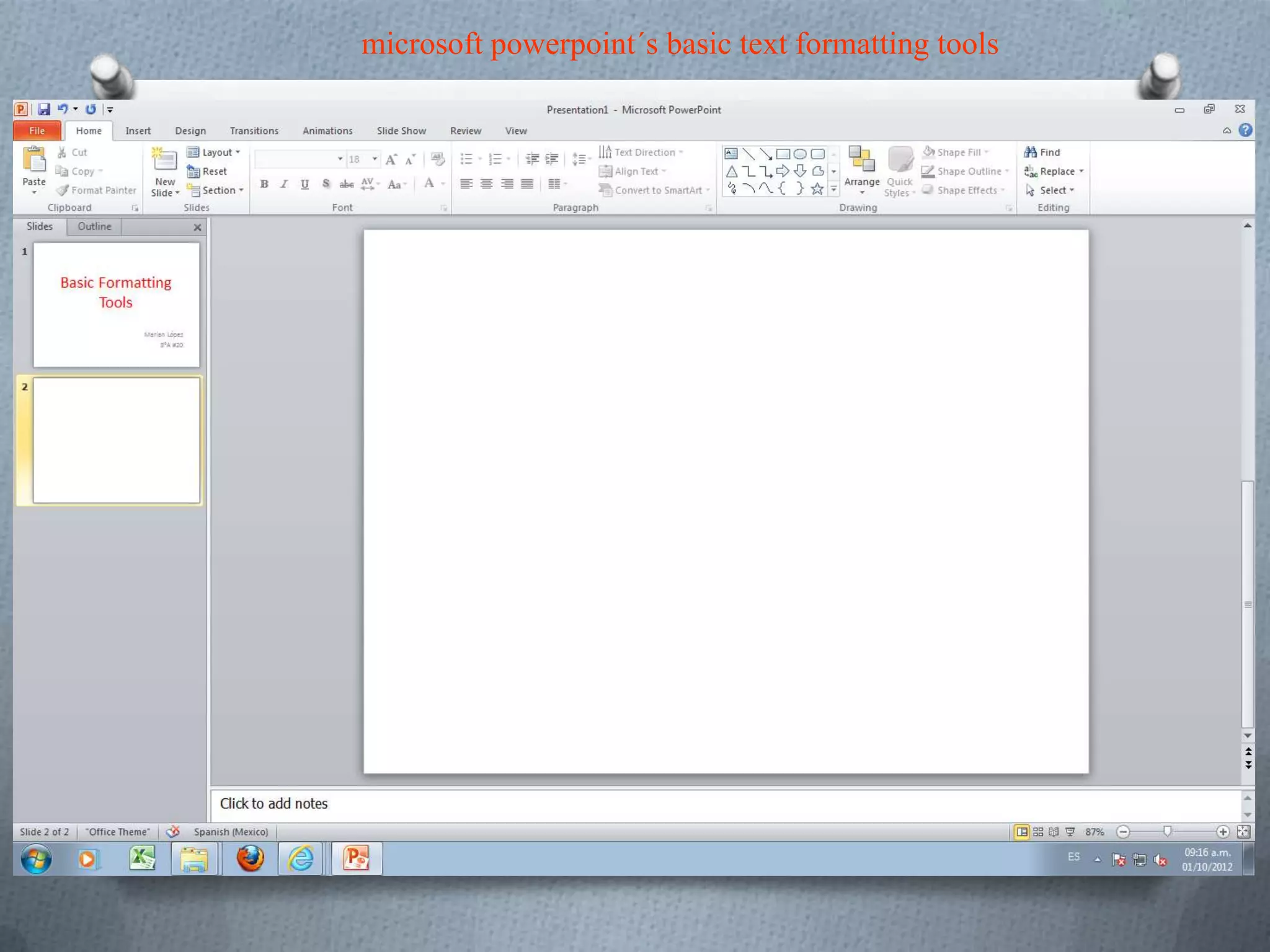
microsoft powerpoint´s basic text formatting tools
There are two groups of text
formatting tools on the Ribbon:
   the Font group
    and the Paragraph group.
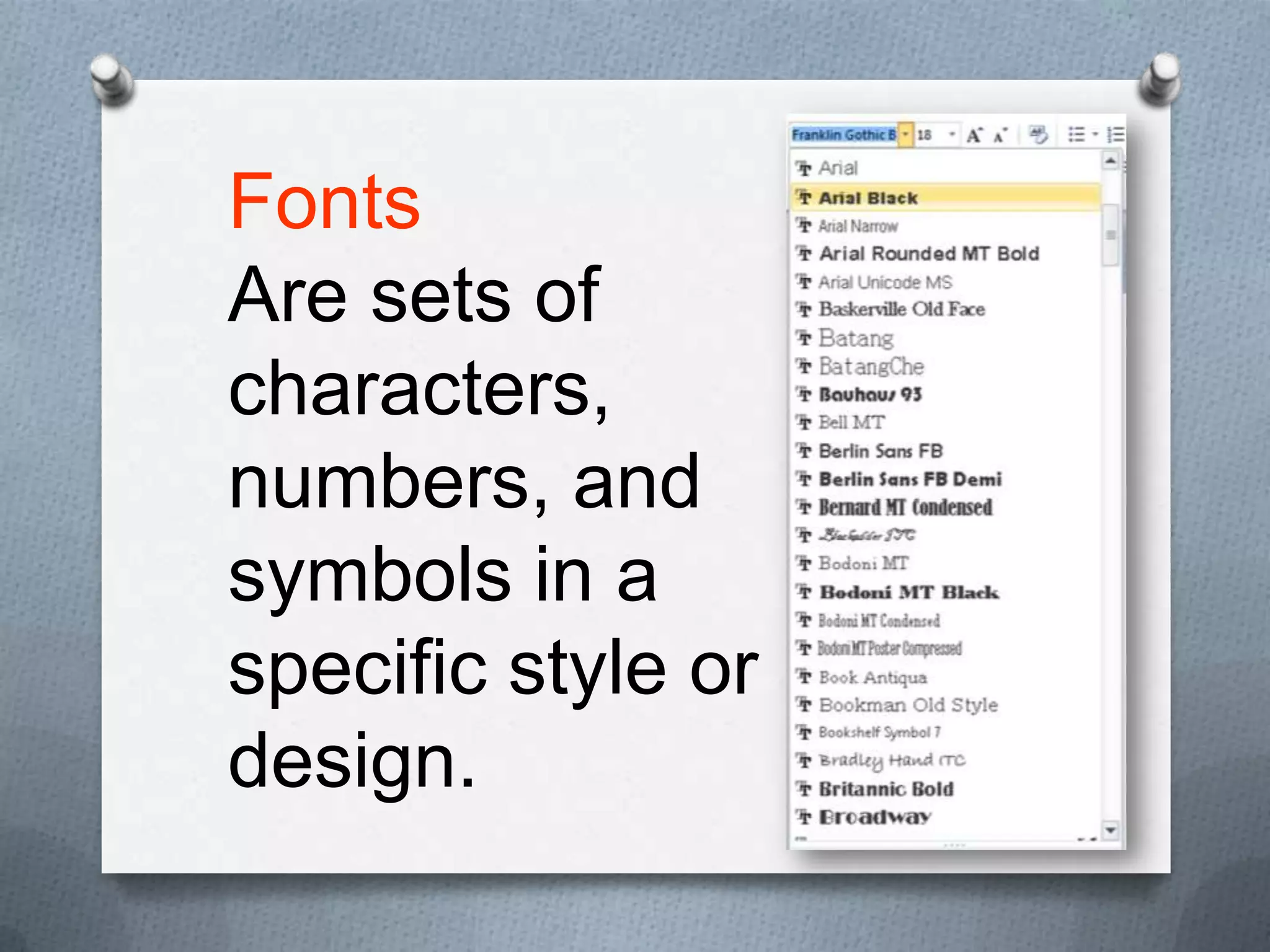
Fonts
Are sets of
characters,
numbers, and
symbols in a
specific style or
design.
Applying Fonts Styles and Effects
Text can be boldfaced or italicized
,called font styles, underlined,
                OR
 Formatted with other attributes
such as strikethrough or shadow
called effects.
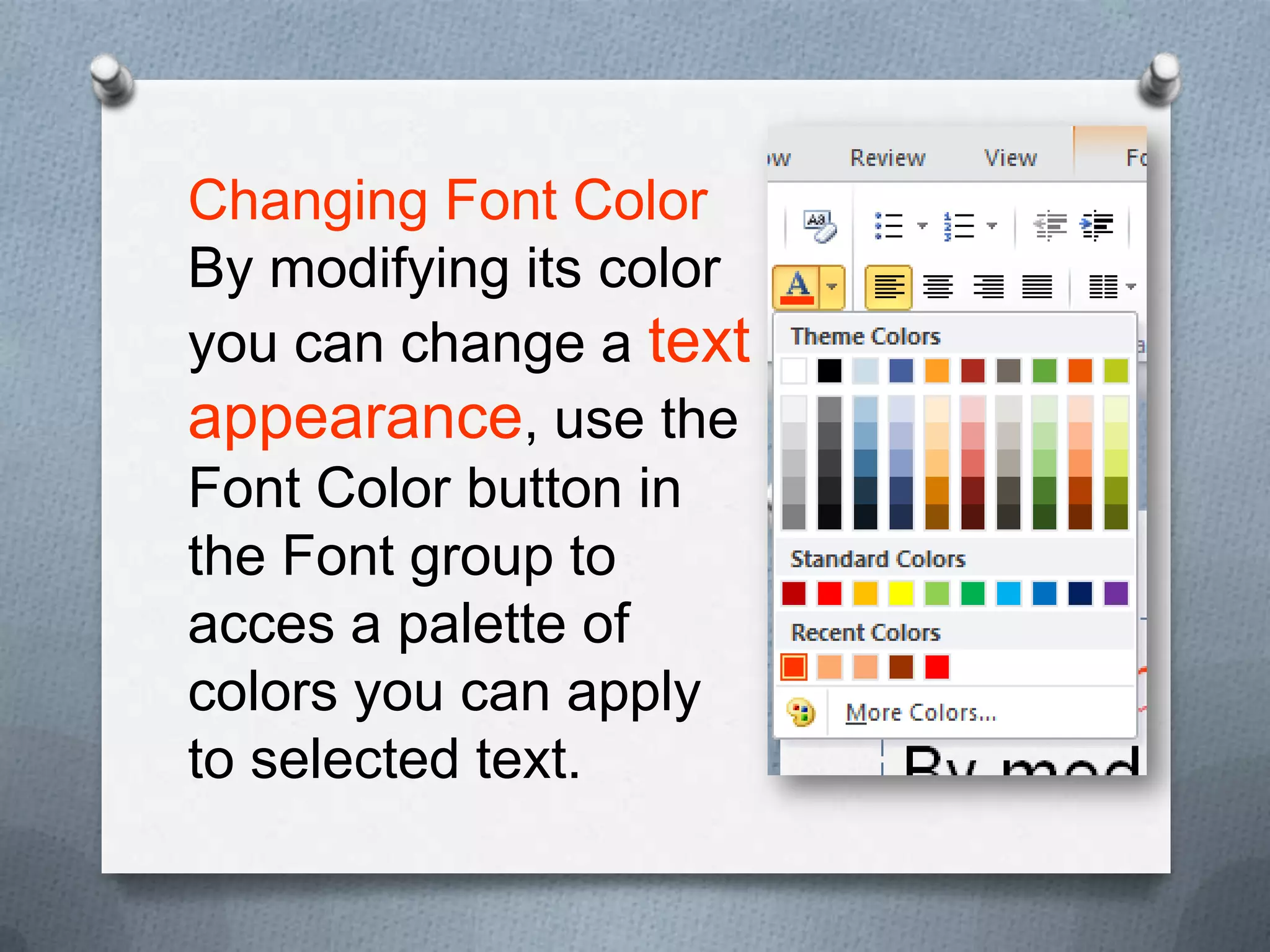
Changing Font Color
By modifying its color
you can change a text
appearance, use the
Font Color button in
the Font group to
acces a palette of
colors you can apply
to selected text.
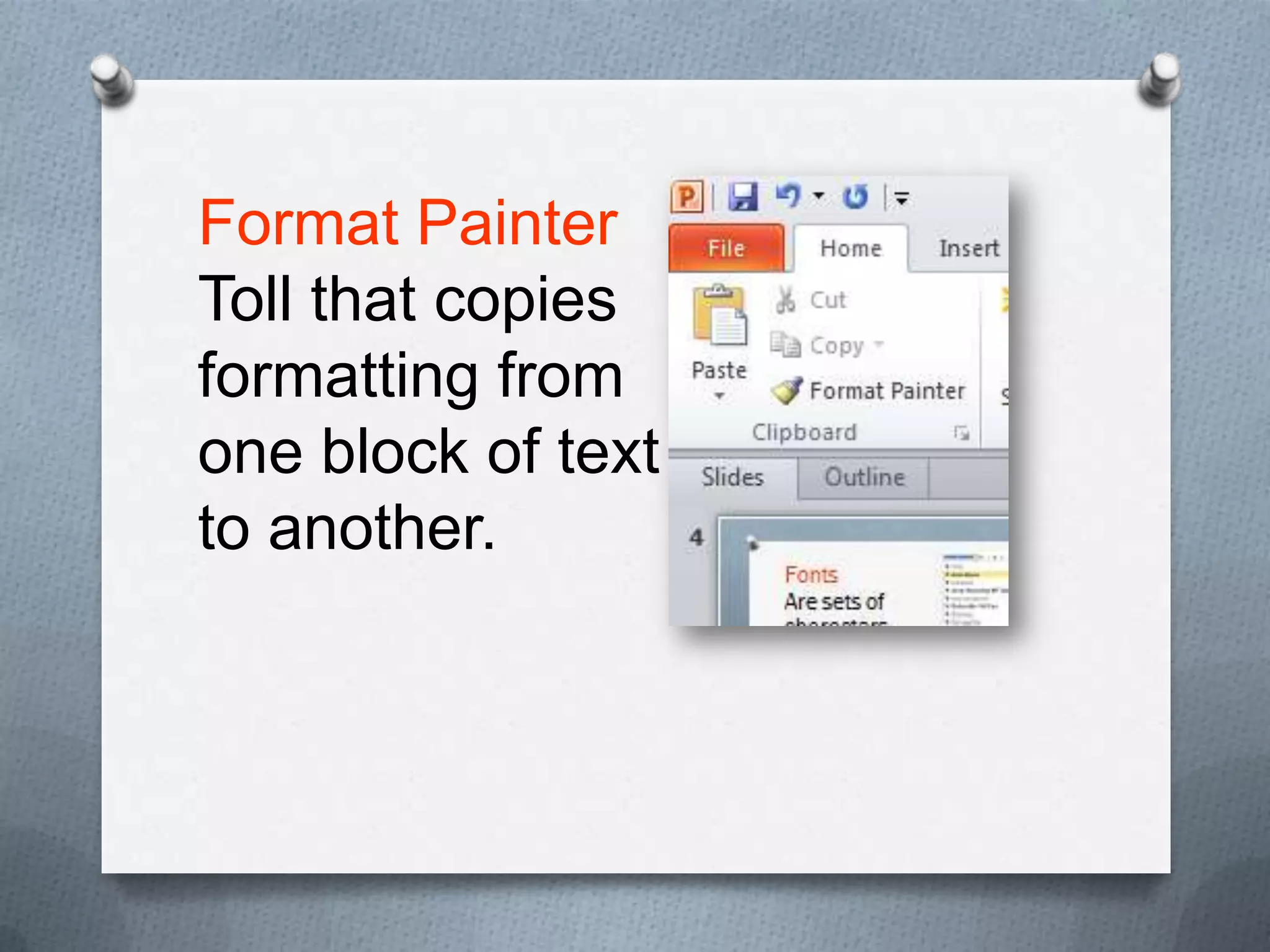
Format Painter
Toll that copies
formatting from
one block of text
to another.
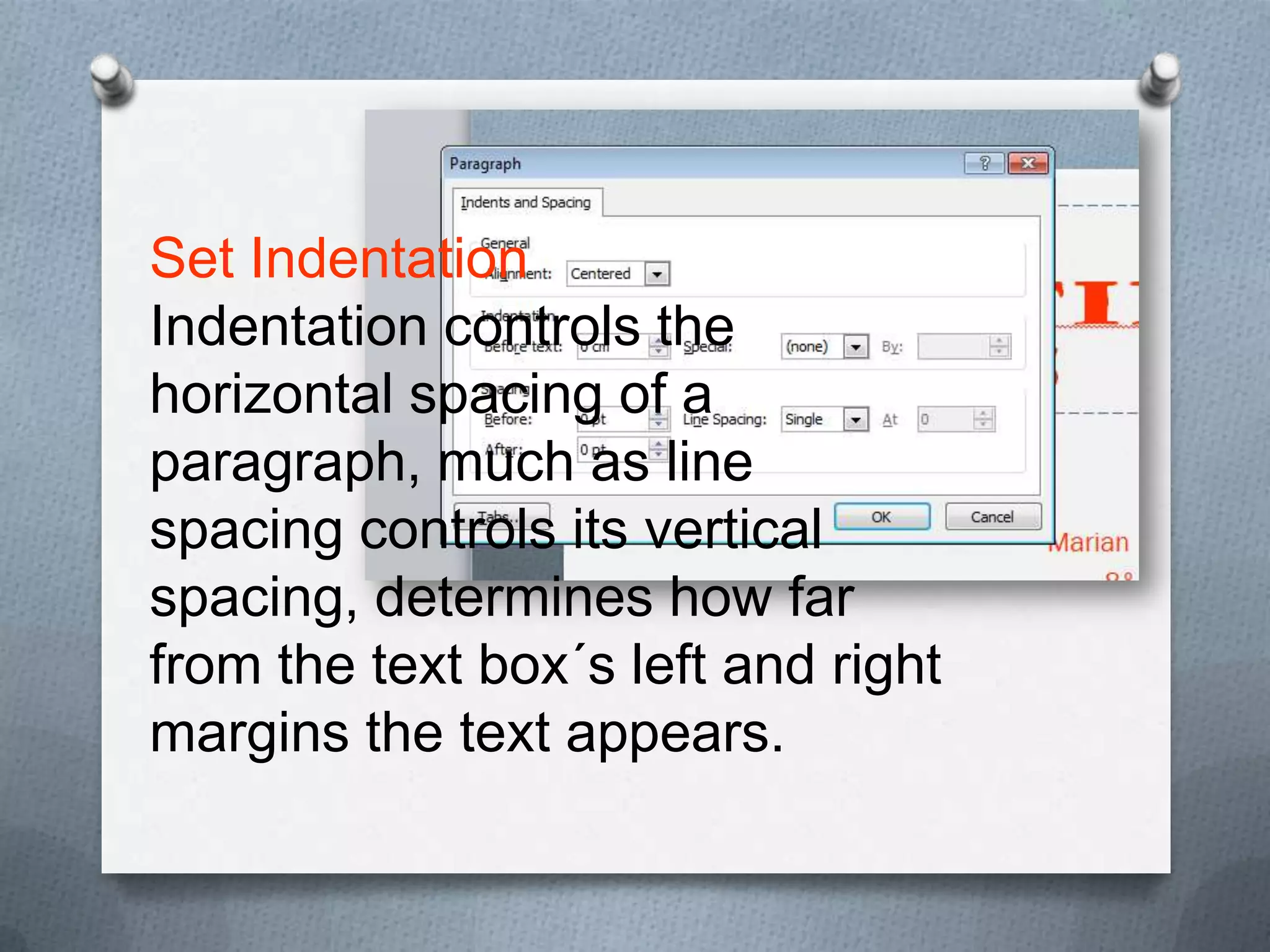
Set Indentation
Indentation controls the
horizontal spacing of a
paragraph, much as line
spacing controls its vertical
spacing, determines how far
from the text box´s left and right
margins the text appears.
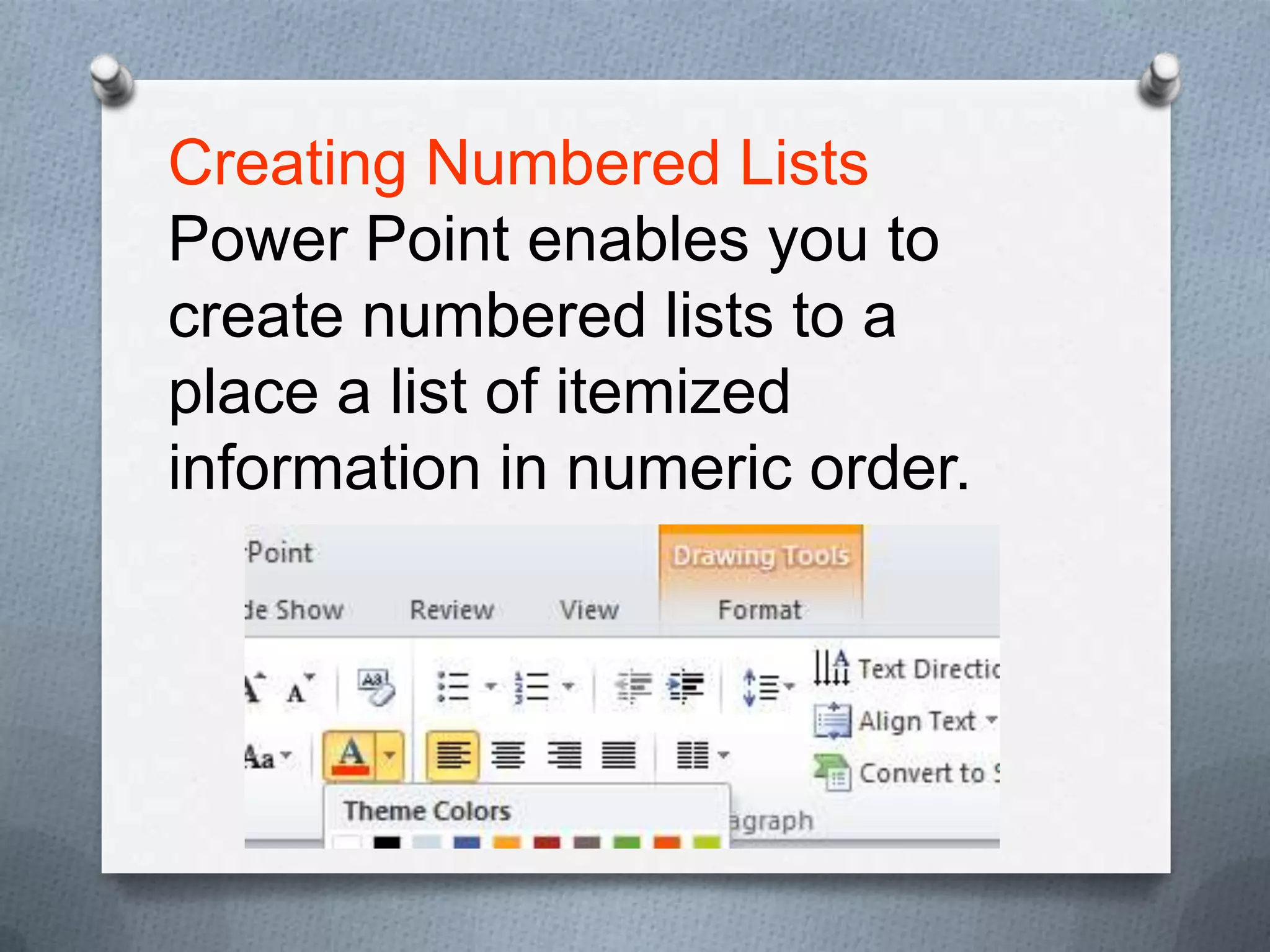
Creating Numbered Lists
Power Point enables you to
create numbered lists to a
place a list of itemized
information in numeric order.
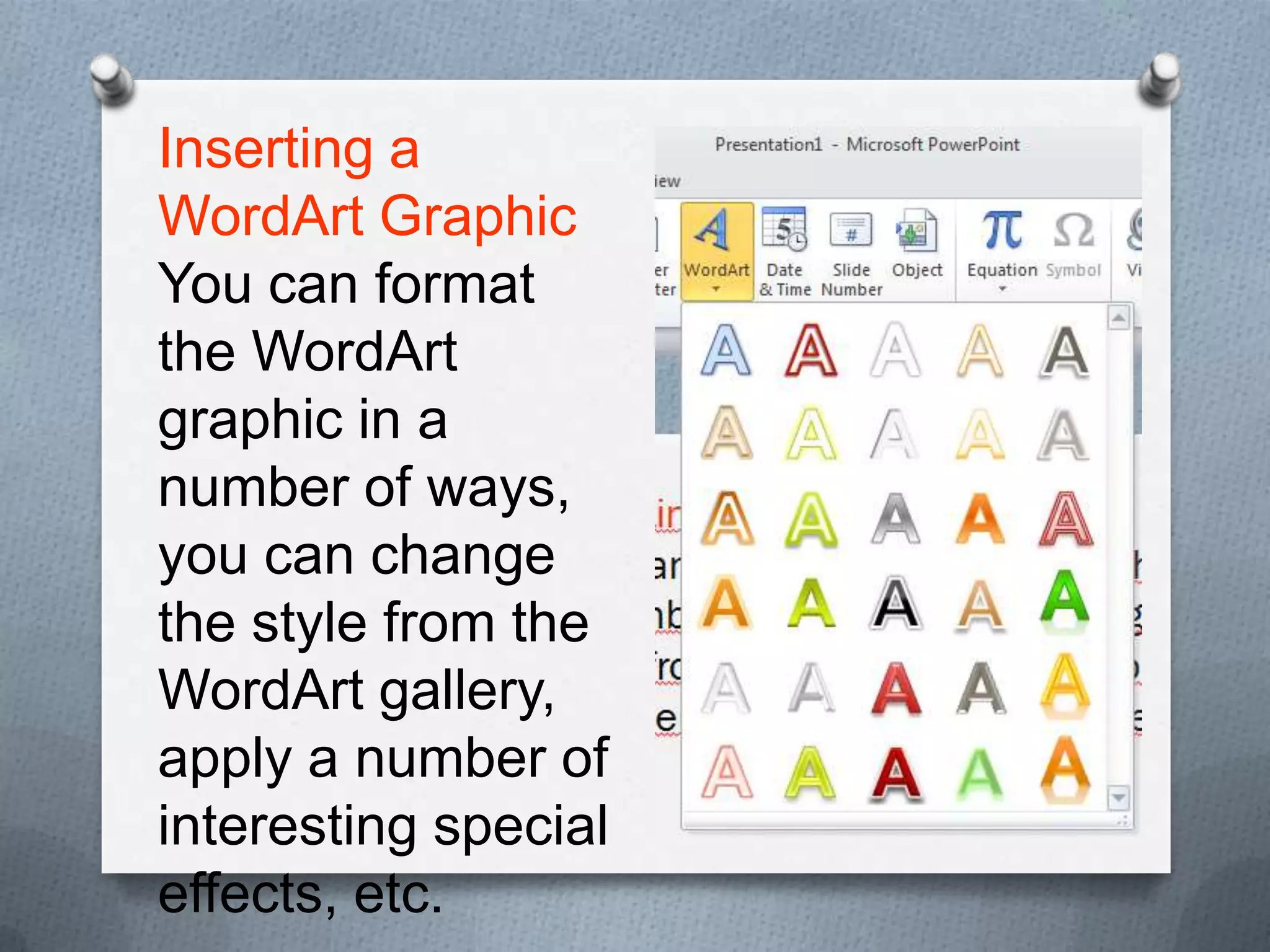
Inserting a
WordArt Graphic
You can format
the WordArt
graphic in a
number of ways,
you can change
the style from the
WordArt gallery,
apply a number of
interesting special
effects, etc.
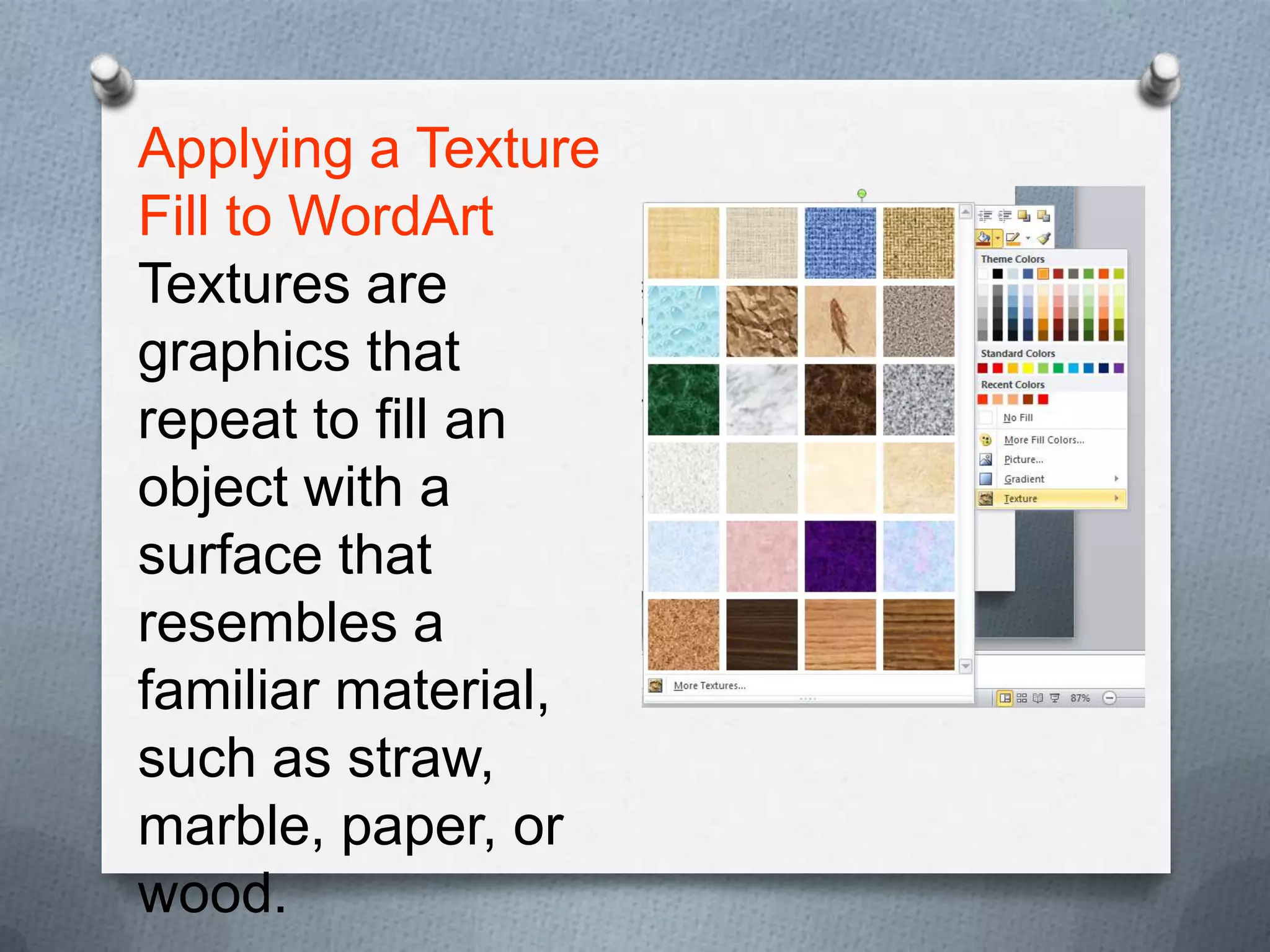
Applying a Texture
Fill to WordArt
Textures are
graphics that
repeat to fill an
object with a
surface that
resembles a
familiar material,
such as straw,
marble, paper, or
wood.
Changing the WordArt Outline
Color
You can fine-tune the outline
color of the object, also allows
you to remove the outline,
change its weight, or apply a
dash style to the outline.
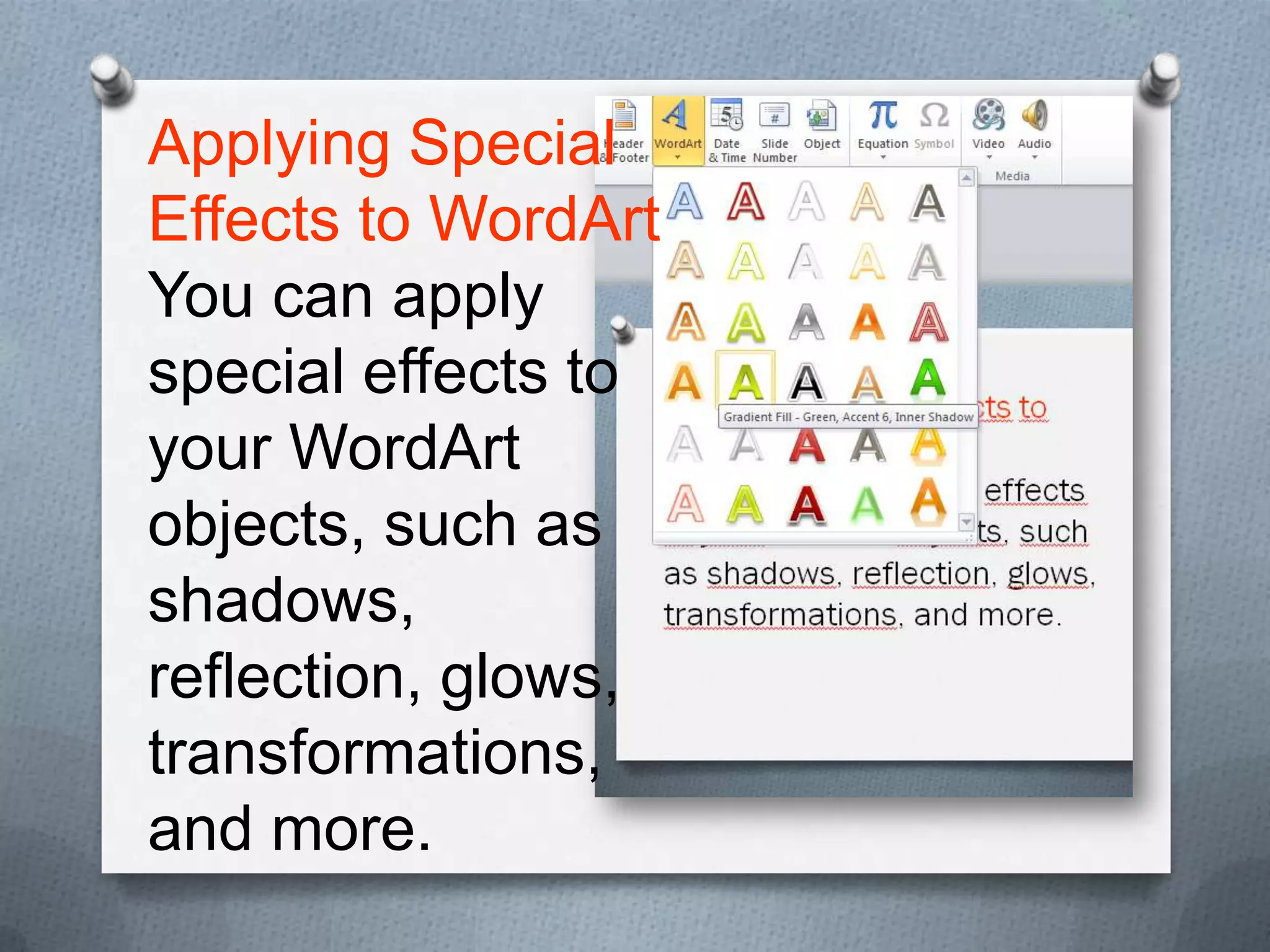
Applying Special
Effects to WordArt
You can apply
special effects to
your WordArt
objects, such as
shadows,
reflection, glows,
transformations,
and more.
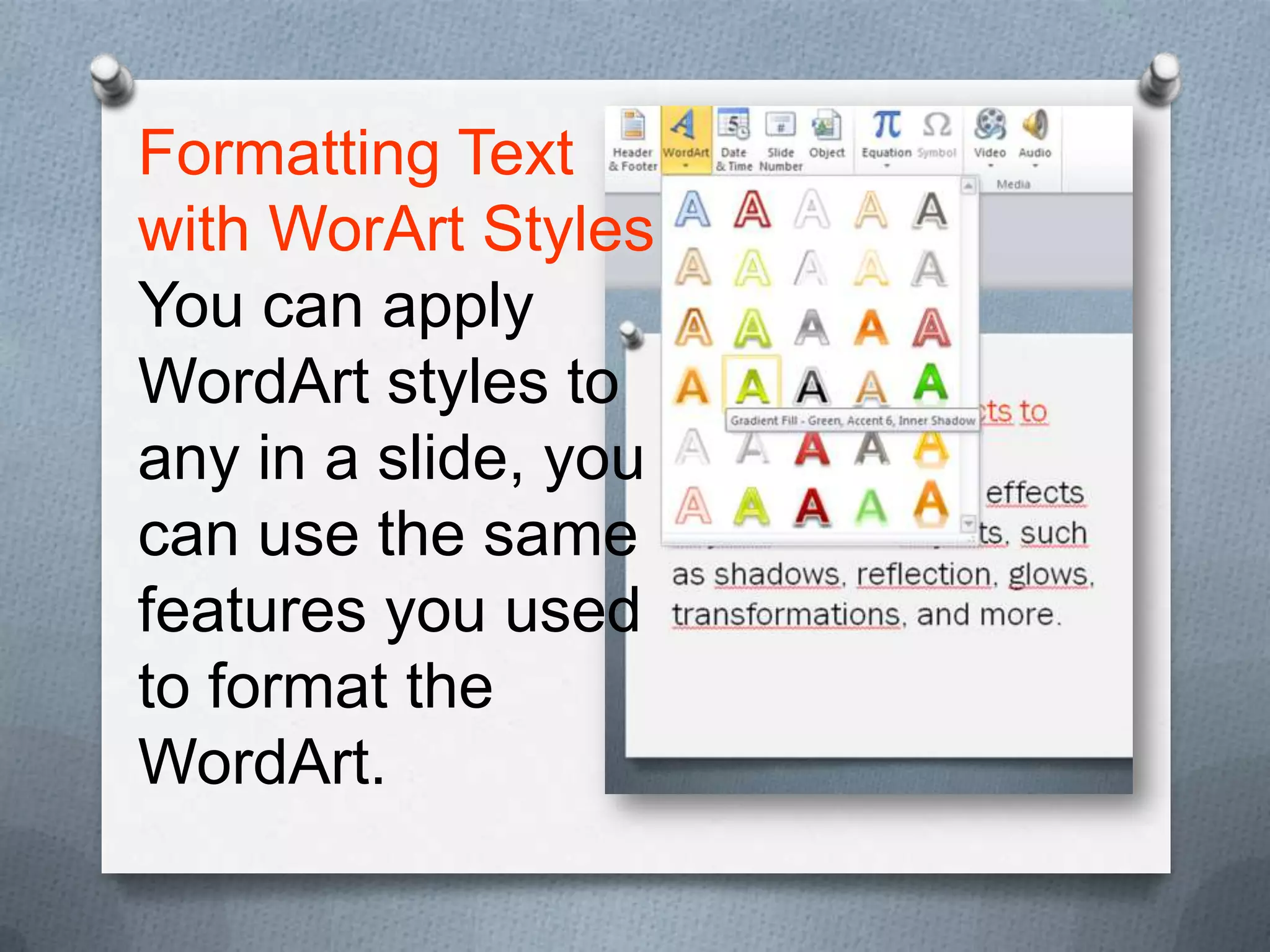
Formatting Text
with WorArt Styles
You can apply
WordArt styles to
any in a slide, you
can use the same
features you used
to format the
WordArt.
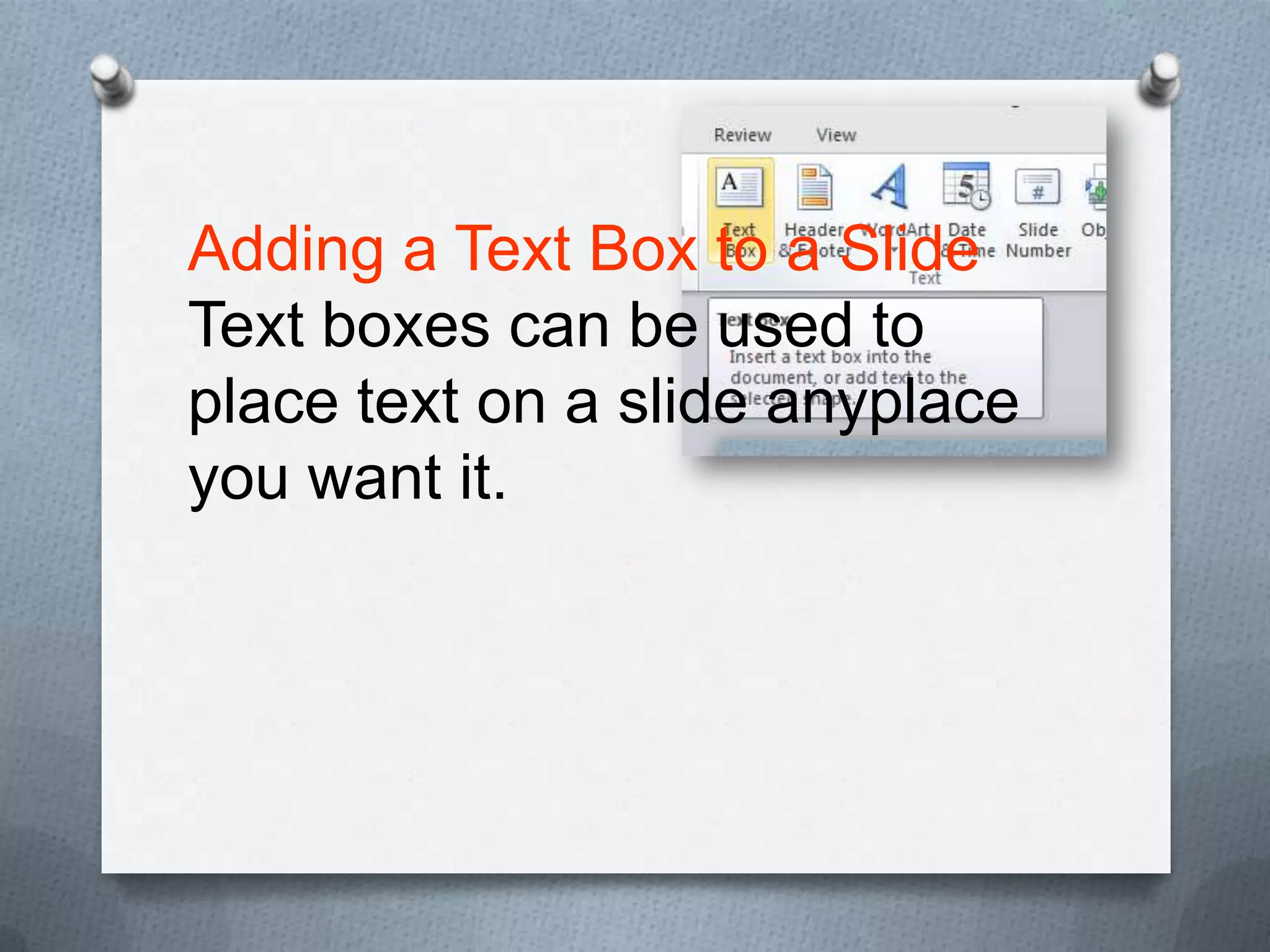
Adding a Text Box to a Slide
Text boxes can be used to
place text on a slide anyplace
you want it.
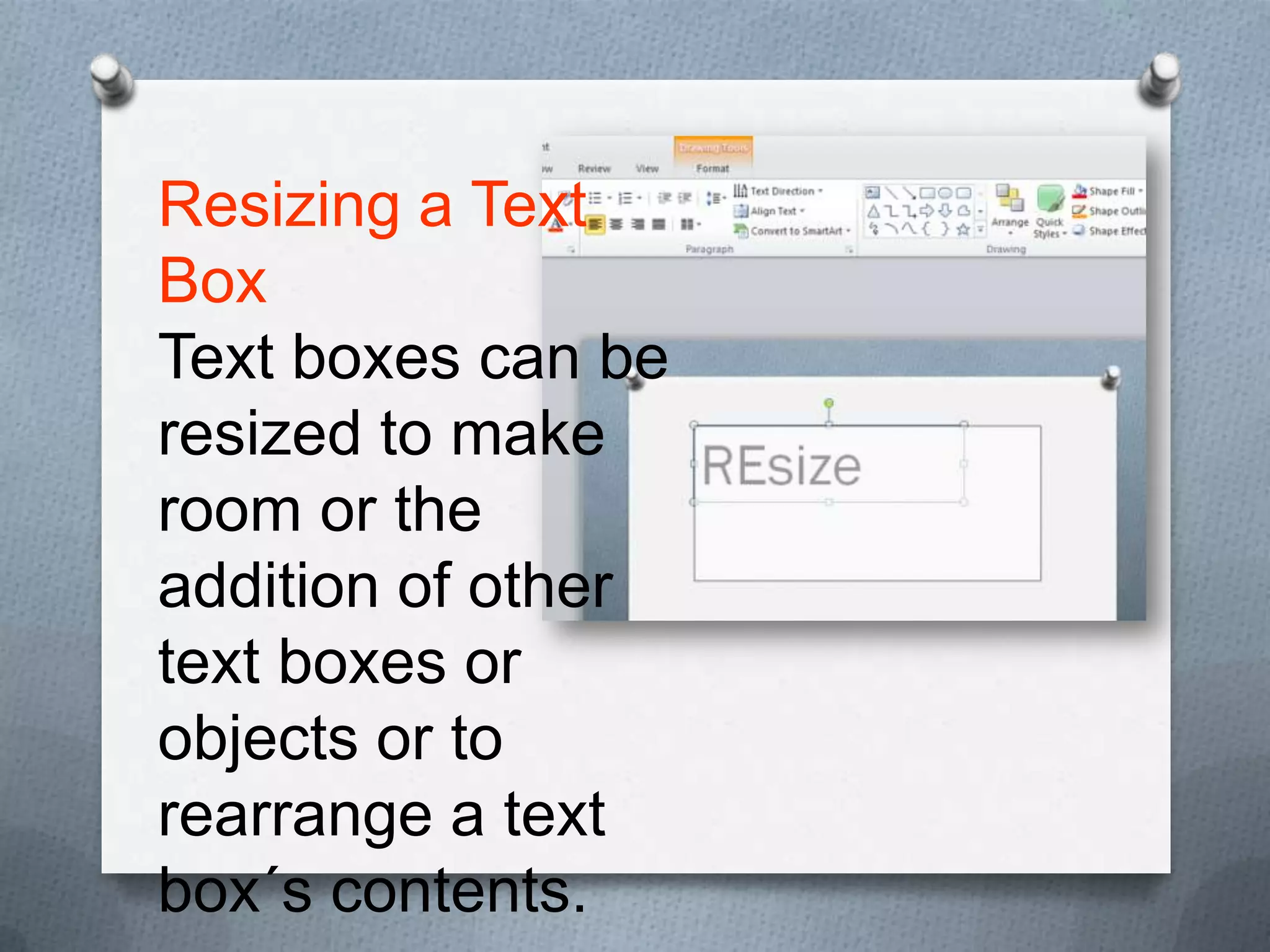
Resizing a Text
Box
Text boxes can be
resized to make
room or the
addition of other
text boxes or
objects or to
rearrange a text
box´s contents.
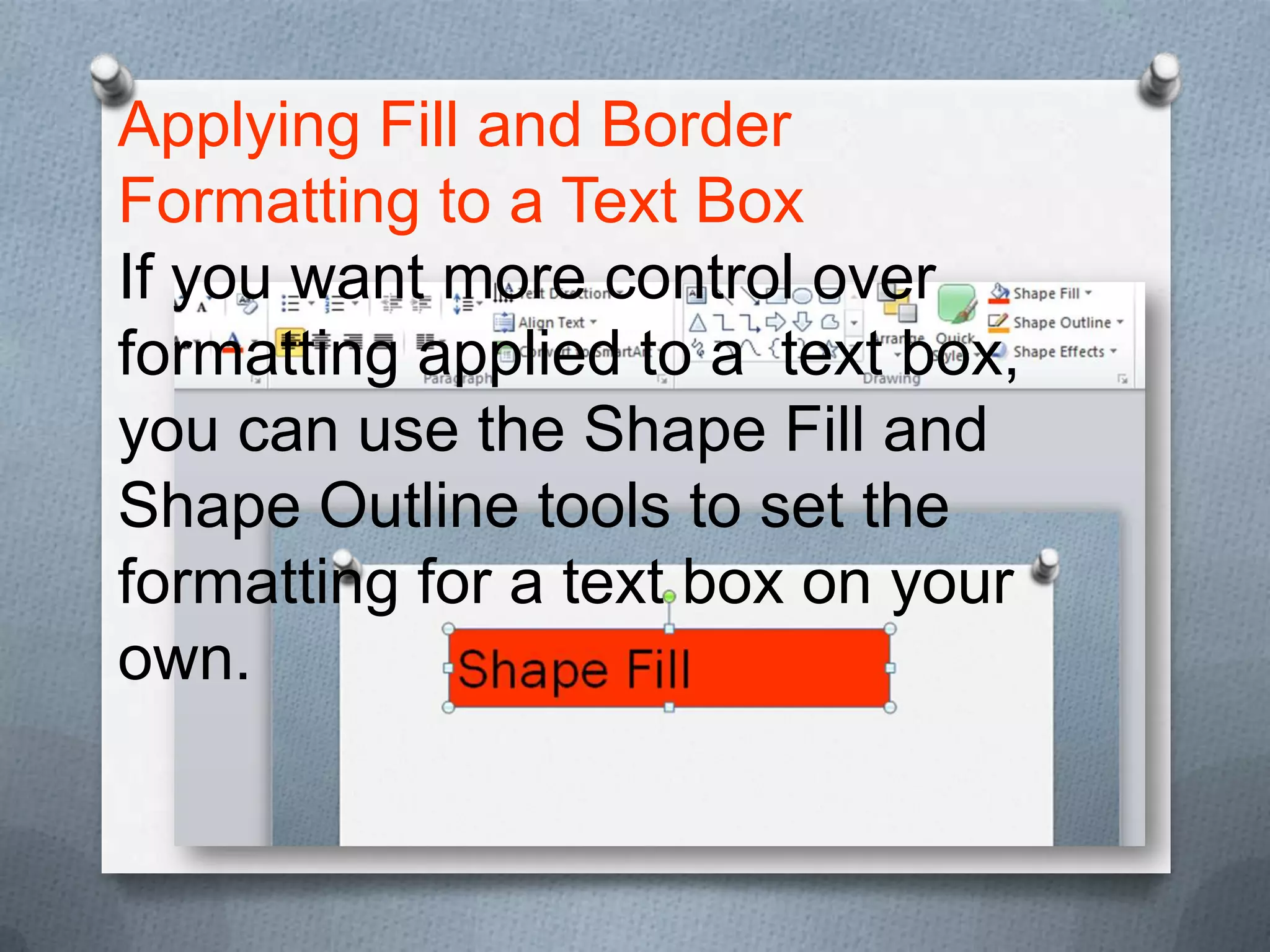
Applying Fill and Border
Formatting to a Text Box
If you want more control over
formatting applied to a text box,
you can use the Shape Fill and
Shape Outline tools to set the
formatting for a text box on your
own.
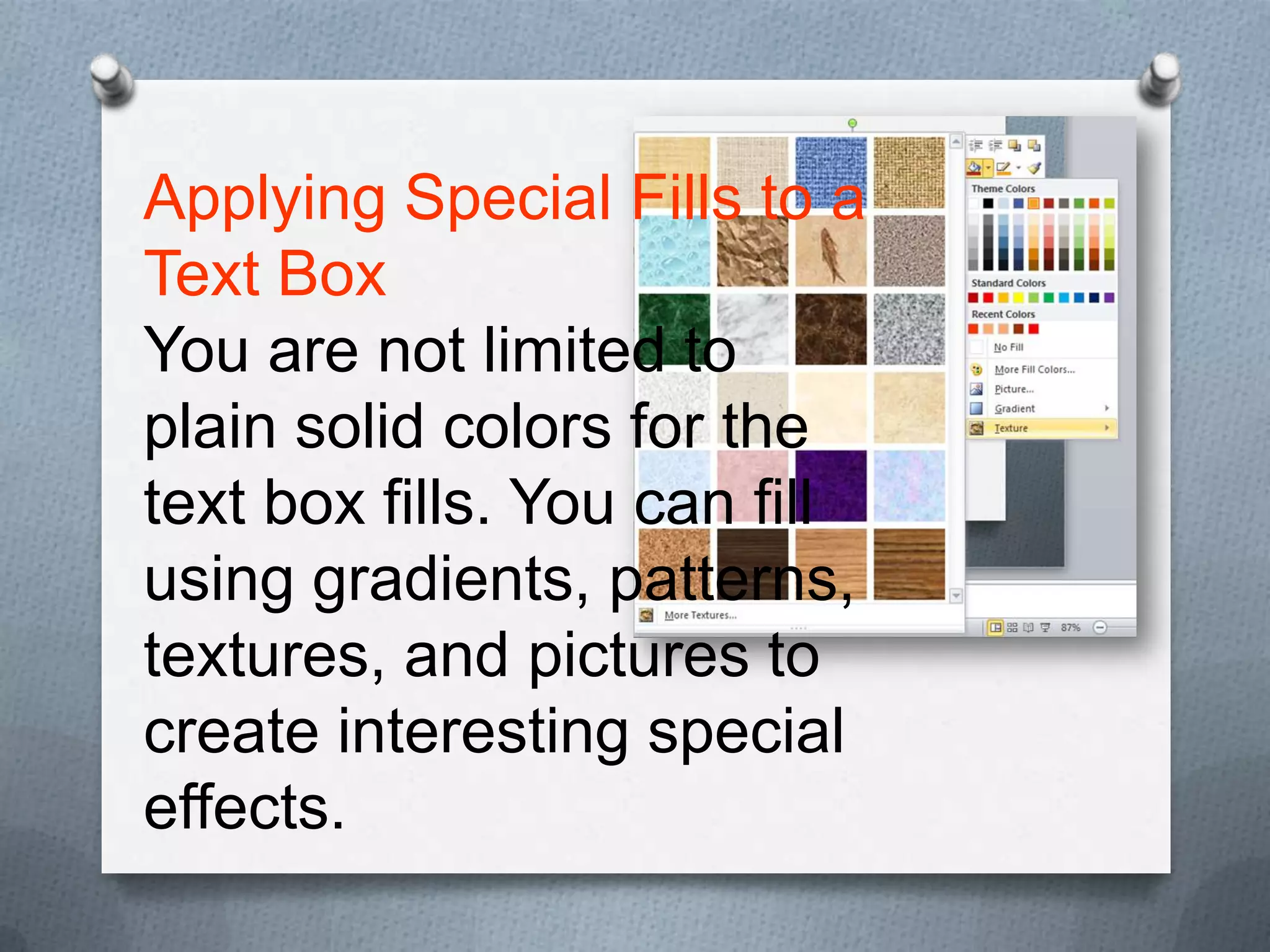
Applying Special Fills to a
Text Box
You are not limited to
plain solid colors for the
text box fills. You can fill
using gradients, patterns,
textures, and pictures to
create interesting special
effects.
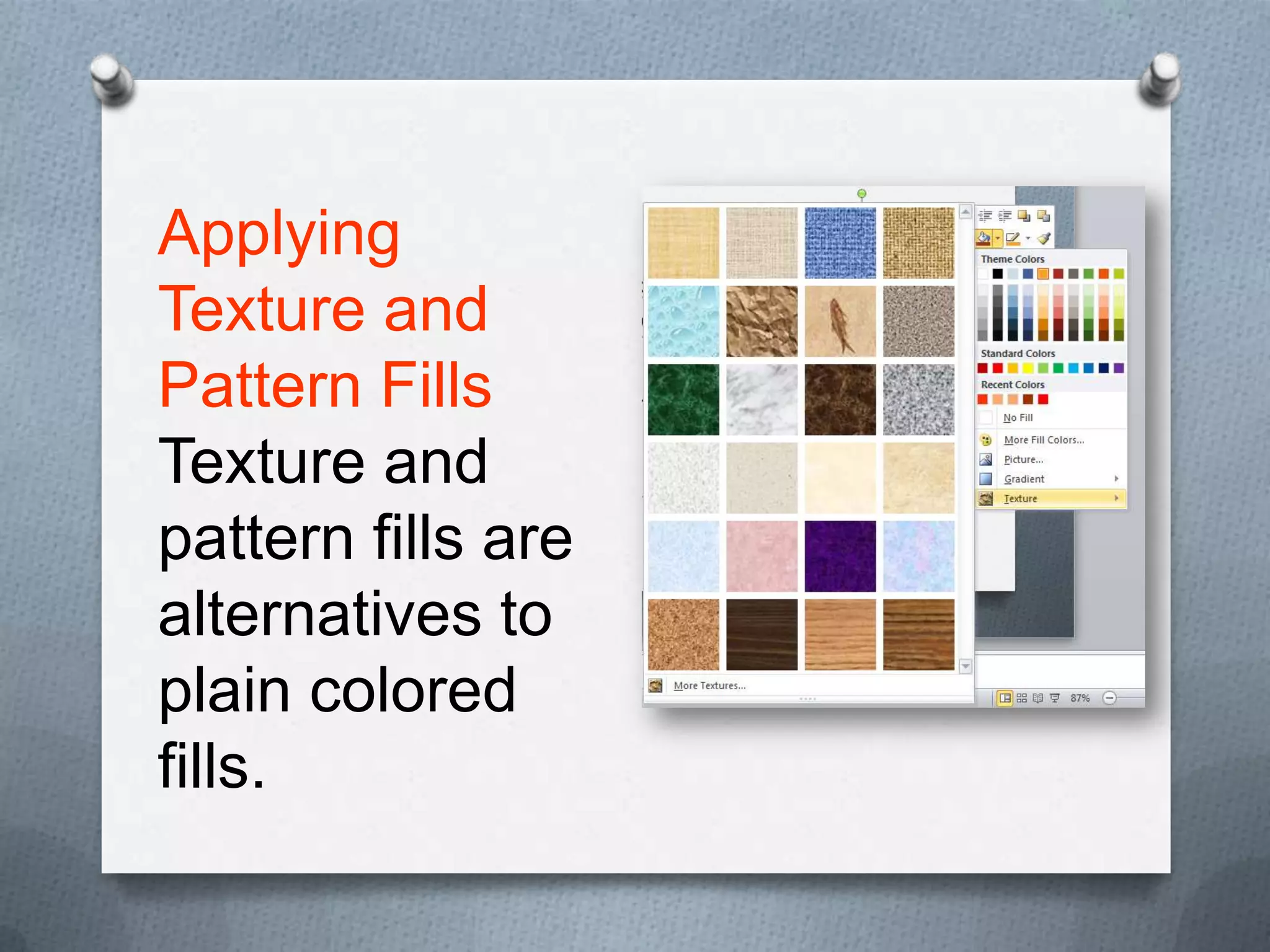
Applying
Texture and
Pattern Fills
Texture and
pattern fills are
alternatives to
plain colored
fills.
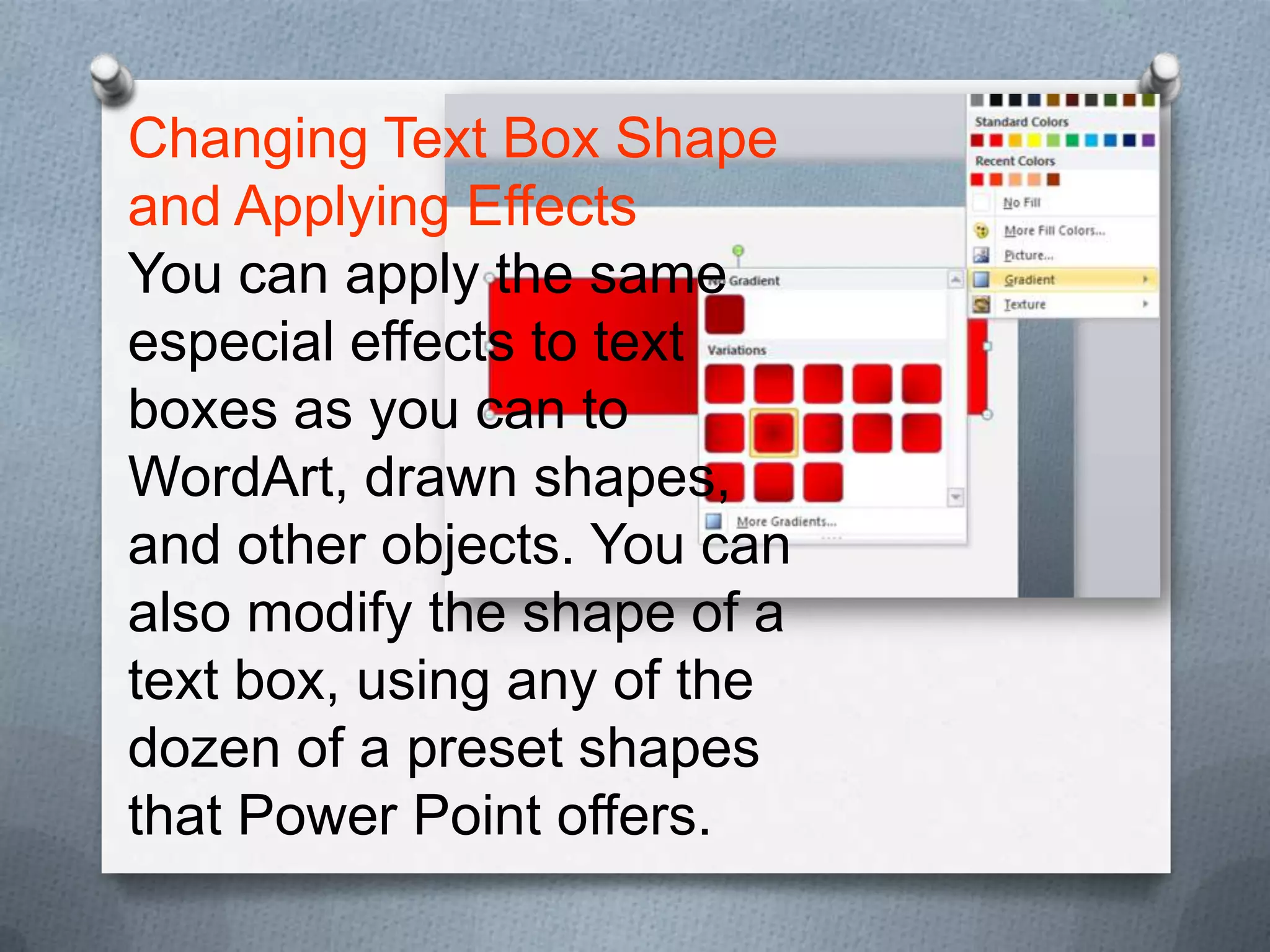
Changing Text Box Shape
and Applying Effects
You can apply the same
especial effects to text
boxes as you can to
WordArt, drawn shapes,
and other objects. You can
also modify the shape of a
text box, using any of the
dozen of a preset shapes
that Power Point offers.
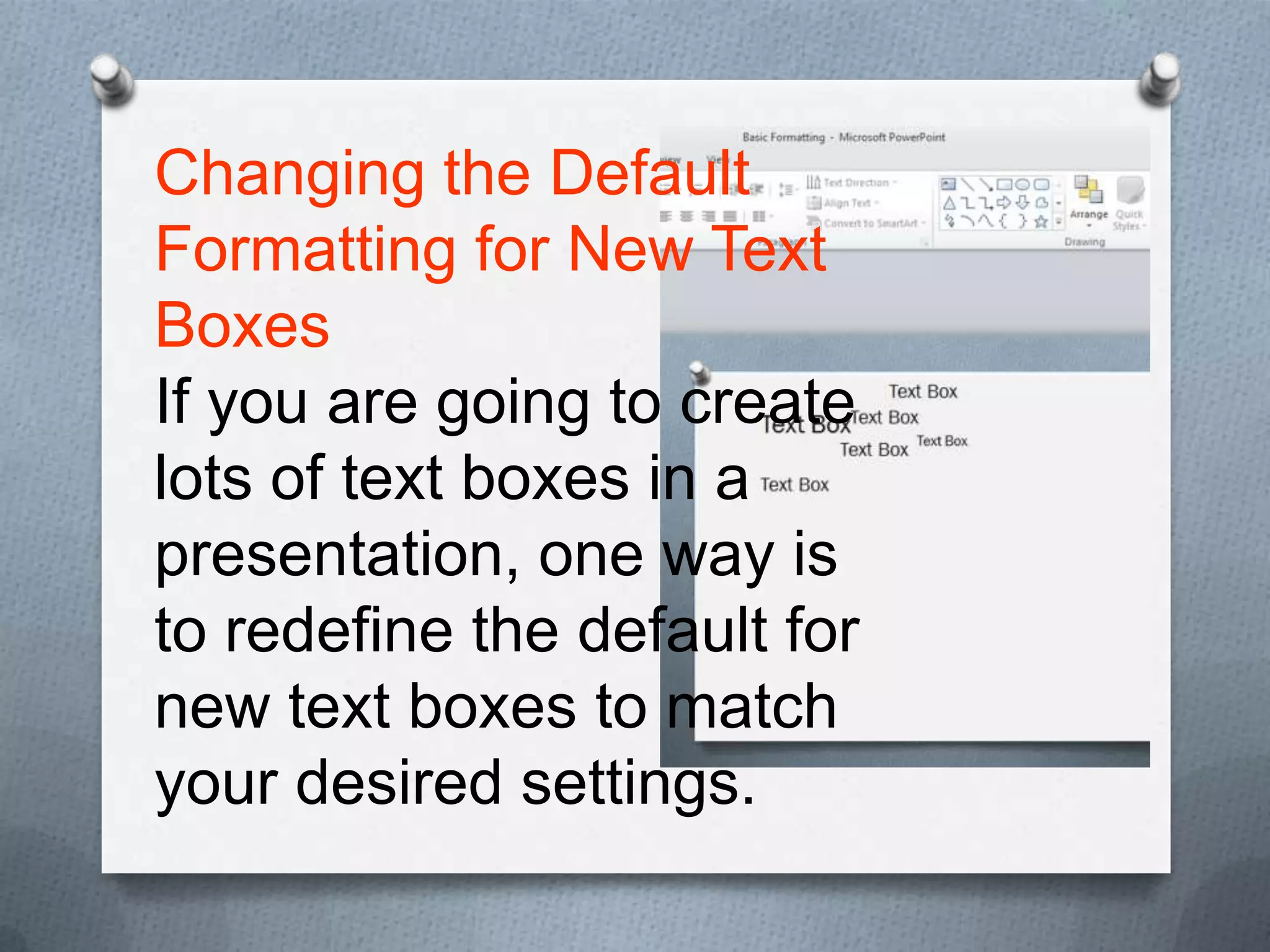
Changing the Default
Formatting for New Text
Boxes
If you are going to create
lots of text boxes in a
presentation, one way is
to redefine the default for
new text boxes to match
your desired settings.
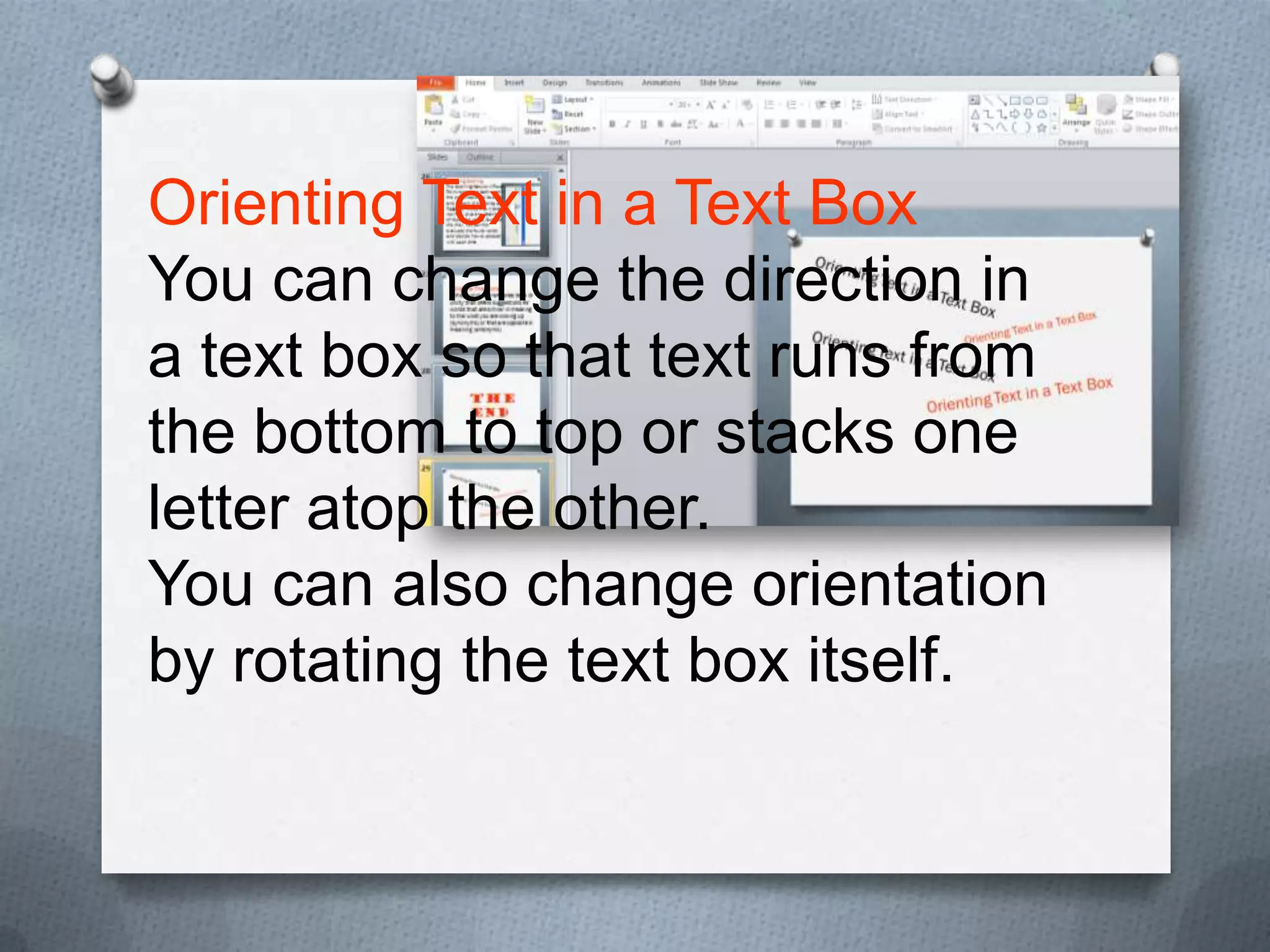
Orienting Text in a Text Box
You can change the direction in
a text box so that text runs from
the bottom to top or stacks one
letter atop the other.
You can also change orientation
by rotating the text box itself.
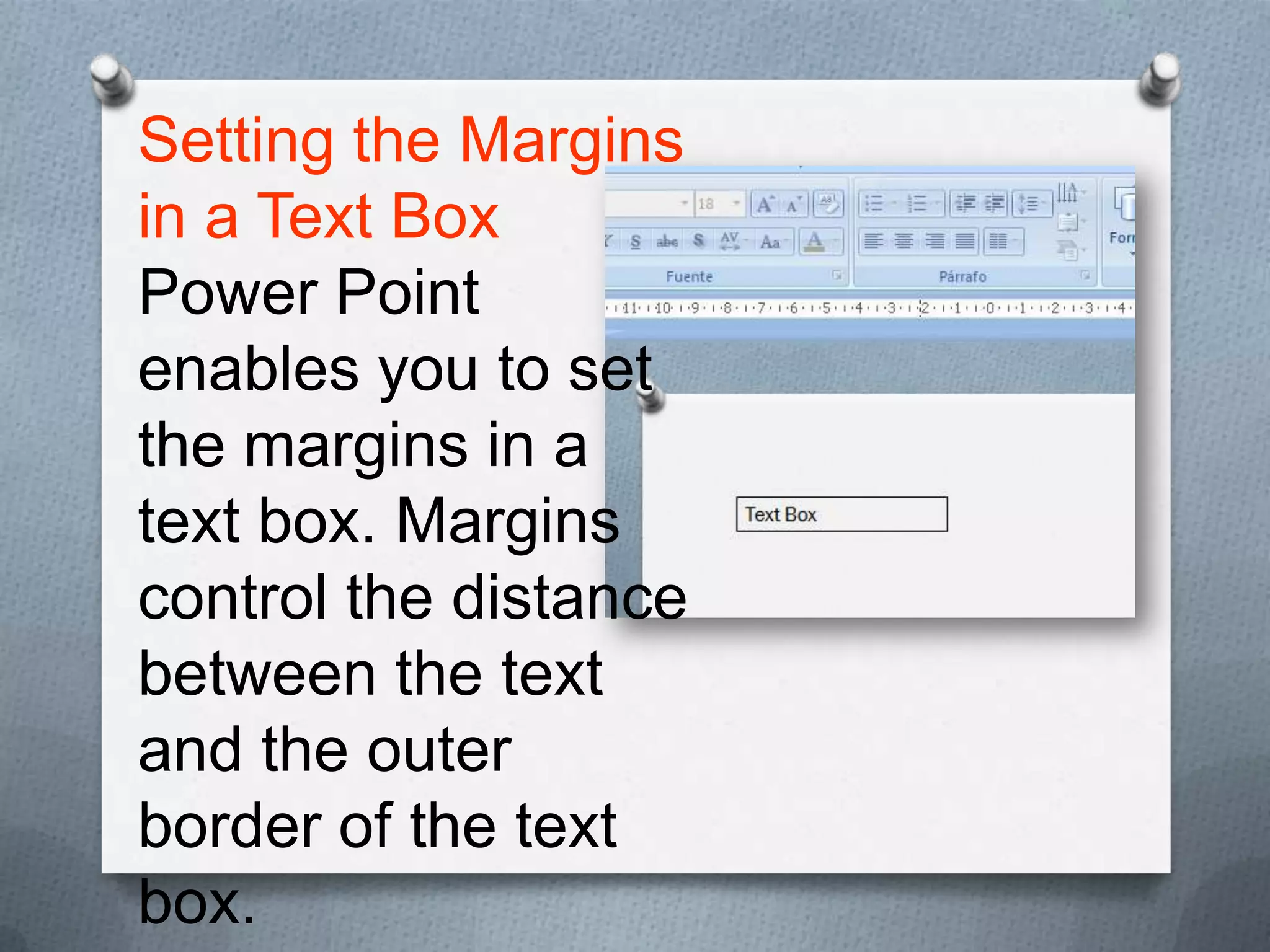
Setting the Margins
in a Text Box
Power Point
enables you to set
the margins in a
text box. Margins
control the distance
between the text
and the outer
border of the text
box.
Changing the Text Wrap Setting
for a Text Box
Depending on the type of text
box and the way it was created,
it may or ,may not be set to
wrap the text automatically to
the next line when the right
margin is reached.
Aligning Text Boxes on a Slide
In addition to aligning the text
within a text box, you can
align the text box itself with
other objects on the slide,
including other text boxes.
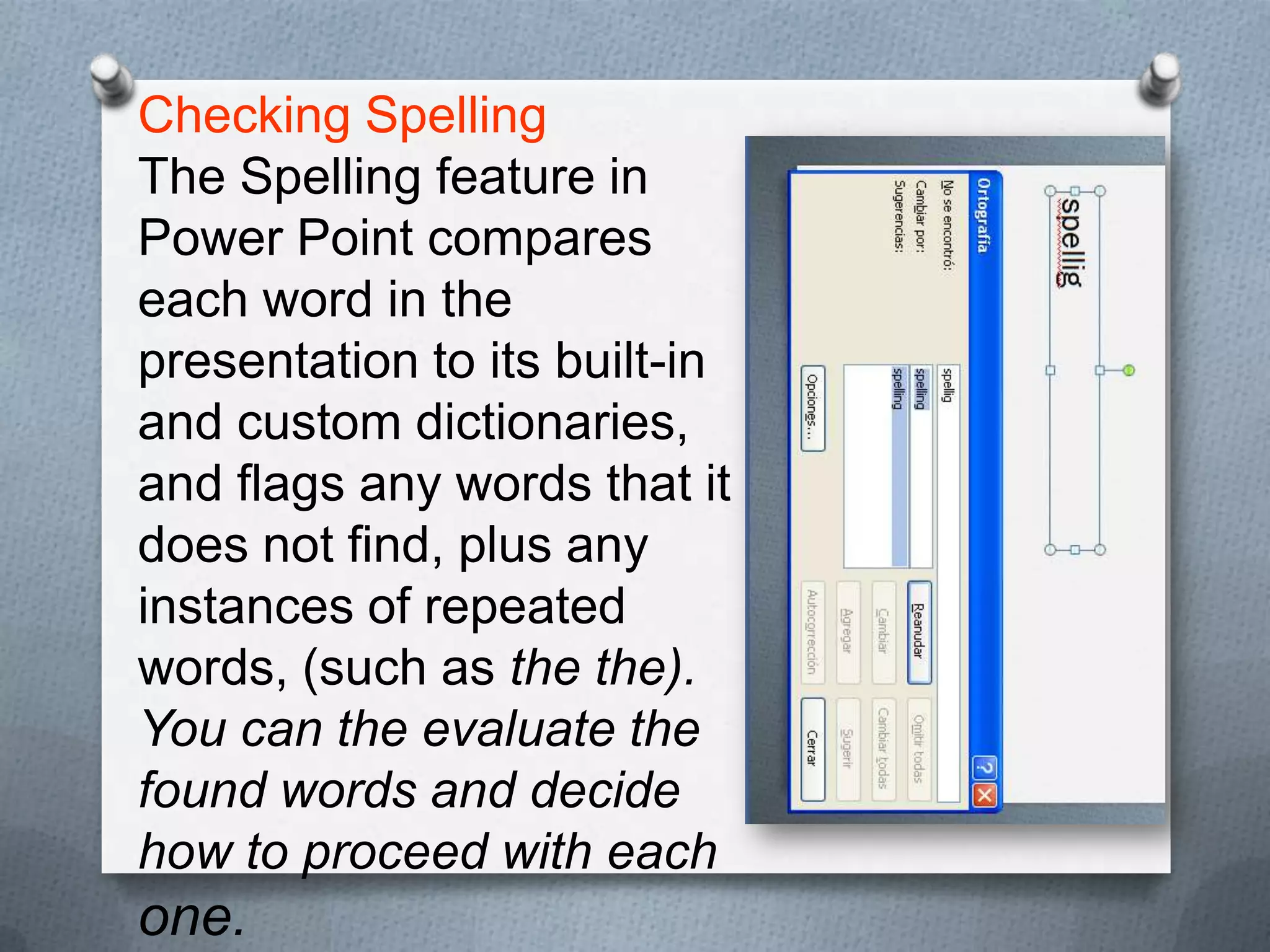
Checking Spelling
The Spelling feature in
Power Point compares
each word in the
presentation to its built-in
and custom dictionaries,
and flags any words that it
does not find, plus any
instances of repeated
words, (such as the the).
You can the evaluate the
found words and decide
how to proceed with each
one.
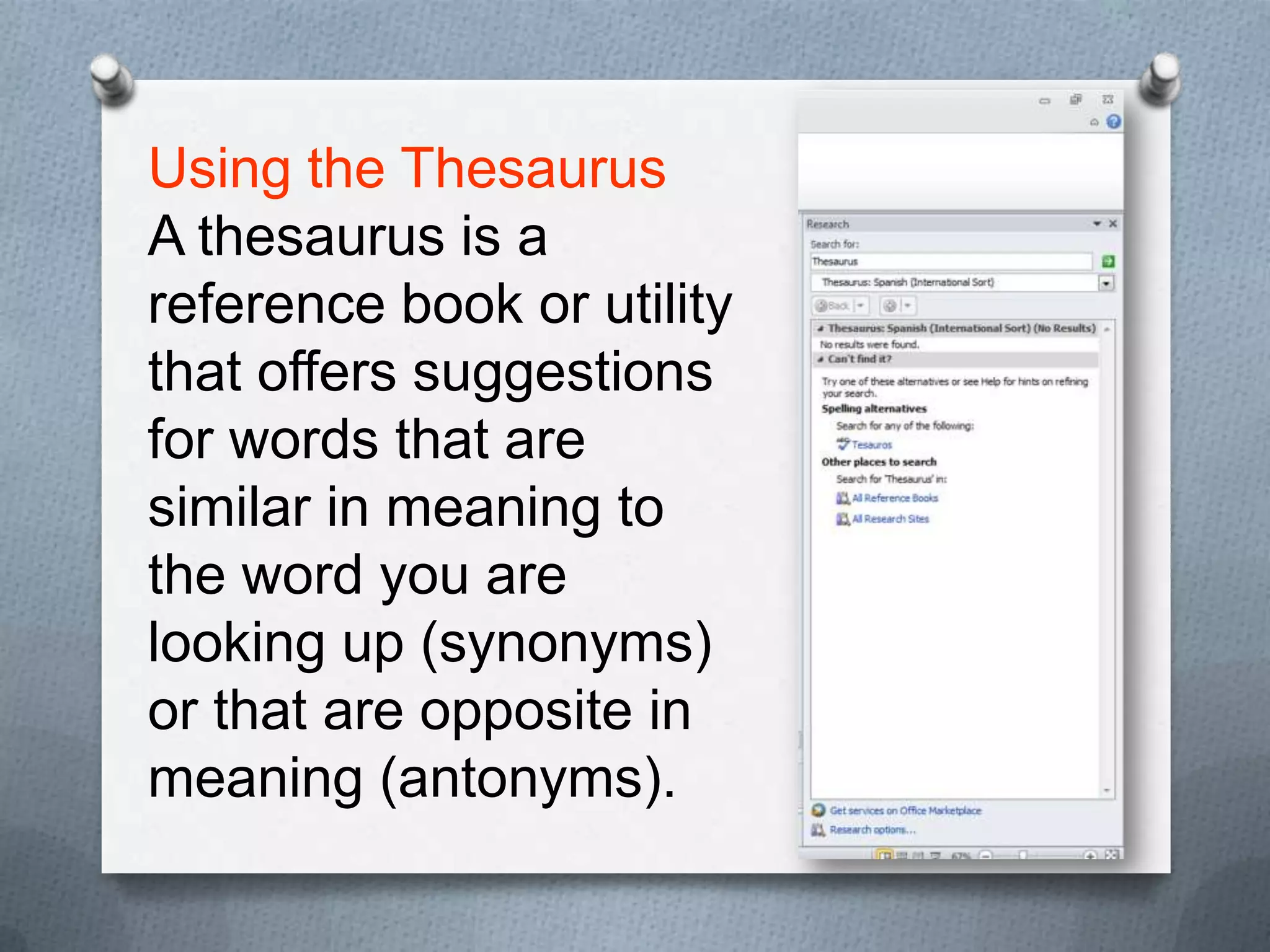
Using the Thesaurus
A thesaurus is a
reference book or utility
that offers suggestions
for words that are
similar in meaning to
the word you are
looking up (synonyms)
or that are opposite in
meaning (antonyms).
Basic formatting

Basic formatting

  • 1.
  • 2.
    microsoft powerpoint´s basictext formatting tools
  • 3.
    There are twogroups of text formatting tools on the Ribbon: the Font group and the Paragraph group.
  • 4.
    Fonts Are sets of characters, numbers,and symbols in a specific style or design.
  • 5.
    Applying Fonts Stylesand Effects Text can be boldfaced or italicized ,called font styles, underlined, OR Formatted with other attributes such as strikethrough or shadow called effects.
  • 6.
    Changing Font Color Bymodifying its color you can change a text appearance, use the Font Color button in the Font group to acces a palette of colors you can apply to selected text.
  • 7.
    Format Painter Toll thatcopies formatting from one block of text to another.
  • 8.
    Set Indentation Indentation controlsthe horizontal spacing of a paragraph, much as line spacing controls its vertical spacing, determines how far from the text box´s left and right margins the text appears.
  • 9.
    Creating Numbered Lists PowerPoint enables you to create numbered lists to a place a list of itemized information in numeric order.
  • 10.
    Inserting a WordArt Graphic Youcan format the WordArt graphic in a number of ways, you can change the style from the WordArt gallery, apply a number of interesting special effects, etc.
  • 11.
    Applying a Texture Fillto WordArt Textures are graphics that repeat to fill an object with a surface that resembles a familiar material, such as straw, marble, paper, or wood.
  • 12.
    Changing the WordArtOutline Color You can fine-tune the outline color of the object, also allows you to remove the outline, change its weight, or apply a dash style to the outline.
  • 13.
    Applying Special Effects toWordArt You can apply special effects to your WordArt objects, such as shadows, reflection, glows, transformations, and more.
  • 14.
    Formatting Text with WorArtStyles You can apply WordArt styles to any in a slide, you can use the same features you used to format the WordArt.
  • 15.
    Adding a TextBox to a Slide Text boxes can be used to place text on a slide anyplace you want it.
  • 16.
    Resizing a Text Box Textboxes can be resized to make room or the addition of other text boxes or objects or to rearrange a text box´s contents.
  • 17.
    Applying Fill andBorder Formatting to a Text Box If you want more control over formatting applied to a text box, you can use the Shape Fill and Shape Outline tools to set the formatting for a text box on your own.
  • 18.
    Applying Special Fillsto a Text Box You are not limited to plain solid colors for the text box fills. You can fill using gradients, patterns, textures, and pictures to create interesting special effects.
  • 19.
    Applying Texture and Pattern Fills Textureand pattern fills are alternatives to plain colored fills.
  • 20.
    Changing Text BoxShape and Applying Effects You can apply the same especial effects to text boxes as you can to WordArt, drawn shapes, and other objects. You can also modify the shape of a text box, using any of the dozen of a preset shapes that Power Point offers.
  • 21.
    Changing the Default Formattingfor New Text Boxes If you are going to create lots of text boxes in a presentation, one way is to redefine the default for new text boxes to match your desired settings.
  • 22.
    Orienting Text ina Text Box You can change the direction in a text box so that text runs from the bottom to top or stacks one letter atop the other. You can also change orientation by rotating the text box itself.
  • 23.
    Setting the Margins ina Text Box Power Point enables you to set the margins in a text box. Margins control the distance between the text and the outer border of the text box.
  • 24.
    Changing the TextWrap Setting for a Text Box Depending on the type of text box and the way it was created, it may or ,may not be set to wrap the text automatically to the next line when the right margin is reached.
  • 25.
    Aligning Text Boxeson a Slide In addition to aligning the text within a text box, you can align the text box itself with other objects on the slide, including other text boxes.
  • 26.
    Checking Spelling The Spellingfeature in Power Point compares each word in the presentation to its built-in and custom dictionaries, and flags any words that it does not find, plus any instances of repeated words, (such as the the). You can the evaluate the found words and decide how to proceed with each one.
  • 27.
    Using the Thesaurus Athesaurus is a reference book or utility that offers suggestions for words that are similar in meaning to the word you are looking up (synonyms) or that are opposite in meaning (antonyms).