UNIT- V
MEASUREMENT AND INSTRUMENTAION
Ms. M. BHARATHI
ASSISTANT PROFSSOR
DEPARTMENT OF ECE
12-06-2024 JIT/I YR/02 SEM/BE3251/BEEE 1
OUTLINE
Functional elements of an instrument, standards and caliberation, operating
principle, types-moving coil and moving iron meters, measurement of three
phase power, energy meter, instrument tranformers-CT and PT, DSO Block
diagram Data acquisition.
JIT/I YR/02 SEM/BE3251/BEEE 2
12-06-2024
Functional elements of an instrument
JIT/I YR/02 SEM/BE3251/BEEE 3
12-06-2024
Most of the measurement systems contain three main functional elements. They are: i) Primary sensing
element ii) Variable conversion element & iii) Data presentation element.
JIT/I YR/02 SEM/BE3251/BEEE
4
12-06-2024
JIT/I YR/02 SEM/BE3251/BEEE
5
12-06-2024
Most of the measurement systems contain three main functional elements. They are:
i) Primary sensing element
ii) Variable conversion element &
iii) Data presentation element.
Primary sensing element:
• The quantity under measurement makes its first contact with the
primary sensing element of a measurement system. i.e., the measurand-
(the unknown quantity which is to be measured) is first detected by
primary sensor which gives the output in a different analogous form
This output is then converted into an e electrical signal by a transducer
- (which converts energy from one form to another). The first stage of a
measurement system is known as adetector transducer stage’.
JIT/I YR/02 SEM/BE3251/BEEE
6
12-06-2024
Data presentation element:
• The information about the quantity under measurement has to be conveyed to the personnel
handling the instrument or the system for monitoring, control, or analysis purposes. This
function is done by data presentation element.
• In case data is to be monitored, visual display devices are needed These devices may be
analog or digital indicating instruments like ammeters, voltmeters etc. In case data is to be
recorded, recorders like magnetic tapes, high speed camera & TV equipment, CRT, printers
may be used. For control & analysis is purpose microprocessor or computers may be used.
The final stage in a measurement system is known as terminating stage’
Moving-coil galvanometers are mainly divided into two types.
•Suspended coil galvanometer
•Pivoted-coil or Weston galvanometer
JIT/I YR/02 SEM/BE3251/BEEE
7
12-06-2024
Moving Coil Galvanometer Construction and Diagram
• The moving coil galvanometer is made up of a rectangular coil that has many turns, and it
is usually made of thinly insulated or fine copper wire that is wounded on a metallic frame.
• The coil is free to rotate about a fixed axis. A phosphor-bronze strip that is connected to a
movable torsion head is used to suspend the coil in a uniform radial magnetic field.
• Essential properties of the material used for the suspension of the coil are conductivity and
a low value of the torsional constant. A cylindrical soft iron core is symmetrically
positioned inside the coil to improve the strength of the magnetic field and to make the
field radial.
• The lower part of the coil is attached to a phosphor-bronze spring having a small number of
turns. The other end of the spring is connected to binding screws.
JIT/I YR/02 SEM/BE3251/BEEE
8
12-06-2024
Moving Coil Galvanometer Diagram
JIT/I YR/02 SEM/BE3251/BEEE 9
12-06-2024
Working of Moving Coil Galvanometer
• Let a current I flow through the rectangular coil of n number of turns and a cross-sectional area A.
When this coil is placed in a uniform radial magnetic field B, the coil experiences a torque τ.
• Let us first consider a single turn ABCD of the rectangular coil having a length l and breadth b. This is
suspended in a magnetic field of strength B, such that the plane of the coil is parallel to the magnetic
field. Since the sides AB and DC are parallel to the direction of the magnetic field, they do not
experience any effective force due to the magnetic field.
• The sides AD and BC being perpendicular to the direction of the field, experience an effective force F
given by F = BIl
JIT/I YR/02 SEM/BE3251/BEEE
10
12-06-2024
JIT/I YR/02 SEM/BE3251/BEEE
11
12-06-2024
• We know that torque τ = Force x Perpendicular distance between the forces
• τ = F × b
• Substituting the value of F, we already know,
• Torque τ acting on single-loop ABCD of the coil = BIl × b
• Where lx b is the area A of the coil,
• Hence, the torque acting on n turns of the coil is given by
• τ = nIAB
• The magnetic torque thus produced causes the coil to rotate, and the phosphor bronze strip twists. In turn,
the spring S attached to the coil produces a counter torque or restoring torque kθ, which results in a steady
angular deflection.
• Under an equilibrium condition,
• kθ = nIAB
• Here, k is called the torsional constant of the spring (restoring a couple per unit twist). The deflection or
twist θ is measured as the value indicated on a scale by a pointer which is connected to the suspension
wire.
• θ= ( nAB / k)I
JIT/I YR/02 SEM/BE3251/BEEE 12
12-06-2024
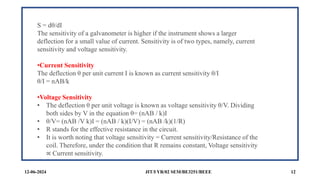
S = dθ/dI
The sensitivity of a galvanometer is higher if the instrument shows a larger
deflection for a small value of current. Sensitivity is of two types, namely, current
sensitivity and voltage sensitivity.
•Current Sensitivity
The deflection θ per unit current I is known as current sensitivity θ/I
θ/I = nAB/k
•Voltage Sensitivity
• The deflection θ per unit voltage is known as voltage sensitivity θ/V. Dividing
both sides by V in the equation θ= (nAB / k)I
• θ/V= (nAB /V k)I = (nAB / k)(I/V) = (nAB /k)(1/R)
• R stands for the effective resistance in the circuit.
• It is worth noting that voltage sensitivity = Current sensitivity/Resistance of the
coil. Therefore, under the condition that R remains constant, Voltage sensitivity
∝ Current sensitivity.
JIT/I YR/02 SEM/BE3251/BEEE
13
12-06-2024
Moving iron meters
• Attraction Type Moving Iron Instrument
• The attraction type moving iron instrument working principle mainly depends
on magnetic attraction, because it attracts an iron piece once arranged close to
a magnetic field. Here, this magnetic field is generated through an
electromagnet.
JIT/I YR/02 SEM/BE3251/BEEE
14
12-06-2024
• This type of moving iron instrument includes a flat fixed coil with
a slight opening. A moving iron in this instrument is designed with
soft iron that is mounted on a spindle. Here, the coils are wounded
with a no. of turns which depends on the instrument range.
• The pointer in this instrument is mounted on a spindle that
includes a graduated scale used to show the deflection.
JIT/I YR/02 SEM/BE3251/BEEE
15
12-06-2024
• Once coil winding is coupled across the supply to be measured, then a
magnetic field will be set up.
• So, the magnetic field’s intensity is higher within the coil as compared to the
outside intensity thus low reluctance will exist within the coil.
• When the moving iron attempts to occupy the low reluctance position, then it
is moved & attracted to the fixed coil.
• Once the iron piece gets moved, then the pointer in the instrument also
moves to illustrate the deflection.
• So, this instrument achieves the equilibrium position once the deflecting
torque is balanced by the controlling torque.
JIT/I YR/02 SEM/BE3251/BEEE
16
12-06-2024
JIT/I YR/02 SEM/BE3251/BEEE
17
12-06-2024
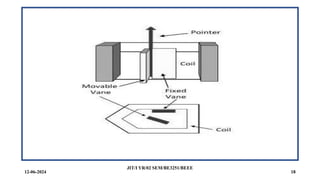
• Repulsion Type Moving Iron Instrument
• The repulsion type instrument includes two vanes otherwise iron plate where
one vane is permanent & another vane is movable.
• In this type of instrument, the fixed vane is connected to the coil and the
movable vane is placed on the spindle.
• So this spindle simply carries the pointer to move on a scale.
JIT/I YR/02 SEM/BE3251/BEEE
18
12-06-2024
JIT/I YR/02 SEM/BE3251/BEEE
19
12-06-2024
• Types of Repulsion Type Moving Iron Instrument
• The repulsion type moving iron instrument is classified into two types radial vane &
concentric vane or co-axial type which are discussed below.
• Radial Vane Repulsion Type Instrument
• If the repulsion type moving iron instrument has radial vanes then this instrument is called a
radial vane repulsion type instrument. This instrument includes two vanes which are also
known as iron strips. These vanes are arranged radially, where one vane is fixed & the other
vane is movable.
The deflection torque in this instrument is directly proportional to the actual current within the
coil to make the scale uniform so that readings of scale can be directly attained. These
instruments are the most sensitive type.
JIT/I YR/02 SEM/BE3251/BEEE
20
12-06-2024
JIT/I YR/02 SEM/BE3251/BEEE
21
12-06-2024
• Co-axial Vane Repulsion Type Instrument
• If the repulsion type moving iron instrument has coaxial vanes then this instrument is
called a coaxial vane repulsion type instrument.
• In this type of instrument, the two vanes are arranged co-axially within the coil where
one vane is stationary and the other vane is movable and rotates at the middle axis
within the stationary vane. But, the deflecting torque on the pointer is directly
proportional to the square of the current within the coil.
• So the scale in this instrument cannot be uniform because of the concentric vanes.
These instruments are less sensitive as compared to radial-type instruments.
JIT/I YR/02 SEM/BE3251/BEEE
22
12-06-2024
JIT/I YR/02 SEM/BE3251/BEEE
23
12-06-2024
• Deflecting Torque of a Moving Iron Instrument
• In a moving iron instrument, the deflecting torque is given as
• Td = (1/2)I^2(dL/dθ)
• The controlling torque in these instruments is provided through spring.
So, controlling torque due to spring is
• Tc = Kθ
• Where,
• ‘K’ is the constant of spring.
• ‘θ’ is the deflection within the needle.
• The deflecting & controlling torque in equilibrium condition is equivalent to
the following.
• Deflecting Torque = Controlling Torque
• Td = Tc
• (1/2)I^2(dL/dθ)
JIT/I YR/02 SEM/BE3251/BEEE
24
12-06-2024
• From the above equation, ‘θ’ can be written as
• θ = (1/2)I^2/K(dL/dθ)
• Advantages
• The advantages of moving iron instruments include the following.
• This instrument is applicable for both AC & DC.
• This device has very less friction error due to a high torque weight ratio
• These instruments are available at less cost because it has less number
of coil turns as compared to other instruments like PMMC.
• This is robust due to its very simple construction.
JIT/I YR/02 SEM/BE3251/BEEE 25
12-06-2024
• It can resist overload for a moment.
• Applicable for high power & low frequency-based circuits.
• It is capable of giving accuracy within limits of both accuracies as well as industrial
grades.
• The disadvantages of moving iron instruments include the following.
• The scale is not uniform.
• The power utilization is high for a low range of voltage.
• The errors in this instrument can be caused because of the hysteresis within the iron &
stray magnetic field.
• Change within frequency can cause very serious errors in AC measurements.
• The spring stiffness will decrease when the temperature increases.
• This instrument is nondirectional, so its accuracy is low.
• Power consumption is high.
•
JIT/I YR/02 SEM/BE3251/BEEE
26
12-06-2024
• Applications
• The applications of moving iron instruments include the following.
• These instruments are mainly used as an ammeter, voltmeter &
wattmeter which can work on both AC & DC.
• These are used for measuring alternating currents & voltages.
• These types of Instruments are used at power frequencies within
laboratories.
• These MI instruments are extensively used in switchboards & labs.
• Know more about Electric Traction MCQs , Dynamometer T
JIT/I YR/02 SEM/BE3251/BEEE
27
12-06-2024
Measurement of three phase power
JIT/I YR/02 SEM/BE3251/BEEE
28
12-06-2024
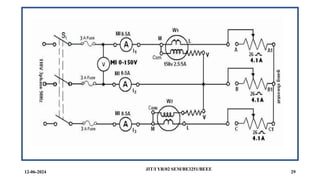
• Power is measured using a single wattmeter. In a three-wire
system, two wattmeters are required as shown in Figure 12.
• The instantaneous power measured by a wattmeter is the
product of the instantaneous voltage and current samples. 2
readings W1 + W2 = i1v1 + i2v2 + i3v3 = total instantaneous
watts.
JIT/I YR/02 SEM/BE3251/BEEE
29
12-06-2024
• Two Wattmeter Method: This method is used to measure power in a 3 phase, 4
wire unbalanced load.
• Three Wattmeter Method: This method is employed to measure power in a 3
phase, 4 wire system. It can also be employed in a 3 phase, 3 wire delta
connected load, where power consumed by each load is required to be
determined separately.
• One Wattmeter Method: This method is used to measure power in a 3 phase, 4
wire or 3 wire system. The single wattmeter is connected between one line and
neutral in a three-phase, 4-wire system.
• Electronic Three-Phase Power Meter: This is a device that measures the power
consumption of a three-phase electrical system.
• The formula for calculating three-phase power is P = √3 × pf × I × V4. The
voltage is multiplied by the square root of 3 (around 1.732)54.
JIT/I YR/02 SEM/BE3251/BEEE
30
12-06-2024
• This procedure would, of course, require access to the conductors
that carry the phase currents as well as the conductors that deliver
voltage potentials to the phases.
• A procedure for measuring the phase power of a balanced delta
circuit is shown in Figure 1. The phase potentials of a delta circuit
are usually accessible, but the conductors carrying the phase
currents may not be conveniently accessible. Usually, a different
method would be preferred
JIT/I YR/02 SEM/BE3251/BEEE
31
12-06-2024
JIT/I YR/02 SEM/BE3251/BEEE
32
12-06-2024
• A procedure for measuring the power of one phase of a
balanced wye circuit is shown in Figure 2. However, in
many instances, the measurements depicted in Figure 2
may not be physically practical.
JIT/I YR/02 SEM/BE3251/BEEE
33
12-06-2024
• Generally, the current of a wye circuit may be measured since the phase current
is the same as the line current. However, access to the point where the phases tie
together (point “d” in Figure 2) may not be readily accessible for a measurement.
This would be the case, for example, if the circuit is a wye wound motor.
• Generally, a connection of a potential lead to point “d” would not be required for
a balanced circuit. This would be true of a wye wound motor since the currents
of the three phases would be equal or nearly equal. Accordingly, the voltage can
be calculated by the known relationship
• VP=VL√3��=��3
• Under some circumstances, a single portable (single-phase) wattmeter can be
used to obtain adequate readings in an unbalanced three-phase three- wire circuit.
As mentioned earlier, this arrangement would be practical only if the measured
parameters remain constant throughout the period of time during which the
measurements are made.
JIT/I YR/02 SEM/BE3251/BEEE 34
12-06-2024
Use of a Single Wattmeter
• .
JIT/I YR/02 SEM/BE3251/BEEE
35
12-06-2024
JIT/I YR/02 SEM/BE3251/BEEE
36
12-06-2024
Use of Two Wattmeters.
JIT/I YR/02 SEM/BE3251/BEEE 37
12-06-2024
Alternate Use of Two Wattmeters
JIT/I YR/02 SEM/BE3251/BEEE
38
12-06-2024
Electric meter or energy meter measures the total power consumed over a time
interval. Electric utilities use electric meters installed at customers' premises for
billing and monitoring purposes. They are typically calibrated in billing units, the
most common one being the kilowatt hour (kWh).
An electricity meter, electric meter, electrical meter, energy meter,
or kilowatt-hour meter is a device that measures the amount of electric
energy consumed by a residence, a business, or an electrically powered
device
Energy meter
JIT/I YR/02 SEM/BE3251/BEEE
39
12-06-2024
• Electric meter or energy meter measures the total power consumed over a
time interval.
• Electric utilities use electric meters installed at customers' premises
for billing and monitoring purposes. They are typically calibrated in billing
units, the most common one being the kilowatt hour (kWh). They are
usually read once each billing period.
• When energy savings during certain periods are desired, some meters may
measure demand, the maximum use of power in some interval. "Time of
day" metering allows electric rates to be changed during a day, to record
usage during peak high-cost periods and off-peak, lower-cost, periods. Also,
in some areas meters have relays for demand response load shedding during
peak load periods.[1]
JIT/I YR/02 SEM/BE3251/BEEE
40
12-06-2024
12-06-2024
JIT/I YR/02 SEM/BE3251/BEEE
41
Direct current
• As commercial use of electric energy spread in the 1880s, it
became increasingly important that an electric energy meter,
similar to the then existing gas meters, was required to properly
bill customers, instead of billing for a fixed number of lamps
per month.
• DC meters measured charge in ampere hours. Since the voltage
of the supply should remain substantially constant, the reading
of the meter was proportional to actual energy consumed. For
example, if a meter recorded that 100 ampere hours had been
consumed on a 200-volt supply, then 20 kilowatt-hours of
energy had been supplied
12-06-2024
JIT/I YR/02 SEM/BE3251/BEEE
42
Alternating current
12-06-2024
JIT/I YR/02 SEM/BE3251/BEEE
43
• The first specimen of the AC kilowatt-hour meter produced on the basis of
Hungarian Ottó Bláthy's patent and named after him was presented by
the Ganz Works at the Frankfurt Fair in the autumn of 1889, and the first
induction kilowatt-hour meter was already marketed by the factory at the
end of the same year. These were the first alternating-current watt-hour
meters, known by the name of Bláthy-meters.[4] The AC kilowatt hour
meters used at present operate on the same principle as Bláthy's original
invention.[5][6][7][8] Also around 1889, Elihu Thomson of the
American General Electric company developed a recording watt meter
(watt-hour meter) based on an ironless commutator motor. This meter
overcame the disadvantages of the electrochemical type and could operate
on either alternating or direct current.[9]
12-06-2024
JIT/I YR/02 SEM/BE3251/BEEE
44
• Single and Three Phase Wattmeters and Energy Meters: Construction
and principle of operation
• i. Driving system The driving system of the meter consists of two electro-
magnets. The core of these electromagnets is made up of silicon steel
laminations. ...
• ii. Moving System This consists of an aluminum disc mounted on a light
alloy shaft. ...
• iii. Braking System A permanent magnet positioned near the edge of the
aluminium disc forms the braking system. ...
• iv. Registering (counting) Mechanism ...
12-06-2024
JIT/I YR/02 SEM/BE3251/BEEE
45
Instrument tranformers-CT and PT
• CT is generally used to measure currents of high magnitude. CT is step
down the current to be measured so that it can be measured with a
normal range ammeter. PT is step down the voltage of high magnitude
to a lower voltage which can be measured with the standard measuring
instrument. The current transformer and potential transformer (also
called voltage transformer) are both measuring devices. A CT lowers
the current signals for measurement purposes, while a PT lowers high
voltage values into lower ones. The transformers are designed to
measure whether power systems are both accurate and safe.
12-06-2024 JIT/I YR/02 SEM/BE3251/BEEE 46
12-06-2024 JIT/I YR/02 SEM/BE3251/BEEE 47
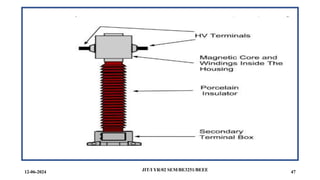
• Current Transformers (CT)
• Current transformers are generally used to measure currents of high
magnitude. These transformers step down the current to be measured,
so that it can be measured with a normal range ammeter. A Current
transformer has only one or very few number of primary turns. The
primary winding may be just a conductor or a bus bar placed in a
hollow core (as shown in the figure). The secondary winding has large
number turns accurately wound for a specific turns ratio. Thus the
current transformer steps up (increases) the voltage while stepping
down (lowering) the current.
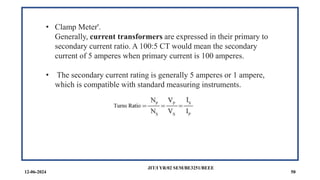
Now, the secondary current is measured with the help of an AC
ammeter. The turns ratio of a transformer is NP / NS = IS / IP
12-06-2024
JIT/I YR/02 SEM/BE3251/BEEE
48
12-06-2024
JIT/I YR/02 SEM/BE3251/BEEE
49
12-06-2024
JIT/I YR/02 SEM/BE3251/BEEE
50
• Clamp Meter'.
Generally, current transformers are expressed in their primary to
secondary current ratio. A 100:5 CT would mean the secondary
current of 5 amperes when primary current is 100 amperes.
• The secondary current rating is generally 5 amperes or 1 ampere,
which is compatible with standard measuring instruments.
• Potential Transformer (PT)
• Potential transformers are also known as voltage transformers and
they are basically step down transformers with extremely accurate
turns ratio. Potential transformers step down the voltage of high
magnitude to a lower voltage which can be measured with standard
measuring instrument. These transformers have large number of
primary turns and smaller number of secondary turns.
A potential transformer is typically expressed in primary to secondary
voltage ratio. For example, a 600:120 PT would mean the voltage
across secondary is 120 volts when primary voltage is 600 volts.
12-06-2024 51
JIT/I YR/02 SEM/BE3251/BEEE
12-06-2024
JIT/I YR/02 SEM/BE3251/BEEE
52
DSO Block diagram
12-06-2024
JIT/I YR/02 SEM/BE3251/BEEE
53
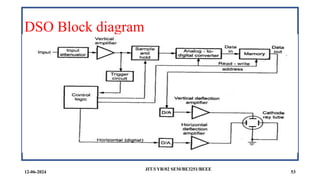
• A digital storage oscilloscope is a special kind of storage oscilloscope that
stores the input signal for years and displays it on a CRT screen when
desired. Digital storage oscilloscope (DSO) is totally reversed to the
working of analog storage oscilloscope. In the analog storage
(ASO)oscilloscope the input signals are stored in mesh storage and
whenever the signal display is needed the electron beam(or)electron gun is
activated which hits the mesh storage passing through a horizontal amplifier
and finally displays the signal on CRT screen. The stored signal can be used
to display for up to few days as the signal has a tendency to fade away. In
DSO the operation and working are totally different from that of ASO.
• In DSO the signals are stored in digital form rather than in analog form. The
conversion of analog signals into digital/binary form can be achieved
through Analog to digital conversion(ADC) technique. The converted signal
is then stored in memory which acts as a storage unit in DSO. whenever the
signal is needed to display on CRT the digital signal is reconstructed to
analog form with the Digital to analog conversion (DAC) technique. The
below figure is the block diagram of DSO.
12-06-2024
JIT/I YR/02 SEM/BE3251/BEEE
54
12-06-2024 55
Working of DSO
• When an analog signal is given as an input it passes through an
attenuator circuit where the unwanted noise signals are attenuated
and this clean signal is applied to a vertical amplifier which performs
the sampling and converts the input into digital. The digitally
converted analog signal is stored in memory, which we can use as
many times as we want to display on CRT. And coming to control
logic it controls the ADC(Analog to Digital converter) conversion
and deflection amplifiers. Both vertical and horizontal deflection
amplifiers are connected to a DAC(Digital to Analog converter)
which deflects the beam of electrons and so the trace on the CRT
screen. This is the working of DSO.
JIT/I YR/02 SEM/BE3251/BEEE
• Advantages of DSO
• DSO is very easy to use and also allows for automation.
• we can store more than one input signal at a time which we can’t do in
ASO.
• DSO can display much better-quality images.
• DSO is comparably cheaper than ASO.
12-06-2024 56
JIT/I YR/02 SEM/BE3251/BEEE
• applications of DSO
• DSO can be used in the visual representation of radar targets.
• DSO can be used to measure AC and DC voltages and currents.
• DSO can be used in telecommunications.
• DSO is used as a monitoring device
• In the nuclear field, scientists use DSO to study environmental changes in
absence of terrestrial/cellular signals.
• Functions of DSO
• DSO is an instrument used to display and analyze electronic signals.It draws
waveforms or a graph of an instantaneous signal voltage against time.
12-06-2024 57
JIT/I YR/02 SEM/BE3251/BEEE
Data acquisition
• In 1963, IBM produced computers that specialized in data acquisition.
These include the IBM 7700 Data Acquisition System, and its
successor, the IBM 1800 Data Acquisition and Control System. These
expensive specialized systems were surpassed in 1974 by general-
purpose S-100 computers and data acquisition cards produced
by Tecmar/Scientific Solutions Inc. In 1981 IBM introduced the IBM
Personal Computer and Scientific Solutions introduced the first PC
data acquisition products.
12-06-2024 58
JIT/I YR/02 SEM/BE3251/BEEE
• Data acquisition is the process of sampling signals that measure real-world
physical conditions and converting the resulting samples into digital numeric
values that can be manipulated by a computer. Data acquisition systems,
abbreviated by the acronyms DAS, DAQ, or DAU, typically convert analog
waveforms into digital values for processing. The components of data acquisition
systems include:
• Sensors, to convert physical parameters to electrical signals.
• Signal conditioning circuitry, to convert sensor signals into a form that can be
converted to digital values.
• Analog-to-digital converters, to convert conditioned sensor signals to digital
values.
12-06-2024 59
JIT/I YR/02 SEM/BE3251/BEEE
12-06-2024 60
JIT/I YR/02 SEM/BE3251/BEEE
• Data acquisition applications are usually controlled
by software programs developed using various general
purpose programming languages such
as Assembly, BASIC, C, C++, C#, Fortran, Java, LabVIEW, Lisp, Pa
scal, etc. Stand-alone data acquisition systems are often called data
loggers.
• There are also open-source software packages providing all the
necessary tools to acquire data from different, typically specific,
hardware equipment. These tools come from the scientific
community where complex experiment requires fast, flexible, and
adaptable software. Those packages are usually custom-fit but more
general DAQ packages like the Maximum Integrated Data
Acquisition System can be easily tailored and are used in several
physics experiments.
12-06-2024 61
JIT/I YR/02 SEM/BE3251/BEEE
• sources and systems
• Data acquisition begins with the physical phenomenon or physical property to be measured. Examples of this
include temperature, vibration, light intensity, gas pressure, fluid flow, and force. Regardless of the type of
physical property to be measured, the physical state that is to be measured must first be transformed into a
unified form that can be sampled by a data acquisition system. The task of performing such transformations
falls on devices called sensors. A data acquisition system is a collection of software and hardware that allows
one to measure or control the physical characteristics of something in the real world. A complete data
acquisition system consists of DAQ hardware, sensors and actuators, signal conditioning hardware, and a
computer running DAQ software. If timing is necessary (such as for event mode DAQ systems), a separate
compensated distributed timing system is required.
• A sensor, which is a type of transducer, is a device that converts a physical property into a corresponding
electrical signal (e.g., strain gauge, thermistor). An acquisition system to measure different properties depends
on the sensors that are suited to detect those properties. Signal conditioning may be necessary if the signal
from the transducer is not suitable for the DAQ hardware being used. The signal may need to be filtered,
shaped, or amplified in most cases. Various other examples of signal conditioning might be bridge
completion, providing current or voltage excitation to the sensor, isolation, and linearization. For transmission
purposes, single ended analog signals, which are more susceptible to noise can be converted to differential
signals. Once digitized, the signal can be encoded to reduce and correct transmission errors.
12-06-2024 62
JIT/I YR/02 SEM/BE3251/BEEE
• DAQ hardware
• DAQ hardware is what usually interfaces between the signal and a PC. It could be in the form of
modules that can be connected to the computer's ports (parallel, serial, USB, etc.) or cards
connected to slots (S-100 bus, AppleBus, ISA, MCA, PCI, PCI-E, etc.) in a PC motherboard or in a
modular crate (CAMAC, NIM, VME). Sometimes adapters are needed, in which case an
external breakout box can be used.
• DAQ cards often contain multiple components (multiplexer, ADC, DAC, TTL-IO, high-speed
timers, RAM). These are accessible via a bus by a microcontroller, which can run small programs.
A controller is more flexible than a hard-wired logic, yet cheaper than a CPU so it is permissible to
block it with simple polling loops. For example: Waiting for a trigger, starting the ADC, looking up
the time, waiting for the ADC to finish, move value to RAM, switch multiplexer, get TTL input, let
DAC proceed with voltage ramp.
• Today, signals from some sensors and Data Acquisition Systems can be streamed via Bluetooth.
• DAQ device drivers[edit]
• DAQ device drivers are needed for the DAQ hardware to work with a PC. The device driver
performs low-level register writes and reads on the hardware while exposing API for developing
user applications in a variety of programs.
•
12-06-2024 63
JIT/I YR/02 SEM/BE3251/BEEE
12-06-2024 64
DAQ device drivers
DAQ device drivers are needed for the DAQ hardware to work
with a PC. The device driver performs low-level register writes
and reads on the hardware while exposing API for developing
user applications in a variety of programs.
Input devices •3D scanner
•Analog-to-digital converter
•Time-to-digital converter
Hardware
•Computer Automated Measurement and Control (CAMAC)
•Industrial Ethernet
•Industrial USB
•LAN eXtensions for Instrumentation
•Network interface controller
•PCI eXtensions for Instrumentation
•VMEbus
•VXI
JIT/I YR/02 SEM/BE3251/BEEE
12-06-2024 65
DAQ software
• Specialized DAQ software may be delivered with the DAQ hardware.
Software tools used for building large-scale data acquisition systems
include EPICS.
• Other programming environments that are used to build DAQ applications
include ladder logic, Visual C++, Visual Basic, LabVIEW, and MATLAB.
JIT/I YR/02 SEM/BE3251/BEEE

Basic electronics electrical and engineering unit 5 notes

  • 1.
    UNIT- V MEASUREMENT ANDINSTRUMENTAION Ms. M. BHARATHI ASSISTANT PROFSSOR DEPARTMENT OF ECE 12-06-2024 JIT/I YR/02 SEM/BE3251/BEEE 1
  • 2.
    OUTLINE Functional elements ofan instrument, standards and caliberation, operating principle, types-moving coil and moving iron meters, measurement of three phase power, energy meter, instrument tranformers-CT and PT, DSO Block diagram Data acquisition. JIT/I YR/02 SEM/BE3251/BEEE 2 12-06-2024
  • 3.
    Functional elements ofan instrument JIT/I YR/02 SEM/BE3251/BEEE 3 12-06-2024 Most of the measurement systems contain three main functional elements. They are: i) Primary sensing element ii) Variable conversion element & iii) Data presentation element.
  • 4.
  • 5.
    JIT/I YR/02 SEM/BE3251/BEEE 5 12-06-2024 Mostof the measurement systems contain three main functional elements. They are: i) Primary sensing element ii) Variable conversion element & iii) Data presentation element. Primary sensing element: • The quantity under measurement makes its first contact with the primary sensing element of a measurement system. i.e., the measurand- (the unknown quantity which is to be measured) is first detected by primary sensor which gives the output in a different analogous form This output is then converted into an e electrical signal by a transducer - (which converts energy from one form to another). The first stage of a measurement system is known as adetector transducer stage’.
  • 6.
    JIT/I YR/02 SEM/BE3251/BEEE 6 12-06-2024 Datapresentation element: • The information about the quantity under measurement has to be conveyed to the personnel handling the instrument or the system for monitoring, control, or analysis purposes. This function is done by data presentation element. • In case data is to be monitored, visual display devices are needed These devices may be analog or digital indicating instruments like ammeters, voltmeters etc. In case data is to be recorded, recorders like magnetic tapes, high speed camera & TV equipment, CRT, printers may be used. For control & analysis is purpose microprocessor or computers may be used. The final stage in a measurement system is known as terminating stage’ Moving-coil galvanometers are mainly divided into two types. •Suspended coil galvanometer •Pivoted-coil or Weston galvanometer
  • 7.
    JIT/I YR/02 SEM/BE3251/BEEE 7 12-06-2024 MovingCoil Galvanometer Construction and Diagram • The moving coil galvanometer is made up of a rectangular coil that has many turns, and it is usually made of thinly insulated or fine copper wire that is wounded on a metallic frame. • The coil is free to rotate about a fixed axis. A phosphor-bronze strip that is connected to a movable torsion head is used to suspend the coil in a uniform radial magnetic field. • Essential properties of the material used for the suspension of the coil are conductivity and a low value of the torsional constant. A cylindrical soft iron core is symmetrically positioned inside the coil to improve the strength of the magnetic field and to make the field radial. • The lower part of the coil is attached to a phosphor-bronze spring having a small number of turns. The other end of the spring is connected to binding screws.
  • 8.
  • 9.
    JIT/I YR/02 SEM/BE3251/BEEE9 12-06-2024 Working of Moving Coil Galvanometer • Let a current I flow through the rectangular coil of n number of turns and a cross-sectional area A. When this coil is placed in a uniform radial magnetic field B, the coil experiences a torque τ. • Let us first consider a single turn ABCD of the rectangular coil having a length l and breadth b. This is suspended in a magnetic field of strength B, such that the plane of the coil is parallel to the magnetic field. Since the sides AB and DC are parallel to the direction of the magnetic field, they do not experience any effective force due to the magnetic field. • The sides AD and BC being perpendicular to the direction of the field, experience an effective force F given by F = BIl
  • 10.
  • 11.
    JIT/I YR/02 SEM/BE3251/BEEE 11 12-06-2024 •We know that torque τ = Force x Perpendicular distance between the forces • τ = F × b • Substituting the value of F, we already know, • Torque τ acting on single-loop ABCD of the coil = BIl × b • Where lx b is the area A of the coil, • Hence, the torque acting on n turns of the coil is given by • τ = nIAB • The magnetic torque thus produced causes the coil to rotate, and the phosphor bronze strip twists. In turn, the spring S attached to the coil produces a counter torque or restoring torque kθ, which results in a steady angular deflection. • Under an equilibrium condition, • kθ = nIAB • Here, k is called the torsional constant of the spring (restoring a couple per unit twist). The deflection or twist θ is measured as the value indicated on a scale by a pointer which is connected to the suspension wire. • θ= ( nAB / k)I
  • 12.
    JIT/I YR/02 SEM/BE3251/BEEE12 12-06-2024 S = dθ/dI The sensitivity of a galvanometer is higher if the instrument shows a larger deflection for a small value of current. Sensitivity is of two types, namely, current sensitivity and voltage sensitivity. •Current Sensitivity The deflection θ per unit current I is known as current sensitivity θ/I θ/I = nAB/k •Voltage Sensitivity • The deflection θ per unit voltage is known as voltage sensitivity θ/V. Dividing both sides by V in the equation θ= (nAB / k)I • θ/V= (nAB /V k)I = (nAB / k)(I/V) = (nAB /k)(1/R) • R stands for the effective resistance in the circuit. • It is worth noting that voltage sensitivity = Current sensitivity/Resistance of the coil. Therefore, under the condition that R remains constant, Voltage sensitivity ∝ Current sensitivity.
  • 13.
  • 14.
    • Attraction TypeMoving Iron Instrument • The attraction type moving iron instrument working principle mainly depends on magnetic attraction, because it attracts an iron piece once arranged close to a magnetic field. Here, this magnetic field is generated through an electromagnet. JIT/I YR/02 SEM/BE3251/BEEE 14 12-06-2024
  • 15.
    • This typeof moving iron instrument includes a flat fixed coil with a slight opening. A moving iron in this instrument is designed with soft iron that is mounted on a spindle. Here, the coils are wounded with a no. of turns which depends on the instrument range. • The pointer in this instrument is mounted on a spindle that includes a graduated scale used to show the deflection. JIT/I YR/02 SEM/BE3251/BEEE 15 12-06-2024
  • 16.
    • Once coilwinding is coupled across the supply to be measured, then a magnetic field will be set up. • So, the magnetic field’s intensity is higher within the coil as compared to the outside intensity thus low reluctance will exist within the coil. • When the moving iron attempts to occupy the low reluctance position, then it is moved & attracted to the fixed coil. • Once the iron piece gets moved, then the pointer in the instrument also moves to illustrate the deflection. • So, this instrument achieves the equilibrium position once the deflecting torque is balanced by the controlling torque. JIT/I YR/02 SEM/BE3251/BEEE 16 12-06-2024
  • 17.
    JIT/I YR/02 SEM/BE3251/BEEE 17 12-06-2024 •Repulsion Type Moving Iron Instrument • The repulsion type instrument includes two vanes otherwise iron plate where one vane is permanent & another vane is movable. • In this type of instrument, the fixed vane is connected to the coil and the movable vane is placed on the spindle. • So this spindle simply carries the pointer to move on a scale.
  • 18.
  • 19.
    JIT/I YR/02 SEM/BE3251/BEEE 19 12-06-2024 •Types of Repulsion Type Moving Iron Instrument • The repulsion type moving iron instrument is classified into two types radial vane & concentric vane or co-axial type which are discussed below. • Radial Vane Repulsion Type Instrument • If the repulsion type moving iron instrument has radial vanes then this instrument is called a radial vane repulsion type instrument. This instrument includes two vanes which are also known as iron strips. These vanes are arranged radially, where one vane is fixed & the other vane is movable. The deflection torque in this instrument is directly proportional to the actual current within the coil to make the scale uniform so that readings of scale can be directly attained. These instruments are the most sensitive type.
  • 20.
  • 21.
    JIT/I YR/02 SEM/BE3251/BEEE 21 12-06-2024 •Co-axial Vane Repulsion Type Instrument • If the repulsion type moving iron instrument has coaxial vanes then this instrument is called a coaxial vane repulsion type instrument. • In this type of instrument, the two vanes are arranged co-axially within the coil where one vane is stationary and the other vane is movable and rotates at the middle axis within the stationary vane. But, the deflecting torque on the pointer is directly proportional to the square of the current within the coil. • So the scale in this instrument cannot be uniform because of the concentric vanes. These instruments are less sensitive as compared to radial-type instruments.
  • 22.
  • 23.
    JIT/I YR/02 SEM/BE3251/BEEE 23 12-06-2024 •Deflecting Torque of a Moving Iron Instrument • In a moving iron instrument, the deflecting torque is given as • Td = (1/2)I^2(dL/dθ) • The controlling torque in these instruments is provided through spring. So, controlling torque due to spring is • Tc = Kθ • Where, • ‘K’ is the constant of spring. • ‘θ’ is the deflection within the needle.
  • 24.
    • The deflecting& controlling torque in equilibrium condition is equivalent to the following. • Deflecting Torque = Controlling Torque • Td = Tc • (1/2)I^2(dL/dθ) JIT/I YR/02 SEM/BE3251/BEEE 24 12-06-2024
  • 25.
    • From theabove equation, ‘θ’ can be written as • θ = (1/2)I^2/K(dL/dθ) • Advantages • The advantages of moving iron instruments include the following. • This instrument is applicable for both AC & DC. • This device has very less friction error due to a high torque weight ratio • These instruments are available at less cost because it has less number of coil turns as compared to other instruments like PMMC. • This is robust due to its very simple construction. JIT/I YR/02 SEM/BE3251/BEEE 25 12-06-2024
  • 26.
    • It canresist overload for a moment. • Applicable for high power & low frequency-based circuits. • It is capable of giving accuracy within limits of both accuracies as well as industrial grades. • The disadvantages of moving iron instruments include the following. • The scale is not uniform. • The power utilization is high for a low range of voltage. • The errors in this instrument can be caused because of the hysteresis within the iron & stray magnetic field. • Change within frequency can cause very serious errors in AC measurements. • The spring stiffness will decrease when the temperature increases. • This instrument is nondirectional, so its accuracy is low. • Power consumption is high. • JIT/I YR/02 SEM/BE3251/BEEE 26 12-06-2024
  • 27.
    • Applications • Theapplications of moving iron instruments include the following. • These instruments are mainly used as an ammeter, voltmeter & wattmeter which can work on both AC & DC. • These are used for measuring alternating currents & voltages. • These types of Instruments are used at power frequencies within laboratories. • These MI instruments are extensively used in switchboards & labs. • Know more about Electric Traction MCQs , Dynamometer T JIT/I YR/02 SEM/BE3251/BEEE 27 12-06-2024
  • 28.
    Measurement of threephase power JIT/I YR/02 SEM/BE3251/BEEE 28 12-06-2024 • Power is measured using a single wattmeter. In a three-wire system, two wattmeters are required as shown in Figure 12. • The instantaneous power measured by a wattmeter is the product of the instantaneous voltage and current samples. 2 readings W1 + W2 = i1v1 + i2v2 + i3v3 = total instantaneous watts.
  • 29.
  • 30.
    • Two WattmeterMethod: This method is used to measure power in a 3 phase, 4 wire unbalanced load. • Three Wattmeter Method: This method is employed to measure power in a 3 phase, 4 wire system. It can also be employed in a 3 phase, 3 wire delta connected load, where power consumed by each load is required to be determined separately. • One Wattmeter Method: This method is used to measure power in a 3 phase, 4 wire or 3 wire system. The single wattmeter is connected between one line and neutral in a three-phase, 4-wire system. • Electronic Three-Phase Power Meter: This is a device that measures the power consumption of a three-phase electrical system. • The formula for calculating three-phase power is P = √3 × pf × I × V4. The voltage is multiplied by the square root of 3 (around 1.732)54. JIT/I YR/02 SEM/BE3251/BEEE 30 12-06-2024
  • 31.
    • This procedurewould, of course, require access to the conductors that carry the phase currents as well as the conductors that deliver voltage potentials to the phases. • A procedure for measuring the phase power of a balanced delta circuit is shown in Figure 1. The phase potentials of a delta circuit are usually accessible, but the conductors carrying the phase currents may not be conveniently accessible. Usually, a different method would be preferred JIT/I YR/02 SEM/BE3251/BEEE 31 12-06-2024
  • 32.
  • 33.
    • A procedurefor measuring the power of one phase of a balanced wye circuit is shown in Figure 2. However, in many instances, the measurements depicted in Figure 2 may not be physically practical. JIT/I YR/02 SEM/BE3251/BEEE 33 12-06-2024
  • 34.
    • Generally, thecurrent of a wye circuit may be measured since the phase current is the same as the line current. However, access to the point where the phases tie together (point “d” in Figure 2) may not be readily accessible for a measurement. This would be the case, for example, if the circuit is a wye wound motor. • Generally, a connection of a potential lead to point “d” would not be required for a balanced circuit. This would be true of a wye wound motor since the currents of the three phases would be equal or nearly equal. Accordingly, the voltage can be calculated by the known relationship • VP=VL√3��=��3 • Under some circumstances, a single portable (single-phase) wattmeter can be used to obtain adequate readings in an unbalanced three-phase three- wire circuit. As mentioned earlier, this arrangement would be practical only if the measured parameters remain constant throughout the period of time during which the measurements are made. JIT/I YR/02 SEM/BE3251/BEEE 34 12-06-2024
  • 35.
    Use of aSingle Wattmeter • . JIT/I YR/02 SEM/BE3251/BEEE 35 12-06-2024
  • 36.
    JIT/I YR/02 SEM/BE3251/BEEE 36 12-06-2024 Useof Two Wattmeters. Use of Two Wattmeters.
  • 37.
    JIT/I YR/02 SEM/BE3251/BEEE37 12-06-2024 Alternate Use of Two Wattmeters
  • 38.
    JIT/I YR/02 SEM/BE3251/BEEE 38 12-06-2024 Electricmeter or energy meter measures the total power consumed over a time interval. Electric utilities use electric meters installed at customers' premises for billing and monitoring purposes. They are typically calibrated in billing units, the most common one being the kilowatt hour (kWh). An electricity meter, electric meter, electrical meter, energy meter, or kilowatt-hour meter is a device that measures the amount of electric energy consumed by a residence, a business, or an electrically powered device Energy meter
  • 39.
    JIT/I YR/02 SEM/BE3251/BEEE 39 12-06-2024 •Electric meter or energy meter measures the total power consumed over a time interval. • Electric utilities use electric meters installed at customers' premises for billing and monitoring purposes. They are typically calibrated in billing units, the most common one being the kilowatt hour (kWh). They are usually read once each billing period. • When energy savings during certain periods are desired, some meters may measure demand, the maximum use of power in some interval. "Time of day" metering allows electric rates to be changed during a day, to record usage during peak high-cost periods and off-peak, lower-cost, periods. Also, in some areas meters have relays for demand response load shedding during peak load periods.[1]
  • 40.
  • 41.
    12-06-2024 JIT/I YR/02 SEM/BE3251/BEEE 41 Directcurrent • As commercial use of electric energy spread in the 1880s, it became increasingly important that an electric energy meter, similar to the then existing gas meters, was required to properly bill customers, instead of billing for a fixed number of lamps per month. • DC meters measured charge in ampere hours. Since the voltage of the supply should remain substantially constant, the reading of the meter was proportional to actual energy consumed. For example, if a meter recorded that 100 ampere hours had been consumed on a 200-volt supply, then 20 kilowatt-hours of energy had been supplied
  • 42.
  • 43.
    Alternating current 12-06-2024 JIT/I YR/02SEM/BE3251/BEEE 43 • The first specimen of the AC kilowatt-hour meter produced on the basis of Hungarian Ottó Bláthy's patent and named after him was presented by the Ganz Works at the Frankfurt Fair in the autumn of 1889, and the first induction kilowatt-hour meter was already marketed by the factory at the end of the same year. These were the first alternating-current watt-hour meters, known by the name of Bláthy-meters.[4] The AC kilowatt hour meters used at present operate on the same principle as Bláthy's original invention.[5][6][7][8] Also around 1889, Elihu Thomson of the American General Electric company developed a recording watt meter (watt-hour meter) based on an ironless commutator motor. This meter overcame the disadvantages of the electrochemical type and could operate on either alternating or direct current.[9]
  • 44.
  • 45.
    • Single andThree Phase Wattmeters and Energy Meters: Construction and principle of operation • i. Driving system The driving system of the meter consists of two electro- magnets. The core of these electromagnets is made up of silicon steel laminations. ... • ii. Moving System This consists of an aluminum disc mounted on a light alloy shaft. ... • iii. Braking System A permanent magnet positioned near the edge of the aluminium disc forms the braking system. ... • iv. Registering (counting) Mechanism ... 12-06-2024 JIT/I YR/02 SEM/BE3251/BEEE 45
  • 46.
    Instrument tranformers-CT andPT • CT is generally used to measure currents of high magnitude. CT is step down the current to be measured so that it can be measured with a normal range ammeter. PT is step down the voltage of high magnitude to a lower voltage which can be measured with the standard measuring instrument. The current transformer and potential transformer (also called voltage transformer) are both measuring devices. A CT lowers the current signals for measurement purposes, while a PT lowers high voltage values into lower ones. The transformers are designed to measure whether power systems are both accurate and safe. 12-06-2024 JIT/I YR/02 SEM/BE3251/BEEE 46
  • 47.
    12-06-2024 JIT/I YR/02SEM/BE3251/BEEE 47
  • 48.
    • Current Transformers(CT) • Current transformers are generally used to measure currents of high magnitude. These transformers step down the current to be measured, so that it can be measured with a normal range ammeter. A Current transformer has only one or very few number of primary turns. The primary winding may be just a conductor or a bus bar placed in a hollow core (as shown in the figure). The secondary winding has large number turns accurately wound for a specific turns ratio. Thus the current transformer steps up (increases) the voltage while stepping down (lowering) the current. Now, the secondary current is measured with the help of an AC ammeter. The turns ratio of a transformer is NP / NS = IS / IP 12-06-2024 JIT/I YR/02 SEM/BE3251/BEEE 48
  • 49.
  • 50.
    12-06-2024 JIT/I YR/02 SEM/BE3251/BEEE 50 •Clamp Meter'. Generally, current transformers are expressed in their primary to secondary current ratio. A 100:5 CT would mean the secondary current of 5 amperes when primary current is 100 amperes. • The secondary current rating is generally 5 amperes or 1 ampere, which is compatible with standard measuring instruments.
  • 51.
    • Potential Transformer(PT) • Potential transformers are also known as voltage transformers and they are basically step down transformers with extremely accurate turns ratio. Potential transformers step down the voltage of high magnitude to a lower voltage which can be measured with standard measuring instrument. These transformers have large number of primary turns and smaller number of secondary turns. A potential transformer is typically expressed in primary to secondary voltage ratio. For example, a 600:120 PT would mean the voltage across secondary is 120 volts when primary voltage is 600 volts. 12-06-2024 51 JIT/I YR/02 SEM/BE3251/BEEE
  • 52.
  • 53.
    DSO Block diagram 12-06-2024 JIT/IYR/02 SEM/BE3251/BEEE 53
  • 54.
    • A digitalstorage oscilloscope is a special kind of storage oscilloscope that stores the input signal for years and displays it on a CRT screen when desired. Digital storage oscilloscope (DSO) is totally reversed to the working of analog storage oscilloscope. In the analog storage (ASO)oscilloscope the input signals are stored in mesh storage and whenever the signal display is needed the electron beam(or)electron gun is activated which hits the mesh storage passing through a horizontal amplifier and finally displays the signal on CRT screen. The stored signal can be used to display for up to few days as the signal has a tendency to fade away. In DSO the operation and working are totally different from that of ASO. • In DSO the signals are stored in digital form rather than in analog form. The conversion of analog signals into digital/binary form can be achieved through Analog to digital conversion(ADC) technique. The converted signal is then stored in memory which acts as a storage unit in DSO. whenever the signal is needed to display on CRT the digital signal is reconstructed to analog form with the Digital to analog conversion (DAC) technique. The below figure is the block diagram of DSO. 12-06-2024 JIT/I YR/02 SEM/BE3251/BEEE 54
  • 55.
    12-06-2024 55 Working ofDSO • When an analog signal is given as an input it passes through an attenuator circuit where the unwanted noise signals are attenuated and this clean signal is applied to a vertical amplifier which performs the sampling and converts the input into digital. The digitally converted analog signal is stored in memory, which we can use as many times as we want to display on CRT. And coming to control logic it controls the ADC(Analog to Digital converter) conversion and deflection amplifiers. Both vertical and horizontal deflection amplifiers are connected to a DAC(Digital to Analog converter) which deflects the beam of electrons and so the trace on the CRT screen. This is the working of DSO. JIT/I YR/02 SEM/BE3251/BEEE
  • 56.
    • Advantages ofDSO • DSO is very easy to use and also allows for automation. • we can store more than one input signal at a time which we can’t do in ASO. • DSO can display much better-quality images. • DSO is comparably cheaper than ASO. 12-06-2024 56 JIT/I YR/02 SEM/BE3251/BEEE
  • 57.
    • applications ofDSO • DSO can be used in the visual representation of radar targets. • DSO can be used to measure AC and DC voltages and currents. • DSO can be used in telecommunications. • DSO is used as a monitoring device • In the nuclear field, scientists use DSO to study environmental changes in absence of terrestrial/cellular signals. • Functions of DSO • DSO is an instrument used to display and analyze electronic signals.It draws waveforms or a graph of an instantaneous signal voltage against time. 12-06-2024 57 JIT/I YR/02 SEM/BE3251/BEEE
  • 58.
    Data acquisition • In1963, IBM produced computers that specialized in data acquisition. These include the IBM 7700 Data Acquisition System, and its successor, the IBM 1800 Data Acquisition and Control System. These expensive specialized systems were surpassed in 1974 by general- purpose S-100 computers and data acquisition cards produced by Tecmar/Scientific Solutions Inc. In 1981 IBM introduced the IBM Personal Computer and Scientific Solutions introduced the first PC data acquisition products. 12-06-2024 58 JIT/I YR/02 SEM/BE3251/BEEE
  • 59.
    • Data acquisitionis the process of sampling signals that measure real-world physical conditions and converting the resulting samples into digital numeric values that can be manipulated by a computer. Data acquisition systems, abbreviated by the acronyms DAS, DAQ, or DAU, typically convert analog waveforms into digital values for processing. The components of data acquisition systems include: • Sensors, to convert physical parameters to electrical signals. • Signal conditioning circuitry, to convert sensor signals into a form that can be converted to digital values. • Analog-to-digital converters, to convert conditioned sensor signals to digital values. 12-06-2024 59 JIT/I YR/02 SEM/BE3251/BEEE
  • 60.
  • 61.
    • Data acquisitionapplications are usually controlled by software programs developed using various general purpose programming languages such as Assembly, BASIC, C, C++, C#, Fortran, Java, LabVIEW, Lisp, Pa scal, etc. Stand-alone data acquisition systems are often called data loggers. • There are also open-source software packages providing all the necessary tools to acquire data from different, typically specific, hardware equipment. These tools come from the scientific community where complex experiment requires fast, flexible, and adaptable software. Those packages are usually custom-fit but more general DAQ packages like the Maximum Integrated Data Acquisition System can be easily tailored and are used in several physics experiments. 12-06-2024 61 JIT/I YR/02 SEM/BE3251/BEEE
  • 62.
    • sources andsystems • Data acquisition begins with the physical phenomenon or physical property to be measured. Examples of this include temperature, vibration, light intensity, gas pressure, fluid flow, and force. Regardless of the type of physical property to be measured, the physical state that is to be measured must first be transformed into a unified form that can be sampled by a data acquisition system. The task of performing such transformations falls on devices called sensors. A data acquisition system is a collection of software and hardware that allows one to measure or control the physical characteristics of something in the real world. A complete data acquisition system consists of DAQ hardware, sensors and actuators, signal conditioning hardware, and a computer running DAQ software. If timing is necessary (such as for event mode DAQ systems), a separate compensated distributed timing system is required. • A sensor, which is a type of transducer, is a device that converts a physical property into a corresponding electrical signal (e.g., strain gauge, thermistor). An acquisition system to measure different properties depends on the sensors that are suited to detect those properties. Signal conditioning may be necessary if the signal from the transducer is not suitable for the DAQ hardware being used. The signal may need to be filtered, shaped, or amplified in most cases. Various other examples of signal conditioning might be bridge completion, providing current or voltage excitation to the sensor, isolation, and linearization. For transmission purposes, single ended analog signals, which are more susceptible to noise can be converted to differential signals. Once digitized, the signal can be encoded to reduce and correct transmission errors. 12-06-2024 62 JIT/I YR/02 SEM/BE3251/BEEE
  • 63.
    • DAQ hardware •DAQ hardware is what usually interfaces between the signal and a PC. It could be in the form of modules that can be connected to the computer's ports (parallel, serial, USB, etc.) or cards connected to slots (S-100 bus, AppleBus, ISA, MCA, PCI, PCI-E, etc.) in a PC motherboard or in a modular crate (CAMAC, NIM, VME). Sometimes adapters are needed, in which case an external breakout box can be used. • DAQ cards often contain multiple components (multiplexer, ADC, DAC, TTL-IO, high-speed timers, RAM). These are accessible via a bus by a microcontroller, which can run small programs. A controller is more flexible than a hard-wired logic, yet cheaper than a CPU so it is permissible to block it with simple polling loops. For example: Waiting for a trigger, starting the ADC, looking up the time, waiting for the ADC to finish, move value to RAM, switch multiplexer, get TTL input, let DAC proceed with voltage ramp. • Today, signals from some sensors and Data Acquisition Systems can be streamed via Bluetooth. • DAQ device drivers[edit] • DAQ device drivers are needed for the DAQ hardware to work with a PC. The device driver performs low-level register writes and reads on the hardware while exposing API for developing user applications in a variety of programs. • 12-06-2024 63 JIT/I YR/02 SEM/BE3251/BEEE
  • 64.
    12-06-2024 64 DAQ devicedrivers DAQ device drivers are needed for the DAQ hardware to work with a PC. The device driver performs low-level register writes and reads on the hardware while exposing API for developing user applications in a variety of programs. Input devices •3D scanner •Analog-to-digital converter •Time-to-digital converter Hardware •Computer Automated Measurement and Control (CAMAC) •Industrial Ethernet •Industrial USB •LAN eXtensions for Instrumentation •Network interface controller •PCI eXtensions for Instrumentation •VMEbus •VXI JIT/I YR/02 SEM/BE3251/BEEE
  • 65.
    12-06-2024 65 DAQ software •Specialized DAQ software may be delivered with the DAQ hardware. Software tools used for building large-scale data acquisition systems include EPICS. • Other programming environments that are used to build DAQ applications include ladder logic, Visual C++, Visual Basic, LabVIEW, and MATLAB. JIT/I YR/02 SEM/BE3251/BEEE

Editor's Notes