Module 10
Advanced Topics
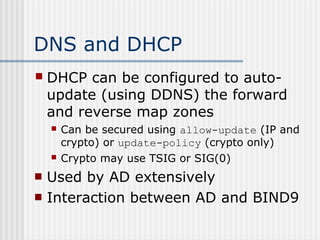
DNS and DHCP
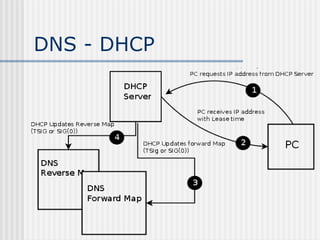
 DHCP can be configured to auto-
update (using DDNS) the forward
and reverse map zones
 Can be secured using allow-update (IP and
crypto) or update-policy (crypto only)
 Crypto may use TSIG or SIG(0)
 Used by AD extensively
 Interaction between AD and BIND9
DNS - DHCP
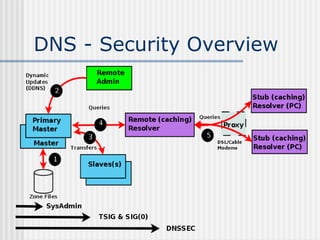
DNS - Security Overview
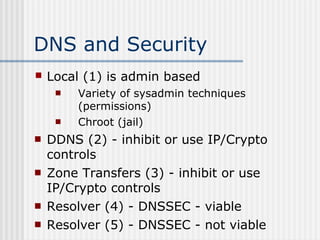
DNS and Security
 Local (1) is admin based
 Variety of sysadmin techniques
(permissions)
 Chroot (jail)
 DDNS (2) - inhibit or use IP/Crypto
controls
 Zone Transfers (3) - inhibit or use
IP/Crypto controls
 Resolver (4) - DNSSEC - viable
 Resolver (5) - DNSSEC - not viable
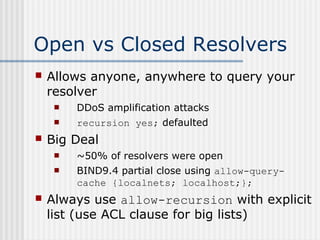
Open vs Closed Resolvers
 Allows anyone, anywhere to query your
resolver
 DDoS amplification attacks
 recursion yes; defaulted
 Big Deal
 ~50% of resolvers were open
 BIND9.4 partial close using allow-query-
cache {localnets; localhost;};
 Always use allow-recursion with explicit
list (use ACL clause for big lists)
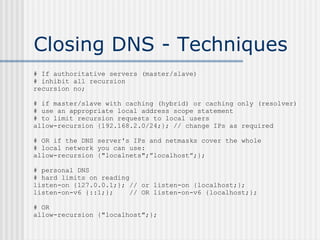
Closing DNS - Techniques
# If authoritative servers (master/slave)
# inhibit all recursion
recursion no;
# if master/slave with caching (hybrid) or caching only (resolver)
# use an appropriate local address scope statement
# to limit recursion requests to local users
allow-recursion {192.168.2.0/24;}; // change IPs as required
# OR if the DNS server's IPs and netmasks cover the whole
# local network you can use:
allow-recursion {"localnets";”localhost”;};
# personal DNS
# hard limits on reading
listen-on {127.0.0.1;}; // or listen-on {localhost;};
listen-on-v6 {::1;}; // OR listen-on-v6 {localhost;};
# OR
allow-recursion {"localhost";};
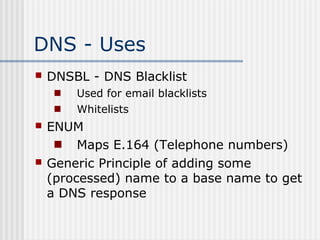
DNS - Uses
 DNSBL - DNS Blacklist
 Used for email blacklists
 Whitelists
 ENUM
 Maps E.164 (Telephone numbers)
 Generic Principle of adding some
(processed) name to a base name to get
a DNS response
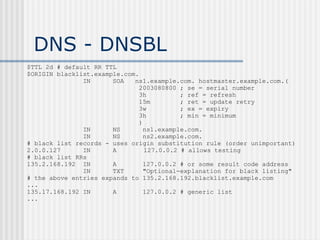
DNS - DNSBL
$TTL 2d # default RR TTL
$ORIGIN blacklist.example.com.
IN SOA ns1.example.com. hostmaster.example.com.(
2003080800 ; se = serial number
3h ; ref = refresh
15m ; ret = update retry
3w ; ex = expiry
3h ; min = minimum
)
IN NS ns1.example.com.
IN NS ns2.example.com.
# black list records - uses origin substitution rule (order unimportant)
2.0.0.127 IN A 127.0.0.2 # allows testing
# black list RRs
135.2.168.192 IN A 127.0.0.2 # or some result code address
IN TXT "Optional-explanation for black listing"
# the above entries expands to 135.2.168.192.blacklist.example.com
...
135.17.168.192 IN A 127.0.0.2 # generic list
...
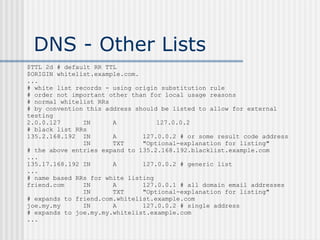
DNS - Other Lists
$TTL 2d # default RR TTL
$ORIGIN whitelist.example.com.
...
# white list records - using origin substitution rule
# order not important other than for local usage reasons
# normal whitelist RRs
# by convention this address should be listed to allow for external
testing
2.0.0.127 IN A 127.0.0.2
# black list RRs
135.2.168.192 IN A 127.0.0.2 # or some result code address
IN TXT "Optional-explanation for listing"
# the above entries expand to 135.2.168.192.blacklist.example.com
...
135.17.168.192 IN A 127.0.0.2 # generic list
...
# name based RRs for white listing
friend.com IN A 127.0.0.1 # all domain email addresses
IN TXT "Optional-explanation for listing"
# expands to friend.com.whitelist.example.com
joe.my.my IN A 127.0.0.2 # single address
# expands to joe.my.my.whitelist.example.com
...
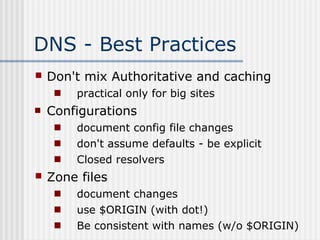
DNS - Best Practices
 Don't mix Authoritative and caching
 practical only for big sites
 Configurations
 document config file changes
 don't assume defaults - be explicit
 Closed resolvers
 Zone files
 document changes
 use $ORIGIN (with dot!)
 Be consistent with names (w/o $ORIGIN)
DNS Resources
 http://www.zytrax.com/books/dns
 http://www.isc.org (BIND 9)
 www.dnssec-deployment.org
 www.dnssec.net (info portal)
 Pro DNS and BIND!
Quick Quiz
 Can DHCP be used to update the
reverse map file?
 Name at least two security threats.
 Why is an OPEN DNS a Bad Thing?
 Name at least one other use for
DNS.
 Why is $ORIGIN important?

Basic dns-mod

  • 1.
  • 2.
    DNS and DHCP DHCP can be configured to auto- update (using DDNS) the forward and reverse map zones  Can be secured using allow-update (IP and crypto) or update-policy (crypto only)  Crypto may use TSIG or SIG(0)  Used by AD extensively  Interaction between AD and BIND9
  • 3.
  • 4.
  • 5.
    DNS and Security Local (1) is admin based  Variety of sysadmin techniques (permissions)  Chroot (jail)  DDNS (2) - inhibit or use IP/Crypto controls  Zone Transfers (3) - inhibit or use IP/Crypto controls  Resolver (4) - DNSSEC - viable  Resolver (5) - DNSSEC - not viable
  • 6.
    Open vs ClosedResolvers  Allows anyone, anywhere to query your resolver  DDoS amplification attacks  recursion yes; defaulted  Big Deal  ~50% of resolvers were open  BIND9.4 partial close using allow-query- cache {localnets; localhost;};  Always use allow-recursion with explicit list (use ACL clause for big lists)
  • 7.
    Closing DNS -Techniques # If authoritative servers (master/slave) # inhibit all recursion recursion no; # if master/slave with caching (hybrid) or caching only (resolver) # use an appropriate local address scope statement # to limit recursion requests to local users allow-recursion {192.168.2.0/24;}; // change IPs as required # OR if the DNS server's IPs and netmasks cover the whole # local network you can use: allow-recursion {"localnets";”localhost”;}; # personal DNS # hard limits on reading listen-on {127.0.0.1;}; // or listen-on {localhost;}; listen-on-v6 {::1;}; // OR listen-on-v6 {localhost;}; # OR allow-recursion {"localhost";};
  • 8.
    DNS - Uses DNSBL - DNS Blacklist  Used for email blacklists  Whitelists  ENUM  Maps E.164 (Telephone numbers)  Generic Principle of adding some (processed) name to a base name to get a DNS response
  • 9.
    DNS - DNSBL $TTL2d # default RR TTL $ORIGIN blacklist.example.com. IN SOA ns1.example.com. hostmaster.example.com.( 2003080800 ; se = serial number 3h ; ref = refresh 15m ; ret = update retry 3w ; ex = expiry 3h ; min = minimum ) IN NS ns1.example.com. IN NS ns2.example.com. # black list records - uses origin substitution rule (order unimportant) 2.0.0.127 IN A 127.0.0.2 # allows testing # black list RRs 135.2.168.192 IN A 127.0.0.2 # or some result code address IN TXT "Optional-explanation for black listing" # the above entries expands to 135.2.168.192.blacklist.example.com ... 135.17.168.192 IN A 127.0.0.2 # generic list ...
  • 10.
    DNS - OtherLists $TTL 2d # default RR TTL $ORIGIN whitelist.example.com. ... # white list records - using origin substitution rule # order not important other than for local usage reasons # normal whitelist RRs # by convention this address should be listed to allow for external testing 2.0.0.127 IN A 127.0.0.2 # black list RRs 135.2.168.192 IN A 127.0.0.2 # or some result code address IN TXT "Optional-explanation for listing" # the above entries expand to 135.2.168.192.blacklist.example.com ... 135.17.168.192 IN A 127.0.0.2 # generic list ... # name based RRs for white listing friend.com IN A 127.0.0.1 # all domain email addresses IN TXT "Optional-explanation for listing" # expands to friend.com.whitelist.example.com joe.my.my IN A 127.0.0.2 # single address # expands to joe.my.my.whitelist.example.com ...
  • 11.
    DNS - BestPractices  Don't mix Authoritative and caching  practical only for big sites  Configurations  document config file changes  don't assume defaults - be explicit  Closed resolvers  Zone files  document changes  use $ORIGIN (with dot!)  Be consistent with names (w/o $ORIGIN)
  • 12.
    DNS Resources  http://www.zytrax.com/books/dns http://www.isc.org (BIND 9)  www.dnssec-deployment.org  www.dnssec.net (info portal)  Pro DNS and BIND!
  • 13.
    Quick Quiz  CanDHCP be used to update the reverse map file?  Name at least two security threats.  Why is an OPEN DNS a Bad Thing?  Name at least one other use for DNS.  Why is $ORIGIN important?