Midwest Environmental Compliance Conference
May 14, 2015
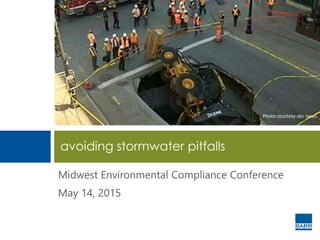
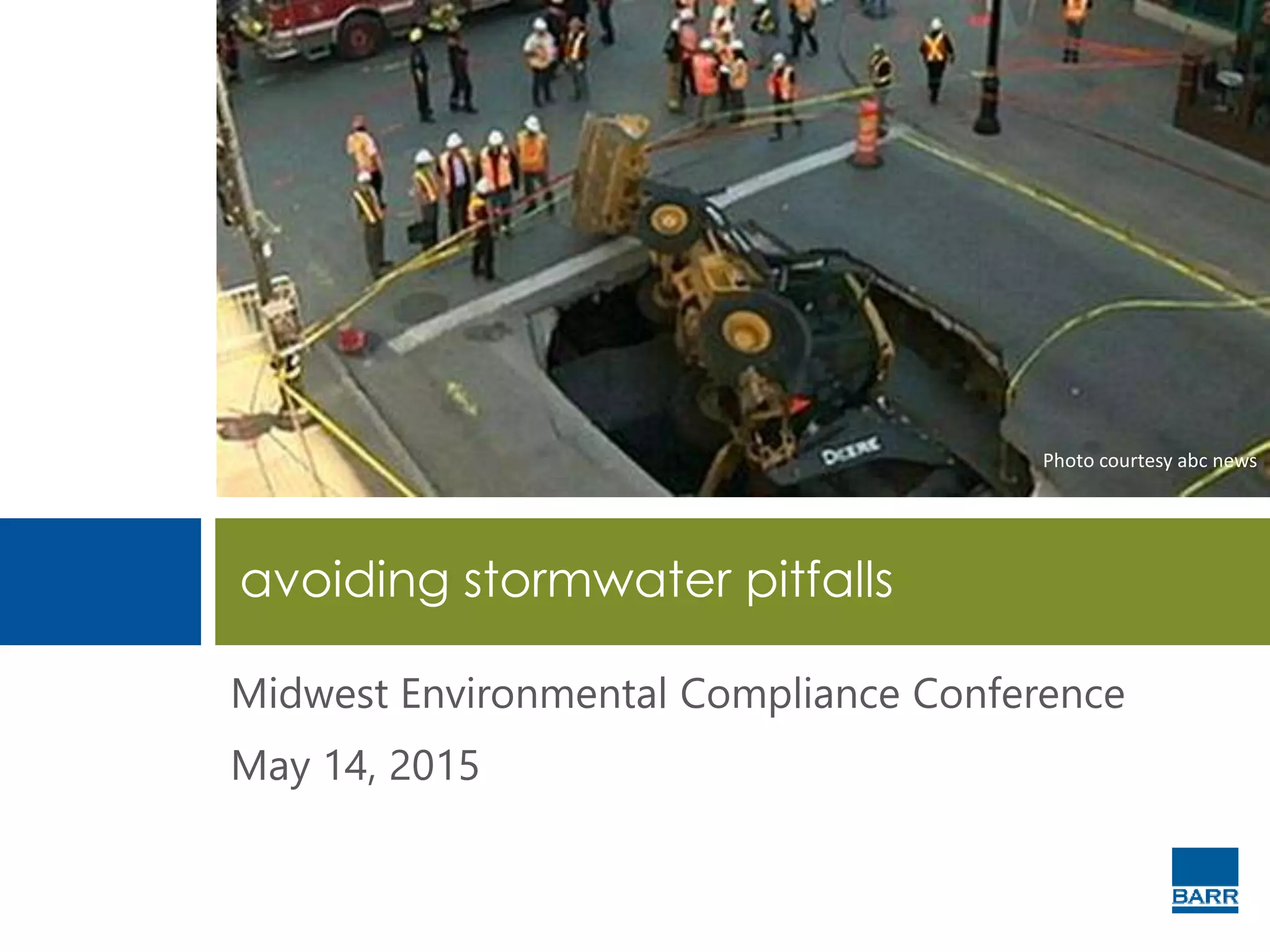
avoiding stormwater pitfalls
Photo courtesy abc news
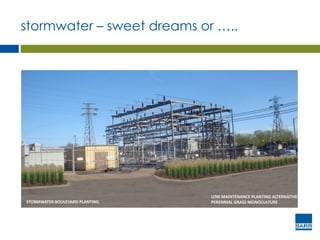
stormwater – sweet dreams or …..
…a nightmare
how do I avoid pitfalls?
• plan
− understand what’s required (aka know the permit requirements)
− be familiar with the discharge scenario
− know your effluent limits
− implement appropriate best management practices
 consider green infrastructure
• inspect/sampling
• training
• document
• maintain
stormwater 101 – what’s required
• 40 CFR 122.21, duty to apply
• 40 CFR 122.26, discharges that require a NPDES permit
• associated with a permit issued prior to February 4, 1987
•industrial activity
• large municipal separate storm sewer system (MS4)
• medium MS4
• discharges that contribute to a violation of the water
quality standards or is a significant contributor of
pollutants to water of the US (e.g. small MS4)
industrial activity – types of facilities*
40 CFR 122.26(b)(14)
− stormwater effluent limitation guidelines (ELG)
− standard industrial classification (SIC) codes (29 industry sectors)
− hazardous waste treatment, storage, and disposal facilities
(TSDFs)
− landfills, land application sites
− recycling facilities (e.g. metal scrapyards, battery reclaimers)
− steam electric power generating facilities
− transportation facilities
− domestic wastewater treatment facilities (>1MGD)
− construction sites
*caveats related to mining and oil & gas facilities
pitfall
• ensure that your facility is correctly identified
(SIC code) and make a determination prior to
submitting a permit application
• identify all pertinent information on the permit
application
• Example
petroleum pipeline stations vs. bulk terminals
122.26(a)(2)(ii) vs. SIC code 5171
permitting
• site specific permit
• general permit – state or EPA multi-sector
general permit (MSGP)
http://water.epa.gov/polwaste/npdes/stormwater/
EPA-Multi-Sector-General-Permit-MSGP.cfm
permitting effluent limits
• conventional effluent limits – 40 CFR 122.44
− technology vs. water quality based
• benchmark/best management practices – 40
CFR 122.44(k)
− MSGP – industry sector specific benchmarks
− site specific benchmarks for site specific permits
alternatives to permitting
• Conditional no-exposure certification [40 CFR
122.26(g)]
− renewed every 5 years
− issued on a facility-wide basis
− updated with changing site conditions
http://water.epa.gov/polwaste/npdes/stormwater/
Conditional-No-Exposure-Exclusion.cfm
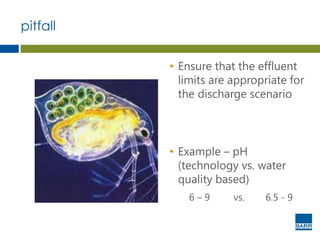
• Ensure that the effluent
limits are appropriate for
the discharge scenario
• Example – pH
(technology vs. water
quality based)
6 – 9 vs. 6.5 - 9
pitfall
best management practices
Definition:
Structural and non-structural controls or measures used
to reduce pollutants in stormwater runoff
bmp performance – planning and design
considerations
Three keys to bmp performance
− concentration (includes benchmark discharge goal)
 benchmarks
•numeric criteria to assist with the assessment of bmp
performance
•assess compliance with water quality criteria
− volume
− total load (understand the pollutants)
http://water.epa.gov/polwaste/npdes/stormwater/Three-Keys-to-
BMP-Performance.cfm
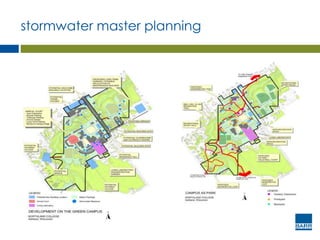
stormwater master planning
stormwater pollution
prevention plan (SWPPP)
 Structural BMP
• grit trap, tree trenches,
porous pavers, rain garden,
vegetated swale
 Non-structural BMP
• street-sweeping
• nutrient management plan
• de-icing plan
http://www.epa.gov/npdes/pubs/indust
rial_swppp_guide.pdf
bmp – plan/implement/comply
bmp implementation/compliance
stormwater pollution prevention plan
• inspections
− purpose
 assess effectiveness
 determine if maintenance is needed
− frequency
 routine (quarterly, annual)
 post-rainfall events
bmp implementation/compliance
stormwater pollution prevention plan
• inspections
− documentation
 inspection log
 deficiencies
 repairs/return to compliance
− follow-up and notification to the agencies of
performance/repairs/non-compliance
bmp implementation/compliance
stormwater pollution prevention plan
• sample collection/analytical parameters
− frequency (when to sample)
− containers, hold times, CoC, analytical method
− flow rate vs volume
• training
− documentation
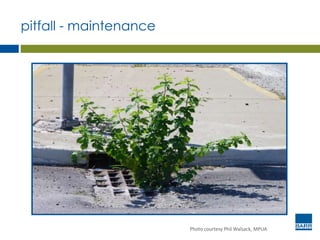
pitfall - maintenance
Photo courtesy Phil Walsack, MPUA
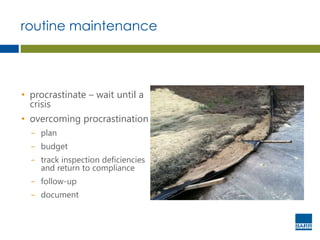
• procrastinate – wait until a
crisis
• overcoming procrastination
− plan
− budget
− track inspection deficiencies
and return to compliance
− follow-up
− document
routine maintenance
avoiding pitfalls
• plan
− understand the permit requirements
− be familiar with the discharge scenario
− know your effluent limits
− implement appropriate best management practices
 consider green infrastructure
• inspect/sampling
• training
• document
• maintain
Questions, Thanks & Contact Info
Rob Morrison, P.E.
Barr Engineering Co.
1001 Diamond Ridge, Suite 1100
Jefferson City, MO
573-638-5025
rmorrison@barr.com
May 13, 2015

Morrison, Rob, Barr Engineering, Avoiding Stormwater Pitfalls, 2015 MECC Kansas City

  • 1.
    Midwest Environmental ComplianceConference May 14, 2015 avoiding stormwater pitfalls Photo courtesy abc news
  • 2.
    stormwater – sweetdreams or …..
  • 3.
  • 4.
    how do Iavoid pitfalls? • plan − understand what’s required (aka know the permit requirements) − be familiar with the discharge scenario − know your effluent limits − implement appropriate best management practices  consider green infrastructure • inspect/sampling • training • document • maintain
  • 5.
    stormwater 101 –what’s required • 40 CFR 122.21, duty to apply • 40 CFR 122.26, discharges that require a NPDES permit • associated with a permit issued prior to February 4, 1987 •industrial activity • large municipal separate storm sewer system (MS4) • medium MS4 • discharges that contribute to a violation of the water quality standards or is a significant contributor of pollutants to water of the US (e.g. small MS4)
  • 6.
    industrial activity –types of facilities* 40 CFR 122.26(b)(14) − stormwater effluent limitation guidelines (ELG) − standard industrial classification (SIC) codes (29 industry sectors) − hazardous waste treatment, storage, and disposal facilities (TSDFs) − landfills, land application sites − recycling facilities (e.g. metal scrapyards, battery reclaimers) − steam electric power generating facilities − transportation facilities − domestic wastewater treatment facilities (>1MGD) − construction sites *caveats related to mining and oil & gas facilities
  • 7.
    pitfall • ensure thatyour facility is correctly identified (SIC code) and make a determination prior to submitting a permit application • identify all pertinent information on the permit application • Example petroleum pipeline stations vs. bulk terminals 122.26(a)(2)(ii) vs. SIC code 5171
  • 8.
    permitting • site specificpermit • general permit – state or EPA multi-sector general permit (MSGP) http://water.epa.gov/polwaste/npdes/stormwater/ EPA-Multi-Sector-General-Permit-MSGP.cfm
  • 9.
    permitting effluent limits •conventional effluent limits – 40 CFR 122.44 − technology vs. water quality based • benchmark/best management practices – 40 CFR 122.44(k) − MSGP – industry sector specific benchmarks − site specific benchmarks for site specific permits
  • 10.
    alternatives to permitting •Conditional no-exposure certification [40 CFR 122.26(g)] − renewed every 5 years − issued on a facility-wide basis − updated with changing site conditions http://water.epa.gov/polwaste/npdes/stormwater/ Conditional-No-Exposure-Exclusion.cfm
  • 11.
    • Ensure thatthe effluent limits are appropriate for the discharge scenario • Example – pH (technology vs. water quality based) 6 – 9 vs. 6.5 - 9 pitfall
  • 12.
    best management practices Definition: Structuraland non-structural controls or measures used to reduce pollutants in stormwater runoff
  • 13.
    bmp performance –planning and design considerations Three keys to bmp performance − concentration (includes benchmark discharge goal)  benchmarks •numeric criteria to assist with the assessment of bmp performance •assess compliance with water quality criteria − volume − total load (understand the pollutants) http://water.epa.gov/polwaste/npdes/stormwater/Three-Keys-to- BMP-Performance.cfm
  • 14.
  • 15.
    stormwater pollution prevention plan(SWPPP)  Structural BMP • grit trap, tree trenches, porous pavers, rain garden, vegetated swale  Non-structural BMP • street-sweeping • nutrient management plan • de-icing plan http://www.epa.gov/npdes/pubs/indust rial_swppp_guide.pdf bmp – plan/implement/comply
  • 16.
    bmp implementation/compliance stormwater pollutionprevention plan • inspections − purpose  assess effectiveness  determine if maintenance is needed − frequency  routine (quarterly, annual)  post-rainfall events
  • 17.
    bmp implementation/compliance stormwater pollutionprevention plan • inspections − documentation  inspection log  deficiencies  repairs/return to compliance − follow-up and notification to the agencies of performance/repairs/non-compliance
  • 18.
    bmp implementation/compliance stormwater pollutionprevention plan • sample collection/analytical parameters − frequency (when to sample) − containers, hold times, CoC, analytical method − flow rate vs volume • training − documentation
  • 19.
    pitfall - maintenance Photocourtesy Phil Walsack, MPUA
  • 20.
    • procrastinate –wait until a crisis • overcoming procrastination − plan − budget − track inspection deficiencies and return to compliance − follow-up − document routine maintenance
  • 21.
    avoiding pitfalls • plan −understand the permit requirements − be familiar with the discharge scenario − know your effluent limits − implement appropriate best management practices  consider green infrastructure • inspect/sampling • training • document • maintain
  • 22.
    Questions, Thanks &Contact Info Rob Morrison, P.E. Barr Engineering Co. 1001 Diamond Ridge, Suite 1100 Jefferson City, MO 573-638-5025 rmorrison@barr.com May 13, 2015