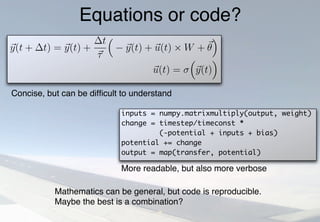
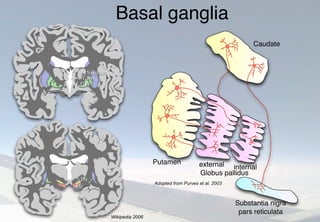
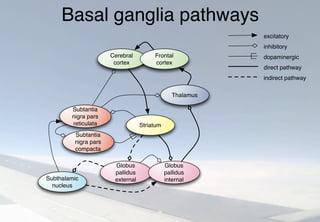
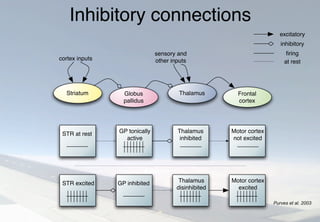
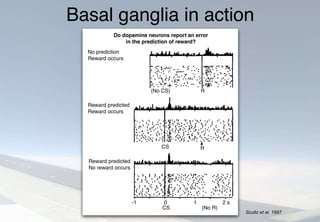
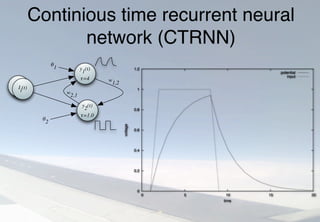
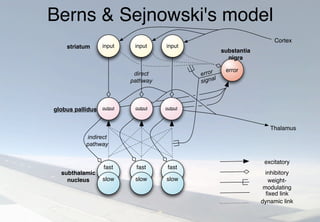
This thesis presents a model of the basal ganglia using a continuous time recurrent neural network (CTRNN) to simulate its pathways and learning. The model reproduces the response of globus pallidus neurons seen in previous work. An error function is used to calculate the difference between striatum and globus pallidus activity for weight updates between the subthalamic nucleus and globus pallidus. Experiments adding noise and using a sigmoidal update rule are also presented. The thesis discusses representing the model with equations versus code, noting tradeoffs between readability and reproducibility. A CTRNN library was implemented in Python to simulate the basal ganglia model.



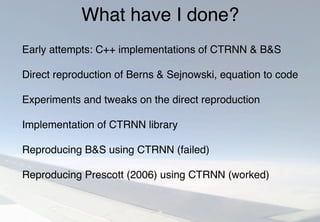

![Error function
he GP output is compared to the weighted STR inpu
e(s) =
i
Gi(s) − vi(s)Si(s)
weight representing the connection between STR un
ed for updating the weight of the connection between ST
STN unit has connections to all GP units, and the co
using a Hebbian learning rule (Sutton and Barto, 1981
def calc_error(self):
sum = 0.0
for i in range(self.inputs):
sum += self.GP[i]
sum -= self.v[i]* self.STR[i]
return sum
1
1.5
2
2.5
3
3.5
4
0 20 40 60 80 100 120 140 160 180 200
error
timestep
Berns & Sejnowski Soiland
Berns & Sejnowski 1998](https://image.slidesharecdn.com/ce4eca64-9b0d-4d96-9fab-7b2a497a9f44-161107105854/85/basal-ganglia-13-320.jpg)
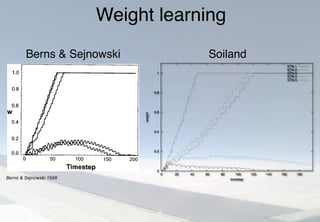
![Experiment: Sigmoidal update ruleAs shown in the discrete update rule in equation 3.5 on page 24
is applied several times, as simplified in:
B(s) = σ (αB(s − 1) + β)
B(s + 1) = σ (ασ (αB(s − 1) + β) + β)
To investigate the effect of using an iterative sigmoidal update ru
were applied in a Octave (Murphy, 1997) simulation, a function
normal leaky integrator potential, while function v(t) represents
rule as in Berns and Sejnowski:
u(t) = u(t − 1) +
1
τ
− u(t − 1) + I(t)
v(t) = σ v(t − 1) +
1
τ
− v(t − 1) + I(t)
0
0.2
0.4
0.6
0.8
1
1.2
0 5 10 15 20 25 30
voltage
input
u(t)
sigmoid(u(t))
v(t)
as a modified version of equation 2.3 on page 16, includ
σ, which is an extended version of equation 2.2 on p
bias β:
σ(x) =
1
1 + e−γ(x−β)
Berns and Sejnowski (1998) introduce a term λ rep
by the size of the time step:
λ =
τ
τ + ∆t
Substituting equation 3.4 into equation 3.2 yields th
def calc_STN(self, i):
return self.sigmoid(lambd * self.STN[i] -
(1-lambd) * self.effect * self.GP[i/2])
(..)
STN[i] = calc_STN(i)
def sigmoid(self, x):
return 1.0 / (1.0 +
math.exp(-self.gain * (x-self.bias)))](https://image.slidesharecdn.com/ce4eca64-9b0d-4d96-9fab-7b2a497a9f44-161107105854/85/basal-ganglia-15-320.jpg)
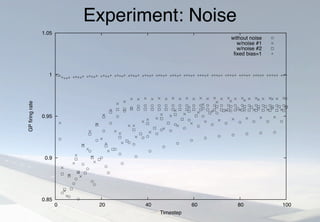
![CTRNN library for Python
import ctrnn
net = ctrnn.CTRNN(2)
net.bias[0] = 0.4
net.timeconst[1] = 1.4
net.weight[0,1] = 1.5
net.weight[1,0] = -1.0
net.calc_timestep(); print net.output
net.calc_timestep(); print net.output
[ 0.59868766 0.5 ]
[ 0.47502081 0.6550814 ]
y1(t)
τ=1.4
y0(t)
τ=1.0
1.5
-1.0
0.4](https://image.slidesharecdn.com/ce4eca64-9b0d-4d96-9fab-7b2a497a9f44-161107105854/85/basal-ganglia-16-320.jpg)