Myth Today & Mythologies
Roland Barthes
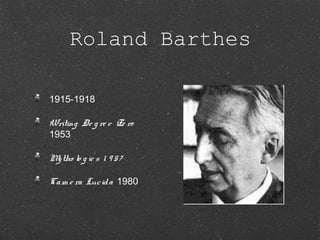
1915-1918
Writing De g re e Ze ro
1953
Mytho lo g ie s 1 9 57
Cam e ra Lucida 1980
Roland Barthes
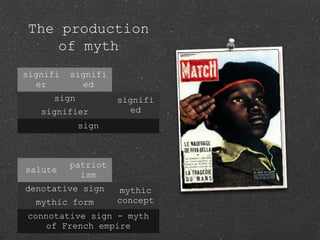
The production
of myth
signifi
er
signifi
ed
sign signifi
edsignifier
sign
salute
patriot
ism
denotative sign mythic
conceptmythic form
connotative sign - myth
of French empire
QuickTime™ and aCinepak decompressorare needed to see
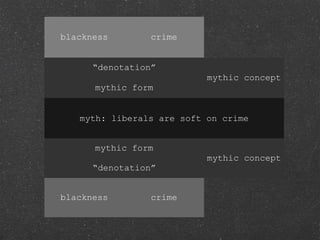
blackness crime
“denotation”
mythic concept
mythic form
myth: liberals are soft on crimemyth: liberals are soft on crime
mythic form
mythic concept
“denotation”
blackness crime
Barthes understands bourgeois myths
to conform generally to seven key
figures
These figures can be used as
heuristics to interrogate cultural
artifacts
Mythical rhetoric
Neither/Norism: “Liberals or
Conservatives: what’s the difference?”;
the lose-lose proposition--leads to
political cynicism
The quantification of quality: the market
determines all value
Myth on the “right”: rhetorical
figures typical of bourgeois
ideology
The statement of fact: common sense;
truisms; things are no more complex
than they seem
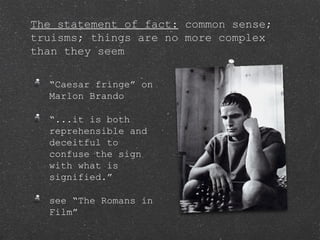
“Caesar fringe” on
Marlon Brando
“...it is both
reprehensible and
deceitful to
confuse the sign
with what is
signified.”
see “The Romans in
Film”
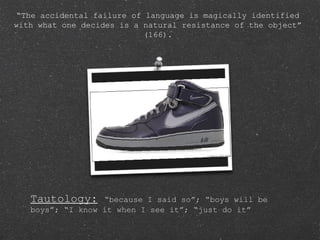
Tautology: “because I said so”; “boys will be
boys”; “I know it when I see it”; “just do it”
“The accidental failure of language is magically identified
with what one decides is a natural resistance of the object”
(166).
Identification: otherness must be
reduced to sameness
The Family of Man Exhibit
Museum of Modern Art 1955
There is only one man in the world
and his name is All Men.
There is only one woman in the world
and her name is All Women.
There is only one child in the world
and the child's name is All Children.
--Carl Sandburg at the
entryway to the exhibit
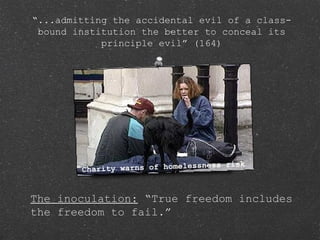
The inoculation: “True freedom includes
the freedom to fail.”
Charity warns of homelessness risk
“...admitting the accidental evil of a class-
bound institution the better to conceal its
principle evil” (164)
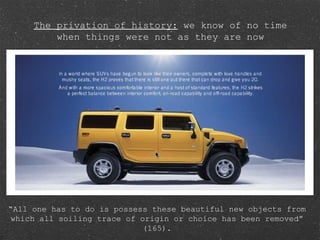
The privation of history: we know of no time
when things were not as they are now
“All one has to do is possess these beautiful new objects from
which all soiling trace of origin or choice has been removed”
(165).
Markers, Metasigns, and Styles
Markedness is opposed to unmarkedness.
It means that a given form is distinguishable from
another on the basis of a special semiotic
feature.
A marked form, in other words, is simply one that
stands out from the rest.
Unmarked forms tend to be transparent--that is,
you don’t notice them; they seem natural.
Unmarked forms are the “default” position.
Markedness is opposed to unmarkedness.
It means that a given form is distinguishable from
another on the basis of a special semiotic
feature.
A marked form, in other words, is simply one that
stands out from the rest.
Unmarked forms tend to be transparent--that is,
you don’t notice them; they seem natural.
Unmarked forms are the “default” position.
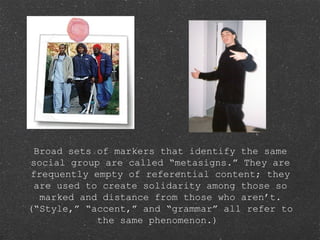
Broad sets of markers that identify the same
social group are called “metasigns.” They are
frequently empty of referential content; they
are used to create solidarity among those so
marked and distance from those who aren’t.
(“Style,” “accent,” and “grammar” all refer to
the same phenomenon.)
roland Barthes

roland Barthes

  • 1.
    Myth Today &Mythologies Roland Barthes
  • 2.
    1915-1918 Writing De gre e Ze ro 1953 Mytho lo g ie s 1 9 57 Cam e ra Lucida 1980 Roland Barthes
  • 3.
    The production of myth signifi er signifi ed signsignifi edsignifier sign salute patriot ism denotative sign mythic conceptmythic form connotative sign - myth of French empire
  • 4.
    QuickTime™ and aCinepakdecompressorare needed to see blackness crime “denotation” mythic concept mythic form myth: liberals are soft on crimemyth: liberals are soft on crime mythic form mythic concept “denotation” blackness crime
  • 5.
    Barthes understands bourgeoismyths to conform generally to seven key figures These figures can be used as heuristics to interrogate cultural artifacts Mythical rhetoric
  • 6.
    Neither/Norism: “Liberals or Conservatives:what’s the difference?”; the lose-lose proposition--leads to political cynicism The quantification of quality: the market determines all value Myth on the “right”: rhetorical figures typical of bourgeois ideology
  • 7.
    The statement offact: common sense; truisms; things are no more complex than they seem “Caesar fringe” on Marlon Brando “...it is both reprehensible and deceitful to confuse the sign with what is signified.” see “The Romans in Film”
  • 8.
    Tautology: “because Isaid so”; “boys will be boys”; “I know it when I see it”; “just do it” “The accidental failure of language is magically identified with what one decides is a natural resistance of the object” (166).
  • 9.
    Identification: otherness mustbe reduced to sameness The Family of Man Exhibit Museum of Modern Art 1955 There is only one man in the world and his name is All Men. There is only one woman in the world and her name is All Women. There is only one child in the world and the child's name is All Children. --Carl Sandburg at the entryway to the exhibit
  • 10.
    The inoculation: “Truefreedom includes the freedom to fail.” Charity warns of homelessness risk “...admitting the accidental evil of a class- bound institution the better to conceal its principle evil” (164)
  • 11.
    The privation ofhistory: we know of no time when things were not as they are now “All one has to do is possess these beautiful new objects from which all soiling trace of origin or choice has been removed” (165).
  • 12.
    Markers, Metasigns, andStyles Markedness is opposed to unmarkedness. It means that a given form is distinguishable from another on the basis of a special semiotic feature. A marked form, in other words, is simply one that stands out from the rest. Unmarked forms tend to be transparent--that is, you don’t notice them; they seem natural. Unmarked forms are the “default” position. Markedness is opposed to unmarkedness. It means that a given form is distinguishable from another on the basis of a special semiotic feature. A marked form, in other words, is simply one that stands out from the rest. Unmarked forms tend to be transparent--that is, you don’t notice them; they seem natural. Unmarked forms are the “default” position.
  • 13.
    Broad sets ofmarkers that identify the same social group are called “metasigns.” They are frequently empty of referential content; they are used to create solidarity among those so marked and distance from those who aren’t. (“Style,” “accent,” and “grammar” all refer to the same phenomenon.)