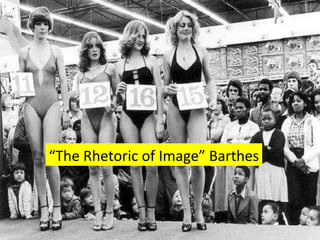
“ The Rhetoric of Image” Barthes
Homework for Today Bring in a simple object that you think refers to something about yourself Bring the object in a bag and list on a piece of paper in the bag what the object signifies Keep both things secret!
Homework for Monday To find a magazine- choose one you don’t usually read Deconstruct the front cover using semiotics to explore- denotation, connotation, ideology, myth Be prepared to present and share on Monday Time limit 4 mins
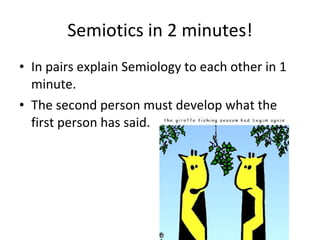
Semiotics in 2 minutes! In pairs explain Semiology to each other in 1 minute. The second person must develop what the first person has said.
The Sign Game
What does the object signify to you?
Compare these with the signifieds you wrote down.  What do you notice?
What is the issue with naturalisation?
“ false consciousness” Leads to an unrealistic understanding of how the world works and one’s role in society. Beliefs expounded by the media become ‘naturalised’=  Mythologising
Dominant Ideologies An ideology is a belief system that is constructed and presented by a media text. Media texts represent the world in order to support a  dominant ideology.
What is the dominant ideology of this text?
 
Some Dominant Ideologies Capitalism.  The production of capital and consumption of surplus value as a life goal. Patriotism.  To love, support and protect one’s country and its people. Marriage and family.  The “right way” to live is to marry an opposite-sex partner and have children. Male superiority.  Men are more suited to positions of power, and more suited to decision-making at work and at home.
How far then are is our consciousness shaped by the mass media?
What is the purpose of ideologies? Is there one?
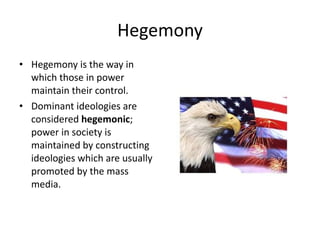
Hegemony Hegemony is the way in which those in power maintain their control.  Dominant ideologies are considered  hegemonic ; power in society is maintained by constructing ideologies which are usually promoted by the mass media.
Examples of hegemonic values The police are always right It is important to be slim A credit card is a desirable status symbol Mass immigration is undesirable The poor are lazy and deserve their hardship Men are better drivers than women It is important to wear fashionable clothes
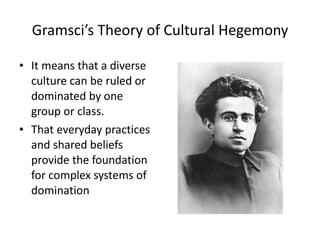
Gramsci’s Theory of Cultural Hegemony It means that a diverse culture can be ruled or dominated by one group or class.  That everyday practices and shared beliefs provide the foundation for complex systems of domination
Gramsci and Hegemony In "advanced" industrial societies hegemonic cultural innovations such as compulsory schooling,  mass media , and popular culture have indoctrinated workers to a false consciousness.
Deconstructing Signs You’re going to have a go at deconstructing signs and codes…
Where do we start? I know what it means but how an earth do I know?
How do I interpret a sign?
Denotation ‘tends to be described as the definitional, 'literal', 'obvious' or 'commonsense' meaning of a sign.
What’s missing? As Roland Barthes noted, Saussure's model of the sign focused on  denotation  at the expense of  connotation  and it was left to subsequent theorists (notably Barthes himself) to offer an account of this important dimension of meaning (Barthes 1967)
Connotation? The interpretation of a sign for meaning it signifies.
What happens when we can’t decipher between denotation and connotation?
‘ Naturalisation’ Barthes 1977 Connotation, in short, produces the  illusion  of denotation- signifier and signified are identical. Connotation becomes a  ‘naturalised ’ process- creating the powerful  illusion  that denotation is a purely literal and has universal meaning
Barthes on Myths Dominant ideologies of our time. Orders of signification= denotation + connotation = ideology
The power of Myths Hide the ideological function of signs and codes They ‘go without saying’ and so appeared not to need to be deciphered or interpreted Beliefs expounded become, as a result, entirely ‘natural’ and unquestioned.
Denotation? Movie star- Marilyn Monroe
Connotation star qualities of glamour, sexuality, beauty - if this is an early photograph –  but also with her depression, drug-taking and untimely death if it is one of her last photographs.
Myth? Myth of Hollywood: the dream dream factory that produces glamour in the form of the stars it constructs, but also the dream machine that can crush them - all with a view to profit and expediency. (Hayward 1996)

Hegemony denotation connotation barthes

  • 1.
    “ The Rhetoricof Image” Barthes
  • 2.
    Homework for TodayBring in a simple object that you think refers to something about yourself Bring the object in a bag and list on a piece of paper in the bag what the object signifies Keep both things secret!
  • 3.
    Homework for MondayTo find a magazine- choose one you don’t usually read Deconstruct the front cover using semiotics to explore- denotation, connotation, ideology, myth Be prepared to present and share on Monday Time limit 4 mins
  • 4.
    Semiotics in 2minutes! In pairs explain Semiology to each other in 1 minute. The second person must develop what the first person has said.
  • 5.
  • 6.
    What does theobject signify to you?
  • 7.
    Compare these withthe signifieds you wrote down. What do you notice?
  • 8.
    What is theissue with naturalisation?
  • 9.
    “ false consciousness”Leads to an unrealistic understanding of how the world works and one’s role in society. Beliefs expounded by the media become ‘naturalised’= Mythologising
  • 10.
    Dominant Ideologies Anideology is a belief system that is constructed and presented by a media text. Media texts represent the world in order to support a dominant ideology.
  • 11.
    What is thedominant ideology of this text?
  • 12.
  • 13.
    Some Dominant IdeologiesCapitalism. The production of capital and consumption of surplus value as a life goal. Patriotism. To love, support and protect one’s country and its people. Marriage and family. The “right way” to live is to marry an opposite-sex partner and have children. Male superiority. Men are more suited to positions of power, and more suited to decision-making at work and at home.
  • 14.
    How far thenare is our consciousness shaped by the mass media?
  • 15.
    What is thepurpose of ideologies? Is there one?
  • 16.
    Hegemony Hegemony isthe way in which those in power maintain their control. Dominant ideologies are considered hegemonic ; power in society is maintained by constructing ideologies which are usually promoted by the mass media.
  • 17.
    Examples of hegemonicvalues The police are always right It is important to be slim A credit card is a desirable status symbol Mass immigration is undesirable The poor are lazy and deserve their hardship Men are better drivers than women It is important to wear fashionable clothes
  • 18.
    Gramsci’s Theory ofCultural Hegemony It means that a diverse culture can be ruled or dominated by one group or class. That everyday practices and shared beliefs provide the foundation for complex systems of domination
  • 19.
    Gramsci and HegemonyIn "advanced" industrial societies hegemonic cultural innovations such as compulsory schooling, mass media , and popular culture have indoctrinated workers to a false consciousness.
  • 20.
    Deconstructing Signs You’regoing to have a go at deconstructing signs and codes…
  • 21.
    Where do westart? I know what it means but how an earth do I know?
  • 22.
    How do Iinterpret a sign?
  • 23.
    Denotation ‘tends tobe described as the definitional, 'literal', 'obvious' or 'commonsense' meaning of a sign.
  • 24.
    What’s missing? AsRoland Barthes noted, Saussure's model of the sign focused on denotation at the expense of connotation and it was left to subsequent theorists (notably Barthes himself) to offer an account of this important dimension of meaning (Barthes 1967)
  • 25.
    Connotation? The interpretationof a sign for meaning it signifies.
  • 26.
    What happens whenwe can’t decipher between denotation and connotation?
  • 27.
    ‘ Naturalisation’ Barthes1977 Connotation, in short, produces the illusion of denotation- signifier and signified are identical. Connotation becomes a ‘naturalised ’ process- creating the powerful illusion that denotation is a purely literal and has universal meaning
  • 28.
    Barthes on MythsDominant ideologies of our time. Orders of signification= denotation + connotation = ideology
  • 29.
    The power ofMyths Hide the ideological function of signs and codes They ‘go without saying’ and so appeared not to need to be deciphered or interpreted Beliefs expounded become, as a result, entirely ‘natural’ and unquestioned.
  • 30.
  • 31.
    Connotation star qualitiesof glamour, sexuality, beauty - if this is an early photograph – but also with her depression, drug-taking and untimely death if it is one of her last photographs.
  • 32.
    Myth? Myth ofHollywood: the dream dream factory that produces glamour in the form of the stars it constructs, but also the dream machine that can crush them - all with a view to profit and expediency. (Hayward 1996)