BARRIERS
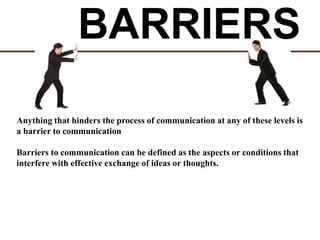
Anything that hinders the process of communication at any of these levels is
a barrier to communication
Barriers to communication can be defined as the aspects or conditions that
interfere with effective exchange of ideas or thoughts.
CLASSIFICATION OF BARRIERS
1. PHYSICAL BARRIERS
2. SEMANTIC AND LANGUAGE BARRIERS
3. SOCIO-PSYCHOLOGICAL BARRIERS
4. ORGANIZATIONAL BARRIERS
5. CROSS-CULTURAL BARRIERS
• Physical barrier is the environmental and natural condition that act as a barrier in
communication in sending message from sender to receiver. Organizational
environment or interior workspace design problems, technological problems and
noise are the parts of physical barriers.
What do you mean by SEMANTICS?
• Semantic is the study of meaning, signs and symbols used for communication.
The word is derived from “sema”, a Greek word meaning signs. Semantic barriers
to communication are the symbolic obstacles that distorts the sent message in
some other way than intended, making the message difficult to understand.
• Cross-cultural communication barriers such as anxiety, uncertainty, stereotyping,
and ethnocentrism are caused by inadequate cultural knowledge and the lack
of intercultural communicative skills.
• Language is needed for any kind of communication even people with speech
impairments communicate with sign language and brail. Communication becomes
difficult in situations where people don’t understand each others’ language. The
inability to communicate using a language is known as language barrier to
communication.
CAUSES OF SEMANTIC BARRIER
• 3 main causes
HOMOPHONES
HOMONYMS
HOMOGRAPHS
DENOTATIONS AND CONNOTATIONS
TYPES OF SEMANTIC BARRIER:
• Denotation: The literal meaning of a word
For example, the meaning of braces which is used to define the metallic structure
to adjust teeth in American English whereas it means a part of clothing in British
English.
• Connotations: The emotions and associations connected to a word
For example, the word astonish can be used to describe surprise as well as startle.
The words, when used by someone, can have any of the meaning. The context in
which it is used will only let the receiver know what the sender means. Another
example is the word god, which is used differently by people following different
religions.
Examples:
They gave us cheap stuff.
At this shop, they sell things cheap
Organizational barriers
• Organizational barriers come up when characteristics of the client system
itself conflict with the demands of change. There are several examples of
these types of barriers. They are threat to power and influence,
organizational structure, behavior of top-level administrators, climate for
change in the organization and technological barriers of resistance.
• Lack of communication policy
• Authoritarian attitude of management
• Poorly Defined Authority and Responsibility
• Too Many Levels in Organization Structure
• Insufficient Communication Training

Barriers.pptx

  • 1.
    BARRIERS Anything that hindersthe process of communication at any of these levels is a barrier to communication Barriers to communication can be defined as the aspects or conditions that interfere with effective exchange of ideas or thoughts.
  • 2.
    CLASSIFICATION OF BARRIERS 1.PHYSICAL BARRIERS 2. SEMANTIC AND LANGUAGE BARRIERS 3. SOCIO-PSYCHOLOGICAL BARRIERS 4. ORGANIZATIONAL BARRIERS 5. CROSS-CULTURAL BARRIERS
  • 3.
    • Physical barrieris the environmental and natural condition that act as a barrier in communication in sending message from sender to receiver. Organizational environment or interior workspace design problems, technological problems and noise are the parts of physical barriers. What do you mean by SEMANTICS? • Semantic is the study of meaning, signs and symbols used for communication. The word is derived from “sema”, a Greek word meaning signs. Semantic barriers to communication are the symbolic obstacles that distorts the sent message in some other way than intended, making the message difficult to understand. • Cross-cultural communication barriers such as anxiety, uncertainty, stereotyping, and ethnocentrism are caused by inadequate cultural knowledge and the lack of intercultural communicative skills. • Language is needed for any kind of communication even people with speech impairments communicate with sign language and brail. Communication becomes difficult in situations where people don’t understand each others’ language. The inability to communicate using a language is known as language barrier to communication.
  • 4.
    CAUSES OF SEMANTICBARRIER • 3 main causes HOMOPHONES HOMONYMS HOMOGRAPHS
  • 5.
    DENOTATIONS AND CONNOTATIONS TYPESOF SEMANTIC BARRIER: • Denotation: The literal meaning of a word For example, the meaning of braces which is used to define the metallic structure to adjust teeth in American English whereas it means a part of clothing in British English. • Connotations: The emotions and associations connected to a word For example, the word astonish can be used to describe surprise as well as startle. The words, when used by someone, can have any of the meaning. The context in which it is used will only let the receiver know what the sender means. Another example is the word god, which is used differently by people following different religions. Examples: They gave us cheap stuff. At this shop, they sell things cheap
  • 6.
    Organizational barriers • Organizationalbarriers come up when characteristics of the client system itself conflict with the demands of change. There are several examples of these types of barriers. They are threat to power and influence, organizational structure, behavior of top-level administrators, climate for change in the organization and technological barriers of resistance. • Lack of communication policy • Authoritarian attitude of management • Poorly Defined Authority and Responsibility • Too Many Levels in Organization Structure • Insufficient Communication Training

Editor's Notes