RENAISSANCE
Víctor Acevedo González, nº1
Lucía Allen Fano, nº3
Iván Bueno Ferrero, nº7 2ºE.S.O. B
RENAISSANCE
• 14th to 17th century.
• Started in Florence, Italy.
• Cultural bridge that marked the start of the Early
Modern Age.
• Ancient Rome and Greece ideas reborned.
• Great intellectual and cultural movement: Humanism
• “Humans are the centre of the Universe”
• “Do your best at Earth!”
Vitruvian Man,
Leonardo da Vinci
La Gioconda,
Leonardo da Vinci
Fractionary numbers,
Christoff Rudolff
Thomas á KempisEl Quijote,
Miguel de Cervantes
MUSIC
ART
LITERATURE PHILOSOPHY
SCIENCE
RENAISSANCE
• Before this period, the most
important music was played by
the Church.
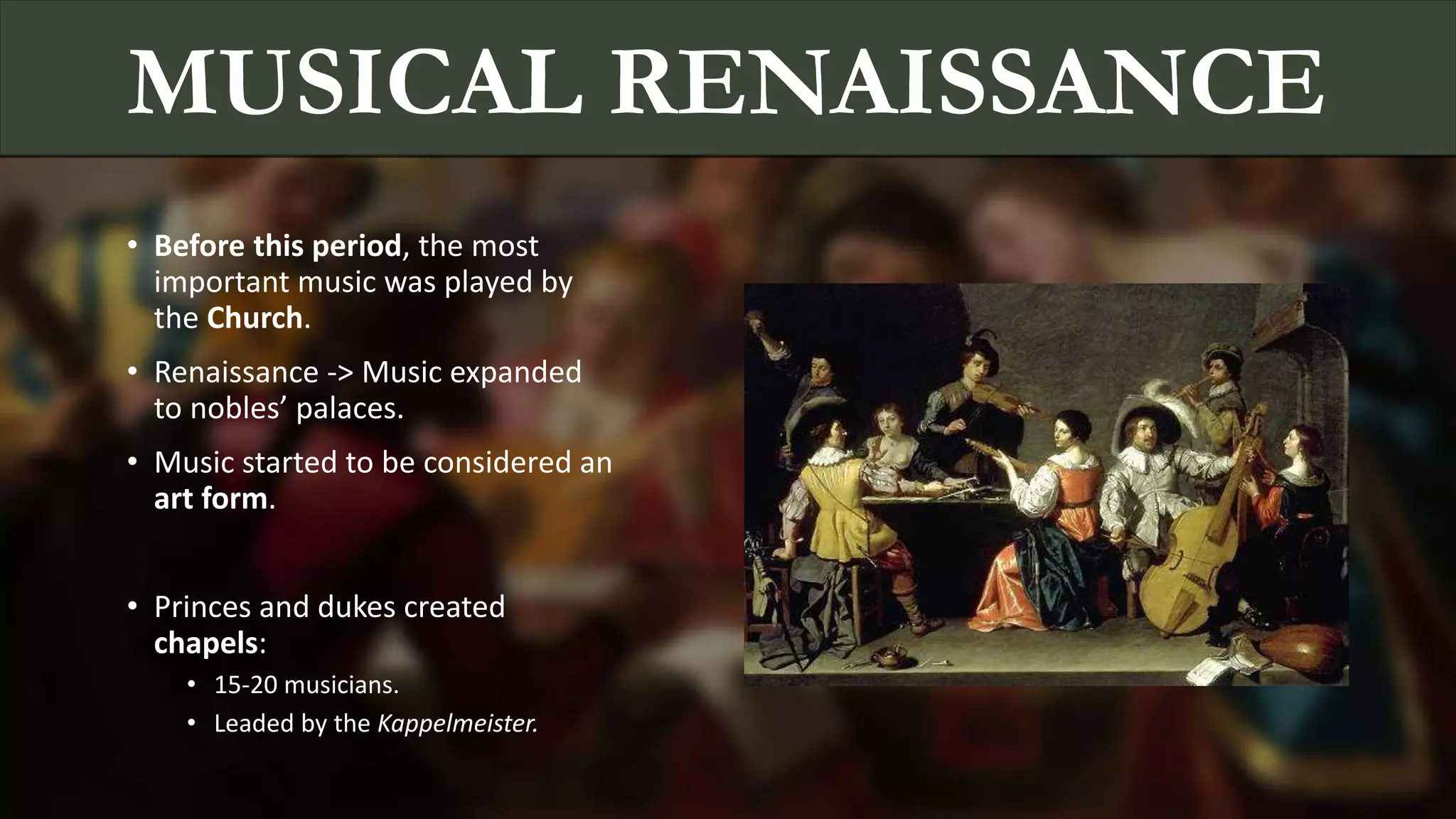
• Renaissance -> Music expanded
to nobles’ palaces.
• Music started to be considered an
art form.
• Princes and dukes created
chapels:
• 15-20 musicians.
• Leaded by the Kappelmeister.
MUSICAL RENAISSANCE
CHARACTERISTICS OF
RENAISSANCE MUSIC:
• JUST POLYPHONY!:
• Counterpoint polyphony.
• Homophonic polyphony.
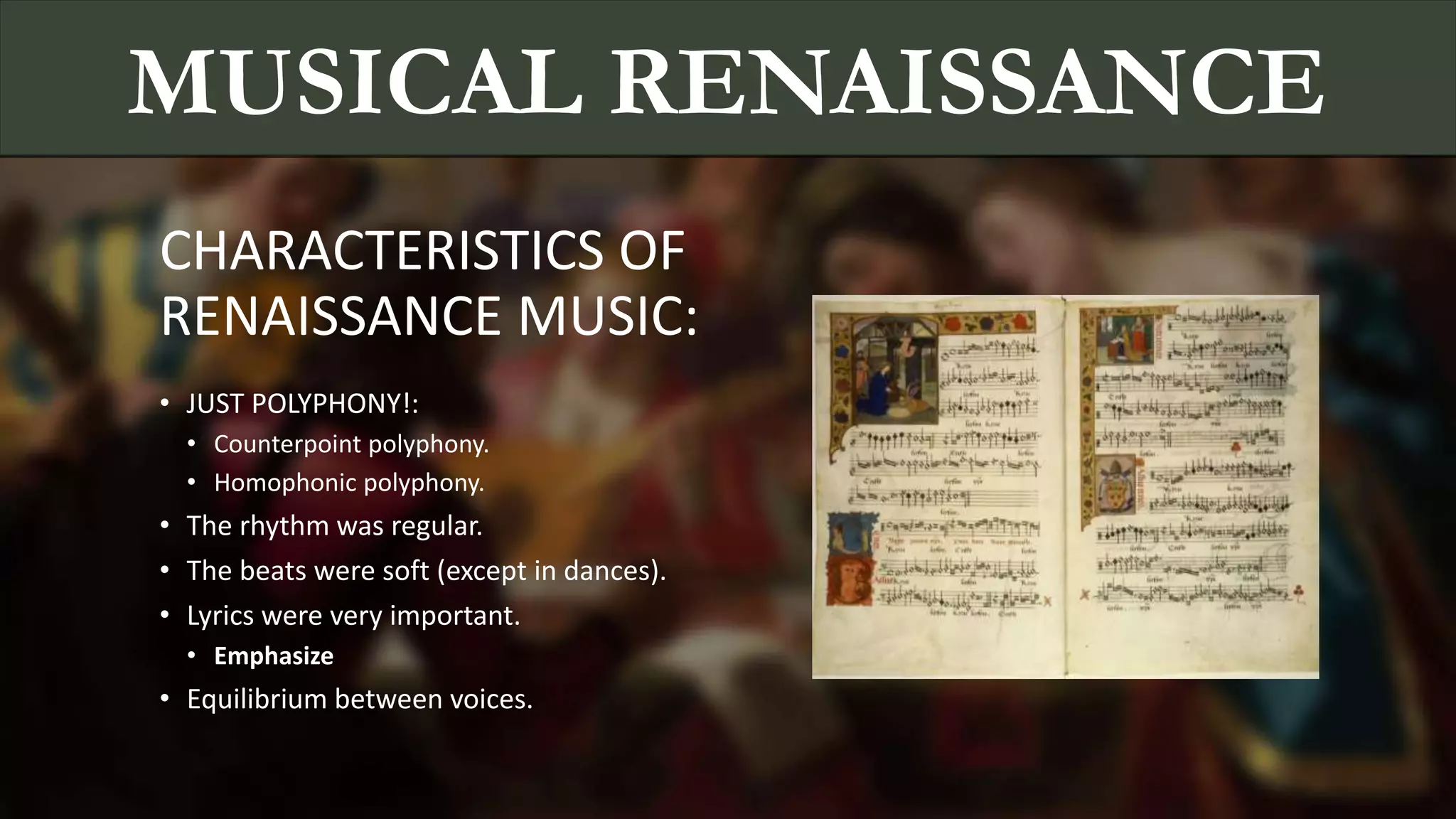
• The rhythm was regular.
• The beats were soft (except in dances).
• Lyrics were very important.
• Emphasize
• Equilibrium between voices.
MUSICAL RENAISSANCE
• MASS:
• Musical form based on the
union of sacred texts
• MOTET:
• Polyphonic composition
without accompainment.
• Doesn’t overlap different
lyrics.
• Most important composers:
• Giovanni Pierluigi da Palestrina
• Orlando di Lasso (Italy)
• Tomás Luis de Victoria & Cristóbal
Morales(Spain)
RELIGIOUS VOCAL MUSIC
•PROTESTANT REFORMATION:
• Germany 1519, Martin Luther
creates Protestantism.
• Brought several changes to music:
• Music began to be written in
German.
• Chorale; the most important
protestant music genre.
• Simple, four voice work.
• Sung in German.
• Homophony.
RELIGIOUS VOCAL MUSIC
• Anglican Church -> ANTHEM Marthin Luther,
“creator” of Protestantism.
•COUNTER-REFORMATION:
• The Catholic church was worried
about internal fights.
• Trent Council (1545-1563):
• The songs were written in Latin.
• Any Secular theme was
forbidden.
• Polyphony was simplified.
RELIGIOUS VOCAL MUSIC
Pope Paul III,
convener of the Council of Trent.
• Different in each area.
• ITALY (Madrigal):
• Complex polyphony.
• Sung by 4 to 5 voices.
• Usually, was sung a capella.
• Luca Marenzio & Claudio
Monteverdi.
• SPAIN (Villancico):
• NOT RELATED TO
CHRISTMAS.
• Sung in Spanish.
• Juan del Enzina.
SECULAR VOCAL MUSIC
• Was being forgotten.
• JUST to entertain people.
• PRESS INVENTION (~1440):
• Musicians printed and spread a great
number of works.
• Sheet music.
• Music theory books.
• Anyone might get involved in music world.
INSTRUMENTAL MUSIC
• Scores based on vocal works:
• In the beginning -> Sung by several voices.
• Later -> Adapted for instruments.
• Scores based on improvisation:
- Were improvised with a written reference.
- Were invented as the music was playing.
• Scores written for being danced:
• Sung by four voices.
• Generally homophonic.
• Basse danse
• Pavane
• Galliard
• Allemande
• Courante.
FRANCO-FLEMISH SCHOOL:
• Nowadays Netherlands and France.
• Josquin des Prez & Orlando di Lasso.
• Whole Europe’s polyphonic music improvement.
SPANISH SCHOOL:
• Deep and dramatic music.
• Cristóbal De Morales & Tomás Luis de Victoria.
EUROPEAN SCHOOLS
Cristóbal de Morales,
Spanish school
VENETIAN SCHOOL:
• VERY IMPORTANT for Music History.
• Its innovations introduced marked the end of
Mussical Renaissance.
• Beginning of the BAROQUE.
• Considered to be the creator of music for two or
more choirs.
• Adrian Willaert (Creator of the school) & Claudio
Monteverdi.
EUROPEAN SCHOOLS
Adrian Willaert,
Creator of Spanish school

Music in the Renaissance period

  • 1.
    RENAISSANCE Víctor Acevedo González,nº1 Lucía Allen Fano, nº3 Iván Bueno Ferrero, nº7 2ºE.S.O. B
  • 2.
    RENAISSANCE • 14th to17th century. • Started in Florence, Italy. • Cultural bridge that marked the start of the Early Modern Age. • Ancient Rome and Greece ideas reborned. • Great intellectual and cultural movement: Humanism • “Humans are the centre of the Universe” • “Do your best at Earth!” Vitruvian Man, Leonardo da Vinci
  • 3.
    La Gioconda, Leonardo daVinci Fractionary numbers, Christoff Rudolff Thomas á KempisEl Quijote, Miguel de Cervantes MUSIC ART LITERATURE PHILOSOPHY SCIENCE RENAISSANCE
  • 4.
    • Before thisperiod, the most important music was played by the Church. • Renaissance -> Music expanded to nobles’ palaces. • Music started to be considered an art form. • Princes and dukes created chapels: • 15-20 musicians. • Leaded by the Kappelmeister. MUSICAL RENAISSANCE
  • 5.
    CHARACTERISTICS OF RENAISSANCE MUSIC: •JUST POLYPHONY!: • Counterpoint polyphony. • Homophonic polyphony. • The rhythm was regular. • The beats were soft (except in dances). • Lyrics were very important. • Emphasize • Equilibrium between voices. MUSICAL RENAISSANCE
  • 6.
    • MASS: • Musicalform based on the union of sacred texts • MOTET: • Polyphonic composition without accompainment. • Doesn’t overlap different lyrics. • Most important composers: • Giovanni Pierluigi da Palestrina • Orlando di Lasso (Italy) • Tomás Luis de Victoria & Cristóbal Morales(Spain) RELIGIOUS VOCAL MUSIC
  • 7.
    •PROTESTANT REFORMATION: • Germany1519, Martin Luther creates Protestantism. • Brought several changes to music: • Music began to be written in German. • Chorale; the most important protestant music genre. • Simple, four voice work. • Sung in German. • Homophony. RELIGIOUS VOCAL MUSIC • Anglican Church -> ANTHEM Marthin Luther, “creator” of Protestantism.
  • 8.
    •COUNTER-REFORMATION: • The Catholicchurch was worried about internal fights. • Trent Council (1545-1563): • The songs were written in Latin. • Any Secular theme was forbidden. • Polyphony was simplified. RELIGIOUS VOCAL MUSIC Pope Paul III, convener of the Council of Trent.
  • 9.
    • Different ineach area. • ITALY (Madrigal): • Complex polyphony. • Sung by 4 to 5 voices. • Usually, was sung a capella. • Luca Marenzio & Claudio Monteverdi. • SPAIN (Villancico): • NOT RELATED TO CHRISTMAS. • Sung in Spanish. • Juan del Enzina. SECULAR VOCAL MUSIC
  • 10.
    • Was beingforgotten. • JUST to entertain people. • PRESS INVENTION (~1440): • Musicians printed and spread a great number of works. • Sheet music. • Music theory books. • Anyone might get involved in music world. INSTRUMENTAL MUSIC • Scores based on vocal works: • In the beginning -> Sung by several voices. • Later -> Adapted for instruments. • Scores based on improvisation: - Were improvised with a written reference. - Were invented as the music was playing. • Scores written for being danced: • Sung by four voices. • Generally homophonic. • Basse danse • Pavane • Galliard • Allemande • Courante.
  • 11.
    FRANCO-FLEMISH SCHOOL: • NowadaysNetherlands and France. • Josquin des Prez & Orlando di Lasso. • Whole Europe’s polyphonic music improvement. SPANISH SCHOOL: • Deep and dramatic music. • Cristóbal De Morales & Tomás Luis de Victoria. EUROPEAN SCHOOLS Cristóbal de Morales, Spanish school
  • 12.
    VENETIAN SCHOOL: • VERYIMPORTANT for Music History. • Its innovations introduced marked the end of Mussical Renaissance. • Beginning of the BAROQUE. • Considered to be the creator of music for two or more choirs. • Adrian Willaert (Creator of the school) & Claudio Monteverdi. EUROPEAN SCHOOLS Adrian Willaert, Creator of Spanish school