Cellular Therapy for Multiple
Myeloma
Nina Shah M.D.
Assistant Professor
Department of Stem Cell Transplantation
and Cellular Therapy
M.D. Anderson Cancer Center
Objectives
• Myeloma therapy: general principles
• Immunotherapy: general principles
• Allogeneic stem cell transplantation (SCT)
• Cellular therapies in development
Myeloma: We’ve come a long way
• Proteosome inhibitors
• Immunomodulatory agents
• Triple therapy
• High dose chemotherapy and autologous stem
cell transplantation
• Maintenance
Changes in survival patterns
1. Pulte, Leuk & Lymph 2014
But most of our patients still
relapse…
Immunotherapy
• Allogeneic stem cell transplantation
• Vaccine strategies
• CAR T and NK cells
• Monoclonal antibodies
• NK cells
Immune system alterations in MM
• BM infiltration by plasma cells
• Interaction between MM cells and BM
microenvironment immunosuppression
• Decrease in number and functional activity of
immune cells
• Recruitment of immunosuppressive cells
• Deficient antigen processing/ presentation
• Expression of co-inhibitory molecules by tumor
cells
1. De Carvalho, Cancer Immunol Immunother 2013
2. Andrade, Cancer Immun, 2008
1. Binsfield, Biochim Biophys Acta, 2014
Allogeneic stem cell transplantation:
controversies remain
• Exploit the graft vs myeloma affect
• DLI’s have been used1
• Chronic GVH may predict for long term disease
control2,3 but this data has not been consistent
• Conflicting data in randomized studies comparing
tandem auto SCT vs auto- allo SCT4,5
• But true effect of allo SCT may take longer than 5
years to emerge
• Myeloablative (MA) allo SCT associated with 50%
TRM but some long term survivors (30-40%) 6
• Outcomes may be improved with better modern
supportive care measures 1. Tricot, Blood 1996
2. Crawley, Blood 2005
3. LeBlanc, BMT 2001
4. Krishnan, Lancet Oncol 2011
5. Bruno, NEJM 2007
6. Barlogie JCO 2006
Overview of findings
• EBMT retrospective analysis of MA
conditioning allo SCT versus auto SCT showed
better OS in auto groups (34 vs 18 months)
but lower relapse rate in allo group (50% vs
70% at 4 years). Results likely due to
increased TRM1
• EBMT analysis shows decreased NRM from
46% to 30% from 1983-1993 vs 1994-1998 2
1. Bjorkstrand, Blood 1996
2. Gharton, Br J Hematol, 2001
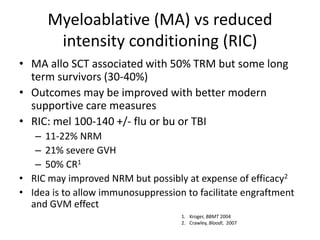
Myeloablative (MA) vs reduced
intensity conditioning (RIC)
• MA allo SCT associated with 50% TRM but some long
term survivors (30-40%)
• Outcomes may be improved with better modern
supportive care measures
• RIC: mel 100-140 +/- flu or bu or TBI
– 11-22% NRM
– 21% severe GVH
– 50% CR1
• RIC may improved NRM but possibly at expense of efficacy2
• Idea is to allow immunosuppression to facilitate engraftment
and GVM effect
1. Kroger, BBMT 2004
2. Crawley, Bloodl, 2007
Examples of RIC allo SCT for MM
1. Binsfield, Biochim Biophys Acta, 2014
Trials comparing tandem auto SCT
with auto-allo SCT
• Biological randomization
When should we use allo SCT?
• Probably not for refractory or aggressively relapsed
disease
– But a subset of patients with relapsed disease can achieve
CR/ long term survival
– One study showed that these patients may actually do
better with MA conditioning and lenalidomide
maintenance (Kroger, BMT, 2013)
• Perhaps upfront in high risk disease (17p deletion, PCL)
• MDACC data with allo SCT shows that patients do
better if they have allo as 1st remission consolidation,
standard risk cytogenetics (Bashir, Am J of Hematol
2012)
• Clinical trials pending (BMT CTN 1301)
Vaccination strategies
• MAGE
• Idiotype vaccine
• DC-MM fusion vaccine
MAGE
• MAGE-C1/CT7 and MAGE-C2/CT10: genes that
appear to be expressed in MM, solitary
plasmacytomas and MGUS1
• Function yet unknown
• MAGEC1/ CT7 gene frequently expressed in
advanced MM and is associated with worse
overall survival (OS) 2
• Resultant protein is immunogenic
• Thus potential cancer/testis antigen (CTA) /target
for immunotherapy
1. De Carvalho, Cancer Immunol Immunother 2013
2. Andrade, Cancer Immun, 2008
Clinical trial of MAGE-A3/Poly-ICLC immunizations
Followed by Adoptive Transfer of Vaccine-Primed and
Costimulated Autologous T Cells
• Phase 2 trial, 27 pts undergoing auto SCT for MM
• MAGE-A3 cancer-testis antigen (CTAg) vaccine
• Injected with TLR-3 agonist Poly-ICLC (Hiltonol)
adjuvant GM-CSF to enhance T-cell priming/ boosting
• Co-injection of Prevnar vaccine
• The protein also contains the HIV-1-TAT membrane
translocation sequence to facilitate formation of MHC
class I complexes
• Lenalidomide maintenance was started at day 100
1. Rapoport, Clin Cancer Res 2013
Trial Design
1. Rapoport, Clin Cancer Res 2013
Results
• T-cell infusions were well tolerated
• Vaccine injection site reactions occurred in >90 pts
• 2/9 pts developed sterile abscesses
• MAGE-A3–specific CD8 T cells seen in 7 of 8 evaluable
HLA-A2 pts (88%)
• Vaccine-specific cytokine producing T cells generated in
19 of 25 patients (76%)
• Antibody responses developed in 7/9 patients (78%)
who received montanide and only weakly in 2/18
patients (11%) who did not
• 2-year OS was 74% and 2-year EFS was 56%
1. Rapoport, Clin Cancer Res 2013
Results
1. Rapoport, Clin Cancer Res 2013
Results
Limitation: MAGE-A3 expression in the myeloma cells was not required for
study entry; thus reducing ability to evaluate vaccine-specific T- and B-cell
responses
Double positive vaccine-directed IFN-gamma responses on CD4 and CD8 T
cells together was possibly associated with better EFS
1. Rapoport, Clin Cancer Res 2013
Idiotype Vaccine
• Targets the variable Ig on surface of plasma cell
• Idiotype-specific T cells at a low frequency have been
detected in 90% of patients with MM or MGUS1
• Induction of CTL activity against autologous myeloma
cells also shown after stimulation with idiotype-loaded
DCs
• Hypothesis that idiotype-specific response diminishes
MM progresses
• Thus far clinical trials have shown safety and some T
cell responses but no definitive clinical response.
1. Yi, Blood 1995
Dendritic cell-based vaccines
• DC’s from MM pts can present idiotype
determinants to autologous T cells1
• DC-tumor cell fusions
– Protection against MM in murine model2
• Vaccination with DC-fusion induces tumor immunity
and may work best in post-SCT setting when
minimal T regs
• Most efficient strategy may be vaccination with
lenalidomide on board as there may be decrease in
T cell PD-1 expression and inhibition of T regs
• Basis for upcoming BMT CTN 1401 trial
1. Dabadghao, Blr J Hematol 1998
2. Gong, Blood, 2002
BMT CTN 1401
Chimeric Antigen Receptor (CAR)
Effector Cells
Chimeric antigen receptor
• Extracellular domain: antigen specific
• Endodomain: signals cells cytotoxic
functioning
– CD28/CD3ζ
– 41BB
• T cells
• NK cells
hinge
1. Binsfeld, Biochimica et Biophysica Acta, 2014
Pre-Clinical data with CAR therapy for MM
• In vitro activity of CAR cells
– CD38-specific CAR T cells1
• In vivo activity of CAR-NK cells in murine models
– CS1-specific CAR-NK2
– CD138-specific CAR-NK3
• In vivo activity of CAR-T cells in murine models
– CS1-specific CAR-T cells4
– CD56-specific CAR-T cells5
– NKG2D-expressing CAR-T cells6
– NY-ESO-1-specific TCR- transduced T cells7
1. Mihara, Leukemia, 2012
2. Chu, Leukemia, 2013
3. Jiang, Mol Oncol, 2014
4. Chu, Clin Cancer Research, 2014
5. Benjamin, AACR, 2012
6. Barber, Genee Ther, 2011
7. Mastaglio, ASH 2014
Clinical trial of CD19 CAR-T cells
• Garfall et al, ASCO 2015
• Relapsed MM pts
• 1-5x10⁷CTL019 cells infused 12-14 days after
high-dose melphalan + ASCT
• N=4
• hypogammaglobulinemia (4/4) and grade 1
cytokine release syndrome (1/4)
• Cells detectable in the 3 evaluable pts
• 2 CRs, 1 progression
NK cells: one paradigm for
adoptive cellular therapy
NK Cells for Multiple Myeloma
• MM cell lines and primary cells appear
susceptible to NK cytotoxicity1
• Infusion of activated NK cells prolongs
survival in a murine model of MM2
• Expanded NK cells kill MM in murine MM
model3
1. Frohn et al, Br J of Haematology, 2002
2. Alilci et al, Expt Hematology, 2007
3. Garg et al, Haematologica, 2012
Why don’t autologous NK cells work?
• Altered balance of inhibitory and activating receptors
on autologous NK cells1
• Altered ligands on tumor cells - requiring more active
NK cells than at baseline2
• Change in distribution of NK cell subpopulations (LN,
PB) 3
• Direct immunosuppression by tumor cell –produced
soluble factors (cytokines, ligands) 1, 4
• NK cells from MM patients express PD-15
• Increased Class I on MM cells in advanced disease6
1. Lion, Leukemia, 2012
2. Veuillen, JCI, 2012
3. Gibson, Hum Pathol, 2011
4. Reiners, Blood, 2013
5. Benson, Blood, 2010
6. Carbone, Blood, 2005
Peripheral Blood NK cells for MM
• Phase 2 study of autologous or haplo-identical NK
cells1
• Relapsed/ refractory MM (n=8)
• NK cells expanded with feeder cells
• Preparative regimen:
– Bortezomib
– Bortezomib +Flu/Cy/Dex
– IL-2
• Cells detectable 7 days out
• 1 PR
• No SAEs
1. Szmania, J Immunotherapy, 2015
Frozen cord
Blood unit
Ficoll
MNC
Culture condition:
2(γ-irradiated)APC : 1 cord TNC
IL-2 100u/ml
GP500 bioreactor
Day 7
CD3 depletion (CliniMACS)
CD3-depleted NK cells
Culture condition:
2(γ-irradiated)APC : 1 CD3 - cell
IL-2 100u/ml
For another 7 days
Day 14
CD3 depletion (CliniMACS)
CD3-depleted NK cells
CD3 + cells
CD3 + cells
Flow cytometry
on day7 & 14
CD56
CD16
CD3
CD19
CD14
CD45
Clinical NK Expansion Experimental Design
Thaw
Day 0
Shah et al, PLoS One, 2013
-8 -7 -5 0
Low dose lenalidomide
High dose
melphalan, 200
mg/m2
CB NK cells
Autologous
graft
Protocol 2011-0379: Phase I/II study of umbilical cord blood-
derived natural killer cells in conjunction with high dose
chemotherapy and autologous stem cell transplant for
patients with multiple myeloma
-2
1 x 10⁸ cells/kg: no infusion reactions
or GVH thus far
Conclusions
• Though the timeline for patients with myeloma
has changed a definitive cure is still needed
• Myeloma is a malignancy of immune
dysregulation and likely immune exhaustion
• Therefore immunotherapies likely have an
important role in the treatment paradigm
• Fine tuning of antibody, cellular and vaccine
therapy will eventually lead us to the ideal
partners for the recently developed novel
therapies
Thank you!
Khop khun!

Cellular Therapy for multiple myeloma

  • 1.
    Cellular Therapy forMultiple Myeloma Nina Shah M.D. Assistant Professor Department of Stem Cell Transplantation and Cellular Therapy M.D. Anderson Cancer Center
  • 2.
    Objectives • Myeloma therapy:general principles • Immunotherapy: general principles • Allogeneic stem cell transplantation (SCT) • Cellular therapies in development
  • 3.
    Myeloma: We’ve comea long way • Proteosome inhibitors • Immunomodulatory agents • Triple therapy • High dose chemotherapy and autologous stem cell transplantation • Maintenance
  • 4.
    Changes in survivalpatterns 1. Pulte, Leuk & Lymph 2014
  • 5.
    But most ofour patients still relapse…
  • 6.
    Immunotherapy • Allogeneic stemcell transplantation • Vaccine strategies • CAR T and NK cells • Monoclonal antibodies • NK cells
  • 7.
    Immune system alterationsin MM • BM infiltration by plasma cells • Interaction between MM cells and BM microenvironment immunosuppression • Decrease in number and functional activity of immune cells • Recruitment of immunosuppressive cells • Deficient antigen processing/ presentation • Expression of co-inhibitory molecules by tumor cells 1. De Carvalho, Cancer Immunol Immunother 2013 2. Andrade, Cancer Immun, 2008
  • 8.
    1. Binsfield, BiochimBiophys Acta, 2014
  • 9.
    Allogeneic stem celltransplantation: controversies remain • Exploit the graft vs myeloma affect • DLI’s have been used1 • Chronic GVH may predict for long term disease control2,3 but this data has not been consistent • Conflicting data in randomized studies comparing tandem auto SCT vs auto- allo SCT4,5 • But true effect of allo SCT may take longer than 5 years to emerge • Myeloablative (MA) allo SCT associated with 50% TRM but some long term survivors (30-40%) 6 • Outcomes may be improved with better modern supportive care measures 1. Tricot, Blood 1996 2. Crawley, Blood 2005 3. LeBlanc, BMT 2001 4. Krishnan, Lancet Oncol 2011 5. Bruno, NEJM 2007 6. Barlogie JCO 2006
  • 10.
    Overview of findings •EBMT retrospective analysis of MA conditioning allo SCT versus auto SCT showed better OS in auto groups (34 vs 18 months) but lower relapse rate in allo group (50% vs 70% at 4 years). Results likely due to increased TRM1 • EBMT analysis shows decreased NRM from 46% to 30% from 1983-1993 vs 1994-1998 2 1. Bjorkstrand, Blood 1996 2. Gharton, Br J Hematol, 2001
  • 11.
    Myeloablative (MA) vsreduced intensity conditioning (RIC) • MA allo SCT associated with 50% TRM but some long term survivors (30-40%) • Outcomes may be improved with better modern supportive care measures • RIC: mel 100-140 +/- flu or bu or TBI – 11-22% NRM – 21% severe GVH – 50% CR1 • RIC may improved NRM but possibly at expense of efficacy2 • Idea is to allow immunosuppression to facilitate engraftment and GVM effect 1. Kroger, BBMT 2004 2. Crawley, Bloodl, 2007
  • 12.
    Examples of RICallo SCT for MM 1. Binsfield, Biochim Biophys Acta, 2014
  • 13.
    Trials comparing tandemauto SCT with auto-allo SCT • Biological randomization
  • 14.
    When should weuse allo SCT? • Probably not for refractory or aggressively relapsed disease – But a subset of patients with relapsed disease can achieve CR/ long term survival – One study showed that these patients may actually do better with MA conditioning and lenalidomide maintenance (Kroger, BMT, 2013) • Perhaps upfront in high risk disease (17p deletion, PCL) • MDACC data with allo SCT shows that patients do better if they have allo as 1st remission consolidation, standard risk cytogenetics (Bashir, Am J of Hematol 2012) • Clinical trials pending (BMT CTN 1301)
  • 15.
    Vaccination strategies • MAGE •Idiotype vaccine • DC-MM fusion vaccine
  • 16.
    MAGE • MAGE-C1/CT7 andMAGE-C2/CT10: genes that appear to be expressed in MM, solitary plasmacytomas and MGUS1 • Function yet unknown • MAGEC1/ CT7 gene frequently expressed in advanced MM and is associated with worse overall survival (OS) 2 • Resultant protein is immunogenic • Thus potential cancer/testis antigen (CTA) /target for immunotherapy 1. De Carvalho, Cancer Immunol Immunother 2013 2. Andrade, Cancer Immun, 2008
  • 17.
    Clinical trial ofMAGE-A3/Poly-ICLC immunizations Followed by Adoptive Transfer of Vaccine-Primed and Costimulated Autologous T Cells • Phase 2 trial, 27 pts undergoing auto SCT for MM • MAGE-A3 cancer-testis antigen (CTAg) vaccine • Injected with TLR-3 agonist Poly-ICLC (Hiltonol) adjuvant GM-CSF to enhance T-cell priming/ boosting • Co-injection of Prevnar vaccine • The protein also contains the HIV-1-TAT membrane translocation sequence to facilitate formation of MHC class I complexes • Lenalidomide maintenance was started at day 100 1. Rapoport, Clin Cancer Res 2013
  • 18.
    Trial Design 1. Rapoport,Clin Cancer Res 2013
  • 19.
    Results • T-cell infusionswere well tolerated • Vaccine injection site reactions occurred in >90 pts • 2/9 pts developed sterile abscesses • MAGE-A3–specific CD8 T cells seen in 7 of 8 evaluable HLA-A2 pts (88%) • Vaccine-specific cytokine producing T cells generated in 19 of 25 patients (76%) • Antibody responses developed in 7/9 patients (78%) who received montanide and only weakly in 2/18 patients (11%) who did not • 2-year OS was 74% and 2-year EFS was 56% 1. Rapoport, Clin Cancer Res 2013
  • 20.
  • 21.
    Results Limitation: MAGE-A3 expressionin the myeloma cells was not required for study entry; thus reducing ability to evaluate vaccine-specific T- and B-cell responses Double positive vaccine-directed IFN-gamma responses on CD4 and CD8 T cells together was possibly associated with better EFS 1. Rapoport, Clin Cancer Res 2013
  • 22.
    Idiotype Vaccine • Targetsthe variable Ig on surface of plasma cell • Idiotype-specific T cells at a low frequency have been detected in 90% of patients with MM or MGUS1 • Induction of CTL activity against autologous myeloma cells also shown after stimulation with idiotype-loaded DCs • Hypothesis that idiotype-specific response diminishes MM progresses • Thus far clinical trials have shown safety and some T cell responses but no definitive clinical response. 1. Yi, Blood 1995
  • 23.
    Dendritic cell-based vaccines •DC’s from MM pts can present idiotype determinants to autologous T cells1 • DC-tumor cell fusions – Protection against MM in murine model2 • Vaccination with DC-fusion induces tumor immunity and may work best in post-SCT setting when minimal T regs • Most efficient strategy may be vaccination with lenalidomide on board as there may be decrease in T cell PD-1 expression and inhibition of T regs • Basis for upcoming BMT CTN 1401 trial 1. Dabadghao, Blr J Hematol 1998 2. Gong, Blood, 2002
  • 24.
  • 25.
    Chimeric Antigen Receptor(CAR) Effector Cells
  • 26.
    Chimeric antigen receptor •Extracellular domain: antigen specific • Endodomain: signals cells cytotoxic functioning – CD28/CD3ζ – 41BB • T cells • NK cells hinge
  • 27.
    1. Binsfeld, Biochimicaet Biophysica Acta, 2014
  • 28.
    Pre-Clinical data withCAR therapy for MM • In vitro activity of CAR cells – CD38-specific CAR T cells1 • In vivo activity of CAR-NK cells in murine models – CS1-specific CAR-NK2 – CD138-specific CAR-NK3 • In vivo activity of CAR-T cells in murine models – CS1-specific CAR-T cells4 – CD56-specific CAR-T cells5 – NKG2D-expressing CAR-T cells6 – NY-ESO-1-specific TCR- transduced T cells7 1. Mihara, Leukemia, 2012 2. Chu, Leukemia, 2013 3. Jiang, Mol Oncol, 2014 4. Chu, Clin Cancer Research, 2014 5. Benjamin, AACR, 2012 6. Barber, Genee Ther, 2011 7. Mastaglio, ASH 2014
  • 29.
    Clinical trial ofCD19 CAR-T cells • Garfall et al, ASCO 2015 • Relapsed MM pts • 1-5x10⁷CTL019 cells infused 12-14 days after high-dose melphalan + ASCT • N=4 • hypogammaglobulinemia (4/4) and grade 1 cytokine release syndrome (1/4) • Cells detectable in the 3 evaluable pts • 2 CRs, 1 progression
  • 30.
    NK cells: oneparadigm for adoptive cellular therapy
  • 31.
    NK Cells forMultiple Myeloma • MM cell lines and primary cells appear susceptible to NK cytotoxicity1 • Infusion of activated NK cells prolongs survival in a murine model of MM2 • Expanded NK cells kill MM in murine MM model3 1. Frohn et al, Br J of Haematology, 2002 2. Alilci et al, Expt Hematology, 2007 3. Garg et al, Haematologica, 2012
  • 32.
    Why don’t autologousNK cells work? • Altered balance of inhibitory and activating receptors on autologous NK cells1 • Altered ligands on tumor cells - requiring more active NK cells than at baseline2 • Change in distribution of NK cell subpopulations (LN, PB) 3 • Direct immunosuppression by tumor cell –produced soluble factors (cytokines, ligands) 1, 4 • NK cells from MM patients express PD-15 • Increased Class I on MM cells in advanced disease6 1. Lion, Leukemia, 2012 2. Veuillen, JCI, 2012 3. Gibson, Hum Pathol, 2011 4. Reiners, Blood, 2013 5. Benson, Blood, 2010 6. Carbone, Blood, 2005
  • 33.
    Peripheral Blood NKcells for MM • Phase 2 study of autologous or haplo-identical NK cells1 • Relapsed/ refractory MM (n=8) • NK cells expanded with feeder cells • Preparative regimen: – Bortezomib – Bortezomib +Flu/Cy/Dex – IL-2 • Cells detectable 7 days out • 1 PR • No SAEs 1. Szmania, J Immunotherapy, 2015
  • 34.
    Frozen cord Blood unit Ficoll MNC Culturecondition: 2(γ-irradiated)APC : 1 cord TNC IL-2 100u/ml GP500 bioreactor Day 7 CD3 depletion (CliniMACS) CD3-depleted NK cells Culture condition: 2(γ-irradiated)APC : 1 CD3 - cell IL-2 100u/ml For another 7 days Day 14 CD3 depletion (CliniMACS) CD3-depleted NK cells CD3 + cells CD3 + cells Flow cytometry on day7 & 14 CD56 CD16 CD3 CD19 CD14 CD45 Clinical NK Expansion Experimental Design Thaw Day 0
  • 35.
    Shah et al,PLoS One, 2013
  • 36.
    Shah et al,PLoS One, 2013
  • 37.
    -8 -7 -50 Low dose lenalidomide High dose melphalan, 200 mg/m2 CB NK cells Autologous graft Protocol 2011-0379: Phase I/II study of umbilical cord blood- derived natural killer cells in conjunction with high dose chemotherapy and autologous stem cell transplant for patients with multiple myeloma -2 1 x 10⁸ cells/kg: no infusion reactions or GVH thus far
  • 38.
    Conclusions • Though thetimeline for patients with myeloma has changed a definitive cure is still needed • Myeloma is a malignancy of immune dysregulation and likely immune exhaustion • Therefore immunotherapies likely have an important role in the treatment paradigm • Fine tuning of antibody, cellular and vaccine therapy will eventually lead us to the ideal partners for the recently developed novel therapies
  • 39.

Editor's Notes

  • #5 Mayo data
  • #22 Alimitation of this study was that MAGE-A3 expression in the myeloma cells was not required for study entry, thus reducing our ability to evaluate the clinical impact of vaccine-specific T- and B-cell responses