RCUK Strategy 2011-14 Steven Hill Research Councils UK Strategy Unit
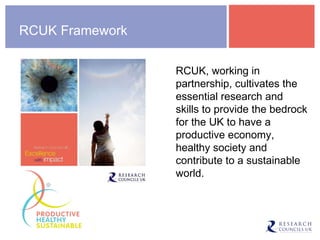
RCUK Framework RCUK, working in partnership, cultivates the essential research and skills to provide the bedrock for the UK to have a productive economy, healthy society and contribute to a sustainable world.
Summary The context: funding and performance of the UK research base Funding and concentration Performance Strategic priorities for RCUK Addressing societal challenges Impact, innovation and growth Efficient and effective research base
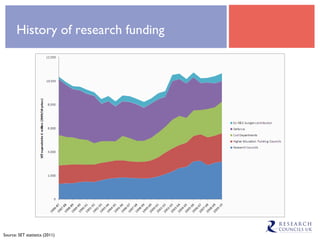
History of research funding Source: SET statistics (2011)
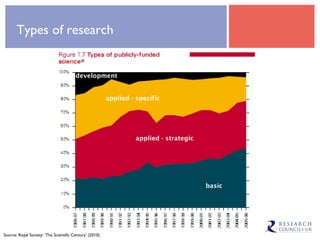
Types of research basic applied - specific development applied - strategic Source: Royal Society: ‘The Scientific Century’ (2010)
Spending Review 2010: headlines Total Research Councils + HEFCE (QR and HEIF) resource budget  fixed  and  ring-fenced  for 2011-15 (approx 10% cut in real terms) Real-terms protection  for MRC resource budget Implementation of Wakeham review of fEC    6-7% saving,  reinvested  within ring-fence 44% reduction  in Research Council capital budget Additional capital for Francis Crick Institute (£220M from Health budget) Additional capital provided since Spending Review Budget 2011 - £50M for campus investments (Daresbury, Babraham, Norwich) Autumn 2011 - £50M for graphene research centre; £145M e-Infrastructure 15% reduction in administration budget
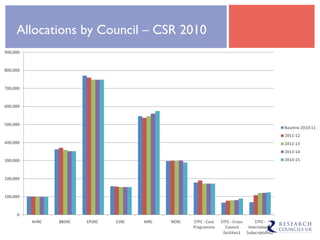
Allocations by Council – CSR 2010
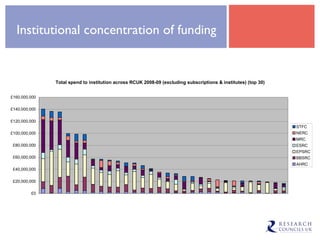
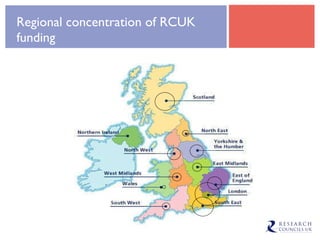
Concentration of research funding Our policy is to support excellent research as identified by peer review. This  results  in relatively high concentration of research funding.
Institutional concentration of funding
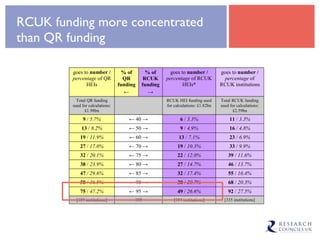
RCUK funding more concentrated than QR funding
Regional concentration of RCUK funding
Summary The context: funding and performance of the UK research base Funding and concentration Performance Strategic priorities for RCUK Addressing societal challenges Impact, innovation and growth Efficient and effective research base
 
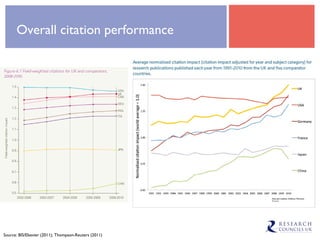
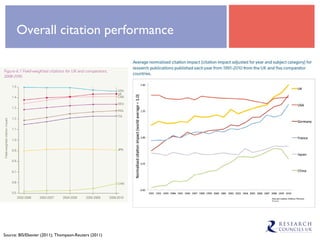
UK research performance – the headlines Best, or near best, in the world Share of output falling despite absolute output increasing Total investment in research low by international standards Easily the most productive research base in the world
Overall citation performance Source: BIS/Elsevier (2011); Thompson-Reuters (2011)
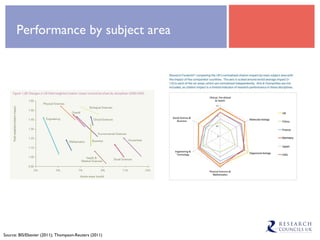
Performance by subject area Source: BIS/Elsevier (2011); Thompson-Reuters (2011)
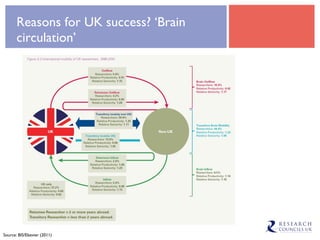
Reasons for UK success? ‘Brain circulation’ Source: BIS/Elsevier (2011)
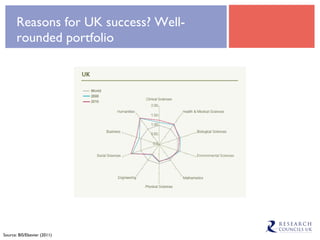
Reasons for UK success? Well-rounded portfolio Source: BIS/Elsevier (2011)
Summary The context: funding and performance of the UK research base Funding and concentration Performance Strategic priorities for RCUK Addressing societal challenges Impact, innovation and growth Efficient and effective research base
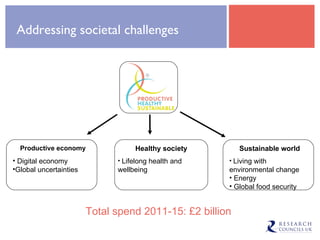
Addressing societal challenges Productive economy Digital economy Global uncertainties Healthy society Lifelong health and wellbeing Sustainable world Living with environmental change Energy Global food security Total spend 2011-15: £2 billion
Summary The context: funding and performance of the UK research base Funding and concentration Performance Strategic priorities for RCUK Addressing societal challenges Impact, innovation and growth Efficient and effective research base
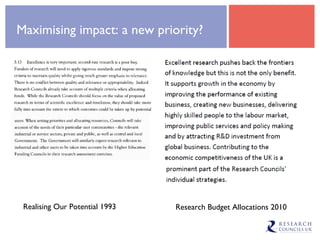
Maximising impact: a new priority? Realising Our Potential 1993 Research Budget Allocations 2010
Types of research basic applied - specific development applied - strategic Source: Royal Society: ‘The Scientific Century’ (2010)
Overall citation performance Source: BIS/Elsevier (2011); Thompson-Reuters (2011)
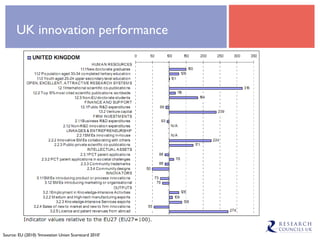
UK innovation performance Source: EU (2010) ‘Innovation Union Scorecard 2010’
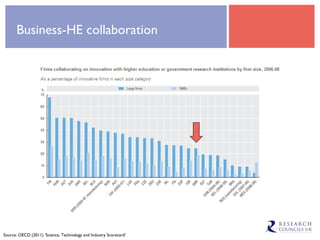
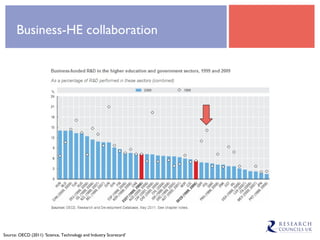
Business-HE collaboration Source: OECD (2011) ‘Science, Technology and Industry Scorecard’
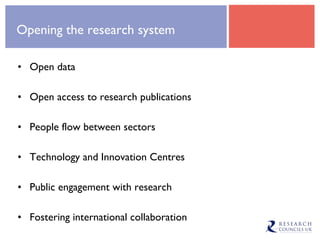
Opening the research system Open data Open access to research publications People flow between sectors Technology and Innovation Centres Public engagement with research Fostering international collaboration
RCUK principles: data policy Publicly funded research data are a public good, produced in the public interest, which should be made openly available with as few restrictions as possible in a timely and responsible manner that does not harm intellectual property. Institutional and project specific data management policies and plans should be in accordance with  relevant standards and community best practice . Data with acknowledged long-term value should be preserved and remain accessible and usable for future research. To enable research data to be discoverable and effectively re-used by others,  sufficient metadata  should be recorded and made openly available to enable other researchers to understand the research and re-use potential of the data. Published results should always include information on how to access the supporting data. RCUK recognises that there are  legal, ethical and commercial constraints  on release of research data. To ensure that the research process is not damaged by inappropriate release of data, research organisation policies and practices should ensure that these are considered at all stages in the research process. To ensure that research teams get appropriate recognition for the effort involved in collecting and analysing data, those who undertake Research Council funded work may be entitled to a  limited period of privileged use of the data they have collected  to enable them to publish the results of their research. The length of this period varies by research discipline and, where appropriate, is discussed further in the published policies of individual Research Councils. In order to recognise the intellectual contributions of researchers who generate, preserve and share key research datasets, all users of research data should  acknowledge the sources of their data  and abide by the terms and conditions under which they are accessed. It is appropriate to  use public funds to support the management and sharing  of publicly-funded research data. To maximise the research benefit which can be gained from limited budgets, the mechanisms for these activities should be both efficient and cost-effective in the use of public funds. http://www.rcuk.ac.uk/research/Pages/DataPolicy.aspx
Opening the research system Open data Open access to research publications People flow between sectors Technology and Innovation Centres Public engagement with research Fostering international collaboration
Concordat for Public Engagement UK research organisations have a strategic commitment to public engagement  Researchers are recognised and valued for their involvement with public engagement activities Researchers are enabled to participate in public engagement activities through appropriate training, support and opportunities The signatories and supporters will undertake regular reviews of their and the wider research sector's progress in fostering public engagement across the UK http://www.rcuk.ac.uk/per/Pages/Concordat.aspx
Opening the research system Open data Open access to research publications People flow between sectors Technology and Innovation Centres Public engagement with research Fostering international collaboration
Summary The context: funding and performance of the UK research base Funding and concentration Performance Strategic priorities for RCUK Addressing societal challenges Impact, innovation and growth Efficient and effective research base
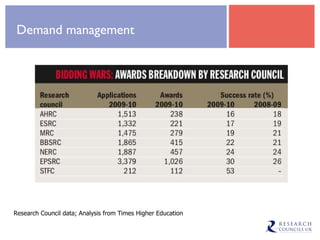
Demand management Research Council data; Analysis from Times Higher Education
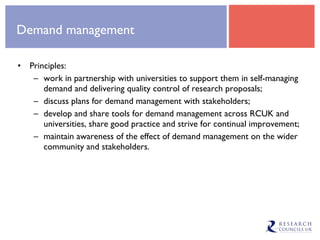
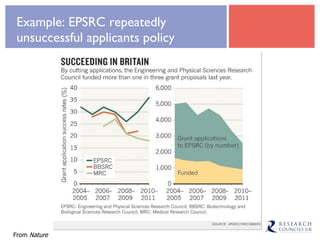
Demand management Principles: work in partnership with universities to support them in self-managing demand and delivering quality control of research proposals; discuss plans for demand management with stakeholders;  develop and share tools for demand management across RCUK and universities, share good practice and strive for continual improvement; maintain awareness of the effect of demand management on the wider community and stakeholders.
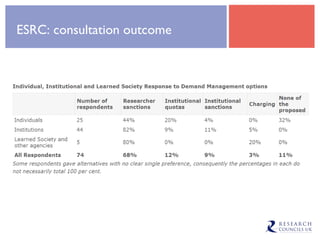
ESRC: consultation outcome
Example: EPSRC repeatedly unsuccessful applicants policy From  Nature
Improving the efficiency of the research base Continued commitment to funding research at 80% full economic cost Implementation of Wakeham review Changes to indirect costs element of fEC Sharing of equipment and facilities Reinvestment of savings within the ring-fence
Summary The context: funding and performance of the UK research base Funding and concentration Performance Strategic priorities for RCUK Addressing societal challenges Impact, innovation and growth Efficient and effective research base

RCUK Strategy

  • 1.
    RCUK Strategy 2011-14Steven Hill Research Councils UK Strategy Unit
  • 2.
    RCUK Framework RCUK,working in partnership, cultivates the essential research and skills to provide the bedrock for the UK to have a productive economy, healthy society and contribute to a sustainable world.
  • 3.
    Summary The context:funding and performance of the UK research base Funding and concentration Performance Strategic priorities for RCUK Addressing societal challenges Impact, innovation and growth Efficient and effective research base
  • 4.
    Summary The context:funding and performance of the UK research base Funding and concentration Performance Strategic priorities for RCUK Addressing societal challenges Impact, innovation and growth Efficient and effective research base
  • 5.
    History of researchfunding Source: SET statistics (2011)
  • 6.
    Types of researchbasic applied - specific development applied - strategic Source: Royal Society: ‘The Scientific Century’ (2010)
  • 7.
    Spending Review 2010:headlines Total Research Councils + HEFCE (QR and HEIF) resource budget fixed and ring-fenced for 2011-15 (approx 10% cut in real terms) Real-terms protection for MRC resource budget Implementation of Wakeham review of fEC  6-7% saving, reinvested within ring-fence 44% reduction in Research Council capital budget Additional capital for Francis Crick Institute (£220M from Health budget) Additional capital provided since Spending Review Budget 2011 - £50M for campus investments (Daresbury, Babraham, Norwich) Autumn 2011 - £50M for graphene research centre; £145M e-Infrastructure 15% reduction in administration budget
  • 8.
  • 9.
    Concentration of researchfunding Our policy is to support excellent research as identified by peer review. This results in relatively high concentration of research funding.
  • 10.
  • 11.
    RCUK funding moreconcentrated than QR funding
  • 12.
  • 13.
    Summary The context:funding and performance of the UK research base Funding and concentration Performance Strategic priorities for RCUK Addressing societal challenges Impact, innovation and growth Efficient and effective research base
  • 14.
  • 15.
    UK research performance– the headlines Best, or near best, in the world Share of output falling despite absolute output increasing Total investment in research low by international standards Easily the most productive research base in the world
  • 16.
    Overall citation performanceSource: BIS/Elsevier (2011); Thompson-Reuters (2011)
  • 17.
    Performance by subjectarea Source: BIS/Elsevier (2011); Thompson-Reuters (2011)
  • 18.
    Reasons for UKsuccess? ‘Brain circulation’ Source: BIS/Elsevier (2011)
  • 19.
    Reasons for UKsuccess? Well-rounded portfolio Source: BIS/Elsevier (2011)
  • 20.
    Summary The context:funding and performance of the UK research base Funding and concentration Performance Strategic priorities for RCUK Addressing societal challenges Impact, innovation and growth Efficient and effective research base
  • 21.
    Addressing societal challengesProductive economy Digital economy Global uncertainties Healthy society Lifelong health and wellbeing Sustainable world Living with environmental change Energy Global food security Total spend 2011-15: £2 billion
  • 22.
    Summary The context:funding and performance of the UK research base Funding and concentration Performance Strategic priorities for RCUK Addressing societal challenges Impact, innovation and growth Efficient and effective research base
  • 23.
    Maximising impact: anew priority? Realising Our Potential 1993 Research Budget Allocations 2010
  • 24.
    Types of researchbasic applied - specific development applied - strategic Source: Royal Society: ‘The Scientific Century’ (2010)
  • 25.
    Overall citation performanceSource: BIS/Elsevier (2011); Thompson-Reuters (2011)
  • 26.
    UK innovation performanceSource: EU (2010) ‘Innovation Union Scorecard 2010’
  • 27.
    Business-HE collaboration Source:OECD (2011) ‘Science, Technology and Industry Scorecard’
  • 28.
    Business-HE collaboration Source:OECD (2011) ‘Science, Technology and Industry Scorecard’
  • 29.
    Opening the researchsystem Open data Open access to research publications People flow between sectors Technology and Innovation Centres Public engagement with research Fostering international collaboration
  • 30.
    RCUK principles: datapolicy Publicly funded research data are a public good, produced in the public interest, which should be made openly available with as few restrictions as possible in a timely and responsible manner that does not harm intellectual property. Institutional and project specific data management policies and plans should be in accordance with relevant standards and community best practice . Data with acknowledged long-term value should be preserved and remain accessible and usable for future research. To enable research data to be discoverable and effectively re-used by others, sufficient metadata should be recorded and made openly available to enable other researchers to understand the research and re-use potential of the data. Published results should always include information on how to access the supporting data. RCUK recognises that there are legal, ethical and commercial constraints on release of research data. To ensure that the research process is not damaged by inappropriate release of data, research organisation policies and practices should ensure that these are considered at all stages in the research process. To ensure that research teams get appropriate recognition for the effort involved in collecting and analysing data, those who undertake Research Council funded work may be entitled to a limited period of privileged use of the data they have collected to enable them to publish the results of their research. The length of this period varies by research discipline and, where appropriate, is discussed further in the published policies of individual Research Councils. In order to recognise the intellectual contributions of researchers who generate, preserve and share key research datasets, all users of research data should acknowledge the sources of their data and abide by the terms and conditions under which they are accessed. It is appropriate to use public funds to support the management and sharing of publicly-funded research data. To maximise the research benefit which can be gained from limited budgets, the mechanisms for these activities should be both efficient and cost-effective in the use of public funds. http://www.rcuk.ac.uk/research/Pages/DataPolicy.aspx
  • 31.
    Opening the researchsystem Open data Open access to research publications People flow between sectors Technology and Innovation Centres Public engagement with research Fostering international collaboration
  • 32.
    Concordat for PublicEngagement UK research organisations have a strategic commitment to public engagement Researchers are recognised and valued for their involvement with public engagement activities Researchers are enabled to participate in public engagement activities through appropriate training, support and opportunities The signatories and supporters will undertake regular reviews of their and the wider research sector's progress in fostering public engagement across the UK http://www.rcuk.ac.uk/per/Pages/Concordat.aspx
  • 33.
    Opening the researchsystem Open data Open access to research publications People flow between sectors Technology and Innovation Centres Public engagement with research Fostering international collaboration
  • 34.
    Summary The context:funding and performance of the UK research base Funding and concentration Performance Strategic priorities for RCUK Addressing societal challenges Impact, innovation and growth Efficient and effective research base
  • 35.
    Demand management ResearchCouncil data; Analysis from Times Higher Education
  • 36.
    Demand management Principles:work in partnership with universities to support them in self-managing demand and delivering quality control of research proposals; discuss plans for demand management with stakeholders; develop and share tools for demand management across RCUK and universities, share good practice and strive for continual improvement; maintain awareness of the effect of demand management on the wider community and stakeholders.
  • 37.
  • 38.
    Example: EPSRC repeatedlyunsuccessful applicants policy From Nature
  • 39.
    Improving the efficiencyof the research base Continued commitment to funding research at 80% full economic cost Implementation of Wakeham review Changes to indirect costs element of fEC Sharing of equipment and facilities Reinvestment of savings within the ring-fence
  • 40.
    Summary The context:funding and performance of the UK research base Funding and concentration Performance Strategic priorities for RCUK Addressing societal challenges Impact, innovation and growth Efficient and effective research base