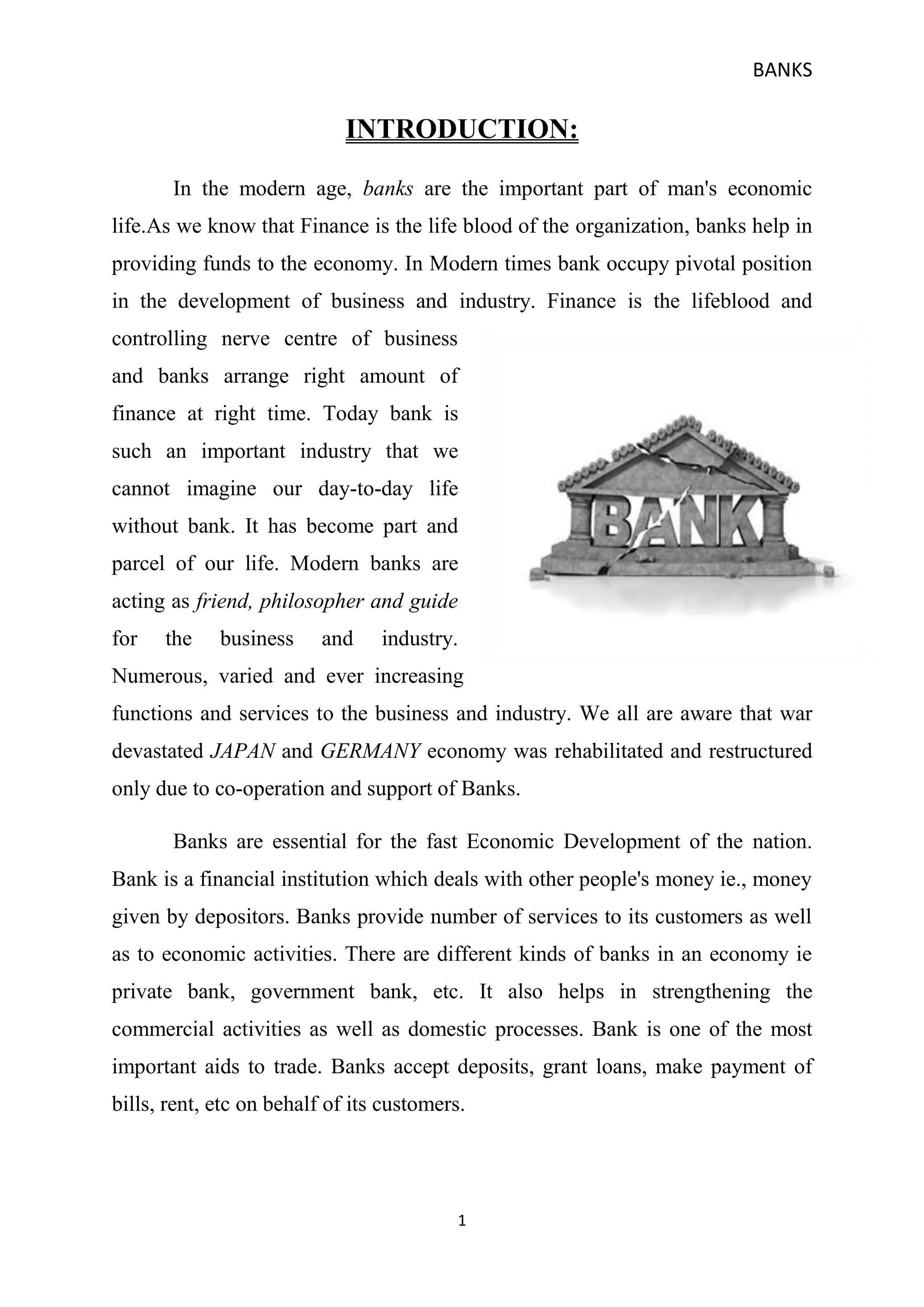
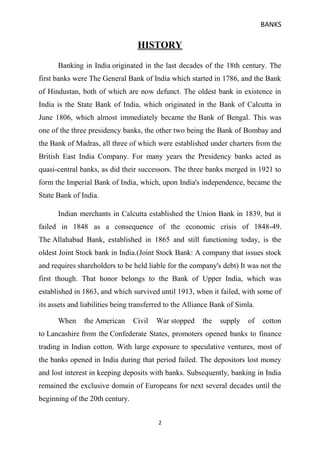
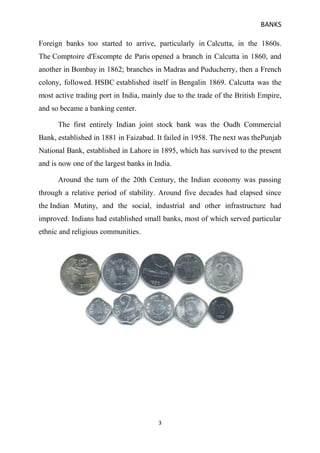
INTRODUCTION:<br />29667201184275 In the modern age, banks are the important part of man's economic life.As we know that Finance is the life blood of the organization, banks help in providing funds to the economy. In Modern times bank occupy pivotal position in the development of business and industry. Finance is the lifeblood and controlling nerve centre of business and banks arrange right amount of finance at right time. Today bank is such an important industry that we cannot imagine our day-to-day life without bank. It has become part and parcel of our life. Modern banks are acting as friend, philosopher and guide for the business and industry. Numerous, varied and ever increasing functions and services to the business and industry. We all are aware that war devastated JAPAN and GERMANY economy was rehabilitated and restructured only due to co-operation and support of Banks.<br /> Banks are essential for the fast Economic Development of the nation. Bank is a financial institution which deals with other people's money ie., money given by depositors. Banks provide number of services to its customers as well as to economic activities. There are different kinds of banks in an economy ie private bank, government bank, etc. It also helps in strengthening the commercial activities as well as domestic processes. Bank is one of the most important aids to trade. Banks accept deposits, grant loans, make payment of bills, rent, etc on behalf of its customers.<br />HISTORY<br />Banking in India originated in the last decades of the 18th century. The first banks were The General Bank of India which started in 1786, and the Bank of Hindustan, both of which are now defunct. The oldest bank in existence in India is the State Bank of India, which originated in the Bank of Calcutta in June 1806, which almost immediately became the Bank of Bengal. This was one of the three presidency banks, the other two being the Bank of Bombay and the Bank of Madras, all three of which were established under charters from the British East India Company. For many years the Presidency banks acted as quasi-central banks, as did their successors. The three banks merged in 1921 to form the Imperial Bank of India, which, upon India's independence, became the State Bank of India.<br />Indian merchants in Calcutta established the Union Bank in 1839, but it failed in 1848 as a consequence of the economic crisis of 1848-49. The Allahabad Bank, established in 1865 and still functioning today, is the oldest Joint Stock bank in India.(Joint Stock Bank: A company that issues stock and requires shareholders to be held liable for the company's debt) It was not the first though. That honor belongs to the Bank of Upper India, which was established in 1863, and which survived until 1913, when it failed, with some of its assets and liabilities being transferred to the Alliance Bank of Simla.<br />When the American Civil War stopped the supply of cotton to Lancashire from the Confederate States, promoters opened banks to finance trading in Indian cotton. With large exposure to speculative ventures, most of the banks opened in India during that period failed. The depositors lost money and lost interest in keeping deposits with banks. Subsequently, banking in India remained the exclusive domain of Europeans for next several decades until the beginning of the 20th century.<br />Foreign banks too started to arrive, particularly in Calcutta, in the 1860s. The Comptoire d'Escompte de Paris opened a branch in Calcutta in 1860, and another in Bombay in 1862; branches in Madras and Puducherry, then a French colony, followed. HSBC established itself in Bengalin 1869. Calcutta was the most active trading port in India, mainly due to the trade of the British Empire, and so became a banking center.<br />The first entirely Indian joint stock bank was the Oudh Commercial Bank, established in 1881 in Faizabad. It failed in 1958. The next was thePunjab National Bank, established in Lahore in 1895, which has survived to the present and is now one of the largest banks in India.<br />Around the turn of the 20th Century, the Indian economy was passing through a relative period of stability. Around five decades had elapsed since the Indian Mutiny, and the social, industrial and other infrastructure had improved. Indians had established small banks, most of which served particular ethnic and religious communities.<br />495300173990<br />DEFINITION:<br />1. According to Dr.H.L.Hart.<br />                     \"
A banker is one who, in the ordinary course of his business, honours cheques drawn upon him by person’s from and for whom he receives money on current account.\"
<br />2. According to SAYERS.<br />501651376045                     \"
Banks are institutions whose debts -usually referred to as \"
bank deposits\"
-are commonly accepted in final settlement of other people's debt.\"
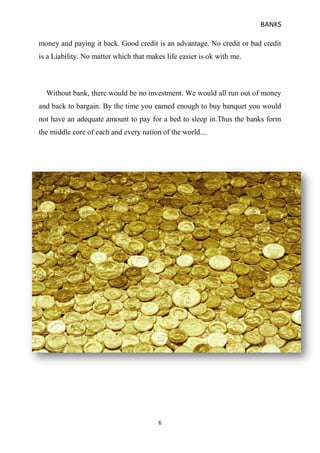
<br />IMPORTANCE OF BANKS<br />      Banks play very important role in the economic life of the nation. The health of the economy is closely related to the soundness of its banking system. Although banks create no new wealth but their borrowing, lending and related activities facilitate the process of production, distribution, exchange and consumption of wealth. <br />     In this way they become very effective partners in the process of economic development. Today, modern banks are very useful for the utilization of the resources of the country. The banks are mobilizing the savings of the people for the investment purposes. The savings are encouraged and saving rate increases. If there would be no banks then a great portion of a capital of the country would remain idle. <br />     A bank as a matter of fact is just like a heart in the economic structure and the Capital provided by it is like blood in it. As long as blood is in circulation the organs will remain sound and healthy. If the blood is not supplied to any organ then that part would become useless. So if the finance is not provided to Agriculture sector or industrial sector, it will be destroyed. Loan facility provided by banks works as an incentive to the producer to increase the production. <br /> <br />    Nobody wants to credit you money if you don't have a depository account. You get superior interest rates when you have a good times past of barrowing money and paying it back. Good credit is an advantage. No credit or bad credit is a Liability. No matter which that makes life easier is ok with me. <br />    Without bank, there would be no investment. We would all run out of money and back to bargain. By the time you earned enough to buy banquet you would not have an adequate amount to pay for a bed to sleep in.Thus the banks form the middle core of each and every nation of the world....<br />-154940610235<br />FUNCTIONS OF BANKS:<br />            Modern banks perform a large number of functions and services to industry and commerce. It is not possible to make an  exhaustive list of its functions and services as they are diverse ,varied and ever-expanding.The functions of banks are increasing day-by-day depending upon the environment prevailing in the country. The functions and services rendered by modern banks can be grouped under the following heads:<br />(A)Banking functions or Primary functions.<br /> 1. Receiving deposits.                                     2. Advancing loans.<br />333375015875-30480015875<br /> <br />3. Discounting of bills of exchange                  .         4. Credit creation<br />333375066675-30480066675.<br /> <br />(B)Nonbanking functions or secondary functions.<br /> 1. Agency services: The agency services are provided to regular customers of the bank. While providing agency services ,bankers acts as the agent of the customers. Some of the important services are :<br />(a)Payment of insurance premium, subscriptions and contributions etc. of societies, club, association’s etc.which are of recurring nature.<br />(b)Collection of salary and pension bills, dividend coupons and interest payable on debentures and other securities.<br />(c)Collection of postal orders.<br />(d)Execution of standing orders eg, payment of electric bills, water charges etc.<br />(e)Collection and payment of cheques ,bills ,and promissory notes.<br />2. General utility services: some important utility services are as follows:<br />(a)Issuing of letters of credit, circulars notes ,bank drafts ,travelers cheque etc.<br />(b)Providing master cards services.<br />(c)Acceptance of bills of exchange for customers.<br />(d)Receiving in safe custody customers valuables ,ornaments and jewels ,documents and deeds.<br />(e)Providing internet banking services, Telebanking facility, which enables a customer to perform banking operations through telephone<br />TYPES OF ACCOUNTS<br />1. Current Account<br />Current Account indicates deposits always payable on demand. Hence they are called demand deposits.
There is no restriction on the number and amount of withdrawals from this account.
Banks insist on the maintenance of certain minimum balance on current account. If the balance goes below this amount, the bank has a right to close that account.
Generally no interest is paid on money deposited in this type of account. Recently, banks have started giving lower interest on this account.
Overdraft facilities are given in case of current accounts only.
Current account suits the requirements of businessmen, joint stock companies, institutions, societies, public authorities and public corporations etc. whose banking transactions happen to be numerous on every working day.
All banking services are made available to current account holders at reasonable service charges.
3257550558165Banks are given full freedom to decide the rules and regulations regarding the operation of current account.
2. Savings Account:-
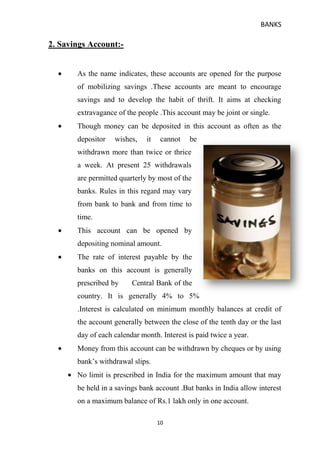
38931851801495As the name indicates, these accounts are opened for the purpose of mobilizing savings .These accounts are meant to encourage savings and to develop the habit of thrift. It aims at checking extravagance of the people .This account may be joint or single.
Though money can be deposited in this account as often as the depositor wishes, it cannot be withdrawn more than twice or thrice a week. At present 25 withdrawals are permitted quarterly by most of the banks. Rules in this regard may vary from bank to bank and from time to time.
This account can be opened by depositing nominal amount.
The rate of interest payable by the banks on this account is generally prescribed by      Central Bank of the country. It is generally 4% to 5% .Interest is calculated on minimum monthly balances at credit of the account generally between the close of the tenth day or the last day of each calendar month. Interest is paid twice a year.
Money from this account can be withdrawn by cheques or by using bank’s withdrawal slips.
No limit is prescribed in India for the maximum amount that may be held in a savings bank account .But banks in India allow interest on a maximum balance of Rs.1 lakh only in one account.
Savings account is not given overdraft facilities like current account.
This account is more suitable to salary earners, wage earners and persons of limited means.
Usual banking services are provided to savings bank account holders.
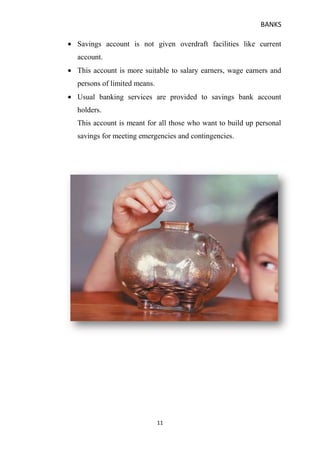
This account is meant for all those who want to build up personal savings for meeting emergencies and contingencies.748665154305<br />Fixed Deposit Account:-<br />Fixed deposits are deposits received for a fixed period specified in advance. No withdrawal is allowed during this period. Therefore they are called time deposits.
The depositor is neither given a cheque book nor a pass book. Withdrawal of interest or principal through cheque is not permitted. The depositor gets a fixed deposit receipt, acknowledging the receipt of sum of money specified therein.
The fixed deposit receipt is non-transferable; It is not a saleable asset.
The depositor gets attractive rate of interest on money deposited in this account .The rate of interest allowed varies with the period of deposit. The longer the period of deposit, higher the rate of interest .Interest paid half yearly.
If the depositor is in need of money before the due date, he can borrow from the same bank against the security of his fixed deposit receipt. Of course, he has to pay a slightly higher rate of interest. In India the directive of Reserve Bank of India requires the banks to charge a minimum of 1% above the rate payable on such deposits.
Individuals, firms or companies with surplus money may invest their idle funds profitably in this account. The persons who want safety of funds and steady return, deposit money in this account . These deposits are called earning assets.
Some of the leading banks transfer funds in excess of some minimum amount from current account to Time deposit so that the accountholder gets income on the same.

Banks project

  • 1.
    INTRODUCTION:<br />29667201184275 Inthe modern age, banks are the important part of man's economic life.As we know that Finance is the life blood of the organization, banks help in providing funds to the economy. In Modern times bank occupy pivotal position in the development of business and industry. Finance is the lifeblood and controlling nerve centre of business and banks arrange right amount of finance at right time. Today bank is such an important industry that we cannot imagine our day-to-day life without bank. It has become part and parcel of our life. Modern banks are acting as friend, philosopher and guide for the business and industry. Numerous, varied and ever increasing functions and services to the business and industry. We all are aware that war devastated JAPAN and GERMANY economy was rehabilitated and restructured only due to co-operation and support of Banks.<br /> Banks are essential for the fast Economic Development of the nation. Bank is a financial institution which deals with other people's money ie., money given by depositors. Banks provide number of services to its customers as well as to economic activities. There are different kinds of banks in an economy ie private bank, government bank, etc. It also helps in strengthening the commercial activities as well as domestic processes. Bank is one of the most important aids to trade. Banks accept deposits, grant loans, make payment of bills, rent, etc on behalf of its customers.<br />HISTORY<br />Banking in India originated in the last decades of the 18th century. The first banks were The General Bank of India which started in 1786, and the Bank of Hindustan, both of which are now defunct. The oldest bank in existence in India is the State Bank of India, which originated in the Bank of Calcutta in June 1806, which almost immediately became the Bank of Bengal. This was one of the three presidency banks, the other two being the Bank of Bombay and the Bank of Madras, all three of which were established under charters from the British East India Company. For many years the Presidency banks acted as quasi-central banks, as did their successors. The three banks merged in 1921 to form the Imperial Bank of India, which, upon India's independence, became the State Bank of India.<br />Indian merchants in Calcutta established the Union Bank in 1839, but it failed in 1848 as a consequence of the economic crisis of 1848-49. The Allahabad Bank, established in 1865 and still functioning today, is the oldest Joint Stock bank in India.(Joint Stock Bank: A company that issues stock and requires shareholders to be held liable for the company's debt) It was not the first though. That honor belongs to the Bank of Upper India, which was established in 1863, and which survived until 1913, when it failed, with some of its assets and liabilities being transferred to the Alliance Bank of Simla.<br />When the American Civil War stopped the supply of cotton to Lancashire from the Confederate States, promoters opened banks to finance trading in Indian cotton. With large exposure to speculative ventures, most of the banks opened in India during that period failed. The depositors lost money and lost interest in keeping deposits with banks. Subsequently, banking in India remained the exclusive domain of Europeans for next several decades until the beginning of the 20th century.<br />Foreign banks too started to arrive, particularly in Calcutta, in the 1860s. The Comptoire d'Escompte de Paris opened a branch in Calcutta in 1860, and another in Bombay in 1862; branches in Madras and Puducherry, then a French colony, followed. HSBC established itself in Bengalin 1869. Calcutta was the most active trading port in India, mainly due to the trade of the British Empire, and so became a banking center.<br />The first entirely Indian joint stock bank was the Oudh Commercial Bank, established in 1881 in Faizabad. It failed in 1958. The next was thePunjab National Bank, established in Lahore in 1895, which has survived to the present and is now one of the largest banks in India.<br />Around the turn of the 20th Century, the Indian economy was passing through a relative period of stability. Around five decades had elapsed since the Indian Mutiny, and the social, industrial and other infrastructure had improved. Indians had established small banks, most of which served particular ethnic and religious communities.<br />495300173990<br />DEFINITION:<br />1. According to Dr.H.L.Hart.<br /> \" A banker is one who, in the ordinary course of his business, honours cheques drawn upon him by person’s from and for whom he receives money on current account.\" <br />2. According to SAYERS.<br />501651376045 \" Banks are institutions whose debts -usually referred to as \" bank deposits\" -are commonly accepted in final settlement of other people's debt.\" <br />IMPORTANCE OF BANKS<br /> Banks play very important role in the economic life of the nation. The health of the economy is closely related to the soundness of its banking system. Although banks create no new wealth but their borrowing, lending and related activities facilitate the process of production, distribution, exchange and consumption of wealth. <br /> In this way they become very effective partners in the process of economic development. Today, modern banks are very useful for the utilization of the resources of the country. The banks are mobilizing the savings of the people for the investment purposes. The savings are encouraged and saving rate increases. If there would be no banks then a great portion of a capital of the country would remain idle. <br /> A bank as a matter of fact is just like a heart in the economic structure and the Capital provided by it is like blood in it. As long as blood is in circulation the organs will remain sound and healthy. If the blood is not supplied to any organ then that part would become useless. So if the finance is not provided to Agriculture sector or industrial sector, it will be destroyed. Loan facility provided by banks works as an incentive to the producer to increase the production. <br /> <br /> Nobody wants to credit you money if you don't have a depository account. You get superior interest rates when you have a good times past of barrowing money and paying it back. Good credit is an advantage. No credit or bad credit is a Liability. No matter which that makes life easier is ok with me. <br /> Without bank, there would be no investment. We would all run out of money and back to bargain. By the time you earned enough to buy banquet you would not have an adequate amount to pay for a bed to sleep in.Thus the banks form the middle core of each and every nation of the world....<br />-154940610235<br />FUNCTIONS OF BANKS:<br /> Modern banks perform a large number of functions and services to industry and commerce. It is not possible to make an exhaustive list of its functions and services as they are diverse ,varied and ever-expanding.The functions of banks are increasing day-by-day depending upon the environment prevailing in the country. The functions and services rendered by modern banks can be grouped under the following heads:<br />(A)Banking functions or Primary functions.<br /> 1. Receiving deposits. 2. Advancing loans.<br />333375015875-30480015875<br /> <br />3. Discounting of bills of exchange . 4. Credit creation<br />333375066675-30480066675.<br /> <br />(B)Nonbanking functions or secondary functions.<br /> 1. Agency services: The agency services are provided to regular customers of the bank. While providing agency services ,bankers acts as the agent of the customers. Some of the important services are :<br />(a)Payment of insurance premium, subscriptions and contributions etc. of societies, club, association’s etc.which are of recurring nature.<br />(b)Collection of salary and pension bills, dividend coupons and interest payable on debentures and other securities.<br />(c)Collection of postal orders.<br />(d)Execution of standing orders eg, payment of electric bills, water charges etc.<br />(e)Collection and payment of cheques ,bills ,and promissory notes.<br />2. General utility services: some important utility services are as follows:<br />(a)Issuing of letters of credit, circulars notes ,bank drafts ,travelers cheque etc.<br />(b)Providing master cards services.<br />(c)Acceptance of bills of exchange for customers.<br />(d)Receiving in safe custody customers valuables ,ornaments and jewels ,documents and deeds.<br />(e)Providing internet banking services, Telebanking facility, which enables a customer to perform banking operations through telephone<br />TYPES OF ACCOUNTS<br />1. Current Account<br />Current Account indicates deposits always payable on demand. Hence they are called demand deposits.
  • 2.
    There is norestriction on the number and amount of withdrawals from this account.
  • 3.
    Banks insist onthe maintenance of certain minimum balance on current account. If the balance goes below this amount, the bank has a right to close that account.
  • 4.
    Generally no interestis paid on money deposited in this type of account. Recently, banks have started giving lower interest on this account.
  • 5.
    Overdraft facilities aregiven in case of current accounts only.
  • 6.
    Current account suitsthe requirements of businessmen, joint stock companies, institutions, societies, public authorities and public corporations etc. whose banking transactions happen to be numerous on every working day.
  • 7.
    All banking servicesare made available to current account holders at reasonable service charges.
  • 8.
    3257550558165Banks are givenfull freedom to decide the rules and regulations regarding the operation of current account.
  • 9.
  • 10.
    38931851801495As the nameindicates, these accounts are opened for the purpose of mobilizing savings .These accounts are meant to encourage savings and to develop the habit of thrift. It aims at checking extravagance of the people .This account may be joint or single.
  • 11.
    Though money canbe deposited in this account as often as the depositor wishes, it cannot be withdrawn more than twice or thrice a week. At present 25 withdrawals are permitted quarterly by most of the banks. Rules in this regard may vary from bank to bank and from time to time.
  • 12.
    This account canbe opened by depositing nominal amount.
  • 13.
    The rate ofinterest payable by the banks on this account is generally prescribed by Central Bank of the country. It is generally 4% to 5% .Interest is calculated on minimum monthly balances at credit of the account generally between the close of the tenth day or the last day of each calendar month. Interest is paid twice a year.
  • 14.
    Money from thisaccount can be withdrawn by cheques or by using bank’s withdrawal slips.
  • 15.
    No limit isprescribed in India for the maximum amount that may be held in a savings bank account .But banks in India allow interest on a maximum balance of Rs.1 lakh only in one account.
  • 16.
    Savings account isnot given overdraft facilities like current account.
  • 17.
    This account ismore suitable to salary earners, wage earners and persons of limited means.
  • 18.
    Usual banking servicesare provided to savings bank account holders.
  • 19.
    This account ismeant for all those who want to build up personal savings for meeting emergencies and contingencies.748665154305<br />Fixed Deposit Account:-<br />Fixed deposits are deposits received for a fixed period specified in advance. No withdrawal is allowed during this period. Therefore they are called time deposits.
  • 20.
    The depositor isneither given a cheque book nor a pass book. Withdrawal of interest or principal through cheque is not permitted. The depositor gets a fixed deposit receipt, acknowledging the receipt of sum of money specified therein.
  • 21.
    The fixed depositreceipt is non-transferable; It is not a saleable asset.
  • 22.
    The depositor getsattractive rate of interest on money deposited in this account .The rate of interest allowed varies with the period of deposit. The longer the period of deposit, higher the rate of interest .Interest paid half yearly.
  • 23.
    If the depositoris in need of money before the due date, he can borrow from the same bank against the security of his fixed deposit receipt. Of course, he has to pay a slightly higher rate of interest. In India the directive of Reserve Bank of India requires the banks to charge a minimum of 1% above the rate payable on such deposits.
  • 24.
    Individuals, firms orcompanies with surplus money may invest their idle funds profitably in this account. The persons who want safety of funds and steady return, deposit money in this account . These deposits are called earning assets.
  • 25.
    Some of theleading banks transfer funds in excess of some minimum amount from current account to Time deposit so that the accountholder gets income on the same.