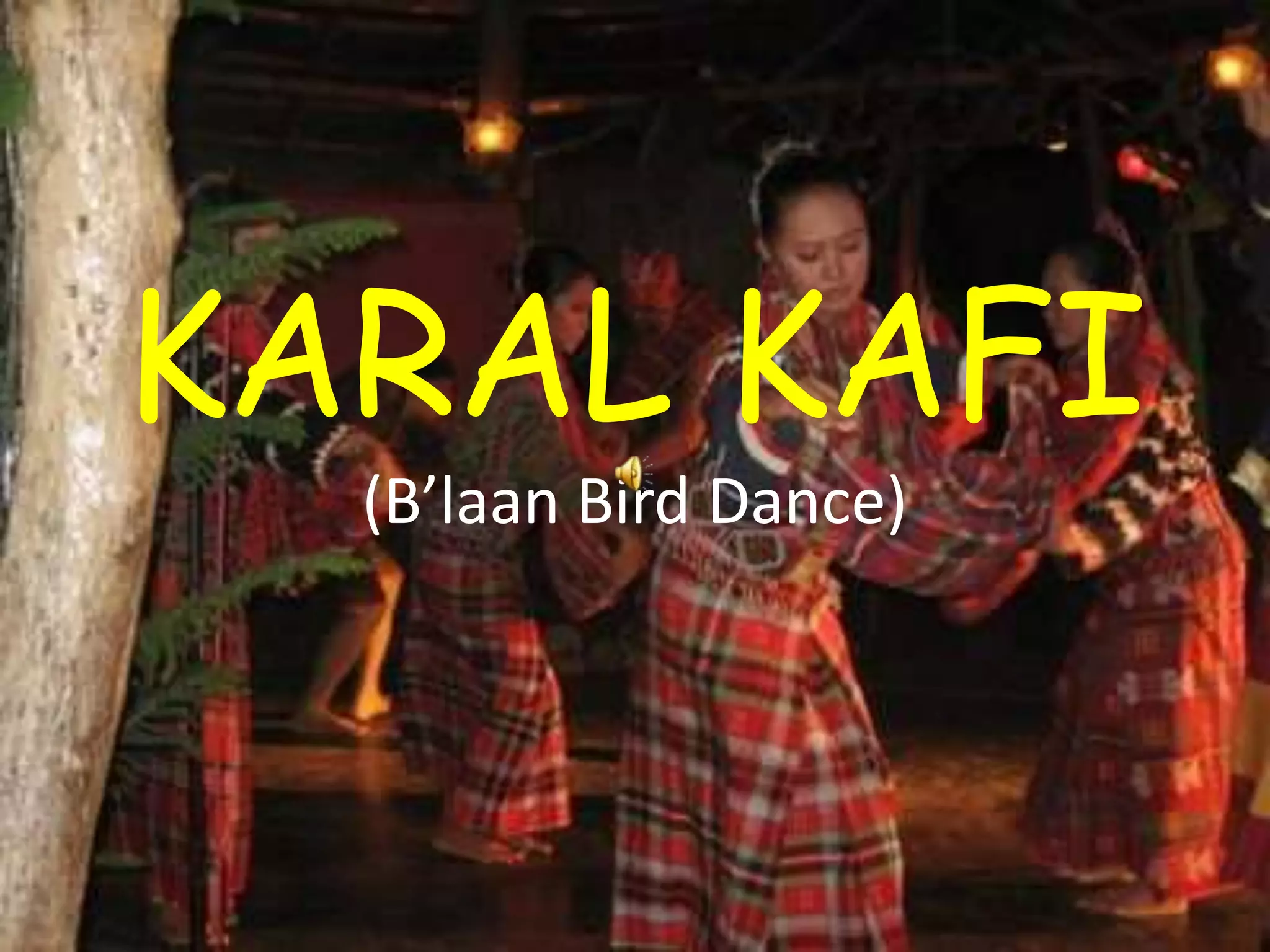
KARAL KAFI
(B’laan Bird Dance)
Introduction
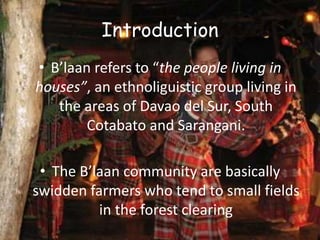
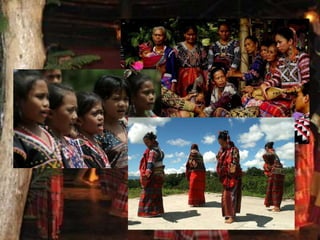
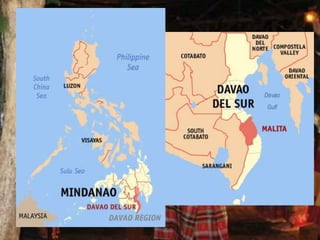
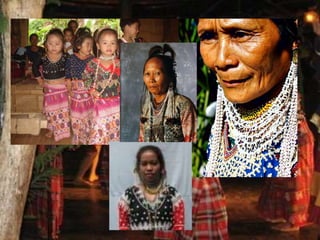
• B’laan refers to “the people living in
houses”, an ethnoliguistic group living in
the areas of Davao del Sur, South
Cotabato and Sarangani.
• The B’laan community are basically
swidden farmers who tend to small fields
in the forest clearing
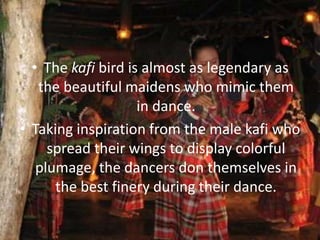
• The kafi bird is almost as legendary as
the beautiful maidens who mimic them
in dance.
• Taking inspiration from the male kafi who
spread their wings to display colorful
plumage, the dancers don themselves in
the best finery during their dance.
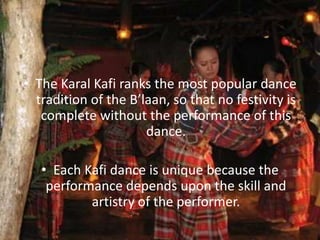
• The Karal Kafi ranks the most popular dance
tradition of the B’laan, so that no festivity is
complete without the performance of this
dance.
• Each Kafi dance is unique because the
performance depends upon the skill and
artistry of the performer.
Etymology
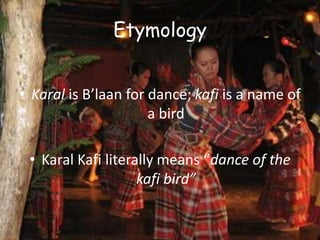
• Karal is B’laan for dance; kafi is a name of
a bird
• Karal Kafi literally means “dance of the
kafi bird”
Dance Properties
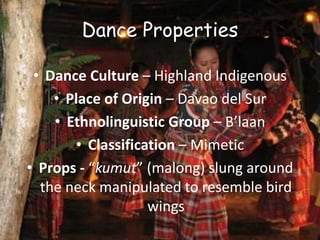
• Dance Culture – Highland Indigenous
• Place of Origin – Davao del Sur
• Ethnolinguistic Group – B’laan
• Classification – Mimetic
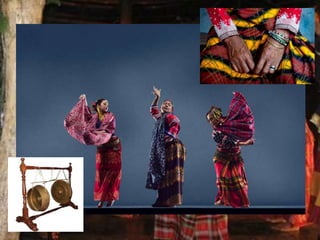
• Props - “kumut” (malong) slung around
the neck manipulated to resemble bird
wings
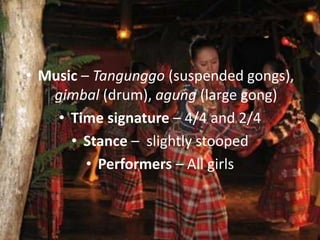
• Music – Tangunggo (suspended gongs),
gimbal (drum), agung (large gong)
• Time signature – 4/4 and 2/4
• Stance – slightly stooped
• Performers – All girls
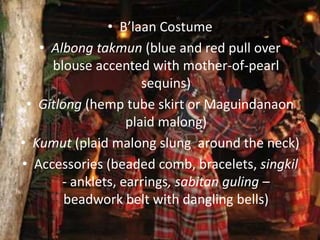
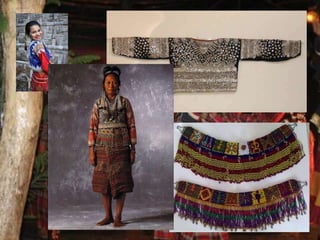
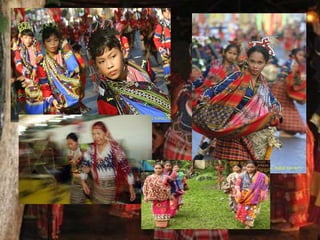
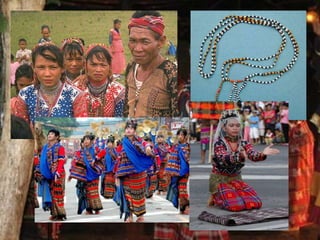
• B’laan Costume
• Albong takmun (blue and red pull over
blouse accented with mother-of-pearl
sequins)
• Gitlong (hemp tube skirt or Maguindanaon
plaid malong)
• Kumut (plaid malong slung around the neck)
• Accessories (beaded comb, bracelets, singkil
- anklets, earrings, sabitan guling –
beadwork belt with dangling bells)
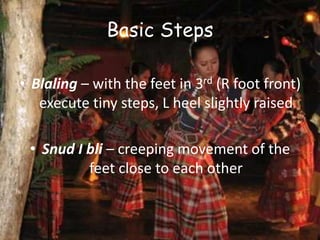
Basic Steps
• Blaling – with the feet in 3rd (R foot front)
execute tiny steps, L heel slightly raised
• Snud I bli – creeping movement of the
feet close to each other
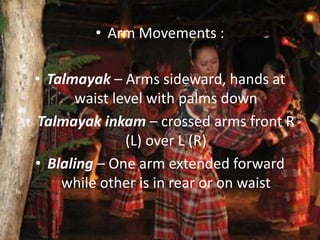
• Arm Movements :
• Talmayak – Arms sideward, hands at
waist level with palms down
• Talmayak inkam – crossed arms front R
(L) over L (R)
• Blaling – One arm extended forward
while other is in rear or on waist
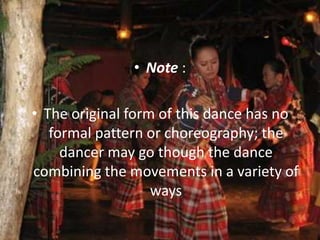
• Note :
• The original form of this dance has no
formal pattern or choreography; the
dancer may go though the dance
combining the movements in a variety of
ways
Choreographed Sequence
4/4 time
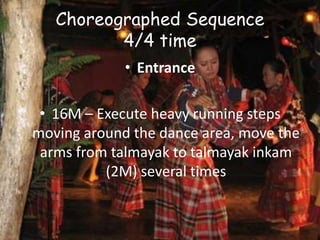
• Entrance
• 16M – Execute heavy running steps
moving around the dance area, move the
arms from talmayak to talmayak inkam
(2M) several times
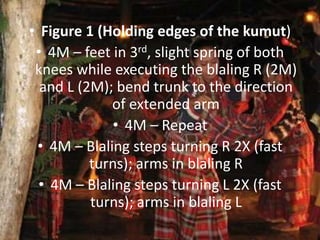
• Figure 1 (Holding edges of the kumut)
• 4M – feet in 3rd, slight spring of both
knees while executing the blaling R (2M)
and L (2M); bend trunk to the direction
of extended arm
• 4M – Repeat
• 4M – Blaling steps turning R 2X (fast
turns); arms in blaling R
• 4M – Blaling steps turning L 2X (fast
turns); arms in blaling L
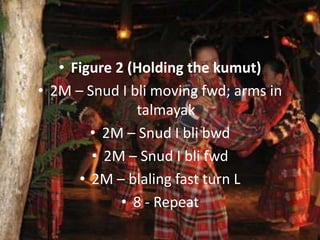
• Figure 2 (Holding the kumut)
• 2M – Snud I bli moving fwd; arms in
talmayak
• 2M – Snud I bli bwd
• 2M – Snud I bli fwd
• 2M – blaling fast turn L
• 8 - Repeat
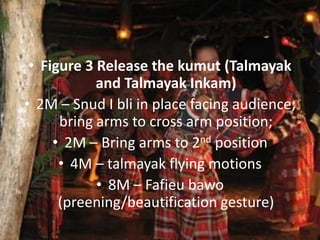
• Figure 3 Release the kumut (Talmayak
and Talmayak Inkam)
• 2M – Snud I bli in place facing audience;
bring arms to cross arm position;
• 2M – Bring arms to 2nd position
• 4M – talmayak flying motions
• 8M – Fafieu bawo
(preening/beautification gesture)
• Figure 4 Flying (Blaling R and L
alternately)
• 8M – Heavy running steps; arms in
blaling R and L alternately
• 2M – Blaling R; moving obliquely fwd R
• 2M – Blaling R; moving obliquely bwd L
2M – Blaling R; moving obliquely fwd R
2M – Blaling L; fast turn L
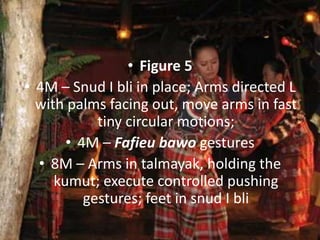
• Figure 5
• 4M – Snud I bli in place; Arms directed L
with palms facing out, move arms in fast
tiny circular motions;
• 4M – Fafieu bawo gestures
• 8M – Arms in talmayak, holding the
kumut; execute controlled pushing
gestures; feet in snud I bli
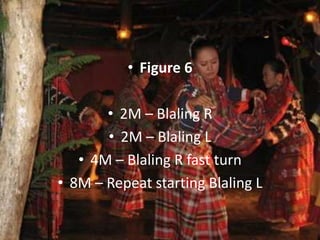
• Figure 6
• 2M – Blaling R
• 2M – Blaling L
• 4M – Blaling R fast turn
• 8M – Repeat starting Blaling L
• Figure 7
• 8M – Heavy running steps around the
floor ; fast talmayak inkam (once per M)
• 4M – facing R side, arms in talmayak
holding kumut, move bwd in snud I bli;
• 4M – facing L side, arms in talmayak,
move bwd in snud I bli
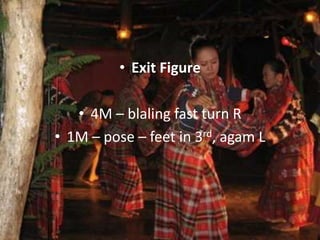
• Exit Figure
• 4M – blaling fast turn R
• 1M – pose – feet in 3rd, agam L
Karal kafi (Philippine Folk Dance)

Karal kafi (Philippine Folk Dance)

  • 1.
  • 3.
    Introduction • B’laan refersto “the people living in houses”, an ethnoliguistic group living in the areas of Davao del Sur, South Cotabato and Sarangani. • The B’laan community are basically swidden farmers who tend to small fields in the forest clearing
  • 4.
    • The kafibird is almost as legendary as the beautiful maidens who mimic them in dance. • Taking inspiration from the male kafi who spread their wings to display colorful plumage, the dancers don themselves in the best finery during their dance.
  • 5.
    • The KaralKafi ranks the most popular dance tradition of the B’laan, so that no festivity is complete without the performance of this dance. • Each Kafi dance is unique because the performance depends upon the skill and artistry of the performer.
  • 6.
    Etymology • Karal isB’laan for dance; kafi is a name of a bird • Karal Kafi literally means “dance of the kafi bird”
  • 8.
    Dance Properties • DanceCulture – Highland Indigenous • Place of Origin – Davao del Sur • Ethnolinguistic Group – B’laan • Classification – Mimetic • Props - “kumut” (malong) slung around the neck manipulated to resemble bird wings
  • 10.
    • Music –Tangunggo (suspended gongs), gimbal (drum), agung (large gong) • Time signature – 4/4 and 2/4 • Stance – slightly stooped • Performers – All girls
  • 11.
    • B’laan Costume •Albong takmun (blue and red pull over blouse accented with mother-of-pearl sequins) • Gitlong (hemp tube skirt or Maguindanaon plaid malong) • Kumut (plaid malong slung around the neck) • Accessories (beaded comb, bracelets, singkil - anklets, earrings, sabitan guling – beadwork belt with dangling bells)
  • 14.
    Basic Steps • Blaling– with the feet in 3rd (R foot front) execute tiny steps, L heel slightly raised • Snud I bli – creeping movement of the feet close to each other
  • 15.
    • Arm Movements: • Talmayak – Arms sideward, hands at waist level with palms down • Talmayak inkam – crossed arms front R (L) over L (R) • Blaling – One arm extended forward while other is in rear or on waist
  • 17.
    • Note : •The original form of this dance has no formal pattern or choreography; the dancer may go though the dance combining the movements in a variety of ways
  • 18.
    Choreographed Sequence 4/4 time •Entrance • 16M – Execute heavy running steps moving around the dance area, move the arms from talmayak to talmayak inkam (2M) several times
  • 19.
    • Figure 1(Holding edges of the kumut) • 4M – feet in 3rd, slight spring of both knees while executing the blaling R (2M) and L (2M); bend trunk to the direction of extended arm • 4M – Repeat • 4M – Blaling steps turning R 2X (fast turns); arms in blaling R • 4M – Blaling steps turning L 2X (fast turns); arms in blaling L
  • 20.
    • Figure 2(Holding the kumut) • 2M – Snud I bli moving fwd; arms in talmayak • 2M – Snud I bli bwd • 2M – Snud I bli fwd • 2M – blaling fast turn L • 8 - Repeat
  • 21.
    • Figure 3Release the kumut (Talmayak and Talmayak Inkam) • 2M – Snud I bli in place facing audience; bring arms to cross arm position; • 2M – Bring arms to 2nd position • 4M – talmayak flying motions • 8M – Fafieu bawo (preening/beautification gesture)
  • 22.
    • Figure 4Flying (Blaling R and L alternately) • 8M – Heavy running steps; arms in blaling R and L alternately • 2M – Blaling R; moving obliquely fwd R • 2M – Blaling R; moving obliquely bwd L 2M – Blaling R; moving obliquely fwd R 2M – Blaling L; fast turn L
  • 23.
    • Figure 5 •4M – Snud I bli in place; Arms directed L with palms facing out, move arms in fast tiny circular motions; • 4M – Fafieu bawo gestures • 8M – Arms in talmayak, holding the kumut; execute controlled pushing gestures; feet in snud I bli
  • 24.
    • Figure 6 •2M – Blaling R • 2M – Blaling L • 4M – Blaling R fast turn • 8M – Repeat starting Blaling L
  • 25.
    • Figure 7 •8M – Heavy running steps around the floor ; fast talmayak inkam (once per M) • 4M – facing R side, arms in talmayak holding kumut, move bwd in snud I bli; • 4M – facing L side, arms in talmayak, move bwd in snud I bli
  • 26.
    • Exit Figure •4M – blaling fast turn R • 1M – pose – feet in 3rd, agam L