BENDIAN
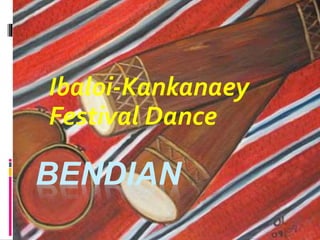
Ibaloi-Kankanaey
Festival Dance
Introduction
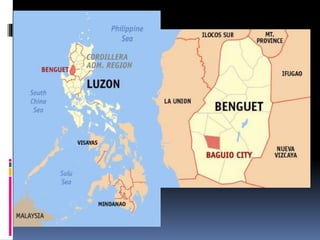
 .The Ibaloi (Nabaloi) and Kankanaey
are indigenous ethnic groups found
in mountains of the Cordillera
Central on the island of Luzon.
 There are approximately 55,000
Ibaloi, most of them can be found in
the southern part of the province
of Benguet.
 The Kankanaey live in western
Mountain Province, northern
Benguet and southeastern Ilocos
Sur.
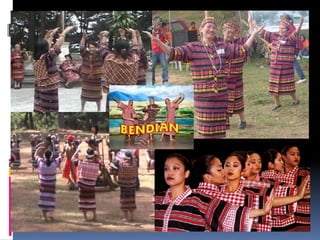
 Both groups perform the ceremony
called the Bendian.
 Bendian festival celebrated by the
Ibaloi and Kankanaey is always big
and extraordinary.
 It involves the village circling and
dancing around the ulul leader while
executing various arm movements.
 Lasting until the wee hours of the
night, the bedian ritual ends on the
sound of the loudest oway or war
cry.
 This version of Bendian centers
around the maiden's part of the
circle.
 Bendian is performed for many
reasons.
 Some of which are to heal a prolong
illness, relieve natural calamities
such as famine and drought, and to
celebrate a bountiful harvest.
 However, in the past the biggest
Bendian was to celebrate a victory
in war and a successful headhunt.
 Nowadays the festival is held for
important festive occasions.
Etymology
 Bendian, Bendaan or Bendayan
literally translates to “ let’s see who
gets tired first” is a circle dance “to
celebrate a victory”
Dance Properties
 Dance Culture – Highland Cordillera
 Place of Origin – Benguet
 Ethnolinguistic Group – Ibaloi and
Kankanaey
 Classification - Festival
 Props – none
 Mood – jovial
 Stance – erect
 Performers – all girls
 Formation - circle
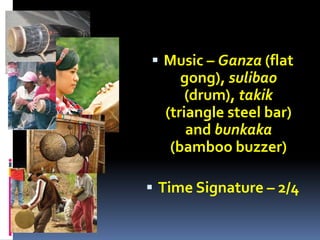
 Music – Ganza (flat
gong), sulibao
(drum), takik
(triangle steel bar)
and bunkaka
(bamboo buzzer)
 Time Signature – 2/4
Costume
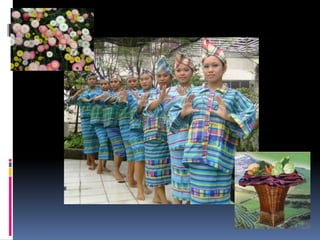
 Kambal – long sleeved jacket of abel
Iloko (Ilocano weave) with broad
stripes of blood red, bottle green,
blue, black and white accented with
strips of checkered cloth
 Aken (Divet) – knee-length wrap-
around skirt of the same material as
the jacket.
 Donas – cloth belt to secure the skirt
on the waist
 Headband of abel Iloko
 Akon – coin necklace/or seed bead
necklace; tabing – gold earrings;
anas – bracelet, complete the attire
Basic Steps
 Step on ball of L and brush-kick R
obliquely backward right (ct. 1)
Feet together (ct. and)
Repeat (ct. 2 and)
Heavy walk
Basic Gestures
 Various arm movements and
positions based on the command of
the ulul or leader
 Djinungluan (watch over) – arms
raided obliquely forward upward,
palms down
 Dimbabaw (display and observe) –
arms stretched laterally, palms
down
 Kinetangan (satisfaction) – hands in
alms position
 Pinaposan – palms facing front over
chest
 Inabaya – Open palms stiffly placed
behind butt, flipped outwards and
inwards like a bird’s tail
 Kiniyakan (dig) – like alms position
but both hands directed to one side
Choreographed Sequence
 Entrance - 15M – Djinungluan
(flipped); brush kick to formation
 Figure 1 –
 8M – Dimbabaw; brush kick
 8M – Dimbabaw; brush kick – four
walls
 Figure 2 –
 16M – Inabaya; trunk slightly
stooped; brush kick moving
CW/CCW; end forming circle, facing
center
 Figure 3 –
 8M – Diagonal arms (R obliquely
upward R), brush kick turning R in
place
 8M – reverse arm position; turn L
 Figure 4 –
 Facing center of circle
 4M – Djinungluan; brush kick
 4M –Turn right about; repeat
 8M – Repeat
 Figure 5 –8M –
 R stretched obliquely forward
upward; L on waist; brush kick,
move CW
 8M – Reverse arm position; move
CCW
 End in two columns
 Figure 6 –
 16M – Kinetangan forward; brush
kick
 Figure 7 –
 8M - Kiniyakan R; brush kick turning
R
 8M – Reverse arm position; turn L
 Figure 8 –
 8M – Alternate diagonal arms; feet
in 3rd
 8M – same arm movement; brush
kick
 Figure 9 –
 8M – Pinaposan; arms flapping
motion; feet in 3rd
 8M – Pinaposan; brush kick moving
to a column formation
 Figure 10 –
 Heavy steps, lead girl execute
djinungluan; girl behind holds
leading girl’s waist; 3rd girl hold 2nd
girl’s; so on
Source
PFDS Sayaw
Volume 3
pp. 11-15
 Dance Researcher –
Mr. Ramon A. Obusan
Bendian (Philippine Folk Dance)

Bendian (Philippine Folk Dance)

  • 1.
  • 4.
    Introduction  .The Ibaloi(Nabaloi) and Kankanaey are indigenous ethnic groups found in mountains of the Cordillera Central on the island of Luzon.  There are approximately 55,000 Ibaloi, most of them can be found in the southern part of the province of Benguet.
  • 5.
     The Kankanaeylive in western Mountain Province, northern Benguet and southeastern Ilocos Sur.  Both groups perform the ceremony called the Bendian.
  • 6.
     Bendian festivalcelebrated by the Ibaloi and Kankanaey is always big and extraordinary.  It involves the village circling and dancing around the ulul leader while executing various arm movements.
  • 7.
     Lasting untilthe wee hours of the night, the bedian ritual ends on the sound of the loudest oway or war cry.  This version of Bendian centers around the maiden's part of the circle.
  • 8.
     Bendian isperformed for many reasons.  Some of which are to heal a prolong illness, relieve natural calamities such as famine and drought, and to celebrate a bountiful harvest.
  • 9.
     However, inthe past the biggest Bendian was to celebrate a victory in war and a successful headhunt.  Nowadays the festival is held for important festive occasions.
  • 10.
    Etymology  Bendian, Bendaanor Bendayan literally translates to “ let’s see who gets tired first” is a circle dance “to celebrate a victory”
  • 11.
    Dance Properties  DanceCulture – Highland Cordillera  Place of Origin – Benguet  Ethnolinguistic Group – Ibaloi and Kankanaey  Classification - Festival
  • 13.
     Props –none  Mood – jovial  Stance – erect  Performers – all girls  Formation - circle
  • 14.
     Music –Ganza (flat gong), sulibao (drum), takik (triangle steel bar) and bunkaka (bamboo buzzer)  Time Signature – 2/4
  • 15.
    Costume  Kambal –long sleeved jacket of abel Iloko (Ilocano weave) with broad stripes of blood red, bottle green, blue, black and white accented with strips of checkered cloth  Aken (Divet) – knee-length wrap- around skirt of the same material as the jacket.
  • 16.
     Donas –cloth belt to secure the skirt on the waist  Headband of abel Iloko  Akon – coin necklace/or seed bead necklace; tabing – gold earrings; anas – bracelet, complete the attire
  • 18.
    Basic Steps  Stepon ball of L and brush-kick R obliquely backward right (ct. 1) Feet together (ct. and) Repeat (ct. 2 and) Heavy walk
  • 19.
    Basic Gestures  Variousarm movements and positions based on the command of the ulul or leader
  • 20.
     Djinungluan (watchover) – arms raided obliquely forward upward, palms down  Dimbabaw (display and observe) – arms stretched laterally, palms down  Kinetangan (satisfaction) – hands in alms position
  • 21.
     Pinaposan –palms facing front over chest  Inabaya – Open palms stiffly placed behind butt, flipped outwards and inwards like a bird’s tail  Kiniyakan (dig) – like alms position but both hands directed to one side
  • 22.
    Choreographed Sequence  Entrance- 15M – Djinungluan (flipped); brush kick to formation  Figure 1 –  8M – Dimbabaw; brush kick  8M – Dimbabaw; brush kick – four walls
  • 23.
     Figure 2–  16M – Inabaya; trunk slightly stooped; brush kick moving CW/CCW; end forming circle, facing center
  • 24.
     Figure 3–  8M – Diagonal arms (R obliquely upward R), brush kick turning R in place  8M – reverse arm position; turn L
  • 25.
     Figure 4–  Facing center of circle  4M – Djinungluan; brush kick  4M –Turn right about; repeat  8M – Repeat
  • 26.
     Figure 5–8M –  R stretched obliquely forward upward; L on waist; brush kick, move CW  8M – Reverse arm position; move CCW  End in two columns
  • 27.
     Figure 6–  16M – Kinetangan forward; brush kick  Figure 7 –  8M - Kiniyakan R; brush kick turning R  8M – Reverse arm position; turn L
  • 28.
     Figure 8–  8M – Alternate diagonal arms; feet in 3rd  8M – same arm movement; brush kick
  • 29.
     Figure 9–  8M – Pinaposan; arms flapping motion; feet in 3rd  8M – Pinaposan; brush kick moving to a column formation
  • 30.
     Figure 10–  Heavy steps, lead girl execute djinungluan; girl behind holds leading girl’s waist; 3rd girl hold 2nd girl’s; so on
  • 31.
    Source PFDS Sayaw Volume 3 pp.11-15  Dance Researcher – Mr. Ramon A. Obusan