VALSE VIEJA
Introduction
• When the Spaniards colonized the
Philippines in the 16th Century, many
lives of the natives changed forever.
• Many aspects of the indigenous culture
either vanished or got modified due to
assimilation of Iberian-European
cultures.
• The area of music and dance also got
modified…the indigenous blended with
western to create “Filipinized” versions
of the European jota, mazurka, redoba,
polka, zapateado and waltz.
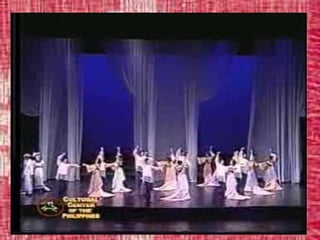
• Valse Vieja is a version of the waltz that
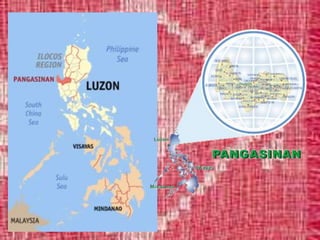
originated in Pangasinan.
• It is performed by the members of the
“principalia” or upper class in old
Pangasinan during stately occasions and
fiestas.
• A distinct feature of this version of the
waltz is the movement of the hand in a
gesture called kewet, unique to the
people of Pangasinan.
Etymology
• “valse vieja” is Spanish for Old
Waltz
Dance Properties
• Dance Culture – Lowland Christian –
Urban
• Place of Origin – Pangasinan
• Ethnolinguistic Group – Pangasinense
• Classification – Festival (Ballroom
Dance)
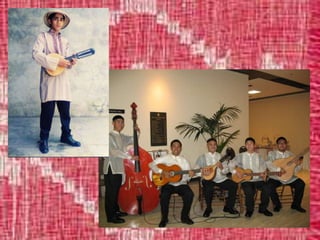
• Music – Provided by the rondalla (native
string ensemble)
• Time Signature – ¾
• Props – None
• Stance – Erect/dignified/
• Mood – Jovial /gracioso (audience-
conscious)
• Performers - Couple
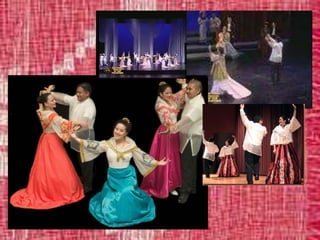
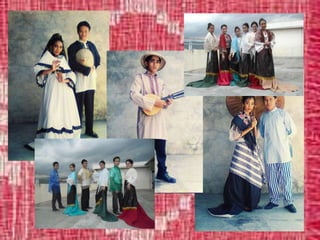
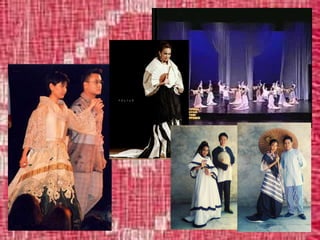
• Costume
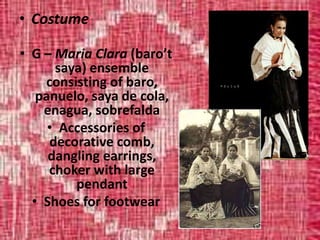
• G – Maria Clara (baro’t
saya) ensemble
consisting of baro,
panuelo, saya de cola,
enagua, sobrefalda
• Accessories of
decorative comb,
dangling earrings,
choker with large
pendant
• Shoes for footwear
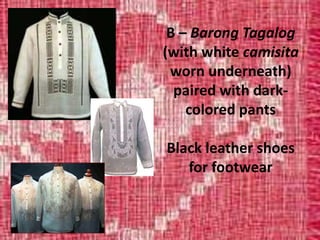
B – Barong Tagalog
(with white camisita
worn underneath)
paired with dark-
colored pants
Black leather shoes
for footwear
Dance Steps and Gestures
• Step cross step raise R and L
• Cross Waltz
• Native Waltz
• Step brush
• Kewet with arms in fourth position
• Hayon Hayon
• Sarok
The Dance
• Entrance
• Waltz in abrasete position to places, end
up partners facing each other
• Fig 1 (Music A)
• 2M – Step cross step raise R; arms 4th;
kewet per M
• 2M –Step close L and curtsy to partner
• 2M – Step cross step raise; arms in 4th;
kewet per M
• 2M – Step close R and curtsy to partner
• Continued :
• 2M – step cross step raise R pass back to
back with partner exchanging places ;
arms in 4th position; kewet
• 2M – 3 step turn L in partner’s place;
end facing partner
• 4M – repeat, starting L ; pass back to
back to return to proper places
• Fig 2 (Music B) – face partners two hand
hold
• 2M – Cross waltz L and R
• 2M – couple turns CW to change places
• 4M – repeat returning to places
• Release hold
• 4M – native waltz fwd passing R to R
with partner exchanging places; hayon
hayon
• 4M – Repeat, returning to proper places
• Fig 3 ( Music A)
• 2M –Slight rocking R in front and R in
rear; arms in 4th (raise L arm and R
alternately)
• 2M – tiny steps in place; G hold skirt; B
hands on waist
• 4M – repeat
• 4M – Step brush R; arms in 4th; kewet
• 4M – Step brush L; reverse arm position
• Fig 4 (Music C)
• 2M – Sarok R across L ; turn R about;
reverse T ; kewet
• 2M – Turn L about; waltz R and L;
reverse T; kewet
• 4M – Repeat
• 8M – R to R hand hold, waltz R and L
alternately
• Fig 5 (Music A) Tumba Tumba
• 4M – Waltz R and L; arms in 2nd
• 12M – Waltz moving CW; arms in 4th
• Fig 6 (Music B) partners face each other
two hand hold
• 2M – Cross waltz L and R
• 2M – steps to make full circle and return
to proper places
• 4M – repeat, starting with L
• 8M - Abrasete position , promenade
• 8M - Finale: Closed ballroom position
Valse Vieja (Philippine Folk Dance)

Valse Vieja (Philippine Folk Dance)

  • 1.
  • 4.
    Introduction • When theSpaniards colonized the Philippines in the 16th Century, many lives of the natives changed forever. • Many aspects of the indigenous culture either vanished or got modified due to assimilation of Iberian-European cultures.
  • 5.
    • The areaof music and dance also got modified…the indigenous blended with western to create “Filipinized” versions of the European jota, mazurka, redoba, polka, zapateado and waltz.
  • 6.
    • Valse Viejais a version of the waltz that originated in Pangasinan. • It is performed by the members of the “principalia” or upper class in old Pangasinan during stately occasions and fiestas.
  • 7.
    • A distinctfeature of this version of the waltz is the movement of the hand in a gesture called kewet, unique to the people of Pangasinan.
  • 8.
  • 9.
    Dance Properties • DanceCulture – Lowland Christian – Urban • Place of Origin – Pangasinan • Ethnolinguistic Group – Pangasinense • Classification – Festival (Ballroom Dance)
  • 11.
    • Music –Provided by the rondalla (native string ensemble) • Time Signature – ¾ • Props – None • Stance – Erect/dignified/ • Mood – Jovial /gracioso (audience- conscious) • Performers - Couple
  • 13.
    • Costume • G– Maria Clara (baro’t saya) ensemble consisting of baro, panuelo, saya de cola, enagua, sobrefalda • Accessories of decorative comb, dangling earrings, choker with large pendant • Shoes for footwear
  • 14.
    B – BarongTagalog (with white camisita worn underneath) paired with dark- colored pants Black leather shoes for footwear
  • 17.
    Dance Steps andGestures • Step cross step raise R and L • Cross Waltz • Native Waltz • Step brush • Kewet with arms in fourth position • Hayon Hayon • Sarok
  • 18.
    The Dance • Entrance •Waltz in abrasete position to places, end up partners facing each other
  • 19.
    • Fig 1(Music A) • 2M – Step cross step raise R; arms 4th; kewet per M • 2M –Step close L and curtsy to partner • 2M – Step cross step raise; arms in 4th; kewet per M • 2M – Step close R and curtsy to partner
  • 20.
    • Continued : •2M – step cross step raise R pass back to back with partner exchanging places ; arms in 4th position; kewet • 2M – 3 step turn L in partner’s place; end facing partner • 4M – repeat, starting L ; pass back to back to return to proper places
  • 21.
    • Fig 2(Music B) – face partners two hand hold • 2M – Cross waltz L and R • 2M – couple turns CW to change places • 4M – repeat returning to places • Release hold • 4M – native waltz fwd passing R to R with partner exchanging places; hayon hayon • 4M – Repeat, returning to proper places
  • 22.
    • Fig 3( Music A) • 2M –Slight rocking R in front and R in rear; arms in 4th (raise L arm and R alternately) • 2M – tiny steps in place; G hold skirt; B hands on waist • 4M – repeat • 4M – Step brush R; arms in 4th; kewet • 4M – Step brush L; reverse arm position
  • 23.
    • Fig 4(Music C) • 2M – Sarok R across L ; turn R about; reverse T ; kewet • 2M – Turn L about; waltz R and L; reverse T; kewet • 4M – Repeat • 8M – R to R hand hold, waltz R and L alternately
  • 24.
    • Fig 5(Music A) Tumba Tumba • 4M – Waltz R and L; arms in 2nd • 12M – Waltz moving CW; arms in 4th
  • 25.
    • Fig 6(Music B) partners face each other two hand hold • 2M – Cross waltz L and R • 2M – steps to make full circle and return to proper places • 4M – repeat, starting with L • 8M - Abrasete position , promenade
  • 26.
    • 8M -Finale: Closed ballroom position