BANDHA 
POETRY ON LOOM
What is Bandha? 
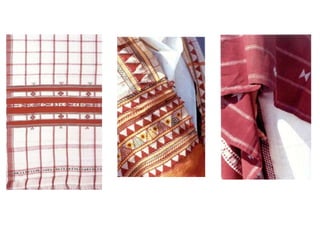
• Bandha from Orissa is a type of ‘Ikat’ which stands apart not 
only in it’s unique designs but also the process, it’s expression 
but the way it is summed up onto the loom. 
• It is acknowledged for distinctively rendered curvilinear 
motifs and relief texture due to supplementary warp and 
weft weaves. 
• The tying of threads for elaborate dyeing processes before 
weaving, requires precision.
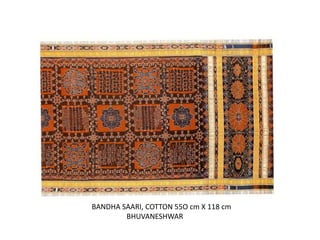
BANDHA SAARI, COTTON 55O cm X 118 cm 
BHUVANESHWAR
• The distinctive hand-woven textiles of Orissa in unusual 
patterns and vibrant colours have supported a thriving 
cottage industry employing thousands. 
• Orissa is famous for its silk Ikat weaves created by an intricate 
process called the "Bandha" in which warp and weft threads 
are tie-dyed to produce the pattern on the loom while 
weaving. 
• Typical design motifs include rows of birds and animals, fish, 
seashells, rudraksh beads and temple spires. While Sambalpur 
is famous for its double-ikat textiles, Sonepur is known for its 
gold embroidered ones.
Development of Bandha Among the 
Communities 
• In the Eastern region this art developed in Tigiria, Nupatna, 
Maniabadha and Badamba in Cuttack district. 
• In the Western parts the art is limited to Bhulia and Kostha 
communities and they are settled in Balasore and Mayurbanj 
districts. 
• This art has again developed in certain villages like Barpalli, 
Remunda, Jhiliminda villages of old Bolangir districts.
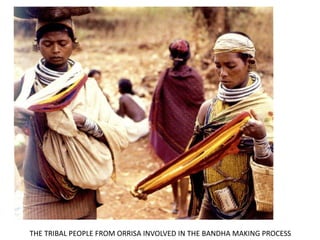
THE TRIBAL PEOPLE FROM ORRISA INVOLVED IN THE BANDHA MAKING PROCESS
The Process 
• In this method of textile process dyeing plays a very 
prominent role. 
• The pattern is not formed by weaving together yarns of 
different color nor it is printed on the fabric : it is made 
by dying the warp and weft threads before weaving. 
• Following the precise plan, pieces of another material are 
tied hanks of yarn at certain points. 
• This material absorbs dye stuff and is removed on 
completion of dyeing, leaving the yarn dyed only where it 
is exposed to the dye-liquor.
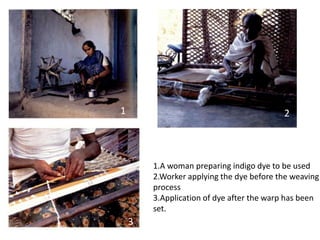
1 2 
1.A woman preparing indigo dye to be used 
2.Worker applying the dye before the weaving 
process 
3.Application of dye after the warp has been 
set. 
3
1 
3 
2 
2 
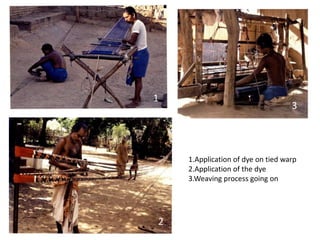
1.Application of dye on tied warp 
2.Application of the dye 
3.Weaving process going on
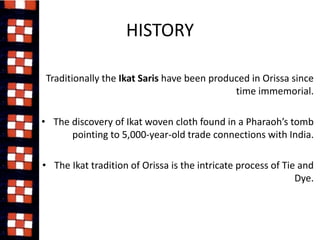
HISTORY 
• Traditionally the Ikat Saris have been produced in Orissa since 
time immemorial. 
• The discovery of Ikat woven cloth found in a Pharaoh’s tomb 
pointing to 5,000-year-old trade connections with India. 
• The Ikat tradition of Orissa is the intricate process of Tie and 
Dye.
Places and their speciality 
• Sambalpur, Berhampur, Mayurbhanj and Nuapatna produce a 
striking range in tussar silk with a brilliance, glaze and texture 
that is unmatched. 
• The rare silk fabric produced at Nuapatna in Cuttack district 
embellished with verses from the Gitagovinda is used to dress 
the idols at the Jagannath Temple. 
• The masters are well versed with the centuries old art of silk 
worm cultivation and create silk ties, stoles, furnishings and 
dress materials apart from saris.
The technique of single ikat is used predominately in 
the saktapar designs which is done in double ikat. 
The two main bandha weaving clusters are Sambalpur 
in the west including Bargarh, Barpali and Sonepur; and 
Nuptana in the east. 
The weaversin the Sambalpur – Bargarh region belong 
to the Meher community and in Nupatana they belong 
to the Patra communtiy.
MOTIFS 
• Even the motifs such as the temple border, lotus, conch and 
wheel, signify the affinity with the reigning deity. 
• The traditional Orissa Saris have undergone vast changes as 
weavers try to adapt the designs to popular taste. 
• The bichitrapar and saktrapar saris are unique examples with 
motifs of duck, fish, lotus, creeper, elephant, lion, deer ; the 
kumbh, temple or serrated edge, and in fine white otline of 
the ikat motif.
BOMKAI SARIS 
• Orissa the Bomkai sari is named after the village where the 
craft is practiced. 
• Using a time consuming weaving technique the field warp 
threads are cut and then retied to different colored warps 
to create the unusually large pallu. 
• This technique is locally called muhajorhi (or pallu with 
joined threads). 
• Some Bomkai saris have small fishes woven onto the 
border. Fish symbolizes prosperity and good health 
• Bomkai saris feature thread work ornament borders and 
pallu. 
• These saris are much in demand owing to their traditional 
look as well as their understated and elegant color palette.
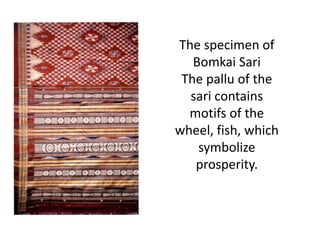
The specimen of 
Bomkai Sari 
The pallu of the 
sari contains 
motifs of the 
wheel, fish, which 
symbolize 
prosperity.
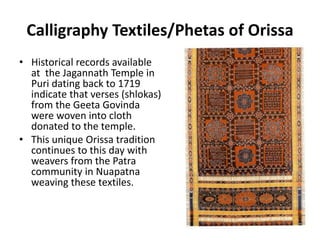
Calligraphy Textiles/Phetas of Orissa 
• Historical records available 
at the Jagannath Temple in 
Puri dating back to 1719 
indicate that verses (shlokas) 
from the Geeta Govinda 
were woven into cloth 
donated to the temple. 
• This unique Orissa tradition 
continues to this day with 
weavers from the Patra 
community in Nuapatna 
weaving these textiles.
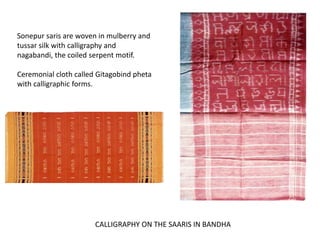
Sonepur saris are woven in mulberry and 
tussar silk with calligraphy and 
nagabandi, the coiled serpent motif. 
Ceremonial cloth called Gitagobind pheta 
with calligraphic forms. 
CALLIGRAPHY ON THE SAARIS IN BANDHA
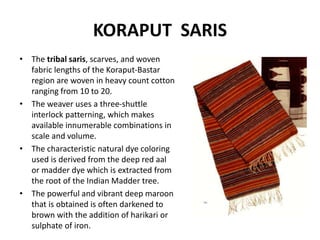
KORAPUT SARIS 
• The tribal saris, scarves, and woven 
fabric lengths of the Koraput-Bastar 
region are woven in heavy count cotton 
ranging from 10 to 20. 
• The weaver uses a three-shuttle 
interlock patterning, which makes 
available innumerable combinations in 
scale and volume. 
• The characteristic natural dye coloring 
used is derived from the deep red aal 
or madder dye which is extracted from 
the root of the Indian Madder tree. 
• The powerful and vibrant deep maroon 
that is obtained is often darkened to 
brown with the addition of harikari or 
sulphate of iron.
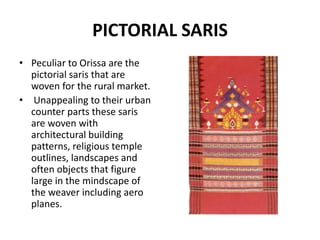
PICTORIAL SARIS 
• Peculiar to Orissa are the 
pictorial saris that are 
woven for the rural market. 
• Unappealing to their urban 
counter parts these saris 
are woven with 
architectural building 
patterns, religious temple 
outlines, landscapes and 
often objects that figure 
large in the mindscape of 
the weaver including aero 
planes.
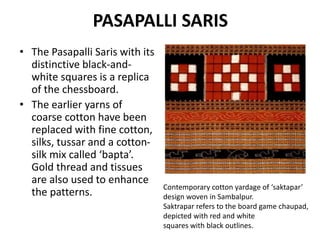
PASAPALLI SARIS 
• The Pasapalli Saris with its 
distinctive black-and-white 
squares is a replica 
of the chessboard. 
• The earlier yarns of 
coarse cotton have been 
replaced with fine cotton, 
silks, tussar and a cotton-silk 
mix called ‘bapta’. 
Gold thread and tissues 
are also used to enhance 
the patterns. Contemporary cotton yardage of ‘saktapar’ 
design woven in Sambalpur. 
Saktrapar refers to the board game chaupad, 
depicted with red and white 
squares with black outlines.
THANK YOU 
HANSIKA SHARMA 
VITIKA MEHTA 
MANINDER SINGH 
KUMAR SUBHASHISH 
MANISHA BHAN 
MALAY BARGALI 
NATIONAL INSTITUTE OF FASHION TECHNOLOGY, KANGRA

Bandha (2)

  • 1.
  • 2.
    What is Bandha? • Bandha from Orissa is a type of ‘Ikat’ which stands apart not only in it’s unique designs but also the process, it’s expression but the way it is summed up onto the loom. • It is acknowledged for distinctively rendered curvilinear motifs and relief texture due to supplementary warp and weft weaves. • The tying of threads for elaborate dyeing processes before weaving, requires precision.
  • 3.
    BANDHA SAARI, COTTON55O cm X 118 cm BHUVANESHWAR
  • 4.
    • The distinctivehand-woven textiles of Orissa in unusual patterns and vibrant colours have supported a thriving cottage industry employing thousands. • Orissa is famous for its silk Ikat weaves created by an intricate process called the "Bandha" in which warp and weft threads are tie-dyed to produce the pattern on the loom while weaving. • Typical design motifs include rows of birds and animals, fish, seashells, rudraksh beads and temple spires. While Sambalpur is famous for its double-ikat textiles, Sonepur is known for its gold embroidered ones.
  • 5.
    Development of BandhaAmong the Communities • In the Eastern region this art developed in Tigiria, Nupatna, Maniabadha and Badamba in Cuttack district. • In the Western parts the art is limited to Bhulia and Kostha communities and they are settled in Balasore and Mayurbanj districts. • This art has again developed in certain villages like Barpalli, Remunda, Jhiliminda villages of old Bolangir districts.
  • 6.
    THE TRIBAL PEOPLEFROM ORRISA INVOLVED IN THE BANDHA MAKING PROCESS
  • 7.
    The Process •In this method of textile process dyeing plays a very prominent role. • The pattern is not formed by weaving together yarns of different color nor it is printed on the fabric : it is made by dying the warp and weft threads before weaving. • Following the precise plan, pieces of another material are tied hanks of yarn at certain points. • This material absorbs dye stuff and is removed on completion of dyeing, leaving the yarn dyed only where it is exposed to the dye-liquor.
  • 8.
    1 2 1.Awoman preparing indigo dye to be used 2.Worker applying the dye before the weaving process 3.Application of dye after the warp has been set. 3
  • 9.
    1 3 2 2 1.Application of dye on tied warp 2.Application of the dye 3.Weaving process going on
  • 10.
    HISTORY • Traditionallythe Ikat Saris have been produced in Orissa since time immemorial. • The discovery of Ikat woven cloth found in a Pharaoh’s tomb pointing to 5,000-year-old trade connections with India. • The Ikat tradition of Orissa is the intricate process of Tie and Dye.
  • 12.
    Places and theirspeciality • Sambalpur, Berhampur, Mayurbhanj and Nuapatna produce a striking range in tussar silk with a brilliance, glaze and texture that is unmatched. • The rare silk fabric produced at Nuapatna in Cuttack district embellished with verses from the Gitagovinda is used to dress the idols at the Jagannath Temple. • The masters are well versed with the centuries old art of silk worm cultivation and create silk ties, stoles, furnishings and dress materials apart from saris.
  • 13.
    The technique ofsingle ikat is used predominately in the saktapar designs which is done in double ikat. The two main bandha weaving clusters are Sambalpur in the west including Bargarh, Barpali and Sonepur; and Nuptana in the east. The weaversin the Sambalpur – Bargarh region belong to the Meher community and in Nupatana they belong to the Patra communtiy.
  • 14.
    MOTIFS • Eventhe motifs such as the temple border, lotus, conch and wheel, signify the affinity with the reigning deity. • The traditional Orissa Saris have undergone vast changes as weavers try to adapt the designs to popular taste. • The bichitrapar and saktrapar saris are unique examples with motifs of duck, fish, lotus, creeper, elephant, lion, deer ; the kumbh, temple or serrated edge, and in fine white otline of the ikat motif.
  • 15.
    BOMKAI SARIS •Orissa the Bomkai sari is named after the village where the craft is practiced. • Using a time consuming weaving technique the field warp threads are cut and then retied to different colored warps to create the unusually large pallu. • This technique is locally called muhajorhi (or pallu with joined threads). • Some Bomkai saris have small fishes woven onto the border. Fish symbolizes prosperity and good health • Bomkai saris feature thread work ornament borders and pallu. • These saris are much in demand owing to their traditional look as well as their understated and elegant color palette.
  • 16.
    The specimen of Bomkai Sari The pallu of the sari contains motifs of the wheel, fish, which symbolize prosperity.
  • 17.
    Calligraphy Textiles/Phetas ofOrissa • Historical records available at the Jagannath Temple in Puri dating back to 1719 indicate that verses (shlokas) from the Geeta Govinda were woven into cloth donated to the temple. • This unique Orissa tradition continues to this day with weavers from the Patra community in Nuapatna weaving these textiles.
  • 18.
    Sonepur saris arewoven in mulberry and tussar silk with calligraphy and nagabandi, the coiled serpent motif. Ceremonial cloth called Gitagobind pheta with calligraphic forms. CALLIGRAPHY ON THE SAARIS IN BANDHA
  • 19.
    KORAPUT SARIS •The tribal saris, scarves, and woven fabric lengths of the Koraput-Bastar region are woven in heavy count cotton ranging from 10 to 20. • The weaver uses a three-shuttle interlock patterning, which makes available innumerable combinations in scale and volume. • The characteristic natural dye coloring used is derived from the deep red aal or madder dye which is extracted from the root of the Indian Madder tree. • The powerful and vibrant deep maroon that is obtained is often darkened to brown with the addition of harikari or sulphate of iron.
  • 20.
    PICTORIAL SARIS •Peculiar to Orissa are the pictorial saris that are woven for the rural market. • Unappealing to their urban counter parts these saris are woven with architectural building patterns, religious temple outlines, landscapes and often objects that figure large in the mindscape of the weaver including aero planes.
  • 22.
    PASAPALLI SARIS •The Pasapalli Saris with its distinctive black-and-white squares is a replica of the chessboard. • The earlier yarns of coarse cotton have been replaced with fine cotton, silks, tussar and a cotton-silk mix called ‘bapta’. Gold thread and tissues are also used to enhance the patterns. Contemporary cotton yardage of ‘saktapar’ design woven in Sambalpur. Saktrapar refers to the board game chaupad, depicted with red and white squares with black outlines.
  • 24.
    THANK YOU HANSIKASHARMA VITIKA MEHTA MANINDER SINGH KUMAR SUBHASHISH MANISHA BHAN MALAY BARGALI NATIONAL INSTITUTE OF FASHION TECHNOLOGY, KANGRA