Bancassurance
 The Bancassurance is a phenomenon
where in insurance products are offered
through the distribution channels of the
banking services along with a complete
range of banking & investment products
& services. In simple term, we can say It is
a relationship/tie-up between a Bank and
an Insurance company. Bank sells the
products of the Insurance company to
their own customers and earn some
amount of commission on sales.
Consideration for Insurers…
Immediate access to New
Markets
Increase in Market
Penetration
Reduce reliance on
traditional distribution
channel
Combine Cost Saving &
Increased Profitability
Develop new financial
products more efficiently
Improve sales
effectiveness & after sales
service
Insurer
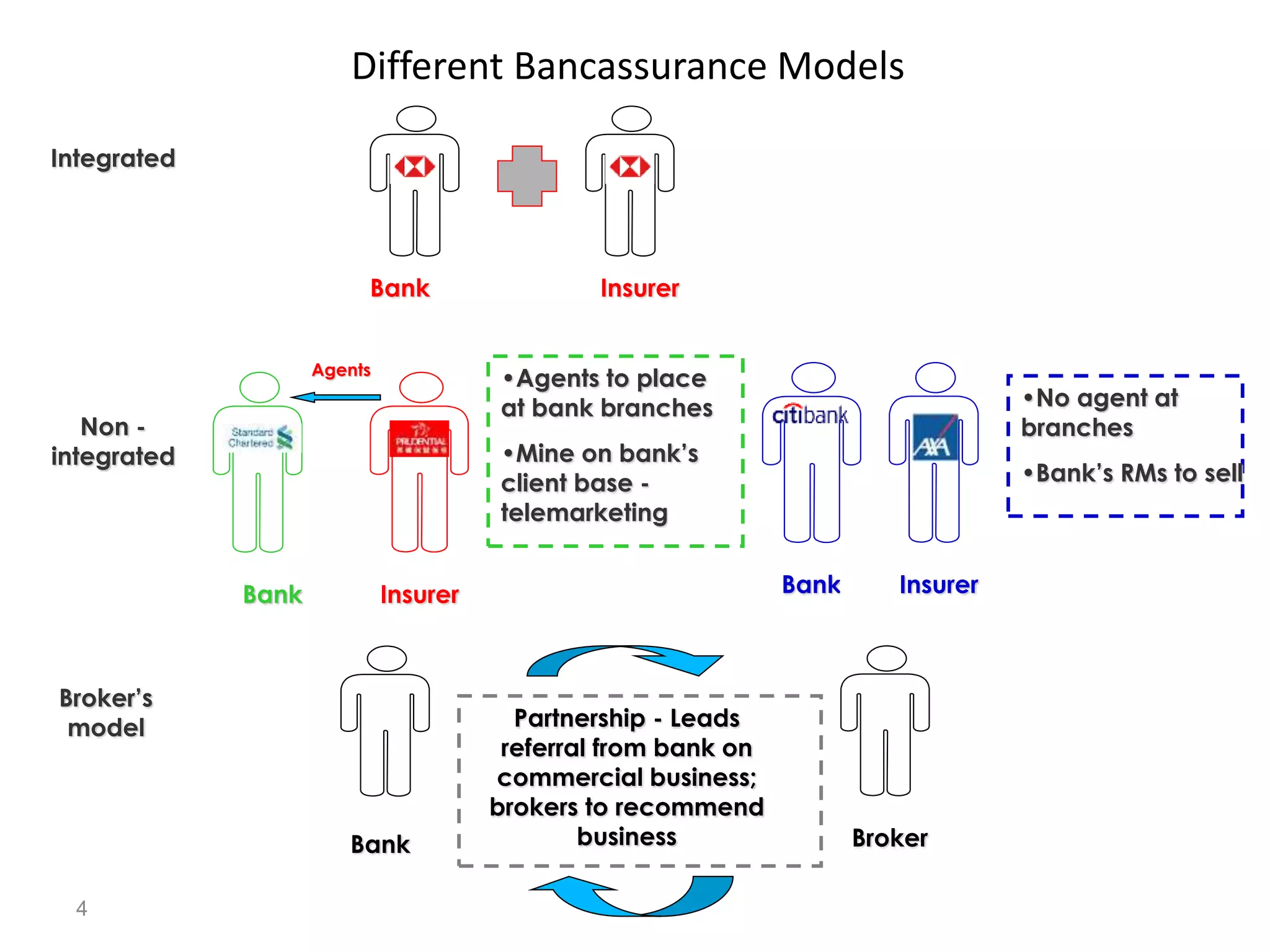
Different Bancassurance Models
4
Integrated
Broker’s
model
InsurerBank
InsurerBank
Non -
integrated
•Agents to place
at bank branches
•Mine on bank’s
client base -
telemarketing
•No agent at
branches
•Bank’s RMs to sell
Bank Insurer
Bank Broker
Partnership - Leads
referral from bank on
commercial business;
brokers to recommend
business
Agents
Bancassurance in India:
Bancassurance in India is a new concept. In our
country the banking & insurance sectors are
regulated by two different entries. They are: -
* Banking is fully governed by RBI &
* Insurance sector is by IRDA
Guidelines given by RBI
 1. Any commercial bank will be allowed to undertake
insurance business as the agent of insurance companies
& this will be on fee basis with no-risk participation
2. The second guideline given by the RBI is that the joint
ventures will be allowed for financial strong banks
wishing to undertake insurance business with risk
participation.
3. The third guideline is for banks which are not eligible
for this joint venture option, an investment option of
(1) up to 10% of the net worth of the bank or
(2) Rs. 50 crores. Whichever is lower is available.
Guidelines given by IRDA
 1) Each bank that sells insurance must have a chief
Insurance Executive to handle all the insurance
matters & activities.
2) All the people involved in selling the insurance
should under-go mandatory training at an institute
determined (authorized) by IRDA & pass the
examination conducted by the authority.
3) Commercial banks, including co-operative banks
and RRBs may become corporate agents for one
insurance company.
4) Banks cannot become insurance brokers
Advantages of Banassurance:
Bancassurance is a tool, which is beneficial to
• bank,
• customer &
• Insurer
Fr From the banks view:
(A) By selling the insurance product by their own channel the
banker can increase their income.
(B) Banks have face-to-face contact with their customers. They can
directly ask them to take a policy. And the banks need not to
go any where for customers.
(C) The Bankers have extensive experience in marketing. They can
easily attract customers & non-customers because the
customer & non-customers also bank on banks.
(D) Banks are using different value added services like-E- Banking
tele banking, direct mail & so on they can also use all the
above-mentioned facility for Bankassurance purpose with
customers & non-customers.
(E) Increased competition also makes it difficult for banks to
retain their customers. Banassurance comes as a help in this
direction also.
(F) Providing multiple services at one place to the customers
means enhanced customer satisfaction
From the Insurer Point of view
• The Insurance Company can increase their
business through the banking distribution
channels because the banks have so many
customers.
• By cutting cost Insurers can serve better to
customers in terms lower premium rate and
better risk coverage through product
diversification.
• The insurance company gets improved
geographical reach without additional costs. In
India around 67,000 branches are there for PSU
banks alone. If all 67,000 branches sell the
insurance products one can see the reach. This is
one method of penetrating the market.
• There is also another method called 'Bank
Referral'. Here the banks do not issue the
policies, they only give the database to the
insurance companies. The companies issue the
policies and pay the commission to them. That is
called referral basis.
From the customers' point of
view:
• Product innovation and distribution activities are
directed towards the satisfaction of needs of the
customer.
• Bancassurance model assists customers in terms
of reduction price, diversified product quality in
time and at their doorstep service by banks.

Bancassurance

  • 1.
  • 2.
     The Bancassuranceis a phenomenon where in insurance products are offered through the distribution channels of the banking services along with a complete range of banking & investment products & services. In simple term, we can say It is a relationship/tie-up between a Bank and an Insurance company. Bank sells the products of the Insurance company to their own customers and earn some amount of commission on sales.
  • 3.
    Consideration for Insurers… Immediateaccess to New Markets Increase in Market Penetration Reduce reliance on traditional distribution channel Combine Cost Saving & Increased Profitability Develop new financial products more efficiently Improve sales effectiveness & after sales service Insurer
  • 4.
    Different Bancassurance Models 4 Integrated Broker’s model InsurerBank InsurerBank Non- integrated •Agents to place at bank branches •Mine on bank’s client base - telemarketing •No agent at branches •Bank’s RMs to sell Bank Insurer Bank Broker Partnership - Leads referral from bank on commercial business; brokers to recommend business Agents
  • 5.
    Bancassurance in India: Bancassurancein India is a new concept. In our country the banking & insurance sectors are regulated by two different entries. They are: - * Banking is fully governed by RBI & * Insurance sector is by IRDA
  • 6.
    Guidelines given byRBI  1. Any commercial bank will be allowed to undertake insurance business as the agent of insurance companies & this will be on fee basis with no-risk participation 2. The second guideline given by the RBI is that the joint ventures will be allowed for financial strong banks wishing to undertake insurance business with risk participation. 3. The third guideline is for banks which are not eligible for this joint venture option, an investment option of (1) up to 10% of the net worth of the bank or (2) Rs. 50 crores. Whichever is lower is available.
  • 7.
    Guidelines given byIRDA  1) Each bank that sells insurance must have a chief Insurance Executive to handle all the insurance matters & activities. 2) All the people involved in selling the insurance should under-go mandatory training at an institute determined (authorized) by IRDA & pass the examination conducted by the authority. 3) Commercial banks, including co-operative banks and RRBs may become corporate agents for one insurance company. 4) Banks cannot become insurance brokers
  • 8.
    Advantages of Banassurance: Bancassuranceis a tool, which is beneficial to • bank, • customer & • Insurer
  • 9.
    Fr From thebanks view: (A) By selling the insurance product by their own channel the banker can increase their income. (B) Banks have face-to-face contact with their customers. They can directly ask them to take a policy. And the banks need not to go any where for customers. (C) The Bankers have extensive experience in marketing. They can easily attract customers & non-customers because the customer & non-customers also bank on banks. (D) Banks are using different value added services like-E- Banking tele banking, direct mail & so on they can also use all the above-mentioned facility for Bankassurance purpose with customers & non-customers.
  • 10.
    (E) Increased competitionalso makes it difficult for banks to retain their customers. Banassurance comes as a help in this direction also. (F) Providing multiple services at one place to the customers means enhanced customer satisfaction
  • 11.
    From the InsurerPoint of view • The Insurance Company can increase their business through the banking distribution channels because the banks have so many customers. • By cutting cost Insurers can serve better to customers in terms lower premium rate and better risk coverage through product diversification.
  • 12.
    • The insurancecompany gets improved geographical reach without additional costs. In India around 67,000 branches are there for PSU banks alone. If all 67,000 branches sell the insurance products one can see the reach. This is one method of penetrating the market. • There is also another method called 'Bank Referral'. Here the banks do not issue the policies, they only give the database to the insurance companies. The companies issue the policies and pay the commission to them. That is called referral basis.
  • 13.
    From the customers'point of view: • Product innovation and distribution activities are directed towards the satisfaction of needs of the customer. • Bancassurance model assists customers in terms of reduction price, diversified product quality in time and at their doorstep service by banks.