the   Upside  of the  Downside   Richard Heinberg Post Carbon Institute March 2009
The economic crisis changes everything before crisis  I   after crisis
It is essential that we… Understand the crisis and its historical context Respond effectively
The BIG context: Why do we have a growth-based economy? Can growth go on forever?
The BIG context: Why do we have a growth-based economy?  (Because of cheap energy!) Can growth go on forever?  (Not if we can’t keep growing the supply of cheap energy!)
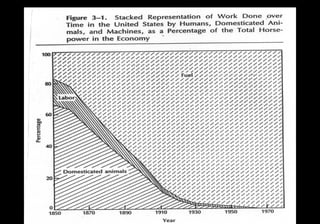
Energy transitions are crucial Adoption of fire Agriculture Domestication of traction animals; slavery Development of more sophisticated tools to leverage available energy (horse collars, plows, gears…)
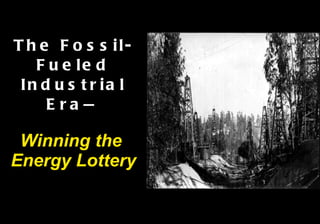
The Fossil-Fueled Industrial Era— Winning the  Energy Lottery
Meanwhile, we were developing economic institutions and theories
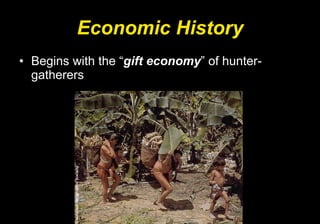
Economic History Begins with the “ gift economy ” of hunter-gatherers
Economic History Begins with the “ gift economy ” of hunter-gatherers. Trade  by barter existed—but only  between  societies, not within them.
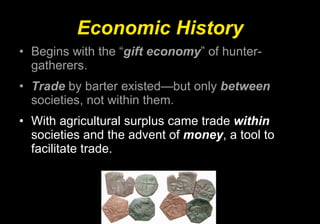
Economic History Begins with the “ gift economy ” of hunter-gatherers. Trade  by barter existed—but only  between  societies, not within them. With agricultural surplus came trade  within  societies and the advent of  money , a tool to facilitate trade.
Economic History Begins with the “ gift economy ” of hunter-gatherers. Trade  by barter existed—but only  between  societies, not within them. With agricultural surplus came trade within societies and the advent of  money , a tool to facilitate trade. The sphere of the  gift economy  shrinks; the sphere of  trade  grows.
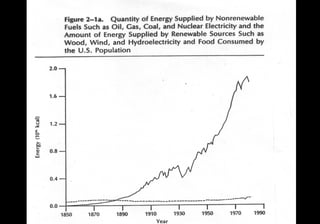
Growth becomes institutionalized With continual growth in energy (from fossil fuels), population, and consumption, it was assumed that economic growth could continue forever
Growth becomes institutionalized With continual growth in energy (from fossil fuels), population, and consumption, it was assumed that economic growth could continue forever With compound interest, fractional reserve banking, and debt leverage, growth became necessary to the monetary health of nations
But remember…growth requires more energy!
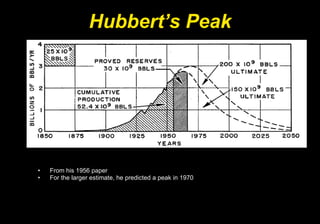
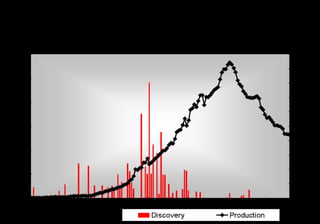
Hubbert’s Peak From his 1956 paper For the larger estimate, he predicted a peak in 1970
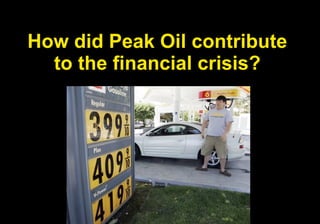
How did Peak Oil contribute to the financial crisis?
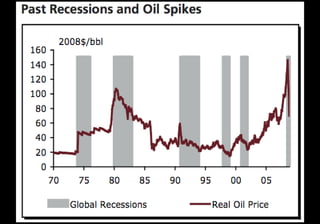
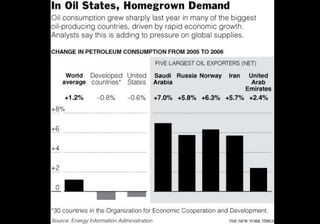
The drivers of crisis: Energy growth becomes difficult and expensive  (oil at $147 a barrel!)
 
The drivers of crisis: Energy growth becomes difficult and expensive Growth-and-debt-based economy goes bust
What all the fuss is about AIG  reports loss of $62 Billion dollars, the biggest quarterly loss in corporate history.  This is  AFTER $85 Billion bailout loan in Sept. 2008 $37.8 Billion more in October  How can this be?
Derivatives contracts! Bets on investments, total: tens of $Trillions AIG used derivative contracts to guarantee complex debt securities on the books of many large (shaky) financial institutions.  If AIG defaults on its debt, a staggering $180 Billion, the whole financial system could crumble.  So the Fed agrees to another $30 Billion bailout and delays the inevitable.
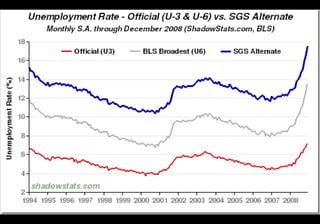
Colliding recessions Mortgage crisis and oil price spike would  each  have caused a recession Both happened at the same time Result: simultaneous crises in auto, airline, banking, finance, housing sectors Once the house of cards started falling, debt de-leverage created a snowball effect
 
“ The value of global financial assets including stocks, bonds, and currencies fell by more than  $50 Trillion  in 2008, equivalent to a year of world GDP.”  -- Asian Development Bank
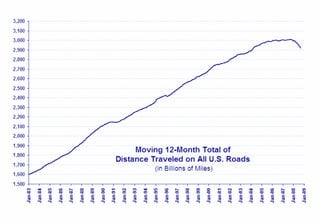
Why have oil prices dropped? Demand destruction Hedge funds in, hedge funds out
 
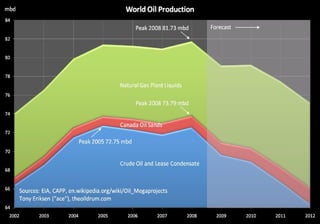
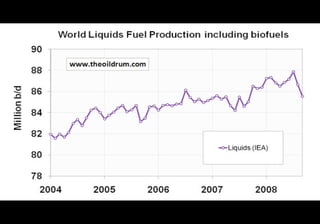
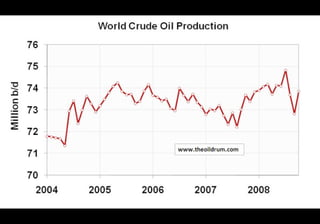
July 2008: The all-time oil peak Though demand is down, depletion of existing fields continues:  capacity erosion
July 2008: The all-time oil peak Though demand is down, depletion of existing fields continues:  capacity erosion Lack of investment (given low oil prices and credit crisis) means new oil projects are being cancelled ($100 billion in projects delayed or canceled in last 6 months).  Not enough capacity is being replaced!
From here forward … it’s a race between Demand  destruction and Supply  destruction
 
But it’s not just oil…
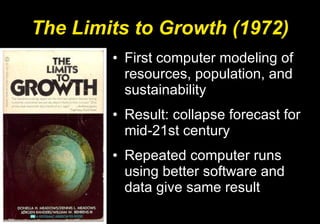
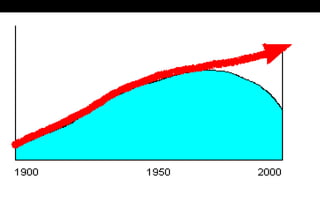
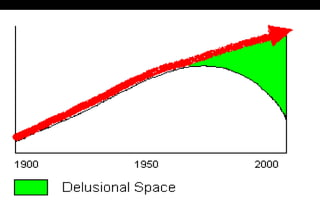
The Limits to Growth (1972) First computer modeling of resources, population, and sustainability Result: collapse forecast for mid-21st century Repeated computer runs using better software and data give same result
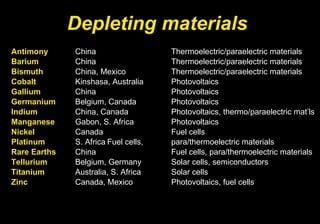
Depleting materials   Antimony China Thermoelectric/paraelectric materials Barium   China   Thermoelectric/paraelectric materials Bismuth China, Mexico  Thermoelectric/paraelectric materials Cobalt Kinshasa, Australia Photovoltaics Gallium China Photovoltaics Germanium Belgium, Canada Photovoltaics Indium China, Canada Photovoltaics, thermo/paraelectric mat’ls Manganese Gabon, S. Africa Photovoltaics Nickel Canada Fuel cells Platinum   S. Africa Fuel cells,  para/thermoelectric materials Rare Earths China Fuel cells, para/thermoelectric materials  Tellurium Belgium, Germany Solar cells, semiconductors Titanium Australia, S. Africa Solar cells Zinc Canada, Mexico Photovoltaics, fuel cells
 
 
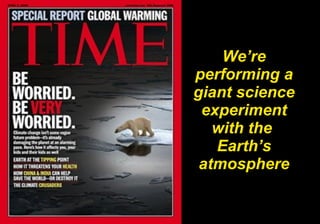
We’re performing a giant science experiment with the  Earth’s atmosphere
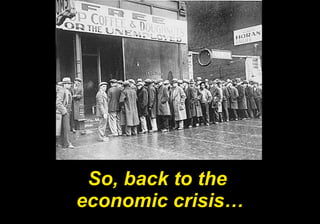
So, back to the  economic crisis…
 
“ We’re in the midst of a once-in-a-lifetime set of economic conditions. The perspective I would bring is  not  one of  recession . Rather,  the economy is resetting to a lower level of business and consumer spending  based largely on the reduced leverage in the economy.” Steven Ballmer Chairman, Microsoft Corp.
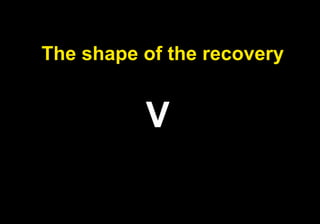
The shape of the recovery V
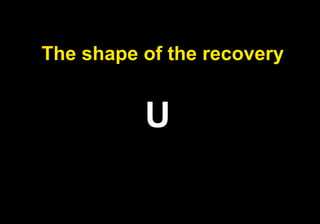
The shape of the recovery U
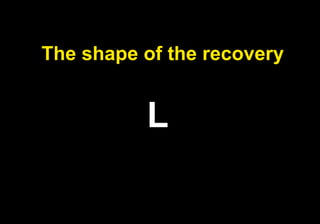
The shape of the recovery L
The good (?) news… Other nations have it even worse, so U.S. dollar is strong for now
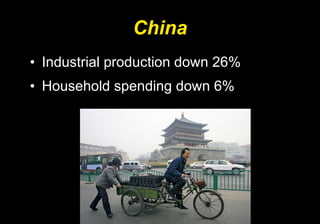
China Industrial production down 26% Household spending down 6%
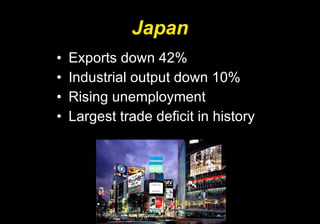
Japan Exports down 42% Industrial output down 10% Rising unemployment Largest trade deficit in history
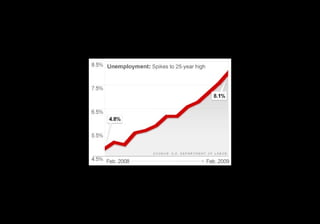
What to expect Unemployment Homelessness Bank failures Hunger Crime Political instability International conflict
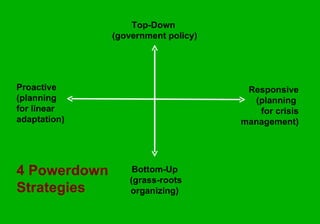
Proactive (planning for linear adaptation) Responsive (planning  for crisis management) Top-Down  (government policy) Bottom-Up  (grass-roots organizing) 4 Powerdown Strategies
Resilience The ability to absorb shocks and continue to function
Resilience characteristics Redundancy in critical systems Dispersed system control points Dispersed inventories Balancing feedback loops
Our current energy and economic systems  are not resilient
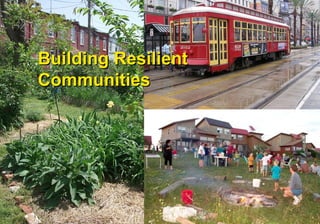
Building resilient communities Building Resilient Communities
Co-op Power “ A regional network of local communities creating a multi-class, multi-racial movement for a sustainable and just energy future”  Cooperative financing method www.cooppower.coop
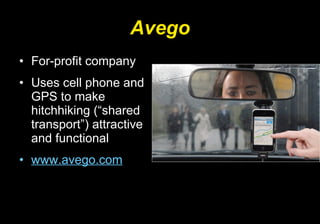
Avego For-profit company Uses cell phone and GPS to make hitchhiking (“shared transport”) attractive and functional www.avego.com
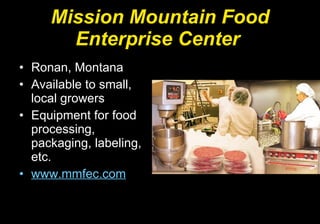
Mission Mountain Food Enterprise Center   Ronan, Montana Available to small, local growers Equipment for food processing, packaging, labeling, etc. www.mmfec.com
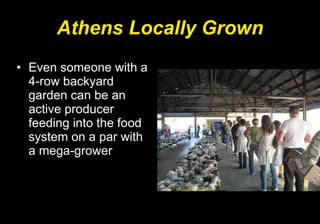
Athens Locally Grown Even someone with a 4-row backyard garden can be an active producer feeding into the food system on a par with a mega-grower
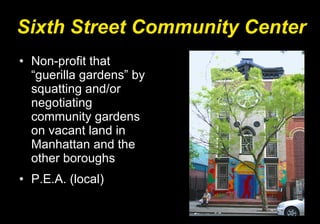
Sixth Street Community Center   Non-profit that “guerilla gardens” by squatting and/or negotiating community gardens on vacant land in Manhattan and the other boroughs P.E.A. (local)
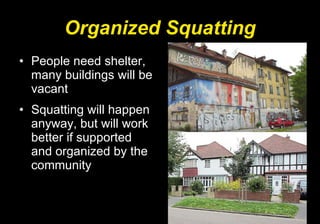
Organized Squatting People need shelter, many buildings will be vacant Squatting will happen anyway, but will work better if supported and organized by the community
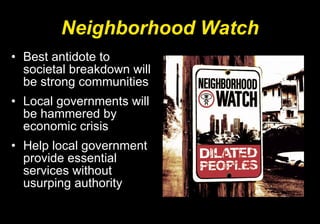
Neighborhood Watch Best antidote to societal breakdown will be strong communities Local governments will be hammered by economic crisis Help local government provide essential services without usurping authority
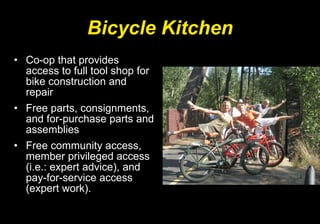
Bicycle Kitchen Co-op that provides access to full tool shop for bike construction and repair  Free parts, consignments, and for-purchase parts and assemblies  Free community access, member privileged access (i.e.: expert advice), and pay-for-service access (expert work).
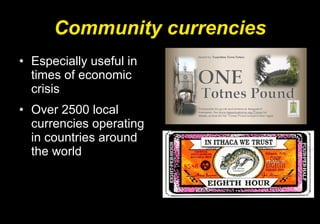
Community currencies Especially useful in times of economic crisis Over 2500 local currencies operating in countries around the world
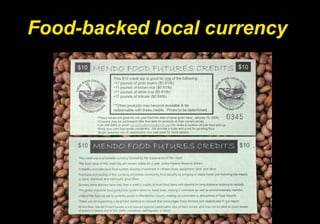
Food-backed local currency
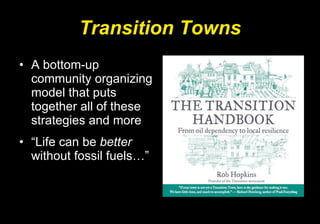
Transition Towns A bottom-up community organizing model that puts together all of these strategies and more “ Life can be  better  without fossil fuels…”
Emphasize what is not at peak Community Personal autonomy Satisfaction from honest work well done Intergenerational solidarity Cooperation Free time Happiness Ingenuity Artistry  Beauty of the built environment
Include all community stakeholders in the process Those who feel excluded from the process may try to undermine it
Is this enough? Ultimately we will need:  No-growth  economic  system Currency  not based on debt and interest Non-fossil fuel  food  system Population  declining to fit Earth’s carrying capacity
We have to start somewhere! Why not here and now?
Remember:  crisis = opportunity This is the biggest opportunity of our lifetimes. Who will seize it?

PostCarbon.org TransitionUS.org
 
Inevitable future trends: Less available energy More labor needed in agriculture Need for massive relocation of people Need for massive replacement of infrastructure Question: How to accomplish this enormous societal reorganization without chaotic breakdown?


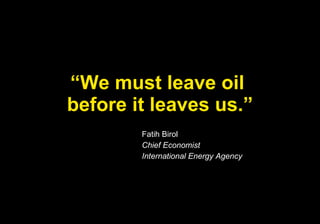
“ We must leave oil  before it leaves us.” Fatih Birol Chief Economist International Energy Agency
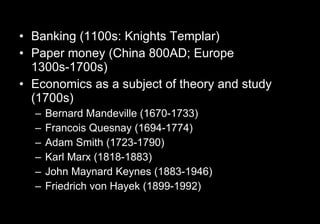
Banking (1100s: Knights Templar) Paper money (China 800AD; Europe 1300s-1700s) Economics as a subject of theory and study (1700s) Bernard Mandeville (1670-1733) Francois Quesnay (1694-1774) Adam Smith (1723-1790) Karl Marx (1818-1883) John Maynard Keynes (1883-1946) Friedrich von Hayek (1899-1992)
Historical Context European colonization Old power centers (aristocracy, Church) give way to new (merchant class) Science supplants religion Economics, embraced by the merchant class, aspires to become a “science” like physics  Meanwhile the “invisible hand” of the market is an agent rivaling God in omniscience, omnipresence, and beneficence.
Historical Context (cont’d) Industrial revolution Factory system Unleashing of fossil fuels A zero-sum game (dividing the pie of net primary annual productivity) becomes a positive-sum game (the pie expands) Result:  Belief in unending growth Expectations of spreading benefits
Nice summary from Herman Daly: In classical economics (Smith, Malthus, Ricardo, Mill) the steady-state, or as they called it the “stationary state” economy, was a real condition toward which the economy was tending as increasing population, diminishing returns, and increasing land rents squeezed profits to zero.
Population would be held constant by subsistence wages and a high death rate. Capital stock would be held constant by a lack of inducement to invest resulting from zero profits thanks to rent absorbing the entire surplus which was itself limited by diminishing returns. Not a happy future—something to be postponed for as long as possible in the opinion of most classical economists.
Mill, however, saw it differently. Population must indeed stabilize, but that could be attained by Malthus’ preventive checks (lowering the birth rate) rather than the positive checks (high death rate). A constant capital stock is not static, but continuously renewed by depreciation and replacement, opening the way for continual technical and qualitative improvement in the physically non-growing capital stock.
By limiting the birth rate, and by technical improvement in the constant capital stock, a surplus above subsistence could be maintained. Mill also believed that the surplus could be equitably redistributed. Unlike the growing economy, the stationary state economy would not have to continually expand into the biosphere and therefore could leave most of the world in its natural state.
In the late 1800’s classical economics was replaced by neoclassical economics, and although the term “stationary” or “steady-state” economy was retained, its meaning was radically changed. It no longer referred to constant population and stock of capital, but to a situation of constant tastes and technology.
In Mill’s conception physical magnitudes (population and capital) were constant, and culture  (tastes and technology) adapted. In the new version culture (tastes and technology) are constant and the physical magnitudes (population and capital stock) adapt. Given that our cultural tastes were assumed to reflect infinite wants, and that technical progress was considered unlimited, the way to adapt was by growth, so-called “steady-state growth” which means proportional growth of population and capital stock. (Daly, 2006)
Problems for Economic Theory Externalities Homo economicus Environment is a subset of the economy Infinite substitution Infinite growth in a finite world Money is merely a medium of exchange
Energy Fuels Growth Fuels extraction Fuels production Overproduction stimulates advertising and the search for markets Fuels transport and trade Supports larger population
The corporation: core institution of the industrial era Organizes production and distribution Aggregates and manages capital Outlives individuals, serves its own inherent mandates: profit and growth In many cases, overpowers existing institutions
The Political Problem Concentrations of wealth are also concentrations of political power. Therefore, as wealth is concentrated in corporations, the inevitable resulting manipulation of regulations and subsidies means the “free market” is never and nowhere “free,”  while participation of corporations in the formal political process means that democracy becomes an unrealizable, receding goal.
 
 
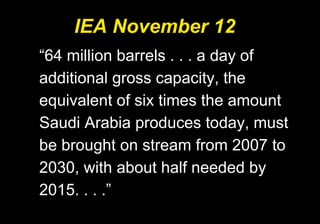
IEA November 12 “ 64 million barrels . . . a day of additional gross capacity, the equivalent of six times the amount Saudi Arabia produces today, must be brought on stream from 2007 to 2030, with about half needed by 2015. . . .”


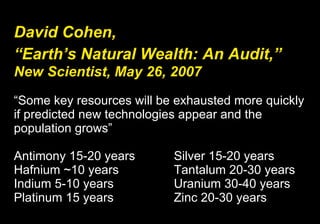
David Cohen,   “Earth’s Natural Wealth: An Audit,”   New Scientist, May 26, 2007 “Some key resources will be exhausted more quickly if predicted new technologies appear and the population grows” Antimony 15-20 years  Silver 15-20 years Hafnium ~10 years  Tantalum 20-30 years Indium 5-10 years  Uranium 30-40 years Platinum 15 years  Zinc 20-30 years
 
 
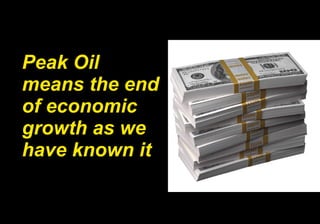
Peak Oil means the end of economic growth as we have known it
 
 
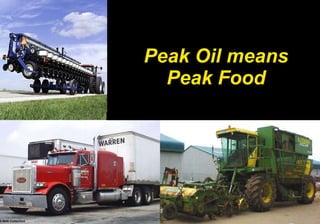
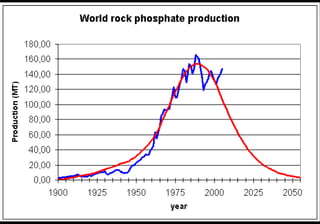
Peak Oil means Peak Food
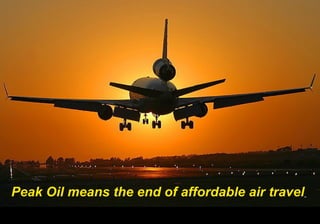
Peak Oil means the end of cheap air travel   Peak Oil means the end of affordable air travel
 
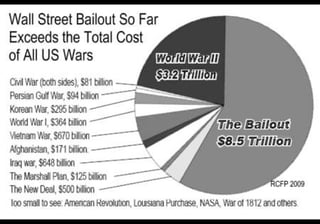
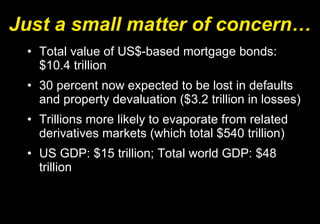
Just a small matter of concern… Total value of US$-based mortgage bonds: $10.4 trillion 30 percent now expected to be lost in defaults and property devaluation ($3.2 trillion in losses) Trillions more likely to evaporate from related derivatives markets (which total $540 trillion) US GDP: $15 trillion; Total world GDP: $48 trillion
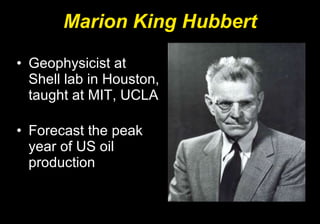
Marion King Hubbert Geophysicist at Shell lab in Houston, taught at MIT, UCLA Forecast the peak year of US oil production
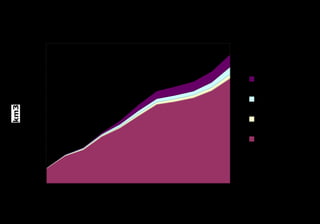
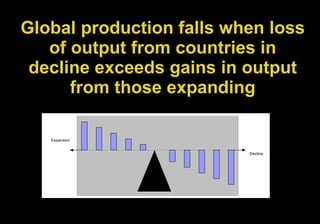
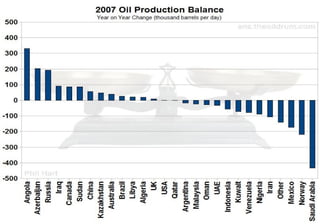
Global production falls when loss of output from countries in decline exceeds gains in output from those expanding Decline Expansion
 
 
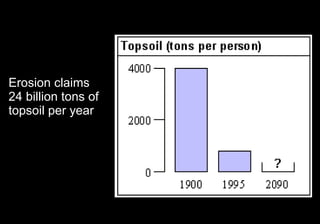
topsoil Erosion claims  24 billion tons of topsoil per year
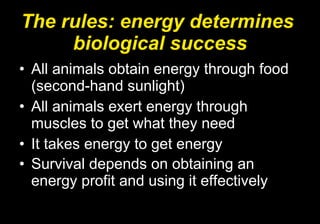
The rules: energy determines  biological success All animals obtain energy through food (second-hand sunlight) All animals exert energy through muscles to get what they need It takes energy to get energy Survival depends on obtaining an energy profit and using it effectively
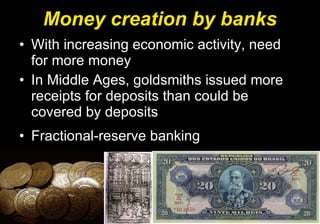
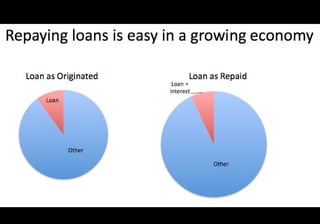
Money creation by banks With increasing economic activity, need for more money In Middle Ages, goldsmiths issued more receipts for deposits than could be covered by deposits Fractional-reserve banking
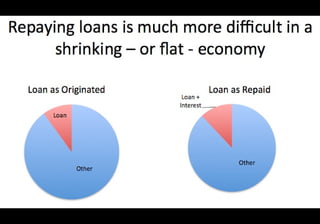
Money creation In U.S. Today Fed creates money by crediting the accounts of member banks Banks loan the money, at interest, requiring eventual repayment of more than the amount loaned That extra amount must come from creation of still more money, by the same process The system must grow…or collapse
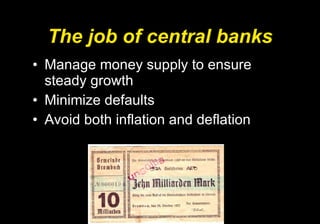
The job of central banks Manage money supply to ensure steady growth Minimize defaults Avoid both inflation and deflation
The problem of Overproduction Fuel-fed factory production can overwhelm the needs of the populace unless needs are artificially stoked, and credit (debt) created One solution: Advertising ($250 billion per year to encourage consumption) The other solution: Find new markets by constantly expanding the scope of trade (globalization)


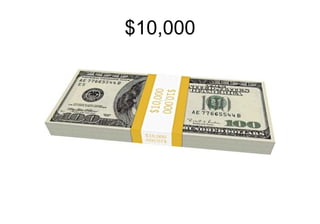
$10,000 Post Carbon Institute
$1,000,000 Post Carbon Institute
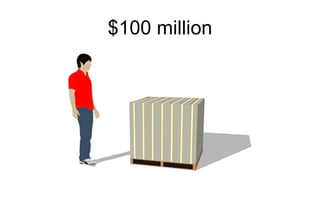
$100 million Post Carbon Institute
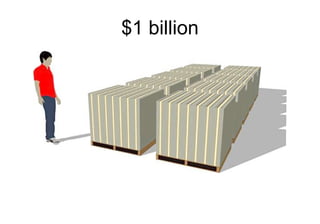
$1 billion Post Carbon Institute
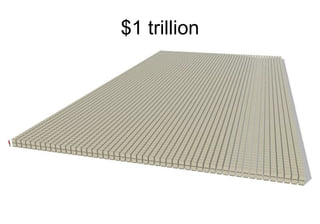
$1 trillion Post Carbon Institute

The Upside of the Downside

  • 1.
    the Upside of the Downside Richard Heinberg Post Carbon Institute March 2009
  • 2.
    The economic crisischanges everything before crisis I after crisis
  • 3.
    It is essentialthat we… Understand the crisis and its historical context Respond effectively
  • 4.
    The BIG context:Why do we have a growth-based economy? Can growth go on forever?
  • 5.
    The BIG context:Why do we have a growth-based economy? (Because of cheap energy!) Can growth go on forever? (Not if we can’t keep growing the supply of cheap energy!)
  • 6.
    Energy transitions arecrucial Adoption of fire Agriculture Domestication of traction animals; slavery Development of more sophisticated tools to leverage available energy (horse collars, plows, gears…)
  • 7.
    The Fossil-Fueled IndustrialEra— Winning the Energy Lottery
  • 8.
    Meanwhile, we weredeveloping economic institutions and theories
  • 9.
    Economic History Beginswith the “ gift economy ” of hunter-gatherers
  • 10.
    Economic History Beginswith the “ gift economy ” of hunter-gatherers. Trade by barter existed—but only between societies, not within them.
  • 11.
    Economic History Beginswith the “ gift economy ” of hunter-gatherers. Trade by barter existed—but only between societies, not within them. With agricultural surplus came trade within societies and the advent of money , a tool to facilitate trade.
  • 12.
    Economic History Beginswith the “ gift economy ” of hunter-gatherers. Trade by barter existed—but only between societies, not within them. With agricultural surplus came trade within societies and the advent of money , a tool to facilitate trade. The sphere of the gift economy shrinks; the sphere of trade grows.
  • 13.
    Growth becomes institutionalizedWith continual growth in energy (from fossil fuels), population, and consumption, it was assumed that economic growth could continue forever
  • 14.
    Growth becomes institutionalizedWith continual growth in energy (from fossil fuels), population, and consumption, it was assumed that economic growth could continue forever With compound interest, fractional reserve banking, and debt leverage, growth became necessary to the monetary health of nations
  • 15.
  • 16.
    Hubbert’s Peak Fromhis 1956 paper For the larger estimate, he predicted a peak in 1970
  • 17.
    How did PeakOil contribute to the financial crisis?
  • 18.
    The drivers ofcrisis: Energy growth becomes difficult and expensive (oil at $147 a barrel!)
  • 19.
  • 20.
    The drivers ofcrisis: Energy growth becomes difficult and expensive Growth-and-debt-based economy goes bust
  • 21.
    What all thefuss is about AIG reports loss of $62 Billion dollars, the biggest quarterly loss in corporate history. This is AFTER $85 Billion bailout loan in Sept. 2008 $37.8 Billion more in October How can this be?
  • 22.
    Derivatives contracts! Betson investments, total: tens of $Trillions AIG used derivative contracts to guarantee complex debt securities on the books of many large (shaky) financial institutions. If AIG defaults on its debt, a staggering $180 Billion, the whole financial system could crumble. So the Fed agrees to another $30 Billion bailout and delays the inevitable.
  • 23.
    Colliding recessions Mortgagecrisis and oil price spike would each have caused a recession Both happened at the same time Result: simultaneous crises in auto, airline, banking, finance, housing sectors Once the house of cards started falling, debt de-leverage created a snowball effect
  • 24.
  • 25.
    “ The valueof global financial assets including stocks, bonds, and currencies fell by more than $50 Trillion in 2008, equivalent to a year of world GDP.” -- Asian Development Bank
  • 26.
    Why have oilprices dropped? Demand destruction Hedge funds in, hedge funds out
  • 27.
  • 28.
    July 2008: Theall-time oil peak Though demand is down, depletion of existing fields continues: capacity erosion
  • 29.
    July 2008: Theall-time oil peak Though demand is down, depletion of existing fields continues: capacity erosion Lack of investment (given low oil prices and credit crisis) means new oil projects are being cancelled ($100 billion in projects delayed or canceled in last 6 months). Not enough capacity is being replaced!
  • 30.
    From here forward… it’s a race between Demand destruction and Supply destruction
  • 31.
  • 32.
    But it’s notjust oil…
  • 33.
    The Limits toGrowth (1972) First computer modeling of resources, population, and sustainability Result: collapse forecast for mid-21st century Repeated computer runs using better software and data give same result
  • 34.
    Depleting materials Antimony China Thermoelectric/paraelectric materials Barium China Thermoelectric/paraelectric materials Bismuth China, Mexico Thermoelectric/paraelectric materials Cobalt Kinshasa, Australia Photovoltaics Gallium China Photovoltaics Germanium Belgium, Canada Photovoltaics Indium China, Canada Photovoltaics, thermo/paraelectric mat’ls Manganese Gabon, S. Africa Photovoltaics Nickel Canada Fuel cells Platinum S. Africa Fuel cells, para/thermoelectric materials Rare Earths China Fuel cells, para/thermoelectric materials Tellurium Belgium, Germany Solar cells, semiconductors Titanium Australia, S. Africa Solar cells Zinc Canada, Mexico Photovoltaics, fuel cells
  • 35.
  • 36.
  • 37.
    We’re performing agiant science experiment with the Earth’s atmosphere
  • 38.
    So, back tothe economic crisis…
  • 39.
  • 40.
    “ We’re inthe midst of a once-in-a-lifetime set of economic conditions. The perspective I would bring is not one of recession . Rather, the economy is resetting to a lower level of business and consumer spending based largely on the reduced leverage in the economy.” Steven Ballmer Chairman, Microsoft Corp.
  • 41.
    The shape ofthe recovery V
  • 42.
    The shape ofthe recovery U
  • 43.
    The shape ofthe recovery L
  • 44.
    The good (?)news… Other nations have it even worse, so U.S. dollar is strong for now
  • 45.
    China Industrial productiondown 26% Household spending down 6%
  • 46.
    Japan Exports down42% Industrial output down 10% Rising unemployment Largest trade deficit in history
  • 47.
    What to expectUnemployment Homelessness Bank failures Hunger Crime Political instability International conflict
  • 48.
    Proactive (planning forlinear adaptation) Responsive (planning for crisis management) Top-Down (government policy) Bottom-Up (grass-roots organizing) 4 Powerdown Strategies
  • 49.
    Resilience The abilityto absorb shocks and continue to function
  • 50.
    Resilience characteristics Redundancyin critical systems Dispersed system control points Dispersed inventories Balancing feedback loops
  • 51.
    Our current energyand economic systems are not resilient
  • 52.
    Building resilient communitiesBuilding Resilient Communities
  • 53.
    Co-op Power “A regional network of local communities creating a multi-class, multi-racial movement for a sustainable and just energy future” Cooperative financing method www.cooppower.coop
  • 54.
    Avego For-profit companyUses cell phone and GPS to make hitchhiking (“shared transport”) attractive and functional www.avego.com
  • 55.
    Mission Mountain FoodEnterprise Center Ronan, Montana Available to small, local growers Equipment for food processing, packaging, labeling, etc. www.mmfec.com
  • 56.
    Athens Locally GrownEven someone with a 4-row backyard garden can be an active producer feeding into the food system on a par with a mega-grower
  • 57.
    Sixth Street CommunityCenter Non-profit that “guerilla gardens” by squatting and/or negotiating community gardens on vacant land in Manhattan and the other boroughs P.E.A. (local)
  • 58.
    Organized Squatting Peopleneed shelter, many buildings will be vacant Squatting will happen anyway, but will work better if supported and organized by the community
  • 59.
    Neighborhood Watch Bestantidote to societal breakdown will be strong communities Local governments will be hammered by economic crisis Help local government provide essential services without usurping authority
  • 60.
    Bicycle Kitchen Co-opthat provides access to full tool shop for bike construction and repair Free parts, consignments, and for-purchase parts and assemblies Free community access, member privileged access (i.e.: expert advice), and pay-for-service access (expert work).
  • 61.
    Community currencies Especiallyuseful in times of economic crisis Over 2500 local currencies operating in countries around the world
  • 62.
  • 63.
    Transition Towns Abottom-up community organizing model that puts together all of these strategies and more “ Life can be better without fossil fuels…”
  • 64.
    Emphasize what isnot at peak Community Personal autonomy Satisfaction from honest work well done Intergenerational solidarity Cooperation Free time Happiness Ingenuity Artistry Beauty of the built environment
  • 65.
    Include all communitystakeholders in the process Those who feel excluded from the process may try to undermine it
  • 66.
    Is this enough?Ultimately we will need: No-growth economic system Currency not based on debt and interest Non-fossil fuel food system Population declining to fit Earth’s carrying capacity
  • 67.
    We have tostart somewhere! Why not here and now?
  • 68.
    Remember: crisis= opportunity This is the biggest opportunity of our lifetimes. Who will seize it?
  • 69.
  • 70.
  • 71.
    Inevitable future trends:Less available energy More labor needed in agriculture Need for massive relocation of people Need for massive replacement of infrastructure Question: How to accomplish this enormous societal reorganization without chaotic breakdown?
  • 72.
  • 73.
  • 74.
  • 75.
    “ We mustleave oil before it leaves us.” Fatih Birol Chief Economist International Energy Agency
  • 76.
    Banking (1100s: KnightsTemplar) Paper money (China 800AD; Europe 1300s-1700s) Economics as a subject of theory and study (1700s) Bernard Mandeville (1670-1733) Francois Quesnay (1694-1774) Adam Smith (1723-1790) Karl Marx (1818-1883) John Maynard Keynes (1883-1946) Friedrich von Hayek (1899-1992)
  • 77.
    Historical Context Europeancolonization Old power centers (aristocracy, Church) give way to new (merchant class) Science supplants religion Economics, embraced by the merchant class, aspires to become a “science” like physics Meanwhile the “invisible hand” of the market is an agent rivaling God in omniscience, omnipresence, and beneficence.
  • 78.
    Historical Context (cont’d)Industrial revolution Factory system Unleashing of fossil fuels A zero-sum game (dividing the pie of net primary annual productivity) becomes a positive-sum game (the pie expands) Result: Belief in unending growth Expectations of spreading benefits
  • 79.
    Nice summary fromHerman Daly: In classical economics (Smith, Malthus, Ricardo, Mill) the steady-state, or as they called it the “stationary state” economy, was a real condition toward which the economy was tending as increasing population, diminishing returns, and increasing land rents squeezed profits to zero.
  • 80.
    Population would beheld constant by subsistence wages and a high death rate. Capital stock would be held constant by a lack of inducement to invest resulting from zero profits thanks to rent absorbing the entire surplus which was itself limited by diminishing returns. Not a happy future—something to be postponed for as long as possible in the opinion of most classical economists.
  • 81.
    Mill, however, sawit differently. Population must indeed stabilize, but that could be attained by Malthus’ preventive checks (lowering the birth rate) rather than the positive checks (high death rate). A constant capital stock is not static, but continuously renewed by depreciation and replacement, opening the way for continual technical and qualitative improvement in the physically non-growing capital stock.
  • 82.
    By limiting thebirth rate, and by technical improvement in the constant capital stock, a surplus above subsistence could be maintained. Mill also believed that the surplus could be equitably redistributed. Unlike the growing economy, the stationary state economy would not have to continually expand into the biosphere and therefore could leave most of the world in its natural state.
  • 83.
    In the late1800’s classical economics was replaced by neoclassical economics, and although the term “stationary” or “steady-state” economy was retained, its meaning was radically changed. It no longer referred to constant population and stock of capital, but to a situation of constant tastes and technology.
  • 84.
    In Mill’s conceptionphysical magnitudes (population and capital) were constant, and culture (tastes and technology) adapted. In the new version culture (tastes and technology) are constant and the physical magnitudes (population and capital stock) adapt. Given that our cultural tastes were assumed to reflect infinite wants, and that technical progress was considered unlimited, the way to adapt was by growth, so-called “steady-state growth” which means proportional growth of population and capital stock. (Daly, 2006)
  • 85.
    Problems for EconomicTheory Externalities Homo economicus Environment is a subset of the economy Infinite substitution Infinite growth in a finite world Money is merely a medium of exchange
  • 86.
    Energy Fuels GrowthFuels extraction Fuels production Overproduction stimulates advertising and the search for markets Fuels transport and trade Supports larger population
  • 87.
    The corporation: coreinstitution of the industrial era Organizes production and distribution Aggregates and manages capital Outlives individuals, serves its own inherent mandates: profit and growth In many cases, overpowers existing institutions
  • 88.
    The Political ProblemConcentrations of wealth are also concentrations of political power. Therefore, as wealth is concentrated in corporations, the inevitable resulting manipulation of regulations and subsidies means the “free market” is never and nowhere “free,” while participation of corporations in the formal political process means that democracy becomes an unrealizable, receding goal.
  • 89.
  • 90.
  • 91.
    IEA November 12“ 64 million barrels . . . a day of additional gross capacity, the equivalent of six times the amount Saudi Arabia produces today, must be brought on stream from 2007 to 2030, with about half needed by 2015. . . .”
  • 92.
  • 93.
  • 94.
  • 95.
    David Cohen, “Earth’s Natural Wealth: An Audit,” New Scientist, May 26, 2007 “Some key resources will be exhausted more quickly if predicted new technologies appear and the population grows” Antimony 15-20 years Silver 15-20 years Hafnium ~10 years Tantalum 20-30 years Indium 5-10 years Uranium 30-40 years Platinum 15 years Zinc 20-30 years
  • 96.
  • 97.
  • 98.
    Peak Oil meansthe end of economic growth as we have known it
  • 99.
  • 100.
  • 101.
    Peak Oil meansPeak Food
  • 102.
    Peak Oil meansthe end of cheap air travel Peak Oil means the end of affordable air travel
  • 103.
  • 104.
    Just a smallmatter of concern… Total value of US$-based mortgage bonds: $10.4 trillion 30 percent now expected to be lost in defaults and property devaluation ($3.2 trillion in losses) Trillions more likely to evaporate from related derivatives markets (which total $540 trillion) US GDP: $15 trillion; Total world GDP: $48 trillion
  • 105.
    Marion King HubbertGeophysicist at Shell lab in Houston, taught at MIT, UCLA Forecast the peak year of US oil production
  • 106.
    Global production fallswhen loss of output from countries in decline exceeds gains in output from those expanding Decline Expansion
  • 107.
  • 108.
  • 109.
    topsoil Erosion claims 24 billion tons of topsoil per year
  • 110.
    The rules: energydetermines biological success All animals obtain energy through food (second-hand sunlight) All animals exert energy through muscles to get what they need It takes energy to get energy Survival depends on obtaining an energy profit and using it effectively
  • 111.
    Money creation bybanks With increasing economic activity, need for more money In Middle Ages, goldsmiths issued more receipts for deposits than could be covered by deposits Fractional-reserve banking
  • 112.
    Money creation InU.S. Today Fed creates money by crediting the accounts of member banks Banks loan the money, at interest, requiring eventual repayment of more than the amount loaned That extra amount must come from creation of still more money, by the same process The system must grow…or collapse
  • 113.
    The job ofcentral banks Manage money supply to ensure steady growth Minimize defaults Avoid both inflation and deflation
  • 114.
    The problem ofOverproduction Fuel-fed factory production can overwhelm the needs of the populace unless needs are artificially stoked, and credit (debt) created One solution: Advertising ($250 billion per year to encourage consumption) The other solution: Find new markets by constantly expanding the scope of trade (globalization)
  • 115.
  • 116.
  • 117.
  • 118.
  • 119.
  • 120.
  • 121.
    $100 million PostCarbon Institute
  • 122.
    $1 billion PostCarbon Institute
  • 123.
    $1 trillion PostCarbon Institute

Editor's Notes

  • #17 For examples of criticism see Environmental and Natural Resource Economics, by Tom Tietenburg, 7 th edition , p. 151. For EIA criticism, see http://www.api.org/aboutoilgas/security/upload/Caruso2005.pdf
  • #107 It is like a scales. Although we will still be finding oil, still developing new fields if just slightly more of the world’s production capacity -- maybe just 51% -- is declining. Then production will have peaked. This is why it will be far earlier than most people expect.