Balancing Resources & Priorities 
Mike Devereux 
President & CEO Nature‘s Way Brands 
Lunch ‘n Learn 
Green Bay, August 26, 2014
About Me 
Me 
Cat 
“Bark the 
Wonder Cat” 
• Grew up in the western suburbs of Chicago in a 3-bedroom, 1- 
bathroom bungalow. 
• Learned how to balance resources and priorities at an early age, 
while competing with four sisters for the bathroom before school.
Nature‘s Way Group
Balancing Resources and Priorities in the context of … 
• Why? 
• How! 
• Does it matter? 
Strategic Planning
Why? 
“If you don’t know where you are going, any road will take you there.” 
R. Rose – My Predecessor
How to Start? 
• Diagnostic on today’s business 
– E.g. SWOT analysis 
• Aspiration for the future 
• Capabilities to deliver 
People 
• Manage the competing agendas 
$ 
Management Team 
Shareholders
a. Outline of Strategic Plans 
• Industry / Business unit / Market context and dynamics 
– Industry/Business unit/Market overview 
– Industry/Business unit/Market profitability 
– Industry/Business unit/Market dynamics 
– Customer needs 
• Competitive assessment 
– Performance review (Brands, Categories, SKUs (topline, bottom line) 
– Achievements since last year 
– Product line assessment (Brands, Categories, SKUs (topline, bottom line) 
– Competitive assessment (Sales operations/ Channels, Marketing, Etc.) 
• Strategic issues (Resulting from Market environment and Competitive assessment) 
– Where are opportunities and threats? 
– Where are our competitive strengths and weaknesses? 
– What are the strategic success factors and with regards to that, where are the strategic gaps? 
• Key strategic initiatives (5-10 year) strategic initiatives in detail that describe measures, 
steps (timeline), investments, structural implications (Resources) and implementation 
risks 
– Financial projections (including scenarios if needed) 
– Detailed financial projections (cash in and cash out) 
– Capital plan 
– NPV
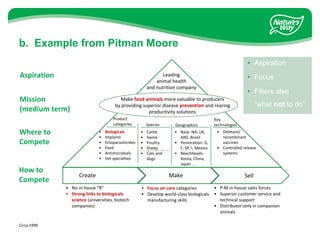
b. Example from Pitman Moore 
• Aspiration 
• Focus 
• Filters also 
“what not to do” 
Aspiration 
Mission 
(medium term) 
Where to 
Compete 
Circa 1990 
Make food animals more valuable to producers 
by providing superior disease prevention and rearing 
Create Make Sell 
How to 
Compete 
Leading 
animal health 
and nutrition company 
Product 
categories Species Geographics 
Key 
technologies 
• Biologicals 
• Implants 
• Ectoparasiticides 
• Feed 
• Antimicrobials 
• Vet specialties 
• Cattle 
• Swine 
• Poultry 
• Sheep 
• Cats and 
dogs 
• Base: NA, UK, 
ANZ, Brazil 
• Penetration: G, 
F, SP, I, Mexico 
• Beachheads: 
Korea, China, 
Japan . . . 
• Deletant/ 
recombinant 
vaccines 
• Controlled release 
systems 
productivity solutions 
• No in-house “R” 
• Strong links to biologicals 
science (universities, biotech 
companies) 
• Focus on core categories 
• Develop world-class biologicals 
manufacturing skills 
• P-M in-house sales forces 
• Superior customer service and 
technical support 
• Distributor-only in companion 
animals
Profit from the Core
Profit from the Core – Key Points that 
lead to Profitable Revenue Growth 
• Focus scarce resources on the core of your business if attractive 
growth opportunities remain – if not, the core needs to be extended. 
• Establish a common set of facts and market insights from which 
impactful growth initiatives can be found. 
• Get an “A” on 3 or 4 initiatives rather than a “C” on 10. 
• Master the science of making change happen within your 
organization.
Profit from the Core 
Keys to Success: 
• Reaching the full potential of the core business. 
• Expanding into logical adjacent businesses surrounding the core. 
• Pre-emptively redefining the core business in response to market 
turbulence. 
All that . . . 
“and some luck/good fortune helps.”
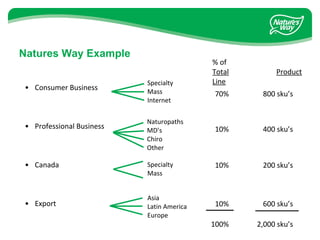
Natures Way Example 
• Consumer Business 
• Professional Business 
• Canada 
• Export 
Specialty 
Mass 
Internet 
Naturopaths 
MD’s 
Chiro 
Other 
Specialty 
Mass 
Asia 
Latin America 
Europe 
% of 
Total Product 
Line 
70% 800 sku’s 
10% 400 sku’s 
10% 200 sku’s 
10% 600 sku’s 
100% 2,000 sku’s
The Alchemy of Growth
Planning the future over 3 time horizons 
Performance / 
Profit / 
Growth 
Time 
Horizon 1 
Defend and extend 
core businesses 
Horizon 3 
Create viable 
options 
Horizon 2 
Build emerging 
businesses 
3 years 
Now 
Beyond
Nature’s Way Accountabilities and Time Horizons 
Performance / 
Profit / 
Growth 
Time 
Horizon 1 
Horizon 2 
Horizon 3 
Develop International 
Markets and enter new 
categories and 
technologies 
U.S. Market Potential 
focus & Maximize 
existing Brands 
Enter New 
Business models, 
Mergers & 
Aquisitions 
Get an “A” on 3 to 4 initiatives versus a “C” on 10.
Digital Competency 
• 50% of population is < 30. 
• 53% of Twitter is recommending products via Tweets. 
• 93% of buyer decisions are influenced by Social Media. 
• 90% trust peer review. 
Nature’s Way Opportunity 
Becoming much more relevant to the last mile of our customer base. 
Historically we transact 100% through retailers and practitioners . . . 
We want to speak directly with the people who buy our supplements. 
Source: Socialnomics 2014 by Erik Qualman
Digital Examples 
Pre-emptively redefining the core business 
in response to market turbulence.
Digital Examples 
Pre-emptively redefining the core business 
in response to market turbulence.
Digital Examples 
Pre-emptively redefining the core business 
in response to market turbulence.
Digital Examples
Digital Examples – Output Measurement
Key Learnings from Mentors (1) 
3 simple rules: 
• Focus on your output 
• Know your resources 
• Be analytical 
L. Bernicky – First boss at Arthur Young
Key Learnings from Mentors (2) 
“Mike, your biggest strength is also your biggest weakness . . . 
… Idealism” 
A. Chawla – SVP of Strategic Planning 
and former boss during the McKinsey project 
“Be okay with me accepting 1 or 2 good ideas from you versus your 
entire agenda”
Key Learnings from Mentors (3) 
“When you move into the CEO role, first reset your relationship with all 
your former peers - … 
…You are now their Boss. 
T. Flood – CEO Collier Enterprises 
– former boss at Beatrice Foods
Key Learnings from Mentors (4) 
“As CEO, you must be able to “create a vision and articulate it verbally 
with substantive support … 
… If you cannot, you don’t belong in the CEO role.” 
After that . . . 
“Be yourself” 
A. Nieto – Former Chairman of Life Fitness, 
now ALS sufferer 
http://www.freep.com/article/20140629/COL01/306290088/augie-nieto-als-mitch-albom
Summary of the Key Learnings that have shaped my thinking 
Inputs 
1. Bernicky – The Fundamentals 
2. Chawla – Pick and choose 
based on substance 
3. Flood - Lead 
4. Nieto – 
“Be you” 
The Output ! ! !
Does it Matter? 
CAGR 2010-2013: 17% CAGR 2010-2013: 44%
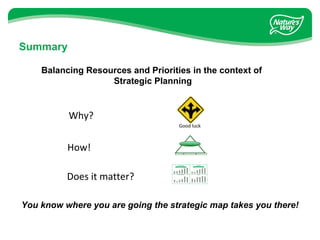
Summary 
Balancing Resources and Priorities in the context of 
Strategic Planning 
Why? 
Good luck 
How! 
Does it matter? 
You know where you are going the strategic map takes you there!
Post Mortem 
• Quote from C. Jennings – Nature’s Way gummy vitamin supplier: 
“The most impressive thing about your facility tour is your 
People.” 
• Come on, let me give your minds a ride.

Balancing Resources and Priorities

  • 1.
    Balancing Resources &Priorities Mike Devereux President & CEO Nature‘s Way Brands Lunch ‘n Learn Green Bay, August 26, 2014
  • 2.
    About Me Me Cat “Bark the Wonder Cat” • Grew up in the western suburbs of Chicago in a 3-bedroom, 1- bathroom bungalow. • Learned how to balance resources and priorities at an early age, while competing with four sisters for the bathroom before school.
  • 3.
  • 4.
    Balancing Resources andPriorities in the context of … • Why? • How! • Does it matter? Strategic Planning
  • 5.
    Why? “If youdon’t know where you are going, any road will take you there.” R. Rose – My Predecessor
  • 6.
    How to Start? • Diagnostic on today’s business – E.g. SWOT analysis • Aspiration for the future • Capabilities to deliver People • Manage the competing agendas $ Management Team Shareholders
  • 7.
    a. Outline ofStrategic Plans • Industry / Business unit / Market context and dynamics – Industry/Business unit/Market overview – Industry/Business unit/Market profitability – Industry/Business unit/Market dynamics – Customer needs • Competitive assessment – Performance review (Brands, Categories, SKUs (topline, bottom line) – Achievements since last year – Product line assessment (Brands, Categories, SKUs (topline, bottom line) – Competitive assessment (Sales operations/ Channels, Marketing, Etc.) • Strategic issues (Resulting from Market environment and Competitive assessment) – Where are opportunities and threats? – Where are our competitive strengths and weaknesses? – What are the strategic success factors and with regards to that, where are the strategic gaps? • Key strategic initiatives (5-10 year) strategic initiatives in detail that describe measures, steps (timeline), investments, structural implications (Resources) and implementation risks – Financial projections (including scenarios if needed) – Detailed financial projections (cash in and cash out) – Capital plan – NPV
  • 8.
    b. Example fromPitman Moore • Aspiration • Focus • Filters also “what not to do” Aspiration Mission (medium term) Where to Compete Circa 1990 Make food animals more valuable to producers by providing superior disease prevention and rearing Create Make Sell How to Compete Leading animal health and nutrition company Product categories Species Geographics Key technologies • Biologicals • Implants • Ectoparasiticides • Feed • Antimicrobials • Vet specialties • Cattle • Swine • Poultry • Sheep • Cats and dogs • Base: NA, UK, ANZ, Brazil • Penetration: G, F, SP, I, Mexico • Beachheads: Korea, China, Japan . . . • Deletant/ recombinant vaccines • Controlled release systems productivity solutions • No in-house “R” • Strong links to biologicals science (universities, biotech companies) • Focus on core categories • Develop world-class biologicals manufacturing skills • P-M in-house sales forces • Superior customer service and technical support • Distributor-only in companion animals
  • 9.
  • 10.
    Profit from theCore – Key Points that lead to Profitable Revenue Growth • Focus scarce resources on the core of your business if attractive growth opportunities remain – if not, the core needs to be extended. • Establish a common set of facts and market insights from which impactful growth initiatives can be found. • Get an “A” on 3 or 4 initiatives rather than a “C” on 10. • Master the science of making change happen within your organization.
  • 11.
    Profit from theCore Keys to Success: • Reaching the full potential of the core business. • Expanding into logical adjacent businesses surrounding the core. • Pre-emptively redefining the core business in response to market turbulence. All that . . . “and some luck/good fortune helps.”
  • 12.
    Natures Way Example • Consumer Business • Professional Business • Canada • Export Specialty Mass Internet Naturopaths MD’s Chiro Other Specialty Mass Asia Latin America Europe % of Total Product Line 70% 800 sku’s 10% 400 sku’s 10% 200 sku’s 10% 600 sku’s 100% 2,000 sku’s
  • 13.
  • 14.
    Planning the futureover 3 time horizons Performance / Profit / Growth Time Horizon 1 Defend and extend core businesses Horizon 3 Create viable options Horizon 2 Build emerging businesses 3 years Now Beyond
  • 15.
    Nature’s Way Accountabilitiesand Time Horizons Performance / Profit / Growth Time Horizon 1 Horizon 2 Horizon 3 Develop International Markets and enter new categories and technologies U.S. Market Potential focus & Maximize existing Brands Enter New Business models, Mergers & Aquisitions Get an “A” on 3 to 4 initiatives versus a “C” on 10.
  • 16.
    Digital Competency •50% of population is < 30. • 53% of Twitter is recommending products via Tweets. • 93% of buyer decisions are influenced by Social Media. • 90% trust peer review. Nature’s Way Opportunity Becoming much more relevant to the last mile of our customer base. Historically we transact 100% through retailers and practitioners . . . We want to speak directly with the people who buy our supplements. Source: Socialnomics 2014 by Erik Qualman
  • 17.
    Digital Examples Pre-emptivelyredefining the core business in response to market turbulence.
  • 18.
    Digital Examples Pre-emptivelyredefining the core business in response to market turbulence.
  • 19.
    Digital Examples Pre-emptivelyredefining the core business in response to market turbulence.
  • 20.
  • 21.
    Digital Examples –Output Measurement
  • 22.
    Key Learnings fromMentors (1) 3 simple rules: • Focus on your output • Know your resources • Be analytical L. Bernicky – First boss at Arthur Young
  • 23.
    Key Learnings fromMentors (2) “Mike, your biggest strength is also your biggest weakness . . . … Idealism” A. Chawla – SVP of Strategic Planning and former boss during the McKinsey project “Be okay with me accepting 1 or 2 good ideas from you versus your entire agenda”
  • 24.
    Key Learnings fromMentors (3) “When you move into the CEO role, first reset your relationship with all your former peers - … …You are now their Boss. T. Flood – CEO Collier Enterprises – former boss at Beatrice Foods
  • 25.
    Key Learnings fromMentors (4) “As CEO, you must be able to “create a vision and articulate it verbally with substantive support … … If you cannot, you don’t belong in the CEO role.” After that . . . “Be yourself” A. Nieto – Former Chairman of Life Fitness, now ALS sufferer http://www.freep.com/article/20140629/COL01/306290088/augie-nieto-als-mitch-albom
  • 26.
    Summary of theKey Learnings that have shaped my thinking Inputs 1. Bernicky – The Fundamentals 2. Chawla – Pick and choose based on substance 3. Flood - Lead 4. Nieto – “Be you” The Output ! ! !
  • 27.
    Does it Matter? CAGR 2010-2013: 17% CAGR 2010-2013: 44%
  • 28.
    Summary Balancing Resourcesand Priorities in the context of Strategic Planning Why? Good luck How! Does it matter? You know where you are going the strategic map takes you there!
  • 29.
    Post Mortem •Quote from C. Jennings – Nature’s Way gummy vitamin supplier: “The most impressive thing about your facility tour is your People.” • Come on, let me give your minds a ride.